EP3377507B1 - Neue 5-azido-5-deoxy-2:3-isopropyliden-d-arabinose-verbindungen; verfahren zu deren herstellung und deren verwendung zur synthese von ara-n3, kdo-n3 und 4ekdo-n3 - Google Patents
Neue 5-azido-5-deoxy-2:3-isopropyliden-d-arabinose-verbindungen; verfahren zu deren herstellung und deren verwendung zur synthese von ara-n3, kdo-n3 und 4ekdo-n3 Download PDFInfo
- Publication number
- EP3377507B1 EP3377507B1 EP16801993.3A EP16801993A EP3377507B1 EP 3377507 B1 EP3377507 B1 EP 3377507B1 EP 16801993 A EP16801993 A EP 16801993A EP 3377507 B1 EP3377507 B1 EP 3377507B1
- Authority
- EP
- European Patent Office
- Prior art keywords
- compound
- formula
- butyl
- ethyl
- substituted
- Prior art date
- Legal status (The legal status is an assumption and is not a legal conclusion. Google has not performed a legal analysis and makes no representation as to the accuracy of the status listed.)
- Active
Links
- 0 CC(C)(O[C@@]1[C@@](C*)O)O[C@]1C=N Chemical compound CC(C)(O[C@@]1[C@@](C*)O)O[C@]1C=N 0.000 description 7
Classifications
-
- C—CHEMISTRY; METALLURGY
- C07—ORGANIC CHEMISTRY
- C07D—HETEROCYCLIC COMPOUNDS
- C07D317/00—Heterocyclic compounds containing five-membered rings having two oxygen atoms as the only ring hetero atoms
- C07D317/08—Heterocyclic compounds containing five-membered rings having two oxygen atoms as the only ring hetero atoms having the hetero atoms in positions 1 and 3
- C07D317/10—Heterocyclic compounds containing five-membered rings having two oxygen atoms as the only ring hetero atoms having the hetero atoms in positions 1 and 3 not condensed with other rings
- C07D317/14—Heterocyclic compounds containing five-membered rings having two oxygen atoms as the only ring hetero atoms having the hetero atoms in positions 1 and 3 not condensed with other rings with substituted hydrocarbon radicals attached to ring carbon atoms
- C07D317/28—Radicals substituted by nitrogen atoms
-
- C—CHEMISTRY; METALLURGY
- C07—ORGANIC CHEMISTRY
- C07D—HETEROCYCLIC COMPOUNDS
- C07D317/00—Heterocyclic compounds containing five-membered rings having two oxygen atoms as the only ring hetero atoms
- C07D317/08—Heterocyclic compounds containing five-membered rings having two oxygen atoms as the only ring hetero atoms having the hetero atoms in positions 1 and 3
- C07D317/10—Heterocyclic compounds containing five-membered rings having two oxygen atoms as the only ring hetero atoms having the hetero atoms in positions 1 and 3 not condensed with other rings
- C07D317/14—Heterocyclic compounds containing five-membered rings having two oxygen atoms as the only ring hetero atoms having the hetero atoms in positions 1 and 3 not condensed with other rings with substituted hydrocarbon radicals attached to ring carbon atoms
- C07D317/30—Radicals substituted by carbon atoms having three bonds to hetero atoms with at the most one bond to halogen, e.g. ester or nitrile radicals
-
- C—CHEMISTRY; METALLURGY
- C07—ORGANIC CHEMISTRY
- C07H—SUGARS; DERIVATIVES THEREOF; NUCLEOSIDES; NUCLEOTIDES; NUCLEIC ACIDS
- C07H1/00—Processes for the preparation of sugar derivatives
-
- C—CHEMISTRY; METALLURGY
- C07—ORGANIC CHEMISTRY
- C07H—SUGARS; DERIVATIVES THEREOF; NUCLEOSIDES; NUCLEOTIDES; NUCLEIC ACIDS
- C07H13/00—Compounds containing saccharide radicals esterified by carbonic acid or derivatives thereof, or by organic acids, e.g. phosphonic acids
-
- C—CHEMISTRY; METALLURGY
- C07—ORGANIC CHEMISTRY
- C07H—SUGARS; DERIVATIVES THEREOF; NUCLEOSIDES; NUCLEOTIDES; NUCLEIC ACIDS
- C07H5/00—Compounds containing saccharide radicals in which the hetero bonds to oxygen have been replaced by the same number of hetero bonds to halogen, nitrogen, sulfur, selenium, or tellurium
- C07H5/04—Compounds containing saccharide radicals in which the hetero bonds to oxygen have been replaced by the same number of hetero bonds to halogen, nitrogen, sulfur, selenium, or tellurium to nitrogen
-
- C—CHEMISTRY; METALLURGY
- C07—ORGANIC CHEMISTRY
- C07H—SUGARS; DERIVATIVES THEREOF; NUCLEOSIDES; NUCLEOTIDES; NUCLEIC ACIDS
- C07H7/00—Compounds containing non-saccharide radicals linked to saccharide radicals by a carbon-to-carbon bond
- C07H7/02—Acyclic radicals
- C07H7/027—Keto-aldonic acids
-
- C—CHEMISTRY; METALLURGY
- C07—ORGANIC CHEMISTRY
- C07H—SUGARS; DERIVATIVES THEREOF; NUCLEOSIDES; NUCLEOTIDES; NUCLEIC ACIDS
- C07H9/00—Compounds containing a hetero ring sharing at least two hetero atoms with a saccharide radical
- C07H9/02—Compounds containing a hetero ring sharing at least two hetero atoms with a saccharide radical the hetero ring containing only oxygen as ring hetero atoms
- C07H9/04—Cyclic acetals
-
- C—CHEMISTRY; METALLURGY
- C12—BIOCHEMISTRY; BEER; SPIRITS; WINE; VINEGAR; MICROBIOLOGY; ENZYMOLOGY; MUTATION OR GENETIC ENGINEERING
- C12Q—MEASURING OR TESTING PROCESSES INVOLVING ENZYMES, NUCLEIC ACIDS OR MICROORGANISMS; COMPOSITIONS OR TEST PAPERS THEREFOR; PROCESSES OF PREPARING SUCH COMPOSITIONS; CONDITION-RESPONSIVE CONTROL IN MICROBIOLOGICAL OR ENZYMOLOGICAL PROCESSES
- C12Q1/00—Measuring or testing processes involving enzymes, nucleic acids or microorganisms; Compositions therefor; Processes of preparing such compositions
- C12Q1/02—Measuring or testing processes involving enzymes, nucleic acids or microorganisms; Compositions therefor; Processes of preparing such compositions involving viable microorganisms
- C12Q1/04—Determining presence or kind of microorganism; Use of selective media for testing antibiotics or bacteriocides; Compositions containing a chemical indicator therefor
-
- G—PHYSICS
- G01—MEASURING; TESTING
- G01N—INVESTIGATING OR ANALYSING MATERIALS BY DETERMINING THEIR CHEMICAL OR PHYSICAL PROPERTIES
- G01N33/00—Investigating or analysing materials by specific methods not covered by groups G01N1/00 - G01N31/00
- G01N33/48—Biological material, e.g. blood, urine; Haemocytometers
- G01N33/50—Chemical analysis of biological material, e.g. blood, urine; Testing involving biospecific ligand binding methods; Immunological testing
- G01N33/53—Immunoassay; Biospecific binding assay; Materials therefor
- G01N33/569—Immunoassay; Biospecific binding assay; Materials therefor for microorganisms, e.g. protozoa, bacteria, viruses
- G01N33/56911—Bacteria
Definitions
- the invention relates to a new synthesis intermediate compound 5-azido-5-deoxy-2:3-isopropylidene D -arabinose, which is a key compound towards the synthesis of either known Kdo-N 3 , or known 4eKdo-N 3 or even known Ara-N 3 , by a new synthesis route with excellent yield and excellent purity and easy purification steps, together with its method of preparation and the use thereof for the synthesis of either known Kdo-N 3 , or known 4eKdo-N 3 or even known Ara-N 3 .
- the synthesis starts from the commercially available D -arabinose and is providing an overall yield of 17 mol% for Kdo-N 3 with a purity of more than 95%, an overall yield of 6 mol% for 4eKdo-N 3 with a purity of more than 95% and an overall yield of 26 mol% for Ara-N 3 with a purity of more than 95%.
- the invention further relates to synthesis intermediates, which are claimed as new compounds, selected from the group consisting of compounds of formulae IV, V, VI, VIIIA, VIIIb, IXa and IXb. More precisely, the invention further relates to specific synthesis intermediates selected from the group consisting of compounds ( 4 ), ( 5 ), ( 6 ), ( 8a ), ( 9a ), ( 8b ) and ( 9b ), set forth here-below.
- all these compounds including a compound of formula V or VI and in particular of formula ( 5 ) or ( 6 ), or a compound of formula VIIIA or VIIIb, and in particular of formula ( 8a ) or ( 8b ), or a compound of formula IXa or IXb, and in particular of formula ( 9a ) or ( 9b ), could be used for metabolic labeling of Gram negative and Gram positive bacteria or other organisms.
- these compounds could be used for detecting viable bacteria in labeling the bacterial enveloppe thereof via metabolic modification of enveloppe glycans thereof, especially the LipoPolySaccharides or LPS layer in case of Gram negative bacteria, by incorporating into their enveloppe glycans, especially their LPS, a modified component bearing a bio orthogonal chemical reporter, thus decorating the cell surface and enabling the detection thereof with a chemistry reaction, especially click chemistry reaction, allowing further detecting of the chemical reporter, in an overall rapid process.
- This detection with a chemical reaction, especially click chemistry is well known to one skilled in the art as reported below.
- bacteria can be, without limitation, selected from the following genus of bacteria: Acinetobacter, Bacteroides, Bartonella, Bordetella, Brachyspira, Brucella, Burkholderia, Campylobacter, Cardiobacterium, Chlamydophila, Chryseobacterium, Clostridium, Coxiella, Cronobacter, Edwardsiella, Ehrlichia, Eikenella, Elizabethkingia, Enterobacter, Escherichia, Francisella, Fusobacterium, Haemophilus, Helicobacter, Klebsiella, Legionella, Leptospira, Morganella, Myxococcus, Neisseria, Neorickettsia, Pasteurella, Plesiomonas, Porphyromonas, Prevotella, Proteus, Providencia, Pseudoalteromonas, Pseudomonas, Rickettsia, Rhodocycclus, Salmonella, Serratia
- KetoDeoxyOctonic acid also named Kdo, a bacterial monosaccharide
- This azido derivative was 8-azido-8-deoxy-Kdo, compound 1 in Scheme 2 of Dumont et al., 2012, 51, P 3144.
- Ara-N 3 can be obtained by a very direct, simple, and time-saving strategy from commercial D -arabinose. More information is accessible on a supporting information available on internet at http://dx.doi.org/10.1002/anie.201108127.
- Ara-N 3 is prepared from commercial D -arabinose by a step of tosylation of the primary alcohol of D -arabinofuranose which is then acetylated to protect the remaining alcohols, and then reacted with sodium azide (NaN 3 ), plus deacetylation with an overall yield of 15 mol%. It is said that the product 6, Ara-N 3 , could be easily purified by flash chromatography. See page 29, and scheme 1 of WO 2013/107759 .
- the drawback of this synthesis lies in a poor yield of not more than about 15 mol% to obtain Ara-N 3 and also to obtain Kdo-N 3 and a greater difficulty to purify the Kdo-N 3 obtained from the reaction medium. Indeed, the Kdo-N 3 is obtained in a low purification yield and a low reproducibility prohibiting to think about an industrial implementation.
- a main aim of the present invention lies in solving the technical problem of finding a new synthesis route with excellent yield, excellent purity and easy purification steps towards the synthesis of either known Kdo-N 3 , or known 4eKdo-N 3 or even known Ara-N 3 .
- Another main aim of the present invention lies in solving this technical problem according to a technical solution which is believed to be extrapolatable, reliably and reproducibly at the industrial scale.
- a further aim of the invention is to prepare the known Kdo-N 3 , or known 4eKdo-N 3 or even known Ara-N 3 through this new synthesis route, from commercially available D -arabinose.
- the invention method solves this technical problem by providing a new synthesis route which reaches the known Kdo-N 3 , or known 4eKdo-N 3 or even known Ara-N 3 with excellent yield, excellent purity and easy purification steps, notably with use of flash chromatography.
- the invention method used for synthesis of Kdo-N 3 and 4eKdo-N 3 further relies on an indium-promoted coupling step which maintains the integrity of an azido group. This central elongation step was not obvious since indium is known to efficiently reduce azido groups into amino groups.
- the invention method permits to avoid the use of ion exchange resin column chromatographies for the separation of Kdo-N 3 and 4eKdo-N 3 .
- This purification method gives low and poorly reproducible isolated yields and purity for Kdo-N 3 and sometimes leads to the formation of non-separable impurities.
- 4eKdo-N 3 was very difficult to isolate in pure form.
- the invention method allows avoiding last step condensation with sodium oxaloacetate which conditions are difficult to precisely control and involves a strict control of pH and sometimes leads to the formation of impurities that are very difficult to eliminate, making the invention method more easily reproducible.
- a further aim of the invention is to provide new synthesis intermediate compounds.
- Another further aim of the invention is to use at least some of these new synthesis intermediate compounds for the detection of bacteria, in particular Gram negative or Gram positive bacteria, including without limitation, the following genus of bacteria: Acinetobacter, Bacteroides, Bartonella, Bordetella, Brachyspira, Brucella, Burkholderia, Campylobacter, Cardiobacterium, Chlamydophila, Chryseobacterium, Clostridium, Coxiella, Cronobacter, Edwardsiella, Ehrlichia, Eikenella, Elizabethkingia, Enterobacter, Escherichia, Francisella, Fusobacterium, Haemophilus, Helicobacter, Klebsiella, Legionella, Leptospira, Morganella, Myxococcus, Neisseria, Neorickettsia, Pasteurella, Plesiomonas, Porphyromonas, Prevotella, Proteus, Providencia, Pseudoalteromonas, Ps
- the invention relates to a new synthesis intermediate compound, which is claimed as a new compound, of formula V or VI , selected from: Wherein:
- the invention relates to a new synthesis intermediate compound, which is claimed as a new compound, of formula V: Wherein:
- the invention relates to the specific synthesis intermediate compound ( 5 ), which is claimed as new compound, named 5-Azido-5-deoxy-2:3-isopropylidene- D -arabinose O -methyloxime ( 5 ):
- the invention relates to a new synthesis intermediate compound, which is claimed as a new compound, of formula VI:
- R 1 and R 2 can be independently H; a C 1 to C 6 alkyl including methyl, ethyl, propyl, butyl; aryl including phenyl, para -methoxyphenyl; or R 1 ,R 2 together with the carbon C-6 can be a cyclopentylidene or cyclohexylidene; each of these groups being substituted or not.
- the invention relates to the specific synthesis intermediate compound ( 6 ), which is claimed as new compound, named 5-Azido-5-deoxy-2:3-isopropylidene- D -arabinose ( 6 ):
- the invention provides a method of preparation of synthesis intermediate compound of formula VI, comprising the chemical reaction of the compound of formula V: Wherein:
- compound of formula VI could be obtained by reaction of compound of formula V (10 mg to 100 g), with an aqueous solution of an organic or inorganic acid (0.01 to 0.50 M of compound of formula V ), such as acetic acid, p -toluenesulfonic acid, hydrochloric acid, typically an aqueous solution of acetic acid (60 to 90%, v/v) and the presence of an aldehyde (0.5 to 50.0 equivalents), typically formaldehyde, at a temperature between 0 and 100°C.
- an organic or inorganic acid such as acetic acid, p -toluenesulfonic acid, hydrochloric acid, typically an aqueous solution of acetic acid (60 to 90%, v/v) and the presence of an aldehyde (0.5 to 50.0 equivalents), typically formaldehyde, at a temperature between 0 and 100°C.
- the invention provides a method of preparation of specific synthesis intermediate compound ( 6 ), comprising the chemical reaction of compound ( 5 ), named 5-azido-5-deoxy-2:3-isopropylidene- D -arabinose O- methyloxime: under the above same reaction conditions as the preparation of compound VI.
- the invention relates to the preparation of synthesis intermediate compound of formula V , comprising the chemical reaction of a compound of formula IV: Wherein:
- compound of formula V could be obtained by reaction of compound of formula IV (10 mg to 100 g), with an organic or inorganic azide salt (0.8 to 15.0 equivalents) such as sodium azide, lithium azide, tetrabutylammonium azide, preferably sodium azide, in a non-polar solvent such as pentane, hexane, cyclohexane, benzene, toluene, chloroform, diethyl ether, dioxane, or in a polar aprotic solvent (0.01 to 0.50 M), such as chloroform, dichloromethane, tetrahydrofuran, ethyl acetate, acetone, N,N- dimethylformamide, acetonitrile, dimethylsulfoxide, typically N,N- dimethylformamide, at a temperature between 0 and 150°C.
- an organic or inorganic azide salt such as sodium azide, lithium azide, tetrabutylammonium azi
- the invention relates to the preparation of specific synthesis intermediate compound ( 5 ), comprising the chemical reaction of compound ( 4 ), named 2:3-isopropylidene-5- O -methanesulfonyl- D -arabinose O -methyloxime: under the above same reaction conditions as the preparation of compound V .
- the invention relates to the preparation of synthesis intermediate compound of formula IV, comprising the chemical reaction of compound of formula III: Wherein:
- compound of formula IV could be obtained by reaction of compound of formula III (10 mg to 100 g), with a sulfonyl chloride or sulfonic anhydride (0.8 to 4.0 equivalents), such as methanesulfonyl chloride, p -toluenesulfonyl chloride, p -nitrobenzenesulfonyl chloride, methanesulfonic anhydride, trifluoromethanesulfonic anhydride, preferably methanesulfonyl chloride, in the presence of an organic base (0.8 to 200 equivalents), such as pyridine, triethylamine, diisopropylethylamine and in the presence or not of a polar aprotic solvent (0.05 to 0.50 M), such as chloroform, dichloromethane, tetrahydrofuran, ethyl acetate, acetone, N,N- dimethylformamide, acetonitrile,
- the invention relates to the preparation of specific synthesis intermediate compound ( 4 ), comprising the chemical reaction of compound ( 3 ), named 2:3-isopropylidene- D -arabinose O -methyloxime, known per se from GILLINGHAM cited above: under the above same reaction conditions as the preparation of compound IV.
- the invention relates to the preparation of synthesis intermediate compound of formula III , comprising the chemical reaction of a compound of formula II: Wherein:
- compound of formula III could be obtained from compound of formula II (10 mg to 100 g) by deprotection of terminal diol with an aqueous solution of an organic or inorganic acid (0.01 to 0.50 M of compound of formula II), such as formic acid, acetic acid, trifluoroacetic acid, p -toluenesulfonic acid, sulphuric acid, hydrochloric acid, typically an aqueous solution of acetic acid (60 to 90%, v/v), at reduced pressure (150 to 400 mbar) and at temperature between 20 and 60°C.
- an organic or inorganic acid such as formic acid, acetic acid, trifluoroacetic acid, p -toluenesulfonic acid, sulphuric acid, hydrochloric acid, typically an aqueous solution of acetic acid (60 to 90%, v/v), at reduced pressure (150 to 400 mbar) and at temperature between 20 and 60°C.
- the invention relates to the preparation of specific synthesis intermediate compound ( 3 ), comprising the chemical reaction of compound ( 2 ), named 2:3,4:5-diisopropylidene- D -arabinose O -methyloxime known per se from GILLINGHAM cited above: under the above same reaction conditions as the preparation of compound III.
- the invention relates to preparation of synthesis intermediate of formula II, comprising the chemical reaction of D -arabinose with an O -alkylhydroxylamine hydrochloride, an O- phenylhydroxylamine hydrochloride, substituted or not in its aromatic ring or O- benzylhydroxylamine hydrochloride substituted or not in its aromatic ring in the presence of an organic base, with or without a protic solvent; the crude residue being then reacted with a ketone, an aldehyde or the corresponding ketal, in the presence of a Brönsted or Lewis acid.
- compound of formula II could be obtained by reaction of D -arabinose (10 mg to 100 g) and an O -alkylhydroxylamine hydrochloride, an O -phenylhydroxylamine hydrochloride, substituted or not in its aromatic ring or O -benzylhydroxylamine hydrochloride substituted or not in its aromatic ring (0.5 to 15.0 equivalents), such as O -methylhydroxylamine, O- ethylhydroxylamine, O -propylhydroxylamine, O -isopropylhydroxylamine, O -(1-methylpropyl)hydroxylamine, O -butylhydroxylamine, O -isobutylhydroxylamine, O - tert -butylhydroxylamine, O -pentylhydroxylamine, O- methylbutylhydroxyamine, O -(1,2-dimethylpropyl)hydroxylamine, O -(2,2-dimethylpropyl)hydroxylamine; or such as O
- a ketone an aldehyde or the corresponding ketal (1.5 to 50.0 equivalents), such as formaldehyde, acetaldehyde, paraldehyde, 1,1-diethoxyethane, acetone, 2,2-dimethoxypropane, 2-methoxypropene, 2-butanone, cyclohexanone, 1,1 dimethoxycyclohexane, 1-ethoxycyclohexene, typically 2,2-dimethoxypropane, in the presence of a Brönsted or Lewis acid (0.01 to 10.0 equivalents) such as sulphuric acid, p -toluenesulfonic acid, pyridinium p -toluenesulfonate, camphorsulfonic acid, typically p -toluenesulfonic acid, at a temperature between 0 and 100°C.
- a Brönsted or Lewis acid such as sulphuric acid, p -to
- the invention relates to the use of synthesis intermediate compound of formula VI for the synthesis of 5-azido-5-deoxy- D -arabinofuranose or Ara-N 3 ( 7 ): comprising reacting synthesis intermediate compound of formula VI, under reaction conditions providing removal of protecting group of compound of formula VI with an aqueous solution of an organic or inorganic acid in a polar aprotic solvent or non-polar solvent.
- the product of interest 7 could be prepared by removal of protecting group of compound of formula VI (10 mg to 100 g) with an aqueous or alcoholic solution (30 to 70%, v/v) of an organic or inorganic acid (10 to 200 equivalents), such as formic acid, acetic acid, trifluoroacetic acid, p -toluenesulfonic acid, sulphuric acid, hydrochloric acid, or an acidic resin (10 to 200 equivalents), such as Amberlyst ® 15, Dowex ® 50W, Amberlite ® IR, typically trifluoroacetic acid; in a polar aprotic solvent (0.01 to 0.50 M), such as chloroform, dichloromethane, tetrahydrofuran, ethyl acetate, acetone, N,N- dimethylformamide, acetonitrile, dimethylsulfoxide or non-polar solvent such as pentane, hexane, cyclohexane,
- compound of formula VIIIA could be obtained by reaction of compound of formula VI (10 mg to 50 g) with alkyl 2-(halomethyl)acrylate (1.0 to 15.0 equivalents), in the presence of indium (0.8 to 3.0 equivalents), and in the presence or not of an aqueous solution of an organic or inorganic acid (0.5 to 10.0 equivalents), such as formic acid, hydrochloric acid, preferably formic acid (5 to 20%, v/v), in a protic solvent such as tert-butanol, n -propanol, isopropanol, ethanol, methanol, preferably ethanol or a mixture of water and a polar aprotic solvent such as chloroform, dichloromethane, tetrahydrofuran, ethyl acetate, acetone, N,N- dimethylformamide, acetonitrile, dimethylsulfoxide (0.01 to 0.30 M), typically acetonitrile, at a temperature between
- the invention relates to the use of specific synthesis intermediate compound ( 6 ) for the synthesis of compound ( 8a ), named ethyl (4 R )-4- ⁇ (4 R ,5 R )-5-[( R )-2-azido-1-hydroxyethyl]-2,2-dimethyl-1,3-dioxolan-4-yl)-4-hydroxy-2-methylenebutanoate: under the above same reaction conditions as the preparation of compound VIIIa.
- the invention further relates to the use of the compound of formula VIIIA for the preparation of intermediate of formula IXa: Wherein:
- compound of formula IXa could be obtained by ozonolysis of compound of formula VIIIA (10 mg to 50 g) with ozone in a protic solvent (0.01 to 0.10 M), such as tert -butanol, n -propanol, isopropanol, ethanol, methanol, typically methanol, at a temperature between -100 and 0°C.
- a protic solvent such as tert -butanol, n -propanol, isopropanol, ethanol, methanol, typically methanol
- the unstable intermediate compound could be reacted with a reducing agent (0.8 to 50.0 equivalents) such as triphenylphosphine, thiourea or dimethyl sulfide, typically dimethyl sulfide, in a protic solvent (0.01 to 0.10 M), such as tert -butanol, n -propanol, isopropanol, ethanol, methanol, typically methanol, at a temperature between -20 and 40°C.
- a reducing agent such as triphenylphosphine, thiourea or dimethyl sulfide, typically dimethyl sulfide
- the invention relates to the use of specific compound ( 8a ) for the preparation of specific compound ( 9a ), named (4 R )-4- ⁇ (4 R ,5 R )-5-[( R )-2-azido-1-hydroxyethyl]-2,2-dimethyl-1,3-dioxolan-4-yl)-4-hydroxy-2-oxobutanoate: under the above same reaction conditions as the preparation of compound IXa.
- the invention further relates to the use of the compound of formula IXa for the preparation of ammonium 8-azido-3,8-dideoxy- D -manno-oct-2-ulosonate or Kdo-N 3 ( 10a ): comprising deprotecting compound of formula IXa with an aqueous solution of an organic or inorganic acid.
- the product of interest ( 10a ) could be obtained by deprotection of compound of formula IXa (10 mg to 50 g) with an aqueous solution of an organic or inorganic acid (20 to 200 equivalents), such as acetic acid, trifluoroacetic acid, sulphuric acid, hydrochloric acid, preferably trifluoroacetic acid (5 to 30%, v/v), at a temperature between 0 and 80°C.
- an organic or inorganic acid such as acetic acid, trifluoroacetic acid, sulphuric acid, hydrochloric acid, preferably trifluoroacetic acid (5 to 30%, v/v)
- the invention relates to the use of synthesis intermediate compound of formula VI for the synthesis of intermediate of formula VIIIb: Wherein:
- compound of formula VIIIb could be obtained by reaction of compound of formula VI (10 mg to 50 g) with alkyl 2-(halomethyl)acrylate (1.0 to 15.0 equivalents), in the presence of indium (0.8 to 3.0 equivalents), and in the presence or not of an aqueous solution of an organic or inorganic acid (0.5 to 10.0 equivalents), such as formic acid, hydrochloric acid, preferably formic acid (5 to 20%, v/v), in a protic solvent such as tert -butanol, n -propanol, isopropanol, ethanol, methanol, preferably ethanol or a mixture of water and a polar aprotic solvent such as chloroform, dichloromethane, tetrahydrofuran, ethyl acetate, acetone, N,N- dimethylformamide, acetonitrile, dimethylsulfoxide (0.01 to 0.30 M), typically acetonitrile, at a temperature
- the invention relates to the use of specific synthesis intermediate compound ( 6 ) for the synthesis of specific compound ( 8b ), named ethyl (4 S )-4- ⁇ (4 R ,5 R )-5-[( R )-2-azido-1-hydroxyethyl]-2,2-dimethyl-1,3-dioxolan-4-yl)-4-hydroxy-2-methylenebutanoate: under the above same reaction conditions as the preparation of compound VIIIb.
- the invention further relates to the use of the compound of formula VIIIb for the preparation of intermediate compound of formula IXb: Wherein:
- compound of formula IXb could be obtained by ozonolysis of compound of formula VIIIb (10 mg to 50 g) with ozone in a protic solvent (0.01 to 0.10 M), such as tert -butanol, n -propanol, isopropanol, ethanol, methanol, typically methanol, at a temperature between -100 and 0°C.
- a protic solvent such as tert -butanol, n -propanol, isopropanol, ethanol, methanol, typically methanol
- the unstable intermediate compound could be reacted with a reducing agent (0.8 to 50.0 equivalents) such as triphenylphosphine, thiourea or dimethyl sulfide, typically dimethyl sulfide, in a protic solvent (0.01 to 0.10 M), such as tert -butanol, n -propanol, isopropanol, ethanol, methanol, typically methanol, at a temperature between -20 and 40°C.
- a reducing agent such as triphenylphosphine, thiourea or dimethyl sulfide, typically dimethyl sulfide
- the invention relates to the use of specific compound ( 8b ) for the preparation of specific compound ( 9b ), named (4 S )-4- ⁇ (4 R ,5 R )-5-[( R )-2-azido-1-hydroxyethyl]-2,2-dimethyl-1,3-dioxolan-4-yl)-4-hydroxy-2-oxobutanoate: under the above same reaction conditions as the preparation of compound IXb.
- the invention further relates to the use of the compound of formula IXb for the preparation of ammonium 8-azido-3,8-dideoxy- D -gluco-oct-2-ulosonate or 4eKdo-N 3 ( 10b ): comprising deprotecting compound of formula IXb with an aqueous solution of an organic or inorganic acid.
- the product of interest ( 10b ) could be obtained by deprotection of compound of formula IXb (10 mg to 50 g) with an aqueous solution of an organic or inorganic acid (20 to 200 equivalents), such as acetic acid, trifluoroacetic acid, sulphuric acid, hydrochloric acid, preferably trifluoroacetic acid (5 to 30%, v/v), at a temperature between 0 and 80°C.
- an organic or inorganic acid such as acetic acid, trifluoroacetic acid, sulphuric acid, hydrochloric acid, preferably trifluoroacetic acid (5 to 30%, v/v)
- the invention further relates to the following new synthesis intermediate compound, which is claimed as new compound: Wherein:
- the invention relates to the specific synthesis intermediate compound ( 9a ), which is claimed as new compound, named ethyl (4 R )-4- ⁇ (4 R ,5 R )-5-[( R )-2-azido-1-hydroxyethyl]-2,2-dimethyl-1,3-dioxolan-4-yl ⁇ -4-hydroxy-2-oxobutanoate ( 9a ), here-below:
- the invention further relates to the following new synthesis intermediate compound, which is claimed as new compound: Wherein:
- the invention relates to the specific synthesis intermediate compound ( 8a ), which is claimed as new compound, named ethyl (4 R )-4- ⁇ (4 R ,5 R )-5-[( R )-2-azido-1-hydroxyethyl]-2,2-dimethyl-1,3-dioxolan-4-yl)-4-hydroxy-2-methylenebutanoate ( 8a ), here-below:
- the invention further relates to the following new synthesis intermediate compound, which is claimed as new compound: Wherein:
- the invention relates to the synthesis intermediate compound ( 9b ), which is claimed as new compound, named ethyl (4 S )-4- ⁇ (4 R ,5 R )-5-[( R )-2-azido-1-hydroxyethyl]-2,2-dimethyl-1,3-dioxolan-4-yl ⁇ -4-hydroxy-2-oxobutanoate (9b), here-below:
- the invention further relates to the following new synthesis intermediate compound, which is claimed as new compound: Wherein:
- the invention relates to the specific synthesis intermediate compound ( 8b ), which is claimed as new compound, named ethyl (4 S )-4- ⁇ (4 R ,5 R )-5-[( R )-2-azido-1-hydroxyethyl]-2,2-dimethyl-1,3-dioxolan-4-yl)-4-hydroxy-2-methylenebutanoate ( 8b ), here-below:
- the invention further relates to the following new synthesis intermediate compound, which is claimed as new compound: Wherein:
- the invention relates to the specific synthesis intermediate compound ( 4 ), which is claimed as new compound, named 2:3-isopropylidene-5- O -methanesulfonyl- D -arabinose O -methyloxime ( 4 ), here-below:
- the invention relates to the use of some synthesis intermediates, and in particular of a compound of formula V or VI and in particular of formula ( 5 ) or ( 6 ), or of a compound of formula VIIIA or VIIIb, and in particular of formula ( 8a ) or ( 8b ), or of a compound of formula IXa or IXb, and in particular of formula ( 9a ) or ( 9b ), to detect bacteria, in particular Gram negative bacteria, including, without limitation, the following genus of bacteria: Acinetobacter, Bacteroides, Bartonella, Bordetella, Brachyspira, Brucella, Burkholderia, Campylobacter, Cardiobacterium, Chlamydophila, Chryseobacterium, Clostridium, Coxiella, Cronobacter, Edwardsiella, Ehrlichia, Eikenella, Elizabethkingia, Enterobacter, Escherichia, Francisella, Fusobacterium, Haemophilus, Helicobacter, Kleb
- the target compounds ( 10a ) (8-azido-8-deoxy-Kdo) and ( 10b ) (8-azido-8-deoxy-4eKdo) were synthesized in 11 steps from D -arabinose with an overall yield of 17 mol% and a purity of more than 95% for compound ( 10a ) and 6 mol% overall yield and a purity of more than 95 % for ( 10b ).
- the key step in both syntheses is an indium-mediated allylation [1] of a common aldehyde intermediate ( 6 ) which in turn is obtained from an oxime ether intermediate [2].
- the target compound ( 7 ) (5-azido-Ara) was synthetized in 7 steps from D -arabinose with an overall yield of 26 mol% and a purity of more than 95%.
- the reaction of D -arabinose with O- methylhydroxylamine in dry pyridine afforded the corresponding O- methyloxime.
- the resulting intermediate was then protected into its bis-isopropylidene form compound ( 2 ) by reaction with 2,2-dimethoxypropane and a catalytic amount of p -toluenesulfonic acid.
- This compound was obtained as a mixture of E - and Z -oxime ethers but no preparative purification was attempted since these oxime ethers were planned to be hydrolysed later.
- target aldehyde ( 6 ) was obtained by hydrolysis of oxime ethers ( 5 ) in aqueous acetic acid by adding a stoichiometric amount of formaldehyde to trap the released O -methylhydroxylamine.
- This common intermediate ( 6 ) was first transformed into 5-azido-5-deoxy- D -arabinose ( 7 ) by removal of the isopropylidene group with a mixture of trifluoroacetic acid and water in dichloromethane.
- 5-azido-5-deoxy- D -arabinofuranose ( 7 ) was obtained in 58% from compound ( 5 ).
- the two diastereomers were separated by flash chromatography over silica gel and each product was separately submitted to ozonolysis in methanol to provide after dimethylsufide addition, the alpha-keto esters ( 9a ) and ( 9b ), respectively.
- Final hydrolysis of the esters and the acetonides were achieved with 10% aqueous trifluoroacetic acid at 40 °C.
- the instability of ulosonic acids to acidic conditions [7] made this step critical and evaporation of solvents had to be done on the rotary evaporator without warming followed by co-evaporation with toluene to allow complete elimination of the acid.
- Thin layer chromatography was performed over Merck 60 F254 with detection by UV, and/or by charring with sulphuric acid or KMnO 4 or phosphomolybdic acid solutions.
- Silica gel 60 40-63 ⁇ m was used for flash column chromatography.
- Mass spectra were taken on a Waters LCT Premier XE (ToF), with electrospray ionization in the positive (ESI+) or in the negative (ESI-) mode of detection.
- IR-FT spectra were recorded on a Perkin Elmer Spectrum 100 spectrometer. Characteristic absorptions are reported in cm -1 .
- Escherichia coli and Legionella strains were purchased from ATCC-LGC or Leibniz Institute DSMZ ( E. coli K12 ATCC 700926, E. coli O13 ATCC 15223, Legionella pneumophila Sg1 Philadelphia DSM 25020 and Legionella ( Fluoribacter ) gormanii ATCC 33342).
- Fluorescence microscopy experiments were performed on a confocal straight Leica SP8 (DM 6000), using a 63x PLAN APO oil immersion lens (Leica), an argon laser (488 nm) and a GaAsP Hybrid detector (Hamamatsu). The microscope was operated with LAS-X program. ImageJ program was used for image treatment.
- IR (cm -1 ) 3296, 2931, 2104, 1612, 1384, 1283, 1072, 805.
- Gram negative bacteria strains comprising Legionella pneumophila serogroup I, Legionella gormanii (Fluoribacter gormanii), Escherichia coli K12 and Escherichia coli 013 were grown in their specific culture medium. Legionella pneumophila serogroup 1 and Legionella gormanii (Fluoribacter gormanii) were grown in Yeast Extract medium supplemented with L-Cysteine, ferric pyrophosphate and ⁇ -ketoglutarate (YEC). Escherichia coli K12 and Escherichia coli 013 were grown in 2xYT medium (Yeast extract, tryptone and NaCl). All strains were grown in a rotary shaker (180 rpm) at 37°C.
- the pellet was re-suspended in 200 ⁇ L of the "click" solution (CR110-CCH (0.10 mM), sodium ascorbate (5.0 mM), TGTA (4.0 mM) and copper sulfate pentahydrate (2.0 mM) in a mixture of PBS buffer and DMSO (99:1)) and transferred in a 2.0 mL microtube for a better agitation.
- This suspension was vigorously agitated in the dark for 30 min at room temperature, then the suspension was transferred back in a 1.5 mL microtube.
- Bacteria were washed 2 times with PBS/DMSO (95:5) buffer (200 ⁇ L) and 1 time with PBS buffer (200 ⁇ L, 12 000 rpm, 1 min, r.t.). The pellet was re-suspended in PBS buffer (200 ⁇ L) and kept at 4°C in the dark. Bacteria were further analyzed by confocal microscopy.
- Gram negative bacteria including E. coli ( K12 and O13 ) , Legionella ( pneumophila serogroup 1 and gormanii ) , were detected with synthesis intermediate compounds (8a) and (8b).
- the synthesis starts from the commercially available D-arabinose and is providing an overall yield of 17 mol% for Kdo-N 3 with a purity of more than 95%, an overall yield of 6 mol% for 4eKdo-N 3 with a purity of more than 95% and an overall yield of 26 mol% for Ara-N 3 with a purity of more than 95%.
Landscapes
- Chemical & Material Sciences (AREA)
- Organic Chemistry (AREA)
- Health & Medical Sciences (AREA)
- Life Sciences & Earth Sciences (AREA)
- Engineering & Computer Science (AREA)
- Molecular Biology (AREA)
- Biochemistry (AREA)
- General Health & Medical Sciences (AREA)
- Biotechnology (AREA)
- Genetics & Genomics (AREA)
- Immunology (AREA)
- Hematology (AREA)
- Biomedical Technology (AREA)
- Urology & Nephrology (AREA)
- Analytical Chemistry (AREA)
- Physics & Mathematics (AREA)
- Microbiology (AREA)
- Wood Science & Technology (AREA)
- Zoology (AREA)
- Proteomics, Peptides & Aminoacids (AREA)
- Tropical Medicine & Parasitology (AREA)
- Food Science & Technology (AREA)
- Virology (AREA)
- Pathology (AREA)
- Cell Biology (AREA)
- General Physics & Mathematics (AREA)
- Medicinal Chemistry (AREA)
- General Engineering & Computer Science (AREA)
- Biophysics (AREA)
- Toxicology (AREA)
- Bioinformatics & Cheminformatics (AREA)
- Saccharide Compounds (AREA)
- Organic Low-Molecular-Weight Compounds And Preparation Thereof (AREA)
- Measuring Or Testing Involving Enzymes Or Micro-Organisms (AREA)
- Medicines Containing Antibodies Or Antigens For Use As Internal Diagnostic Agents (AREA)
Claims (16)
- Verbindung von Formel V oder VI, ausgewählt aus:
 R1 und R2 sind unabhängig H; ein C1 bis C6 Alkyl, einschließlich Methyl, Ethyl, Propyl, Butyl; Aryl, einschließlich Phenyl, para-Methoxyphenyl; oder R1, R2 zusammen mit dem Kohlenstoff C-6 ein Cyclopentyliden oder Cyclohexyliden sind; wobei jede dieser Gruppen substituiert sein kann oder nicht;und R3 ein C1 bis C6-Alkyl ist, einschließlich Methyl, Ethyl, Propyl, Isopropyl, Butyl, Isobutyl, tert-Butyl, Pentyl; oder Aryl, einschließlich Phenyl, Methylphenyl, Ethylphenyl, wobei jede dieser Gruppen substituiert sein kann oder nicht;wobei die Verbindung von Formel V oder VI insbesondere wie folgt ist 5-Azido-5-deoxy-2:3-isopropyliden-D-arabinose O-methyloxim (5):
 5-Azido-5-deoxy-2:3-isopropyliden-D-arabinose (6):
- Verfahren zur Herstellung einer Verbindung von Formel VI, wobei die Verbindung von Formel VI insbesondere Verbindung (6) ist, nach Anspruch 1, das Verfahren umfassend die chemische Reaktion einer Verbindung von Formel V, insbesondere von Verbindung (5):
 R1 und R2 sind unabhängig H; ein C1 bis C6 Alkyl, einschließlich Methyl, Ethyl, Propyl, Butyl; Aryl, einschließlich Phenyl, para-Methoxyphenyl; oder R1, R2 zusammen mit dem Kohlenstoff C-6 ein Cyclopentyliden oder Cyclohexyliden sind; wobei jede dieser Gruppen substituiert sein kann oder nicht;und R3 ein C1 bis C6-Alkyl ist, einschließlich Methyl, Ethyl, Propyl, Isopropyl, Butyl, Isobutyl, tert-Butyl, Pentyl; oder Aryl, einschließlich Phenyl, Methylphenyl, Ethylphenyl, wobei jede dieser Gruppen substituiert sein kann oder nicht;mit einer wässrigen Lösung einer organischen oder anorganischen Säure in Anwesenheit eines Aldehyds.
 - Verfahren zur Herstellung einer Verbindung von Formel V, wobei die Verbindung von Formel V insbesondere Verbindung (5) ist, nach Anspruch 1 oder 2, das Verfahren umfassend die chemische Reaktion einer Verbindung von Formel IV:
 R1 und R2 sind unabhängig H; ein C1 bis C6 Alkyl, einschließlich Methyl, Ethyl, Propyl, Butyl; Aryl, einschließlich Phenyl, para-Methoxyphenyl; oder R1, R2 zusammen mit dem Kohlenstoff C-6 ein Cyclopentyliden oder Cyclohexyliden sind; wobei jede dieser Gruppen substituiert sein kann oder nicht;und R3 ein C1 bis C6-Alkyl ist, einschließlich Methyl, Ethyl, Propyl, Isopropyl, Butyl, Isobutyl, tert-Butyl, Pentyl; oder Aryl, einschließlich Phenyl, Methylphenyl, Ethylphenyl, wobei jede dieser Gruppen substituiert sein kann oder nicht;und R4 ein C1 bis C6-Alkyl ist, einschließlich Methyl, Ethyl, Propyl, ein C1 bis C6-Perfluoroalkyl, einschließlich Trifluormethyl, Pentafluorethyl, oder Aryl, einschließlich para-Methylphenyl, para-Nitrophenyl, wobei jede dieser Gruppen substituiert sein kann oder nicht;wobei die Verbindung von Formel IV insbesondere Verbindung (4) ist, mit der Bezeichnung 2:3-Isopropyliden-5-O-methansulfonyl-D-arabinose-O-methyloxim:mit einem organischen oder anorganischen Azidsalz in einem unpolaren Lösungsmittel oder in einem polaren aprotischen Lösungsmittel.
- Verfahren zur Herstellung einer Verbindung von Formel IV, wobei die Verbindung von Formel IV insbesondere Verbindung (4) ist, nach Anspruch 3, das Verfahren umfassend die chemische Reaktion einer Verbindung von Formel III:
 R1 und R2 sind unabhängig H; ein C1 bis C6 Alkyl einschließlich Methyl, Ethyl, Propyl, Butyl; Aryl, einschließlich Phenyl, para-Methoxyphenyl; oder R1, R2 zusammen mit dem Kohlenstoff C-6 ein Cyclopentyliden oder Cyclohexyliden sind; wobei jede dieser Gruppen substituiert sein kann oder nicht;und R3 ein C1 bis C6-Alkyl ist, einschließlich Methyl, Ethyl, Propyl, Isopropyl, Butyl, Isobutyl, tert-Butyl, Pentyl; oder Aryl, einschließlich Phenyl, Methylphenyl, Ethylphenyl, wobei jede dieser Gruppen substituiert sein kann oder nicht;wobei die Verbindung von Formel III insbesondere Verbindung (3) ist, mit der Bezeichnung 2:3-Isopropyliden-D-arabinose O-methyloxim:mit einem Sulfonylchlorid oder Sulfonsäureanhydrid in Anwesenheit einer organischen Base und in Anwesenheit eines polaren aprotischen Lösungsmittels oder nicht.
- Verwendung einer Verbindung von Formel VI nach Anspruch 1 für die Synthese von 5-Azido-5-desoxy-D-arabinofuranose oder Ara-N3 (7):


- Verwendung einer Verbindung von Formel VI, wobei die Verbindung von Formel VI insbesondere Verbindung (6) ist, nach Anspruch 1, für die Synthese einer Verbindung von Formel VIIIa:
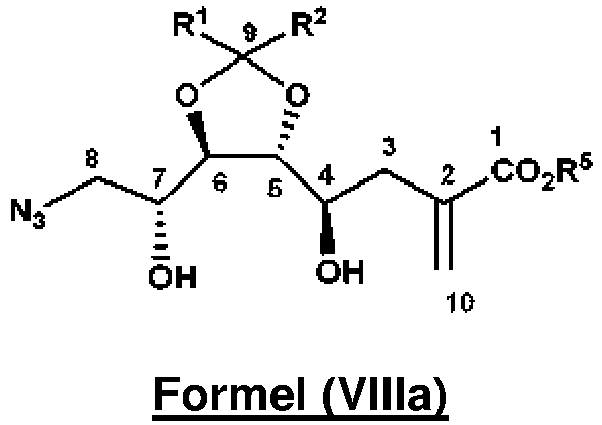 R1 und R2 sind unabhängig H; ein C1 bis C6 Alkyl einschließlich Methyl, Ethyl, Propyl, Butyl; Aryl, einschließlich Phenyl, para-Methoxyphenyl; oder R1, R2 zusammen mit dem Kohlenstoff C-6 ein Cyclopentyliden oder Cyclohexyliden sind; wobei jede dieser Gruppen substituiert sein kann oder nicht;und R5 ein C1 bis C6-Alkyl ist, einschließlich Methyl, Ethyl, Propyl, Butyl, t-Butyl, Pentyl, Hexyl oder Benzyl, wobei jede dieser Gruppen substituiert sein kann oder nicht;wobei die Verbindung von Formel VIIIa insbesondere Verbindung (8a) ist, mit der Bezeichnung Ethyl-(4/R)-4-{(4/R,5A)-5-[(R)-2-azido-1-hydroxyethyl]-2,2-dimethyl-1,3-dioxolan-4-yl)-4-hydroxy-2-methylenbutanoat:durch Reaktion der Verbindung von Formel VI mit Alkyl-2-(halogenmethyl)acrylat in Anwesenheit eines Metalls, wie z. B. Indium, und in Anwesenheit oder Abwesenheit einer wässrigen Lösung einer organischen oder anorganischen Säure in einem protischen Lösungsmittel oder in einem Gemisch aus Wasser und einem polaren aprotischen Lösungsmittel.
- Verwendung einer Verbindung von Formel VIIIa, wobei die Verbindung von Formel VIIIa insbesondere Verbindung (8a) ist, nach Anspruch 6, für die Herstellung einer Verbindung von Formel IXa:
 R1 und R2 sind unabhängig H; ein C1 bis C6 Alkyl einschließlich Methyl, Ethyl, Propyl, Butyl; Aryl, einschließlich Phenyl, para-Methoxyphenyl; oder R1, R2 zusammen mit dem Kohlenstoff C-6 ein Cyclopentyliden oder Cyclohexyliden sind; wobei jede dieser Gruppen substituiert sein kann oder nicht;und R5 ein C1 bis C6-Alkyl ist, einschließlich Methyl, Ethyl, Propyl, Butyl, t-Butyl, Pentyl, Hexyl oder Benzyl, wobei jede dieser Gruppen substituiert sein kann oder nicht;wobei die Verbindung von Formel IXa insbesondere Verbindung (9a) ist, mit der Bezeichnung (4/R)-4-{(4/R,5/R)-5-[(R)-2-azido-1-hydroxyethyl]-2,2-dimethyl-1,3-dioxolan-4-yl)-4-hydroxy-2-oxobutanoat:umfassend ein Ausführen einer Ozonolyse der Verbindung von Formel VIIIa mit Ozon in einem protischen Lösungsmittel bei einer Temperatur zwischen -100 und 0 °C und wobei dann die instabile Zwischenverbindung mit einem Reduktionsmittel in einem protischen Lösungsmittel reagiert wird.
- Verwendung einer Verbindung von Formel IXa nach Anspruch 7 zur Herstellung von Ammonium 8-Azido-3,8-dideoxy-D-manno-oct-2-ulosonat oder Kdo-N3 (10a):

- Verwendung einer Verbindung von Formel VI, wobei die Verbindung von Formel VI insbesondere Verbindung (6) ist, nach Anspruch 1, für die Synthese einer Verbindung von Formel Vlllb:
 R1 und R2 sind unabhängig H; ein C1 bis C6 Alkyl einschließlich Methyl, Ethyl, Propyl, Butyl; Aryl, einschließlich Phenyl, para-Methoxyphenyl; oder R1, R2 zusammen mit dem Kohlenstoff C-6 ein Cyclopentyliden oder Cyclohexyliden sind; wobei jede dieser Gruppen substituiert sein kann oder nicht;und R5 ein C1 bis C6-Alkyl ist, einschließlich Methyl, Ethyl, Propyl, Butyl, t-Butyl, Pentyl, Hexyl oder Benzyl, wobei jede dieser Gruppen substituiert sein kann oder nicht;wobei die Verbindung von Formel VIIIb insbesondere Verbindung (8b) ist, mit der Bezeichnung Ethyl-(4S)-4-{(4/R,5/R)-5-[(R)-2-azido-1-hydroxyethyl]-2,2-dimethyl-1,3-dioxolan-4-yl)-4-hydroxy-2-methylenbutanoat:durch Reaktion der Verbindung von Formel VI mit Alkyl-2-(halogenmethyl)acrylat in Anwesenheit eines Metalls, wie z. B. Indium, und in Anwesenheit oder Abwesenheit einer wässrigen Lösung einer organischen oder anorganischen Säure in einem protischen Lösungsmittel oder in einem Gemisch aus Wasser und einem polaren aprotischen Lösungsmittel.
- Verwendung einer Verbindung von Formel VIIIb, wobei die Verbindung von Formel VIIIb insbesondere Verbindung (8b) ist, nach Anspruch 9, für die Herstellung einer Verbindung von Formel IXb:
 R1 und R2 sind unabhängig H; ein C1 bis C6 Alkyl, einschließlich Methyl, Ethyl, Propyl, Butyl; Aryl, einschließlich Phenyl, para-Methoxyphenyl; oder R1, R2 zusammen mit dem Kohlenstoff C-6 ein Cyclopentyliden oder Cyclohexyliden sind; wobei jede dieser Gruppen substituiert sein kann oder nicht;und R5 ein C1 bis C6-Alkyl ist, einschließlich Methyl, Ethyl, Propyl, Butyl, t-Butyl, Pentyl, Hexyl oder Benzyl, wobei jede dieser Gruppen substituiert sein kann oder nicht;wobei die Verbindung von Formel IXb insbesondere Verbindung (9b) ist, mit der Bezeichnung (4S)-4-{(4R,5R)-5-[(R)-2-Azido-1-hydroxyethyl]-2,2-dimethyl-1,3-dioxolan-4-yl)-4-hydroxy-2-oxobutanoat:umfassend ein Ausführen einer Ozonolyse der Verbindung von Formel VIIIb mit Ozon in einem protischen Lösungsmittel bei einer Temperatur zwischen -100 und 0 °C und wobei dann die instabile Zwischenverbindung mit einem Reduktionsmittel in einem protischen Lösungsmittel reagiert wird.
- Verwendung einer Verbindung von Formel IXb nach Anspruch 10 zur Herstellung von Ammonium 8-Azido-3,8-dideoxy-D-gluco-oct-2-ulosonat oder 4eKdo-N3 (10b):

- Verbindung, ausgewählt aus der Gruppe, bestehend aus:a)
 R1 und R2 sind unabhängig H; ein C1 bis C6 Alkyl, einschließlich Methyl, Ethyl, Propyl, Butyl; Aryl, einschließlich Phenyl, para-Methoxyphenyl; oder R1, R2 zusammen mit dem Kohlenstoff C-6 ein Cyclopentyliden oder Cyclohexyliden sind; wobei jede dieser Gruppen substituiert sein kann oder nicht;und R5 ein C1 bis C6-Alkyl ist, einschließlich Methyl, Ethyl, Propyl, Butyl, t-Butyl, Pentyl, Hexyl oder Benzyl, wobei jede dieser Gruppen substituiert sein kann oder nicht; undwobei die Verbindung von Formel IXa insbesondere Ethyl-(4R)-4-{(4R,5R)-5- [(R)-2-azido-1-hydroxyethyl]-2,2-dimethyl-1,3-dioxolan-4-yl}-4-hydroxy-2-oxobutanoat (9a) ist, hierin nachstehend:
 b)
b) R1 und R2 sind unabhängig H; ein C1 bis C6 Alkyl, einschließlich Methyl, Ethyl, Propyl, Butyl; Aryl, einschließlich Phenyl, para-Methoxyphenyl; oder R1, R2 zusammen mit dem Kohlenstoff C-6 ein Cyclopentyliden oder Cyclohexyliden sind; wobei jede dieser Gruppen substituiert sein kann oder nicht;und R5 ein C1 bis C6-Alkyl ist, einschließlich Methyl, Ethyl, Propyl, Butyl, t-Butyl, Pentyl, Hexyl oder Benzyl, wobei jede dieser Gruppen substituiert sein kann oder nicht; undwobei die Verbindung von Formel VIIIa insbesondere Ethyl-(4R)-4-{(4R,5R)-5- [(R)-2-azido-1-hydroxyethyl]-2,2-dimethyl-1,3-dioxolan-4-yl)-4-hydroxy-2-methylenbutanoat (8a) ist, hierin nachstehend:
 c)
c) R1 und R2 sind unabhängig H; ein C1 bis C6 Alkyl, einschließlich Methyl, Ethyl, Propyl, Butyl; Aryl, einschließlich Phenyl, para-Methoxyphenyl; oder R1, R2 zusammen mit dem Kohlenstoff C-6 ein Cyclopentyliden oder Cyclohexyliden sind; wobei jede dieser Gruppen substituiert sein kann oder nicht;und R5 ein C1 bis C6-Alkyl ist, einschließlich Methyl, Ethyl, Propyl, Butyl, t-Butyl, Pentyl, Hexyl oder Benzyl, wobei jede dieser Gruppen substituiert sein kann oder nicht; undwobei die Verbindung von Formel IXb insbesondere Ethyl-(4R)-4-{(4R,5R)-5- [(R)-2-azido-1-hydroxyethyl]-2,2-dimethyl-1,3-dioxolan-4-yl}-4-hydroxy-2-oxobutanoat (9b) ist, hierin nachstehend
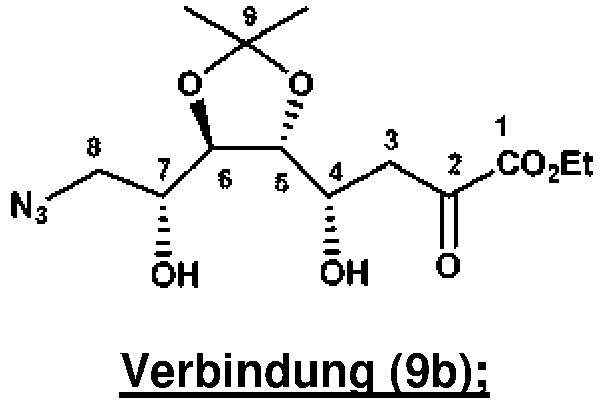 d)
d) R1 und R2 sind unabhängig H; ein C1 bis C6 Alkyl, einschließlich Methyl, Ethyl, Propyl, Butyl; Aryl, einschließlich Phenyl, para-Methoxyphenyl; oder R1, R2 zusammen mit dem Kohlenstoff C-6 ein Cyclopentyliden oder Cyclohexyliden sind; wobei jede dieser Gruppen substituiert sein kann oder nicht;und R5 ein C1 bis C6-Alkyl ist, einschließlich Methyl, Ethyl, Propyl, Butyl, t-Butyl, Pentyl, Hexyl oder Benzyl, wobei jede dieser Gruppen substituiert sein kann oder nicht; undwobei die Verbindung von Formel VIIIb insbesondere Ethyl-(4S)-4-{(4R,5R)-5-[(R)-2-azido-1-hydroxyethyl]-2,2-dimethyl-1,3-dioxolan-4-yl)-4-hydroxy-2-methylenbutanoat (8b) ist, hierin nachstehend:
 e)
e) R1 und R2 sind unabhängig H; ein C1 bis C6 Alkyl, einschließlich Methyl, Ethyl, Propyl, Butyl; Aryl, einschließlich Phenyl, para-Methoxyphenyl; oder R1, R2 zusammen mit dem Kohlenstoff C-6 ein Cyclopentyliden oder Cyclohexyliden sind; wobei jede dieser Gruppen substituiert sein kann oder nicht;und R3 ein C1 bis C6-Alkyl ist, einschließlich Methyl, Ethyl, Propyl, Isopropyl, Butyl, Isobutyl, tert-Butyl, Pentyl; oder Aryl, einschließlich Phenyl, Methylphenyl, Ethylphenyl, wobei jede dieser Gruppen substituiert sein kann oder nicht;und R4 ein C1 bis C6-Alkyl ist, einschließlich Methyl, Ethyl, Propyl, ein C1 bis C6-Perfluoroalkyl, einschließlich Trifluormethyl, Pentafluorethyl, oder Aryl, einschließlich para-Methylphenyl, para-Nitrophenyl, wobei jede dieser Gruppen substituiert oder nicht substituiert sein kann;wobei die Verbindung von Formel IV insbesondere 2:3-isopropylidene-5-O-methansulfonyl-D-arabinose O-methyloxim (4) ist, hierin nachstehend:
- In vitro-Verwendung einer Verbindung von Formel VIIIa oder VIIIb und insbesondere Formel (8a) oder (8b) nach Anspruch 12 zu Detektieren von Bakterien, insbesondere Gram-negativen Bakterien, einschließlich der folgenden Bakteriengattung:
Acinetobacter, Bacteroides, Bartonella, Borde tel la, Brachyspira, Brucella, Burkholderia, Campylobacter, Cardiobacterium, Chlamydophila, Chryseobacterium, Clostridium, Coxiella, Cronobacter, Edwardsiella, Ehrlichia, Eikenella, Elizabethkingia, Enterobacter, Escherichia, Francisella, Fusobacterium, Haemophilus, Helicobacter, Klebsiella, Legionella, Leptospira, Morganella, Myxococcus, Neisseria, Neorickettsia, Pasteurella, Plesiomonas, Porphyromonas, Prevotella, Proteus, Providencia, Pseudoalteromonas, Pseudomonas, Rickettsia, Rhodocyccius, Salmonella, Serratia, Sinorhizobium, Shigella, Schewanella, Shewamma, Stenotrophomonas, Streptobacillus, Tenacibaculum, Treponema, Vibrio, Yersinia. - Verwendung einer Verbindung (6) nach Anspruch 1 für die Synthese von 5-Azido-5-desoxy-D-arabinofuranose oder Ara-N3 (7):

- Verwendung einer Verbindung (9a) nach Anspruch 7 zur Herstellung von Ammonium 8-Azido-3,8-dideoxy-D-manno-oct-2-ulosonat oder Kdo-N3 (10a):

- Verwendung einer Verbindung (9b), nach Anspruch 10 zur Herstellung von Ammonium 8-Azido-3,8-dideoxy-D-gluco-oct-2-ulosonat oder 4eKdo-N3 (10b):

Applications Claiming Priority (2)
| Application Number | Priority Date | Filing Date | Title |
|---|---|---|---|
| EP15306824.2A EP3170830A1 (de) | 2015-11-17 | 2015-11-17 | Neue 5-azido-5-deoxy-2:3-isopropyliden-d-arabinose-verbindungen; verfahren zu deren herstellung und deren verwendung zur synthese von ara-n3, kdo-n3 und 4ekdo-n3 |
| PCT/EP2016/077900 WO2017085144A1 (en) | 2015-11-17 | 2016-11-16 | New 5-azido-5-deoxy-2 :3-isopropylidene-d-arabinose compounds; their method of manufacture and their use for the synthesis of ara-n3, kdo-n3 and 4ekdo-n3 |
Publications (2)
| Publication Number | Publication Date |
|---|---|
| EP3377507A1 EP3377507A1 (de) | 2018-09-26 |
| EP3377507B1 true EP3377507B1 (de) | 2021-12-08 |
Family
ID=55024958
Family Applications (2)
| Application Number | Title | Priority Date | Filing Date |
|---|---|---|---|
| EP15306824.2A Withdrawn EP3170830A1 (de) | 2015-11-17 | 2015-11-17 | Neue 5-azido-5-deoxy-2:3-isopropyliden-d-arabinose-verbindungen; verfahren zu deren herstellung und deren verwendung zur synthese von ara-n3, kdo-n3 und 4ekdo-n3 |
| EP16801993.3A Active EP3377507B1 (de) | 2015-11-17 | 2016-11-16 | Neue 5-azido-5-deoxy-2:3-isopropyliden-d-arabinose-verbindungen; verfahren zu deren herstellung und deren verwendung zur synthese von ara-n3, kdo-n3 und 4ekdo-n3 |
Family Applications Before (1)
| Application Number | Title | Priority Date | Filing Date |
|---|---|---|---|
| EP15306824.2A Withdrawn EP3170830A1 (de) | 2015-11-17 | 2015-11-17 | Neue 5-azido-5-deoxy-2:3-isopropyliden-d-arabinose-verbindungen; verfahren zu deren herstellung und deren verwendung zur synthese von ara-n3, kdo-n3 und 4ekdo-n3 |
Country Status (11)
| Country | Link |
|---|---|
| US (1) | US10717718B2 (de) |
| EP (2) | EP3170830A1 (de) |
| JP (1) | JP6923520B2 (de) |
| KR (1) | KR20180095508A (de) |
| CN (1) | CN108431014B (de) |
| AU (1) | AU2016358039B2 (de) |
| BR (1) | BR112018010056B1 (de) |
| CA (1) | CA3005500A1 (de) |
| SG (1) | SG11201804184SA (de) |
| WO (1) | WO2017085144A1 (de) |
| ZA (1) | ZA201803250B (de) |
Families Citing this family (3)
| Publication number | Priority date | Publication date | Assignee | Title |
|---|---|---|---|---|
| BR112021016399A2 (pt) | 2019-02-20 | 2021-10-19 | Diamidex | Métodos para marcar células eucarióticas de um organismo multicelular usando compostos de monossacarídeos modificados |
| IL299328A (en) * | 2020-07-07 | 2023-02-01 | Theraonco | Methods for treating cancer using a modified monosaccharide compound |
| EP4619409A1 (de) * | 2022-11-15 | 2025-09-24 | Ecole Polytechnique Federale De Lausanne (Epfl) | Verfahren zur herstellung eines zumindest teilweise acetal-geschützten zuckers |
Family Cites Families (3)
| Publication number | Priority date | Publication date | Assignee | Title |
|---|---|---|---|---|
| IL108523A0 (en) * | 1993-02-03 | 1994-05-30 | Gensia Inc | Pharmaceutical compositions containing adenosine kinase inhibitors for preventing or treating conditions involving inflammatory responses and pain |
| CN101070301B (zh) * | 2006-05-08 | 2011-06-08 | 中国科学院化学研究所 | 一种双羟基高脯氨酸衍生物及其制备方法与应用 |
| EP2617833A1 (de) * | 2012-01-18 | 2013-07-24 | Centre National de la Recherche Scientifique (CNRS) | Verfahren zum spezifischen Nachweisen von lebenden Bakterien |
-
2015
- 2015-11-17 EP EP15306824.2A patent/EP3170830A1/de not_active Withdrawn
-
2016
- 2016-11-16 BR BR112018010056-0A patent/BR112018010056B1/pt not_active IP Right Cessation
- 2016-11-16 JP JP2018525722A patent/JP6923520B2/ja not_active Expired - Fee Related
- 2016-11-16 US US15/777,060 patent/US10717718B2/en active Active
- 2016-11-16 CA CA3005500A patent/CA3005500A1/en active Pending
- 2016-11-16 CN CN201680072705.1A patent/CN108431014B/zh not_active Expired - Fee Related
- 2016-11-16 WO PCT/EP2016/077900 patent/WO2017085144A1/en not_active Ceased
- 2016-11-16 AU AU2016358039A patent/AU2016358039B2/en not_active Ceased
- 2016-11-16 EP EP16801993.3A patent/EP3377507B1/de active Active
- 2016-11-16 KR KR1020187014061A patent/KR20180095508A/ko active Pending
- 2016-11-16 SG SG11201804184SA patent/SG11201804184SA/en unknown
-
2018
- 2018-05-16 ZA ZA2018/03250A patent/ZA201803250B/en unknown
Non-Patent Citations (1)
| Title |
|---|
| None * |
Also Published As
| Publication number | Publication date |
|---|---|
| CN108431014B (zh) | 2021-08-10 |
| EP3377507A1 (de) | 2018-09-26 |
| SG11201804184SA (en) | 2018-06-28 |
| WO2017085144A1 (en) | 2017-05-26 |
| US10717718B2 (en) | 2020-07-21 |
| AU2016358039B2 (en) | 2020-10-15 |
| ZA201803250B (en) | 2019-06-26 |
| EP3170830A1 (de) | 2017-05-24 |
| KR20180095508A (ko) | 2018-08-27 |
| AU2016358039A1 (en) | 2018-06-07 |
| BR112018010056B1 (pt) | 2022-11-08 |
| JP2018534312A (ja) | 2018-11-22 |
| JP6923520B2 (ja) | 2021-08-18 |
| CA3005500A1 (en) | 2017-05-26 |
| CN108431014A (zh) | 2018-08-21 |
| BR112018010056A2 (pt) | 2018-11-13 |
| US20180370942A1 (en) | 2018-12-27 |
Similar Documents
| Publication | Publication Date | Title |
|---|---|---|
| RU2559364C2 (ru) | СПОСОБ ПОЛУЧЕНИЯ ЗАМЕЩЕННЫХ 1-О-АЦИЛ-2-ДЕЗОКСИ-2-ФТОР-4-ТИО-β-D-АРАБИНОФУРАНОЗ | |
| CS246075B2 (en) | Method of 2,2-difluoronucleoside production | |
| EP3377507B1 (de) | Neue 5-azido-5-deoxy-2:3-isopropyliden-d-arabinose-verbindungen; verfahren zu deren herstellung und deren verwendung zur synthese von ara-n3, kdo-n3 und 4ekdo-n3 | |
| US20110040120A1 (en) | Preparation of oseltamivir phosphate (tamiflu®) and intermediates starting from d-glucose or d-xylose | |
| US11661406B2 (en) | Method for producing intermediate useful for synthesis of SGLT inhibitor | |
| Hayman et al. | A stereoselective synthesis of 6, 6, 6-trifluoro-l-daunosamine and 6, 6, 6-trifluoro-l-acosamine | |
| RU2346948C2 (ru) | ПРОИЗВОДНЫЕ 1-α-ГАЛОГЕН-2,2-ДИФТОР-2-ДЕЗОКСИ-D-РИБОФУРАНОЗЫ И СПОСОБ ИХ ПОЛУЧЕНИЯ | |
| US7361745B2 (en) | Process for the preparation of 1-chloro-3,5-di-o-acyl-2-deoxy-l-ribofuranoside derivatives | |
| JP6898323B2 (ja) | 6−アジド−2,4−ジアセトアミド−2,4,6−トリデオキシ−d−マンノースの調製方法 | |
| US6013790A (en) | Heavily fluorinated sugar analogs | |
| Sugiyama et al. | Synthesis of chiral aspyrone, a multi-functional dihydropyranone antibiotic | |
| EP1874788A1 (de) | Monosaccharidderivate als entzündungshemmende mittel und/oder antikrebsmittel | |
| CA1292002C (en) | Propanol derivatives | |
| US20140235840A1 (en) | New synthesis of fucose | |
| Hemeon et al. | Synthesis of 4-deoxy-4-nitrosialic acid | |
| JP2670574B2 (ja) | 同位元素標識アルドノニトリル誘導体 | |
| JP2673478B2 (ja) | セラミド誘導体とその製造方法及び中間体 | |
| US20100056771A1 (en) | Process of Making 2-Deoxy-2,2-Difluoro-D-Ribofuranosyl Nucleosides and Intermediates Therefor | |
| US20140235848A1 (en) | Method for making a precursor of l-fucose from d-glucose | |
| JP2004217540A (ja) | 没食子酸配糖体の製造方法 | |
| FR2934860A1 (fr) | Procede de preparation de l-hexodialdose. | |
| JP2005314433A (ja) | ピリピロペン誘導体 | |
| WO2001055157A1 (fr) | DERIVES N-SUBSTITUES DE 4-AMINO-4,6-DIDESOXY-α-D-GLUCOPYRANOSYL-(1→4)-α-D-GLUCOPYRANOSYL-(1→4)-D-GLUCOPYRANOSE ET DE 4-AMINO-4,6-DIDESOXY-α-D-GLUCOPYRANOSYL-(1→4)-α-D-GLUCOPYRANOSYL-(1→4)-β-D-GLUCOPYRANOSIDE ET LEUR METHODE DE PREPARATION |
Legal Events
| Date | Code | Title | Description |
|---|---|---|---|
| STAA | Information on the status of an ep patent application or granted ep patent |
Free format text: STATUS: UNKNOWN |
|
| STAA | Information on the status of an ep patent application or granted ep patent |
Free format text: STATUS: THE INTERNATIONAL PUBLICATION HAS BEEN MADE |
|
| PUAI | Public reference made under article 153(3) epc to a published international application that has entered the european phase |
Free format text: ORIGINAL CODE: 0009012 |
|
| STAA | Information on the status of an ep patent application or granted ep patent |
Free format text: STATUS: REQUEST FOR EXAMINATION WAS MADE |
|
| 17P | Request for examination filed |
Effective date: 20180615 |
|
| AK | Designated contracting states |
Kind code of ref document: A1 Designated state(s): AL AT BE BG CH CY CZ DE DK EE ES FI FR GB GR HR HU IE IS IT LI LT LU LV MC MK MT NL NO PL PT RO RS SE SI SK SM TR |
|
| AX | Request for extension of the european patent |
Extension state: BA ME |
|
| DAV | Request for validation of the european patent (deleted) | ||
| DAX | Request for extension of the european patent (deleted) | ||
| STAA | Information on the status of an ep patent application or granted ep patent |
Free format text: STATUS: EXAMINATION IS IN PROGRESS |
|
| RIC1 | Information provided on ipc code assigned before grant |
Ipc: C12Q 1/04 20060101ALI20201028BHEP Ipc: C07D 317/30 20060101ALI20201028BHEP Ipc: G01N 33/569 20060101ALI20201028BHEP Ipc: C07H 1/00 20060101AFI20201028BHEP Ipc: C07H 13/00 20060101ALI20201028BHEP Ipc: C07D 317/28 20060101ALI20201028BHEP Ipc: C07H 7/027 20060101ALI20201028BHEP Ipc: C07H 9/04 20060101ALI20201028BHEP Ipc: C07H 5/04 20060101ALI20201028BHEP |
|
| 17Q | First examination report despatched |
Effective date: 20201127 |
|
| GRAP | Despatch of communication of intention to grant a patent |
Free format text: ORIGINAL CODE: EPIDOSNIGR1 |
|
| STAA | Information on the status of an ep patent application or granted ep patent |
Free format text: STATUS: GRANT OF PATENT IS INTENDED |
|
| INTG | Intention to grant announced |
Effective date: 20210610 |
|
| GRAS | Grant fee paid |
Free format text: ORIGINAL CODE: EPIDOSNIGR3 |
|
| GRAA | (expected) grant |
Free format text: ORIGINAL CODE: 0009210 |
|
| STAA | Information on the status of an ep patent application or granted ep patent |
Free format text: STATUS: THE PATENT HAS BEEN GRANTED |
|
| REG | Reference to a national code |
Ref country code: DE Ref legal event code: R081 Ref document number: 602016067185 Country of ref document: DE Owner name: CENTRE NATIONAL DE LA RECHERCHE SCIENTIFIQUE, FR Free format text: FORMER OWNER: CENTRE NATIONAL DE LA RECHERCHE SCIENTIFIQUE, PARIS, FR |
|
| AK | Designated contracting states |
Kind code of ref document: B1 Designated state(s): AL AT BE BG CH CY CZ DE DK EE ES FI FR GB GR HR HU IE IS IT LI LT LU LV MC MK MT NL NO PL PT RO RS SE SI SK SM TR |
|
| REG | Reference to a national code |
Ref country code: GB Ref legal event code: FG4D |
|
| REG | Reference to a national code |
Ref country code: AT Ref legal event code: REF Ref document number: 1453698 Country of ref document: AT Kind code of ref document: T Effective date: 20211215 Ref country code: CH Ref legal event code: EP |
|
| REG | Reference to a national code |
Ref country code: DE Ref legal event code: R096 Ref document number: 602016067185 Country of ref document: DE |
|
| REG | Reference to a national code |
Ref country code: IE Ref legal event code: FG4D |
|
| REG | Reference to a national code |
Ref country code: LT Ref legal event code: MG9D |
|
| REG | Reference to a national code |
Ref country code: NL Ref legal event code: MP Effective date: 20211208 |
|
| PG25 | Lapsed in a contracting state [announced via postgrant information from national office to epo] |
Ref country code: RS Free format text: LAPSE BECAUSE OF FAILURE TO SUBMIT A TRANSLATION OF THE DESCRIPTION OR TO PAY THE FEE WITHIN THE PRESCRIBED TIME-LIMIT Effective date: 20211208 Ref country code: LT Free format text: LAPSE BECAUSE OF FAILURE TO SUBMIT A TRANSLATION OF THE DESCRIPTION OR TO PAY THE FEE WITHIN THE PRESCRIBED TIME-LIMIT Effective date: 20211208 Ref country code: FI Free format text: LAPSE BECAUSE OF FAILURE TO SUBMIT A TRANSLATION OF THE DESCRIPTION OR TO PAY THE FEE WITHIN THE PRESCRIBED TIME-LIMIT Effective date: 20211208 Ref country code: BG Free format text: LAPSE BECAUSE OF FAILURE TO SUBMIT A TRANSLATION OF THE DESCRIPTION OR TO PAY THE FEE WITHIN THE PRESCRIBED TIME-LIMIT Effective date: 20220308 |
|
| REG | Reference to a national code |
Ref country code: AT Ref legal event code: MK05 Ref document number: 1453698 Country of ref document: AT Kind code of ref document: T Effective date: 20211208 |
|
| PG25 | Lapsed in a contracting state [announced via postgrant information from national office to epo] |
Ref country code: SE Free format text: LAPSE BECAUSE OF FAILURE TO SUBMIT A TRANSLATION OF THE DESCRIPTION OR TO PAY THE FEE WITHIN THE PRESCRIBED TIME-LIMIT Effective date: 20211208 Ref country code: NO Free format text: LAPSE BECAUSE OF FAILURE TO SUBMIT A TRANSLATION OF THE DESCRIPTION OR TO PAY THE FEE WITHIN THE PRESCRIBED TIME-LIMIT Effective date: 20220308 Ref country code: LV Free format text: LAPSE BECAUSE OF FAILURE TO SUBMIT A TRANSLATION OF THE DESCRIPTION OR TO PAY THE FEE WITHIN THE PRESCRIBED TIME-LIMIT Effective date: 20211208 Ref country code: HR Free format text: LAPSE BECAUSE OF FAILURE TO SUBMIT A TRANSLATION OF THE DESCRIPTION OR TO PAY THE FEE WITHIN THE PRESCRIBED TIME-LIMIT Effective date: 20211208 Ref country code: GR Free format text: LAPSE BECAUSE OF FAILURE TO SUBMIT A TRANSLATION OF THE DESCRIPTION OR TO PAY THE FEE WITHIN THE PRESCRIBED TIME-LIMIT Effective date: 20220309 Ref country code: ES Free format text: LAPSE BECAUSE OF FAILURE TO SUBMIT A TRANSLATION OF THE DESCRIPTION OR TO PAY THE FEE WITHIN THE PRESCRIBED TIME-LIMIT Effective date: 20211208 |
|
| PG25 | Lapsed in a contracting state [announced via postgrant information from national office to epo] |
Ref country code: NL Free format text: LAPSE BECAUSE OF FAILURE TO SUBMIT A TRANSLATION OF THE DESCRIPTION OR TO PAY THE FEE WITHIN THE PRESCRIBED TIME-LIMIT Effective date: 20211208 |
|
| PG25 | Lapsed in a contracting state [announced via postgrant information from national office to epo] |
Ref country code: SM Free format text: LAPSE BECAUSE OF FAILURE TO SUBMIT A TRANSLATION OF THE DESCRIPTION OR TO PAY THE FEE WITHIN THE PRESCRIBED TIME-LIMIT Effective date: 20211208 Ref country code: SK Free format text: LAPSE BECAUSE OF FAILURE TO SUBMIT A TRANSLATION OF THE DESCRIPTION OR TO PAY THE FEE WITHIN THE PRESCRIBED TIME-LIMIT Effective date: 20211208 Ref country code: RO Free format text: LAPSE BECAUSE OF FAILURE TO SUBMIT A TRANSLATION OF THE DESCRIPTION OR TO PAY THE FEE WITHIN THE PRESCRIBED TIME-LIMIT Effective date: 20211208 Ref country code: PT Free format text: LAPSE BECAUSE OF FAILURE TO SUBMIT A TRANSLATION OF THE DESCRIPTION OR TO PAY THE FEE WITHIN THE PRESCRIBED TIME-LIMIT Effective date: 20220408 Ref country code: EE Free format text: LAPSE BECAUSE OF FAILURE TO SUBMIT A TRANSLATION OF THE DESCRIPTION OR TO PAY THE FEE WITHIN THE PRESCRIBED TIME-LIMIT Effective date: 20211208 Ref country code: CZ Free format text: LAPSE BECAUSE OF FAILURE TO SUBMIT A TRANSLATION OF THE DESCRIPTION OR TO PAY THE FEE WITHIN THE PRESCRIBED TIME-LIMIT Effective date: 20211208 |
|
| PG25 | Lapsed in a contracting state [announced via postgrant information from national office to epo] |
Ref country code: PL Free format text: LAPSE BECAUSE OF FAILURE TO SUBMIT A TRANSLATION OF THE DESCRIPTION OR TO PAY THE FEE WITHIN THE PRESCRIBED TIME-LIMIT Effective date: 20211208 Ref country code: AT Free format text: LAPSE BECAUSE OF FAILURE TO SUBMIT A TRANSLATION OF THE DESCRIPTION OR TO PAY THE FEE WITHIN THE PRESCRIBED TIME-LIMIT Effective date: 20211208 |
|
| REG | Reference to a national code |
Ref country code: DE Ref legal event code: R097 Ref document number: 602016067185 Country of ref document: DE |
|
| PG25 | Lapsed in a contracting state [announced via postgrant information from national office to epo] |
Ref country code: IS Free format text: LAPSE BECAUSE OF FAILURE TO SUBMIT A TRANSLATION OF THE DESCRIPTION OR TO PAY THE FEE WITHIN THE PRESCRIBED TIME-LIMIT Effective date: 20220408 |
|
| PLBE | No opposition filed within time limit |
Free format text: ORIGINAL CODE: 0009261 |
|
| STAA | Information on the status of an ep patent application or granted ep patent |
Free format text: STATUS: NO OPPOSITION FILED WITHIN TIME LIMIT |
|
| PG25 | Lapsed in a contracting state [announced via postgrant information from national office to epo] |
Ref country code: DK Free format text: LAPSE BECAUSE OF FAILURE TO SUBMIT A TRANSLATION OF THE DESCRIPTION OR TO PAY THE FEE WITHIN THE PRESCRIBED TIME-LIMIT Effective date: 20211208 Ref country code: AL Free format text: LAPSE BECAUSE OF FAILURE TO SUBMIT A TRANSLATION OF THE DESCRIPTION OR TO PAY THE FEE WITHIN THE PRESCRIBED TIME-LIMIT Effective date: 20211208 |
|
| 26N | No opposition filed |
Effective date: 20220909 |
|
| PG25 | Lapsed in a contracting state [announced via postgrant information from national office to epo] |
Ref country code: SI Free format text: LAPSE BECAUSE OF FAILURE TO SUBMIT A TRANSLATION OF THE DESCRIPTION OR TO PAY THE FEE WITHIN THE PRESCRIBED TIME-LIMIT Effective date: 20211208 |
|
| PG25 | Lapsed in a contracting state [announced via postgrant information from national office to epo] |
Ref country code: IT Free format text: LAPSE BECAUSE OF FAILURE TO SUBMIT A TRANSLATION OF THE DESCRIPTION OR TO PAY THE FEE WITHIN THE PRESCRIBED TIME-LIMIT Effective date: 20211208 |
|
| PG25 | Lapsed in a contracting state [announced via postgrant information from national office to epo] |
Ref country code: MC Free format text: LAPSE BECAUSE OF FAILURE TO SUBMIT A TRANSLATION OF THE DESCRIPTION OR TO PAY THE FEE WITHIN THE PRESCRIBED TIME-LIMIT Effective date: 20211208 |
|
| REG | Reference to a national code |
Ref country code: BE Ref legal event code: MM Effective date: 20221130 |
|
| PG25 | Lapsed in a contracting state [announced via postgrant information from national office to epo] |
Ref country code: LU Free format text: LAPSE BECAUSE OF NON-PAYMENT OF DUE FEES Effective date: 20221116 |
|
| PG25 | Lapsed in a contracting state [announced via postgrant information from national office to epo] |
Ref country code: IE Free format text: LAPSE BECAUSE OF NON-PAYMENT OF DUE FEES Effective date: 20221116 |
|
| PG25 | Lapsed in a contracting state [announced via postgrant information from national office to epo] |
Ref country code: BE Free format text: LAPSE BECAUSE OF NON-PAYMENT OF DUE FEES Effective date: 20221130 |
|
| PGFP | Annual fee paid to national office [announced via postgrant information from national office to epo] |
Ref country code: GB Payment date: 20231129 Year of fee payment: 8 |
|
| PGFP | Annual fee paid to national office [announced via postgrant information from national office to epo] |
Ref country code: FR Payment date: 20231127 Year of fee payment: 8 Ref country code: DE Payment date: 20231130 Year of fee payment: 8 Ref country code: CH Payment date: 20231202 Year of fee payment: 8 |
|
| PG25 | Lapsed in a contracting state [announced via postgrant information from national office to epo] |
Ref country code: HU Free format text: LAPSE BECAUSE OF FAILURE TO SUBMIT A TRANSLATION OF THE DESCRIPTION OR TO PAY THE FEE WITHIN THE PRESCRIBED TIME-LIMIT; INVALID AB INITIO Effective date: 20161116 |
|
| PG25 | Lapsed in a contracting state [announced via postgrant information from national office to epo] |
Ref country code: CY Free format text: LAPSE BECAUSE OF FAILURE TO SUBMIT A TRANSLATION OF THE DESCRIPTION OR TO PAY THE FEE WITHIN THE PRESCRIBED TIME-LIMIT Effective date: 20211208 |
|
| PG25 | Lapsed in a contracting state [announced via postgrant information from national office to epo] |
Ref country code: MK Free format text: LAPSE BECAUSE OF FAILURE TO SUBMIT A TRANSLATION OF THE DESCRIPTION OR TO PAY THE FEE WITHIN THE PRESCRIBED TIME-LIMIT Effective date: 20211208 |
|
| PG25 | Lapsed in a contracting state [announced via postgrant information from national office to epo] |
Ref country code: MT Free format text: LAPSE BECAUSE OF FAILURE TO SUBMIT A TRANSLATION OF THE DESCRIPTION OR TO PAY THE FEE WITHIN THE PRESCRIBED TIME-LIMIT Effective date: 20211208 |
|
| REG | Reference to a national code |
Ref country code: DE Ref legal event code: R119 Ref document number: 602016067185 Country of ref document: DE |
|
| REG | Reference to a national code |
Ref country code: CH Ref legal event code: PL |
|
| REG | Reference to a national code |
Ref country code: CH Ref legal event code: PL |
|
| GBPC | Gb: european patent ceased through non-payment of renewal fee |
Effective date: 20241116 |
|
| PG25 | Lapsed in a contracting state [announced via postgrant information from national office to epo] |
Ref country code: CH Free format text: LAPSE BECAUSE OF NON-PAYMENT OF DUE FEES Effective date: 20241130 |
|
| PG25 | Lapsed in a contracting state [announced via postgrant information from national office to epo] |
Ref country code: DE Free format text: LAPSE BECAUSE OF NON-PAYMENT OF DUE FEES Effective date: 20250603 |
|
| PG25 | Lapsed in a contracting state [announced via postgrant information from national office to epo] |
Ref country code: GB Free format text: LAPSE BECAUSE OF NON-PAYMENT OF DUE FEES Effective date: 20241116 |
|
| PG25 | Lapsed in a contracting state [announced via postgrant information from national office to epo] |
Ref country code: FR Free format text: LAPSE BECAUSE OF NON-PAYMENT OF DUE FEES Effective date: 20241130 |
|
| PG25 | Lapsed in a contracting state [announced via postgrant information from national office to epo] |
Ref country code: TR Free format text: LAPSE BECAUSE OF FAILURE TO SUBMIT A TRANSLATION OF THE DESCRIPTION OR TO PAY THE FEE WITHIN THE PRESCRIBED TIME-LIMIT Effective date: 20211208 |