EP3379226A2 - Procédé de détermination d'un état de fonctionnement spécial d'un véhicule à moteur, dispositif mobile, produit de programme informatique et collecte de bruit de référence - Google Patents
Procédé de détermination d'un état de fonctionnement spécial d'un véhicule à moteur, dispositif mobile, produit de programme informatique et collecte de bruit de référence Download PDFInfo
- Publication number
- EP3379226A2 EP3379226A2 EP18153259.9A EP18153259A EP3379226A2 EP 3379226 A2 EP3379226 A2 EP 3379226A2 EP 18153259 A EP18153259 A EP 18153259A EP 3379226 A2 EP3379226 A2 EP 3379226A2
- Authority
- EP
- European Patent Office
- Prior art keywords
- noise
- motor vehicle
- mobile device
- operating state
- noises
- Prior art date
- Legal status (The legal status is an assumption and is not a legal conclusion. Google has not performed a legal analysis and makes no representation as to the accuracy of the status listed.)
- Granted
Links
Images

Classifications
-
- G—PHYSICS
- G01—MEASURING; TESTING
- G01M—TESTING STATIC OR DYNAMIC BALANCE OF MACHINES OR STRUCTURES; TESTING OF STRUCTURES OR APPARATUS, NOT OTHERWISE PROVIDED FOR
- G01M17/00—Testing of vehicles
- G01M17/007—Wheeled or endless-tracked vehicles
-
- B—PERFORMING OPERATIONS; TRANSPORTING
- B60—VEHICLES IN GENERAL
- B60R—VEHICLES, VEHICLE FITTINGS, OR VEHICLE PARTS, NOT OTHERWISE PROVIDED FOR
- B60R16/00—Electric or fluid circuits specially adapted for vehicles and not otherwise provided for; Arrangement of elements of electric or fluid circuits specially adapted for vehicles and not otherwise provided for
- B60R16/02—Electric or fluid circuits specially adapted for vehicles and not otherwise provided for; Arrangement of elements of electric or fluid circuits specially adapted for vehicles and not otherwise provided for electric constitutive elements
- B60R16/023—Electric or fluid circuits specially adapted for vehicles and not otherwise provided for; Arrangement of elements of electric or fluid circuits specially adapted for vehicles and not otherwise provided for electric constitutive elements for transmission of signals between vehicle parts or subsystems
- B60R16/0231—Circuits relating to the driving or the functioning of the vehicle
- B60R16/0232—Circuits relating to the driving or the functioning of the vehicle for measuring vehicle parameters and indicating critical, abnormal or dangerous conditions
- B60R16/0234—Circuits relating to the driving or the functioning of the vehicle for measuring vehicle parameters and indicating critical, abnormal or dangerous conditions related to maintenance or repairing of vehicles
-
- B—PERFORMING OPERATIONS; TRANSPORTING
- B60—VEHICLES IN GENERAL
- B60R—VEHICLES, VEHICLE FITTINGS, OR VEHICLE PARTS, NOT OTHERWISE PROVIDED FOR
- B60R16/00—Electric or fluid circuits specially adapted for vehicles and not otherwise provided for; Arrangement of elements of electric or fluid circuits specially adapted for vehicles and not otherwise provided for
- B60R16/02—Electric or fluid circuits specially adapted for vehicles and not otherwise provided for; Arrangement of elements of electric or fluid circuits specially adapted for vehicles and not otherwise provided for electric constitutive elements
- B60R16/023—Electric or fluid circuits specially adapted for vehicles and not otherwise provided for; Arrangement of elements of electric or fluid circuits specially adapted for vehicles and not otherwise provided for electric constitutive elements for transmission of signals between vehicle parts or subsystems
- B60R16/0237—Electric or fluid circuits specially adapted for vehicles and not otherwise provided for; Arrangement of elements of electric or fluid circuits specially adapted for vehicles and not otherwise provided for electric constitutive elements for transmission of signals between vehicle parts or subsystems circuits concerning the atmospheric environment
-
- G—PHYSICS
- G01—MEASURING; TESTING
- G01M—TESTING STATIC OR DYNAMIC BALANCE OF MACHINES OR STRUCTURES; TESTING OF STRUCTURES OR APPARATUS, NOT OTHERWISE PROVIDED FOR
- G01M7/00—Vibration-testing of structures; Shock-testing of structures
-
- G—PHYSICS
- G06—COMPUTING OR CALCULATING; COUNTING
- G06Q—INFORMATION AND COMMUNICATION TECHNOLOGY [ICT] SPECIALLY ADAPTED FOR ADMINISTRATIVE, COMMERCIAL, FINANCIAL, MANAGERIAL OR SUPERVISORY PURPOSES; SYSTEMS OR METHODS SPECIALLY ADAPTED FOR ADMINISTRATIVE, COMMERCIAL, FINANCIAL, MANAGERIAL OR SUPERVISORY PURPOSES, NOT OTHERWISE PROVIDED FOR
- G06Q30/00—Commerce
- G06Q30/06—Buying, selling or leasing transactions
- G06Q30/0601—Electronic shopping [e-shopping]
- G06Q30/0631—Recommending goods or services
-
- G—PHYSICS
- G07—CHECKING-DEVICES
- G07C—TIME OR ATTENDANCE REGISTERS; REGISTERING OR INDICATING THE WORKING OF MACHINES; GENERATING RANDOM NUMBERS; VOTING OR LOTTERY APPARATUS; ARRANGEMENTS, SYSTEMS OR APPARATUS FOR CHECKING NOT PROVIDED FOR ELSEWHERE
- G07C5/00—Registering or indicating the working of vehicles
- G07C5/08—Registering or indicating performance data other than driving, working, idle, or waiting time, with or without registering driving, working, idle or waiting time
- G07C5/0808—Diagnosing performance data
-
- H—ELECTRICITY
- H04—ELECTRIC COMMUNICATION TECHNIQUE
- H04W—WIRELESS COMMUNICATION NETWORKS
- H04W4/00—Services specially adapted for wireless communication networks; Facilities therefor
- H04W4/02—Services making use of location information
-
- H—ELECTRICITY
- H04—ELECTRIC COMMUNICATION TECHNIQUE
- H04W—WIRELESS COMMUNICATION NETWORKS
- H04W4/00—Services specially adapted for wireless communication networks; Facilities therefor
- H04W4/02—Services making use of location information
- H04W4/025—Services making use of location information using location based information parameters
- H04W4/026—Services making use of location information using location based information parameters using orientation information, e.g. compass
Definitions
- the invention relates to a method for detecting a different from a normal operating state of a motor vehicle special operating state of the motor vehicle. Furthermore, the invention relates to a mobile device for detecting a different from a normal operating state of a motor vehicle special operating state of the motor vehicle. The invention also relates to a computer program product having instructions executable by a computer system for carrying out a corresponding method and a reference noise collection.
- the special operating state is different from a normal operating state of the motor vehicle and can be present for example by a defective component of the motor vehicle.
- a special operating state of the motor vehicle deviating from a normal operating state of a motor vehicle is detected.
- a noise emitted by the motor vehicle during operation of the motor vehicle is detected in the interior of the motor vehicle with a separate mobile device from the motor vehicle.
- the noise is compared with a plurality of reference sounds provided by the mobile device. Further, when a minimum similarity value is exceeded, the noise is assigned to a most similar reference sound of the plurality of reference sounds by comparison. Due to the assignment, the special operating state is detected.
- the procedure is based on the finding that a special operating state of the motor vehicle, for example a drive of the motor vehicle with a defective wheel bearing, is characterized by an unmistakable and clearly allocable noise, whereby the special operating state can be recognized again after this allocation to this noise.
- the normal operating state is in particular a state of the motor vehicle in which all, in particular noise-generating, components of the motor vehicle function properly. In the normal operating state, in particular, there is no defective component. In the special operating state, however, there is a, in particular noise-generating, defective component of the motor vehicle. It may, for example, also be the case that the component generates the noise only when it is defective and is operated noiselessly in the non-defective state. But it can also be that sound changed from proper operation to defective or damaged operation. The change can be made for example by changing the spectrum of the frequency and / or changing the volume of the noise.
- the noise is detectable in the interior of the motor vehicle.
- the noise is an airborne sound signal and in particular no structure-borne sound signal.
- the interior of the motor vehicle is in particular a passenger compartment of the motor vehicle, that is to say the area of the interior space in which a vehicle occupant resides.
- the noise is detected with the mobile device.
- the mobile device is preferably a mobile phone, a smartphone, a tablet or a portable computer.
- the mobile device is formed separately from the motor vehicle, that is, the mobile device can be easily removed from the interior of the motor vehicle and moved to another location. Furthermore, it is provided in particular that the mobile device can be moved freely within the interior and can be passed, for example, from one vehicle occupant to another vehicle occupant. In particular, however, the mobile device can also be fixed to a holder provided in the interior of the motor vehicle for this purpose. In particular, the mobile device has a microphone to detect the noise.
- the detected noise is compared with the plurality of reference sounds.
- the reference noises are, in particular in advance, recorded noises to which at least one special operating state is assigned in each case.
- the reference sounds are provided by the mobile device, which means in particular that the mobile device has access to a database or reference noise collection in which the plurality of reference sounds is held up.
- the reference noise collection can then be stored, for example, in the mobile device or stored on a, in particular wireless, coupled to the mobile device server, which may be formed outside the vehicle or inside the vehicle, stored. In the latter case, the mobile device transmits the noise to the server. This can perform the comparison.
- the minimum similarity value is exceeded, it is assumed that there is a special operating state and not a normal operating state. If the minimum similarity value is not exceeded, then it is assumed in particular that the motor vehicle is operated in the normal operating state and, in particular, that there is no defective component. The minimum similarity value is not exceeded, in particular, if the assignment of the noise to one of the reference noises does not take place with sufficiently high similarity.
- a defective component of the motor vehicle is determined by means of a predetermined association between the defective component and the plurality of reference noises. In general, the assignment is between component and reference noise. If the special operating state is detected, ie it is detected that the motor vehicle is not operated in the normal operating state, ie if a defect exists, a defective component or several defective components of the motor vehicle is determined based on the assignment.
- determining the defective component for example, an identification, in particular a part number for a spare part of the motor vehicle can be determined.
- the defective component can be, for example, a group of components comprising a wheel bearing, a radiator fan or the main drive unit.
- the defective component can also already the concrete spare part correspond.
- the defective component may refer to a sealing ring, a retaining clip or a ball bearing.
- an estimate of the replacement part costs and / or the total repair costs, including the work involved can be carried out immediately, for example.
- the costs can be assigned by the assignment to the respective reference noise.
- the order of a replacement part for the defective component can already be prepared and proposed to a user of the mobile device or automatically be commissioned immediately after determining the defective component.
- At least one state of the motor vehicle is determined on the basis of a communication bus of the motor vehicle and the plurality of reference noises provided by the mobile device is selected depending on an association between the state and the plurality of reference noises.
- the state which is determined on the basis of the communication bus can be, for example, a speed value, an acceleration value, in particular a value of a lateral acceleration, an angle of inclination, an operating time or a tire pressure value of the motor vehicle.
- the communication bus of the motor vehicle is, for example, a CAN bus (Controller Area Network), an Ethernet or a LIN bus (Local Interconnect Network).
- the communication bus is then connected, for example, with a variety of sensors of the motor vehicle. Due to the state of the motor vehicle, the majority of the reference sounds can be adapted individually to the current situation during the noise detection and the assignment of the noise to the reference noise is more accurate.
- the noise of a normal operating state characterizing normal noise is cleaned up and the adjusted noise compared with the majority of the reference noise.
- the normal sound can be detected, for example, at a time at which the motor vehicle is proven to be in the normal operating state.
- the normal sound can be provided, for example, for a variety of states of the motor vehicle. The provision of the normal sound can be effected, for example, by a manufacturer of the motor vehicle or else by the workshop of the motor vehicle or by the user of the mobile device himself by recording the normal sound during the normal operating state of the motor vehicle with the mobile device.
- a position of the mobile device in the interior relative to the motor vehicle is determined and a distance of the source of the noise to the position of the mobile device is determined and / or an orientation of the source of the noise is determined relative to the mobile device in the interior , and depending on the distance and / or the orientation, a position of the source is determined, wherein the noise of the plurality of reference sounds is assigned depending on the position of the source to the motor vehicle. Determining the position of the mobile device in the interior determines where the mobile device is during the recording of the sound. In addition, preferably, a distance of the source of the noise to the position is determined. Depending on the position and the distance, the assignment of the noise to the reference noise can be made more reliable and precise.
- a selection of reference sounds can be made which are suitable for the noise.
- around the position there may be a radius with the distance are drawn and only the components of the motor vehicle, which are covered by the radius and optionally a tolerance range of the radius, are then taken into account in the reference noise provided for the comparison.
- the orientation of the source of the noise relative to the mobile device can be determined. The orientation can then take into account, for example, the information that the noise is emitted from a rear left area of the motor vehicle.
- the position of the source is in particular a position estimate or a position range, ie an area of the motor vehicle in which the source of the noise is arranged.
- each reference noise is assigned a position in the motor vehicle.
- the position may be present only two-dimensionally in the roadway plane or else in a three-dimensional space.
- a current acceleration value of the mobile device is detected during the detection of the noise and the noise is assigned to the plurality of reference noises as a function of the current acceleration value.
- the current acceleration value is detected in particular with an acceleration sensor of the mobile device.
- picking up of the acceleration value via the communication bus of the motor vehicle can be dispensed with.
- the acceleration of the mobile device can already be taken into account if there is no coupling, for example wirelessly, between the mobile device and the motor vehicle.
- a relative acceleration value between the acceleration of the mobile device and an acceleration of the motor vehicle can be determined.
- the acceleration value of the mobile device may deviate from the acceleration value of the motor vehicle if the mobile device is moved during the detection of the noise in the interior. This can then also be taken into account in the assignment of the noise to the plurality of reference noises.
- the reference noises are assigned various previously known acceleration values of the mobile device. The assignment is created in particular in the reference noise collection or a database.
- the relative acceleration may also be of interest because a sound will change as the microphone of the mobile device moves toward or away from the source of the noise, high frequency or low frequency. This effect can be taken into account by the specific relative acceleration.
- a current environmental situation of the motor vehicle during the detection of the Sound is detected and the noise of the majority of the reference noise is assigned depending on the current environmental situation.
- the reference sounds are assigned to various known environmental situations. The assignment is created in particular in the reference noise collection or a database.
- the current environmental situation is detected, for example, by environmental sensors of the motor vehicle.
- the current environmental situation can also be detected by another motor vehicle in an environmental region of the motor vehicle and then transmitted, preferably wirelessly, to the motor vehicle, for example according to the principle of car-to-X communication.
- the current environmental situation allows the noise of the majority of reference sounds to be more accurately and reliably assigned.
- the current environmental situation may indicate that raindrops fall on the motor vehicle or that the motor vehicle is driving on a wet roadway and thus results in a characteristic driving noise, or that external noise is registered, for example if the vehicle is in viscous traffic or a vehicle Jam is located and next to the motor vehicle, for example, a truck is operated with loud engine noise.
- particular reference sounds of the plurality of reference noises may then be selected for the assignment of the noise.
- the current environmental situation can also be used, for example, to determine the normal noise.
- a workshop proposal for the motor vehicle is determined by means of an association between the workshop proposal and the plurality of reference noises, and in particular the workshop suggestion is output by the mobile device.
- the most similar reference noise can be assigned which workshop has special expertise for this type of damage.
- the workshop suggestion for example, a place of the workshop, which is obvious, for example, a current position of the motor vehicle and / or a designation of the workshop.
- On the basis of the detected special operating state or the defective component can then be estimated, for example, how long the vehicle can still be operated without hesitation, to get to the workshop proposed by the workshop proposal.
- a balance can be made between a nearby workshop and a remote workshop, but which has increased repair experience regarding the defective component.
- the workshop proposal thus contains repair experience and / or information as to whether a replacement part for the defective component is present. Furthermore, it can be considered, for example, in the workshop proposal, which vehicle type or which vehicle make the vehicle is associated.
- the vehicle type may be input to the mobile device, for example, by a radio signal or by an image capture made by the motor vehicle with the mobile device.
- the vehicle type can also be transmitted, for example via the communication bus of the motor vehicle.
- the workshop proposal shows the user of the mobile device a quick way to end the special operating state again.
- the noise in particular together with operating information of the motor vehicle, is recorded by the mobile device and provided as a reference sound of the plurality of reference noises.
- the user of the mobile device can extend the plurality of reference sounds or a database in which the reference sounds are stored. This allows the user, for example Sounds that occur again, more precise and reliable assign the reference noise.
- the mobile device may also record the noise and classify it as normal noise. In this case, this noise is no longer associated with the reference noise at the next application of the mobile device and no, possibly wrong, special operating state is detected.
- the recorded sound can then be classified, for example, by the user of the mobile device or else by a workshop which carries out the repair, that is to say in particular to a defective component of the motor vehicle.
- the noise is recorded along with the operating information.
- the operating information may be, for example, an acceleration value, a speed value or an inclination angle of the motor vehicle.
- the invention also relates to a mobile device.
- the mobile device is configured to recognize a special operating state of the motor vehicle deviating from a normal operating state of a motor vehicle.
- a noise emitted by the motor vehicle noise in the interior of the motor vehicle can be detected during operation of the motor vehicle.
- the mobile device is designed separately from the motor vehicle.
- the noise is comparable to a plurality of reference sounds equivalent to the mobile device. When a minimum similarity value is exceeded, the noise can be assigned to a most similar reference sound of the plurality of reference noises on the basis of the comparison, and the special operating state can be recognized by the assignment made.
- the invention also relates to a computer program product with instructions executable by a computer system for carrying out a method according to the invention.
- the computer program product is stored in particular on a computer-readable medium, for example a flash memory, a volatile memory or a magnetic memory.
- the computer program product is preferably present as an application program.
- the application program is preferably designed to be executed on a mobile operating system, for example iOS or Android or WindowsMobile.
- the invention also relates to a reference noise collection comprising a plurality of reference sounds.
- the reference noises of the plurality of reference noises are each assigned a special operating state and at least one defective component.
- the reference noise collection is designed as a database.
- the reference noise collection can, for example, be stored on a server external to the vehicle and designed separately from the mobile device, or alternatively stored in the mobile device in addition or alternatively.
- the reference noise collection can also be kept in several places and be synchronized, for example, at predetermined intervals.
- the reference noise collection includes the assignment of reference noise to defective components of the motor vehicle.
- the reference sounds are vehicle manufacturers, vehicle types, positions of the mobile device, states of the vehicle Motor vehicle, acceleration values, environmental situations and / or inclination angle of the motor vehicle assigned.
- the assignment can be present, for example, as a relational database.
- the assignment takes place in particular on the basis of previously known training data.
- the comparison can then be done faster and more reliable, since less reference noise must be compared.
- the workshop proposal may suggest a suitable workshop for repairing the defective component.
- Advantageous embodiments of the method according to the invention are to be regarded as advantageous embodiments of the mobile device, the computer program product and the reference noise collection.
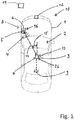
- Fig. 1 shows a schematic representation of a motor vehicle 1 in plan view.
- a mobile device 3 In an interior 2 of the motor vehicle 1 is a mobile device 3.
- the interior 2 of the motor vehicle 1 is in particular a passenger compartment or a space of the motor vehicle 1, in which a vehicle occupant usually resides.
- the mobile device 3 is configured separately from the motor vehicle 1 and is held in the hands of a user of the mobile device 3, for example. However, the mobile device 3 can also be stored at any location in the interior 2, for example on a center console of the motor vehicle 1. The mobile device 3 can for example also be attached to a holder in the motor vehicle 1.
- the mobile device 3 can for example be wirelessly coupled to a data transmission interface of the motor vehicle 1, for example by means of a Bluetooth connection.
- the mobile device 3 detects a noise 4 emitted by the motor vehicle 1 in the interior 2 of the motor vehicle 1.
- the noise 4 comes from a source 5.
- sound which characterizes the noise 4 propagates from the source 5.
- the source 5 is present in particular in or on a defective component 6 of the motor vehicle 1.
- the noise 4 is delivered from the front left in the motor vehicle 1 arranged wheel bearing as the defective component 6.
- the defective component 6 can be present as a diverse component of the motor vehicle 1.
- the defective component 6 may be, for example, a windshield wiper, a tire, an exhaust system, in particular a middle silencer or an end silencer, a brake system, a holder or a trim part.
- the noise 4 is now compared with a plurality of reference sounds 7.
- the plurality of reference sounds 7 are provided by the mobile device 3 in particular. That is, the mobile device 3 holds the plurality of reference sounds 7 itself, and thus it is stored in the mobile device 3, or the plurality of reference sounds 7 are held on a device external server and retrieved from the mobile device 3 as needed , for example via a wireless connection.
- the plurality of reference sounds 7 are provided by a reference noise collection 26.
- the comparison of the noise 4 with the reference noises 7 results in similarity values. If at least one similarity value of the comparison exceeds a minimum similarity value, the noise 4 is assigned to a most similar reference sound of the plurality of reference noises 7. The The most similar reference noise is in particular the reference noise, which has the highest similarity value through the comparison. If the noise 4 is assigned to the most similar reference noise, ie if the minimum similarity value is exceeded, a special operating state 8 of the motor vehicle 1 is detected.
- the special operating state 8 differs from a normal operating state of the motor vehicle 1.
- the special operating state 8 is present, for example, if, as in the exemplary embodiment of FIG Fig. 1 a defective wheel bearing is present.
- the normal operating state is present when the motor vehicle 1 is operated defect-free or trouble-free.
- the special operating state 8 is characterized in particular by the presence of the defective component 6.
- the defective component 6 is then determined.
- the defective component 6 can be determined in particular by the reference noise 7 is assigned in each case at least one defective component 6.
- the association between defective components 6 and reference noises 7 can be carried out, for example, by training, which takes place, for example, on the vehicle manufacturer side or is performed by the user himself. The training of the assignment can also be done by any third party.
- the mobile device 3 can obtain information from a communication bus 9 of the motor vehicle 1.
- the communication bus 9 is designed, for example, as a CAN bus, LIN bus or Ethernet.
- a multiplicity of sensors and information transmitters are connected to the communication bus 9 of the motor vehicle 1.
- a state 10 of the motor vehicle 1 can be determined.
- the state 10 may be, for example, a currently present speed value, a currently present acceleration value, a wheel revolution number or else the activity of a component.
- the state 10 is then, for example, the information as to whether a windshield wiper is in an active or deactivated state or whether a lighting unit is active or inactive.
- the noise 4 is adjusted from a normal noise before the comparison with the reference noise 7. Then only the adjusted noise is compared with the majority of the reference noises 7. The normal sound is present when the motor vehicle 1 is operated in the normal operating state.
- the normal sound is recorded, for example, at different speeds of the motor vehicle 1.
- the normal sound is thus preferably in different forms, but preferably only for cases in which the motor vehicle 1 is operated without interference.
- a current environmental situation 11 of the motor vehicle 1 is detected during the detection of the noise 4.
- the current environmental situation 11 may be, for example, a roadway condition, ie a gravel road or a concrete road, rainfall, snowfall, other road users, animals, wind force or flying objects.
- the current environmental situation 11 is detected in particular with at least one environmental sensor 12 of the motor vehicle 1.
- the environmental sensor 12 can be designed, for example, as a camera, radar sensor, ultrasound sensor, lidar or laser scanner be.
- the environmental situation 11 can also be detected by an environmental sensor of the mobile device 3.
- the mobile device 3 may have a camera as the environment sensor 12. Based on the current environmental situation 11 then the normal sound from a collection of normal sounds can be selected.
- the current environmental situation 11 can also be detected by a vehicle-external or device-external sensor, for example by an environmental sensor of another motor vehicle, which transmits the current environmental situation 11 to the motor vehicle 1.
- a position 13 of the mobile device 3 in the interior 2 relative to the motor vehicle 1 is determined.
- the position 13 can be determined, for example, depending on a global navigation satellite system (GNSS).
- GNSS global navigation satellite system
- the mobile device 3 then has, for example, a GNSS receiver and / or the motor vehicle 1 has a further GNSS receiver.
- the position 13 can also be determined on the basis of an image acquisition with a camera of the mobile device 3.
- a picture of the interior 2 can be taken, which can be deduced on the basis of comparisons with georeferenced reference images on the position 13 of the mobile device 3 in the interior 2.
- a distance 14 from the source 5 to the position is determined.
- the distance 14 can be determined, for example, from two different positions 13 of the mobile device 3.
- the noise 4 is detected by at least two different positions 13 in the interior 2. Based on the orientation of the mobile device 3 to the source 5 and / or the respective volume of the sound 4, which for example varies from one position 13 to another position 13, the distance 14 can then be determined.
- an orientation 15 of the source 5 to the mobile device 3 is determined.
- the orientation 15 can be determined, for example, depending on a reference point, which may be, for example, the center of the rear axle of the motor vehicle 1 or the center of the steering wheel of the motor vehicle 1.
- a position 16 of the source 5 is determined.
- the position 16 of the source 5 may for example also be a position range, which is located, for example, in a part of the motor vehicle 1 and comprises only a part of components of the motor vehicle 1.
- the selection of the reference noises 7 takes place, for example, such that only reference noises associated with a defective component 6, which are located at the position 16 of the source 5 or at a certain distance from the position 16 of the source 5, are taken into account in the assignment.
- Fig. 2 shows the mobile device 3.
- the mobile device 3 is designed in particular as a smartphone.
- the mobile device 3 can also be designed, for example, as a laptop or a PC (personal computer) with a sound card.
- the mobile device 3 has a housing 17, a screen 18, a loudspeaker 19, an operating element 20 and a microphone 21.
- the mobile device 3 has a memory 22.
- a computer program product 23 is stored on the memory 22.
- the computer program product 23 includes instructions for the mobile device 3 for carrying out the method for recognizing the special operating state 8.
- the computer program product 23 is in particular designed as an application program or as an application program, in short "App".
- a current acceleration value during the detection of the noise 4 is detected according to the embodiment.
- the current acceleration value can be detected, for example, by an acceleration sensor 24 of the mobile device 3. Additionally or alternatively, the current acceleration value can also be detected by a GNSS receiver of the mobile device 3.
- the assignment of the noise 4 to the most similar reference noise then takes place, in particular, depending on the current acceleration value of the mobile device 3.
- a selection of reference noises 7 can again take place. Only the selected reference noises 7 are then considered, for example, in the comparison.
- a workshop proposal 25 for example via the screen 18 and / or the speaker 19, is output by the mobile device 3.
- the workshop proposal is made based on an assignment of workshops to the respective reference noise.
- a workshop may be assigned to a reference sound, which specializes in repairing those defective components 6 associated with the reference sound 7 is.
- a workshop can also be proposed, which is currently currently in the vicinity of the motor vehicle 1.
- a procedure of the method is, for example, as follows.
- a user of the mobile device 3 and / or the motor vehicle 1 registers an image noise or the noise 4.
- the noise 4 is detected.
- the noise 4 can be detected, for example via the microphone 21 of the mobile device 3 or, if the mobile device 3 is coupled to the motor vehicle 1, via a microphone of the motor vehicle 1.
- the noise 4 is then continuously recorded by the mobile device 3.
- the storage of the noise 4 may, for example, take place in a ring memory in which older data is replaced by newer data according to a specific replacement concept.
- the noise 4 can also be transmitted, for example, directly to an external server and stored there.
- the measurement may include values which the mobile device 3 reads in via an interface from the communication bus of the motor vehicle 1.
- further measured variables are measured, which the mobile device 3 provides, in particular acceleration and / or position information and information about the mobile device 3, in order to take into account its characteristics such as the frequency response of the microphone 21 during the later assignment.
- the user then starts recording and the mobile device 3 records the sound 4, for example, until the user stops recording.
- the control with respect to the beginning and end of the recording of the noise 4 can be effected, for example, via a normal user interface of the mobile device 3 or via voice control. Additionally or alternatively, the end of the measurement can also take place via an acoustic trigger, for example, when a short noise is to be analyzed in a quiet environment, which occurs only rarely. The user is then offered the opportunity to hear the noise 4 and thus to control the recording.
- the user may enrich the recording of the sound 4 with further information to assist in the later analysis and noise classification, such as source of noise, vehicle type, tire size, engine type, engine displacement.
- a portal provides the computer program product 23 selection masks for noise classification, which can be downloaded online via a mobile data connection or can also be stored in the mobile device 3.
- the computer program product 23 offers the possibility for the user to mark the exact beginning and end of the sound 4 in the record. This can be done, for example, by simply pressing a button when loading and enriched by a graphical representation of the signal level over time.
- the computer program product 23 offers the possibility of shortening the recording in order to eliminate unnecessarily long pre- and post-production phases. This can be done by simply pressing a button while playing but also enriched by a graphical representation of the signal level over time.
- the computer program product 23 offers the user the option of loading the recorded post-processed sound 4 into a vehicle-external portal. This can be done on the go via a mobile data connection.
- the portal then stores, for example, all uploaded sounds 4.
- an analysis software is used. Professional vendors can download the uploaded sounds 4 from the portal for self-analysis purposes to provide users with their analysis results and possibly additional services.
- the comparison of the noise 4 with the reference noises 7 can be done, for example, depending on an FFT (Fast Fourier Transformation).
- frequencies and levels are compared with each other. For example, various parameters are determined, for example, the lowest and highest frequencies or a specific number of main frequencies and the levels at the main frequencies. These values are then stored in the form of an assignment in a database or the reference noise collection 26 with the reference noises 7.
- the computer program product 23 calculates, for example with the method of least squares in the course of comparison, a similarity value between the noise 4 to be examined and the reference noise 7 in the reference noise collection 26. Then the respective parameter of the signal to be examined is set to 100 %, the transfer of the percentage difference to the relevant parameter of the comparison signal is determined and squared. These squares of error are added up. The comparison signal with the least sum of the error squares comes closest to the signal to be examined.
- the algorithm can be accelerated if the calculation is aborted to a reference noise as soon as the current sum the error squares is already greater than the final sum of the currently most similar signal. Other methods may be used.
- the computer program product 23 provides the user with the most similar reference sounds 7, so that he can compare them himself with his noise or the noise 4.
- This result representation is preferably done in a tabular arrangement. Ideally, the first result fits. If this is not the case, further action will help.
- this function can also be realized via a rotary knob of the mobile device 3 or the operating element 20 so that the user can turn through the various reference noises 7.
- the reference noise collection 26 creates a database, ie a central platform for exchanging reference sounds 7.
- the reference noise collection 26 can then be forwarded to different users of further mobile devices 3.
- the noise 4 and / or the normal sound is added by the user independently or by a workshop to the reference noise collection 26.
- the reference noise collection 26 can be steadily expanded.
- the workshop checks before adding the noise 4 to the reference noise collection 26, whether the assignment with the special operating state 8 and / or the defective component 6 is correct.
- the mobile device 3 and / or the reference noise collection 26 preferably has an interface for the workshop to add the noise 4 to the reference noise collection 26.
- the user makes his recorded noise 4 available to the computer program product 23 for comparison, and after recognizing the special operating state 8, the defective component 6 is output to him.
- the noise 4 can be detected together with additional information, which is transmitted to a workshop, for example, the vehicle type and / or the vehicle age.
- a workshop for example, the vehicle type and / or the vehicle age.
- the workshop can either do a remote diagnosis and / or she can prepare for the repair order.
- the filling of the reference sound collection 26 by other users of further mobile devices can be stimulated, for example, by the users receiving a reward, such as a confirmation in a social network.
Landscapes
- General Physics & Mathematics (AREA)
- Physics & Mathematics (AREA)
- Engineering & Computer Science (AREA)
- Business, Economics & Management (AREA)
- Accounting & Taxation (AREA)
- Finance (AREA)
- Mechanical Engineering (AREA)
- Development Economics (AREA)
- Strategic Management (AREA)
- General Business, Economics & Management (AREA)
- Marketing (AREA)
- Theoretical Computer Science (AREA)
- Economics (AREA)
- Automation & Control Theory (AREA)
- Life Sciences & Earth Sciences (AREA)
- Biodiversity & Conservation Biology (AREA)
- Environmental & Geological Engineering (AREA)
- Environmental Sciences (AREA)
- Measurement Of Mechanical Vibrations Or Ultrasonic Waves (AREA)
- Control Of Electric Motors In General (AREA)
Applications Claiming Priority (1)
| Application Number | Priority Date | Filing Date | Title |
|---|---|---|---|
| DE102017204941.3A DE102017204941A1 (de) | 2017-03-23 | 2017-03-23 | Verfahren zum Erkennen eines Sonderbetriebszustands eines Kraftfahrzeugs, mobile Vorrichtung, Computerprogrammprodukt und Referenzgeräuschsammlung |
Publications (3)
| Publication Number | Publication Date |
|---|---|
| EP3379226A2 true EP3379226A2 (fr) | 2018-09-26 |
| EP3379226A3 EP3379226A3 (fr) | 2018-12-19 |
| EP3379226B1 EP3379226B1 (fr) | 2021-03-10 |
Family
ID=61131969
Family Applications (1)
| Application Number | Title | Priority Date | Filing Date |
|---|---|---|---|
| EP18153259.9A Active EP3379226B1 (fr) | 2017-03-23 | 2018-01-24 | Procédé de détermination d'un état de fonctionnement spécial d'un véhicule à moteur, dispositif mobile et produit de programme informatique |
Country Status (4)
| Country | Link |
|---|---|
| US (1) | US11760282B2 (fr) |
| EP (1) | EP3379226B1 (fr) |
| CN (1) | CN108627349B (fr) |
| DE (1) | DE102017204941A1 (fr) |
Families Citing this family (9)
| Publication number | Priority date | Publication date | Assignee | Title |
|---|---|---|---|---|
| DE102018207408B4 (de) * | 2018-05-14 | 2025-07-24 | Bayerische Motoren Werke Aktiengesellschaft | Ursachenbestimmung für ein Störgeräusch eines Kraftfahrzeugs |
| DE102018210689A1 (de) * | 2018-06-29 | 2020-01-02 | Bayerische Motoren Werke Aktiengesellschaft | Verfahren zum Bestimmen eines Defekts eines Kraftfahrzeugbauteils in Abhängigkeit eines Störgeräuschs sowie Diagnosesystem |
| DE102018009451B4 (de) | 2018-12-04 | 2025-01-30 | Mercedes-Benz Group AG | Verfahren zum Überprüfen wenigstens eines Fahrzeugs sowie elektronische Recheneinrichtung |
| CN113696839B (zh) * | 2021-10-29 | 2021-12-28 | 南京易砼科技有限公司 | 一种混凝土泵送车辆的泵送状态检测方法和装置 |
| DE102022127608A1 (de) * | 2022-10-19 | 2024-04-25 | Bayerische Motoren Werke Aktiengesellschaft | Verfahren zur Überwachung eines Kraftfahrzeugs |
| US12354418B2 (en) * | 2022-11-30 | 2025-07-08 | Nissan North America, Inc. | Determining a location of a squeak or rattle associated with a vehicle |
| DE102022004650A1 (de) | 2022-12-12 | 2023-03-23 | Mercedes-Benz Group AG | Vibrationsbasiertes Überwachen eines physischen Fahrzeugzustands |
| DE102023205896A1 (de) * | 2023-06-23 | 2024-12-24 | Stellantis Auto Sas | Messeinrichtung und Messsystem zur Vibrations- und Akustikanalyse |
| DE102024128592B3 (de) * | 2024-10-02 | 2026-02-19 | Bayerische Motoren Werke Aktiengesellschaft | Verfahren zum Erkennen eines Betriebszustands einer Fahrzeugkomponente eines Kraftfahrzeuges, Computerprogramm und/oder computerlesbares Medium, Datenverarbeitungsvorrichtung und Kraftfahrzeug |
Family Cites Families (25)
| Publication number | Priority date | Publication date | Assignee | Title |
|---|---|---|---|---|
| US4676111A (en) * | 1986-01-13 | 1987-06-30 | Donaldson Company, Inc. | Method and apparatus for sound testing mufflers |
| US7103460B1 (en) | 1994-05-09 | 2006-09-05 | Automotive Technologies International, Inc. | System and method for vehicle diagnostics |
| US7672756B2 (en) | 1995-06-07 | 2010-03-02 | Automotive Technologies International, Inc. | Vehicle communications using the internet |
| DE19844784B4 (de) | 1998-09-30 | 2006-09-07 | Head Acoustics Gmbh | Verfahren zur Ermittlung und ggf. Beseitigung eines von einem Betreiber subjektiv wahrgenommenen Störgeräusches |
| MXPA03010949A (es) | 2001-05-30 | 2004-03-26 | Gen Electric | Un sistema y metodo para monitorear la condicion de un vehiculo. |
| DE20216738U1 (de) | 2002-10-29 | 2003-01-02 | Cartec GmbH, 84579 Unterneukirchen | Prüf- und Dokumentationseinrichtung |
| US20050177352A1 (en) | 2004-02-05 | 2005-08-11 | Ford Motor Company | Defect identification signal analysis method |
| DE102004034749A1 (de) | 2004-07-17 | 2006-02-02 | Conti Temic Microelectronic Gmbh | Diagnosevorrichtung für ein Kraftfahrzeug, geeignet zur Ortung und Speicherung von unerwünschten vom Fahrzeugführer im Fahrgastinnenraum wahrnehmbaren Störgeräuschen |
| JP4983207B2 (ja) | 2006-01-30 | 2012-07-25 | 日産自動車株式会社 | 異音対策確認装置および異音対策確認方法 |
| CN101029855A (zh) | 2007-04-05 | 2007-09-05 | 童军 | 机动车即时故障检测方法及装置 |
| DE102007051261A1 (de) | 2007-10-26 | 2009-04-30 | Volkswagen Ag | Verfahren und Vorrichtung zur akustischen Beurteilung eines Kraftfahrzeuges |
| DE102008047473B4 (de) | 2008-09-17 | 2019-03-14 | Volkswagen Aktiengesellschaft | Verfahren und Vorrichtung zur Lokalisierung eines defekten Bauteils eines Fahrzeugs |
| KR101251781B1 (ko) | 2010-12-06 | 2013-04-08 | 현대자동차주식회사 | 마이크를 이용한 고장 진단 장치 |
| DE102012004585A1 (de) | 2012-03-09 | 2013-09-12 | Man Truck & Bus Ag | Schallabstrahlreduziertes Kraftfahrzeug |
| TW201341775A (zh) | 2012-04-03 | 2013-10-16 | Inst Information Industry | 車輛故障診斷方法以及系統以及其電腦可讀取記錄媒體 |
| US9483884B2 (en) | 2012-05-09 | 2016-11-01 | Innova Electronics, Inc. | Smart phone app-based remote vehicle diagnostic system and method |
| US20140100714A1 (en) | 2012-10-04 | 2014-04-10 | Ford Global Technologies, Llc | Vehicular squeak and rattle detection |
| US8775013B1 (en) | 2013-04-19 | 2014-07-08 | The Boeing Company | System and method for acoustic signature health monitoring of unmanned autonomous vehicles (UAVS) |
| US9092914B2 (en) | 2013-06-24 | 2015-07-28 | Zf Friedrichshafen Ag | Vehicle efficiency and defect recognition based on GPS location |
| US10591387B2 (en) * | 2013-08-22 | 2020-03-17 | Ford Global Technologies, Llc | Signal classification |
| DE102015207486A1 (de) * | 2015-04-23 | 2016-10-27 | Bayerische Motoren Werke Aktiengesellschaft | Fahrerassistenzsystem, Fahrzeug und Verfahren zur automatischen Durchführung eines Testmanövers für ein Fahrwerk |
| US10360740B2 (en) * | 2016-01-19 | 2019-07-23 | Robert Bosch Gmbh | Methods and systems for diagnosing a vehicle using sound |
| CN107458383B (zh) * | 2016-06-03 | 2020-07-10 | 法拉第未来公司 | 使用音频信号的车辆故障自动检测 |
| CN106327344A (zh) | 2016-08-28 | 2017-01-11 | 华南理工大学 | 一种基于车联网的车辆故障在线检测预警装置和方法 |
| CN106441302B (zh) | 2016-09-23 | 2020-06-12 | 上海交通大学 | 大型开放式区域内的室内定位方法 |
-
2017
- 2017-03-23 DE DE102017204941.3A patent/DE102017204941A1/de not_active Ceased
-
2018
- 2018-01-24 EP EP18153259.9A patent/EP3379226B1/fr active Active
- 2018-03-22 US US15/928,317 patent/US11760282B2/en active Active
- 2018-03-23 CN CN201810245515.6A patent/CN108627349B/zh active Active
Non-Patent Citations (1)
| Title |
|---|
| None |
Also Published As
| Publication number | Publication date |
|---|---|
| CN108627349A (zh) | 2018-10-09 |
| EP3379226A3 (fr) | 2018-12-19 |
| US20180272966A1 (en) | 2018-09-27 |
| EP3379226B1 (fr) | 2021-03-10 |
| US11760282B2 (en) | 2023-09-19 |
| DE102017204941A1 (de) | 2018-09-27 |
| CN108627349B (zh) | 2021-08-13 |
Similar Documents
| Publication | Publication Date | Title |
|---|---|---|
| EP3379226B1 (fr) | Procédé de détermination d'un état de fonctionnement spécial d'un véhicule à moteur, dispositif mobile et produit de programme informatique | |
| DE102020215842A1 (de) | Cloud-konnektivität für fahrzeuginterne sensormodule | |
| DE102019107797A1 (de) | FAHRZEUGPROGNOSEN UND ABHILFEMAßNAHMEN | |
| DE102015113644A1 (de) | Vorrichtung und system zum erzeugen von fahrzeugnotfallaufzeichnungsdaten | |
| DE102018107740A1 (de) | Einstellungsanpassungen von Geländefahrzeugen | |
| DE102018100097A1 (de) | Interaktives fahrersystem für halbautonome modi eines fahrzeugs | |
| DE102015110941A1 (de) | Steuern des Zugangs zu einer Fahrzeug-Benutzeroberfläche | |
| DE102013217552A1 (de) | Situationsabhängige Aktivierung von Fahrerassistenz-Funktionen | |
| DE202017106704U1 (de) | Automatisches System zum Vorschlagen von Schweibenwischeraustausch | |
| DE112019007558T5 (de) | Kognitiv-Funktion-Abschätzungsvorrichtung, Lernvorrichtung und Verfahren zur Schätzung der kognitiven Funktion | |
| WO2019233827A1 (fr) | Procédé pour faire fonctionner un dispositif d'émission sonore d'un véhicule automobile, dispositif d'analyse et de commande de la parole, véhicule automobile, et dispositif serveur externe au véhicule automobile | |
| DE102019100695A1 (de) | Verfahren und Vorrichtung zur Fahrzeugunterstützung mit Fernunterstützung | |
| DE102013218813A1 (de) | Verfahren zur Detektion einer Kollision eines Fahrzeugs mit einem fahrzeugexternen Objekt und entsprechendes Verfahren | |
| DE102023120036A1 (de) | Fahrerbewertungsplattform | |
| DE102015207177A1 (de) | Verfahren und Vorrichtung für ein Spracherkennungstraining ausserhalb eines Fahrzeugs, einschliesslich einer Fahrzeugaktualisierung | |
| DE102008060194B4 (de) | Verfahren und Kraftfahrzeug für ein Fahrzeugflotten-Qualifikationsmanagement | |
| DE102018208831A1 (de) | Detektion eines Aufprallereignisses | |
| DE102016210272A1 (de) | Gerät für das erstellen einer nutzungsinformation eines sensors und verfahren dafür | |
| DE102018130754A1 (de) | Nahtloser berater-eingriff | |
| DE102014101785A1 (de) | System zum Verarbeiten von Daten sowie Verfahren zum Betreiben des Systems | |
| DE10238571A1 (de) | Verfahren und Vorrichtung zum Erkennen von fahrzeugeigenen Radelektronikeinheiten sowie Radelektronikeinheit | |
| DE102012020100A1 (de) | Verfahren zum Aufzeichnen von Nachweisen von Fahrgeschwindigkeiten und zugehörige mobile Vorrichtung | |
| WO2018114524A1 (fr) | Unité de roue électronique et dispositif de commande pour un système de surveillance de roue d'un véhicule, système de surveillance de roue pour un véhicule ainsi que procédé de surveillance de roue dans un véhicule | |
| DE102017011026A1 (de) | Audioeinrichtung, Fahrzeug mit einer Audioeinrichtung und Verfahren zur Erzeugung von Audiosignalen für ein elektrisch oder hybridisch betreibbares Fahrzeug | |
| DE102020005466A1 (de) | Verfahren zur Auswahl von Daten für ADAS Systeme |
Legal Events
| Date | Code | Title | Description |
|---|---|---|---|
| PUAI | Public reference made under article 153(3) epc to a published international application that has entered the european phase |
Free format text: ORIGINAL CODE: 0009012 |
|
| STAA | Information on the status of an ep patent application or granted ep patent |
Free format text: STATUS: THE APPLICATION HAS BEEN PUBLISHED |
|
| AK | Designated contracting states |
Kind code of ref document: A2 Designated state(s): AL AT BE BG CH CY CZ DE DK EE ES FI FR GB GR HR HU IE IS IT LI LT LU LV MC MK MT NL NO PL PT RO RS SE SI SK SM TR |
|
| AX | Request for extension of the european patent |
Extension state: BA ME |
|
| PUAL | Search report despatched |
Free format text: ORIGINAL CODE: 0009013 |
|
| AK | Designated contracting states |
Kind code of ref document: A3 Designated state(s): AL AT BE BG CH CY CZ DE DK EE ES FI FR GB GR HR HU IE IS IT LI LT LU LV MC MK MT NL NO PL PT RO RS SE SI SK SM TR |
|
| AX | Request for extension of the european patent |
Extension state: BA ME |
|
| RIC1 | Information provided on ipc code assigned before grant |
Ipc: G01M 17/007 20060101AFI20181113BHEP |
|
| STAA | Information on the status of an ep patent application or granted ep patent |
Free format text: STATUS: REQUEST FOR EXAMINATION WAS MADE |
|
| 17P | Request for examination filed |
Effective date: 20190619 |
|
| RBV | Designated contracting states (corrected) |
Designated state(s): AL AT BE BG CH CY CZ DE DK EE ES FI FR GB GR HR HU IE IS IT LI LT LU LV MC MK MT NL NO PL PT RO RS SE SI SK SM TR |
|
| STAA | Information on the status of an ep patent application or granted ep patent |
Free format text: STATUS: EXAMINATION IS IN PROGRESS |
|
| 17Q | First examination report despatched |
Effective date: 20191205 |
|
| RAP1 | Party data changed (applicant data changed or rights of an application transferred) |
Owner name: VITESCO TECHNOLOGIES GMBH |
|
| RIC1 | Information provided on ipc code assigned before grant |
Ipc: G01M 17/007 20060101AFI20200819BHEP |
|
| GRAP | Despatch of communication of intention to grant a patent |
Free format text: ORIGINAL CODE: EPIDOSNIGR1 |
|
| STAA | Information on the status of an ep patent application or granted ep patent |
Free format text: STATUS: GRANT OF PATENT IS INTENDED |
|
| INTG | Intention to grant announced |
Effective date: 20201028 |
|
| GRAS | Grant fee paid |
Free format text: ORIGINAL CODE: EPIDOSNIGR3 |
|
| GRAA | (expected) grant |
Free format text: ORIGINAL CODE: 0009210 |
|
| STAA | Information on the status of an ep patent application or granted ep patent |
Free format text: STATUS: THE PATENT HAS BEEN GRANTED |
|
| AK | Designated contracting states |
Kind code of ref document: B1 Designated state(s): AL AT BE BG CH CY CZ DE DK EE ES FI FR GB GR HR HU IE IS IT LI LT LU LV MC MK MT NL NO PL PT RO RS SE SI SK SM TR |
|
| REG | Reference to a national code |
Ref country code: GB Ref legal event code: FG4D Free format text: NOT ENGLISH |
|
| REG | Reference to a national code |
Ref country code: AT Ref legal event code: REF Ref document number: 1370354 Country of ref document: AT Kind code of ref document: T Effective date: 20210315 Ref country code: CH Ref legal event code: EP |
|
| REG | Reference to a national code |
Ref country code: DE Ref legal event code: R096 Ref document number: 502018004191 Country of ref document: DE |
|
| REG | Reference to a national code |
Ref country code: IE Ref legal event code: FG4D Free format text: LANGUAGE OF EP DOCUMENT: GERMAN |
|
| REG | Reference to a national code |
Ref country code: LT Ref legal event code: MG9D |
|
| PG25 | Lapsed in a contracting state [announced via postgrant information from national office to epo] |
Ref country code: BG Free format text: LAPSE BECAUSE OF FAILURE TO SUBMIT A TRANSLATION OF THE DESCRIPTION OR TO PAY THE FEE WITHIN THE PRESCRIBED TIME-LIMIT Effective date: 20210610 Ref country code: LT Free format text: LAPSE BECAUSE OF FAILURE TO SUBMIT A TRANSLATION OF THE DESCRIPTION OR TO PAY THE FEE WITHIN THE PRESCRIBED TIME-LIMIT Effective date: 20210310 Ref country code: FI Free format text: LAPSE BECAUSE OF FAILURE TO SUBMIT A TRANSLATION OF THE DESCRIPTION OR TO PAY THE FEE WITHIN THE PRESCRIBED TIME-LIMIT Effective date: 20210310 Ref country code: HR Free format text: LAPSE BECAUSE OF FAILURE TO SUBMIT A TRANSLATION OF THE DESCRIPTION OR TO PAY THE FEE WITHIN THE PRESCRIBED TIME-LIMIT Effective date: 20210310 Ref country code: GR Free format text: LAPSE BECAUSE OF FAILURE TO SUBMIT A TRANSLATION OF THE DESCRIPTION OR TO PAY THE FEE WITHIN THE PRESCRIBED TIME-LIMIT Effective date: 20210611 Ref country code: NO Free format text: LAPSE BECAUSE OF FAILURE TO SUBMIT A TRANSLATION OF THE DESCRIPTION OR TO PAY THE FEE WITHIN THE PRESCRIBED TIME-LIMIT Effective date: 20210610 |
|
| REG | Reference to a national code |
Ref country code: NL Ref legal event code: MP Effective date: 20210310 |
|
| PG25 | Lapsed in a contracting state [announced via postgrant information from national office to epo] |
Ref country code: SE Free format text: LAPSE BECAUSE OF FAILURE TO SUBMIT A TRANSLATION OF THE DESCRIPTION OR TO PAY THE FEE WITHIN THE PRESCRIBED TIME-LIMIT Effective date: 20210310 Ref country code: LV Free format text: LAPSE BECAUSE OF FAILURE TO SUBMIT A TRANSLATION OF THE DESCRIPTION OR TO PAY THE FEE WITHIN THE PRESCRIBED TIME-LIMIT Effective date: 20210310 Ref country code: RS Free format text: LAPSE BECAUSE OF FAILURE TO SUBMIT A TRANSLATION OF THE DESCRIPTION OR TO PAY THE FEE WITHIN THE PRESCRIBED TIME-LIMIT Effective date: 20210310 |
|
| PG25 | Lapsed in a contracting state [announced via postgrant information from national office to epo] |
Ref country code: NL Free format text: LAPSE BECAUSE OF FAILURE TO SUBMIT A TRANSLATION OF THE DESCRIPTION OR TO PAY THE FEE WITHIN THE PRESCRIBED TIME-LIMIT Effective date: 20210310 |
|
| PG25 | Lapsed in a contracting state [announced via postgrant information from national office to epo] |
Ref country code: EE Free format text: LAPSE BECAUSE OF FAILURE TO SUBMIT A TRANSLATION OF THE DESCRIPTION OR TO PAY THE FEE WITHIN THE PRESCRIBED TIME-LIMIT Effective date: 20210310 Ref country code: CZ Free format text: LAPSE BECAUSE OF FAILURE TO SUBMIT A TRANSLATION OF THE DESCRIPTION OR TO PAY THE FEE WITHIN THE PRESCRIBED TIME-LIMIT Effective date: 20210310 Ref country code: SM Free format text: LAPSE BECAUSE OF FAILURE TO SUBMIT A TRANSLATION OF THE DESCRIPTION OR TO PAY THE FEE WITHIN THE PRESCRIBED TIME-LIMIT Effective date: 20210310 |
|
| PG25 | Lapsed in a contracting state [announced via postgrant information from national office to epo] |
Ref country code: PT Free format text: LAPSE BECAUSE OF FAILURE TO SUBMIT A TRANSLATION OF THE DESCRIPTION OR TO PAY THE FEE WITHIN THE PRESCRIBED TIME-LIMIT Effective date: 20210712 Ref country code: PL Free format text: LAPSE BECAUSE OF FAILURE TO SUBMIT A TRANSLATION OF THE DESCRIPTION OR TO PAY THE FEE WITHIN THE PRESCRIBED TIME-LIMIT Effective date: 20210310 Ref country code: RO Free format text: LAPSE BECAUSE OF FAILURE TO SUBMIT A TRANSLATION OF THE DESCRIPTION OR TO PAY THE FEE WITHIN THE PRESCRIBED TIME-LIMIT Effective date: 20210310 Ref country code: SK Free format text: LAPSE BECAUSE OF FAILURE TO SUBMIT A TRANSLATION OF THE DESCRIPTION OR TO PAY THE FEE WITHIN THE PRESCRIBED TIME-LIMIT Effective date: 20210310 Ref country code: IS Free format text: LAPSE BECAUSE OF FAILURE TO SUBMIT A TRANSLATION OF THE DESCRIPTION OR TO PAY THE FEE WITHIN THE PRESCRIBED TIME-LIMIT Effective date: 20210710 |
|
| RAP4 | Party data changed (patent owner data changed or rights of a patent transferred) |
Owner name: VITESCO TECHNOLOGIES GMBH |
|
| REG | Reference to a national code |
Ref country code: DE Ref legal event code: R097 Ref document number: 502018004191 Country of ref document: DE |
|
| PLBE | No opposition filed within time limit |
Free format text: ORIGINAL CODE: 0009261 |
|
| REG | Reference to a national code |
Ref country code: DE Ref legal event code: R081 Ref document number: 502018004191 Country of ref document: DE Owner name: SCHAEFFLER TECHNOLOGIES AG & CO. KG, DE Free format text: FORMER OWNER: VITESCO TECHNOLOGIES GMBH, 30165 HANNOVER, DE Ref country code: DE Ref legal event code: R081 Ref document number: 502018004191 Country of ref document: DE Owner name: VITESCO TECHNOLOGIES GMBH, DE Free format text: FORMER OWNER: VITESCO TECHNOLOGIES GMBH, 30165 HANNOVER, DE |
|
| STAA | Information on the status of an ep patent application or granted ep patent |
Free format text: STATUS: NO OPPOSITION FILED WITHIN TIME LIMIT |
|
| PG25 | Lapsed in a contracting state [announced via postgrant information from national office to epo] |
Ref country code: ES Free format text: LAPSE BECAUSE OF FAILURE TO SUBMIT A TRANSLATION OF THE DESCRIPTION OR TO PAY THE FEE WITHIN THE PRESCRIBED TIME-LIMIT Effective date: 20210310 Ref country code: AL Free format text: LAPSE BECAUSE OF FAILURE TO SUBMIT A TRANSLATION OF THE DESCRIPTION OR TO PAY THE FEE WITHIN THE PRESCRIBED TIME-LIMIT Effective date: 20210310 Ref country code: DK Free format text: LAPSE BECAUSE OF FAILURE TO SUBMIT A TRANSLATION OF THE DESCRIPTION OR TO PAY THE FEE WITHIN THE PRESCRIBED TIME-LIMIT Effective date: 20210310 |
|
| 26N | No opposition filed |
Effective date: 20211213 |
|
| PG25 | Lapsed in a contracting state [announced via postgrant information from national office to epo] |
Ref country code: SI Free format text: LAPSE BECAUSE OF FAILURE TO SUBMIT A TRANSLATION OF THE DESCRIPTION OR TO PAY THE FEE WITHIN THE PRESCRIBED TIME-LIMIT Effective date: 20210310 |
|
| PG25 | Lapsed in a contracting state [announced via postgrant information from national office to epo] |
Ref country code: IT Free format text: LAPSE BECAUSE OF FAILURE TO SUBMIT A TRANSLATION OF THE DESCRIPTION OR TO PAY THE FEE WITHIN THE PRESCRIBED TIME-LIMIT Effective date: 20210310 |
|
| PG25 | Lapsed in a contracting state [announced via postgrant information from national office to epo] |
Ref country code: IS Free format text: LAPSE BECAUSE OF FAILURE TO SUBMIT A TRANSLATION OF THE DESCRIPTION OR TO PAY THE FEE WITHIN THE PRESCRIBED TIME-LIMIT Effective date: 20210710 |
|
| PG25 | Lapsed in a contracting state [announced via postgrant information from national office to epo] |
Ref country code: MC Free format text: LAPSE BECAUSE OF FAILURE TO SUBMIT A TRANSLATION OF THE DESCRIPTION OR TO PAY THE FEE WITHIN THE PRESCRIBED TIME-LIMIT Effective date: 20210310 |
|
| REG | Reference to a national code |
Ref country code: CH Ref legal event code: PL |
|
| REG | Reference to a national code |
Ref country code: BE Ref legal event code: MM Effective date: 20220131 |
|
| PG25 | Lapsed in a contracting state [announced via postgrant information from national office to epo] |
Ref country code: LU Free format text: LAPSE BECAUSE OF NON-PAYMENT OF DUE FEES Effective date: 20220124 |
|
| PG25 | Lapsed in a contracting state [announced via postgrant information from national office to epo] |
Ref country code: BE Free format text: LAPSE BECAUSE OF NON-PAYMENT OF DUE FEES Effective date: 20220131 |
|
| PG25 | Lapsed in a contracting state [announced via postgrant information from national office to epo] |
Ref country code: LI Free format text: LAPSE BECAUSE OF NON-PAYMENT OF DUE FEES Effective date: 20220131 Ref country code: CH Free format text: LAPSE BECAUSE OF NON-PAYMENT OF DUE FEES Effective date: 20220131 |
|
| PG25 | Lapsed in a contracting state [announced via postgrant information from national office to epo] |
Ref country code: IE Free format text: LAPSE BECAUSE OF NON-PAYMENT OF DUE FEES Effective date: 20220124 |
|
| P01 | Opt-out of the competence of the unified patent court (upc) registered |
Effective date: 20230530 |
|
| REG | Reference to a national code |
Ref country code: AT Ref legal event code: MM01 Ref document number: 1370354 Country of ref document: AT Kind code of ref document: T Effective date: 20230124 |
|
| PG25 | Lapsed in a contracting state [announced via postgrant information from national office to epo] |
Ref country code: HU Free format text: LAPSE BECAUSE OF FAILURE TO SUBMIT A TRANSLATION OF THE DESCRIPTION OR TO PAY THE FEE WITHIN THE PRESCRIBED TIME-LIMIT; INVALID AB INITIO Effective date: 20180124 |
|
| PG25 | Lapsed in a contracting state [announced via postgrant information from national office to epo] |
Ref country code: AT Free format text: LAPSE BECAUSE OF NON-PAYMENT OF DUE FEES Effective date: 20230124 |
|
| PG25 | Lapsed in a contracting state [announced via postgrant information from national office to epo] |
Ref country code: MK Free format text: LAPSE BECAUSE OF FAILURE TO SUBMIT A TRANSLATION OF THE DESCRIPTION OR TO PAY THE FEE WITHIN THE PRESCRIBED TIME-LIMIT Effective date: 20210310 Ref country code: CY Free format text: LAPSE BECAUSE OF FAILURE TO SUBMIT A TRANSLATION OF THE DESCRIPTION OR TO PAY THE FEE WITHIN THE PRESCRIBED TIME-LIMIT Effective date: 20210310 Ref country code: AT Free format text: LAPSE BECAUSE OF NON-PAYMENT OF DUE FEES Effective date: 20230124 |
|
| PG25 | Lapsed in a contracting state [announced via postgrant information from national office to epo] |
Ref country code: MT Free format text: LAPSE BECAUSE OF FAILURE TO SUBMIT A TRANSLATION OF THE DESCRIPTION OR TO PAY THE FEE WITHIN THE PRESCRIBED TIME-LIMIT Effective date: 20210310 |
|
| REG | Reference to a national code |
Ref country code: DE Ref legal event code: R081 Ref document number: 502018004191 Country of ref document: DE Owner name: SCHAEFFLER TECHNOLOGIES AG & CO. KG, DE Free format text: FORMER OWNER: VITESCO TECHNOLOGIES GMBH, 93055 REGENSBURG, DE |
|
| PG25 | Lapsed in a contracting state [announced via postgrant information from national office to epo] |
Ref country code: TR Free format text: LAPSE BECAUSE OF FAILURE TO SUBMIT A TRANSLATION OF THE DESCRIPTION OR TO PAY THE FEE WITHIN THE PRESCRIBED TIME-LIMIT Effective date: 20210310 |
|
| PGFP | Annual fee paid to national office [announced via postgrant information from national office to epo] |
Ref country code: GB Payment date: 20260123 Year of fee payment: 9 |
|
| PGFP | Annual fee paid to national office [announced via postgrant information from national office to epo] |
Ref country code: DE Payment date: 20260131 Year of fee payment: 9 |
|
| PGFP | Annual fee paid to national office [announced via postgrant information from national office to epo] |
Ref country code: AT Payment date: 20260410 Year of fee payment: 5 |
|
| PGFP | Annual fee paid to national office [announced via postgrant information from national office to epo] |
Ref country code: FR Payment date: 20260123 Year of fee payment: 9 |