EP3379457A2 - Ic-karte und verfahren zur steuerung einer ic-karte - Google Patents
Ic-karte und verfahren zur steuerung einer ic-karte Download PDFInfo
- Publication number
- EP3379457A2 EP3379457A2 EP18159706.3A EP18159706A EP3379457A2 EP 3379457 A2 EP3379457 A2 EP 3379457A2 EP 18159706 A EP18159706 A EP 18159706A EP 3379457 A2 EP3379457 A2 EP 3379457A2
- Authority
- EP
- European Patent Office
- Prior art keywords
- information
- biometric
- biometric authentication
- authentication information
- processor
- Prior art date
- Legal status (The legal status is an assumption and is not a legal conclusion. Google has not performed a legal analysis and makes no representation as to the accuracy of the status listed.)
- Withdrawn
Links
Images




Classifications
-
- G—PHYSICS
- G06—COMPUTING OR CALCULATING; COUNTING
- G06K—GRAPHICAL DATA READING; PRESENTATION OF DATA; RECORD CARRIERS; HANDLING RECORD CARRIERS
- G06K19/00—Record carriers for use with machines and with at least a part designed to carry digital markings
- G06K19/06—Record carriers for use with machines and with at least a part designed to carry digital markings characterised by the kind of the digital marking, e.g. shape, nature, code
- G06K19/067—Record carriers with conductive marks, printed circuits or semiconductor circuit elements, e.g. credit or identity cards also with resonating or responding marks without active components
- G06K19/07—Record carriers with conductive marks, printed circuits or semiconductor circuit elements, e.g. credit or identity cards also with resonating or responding marks without active components with integrated circuit chips
-
- G—PHYSICS
- G06—COMPUTING OR CALCULATING; COUNTING
- G06F—ELECTRIC DIGITAL DATA PROCESSING
- G06F21/00—Security arrangements for protecting computers, components thereof, programs or data against unauthorised activity
- G06F21/30—Authentication, i.e. establishing the identity or authorisation of security principals
- G06F21/31—User authentication
- G06F21/32—User authentication using biometric data, e.g. fingerprints, iris scans or voiceprints
-
- G—PHYSICS
- G06—COMPUTING OR CALCULATING; COUNTING
- G06V—IMAGE OR VIDEO RECOGNITION OR UNDERSTANDING
- G06V40/00—Recognition of biometric, human-related or animal-related patterns in image or video data
- G06V40/10—Human or animal bodies, e.g. vehicle occupants or pedestrians; Body parts, e.g. hands
- G06V40/12—Fingerprints or palmprints
- G06V40/13—Sensors therefor
-
- G—PHYSICS
- G07—CHECKING-DEVICES
- G07C—TIME OR ATTENDANCE REGISTERS; REGISTERING OR INDICATING THE WORKING OF MACHINES; GENERATING RANDOM NUMBERS; VOTING OR LOTTERY APPARATUS; ARRANGEMENTS, SYSTEMS OR APPARATUS FOR CHECKING NOT PROVIDED FOR ELSEWHERE
- G07C9/00—Individual registration on entry or exit
- G07C9/20—Individual registration on entry or exit involving the use of a pass
- G07C9/22—Individual registration on entry or exit involving the use of a pass in combination with an identity check of the pass holder
- G07C9/25—Individual registration on entry or exit involving the use of a pass in combination with an identity check of the pass holder using biometric data, e.g. fingerprints, iris scans or voice recognition
- G07C9/257—Individual registration on entry or exit involving the use of a pass in combination with an identity check of the pass holder using biometric data, e.g. fingerprints, iris scans or voice recognition electronically
-
- G—PHYSICS
- G07—CHECKING-DEVICES
- G07C—TIME OR ATTENDANCE REGISTERS; REGISTERING OR INDICATING THE WORKING OF MACHINES; GENERATING RANDOM NUMBERS; VOTING OR LOTTERY APPARATUS; ARRANGEMENTS, SYSTEMS OR APPARATUS FOR CHECKING NOT PROVIDED FOR ELSEWHERE
- G07C9/00—Individual registration on entry or exit
- G07C9/20—Individual registration on entry or exit involving the use of a pass
- G07C9/22—Individual registration on entry or exit involving the use of a pass in combination with an identity check of the pass holder
- G07C9/25—Individual registration on entry or exit involving the use of a pass in combination with an identity check of the pass holder using biometric data, e.g. fingerprints, iris scans or voice recognition
- G07C9/26—Individual registration on entry or exit involving the use of a pass in combination with an identity check of the pass holder using biometric data, e.g. fingerprints, iris scans or voice recognition using a biometric sensor integrated in the pass
-
- H—ELECTRICITY
- H04—ELECTRIC COMMUNICATION TECHNIQUE
- H04L—TRANSMISSION OF DIGITAL INFORMATION, e.g. TELEGRAPHIC COMMUNICATION
- H04L9/00—Cryptographic mechanisms or cryptographic arrangements for secret or secure communications; Network security protocols
- H04L9/08—Key distribution or management, e.g. generation, sharing or updating, of cryptographic keys or passwords
- H04L9/0861—Generation of secret information including derivation or calculation of cryptographic keys or passwords
- H04L9/0869—Generation of secret information including derivation or calculation of cryptographic keys or passwords involving random numbers or seeds
-
- H—ELECTRICITY
- H04—ELECTRIC COMMUNICATION TECHNIQUE
- H04L—TRANSMISSION OF DIGITAL INFORMATION, e.g. TELEGRAPHIC COMMUNICATION
- H04L9/00—Cryptographic mechanisms or cryptographic arrangements for secret or secure communications; Network security protocols
- H04L9/30—Public key, i.e. encryption algorithm being computationally infeasible to invert or user's encryption keys not requiring secrecy
-
- H—ELECTRICITY
- H04—ELECTRIC COMMUNICATION TECHNIQUE
- H04L—TRANSMISSION OF DIGITAL INFORMATION, e.g. TELEGRAPHIC COMMUNICATION
- H04L9/00—Cryptographic mechanisms or cryptographic arrangements for secret or secure communications; Network security protocols
- H04L9/32—Cryptographic mechanisms or cryptographic arrangements for secret or secure communications; Network security protocols including means for verifying the identity or authority of a user of the system or for message authentication, e.g. authorization, entity authentication, data integrity or data verification, non-repudiation, key authentication or verification of credentials
- H04L9/3226—Cryptographic mechanisms or cryptographic arrangements for secret or secure communications; Network security protocols including means for verifying the identity or authority of a user of the system or for message authentication, e.g. authorization, entity authentication, data integrity or data verification, non-repudiation, key authentication or verification of credentials using a predetermined code, e.g. password, passphrase or PIN
- H04L9/3231—Biological data, e.g. fingerprint, voice or retina
Definitions
- Embodiments of the present invention relate to an integrated circuit (IC) card and a method for controlling the IC card.
- IC integrated circuit
- the biometric information is information of a fingerprint of a finger, a vein, an iris of an eye, and the like.
- the biometric information is pre-stored in an IC chip embedded in the IC card.
- the body of a user changes day by day with aging or the like, there are some cases in which the accuracy of personal authentication decreases even in the case of the same person.
- An integrated circuit (IC) card of an embodiment includes a communicator, a storage storing a plurality of pieces of biometric authentication information, an acquirer, and a processor.
- the communicator communicates with a terminal device.
- the acquirer acquires biometric information of a user.
- the processor collates the biometric information acquired by the acquirer with each of the plurality of pieces of biometric authentication information stored in the storage in a case that the communicator receives a command the terminal device and updates some of the plurality of pieces of biometric authentication information stored in the storage with information on the basis of the biometric information acquired by the acquirer in accordance with collation results for the biometric authentication information.
- IC card of the embodiment is assumed to be a contact type IC card in the following description, a non-contact type IC card may be used.
- FIG. 1 is a schematic configuration diagram of an IC card 1 according to the embodiment.
- the IC card 1 is formed by mounting an IC module 10 on a plastic card base material PT (an example of a card body). That is, the IC card 1 includes the IC module 10, a fingerprint sensor 50, a collation processor (collation Pr in FIG. 1 ) 60, and the card base material PT in which these are embedded.
- the IC card 1 can communicate with an external terminal device 100 via a contact portion 15.
- the collation processor 60 authenticates a user by comparing fingerprint information of the user acquired by the fingerprint sensor 50 with biometric authentication information held within the IC module 10 and outputs an authentication result to the IC module 10.
- the fingerprint sensor 50 is an example of an "acquirer" for acquiring biometric information and the fingerprint information is an example of the "biometric information.”
- the biometric information may be vein pattern information, iris information, voice print information, DNA information, or the like as well as fingerprint information.
- a case in which the collation processor 60 is provided outside the IC module 10 is only an example and the IC module 10 may have a function corresponding to that of the collation processor 60.
- the IC card 1 receives a command (a processing request) transmitted by the terminal device 100 via the contact portion 15 and executes processing (command processing) according to the received command. Then, the IC card 1 transmits a response (a processing response) which is a result of executing the command processing to the terminal device 100 via the contact portion 15.
- the terminal device 100 is a device configured to communicate with the IC card 1, and is, for example, a device including a reader/writer device.
- the IC module 10 includes the contact portion 15 and an IC chip 20.
- the IC module 10 is a module by which a transaction is performed in the form of a chip on tape (COT) in which a plurality of IC modules 10 are arranged on a tape or the like.
- COT chip on tape
- a single IC module 10 cut out and isolated from the tape may be referred to as a COT.
- the contact portion 15 has terminals for various types of signals necessary for the IC card 1 to operate.
- the terminals for the various types of signals include terminals for supplying a power supply voltage, a clock signal, a reset signal, and the like from the terminal device 100 and a serial data input/output terminal (an SIO terminal) for communicating with the terminal device 100.
- the IC chip 20 includes, for example, a large scale integration (LSI) such as a one-chip microprocessor.
- LSI large scale integration
- FIG. 2 is a hardware configuration diagram of the IC card 1 according to the embodiment.
- the IC card 1 includes the IC module 10 including the contact portion 15 and the IC chip 20.
- the IC chip 20 includes a universal asynchronous receiver transmitter (UART) 24, a CPU 25, a read only memory (ROM) 26, a random access memory (RAM) 27, and an electrically erasable programmable ROM (EEPROM) 28. These components are connected via an internal bus BS1.
- UART universal asynchronous receiver transmitter
- ROM read only memory
- RAM random access memory
- EEPROM electrically erasable programmable ROM
- the UART 24 performs serial data communication with the terminal device 100 via the above-described SIO terminal.
- the UART 24 outputs data (for example, 1-byte data) obtained by performing parallel conversion on the serial data signal received via the SIO terminal to the internal bus BS1.
- the UART 24 performs serial conversion on data acquired via the internal bus BS1 and outputs serial data to the terminal device 100 via the SIO terminal.
- the UART 24 receives a command from the terminal device 100 via the SIO terminal.
- the UART 24 transmits a response to the terminal device 100 via the SIO terminal.
- the UART 24 is an example of a "communicator.”
- the CPU 25 executes a program stored in the ROM 26 or the EEPROM 28 to perform various types of processes of the IC card 1. For example, the CPU 25 executes command processing according to the command received by the UART 24 via the contact portion 15.
- the ROM 26 includes, for example, a nonvolatile memory such as a mask ROM.
- the ROM 26 stores programs for executing various types of processes of the IC card 1 and data such as a command table.
- the RAM 27 includes, for example, a volatile memory such as a static RAM (SRAM).
- SRAM static RAM
- the RAM 27 temporarily stores data to be used when various types of processes of the IC card 1 are performed.
- the EEPROM 28 includes, for example, an electrically rewritable nonvolatile memory.
- the EEPROM 28 stores various types of data used by the IC card 1.
- the EEPROM 28 stores information used for various types of services (applications) using the IC card 1.
- the collation processor 60 is connected to the internal bus BS1.
- the collation processor 60 includes a CPU and a program memory.
- the collation processor 60 is connected to the fingerprint sensor 50 by a dedicated line or the like, and can detect whether or not the fingerprint sensor 50 is in a state in which fingerprint information can be acquired (a power-on state). For example, when the user's finger touches the fingerprint sensor 50 and the fingerprint sensor 50 is powered on, the collation processor 60 determines that the fingerprint sensor 50 is in a state in which fingerprint information can be acquired.
- the fingerprint sensor 50 acquires the fingerprint information of the user in any one of an electrostatic capacitance type, a thermosensitive type, an optical type, and the like.
- FIG. 3 is a functional configuration diagram of the IC card 1 according to the embodiment.
- the IC card 1 includes the above-described UART 24 and fingerprint sensor 50, a processor 30, and a storage 40.
- the processor 30 includes a biometric information collator 32 and a command processor 34.
- the command processor 34 is implemented by the CPU 25 executing a program 44.
- the biometric information collator 32 is implemented by the collation processor 60 executing the program 44.
- the storage 40 is implemented by a program memory attached to the EEPROM 28 or the collation processor. In the storage 40, a plurality of pieces of biometric authentication information 42, the program 44, and a common key 46 are pre-stored.
- each of the plurality of pieces of biometric authentication information 42 includes various pieces of information extracted from different parts of a body of the user who is an owner of the IC card 1, such as a thumb, an index finger, a middle finger, a ring finger, and a little finger.
- the biometric authentication information 42 is information to be collated with the fingerprint information acquired by the fingerprint sensor 50 and includes information in which a shape pattern of a fingerprint is designated as geometric information, information converted into some feature amount, a combination thereof, or the like.
- the biometric information collator 32 compares the fingerprint information acquired by the fingerprint sensor 50 with each of the plurality of pieces of biometric authentication information 42 pre-stored in the storage 40 and determines that personal authentication succeeds in a case that the acquired fingerprint information matches any biometric authentication information 42. For example, "matching" means that a score indicating a degree of matching of information is greater than or equal to a threshold value.
- the biometric information collator 32 permits access to a secure region in the storage 40 and is brought into a state in which a predetermined process can be executed.
- the command processor 34 executes processing (command processing) of various types of commands in accordance with a command (a processing request) transmitted by the terminal device 100.
- the command processor 34 transmits a response, which is a command processing result, to the terminal device 100 via the UART 24.
- the command processor 34 proceeds to perform the process.
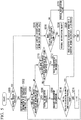
- FIG. 4 is a flowchart showing an outline of a flow of a process to be executed by the processor 30 (the IC chip 20 and the collation processor 60). For example, the process of the present flowchart is iterated in a predetermined cycle.
- the processor 30 waits for a command to be received from the terminal device 100 by the UART 24 (step S100).
- the processor 30 performs a mutual authentication process between the IC chip 20 and the collation processor 60.
- Mutual authentication means that both the IC chip 20 and the collation processor 60 mutually authenticate a legitimacy of a partner. For example, when a receiving side can decrypt information encrypted by a transmitting side, the legitimacy of both the sides is authenticated.
- the command processor 34 implemented by the IC chip 20 generates a temporary session key on the basis of the common key 46 pre-stored in the storage 40 and a random number generated by a predetermined rule and encrypts information to be transmitted using this session key.
- the command processor 34 uses information obtained by performing an exclusive OR operation on the common key 46 and the random number as the session key. Then, the command processor 34 transmits the encrypted information and the generated random number to the collation processor 60.
- the session key is an example of a "public key.”
- the biometric information collator 32 implemented by the collation processor 60 generates a session key on the basis of the common key 46 stored in the storage 40 and the random number transmitted by the command processor 34 and uses this session key to decrypt the information encrypted by the command processor 34.
- the biometric information collator 32 sets information obtained by performing an exclusive OR operation on the encrypted information and the session key as information before encryption.
- the processor 30 performs the process shown in the flowchart while performing such a mutual authentication process. That is, it is assumed that information transmitted and received between the IC chip 20 and the collation processor 60 for implementing the processor 30 is encrypted.
- the processor 30 transmits request information for requesting transmission of fingerprint information to the fingerprint sensor 50 (step S104).
- the fingerprint sensor 50 transmits the fingerprint information in a predetermined data format and transmission period.
- the processor 30 waits for the fingerprint information to be transmitted by the fingerprint sensor 50 (step S106).
- the processor 30 stores the fingerprint information into the storage 40 and collates the fingerprint information acquired by the fingerprint sensor 50 with each of a plurality of pieces of biometric authentication information 42 pre-stored in the storage 40 (step S108).
- the processor 30 performs a process of updating the biometric authentication information 42 in accordance with a result of collating the fingerprint information with each piece of biometric authentication information 42 (step S110). Details of the process of updating the biometric authentication information 42 will be described below.
- the processor 30 performs command processing in accordance with a collation result (a personal authentication result), and transmits a response, which is a command processing result, to the terminal device 100 via the UART 24 (step S112). Thereby, the process of this flowchart ends.
- FIG. 5 is a flowchart showing an example of the process of updating the biometric authentication information 42 (the above-described processing of S110).
- the processor 30 determines whether or not an iterated process of the above-described flowchart is an n th process (n is the number of pieces of biometric authentication information 42) (step S200) and selects one piece of the biometric authentication information as a processing target from among n pieces of the biometric authentication information 42 in a case that it is determined that the process is not the n th process and the number of iterations is less than n (step S202).
- i th biometric authentication information one piece of the biometric authentication information selected as the processing target.
- the processor 30 determines whether or not a result of collating the i th biometric authentication information selected as the processing target with the fingerprint information acquired in response to the request (the fingerprint information received in the processing of S106) satisfies a first predetermined condition (step S204).
- the first predetermined condition is, for example, that a score indicating a degree of matching of information as a collation result is greater than or equal to a certain first threshold value Th1 (score value ⁇ first threshold value Th1).
- the first predetermined condition is an example of a "predetermined condition.”
- the processor 30 determines that the personal authentication has succeeded (the user of the IC card 1 is a person identical to a card owner) (step S206).
- the processor 30 discards the fingerprint information acquired in response to the request from the storage 40 (step S208).
- the processor 30 determines whether or not the result of collating the i th biometric authentication information with the fingerprint information satisfies a second predetermined condition (step S210).
- the second predetermined condition is, for example, that a score indicating a degree of matching of information as a collation result is less than the first threshold value Th1 and greater than or equal to a second threshold value Th2 that is smaller than the first threshold value Th1 (first threshold value Th1 > score value ⁇ second threshold value Th2).
- the processor 30 causes the storage 40 to hold the fingerprint information acquired in response to the request as it is without confirming whether or not personal authentication has succeeded (step S212).
- the processor 30 proceeds to the processing of S208 without confirming whether or not the personal authentication has succeeded and discards the fingerprint information acquired in response to the request from the storage 40.
- the processor 30 determines whether or not all of the n pieces of the biometric authentication information 42 have been selected as the processing target (step S214), selects one piece of the biometric authentication information 42 as "i+1 th biometric authentication information" from among one or more other pieces of the biometric authentication information 42 excluding the biometric authentication information 42 already selected as the processing target in a case that it is determined that not all the biometric authentication information 42 as the processing target has been selected (step S216), and moves to the processing of S204 described above.
- the processor 30 selects biometric authentication information different from biometric authentication information (hereinafter referred to as update target biometric authentication information) whose collation result does not satisfy the first predetermined condition from among the n pieces of the biometric authentication information 42 in the course of processing up to a previous (n-1) th process (step S218).
- update target biometric authentication information biometric authentication information different from biometric authentication information
- the processor 30 determines whether or not each result of collating the biometric authentication information different from the update target biometric authentication information with the fingerprint information acquired in response to the request (fingerprint information acquired in the processing of S106 in the (n-1) th process) satisfies the first predetermined condition (step S220).
- the processor 30 determines that the personal authentication has failed (the user of the IC card 1 is not a person identical to the card owner) (step S222).
- the processor 30 determines that the personal authentication has succeeded (the user of the IC card 1 is a person identical to the card owner) (step S224).
- the processor 30 updates each piece of the update target biometric authentication information by rewriting the update target biometric authentication information with the fingerprint information held in the storage 40 until the (n-1) th process (step S226). Thereby, the process of this flowchart ends.
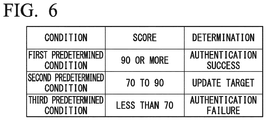
- FIG. 6 is a diagram showing an example of a score serving as a threshold value for each condition.
- the first predetermined condition is that the score is 90 or more in a case that a maximum value is 100 and it is determined that the personal authentication has succeeded in a case that the first predetermined condition is satisfied.
- the second predetermined condition is that the score is 70 or more and less than 90 and biometric authentication information which is target for obtaining the score is determined to be biometric authentication information to be updated in a case that the second predetermined condition is satisfied.
- a third predetermined condition is that the score is less than 70 and it is determined that the personal authentication has failed in a case that the third predetermined condition is satisfied.
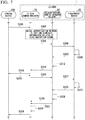
- FIG. 7 is a sequence diagram showing an example of a process to be executed by the terminal device 100 and the IC card 1.
- two types of biometric authentication information are stored in the storage 40, and a collation process (a personal authentication process) is performed using the two types of biometric authentication information.
- biometric authentication information A one of the two types of biometric authentication information
- biometric authentication information B one of the two types of biometric authentication information
- the IC chip 20 configured to implement the command processor 34 and the collation processor 60 configured to implement the biometric information collator 32 will be described as subjects of operations.
- the IC chip 20 may be replaced with the command processor 34 and the collation processor 60 may be replaced with the biometric information collator 32.
- the terminal device 100 transmits a command for requesting personal authentication to the IC chip 20 of the IC card 1 (step S300).
- the IC chip 20 (the command processor 34) generates a temporary session key on the basis of the common key 46 pre-stored in the storage 40 and a random number generated by a predetermined rule (step S302).
- the IC chip 20 reads the two type of biometric authentication information A and B stored in the storage 40, encrypts the biometric authentication information A and B with the session key, and transmits the encrypted biometric authentication information A and B and the generated random number to the collation processor 60 (step S304).
- the collation processor 60 (the biometric information collator 32) transmits request information for requesting transmission of the fingerprint information to the fingerprint sensor 50 (step S306).
- the fingerprint sensor 50 acquires fingerprint information X (step S308) and transmits the fingerprint information X to the collation processor 60 in a predetermined data format and transmission period (step S310).
- the collation processor 60 stores the fingerprint information X received from the fingerprint sensor 50 into the storage 40, generates a session key on the basis of the random number received from the IC chip 20 and the common key 46 stored in the storage 40, and decrypts the encrypted biometric authentication information A and B by using this session key. Then, the collation processor 60 collates each piece of the decrypted biometric authentication information A and B with the fingerprint information X acquired by the fingerprint sensor 50 (step S312).
- FIG. 8 is a diagram showing an example of processing content corresponding to collation results when two types of biometric authentication information are used. For example, when the score of the biometric authentication information A for the fingerprint information X received in the processing of S310 is 90 or more (when the first predetermined condition is satisfied), the collation processor 60 determines that the personal authentication has succeeded in a case that the score of the other biometric authentication information B is less than 90.
- the collation processor 60 determines that the success or failure of the personal authentication is not confirmed in a case that the score of the other biometric authentication information B is less than 90. At this time, the collation processor 60 causes the storage 40 to hold the stored fingerprint information X as it is. In a case that a determination result indicating that the success or failure of the personal authentication is not confirmed is obtained, the terminal device 100 retransmits a command for requesting the personal authentication to the IC card 1. Thereby, the IC card 1 side moves to a second collation process.
- the collation processor 60 determines that the success or failure of the personal authentication is not confirmed in a case that the score of the other biometric authentication information B is less than 90. At this time, the collation processor 60 causes the storage 40 to discard the stored fingerprint information X without holding it. Because the determination result indicating that the success or failure of the personal authentication is not confirmed is obtained as described above, the terminal device 100 retransmits a command for requesting personal authentication to the IC card 1. Thereby, the IC card 1 side moves to the second collation process.
- the collation processor 60 performs a determination in accordance with scores of the biometric authentication information A and B, encrypts the collation results of the biometric authentication information by using the generated session key, and transmits the encrypted collation results to the IC chip 20 (step S314).
- the IC chip 20 uses the session key used when biometric authentication information A and B are encrypted to decode the collation results transmitted by the collation processor 60 and executes command processing corresponding to a command received in the processing of S300 on the basis of the decoded collation results. Then, the IC chip 20 transmits a response, which is a command processing result, to the terminal device 100 via the UART 24 (step S316).
- the terminal device 100 having received the response retransmits a command for requesting personal authentication to the IC chip 20 of the IC card 1 in a case that the content of the response is an authentication result other than "success of personal authentication" (step S318).
- the IC chip 20 reads the two types of biometric authentication information A and B from the storage 40, encrypts the biometric authentication information A and B with the session key, and transmits the encrypted biometric authentication information A and B and the generated random number to the collation processor 60 (step S320).
- the collation processor 60 transmits request information for requesting transmission of fingerprint information to the fingerprint sensor 50 (step S322).
- the fingerprint sensor 50 having received the request information acquires fingerprint information Y (step S324) and transmits the fingerprint information Y to the collation processor 60 in a predetermined data format and transmission period (step S326).
- the collation processor 60 decrypts the encrypted biometric authentication information A and B by using the session key generated when a first command is received. Then, the collation processor 60 collates each piece of the decrypted biometric authentication information A and B with the fingerprint information Y acquired by the fingerprint sensor 50 (step S328).
- FIG. 9 is a diagram showing an example of processing content corresponding to collation results when two types of biometric authentication information are used. For example, when the score of the biometric authentication information B different from the biometric authentication information A (update target biometric authentication information) of which the collation result does not satisfy the first predetermined condition when the first command is received among scores of biometric authentication information for the fingerprint information Y received in the processing of S324 is 90 or more (when the first predetermined condition is satisfied), the collation processor 60 determines that the personal authentication has succeeded in a case that the score of the other biometric authentication information A is less than 90. The collation processor 60 transmits the fingerprint information X held in the storage 40 to the IC chip 20 when the first command is received together with the determination result.
- the fingerprint information X temporarily stored in the storage 40 is discarded, so that the collation processor 60 does not transmit the fingerprint information X to the IC chip 20.
- the collation processor 60 discards the fingerprint information X held in the storage 40 when the first command is received and determines that the personal authentication has failed in a case that the score of the biometric authentication information A is less than 90.
- the collation processor 60 performs a determination in accordance with the scores of the biometric authentication information A and B, encrypts collation results of the biometric authentication information, and transmits the encrypted collation results to the IC chip 20 (step S330).
- the collation processor 60 discards the session key generated when the first command is received, generates a new session key by performing an exclusive OR operation on the fingerprint information X temporarily held in the storage 40 and the common key 46, and encrypts collation results of the biometric authentication information by using the session key. Then, the collation processor 60 transmits the collation results encrypted using the new session key and the fingerprint information X to the IC chip 20 (step S332).
- the IC chip 20 determines whether or not there is a change in the session key of the collation processor 60 in accordance with the presence or absence of the fingerprint information X of information received from the collation processor 60 (step S334). For example, in a case that the fingerprint information X is not included in the received information, the IC chip 20 determines that the session key has not been changed and uses the session key generated when the first command is received to decode the collation results transmitted by the collation processor 60.
- the IC chip 20 determines that the session key has been changed, generates a new session key by using the received fingerprint information X and the common key 46 stored in the storage 40, and uses the newly generated session key to decrypt the encrypted collation results.
- the IC chip 20 updates update target biometric authentication information serving as a processing target when the first command is received, that is, the biometric authentication information A, to the received fingerprint information X.
- the IC chip 20 may extract features such as feature quantities and feature points from the fingerprint information X at appropriate times, and designate the extracted features as update target biometric authentication information.
- the IC chip 20 executes command processing corresponding to the command received in the processing of S318 on the basis of the decrypted collation results. Then, the IC chip 20 transmits a response, which is a command processing result, to the terminal device 100 via the UART 24 (step S336).
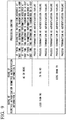
- FIG. 10 is a diagram schematically showing sequence processing illustrated in FIG. 9 .
- the biometric authentication information A of which the score is less than 90 in the first and second processes is updated to the fingerprint information X.
- a communicator (24) configured to communicate with a terminal device (100); a storage (40) storing a plurality of pieces of biometric authentication information (42); an acquirer (50) configured to acquire biometric information (fingerprint information) of a user; and the processor (30) configured to collate the biometric information acquired by the acquirer with each of the plurality of pieces of biometric authentication information stored in the storage in a case that a command is received from the terminal device through the communicator and update some of the plurality of pieces of biometric authentication information stored in the storage to information on the basis of the biometric information acquired by the acquirer in accordance with collation results for the biometric authentication information, so that it is possible to improve the accuracy of authentication using biometric information.
- the second person authentication is further performed.
- a degree of matching between the newly acquired biometric information and the pre-registered biometric authentication information is greater than or equal to the first threshold value Th1
- biometric authentication information for which a person's identity is likely to be confirmed in the first personal authentication is updated to first acquired biometric information. Because the biometric authentication information is updated at the appropriate time in the operation process of the IC card 1, security can be improved.
- the session key used for encrypting information is generated using biometric information to be updated, it is possible to further improve security.
- An integrated circuit card including:
- Entities such as a communicator, storage, acquirer, processor etc. method steps or processes may be implemented in terms of hardware and/or in software. If said entity is implemented in hardware, it may be embodied as a device, e.g. as a computer or as a processor or as a part of a system, e.g. a computer system. If said entity is implemented in software it may be embodied as a software service, computer program product, as a function, as a routine, as a program code or as an executable object.
- this disclosure relates to a computer program product comprising program code for executing the above-described method for controlling when run on at least one computer or processor device.
- the respective device or process may determine if the biometric information matches with predetermined authentic information. Collating can be understood as recognizing as to whether a data set or a representation of biometric information corresponds or matches with a second data set or a representation of the biometric information, wherein the second data set or representation refers to genuine biometric information. In embodiments "collating" may correspond to "comparing".
Landscapes
- Engineering & Computer Science (AREA)
- Physics & Mathematics (AREA)
- General Physics & Mathematics (AREA)
- Theoretical Computer Science (AREA)
- Computer Security & Cryptography (AREA)
- Human Computer Interaction (AREA)
- Computer Networks & Wireless Communication (AREA)
- Signal Processing (AREA)
- Computer Hardware Design (AREA)
- Microelectronics & Electronic Packaging (AREA)
- Multimedia (AREA)
- Health & Medical Sciences (AREA)
- Biodiversity & Conservation Biology (AREA)
- Biomedical Technology (AREA)
- General Health & Medical Sciences (AREA)
- Life Sciences & Earth Sciences (AREA)
- Software Systems (AREA)
- Computing Systems (AREA)
- General Engineering & Computer Science (AREA)
- Collating Specific Patterns (AREA)
- Credit Cards Or The Like (AREA)
Applications Claiming Priority (1)
| Application Number | Priority Date | Filing Date | Title |
|---|---|---|---|
| JP2017055786A JP6946031B2 (ja) | 2017-03-22 | 2017-03-22 | Icカード、およびicカードの制御方法 |
Publications (2)
| Publication Number | Publication Date |
|---|---|
| EP3379457A2 true EP3379457A2 (de) | 2018-09-26 |
| EP3379457A3 EP3379457A3 (de) | 2018-11-28 |
Family
ID=61557187
Family Applications (1)
| Application Number | Title | Priority Date | Filing Date |
|---|---|---|---|
| EP18159706.3A Withdrawn EP3379457A3 (de) | 2017-03-22 | 2018-03-02 | Ic-karte und verfahren zur steuerung einer ic-karte |
Country Status (4)
| Country | Link |
|---|---|
| US (1) | US10872137B2 (de) |
| EP (1) | EP3379457A3 (de) |
| JP (1) | JP6946031B2 (de) |
| SG (1) | SG10201801705UA (de) |
Cited By (1)
| Publication number | Priority date | Publication date | Assignee | Title |
|---|---|---|---|---|
| US20230261864A1 (en) * | 2020-11-02 | 2023-08-17 | Kabushiki Kaisha Toshiba | Ic card, portable electronic device, and issuing device |
Families Citing this family (8)
| Publication number | Priority date | Publication date | Assignee | Title |
|---|---|---|---|---|
| US10700856B2 (en) * | 2013-11-19 | 2020-06-30 | Network-1 Technologies, Inc. | Key derivation for a module using an embedded universal integrated circuit card |
| JP6721435B2 (ja) * | 2016-07-04 | 2020-07-15 | 株式会社東芝 | Icカード、携帯可能電子装置及び情報処理方法 |
| US10984304B2 (en) | 2017-02-02 | 2021-04-20 | Jonny B. Vu | Methods for placing an EMV chip onto a metal card |
| USD956760S1 (en) * | 2018-07-30 | 2022-07-05 | Lion Credit Card Inc. | Multi EMV chip card |
| JP7204439B2 (ja) * | 2018-11-21 | 2023-01-16 | 株式会社東芝 | Icカード、携帯可能電子装置、icカード処理方法及びプログラム |
| JP7414545B2 (ja) * | 2020-01-20 | 2024-01-16 | 株式会社東芝 | 携帯可能な認証デバイス、icカードおよび認証システム |
| EP4310754A4 (de) * | 2021-03-18 | 2025-03-12 | Kabushiki Kaisha Toshiba | Fernausgabesystem und datenerzeugungsserver |
| JP7528904B2 (ja) * | 2021-10-14 | 2024-08-06 | 大日本印刷株式会社 | 情報処理方法、カード、セキュアデバイス、マイクロコントローラ及びコンピュータプログラム |
Family Cites Families (29)
| Publication number | Priority date | Publication date | Assignee | Title |
|---|---|---|---|---|
| JP2949555B2 (ja) * | 1994-03-31 | 1999-09-13 | 富士通電装株式会社 | 指紋認識用辞書登録更新方法 |
| JPH11143833A (ja) * | 1997-11-14 | 1999-05-28 | Toshiba Corp | 生体データによるユーザ確認システム及びicカード並びに記録媒体 |
| JPH11312225A (ja) * | 1998-04-30 | 1999-11-09 | Dainippon Printing Co Ltd | 指紋読取認証機能付きicカード |
| JP2000094873A (ja) | 1998-09-18 | 2000-04-04 | Oki Electric Ind Co Ltd | 個人識別カードシステム |
| AU729157B1 (en) | 1999-08-02 | 2001-01-25 | Ming-Shiang Shen | Integrated circuit card with fingerprint verification capability |
| JP3749640B2 (ja) * | 1999-10-15 | 2006-03-01 | 株式会社東芝 | Icカード利用装置、icカード及び記憶媒体 |
| JP3754004B2 (ja) | 2002-05-20 | 2006-03-08 | システムニーズ株式会社 | データ更新方法 |
| US7543156B2 (en) | 2002-06-25 | 2009-06-02 | Resilent, Llc | Transaction authentication card |
| CZ2005209A3 (cs) | 2002-09-10 | 2005-12-14 | Ivi Smart Technologies, Inc. | Bezpečné biometrické ověření identity |
| JP4314016B2 (ja) | 2002-11-01 | 2009-08-12 | 株式会社東芝 | 人物認識装置および通行制御装置 |
| US20080122577A1 (en) | 2003-05-12 | 2008-05-29 | Srinivas Gutta | System and Method for Selectively Activating Biometric Sensors |
| US9286457B2 (en) | 2004-06-14 | 2016-03-15 | Rodney Beatson | Method and system for providing password-free, hardware-rooted, ASIC-based authentication of a human to a mobile device using biometrics with a protected, local template to release trusted credentials to relying parties |
| JP4559181B2 (ja) * | 2004-10-08 | 2010-10-06 | 富士通株式会社 | ユーザ認証装置、電子機器、およびユーザ認証プログラム |
| JP2006119811A (ja) | 2004-10-20 | 2006-05-11 | Seiko Epson Corp | Icカード |
| JP4607542B2 (ja) | 2004-10-26 | 2011-01-05 | 富士通株式会社 | データ処理装置 |
| JP2006163492A (ja) | 2004-12-02 | 2006-06-22 | Dainippon Printing Co Ltd | 決済システム |
| WO2007008159A2 (en) * | 2005-07-11 | 2007-01-18 | Volvo Technology Corporation | Method for performing driver identity verification |
| JP4815912B2 (ja) | 2005-07-15 | 2011-11-16 | 大日本印刷株式会社 | Icカード、icカード用プログラム |
| EP1811412A1 (de) | 2005-08-04 | 2007-07-25 | Intelligent Wave Inc. | Computersteuerverfahren mit einer extern verbundenen einrichtung und computersteuersystem |
| JP2007233461A (ja) | 2006-02-27 | 2007-09-13 | Hitachi Software Eng Co Ltd | 生体認証システム |
| JP2009531752A (ja) | 2006-03-27 | 2009-09-03 | ボラーチ,ファブリジオ | 個人用セキュアカードの作成方法及びその動作過程 |
| JP2007334707A (ja) | 2006-06-16 | 2007-12-27 | Hitachi Omron Terminal Solutions Corp | 複数の生体情報で認証を行う生体認証装置及びその方法 |
| US20150286922A1 (en) | 2008-02-28 | 2015-10-08 | Ivi Holdings Ltd. | Biometric identity verification system and method |
| JP2010061528A (ja) * | 2008-09-05 | 2010-03-18 | Fujitsu Ltd | 生体認証装置、生体認証プログラム及び生体認証方法 |
| JP4999193B2 (ja) | 2008-11-25 | 2012-08-15 | エイエスディ株式会社 | 指紋認証機能搭載携帯型装置 |
| US8756680B2 (en) | 2011-08-02 | 2014-06-17 | Corning Incorporated | Biometric-enabled smart card |
| JP3201473U (ja) * | 2015-09-28 | 2015-12-10 | 中科實業股▲ふん▼有限公司 | 指紋認証機能を内蔵したicカード |
| KR101913110B1 (ko) | 2016-10-13 | 2018-12-28 | 코나아이 (주) | 지문 인식 카드 및 지문 인식 카드를 이용한 카드 동작 방법 |
| CN106503777A (zh) | 2016-12-30 | 2017-03-15 | 镇江市民卡有限公司 | 一种新型智能市民卡 |
-
2017
- 2017-03-22 JP JP2017055786A patent/JP6946031B2/ja active Active
-
2018
- 2018-03-01 US US15/909,061 patent/US10872137B2/en active Active
- 2018-03-02 SG SG10201801705UA patent/SG10201801705UA/en unknown
- 2018-03-02 EP EP18159706.3A patent/EP3379457A3/de not_active Withdrawn
Non-Patent Citations (1)
| Title |
|---|
| None |
Cited By (2)
| Publication number | Priority date | Publication date | Assignee | Title |
|---|---|---|---|---|
| US20230261864A1 (en) * | 2020-11-02 | 2023-08-17 | Kabushiki Kaisha Toshiba | Ic card, portable electronic device, and issuing device |
| US12512980B2 (en) * | 2020-11-02 | 2025-12-30 | Kabushiki Kaisha Toshiba | IC card, portable electronic device, and issuing device |
Also Published As
| Publication number | Publication date |
|---|---|
| JP6946031B2 (ja) | 2021-10-06 |
| SG10201801705UA (en) | 2018-10-30 |
| JP2018160014A (ja) | 2018-10-11 |
| US10872137B2 (en) | 2020-12-22 |
| US20180276358A1 (en) | 2018-09-27 |
| EP3379457A3 (de) | 2018-11-28 |
Similar Documents
| Publication | Publication Date | Title |
|---|---|---|
| EP3379457A2 (de) | Ic-karte und verfahren zur steuerung einer ic-karte | |
| EP3379456B1 (de) | Ic-karte und verfahren zur steuerung einer ic-karte | |
| TWI669658B (zh) | Portable electronic device | |
| US10354055B2 (en) | Portable electronic device and system | |
| TW201804350A (zh) | Ic卡、可攜式電子裝置及資訊處理方法 | |
| US10523669B2 (en) | Server, IC card processing apparatus, and IC card processing system | |
| KR20220084058A (ko) | 장치 외 생체인식 등록 | |
| US20200314094A1 (en) | Server, method for controlling server, and terminal device | |
| US10915616B2 (en) | IC module, IC card, and verification device | |
| JP2012238256A (ja) | 生体認証装置、生体認証方法および生体認証プログラム | |
| KR20220131003A (ko) | 생체 데이터를 암호화하는 전자 장치 및 전자 장치의 동작 방법 | |
| EP1421542B1 (de) | Elektronisches schreibgerät und verfahren zur erzeugung einer elektronischen signatur | |
| JP2018151799A (ja) | Icカード、およびicカードの制御方法 | |
| JP7080768B2 (ja) | Icカード、およびicカードの制御方法 | |
| JP6790839B2 (ja) | セキュアエレメント、uimカード、認証方法、及び認証プログラム | |
| CN107615299A (zh) | 用于评估指纹模板的方法和系统 | |
| KR102010764B1 (ko) | 스마트폰 인증 기능을 이용한 컴퓨터 보안 시스템 및 방법 | |
| JP2020046778A (ja) | Icカード及び携帯可能電子装置 | |
| JP2006163492A (ja) | 決済システム | |
| US11829825B2 (en) | Portable electronic device, IC card and program | |
| JP2019192094A (ja) | Icカード、icカードの本人認証方法 | |
| JP2025023433A (ja) | 携帯可能電子装置およびicカード | |
| JP2022000729A (ja) | Icカード及び携帯可能電子装置 | |
| JP2022017848A (ja) | 携帯可能電子装置、icカードおよび認証管理システム | |
| JP2006188859A (ja) | 入退室管理システム |
Legal Events
| Date | Code | Title | Description |
|---|---|---|---|
| PUAI | Public reference made under article 153(3) epc to a published international application that has entered the european phase |
Free format text: ORIGINAL CODE: 0009012 |
|
| STAA | Information on the status of an ep patent application or granted ep patent |
Free format text: STATUS: REQUEST FOR EXAMINATION WAS MADE |
|
| 17P | Request for examination filed |
Effective date: 20180302 |
|
| AK | Designated contracting states |
Kind code of ref document: A2 Designated state(s): AL AT BE BG CH CY CZ DE DK EE ES FI FR GB GR HR HU IE IS IT LI LT LU LV MC MK MT NL NO PL PT RO RS SE SI SK SM TR |
|
| AX | Request for extension of the european patent |
Extension state: BA ME |
|
| PUAL | Search report despatched |
Free format text: ORIGINAL CODE: 0009013 |
|
| AK | Designated contracting states |
Kind code of ref document: A3 Designated state(s): AL AT BE BG CH CY CZ DE DK EE ES FI FR GB GR HR HU IE IS IT LI LT LU LV MC MK MT NL NO PL PT RO RS SE SI SK SM TR |
|
| AX | Request for extension of the european patent |
Extension state: BA ME |
|
| RIC1 | Information provided on ipc code assigned before grant |
Ipc: G06K 19/07 20060101ALI20181025BHEP Ipc: G06K 9/00 20060101AFI20181025BHEP |
|
| STAA | Information on the status of an ep patent application or granted ep patent |
Free format text: STATUS: EXAMINATION IS IN PROGRESS |
|
| 17Q | First examination report despatched |
Effective date: 20201015 |
|
| STAA | Information on the status of an ep patent application or granted ep patent |
Free format text: STATUS: THE APPLICATION IS DEEMED TO BE WITHDRAWN |
|
| 18D | Application deemed to be withdrawn |
Effective date: 20221124 |