EP3379559B1 - Verfahren und systeme zur quantitativen massenanalyse - Google Patents
Verfahren und systeme zur quantitativen massenanalyse Download PDFInfo
- Publication number
- EP3379559B1 EP3379559B1 EP18163707.5A EP18163707A EP3379559B1 EP 3379559 B1 EP3379559 B1 EP 3379559B1 EP 18163707 A EP18163707 A EP 18163707A EP 3379559 B1 EP3379559 B1 EP 3379559B1
- Authority
- EP
- European Patent Office
- Prior art keywords
- ions
- precursor ions
- mass
- precursor
- scan
- Prior art date
- Legal status (The legal status is an assumption and is not a legal conclusion. Google has not performed a legal analysis and makes no representation as to the accuracy of the status listed.)
- Active
Links
Images



Classifications
-
- H—ELECTRICITY
- H01—ELECTRIC ELEMENTS
- H01J—ELECTRIC DISCHARGE TUBES OR DISCHARGE LAMPS
- H01J49/00—Particle spectrometers or separator tubes
- H01J49/0027—Methods for using particle spectrometers
- H01J49/0031—Step by step routines describing the use of the apparatus
-
- G—PHYSICS
- G01—MEASURING; TESTING
- G01N—INVESTIGATING OR ANALYSING MATERIALS BY DETERMINING THEIR CHEMICAL OR PHYSICAL PROPERTIES
- G01N27/00—Investigating or analysing materials by the use of electric, electrochemical, or magnetic means
- G01N27/62—Investigating or analysing materials by the use of electric, electrochemical, or magnetic means by investigating the ionisation of gases, e.g. aerosols; by investigating electric discharges, e.g. emission of cathode
-
- H—ELECTRICITY
- H01—ELECTRIC ELEMENTS
- H01J—ELECTRIC DISCHARGE TUBES OR DISCHARGE LAMPS
- H01J49/00—Particle spectrometers or separator tubes
- H01J49/004—Combinations of spectrometers, tandem spectrometers, e.g. MS/MS, MSn
- H01J49/0081—Tandem in time, i.e. using a single spectrometer
-
- H—ELECTRICITY
- H01—ELECTRIC ELEMENTS
- H01J—ELECTRIC DISCHARGE TUBES OR DISCHARGE LAMPS
- H01J49/00—Particle spectrometers or separator tubes
- H01J49/26—Mass spectrometers or separator tubes
- H01J49/34—Dynamic spectrometers
- H01J49/42—Stability-of-path spectrometers, e.g. monopole, quadrupole, multipole, farvitrons
- H01J49/4205—Device types
- H01J49/422—Two-dimensional RF ion traps
- H01J49/4225—Multipole linear ion traps, e.g. quadrupoles, hexapoles
-
- H—ELECTRICITY
- H01—ELECTRIC ELEMENTS
- H01J—ELECTRIC DISCHARGE TUBES OR DISCHARGE LAMPS
- H01J49/00—Particle spectrometers or separator tubes
- H01J49/26—Mass spectrometers or separator tubes
- H01J49/34—Dynamic spectrometers
- H01J49/42—Stability-of-path spectrometers, e.g. monopole, quadrupole, multipole, farvitrons
- H01J49/426—Methods for controlling ions
- H01J49/427—Ejection and selection methods
- H01J49/429—Scanning an electric parameter, e.g. voltage amplitude or frequency
-
- H—ELECTRICITY
- H01—ELECTRIC ELEMENTS
- H01J—ELECTRIC DISCHARGE TUBES OR DISCHARGE LAMPS
- H01J49/00—Particle spectrometers or separator tubes
- H01J49/0009—Calibration of the apparatus
Definitions
- This invention relates to mass spectrometry based quantitative analysis. More specifically, this invention relates to quantitative mass analysis of product ions dissociated from precursor species, some having multiple charge states, with different mass-to-charge (m/z) ratios injected into an ion trap mass analyzer in the same ion injection event.
- m/z mass-to-charge
- US-A-2011/006200 describes a method of quantitative mass analysis of precursor ion species of different mass-to-charge (m/z) ratios from the same or common ion injection event is disclosed.
- a plurality of precursor ion species with different respective m/z ratios are introduced into an ion trap mass analyzer at the same time.
- the precursor ion species are isolated.
- a first subset of the isolated precursor ions, which have a first m/z ratio range, is fragmented and scanned by dividing the scan into at least two separate scan windows.
- a first mass spectrum is generated for the fragment ions of the first subset of precursor ions.
- a second subset of the isolated precursor ions having a second m/z ratio is fragmented and scanned, and a second mass spectrum is generated for the fragment ions of the second subset of precursor ions.
- Embodiments of the present invention provide methods, systems, and apparatuses for quantitative mass analysis using ion trap mass analyzers.
- a method of operating an ion trap mass analyzer for quantification of analytes in a sample is provided in accordance with claim 1.
- the analytes may comprise, in various implementations, therapeutic drugs or their metabolites, drugs of abuse or their metabolites, and endogenous substances such as creatinine.
- the method includes introducing sample ions into the ion trap mass analyzer comprising an ion trap.
- the sample ions which are introduced into the ion trap in single or common ion injection events, include first precursor ions having a first mass-to-charge ratio (m/z) and second precursor ions having a second m/z.
- the first precursor ions are multiply charged. In some embodiments, both the first precursor ions and the second precursor ions are multiply charged.
- the method also includes concurrently isolating the first precursor ions and the second precursor ions and fragmenting (dissociating) the first precursor ions, but not the second precursor ions, to generate first product ions.
- the method further includes performing a first scan (alternately referred to as a first scan window) at a first value of a resonance ejection q (the value of the Mathieu parameter q at which resonance ejection occurs) to mass-selectively eject to a detector first product ions having m/z's lower than the second precursor ion m/z range, and performing a second scan (alternately referred to as a second scan window) at a second value of the resonance ejection q, lower than the first value, to mass-selectively eject to the detect first product ions having m/z's greater than the second precursor m/z range.
- a first scan (alternately referred to as a first scan window) at a first value of a resonance ejection q (the value of the Mathieu parameter q at which resonance ejection occurs) to mass-selectively eject to a detector first product ions having m/z's lower
- the low mass cut off (LMCO) may be maintained throughout the second scan at a value below the m/z of the second precursor ions, such that the second precursor ions do not develop unstable trajectories and are thereby retained in the trap for subsequent analysis.
- the method also includes fragmenting the second precursor ions to generate second product ions and performing a third scan to mass-selectively eject to the detector second product ions.
- the third analytical scan of the second product ions can also be divided into at least two separate scan windows.
- the first precursor ions are analyte precursor ions and the second precursor ions are internal standard precursor ions.
- the first precursor ions are internal standard precursor ions and the second precursor ions are analyte precursor ions.
- the internal standard may be, but is not limited to, an isotopologue of the analyte.
- the amount of the analyte in the sample may be determined using a relationship between intensities of the product ions in the first mass spectrum and the second mass spectrum.
- the first resonance ejection q value is approximately 0.78 and the second resonance ejection q value is approximately 0.30.
- a multi-notched broadband excitation waveform may be applied to concurrently isolate the first precursor ions and the second precursor ions from any background ions.
- the ions may be fragmented using collision-induced dissociation (CID).
- CID collision-induced dissociation
- an excitation waveform with a frequency which corresponds to or matches a secular frequency of the first precursor ions, but does not correspond to a secular frequency of the second precursor ions is applied, creating a resonance condition by which the first precursor ions pick up kinetic energy from the resonant field and undergo energetic collisions with molecules of a background gas and, causing dissociation.
- an excitation waveform with a frequency which corresponds to or matches a secular frequency of the second precursor ions is applied, creating a resonance condition by which the second precursor ions pick up energy from the resonant field and undergo energetic collisions with molecules of a background gas, causing dissociation.
- an ion trap mass spectrometer system adapted for quantitative mass analysis of precursor species.
- the mass spectrometer includes an ion source configured so as to generate a plurality of precursor ion species having different respective mass-to-charge ratios (m/z).
- the mass spectrometer also includes an ion trap mass analyzer comprising an ion trap positioned to receive the precursor ions.
- the precursor ions include first precursor ions having a first m/z range and second precursor ions having a second m/z range.
- the first precursor ions are multiply charged. In some embodiments, both the first precursor ions and the second precursor ions are multiply charged.
- the ion trap mass analyzer has a controller which is programmed with instructions to cause the ion trap mass analyzer to perform steps of: concurrently isolating the first precursor ion species and the second precursor ions; fragmenting the first precursor ions, but not the second precursor ions, to generate first product ions of m/z above and below the second m/z of the second multiply-charged precursor ions; performing a first scan divided into at least two separate scan windows to mass-selectively eject and detect the first product ions and acquire a first mass spectrum of the first product ions, while retaining in the ion trap the second precursor ions, by performing resonance ejections at different q-values in each scan window, while the low-mass cut-off (LMCO) is kept below the m/z of the second precursor ions; fragmenting the second precursor ions to generate second product ions; and performing a second scan to mass-selectively eject and detect the second product ions and acquire a second mass spectrum of the second product
- FIG. 1 illustrates an example of an ion trap mass spectrometer 100 which may be operated in accordance with embodiments of the present invention. It will be understood that certain features and configurations of mass spectrometer 100 are presented by way of illustrative examples, and should not be construed as limiting the methods of the present invention to implementation in a specific environment.
- An ion source which may take the form of a conventional electrospray ion source 105, generates ions from a sample material.
- the ion source may take the form of a direct sampling ion source such as the Paper Spray ionization system available from Prosolia (Indianapolis, IN), in which a sample (e.g., a biological fluid such as blood or plasma) is deposited on a porous wicking material and elctrosprayed from a tip of the material.
- a direct sampling ion source such as the Paper Spray ionization system available from Prosolia (Indianapolis, IN)
- a sample e.g., a biological fluid such as blood or plasma
- the ions are transported from ion source chamber 110, which for an electrospray source will typically be held at or near atmospheric pressure, through several intermediate chambers 120, 125 and 130 of successively lower pressure, to a vacuum chamber 135 in which ion trap 140 resides. Efficient transport of ions from ion source 105 to ion trap 140 is facilitated by a number of ion optic components, including quadrupole RF ion guides 145 and 150, octopole RF ion guide 155, skimmer 160, and electrostatic lenses 165 and 170. Ions may be transported between ion source chamber 110 and first intermediate chamber 120 through an ion transfer tube 175 that is heated to evaporate residual solvent and break up solvent-analyte clusters.
- ion optic components including quadrupole RF ion guides 145 and 150, octopole RF ion guide 155, skimmer 160, and electrostatic lenses 165 and 170.
- Ions may be transported between
- Intermediate chambers 120, 125 and 130 and vacuum chamber 135 are evacuated by a suitable arrangement of pumps to maintain the pressures therein at the desired values.
- intermediate chamber 120 communicates with a port of a mechanical pump (not depicted), and intermediate pressure chambers 125 and 130 and vacuum chamber 135 communicate with corresponding ports of a multistage, multiport turbo-molecular pump (also not depicted).
- Ion trap 140 includes axial trapping electrodes 180 and 185 (which may take the form of conventional plate lenses) positioned axially outward from the ion trap electrodes to assist in the generation of a potential well for axial confinement of ions, and also to effect controlled gating of ions into the interior volume of ion trap 140 in order to regulate the filling (injection) time of ion trap 140; for example, DC offset voltages applied to axial trapping electrode 180 (and/or electrodes located upstream in the ion path relative to axial trapping electrode 180) may be set to selectively allow or block the flow of ions into ion trap 140.
- a damping/collision gas inlet (not depicted), coupled to a source of an inert gas such as helium or argon, will typically be provided to controllably add a damping/collision gas to the interior of ion trap 140 in order to facilitate ion trapping, fragmentation and cooling.
- Ion trap 140 is additionally provided with at least one set of detectors 190 (wherein each set may consist of a single detector or multiple detectors) that generate a signal representative of the abundance of ions ejected from the ion trap.
- Ion trap 140 communicates with and operate under the control of a data and control system (not depicted), which will typically include a combination of one or more general purpose computers and application-specific circuitry and processors.
- a data and control system acquires and processes data and directs the functioning of the various components of mass spectrometer 100.
- the data and control system will have the capability of executing a set of instructions, typically encoded as software or firmware, for carrying out the analysis methods described herein.
- FIG. 2 depicts a cross-sectional view of ion trap 140, which may be constructed as a conventional two-dimensional ion trap of the type described by Schwartz et al. in "A Two-Dimensional Quadrupole Ion Trap Mass Spectrometer", J. Am. Soc. Mass Spectrometry, 13: 659-669 (2002 ).
- Ion trap 140 includes four elongated electrodes 210a, 210b, 210c, 210d, each electrode having an inwardly directed hyperbolic-shaped surface, arranged in two electrode pairs 220 and 230 aligned with and opposed across the trap centerline.
- the electrodes of one electrode pair 220 are each adapted with an aperture (slot) 235 extending through the thickness of the electrode in order to permit ejected ions to travel through the aperture to an adjacently located detector 190.
- a main RF trapping voltage source 240 applies opposite phases of an RF voltage to electrode pairs 220 and 230 to establish an RF trapping field that radially confines ions within the interior of ion trap 140.
- resonant ejection voltage source 250 applies an oscillatory voltage across apertured electrode pair 220 to create a dipole excitation field. The amplitude of the applied main trapping RF voltage is ramped such that ions come into resonance with the excitation field in order of their m/z's.
- the resonantly excited ions develop unstable trajectories and are ejected through apertures 235 to detectors 190.
- Control of the main RF trapping voltage, resonant ejection voltage, and CID excitation voltage applied to electrodes of ion trap 140, specifically adjustment of their amplitudes, is affected by a controller 260 that forms part of the data and control system.
- FIG. 2 depicts a conventionally arranged and configured two-dimensional ion trap
- practice of the invention should not be construed as being limited to any particular ion trap geometry or configuration.
- the ion trap may take the form of a symmetrically stretched, four-slotted ion trap of the type described in U.S. Patent 8,415,617 .
- the ion trap may also constitute a part of a dual ion trap mass analyzer structure disclosed in U.S. Patent 7,692,142 .
- the methods described herein may also be utilized in connection with conventional rotationally symmetric three-dimensional ion traps (including variants such as toroidal or cylindrical ion traps) as well as for rectilinear ion traps.
- FIG. 3 is a flowchart 300 depicting steps of a method of operating an ion trap mass analyzer for quantification of analytes in a sample, in accordance with one embodiment of the present invention.
- the sample may take the form a biological fluid, such as blood, plasma, saliva, or urine, or fraction thereof, or an extract from a biological tissue sample.
- the analyte may comprise, for example, a therapeutic drug or its metabolite, a drug of abuse or its metabolite, or an endogenous substance, such as creatinine or a steroid hormone.
- sample ions generated by the ionization source by ionizing molecules in the sample by an appropriate technique, are introduced into an ion trap mass analyzer.
- the sample ions include first precursor ions having a first m/z and second precursor ions having a second m/z, different from the first m/z.
- the first precursor ions are multiply charged.
- the first precursor ions are analyte precursor ions
- the second precursor ions are internal standard precursor ions.
- the internal standard from which the internal precursor ions are generated may consist of, but is not limited to, an isotopologue (e.g., a deuterated version) of the corresponding analyte. While the description set forth below discusses quantification of a single analyte, variants of this technique may quantify multiple analytes (e.g., a panel of two or more therapeutic drugs).
- the first precursor ions can be internal standard precursor ions, while the second precursor ions can be analyte precursor ions.
- the first precursor ions and the second precursor ions are introduced into the ion trap mass analyzer from a common injection event, i.e. the first and second precursor ions both enter the ion trap during a period defined by an injection start time (when the applied DC offset voltage(s) is/are set to allow the passage of ions into the ion trap) and an injection end time (when the applied DC offset voltage(s) is/are switched to a value that blocks the passage of ions into the ion trap).
- the first precursor ions and the second precursor ions are isolated concurrently (step 310) by removing ions having m/z's other than those of the first and second precursor ions.
- this operation is performed by applying oscillatory voltages to the ion trap electrodes to establish an electric field that kinetically excites the non-desired ions (those other than the first and second precursor ions) such that the excited ions are ejected from the ion trap or are neutralized via collisions with electrode surfaces.
- concurrent isolation of the first and second precursor ions is achieved by applying a notched multifrequency waveform voltage to the trap electrodes, as described in U.S. Patent No. 9,048,074 .
- the frequency notches are set to correspond to the secular frequencies of the ions to be isolated, such that those ions are not kinetically excited.
- the first precursor ions, but not the second precursor ions are fragmented to generated first product ions of m/z above and below the second m/z.
- Fragmentation may be carried out using collision induced dissociation (CID) by applying an excitation waveform with a frequency which closely matches a secular frequency of the first precursor ions but is sufficiently different from the secular frequency of the second precursor ions to avoid substantial resonant excitation thereof.
- CID collision induced dissociation
- the first precursor ions undergo energetic collisions with atoms or molecules of collision gas (also referred to as background or damping gas), causing them to fragment into first product ions, whereas the second precursor ions remain substantially unfragmented.
- the resultant product ions may include a first group having m/z's lower than that of the precursor ions (those product ions that retain the same charge state as the precursor) as well as a second group having m/z's higher than that of the precursor ions (those product ions having a reduced charge state relative to the precursor ions).
- a single analytical scan to acquire a product ion spectrum including both the lowm/z group and the high-m/z group would result in the ejection from the ion trap of the second precursor ions, which will typically have an m/z within the range spanned by the product ions.
- a multi-scan window approach may be employed, as described below.
- a first analytical scan is performed by dividing the scan into at least two separate scan windows to mass-selectively eject and detect the first product ions to the detector of the ion trap mass analyzer and thereby acquire a first mass spectrum of the first product ions, while retaining the second precursor ions in the ion trap.
- a resonance ejection scan is performed by gradually increasing the RF trapping voltage amplitude while applying an oscillatory resonance ejection voltage to trap electrodes.
- the resonance ejection q-value may be set to a "normal" (i.e., typical) value of approximately 0.78.
- the resonance ejection q-value is determined by the frequency of the applied oscillatory resonance ejection voltage.
- the RF trapping voltage amplitude ramp is terminated at a point at which the Mathieu parameter q of the second precursor ions is below the resonance ejection q, such that the second precursor ions are not resonantly ejected.
- the RF trapping voltage is reduced and a resonance ejection scan is performed in a second scan window to eject the higher-m/z product ions.
- the resonance ejection scan for the second window is performed at a reduced resonance ejection q value relative to the first scan window (by appropriately adjusting the frequency of the resonant ejection voltage applied to the trap); for example, if the resonance ejection q value for the first scan window is fixed at 0.78, the scan for the second scan window may be performed at a resonance ejection q-value between approximately 0.05 to approximately 0.77
- the q for the second precursor ions is maintained throughout the scan at a value less than the Mathieu instability limit of 0.908 (but above the resonant ejection q-value), thereby avoiding ejection of the second precursor ions from the trap.
- the first product ions with m/z values lower than the m/z value of the second precursor ions are resonantly ejected and detected in scan window 1 as shown in Figure 7c .
- the first product ions with m/z values higher than the m/z value of the second precursor ions and the second precursor ions are still retained in the trap.
- the q values of the retained ions are lowered as shown in Figure 7d .
- the resonance ejection at a lower q value is performed to eject the first product ions of m/z values higher than the second precursor ions in scan window 2 as shown in Figure 7e .
- the R.E. q value must be lower than the q value of the second precursor ions in the overall scan window 2.
- LMCO m z ⁇ q 0.908
- m/z the mass to charge ratio of an ion species while q is the q value of this ion species.
- the LMCO will be lower than the m/z value as long as the q value is kept lower than 0.908 by controlling the RF amplitude.
- the second precursor ions are not resonantly ejected nor do they fall below the LMCO. Thus, the second precursor ions are still retained in the ion trap.
- the second precursor ions (of higher m/z), which were retained in the ion trap mass analyzer, are fragmented in step 325 to generate second product ions.
- fragmentation is carried out using CID by applying an excitation waveform with a frequency that closely matches a secular frequency of the second precursor ions, creating a resonance condition by which the second precursor ions pick up energy and collide with molecules of a background gas and dissociate.
- a second analytical scan is performed to mass-selectively detect the second product ions and acquire a second mass spectrum that includes the second product ions.
- the selections of R.E. q value for analyzing the second product ions (of the second precursor ions) are quite flexible.
- a standard one window scan can be performed with one normal R.E. q value.
- a dual or multi window scan can be performed with same or different R.E. q values in each window. Any q values can be used in analyzing the second product ions, from about -0.1 to about 0.9.
- the R.E. q value for the second product ions are independent from the R.E. q values for the first product ions.
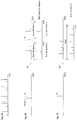
- FIGS. 4A-4C show a depiction of precursor species of different m/z ratios introduced into an ion trap mass analyzer from the same ion injection event.
- the precursor ions include multiply-charged analyte ions which are of lower m/z compared to the corresponding internal standard ("IS") ions.
- FIG. 4B illustrates MS 2 analysis of the precursor ions of the analyte. First, ions other than those of the targeted analyte species and its corresponding internal standard are ejected in the process of ion isolation, as shown on the left side of FIG. 4B .
- a notched multifrequency waveform can be used to isolate the precursor ion species.
- the analyte precursor ions and the internal standard precursor ions are concurrently isolated within an ion trap mass analyzer using a notched multifrequency waveform having frequency notches corresponding to the secular frequencies of the analyte and internal standard precursor ions, as is shown.
- the analyte precursor ions are then selectively fragmented (for example, using the CID technique with the excitation frequency tuned to match the secular frequency of the analyte ions) and then analyzed by scanning the RF amplitude in at least two separate scan windows at resonance ejection q-values associated with the m/z of the first product ions to eject particular product ions of the analyte to a detector, while the precursor ions of the internal standard are trapped and intact.
- a RF amplitude corresponding to a LMCO below the m/z of the internal standard precursor ions is scanned in each scan window at resonance ejection q-values associated with the m/z of the analyte product ions.
- a mass spectrum is generated for the fragment ions of the analyte, as shown on the right side of FIG. 4B .
- FIG. 4C illustrates, subsequent to the acquisition of the mass spectrum of the analyte precursor ions in FIG. 4B , mass analysis of product ions produced by fragmentation of the internal standard precursor ions.
- the analyte precursor ions have already been fragmented, analyzed and detected, leaving only the internal standard precursor ions.
- the internal standard precursor ions are selectively fragmented by (for example) the CID technique and a MS 2 spectrum is generated for the fragment ions of the internal standard, as shown on the right side of FIG. 4C , by mass-selective ejection of ions to the ion trap detector.
- spectra of the product ions of the multiply-charged analyte and the internal standard can be obtained using only a single ion accumulation step.
- the abundance of the product ions of the analyte and the internal standard can be used to calculate the ratio of analyte versus internal standard.
- the quantity of the analyte present in the sample may be calculated using a pre-calibrated relationship between the intensities of one or more characteristic product ions of the analyte appearing in the spectrum produced by the first analytical scan and the intensities of the corresponding characteristic product ions of the internal standard (which is added in a known quantity to the sample) appearing in the spectrum produced by the second analytical scan.
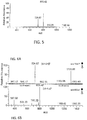
- FIG. 5 shows isolated precursor ions of an immunosuppressant solution containing precursor ions of analyte Vancomycin [(M+2H)2+] and internal standard Digoxin [M+Na]+.
- the solution contained 50 ⁇ g/ml of Vancomycin and 5 ⁇ g/ml of Digoxin, prepared in methanol/water (50/50) and infused to Nano-electrospray ionization (nanoESI) at a flow rate of 0.35 ⁇ l/min.
- a spray voltage of approximately 3 kV was applied to the solution.
- a dual-notch isolation waveform which has a dual isolation window, was constructed and applied in the steps of ion injection and ion isolation. As shown in FIG.
- precursor ions of analyte Vancomycin and internal standard Digoxin are isolated from any background ions.
- Precursor ions of lower m/z, doubly-charged ions of the analyte Vancomycin [(M+2H)2+] are firstly fragmented by collision induced dissociation (e.g., ion trap type resonant activated CID which is inherently m/z selective).
- FIG. 6A show a MS 2 spectrum of Vancomycin [(M+2H)2+] obtained in two RF scannings with different resonance ejection q-values.
- the product ions and undissociated precursor ions of the analyte Vancomycin of both lower and higher m/z than the internal standard precursor ions Digoxin [M+Na]+ are analyzed without destabilizing the internal standard precursor ions.
- the MS 2 spectrum of precursor ions of the lower m/z analyte Vancomycin [(M+2H)2+] ions the higher m/z internal standard precursor ions Digoxin [M+Na]+ are isolated (optional), fragmented, and scanned in one RF scanning as shown in FIG. 6B .
- multiply-charged precursor ions of different m/z, introduced from the same ion injection event can be analyzed respectively.
- the advantages of the present invention include higher efficiency of sample utilization. Multiple precursor ions of different m/z and multiple charge states can be analyzed with a single ion injection event giving improved precision for quantitative measurements. Other advantages of the present invention include the ability to practice the invention on simple, low cost, hardware configurations such as a single linear ion trap mass spectrometer.
Landscapes
- Chemical & Material Sciences (AREA)
- Analytical Chemistry (AREA)
- Physics & Mathematics (AREA)
- Electrochemistry (AREA)
- Health & Medical Sciences (AREA)
- Life Sciences & Earth Sciences (AREA)
- Chemical Kinetics & Catalysis (AREA)
- Biochemistry (AREA)
- General Health & Medical Sciences (AREA)
- General Physics & Mathematics (AREA)
- Immunology (AREA)
- Pathology (AREA)
- Other Investigation Or Analysis Of Materials By Electrical Means (AREA)
- Electron Tubes For Measurement (AREA)
Claims (14)
- Verfahren zum Betreiben eines lonenfallenmassenanalysators, umfassend eine Ionenfalle (140) zum Quantifizieren von Analyten in einer Probe, Folgendes umfassend:a. Einführen von Proben-Ionen in die Ionenfalle (140) in einem einzelnen Injektionsereignis, wobei die Proben-Ionen erste Vorläufer-Ionen, die ein erstes Masse-zu-Ladung-Verhältnis (m/z) aufweisen, und zweite Vorläufer-Ionen beinhalten, die ein zweites m/z aufweisen, wobei die ersten Vorläufer-Ionen mehrfach geladen sind;b. gleichzeitiges Isolieren der ersten Vorläufer-Ionen und der zweiten Vorläufer-Ionen;c. Fragmentieren der ersten Vorläufer-Ionen, jedoch nicht der zweiten Vorläufer-Ionen, um erste Produkt-Ionen eines m/z oberhalb und unterhalb des zweiten m/z zu erzeugen;d. Durchführen einer ersten Abtastung, die in wenigstens zwei separate Abtastfenster unterteilt ist, um die ersten Produkt-Ionen massenselektiv auszustoßen und zu erfassen und ein erstes Massenspektrum der ersten Produkt-Ionen zu gewinnen, während die zweiten Vorläufer-Ionen in der Ionenfalle (140) zurückgehalten werden, durch Durchführen von Resonanzausstößen mit unterschiedlichen q-Werten in jedem Abtastfenster, während der Low-Mass-Cut-Off (LMCO) unter dem m/z der zweiten Vorläufer-Ionen gehalten wird;e. Fragmentieren der zweiten Vorläufer-Ionen, um zweite Produkt-Ionen zu erzeugen; undf. Durchführen einer zweiten Abtastung, um die zweiten Produkt-Ionen massenselektiv auszustoßen und zu erfassen und ein zweites Massenspektrum der zweiten Produkt-Ionen zu gewinnen.
- Verfahren nach Anspruch 1, wobei die ersten Vorläufer-Ionen Analytvorläufer-Ionen oder Vorläufer-Ionen des internen Standards sind und die zweiten Vorläufer-Ionen das andere der Analytvorläufer-Ionen oder Vorläufer-Ionen des internen Standards sind.
- Verfahren nach Anspruch 2, ferner umfassend ein Bestimmen einer Menge des Analyten in der Probe unter Verwendung einer Beziehung zwischen Intensitäten der Produkt-Ionen in dem ersten Massenspektrum und dem zweiten Massenspektrum.
- Verfahren nach Anspruch 1, wobei der Schritt des gleichzeitigen Isolierens der ersten Vorläufer-Ionen und der zweiten Vorläufer-Ionen von beliebigen Hintergrund-Ionen ein Anlegen einer gekerbten Wellenform umfasst.
- Verfahren nach Anspruch 1, wobei das Fragmentieren unter Verwendung einer durch eine Ionenfalle kollisionsinduzierten Dissoziation (collision-induced dissociation - CID) ausgeführt wird.
- Verfahren nach Anspruch 1, wobei die Ausstoß-q-Werte in einem Bereich von 0,05 bis 0,90 liegen.
- Verfahren nach Anspruch 6, wobei der Resonanzausstoß-q-Wert des ersten Abtastfensters innerhalb der ersten Abtastung 0,78 beträgt und der Resonanzausstoß-q-Wert des zweiten Abtastfensters innerhalb der ersten Abtastung 0,30 beträgt.
- Verfahren nach Anspruch 1, wobei die HF-Amplitude von Produkt-Ionen mit niedrigem Massenwert bis zu Produkt-Ionen mit hohem Massenwert abgetastet wird.
- Verfahren nach Anspruch 1, wobei das Durchführen der zweiten Abtastung ein Aufteilen der zweiten Abtastung in wenigstens zwei separate Abtastfenster umfasst, um die zweiten Produkt-Ionen massenselektiv auszustoßen und zu erfassen und das zweite Massenspektrum der zweiten Produkt-Ionen zu gewinnen.
- lonenfallenmassenspektrometersystem (100) zum Quantifizieren von Analyten in einer Probe, Folgendes umfassend:a. eine lonenquelle (105), die konfiguriert ist, um Proben-Ionen zu erzeugen, wobei die Proben-Ionen erste Vorläufer-Ionen, die ein erstes Masse-zu-Ladung-Verhältnis (m/z) aufweisen, und zweite Vorläufer-Ionen beinhalten, die ein zweites m/z aufweisen, wobei die ersten Vorläufer-Ionen mehrfach geladen sind;b. einen lonenfallenmassenanalysator, umfassend eine Ionenfalle (140), die positioniert ist, um die Proben-Ionen aufzunehmen, wobei der lonenfallenmassenanalysator, der eine Steuerung (260) aufweist, mit einem Algorithmus programmiert ist, der Anweisungen an den lonenfallenmassenanalysator umfasst, den lonenfallenmassenanalysator zu veranlassen, die folgenden Schritte durchzuführen: (a) gleichzeitiges Isolieren der ersten Vorläufer-Ionen und der zweiten Vorläufer-Ionen; (b) um die ersten Vorläufer-Ionen zu fragmentieren, jedoch nicht der zweiten Vorläufer-Ionen, um erste Produkt-Ionen eines m/z oberhalb und unterhalb des zweiten m/z zu erzeugen; (c) Durchführen einer ersten Abtastung, die in wenigstens zwei separate Abtastfenster unterteilt ist, um die ersten Produkt-Ionen massenselektiv auszustoßen und zu erfassen und ein erstes Massenspektrum der ersten Produkt-Ionen zu gewinnen, während die zweiten Vorläufer-Ionen in der Ionenfalle (140) zurückgehalten werden, durch Durchführen von Resonanzausstößen mit unterschiedlichen q-Werten in jedem Abtastfenster, während der Low-Mass-Cut-Off (LMCO) unterhalb des m/z der zweiten Vorläufer-Ionen gehalten wird; (d) Fragmentieren der zweiten Vorläufer-Ionen, um zweite Produkt-Ionen zu erzeugen; und (e) Durchführen einer zweiten Abtastung, um die zweiten Produkt-Ionen massenselektiv auszustoßen und zu erfassen und ein zweites Massenspektrum der zweiten Produkt-Ionen zu gewinnen.
- System nach Anspruch 10, wobei die ersten Vorläufer-Ionen Analytvorläufer-Ionen oder Vorläufer-Ionen des internen Standards sind und die zweiten Vorläufer-Ionen das andere der Analytvorläufer-Ionen oder Vorläufer-Ionen des internen Standards sind.
- System nach Anspruch 11, wobei eine Menge des Analyten in der Probe unter Verwendung einer Beziehung zwischen Intensitäten der Produkt-Ionen in dem ersten Massenspektrum und dem zweiten Massenspektrum bestimmt wird.
- System nach Anspruch 10, wobei die Ausstoß-q-Werte in einem Bereich von 0,05 bis 0,90 liegen.
- System nach Anspruch 10, wobei das Durchführen der zweiten Abtastung das Aufteilen der zweiten Abtastung in wenigstens zwei separate Abtastfenster umfasst, um die zweiten Produkt-Ionen massenselektiv auszustoßen und zu erfassen und das zweite Massenspektrum der zweiten Produkt-Ionen zu gewinnen.
Applications Claiming Priority (1)
| Application Number | Priority Date | Filing Date | Title |
|---|---|---|---|
| US201762476507P | 2017-03-24 | 2017-03-24 |
Publications (2)
| Publication Number | Publication Date |
|---|---|
| EP3379559A1 EP3379559A1 (de) | 2018-09-26 |
| EP3379559B1 true EP3379559B1 (de) | 2022-01-05 |
Family
ID=61800343
Family Applications (1)
| Application Number | Title | Priority Date | Filing Date |
|---|---|---|---|
| EP18163707.5A Active EP3379559B1 (de) | 2017-03-24 | 2018-03-23 | Verfahren und systeme zur quantitativen massenanalyse |
Country Status (3)
| Country | Link |
|---|---|
| US (1) | US10347477B2 (de) |
| EP (1) | EP3379559B1 (de) |
| CN (1) | CN108627566A (de) |
Families Citing this family (4)
| Publication number | Priority date | Publication date | Assignee | Title |
|---|---|---|---|---|
| WO2017126006A1 (ja) * | 2016-01-18 | 2017-07-27 | 株式会社島津製作所 | イオントラップ質量分析装置及び該装置を用いた質量分析方法 |
| WO2021061650A1 (en) | 2019-09-25 | 2021-04-01 | The Trustees Of Indiana University | Apparatus and method for pulsed mode charge detection mass spectrometry |
| CN114728237B (zh) * | 2019-10-10 | 2026-02-24 | 印地安纳大学理事会 | 用于识别、选择和纯化粒子的系统和方法 |
| WO2025041062A1 (en) * | 2023-08-23 | 2025-02-27 | Dh Technologies Development Pte. Ltd. | Electron detachment method and device for oligonucleotide analysis in mass spectrometry |
Citations (1)
| Publication number | Priority date | Publication date | Assignee | Title |
|---|---|---|---|---|
| US20120305762A1 (en) * | 2010-03-24 | 2012-12-06 | Akihito Kaneko | Ion isolation method and mass spectrometer |
Family Cites Families (22)
| Publication number | Priority date | Publication date | Assignee | Title |
|---|---|---|---|---|
| US6147348A (en) | 1997-04-11 | 2000-11-14 | University Of Florida | Method for performing a scan function on quadrupole ion trap mass spectrometers |
| WO2003054549A2 (en) | 2001-12-08 | 2003-07-03 | Micromass Uk Limited | Method of mass spectrometry |
| JP4284167B2 (ja) | 2003-12-24 | 2009-06-24 | 株式会社日立ハイテクノロジーズ | イオントラップ/飛行時間型質量分析計による精密質量測定方法 |
| US20050253059A1 (en) * | 2004-05-13 | 2005-11-17 | Goeringer Douglas E | Tandem-in-time and-in-space mass spectrometer and associated method for tandem mass spectrometry |
| US7692142B2 (en) | 2006-12-13 | 2010-04-06 | Thermo Finnigan Llc | Differential-pressure dual ion trap mass analyzer and methods of use thereof |
| US7569813B2 (en) | 2007-08-21 | 2009-08-04 | Mds Analytical Technologies, A Business Unit Of Mds Inc. | Method for enhancing mass assignment accuracy |
| US8258462B2 (en) | 2008-09-05 | 2012-09-04 | Thermo Finnigan Llc | Methods of calibrating and operating an ion trap mass analyzer to optimize mass spectral peak characteristics |
| US7947948B2 (en) | 2008-09-05 | 2011-05-24 | Thermo Funnigan LLC | Two-dimensional radial-ejection ion trap operable as a quadrupole mass filter |
| WO2010045049A1 (en) | 2008-10-13 | 2010-04-22 | Purdue Research Foundation | Systems and methods for transfer of ions for analysis |
| US20110006200A1 (en) | 2009-07-07 | 2011-01-13 | Dh Technologies Development Pte. Ltd. | Methods And Apparatus For Mass Spectrometry With High Sample Utilization |
| JP5675442B2 (ja) | 2011-03-04 | 2015-02-25 | 株式会社日立ハイテクノロジーズ | 質量分析方法及び質量分析装置 |
| US8969798B2 (en) * | 2011-07-07 | 2015-03-03 | Bruker Daltonics, Inc. | Abridged ion trap-time of flight mass spectrometer |
| US9318310B2 (en) * | 2011-07-11 | 2016-04-19 | Dh Technologies Development Pte. Ltd. | Method to control space charge in a mass spectrometer |
| GB201122178D0 (en) * | 2011-12-22 | 2012-02-01 | Thermo Fisher Scient Bremen | Method of tandem mass spectrometry |
| WO2013112677A2 (en) * | 2012-01-24 | 2013-08-01 | Thermo Finnigan Llc | Multinotch isolation for ms3 mass analysis |
| EP2894654B1 (de) * | 2012-09-10 | 2019-05-08 | Shimadzu Corporation | Ionenauswahlverfahren in einer ionenfalle und ionenfalle |
| CN105143872B (zh) | 2013-06-07 | 2019-03-01 | 皮尔斯生物科技有限公司 | 通过质谱分析用复用内标物对蛋白质和蛋白质修饰的绝对定量 |
| JP2015011801A (ja) | 2013-06-27 | 2015-01-19 | 株式会社日立ハイテクノロジーズ | 質量分析方法及び質量分析装置 |
| CN103413751B (zh) * | 2013-07-18 | 2016-08-10 | 复旦大学 | 一种在离子阱质量分析器中进行的串级质谱分析方法 |
| WO2015023480A1 (en) | 2013-08-13 | 2015-02-19 | Purdue Research Foundation | Sample quantitation with a miniature mass spectrometer |
| US9818595B2 (en) | 2015-05-11 | 2017-11-14 | Thermo Finnigan Llc | Systems and methods for ion isolation using a dual waveform |
| US9911588B1 (en) * | 2017-03-10 | 2018-03-06 | Thermo Finnigan Llc | Methods and systems for quantitative mass analysis |
-
2018
- 2018-03-05 US US15/911,304 patent/US10347477B2/en active Active
- 2018-03-23 EP EP18163707.5A patent/EP3379559B1/de active Active
- 2018-03-23 CN CN201810245008.2A patent/CN108627566A/zh active Pending
Patent Citations (1)
| Publication number | Priority date | Publication date | Assignee | Title |
|---|---|---|---|---|
| US20120305762A1 (en) * | 2010-03-24 | 2012-12-06 | Akihito Kaneko | Ion isolation method and mass spectrometer |
Also Published As
| Publication number | Publication date |
|---|---|
| EP3379559A1 (de) | 2018-09-26 |
| CN108627566A (zh) | 2018-10-09 |
| US20180277345A1 (en) | 2018-09-27 |
| US10347477B2 (en) | 2019-07-09 |
Similar Documents
| Publication | Publication Date | Title |
|---|---|---|
| EP2102890B1 (de) | Duales ionenfallen-massenspektrometer auf der basis von differenzialdruck und verfahren zu seiner verwendung | |
| CN103650099B (zh) | 串联质谱法的靶向分析 | |
| EP2388798B1 (de) | Begrenzung positiver und negativer Ionen in einer linearen HF-Ionenfalle | |
| EP1084507B1 (de) | Axialejektion aus einem mutipolmassenspektrometer | |
| CN1833300B (zh) | 在离子总体中获取多个母离子的串联质谱分析数据 | |
| US7456397B2 (en) | Ion fragmentation by electron transfer in ion traps | |
| CN101213634A (zh) | 质谱测定法中的多离子注入 | |
| CA2654857C (en) | High throughput quadrupolar ion trap | |
| US10665441B2 (en) | Methods and apparatus for improved tandem mass spectrometry duty cycle | |
| US20080210860A1 (en) | Segmented ion trap mass spectrometry | |
| CN107690690B (zh) | 使用离子过滤的质量分析方法 | |
| EP3379559B1 (de) | Verfahren und systeme zur quantitativen massenanalyse | |
| US9911587B1 (en) | Methods and systems for quantitative mass analysis | |
| EP2798663A1 (de) | Verfahren zur extraktion von ionen mit niedrigem m/z-verhältnis aus einer ionenfalle | |
| US9911588B1 (en) | Methods and systems for quantitative mass analysis | |
| CN111312577A (zh) | 陷阱填充时间动态范围增强 | |
| EP2798666B1 (de) | Ionenextraktionsverfahren für ionenfallen-massenspektrometrie | |
| US11031232B1 (en) | Injection of ions into an ion storage device | |
| EP3916755A1 (de) | Verfahren und vorrichtung für hochgeschwindigkeitsmassenspektrometrie | |
| CN112534547B (zh) | Rf离子阱离子加载方法 | |
| EP3373324A1 (de) | Verfahren und systeme quantitativen massenanalyse | |
| CN113366609A (zh) | 用于优化离子阱填充的自动增益控制 | |
| GB2444358A (en) | Time division multiplexing mass spectrometry with beam converging capillary | |
| IL146238A (en) | Ionic mobility and mass spectrometer |
Legal Events
| Date | Code | Title | Description |
|---|---|---|---|
| PUAI | Public reference made under article 153(3) epc to a published international application that has entered the european phase |
Free format text: ORIGINAL CODE: 0009012 |
|
| STAA | Information on the status of an ep patent application or granted ep patent |
Free format text: STATUS: THE APPLICATION HAS BEEN PUBLISHED |
|
| AK | Designated contracting states |
Kind code of ref document: A1 Designated state(s): AL AT BE BG CH CY CZ DE DK EE ES FI FR GB GR HR HU IE IS IT LI LT LU LV MC MK MT NL NO PL PT RO RS SE SI SK SM TR |
|
| AX | Request for extension of the european patent |
Extension state: BA ME |
|
| STAA | Information on the status of an ep patent application or granted ep patent |
Free format text: STATUS: REQUEST FOR EXAMINATION WAS MADE |
|
| 17P | Request for examination filed |
Effective date: 20190325 |
|
| RBV | Designated contracting states (corrected) |
Designated state(s): AL AT BE BG CH CY CZ DE DK EE ES FI FR GB GR HR HU IE IS IT LI LT LU LV MC MK MT NL NO PL PT RO RS SE SI SK SM TR |
|
| GRAP | Despatch of communication of intention to grant a patent |
Free format text: ORIGINAL CODE: EPIDOSNIGR1 |
|
| STAA | Information on the status of an ep patent application or granted ep patent |
Free format text: STATUS: GRANT OF PATENT IS INTENDED |
|
| INTG | Intention to grant announced |
Effective date: 20210720 |
|
| GRAS | Grant fee paid |
Free format text: ORIGINAL CODE: EPIDOSNIGR3 |
|
| GRAA | (expected) grant |
Free format text: ORIGINAL CODE: 0009210 |
|
| STAA | Information on the status of an ep patent application or granted ep patent |
Free format text: STATUS: THE PATENT HAS BEEN GRANTED |
|
| RIN1 | Information on inventor provided before grant (corrected) |
Inventor name: SCHWARTZ, JAE C. Inventor name: LI, LINFAN |
|
| AK | Designated contracting states |
Kind code of ref document: B1 Designated state(s): AL AT BE BG CH CY CZ DE DK EE ES FI FR GB GR HR HU IE IS IT LI LT LU LV MC MK MT NL NO PL PT RO RS SE SI SK SM TR |
|
| REG | Reference to a national code |
Ref country code: GB Ref legal event code: FG4D |
|
| REG | Reference to a national code |
Ref country code: CH Ref legal event code: EP |
|
| REG | Reference to a national code |
Ref country code: AT Ref legal event code: REF Ref document number: 1461318 Country of ref document: AT Kind code of ref document: T Effective date: 20220115 |
|
| REG | Reference to a national code |
Ref country code: DE Ref legal event code: R096 Ref document number: 602018028997 Country of ref document: DE |
|
| REG | Reference to a national code |
Ref country code: IE Ref legal event code: FG4D |
|
| REG | Reference to a national code |
Ref country code: LT Ref legal event code: MG9D |
|
| REG | Reference to a national code |
Ref country code: NL Ref legal event code: MP Effective date: 20220105 |
|
| REG | Reference to a national code |
Ref country code: AT Ref legal event code: MK05 Ref document number: 1461318 Country of ref document: AT Kind code of ref document: T Effective date: 20220105 |
|
| PG25 | Lapsed in a contracting state [announced via postgrant information from national office to epo] |
Ref country code: NL Free format text: LAPSE BECAUSE OF FAILURE TO SUBMIT A TRANSLATION OF THE DESCRIPTION OR TO PAY THE FEE WITHIN THE PRESCRIBED TIME-LIMIT Effective date: 20220105 |
|
| PG25 | Lapsed in a contracting state [announced via postgrant information from national office to epo] |
Ref country code: SE Free format text: LAPSE BECAUSE OF FAILURE TO SUBMIT A TRANSLATION OF THE DESCRIPTION OR TO PAY THE FEE WITHIN THE PRESCRIBED TIME-LIMIT Effective date: 20220105 Ref country code: RS Free format text: LAPSE BECAUSE OF FAILURE TO SUBMIT A TRANSLATION OF THE DESCRIPTION OR TO PAY THE FEE WITHIN THE PRESCRIBED TIME-LIMIT Effective date: 20220105 Ref country code: PT Free format text: LAPSE BECAUSE OF FAILURE TO SUBMIT A TRANSLATION OF THE DESCRIPTION OR TO PAY THE FEE WITHIN THE PRESCRIBED TIME-LIMIT Effective date: 20220505 Ref country code: NO Free format text: LAPSE BECAUSE OF FAILURE TO SUBMIT A TRANSLATION OF THE DESCRIPTION OR TO PAY THE FEE WITHIN THE PRESCRIBED TIME-LIMIT Effective date: 20220405 Ref country code: LT Free format text: LAPSE BECAUSE OF FAILURE TO SUBMIT A TRANSLATION OF THE DESCRIPTION OR TO PAY THE FEE WITHIN THE PRESCRIBED TIME-LIMIT Effective date: 20220105 Ref country code: HR Free format text: LAPSE BECAUSE OF FAILURE TO SUBMIT A TRANSLATION OF THE DESCRIPTION OR TO PAY THE FEE WITHIN THE PRESCRIBED TIME-LIMIT Effective date: 20220105 Ref country code: ES Free format text: LAPSE BECAUSE OF FAILURE TO SUBMIT A TRANSLATION OF THE DESCRIPTION OR TO PAY THE FEE WITHIN THE PRESCRIBED TIME-LIMIT Effective date: 20220105 Ref country code: BG Free format text: LAPSE BECAUSE OF FAILURE TO SUBMIT A TRANSLATION OF THE DESCRIPTION OR TO PAY THE FEE WITHIN THE PRESCRIBED TIME-LIMIT Effective date: 20220405 |
|
| PG25 | Lapsed in a contracting state [announced via postgrant information from national office to epo] |
Ref country code: PL Free format text: LAPSE BECAUSE OF FAILURE TO SUBMIT A TRANSLATION OF THE DESCRIPTION OR TO PAY THE FEE WITHIN THE PRESCRIBED TIME-LIMIT Effective date: 20220105 Ref country code: LV Free format text: LAPSE BECAUSE OF FAILURE TO SUBMIT A TRANSLATION OF THE DESCRIPTION OR TO PAY THE FEE WITHIN THE PRESCRIBED TIME-LIMIT Effective date: 20220105 Ref country code: GR Free format text: LAPSE BECAUSE OF FAILURE TO SUBMIT A TRANSLATION OF THE DESCRIPTION OR TO PAY THE FEE WITHIN THE PRESCRIBED TIME-LIMIT Effective date: 20220406 Ref country code: FI Free format text: LAPSE BECAUSE OF FAILURE TO SUBMIT A TRANSLATION OF THE DESCRIPTION OR TO PAY THE FEE WITHIN THE PRESCRIBED TIME-LIMIT Effective date: 20220105 Ref country code: AT Free format text: LAPSE BECAUSE OF FAILURE TO SUBMIT A TRANSLATION OF THE DESCRIPTION OR TO PAY THE FEE WITHIN THE PRESCRIBED TIME-LIMIT Effective date: 20220105 |
|
| PG25 | Lapsed in a contracting state [announced via postgrant information from national office to epo] |
Ref country code: IS Free format text: LAPSE BECAUSE OF FAILURE TO SUBMIT A TRANSLATION OF THE DESCRIPTION OR TO PAY THE FEE WITHIN THE PRESCRIBED TIME-LIMIT Effective date: 20220505 |
|
| REG | Reference to a national code |
Ref country code: DE Ref legal event code: R097 Ref document number: 602018028997 Country of ref document: DE |
|
| PG25 | Lapsed in a contracting state [announced via postgrant information from national office to epo] |
Ref country code: SM Free format text: LAPSE BECAUSE OF FAILURE TO SUBMIT A TRANSLATION OF THE DESCRIPTION OR TO PAY THE FEE WITHIN THE PRESCRIBED TIME-LIMIT Effective date: 20220105 Ref country code: SK Free format text: LAPSE BECAUSE OF FAILURE TO SUBMIT A TRANSLATION OF THE DESCRIPTION OR TO PAY THE FEE WITHIN THE PRESCRIBED TIME-LIMIT Effective date: 20220105 Ref country code: RO Free format text: LAPSE BECAUSE OF FAILURE TO SUBMIT A TRANSLATION OF THE DESCRIPTION OR TO PAY THE FEE WITHIN THE PRESCRIBED TIME-LIMIT Effective date: 20220105 Ref country code: MC Free format text: LAPSE BECAUSE OF FAILURE TO SUBMIT A TRANSLATION OF THE DESCRIPTION OR TO PAY THE FEE WITHIN THE PRESCRIBED TIME-LIMIT Effective date: 20220105 Ref country code: EE Free format text: LAPSE BECAUSE OF FAILURE TO SUBMIT A TRANSLATION OF THE DESCRIPTION OR TO PAY THE FEE WITHIN THE PRESCRIBED TIME-LIMIT Effective date: 20220105 Ref country code: DK Free format text: LAPSE BECAUSE OF FAILURE TO SUBMIT A TRANSLATION OF THE DESCRIPTION OR TO PAY THE FEE WITHIN THE PRESCRIBED TIME-LIMIT Effective date: 20220105 Ref country code: CZ Free format text: LAPSE BECAUSE OF FAILURE TO SUBMIT A TRANSLATION OF THE DESCRIPTION OR TO PAY THE FEE WITHIN THE PRESCRIBED TIME-LIMIT Effective date: 20220105 |
|
| REG | Reference to a national code |
Ref country code: CH Ref legal event code: PL |
|
| PLBE | No opposition filed within time limit |
Free format text: ORIGINAL CODE: 0009261 |
|
| STAA | Information on the status of an ep patent application or granted ep patent |
Free format text: STATUS: NO OPPOSITION FILED WITHIN TIME LIMIT |
|
| PG25 | Lapsed in a contracting state [announced via postgrant information from national office to epo] |
Ref country code: AL Free format text: LAPSE BECAUSE OF FAILURE TO SUBMIT A TRANSLATION OF THE DESCRIPTION OR TO PAY THE FEE WITHIN THE PRESCRIBED TIME-LIMIT Effective date: 20220105 |
|
| REG | Reference to a national code |
Ref country code: BE Ref legal event code: MM Effective date: 20220331 |
|
| 26N | No opposition filed |
Effective date: 20221006 |
|
| PG25 | Lapsed in a contracting state [announced via postgrant information from national office to epo] |
Ref country code: LU Free format text: LAPSE BECAUSE OF NON-PAYMENT OF DUE FEES Effective date: 20220323 Ref country code: LI Free format text: LAPSE BECAUSE OF NON-PAYMENT OF DUE FEES Effective date: 20220331 Ref country code: IE Free format text: LAPSE BECAUSE OF NON-PAYMENT OF DUE FEES Effective date: 20220323 Ref country code: FR Free format text: LAPSE BECAUSE OF NON-PAYMENT OF DUE FEES Effective date: 20220331 Ref country code: CH Free format text: LAPSE BECAUSE OF NON-PAYMENT OF DUE FEES Effective date: 20220331 |
|
| PG25 | Lapsed in a contracting state [announced via postgrant information from national office to epo] |
Ref country code: SI Free format text: LAPSE BECAUSE OF FAILURE TO SUBMIT A TRANSLATION OF THE DESCRIPTION OR TO PAY THE FEE WITHIN THE PRESCRIBED TIME-LIMIT Effective date: 20220105 Ref country code: BE Free format text: LAPSE BECAUSE OF NON-PAYMENT OF DUE FEES Effective date: 20220331 |
|
| PG25 | Lapsed in a contracting state [announced via postgrant information from national office to epo] |
Ref country code: IT Free format text: LAPSE BECAUSE OF FAILURE TO SUBMIT A TRANSLATION OF THE DESCRIPTION OR TO PAY THE FEE WITHIN THE PRESCRIBED TIME-LIMIT Effective date: 20220105 |
|
| PG25 | Lapsed in a contracting state [announced via postgrant information from national office to epo] |
Ref country code: HU Free format text: LAPSE BECAUSE OF FAILURE TO SUBMIT A TRANSLATION OF THE DESCRIPTION OR TO PAY THE FEE WITHIN THE PRESCRIBED TIME-LIMIT; INVALID AB INITIO Effective date: 20180323 |
|
| PG25 | Lapsed in a contracting state [announced via postgrant information from national office to epo] |
Ref country code: MK Free format text: LAPSE BECAUSE OF FAILURE TO SUBMIT A TRANSLATION OF THE DESCRIPTION OR TO PAY THE FEE WITHIN THE PRESCRIBED TIME-LIMIT Effective date: 20220105 Ref country code: CY Free format text: LAPSE BECAUSE OF FAILURE TO SUBMIT A TRANSLATION OF THE DESCRIPTION OR TO PAY THE FEE WITHIN THE PRESCRIBED TIME-LIMIT Effective date: 20220105 |
|
| PG25 | Lapsed in a contracting state [announced via postgrant information from national office to epo] |
Ref country code: MT Free format text: LAPSE BECAUSE OF FAILURE TO SUBMIT A TRANSLATION OF THE DESCRIPTION OR TO PAY THE FEE WITHIN THE PRESCRIBED TIME-LIMIT Effective date: 20220105 |
|
| PG25 | Lapsed in a contracting state [announced via postgrant information from national office to epo] |
Ref country code: TR Free format text: LAPSE BECAUSE OF FAILURE TO SUBMIT A TRANSLATION OF THE DESCRIPTION OR TO PAY THE FEE WITHIN THE PRESCRIBED TIME-LIMIT Effective date: 20220105 |
|
| PGFP | Annual fee paid to national office [announced via postgrant information from national office to epo] |
Ref country code: GB Payment date: 20260226 Year of fee payment: 9 |
|
| PGFP | Annual fee paid to national office [announced via postgrant information from national office to epo] |
Ref country code: DE Payment date: 20260217 Year of fee payment: 9 |