EP3379703A1 - Sinterkörper zur herstellung eines seltenerdmagneten und durch magnetisierung dieses sinterkörpers hergestellter seltenerd-permanentmagnet - Google Patents
Sinterkörper zur herstellung eines seltenerdmagneten und durch magnetisierung dieses sinterkörpers hergestellter seltenerd-permanentmagnet Download PDFInfo
- Publication number
- EP3379703A1 EP3379703A1 EP16866387.0A EP16866387A EP3379703A1 EP 3379703 A1 EP3379703 A1 EP 3379703A1 EP 16866387 A EP16866387 A EP 16866387A EP 3379703 A1 EP3379703 A1 EP 3379703A1
- Authority
- EP
- European Patent Office
- Prior art keywords
- magnet
- rare
- material particles
- angle
- radial line
- Prior art date
- Legal status (The legal status is an assumption and is not a legal conclusion. Google has not performed a legal analysis and makes no representation as to the accuracy of the status listed.)
- Withdrawn
Links
Images


Classifications
-
- H—ELECTRICITY
- H01—ELECTRIC ELEMENTS
- H01F—MAGNETS; INDUCTANCES; TRANSFORMERS; SELECTION OF MATERIALS FOR THEIR MAGNETIC PROPERTIES
- H01F41/00—Apparatus or processes specially adapted for manufacturing or assembling magnets, inductances or transformers; Apparatus or processes specially adapted for manufacturing materials characterised by their magnetic properties
- H01F41/02—Apparatus or processes specially adapted for manufacturing or assembling magnets, inductances or transformers; Apparatus or processes specially adapted for manufacturing materials characterised by their magnetic properties for manufacturing cores, coils, or magnets
- H01F41/0253—Apparatus or processes specially adapted for manufacturing or assembling magnets, inductances or transformers; Apparatus or processes specially adapted for manufacturing materials characterised by their magnetic properties for manufacturing cores, coils, or magnets for manufacturing permanent magnets
- H01F41/0273—Imparting anisotropy
-
- H—ELECTRICITY
- H01—ELECTRIC ELEMENTS
- H01F—MAGNETS; INDUCTANCES; TRANSFORMERS; SELECTION OF MATERIALS FOR THEIR MAGNETIC PROPERTIES
- H01F1/00—Magnets or magnetic bodies characterised by the magnetic materials therefor; Selection of materials for their magnetic properties
- H01F1/01—Magnets or magnetic bodies characterised by the magnetic materials therefor; Selection of materials for their magnetic properties of inorganic materials
- H01F1/03—Magnets or magnetic bodies characterised by the magnetic materials therefor; Selection of materials for their magnetic properties of inorganic materials characterised by their coercivity
- H01F1/032—Magnets or magnetic bodies characterised by the magnetic materials therefor; Selection of materials for their magnetic properties of inorganic materials characterised by their coercivity of hard-magnetic materials
- H01F1/04—Magnets or magnetic bodies characterised by the magnetic materials therefor; Selection of materials for their magnetic properties of inorganic materials characterised by their coercivity of hard-magnetic materials metals or alloys
- H01F1/06—Magnets or magnetic bodies characterised by the magnetic materials therefor; Selection of materials for their magnetic properties of inorganic materials characterised by their coercivity of hard-magnetic materials metals or alloys in the form of particles, e.g. powder
- H01F1/08—Magnets or magnetic bodies characterised by the magnetic materials therefor; Selection of materials for their magnetic properties of inorganic materials characterised by their coercivity of hard-magnetic materials metals or alloys in the form of particles, e.g. powder pressed, sintered, or bound together
- H01F1/086—Magnets or magnetic bodies characterised by the magnetic materials therefor; Selection of materials for their magnetic properties of inorganic materials characterised by their coercivity of hard-magnetic materials metals or alloys in the form of particles, e.g. powder pressed, sintered, or bound together sintered
-
- H—ELECTRICITY
- H01—ELECTRIC ELEMENTS
- H01F—MAGNETS; INDUCTANCES; TRANSFORMERS; SELECTION OF MATERIALS FOR THEIR MAGNETIC PROPERTIES
- H01F13/00—Apparatus or processes for magnetising or demagnetising
-
- H—ELECTRICITY
- H01—ELECTRIC ELEMENTS
- H01F—MAGNETS; INDUCTANCES; TRANSFORMERS; SELECTION OF MATERIALS FOR THEIR MAGNETIC PROPERTIES
- H01F41/00—Apparatus or processes specially adapted for manufacturing or assembling magnets, inductances or transformers; Apparatus or processes specially adapted for manufacturing materials characterised by their magnetic properties
- H01F41/02—Apparatus or processes specially adapted for manufacturing or assembling magnets, inductances or transformers; Apparatus or processes specially adapted for manufacturing materials characterised by their magnetic properties for manufacturing cores, coils, or magnets
- H01F41/0253—Apparatus or processes specially adapted for manufacturing or assembling magnets, inductances or transformers; Apparatus or processes specially adapted for manufacturing materials characterised by their magnetic properties for manufacturing cores, coils, or magnets for manufacturing permanent magnets
-
- H—ELECTRICITY
- H01—ELECTRIC ELEMENTS
- H01F—MAGNETS; INDUCTANCES; TRANSFORMERS; SELECTION OF MATERIALS FOR THEIR MAGNETIC PROPERTIES
- H01F7/00—Magnets
- H01F7/02—Permanent magnets [PM]
-
- H—ELECTRICITY
- H02—GENERATION; CONVERSION OR DISTRIBUTION OF ELECTRIC POWER
- H02K—DYNAMO-ELECTRIC MACHINES
- H02K1/00—Details of the magnetic circuit
- H02K1/02—Details of the magnetic circuit characterised by the magnetic material
-
- H—ELECTRICITY
- H02—GENERATION; CONVERSION OR DISTRIBUTION OF ELECTRIC POWER
- H02K—DYNAMO-ELECTRIC MACHINES
- H02K1/00—Details of the magnetic circuit
- H02K1/06—Details of the magnetic circuit characterised by the shape, form or construction
- H02K1/22—Rotating parts of the magnetic circuit
- H02K1/27—Rotor cores with permanent magnets
-
- H—ELECTRICITY
- H02—GENERATION; CONVERSION OR DISTRIBUTION OF ELECTRIC POWER
- H02K—DYNAMO-ELECTRIC MACHINES
- H02K1/00—Details of the magnetic circuit
- H02K1/06—Details of the magnetic circuit characterised by the shape, form or construction
- H02K1/22—Rotating parts of the magnetic circuit
- H02K1/27—Rotor cores with permanent magnets
- H02K1/2706—Inner rotors
-
- H—ELECTRICITY
- H02—GENERATION; CONVERSION OR DISTRIBUTION OF ELECTRIC POWER
- H02K—DYNAMO-ELECTRIC MACHINES
- H02K15/00—Processes or apparatus specially adapted for manufacturing, assembling, maintaining or repairing of dynamo-electric machines
- H02K15/02—Processes or apparatus specially adapted for manufacturing, assembling, maintaining or repairing of dynamo-electric machines of stator or rotor bodies
- H02K15/03—Processes or apparatus specially adapted for manufacturing, assembling, maintaining or repairing of dynamo-electric machines of stator or rotor bodies having permanent magnets
Definitions
- the present invention relates to a rare-earth permanent magnet-forming sintered body having an integrally sintered structure of magnet material particles (particles of a magnet material) containing a rare-earth substance, and a rare-earth permanent magnet obtained by magnetizing the rare-earth permanent magnet-forming sintered body. Further, the present invention relates to a rotary electric machine, such as an electric motor or a power generator, comprising a rotor in which a plurality of rare-earth permanent magnets each obtained by magnetizing the rare-earth permanent magnet-forming sintered body are arranged on a circular outer peripheral surface of a rotor core thereof with a given gap between opposed end faces of circumferentially-adjacent ones of the rare-earth permanent magnets.
- the present invention relates to a rare-earth permanent magnet usable in a rotary electric machine having a rotor with surface-arranged permanent magnets, and suited to configuring a polar-anisotropic ring magnet, and a rare-earth permanent magnet-forming sintered body for forming such a rare-earth permanent magnet.
- a polar-anisotropic ring magnet means a magnet configured such that a magnetization direction of magnet material particles forming the magnet continuously changes along with a change in rotational angle, preferably, to achieve a sinusoidal wave-shaped surface magnetic flux distribution, and there has been known a polar-anisotropic ring magnet using, as the magnet material particles, alloy material particles containing a rare-earth substance, as disclosed, for example, in JP 2000-195714A (Patent Document 1) and JP 2000-269062A (Patent Document 2).
- a rare-earth magnet disclosed in the Patent Document 1 is a bonded magnet in which rare-earth magnet material particles are bonded together by a resin material
- a magnet disclosed in the Patent Document 2 is a sintered magnet.
- Patent Document 3 a magnet using a NdFeB-based material which is a magnet material containing a rare-earth substance has a problem that, in an orientation step of orienting easy-to-magnetize axes of the magnet material particles and a sintering step of sintering the magnet material particles, variation in the orientation and anisotropy in thermal expansion coefficient occur, thereby leading to variance in the orientations of the easy-to-magnetize axes after the sintering.
- Each of the magnet pieces described in the Patent Document 4 is disposed such that the arc-shaped surface thereof is opposed to a face of each of a plurality of stator teeth formed approximately linearly, i.e., a gap between the rotor-side magnet piece and the stator-side tooth is circumferentially unevenly formed, so that a surface magnetic flux around each of the circumferential edges of the magnet piece is reduced to thereby achieve reduction of cogging torque.
- this configuration is required to increase the gap between the stator and the rotor. Thus, there is a concern about a problem of degradation in magnet efficiency.
- the present invention is configured to, in a plurality of pillar-shaped magnets each having an arc-shaped cross-section, which are circumferentially arranged side-by-side on an outer peripheral surface of a rotor of a rotary electric machine through an inter-edge gap to form a polar-anisotropic ring magnet, deviating a magnetization direction in a given region at each of circumferentially-opposite ends of each of the pillar-shaped magnets, from a given polar-anisotropic orientation by a given angle to thereby enable a surface magnetic flux distribution profile at the circumferentially opposite ends to come closer to a sinusoidal wave.
- each of the outer-side and inner-side arc-shaped surfaces has a circumferential length corresponding to an angular range 2 ⁇ between the two virtual radial lines defining, respectively, the first and second circumferentially end faces.
- the magnet material particles are oriented such that, their easy-to-magnetize axes are oriented, on a central radial line connecting the curvature center and a circumferential center point of the outer-side arc-shaped surface in a radially outward direction along the central radial line, easy-to-magnetize axes are further oriented, in a central region 2(1 - ⁇ ) co, excluding opposite end regions defined as two regions each extending over an angular region ⁇ from a respective one of the first and second circumferentially end faces, at a position on an arbitrary radial line located at an angle ⁇ from the central radial line, in a direction angularly displaced from a radially outward direction along the arbitrary
- ⁇ denotes a value falling within the range of 0.1 ⁇ ⁇ ⁇ 0.6
- a rare-earth permanent magnet obtained by magnetizing the rare-earth permanent magnet-forming sintered body having the feature of the first aspect of the present invention.
- a rotary electric machine comprising a rotor in which a plurality of the above rare-earth permanent magnets are circumferentially arranged side-by-side on a circular outer peripheral surface of a rotor core thereof.
- a rotary electric machine comprising a rotor in which a plurality of rare-earth permanent magnets each obtained by magnetizing the above rare-earth permanent magnet-forming sintered body are arranged on a circular outer peripheral surface of a rotor core thereof, with a gap between opposed circumferentially end faces being twice as large as the angle d.
- easy-to-magnetize axes of magnet material particles in each of the end regions of the rare-earth permanent magnet-forming sintered body are oriented with a deviation from a polar-anisotropic orientation, as mentioned above, so that, even in the case where a plurality of permanent magnets each obtained by magnetizing the sintered body are arranged in a ring shape through an inter-end face gap, it becomes possible to enable a magnetic flux distribution in the vicinity of the inter-end face gap to come closer to a sinusoidal wave. This makes it possible to reduce cogging torque in a rotary electric machine using this permanent magnet.
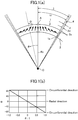
- FIGS. 1(a) and 1(b) depict magnetization directions in a segment magnet constituting a 6-pole polar-anisotropic ring magnet.
- the segment magnet 1 is formed in an arc shape having a curvature center at a point O, and with a circumferential length set to fall within an angular range 2 ⁇ approximately corresponding to an angular range 2 ⁇ equivalent to one pole of the polar-anisotropic ring magnet, and a given thickness.
- a segment magnet 2 equivalent to the next one pole is disposed in circumferentially-adjacent relation.
- the adjacent two segment magnets 1, 2 are arranged such that circumferentially adjacent end faces 1a, 1b thereof are opposed to each other, and a gap g having an angular interval 2d is formed between the opposed arranged end faces 1a, 1b.
- FIG. 2 depicts in an enlarged scale the gap g between the end faces 1a, 1b.
- the reference signs 3 and 4 denote, respectively, a rotor and a stator in a rotary electric machine such as an electric motor.
- the segment magnets 1, 2 are arranged side-by-side on an outer peripheral surface of the rotor 3.
- the gap g with the angular range 2d is inevitably formed between adjacent ones of the segment magnets, so that the angular range 2 ⁇ corresponding to one pole in each of the segment magnets is a value calculated by adding 1/2 of the angular range 2d of the gap g at each of circumferentially-opposite ends of the segment magnet to the angular interval 2 ⁇ defining the circumferential length of the segment magnet.
- a radial line connecting a circumferential center point A of an outer peripheral surface of the segment magnet 1 and the point O which is a curvature center of the arc of the segment magnet 1 is denoted by a central radial line Rc
- an angle between a magnetization direction of the segment magnet at each point located on a radial line Rc ( ⁇ ) deviated from the central radial line Rc in a direction toward each of the ends of the segment magnet by an angle ⁇ , and the radial line Rc ( ⁇ ) is denoted by ⁇
- " ⁇ " denotes an angle equivalent to a half cycle in the case where a periodic magnetic flux distribution to be formed by the segment magnets equivalent to two poles is defined as one cycle.
- the angle ⁇ is ⁇ /2 or 90° indicates that the magnetization direction is oriented in the circumferential direction.
- the relationship between the angles ⁇ and ⁇ expressed by the formula (1) is presented in FIG. 1(b) by taking ⁇ / ⁇ and ⁇ , respectively, on the horizontal axis and the vertical axis. As can be seen from the formula (1) and FIG. 1(b) , the angle ⁇ and the angle ⁇ have a linear relationship. These magnetization directions will be referred to as "polar-anisotropic orientation".
- FIG. 3(b) is a chart presenting a magnetic flux distribution in the inter-pole region designated by the reference sign B in FIG. 3(a) , wherein the magnetic flux distribution is derived by calculation in regard to a modeled gap shape in which a corner of an end face at each of the circumferentially-opposite ends of the segment magnet has a quarter-circular shaped cross-section.
- the scale of the horizontal axis is enlargedly indicated. As can be seen from FIG.
- a region extending circumferentially inwardly from each of two end faces 11a of circumferentially-opposite ends over an angular range ⁇ is defined as an end region 13, and the remaining region other than the two end regions 13 is defined as a central region 14.
- the magnetization directions are the "polar-anisotropic orientation" represented by the formula (1).
- the second term on the right-hand side is a correction term.
- ⁇ is a coefficient " ⁇ " in the case where an angular range between a radial line 13a defining the end region 13 and a bisecting radial line Rg of the gap g is expressed as " ⁇ ".
- [(90° - d) / 90°] ⁇ ⁇
- 1 - ⁇ [(90° - d) / 90°] (1 - ⁇ ).
- This segment magnet 11 is produced by sintering magnet material particles (particles of a magnet material) containing a rare-earth substance.
- an external magnetic field is applied to a shaped body of the magnet material particles formed into a shape of the segment magnet to cause easy-to-magnetize axes of the magnet material particles to be oriented in directions corresponding to magnetization directions in the segment magnet, and the resulting magnetized body is subjected to sintering.
- a rare-earth permanent magnet-forming sintered body as one embodiment of the present invention is obtained in which the magnetization axes of the magnet material particles are oriented in given directions.
- an external magnetic field is applied to the rare-earth permanent magnet-forming sintered body to obtain a rare-earth permanent magnet having the above magnetization directions.
- a plurality of the arc-shaped rare-earth permanent magnets each formed in this manner are arranged in a ring shape on a rotor of a rotary electric machine.
- ⁇ is an arbitrarily set constant.
- ⁇ denotes a constant falling within the following range: 0 ⁇ ⁇ ⁇ (1 - ⁇ ) ⁇ (90° - d). For example, it may be set in the range of 10° to 70°.
- each of m and n is a constant arbitrarily set in the range of greater than 1, the third embodiment is exactly the same as the first and second embodiments.
- the relationship between the angles ⁇ and ⁇ of the segment magnet 11 according to the third embodiment in which the magnetization direction in each of the end regions 13 is set based on the formula (7) can be indicated by taking ⁇ / ⁇ and ⁇ , respectively, on the horizontal axis and the vertical axis, as depicted in FIG. 7 .
- the magnetization direction angle in each of the end regions 13 changes depending on the angle ⁇ based on a power law.
- ⁇ denotes a constant falling within the following range: 0.2 ⁇ ⁇ ⁇ 0.9.
- n is not particularly limited as long as it is a value greater than 1.
- m is not particularly limited as long as it is a value greater than 1.
- it may be set in the range of 100 to 5000.
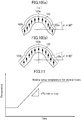
- FIG. 8 is a schematic diagram depicting a production process of the permanent magnet-forming sintered body 1 according to the first embodiment.
- an ingot of a magnet material comprised of an Nd-Fe-B based alloy having a given mixing ratio is produced by a casting process.
- the Nd-Fe-B based alloy usable for a neodymium magnet has a composition comprising 30 wt% of Nd, 67 wt% of Fe which is preferably electrolytic iron, and 1.0 wt% of B.
- this ingot is coarsely pulverized to a size of about 200 ⁇ m, using heretofore-known means such as a stamp mill or a crusher.
- the ingot may be melted and subjected to a strip casting process to produce flakes, and then the flakes may be coarsely powdered by a hydrogen cracking process. In this way, coarsely-pulverized magnet material particles 115 are obtained (see FIG. 8(a) ).
- the coarsely-pulverized magnet material particles 115 are finely pulverized by a wet process using a bead mill 116, a dry process using a jet mill, or the like.
- the coarsely-pulverized magnet material particles 115 are finely pulverized, in the solvent, to a particle size falling within a given range (e.g., 0.1 ⁇ m to 5.0 ⁇ m), to thereby disperse the resulting magnet material particles in the solvent (see FIG. 8(b) ).
- the magnet material particles contained in the solvent after the wet pulverization are dried by drying mean such as vacuum drying, and the dried magnet material particles are extracted (not depicted).
- a type of solvent usable in the pulverization is not particularly limited.
- an organic solvent including: alcohols such as isopropyl alcohol, ethanol and methanol; esters such as ethyl acetate; lower hydrocarbons such as pentane and hexane; aromatics such as benzene, toluene and xylene; and ketones; and mixtures thereof, and an inorganic solvent including liquefied argon.
- the coarsely-pulverized magnet material particles 115 are finely pulverized by the jet mill, in (a) an atmosphere consisting inert gas such as nitrogen gas, Ar gas or He gas, wherein an oxygen content of the inert gas is substantially 0%, or (b) an atmosphere consisting inert gas such as nitrogen gas, Ar gas or He gas, wherein an oxygen content of the inert gas is in the range of 0.0001 to 0.5%, and formed as fine particles having an average particle size falling within a given range, such as 0.7 ⁇ m to 5.0 ⁇ m.
- the term "the concentration of oxygen is substantially 0%” does not limitedly mean that the concentration of oxygen is absolutely 0%, but means that oxygen may be contained in an amount to an extent that it very slightly forms an oxide layer on surfaces of the fine particles.
- the magnet material particles finely pulverized by the bead mill 116 or the like are formed into a desired shape.
- a mixture obtained by mixing the finely-pulverized magnet material particles 115 and a binder together, i.e., a compound 117, is preliminarily prepared.
- the binder it is preferable to use a resin material. In the case where a resin is used as the binder, it is preferable to use a polymer containing no oxygen atom in its structure and having a depolymerization property.
- thermoplastic resin so as to enable a residue of the mixture 117 of the magnet material particles and the binder, occurring when the mixture is formed into a desired shape such as a trapezoidal shape in cross-section, as described later, to be reused, and enable magnetic field orientation to be performed under a condition that the binder is softened as a result of heating the mixture.
- a polymer is suitably used which comprises one or more polymers or copolymers formed from a monomer represented by the following general formula (1): (where each of R1 and R2 denotes one of a hydrogen atom, a lower alkyl group, a phenyl group and a vinyl group.)
- a resin to be used as the binder may have a composition containing a polymer or copolymer of monomers containing an oxygen atom and/or a nitrogen atom (e.g., poly(butyl methacrylate) or poly(methyl methacrylate)) in a small amount. Further, a monomer which does not meet the general formula (1) may be partially copolymerized. Even in such a situation, it is possible to achieve the object of the present invention.
- the mixture is heated to allow such magnetic field orientation treatment to be performed under a condition that the binder component is softened.
- the shaping method in the present invention is not limited to such a specific coating process.
- the shaping may be performed by putting the compound 117 in a shaping mold, and applying a pressure of 0.1 to 100 MPa thereto while heating it from room temperature to 300°C.
- this shaping method may comprise heating the compound 117 to a softening temperature thereof, and injecting and charging the softened compound 117 into a mold while applying an injection pressure thereto.
- a ratio of the binder to a total amount of the magnet material particles and the binder is set in the range of 1 wt% to 40 wt%, more preferably in the range of 2 wt% to 30 wt%, still more preferably in the range of 3 wt% to 20 wt%, as mentioned above.
- the dispersant added to the magnet material particles adheres onto surfaces of the magnet material particles, and acts to facilitate dispersion of the magnet material particles to provide the clayey mixture, and to assist turning of the magnet material particles in the later mentioned magnetic field orientation treatment.
- it becomes possible to facilitate orientation during application of a magnetic field so as to uniform respective directions of easy-to-magnetize axes of the magnet material particles, into approximately the same direction, i.e., so as to increase the degree of orientation.
- the binder is mixed with the magnet material particles, the binder is present around the surfaces of the magnet material particles, so that a frictional force against the magnet material particles during the magnetic field orientation treatment is increased, thereby possibly leading to deterioration in orientation property of the magnet material particles.
- the effect arising from addition of the dispersant becomes more important.
- the mixing of the magnet material particles and the binder is performed in an atmosphere consisting of inert gas such as nitrogen gas, Ar gas or He gas.
- inert gas such as nitrogen gas, Ar gas or He gas.
- the mixing of the magnet material particles and the binder is performed by inputting the magnet material particles and the binder into a stirring machine and stirring them using the stirring machine.
- heating-stirring may be performed.
- the compound 117 may be obtained by adding the binder to a solvent used for pulverization, without extracting the magnet material particles from the solvent, and, after kneading the resulting mixture, volatilizing the solvent.
- the compound 117 is formed into a sheet shape to prepare the aforementioned green sheet. Specifically, in case of employing the hot-melt coating process, the compound 117 is heated and melted to have flowability, and then coated on a support substrate 118. Subsequently, the compound 117 is solidified according to heat dissipation to form a long strip-shaped green sheet 119 on the support substrate 118.
- a temperature during heating and melting of the compound 117 varies depending on a type and an amount of a binder used, it is typically set in the range of 50 to 300°C. In this case, it is to be understood that the temperature needs to be set to a value greater than the flow starting temperature of the binder used.
- a slurry obtained by dispersing the magnet material particles, the binder and optionally an additive for facilitating the orientation, over a large volume of solvent is coated on the support substrate 118. Subsequently, the slurry is subjected to drying to volatilize the solvent therefrom to thereby form a long strip-shaped green sheet 119 on the support substrate 118.
- a coating system for the melted compound 117 it is preferable to use a system having excellent layer thickness controllability, such as a slot-die system or a calender roll system.
- a die system or a comma coating system which is a system having particularly excellent layer thickness controllability, i.e., a system capable of coating a layer having a highly-accurate thickness, on a surface of a substrate.
- the compound 117 after being heated to have flowability is pressure-fed from a gear pump into a die, and discharged from the die to perform coating.
- coating of the compound 117 is performed using a slot-die 120.
- a step of forming the green sheet 119 using this slot-die system it is desirable to actually measure a sheet thickness of the coated green sheet 119, and adjust a nip gap between the slot-die 120 and the support substrate 118, by feedback control based on the actually-measured value.
- the thickness accuracy of the green sheet 119 may be within ⁇ 10%, preferably within ⁇ 3%, more preferably within ⁇ 1%.
- a film thickness of the compound 117 to be transferred to the support substrate 118 can be controlled by feedback-controlling calendering conditions based on an actually-measured value in the same manner as that described above.
- the thickness of the green sheet 119 is set in the range of 0.05 mm to 20 mm. If the thickness is reduced to less than 0.05 mm, it becomes necessary to laminate a plurality of layers so as to achieve a required magnet thickness, resulting in deteriorated productivity.
- the green sheet 119 formed on the support substrate 118 by the hot-melt coating process is cut into a size corresponding to a desired magnet size to form a processing sheet piece 123.
- the processing sheet piece 123 is formed in a cross-sectional shape having: an arc-shaped region 123a corresponding to the central region in the rare-earth permanent magnet-forming sintered body 1 as a final product; and two linear-shaped regions 123b, 123c continuous, respectively, with opposite ends of the arc-shaped region 123a.
- the arc-shaped region 123a is formed in an arc shape having a curvature center at a point indicated by O in FIG.
- a mold having a plurality of cavities may be used, or a plurality of molds may be arranged side-by-side, so as to enable the parallel magnetic field 121 to be simultaneously applied to the plurality of processing sheet pieces 123.
- the step of applying a magnetic field to the processing sheet piece 123 may be performed in concurrence with the heating step, or during a period after completion of the heating step and before solidification of the binder of the processing sheet piece 123.
- the processing sheet piece 123 in which the easy-to-magnetize axes of the magnet material particles thereof are oriented in parallel alignment as indicated by the arrowed lines 122 through the magnetic field application step depicted in FIG. 9(a) is extracted from the magnetic field application mold, and transferred into a final shaping mold having an arc-shaped cavity 124 depicted in FIG. 9(b) , so as to be shaped into a sintering sheet piece 125.
- the post-orientation sintering sheet piece 125 in which the easy-to-magnetize axes of the magnet material particles thereof are oriented in the above manner is processed such that each of opposite ends thereof is cut off while a part thereof corresponding to the aforementioned angular interval ⁇ is left, and as a result, a sintering sheet piece 125a is formed.
- This sintering sheet piece 125a is subjected to calcining treatment in a non-oxidizing atmosphere adjusted at atmospheric pressure, or a pressure greater or less than atmospheric pressure (e.g., at 1.0 Pa or 1.0 MPa) at a decomposition temperature of the binder, for a holding time of several hours to several ten hours (e.g., 5 hours).
- the temperature rising speed may be set to 2°C/min or less, e.g., 1.5°C/min. In this case, a good result can be obtained.
- the calcining treatment is performed such that a calcining temperature is increased at a given temperature rising speed of 2°C/min or less as depicted in FIG. 11 , and, after reaching a predetermined setup temperature (binder decomposition temperature), held at the setup temperature for several hours to several ten hours.
- the temperature rising speed in the calcining treatment is set to a relatively small value, so that carbon in the sintering sheet piece 125a is removed in a step-by-step manner without being rapidly removed.
- This makes it possible to reduce an amount of residual carbon to a sufficient level to thereby increase the density of a permanent magnet-forming sintered body after sintering. That is, by reducing the amount of residual carbon, it is possible to reduce voids in a permanent magnet.
- the temperature rising speed is set to 2°C/min or less as mentioned above, the density of a permanent magnet-forming sintered body after sintering can be increased to 98% or more (7.40 g/cm 3 or more), and high magnet properties can expected in a permanent magnet after magnetization.
- the sintering treatment it is preferable to employ a uniaxial pressing-sintering method which comprises sintering the sintering sheet piece 125a while uniaxially pressing the sintering sheet piece 125a in the length direction, although an in-vacuum non-pressurized sintering method may be employed.
- the sintering sheet piece 125a is loaded in a sintering mold (not depicted) having a cavity with the same shape as that designated by the reference sign "124" in FIG. 9(b) .
- the sintering is performed by the SPS
- a heat treatment is performed in which the sheet piece is heated to 300°C to 1000°C again, and held at this temperature for 2 hours.
- the rare-earth permanent magnet-forming sintered body 1 according to the first embodiment is produced from the sintering sheet piece 125a.
- the uniaxial pressing-sintering method capable of sintering the sintering sheet piece 125a while pressing it in the length direction makes it possible to suppress a situation where orientations of the easy-to-magnetize axes imparted to the magnet material particles in the sintering sheet piece 125a are changed.
- a plurality of the above rare-earth permanent magnet-forming sintered bodies 1 are arranged side-by-side on the outer peripheral surface of the rotor core 3 depicted in FIG. 2 , in an un-magnetized state. Then, each of the rare-earth permanent magnet-forming sintered bodies 1 arranged in this manner is subjected to magnetization along the easy-to-magnetize axes, i.e., C axes, of the magnet material particles included therein. Specifically, the magnetization is performed such that an N-pole and an S-pole are alternately arranged along a circumferential direction of the rotor core 3, with respect to the plurality of rare-earth permanent magnet-forming sintered bodies 1 each arranged on the outer peripheral surface of the rotor core 3.
- the permanent magnet 1 can be produced.
- magnetization of the rare-earth permanent magnet-forming sintered body 1 it is possible to use any theretofore-known magnetization means, such as a magnetizing coil, a magnetizing yoke, or a capacitor-type magnetizing power supply device.
- the rare-earth permanent magnet-forming sintered body 1 may be magnetized to form a rare-earth permanent magnet, before being arranged on the outer peripheral surface of the rotor core 3, and then this magnetized magnet may be arranged on the outer peripheral surface of the rotor core 3.
- motor components such as the stator 4 and a rotary shaft are assembled to the resulting rotor to produce a desired electric motor such as an SPM (Surface Permanent Magnet) motor.
- SPM Surface Permanent Magnet
- a magnet material is pulverized into fine particles of the magnet material, and the pulverized magnet material particles and a binder are mixed together to create a compound 117. Then, the created compound 117 is formed into a sheet shape to prepare a green sheet 119. Subsequently, the shaped green sheet 119 is cut into a sheet piece having a given size and the sheet piece is formed into a desired shape to form a processing sheet piece 123. Then, a parallel magnetic field is applied to the processing sheet piece 123 in a thickness direction thereof to thereby orient easy-to-magnetize axes of the magnet material particles therein.
- the processing sheet piece 123 after being subjected to the orientation treatment is deformed into a given product shape, to obtain a sintering sheet piece 125a.
- the sintering sheet piece 125a is sintered in a non-pressing state, or a uniaxially pressing state in a length direction thereof, to produce the rare-earth permanent magnet-forming sintered body 1.
- the compound i.e., a mixture obtained by mixing magnet material particles and a binder together
- easy-to-magnetize axes can be oriented so as to be adequately converged toward the surface of each of the end regions requiring demagnetization measures.
- the mixture with a binder is subjected to shaping, so that, as compared to a method using a powder compact or the like, it becomes possible to improve a degree of orientation without turning of the magnet material particles after the orientation treatment.
- the number of turns of a winding wire through which a current is passed to form the magnetic field can be appropriately increased, so that it is possible to ensure a magnetic field intensity in a wide range during the magnetic field orientation, and apply a magnetic field for a long period of time in a magnetostatic field.
- This makes it possible to realize a high degree of orientation with little variation.
- resulting orientation directions may be corrected. This makes it possible to ensure a highly oriented state with little variation
- a magnetic field is applied to the mixture of the magnet material particles and a binder, and the mixture after the magnetic field application is deformed into a shaped body to thereby manipulate directions of easy-to-magnetize axes.
- each of the opposite end regions 123b, 123c of the processing sheet piece 123 is formed in an arc shape curved in a direction opposite to that of the central region 123a, instead of a linear shape. Except for the above, the same method as that in the first embodiment may be employed.
- each of the opposite end regions 123b, 123c of the processing sheet piece 123 is formed in a shape corresponding to a curve form changing depending on the angle ⁇ based on a power law.
- a specific method may comprise numerically-integrating the function expressed by the formula (7), and approximating and determining a shape by the obtained value. Except for the above, the same method as that in the first embodiment may be employed.
Landscapes
- Engineering & Computer Science (AREA)
- Power Engineering (AREA)
- Manufacturing & Machinery (AREA)
- Physics & Mathematics (AREA)
- Electromagnetism (AREA)
- Permanent Field Magnets Of Synchronous Machinery (AREA)
- Hard Magnetic Materials (AREA)
Applications Claiming Priority (2)
| Application Number | Priority Date | Filing Date | Title |
|---|---|---|---|
| JP2015226577A JP6706487B2 (ja) | 2015-11-19 | 2015-11-19 | 希土類永久磁石をもった回転子を備える回転電機 |
| PCT/JP2016/084105 WO2017086386A1 (ja) | 2015-11-19 | 2016-11-17 | 希土類磁石形成用焼結体及び該焼結体に着磁した希土類永久磁石 |
Publications (2)
| Publication Number | Publication Date |
|---|---|
| EP3379703A1 true EP3379703A1 (de) | 2018-09-26 |
| EP3379703A4 EP3379703A4 (de) | 2019-08-21 |
Family
ID=58717417
Family Applications (1)
| Application Number | Title | Priority Date | Filing Date |
|---|---|---|---|
| EP16866387.0A Withdrawn EP3379703A4 (de) | 2015-11-19 | 2016-11-17 | Sinterkörper zur herstellung eines seltenerdmagneten und durch magnetisierung dieses sinterkörpers hergestellter seltenerd-permanentmagnet |
Country Status (6)
| Country | Link |
|---|---|
| US (1) | US10573440B2 (de) |
| EP (1) | EP3379703A4 (de) |
| JP (1) | JP6706487B2 (de) |
| CN (1) | CN108352768B (de) |
| TW (1) | TWI676188B (de) |
| WO (1) | WO2017086386A1 (de) |
Cited By (1)
| Publication number | Priority date | Publication date | Assignee | Title |
|---|---|---|---|---|
| WO2019219985A3 (en) * | 2019-03-11 | 2020-01-16 | Siemens Gamesa Renewable Energy A/S | Permanent magnet assembly comprising three magnet devices with different magnetic domain alignment patterns |
Families Citing this family (22)
| Publication number | Priority date | Publication date | Assignee | Title |
|---|---|---|---|---|
| US11843334B2 (en) | 2017-07-13 | 2023-12-12 | Denso Corporation | Rotating electrical machine |
| JP2019024293A (ja) | 2017-07-21 | 2019-02-14 | 株式会社デンソー | 回転電機 |
| CN113991958A (zh) | 2017-07-21 | 2022-01-28 | 株式会社电装 | 旋转电机 |
| JP6927186B2 (ja) | 2017-12-28 | 2021-08-25 | 株式会社デンソー | 回転電機 |
| CN111512519B (zh) * | 2017-12-28 | 2022-10-11 | 株式会社电装 | 旋转电机 |
| JP6922868B2 (ja) | 2017-12-28 | 2021-08-18 | 株式会社デンソー | 回転電機システム |
| JP6939750B2 (ja) | 2017-12-28 | 2021-09-22 | 株式会社デンソー | 回転電機 |
| CN111565965B (zh) | 2017-12-28 | 2023-07-14 | 株式会社电装 | 车轮驱动装置 |
| DE112018006717T5 (de) | 2017-12-28 | 2020-09-10 | Denso Corporation | Rotierende elektrische Maschine |
| DE112018006699T5 (de) | 2017-12-28 | 2020-09-10 | Denso Corporation | Rotierende elektrische Maschine |
| JP7006541B2 (ja) | 2017-12-28 | 2022-01-24 | 株式会社デンソー | 回転電機 |
| CN109192487A (zh) * | 2018-08-29 | 2019-01-11 | 江苏健睡宝健康科技有限公司 | 一种高强磁磁条的制造方法 |
| WO2020138094A1 (ja) * | 2018-12-25 | 2020-07-02 | ダイセルポリマー株式会社 | 表面に粗面化構造を有する希土類磁石前駆体または希土類磁石成形体とそれらの製造方法 |
| JP7173873B2 (ja) * | 2019-01-11 | 2022-11-16 | 京セラ株式会社 | コア部品、その製造方法、およびインダクタ |
| CN111834117B (zh) * | 2019-04-23 | 2025-04-04 | 西门子歌美飒可再生能源公司 | 利用具有不对称形成的磁装置的设备制造烧结磁通聚焦永磁体 |
| CN111834116B (zh) * | 2019-04-23 | 2025-03-28 | 西门子歌美飒可再生能源公司 | 制造具有减小的变形的烧结永磁体 |
| JP7367413B2 (ja) | 2019-09-10 | 2023-10-24 | 株式会社デンソー | 回転電機 |
| CN111123179B (zh) * | 2020-01-15 | 2022-06-24 | 合肥工业大学 | 一种最后闭合磁面半径与径向角度关系的计算方法 |
| DE112020006839T5 (de) | 2020-03-05 | 2022-12-15 | Denso Corporation | Rotierende elektrische Maschinen |
| US11894719B2 (en) * | 2020-09-10 | 2024-02-06 | Ford Global Technologies, Llc | Permanent magnet of multiple pieces having different easy axes |
| JP6894616B1 (ja) * | 2020-12-25 | 2021-06-30 | 田中精密工業株式会社 | 積層鉄心の加熱装置 |
| CN118969433A (zh) * | 2024-10-16 | 2024-11-15 | 宁波金鸡强磁股份有限公司 | 一种弧形取向的磁体及其应用 |
Family Cites Families (24)
| Publication number | Priority date | Publication date | Assignee | Title |
|---|---|---|---|---|
| JPS60245460A (ja) | 1984-05-16 | 1985-12-05 | Hitachi Metals Ltd | 電磁駆動装置 |
| DE3913276A1 (de) * | 1989-04-22 | 1990-10-25 | Siemens Ag | Eletrische maschine, insbesondere gleichstrom-kleinmotor |
| JP2000195714A (ja) | 1998-10-23 | 2000-07-14 | Sumitomo Metal Mining Co Ltd | 極異方性希土類ボンド磁石とその製造方法及び永久磁石型モ―タ |
| JP4400698B2 (ja) | 1999-03-19 | 2010-01-20 | Tdk株式会社 | 表面多極異方性リング磁石の成形装置 |
| JP2002134314A (ja) * | 2000-10-20 | 2002-05-10 | Toda Kogyo Corp | 異方性セグメント形状磁石及びその成形金型磁気回路装置 |
| JP2003199274A (ja) | 2001-12-25 | 2003-07-11 | Hitachi Ltd | 回転子とその製造法及び回転機 |
| JP3997427B2 (ja) * | 2002-06-18 | 2007-10-24 | 日立金属株式会社 | 極異方性リング磁石の製造に用いる磁場中成形装置 |
| US6992553B2 (en) | 2002-06-18 | 2006-01-31 | Hitachi Metals, Ltd. | Magnetic-field molding apparatus |
| JP2004208341A (ja) | 2002-11-05 | 2004-07-22 | Hitachi Ltd | 永久磁石式回転電機 |
| JP2004207430A (ja) | 2002-12-25 | 2004-07-22 | Hitachi Metals Ltd | 極異方性リング磁石およびそれを用いた回転機 |
| US8044547B2 (en) * | 2006-11-27 | 2011-10-25 | Panasonic Corporation | Radial-direction gap type magnet motor |
| EP1956698B1 (de) | 2006-11-27 | 2018-03-07 | Panasonic Corporation | Permanentmagnetrotor und motor damit |
| JP5359192B2 (ja) * | 2007-11-12 | 2013-12-04 | パナソニック株式会社 | 異方性永久磁石型モータ |
| WO2012033202A1 (ja) | 2010-09-10 | 2012-03-15 | Tdk株式会社 | 弓形磁石及び磁場成形用金型 |
| WO2012090841A1 (ja) | 2010-12-28 | 2012-07-05 | 日立金属株式会社 | 極異方性配向を有する円弧状磁石、その製造方法、及びそれを製造するための金型 |
| US10511212B2 (en) * | 2011-10-07 | 2019-12-17 | Minebea Mitsumi Inc. | Inner rotor-type permanent magnet motor with annular magnetic poles |
| JP2015156405A (ja) * | 2012-05-24 | 2015-08-27 | パナソニック株式会社 | 異方性ボンド磁石とその製造方法およびそれらを用いたモータ |
| US9312057B2 (en) * | 2013-01-30 | 2016-04-12 | Arnold Magnetic Technologies Ag | Contoured-field magnets |
| DE112014006129B4 (de) * | 2014-01-08 | 2025-05-22 | Mitsubishi Electric Corporation | Rotierende elektrische Maschine |
| JP6502015B2 (ja) * | 2014-02-11 | 2019-04-17 | 日東電工株式会社 | 永久磁石の製造方法 |
| TWI679658B (zh) * | 2015-03-24 | 2019-12-11 | 日商日東電工股份有限公司 | 稀土類永久磁石及具有稀土類永久磁石之旋轉機 |
| CN111276310A (zh) * | 2015-03-24 | 2020-06-12 | 日东电工株式会社 | 稀土类磁体形成用烧结体及稀土类烧结磁体 |
| TWI719259B (zh) * | 2016-09-23 | 2021-02-21 | 日商日東電工股份有限公司 | 稀土類燒結磁石形成用燒結體及其製造方法 |
| JP6879140B2 (ja) * | 2017-09-15 | 2021-06-02 | トヨタ自動車株式会社 | 回転電機 |
-
2015
- 2015-11-19 JP JP2015226577A patent/JP6706487B2/ja active Active
-
2016
- 2016-11-17 US US15/771,125 patent/US10573440B2/en active Active
- 2016-11-17 CN CN201680067820.XA patent/CN108352768B/zh active Active
- 2016-11-17 EP EP16866387.0A patent/EP3379703A4/de not_active Withdrawn
- 2016-11-17 WO PCT/JP2016/084105 patent/WO2017086386A1/ja not_active Ceased
- 2016-11-18 TW TW105137902A patent/TWI676188B/zh not_active IP Right Cessation
Cited By (1)
| Publication number | Priority date | Publication date | Assignee | Title |
|---|---|---|---|---|
| WO2019219985A3 (en) * | 2019-03-11 | 2020-01-16 | Siemens Gamesa Renewable Energy A/S | Permanent magnet assembly comprising three magnet devices with different magnetic domain alignment patterns |
Also Published As
| Publication number | Publication date |
|---|---|
| JP6706487B2 (ja) | 2020-06-10 |
| EP3379703A4 (de) | 2019-08-21 |
| TW201730898A (zh) | 2017-09-01 |
| US20180336981A1 (en) | 2018-11-22 |
| US10573440B2 (en) | 2020-02-25 |
| CN108352768A (zh) | 2018-07-31 |
| JP2017099071A (ja) | 2017-06-01 |
| TWI676188B (zh) | 2019-11-01 |
| WO2017086386A1 (ja) | 2017-05-26 |
| CN108352768B (zh) | 2020-02-14 |
Similar Documents
| Publication | Publication Date | Title |
|---|---|---|
| US10573440B2 (en) | Rare-earth permanent magnet-forming sintered body, and rare-earth permanent magnet obtained by magnetizing said sintered body | |
| EP3276795B1 (de) | Seltenerd-permanentmagnet und rotationsmaschine mit seltenerd-permanentmagnet | |
| US20210012934A1 (en) | Sintered body for forming rare-earth magnet, and rare-earth sintered magnet | |
| JP7287991B2 (ja) | 永久磁石ユニット、該永久磁石ユニットを有する回転機、及び該永久磁石ユニットの製造方法 | |
| EP3276796B1 (de) | Elektrische drehmaschine mit seltenerd-permanentmagnet | |
| US11239014B2 (en) | Rare-earth magnet and linear motor using same | |
| WO2013176116A1 (ja) | 永久磁石モータ、永久磁石モータの製造方法及び永久磁石 | |
| US20180221951A1 (en) | Sintered body for forming a rare-earth magnet and rare-earth sintered magnet | |
| TW201603058A (zh) | 旋轉電機用永久磁石、旋轉電機用永久磁石之製造方法、旋轉電機及旋轉電機之製造方法 | |
| JP2015207687A (ja) | 永久磁石及び永久磁石の製造方法 | |
| JP2016032025A (ja) | 永久磁石及び永久磁石の製造方法 |
Legal Events
| Date | Code | Title | Description |
|---|---|---|---|
| STAA | Information on the status of an ep patent application or granted ep patent |
Free format text: STATUS: THE INTERNATIONAL PUBLICATION HAS BEEN MADE |
|
| PUAI | Public reference made under article 153(3) epc to a published international application that has entered the european phase |
Free format text: ORIGINAL CODE: 0009012 |
|
| STAA | Information on the status of an ep patent application or granted ep patent |
Free format text: STATUS: REQUEST FOR EXAMINATION WAS MADE |
|
| 17P | Request for examination filed |
Effective date: 20180517 |
|
| AK | Designated contracting states |
Kind code of ref document: A1 Designated state(s): AL AT BE BG CH CY CZ DE DK EE ES FI FR GB GR HR HU IE IS IT LI LT LU LV MC MK MT NL NO PL PT RO RS SE SI SK SM TR |
|
| AX | Request for extension of the european patent |
Extension state: BA ME |
|
| DAV | Request for validation of the european patent (deleted) | ||
| DAX | Request for extension of the european patent (deleted) | ||
| A4 | Supplementary search report drawn up and despatched |
Effective date: 20190722 |
|
| RIC1 | Information provided on ipc code assigned before grant |
Ipc: H01F 41/02 20060101ALI20190716BHEP Ipc: H02K 1/27 20060101ALI20190716BHEP Ipc: H01F 7/02 20060101ALI20190716BHEP Ipc: H02K 15/03 20060101AFI20190716BHEP |
|
| STAA | Information on the status of an ep patent application or granted ep patent |
Free format text: STATUS: EXAMINATION IS IN PROGRESS |
|
| 17Q | First examination report despatched |
Effective date: 20211108 |
|
| REG | Reference to a national code |
Ref country code: DE Ref legal event code: R079 Free format text: PREVIOUS MAIN CLASS: H02K0015030000 Ipc: H01F0041020000 |
|
| GRAP | Despatch of communication of intention to grant a patent |
Free format text: ORIGINAL CODE: EPIDOSNIGR1 |
|
| STAA | Information on the status of an ep patent application or granted ep patent |
Free format text: STATUS: GRANT OF PATENT IS INTENDED |
|
| RIC1 | Information provided on ipc code assigned before grant |
Ipc: H02K 1/27 20060101ALI20230417BHEP Ipc: H01F 7/02 20060101ALI20230417BHEP Ipc: H02K 15/03 20060101ALI20230417BHEP Ipc: H01F 41/02 20060101AFI20230417BHEP |
|
| INTG | Intention to grant announced |
Effective date: 20230509 |
|
| STAA | Information on the status of an ep patent application or granted ep patent |
Free format text: STATUS: THE APPLICATION IS DEEMED TO BE WITHDRAWN |
|
| 18D | Application deemed to be withdrawn |
Effective date: 20230920 |