EP3379767A1 - Verteilte authentifizierung - Google Patents
Verteilte authentifizierung Download PDFInfo
- Publication number
- EP3379767A1 EP3379767A1 EP17305335.6A EP17305335A EP3379767A1 EP 3379767 A1 EP3379767 A1 EP 3379767A1 EP 17305335 A EP17305335 A EP 17305335A EP 3379767 A1 EP3379767 A1 EP 3379767A1
- Authority
- EP
- European Patent Office
- Prior art keywords
- devices
- user
- challenge
- module
- members
- Prior art date
- Legal status (The legal status is an assumption and is not a legal conclusion. Google has not performed a legal analysis and makes no representation as to the accuracy of the status listed.)
- Granted
Links
Images


Classifications
-
- H—ELECTRICITY
- H04—ELECTRIC COMMUNICATION TECHNIQUE
- H04L—TRANSMISSION OF DIGITAL INFORMATION, e.g. TELEGRAPHIC COMMUNICATION
- H04L63/00—Network architectures or network communication protocols for network security
- H04L63/06—Network architectures or network communication protocols for network security for supporting key management in a packet data network
- H04L63/062—Network architectures or network communication protocols for network security for supporting key management in a packet data network for key distribution, e.g. centrally by trusted party
-
- H—ELECTRICITY
- H04—ELECTRIC COMMUNICATION TECHNIQUE
- H04L—TRANSMISSION OF DIGITAL INFORMATION, e.g. TELEGRAPHIC COMMUNICATION
- H04L63/00—Network architectures or network communication protocols for network security
- H04L63/08—Network architectures or network communication protocols for network security for authentication of entities
- H04L63/0853—Network architectures or network communication protocols for network security for authentication of entities using an additional device, e.g. smartcard, SIM or a different communication terminal
-
- H—ELECTRICITY
- H04—ELECTRIC COMMUNICATION TECHNIQUE
- H04L—TRANSMISSION OF DIGITAL INFORMATION, e.g. TELEGRAPHIC COMMUNICATION
- H04L63/00—Network architectures or network communication protocols for network security
- H04L63/10—Network architectures or network communication protocols for network security for controlling access to devices or network resources
- H04L63/104—Grouping of entities
-
- H—ELECTRICITY
- H04—ELECTRIC COMMUNICATION TECHNIQUE
- H04L—TRANSMISSION OF DIGITAL INFORMATION, e.g. TELEGRAPHIC COMMUNICATION
- H04L9/00—Cryptographic mechanisms or cryptographic arrangements for secret or secure communications; Network security protocols
- H04L9/08—Key distribution or management, e.g. generation, sharing or updating, of cryptographic keys or passwords
- H04L9/0816—Key establishment, i.e. cryptographic processes or cryptographic protocols whereby a shared secret becomes available to two or more parties, for subsequent use
- H04L9/085—Secret sharing or secret splitting, e.g. threshold schemes
-
- H—ELECTRICITY
- H04—ELECTRIC COMMUNICATION TECHNIQUE
- H04L—TRANSMISSION OF DIGITAL INFORMATION, e.g. TELEGRAPHIC COMMUNICATION
- H04L9/00—Cryptographic mechanisms or cryptographic arrangements for secret or secure communications; Network security protocols
- H04L9/08—Key distribution or management, e.g. generation, sharing or updating, of cryptographic keys or passwords
- H04L9/0861—Generation of secret information including derivation or calculation of cryptographic keys or passwords
-
- H—ELECTRICITY
- H04—ELECTRIC COMMUNICATION TECHNIQUE
- H04L—TRANSMISSION OF DIGITAL INFORMATION, e.g. TELEGRAPHIC COMMUNICATION
- H04L9/00—Cryptographic mechanisms or cryptographic arrangements for secret or secure communications; Network security protocols
- H04L9/08—Key distribution or management, e.g. generation, sharing or updating, of cryptographic keys or passwords
- H04L9/0891—Revocation or update of secret information, e.g. encryption key update or rekeying
-
- H—ELECTRICITY
- H04—ELECTRIC COMMUNICATION TECHNIQUE
- H04L—TRANSMISSION OF DIGITAL INFORMATION, e.g. TELEGRAPHIC COMMUNICATION
- H04L9/00—Cryptographic mechanisms or cryptographic arrangements for secret or secure communications; Network security protocols
- H04L9/32—Cryptographic mechanisms or cryptographic arrangements for secret or secure communications; Network security protocols including means for verifying the identity or authority of a user of the system or for message authentication, e.g. authorization, entity authentication, data integrity or data verification, non-repudiation, key authentication or verification of credentials
- H04L9/3247—Cryptographic mechanisms or cryptographic arrangements for secret or secure communications; Network security protocols including means for verifying the identity or authority of a user of the system or for message authentication, e.g. authorization, entity authentication, data integrity or data verification, non-repudiation, key authentication or verification of credentials involving digital signatures
- H04L9/3255—Cryptographic mechanisms or cryptographic arrangements for secret or secure communications; Network security protocols including means for verifying the identity or authority of a user of the system or for message authentication, e.g. authorization, entity authentication, data integrity or data verification, non-repudiation, key authentication or verification of credentials involving digital signatures using group based signatures, e.g. ring or threshold signatures
-
- H—ELECTRICITY
- H04—ELECTRIC COMMUNICATION TECHNIQUE
- H04L—TRANSMISSION OF DIGITAL INFORMATION, e.g. TELEGRAPHIC COMMUNICATION
- H04L9/00—Cryptographic mechanisms or cryptographic arrangements for secret or secure communications; Network security protocols
- H04L9/32—Cryptographic mechanisms or cryptographic arrangements for secret or secure communications; Network security protocols including means for verifying the identity or authority of a user of the system or for message authentication, e.g. authorization, entity authentication, data integrity or data verification, non-repudiation, key authentication or verification of credentials
- H04L9/3271—Cryptographic mechanisms or cryptographic arrangements for secret or secure communications; Network security protocols including means for verifying the identity or authority of a user of the system or for message authentication, e.g. authorization, entity authentication, data integrity or data verification, non-repudiation, key authentication or verification of credentials using challenge-response
-
- G—PHYSICS
- G06—COMPUTING OR CALCULATING; COUNTING
- G06F—ELECTRIC DIGITAL DATA PROCESSING
- G06F2221/00—Indexing scheme relating to security arrangements for protecting computers, components thereof, programs or data against unauthorised activity
- G06F2221/21—Indexing scheme relating to G06F21/00 and subgroups addressing additional information or applications relating to security arrangements for protecting computers, components thereof, programs or data against unauthorised activity
- G06F2221/2103—Challenge-response
Definitions
- User authentication is one technique used for protecting data and access to resources. Many authentication techniques rely on a credential associated with an identity to prevent unauthorized access these resources. To reduce the risk that the credential can be lost and/or compromised, some systems employ multi-factor approaches that rely on a physical device in possession of the user in addition to the credential.
- a public-private key pair may be generated for the user.
- the public key may be stored with an authenticating device, and the private key may be used to generate a number of shares.
- the shares may then be stored in devices associated with the user that are likely to be around the user when the user seeks to use the resource.
- These devices may be, for example, mobile devices (e.g., phones, tablets), personal computers, wearables (e.g., watches, fitness trackers), and other devices that the user carries with them.
- Other example devices may include devices detected from an environment in which the user is seeking to access the resource.
- a challenge may be issued to devices near the user during the access attempt.
- the challenge may be, for example, a one-time use nonce.
- the devices may respond to the challenge by transmitting partial responses to a collector which will form the partial responses into a group response.
- the shares of the private key may be generated so that the group response authenticates the user when a threshold number of shares on devices have participated in forming the group response.
- the shares may be designed so that participation of two of three devices will result in responding to a challenge with a group response that is equivalent to signing the challenge with the private key.
- the response may be generated despite the private key not being stored on any of the three devices or even being formed during the generation of the group response.
- Authenticating a user in this manner may be simpler for users than memorizing a password or carrying around a specialized device for authenticating themselves. Additionally, as a quorum of devices is used for authentication, if the user inadvertently leaves one device at home or a device becomes corrupted, the user may still be able to access the resource as long as the user has access to a threshold number of participating devices. Further, even if one device becomes compromised or stolen, that one device may not be sufficient for an attacker to access the resource without compromising additional devices.
- Figure 1 illustrates an example modules, devices, and entities associated with distributed authentication. It should be appreciated that the items depicted in Figure 1 are illustrative examples, and many different systems, devices, and so forth, may operate in accordance with various examples.
- Figure 1 illustrates a user 100 and a resource 110.
- user 100 would like to access resource 110, and an entity invested in the security of resource 110 may seek to prevent unauthorized accesses to resource 110. Consequently, an authentication technique may be employed to ensure that users 100 seeking to access resource 110 are who they say they are and that they are authorized to access resource 110.
- resource 110 may be, for example, a device (e.g., a computer), a location, an application or service operating on a device, and so forth. In various examples, resource 110 may be remote or local to user 100.
- the authentication technique used to provide access to resource 110 may rely on evidence provided from multiple sources that when combined, provide an adequate guarantee that user 100 is who they say they are.
- the evidence may take the form of a private key that has been divided into shares amongst a number of key shareholders 120.
- key shareholders 120 include a phone 122 and a smartwatch 124 which may be devices that user 100 is expected to have on their person when accessing resource 110.
- Key shareholders 120 also include a wireless access point 126, which may be related to a location at which user 100 is expected to access resource 110.
- key shareholders 120 may be devices expected to be carried by user 100, on the person of user 100, associated with user 100, or otherwise expected to be available to user 100 when user 100 attempts to access resource 110.
- the key shareholders 120 may be devices that indicate that user 100 is in and/or has access to location at which user 100 is expected to be accessing resource 110.
- These devices may include, for example, environmental devices, such as wireless routers, devices of belonging to users who regularly interact or are collocated with user 100, and so forth.
- Deciding which types of devices to use may depend on, for example, whether resource 110 is a device, location, application, or other resource type, where and/or how resource 110 is expected to be used, other attributes of resource 110, and which functionalities of various modules are designed to reside on a device in possession of user 100.
- dealer module 130 may be responsible for generating a public-private key pair, and distributing shares of the private key to key shareholders 120.
- dealer module 130 may control generation of shares and a verifier module 140 may authenticate user 100 based on RSA public-private key cryptography, and Shoup's scheme (See: Shoup V. (2000) Practical Threshold Signatures. In: Preneel B. (eds) Advances in Cryptology - EUROCRYPT 2000 ), which are described herein.
- share generation and user authentication may rely on alternative techniques.
- dealer module 130 may generate the public-private key pair by controlling a processer of a device on which dealer module 130 resides and/or which is executing dealer module 130 to select two large primes p and q , each having a predefined length exceeding a predefined value measured in bits (e.g., 3072).
- the dealer module 130 may provide the public key to verifier module 140, which will eventually perform authentication of user 100.
- Dealer module 130 may then use the private key to control generation, by the processor executing dealer module 130, of the l shares that will be distributed to key shareholders 120.
- dealer module 130 may control generation of shares S i for each of the l shares by the processor executing dealer module 130 according to 2:
- the shares of form ( S i ,i ) may then be distributed by dealer module 130 to key shareholders 120.
- shares may be distributed so that each key shareholder 120 is assigned a single share.
- multiple shares may be given to a single key shareholder 120 to emphasize the value of that key shareholder 120 in authenticating user 100.
- phone 122 may be assigned two shares of four, while smartwatch 124 and wireless access point 126 may be assigned single shares. If three shares of the private key are mandated for authenticating user 100, then phone 122 in addition to at least one of smartwatch 124 and wireless access point 126 may need to be present for authenticating user 100.
- dealer module 130 may also generate verification values for each key shareholder 120.
- the verification values may be used by key shareholders 120 to authenticate themselves to a combiner module 160.
- Combiner module 160 may combines partial responses from key shareholders 120 into a group response to the challenge (a process that will be discussed in greater detail below). Consequently, combiner module 160 may use the verification values to ensure that values received from key shareholders 120 are only combined into the group response when they are received from real key shareholders 120, as combining an invalid partial response may make the group response invalid, rendering user 100 unable to authenticate themselves.
- a value u ⁇ Z n * is chosen such that the Jacobi symbol ( u
- n ) -1, and the values v and u are used as the group verification key, and each value v i serves as the verification value for share i .
- the dealer module 130 may control distribution of a share number i , share S i , and verification value v i to key shareholders 120 for each share to be held by that key shareholder 120.
- Key shareholders 120 may also be transmitted the group verification key v and u to use in certain calculations described below.
- dealer module 130 may seek to securely transmit shares, verification values, and so forth, to key shareholders 120. In some examples, this may be achieved using a secure connection protocol (e.g., Bluetooth). In other examples, the sensitive data may be secured during transmission by first exchanging public-private keys, and using the keys to encrypt and/or sign the sensitive data.
- a secure connection protocol e.g., Bluetooth
- verifier module 140 may generate a challenge to transmit key shareholders 120.
- the challenge may be a nonce.
- a nonce may be a random value generated at the time the challenge is issued, and used solely for the present challenge. Thus, even in the unlikely event the nonce is randomly generated a second time, the repeated use of the nonce may be prevented to reduce the risk of a playback attack authenticating an unauthorized user.
- the challenge may be distributed to key shareholders 120 via a challenger module 150.
- Challenger module 150 may be, for example, verifier module 140, a component of a key shareholder 120, a third party device, and so forth.
- resource 110 it may be desirable for there to be some form of locality between one or more of resource 110, user 100, verifier module 140, challenger module 150, and/or key shareholders 120.
- Which entities should be local to one another may depend on the nature of resource 110, whether user 100 is local to resource 110 itself or to an access point of resource 110, and so forth. For example, when resource 110 is a desktop computer or certain other resource types that user 100 may directly access in person, resource 110 itself may perform functions of challenger module 150. In other examples, when user 100 accesses a resource 110 remotely, one of the key shareholders 120 may perform functions of challenger module 150.
- Partial responses may be generated by first creating a hash of challenge cha using, for example, SHA512.
- SHA512 has been used, though other secure hash functions could also be used.
- n and e refer to the modulus and exponent of the public key generated by dealer module 130
- n 1 x ⁇ u e , if x ⁇
- n ⁇ 1
- the processor for this key shareholder 120 may also chose a random number r ⁇ ⁇ 0,..., 2 L ( n )+2 L 1 - 1 ⁇ , where L ( n ) is the bit length of n which in this case may be 3072, and L 1 is an RSA security parameter.
- the values x i , c i , and z i may be provided to combiner module 160.
- the processor of a device executing combiner module 160 may then verify that 4 holds true for these values to verify the authenticity of the partial response provided to the key shareholder 120 (though in alternative examples both key shareholder 120 and combiner module 160 could use hash functions other than SHA512):
- c i SHA 512 v , x 4 , v i , x i 2 , v z i v i ⁇ c i , x 4 z i x ⁇ 2 c i
- combiner module 160 may generate a group signature from these partial responses.
- a and b may be calculated using Euclid's algorithm. If ( x ⁇
- n ) 1 then y may be used as the group signature GroupSig. Otherwise if ( x ⁇
- n ) -1, then y u may be used as the group signature GroupSig.
- the group signature may be transmitted by to verifier module 140.
- dealer module 130 may be combined and/or reside within one another.
- one or more of dealer module 130, combiner module 160, and/or challenger module 150 may reside within a key shareholder 120 such as phone 122.
- dealer module 130, verifier module 140, combiner module 160, and challenger module 150 may reside within a single system that communicates with key shareholders 120 when user 100 seeks to access resource 110.
- many of these modules may be local or remote to one or more of user 100, resource 110, key shareholders 120, and so forth.
- key shareholders 120 may be selected from a set of devices designed to indicate a quorum of multiple users 100.
- each key shareholder 120 may be a mobile device belonging to a different user 100.
- verifier module 140 may grant these users access to resource 110.
- One example situation where this may be desirable is to ensure that a board of trustees or executives has a mandated quorum to approve certain types of transactions.
- an update module may also interact with various entities depicted in figure 1 .
- the update module may facilitate adding shares to and/or removing shares from key shareholders 120, refreshing shares, and so forth.
- Removing a key shareholder 120 may involve deprovisioning a verification value, or in cases where verification values are not used, regenerating and distributing shares. Updating shares may be achieved by regenerating and provisioning shares. In some of these examples, regenerating and provisioning shares may be achievable without updating the public key.
- Module includes but is not limited to hardware, firmware, software stored on a computer-readable medium or in execution on a machine, and/or combinations of each to perform a function(s) or an action(s), and/or to cause a function or action from another module, method, and/or system.
- a module may include a software controlled microprocessor, a discrete module, an analog circuit, a digital circuit, a programmed module device, a memory device containing instructions, and so on. Modules may include gates, combinations of gates, or other circuit components. Where multiple logical modules are described, it may be possible to incorporate the multiple logical modules into one physical module. Similarly, where a single logical module is described, it may be possible to distribute that single logical module between multiple physical modules.
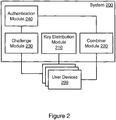
- FIG. 2 illustrates an example system 200 associated with distributed authentication.
- System 200 includes a key distribution module 210.
- Key distribution module 210 may generate a paired public key and private key. The paired public key and private key may be associated with a user.
- Key distribution module 210 may also provide or store the public key in a manner that makes the public key accessible to other aspects of system 200.
- Key distribution module 210 may also split the private key into a set of shares.
- Key distribution module 210 may also distribute members of the set of shares to a set of devices 299 associated with the user.
- key distribution module 210 may generate more shares than there are devices 299. This may allow key distribution module to provide multiple shares to certain devices 299. This may make it so these devices 299 have greater weight when authenticating the user.
- generating more shares than devices 299 may aid in provisioning a share to a new device 299 without having to create a new public key and/or private key.
- Devices 299 may include, for example, mobile devices (e.g., cellular phone) belonging to the user, a laptop or other computer belonging to the user, a wearable (e.g., fitness tracker, smart watch) belonging to the user, a security device belonging to the user, a device belonging to another user, an environmental device, and so forth.
- mobile devices e.g., cellular phone
- a wearable e.g., fitness tracker, smart watch
- security device belonging to the user
- a device belonging to another user e.g., an environmental device, and so forth.
- key distribution module 210 may also establish a secure communication channel with user devices 299 when distributing shares to user devices 299. This may be achieved by, for example, using a secure communication technique (e.g., Bluetooth), exchanging public-private keys prior to transmitting shares, and so forth. Ensuring that keys are distributed securely may prevent interception of the keys and, consequently, authentication of an unauthorized person to system 200.
- a secure communication technique e.g., Bluetooth
- System 200 also includes an authentication module 240.
- Authentication module 240 may generate a challenge to authenticate the user.
- authentication module 240 may grant the user access to a resource.
- the resource may be, for example, a device (e.g., a desktop computer), a location (e.g., a building), a process or service running on a device, and so forth.
- the challenge may be a nonce.
- the nonce may be a randomly generated data string that is used for a single authentication attempt.
- the authenticating response may be a value generated by signing the nonce using the private key.
- System 200 also includes a challenge module 230.
- Challenge module 230 may distribute the challenge generated by authentication module 230 to members of the set of devices 299 associated with the user.
- System 200 also includes a combiner module 220.
- Combiner module 220 may receive partial responses from members of the set of user devices 299.
- Combiner module 220 may also combine the partial responses into a group signature, and provide the group signature to authentication module 240.
- the group signature may serve as an authenticating response to the challenge when generated from partial responses received from a threshold number of members of the set of devices 299.
- the group signature may authenticate the user, allowing access to the resource guarded by authentication module 240.
- key distribution module 210 may provide verification values to the members of the set of devices 299.
- the verification values may be used by devices 299 to authenticate themselves to combiner module 220.
- combiner module 220 may check that the verification values match prior to combining partial shares into the group signature.
- combiner module may exclude partial share received from that device when generating the group signature. This may allow combiner module 220 to submit an authenticating response to authentication module 240 despite one or more user devices 299 becoming compromised.
- At least one of the challenge module 230, key distribution module 210, and combiner module 220 may reside within a member of the set of devices 299.
- these modules may operate as an application embedded in a user device 299.
- a mobile device 299 may serve as key distribution module 210 and distribute keys to other user devices, and provide the public key to authentication module 240.
- authentication module 240 may also transmit a challenge to the user's mobile device may serve as challenge module 230 by forwarding the challenge to other devices 299 on which shares are stored.
- the devices 299 may then respond with partial responses to the mobile device, which may also generate its own partial response using a share it kept for itself.
- the mobile device may then serve as combiner module 220, by combining the partial responses into the group signature and forwarding the group signature to authentication module 240.
- system 200 may include an update module (not shown).
- the update module may control redistribution of secret shares to user devices 299. Redistribution of secret shares may facilitate, for example, adding a new user device to the set of devices 299, removing a removed device from the set of devices 299, changing the threshold number of devices needed for a valid authenticating response to be generating, updating the private key, and so forth.
- the update module may control other aspects of system 200 to effect this redistribution of secret shares. By way of illustration, some of these redistributions may involve generating a new private and/or public key.
- the update module may control key distribution module 210 to generate a new private and public key and distribute shares of the private key to the user devices.
- some redistributions may not involve generation of new keys.
- removing a device from the set of user devices 299 may involve revoking that device's verification value so that combiner module refuses to combine partial shares received from that device.
- Adding a device without generating a new key may be achieved by generating an initial number of shares that exceeds the number of devices in the set of devices 299. Then, adding a new device to the set of user devices may involve assigning and providing an unassigned share to the new device.
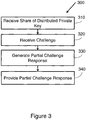
- Figure 3 illustrates an example method 300.
- Method 300 may be embodied on a non-transitory processor-readable medium storing processor-executable instructions. The instructions, when executed by a processor, may cause the processor to perform method 300. In other examples, method 300 may exist within logic gates and/or RAM of an application specific integrated circuit (ASIC).
- ASIC application specific integrated circuit
- Method 300 may perform various tasks associated with distributed authentication. Method 300 may be performed by a user device. Method 300 includes receiving a share of a distributed private key at 310. The distributed private key may be received from a dealer device. The distributed private key may be paired with a public key used by an authentication device to authenticate a user. In one example, the dealer device may be the user device.
- Method 300 also includes receiving a challenge at 320.
- the challenge may seek to authenticate the user.
- the challenge may be received from the authentication device via a challenge device.
- the authentication device and the challenge device may be the same device.
- the user device may be the challenge device.
- Method 300 also includes generating a partial response to the challenge at 330.
- the partial response may be generated based on the challenge and on the share of the distributed private key.
- Method 300 also includes providing the partial response at 340.
- the partial response may be provided to a combiner device.
- the user device may be the combiner device.
- the combiner device may generate a complete response from a threshold number of partial responses.
- the partial responses may be received from a set of devices including the user device.
- the combiner device may transmit the complete response to the authentication device.
- the complete response may be a message that would be produced by signing the challenge with the private key.
- the complete response may be used by the authentication device to authenticate the user to grant the user access to a resource.
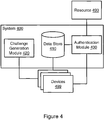
- FIG. 4 illustrates a system 400 associated with distributed authentication.
- System 400 includes a data store 410.
- Data store 410 may store a public key.
- the public key may be paired with a private key.
- the private key may be split into a set of shares. Members of the set of shares may be distributed amongst members of a set of devices 499.
- System 400 also includes a challenge generation module 420.
- Challenge generation module 420 may issue an authenticating challenge to be distributed to members of the set of devices 499.
- System 400 also includes an authentication module 430.
- Authentication module 430 may use the public key from data store 410 to grant access to a resource 490 upon receiving an authenticating response from the members of the set of devices 499.
- the authenticating response may be a response that would be generated by signing the authenticating challenge with the private key.
- the authenticating response may be generated by the cooperation of a quorum of the members of the set of devices using members of the set of shares stored on the quorum of devices.
- system 400 may include a key distribution module (not shown).
- the key distribution module may generate the public key, the private key, and split the private key into the set of shares.
- the key distribution module may also facilitate distribution of the keys.
- the members of the set of devices may be devices belonging to members of a group.
- receiving the authenticating response may indicate participation of a quorum of the group. This may allow the group to ensure that a consensus has been reached or that there are enough members present to ensure that certain safeguards or requirements have been met.
- FIG. 5 illustrates an example computing device in which example systems and methods, and equivalents, may operate.
- the example computing device may be a computer 500 that includes a processor 510 and a memory 520 connected by a bus 530.
- Computer 500 includes a distributed authentication module 540.
- Distributed authentication module 540 may perform, alone or in combination, various functions described above with reference to the example systems, methods, and so forth.
- distributed authentication module 540 may be implemented as a non-transitory computer-readable medium storing processor-executable instructions, in hardware, software, firmware, an application specific integrated circuit, and/or combinations thereof.
- the instructions may also be presented to computer 500 as data 550 and/or process 560 that are temporarily stored in memory 520 and then executed by processor 510.
- the processor 510 may be a variety of processors including dual microprocessor and other multi-processor architectures.
- Memory 520 may include non-volatile memory (e.g., read-only memory) and/or volatile memory (e.g., random access memory).
- Memory 520 may also be, for example, a magnetic disk drive, a solid state disk drive, a floppy disk drive, a tape drive, a flash memory card, an optical disk, and so on.
- Computer 500 may also be associated with other devices including other computers, devices, peripherals, and so forth in numerous configurations (not shown).
Landscapes
- Engineering & Computer Science (AREA)
- Computer Security & Cryptography (AREA)
- Computer Networks & Wireless Communication (AREA)
- Signal Processing (AREA)
- Computer Hardware Design (AREA)
- Computing Systems (AREA)
- General Engineering & Computer Science (AREA)
- Storage Device Security (AREA)
Priority Applications (3)
| Application Number | Priority Date | Filing Date | Title |
|---|---|---|---|
| EP17305335.6A EP3379767B1 (de) | 2017-03-24 | 2017-03-24 | Verteilte authentifizierung |
| US15/947,299 US10771444B2 (en) | 2017-03-24 | 2018-04-06 | Distributed authentication |
| US17/006,019 US20200396212A1 (en) | 2017-03-24 | 2020-08-28 | Distributed authentication |
Applications Claiming Priority (1)
| Application Number | Priority Date | Filing Date | Title |
|---|---|---|---|
| EP17305335.6A EP3379767B1 (de) | 2017-03-24 | 2017-03-24 | Verteilte authentifizierung |
Publications (2)
| Publication Number | Publication Date |
|---|---|
| EP3379767A1 true EP3379767A1 (de) | 2018-09-26 |
| EP3379767B1 EP3379767B1 (de) | 2021-01-13 |
Family
ID=59091430
Family Applications (1)
| Application Number | Title | Priority Date | Filing Date |
|---|---|---|---|
| EP17305335.6A Not-in-force EP3379767B1 (de) | 2017-03-24 | 2017-03-24 | Verteilte authentifizierung |
Country Status (2)
| Country | Link |
|---|---|
| US (2) | US10771444B2 (de) |
| EP (1) | EP3379767B1 (de) |
Cited By (3)
| Publication number | Priority date | Publication date | Assignee | Title |
|---|---|---|---|---|
| CN109934585A (zh) * | 2019-03-08 | 2019-06-25 | 矩阵元技术(深圳)有限公司 | 一种基于安全多方计算的签名方法、装置及系统 |
| EP3767501A1 (de) * | 2019-07-18 | 2021-01-20 | Hewlett-Packard Development Company, L.P. | Benutzerauthentifizierung |
| ES2904423A1 (es) * | 2021-09-22 | 2022-04-04 | Univ Valencia Politecnica | Metodo de registro distribuido para el control de acceso anonimo |
Families Citing this family (38)
| Publication number | Priority date | Publication date | Assignee | Title |
|---|---|---|---|---|
| US8271106B2 (en) | 2009-04-17 | 2012-09-18 | Hospira, Inc. | System and method for configuring a rule set for medical event management and responses |
| AU2012325937B2 (en) | 2011-10-21 | 2018-03-01 | Icu Medical, Inc. | Medical device update system |
| US9572029B2 (en) * | 2012-04-10 | 2017-02-14 | Imprivata, Inc. | Quorum-based secure authentication |
| AU2014225658B2 (en) | 2013-03-06 | 2018-05-31 | Icu Medical, Inc. | Medical device communication method |
| JP6621748B2 (ja) | 2013-08-30 | 2019-12-18 | アイシーユー・メディカル・インコーポレーテッド | 遠隔輸液レジメンを監視および管理するシステムならびに方法 |
| US9662436B2 (en) | 2013-09-20 | 2017-05-30 | Icu Medical, Inc. | Fail-safe drug infusion therapy system |
| US9764082B2 (en) | 2014-04-30 | 2017-09-19 | Icu Medical, Inc. | Patient care system with conditional alarm forwarding |
| US9539383B2 (en) | 2014-09-15 | 2017-01-10 | Hospira, Inc. | System and method that matches delayed infusion auto-programs with manually entered infusion programs and analyzes differences therein |
| GB201707168D0 (en) | 2017-05-05 | 2017-06-21 | Nchain Holdings Ltd | Computer-implemented system and method |
| JP2020525880A (ja) | 2017-05-22 | 2020-08-27 | エヌチェーン ホールディングス リミテッドNchain Holdings Limited | パラメータ化可能なスマートコントラクト |
| GB201715423D0 (en) * | 2017-09-22 | 2017-11-08 | Nchain Holdings Ltd | Computer-implemented system and method |
| GB201817506D0 (en) * | 2018-03-02 | 2018-12-12 | Nchain Holdings Ltd | Computer implemented method and system |
| EP3824386B1 (de) | 2018-07-17 | 2024-02-21 | ICU Medical, Inc. | Aktualisierung von infusionspumpenmedikamentenbibliotheken und betriebssoftware in einer vernetzten umgebung |
| NZ772135A (en) | 2018-07-17 | 2022-11-25 | Icu Medical Inc | Systems and methods for facilitating clinical messaging in a network environment |
| AU2019309766B2 (en) | 2018-07-26 | 2024-06-13 | Icu Medical, Inc. | Drug library management system |
| US20200052889A1 (en) * | 2018-08-09 | 2020-02-13 | Cyberark Software Ltd. | Secure distributed transmission and recombination of secrets |
| US11907354B2 (en) | 2018-08-09 | 2024-02-20 | Cyberark Software Ltd. | Secure authentication |
| EP3966992A4 (de) | 2019-05-08 | 2023-06-21 | ICU Medical, Inc. | Auf schwellensignatur basierte medizinproduktverwaltung |
| FR3098950B3 (fr) * | 2019-07-19 | 2021-07-30 | Edgewhere | « Procédé de stockage sécurisé de données et système de mise en œuvre du procédé » |
| WO2021014081A1 (fr) * | 2019-07-19 | 2021-01-28 | Edgewhere | Procede de stockage securise de donnees et systeme de mise en oeuvre du procede |
| WO2021034302A1 (en) * | 2019-08-16 | 2021-02-25 | Hewlett-Packard Development Company, L.P. | Remote commands |
| US11184351B2 (en) * | 2019-09-04 | 2021-11-23 | Bank Of America Corporation | Security tool |
| EP4062350A4 (de) * | 2019-11-22 | 2024-03-06 | Conio Inc. | Verfahren und vorrichtung für blockchain-agnostisches sicheres mehrsignaturen-management von digitalen vermögenswerten |
| US20220385480A1 (en) * | 2019-12-20 | 2022-12-01 | Hewlett-Packard Development Company, L.P. | Device registration |
| US11438152B2 (en) * | 2020-01-31 | 2022-09-06 | Visa International Service Association | Distributed symmetric encryption |
| DE102020202532A1 (de) * | 2020-02-27 | 2021-09-02 | Infineon Technologies Ag | Vorrichtungen und verfahren zur authentifizierung |
| US11431487B2 (en) * | 2020-04-28 | 2022-08-30 | Visa International Service Association | Adaptive attack resistant distributed symmetric encryption |
| WO2022006017A1 (en) | 2020-07-02 | 2022-01-06 | Icu Medical, Inc. | Location-based reconfiguration of infusion pump settings |
| WO2022039756A1 (en) * | 2020-08-21 | 2022-02-24 | Hewlett-Packard Development Company, L.P. | Contextual authorisation |
| US20230327860A1 (en) * | 2020-08-28 | 2023-10-12 | Hewlett-Packard Development Company, L.P. | Issuing secret shares |
| WO2022051230A1 (en) | 2020-09-05 | 2022-03-10 | Icu Medical, Inc. | Identity-based secure medical device communications |
| US11398902B2 (en) * | 2020-09-10 | 2022-07-26 | Cyborn Limited | Systems and methods for non-deterministic multi-party, multi-user sender-receiver authentication and non-repudiatable resilient authorized access to secret data |
| CN113364585B (zh) * | 2021-06-04 | 2022-09-13 | 晶澄微电子(宁波)有限公司 | 减少模逆计算的ecc认证方法及系统 |
| KR102568418B1 (ko) * | 2021-08-26 | 2023-08-18 | 하이파이브랩 주식회사 | 다중 서명을 지원하는 전자 인증 시스템 및 방법 |
| US12519622B2 (en) * | 2021-09-30 | 2026-01-06 | Visa International Service Association | Replicated secret share generation for distributed symmetric cryptography |
| ES3048519T3 (en) | 2021-10-26 | 2025-12-10 | Assa Abloy Ab | Authenticating an electronic device |
| SE546023C2 (en) * | 2021-10-26 | 2024-04-16 | Assa Abloy Ab | Providing biometric access control using threshold cryptography |
| US12375478B2 (en) * | 2022-07-01 | 2025-07-29 | Thales Dis Cpl Usa, Inc. | Quorum-based authorization to secure sensitive cloud assets |
Citations (3)
| Publication number | Priority date | Publication date | Assignee | Title |
|---|---|---|---|---|
| US20100037055A1 (en) * | 2008-08-11 | 2010-02-11 | International Business Machines Corporation | Method For Authenticated Communication In Dynamic Federated Environments |
| WO2016049406A1 (en) * | 2014-09-26 | 2016-03-31 | Technicolor Usa, Inc. | Method and apparatus for secure non-interactive threshold signatures |
| US20160294562A1 (en) * | 2015-03-31 | 2016-10-06 | Duo Security, Inc. | Method for distributed trust authentication |
Family Cites Families (21)
| Publication number | Priority date | Publication date | Assignee | Title |
|---|---|---|---|---|
| US20020013898A1 (en) * | 1997-06-04 | 2002-01-31 | Sudia Frank W. | Method and apparatus for roaming use of cryptographic values |
| US5825880A (en) | 1994-01-13 | 1998-10-20 | Sudia; Frank W. | Multi-step digital signature method and system |
| EP1383265A1 (de) | 2002-07-16 | 2004-01-21 | Nokia Corporation | Verfahren zur Erzeugung von Proxysignaturen |
| US7194628B1 (en) * | 2002-10-28 | 2007-03-20 | Mobile-Mind, Inc. | Methods and systems for group authentication using the naccache-stern cryptosystem in accordance with a prescribed rule |
| ATE444617T1 (de) * | 2003-01-07 | 2009-10-15 | Qualcomm Inc | System, vorrichtung und verfahren zum auswechseln eines kryptographischen schlüssels |
| US7861078B2 (en) | 2005-10-14 | 2010-12-28 | Juniper Networks, Inc. | Password-authenticated asymmetric key exchange |
| US8989390B2 (en) * | 2005-12-12 | 2015-03-24 | Qualcomm Incorporated | Certify and split system and method for replacing cryptographic keys |
| US8434133B2 (en) | 2006-10-06 | 2013-04-30 | Fmr Llc | Single-party, secure multi-channel authentication |
| US20110138475A1 (en) * | 2008-07-30 | 2011-06-09 | Telefonaktiebolaget L M Ericsson (Publ) | Systems and method for providing trusted system functionalities in a cluster based system |
| US20100153719A1 (en) * | 2008-12-17 | 2010-06-17 | Information And Communications University | Lightweight Authentication Method and System for Low-Cost Devices Without Pseudorandom Number Generator |
| IL216162A0 (en) * | 2011-11-06 | 2012-02-29 | Nds Ltd | Electronic content distribution based on secret sharing |
| US8792638B2 (en) * | 2012-11-28 | 2014-07-29 | Sap Ag | Method to verify that a user has made an external copy of a cryptographic key |
| US8977847B1 (en) * | 2013-03-13 | 2015-03-10 | Emc Corporation | Distributed challenge-response authentication |
| EP2937802B1 (de) * | 2014-04-25 | 2021-03-24 | Samsung Electronics Co., Ltd | Mobile vorrichtung und verfahren zur gemeinsamen nutzung von inhalten |
| EP3161992B1 (de) * | 2014-06-26 | 2019-08-07 | Telefonaktiebolaget LM Ericsson (publ) | Datenschutzerhaltener abfragemechanismus auf privat verschlüsselten daten in einer halbvertrauenswürdigen cloud |
| US9298901B1 (en) | 2014-10-08 | 2016-03-29 | International Business Machines Corporation | Credential validation using multiple computing devices |
| US9380058B1 (en) | 2014-12-22 | 2016-06-28 | University Of South Florida | Systems and methods for anonymous authentication using multiple devices |
| US20170289153A1 (en) * | 2016-04-01 | 2017-10-05 | Intel Corporation | Secure archival and recovery of multifactor authentication templates |
| US10193895B2 (en) * | 2016-05-18 | 2019-01-29 | Abdulrahman Alhothaily | System and method for remote authentication with dynamic usernames |
| US10356067B2 (en) * | 2016-11-02 | 2019-07-16 | Robert Bosch Gmbh | Device and method for providing user-configured trust domains |
| US10511436B1 (en) * | 2017-07-31 | 2019-12-17 | EMC IP Holding Company LLC | Protecting key material using white-box cryptography and split key techniques |
-
2017
- 2017-03-24 EP EP17305335.6A patent/EP3379767B1/de not_active Not-in-force
-
2018
- 2018-04-06 US US15/947,299 patent/US10771444B2/en active Active
-
2020
- 2020-08-28 US US17/006,019 patent/US20200396212A1/en not_active Abandoned
Patent Citations (3)
| Publication number | Priority date | Publication date | Assignee | Title |
|---|---|---|---|---|
| US20100037055A1 (en) * | 2008-08-11 | 2010-02-11 | International Business Machines Corporation | Method For Authenticated Communication In Dynamic Federated Environments |
| WO2016049406A1 (en) * | 2014-09-26 | 2016-03-31 | Technicolor Usa, Inc. | Method and apparatus for secure non-interactive threshold signatures |
| US20160294562A1 (en) * | 2015-03-31 | 2016-10-06 | Duo Security, Inc. | Method for distributed trust authentication |
Non-Patent Citations (2)
| Title |
|---|
| SHOUP V ED - PRENEEL B (ED): "PRACTICAL THRESHOLD SIGNATURES", ADVANCES IN CRYPTOLOGY - EUROCRYPT 2000. INTERNATIONAL CONF. ON THE THEORY AND APPLICATION OF CRYPTOGRAPHIC TECHNIQUES. BRUGES, BE, MAY 14 - 18, 2000. PROCEEDINGS; [LECTURE NOTES IN COMPUTER SCIENCE], SPRINGER, BERLIN, DE, vol. VOL. 1807, 14 May 2000 (2000-05-14), pages 207 - 220, XP000896061, ISBN: 978-3-540-67517-4 * |
| SHOUP V.: "Advances in Cryptology — EUROCRYPT 2000", 2000, article "Practical Threshold Signatures" |
Cited By (5)
| Publication number | Priority date | Publication date | Assignee | Title |
|---|---|---|---|---|
| CN109934585A (zh) * | 2019-03-08 | 2019-06-25 | 矩阵元技术(深圳)有限公司 | 一种基于安全多方计算的签名方法、装置及系统 |
| EP3767501A1 (de) * | 2019-07-18 | 2021-01-20 | Hewlett-Packard Development Company, L.P. | Benutzerauthentifizierung |
| US20220138304A1 (en) * | 2019-07-18 | 2022-05-05 | Hewlett-Packard Development Company, L.P. | User authentication |
| ES2904423A1 (es) * | 2021-09-22 | 2022-04-04 | Univ Valencia Politecnica | Metodo de registro distribuido para el control de acceso anonimo |
| WO2023047003A1 (es) * | 2021-09-22 | 2023-03-30 | Universitat Politècnica De València | Método de registro distribuido para el control de acceso anónimo |
Also Published As
| Publication number | Publication date |
|---|---|
| US20200396212A1 (en) | 2020-12-17 |
| US10771444B2 (en) | 2020-09-08 |
| US20180278594A1 (en) | 2018-09-27 |
| EP3379767B1 (de) | 2021-01-13 |
Similar Documents
| Publication | Publication Date | Title |
|---|---|---|
| US10771444B2 (en) | Distributed authentication | |
| EP3619884B1 (de) | Sicheres dynamisches schwellensignaturschema unter verwendung von vertrauenswürdiger hardware | |
| US9853816B2 (en) | Credential validation | |
| JP4774492B2 (ja) | 認証システム及び遠隔分散保存システム | |
| US8700899B1 (en) | Forward-secure key unlocking for cryptographic devices | |
| US9032212B1 (en) | Self-refreshing distributed cryptography | |
| US8874900B2 (en) | Direct anonymous attestation scheme with outsourcing capability | |
| US8370638B2 (en) | Derivative seeds | |
| EP2182671B1 (de) | System, Gerät und Verfahren zum Ersetzen eines kryptographischen Schlüssels | |
| Kumari et al. | A provably secure biometrics-based authenticated key agreement scheme for multi-server environments | |
| US9698985B2 (en) | Authentication | |
| EP4245015A1 (de) | Sichere digitale unterzeichnung | |
| US9882890B2 (en) | Reissue of cryptographic credentials | |
| US20150124963A1 (en) | Authentication | |
| CN109787758B (zh) | 基于私钥池和Elgamal的抗量子计算MQV密钥协商方法和系统 | |
| US9860237B2 (en) | Password-based authentication in server systems | |
| CN109936456B (zh) | 基于私钥池的抗量子计算数字签名方法和系统 | |
| CN110138548B (zh) | 基于非对称密钥池对和dh协议的量子通信服务站密钥协商方法和系统 | |
| EP3496331A1 (de) | Zweiparteien-signaturvorrichtung und -verfahren | |
| Li et al. | Towards smart card based mutual authentication schemes in cloud computing | |
| CN110098925B (zh) | 基于非对称密钥池对和随机数的量子通信服务站密钥协商方法和系统 | |
| Sun et al. | A new design of wearable token system for mobile device security | |
| CN110430047B (zh) | 基于非对称密钥和mqv的抗量子计算节能设备密钥协商方法和系统 | |
| Park et al. | BAPS-DITS: Blockchain-enabled accountable privacy-preserving scheme for decentralized intelligent transportation systems | |
| US11424922B2 (en) | Hashing schemes for cryptographic private key generation |
Legal Events
| Date | Code | Title | Description |
|---|---|---|---|
| PUAI | Public reference made under article 153(3) epc to a published international application that has entered the european phase |
Free format text: ORIGINAL CODE: 0009012 |
|
| STAA | Information on the status of an ep patent application or granted ep patent |
Free format text: STATUS: THE APPLICATION HAS BEEN PUBLISHED |
|
| AK | Designated contracting states |
Kind code of ref document: A1 Designated state(s): AL AT BE BG CH CY CZ DE DK EE ES FI FR GB GR HR HU IE IS IT LI LT LU LV MC MK MT NL NO PL PT RO RS SE SI SK SM TR |
|
| AX | Request for extension of the european patent |
Extension state: BA ME |
|
| STAA | Information on the status of an ep patent application or granted ep patent |
Free format text: STATUS: REQUEST FOR EXAMINATION WAS MADE |
|
| 17P | Request for examination filed |
Effective date: 20181023 |
|
| RBV | Designated contracting states (corrected) |
Designated state(s): AL AT BE BG CH CY CZ DE DK EE ES FI FR GB GR HR HU IE IS IT LI LT LU LV MC MK MT NL NO PL PT RO RS SE SI SK SM TR |
|
| RAP1 | Party data changed (applicant data changed or rights of an application transferred) |
Owner name: HEWLETT-PACKARD DEVELOPMENT COMPANY, L.P. |
|
| STAA | Information on the status of an ep patent application or granted ep patent |
Free format text: STATUS: EXAMINATION IS IN PROGRESS |
|
| 17Q | First examination report despatched |
Effective date: 20190604 |
|
| GRAP | Despatch of communication of intention to grant a patent |
Free format text: ORIGINAL CODE: EPIDOSNIGR1 |
|
| STAA | Information on the status of an ep patent application or granted ep patent |
Free format text: STATUS: GRANT OF PATENT IS INTENDED |
|
| INTG | Intention to grant announced |
Effective date: 20201001 |
|
| GRAS | Grant fee paid |
Free format text: ORIGINAL CODE: EPIDOSNIGR3 |
|
| GRAA | (expected) grant |
Free format text: ORIGINAL CODE: 0009210 |
|
| STAA | Information on the status of an ep patent application or granted ep patent |
Free format text: STATUS: THE PATENT HAS BEEN GRANTED |
|
| AK | Designated contracting states |
Kind code of ref document: B1 Designated state(s): AL AT BE BG CH CY CZ DE DK EE ES FI FR GB GR HR HU IE IS IT LI LT LU LV MC MK MT NL NO PL PT RO RS SE SI SK SM TR |
|
| REG | Reference to a national code |
Ref country code: GB Ref legal event code: FG4D |
|
| REG | Reference to a national code |
Ref country code: CH Ref legal event code: EP |
|
| REG | Reference to a national code |
Ref country code: IE Ref legal event code: FG4D |
|
| REG | Reference to a national code |
Ref country code: DE Ref legal event code: R096 Ref document number: 602017031315 Country of ref document: DE |
|
| REG | Reference to a national code |
Ref country code: AT Ref legal event code: REF Ref document number: 1355349 Country of ref document: AT Kind code of ref document: T Effective date: 20210215 |
|
| REG | Reference to a national code |
Ref country code: AT Ref legal event code: MK05 Ref document number: 1355349 Country of ref document: AT Kind code of ref document: T Effective date: 20210113 |
|
| REG | Reference to a national code |
Ref country code: NL Ref legal event code: MP Effective date: 20210113 |
|
| REG | Reference to a national code |
Ref country code: LT Ref legal event code: MG9D |
|
| PG25 | Lapsed in a contracting state [announced via postgrant information from national office to epo] |
Ref country code: NO Free format text: LAPSE BECAUSE OF FAILURE TO SUBMIT A TRANSLATION OF THE DESCRIPTION OR TO PAY THE FEE WITHIN THE PRESCRIBED TIME-LIMIT Effective date: 20210413 Ref country code: PT Free format text: LAPSE BECAUSE OF FAILURE TO SUBMIT A TRANSLATION OF THE DESCRIPTION OR TO PAY THE FEE WITHIN THE PRESCRIBED TIME-LIMIT Effective date: 20210513 Ref country code: GR Free format text: LAPSE BECAUSE OF FAILURE TO SUBMIT A TRANSLATION OF THE DESCRIPTION OR TO PAY THE FEE WITHIN THE PRESCRIBED TIME-LIMIT Effective date: 20210414 Ref country code: HR Free format text: LAPSE BECAUSE OF FAILURE TO SUBMIT A TRANSLATION OF THE DESCRIPTION OR TO PAY THE FEE WITHIN THE PRESCRIBED TIME-LIMIT Effective date: 20210113 Ref country code: FI Free format text: LAPSE BECAUSE OF FAILURE TO SUBMIT A TRANSLATION OF THE DESCRIPTION OR TO PAY THE FEE WITHIN THE PRESCRIBED TIME-LIMIT Effective date: 20210113 Ref country code: BG Free format text: LAPSE BECAUSE OF FAILURE TO SUBMIT A TRANSLATION OF THE DESCRIPTION OR TO PAY THE FEE WITHIN THE PRESCRIBED TIME-LIMIT Effective date: 20210413 Ref country code: LT Free format text: LAPSE BECAUSE OF FAILURE TO SUBMIT A TRANSLATION OF THE DESCRIPTION OR TO PAY THE FEE WITHIN THE PRESCRIBED TIME-LIMIT Effective date: 20210113 |
|
| PG25 | Lapsed in a contracting state [announced via postgrant information from national office to epo] |
Ref country code: AT Free format text: LAPSE BECAUSE OF FAILURE TO SUBMIT A TRANSLATION OF THE DESCRIPTION OR TO PAY THE FEE WITHIN THE PRESCRIBED TIME-LIMIT Effective date: 20210113 Ref country code: RS Free format text: LAPSE BECAUSE OF FAILURE TO SUBMIT A TRANSLATION OF THE DESCRIPTION OR TO PAY THE FEE WITHIN THE PRESCRIBED TIME-LIMIT Effective date: 20210113 Ref country code: LV Free format text: LAPSE BECAUSE OF FAILURE TO SUBMIT A TRANSLATION OF THE DESCRIPTION OR TO PAY THE FEE WITHIN THE PRESCRIBED TIME-LIMIT Effective date: 20210113 Ref country code: PL Free format text: LAPSE BECAUSE OF FAILURE TO SUBMIT A TRANSLATION OF THE DESCRIPTION OR TO PAY THE FEE WITHIN THE PRESCRIBED TIME-LIMIT Effective date: 20210113 Ref country code: SE Free format text: LAPSE BECAUSE OF FAILURE TO SUBMIT A TRANSLATION OF THE DESCRIPTION OR TO PAY THE FEE WITHIN THE PRESCRIBED TIME-LIMIT Effective date: 20210113 |
|
| PG25 | Lapsed in a contracting state [announced via postgrant information from national office to epo] |
Ref country code: IS Free format text: LAPSE BECAUSE OF FAILURE TO SUBMIT A TRANSLATION OF THE DESCRIPTION OR TO PAY THE FEE WITHIN THE PRESCRIBED TIME-LIMIT Effective date: 20210513 |
|
| REG | Reference to a national code |
Ref country code: DE Ref legal event code: R097 Ref document number: 602017031315 Country of ref document: DE |
|
| PG25 | Lapsed in a contracting state [announced via postgrant information from national office to epo] |
Ref country code: SM Free format text: LAPSE BECAUSE OF FAILURE TO SUBMIT A TRANSLATION OF THE DESCRIPTION OR TO PAY THE FEE WITHIN THE PRESCRIBED TIME-LIMIT Effective date: 20210113 Ref country code: EE Free format text: LAPSE BECAUSE OF FAILURE TO SUBMIT A TRANSLATION OF THE DESCRIPTION OR TO PAY THE FEE WITHIN THE PRESCRIBED TIME-LIMIT Effective date: 20210113 Ref country code: CZ Free format text: LAPSE BECAUSE OF FAILURE TO SUBMIT A TRANSLATION OF THE DESCRIPTION OR TO PAY THE FEE WITHIN THE PRESCRIBED TIME-LIMIT Effective date: 20210113 Ref country code: MC Free format text: LAPSE BECAUSE OF FAILURE TO SUBMIT A TRANSLATION OF THE DESCRIPTION OR TO PAY THE FEE WITHIN THE PRESCRIBED TIME-LIMIT Effective date: 20210113 |
|
| REG | Reference to a national code |
Ref country code: CH Ref legal event code: PL |
|
| PLBE | No opposition filed within time limit |
Free format text: ORIGINAL CODE: 0009261 |
|
| STAA | Information on the status of an ep patent application or granted ep patent |
Free format text: STATUS: NO OPPOSITION FILED WITHIN TIME LIMIT |
|
| PG25 | Lapsed in a contracting state [announced via postgrant information from national office to epo] |
Ref country code: SK Free format text: LAPSE BECAUSE OF FAILURE TO SUBMIT A TRANSLATION OF THE DESCRIPTION OR TO PAY THE FEE WITHIN THE PRESCRIBED TIME-LIMIT Effective date: 20210113 Ref country code: RO Free format text: LAPSE BECAUSE OF FAILURE TO SUBMIT A TRANSLATION OF THE DESCRIPTION OR TO PAY THE FEE WITHIN THE PRESCRIBED TIME-LIMIT Effective date: 20210113 Ref country code: DK Free format text: LAPSE BECAUSE OF FAILURE TO SUBMIT A TRANSLATION OF THE DESCRIPTION OR TO PAY THE FEE WITHIN THE PRESCRIBED TIME-LIMIT Effective date: 20210113 |
|
| REG | Reference to a national code |
Ref country code: BE Ref legal event code: MM Effective date: 20210331 |
|
| 26N | No opposition filed |
Effective date: 20211014 |
|
| PG25 | Lapsed in a contracting state [announced via postgrant information from national office to epo] |
Ref country code: IE Free format text: LAPSE BECAUSE OF NON-PAYMENT OF DUE FEES Effective date: 20210324 Ref country code: ES Free format text: LAPSE BECAUSE OF FAILURE TO SUBMIT A TRANSLATION OF THE DESCRIPTION OR TO PAY THE FEE WITHIN THE PRESCRIBED TIME-LIMIT Effective date: 20210113 Ref country code: LI Free format text: LAPSE BECAUSE OF NON-PAYMENT OF DUE FEES Effective date: 20210331 Ref country code: LU Free format text: LAPSE BECAUSE OF NON-PAYMENT OF DUE FEES Effective date: 20210324 Ref country code: CH Free format text: LAPSE BECAUSE OF NON-PAYMENT OF DUE FEES Effective date: 20210331 Ref country code: AL Free format text: LAPSE BECAUSE OF FAILURE TO SUBMIT A TRANSLATION OF THE DESCRIPTION OR TO PAY THE FEE WITHIN THE PRESCRIBED TIME-LIMIT Effective date: 20210113 |
|
| PG25 | Lapsed in a contracting state [announced via postgrant information from national office to epo] |
Ref country code: SI Free format text: LAPSE BECAUSE OF FAILURE TO SUBMIT A TRANSLATION OF THE DESCRIPTION OR TO PAY THE FEE WITHIN THE PRESCRIBED TIME-LIMIT Effective date: 20210113 |
|
| PG25 | Lapsed in a contracting state [announced via postgrant information from national office to epo] |
Ref country code: IT Free format text: LAPSE BECAUSE OF FAILURE TO SUBMIT A TRANSLATION OF THE DESCRIPTION OR TO PAY THE FEE WITHIN THE PRESCRIBED TIME-LIMIT Effective date: 20210113 |
|
| PGFP | Annual fee paid to national office [announced via postgrant information from national office to epo] |
Ref country code: GB Payment date: 20220223 Year of fee payment: 6 |
|
| PG25 | Lapsed in a contracting state [announced via postgrant information from national office to epo] |
Ref country code: IS Free format text: LAPSE BECAUSE OF FAILURE TO SUBMIT A TRANSLATION OF THE DESCRIPTION OR TO PAY THE FEE WITHIN THE PRESCRIBED TIME-LIMIT Effective date: 20210513 |
|
| PGFP | Annual fee paid to national office [announced via postgrant information from national office to epo] |
Ref country code: FR Payment date: 20220221 Year of fee payment: 6 |
|
| PG25 | Lapsed in a contracting state [announced via postgrant information from national office to epo] |
Ref country code: BE Free format text: LAPSE BECAUSE OF NON-PAYMENT OF DUE FEES Effective date: 20210331 |
|
| PGFP | Annual fee paid to national office [announced via postgrant information from national office to epo] |
Ref country code: DE Payment date: 20230221 Year of fee payment: 7 |
|
| PG25 | Lapsed in a contracting state [announced via postgrant information from national office to epo] |
Ref country code: NL Free format text: LAPSE BECAUSE OF NON-PAYMENT OF DUE FEES Effective date: 20210113 Ref country code: CY Free format text: LAPSE BECAUSE OF FAILURE TO SUBMIT A TRANSLATION OF THE DESCRIPTION OR TO PAY THE FEE WITHIN THE PRESCRIBED TIME-LIMIT Effective date: 20210113 |
|
| PG25 | Lapsed in a contracting state [announced via postgrant information from national office to epo] |
Ref country code: HU Free format text: LAPSE BECAUSE OF FAILURE TO SUBMIT A TRANSLATION OF THE DESCRIPTION OR TO PAY THE FEE WITHIN THE PRESCRIBED TIME-LIMIT; INVALID AB INITIO Effective date: 20170324 |
|
| GBPC | Gb: european patent ceased through non-payment of renewal fee |
Effective date: 20230324 |
|
| PG25 | Lapsed in a contracting state [announced via postgrant information from national office to epo] |
Ref country code: GB Free format text: LAPSE BECAUSE OF NON-PAYMENT OF DUE FEES Effective date: 20230324 |
|
| PG25 | Lapsed in a contracting state [announced via postgrant information from national office to epo] |
Ref country code: GB Free format text: LAPSE BECAUSE OF NON-PAYMENT OF DUE FEES Effective date: 20230324 Ref country code: FR Free format text: LAPSE BECAUSE OF NON-PAYMENT OF DUE FEES Effective date: 20230331 |
|
| PG25 | Lapsed in a contracting state [announced via postgrant information from national office to epo] |
Ref country code: MK Free format text: LAPSE BECAUSE OF FAILURE TO SUBMIT A TRANSLATION OF THE DESCRIPTION OR TO PAY THE FEE WITHIN THE PRESCRIBED TIME-LIMIT Effective date: 20210113 |
|
| PG25 | Lapsed in a contracting state [announced via postgrant information from national office to epo] |
Ref country code: MT Free format text: LAPSE BECAUSE OF FAILURE TO SUBMIT A TRANSLATION OF THE DESCRIPTION OR TO PAY THE FEE WITHIN THE PRESCRIBED TIME-LIMIT Effective date: 20210113 |
|
| REG | Reference to a national code |
Ref country code: DE Ref legal event code: R119 Ref document number: 602017031315 Country of ref document: DE |
|
| PG25 | Lapsed in a contracting state [announced via postgrant information from national office to epo] |
Ref country code: DE Free format text: LAPSE BECAUSE OF NON-PAYMENT OF DUE FEES Effective date: 20241001 |
|
| PG25 | Lapsed in a contracting state [announced via postgrant information from national office to epo] |
Ref country code: DE Free format text: LAPSE BECAUSE OF NON-PAYMENT OF DUE FEES Effective date: 20241001 |
|
| PG25 | Lapsed in a contracting state [announced via postgrant information from national office to epo] |
Ref country code: TR Free format text: LAPSE BECAUSE OF FAILURE TO SUBMIT A TRANSLATION OF THE DESCRIPTION OR TO PAY THE FEE WITHIN THE PRESCRIBED TIME-LIMIT Effective date: 20210113 |