EP3379820B1 - Organe de commande, caméra vidéo et procédé de commande d'une caméra vidéo - Google Patents
Organe de commande, caméra vidéo et procédé de commande d'une caméra vidéo Download PDFInfo
- Publication number
- EP3379820B1 EP3379820B1 EP17162802.7A EP17162802A EP3379820B1 EP 3379820 B1 EP3379820 B1 EP 3379820B1 EP 17162802 A EP17162802 A EP 17162802A EP 3379820 B1 EP3379820 B1 EP 3379820B1
- Authority
- EP
- European Patent Office
- Prior art keywords
- frames
- image
- frame
- image frames
- video camera
- Prior art date
- Legal status (The legal status is an assumption and is not a legal conclusion. Google has not performed a legal analysis and makes no representation as to the accuracy of the status listed.)
- Active
Links
Images

Classifications
-
- H—ELECTRICITY
- H04—ELECTRIC COMMUNICATION TECHNIQUE
- H04N—PICTORIAL COMMUNICATION, e.g. TELEVISION
- H04N23/00—Cameras or camera modules comprising electronic image sensors; Control thereof
- H04N23/60—Control of cameras or camera modules
-
- H—ELECTRICITY
- H04—ELECTRIC COMMUNICATION TECHNIQUE
- H04N—PICTORIAL COMMUNICATION, e.g. TELEVISION
- H04N23/00—Cameras or camera modules comprising electronic image sensors; Control thereof
- H04N23/60—Control of cameras or camera modules
- H04N23/68—Control of cameras or camera modules for stable pick-up of the scene, e.g. compensating for camera body vibrations
- H04N23/682—Vibration or motion blur correction
- H04N23/683—Vibration or motion blur correction performed by a processor, e.g. controlling the readout of an image memory
-
- H—ELECTRICITY
- H04—ELECTRIC COMMUNICATION TECHNIQUE
- H04N—PICTORIAL COMMUNICATION, e.g. TELEVISION
- H04N19/00—Methods or arrangements for coding, decoding, compressing or decompressing digital video signals
- H04N19/10—Methods or arrangements for coding, decoding, compressing or decompressing digital video signals using adaptive coding
- H04N19/102—Methods or arrangements for coding, decoding, compressing or decompressing digital video signals using adaptive coding characterised by the element, parameter or selection affected or controlled by the adaptive coding
- H04N19/103—Selection of coding mode or of prediction mode
- H04N19/105—Selection of the reference unit for prediction within a chosen coding or prediction mode, e.g. adaptive choice of position and number of pixels used for prediction
-
- H—ELECTRICITY
- H04—ELECTRIC COMMUNICATION TECHNIQUE
- H04N—PICTORIAL COMMUNICATION, e.g. TELEVISION
- H04N19/00—Methods or arrangements for coding, decoding, compressing or decompressing digital video signals
- H04N19/10—Methods or arrangements for coding, decoding, compressing or decompressing digital video signals using adaptive coding
- H04N19/134—Methods or arrangements for coding, decoding, compressing or decompressing digital video signals using adaptive coding characterised by the element, parameter or criterion affecting or controlling the adaptive coding
- H04N19/136—Incoming video signal characteristics or properties
- H04N19/137—Motion inside a coding unit, e.g. average field, frame or block difference
- H04N19/139—Analysis of motion vectors, e.g. their magnitude, direction, variance or reliability
-
- H—ELECTRICITY
- H04—ELECTRIC COMMUNICATION TECHNIQUE
- H04N—PICTORIAL COMMUNICATION, e.g. TELEVISION
- H04N19/00—Methods or arrangements for coding, decoding, compressing or decompressing digital video signals
- H04N19/10—Methods or arrangements for coding, decoding, compressing or decompressing digital video signals using adaptive coding
- H04N19/134—Methods or arrangements for coding, decoding, compressing or decompressing digital video signals using adaptive coding characterised by the element, parameter or criterion affecting or controlling the adaptive coding
- H04N19/154—Measured or subjectively estimated visual quality after decoding, e.g. measurement of distortion
-
- H—ELECTRICITY
- H04—ELECTRIC COMMUNICATION TECHNIQUE
- H04N—PICTORIAL COMMUNICATION, e.g. TELEVISION
- H04N19/00—Methods or arrangements for coding, decoding, compressing or decompressing digital video signals
- H04N19/10—Methods or arrangements for coding, decoding, compressing or decompressing digital video signals using adaptive coding
- H04N19/169—Methods or arrangements for coding, decoding, compressing or decompressing digital video signals using adaptive coding characterised by the coding unit, i.e. the structural portion or semantic portion of the video signal being the object or the subject of the adaptive coding
- H04N19/177—Methods or arrangements for coding, decoding, compressing or decompressing digital video signals using adaptive coding characterised by the coding unit, i.e. the structural portion or semantic portion of the video signal being the object or the subject of the adaptive coding the unit being a group of pictures [GOP]
-
- H—ELECTRICITY
- H04—ELECTRIC COMMUNICATION TECHNIQUE
- H04N—PICTORIAL COMMUNICATION, e.g. TELEVISION
- H04N23/00—Cameras or camera modules comprising electronic image sensors; Control thereof
- H04N23/60—Control of cameras or camera modules
- H04N23/68—Control of cameras or camera modules for stable pick-up of the scene, e.g. compensating for camera body vibrations
- H04N23/681—Motion detection
- H04N23/6811—Motion detection based on the image signal
-
- H—ELECTRICITY
- H04—ELECTRIC COMMUNICATION TECHNIQUE
- H04N—PICTORIAL COMMUNICATION, e.g. TELEVISION
- H04N23/00—Cameras or camera modules comprising electronic image sensors; Control thereof
- H04N23/70—Circuitry for compensating brightness variation in the scene
-
- H—ELECTRICITY
- H04—ELECTRIC COMMUNICATION TECHNIQUE
- H04N—PICTORIAL COMMUNICATION, e.g. TELEVISION
- H04N23/00—Cameras or camera modules comprising electronic image sensors; Control thereof
- H04N23/70—Circuitry for compensating brightness variation in the scene
- H04N23/76—Circuitry for compensating brightness variation in the scene by influencing the image signals
-
- H—ELECTRICITY
- H04—ELECTRIC COMMUNICATION TECHNIQUE
- H04N—PICTORIAL COMMUNICATION, e.g. TELEVISION
- H04N23/00—Cameras or camera modules comprising electronic image sensors; Control thereof
- H04N23/80—Camera processing pipelines; Components thereof
- H04N23/81—Camera processing pipelines; Components thereof for suppressing or minimising disturbance in the image signal generation
-
- H—ELECTRICITY
- H04—ELECTRIC COMMUNICATION TECHNIQUE
- H04N—PICTORIAL COMMUNICATION, e.g. TELEVISION
- H04N23/00—Cameras or camera modules comprising electronic image sensors; Control thereof
- H04N23/95—Computational photography systems, e.g. light-field imaging systems
- H04N23/951—Computational photography systems, e.g. light-field imaging systems by using two or more images to influence resolution, frame rate or aspect ratio
Definitions
- the present invention relates to the field of video cameras.
- it relates to control of a video camera which is configured to capture and process image frames prior to encoding.
- the encoded image frames are typically provided in the form of a bit stream which may be sent over a network to a decoder.
- a bit stream which may be sent over a network to a decoder.
- Known video coding techniques such as MPEG-4 and H.264, use inter-frame prediction to reduce video data between a series of frames. This involves techniques such as block-based motion compensation, where a new frame can be predicted block by block by looking for a matching block in a reference frame.
- each frame is classified as a certain type of frame, such as an intra-frame (sometimes referred to as an I-frame, e.g., in H.264) or an inter-frame (sometimes referred to as a P-frame or B-frame, e.g., in H.264).
- An intra-frame is a self-contained frame that can be independently decoded without reference to any other frames. This is in contrast to an inter-frame which make reference to one or more previously decoded frames.
- the intra-frames and the inter-frames are arranged in a certain order in the video stream as defined by a group of pictures (GOP) structure.
- An intra-frame indicates the beginning of a GOP structure, and thereafter several inter-frames follow.
- a decoder encounters a new GOP structure in the bit stream, it does not need any previously decoded frames in order to decode the following frames.
- the decoder will first decode the intra-frame at the beginning of the GOP structure since the intra-frame can be decoded without reference to any other frame. Then the decoder proceeds to decode the next frame in the decoding order, which will be an inter-frame, using the decoded intra-frame as a reference frame.
- the decoder then proceeds to successively decode inter-frames using one or more of the decoded intra-frame and the previously decoded inter-frames of the GOP structure as reference frames until a new intra-frame indicating the beginning of a new GOP structure is encountered in the bit stream.
- the intra-frame at the beginning of a GOP structure thus serves as a base reference image for decoding the following inter-frames, since the following inter-frames directly, or indirectly via another reference frame, use the decoded intra-frame as a reference frame.
- blocks of pixels in the inter-frame are compared to blocks of a reference frames so as to estimate motion vectors, i.e., vectors which describe the motion of the blocks in relation to the reference frames.
- This comparison typically includes comparing individual pixel values of a block of the inter-frame to individual pixel values of a number of blocks in the reference frame, and selecting the block in the reference frame that gives the best match.
- the level of noise in the image frames highly affects the accuracy of the motion vector estimation. In the end, this will have a negative impact on the quality of the encoded video - there will be more artefacts in the video - as well as the bitrate of the encoded video.
- US patent application US 2013/0027581 A1 relates to techniques for adjusting exposure parameters of a camera such that video data captured by the camera may be coded efficiently. For example, as the camera motion increases above a threshold, the exposure window size may be decreased, and as the camera motion decreases below a threshold, the exposure window size may be increased.
- Japanese patent application JP 2015 023498 A relates to encoding of a plurality of images captured with periodically varying exposure.
- US patent application US 2013/002898 A1 relates to adjusting one or more imaging parameters based on encoding properties which are fed back from an encoder.
- US patent application US 2011/0249133 A1 relates to controlling image acquisition and image pre-processing parameters based on an achieved video coding quality.
- US patent application US 2009/0244319 A1 relates to setting an optimal ratio between exposure time and gain to realize images with less noise and blur.
- a method for controlling a video camera which is configured to capture and process image frames prior to encoding comprising:
- intra-frame is meant a frame which is coded independently of all other frames.
- an intra-frame can be independently decoded without reference to any other frames.
- An intra-frame is sometimes referred to as an I-frame, e.g., in H.264.
- inter-frame is meant a frame which is coded with reference to one or more previously decoded frames.
- An inter-frame is sometimes referred to as a P-frame or a B-frame, e.g., in H.264.
- the first and the second settings generally comprise settings which affect the level of noise in the image frame. These settings may, e.g., be related to exposure time, gain, sharpness, and noise reduction such as spatial and/or temporal noise filtering.
- the video camera may generally reduce the level of noise in the image frames.
- the level of noise in the image frame is reduced to a first level. If the image frame instead had been captured and processed using the second settings, the level of noise in the image frame would have been reduced to a second level, which is lower than the first level.
- the level of noise in the image frame is reduced to a lower level if the second settings are used compared to if the first settings had been used.
- every image frame is treated equally when it comes to capturing and processing with the purpose of producing the best possible image at all times. However, this does not necessarily mean that it will produce the best possible encoded video.
- steps of the capturing and the processing such as exposure handling and temporal and spatial noise filtering, heavily impact how easy an image frame is to encode, and its ability to be used as a reference for the coming frames.
- the image frames are handled differently prior to encoding depending on whether they will be encoded as intra-frames or inter-frames.
- the settings which are applied by the video camera when capturing and/or processing the image frames prior to encoding are selected differently depending on whether the image frame will be encoded as an intra-frame or an inter-frame.
- the settings are selected such that image frames to be encoded as intra-frames are captured and processed to further reduce the level of noise in the image frame compared to image frames which are to be encoded as inter-frames.
- an intra-frame serves as a base reference frame for the following inter-frames in the GOP structure. Accordingly, the processing of the intra-frame will affect the encoding quality and bitrate of all frames in the GOP structure. In particular, by further reducing the level of noise in the intra-frame, the intra-frame will serve as an improved reference frame for the purpose of motion vector estimation. Since the motion vector estimation is based on computation of differences between individual pixel values of an inter-frame and a reference frame (stemming from the intra-frame), a reduced level of noise in the reference frame will give rise to a lower variance of the motion vector estimation, thereby improving the accuracy of the motion vector estimation and the resulting quality of the encoded video.
- the negative impacts of introducing blur may be mitigated. More specifically, the additional noise reduction may cause blur at portions of the intra-frame where there are moving objects. However, the portions with moving objects will be re-encoded already in the next inter-frame, in which there is less blur due to the higher level of noise. The blur at portions with moving objects will hence only be visible in the encoded intra-frame, but not in the following inter-frames. This is in contrast to a situation where additional noise reduction is applied to all frames, and blur will be introduced and be visible in all frames.
- stationary portions of the image frames will only be encoded in the intra-frame, and these stationary portions will not be encoded for the inter-frames (in inter-frames only the moving objects of the frames are encoded). Thus, in relation to stationary portions of the image frames, there is no loss by not performing additional noise reduction for inter-frames.
- the second settings may be modified in relation to the first settings by increasing a ratio between exposure time and gain of the image frame.
- a longer exposure time serves to integrate the incoming light over time, thereby leading to a reduced level of noise.
- a reduced gain will also lead to a reduced level of noise, since the noise will be less amplified.
- the signal-to-noise ratio is improved if the gain is reduced and the exposure time increased.
- the dynamic range of an image frame may be increased by capturing several images in a rapid sequence, using a different exposure level and/or gain for each image, and combining the images into a composite. This is sometimes referred to as high dynamic range imaging, or wide dynamic range.
- the second settings may be modified in relation to the first settings by increasing a ratio between exposure time and gain for at least one of the plurality of images.
- the second settings may be modified in relation to the first settings by modifying the different exposure times in relation to each other. Changing exposure time will change the available dynamic range. For example, a longer exposure time will saturate more pixels in the bright areas. According to examples, the different exposure times could be modified such that a longer exposure time is used in dark portions of the image frame if the image frame is going to be encoded as an inter-frame compared to if the image frame is going to be encoded as an intra-frame, thereby allowing for more moving objects to be captured in the dark parts of the image and get more bright stationary parts covered in the I-frame. The opposite case is also possible.
- the second settings may be modified in relation to the first settings to decrease sharpness of the image frame. Decreasing sharpening will have a smoothing effect. Also, a decreased sharpening is likely to reduce bitrate without affecting visual quality after compression.
- the second settings may be modified in relation to the first settings by increasing a strength of at least one of a temporal noise filtering and a spatial noise filtering of the image frame.
- the filters may be associated with parameters, or settings, which govern how much a pixel of the image frame is smoothed or averaged with respect to neighbouring pixels in time and/or space.
- the parameters, or settings also governs how many neighbouring pixels in time and/or space that are used by the filter.
- strength of a filtering is meant the degree of smoothing achieved by the filtering, or, expressed differently, how much noise that the filter removes.
- the second settings may be modified in relation to the first settings by increasing a complexity level of at least one of a filtering and a processing algorithm applied to the image frame.
- more advanced filtering and processing may be carried out for intra-frames compared to inter-frames.
- an intra-frame is faster to encode than an inter-frame, since no search for motion vectors need to be made. That additional time may instead be spent on more complex filtering and processing.
- complexity level is generally meant how advanced, and/or demanding in terms of time and resources (e.g., memory resources or processing resources), the filtering and/or processing algorithm is.
- the complexity level may be increased by choosing a different type of algorithm which is more advanced and more time demanding.
- the complexity level may be increased by choosing the same type of algorithm, but changing parameters of the algorithm to make it more advanced and time demanding. For example, the size of a filter used for spatial or temporal noise filtering may be increased.
- the determination whether an image frame is going to be encoded as an intra-frame or an inter-frame may be based on feedback from the encoder.
- the step of determining whether the video camera is going to encode an image frame as an intra-frame of an inter-frame may be based on information received from an encoder of the video camera.
- feedback from the encoder is used in the control of the video camera upstream of the encoder, such as the capturing and processing of video frames.
- the information may for example comprise a group of pictures structure.
- the group of pictures structure may be static, meaning that it is the same all the time regardless of the contents of the image frames, or dynamic, meaning that it may vary with time depending on the contents in previous image frames, such as the degree of motion in the image frames.
- the step of determining whether the video camera is going to encode an image frame as an intra-frame or an inter-frame may thus be based on contents in previous image frames.
- the GOP structure may be tailored to optimally follow the contents of the image frames.
- the contents of the previous image frames may for example be analyzed by an image processor upstream of the encoder.
- the decision of whether the video camera is going to encode an image frame as an intra-frame or an inter-frame may be based on information received from an image processor upstream of the encoder, rather than information received from the encoder itself.
- the receiving side When the encoded image frames are sent from the video camera over a network, the receiving side typically acknowledges receipt of the image frames. If no acknowledgement is received, thus indicating that an image frame has been lost, the network interface of the video camera may request that the next image frame is encoded as an intra-frame. The step of determining whether the video camera is going to encode an image frame as an intra-frame or an inter-frame may thus be made in response to a network interface of the video camera requesting that the image frame is encoded as an intra-frame. Since the decoding of the image frames, with the exception of intra-frames, depends on previously decoded image frames, a lost frame has the effect that the following frames cannot be decoded until a new intra-frame arrives. Thus, by requesting a new intra-frame, the receiving side will be able to re-start the decoding of the image frames immediately.
- a controller for controlling a video camera which is configured to capture and process image frames prior to encoding comprising: a processor configured to:
- a video camera comprising:
- the above object is achieved by a non-transitory computer-readable medium having computer-code instructions stored thereon which, when executed by a device having processing capability, are adapted to perform the method according to the first example.
- Fig. 1 illustrates a video camera 100.
- the video camera 100 comprises an image sensor 102, an image pipeline 104, a network interface 106, and a controller 108.
- the image sensor 102 captures a sequence of image frames, i.e., a video, of a scene.
- the image sensor 102 sequentially outputs image frames as raw data to the image pipeline 104, which then processes the image frames.
- the network interface 106 then transmits the captured and processed image frames over a network in the form of a bit stream 110.
- a client device may decode the bit stream 110 to generate a video of the scene for display to a user.
- the image sensor 102 is configured to capture image frames using an exposure time and a gain.
- the exposure time and the gain affect the level of noise in the image frames.
- a longer exposure time will result in an image having a lower level of noise compared to a shorter exposure time.
- a longer exposure time will also serve to increase the amount of motion blur in the image frame.
- a lower gain results in an image having a lower level of noise compared to a higher gain. Accordingly, if the ratio between exposure time and gain is increased, the level of noise in the image frame is decreased.
- the exposure time and the gain may typically be set automatically by the video camera, e.g., by means of an auto-exposure algorithm. However, the exposure time and gain may also be modified and/or set by the controller 108.
- an image pipeline 104 comprises a set of components for performing processing of raw data received from the image sensor 102.
- the image pipeline may comprise an image processor 112 for performing image signal processing, and an encoder 114 for encoding the processed image frames.
- the image signal processing may, for instance, include image sensor corrections, image rotation, image scaling, gamma correction, colorspace conversion, chroma subsampling, and framerate conversion.
- the image signal processing may include processing which affects the level of noise in the image frames.
- the image processor 112 may be configured to apply different types of filters to an image frame so as to reduce the level of noise in the image frame. This may include temporal noise filters and/or spatial noise filters.
- the image processor 112 may be configured to process the image frames to affect the sharpness of the image frame.
- the image pipeline 104 further comprises an encoder 114 upstream of the image processor 112.
- the encoder 114 is configured to compress the sequence of processed image frames.
- the encoder 114 may generally implement any video coding technique, such as MPEG-4, H.264 or H.265, which uses inter-frame prediction, including block-based motion compensation, as previously described.
- the encoder 114 is configured to encode the image frames as intra-frames or inter-frames.
- the encoder 114 may work with a GOP structure which specifies the order in which the intra- and inter-frames are arranged.
- the GOP structure may either be static, i.e., fixed, or it may be dynamic, i.e., it may vary temporally. Either way, the encoder 114 is typically aware of whether a frame is to be encoded as an intra-frame or an inter-frame one or more frames in advance.
- the image pipeline 114 may be implemented in software, hardware or a combination thereof.
- the image pipeline, and the components thereof may be implemented by computer code instructions stored on a (non-transitory) computer readable medium and which are executed by a processor or a digital signal processor.
- the image pipeline 114, and the components thereof may also be implemented by circuitry, such as an integrated circuit, for example in the form of a field-programmable gate array or an application specific integrated circuit.
- the network interface 106 is configured to transmit the encoded image frames over a network in the form of a bit stream 110 to a client device.
- the network interface 106 and the client device may apply a handshake procedure to confirm that the image frames are safely received by the client device.
- the client device may send an acknowledgement to the network interface. If no acknowledgement is received, the network interface 106 may deduce that the image frame was lost in the transmission. In response thereto, it may request that the next image frame be encoded as an intra-frame so as to enable the client device to re-start the decoding of the transmitted video.
- the controller 108 is configured to control the video camera 100.
- the controller 108 is configured to control the video camera 100 upstream of the encoder 114.
- the controller 108 may control the image sensor 102 to capture image frames and/or the image processor 112 to process image frames.
- the controller 108 may control the settings applied by the image sensor 102 when capturing image frames, and/or the settings applied by the image processor 112 when processing image frames.
- the controller 108 may control settings which affect the level of noise in the image frames. Examples of such settings are exposure time, gain, sharpness, and parameters and complexity level of filters and processing algorithms.
- the controller 108 may generally be implemented in software, in hardware, or a combination thereof.
- the controller 108 may comprise a processor 116 and a memory 118 which may act as non-transitory computer-readable medium for storing computer-code instructions, which, when executed by the processor 116, causes the controller 108 to carry out any method described herein.
- the controller may comprise circuitry, such as an integrated circuit, e.g., in the form of an application-specific integrated circuit or a field-programmable gate array.
- the controller 108 may also comprise a receiver, e.g., for receiving information regarding whether a next frame is going to be encoded as an inter-frame or an intra-frame, and a transmitter, e.g., for transmitting a control signal to the image sensor 102 and/or the image processor 112.
- the control signal may indicate the settings to be used when capturing and/or processing image frames.
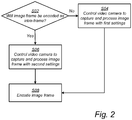
- Step S02 the controller 108 determines whether an image frame is going to be encoded as an intra-frame or an inter-frame. Typically, step S108 is carried out before the image frame is captured by the video camera 100. For example, the image frame may be the next frame to be captured.
- the decision in step S02 may be based on information from the encoder 114.
- the controller 108 may receive information from the encoder 114 regarding a GOP structure. From the GOP structure, the controller 108 may determine whether the image frame is going to be encoded as an intra-frame (I-frame), or an inter-frame (P- or B-frame).
- I-frame intra-frame
- P- or B-frame inter-frame
- the decision in step S02 may be based on contents in previous image frames, that is, image frames that were captured and processed prior to the image frame with respect to which the decision is to be made.
- the image processor 112 may have analysed contents of the previous image frames.
- the image processor 112 may have analysed the amount of motion in previous image frames, and on basis thereof determined whether the following frames should be encoded as intra-frames or inter-frames. If there is a lot of motion in the previous image frames, it may be beneficial to encode intra-frames more frequently compared to if there is less motion.
- the decision in step S02 may also be based on information from the network interface 106.
- the network interface 106 may request that a new intra-frame be encoded. Responsive to that request, the controller 108 may determine that the image frame is to be encoded an intra-frame.
- the decision in step S02 may also be based on a fixed intra-frame rate. For example, every n:th image frame, such as every 10 th image frame may be encoded as an intra-frame.
- the decision regarding whether or not to encode an image frame as an intra-frame is taken a number of frames ahead of time, such as three frames ahead. In that way, the information regarding whether a particular image frame will be encoded as an intra-frame is available to the image sensor 102 and/or image processor 112 in time before capturing and processing the particular image frame.
- step S04 the controller 108 controls the video camera 100 upstream of the encoder 114, and in particular, the image sensor 102 and the image processor 112, to capture and process the image frame using first settings.
- the controller 108 may send a control signal to the image sensor 102 and/or the image processor 112 which is indicative of the first settings.
- the first settings may for instance correspond to default settings, or settings which are automatically set by the video camera, e.g., by means of an auto-exposure procedure.
- the image sensor 102 and the image processor 112 will reduce the level of noise in the image frame to a first level, e.g., by applying a certain exposure time, gain, or noise filter.
- step S06 the controller 108 controls the video camera 100 upstream of the encoder 114, and in particular, the image sensor 102 and the image processor 112, to capture and process the image frame using second settings.
- the controller 108 may send a control signal to the image sensor 102 and/or the image processor 112 which is indicative of the second settings.
- the second settings are different from the first settings.
- the second settings differ from the first settings in that they will cause the image sensor 102 and the image processor 112 to further reduce the level of noise in the image frame to a second level which is lower than the first level.
- the level of noise in the resulting image frame is lower when captured and processed using the second settings compared to if the image frame instead had been captured and processed using the first settings.
- the controller 108 may modify the first settings, i.e., it may modify the default parameters or those parameters which were automatically set by the camera 100 by an auto-exposure algorithm.
- the controller 108 may modify the first settings so as to increase a ratio between exposure time and gain of the image frame.
- the first settings may comprise values of exposure time and gain, e.g., as set by auto-exposure.
- the controller 108 may modify the ratio of exposure time to gain by, for instance, increasing the exposure time and reducing the gain. In this way, the level of noise in the image frame will be further reduced.
- the video camera 100 captures a plurality of images using different exposure times and gains, and then combines the plurality of images into a single image frame. This is sometimes referred to as wide dynamic range.
- the controller 108 may modify the first settings including the different exposure times and gains of one or more of the plurality of images. For instance, it may increase the ratio between exposure time and gain of one or more of the images. However, it may not only increase the ratio between exposure time and gain for one or more of the plurality of images, but it may also modify the different exposure times in relation to each other.
- the controller 108 may modify the first settings so as to decrease the sharpness of the image frame. In this way, the image frame will be more smooth, and at the same time the bit rate will be reduced without any major effects on the visual quality after compression.
- the controller 108 may modify the first settings so as to increase a strength of at least one of a temporal noise filtering and a spatial noise filtering of the image frame.
- the image processor 112 may be configured to apply different types of filters, such as a temporal noise filter and/or a spatial noise filter, to an image frame so as to reduce the level of noise in the image frame.
- the filters may be associated with parameters, or settings, which govern how much a pixel of the image frame is smoothed or averaged with respect to neighbouring pixels in time and/or space.
- the parameters, or settings also governs how many neighbouring pixels in time and/or space that are used by the filter.
- the degree of smoothing is referred to herein as the strength of the filter.
- the controller 108 may modify the first settings by increasing a complexity level of at least one of a filtering and a processing algorithm applied to the image frame. For example, a more complex or advanced noise filtering algorithm may be used if the image frame is going to be encoded as an intra-frame compared to if it is going to be encoded as an inter-frame.
- the complexity level may be increased by choosing a different type of algorithm which is more advanced and more time consuming. Generally, an intra-frame is faster to encode than an inter-frame, since no search for motion vectors need to be made. That additional time may instead be spent on more complex filtering and processing.
- the encoder 114 When the video camera 100 has captured and processed the image frame as controlled by the controller 108, the encoder 114 will encode the image frame and transmit it in the bit stream 110 via the network interface 106. If it was decided in step S02 that the image frame is to be encoded as an intra-frame, the encoder 114 will encode the image frame as an intra-frame, and if it was decided that the image frame is to be encoded as an inter-frame, the encoder 114 will encode the image frame as an inter-frame.
- the encoder may use any known coding technique which uses inter-frame prediction, e.g., as standardized by H.264 or MPEG4.
Landscapes
- Engineering & Computer Science (AREA)
- Multimedia (AREA)
- Signal Processing (AREA)
- Computing Systems (AREA)
- Theoretical Computer Science (AREA)
- Compression Or Coding Systems Of Tv Signals (AREA)
Claims (10)
- Procédé de commande d'une caméra vidéo (100) qui est configurée pour capturer et traiter des trames d'images avant un encodage, caractérisé par :déterminer (S02) si la caméra vidéo est sur le point d'encoder les trames d'images comme des trames intra ou comme des trames inter ;pour les trames d'images qui sont sur le point d'être encodées comme des trames inter, commander (S04) la caméra vidéo (100) afin de capturer et traiter les trames d'image en utilisant des premiers réglages avant l'encodage ; etpour les trames d'images qui sont sur le point d'être encodées comme des trames intra, commander (S06) la caméra vidéo (100) afin de capturer et traiter les trames d'image en utilisant les seconds réglages avant l'encodage, dans lequel les seconds réglages sont modifiés par rapport au premier réglage en effectuant au moins un de :augmenter un rapport entre la durée d'exposition et le gain des trames d'images ;diminuer la netteté des trames d'images ;augmenter une intensité d'au moins un filtrage de bruit temporel et un filtrage de bruit spatial des trames d'images, etaugmenter un niveau de complexité d'au moins un algorithme de filtrage de traitement appliqué aux trames d'images, dans lequel le niveau de complexité indique combien de temps ou de ressources l'algorithme de filtrage ou de traitement demande.
- Procédé selon la revendication 1, dans lequel la trame d'image composée d'une pluralité d'images capturées avec des durées d'exposition différentes et/ou ayant des gains différents, dans lequel les seconds réglages sont modifiés par rapport au premier réglage en augmentant un rapport entre une durée d'exposition et un gain pour au moins une de la pluralité d'images.
- Procédé selon la revendication 2, dans lequel les seconds réglages sont modifiés par rapport aux premiers réglages en modifiant les différentes durées d'exposition et/ou les gains différents les uns par rapport aux autres.
- Procédé selon une quelconque des revendications précédentes, dans lequel l'étape de détermination que la caméra vidéo est sur le point d'encoder les trames d'images comme des trames intra ou des trames inter est basée sur une information reçue depuis un encodeur (114) de la caméra vidéo (100).
- Procédé selon la revendication 4, dans lequel l'information reçue depuis l'encodeur (114) de la caméra vidéo (100) comprend un groupe de structures d'images.
- Procédé selon une quelconque des revendications 1-3, dans lequel l'étape de détermination (S02) que la caméra vidéo (100) est sur le point d'encoder les trames d'image comme des trames intra ou des trames inter est basée sur les contenus dans les trames d'images précédentes.
- Procédé selon une quelconque des revendications 1-3, dans lequel l'étape de détermination (S02) que la caméra vidéo (100) est sur le point d'encoder les trames d'images comme des trames intra ou des trames inter est effectuée en réponse à une interface de réseau (106) de la caméra vidéo (100) demandant qu'une trame d'images soit encodée commune une trame intra.
- Contrôleur (108) pour commander une caméra vidéo (100) qui est configuré pour capturer et traiter des trames d'images avant un encodage, caractérisé par :
un processeur (116) configuré pour :déterminer (S02) si la caméra vidéo (100) est sur le point d'encoder les trames d'images comme des trames intra ou comme des trames inter ;commander (S04) la caméra vidéo (100) afin de capturer et traiter la trame d'image en utilisant des premiers réglages avant l'encodage pour les trames d'images qui sont sur le point d'être encodées comme des trames inter; et commander (S06) la caméra vidéo (100) afin de capturer et traiter les trames d'image en utilisant des seconds réglages avant l'encodage pour les trames d'images qui sont sur le point d'être encodées comme des trames intra, dans lequel les seconds réglages sont modifiés par rapport au premier réglage en effectuant au moins un de :augmenter un rapport entre la durée de position et le gain des trames d'images ;diminuer la netteté des trames d'images ;augmenter une intensité d'au moins un filtrage de bruit temporel et un filtrage de bruit spatial des trames d'images, etaugmenter un niveau de complexité d'au moins un algorithme de filtrage de traitement appliqué aux trames d'images, dans lequel le niveau de complexité indique combien de temps ou de ressources l'algorithme de filtrage ou de traitement demande. - Caméra vidéo (100) comprenant :un capteur d'images (102) pour capturer des trames d'images ;un processeur d'images (112) pour traiter des trames d'images capturées ;un encodeur (114) disposés en aval du capteur d'image (102) et du processeur d'images (112) pour encoder des trames d'images capturées et traitées ; etun contrôleur (108) selon la revendication 8 pour commander la caméra vidéo (100), dans lequel le contrôleur (108) est configuré pour commander le capteur d'images (102) afin de capturer des trames d'image et le processeur d'images (112) afin de traiter les trames d'images capturées avant l'encodage par l'encodeur.
- Support lisible par ordinateur non transitoire (118) renfermant des instructions de code informatique mémorisées sur celui-ci qui, lorsqu'elles sont exécutées par un dispositif ayant une capacité de traitement, sont adaptées pour mettre en œuvre le procédé selon une quelconque des revendications 1-7.
Priority Applications (3)
| Application Number | Priority Date | Filing Date | Title |
|---|---|---|---|
| EP17162802.7A EP3379820B1 (fr) | 2017-03-24 | 2017-03-24 | Organe de commande, caméra vidéo et procédé de commande d'une caméra vidéo |
| CN201810224173.XA CN108632527B (zh) | 2017-03-24 | 2018-03-19 | 控制器、摄像机以及用于控制摄像机的方法 |
| US15/928,722 US10531001B2 (en) | 2017-03-24 | 2018-03-22 | Controller, video camera, and method for controlling a video camera |
Applications Claiming Priority (1)
| Application Number | Priority Date | Filing Date | Title |
|---|---|---|---|
| EP17162802.7A EP3379820B1 (fr) | 2017-03-24 | 2017-03-24 | Organe de commande, caméra vidéo et procédé de commande d'une caméra vidéo |
Publications (2)
| Publication Number | Publication Date |
|---|---|
| EP3379820A1 EP3379820A1 (fr) | 2018-09-26 |
| EP3379820B1 true EP3379820B1 (fr) | 2020-01-15 |
Family
ID=58448366
Family Applications (1)
| Application Number | Title | Priority Date | Filing Date |
|---|---|---|---|
| EP17162802.7A Active EP3379820B1 (fr) | 2017-03-24 | 2017-03-24 | Organe de commande, caméra vidéo et procédé de commande d'une caméra vidéo |
Country Status (3)
| Country | Link |
|---|---|
| US (1) | US10531001B2 (fr) |
| EP (1) | EP3379820B1 (fr) |
| CN (1) | CN108632527B (fr) |
Families Citing this family (5)
| Publication number | Priority date | Publication date | Assignee | Title |
|---|---|---|---|---|
| CN110677653B (zh) * | 2019-09-27 | 2024-01-09 | 腾讯科技(深圳)有限公司 | 视频编解码方法和装置及存储介质 |
| CN111010495B (zh) * | 2019-12-09 | 2023-03-14 | 腾讯科技(深圳)有限公司 | 一种视频降噪处理方法及装置 |
| CN111901596B (zh) * | 2020-06-29 | 2021-10-22 | 北京大学 | 基于深度学习的视频混合编码与解码方法及装置、介质 |
| EP3985975B1 (fr) * | 2020-10-13 | 2023-05-03 | Axis AB | Dispositif de traitement d'image et procédé de codage d'images capturées par une caméra |
| EP4203472A1 (fr) * | 2021-12-21 | 2023-06-28 | Axis AB | Procédé et dispositif de traitement d'image pour le codage d'une vidéo |
Citations (3)
| Publication number | Priority date | Publication date | Assignee | Title |
|---|---|---|---|---|
| US20090244319A1 (en) * | 2008-04-01 | 2009-10-01 | Samsung Electronics Co., Ltd. | Image capturing apparatus and method |
| US20110249133A1 (en) * | 2010-04-07 | 2011-10-13 | Apple Inc. | Compression-quality driven image acquisition and processing system |
| US20130002898A1 (en) * | 2011-06-30 | 2013-01-03 | Dihong Tian | Encoder-supervised imaging for video cameras |
Family Cites Families (23)
| Publication number | Priority date | Publication date | Assignee | Title |
|---|---|---|---|---|
| US5550595A (en) * | 1994-12-16 | 1996-08-27 | Intel Corporation | Apparatus and method for motion estimation with enhanced camera interface |
| US6904169B2 (en) | 2001-11-13 | 2005-06-07 | Nokia Corporation | Method and system for improving color images |
| US20030161407A1 (en) | 2002-02-22 | 2003-08-28 | International Business Machines Corporation | Programmable and adaptive temporal filter for video encoding |
| CN1233171C (zh) | 2004-01-16 | 2005-12-21 | 北京工业大学 | 一种用于视频编码的简单化环路滤波方法 |
| US8218655B2 (en) | 2005-09-19 | 2012-07-10 | Maxim Integrated Products, Inc. | Method, system and device for improving video quality through in-loop temporal pre-filtering |
| US7589796B2 (en) | 2006-02-06 | 2009-09-15 | Vixs Systems Inc. | Video display device, video encoder, and methods for use therewith |
| US20080101469A1 (en) | 2006-10-31 | 2008-05-01 | Motorola, Inc. | Method and apparatus for adaptive noise filtering of pixel data |
| WO2008075261A1 (fr) | 2006-12-18 | 2008-06-26 | Koninklijke Philips Electronics N.V. | Amélioration de la réduction de bruit automatique dans des séquences vidéo |
| US8385425B2 (en) | 2007-10-25 | 2013-02-26 | Microsoft Corporation | Temporal video filtering for real time communication systems |
| US8264587B2 (en) | 2009-01-15 | 2012-09-11 | Nokia Corporation | Increasing frame rate for imaging |
| TWI440363B (zh) | 2009-02-19 | 2014-06-01 | Sony Corp | Image processing apparatus and method |
| CN102164278B (zh) | 2011-02-15 | 2013-05-15 | 杭州海康威视数字技术股份有限公司 | 用于去除i帧闪烁的视频编码方法及其装置 |
| US9402034B2 (en) * | 2011-07-29 | 2016-07-26 | Apple Inc. | Adaptive auto exposure adjustment |
| US8666042B2 (en) * | 2011-11-02 | 2014-03-04 | Cisco Technology, Inc. | Techniques for performing key frame requests in media servers and endpoint devices |
| JP5980618B2 (ja) | 2012-08-09 | 2016-08-31 | オリンパス株式会社 | 画像処理装置及び画像処理方法 |
| US8948529B1 (en) * | 2012-10-30 | 2015-02-03 | Google Inc. | Multi-pass encoding |
| US10080017B2 (en) | 2012-12-26 | 2018-09-18 | Avago Technologies General Ip (Singapore) Pte. Ltd. | Reduction of I-pulsing artifacts |
| JP2015023498A (ja) * | 2013-07-22 | 2015-02-02 | キヤノン株式会社 | 画像符号化装置、画像符号化方法およびプログラム |
| US20160112707A1 (en) * | 2014-10-15 | 2016-04-21 | Intel Corporation | Policy-based image encoding |
| EP3016383B1 (fr) | 2014-11-03 | 2017-06-21 | Axis AB | Procédé, dispositif et système permettant de prétraiter un flux vidéo pour le traitement de détection de mouvement subséquent |
| US20180262754A1 (en) | 2015-10-05 | 2018-09-13 | Hitachi, Ltd. | Image compression apparatus, image decoding apparatus, and image processing method |
| EP3328051B1 (fr) * | 2016-11-29 | 2019-01-02 | Axis AB | Procédé de commande d'un filtre de blocage infrarouge d'une caméra vidéo |
| US10341658B2 (en) | 2017-01-30 | 2019-07-02 | Intel Corporation | Motion, coding, and application aware temporal and spatial filtering for video pre-processing |
-
2017
- 2017-03-24 EP EP17162802.7A patent/EP3379820B1/fr active Active
-
2018
- 2018-03-19 CN CN201810224173.XA patent/CN108632527B/zh active Active
- 2018-03-22 US US15/928,722 patent/US10531001B2/en active Active
Patent Citations (3)
| Publication number | Priority date | Publication date | Assignee | Title |
|---|---|---|---|---|
| US20090244319A1 (en) * | 2008-04-01 | 2009-10-01 | Samsung Electronics Co., Ltd. | Image capturing apparatus and method |
| US20110249133A1 (en) * | 2010-04-07 | 2011-10-13 | Apple Inc. | Compression-quality driven image acquisition and processing system |
| US20130002898A1 (en) * | 2011-06-30 | 2013-01-03 | Dihong Tian | Encoder-supervised imaging for video cameras |
Also Published As
| Publication number | Publication date |
|---|---|
| CN108632527B (zh) | 2021-05-14 |
| US10531001B2 (en) | 2020-01-07 |
| CN108632527A (zh) | 2018-10-09 |
| EP3379820A1 (fr) | 2018-09-26 |
| US20180278849A1 (en) | 2018-09-27 |
Similar Documents
| Publication | Publication Date | Title |
|---|---|---|
| US10531001B2 (en) | Controller, video camera, and method for controlling a video camera | |
| US9402034B2 (en) | Adaptive auto exposure adjustment | |
| US8493499B2 (en) | Compression-quality driven image acquisition and processing system | |
| JP6479621B2 (ja) | ビデオ符号化方法及びビデオエンコーダシステム | |
| JP6961443B2 (ja) | 画像処理装置、画像処理方法、及びプログラム | |
| WO2014139396A1 (fr) | Procédé de codage vidéo à l'aide d'au moins une qualité visuelle évaluée, et appareil de codage vidéo y relatif | |
| EP3014880A2 (fr) | Codage d'une vidéo capturée avec une faible luminosité | |
| US10341675B2 (en) | Video encoding method and video encoder system | |
| JP2011523300A (ja) | ビデオのコーダとデコーダとの同時最適化のための方法およびシステム | |
| CN108632618B (zh) | 用于对视频流进行编码的方法、视频编码器和摄像机 | |
| EP2727330A1 (fr) | Imagerie supervisée par codeur pour des caméras vidéo | |
| US20130301700A1 (en) | Video encoding device and encoding method thereof | |
| US8488892B2 (en) | Image encoder and camera system | |
| JP2005295215A (ja) | 動画像符号化装置 | |
| JP4828950B2 (ja) | 動画像復号装置 | |
| US10834394B2 (en) | Method and a controller for adding comfort noise to a video sequence | |
| JP7775459B2 (ja) | 後のアナリティクスおよび再構成要件に基づいた、アダプティブなビデオシンニング | |
| CN102098505A (zh) | 监控视频压缩方法及设备 | |
| KR102315524B1 (ko) | 영상의 비트레이트 조절 방법 및 영상 획득 장치 | |
| EP3989587A1 (fr) | Dispositif de traitement d'images et procédé de pré-traitement des images d'un flux vidéo avant l'encodage | |
| CN114449281A (zh) | 一种基于场景变动的智能码率控制优化方法 | |
| JPH0984024A (ja) | 動画像信号の符号化装置 | |
| CN119420922B (zh) | 视频编码方法及装置 | |
| US20130064302A1 (en) | Video compression coding device and decoding device applied with motion compensation technique using selective reference frame, and method for determining selective reference frame for motion compensation | |
| JP2006303987A (ja) | 画像符号化装置及び画像符号化方法 |
Legal Events
| Date | Code | Title | Description |
|---|---|---|---|
| PUAI | Public reference made under article 153(3) epc to a published international application that has entered the european phase |
Free format text: ORIGINAL CODE: 0009012 |
|
| STAA | Information on the status of an ep patent application or granted ep patent |
Free format text: STATUS: REQUEST FOR EXAMINATION WAS MADE |
|
| 17P | Request for examination filed |
Effective date: 20170907 |
|
| AK | Designated contracting states |
Kind code of ref document: A1 Designated state(s): AL AT BE BG CH CY CZ DE DK EE ES FI FR GB GR HR HU IE IS IT LI LT LU LV MC MK MT NL NO PL PT RO RS SE SI SK SM TR |
|
| AX | Request for extension of the european patent |
Extension state: BA ME |
|
| STAA | Information on the status of an ep patent application or granted ep patent |
Free format text: STATUS: EXAMINATION IS IN PROGRESS |
|
| 17Q | First examination report despatched |
Effective date: 20181011 |
|
| GRAP | Despatch of communication of intention to grant a patent |
Free format text: ORIGINAL CODE: EPIDOSNIGR1 |
|
| STAA | Information on the status of an ep patent application or granted ep patent |
Free format text: STATUS: GRANT OF PATENT IS INTENDED |
|
| INTG | Intention to grant announced |
Effective date: 20191031 |
|
| GRAS | Grant fee paid |
Free format text: ORIGINAL CODE: EPIDOSNIGR3 |
|
| GRAA | (expected) grant |
Free format text: ORIGINAL CODE: 0009210 |
|
| STAA | Information on the status of an ep patent application or granted ep patent |
Free format text: STATUS: THE PATENT HAS BEEN GRANTED |
|
| AK | Designated contracting states |
Kind code of ref document: B1 Designated state(s): AL AT BE BG CH CY CZ DE DK EE ES FI FR GB GR HR HU IE IS IT LI LT LU LV MC MK MT NL NO PL PT RO RS SE SI SK SM TR |
|
| REG | Reference to a national code |
Ref country code: CH Ref legal event code: EP Ref country code: GB Ref legal event code: FG4D |
|
| REG | Reference to a national code |
Ref country code: IE Ref legal event code: FG4D |
|
| REG | Reference to a national code |
Ref country code: SE Ref legal event code: TRGR |
|
| REG | Reference to a national code |
Ref country code: DE Ref legal event code: R096 Ref document number: 602017010807 Country of ref document: DE |
|
| REG | Reference to a national code |
Ref country code: AT Ref legal event code: REF Ref document number: 1226195 Country of ref document: AT Kind code of ref document: T Effective date: 20200215 |
|
| REG | Reference to a national code |
Ref country code: NL Ref legal event code: MP Effective date: 20200115 |
|
| REG | Reference to a national code |
Ref country code: LT Ref legal event code: MG4D |
|
| PG25 | Lapsed in a contracting state [announced via postgrant information from national office to epo] |
Ref country code: NL Free format text: LAPSE BECAUSE OF FAILURE TO SUBMIT A TRANSLATION OF THE DESCRIPTION OR TO PAY THE FEE WITHIN THE PRESCRIBED TIME-LIMIT Effective date: 20200115 Ref country code: NO Free format text: LAPSE BECAUSE OF FAILURE TO SUBMIT A TRANSLATION OF THE DESCRIPTION OR TO PAY THE FEE WITHIN THE PRESCRIBED TIME-LIMIT Effective date: 20200415 Ref country code: FI Free format text: LAPSE BECAUSE OF FAILURE TO SUBMIT A TRANSLATION OF THE DESCRIPTION OR TO PAY THE FEE WITHIN THE PRESCRIBED TIME-LIMIT Effective date: 20200115 Ref country code: PT Free format text: LAPSE BECAUSE OF FAILURE TO SUBMIT A TRANSLATION OF THE DESCRIPTION OR TO PAY THE FEE WITHIN THE PRESCRIBED TIME-LIMIT Effective date: 20200607 Ref country code: RS Free format text: LAPSE BECAUSE OF FAILURE TO SUBMIT A TRANSLATION OF THE DESCRIPTION OR TO PAY THE FEE WITHIN THE PRESCRIBED TIME-LIMIT Effective date: 20200115 |
|
| PG25 | Lapsed in a contracting state [announced via postgrant information from national office to epo] |
Ref country code: LV Free format text: LAPSE BECAUSE OF FAILURE TO SUBMIT A TRANSLATION OF THE DESCRIPTION OR TO PAY THE FEE WITHIN THE PRESCRIBED TIME-LIMIT Effective date: 20200115 Ref country code: IS Free format text: LAPSE BECAUSE OF FAILURE TO SUBMIT A TRANSLATION OF THE DESCRIPTION OR TO PAY THE FEE WITHIN THE PRESCRIBED TIME-LIMIT Effective date: 20200515 Ref country code: HR Free format text: LAPSE BECAUSE OF FAILURE TO SUBMIT A TRANSLATION OF THE DESCRIPTION OR TO PAY THE FEE WITHIN THE PRESCRIBED TIME-LIMIT Effective date: 20200115 Ref country code: GR Free format text: LAPSE BECAUSE OF FAILURE TO SUBMIT A TRANSLATION OF THE DESCRIPTION OR TO PAY THE FEE WITHIN THE PRESCRIBED TIME-LIMIT Effective date: 20200416 Ref country code: BG Free format text: LAPSE BECAUSE OF FAILURE TO SUBMIT A TRANSLATION OF THE DESCRIPTION OR TO PAY THE FEE WITHIN THE PRESCRIBED TIME-LIMIT Effective date: 20200415 |
|
| REG | Reference to a national code |
Ref country code: DE Ref legal event code: R097 Ref document number: 602017010807 Country of ref document: DE |
|
| PG25 | Lapsed in a contracting state [announced via postgrant information from national office to epo] |
Ref country code: SM Free format text: LAPSE BECAUSE OF FAILURE TO SUBMIT A TRANSLATION OF THE DESCRIPTION OR TO PAY THE FEE WITHIN THE PRESCRIBED TIME-LIMIT Effective date: 20200115 Ref country code: EE Free format text: LAPSE BECAUSE OF FAILURE TO SUBMIT A TRANSLATION OF THE DESCRIPTION OR TO PAY THE FEE WITHIN THE PRESCRIBED TIME-LIMIT Effective date: 20200115 Ref country code: RO Free format text: LAPSE BECAUSE OF FAILURE TO SUBMIT A TRANSLATION OF THE DESCRIPTION OR TO PAY THE FEE WITHIN THE PRESCRIBED TIME-LIMIT Effective date: 20200115 Ref country code: ES Free format text: LAPSE BECAUSE OF FAILURE TO SUBMIT A TRANSLATION OF THE DESCRIPTION OR TO PAY THE FEE WITHIN THE PRESCRIBED TIME-LIMIT Effective date: 20200115 Ref country code: LT Free format text: LAPSE BECAUSE OF FAILURE TO SUBMIT A TRANSLATION OF THE DESCRIPTION OR TO PAY THE FEE WITHIN THE PRESCRIBED TIME-LIMIT Effective date: 20200115 Ref country code: CZ Free format text: LAPSE BECAUSE OF FAILURE TO SUBMIT A TRANSLATION OF THE DESCRIPTION OR TO PAY THE FEE WITHIN THE PRESCRIBED TIME-LIMIT Effective date: 20200115 Ref country code: MC Free format text: LAPSE BECAUSE OF FAILURE TO SUBMIT A TRANSLATION OF THE DESCRIPTION OR TO PAY THE FEE WITHIN THE PRESCRIBED TIME-LIMIT Effective date: 20200115 Ref country code: DK Free format text: LAPSE BECAUSE OF FAILURE TO SUBMIT A TRANSLATION OF THE DESCRIPTION OR TO PAY THE FEE WITHIN THE PRESCRIBED TIME-LIMIT Effective date: 20200115 Ref country code: SK Free format text: LAPSE BECAUSE OF FAILURE TO SUBMIT A TRANSLATION OF THE DESCRIPTION OR TO PAY THE FEE WITHIN THE PRESCRIBED TIME-LIMIT Effective date: 20200115 |
|
| REG | Reference to a national code |
Ref country code: CH Ref legal event code: PL |
|
| REG | Reference to a national code |
Ref country code: AT Ref legal event code: MK05 Ref document number: 1226195 Country of ref document: AT Kind code of ref document: T Effective date: 20200115 |
|
| PLBE | No opposition filed within time limit |
Free format text: ORIGINAL CODE: 0009261 |
|
| STAA | Information on the status of an ep patent application or granted ep patent |
Free format text: STATUS: NO OPPOSITION FILED WITHIN TIME LIMIT |
|
| 26N | No opposition filed |
Effective date: 20201016 |
|
| REG | Reference to a national code |
Ref country code: BE Ref legal event code: MM Effective date: 20200331 |
|
| PG25 | Lapsed in a contracting state [announced via postgrant information from national office to epo] |
Ref country code: LU Free format text: LAPSE BECAUSE OF NON-PAYMENT OF DUE FEES Effective date: 20200324 |
|
| PG25 | Lapsed in a contracting state [announced via postgrant information from national office to epo] |
Ref country code: LI Free format text: LAPSE BECAUSE OF NON-PAYMENT OF DUE FEES Effective date: 20200331 Ref country code: IE Free format text: LAPSE BECAUSE OF NON-PAYMENT OF DUE FEES Effective date: 20200324 Ref country code: IT Free format text: LAPSE BECAUSE OF FAILURE TO SUBMIT A TRANSLATION OF THE DESCRIPTION OR TO PAY THE FEE WITHIN THE PRESCRIBED TIME-LIMIT Effective date: 20200115 Ref country code: AT Free format text: LAPSE BECAUSE OF FAILURE TO SUBMIT A TRANSLATION OF THE DESCRIPTION OR TO PAY THE FEE WITHIN THE PRESCRIBED TIME-LIMIT Effective date: 20200115 Ref country code: CH Free format text: LAPSE BECAUSE OF NON-PAYMENT OF DUE FEES Effective date: 20200331 |
|
| PG25 | Lapsed in a contracting state [announced via postgrant information from national office to epo] |
Ref country code: SI Free format text: LAPSE BECAUSE OF FAILURE TO SUBMIT A TRANSLATION OF THE DESCRIPTION OR TO PAY THE FEE WITHIN THE PRESCRIBED TIME-LIMIT Effective date: 20200115 Ref country code: PL Free format text: LAPSE BECAUSE OF FAILURE TO SUBMIT A TRANSLATION OF THE DESCRIPTION OR TO PAY THE FEE WITHIN THE PRESCRIBED TIME-LIMIT Effective date: 20200115 Ref country code: BE Free format text: LAPSE BECAUSE OF NON-PAYMENT OF DUE FEES Effective date: 20200331 |
|
| PG25 | Lapsed in a contracting state [announced via postgrant information from national office to epo] |
Ref country code: TR Free format text: LAPSE BECAUSE OF FAILURE TO SUBMIT A TRANSLATION OF THE DESCRIPTION OR TO PAY THE FEE WITHIN THE PRESCRIBED TIME-LIMIT Effective date: 20200115 Ref country code: MT Free format text: LAPSE BECAUSE OF FAILURE TO SUBMIT A TRANSLATION OF THE DESCRIPTION OR TO PAY THE FEE WITHIN THE PRESCRIBED TIME-LIMIT Effective date: 20200115 Ref country code: CY Free format text: LAPSE BECAUSE OF FAILURE TO SUBMIT A TRANSLATION OF THE DESCRIPTION OR TO PAY THE FEE WITHIN THE PRESCRIBED TIME-LIMIT Effective date: 20200115 |
|
| PG25 | Lapsed in a contracting state [announced via postgrant information from national office to epo] |
Ref country code: MK Free format text: LAPSE BECAUSE OF FAILURE TO SUBMIT A TRANSLATION OF THE DESCRIPTION OR TO PAY THE FEE WITHIN THE PRESCRIBED TIME-LIMIT Effective date: 20200115 Ref country code: AL Free format text: LAPSE BECAUSE OF FAILURE TO SUBMIT A TRANSLATION OF THE DESCRIPTION OR TO PAY THE FEE WITHIN THE PRESCRIBED TIME-LIMIT Effective date: 20200115 |
|
| REG | Reference to a national code |
Ref country code: DE Ref legal event code: R079 Ref document number: 602017010807 Country of ref document: DE Free format text: PREVIOUS MAIN CLASS: H04N0005232000 Ipc: H04N0023600000 |
|
| P01 | Opt-out of the competence of the unified patent court (upc) registered |
Effective date: 20230505 |
|
| PGFP | Annual fee paid to national office [announced via postgrant information from national office to epo] |
Ref country code: SE Payment date: 20260219 Year of fee payment: 10 |
|
| PGFP | Annual fee paid to national office [announced via postgrant information from national office to epo] |
Ref country code: GB Payment date: 20260220 Year of fee payment: 10 |
|
| PGFP | Annual fee paid to national office [announced via postgrant information from national office to epo] |
Ref country code: DE Payment date: 20260219 Year of fee payment: 10 |
|
| PGFP | Annual fee paid to national office [announced via postgrant information from national office to epo] |
Ref country code: FR Payment date: 20260220 Year of fee payment: 10 |