EP3380657B1 - Procédé de fabrication d'une composition à base de lignine - Google Patents
Procédé de fabrication d'une composition à base de lignine Download PDFInfo
- Publication number
- EP3380657B1 EP3380657B1 EP16802032.9A EP16802032A EP3380657B1 EP 3380657 B1 EP3380657 B1 EP 3380657B1 EP 16802032 A EP16802032 A EP 16802032A EP 3380657 B1 EP3380657 B1 EP 3380657B1
- Authority
- EP
- European Patent Office
- Prior art keywords
- lignin
- group
- reactive component
- reaction mixture
- fibers
- Prior art date
- Legal status (The legal status is an assumption and is not a legal conclusion. Google has not performed a legal analysis and makes no representation as to the accuracy of the status listed.)
- Active
Links
Images
Classifications
-
- D—TEXTILES; PAPER
- D01—NATURAL OR MAN-MADE THREADS OR FIBRES; SPINNING
- D01F—CHEMICAL FEATURES IN THE MANUFACTURE OF ARTIFICIAL FILAMENTS, THREADS, FIBRES, BRISTLES OR RIBBONS; APPARATUS SPECIALLY ADAPTED FOR THE MANUFACTURE OF CARBON FILAMENTS
- D01F9/00—Artificial filaments or the like of other substances; Manufacture thereof; Apparatus specially adapted for the manufacture of carbon filaments
- D01F9/08—Artificial filaments or the like of other substances; Manufacture thereof; Apparatus specially adapted for the manufacture of carbon filaments of inorganic material
- D01F9/12—Carbon filaments; Apparatus specially adapted for the manufacture thereof
- D01F9/14—Carbon filaments; Apparatus specially adapted for the manufacture thereof by decomposition of organic filaments
- D01F9/16—Carbon filaments; Apparatus specially adapted for the manufacture thereof by decomposition of organic filaments from products of vegetable origin or derivatives thereof, e.g. from cellulose acetate
- D01F9/17—Carbon filaments; Apparatus specially adapted for the manufacture thereof by decomposition of organic filaments from products of vegetable origin or derivatives thereof, e.g. from cellulose acetate from lignin
-
- C—CHEMISTRY; METALLURGY
- C08—ORGANIC MACROMOLECULAR COMPOUNDS; THEIR PREPARATION OR CHEMICAL WORKING-UP; COMPOSITIONS BASED THEREON
- C08L—COMPOSITIONS OF MACROMOLECULAR COMPOUNDS
- C08L97/00—Compositions of lignin-containing materials
- C08L97/005—Lignin
-
- D—TEXTILES; PAPER
- D01—NATURAL OR MAN-MADE THREADS OR FIBRES; SPINNING
- D01F—CHEMICAL FEATURES IN THE MANUFACTURE OF ARTIFICIAL FILAMENTS, THREADS, FIBRES, BRISTLES OR RIBBONS; APPARATUS SPECIALLY ADAPTED FOR THE MANUFACTURE OF CARBON FILAMENTS
- D01F9/00—Artificial filaments or the like of other substances; Manufacture thereof; Apparatus specially adapted for the manufacture of carbon filaments
Definitions
- the invention relates to a process for the production of a melt-spinnable lignin-based composition, a development of this process, according to which its products are used for the production of precursor fibers for carbon fibers, and the use of these precursor fibers for the production of carbon fibers by carbonization, optionally with subsequent graphitization.
- Carbon fibers are understood to mean any structure containing carbon and preferably consisting of carbon, thin and flexible in relation to its length, which contains at least one monofilament and has a carbon content of at least 92% by weight, produced from a polymeric organic precursor or carbon allotrope Building blocks. Therefore, by definition, the carbon fibers include all carbon fiber single filaments that meet these criteria as well as all carbon fiber bundles or carbon fiber rovings.
- Carbon fibers are currently made from organic raw materials, the so-called precursors, which have a high carbon content.
- the most commonly used precursors are polyacrylonitrile (PAN) and mesophase pitch (pitch). Both are petroleum-based, the synthesis of potent PAN Fibers are complex and costly. In addition, both precursors are directly dependent on the possibly fluctuating crude oil price. It is therefore of particular interest to develop alternative precursors for carbon fiber synthesis. In order to be economically viable, they must either deliver better carbon fiber qualities or at least be cheaper than the current precursor systems.
- An alternative raw material for carbon fibers is the biopolymer lignin, which together with cellulose is the second most common biopolymer. It is characterized by good availability and a low basic price as well as a high carbon content> 60% by weight.
- the second group of methods primarily deals with derivatization reactions of the lignins.
- these are esters or ethers of the hydroxyl groups of the lignins as well as other derivatives such as urethanes.
- esters or ethers of the hydroxyl groups of the lignins as well as other derivatives such as urethanes.
- As structural The simplest ester of lignin is acetylated lignin, produced either by digestion of the lignin with automatic partial esterification or the targeted quantitative esterification ( US 7794824 B2 ). Further ester, ether and urethane derivatives are described in the prior art ( B. Wohlmann in WO 2010081775 A1 ).
- a lignin derivative is also known which differs from the previous derivatives in that it is not the hydroxyl function of the lignin that is derivatized here, but the alpha- carbon of phenolic hydroxyl groups.
- Various amines were coupled to hardwood lignins via methylene bridges via formaldehyde ( B. Wohlmann, S. Stüsgen in WO 2013144123 A1 ).
- the disadvantage of this technical proposal is that the fusible lignin derivative described is derivatized via complex amines coupled with formaldehyde. The inclusion of amines is a significant disadvantage.
- lignin-based novolaks Due to the fact that lignin is principally composed of phenol derivatives, namely cumaryl alcohol, coniferyl alcohol and sinapyl alcohol, similar to pure phenol, lignin can react with formaldehyde in a condensation reaction to form a resin. In the case of conventional phenolic resins, these can be divided into two groups: novolaks and resols. Novolaks are formed by acid catalysis of the reaction of phenol with formaldehyde mentioned. As a rule, formaldehyde is added in deficit.
- the stoichiometry means that the novolaks are usually relatively temperature-stable and meltable.
- Resoles on the other hand, are produced under base catalysis and excess formaldehyde. The products are easily hardenable, therefore poorly soluble and no longer meltable.
- Classic Phenol novolaks are usually made in a batch process. For this purpose, phenol (mp. 40.5 ° C.) is melted and an aqueous solution of formaldehyde or a formaldehyde precursor and an acid, for example oxalic acid, are added. The reaction mixture is heat treated for some time before the material takes on the desired properties. The phenol can be replaced by lignin. However, the level of lignin rarely exceeds the level of phenol.
- lignin changes the reaction conditions and the reactivity is reduced. Therefore longer reaction times and possibly higher temperatures have to be used.
- novolaks are used as binders and adhesives. They can be hardened by adding further formaldehyde or amines.
- a method for producing a lignin-phenol novolak by acid catalysis is also described in the prior art. Hydrochloric acid and sulfuric acid in low concentrations as well as oxalic acid are mentioned as catalytic acids.
- An aqueous solution of formaldehyde (formalin) as well as paraformaldehyde and 1,3,5-trioxane can be used as formaldehyde source ( A. Apel in US 2956033 ).
- ligno-novolaks A method for producing so-called ligno-novolaks is also known, which means novolak-like condensation products of lignin, a phenol-like compound (phenol, cresol, cresolic acid, xylenol) and an aldehyde (formaldehyde, furfural, paraformaldehyde) ( Gobran in US 4320036 A ).
- a phenolic resin is known that is based on polycondensation of lignin, phenol and formaldehyde under basic and acid catalysis ( Delmas in WO 2014206586 A1 ).
- the DE 10 2014 004 797 A1 discloses a process for producing a melt-spinnable lignin-based composition, wherein a reaction mixture which contains a lignin derivative as reactive component A and an auxiliary polymer with crosslinking function and / or with plasticizer function as reactive component B is subjected to reactive extrusion at elevated temperature.
- the reactive component B is selected from the group consisting of unsaturated polyester, saturated polyester, polyformaldehyde, polyacetaldehyde, polybenzaldehyde, polyketone, polyvinyl acetate and / or polymethoxystyrene.
- the invention has for its object to provide a method for producing a fusible lignin-based composition, which is characterized in that it is simple, practical and economical to carry out.
- the process product in the form of the lignin-based composition should advantageously be able to be converted into carbon fiber precursor fibers.
- the carbon fibers obtained therefrom after carbonization and optionally graphitization are said to be distinguished by advantageous mechanical properties that those Lignin-based carbon fibers that have been known up to now exceed advantageous tensile strength and elastic modulus values.
- a process for producing a fusible lignin-based composition which is characterized in that a reaction mixture, the lignin and / or a lignin derivative in the form of an esterified or etherified lignin as reactive component A and one at room temperature (20 ° C.
- solid formaldehyde-releasing compound as reactive component B in the form of 1,3,5-trioxane, paraformaldehyde and / or hexamethylenetetramine, at elevated temperature, preferably at a temperature of 100 to 230 ° C, in particular 100 to 200 ° C, one Is subjected to reactive extrusion, the reaction mixture being adjusted to a complex viscosity below 1500 Pa.s, preferably below 1300 Pa.s, in particular from 10 to 1000 Pa.s.
- the particularly preferred temperature range when carrying out the reactive extrusion is 120 to 180 ° C.
- reaction component A which may initially be lignin and / or a lignin derivative, and a formaldehyde-releasing compound as reactive component B.
- reaction component A preferably makes up a mass fraction of at least 50% by weight, in particular at least 60% by weight, of the entire reaction mixture. The range from 50 to 70% by weight is very particularly preferred.
- the lignin as reactive component A can originate from a single type or can be composed of several different lignins in different proportions. It can also be an artificial composition of different fractions of lignins.
- the lignins can be chemically modified beforehand, which then leads to the lignin derivative as reactive component A.
- the reactive component B is a compound or a mixture of compounds whose main task is to release formaldehyde in a controlled manner, which is used for further reaction with the components of the mixture is capable. Furthermore, what will be discussed below, preferably includes at least one third component C, which has its main use therein has to accelerate the reactivity of the lignin with formaldehyde, to act as a linking component as well as a plasticizer.
- Other components include additional softening substances that improve the processing and handling of the melt and the fiber, components that accelerate the reaction of the components with formaldehyde, and polymers that improve the mechanical properties of the lignin fibers and the properties of the melt.
- any isolated lignin can be used as lignin.
- lignins from almost all production methods, i.e. lignins from sulfite digestion, sulfate (kraft) digestion, soda-anthraquinone digestion and organosolv digestions of all kinds.
- lignin Depending on the production method and type of lignin, it may be necessary, on the one hand, to vary the composition of the components of the reaction already described, and thus to ensure optimum processability. It is also possible to put together an optimal lignin by fractionating one or more lignins according to, for example, molecular weights into different fractions and by mixing these fractions. Fractional lignin precipitation, which can also be carried out during the production or isolation process of the lignin, as well as the sequential extraction of lignin and ultrafiltration of solutions of lignin are possible.
- the purity of the reactive component A ie the lignin and the lignin derivative, is of considerable importance. It is known that too high a proportion of foreign ions can have a detrimental effect on the carbon structure and the stability of the carbon fiber.
- a low ash content is therefore an important criterion for the selection and purification of the lignin and the lignin derivative.
- a low content of alkali metal cations is preferred, in particular a low proportion of sodium and potassium in the reactive component A.
- the ash content can be determined in accordance with DIN ISO EN 3451-4.
- the exact quantification of the salts and metals contained can be carried out using ICP-MS, inductively coupled plasma mass spectrometry, after a suitable calibration and has a very low detection limit.
- Several methods are presented for reducing the salt concentration of lignins and for cleaning. This includes, for example, washing the lignins with demineralized water as well as with dilute aqueous hydrochloric acid.
- a reactive component A of high purity and with a low ash and salt content is therefore preferred.
- the reactive component A, in particular the lignin has an advantageous rheological behavior and in particular the lignin is ideally meltable, as a melt it can achieve a complex viscosity of less than 1000 Pa.s, in particular less than 800 Pa.s, whereby it is stable at this temperature, i.e. it does not show a large increase in viscosity due to crosslinking, nor does it decompose or carbonize.
- non-meltable lignins with meltable lignins in different ratios and lignins or lignin mixtures in which chemically modified lignins have already been used are preferred. Also preferred are lignins that have been artificially assembled from previously fractionated lignins into an optimal composition as required in order to obtain an optimized lignin in accordance with the applications. In this context, it is further preferred to design a non-meltable lignin, also by adapting the contents of other components of the reactions, such as the formaldehyde source, the plasticizer and the reaction accelerator.
- Lignins or mixtures of lignins with meltable hardwood lignins which have a Na content of less than 100 ppm and an ash content of less than 0.1% and a complex viscosity of less than 1000 Pa.s in the temperature range from 100 to 200 are very particularly preferred ° C can reach.
- the mixing of meltable and non-meltable lignins has already been done in the CA 2826061 A1 described.
- the lignin is in the form of a kraft lignin, soda lignin and / or organosolv lignin is used. It is very particularly preferred if a hardwood lignin (hardwood lignin) is used.
- reactive component A can also be present alone as a lignin derivative or as a mixture of the lignin derivative and the lignin. It is preferred that the lignin derivatives are used in the form of an esterified or etherified lignin.
- the lignin derivative is represented by the formula LO-CO-R x (I), formula LOR y (II) and / or formula LOR z (III), in which LO in the formulas (I ) and (II) an esterified or etherified lignin residue, the residue -CO-Rx in the formula (I) an acyl residue, the residue Rx and Ry an aliphatic and / or aromatic residue and the residue Rz in the formula ( III) a sulfonate, phosphate, phosphonate, phosphinate, phosphite, phosphonite and / or phosphinite residue, in the definition of which the oxygen atom from the LO is included, the lignin derivative in particular having a softening point between 80 ° C. and 220 ° C.
- the acyl radical in the formula (I) is aliphatic and / or aromatic, in particular aromatic. It is particularly expedient here if the aromatic acyl residue as benzoyl, as methoxybenzoyl, as 3- (4-methoxyphenyl) propenoyl (p-methoxy-cinnamic acid residue) and / or as 3-phenylpropenoyl residue (cinnamic acid- Radical) is present and / or the aliphatic acyl radical is a straight-chain or branched C 3 -C 18 -alkanoyl radical and / or a straight-chain or branched C 3 -C 18 -alkenoyl radical.
- alkanoyl residue as acetyl, propanoyl, butanoyl, pentanoyl, hexanoyl, octanoyl and / or decanoyl residue and the alkenoyl residue as methacrylic acid, acrylic acid and / or 2- Butenoyl acid residue is present.
- the aromatic radical Ry mentioned above is an aryl radical, in particular as a benzyl, methoxybenzyl and / or as a 3- (4-methoxyphenyl) propenyl and / or as a 3-phenylpropenyl radical (Cinnamon alcohol residue) is present.
- the aliphatic radical Ry is a straight-chain or branched C 1 -C 10 radical, in particular a methyl, ethyl, n-propyl, iso-propyl, tert-butyl or neo-pentyl radical, or a C 3 -C 12 cycloalkyl radical, in particular a cyclohexyl radical.
- formula (III) it should be stated that it is particularly advantageous in the sense of the invention if it represents: a sulfonic acid ester of the formula LO-SO 2 -R w (IIIa), in particular a lignin-p-toluenesulfonate, a phosphate of the formula LOP (O) (OR w ) 2 (IIIb), in particular a lignin diphenyl phosphate, a phosphonate of the formula LOP (O) (OR w ) (R w ) (IIIc), in particular a lignin methyl (methylphosphonate) Phosphinate of the formula LOP (O) (R w ) 2 (IIId), in particular a lignin-phenylphosphinate, a phosphite of the formula LOP (OR w ) 2 (IIIe), in particular a lignin-dimethylphosphite, a phosphonite of the formula LOP (OR
- 1% to 100%, in particular 1% to 50%, of the hydroxyl radicals of the lignin according to the formulas (IIIb), (IIIc), (IIId), (IIIe), (IIIf) and / or (IIIg) are occupied and the other hydroxyl groups are esterified and / or etherified and a total of 35% to 100% of the hydroxyl groups are occupied.
- 35% to 100%, in particular 60% to 100%, of the hydroxyl radicals of the lignin are esterified via an acyl radical and / or etherified via an alkyl radical or aryl radical and / or are occupied by a sulfonate, phosphate, phosphonate, phosphinate, phosphite, phosphonite and / or phosphinite residue.
- Mn number average molecular weight
- the purity of the reactive component A plays a relevant role for the successful implementation of the method according to the invention. It is therefore preferred that the reactive component A has a volatile component content, determined on the basis of the weight loss, after 60 min at a temperature of 50 ° C. above the glass transition temperature T g and at normal pressure (1 atm), of at most 1.0% by weight. %, in particular less than 0.3% by weight. Furthermore, it is considered expedient if the ash content of reactive component A, measured according to DIN EN ISO 3451-4, is less than 0.1% by weight and / or reactive component A is less than 1000 ppm foreign ions, in particular less than 500 ppm Contains foreign ions, especially in the form of alkali metal ions. It is furthermore expedient that the reactive component A has a complex viscosity below 100 Pa.s at 100 to 200 ° C. in the melt, the complex viscosity being in particular between 100 and 500 Pa.s.
- an essential component of the reaction mixture according to the invention is a formaldehyde-releasing compound which is to be used as reactive component B: this compound is capable, controlled and controllable to release formaldehyde via external influences.
- these include 1,3,5-trioxane, the trimer of formaldehyde, a colorless solid and paraformaldehyde, an approximately linear oligomer of formaldehyde.
- the reactive component B is able to prevent crosslinking of the reactive component A, in particular a lignin mixture, by premature release of formaldehyde during the fiber production process.
- reactive component B In connection with reactive component B and optionally a softening component, it is possible, depending on the choice of reactive component B, the temperature, residence time and concentrations, to produce different molecular weights and structures during the extrusion and during the conversion to carbon fiber, and to control the rheological behavior .
- Reactive component B has been found to be solid at room temperature (20 ° C.) and in the form of 1,3,5-trioxane, paraformaldehyde and / or hexamethylenetetraamine.
- the quantitative ratio of reactive component A and reactive component B can be optimized. To achieve the desired effects, it is advantageous if about 3 to 20 parts by weight, in particular 4 to 15 parts by weight of reactive component A are used per 1 part by weight of reactive component B.
- an acid accelerates the reaction to the novolak itself, i.e. the coupling of phenolic compounds such as phenol, resorcinol and lignin via methylene bridges.
- an acid can accelerate the decomposition of the formaldehyde-producing substance to formaldehyde.
- organic acids the organic residues of which are similar to the building blocks of lignin or which are linked to the unit of the benzene ring formed in the conversion process to carbon fiber and can be incorporated into the carbon structure. Acids such as trans-cinnamic acid and their derivatives are therefore particularly preferred.
- Cinnamic acid also has a double bond in conjugation to the benzene ring and can therefore participate in crosslinking reactions.
- reaction-accelerating organic acids in particular in the form of cinnamic acid, phthalic acid, methanesulfonic acid, toluenesulfonic acid and / or benzoic acid, the reaction mixture of which contains 0.1 to 5% by weight, in particular 0.3 to 3% by weight.
- Reactive component C It has already been expressed above that it is useful for the invention to add softening and reactive components to the reaction mixture.
- the main softening components used are low-molecular substances, whose structure is similar to the structural sub-components of lignin. Likewise, oligomeric substances which are completely miscible with the lignin and have a lower melting point can be used as plasticizers.
- Benzene ring Compounds which contain at least one aromatic unit, usually a benzene ring, are preferred. This may be linked to other benzene rings. Furthermore, this additive may have functional groups such as hydroxyl (OH -) -, alkyl, alkenyl and alkoxy (-OR) -, in particular methoxy groups, bonded to the benzene ring already described, and also show the functionality of a carboxylic acid (-COOH) which can also serve as an aliphatic or aromatic ester (-COOR). Resorcinol, phenol, vanilin, bisphenol A are preferred. It is preferred to add this additive in an amount of less than 40% by weight to reactive component A, in particular to lignin, in particular less than 30% by weight.
- -COOH carboxylic acid
- Resorcinol, phenol, vanilin, bisphenol A are preferred. It is preferred to add this additive in an amount of less than 40% by weight to reactive component A, in particular to lignin, in particular
- a content of 5 to 20% by weight is very particularly preferred.
- the preferred compounds mentioned have the important property of being able to participate in the chemical reactions, such as the molecular weight build-up via methylene bridging. By choosing these compounds or mixing the compounds or the concentration, in particular also in combination with the formaldehyde component, the flow properties of the melt of reactive component A and the extent of the reaction during the extrusion can be controlled.
- reaction component C In principle, it is preferred that part of the lignin and / or the lignin derivative in the reactive component A is replaced by an additional phenolic component as the reactive component C. It is particularly expedient here to use an unsubstituted or mono- or polysubstituted phenol and / or an unsubstituted and / or mono- or polysubstituted bisphenol as the reactive component C, in particular phenol, resorcinol, vanillin and / or bisphenol A.
- This embodiment is developed particularly advantageously by the substituent of the reactive component C being an alkyl and / or alkenyl radical with 1 to 10 carbon atoms and / or an alkoxy radical with 1 to 10 Carbon atoms, in particular a methoxy, ethoxy, propoxy and / or butoxy radical.
- the reaction mixture When plasticizing components are included, it has proven to be advantageous for the reaction mixture to contain a spinning additive D having a plasticizing function in the form of an aromatic compound which has at least one benzene ring and at least one benzene ring has one OH, one CHO, one COOH and one COORy and / or an alkoxy radical, wherein Ry has the meaning as it was presented above in connection with the formulas for reactive component A.
- the alkoxy radical of the spinning additive D has 1 to 10 carbon atoms, in particular as methoxy, ethoxy, 2-propoxy, n-propoxy, tert-butoxy, isobutoxy, sec-butoxy and / or n-butoxy radical is present.
- the spin additive D is present in the reaction mixture in an amount of less than 30% by weight, in particular less than 15% by weight. It is particularly preferred that the spin additive D is present in the reaction mixture in an amount of at least 0.5% by weight, in particular in an amount of 1 to 5% by weight.
- the reaction mixture according to the invention may contain an auxiliary polymer E with a crosslinking and / or plasticizing function, this auxiliary polymer E preferably having a softening point between 130 ° C. and 220 ° C. It is particularly preferred here that the auxiliary polymer E has a softening point from 130 ° C. to 200 ° C., in particular from 150 ° C. to 180 ° C.
- the auxiliary polymer E is expediently a saturated polyester, a polyamide, a polyoxymethylene and / or esterified cellulose. Cellulose acetate butyrate is particularly suitable here.
- auxiliary polymer E is present in the reaction mixture in an amount of at least 10% by weight, preferably from 15 to 50% by weight, in particular from 15 to 35% by weight.
- the overall idea of the invention is that a special reaction mixture is subjected to reactive extrusion, in the course of a melting process and an extrusion. Further processing takes place in a later step of spinning or in the immediate subsequent spinning.
- the reaction mixture therefore has a softening range or melting range of preferably 100 ° C. to 200 ° C., in particular between 120 ° C. and 180 ° C.
- the reaction mixture should expediently have a complex viscosity of below 1500 Pa.s, the mixture being stable over a processing period of at least 30 min, preferably below 1300 Pa.s, in particular below 1000 Pa.s, the range from 10 up to 1000 Pa.s is particularly preferred with regard to the rheology, a viscosity in the range of decreasing viscosity with temperature rise between 10 and 1000 Pa.s, in particular from 100 to 500 Pa.s. In general, the viscous portion of the melt must dominate in this area by a distance, so that the thread can be drawn.
- the production of the lignin-based carbon fibers begins in the first step with the reactive extrusion of the lignin or the lignin derivative with the other components according to the invention, followed by the process of melt spinning into filaments.
- the extrusion relates to the compounding of the individual components and, if appropriate, their reaction with one another. This takes place in an extruder, preferably a twin-screw extruder, which is more suitable for mixing.
- the individual components of the reaction can already be premixed to the extruder. Simultaneous separate dosing of the only partially premixed components is also possible.
- the extruder has different heating zones that can be set individually.
- the dosing can be carried out with the aid of solid dosing systems.
- the starting materials can be metered in powder form.
- the spinning attachment is preferably attached to the extruder, which has at least one spinning pump, which exerts a constant pressure of the melt on the spinning package with a spinneret and is intended to guarantee a constant mass flow. These units can be heated individually.
- the spinnerets used preferably have about 10 to 10,000 spinnerets per spin pack, in particular 100 to 1000 spinnerets per spin pack.
- the nozzle diameter is preferably approximately 100 to 500 ⁇ m, in particular 150 to 300 ⁇ m.
- the product obtained after the reactive extrusion can be spun immediately or after intermediate storage.
- the invention accordingly also relates to the use of the melt-spinnable lignin-based composition obtained by the process according to the invention for the production of precursor fibers of carbon fibers by melt extrusion at elevated temperature, in particular in a temperature range from 100 to 200 ° C., and subsequent thermal stabilization of the precursor fibers obtained.
- thermostabilize the precursor fibers before carbonization is preferably done in a temperature range from 100 to 400 ° C, in particular from 200 to 300 ° C. It is preferred that the thermal stabilization is carried out as oxidative thermal stabilization and / or stabilization with high-energy radiation.
- the thermal stabilization with high-energy radiation is preferably based on ultraviolet radiation (UV), vacuum ultraviolet radiation (VUUV), electron radiation, X-rays and / or gamma radiation.
- UV ultraviolet radiation
- VUUV vacuum ultraviolet radiation
- the oxidative thermal stabilization is expediently carried out at a final temperature of from 100 ° C. to 400 ° C., in particular from 200 ° C. to 300 ° C.
- the range from 220 ° C. to 275 ° C. is particularly preferred.
- the types of stabilization can consequently, in particular, be oxidative as well as under an inert atmosphere Nitrogen. Both types of stabilization are based, among other things, on the thermally induced crosslinking of the lignin molecules within the precursor fiber. One of the consequences of this is that the fiber becomes infusible and can be carbonized in a further step at a higher heating rate.
- the reactive component B of the invention ie the formaldehyde-releasing compound
- the treatment of the spun lignin fibers with high-energy rays, such as electron beams, should be emphasized.
- formaldehyde can be polymerized or trimerized by exposure to radiation. It is possible according to the invention to decompose the same product again in situ within the fiber to formaldehyde and thus to trigger a triggered chemical crosslinking. During the stabilization, the fiber should be subjected to a constant tensile force.
- the particular advantage of the invention is that the precursor fibers produced in the manner described above can advantageously be used for the production of carbon fibers by carbonization, optionally with subsequent graphitization.
- the carbonization is preferably carried out by heating the stabilized fibers under protective gas in the temperature range from 200 ° C. to 2000 ° C., in particular from 250 ° C. to 1800 ° C. It is preferably heated to a maximum of 1400 ° C.
- the fiber should also feel a constant tensile force in the fiber axis during carbonization.
- the subsequent graphitization which can optionally be carried out, is preferably carried out by thermal treatment at 1700 ° C.
- the graphitized fibers have a higher modulus of elasticity than conventional carbonized fibers.
- the best values achieved according to the invention are around 294 GPa (DIN EN ISO 5079).
- the invention relates to a simple method for producing a fusible lignin-based composition and the production of advantageous lignin-based Precursor fibers and their further processing into useful carbon fibers.
- the synthesis of the precursor fibers or the starting material for this is characterized in that, with the aid of reactive extrusion, which is easy to carry out, a reactive component A, in particular based on lignin and / or a lignin derivative, a reactive component B, which is a compound which releases formaldehyde, and optionally phenol derivatives, and also further, if necessary, further additives are co-extruded together.
- the core of the present invention preferably does not relate to the production of resins as binders or adhesives or moldings per se and relates less to the synthesis of novolak resins in the stirred kettle, but to the combination of the reaction of lignin or a lignin derivative Formaldehyde and additives in the extruder and the (preferably simultaneous) shaping of the reaction mass. Melt spinning of fibers, which are used as novel precursors for carbon fibers, is particularly addressed.
- the challenge facing the invention is, besides desirable carbon fiber qualities, to adjust the process in such a way that the rheological properties of the process product, which change with the reaction in the extruder, make it optimally suitable for spinning into fibers. This has been fully achieved. It is quite desirable that the reaction in the extruder and in the spinning head does not proceed completely, but that it can continue during the thermal or radiation-induced stabilization.
- Reactive extrusion does not only serve to subject the spinning mass to crosslinking in its entirety, but also for the controlled build-up of a higher molar mass to improve the spinnability and the binding of the reactive components to the lignin.
- the wet chemical processes known in the prior art require the handling of non-aqueous solvents, which generates considerable process costs by recovering the solvent and drying the precursor fiber.
- a reaction of the components in the process according to the invention in the selected extruder does not necessarily mean that it is largely crosslinking.
- a non-crosslinking reaction linear molecular weight build-up
- reactive extrusion can be referred to as such, but not necessarily as a whole as a crosslinking reaction.
- the desired complete crosslinking should only take place in the spun precursor fiber.
- networking has a particularly positive impact on the properties of the stabilized fibers and the carbon fibers.
- the final crosslinking of the lignin precursor fibers is evidently carried out in the subsequent step of thermal stabilization.
- the lignin molecules react with each other as well as by bridging using the released formaldehyde. It is particularly advantageous that the complete release of the formaldehyde takes place, in particular, only during the thermal crosslinking or thermal stabilization.
- An admixture of free formaldehyde to the spinning mass according to the prior art requires extensive use of protective measures against its release in a technical implementation.
- the process for producing the precursor fibers is characterized by simplicity and cost-effective production options. Chemical modifications of the lignin, the molecular weight structure of the extrusion and the spinning process can be carried out in a single technical step. In addition to the lignin as a biopolymer, it is also conceivable to use the further components of the reaction according to the invention, produced bio-based. For example, the formaldehyde components based on bio-based methanol can be produced using catalytic and oxidative processes.
- a particular advantage of the invention is that it opens up the possibility of accelerating the reactivity of reactive component A with reactive component B in the simplest form. This is done through connections that act as linking components as well as plasticizers. Other components with an additional softening effect help to improve the processing and handling of the melt and the fibers. Other components accelerate the reaction with formaldehyde. Polymers improve the mechanical properties of the lignin fibers and those of the melt.
- the method according to the invention i.e. for the production of the melt-spinnable lignin-based composition and the further processing of the same into precursor fibers and subsequently into carbon fibers, which provides the person skilled in the art with a variety of useful control options in order to obtain a particularly advantageous process product.
- a hardwood lignin (85%) is mixed with paraformaldehyde (10%) and phenol (5%) and continuously metered into a twin screw extruder, Leistritz.
- the extruder temperature is 120 ° C in the first zone and 140 ° C in all further zones.
- the dosing speed depends on the speed of the extruder.
- the screw speed is 250 rpm.
- the melt is degassed on the extruder with the help of a vacuum pump.
- the extruded melt is spun directly into filaments by a spinning package, which is subsequently attached to the extruder, consisting of a spinning pump and spinneret.
- the compounded lignin granules are spun separately, the granules are added to a single-screw extruder, Haake Rheomex OS.
- the temperature of the heating zones is 120 ° C in the first zone and 140 ° C in all others.
- a subsequent spinning pump conveys the melt through the spinneret (13 x 200 ⁇ m). The melting threads hardened over a fall distance of 4 m and can be wound up.
- Lignin is mixed with 1,3,5-trioxane (22%) and resorcinol (6%), as well as cinnamic acid (4%) and homogenized and, as in Example 1, continuously fed to a twin-screw extruder and extruded.
- the extruder temperature was 120 ° C in the first zone and 135 ° C in all other later zones.
- the granules obtained are spun using a single-screw extruder, Haake Rheomex OS, through a spinneret (13 ⁇ 200 ⁇ m).
- the temperature in the first zone is 120 ° C, in all other heating zones 135 ° C.
- Cinnamon lignin previously synthesized by esterification is mixed with 1,3,5-trioxane (22%) and resorcinol (6%) and spun on a small extruder at 140 ° C to form monofilaments through a spinneret with a hole diameter of 0.5 mm and wound up.
- Example 4 thermo stabilization and carbonization of the lignin precursor fibers from example 3a
- the lignin precursor fibers are oxidatively thermostabilized.
- the fibers are heated from room temperature to 250 ° C at a heating rate of 0.25 K / min in air in a muffle furnace from Nabertherm.
- the fibers were used as a monofilament.
- the monofilaments are fixed on their ends on graphite substrates.
- Thermal stabilization of the fibers is also possible as a fiber bundle, to which tensile stress is exerted during the thermal treatment.
- the carbonization takes place with the same device and fixation or tensile treatment as with the thermal stabilization. Carbonization is carried out under pure nitrogen from room temperature to 1000 ° C and a heating rate of 10 K / min in a high-temperature furnace from Gero.
- Carbon fibers with diameters in the range from 25 to 10 ⁇ m are obtained, with an average of 17 ⁇ m.
- the tensile strengths, elongations and moduli of elasticity of the fibers are determined using the Favimat testing device from Textechno.
- Tensile strengths of up to 2.44 GPa, on average 0.71 GPa and modules up to 294 GPa, on average 96 GPa are obtained for the fibers.
- the density of the fibers is 1.62 g / cm 3 .
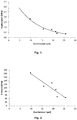
- Fig. 1 is the order of the measured tensile strengths and in the Fig. 2 that of the measured modulus of elasticity of the carbon fibers as a function of different fiber diameters.
- Example 5 thermo stabilization and carbonization of the lignin fibers from Example 3b
- the lignin fibers are thermally stabilized analogously to Example 4 up to 250 ° C. and then carbonized up to 1000 ° C. under a nitrogen atmosphere.
- Carbon fibers with diameters in the range from 29 to 17 ⁇ m are obtained, with an average of 23 ⁇ m.
- the tensile strengths, elongations and moduli of elasticity of the fibers were determined using the Favimat testing device from Textechno.
- Tensile strengths of up to 0.74 GPa, on average 0.48 GPa and modules of up to 64 GPa, on average 46 GPa, are obtained for the fibers.
- the density of the carbon fibers is 1.6 g / cm 3 .
- Example 6 thermo stabilization and carbonization of the lignin fibers from Example 3c
- the lignin fibers are thermally stabilized analogously to Example 4 up to 250 ° C. and then carbonized up to 1000 ° C. under a nitrogen atmosphere.
- Carbon fibers with diameters in the range from 50 to 26 ⁇ m are obtained, with an average of 37 ⁇ m.
- Tensile strengths of up to 0.63 GPa, on average 0.40 GPa and modules up to 149 GPa, on average 63 GPa are obtained for the fibers.
- Example 7 thermo stabilization and carbonization of the lignin fibers from example 3d
- the lignin fibers are thermally stabilized analogously to Example 4 up to 250 ° C. and then carbonized up to 1000 ° C. under a nitrogen atmosphere. Carbon fibers with diameters between 12 and 25 ⁇ m, on average 20 ⁇ m, are obtained. The result is an average tensile strength of 0.58 GPa with a maximum tensile strength of 1.1 GPa and an elastic modulus of 61 GPa, maximum 97 GPa.
- Example 8 thermo stabilization and carbonization of the lignin fibers from example 2.
- the lignin fibers are thermally stabilized analogously to Example 4 up to 250 ° C. and then carbonized up to 1000 ° C. under a nitrogen atmosphere.
- Carbon fibers with diameters in the range of ⁇ 30 ⁇ m are obtained.
- the tensile strengths, elongations and moduli of elasticity of the fibers are determined using the Favimat testing device from Textechno. Average tensile strengths of 0.54 GPa and modules on average of 82 GPa, maximum 113 GPa, are obtained.
- cellulose acetate butyrate 20 percent by weight 1,3,5-trioxane and 6 percent by weight resorcinol were mixed with the adjusted amounts of organosolv lignin (52, 32 and 22 percent by weight, respectively). -%) mixed and compounded and spun at 170 ° C in a small extruder. The fibers were easy to unwind and were not brittle.
- the lignin fibers from Example 9 were thermally stabilized analogously to Example 8 up to 250 ° C. and then carbonized up to 1000 ° C. under a nitrogen atmosphere. Carbon fibers were obtained which showed a compact cross-section without phase separation and a homogeneous surface in scanning electron microscopy.
- the fibers from Example 2 were placed in graphite boats, mechanically fixed and heated at room temperature (20 ° C.) at a heating rate of 1 ° Kelvin / min in air in a muffle furnace from Nabertherm GmbH to 250 ° C. within 4 hours.
- the fibers kept their shape, showed no sticking or droplet formation.
- Miscanthus lignin was obtained from Miscanthus straw ( Miscanthus ⁇ giganteus ) using an Organosolv process.
- the lignin was converted into the acetyl derivative and, with the addition of 1,3,5-trioxane (22%) and resorcinol (6%), could be melt-spun into fibers in a stable manner at 120 ° C.
Landscapes
- Chemical & Material Sciences (AREA)
- Chemical Kinetics & Catalysis (AREA)
- Engineering & Computer Science (AREA)
- General Chemical & Material Sciences (AREA)
- Textile Engineering (AREA)
- Materials Engineering (AREA)
- Health & Medical Sciences (AREA)
- Medicinal Chemistry (AREA)
- Polymers & Plastics (AREA)
- Organic Chemistry (AREA)
- Inorganic Fibers (AREA)
- Artificial Filaments (AREA)
Claims (21)
- Procédé pour la fabrication d'une composition à base de lignine, pouvant être filée à l'état fondu, caractérisé en ce qu'on soumet à une extrusion réactive à haute température un mélange réactionnel qui contient de la lignine et/ou un dérivé de lignine sous forme d'une lignine estérifiée ou éthérifiée en tant que composant réactif A et un composé libérant du formaldéhyde solide à 20°C en tant que composant réactif B, sous forme de 1, 3, 5-trioxanne, de paraformaldéhyde et/ou d'hexaméthylènetétramine, le mélange réactionnel étant ajusté à une viscosité complexe inférieure à 1 500 Pa.s, en particulier de 10 à 1300 Pa.s.
- Procédé selon la revendication 1, caractérisé en ce que la lignine est utilisée sous forme d'une lignine obtenue par le procédé Kraft, le procédé à la soude et/ou le procédé Organosolv, de préférence une lignine de feuillu (hardwood lignin), une lignine de conifère (softwood lignin) et/ou une lignine de graminées.
- Procédé selon l'une des revendications 1 ou 2, caractérisé en ce que le dérivé de lignine est représenté parla formule L-O-CO-Rx (I),la formule L-O-Ry (II) et/oula formule L-O-Rz (III),dans laquelle
L-O, dans les formules (I) et (II), représente un radical lignine estérifiée ou éthérifiée,
le radical -CO-Rx, dans la formule (I), représente un radical acyle,
les radicaux Rx et Ry représentent chacun un radical aliphatique et/ou aromatique,
et le radical Rz, dans la formule (III), représente un radical sulfonate, phosphate, phosphonate, phosphinate, phosphite, phosphonite et/ou phosphinite, dans la définition desquels l'atome d'oxygène provient de L-O. - Procédé selon au moins l'une des revendications 1 à 3, caractérisé en ce que le dérivé de lignine présente une masse moléculaire moyenne en nombre (Mn) de 200 à 40 000, en particulier de 300 à 20 000.
- Procédé selon au moins l'une des revendications précédentes, caractérisé en ce que la teneur en cendres du composant réactif A, mesurée selon DIN EN ISO 3451-4, est inférieure à 0,1 % en poids, et/ou le composant réactif A contient moins de 1 000 ppm d'ions étrangers, en particulier moins de 500 ppm d'ions étrangers, en particulier sous forme d'ions de métaux alcalins.
- Procédé selon au moins l'une des revendications précédentes, caractérisé en ce que le composant réactif A présente, à 100 à 200°C dans la masse fondue, une viscosité complexe inférieure à 1 000 Pa.s, la viscosité complexe étant en particulier comprise entre 100 et 500 Pa.s.
- Procédé selon au moins l'une des revendications précédentes, caractérisé en ce que, dans le composant réactif A, une partie de la lignine et/ou du dérivé de lignine est remplacée par un composant phénolique supplémentaire en tant que composant réactif C.
- Procédé selon la revendication 7, caractérisé en ce qu'on utilise en tant que composant réactif C un phénol non substitué et/ou une ou plusieurs fois substitué et/ou un bisphénol non substitué et/ou substitué, une ou plusieurs fois substitué, en particulier le phénol, le résorcinol, la vanilline et/ou le bisphénol A, le substituant du composant réactif C étant de préférence un radical alkyle et/ou alcényle ayant 1 à 10 atomes de carbone et/ou un radical alkoxy ayant 1 à 10 atomes de carbone, en particulier un radical méthoxy, éthoxy, propoxy et/ou butoxy.
- Procédé selon au moins l'une des revendications précédentes, caractérisé en ce qu'on utilise pour 1 partie en poids du composant réactif B 3 à 20 parties en poids, en particulier 4 à 15 parties en poids du composant réactif A.
- Procédé selon au moins l'une des revendications précédentes, caractérisé en ce que la température, pendant la mise en œuvre de l'extrusion réactive, est ajustée à 120 à 180°C.
- Procédé selon au moins l'une des revendications précédentes, caractérisé en ce qu'on ajoute au mélange réactionnel des acides organiques accélérateurs de réaction, en particulier sous forme d'acide cinnamique, d'acide phtalique, d'acide méthanesulfonique, d'acide toluènesulfonique et/ou d'acide benzoïque, le mélange réactionnel en contenant de préférence 0,1 à 5 % en poids, en particulier 0,3 à 3 % en poids.
- Procédé selon au moins l'une des revendications précédentes, caractérisé en ce que le mélange réactionnel contient un additif de filage (D) ayant une fonction plastifiante sous forme d'un composé aromatique, qui présente au moins un cycle benzène et, sur au moins un cycle benzène, un radical OH, CHO, COOH, COORy, Ry ayant la signification donnée ci-dessus, et/ou alkoxy, le radical alkoxy de l'additif de filage (D) ayant de préférence 1 à 10 atomes de carbone, et se présentant de préférence sous forme d'un radical méthoxy, éthoxy, 2-propoxy, n-propoxy, tert.-butoxy, isobutoxy, sec.-butoxy et/ou n-butoxy.
- Procédé selon la revendication 12, caractérisé en ce que l'additif de filage (D) est présent dans le mélange réactionnel en une quantité inférieure à 30 % en poids, en particulier inférieure à 15 % en poids, de préférence en une quantité d'au moins 0,5 % en poids, en particulier en une quantité de 1 à 5 % en poids.
- Procédé selon au moins l'une des revendications précédentes, caractérisé en ce que le mélange réactionnel contient un polymère auxiliaire (E) ayant une fonction d'agent de réticulation et/ou de plastifiant.
- Procédé selon au moins l'une des revendications précédentes, caractérisé en ce que le polymère auxiliaire (E) est présent sous forme d'un polyester saturé, d'un polyamide, d'un polyoxyméthylène, d'un poly(méthacrylate de méthyle) et/ou de cellulose estérifiée.
- Procédé selon la revendication 14, caractérisé en ce que le polymère auxiliaire (E) est présent dans le mélange réactionnel en une quantité d'au moins 10 % en poids, de préférence de 15 à 50 % en poids, en particulier de 15 à 35 % en poids.
- Utilisation de la composition à base de lignine, pouvant être filée à l'état fondu, obtenue selon l'une des revendications précédentes, pour la fabrication de fibres précurseurs de fibres de carbone par extrusion à l'état fondu à haute température, en particulier dans une plage de températures de 100 à 200°C, suivie d'une thermostabilisation des fibres précurseurs obtenues, le procédé de fabrication des fibres précurseurs étant de préférence mis en œuvre immédiatement après le procédé de fabrication de la composition à base de lignine pouvant être filée à l'état fondu, une extrudeuse à deux vis étant de préférence utilisée lors de l'extrusion à l'état fondu.
- Utilisation selon la revendication 17, caractérisée en ce que la thermostabilisation des fibres précurseurs est mise en œuvre dans la plage de températures de 100 à 400°C, en particulier de 200 à 300°C, en particulier sous forme d'une thermostabilisation oxydative et/ou d'une stabilisation par un rayonnement de haute énergie.
- Utilisation selon la revendication 18, caractérisée en ce qu'on met en œuvre en tant que rayonnement de haute énergie un rayonnement ultraviolet (UV), un rayonnement ultraviolet sous vide (VUUV), un rayonnement électronique, un rayonnement X et/ou un rayonnement gamma.
- Utilisation selon la revendication 18 ou 19, caractérisée en ce que la thermostabilisation oxydative est mise en œuvre à une température finale de 100 à 400°C, en particulier de 200 à 300°C, la thermostabilisation étant mise en œuvre de préférence jusqu'à une température finale de 220 à 275°C.
- Utilisation selon au moins l'une des revendications 17 à 20, dans laquelle la fabrication des fibres précurseurs suit la fabrication de fibres de carbone par carbonisation des fibres précurseurs, l'opération étant éventuellement suivie d'une graphitisation.
Applications Claiming Priority (2)
| Application Number | Priority Date | Filing Date | Title |
|---|---|---|---|
| DE102015120377.4A DE102015120377A1 (de) | 2015-11-25 | 2015-11-25 | Verfahren zur Herstellung einer Lignin-basierten Zusammensetzung |
| PCT/EP2016/078896 WO2017089585A1 (fr) | 2015-11-25 | 2016-11-25 | Procédé de fabrication d'une composition à base de lignine |
Publications (2)
| Publication Number | Publication Date |
|---|---|
| EP3380657A1 EP3380657A1 (fr) | 2018-10-03 |
| EP3380657B1 true EP3380657B1 (fr) | 2020-07-01 |
Family
ID=57421844
Family Applications (1)
| Application Number | Title | Priority Date | Filing Date |
|---|---|---|---|
| EP16802032.9A Active EP3380657B1 (fr) | 2015-11-25 | 2016-11-25 | Procédé de fabrication d'une composition à base de lignine |
Country Status (3)
| Country | Link |
|---|---|
| EP (1) | EP3380657B1 (fr) |
| DE (1) | DE102015120377A1 (fr) |
| WO (1) | WO2017089585A1 (fr) |
Families Citing this family (6)
| Publication number | Priority date | Publication date | Assignee | Title |
|---|---|---|---|---|
| US10633770B2 (en) | 2018-01-04 | 2020-04-28 | North Carolina State University | Coagulation map for fiber spinning |
| WO2020191407A1 (fr) * | 2019-03-21 | 2020-09-24 | Carbon Holdings Intellectual Properties, Llc | Processus à co2 supercritique solvaté pour convertir du charbon en fibres de carbone |
| DE102020119592B4 (de) | 2020-07-24 | 2024-09-05 | Technische Universität Dresden | Verfahren zur Herstellung poröser Kohlenstofffasern |
| CN113956501B (zh) * | 2021-11-16 | 2022-07-22 | 东华大学 | 一种改性木质素及其制备方法、改性木质素增强聚乙烯醇纤维及其制备方法和应用 |
| DE102022117670A1 (de) | 2022-07-14 | 2024-01-25 | Technikum Laubholz Gmbh | Precursor-Fasern von Lignin-basierten Carbonfasern, deren Herstellung und Verwendung |
| US20240141560A1 (en) * | 2022-10-27 | 2024-05-02 | Iowa State University Research Foundation, Inc. | Method to produce high-quality carbon fiber using lignin |
Family Cites Families (13)
| Publication number | Priority date | Publication date | Assignee | Title |
|---|---|---|---|---|
| US2956033A (en) | 1952-10-03 | 1960-10-11 | Apel Alfons | Lignin-phenol-formaldehyde resins, and method of preparation |
| GB1111299A (en) | 1964-10-10 | 1968-04-24 | Nippon Kayaku Kk | Method of producing carbonized material |
| US4320036A (en) | 1980-10-16 | 1982-03-16 | American Can Company | Ligno-novolak resin molding compositions |
| US7794824B2 (en) | 2007-06-25 | 2010-09-14 | Weyerhaeuser Nr Company | Carbon fibers from kraft softwood lignin |
| TW201031692A (en) | 2009-01-15 | 2010-09-01 | Toho Tenax Europe Gmbh | Lignin derivative, shaped body comprising the derivative and carbon fibres produced from the shaped body |
| CA2826061C (fr) | 2011-02-14 | 2018-10-02 | Innventia Ab | Procede de fabrication d'une fibre de lignine |
| WO2012127009A1 (fr) * | 2011-03-23 | 2012-09-27 | Basf Se | Compositions contenant des composés ioniques polymères comprenant des groupes imidazolium |
| WO2013144123A1 (fr) | 2012-03-28 | 2013-10-03 | Toho Tenax Europe Gmbh | Dérivé de lignine fusible et fibre produite à partir de ce dérivé de lignine |
| WO2013144124A1 (fr) * | 2012-03-28 | 2013-10-03 | Toho Tenax Europe Gmbh | Dérivé de lignine, son procédé de production, et procédé de filature pour la production d'une fibre à partir du dérivé de lignine |
| FI127816B (en) * | 2012-06-06 | 2019-03-15 | Upm Kymmene Corp | A method for fractionating lignin |
| DE102014004797B4 (de) | 2013-05-24 | 2024-06-13 | Technikum Laubholz Gmbh | Precursor-Fasern von Lignin-basierten Carbonfasern, deren Herstellung und Verwendung |
| FR3007764B1 (fr) | 2013-06-26 | 2016-11-25 | Cie Ind De La Matiere Vegetale - Cimv | "resine phenolique obtenue par polycondensation de formaldehyde, de phenol et de lignine" |
| CN105040162A (zh) * | 2015-06-11 | 2015-11-11 | 天津科技大学 | 木质中空纤维和木质中空活性炭纤维的制备方法 |
-
2015
- 2015-11-25 DE DE102015120377.4A patent/DE102015120377A1/de not_active Ceased
-
2016
- 2016-11-25 EP EP16802032.9A patent/EP3380657B1/fr active Active
- 2016-11-25 WO PCT/EP2016/078896 patent/WO2017089585A1/fr not_active Ceased
Non-Patent Citations (1)
| Title |
|---|
| None * |
Also Published As
| Publication number | Publication date |
|---|---|
| DE102015120377A1 (de) | 2017-06-01 |
| EP3380657A1 (fr) | 2018-10-03 |
| WO2017089585A1 (fr) | 2017-06-01 |
Similar Documents
| Publication | Publication Date | Title |
|---|---|---|
| EP3380657A1 (fr) | Procédé de fabrication d'une composition à base de lignine | |
| EP3717546B1 (fr) | Lignine modifiee, procedes de preparation et utilisation | |
| DE2826114C2 (de) | Kohlenstoff-Kohlenstoff-Verbundmaterialien und Verfahren zu dessen Herstellung | |
| DE1910419C3 (de) | Novolak-Fasern und Verfahren zu ihrer Herstellung | |
| DE102005056792B4 (de) | Zusammensetzung für formaldehydfreies Phenolharzbindemittel und deren Verwendung | |
| EP2619251A1 (fr) | Lignine thermoplastique pour la fabrication de fibres de carbone | |
| DE69220385T2 (de) | Verdichtung von strukturgebilden mit benzoxazinen | |
| DE2612845C3 (de) | Kohlenstoffhaltige Fasern, Verfahren zu ihrer Herstellung und ihre Verwendung | |
| DE2839167A1 (de) | Kohlenstoff-kohlenstoff-verbundmaterial und verfahren zu seiner herstellung | |
| DE102014004797B4 (de) | Precursor-Fasern von Lignin-basierten Carbonfasern, deren Herstellung und Verwendung | |
| DE3122884A1 (de) | Gemische aus polyalkylen-terephthalat und einem vollstaendig aromatischen polyester und ihre verwendung | |
| DE2214281C3 (de) | Phenolharzfaser mit verbesserten Beständigkeiten und Verfahren zu ihrer Herstellung | |
| DE10331342B4 (de) | Thermostabile Form- oder Spinnmasse | |
| DE69632784T2 (de) | Stark basische tertiäre aminoalkohole als katalysatoren | |
| DE60220423T2 (de) | Stabilisierte polyesterzusammensetzungen und monofilamente daraus | |
| DE69222817T2 (de) | Verfahren zur Herstellung von Kohlenstofffasern auf Pechbasis | |
| DE102019119464B3 (de) | Verfahren zur Herstellung von Lignin-PAN-basierten Polymercompounds und Lignin-PAN-basierte Polymercompounds | |
| DE2211437A1 (de) | Phenol-Endlosfaden und Verfahren zu seiner Herstellung | |
| EP4493746A1 (fr) | Fibres précurseurs de fibres de carbone à base de lignine, leur production et leur utilisation | |
| DE2355211A1 (de) | Selbstverloeschende, verstaerkte polycarbonatformmassen | |
| WO2013144123A1 (fr) | Dérivé de lignine fusible et fibre produite à partir de ce dérivé de lignine | |
| DE2754599C2 (de) | Faserverstärkte Preß- und Formmassen auf der Basis von Polyoxymethylenen und ihre Verwendung | |
| DE2646325C2 (de) | Phenolharzfasern oder -filme und Verfahren zu ihrer Herstellung | |
| EP2889401A1 (fr) | Fibre de cellulose régénérée | |
| DE10246472A1 (de) | Endlosfäden mit hoher Dimensionsstabilität, Hydrolysebeständigkeit und Flammfestigkeit |
Legal Events
| Date | Code | Title | Description |
|---|---|---|---|
| STAA | Information on the status of an ep patent application or granted ep patent |
Free format text: STATUS: UNKNOWN |
|
| STAA | Information on the status of an ep patent application or granted ep patent |
Free format text: STATUS: THE INTERNATIONAL PUBLICATION HAS BEEN MADE |
|
| PUAI | Public reference made under article 153(3) epc to a published international application that has entered the european phase |
Free format text: ORIGINAL CODE: 0009012 |
|
| STAA | Information on the status of an ep patent application or granted ep patent |
Free format text: STATUS: REQUEST FOR EXAMINATION WAS MADE |
|
| 17P | Request for examination filed |
Effective date: 20180620 |
|
| AK | Designated contracting states |
Kind code of ref document: A1 Designated state(s): AL AT BE BG CH CY CZ DE DK EE ES FI FR GB GR HR HU IE IS IT LI LT LU LV MC MK MT NL NO PL PT RO RS SE SI SK SM TR |
|
| AX | Request for extension of the european patent |
Extension state: BA ME |
|
| DAV | Request for validation of the european patent (deleted) | ||
| DAX | Request for extension of the european patent (deleted) | ||
| RAP1 | Party data changed (applicant data changed or rights of an application transferred) |
Owner name: DEUTSCHE INSTITUTE FUER TEXTIL- UND FASERFORSCHUNG |
|
| GRAP | Despatch of communication of intention to grant a patent |
Free format text: ORIGINAL CODE: EPIDOSNIGR1 |
|
| STAA | Information on the status of an ep patent application or granted ep patent |
Free format text: STATUS: GRANT OF PATENT IS INTENDED |
|
| INTG | Intention to grant announced |
Effective date: 20200127 |
|
| GRAS | Grant fee paid |
Free format text: ORIGINAL CODE: EPIDOSNIGR3 |
|
| GRAA | (expected) grant |
Free format text: ORIGINAL CODE: 0009210 |
|
| STAA | Information on the status of an ep patent application or granted ep patent |
Free format text: STATUS: THE PATENT HAS BEEN GRANTED |
|
| AK | Designated contracting states |
Kind code of ref document: B1 Designated state(s): AL AT BE BG CH CY CZ DE DK EE ES FI FR GB GR HR HU IE IS IT LI LT LU LV MC MK MT NL NO PL PT RO RS SE SI SK SM TR |
|
| REG | Reference to a national code |
Ref country code: CH Ref legal event code: EP Ref country code: AT Ref legal event code: REF Ref document number: 1286271 Country of ref document: AT Kind code of ref document: T Effective date: 20200715 |
|
| REG | Reference to a national code |
Ref country code: IE Ref legal event code: FG4D Free format text: LANGUAGE OF EP DOCUMENT: GERMAN |
|
| REG | Reference to a national code |
Ref country code: DE Ref legal event code: R096 Ref document number: 502016010398 Country of ref document: DE |
|
| REG | Reference to a national code |
Ref country code: LT Ref legal event code: MG4D |
|
| PG25 | Lapsed in a contracting state [announced via postgrant information from national office to epo] |
Ref country code: BG Free format text: LAPSE BECAUSE OF FAILURE TO SUBMIT A TRANSLATION OF THE DESCRIPTION OR TO PAY THE FEE WITHIN THE PRESCRIBED TIME-LIMIT Effective date: 20201001 |
|
| REG | Reference to a national code |
Ref country code: NL Ref legal event code: MP Effective date: 20200701 |
|
| PG25 | Lapsed in a contracting state [announced via postgrant information from national office to epo] |
Ref country code: HR Free format text: LAPSE BECAUSE OF FAILURE TO SUBMIT A TRANSLATION OF THE DESCRIPTION OR TO PAY THE FEE WITHIN THE PRESCRIBED TIME-LIMIT Effective date: 20200701 Ref country code: LT Free format text: LAPSE BECAUSE OF FAILURE TO SUBMIT A TRANSLATION OF THE DESCRIPTION OR TO PAY THE FEE WITHIN THE PRESCRIBED TIME-LIMIT Effective date: 20200701 Ref country code: SE Free format text: LAPSE BECAUSE OF FAILURE TO SUBMIT A TRANSLATION OF THE DESCRIPTION OR TO PAY THE FEE WITHIN THE PRESCRIBED TIME-LIMIT Effective date: 20200701 Ref country code: PT Free format text: LAPSE BECAUSE OF FAILURE TO SUBMIT A TRANSLATION OF THE DESCRIPTION OR TO PAY THE FEE WITHIN THE PRESCRIBED TIME-LIMIT Effective date: 20201102 Ref country code: ES Free format text: LAPSE BECAUSE OF FAILURE TO SUBMIT A TRANSLATION OF THE DESCRIPTION OR TO PAY THE FEE WITHIN THE PRESCRIBED TIME-LIMIT Effective date: 20200701 Ref country code: CZ Free format text: LAPSE BECAUSE OF FAILURE TO SUBMIT A TRANSLATION OF THE DESCRIPTION OR TO PAY THE FEE WITHIN THE PRESCRIBED TIME-LIMIT Effective date: 20200701 Ref country code: FI Free format text: LAPSE BECAUSE OF FAILURE TO SUBMIT A TRANSLATION OF THE DESCRIPTION OR TO PAY THE FEE WITHIN THE PRESCRIBED TIME-LIMIT Effective date: 20200701 Ref country code: GR Free format text: LAPSE BECAUSE OF FAILURE TO SUBMIT A TRANSLATION OF THE DESCRIPTION OR TO PAY THE FEE WITHIN THE PRESCRIBED TIME-LIMIT Effective date: 20201002 Ref country code: NO Free format text: LAPSE BECAUSE OF FAILURE TO SUBMIT A TRANSLATION OF THE DESCRIPTION OR TO PAY THE FEE WITHIN THE PRESCRIBED TIME-LIMIT Effective date: 20201001 |
|
| PG25 | Lapsed in a contracting state [announced via postgrant information from national office to epo] |
Ref country code: LV Free format text: LAPSE BECAUSE OF FAILURE TO SUBMIT A TRANSLATION OF THE DESCRIPTION OR TO PAY THE FEE WITHIN THE PRESCRIBED TIME-LIMIT Effective date: 20200701 Ref country code: RS Free format text: LAPSE BECAUSE OF FAILURE TO SUBMIT A TRANSLATION OF THE DESCRIPTION OR TO PAY THE FEE WITHIN THE PRESCRIBED TIME-LIMIT Effective date: 20200701 Ref country code: PL Free format text: LAPSE BECAUSE OF FAILURE TO SUBMIT A TRANSLATION OF THE DESCRIPTION OR TO PAY THE FEE WITHIN THE PRESCRIBED TIME-LIMIT Effective date: 20200701 Ref country code: IS Free format text: LAPSE BECAUSE OF FAILURE TO SUBMIT A TRANSLATION OF THE DESCRIPTION OR TO PAY THE FEE WITHIN THE PRESCRIBED TIME-LIMIT Effective date: 20201101 |
|
| PG25 | Lapsed in a contracting state [announced via postgrant information from national office to epo] |
Ref country code: NL Free format text: LAPSE BECAUSE OF FAILURE TO SUBMIT A TRANSLATION OF THE DESCRIPTION OR TO PAY THE FEE WITHIN THE PRESCRIBED TIME-LIMIT Effective date: 20200701 |
|
| REG | Reference to a national code |
Ref country code: DE Ref legal event code: R097 Ref document number: 502016010398 Country of ref document: DE |
|
| PG25 | Lapsed in a contracting state [announced via postgrant information from national office to epo] |
Ref country code: RO Free format text: LAPSE BECAUSE OF FAILURE TO SUBMIT A TRANSLATION OF THE DESCRIPTION OR TO PAY THE FEE WITHIN THE PRESCRIBED TIME-LIMIT Effective date: 20200701 Ref country code: DK Free format text: LAPSE BECAUSE OF FAILURE TO SUBMIT A TRANSLATION OF THE DESCRIPTION OR TO PAY THE FEE WITHIN THE PRESCRIBED TIME-LIMIT Effective date: 20200701 Ref country code: EE Free format text: LAPSE BECAUSE OF FAILURE TO SUBMIT A TRANSLATION OF THE DESCRIPTION OR TO PAY THE FEE WITHIN THE PRESCRIBED TIME-LIMIT Effective date: 20200701 Ref country code: IT Free format text: LAPSE BECAUSE OF FAILURE TO SUBMIT A TRANSLATION OF THE DESCRIPTION OR TO PAY THE FEE WITHIN THE PRESCRIBED TIME-LIMIT Effective date: 20200701 Ref country code: SM Free format text: LAPSE BECAUSE OF FAILURE TO SUBMIT A TRANSLATION OF THE DESCRIPTION OR TO PAY THE FEE WITHIN THE PRESCRIBED TIME-LIMIT Effective date: 20200701 |
|
| PLBE | No opposition filed within time limit |
Free format text: ORIGINAL CODE: 0009261 |
|
| STAA | Information on the status of an ep patent application or granted ep patent |
Free format text: STATUS: NO OPPOSITION FILED WITHIN TIME LIMIT |
|
| PG25 | Lapsed in a contracting state [announced via postgrant information from national office to epo] |
Ref country code: AL Free format text: LAPSE BECAUSE OF FAILURE TO SUBMIT A TRANSLATION OF THE DESCRIPTION OR TO PAY THE FEE WITHIN THE PRESCRIBED TIME-LIMIT Effective date: 20200701 |
|
| 26N | No opposition filed |
Effective date: 20210406 |
|
| PG25 | Lapsed in a contracting state [announced via postgrant information from national office to epo] |
Ref country code: SK Free format text: LAPSE BECAUSE OF FAILURE TO SUBMIT A TRANSLATION OF THE DESCRIPTION OR TO PAY THE FEE WITHIN THE PRESCRIBED TIME-LIMIT Effective date: 20200701 Ref country code: MC Free format text: LAPSE BECAUSE OF FAILURE TO SUBMIT A TRANSLATION OF THE DESCRIPTION OR TO PAY THE FEE WITHIN THE PRESCRIBED TIME-LIMIT Effective date: 20200701 |
|
| REG | Reference to a national code |
Ref country code: CH Ref legal event code: PL |
|
| PG25 | Lapsed in a contracting state [announced via postgrant information from national office to epo] |
Ref country code: LU Free format text: LAPSE BECAUSE OF NON-PAYMENT OF DUE FEES Effective date: 20201125 |
|
| REG | Reference to a national code |
Ref country code: BE Ref legal event code: MM Effective date: 20201130 |
|
| PG25 | Lapsed in a contracting state [announced via postgrant information from national office to epo] |
Ref country code: LI Free format text: LAPSE BECAUSE OF NON-PAYMENT OF DUE FEES Effective date: 20201130 Ref country code: SI Free format text: LAPSE BECAUSE OF FAILURE TO SUBMIT A TRANSLATION OF THE DESCRIPTION OR TO PAY THE FEE WITHIN THE PRESCRIBED TIME-LIMIT Effective date: 20200701 Ref country code: CH Free format text: LAPSE BECAUSE OF NON-PAYMENT OF DUE FEES Effective date: 20201130 |
|
| PG25 | Lapsed in a contracting state [announced via postgrant information from national office to epo] |
Ref country code: IE Free format text: LAPSE BECAUSE OF NON-PAYMENT OF DUE FEES Effective date: 20201125 |
|
| REG | Reference to a national code |
Ref country code: DE Ref legal event code: R081 Ref document number: 502016010398 Country of ref document: DE Owner name: TECHNIKUM LAUBHOLZ GMBH (TLH), DE Free format text: FORMER OWNER: DEUTSCHE INSTITUTE FUER TEXTIL- UND FASERFORSCHUNG DENKENDORF, 73770 DENKENDORF, DE Ref country code: DE Ref legal event code: R081 Ref document number: 502016010398 Country of ref document: DE Owner name: TECHNIKUM LAUBHOLZ GMBH, DE Free format text: FORMER OWNER: DEUTSCHE INSTITUTE FUER TEXTIL- UND FASERFORSCHUNG DENKENDORF, 73770 DENKENDORF, DE |
|
| REG | Reference to a national code |
Ref country code: GB Ref legal event code: 732E Free format text: REGISTERED BETWEEN 20220127 AND 20220202 |
|
| PG25 | Lapsed in a contracting state [announced via postgrant information from national office to epo] |
Ref country code: TR Free format text: LAPSE BECAUSE OF FAILURE TO SUBMIT A TRANSLATION OF THE DESCRIPTION OR TO PAY THE FEE WITHIN THE PRESCRIBED TIME-LIMIT Effective date: 20200701 Ref country code: MT Free format text: LAPSE BECAUSE OF FAILURE TO SUBMIT A TRANSLATION OF THE DESCRIPTION OR TO PAY THE FEE WITHIN THE PRESCRIBED TIME-LIMIT Effective date: 20200701 Ref country code: CY Free format text: LAPSE BECAUSE OF FAILURE TO SUBMIT A TRANSLATION OF THE DESCRIPTION OR TO PAY THE FEE WITHIN THE PRESCRIBED TIME-LIMIT Effective date: 20200701 |
|
| PG25 | Lapsed in a contracting state [announced via postgrant information from national office to epo] |
Ref country code: MK Free format text: LAPSE BECAUSE OF FAILURE TO SUBMIT A TRANSLATION OF THE DESCRIPTION OR TO PAY THE FEE WITHIN THE PRESCRIBED TIME-LIMIT Effective date: 20200701 |
|
| PG25 | Lapsed in a contracting state [announced via postgrant information from national office to epo] |
Ref country code: BE Free format text: LAPSE BECAUSE OF NON-PAYMENT OF DUE FEES Effective date: 20201130 |
|
| REG | Reference to a national code |
Ref country code: AT Ref legal event code: PC Ref document number: 1286271 Country of ref document: AT Kind code of ref document: T Owner name: TECHNIKUM LAUBHOLZ GMBH, DE Effective date: 20221007 |
|
| REG | Reference to a national code |
Ref country code: DE Ref legal event code: R081 Ref document number: 502016010398 Country of ref document: DE Owner name: TECHNIKUM LAUBHOLZ GMBH, DE Free format text: FORMER OWNER: TECHNIKUM LAUBHOLZ GMBH (TLH), 89143 BLAUBEUREN, DE Ref country code: DE Ref legal event code: R081 Ref document number: 502016010398 Country of ref document: DE Owner name: TECHNIKUM LAUBHOLZ GMBH (TLH), DE Free format text: FORMER OWNER: TECHNIKUM LAUBHOLZ GMBH (TLH), 89143 BLAUBEUREN, DE |
|
| PGFP | Annual fee paid to national office [announced via postgrant information from national office to epo] |
Ref country code: DE Payment date: 20251118 Year of fee payment: 10 |
|
| PGFP | Annual fee paid to national office [announced via postgrant information from national office to epo] |
Ref country code: GB Payment date: 20251120 Year of fee payment: 10 |
|
| PGFP | Annual fee paid to national office [announced via postgrant information from national office to epo] |
Ref country code: AT Payment date: 20251117 Year of fee payment: 10 |
|
| PGFP | Annual fee paid to national office [announced via postgrant information from national office to epo] |
Ref country code: FR Payment date: 20251120 Year of fee payment: 10 |