EP3381771B1 - Integrierte fahrzeughaube - Google Patents
Integrierte fahrzeughaube Download PDFInfo
- Publication number
- EP3381771B1 EP3381771B1 EP17163013.0A EP17163013A EP3381771B1 EP 3381771 B1 EP3381771 B1 EP 3381771B1 EP 17163013 A EP17163013 A EP 17163013A EP 3381771 B1 EP3381771 B1 EP 3381771B1
- Authority
- EP
- European Patent Office
- Prior art keywords
- hood
- central cover
- rear beam
- reinforcements
- thermoplastic
- Prior art date
- Legal status (The legal status is an assumption and is not a legal conclusion. Google has not performed a legal analysis and makes no representation as to the accuracy of the status listed.)
- Not-in-force
Links
Images




Classifications
-
- B—PERFORMING OPERATIONS; TRANSPORTING
- B62—LAND VEHICLES FOR TRAVELLING OTHERWISE THAN ON RAILS
- B62D—MOTOR VEHICLES; TRAILERS
- B62D25/00—Superstructure or monocoque structure sub-units; Parts or details thereof not otherwise provided for
- B62D25/08—Front or rear portions
- B62D25/10—Bonnets or lids, e.g. for trucks, tractors, busses, work vehicles
- B62D25/105—Bonnets or lids, e.g. for trucks, tractors, busses, work vehicles for motor cars
-
- B—PERFORMING OPERATIONS; TRANSPORTING
- B62—LAND VEHICLES FOR TRAVELLING OTHERWISE THAN ON RAILS
- B62D—MOTOR VEHICLES; TRAILERS
- B62D25/00—Superstructure or monocoque structure sub-units; Parts or details thereof not otherwise provided for
- B62D25/08—Front or rear portions
- B62D25/10—Bonnets or lids, e.g. for trucks, tractors, busses, work vehicles
- B62D25/12—Parts or details thereof
-
- B—PERFORMING OPERATIONS; TRANSPORTING
- B62—LAND VEHICLES FOR TRAVELLING OTHERWISE THAN ON RAILS
- B62D—MOTOR VEHICLES; TRAILERS
- B62D25/00—Superstructure or monocoque structure sub-units; Parts or details thereof not otherwise provided for
- B62D25/08—Front or rear portions
- B62D25/10—Bonnets or lids, e.g. for trucks, tractors, busses, work vehicles
-
- B—PERFORMING OPERATIONS; TRANSPORTING
- B62—LAND VEHICLES FOR TRAVELLING OTHERWISE THAN ON RAILS
- B62D—MOTOR VEHICLES; TRAILERS
- B62D25/00—Superstructure or monocoque structure sub-units; Parts or details thereof not otherwise provided for
- B62D25/08—Front or rear portions
- B62D25/16—Mud-guards or wings; Wheel cover panels
-
- B—PERFORMING OPERATIONS; TRANSPORTING
- B62—LAND VEHICLES FOR TRAVELLING OTHERWISE THAN ON RAILS
- B62D—MOTOR VEHICLES; TRAILERS
- B62D25/00—Superstructure or monocoque structure sub-units; Parts or details thereof not otherwise provided for
- B62D25/08—Front or rear portions
- B62D25/16—Mud-guards or wings; Wheel cover panels
- B62D25/163—Mounting devices
-
- B—PERFORMING OPERATIONS; TRANSPORTING
- B62—LAND VEHICLES FOR TRAVELLING OTHERWISE THAN ON RAILS
- B62D—MOTOR VEHICLES; TRAILERS
- B62D29/00—Superstructures, understructures, or sub-units thereof, characterised by the material thereof
- B62D29/04—Superstructures, understructures, or sub-units thereof, characterised by the material thereof predominantly of synthetic material
- B62D29/043—Superstructures
-
- B—PERFORMING OPERATIONS; TRANSPORTING
- B60—VEHICLES IN GENERAL
- B60Y—INDEXING SCHEME RELATING TO ASPECTS CROSS-CUTTING VEHICLE TECHNOLOGY
- B60Y2410/00—Constructional features of vehicle sub-units
- B60Y2410/12—Production or manufacturing of vehicle parts
- B60Y2410/122—Plastic parts manufactured by moulding
Definitions
- This disclosure relates to a structural component of a vehicle, such as a hood system, in particular a plastic hood system.
- Hood systems are large component members of a vehicle body that rotate around a hinge when they open or close. Hoods allow access to engine components in the front of a vehicle, such as a truck. To ensure sufficient strength and stiffness at potentially raised temperatures typically metal or thermoset materials are used to manufacture the hood.
- Patent publications WO2016/098024 , EP0846612 , US2008/272518 , and US2005/211484 disclose hood systems for vehicles according to the state of the art.
- a structural component of a vehicle such as a hood, that has bending and torsional stiffness
- a thermoplastic vehicle component comprising a central cover that extends from a front end module or grill opening reinforcement (hereinafter referred to as front end module), to a rear beam, wherein the central cover including reinforcement, e.g., to enhance bending and torsional stiffness.
- the hood disclosed herein has a bending and torsion stiffness that meets safety standards and regulations for the particular vehicle on which it is used.
- a hood is a portion of a front of a vehicle, such as a truck, bus, or the like, that is designed to open to allow access to engine components thereof.
- a hood can be hingedly rotated (e.g., forward) to provide access to vehicle systems, e.g., cooling systems, oil, wiper fluid, etc.
- vehicle systems e.g., cooling systems, oil, wiper fluid, etc.
- hoods Due to their relative size, hoods can be subjected to high torsion and bending loads, e.g., from opening and closing the hood or from aerodynamic loads or highway driving loads. Due to the structural integrity requirements of a hood, the use of thermoplastic materials is particularly problematic and difficult at raised temperatures, e.g., greater than or equal to 80°C.
- a hood comprising a central cover with reinforcements, extending between and eventually connected to the front end module and the rear beam, has the structural integrity, e.g., has torsion and bending stiffness to meet the requirements on panel/skin stiffness. Additionally, the structural integrity is attained without the aforementioned aesthetic deficiencies.
- the hood disclosed herein can have a bending and torsional stiffness so as to exceed a natural frequency of 15 hertz (Hz) when latched, and 1 Hz in an open configuration (such as 60 degree vertical inclination of the hood).
- hood canning Local deflections due to a 10 kilogram (Kg) load placed on a 6 centimeter (cm) diameter area (known as "oil canning") is less than 0.5 cm. Finally, the hood can be closed, from an open configuration, even if pulled from a corner of the hood.
- the central cover comprises the reinforcement and optionally comprises an opening, such as for air flow.
- the reinforcement can be a channel that extends longitudinally (e.g., in the "Y" direction as illustrated in FIGs. 3 and 7A ) between the front end module and the rear beam.
- the reinforcement can extend longitudinally between the front end module and the rear beam, preferably at least extend from the front end module to the rear beam.
- the reinforcement can alternatively end a distance from the rear beam or from the front end module (when the cover is assembled with the front end module and the rear beam).
- the channels can end a distance from the front and/or rear edge of the central cover such that a support member can be placed underneath the central cover without contacting the channels.
- the reinforcements can be formed integrally with the central cover, i.e., molded as a single component. Alternatively, the reinforcement can be formed separately and attached to the central cover, e.g., with an adhesive.
- the reinforcements may be hollowshaped reinforcements.
- the reinforcements When formed integrally with the central cover, the reinforcements can be defined by two walls with an optional connecting portion there between. The reinforcement can protrude out of the bottom of the central cover, and can optionally be open on one side (e.g., the top, such as in a U-like shape).
- the walls of the reinforcement can be located between and connected to an optional flange of the central cover and the main body of the central cover.
- the first wall can be oriented non-perpendicular to the flange.
- the second wall can be located perpendicular to the main body.
- the second wall can be located non-perpendicular to the main body.
- the first wall and the second wall converge toward a bottom portion.
- the bottom portion is a single straight member.
- the bottom portion is formed of multiple walls. The bottom portion can be a convex connection from the first wall to the second wall.
- Each channel can be the same or a different size, depending upon the structural integrity needed in the specific location or available space.
- the channels are located adjacent the outer periphery of the central cover.
- the main body comprises greater than or equal to 70% of the width and length of the cover, with each channel located within 15% of the width from the edge of the side of the cover.
- the main body, between the channels would be greater than or equal to 70 cm wide (see the double headed arrow in FIG. 3 ), preferably greater than or equal to 80 cm wide.
- the reinforcement or channel can be of constant depth (the walls are constant and equal).
- the walls can have different lengths.
- the dimensions of the reinforcement or channel can be selected to attain the desired bending stiffness and torsional stiffness. Bending stiffness is increased by increasing the depth ("d") of the reinforcement. The torsional stiffness is increased by increasing the width ("w") of the reinforcement. (See FIG. 5B )
- the specific depth and size of the reinforcements can be dependent upon the desired structural integrity and the vehicle components included under the central cover. For example, if the cover is 100 cm wide, and the walls have a uniform thickness of 0.4 cm, the reinforcement can be over 2.0 cm deep and over 2.0 cm wide to attain torsional and bending stiffness.
- the central cover should be of a size sufficient to have desired bending stiffness, while covering the entirety of the mechanical components in the front end of a vehicle.
- the thickness of the central plate can be dependent on the desired stiffness and the materials used for the central plate.
- the central plate can be 3 to 5 millimeters (mm) thick.
- the size of the central cover 1 can be dependent upon the size of the vehicle; it can be of a size equal to a portion of the front end of a vehicle not covered by fenders, for example, the central cover can have an area of 1 to 2 square meters (m 2 ), e.g., 1.2 to 1.5 m 2 .
- reinforcements enables enhanced aesthetics while meeting the stiffness requirements.
- ribs can be included on the central cover.
- the central cover and the reinforcements can be separately manufactured, such that the central cover can be a flat cover and the reinforcements can be attached to one side of the central cover.
- the central cover can extend to, onto, or over the front end module.
- the front end module can comprise a front beam, and additionally may comprise side rails extending between the front beam and a connecting bar.
- the front beam, side rails, and connecting bar together can form a frame having a central portion, e.g., a grill opening.
- Extending from the side rails, away from the central portion and toward the fenders, can be supports (e.g., upper and lower supports).
- the supports can provide further structural integrity to the fenders, and can support lights (such as headlamps).
- the connecting bar can hingedly attach to the vehicle structure so as to allow the hood to open and close.
- a fender is a barrier piece that surrounds the wheels of a vehicle to block splashing water or mud. In this application, the fender is a side part of the hood that protects the sides of the mechanical system under the hood.
- the front end module can be a structural member such that it has sufficient strength to allow for repeated opening and closing of the hood without damage or failing.
- the front beam can be shaped complimentary with the central cover. For example, so that the front beam can accept the central cover, such that the central cover can extend over a portion of the front beam and attach thereto.
- the central cover extend over the front beam such that the front beam can attach to the bottom of the cover, such as with an adhesive.
- the front beam can further include grooves sized and shaped to receive the reinforcement in the central cover, e.g., such that the central cover can be attached to the front beam.
- the central cover can be flush with the front beam.
- the grooves in the front beam can provide rigidity to the reinforcement in the central cover, inhibiting twisting movement and hence providing torsional stiffness to the hood design.
- the supports can extend from the side rails such that they extend over and under an opening in the fender for a light.
- the rear beam can also be a structural member.
- the rear beam can provide stiffness so as to distribute the load across the entire hood.
- the rear beam extends at least the width of the central cover, and preferably from one fender to the other fender (e.g., extends the width of the vehicle).
- the rear beam can be fixedly attached to the central cover.
- the central cover can extend over and be attached to a flange of the rear beam.
- the rear beam can be hingedly attached to the body of the vehicle. If the reinforcement of the central cover extends over the rear beam, the rear beam will comprise grooves to receive the reinforcement.
- the rear beam can further include a raintray. The raintray can extend the entire length of the rear beam.
- the rain tray can be included on the top of the rear beam and can comprise a channel with edges.
- the edges of the rain tray can run parallel to the windshield, such that the rear edge of the rain tray is flush with the lower edge of the windshield.
- the raintray can receive water and debris (such as leaves), such that the water and debris are prevented from reaching the engine components of the vehicle.
- the raintray can be formed integral to the rear beam, i.e. formed in the same mold, or can be manufactured separately from the rear beam and attached to the rear beam during assembly.
- Attached to the rear beam, the front end module, and the central cover are the fenders. They can be attached via an adhesive and/or a mechanical attachment such as a clip, bolt, snap-fit connection, or similar removable attachment.
- the fenders can be attached to the central cover such that they extend over the reinforcement. Therefore, if the reinforcement is an open channel (e.g., a U-like shaped channel), the fenders can cover the opening in the channel (e.g., the longitudinal opening).
- the fenders can at least extend from the front edge to the rear edge of the central cover and over the channels. The edge of the fenders can contact the central cover in a divot, or groove, or furrow designed to receive the fender edge. More preferably, the fenders cover the entirety of the channels such that the channels are not visible from the top of the hood.
- the fenders can have an opening for a headlamp.
- the supports from the front end module can extend behind the fender and above and below the opening.
- the fenders can integrate additional ribbing at their edges, i.e. around the wheel well and front, to increase the bending stiffness.
- An additional guard piece can be integrated to the fender to minimize risk of impact from road debris, e.g. gravel, from the wheel well.
- the hood e.g., the central cover, fenders, front end module, and/or rear beam
- the hood can comprise polymeric material, such as thermoplastic material.
- the central cover can consist of thermoplastic material.
- the fenders can consist of thermoplastic material.
- the front end module and/or rear beam can consist of thermoplastic material.
- thermoplastic materials include polybutylene terephthalate (PBT); acrylonitrile-butadiene-styrene (ABS); polycarbonate (LEXANTM and LEXANTM EXL resins, commercially available from SABIC Innovative Plastics); polycarbonate/PBT blends; polycarbonate/ABS blends; copolycarbonate-polyesters; acrylicstyrene-acrylonitrile (ASA); acrylonitrile-(ethylene-polypropylene diamine modified)-styrene (AES); phenylene ether resins; blends of polyphenylene ether/polyamide (NORYL GTXTM resins, commercially available from SABIC Innovative Plastics); blends of polycarbonate/polyethylene terephthalate (PET/PBT); polybutylene terephthalate and impact modifier (XENOYTM resins, commercially available from SABIC Innovative Plastics); polyamides; phenylene sulfide resins; polyvinyl
- the thermoplastic can comprise a filler, e.g., a mineral filler.
- the filler can be fibers, provided the aesthetics requirements on the component are met.
- the mineral filler can comprise at least one of talc, mica, wollastonite, and calcium carbonate, preferably, the filler comprises talc.
- the central cover, and optionally the fenders can comprise a blend of polyamide and polyphenylene ether polymer with mineral filler that has a tensile stress at break, (5 mm/min) of 55 - 65 MegaPascals (MPa) in accordance with ISO 527 such as NORYL GTXTM resin (e.g., NORYL GTXTM resin 679).
- the front end module and the rear beam can comprise a blend of polyamide and polyphenylene ether polymer with glass filler that has a tensile stress at break, (5 mm/min) of 100 - 120 MPa in accordance with ISO 527; such as NORYL GTXTM resin (e.g., NORYL GTXTM resin 830).
- NORYL GTXTM resin e.g., NORYL GTXTM resin 830.
- the rear beam and/or the front end module can comprise metal or a thermoset material.
- the central cover, fenders, the rear beam, and the front end module consist of thermoplastic material.
- at least one of the central cover, fenders, the rear beam, and the front end module is free of metal, more preferably, all of the central cover, fenders, the rear beam, and the front end module are free of metal.
- FIGS. 1 and 2 illustrate a front end of a vehicle (e.g., a truck, bus, train, etc.) including hood 101.
- hood 101 is located in front of the windshield 99 and above the engine.
- the hood 101 can include a central cover 1 that can be used to cover mechanical components of the vehicle.
- the central cover 1 can significantly affect the aesthetic appearance of the vehicle because it is the predominantly visible section of the front of the vehicle, as shown in FIG. 2 .
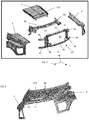
- the hood of a vehicle can include the central cover 1, a rear beam 30, which can provide additional support, fenders 5, 6 and a front end module 34, as shown in FIG. 3 .
- the front end module 34 can comprise the front beam 10, first side rail 36 and second side rail 38 extending between the front beam 10 and a connecting bar 40 (e.g., that can hingedly attach (such as via hinge 18) to the vehicle) (See FIG. 6 ).
- Protruding from the side rails 36, 38, in a direction opposition central portion 42, can be lower supports 44 and upper supports 46, e.g., for attaching a light such as a headlamp to the vehicle, and for providing further support and structural integrity to the fenders 5, 6.
- the front beam 10 can further include grooves 11, 12 sized and shaped to receive the channels 20, 21 in the central cover 1, such that the central cover 1.
- the hood can further include a rear beam 30, which can be used for additional support and/or to attach the hood to the vehicle.
- FIGS. 5A and 5B are exploded views of the various components of the hood.
- the hood includes fenders 5, 6, and central cover 1.
- Central cover 1 can include a front 51, rear 50, and sides 52, 53.
- the central cover 1 can include hollow reinforcements, such as channels 20, 21 that extend between the front beam and the front end module, optionally, from the front 51 to the rear 50.
- the channels 20, 21 can include a first wall 22, a second wall 23, and a bottom portion 24 which connects the first wall 22 and the second wall 23, to define the channel, shown in FIG. 5B .
- Extending from the first wall 22 can be a flange 26, which extends in a direction opposite a main body 7 of the cover.
- the main body 7 of the cover extends from one channel to another channel.
- the channels 20, 21 can extend across the sides 52, 53 of the central cover 1 from the front edge to the rear edge.
- the central cover 1 can further include an optional opening 111 to allow air to pass through to a cooling system or other internal part of a vehicle.
- a handle portion (not shown) can be included on the rear beam.
- a latch 48 or other mechanism for opening the hood can be located on the rear beam such that when released, the hood can pivot around the hinge on the front end module to an open position.
- fenders 5, 6 are located on the sides 52, 53 of the central cover 1.
- Fenders 5, 6 can be formed integral with central cover 1, or attached thereto.
- the fenders 5, 6 can be mounted onto the vehicle by attaching the fenders 5, 6 to the central cover 1, front end module 34 and rear beam 30.
- the fenders 5, 6 can be attached to the central cover 1 such that they extend over the channels 20, 21, as shown in FIG.s 5A and 5B .
- the fenders 5, 6, can at least extend from the front edge 51, to the rear edge 50, and over the channels.
- the edge of the fenders can contact the central cover 1 in a divot or groove 28 designed to receive the fender edge. More preferably, the fenders 5, 6 cover the entirety of the channels 20, 21 such that the channels are not visible from the top of the hood 101, as shown in FIG. 5A .
- the central cover 1 can be mounted to the front beam and the front end module, which, in turn, can be mounted to the chassis (e.g., to the Body-In-White (BIW)) of a vehicle.
- the central cover 1 or the rear beam 30 can be used to attach the hood 101 to the vehicle (not shown).
- the rear beam 30 can be shaped such that the central cover 1 can sit flush on top of the rear beam 30. If the rear beam is positioned underneath the channels 20, 21 in the central cover 1 (not shown) the rear beam can include corresponding grooves such that the channels can be accepted onto the corresponding channels of the rear beam. Alternatively, the channels 20, 21 can end before the rear beam 30 such they do not extend onto the rear beam 30.
- the central cover 1 can be extend onto and be fixedly attached to flange 49 of the rear beam 30. (See FIG. 3 )
- FIGS. 7A and 7B illustrate a simulation comparing the application of a vertical load to the same location in the central panel in a hood system without reinforcements ( FIG. 7A ) and one with reinforcements ( FIG. 7B).
- FIG. 7A shows an uneven displacement, wherein the displacement at a magnitude of 3.5 extending in an elliptical shape (with its major axis extending in the Y direction and the major axis extending in the Z direction) across the central cover.
- the distribution of the load is across less than 70% of the central cover.
- the distribution of load is substantially more uniform across the central panel, with the displacement being circular down to displacements of 3.5, and then generally distributed across greater than or equal to 75% (preferably greater than or equal to 85%) of the central cover.
Landscapes
- Engineering & Computer Science (AREA)
- Chemical & Material Sciences (AREA)
- Combustion & Propulsion (AREA)
- Transportation (AREA)
- Mechanical Engineering (AREA)
- Architecture (AREA)
- Structural Engineering (AREA)
- Body Structure For Vehicles (AREA)
- Superstructure Of Vehicle (AREA)
Claims (15)
- Motorhaube (101) für ein Fahrzeug, umfassend:ein Frontendmodul (34);eine thermoplastische mittlere Abdeckung (1); undKotflügel (5, 6), die mit dem Frontendmodul und der thermoplastischen mittleren Abdeckung verbunden sind, dadurch gekennzeichnet, dass die Motorhaube ferner einen hinteren Träger (30) umfasst; undwobei sich die thermoplastische mittlere Abdeckung zwischen dem hinteren Träger und dem Frontendmodul erstreckt, wobei die thermoplastische mittlere Abdeckung Verstärkungen (20, 21) entlang Seiten der thermoplastischen mittleren Abdeckung umfasst, die sich zwischen dem hinteren Träger und dem Frontendmodul erstrecken, wobei die Verstärkungen von einer oberen Fläche der thermoplastischen mittleren Abdeckung weg vorstehen, wobei sich ein Flansch (26) von einer Seite der Verstärkung erstreckt; undwobei sich jeder Kotflügel über eine Verstärkung erstreckt und mit einer oberen Fläche der thermoplastischen mittleren Abdeckung verbindet.
- Motorhaube nach Anspruch 1, wobei die Verstärkungen hohle Verstärkungen sind.
- Motorhaube nach Anspruch 2, wobei die hohlen Verstärkungen Kanäle sind, die auf einer Seite offen und optional an Enden der Kanäle offen sind.
- Motorhaube nach Anspruch 2 oder 3, wobei die hohlen Verstärkungen durch eine erste Wand (22), die sich von dem Flansch weg erstreckt, und einer zweiten Wand (23), die sich von der oberen Fläche weg erstreckt, gebildet sind, und wobei ein unterer Abschnitt (24) die erste Wand und die zweite Wand verbindet.
- Motorhaube nach Anspruch 4, wobei die erste Wand den Flansch in einem nicht senkrechten Winkel trifft.
- Motorhaube nach einem der vorstehenden Ansprüche, wobei die thermoplastische mittlere Abdeckung eine Vertiefung umfasst, die sich zum Aufnehmen einer Kante eines Kotflügels auf einer Seite der Verstärkungen gegenüber dem Flansch befindet.
- Motorhaube nach einem der vorstehenden Ansprüche, wobei sich die Verstärkungen von dem hinteren Träger zu dem Frontendmodul erstrecken.
- Motorhaube nach einem der vorstehenden Ansprüche, wobei die thermoplastische mittlere Abdeckung frei von Rippen ist.
- Motorhaube nach einem der vorstehenden Ansprüche, wobei die Kotflügel aus Thermoplast hergestellt sind und frei von Rippen sind.
- Motorhaube nach einem der vorstehenden Ansprüche, wobei die thermoplastische mittlere Abdeckung und die Kotflügel frei von Metall sind.
- Motorhaube nach einem der vorstehenden Ansprüche, wobei der hintere Träger und das Frontendmodul frei von Metall sind.
- Motorhaube nach einem der vorstehenden Ansprüche, wobei die thermoplastische mittlere Abdeckung aus Thermoplast und mineralischem Füllstoff gebildet ist.
- Motorhaube nach einem der vorstehenden Ansprüche, wobei der hintere Träger eine Regenplatte umfasst.
- Motorhaube nach einem der vorstehenden Ansprüche, wobei die Motorhaube mindestens eines aus Folgenden umfasst:a. eine Steifigkeit, die eine Eigenfrequenz von 15 Hz übersteigt, wenn sie eingerastet ist;b. eine Steifigkeit, die in einer offenen Konfiguration einer vertikalen 60-Grad-Neigung der Motorhaube 1 Hz übersteigt; undc. eine lokale Auslenkung von weniger als 0,5 cm durch eine 10-kg-Last, die auf einem Bereich mit 6 cm Durchmesser der Motorhaube platziert wird.
- Fahrzeug, umfassend: einen Strukturkörper, einen Motor und die Motorhaube (101) nach einem der vorstehenden Ansprüche.
Priority Applications (7)
| Application Number | Priority Date | Filing Date | Title |
|---|---|---|---|
| EP17163013.0A EP3381771B1 (de) | 2017-03-27 | 2017-03-27 | Integrierte fahrzeughaube |
| US15/925,947 US10471998B2 (en) | 2017-03-27 | 2018-03-20 | Integrated vehicle hood |
| RU2018110415A RU2018110415A (ru) | 2017-03-27 | 2018-03-23 | Комбинированный капот транспортного средства |
| BR102018005988-2A BR102018005988A2 (pt) | 2017-03-27 | 2018-03-26 | capô integrado para veículo |
| CN201810258027.9A CN108657291B (zh) | 2017-03-27 | 2018-03-27 | 一体式车辆引擎罩 |
| US16/545,418 US10829160B2 (en) | 2017-03-27 | 2019-08-20 | Integrated vehicle hood |
| US16/587,482 US11052952B2 (en) | 2017-03-27 | 2019-09-30 | Integrated vehicle hood |
Applications Claiming Priority (1)
| Application Number | Priority Date | Filing Date | Title |
|---|---|---|---|
| EP17163013.0A EP3381771B1 (de) | 2017-03-27 | 2017-03-27 | Integrierte fahrzeughaube |
Publications (2)
| Publication Number | Publication Date |
|---|---|
| EP3381771A1 EP3381771A1 (de) | 2018-10-03 |
| EP3381771B1 true EP3381771B1 (de) | 2021-03-24 |
Family
ID=58428167
Family Applications (1)
| Application Number | Title | Priority Date | Filing Date |
|---|---|---|---|
| EP17163013.0A Not-in-force EP3381771B1 (de) | 2017-03-27 | 2017-03-27 | Integrierte fahrzeughaube |
Country Status (5)
| Country | Link |
|---|---|
| US (3) | US10471998B2 (de) |
| EP (1) | EP3381771B1 (de) |
| CN (1) | CN108657291B (de) |
| BR (1) | BR102018005988A2 (de) |
| RU (1) | RU2018110415A (de) |
Families Citing this family (11)
| Publication number | Priority date | Publication date | Assignee | Title |
|---|---|---|---|---|
| EP3381771B1 (de) * | 2017-03-27 | 2021-03-24 | SABIC Global Technologies B.V. | Integrierte fahrzeughaube |
| USD880384S1 (en) * | 2018-01-12 | 2020-04-07 | Jaguar Land Rover Limited | Vehicle front fender |
| USD881071S1 (en) * | 2018-03-02 | 2020-04-14 | Ford Global Technologies, Llc | Vehicle exterior |
| USD885270S1 (en) * | 2018-09-27 | 2020-05-26 | GM Global Technology Operations LLC | Vehicle hood |
| USD956637S1 (en) * | 2019-03-29 | 2022-07-05 | Cnh Industrial America Llc | Hood for a work vehicle |
| CN110001788B (zh) * | 2019-04-30 | 2021-04-20 | 北京长城华冠汽车科技股份有限公司 | 用于车辆的前端安装支架及具有其的车辆 |
| USD928045S1 (en) * | 2019-06-27 | 2021-08-17 | Jaguar Land Rover Limited | Hood decal for a vehicle |
| CN110789638B (zh) * | 2019-09-29 | 2020-11-27 | 浙江合众新能源汽车有限公司 | 一种基于塑料翼子板的轿车尺寸精度控制装配方法 |
| USD939409S1 (en) * | 2020-02-25 | 2021-12-28 | GM Global Technology Operations LLC | Vehicle hood |
| USD958708S1 (en) * | 2020-04-13 | 2022-07-26 | Luffy Zongxian Liu | Engine hood |
| US12589811B2 (en) * | 2023-06-28 | 2026-03-31 | Meyers Manx LLC | Vehicle hood retention system |
Family Cites Families (19)
| Publication number | Priority date | Publication date | Assignee | Title |
|---|---|---|---|---|
| US5096611A (en) | 1989-05-25 | 1992-03-17 | Globe-Union Inc. | Process for the production of battery paste |
| US5054567A (en) * | 1989-06-30 | 1991-10-08 | Navistar International Transportation Corp. | Truck hood reinforcement system |
| GB2319994B (en) * | 1996-12-04 | 2001-05-23 | Massey Ferguson Ltd | Vehicle body panel assembly |
| AU2002362067A1 (en) * | 2002-11-26 | 2004-06-18 | General Motors Corporation | Load-bearing body panel assembly for a motor vehicle |
| US7225542B2 (en) * | 2004-01-23 | 2007-06-05 | General Motors Corporation | Vehicle body compartment lid method of manufacturing |
| US7240753B2 (en) * | 2004-02-27 | 2007-07-10 | Ck Technologies, Llc | Vehicle hood assembly |
| FR2875777B1 (fr) * | 2004-09-24 | 2008-08-15 | Renault Sas | Capot de vehicule automobile pourvu d'une doublure renforcee |
| US7416038B2 (en) * | 2005-02-04 | 2008-08-26 | International Truck Intellectual Property Company, Llc | Tubular hinge bar |
| US8096611B2 (en) * | 2005-02-04 | 2012-01-17 | Toyota Jidosha Kabushiki Kaisha | Vehicle front-part structure |
| US7341298B2 (en) * | 2005-05-06 | 2008-03-11 | Jones Performance Products, Inc. | Fiberglass body with reinforcing member |
| US7815249B2 (en) * | 2006-08-28 | 2010-10-19 | Alcoa Inc. | Lightweight hybrid material truck hood |
| US7789179B2 (en) * | 2007-05-03 | 2010-09-07 | International Truck Intellectual Property Company, Llc | Method of compression molding motor vehicle components and parts made therefrom |
| WO2011155920A1 (en) * | 2010-06-07 | 2011-12-15 | Volvo Group North America, Llc | Improved vehicle bumper |
| DE102012012157A1 (de) * | 2011-11-22 | 2013-05-23 | GM Global Technology Operations LLC (n. d. Gesetzen des Staates Delaware) | Haube für ein Kraftfahrzeug |
| EP3055150B1 (de) | 2013-10-07 | 2020-08-12 | SABIC Global Technologies B.V. | Hohlförmige fahrzeugkomponenten mit geschlossener abschnittsgeometrie |
| CN107107965B (zh) * | 2014-12-16 | 2019-09-13 | 沙特基础工业全球技术有限公司 | 发动机罩组件、前端模块、包含其的车辆及其制造方法 |
| KR101713724B1 (ko) * | 2015-08-12 | 2017-03-08 | 현대자동차 주식회사 | 전방 차체 구조 |
| EP3381771B1 (de) * | 2017-03-27 | 2021-03-24 | SABIC Global Technologies B.V. | Integrierte fahrzeughaube |
| US10782047B2 (en) * | 2018-04-16 | 2020-09-22 | Volvo Truck Corporation | Front grille mounting to a motor vehicle hood assembly |
-
2017
- 2017-03-27 EP EP17163013.0A patent/EP3381771B1/de not_active Not-in-force
-
2018
- 2018-03-20 US US15/925,947 patent/US10471998B2/en active Active
- 2018-03-23 RU RU2018110415A patent/RU2018110415A/ru not_active Application Discontinuation
- 2018-03-26 BR BR102018005988-2A patent/BR102018005988A2/pt not_active Application Discontinuation
- 2018-03-27 CN CN201810258027.9A patent/CN108657291B/zh not_active Expired - Fee Related
-
2019
- 2019-08-20 US US16/545,418 patent/US10829160B2/en active Active
- 2019-09-30 US US16/587,482 patent/US11052952B2/en not_active Expired - Fee Related
Non-Patent Citations (1)
| Title |
|---|
| None * |
Also Published As
| Publication number | Publication date |
|---|---|
| US11052952B2 (en) | 2021-07-06 |
| EP3381771A1 (de) | 2018-10-03 |
| CN108657291A (zh) | 2018-10-16 |
| CN108657291B (zh) | 2022-04-29 |
| US20200023908A1 (en) | 2020-01-23 |
| US20190367096A1 (en) | 2019-12-05 |
| US10471998B2 (en) | 2019-11-12 |
| US20180273111A1 (en) | 2018-09-27 |
| US10829160B2 (en) | 2020-11-10 |
| BR102018005988A2 (pt) | 2018-12-18 |
| RU2018110415A (ru) | 2019-09-24 |
Similar Documents
| Publication | Publication Date | Title |
|---|---|---|
| EP3381771B1 (de) | Integrierte fahrzeughaube | |
| US9033399B2 (en) | Energy absorber elements and vehicle systems | |
| JP4733091B2 (ja) | 自動車用ルーフフレーム | |
| EP3126706B1 (de) | Hybridstossstangeträger und verfahren zur herstellung und verwendung | |
| US20120049546A1 (en) | Energy absorber for vehicle bumper | |
| EP3233611B1 (de) | Polymere motorhaubenanordnung, kraftfahrzeugfrontmodul, fahrzeuge damit und verfahren zur herstellung davon | |
| KR20180015729A (ko) | 에너지 흡수 조립체 및 그 제조 방법 및 사용 방법 | |
| US7988224B2 (en) | Cowl cover assembly for a motor vehicle | |
| US20110133499A1 (en) | Bumper for a motor vehicle | |
| JP2005119633A (ja) | 車両のハイルーフ構造 | |
| US20050269823A1 (en) | Structural beam incorporating wire reinforcement | |
| AU2002250119B2 (en) | Instrument panel beam assembly and methods of manufacture | |
| KR20160105593A (ko) | 스티프너 일체형 프론트 범퍼 | |
| US5954389A (en) | Reinforced front part for use in the manufacture of cabins/bodies for vehicles | |
| CN101171157A (zh) | 具有装饰件的混合式保险杠 | |
| KR102073003B1 (ko) | 기존의 부품을 그대로 사용할 수 있는 차량 모델 변경 튜닝부재 | |
| JP2010221866A (ja) | 樹脂製自動車用外装板 | |
| WO2017203009A1 (en) | Polymer hatch door for a vehicle |
Legal Events
| Date | Code | Title | Description |
|---|---|---|---|
| PUAI | Public reference made under article 153(3) epc to a published international application that has entered the european phase |
Free format text: ORIGINAL CODE: 0009012 |
|
| STAA | Information on the status of an ep patent application or granted ep patent |
Free format text: STATUS: THE APPLICATION HAS BEEN PUBLISHED |
|
| AK | Designated contracting states |
Kind code of ref document: A1 Designated state(s): AL AT BE BG CH CY CZ DE DK EE ES FI FR GB GR HR HU IE IS IT LI LT LU LV MC MK MT NL NO PL PT RO RS SE SI SK SM TR |
|
| AX | Request for extension of the european patent |
Extension state: BA ME |
|
| STAA | Information on the status of an ep patent application or granted ep patent |
Free format text: STATUS: REQUEST FOR EXAMINATION WAS MADE |
|
| 17P | Request for examination filed |
Effective date: 20181012 |
|
| RBV | Designated contracting states (corrected) |
Designated state(s): AL AT BE BG CH CY CZ DE DK EE ES FI FR GB GR HR HU IE IS IT LI LT LU LV MC MK MT NL NO PL PT RO RS SE SI SK SM TR |
|
| GRAP | Despatch of communication of intention to grant a patent |
Free format text: ORIGINAL CODE: EPIDOSNIGR1 |
|
| STAA | Information on the status of an ep patent application or granted ep patent |
Free format text: STATUS: GRANT OF PATENT IS INTENDED |
|
| INTG | Intention to grant announced |
Effective date: 20200722 |
|
| GRAS | Grant fee paid |
Free format text: ORIGINAL CODE: EPIDOSNIGR3 |
|
| GRAA | (expected) grant |
Free format text: ORIGINAL CODE: 0009210 |
|
| STAA | Information on the status of an ep patent application or granted ep patent |
Free format text: STATUS: THE PATENT HAS BEEN GRANTED |
|
| AK | Designated contracting states |
Kind code of ref document: B1 Designated state(s): AL AT BE BG CH CY CZ DE DK EE ES FI FR GB GR HR HU IE IS IT LI LT LU LV MC MK MT NL NO PL PT RO RS SE SI SK SM TR |
|
| REG | Reference to a national code |
Ref country code: GB Ref legal event code: FG4D |
|
| REG | Reference to a national code |
Ref country code: CH Ref legal event code: EP |
|
| REG | Reference to a national code |
Ref country code: IE Ref legal event code: FG4D |
|
| REG | Reference to a national code |
Ref country code: AT Ref legal event code: REF Ref document number: 1374218 Country of ref document: AT Kind code of ref document: T Effective date: 20210415 Ref country code: DE Ref legal event code: R096 Ref document number: 602017035056 Country of ref document: DE |
|
| REG | Reference to a national code |
Ref country code: LT Ref legal event code: MG9D |
|
| PG25 | Lapsed in a contracting state [announced via postgrant information from national office to epo] |
Ref country code: GR Free format text: LAPSE BECAUSE OF FAILURE TO SUBMIT A TRANSLATION OF THE DESCRIPTION OR TO PAY THE FEE WITHIN THE PRESCRIBED TIME-LIMIT Effective date: 20210625 Ref country code: FI Free format text: LAPSE BECAUSE OF FAILURE TO SUBMIT A TRANSLATION OF THE DESCRIPTION OR TO PAY THE FEE WITHIN THE PRESCRIBED TIME-LIMIT Effective date: 20210324 Ref country code: HR Free format text: LAPSE BECAUSE OF FAILURE TO SUBMIT A TRANSLATION OF THE DESCRIPTION OR TO PAY THE FEE WITHIN THE PRESCRIBED TIME-LIMIT Effective date: 20210324 Ref country code: NO Free format text: LAPSE BECAUSE OF FAILURE TO SUBMIT A TRANSLATION OF THE DESCRIPTION OR TO PAY THE FEE WITHIN THE PRESCRIBED TIME-LIMIT Effective date: 20210624 Ref country code: BG Free format text: LAPSE BECAUSE OF FAILURE TO SUBMIT A TRANSLATION OF THE DESCRIPTION OR TO PAY THE FEE WITHIN THE PRESCRIBED TIME-LIMIT Effective date: 20210624 |
|
| PG25 | Lapsed in a contracting state [announced via postgrant information from national office to epo] |
Ref country code: RS Free format text: LAPSE BECAUSE OF FAILURE TO SUBMIT A TRANSLATION OF THE DESCRIPTION OR TO PAY THE FEE WITHIN THE PRESCRIBED TIME-LIMIT Effective date: 20210324 Ref country code: LV Free format text: LAPSE BECAUSE OF FAILURE TO SUBMIT A TRANSLATION OF THE DESCRIPTION OR TO PAY THE FEE WITHIN THE PRESCRIBED TIME-LIMIT Effective date: 20210324 Ref country code: SE Free format text: LAPSE BECAUSE OF FAILURE TO SUBMIT A TRANSLATION OF THE DESCRIPTION OR TO PAY THE FEE WITHIN THE PRESCRIBED TIME-LIMIT Effective date: 20210324 |
|
| REG | Reference to a national code |
Ref country code: NL Ref legal event code: MP Effective date: 20210324 |
|
| REG | Reference to a national code |
Ref country code: AT Ref legal event code: MK05 Ref document number: 1374218 Country of ref document: AT Kind code of ref document: T Effective date: 20210324 |
|
| PG25 | Lapsed in a contracting state [announced via postgrant information from national office to epo] |
Ref country code: NL Free format text: LAPSE BECAUSE OF FAILURE TO SUBMIT A TRANSLATION OF THE DESCRIPTION OR TO PAY THE FEE WITHIN THE PRESCRIBED TIME-LIMIT Effective date: 20210324 |
|
| PG25 | Lapsed in a contracting state [announced via postgrant information from national office to epo] |
Ref country code: SM Free format text: LAPSE BECAUSE OF FAILURE TO SUBMIT A TRANSLATION OF THE DESCRIPTION OR TO PAY THE FEE WITHIN THE PRESCRIBED TIME-LIMIT Effective date: 20210324 Ref country code: AT Free format text: LAPSE BECAUSE OF FAILURE TO SUBMIT A TRANSLATION OF THE DESCRIPTION OR TO PAY THE FEE WITHIN THE PRESCRIBED TIME-LIMIT Effective date: 20210324 Ref country code: EE Free format text: LAPSE BECAUSE OF FAILURE TO SUBMIT A TRANSLATION OF THE DESCRIPTION OR TO PAY THE FEE WITHIN THE PRESCRIBED TIME-LIMIT Effective date: 20210324 Ref country code: CZ Free format text: LAPSE BECAUSE OF FAILURE TO SUBMIT A TRANSLATION OF THE DESCRIPTION OR TO PAY THE FEE WITHIN THE PRESCRIBED TIME-LIMIT Effective date: 20210324 Ref country code: LT Free format text: LAPSE BECAUSE OF FAILURE TO SUBMIT A TRANSLATION OF THE DESCRIPTION OR TO PAY THE FEE WITHIN THE PRESCRIBED TIME-LIMIT Effective date: 20210324 |
|
| REG | Reference to a national code |
Ref country code: CH Ref legal event code: PL |
|
| PG25 | Lapsed in a contracting state [announced via postgrant information from national office to epo] |
Ref country code: SK Free format text: LAPSE BECAUSE OF FAILURE TO SUBMIT A TRANSLATION OF THE DESCRIPTION OR TO PAY THE FEE WITHIN THE PRESCRIBED TIME-LIMIT Effective date: 20210324 Ref country code: RO Free format text: LAPSE BECAUSE OF FAILURE TO SUBMIT A TRANSLATION OF THE DESCRIPTION OR TO PAY THE FEE WITHIN THE PRESCRIBED TIME-LIMIT Effective date: 20210324 Ref country code: PT Free format text: LAPSE BECAUSE OF FAILURE TO SUBMIT A TRANSLATION OF THE DESCRIPTION OR TO PAY THE FEE WITHIN THE PRESCRIBED TIME-LIMIT Effective date: 20210726 Ref country code: PL Free format text: LAPSE BECAUSE OF FAILURE TO SUBMIT A TRANSLATION OF THE DESCRIPTION OR TO PAY THE FEE WITHIN THE PRESCRIBED TIME-LIMIT Effective date: 20210324 Ref country code: IS Free format text: LAPSE BECAUSE OF FAILURE TO SUBMIT A TRANSLATION OF THE DESCRIPTION OR TO PAY THE FEE WITHIN THE PRESCRIBED TIME-LIMIT Effective date: 20210724 |
|
| REG | Reference to a national code |
Ref country code: BE Ref legal event code: MM Effective date: 20210331 |
|
| REG | Reference to a national code |
Ref country code: DE Ref legal event code: R097 Ref document number: 602017035056 Country of ref document: DE |
|
| PG25 | Lapsed in a contracting state [announced via postgrant information from national office to epo] |
Ref country code: DK Free format text: LAPSE BECAUSE OF FAILURE TO SUBMIT A TRANSLATION OF THE DESCRIPTION OR TO PAY THE FEE WITHIN THE PRESCRIBED TIME-LIMIT Effective date: 20210324 Ref country code: AL Free format text: LAPSE BECAUSE OF FAILURE TO SUBMIT A TRANSLATION OF THE DESCRIPTION OR TO PAY THE FEE WITHIN THE PRESCRIBED TIME-LIMIT Effective date: 20210324 Ref country code: CH Free format text: LAPSE BECAUSE OF NON-PAYMENT OF DUE FEES Effective date: 20210331 Ref country code: LI Free format text: LAPSE BECAUSE OF NON-PAYMENT OF DUE FEES Effective date: 20210331 Ref country code: MC Free format text: LAPSE BECAUSE OF FAILURE TO SUBMIT A TRANSLATION OF THE DESCRIPTION OR TO PAY THE FEE WITHIN THE PRESCRIBED TIME-LIMIT Effective date: 20210324 Ref country code: LU Free format text: LAPSE BECAUSE OF NON-PAYMENT OF DUE FEES Effective date: 20210327 Ref country code: ES Free format text: LAPSE BECAUSE OF FAILURE TO SUBMIT A TRANSLATION OF THE DESCRIPTION OR TO PAY THE FEE WITHIN THE PRESCRIBED TIME-LIMIT Effective date: 20210324 Ref country code: IE Free format text: LAPSE BECAUSE OF NON-PAYMENT OF DUE FEES Effective date: 20210327 |
|
| PLBE | No opposition filed within time limit |
Free format text: ORIGINAL CODE: 0009261 |
|
| STAA | Information on the status of an ep patent application or granted ep patent |
Free format text: STATUS: NO OPPOSITION FILED WITHIN TIME LIMIT |
|
| PG25 | Lapsed in a contracting state [announced via postgrant information from national office to epo] |
Ref country code: SI Free format text: LAPSE BECAUSE OF FAILURE TO SUBMIT A TRANSLATION OF THE DESCRIPTION OR TO PAY THE FEE WITHIN THE PRESCRIBED TIME-LIMIT Effective date: 20210324 |
|
| 26N | No opposition filed |
Effective date: 20220104 |
|
| PG25 | Lapsed in a contracting state [announced via postgrant information from national office to epo] |
Ref country code: IS Free format text: LAPSE BECAUSE OF FAILURE TO SUBMIT A TRANSLATION OF THE DESCRIPTION OR TO PAY THE FEE WITHIN THE PRESCRIBED TIME-LIMIT Effective date: 20210724 |
|
| PG25 | Lapsed in a contracting state [announced via postgrant information from national office to epo] |
Ref country code: BE Free format text: LAPSE BECAUSE OF NON-PAYMENT OF DUE FEES Effective date: 20210331 |
|
| PG25 | Lapsed in a contracting state [announced via postgrant information from national office to epo] |
Ref country code: IT Free format text: LAPSE BECAUSE OF FAILURE TO SUBMIT A TRANSLATION OF THE DESCRIPTION OR TO PAY THE FEE WITHIN THE PRESCRIBED TIME-LIMIT Effective date: 20210324 |
|
| PG25 | Lapsed in a contracting state [announced via postgrant information from national office to epo] |
Ref country code: CY Free format text: LAPSE BECAUSE OF FAILURE TO SUBMIT A TRANSLATION OF THE DESCRIPTION OR TO PAY THE FEE WITHIN THE PRESCRIBED TIME-LIMIT Effective date: 20210324 |
|
| P01 | Opt-out of the competence of the unified patent court (upc) registered |
Effective date: 20230529 |
|
| PG25 | Lapsed in a contracting state [announced via postgrant information from national office to epo] |
Ref country code: HU Free format text: LAPSE BECAUSE OF FAILURE TO SUBMIT A TRANSLATION OF THE DESCRIPTION OR TO PAY THE FEE WITHIN THE PRESCRIBED TIME-LIMIT; INVALID AB INITIO Effective date: 20170327 |
|
| PG25 | Lapsed in a contracting state [announced via postgrant information from national office to epo] |
Ref country code: MK Free format text: LAPSE BECAUSE OF FAILURE TO SUBMIT A TRANSLATION OF THE DESCRIPTION OR TO PAY THE FEE WITHIN THE PRESCRIBED TIME-LIMIT Effective date: 20210324 |
|
| PGFP | Annual fee paid to national office [announced via postgrant information from national office to epo] |
Ref country code: DE Payment date: 20231229 Year of fee payment: 8 Ref country code: GB Payment date: 20240108 Year of fee payment: 8 |
|
| PGFP | Annual fee paid to national office [announced via postgrant information from national office to epo] |
Ref country code: FR Payment date: 20240103 Year of fee payment: 8 |
|
| PG25 | Lapsed in a contracting state [announced via postgrant information from national office to epo] |
Ref country code: MT Free format text: LAPSE BECAUSE OF FAILURE TO SUBMIT A TRANSLATION OF THE DESCRIPTION OR TO PAY THE FEE WITHIN THE PRESCRIBED TIME-LIMIT Effective date: 20210324 |
|
| REG | Reference to a national code |
Ref country code: DE Ref legal event code: R119 Ref document number: 602017035056 Country of ref document: DE |
|
| GBPC | Gb: european patent ceased through non-payment of renewal fee |
Effective date: 20250327 |
|
| PG25 | Lapsed in a contracting state [announced via postgrant information from national office to epo] |
Ref country code: TR Free format text: LAPSE BECAUSE OF FAILURE TO SUBMIT A TRANSLATION OF THE DESCRIPTION OR TO PAY THE FEE WITHIN THE PRESCRIBED TIME-LIMIT Effective date: 20210324 |
|
| PG25 | Lapsed in a contracting state [announced via postgrant information from national office to epo] |
Ref country code: DE Free format text: LAPSE BECAUSE OF NON-PAYMENT OF DUE FEES Effective date: 20251001 |
|
| PG25 | Lapsed in a contracting state [announced via postgrant information from national office to epo] |
Ref country code: GB Free format text: LAPSE BECAUSE OF NON-PAYMENT OF DUE FEES Effective date: 20250327 |
|
| PG25 | Lapsed in a contracting state [announced via postgrant information from national office to epo] |
Ref country code: FR Free format text: LAPSE BECAUSE OF NON-PAYMENT OF DUE FEES Effective date: 20250331 |