EP3382976A1 - Dispositif de protection, procédé et appareil comprenant un dispositif de protection destiné à protéger un réseau de communication connecté à l'appareil - Google Patents
Dispositif de protection, procédé et appareil comprenant un dispositif de protection destiné à protéger un réseau de communication connecté à l'appareil Download PDFInfo
- Publication number
- EP3382976A1 EP3382976A1 EP17163856.2A EP17163856A EP3382976A1 EP 3382976 A1 EP3382976 A1 EP 3382976A1 EP 17163856 A EP17163856 A EP 17163856A EP 3382976 A1 EP3382976 A1 EP 3382976A1
- Authority
- EP
- European Patent Office
- Prior art keywords
- access
- software
- firmware
- access identifier
- communication network
- Prior art date
- Legal status (The legal status is an assumption and is not a legal conclusion. Google has not performed a legal analysis and makes no representation as to the accuracy of the status listed.)
- Withdrawn
Links
Images

Classifications
-
- H—ELECTRICITY
- H04—ELECTRIC COMMUNICATION TECHNIQUE
- H04L—TRANSMISSION OF DIGITAL INFORMATION, e.g. TELEGRAPHIC COMMUNICATION
- H04L63/00—Network architectures or network communication protocols for network security
- H04L63/14—Network architectures or network communication protocols for network security for detecting or protecting against malicious traffic
- H04L63/1433—Vulnerability analysis
-
- G—PHYSICS
- G06—COMPUTING OR CALCULATING; COUNTING
- G06F—ELECTRIC DIGITAL DATA PROCESSING
- G06F21/00—Security arrangements for protecting computers, components thereof, programs or data against unauthorised activity
- G06F21/50—Monitoring users, programs or devices to maintain the integrity of platforms, e.g. of processors, firmware or operating systems
- G06F21/52—Monitoring users, programs or devices to maintain the integrity of platforms, e.g. of processors, firmware or operating systems during program execution, e.g. stack integrity ; Preventing unwanted data erasure; Buffer overflow
- G06F21/53—Monitoring users, programs or devices to maintain the integrity of platforms, e.g. of processors, firmware or operating systems during program execution, e.g. stack integrity ; Preventing unwanted data erasure; Buffer overflow by executing in a restricted environment, e.g. sandbox or secure virtual machine
-
- H—ELECTRICITY
- H04—ELECTRIC COMMUNICATION TECHNIQUE
- H04L—TRANSMISSION OF DIGITAL INFORMATION, e.g. TELEGRAPHIC COMMUNICATION
- H04L63/00—Network architectures or network communication protocols for network security
- H04L63/02—Network architectures or network communication protocols for network security for separating internal from external traffic, e.g. firewalls
- H04L63/0227—Filtering policies
- H04L63/0263—Rule management
-
- H—ELECTRICITY
- H04—ELECTRIC COMMUNICATION TECHNIQUE
- H04L—TRANSMISSION OF DIGITAL INFORMATION, e.g. TELEGRAPHIC COMMUNICATION
- H04L63/00—Network architectures or network communication protocols for network security
- H04L63/14—Network architectures or network communication protocols for network security for detecting or protecting against malicious traffic
- H04L63/1441—Countermeasures against malicious traffic
- H04L63/1458—Denial of Service
-
- H—ELECTRICITY
- H04—ELECTRIC COMMUNICATION TECHNIQUE
- H04L—TRANSMISSION OF DIGITAL INFORMATION, e.g. TELEGRAPHIC COMMUNICATION
- H04L63/00—Network architectures or network communication protocols for network security
- H04L63/06—Network architectures or network communication protocols for network security for supporting key management in a packet data network
- H04L63/068—Network architectures or network communication protocols for network security for supporting key management in a packet data network using time-dependent keys, e.g. periodically changing keys
-
- H—ELECTRICITY
- H04—ELECTRIC COMMUNICATION TECHNIQUE
- H04L—TRANSMISSION OF DIGITAL INFORMATION, e.g. TELEGRAPHIC COMMUNICATION
- H04L63/00—Network architectures or network communication protocols for network security
- H04L63/10—Network architectures or network communication protocols for network security for controlling access to devices or network resources
- H04L63/108—Network architectures or network communication protocols for network security for controlling access to devices or network resources when the policy decisions are valid for a limited amount of time
-
- H—ELECTRICITY
- H04—ELECTRIC COMMUNICATION TECHNIQUE
- H04L—TRANSMISSION OF DIGITAL INFORMATION, e.g. TELEGRAPHIC COMMUNICATION
- H04L67/00—Network arrangements or protocols for supporting network services or applications
- H04L67/01—Protocols
- H04L67/12—Protocols specially adapted for proprietary or special-purpose networking environments, e.g. medical networks, sensor networks, networks in vehicles or remote metering networks
-
- H—ELECTRICITY
- H04—ELECTRIC COMMUNICATION TECHNIQUE
- H04L—TRANSMISSION OF DIGITAL INFORMATION, e.g. TELEGRAPHIC COMMUNICATION
- H04L67/00—Network arrangements or protocols for supporting network services or applications
- H04L67/34—Network arrangements or protocols for supporting network services or applications involving the movement of software or configuration parameters
-
- H—ELECTRICITY
- H04—ELECTRIC COMMUNICATION TECHNIQUE
- H04W—WIRELESS COMMUNICATION NETWORKS
- H04W4/00—Services specially adapted for wireless communication networks; Facilities therefor
- H04W4/50—Service provisioning or reconfiguring
-
- H—ELECTRICITY
- H04—ELECTRIC COMMUNICATION TECHNIQUE
- H04W—WIRELESS COMMUNICATION NETWORKS
- H04W4/00—Services specially adapted for wireless communication networks; Facilities therefor
- H04W4/70—Services for machine-to-machine communication [M2M] or machine type communication [MTC]
Definitions
- the invention relates to a protective device, a method, a computer program product and a device comprising a protective device for protecting a communication network connected to the device against attacks by the device itself to prevent a device with outdated software version attacks other devices or systems via the network.
- a variety of devices in a public data network such as the Internet, or in private data networks, such as industrial control networks, and in particular in an Internet of Things, interconnected. It must be assumed that such devices also have vulnerabilities, so that you can make attacks on other devices or systems over the data network.
- devices with software applications that are not up to date with security updates can be used by attackers to exploit and manipulate vulnerabilities in this software and attack other systems over the network.
- Firewalls are known as network components that filter network traffic between network areas.
- "personal firewalls” are known, by which the device is to be protected against attacks from the network.
- IPTables on a Linux-based operating system, so that they can be updated and reconfigured by the operating system or by other software that has been executed. Therefore They do not protect against attacks that originate from the software of the device itself.
- firmware / software updates or patches on devices can be closed by the vulnerabilities in software applications on the device.
- Firmware refers to software that is embedded in electronic devices. It is usually stored in a flash memory, such as an EPROM, EEPROM or ROM, and can only be exchanged by a user with special means or functions.
- the firmware also includes operating software of various devices or components as well as basic software of a computer, such as a BIOS in personal computers anchored in a flash memory, which is necessary in order to be able to load and operate the operating system kernel of the actual operating system.
- firmware / software is used in the description to express that the context in which the term stands applies equally to firmware and software. A firmware / software update thus indicates both an update of the firmware and an update of the software.
- the invention relates to a device comprising a protective device for protecting a communication network connected to the device from attacks by the connected device itself, wherein the protective device is formed separately from a software execution environment of the device and is set up to check a provided access identifier to activate at least one provided access rule describing the access of the device to the network depending on the access identifier and restricting the access of the device to the communication network for transmitting data in accordance with the at least one activated access rule.
- a software execution environment is, for example, a central processor unit which contains one or more processors, or a general zone of a central processor unit, which is formed for example via a hypervisor on a central processor unit.
- the formation of a protective device separated from a software execution environment of the device ensures that the protective device can not be manipulated by the software execution environment of the device itself. Thus, an attacker can not exploit vulnerabilities of an example outdated software execution environment to manipulate the protection device.
- By providing the access identifier conditions or states of the software execution environment can be checked very flexible and responded to by different access rules by limiting the access of the device to the communication network, that is, the transmission of data through the device via the communication network to a receiver become.
- the device can thus remain active, for example, but may For example, send only with a limited send rate or to restricted destinations.
- a communication network is any type of communication network, in particular a data transmission network, to be understood for different connection purposes, in addition to a local network structure and other connected accessible networks, such as an office network or a public network such as the Internet, but also a connected control or diagnostic network includes.
- a local network structure may be an automation network or an Internet of Things (IoT) network.
- IoT Internet of Things
- the protective device is designed as a physically independent, in particular integrated in the device, hardware-based device.
- the protection device selects an access rule depending on the content of the access identifier and / or depending on the time since a last provision or update of the access identifier.
- a specific device status can be communicated in an access code, for example, the device is in diagnostic mode, and accordingly the transmission of data to the communication network is more limited.
- This stronger restriction is implemented by a corresponding access rule.
- the protection device activates an access rule with an open policy, that is to say with no or limited access restriction, if a current access identifier is present. In the absence of a current access ID, an access rule with restrictive policy is activated.
- the presence of a current or even non-current access identifier can be determined, for example, by an entry in the access identifier for the validity period of the access identifier.
- the up-to-dateness of an access detection can also be determined depending on the time since the last update.
- the protection device provides an access identifier depending on the firmware / software update state of the device.
- the information about the firmware / software update state can be used to selectively restrict devices with outdated firmware / software or software in their transmission behavior.
- the protective device has a first monitoring unit, which is designed to monitor data received from the device for information on available firmware / software updates and to compare the firmware / software update status by comparison with the device active in the device. / To determine software.
- incoming notification messages that updated software versions are available can be obtained.
- the update status can be determined automatically without active intervention of the device itself or by the maintenance personnel.
- the protection device has a second monitoring unit, which is designed to monitor a write access to a firmware / software memory device, for example a flash memory for software active on a device, and, upon successful firmware / software update To determine firmware / software update status.
- firmware / software memory device for example a flash memory for software active on a device
- updated versions of software often include a cryptographic signature from which version information of the software can be determined.
- the protection device can also be determined automatically, without active intervention of the device or by maintenance personnel of the update status.
- the protection device is designed to receive the access identifier from an updating device physically separate from the device.
- an access identifier can be received from, for example, an external server.
- an access identifier can be received from, for example, an external server. This makes it possible to selectively restrict devices in their network access from a central location. For example, the device may be disconnected from the network by activating an access rule by the sent access identifier, which is complete by sending messages to the communication network.
- the access code itself contains an access rule to be used, which can be activated directly by the protective device.
- the protection device limits outgoing communication connections with respect to a destination address, a communication protocol to be used, a port, a transmission rate or a data volume.
- a further aspect of the present invention relates to a protective device that can be installed separately from a software execution environment of a device in a device connected to a communication network or connectable and is designed to check a provided access identifier, at least one provided access rule, the Access of the device to the network describes how to activate depending on the access ID and restrict access of the device to the communication network for sending data according to the activated access rule.
- the protective device itself is independent of the software execution environment of the device and thus can not be leveraged by manipulated software.
- Another aspect of the present invention is a method for protecting a communication network from attacks by a device connected to the communication network comprising the steps of: verifying an access identifier provided in the device in one of a software execution environment of the device Device separated protection device of the device, activating a provided access rule depending on the access identifier, the access rule describes the access of the device to the network, and restricting access of the device to the communication network for transmitting data according to at least one activated access rule.
- the access rule is selected depending on the content of the access identifier and / or time since a last update of the access identifier.
- an updated access identifier is provided as a function of a firmware / software update status.
- data received from the device is monitored for information on available firmware / software updates, and the firmware / software update status is determined by comparison with the firmware / software implemented in the device and / or a write access to one Monitored firmware / software storage device and determined on successful firmware / software update of the firmware / software update status, in particular from a signature of the firmware / software update.
- the access identifier is received by an updating device physically separate from the device, the provided access identifier itself containing an access rule to be applied and the access rule to be applied activated by the protector.
- the access identifier is provided protected with a cryptographically protected checksum.
- the transmitter or the providing unit can be authenticated by the device and also the integrity of the access identifier can be checked. This ensures that only an unmodified access code provided by an authorized sender is accepted and processed in the device.
- Another aspect of the invention relates to a computer program product directly loadable in a memory of a digital computer, comprising program code parts adapted to perform the steps of the aforementioned method.
- FIG. 1 shows a communication network 100 with a local automation network 140.
- the automation network 140 for example, a controller 104, a monitoring device 105 and devices 101 and 102 are connected to the.
- the devices 101, 102 are designed, for example, as field devices that provide sensors or actuators. Such devices 101, 102 provide data that transmit via the automation network 140 to other devices or control devices 104 or a monitoring device 105 or via a transition device 103 to other receiving devices.
- Further devices 110, 111 are directly connected to an open network 130, for example via a mobile radio connection or a DSL connection.
- an updating device 120 is connected to the open network 130, for example. These devices 110, 111 and the updater 120 may communicate with the automation network 140 via the open network 130 and the gateway 130.
- Each device 101, 102, 110, 111, control device 104 or monitoring unit 105 may have vulnerabilities such that they may emanate attacks on one or more other devices or the communication network as a whole, for example by overload with a denial-of-service attack ,
- less complex devices 101, 102, 110, 111, which are connected in large numbers to the network 100 for example present a risk, in particular if they are not regularly maintained or if updates (patches) are no longer provided.
- This is not only true for automation networks, but especially for an Internet of Things, in which various private or other devices such as smart household appliances or sensors transmit data over open networks.
- This protection device is implemented in an environment of the device separated from a software execution environment of the device.
- a first step S10 an access identifier provided to the device is checked in this protective device. Depending on the access identifier, a provided Access rule that describes the access of the device to the network enabled. Then, see S30, the access of the device to the communication network, that is, the transmission of data from the device via the network to a receiver, is restricted according to the at least one activity access rule.
- a first access identifier may, for example, be provided to the device when a device is manufactured or when the device is integrated into a network, for example by the manufacturer or operator of the communication network.
- the at least one access rule may be selected and activated depending on the content of the access identifier and / or the length of time since a last provision or update of the access identifier.
- an access code is protected by means of a cryptographic checksum so that the identity of the content of the access code as well as a sender or a providing unit of the access code can be checked.
- an updated access code can be provided by the protection device depending on the firmware or software update state of the device.
- the update status can be determined, for example, by monitoring data received from the device itself for information on available firmware or software updates and comparing it with the software or firmware version that is implemented in the device.
- a write access to a memory device which stores corresponding firmware or software can be monitored.
- the version of the firmracking disrupt software can be determined.
- an updated access identifier of the protection device may be provided. If the protection device has a current access identifier in, an open access rule is activated. In the absence of a current access identifier, a restrictive access rule is activated. Furthermore, a more restrictive restrictive access rule can be activated depending on the time period since the last update of the access identifier, for example with a longer time since the last update.
- Access rules may in particular relate to restrictions on permitted destination addresses or output ports of a communication connection, the permitted communication protocols or a transmission rate, for example a number of packets per second or a maximum volume of data that can be transmitted into the network.
- the access rules can either be fixed to the device or changed. For example, access rules can be updated or replaced in a maintenance process.
- the access identifier can not only be detected and provided by the device itself, but also transmitted to the device by an updating device physically separate from the device.
- the access identifier itself may contain one or more access rules, so that the access rules can be used to change the access rules or to provide changed access rules to the device.
- an in FIG. 1 device represented as updating device 120 transmits such an access identifier to the device 101, 102, 110, 111.
- the access code can be transmitted, for example, a restriction of the device to a certain access rate or even a complete broadcasting ban.
- a device with such a protection device can not only be a field device or simply structured device within an Internet of Things, but also a control device, a control computer or a mobile device.
- the invention can also be implemented on computer systems and network components such as routers or switches.
- the method may be loaded as a computer program product directly into a memory of a digital computer and comprise program code portions adapted to perform the described method.
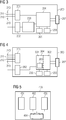
- FIGS. 3 and 4 Devices 200, 300 are shown with different embodiments of a protective device 203, 303.
- FIG. 3 shows the device 200 with a central processing unit 204, which is formed for example of microprocessors.
- the central processor unit 204 executes software programs that are stored in a persistent, rewritable memory device 206, which is embodied as a flash memory, for example, and are loaded into the central processor unit for execution.
- the device 200 further has a volatile main memory 205, a network interface 202 and an input / output unit 201 to which peripheral devices such as sensors 210, 211 or actuators 212, 213 can be connected. Via a USB interface 207, for example, the software or firmware stored in the memory device 206 can be updated.
- the device 200 has a protective device 203, which is designed as a stand-alone hardware-based device and is installed in the device.
- This protective device 203 is separated from a software execution environment of the device 200, which is formed on the central processor unit 204, and thus can not be influenced or changed by the software itself in their operation.
- the protective device 203 is connected to the network interface 202 of the device 200 and can thus limit the network communication of the device 200, that is to say in particular the transmission of data to another device or to any other receiver.
- the protection device 203 is fixed, that is not configurable or changeable by the software / firmware executed on the processor. As a result, such a protective device 203 embodied as a hardware firewall is also effective if the software / firmware has been manipulated.
- Such a hardware-based protection device 203 can be implemented, for example, as functionality in a semiconductor-based integrated circuit, for example as an application-specific integrated circuit (ASIC) or field programmable gate array (FPGA) or as a functional block in a system-on-chip device be.
- a system-on-chip comprises a field programmable gate array and an integrated circuit, especially on a separate device, or chip, in which functions for a network interface are provided.
- a separate communication module or communication module such as a UMTS modem or in a software-programmable component such as microcontroller or cryptocontroller.
- a device 300 with a protection device 303 is shown, wherein the security device 303 is implemented in a central processing unit 304 with a hypervisor as a software-based function in a separate secure domain 301 that is protected by the hypervisor from the other regular software Zone 302 of the central processing unit is executed, be separated.
- the central processor unit 204, 304 or the general zone 302 with the software execution environment the central processing unit 304, a cryptographically protected access identifier, also referred to as an enabling token or network access token, the hardware protection device 203, 303 provide.
- the access code is used in particular by an in FIG. 2 shown updater 120 as a backend device security service and tested on the protection device 203, 303.
- the central processor unit 204, 304, or the general zone 302 with the software execution environment of the central processor unit 304, or the software or firmware executed thereon can indeed pass on a received access identifier but not manipulate it unnoticed.
- the updating device 120 may temporarily enable the network interface 202, that is, instead of a restrictive access rule, activate a less restrictive access rule.
- the updating device 120 may, for example, check a device configuration or a firmware state, for example stored on a device management server or a device management database on such a device management server.
- an access identifier contains an access rule that is configured instead of a stored access rule.
- the write access to a flash memory device 206 is monitored. Updating the firmware image, ie a write access to the memory area of the firmware, results in the temporary activation of a less restrictive access rule. If a secure firmware or software update is implemented in which only correctly signed, more recent firmware / hardware versions can be inserted, this ensures that only then a less restrictive access rule is maintained, if there is a regular firmware or software update.
- An access identifier may be protected, for example, by a digital signature or by a symmetric cryptographic message authentication code, also called a message authentication code (MAC).
- MAC message authentication code
- RSA Rivest-Shamir-Adelmann Cryptosystem
- DSA Digital Signature Algorithm
- EDSA Elliptical Curve Digital Signature Algorithm
- HMAC Cryptographic Message Access Codes
- AES CBC MAC algorithm AES CBC MAC algorithm
- FIG. 5 1 shows an embodiment of a protective device 400 according to the invention with a first monitoring unit 401, which monitors the data received from the device 200, 300, for example via the network interface 202.
- the first monitoring unit 401 is configured to receive an access identifier sent from an updating device 120 physically separate from the device 200, 300 and received, for example, via the network interface 202.
- the protection device 400 further comprises a second monitoring unit 403, which monitors a write access to a firmware or software memory device 206 of the device 200, 300 and determines, for example, from a signature of the software update the update state of the firmware or software.
- the protective device 400 furthermore has a checking unit 402 and a memory unit 404.
- the memory unit 404 provides the at least one access identifier and the at least one access rule of the checking unit 402.
- the access of the device 101, 102, 110, 111, 200, 300 to the communication network 100 is checked and limited on the basis of the current access identifier and the access rules.
- the review can for example, when setting up a communication connection in which the device 101, 102, 110, 111, 200, 300 sends data via the communication network 100, are executed. However, the check can also be executed upon receipt of an updated access code and corresponding access rules activated.
- the checking unit 402 is designed to monitor a time period since the last update of the access identifier or to monitor a validity period provided in the access identifier.
- the invention can be used in any type of communication network and not limited to devices in an automation network.
- a protection device according to the invention can be implemented in any type of device that can send data over a network. The invention is not limited to the described embodiments.
Landscapes
- Engineering & Computer Science (AREA)
- Computer Security & Cryptography (AREA)
- General Engineering & Computer Science (AREA)
- Computer Hardware Design (AREA)
- Computer Networks & Wireless Communication (AREA)
- Computing Systems (AREA)
- Signal Processing (AREA)
- Theoretical Computer Science (AREA)
- Software Systems (AREA)
- Physics & Mathematics (AREA)
- General Physics & Mathematics (AREA)
- Business, Economics & Management (AREA)
- General Business, Economics & Management (AREA)
- Data Exchanges In Wide-Area Networks (AREA)
Priority Applications (2)
| Application Number | Priority Date | Filing Date | Title |
|---|---|---|---|
| EP17163856.2A EP3382976A1 (fr) | 2017-03-30 | 2017-03-30 | Dispositif de protection, procédé et appareil comprenant un dispositif de protection destiné à protéger un réseau de communication connecté à l'appareil |
| PCT/EP2018/050228 WO2018177614A1 (fr) | 2017-03-30 | 2018-01-05 | Dispositif de protection, procédé et appareil comportant un dispositif de protection destiné à protéger un réseau de communication connecté à l'appareil |
Applications Claiming Priority (1)
| Application Number | Priority Date | Filing Date | Title |
|---|---|---|---|
| EP17163856.2A EP3382976A1 (fr) | 2017-03-30 | 2017-03-30 | Dispositif de protection, procédé et appareil comprenant un dispositif de protection destiné à protéger un réseau de communication connecté à l'appareil |
Publications (1)
| Publication Number | Publication Date |
|---|---|
| EP3382976A1 true EP3382976A1 (fr) | 2018-10-03 |
Family
ID=58489510
Family Applications (1)
| Application Number | Title | Priority Date | Filing Date |
|---|---|---|---|
| EP17163856.2A Withdrawn EP3382976A1 (fr) | 2017-03-30 | 2017-03-30 | Dispositif de protection, procédé et appareil comprenant un dispositif de protection destiné à protéger un réseau de communication connecté à l'appareil |
Country Status (2)
| Country | Link |
|---|---|
| EP (1) | EP3382976A1 (fr) |
| WO (1) | WO2018177614A1 (fr) |
Cited By (1)
| Publication number | Priority date | Publication date | Assignee | Title |
|---|---|---|---|---|
| WO2020089409A1 (fr) * | 2018-11-01 | 2020-05-07 | Continental Automotive Gmbh | Dispositif pour la configuration et la validation d'une intervention dans un réseau de données ethernet en temps réel |
Citations (2)
| Publication number | Priority date | Publication date | Assignee | Title |
|---|---|---|---|---|
| EP1496664A2 (fr) * | 2003-07-10 | 2005-01-12 | Siemens Aktiengesellschaft | Système, méthode et module de sécurité pour sécuriser l'accèss d'un utilisateur à au moins un composant d'automatisation d'un système d'automatisation |
| DE102010008816A1 (de) * | 2010-02-22 | 2011-08-25 | Continental Automotive GmbH, 30165 | Verfahren zur Online-Kommunikation |
-
2017
- 2017-03-30 EP EP17163856.2A patent/EP3382976A1/fr not_active Withdrawn
-
2018
- 2018-01-05 WO PCT/EP2018/050228 patent/WO2018177614A1/fr not_active Ceased
Patent Citations (2)
| Publication number | Priority date | Publication date | Assignee | Title |
|---|---|---|---|---|
| EP1496664A2 (fr) * | 2003-07-10 | 2005-01-12 | Siemens Aktiengesellschaft | Système, méthode et module de sécurité pour sécuriser l'accèss d'un utilisateur à au moins un composant d'automatisation d'un système d'automatisation |
| DE102010008816A1 (de) * | 2010-02-22 | 2011-08-25 | Continental Automotive GmbH, 30165 | Verfahren zur Online-Kommunikation |
Cited By (2)
| Publication number | Priority date | Publication date | Assignee | Title |
|---|---|---|---|---|
| WO2020089409A1 (fr) * | 2018-11-01 | 2020-05-07 | Continental Automotive Gmbh | Dispositif pour la configuration et la validation d'une intervention dans un réseau de données ethernet en temps réel |
| US11764997B2 (en) | 2018-11-01 | 2023-09-19 | Continental Automotive Gmbh | Apparatus for configuring and validating an intervention in a real-time ethernet data network |
Also Published As
| Publication number | Publication date |
|---|---|
| WO2018177614A1 (fr) | 2018-10-04 |
Similar Documents
| Publication | Publication Date | Title |
|---|---|---|
| DE602005002572T2 (de) | System und Verfahren zum Schutz eines Computers gegen Computerattacken in einer sicheren Kommunikation | |
| DE102016109358B4 (de) | Konfigurierbares Robustheitsmittel in einem Anlagensicherheitssystem | |
| EP3278529B1 (fr) | Procédé de détection d'attaque, dispositif de détection d'attaque et système de bus pour un véhicule automobile | |
| DE102005028663B4 (de) | Verfahren und Vorrichtung zum sicheren Kommunizieren einer Komponente eines Fahrzeugs über eine drahtlose Kommunikationsverbindung mit einem externen Kommunikationspartner | |
| EP3001884B1 (fr) | Procédé, dispositif et système de surveillance d'une passerelle de sécurité | |
| DE112019000485T5 (de) | System und verfahren zum bereitstellen der sicherheit für einfahrzeuginternes netzwerk | |
| EP3192226B1 (fr) | Dispositif et procédé de commande d'un réseau de communication | |
| EP3556071B1 (fr) | Procédé, dispositif et moyen de stockage lisible par ordinateur comprenant des instructions pour la signature de valeurs de mesure d'un capteur | |
| DE102014107783B4 (de) | Routing-Verfahren zur Weiterleitung von Task-Anweisungen zwischen Computersystemen, Computernetz-Infrastruktur sowie Computerprogramm-Produkt | |
| DE102012210327A1 (de) | Verfahren zum Übertragen von Nachrichten in einem Kommunikationssystem, insbesondere eines Fahrzeugs | |
| EP3688951B1 (fr) | Procédé de détection d'une attaque menée contre un calculateur d'un véhicule | |
| EP3382976A1 (fr) | Dispositif de protection, procédé et appareil comprenant un dispositif de protection destiné à protéger un réseau de communication connecté à l'appareil | |
| WO2021197822A1 (fr) | Procédé pour traiter une anomalie de données, en particulier dans un véhicule automobile | |
| EP3417589A1 (fr) | Réduction de la capacité d'attaque d'un point faible d'un appareil par le biais d'un point d'accès à un réseau | |
| WO2020099291A1 (fr) | Dispositif destiné à sécuriser un réseau de données ethernet en temps réel d'un véhicule automobile | |
| DE102015107071B3 (de) | Vorrichtung und Verfahren zur Steuerung eines Kommunikationsnetzwerks | |
| DE102013209914A1 (de) | Filtern eines Datenpaketes mittels einer Netzwerkfiltereinrichtung | |
| EP1473614A2 (fr) | Ordinateur pour un véhicle et procédé de contrôle des échanges de données associés | |
| EP3813314A1 (fr) | Système de sécurisation et procédé de filtration d'un trafic des données | |
| DE102023001972B4 (de) | Kommunikationssystem und Fahrzeug | |
| DE102020114199A1 (de) | Absicherung von Computersystemen gegen Manipulationen und Funktionsanomalien | |
| EP3248137A1 (fr) | Dispositif de commande électronique | |
| EP4625886A1 (fr) | Contrôleur, réseau et transmission de données d'un contrôleur dans un réseau | |
| DE102016203534A1 (de) | Verfahren und Analysemodul zur Überprüfung von verschlüsselten Datenübertragungen | |
| DE102019201133B4 (de) | Kraftfahrzeug |
Legal Events
| Date | Code | Title | Description |
|---|---|---|---|
| PUAI | Public reference made under article 153(3) epc to a published international application that has entered the european phase |
Free format text: ORIGINAL CODE: 0009012 |
|
| AK | Designated contracting states |
Kind code of ref document: A1 Designated state(s): AL AT BE BG CH CY CZ DE DK EE ES FI FR GB GR HR HU IE IS IT LI LT LU LV MC MK MT NL NO PL PT RO RS SE SI SK SM TR |
|
| AX | Request for extension of the european patent |
Extension state: BA ME |
|
| STAA | Information on the status of an ep patent application or granted ep patent |
Free format text: STATUS: THE APPLICATION IS DEEMED TO BE WITHDRAWN |
|
| 18D | Application deemed to be withdrawn |
Effective date: 20190404 |