EP3384698B1 - Sicherheit einer multi-rat-zugangsschicht - Google Patents
Sicherheit einer multi-rat-zugangsschicht Download PDFInfo
- Publication number
- EP3384698B1 EP3384698B1 EP15812985.8A EP15812985A EP3384698B1 EP 3384698 B1 EP3384698 B1 EP 3384698B1 EP 15812985 A EP15812985 A EP 15812985A EP 3384698 B1 EP3384698 B1 EP 3384698B1
- Authority
- EP
- European Patent Office
- Prior art keywords
- rat
- wireless communication
- ran
- security
- communication device
- Prior art date
- Legal status (The legal status is an assumption and is not a legal conclusion. Google has not performed a legal analysis and makes no representation as to the accuracy of the status listed.)
- Active
Links
Images



Classifications
-
- H—ELECTRICITY
- H04—ELECTRIC COMMUNICATION TECHNIQUE
- H04W—WIRELESS COMMUNICATION NETWORKS
- H04W12/00—Security arrangements; Authentication; Protecting privacy or anonymity
- H04W12/04—Key management, e.g. using generic bootstrapping architecture [GBA]
- H04W12/041—Key generation or derivation
-
- H—ELECTRICITY
- H04—ELECTRIC COMMUNICATION TECHNIQUE
- H04W—WIRELESS COMMUNICATION NETWORKS
- H04W12/00—Security arrangements; Authentication; Protecting privacy or anonymity
- H04W12/08—Access security
-
- H—ELECTRICITY
- H04—ELECTRIC COMMUNICATION TECHNIQUE
- H04W—WIRELESS COMMUNICATION NETWORKS
- H04W12/00—Security arrangements; Authentication; Protecting privacy or anonymity
- H04W12/10—Integrity
- H04W12/106—Packet or message integrity
-
- H—ELECTRICITY
- H04—ELECTRIC COMMUNICATION TECHNIQUE
- H04W—WIRELESS COMMUNICATION NETWORKS
- H04W60/00—Affiliation to network, e.g. registration; Terminating affiliation with the network, e.g. de-registration
- H04W60/005—Multiple registrations, e.g. multihoming
-
- H—ELECTRICITY
- H04—ELECTRIC COMMUNICATION TECHNIQUE
- H04W—WIRELESS COMMUNICATION NETWORKS
- H04W74/00—Wireless channel access
- H04W74/08—Non-scheduled access, e.g. ALOHA
-
- H—ELECTRICITY
- H04—ELECTRIC COMMUNICATION TECHNIQUE
- H04W—WIRELESS COMMUNICATION NETWORKS
- H04W8/00—Network data management
- H04W8/02—Processing of mobility data, e.g. registration information at HLR [Home Location Register] or VLR [Visitor Location Register]; Transfer of mobility data, e.g. between HLR, VLR or external networks
- H04W8/04—Registration at HLR or HSS [Home Subscriber Server]
-
- H—ELECTRICITY
- H04—ELECTRIC COMMUNICATION TECHNIQUE
- H04W—WIRELESS COMMUNICATION NETWORKS
- H04W88/00—Devices specially adapted for wireless communication networks, e.g. terminals, base stations or access point devices
- H04W88/02—Terminal devices
- H04W88/06—Terminal devices adapted for operation in multiple networks or having at least two operational modes, e.g. multi-mode terminals
Definitions
- the present disclosure generally relates to the field of security context setup. More specifically, the present disclosure relates to techniques of supporting security context setup in a wireless communication network.
- LTE Long Term Evolution
- the compartmentalization mainly consists of ensuring that if an attacker breaks the security of one function, only that function is compromised.
- RRC Radio Resource Control
- RRC is a signaling protocol which uses lower layers for segmentation and reliable in-order delivery of signaling messages.
- RRC is suitable for messages of any size requiring reliable delivery such as user equipment (UE) configuration.
- RRC is involved in the Non-Access Stratum (NAS) message exchange between a UE and a Mobility Management Entity (MME) as well as to provide various control-plane functions both on the UE and the evolved NodeB (eNodeB or in short eNB).
- NAS Non-Access Stratum
- MME Mobility Management Entity
- Access Stratum (AS) security is comprised of integrity protection of control plane (i.e., RRC signalling) and the ciphering of both the control and user planes. If an attacker breaks the RRC encryption key, the attacker can decrypt and read all RRC messages. However, since the integrity key is different from the encryption key, the attacker cannot modify or inject RRC messages. Neither can an attacker that has broken the RRC encryption key use that to eavesdrop on Data Radio Bearers (DRBs) since they use separate encryption keys (and vice versa). Another part of the compartmentalization design is that each eNB uses a separate set of keys. The rationale is that this ensures that an attacker breaking in to one eNB does not gain any information about data transmitted between a UE and another physically different eNB.
- RRC signalling i.e., RRC signalling
- the assisting eNB should use its own key set separate from the key set used in the anchor eNB, however it can be derived from the anchor eNB as in LTE dual connectivity.
- RAN Radio Access Network
- moving from one RAT to another RAT means establishing a RRC connection towards the target RAT and removing the RRC connection from the source RAT, and because those RRC connections terminate in different logical nodes anchoring in different Core Networks (i.e., are completely separate UE connections), there is no possibility of synergy between them.
- Signaling bearer and/or data bearer establishment and/or signaling bearer and/or data bearer recovery requires a number of signaling steps, resulting in e.g. signaling overhead and/or long signaling duration.
- Current signaling procedures for security context setup have not been designed or at least optimized to support a RAN architecture which is comprised of multiple air interfaces as in multi-RAT networks. This is even the case when the first RAT and second RAT connections of the UE would be toward the same, or in other words, a shared radio node and/or core network node.
- security context may be different for different RATs (despite the tight integration) or standard releases or UE capabilities or device categories.
- security keys of different RATs may be in separate nodes, requiring separate sets of keys.
- Patent application EP 2 648 437 A1 discloses a method including obtaining, by a base station on an LTE branch, an access stratum root key to the LTE branch and user security capability, and generating, according to the access stratum root key to the LTE branch and an access stratum algorithm determined according to the user security capability, an access stratum key to the LTE branch.
- Patent application US 2013/044709 A1 discloses methods and an apparatus for a wireless transmit/receive unit (WTRU) to perform a multi-radio access technology (RAT) access (MRA) operation.
- the apparatus includes a WTRU non-access stratum (NAS) entity to communicate with a first and second NAS entity of a first and second core network (CN).
- NAS non-access stratum
- the first WTRU NAS entity communicates with a first NAS entity of a first CN
- a second WTRU NAS entity communicates with a second NAS entity of a second CN.
- the apparatus includes a radio resource control (RRC) entity which controls a first RAT connected to the first CN and a second RAT connected to the second CN.
- RRC radio resource control
- the apparatus includes an RRC entity which controls a first connection using a first RAT connected to the first CN and a second connection using a second RAT connected to a second CN.
- Non-patent disclosure Forsberg et al.: "LTE security", Somerset, GB, 1 January 2012 , provides an overview of GSM encryption and a key hierarchy.
- the present disclosure provides a method, a radio access element (RAN), a core network (CN) element, a wireless communication device and a wireless communication system for supporting security context setup in a wireless communication network, as defined in the independent claims. Preferred embodiments are recited in the dependent claims.
- a method of supporting security context setup in a wireless communication network comprises initiating, by a radio access network (RAN) element of the wireless communication network, Access Stratum (AS) security context setup for a first Radio Access Technology (RAT) and a second RAT in a common signaling procedure.
- RAN radio access network
- AS Access Stratum
- the term Radio Access Technology may be understood as the underlying physical connection technique for a radio based communication network.
- the radio access network element may comprise or be configured as a base station of a radio access network.
- the common signaling procedure may comprise the exchange of one or more messages that relate to both the first RAT and the second RAT.
- the method may comprise receiving, by the RAN element, first RAN key material from a core network (CN) element of the wireless communication network.
- the first RAN key material enables the RAN element to initiate the AS security context setup for the first RAT.
- the method further comprises receiving, by the RAN element, second RAN key material from the CN element of the wireless communication network.
- the second RAN key material enables the RAN element to initiate the AS security context setup for the second RAT.
- two separate key materials one for the first RAT and one for the second RAT, may be signaled to the RAN.
- the key material may be used to set up the security context.
- the key material received from CN may but does not have to be directly used in the security context setup, e.g. may be used later on.
- the method may comprise receiving, by the RAN element, first RAN key material from a CN element of the wireless communication network.
- the first RAN key material enables the RAN element to initiate the AS security context setup for the first RAT.
- the method may further comprise deriving, by the RAN element, second RAN key material from the received first RAN key material.
- the second RAN key material enables the RAN element to initiate the AS security context setup for the second RAT.
- the first RAN key material for the first RAT may be used to derive the key material for the second RAT.
- the key material may then be used to set up the security context.
- the step of initiating the AS security context setup may include directly using the received first RAN key material for initiating the AS security context setup for the first RAT.
- the step of initiating the AS security context setup may include deriving third RAN key material from the received first RAN key material and using the derived third RAN key material for initiating the AS security context setup for the first RAT.
- the first RAN key material received from the CN may but does not have to be directly used in the security context setup, e.g. may be used later on.
- a third RAN key material may be derived from the first RAN key material and the third RAN key material may be used for setting up the security context for the first RAT.
- the signaling for AS security setup for the first and second RAT i.e. a multi-RAT environment
- multi-RAT security context setup can be simplified even further.
- the step of initiating the AS security context setup comprises transmitting, by the RAN element, a single common AS security mode command message for the first RAT and the second RAT to a wireless communication device of the wireless communication network.
- the method may comprise receiving, by the RAN element, an AS security mode complete message informing the RAN element of the completion of the AS security context setup for the first RAT and the second RAT.
- the RAN element may correspond to the RAN element implementing the first RAT. Further, the RAN element may corresponc to or may be different from the RAN element implementing the second RAT.
- a method of supporting security context setup in a wireless communication network comprising informing, by a core network (CN) element of the wireless communication network, a radio access network (RAN) element of the wireless communication network, to initiate Access Stratum (AS) security context setup for a first Radio Access Technology (RAT) and a second RAT in a common signaling procedure.
- CN core network
- RAN radio access network
- AS Access Stratum
- the method may comprise receiving, by the CN element from a wireless communication device, information about security capabilities of the wireless communication device regarding the first RAT and the second RAT.
- the method may comprise initiating, by the CN element, Non Access Stratum (NAS) security context setup for the first RAT and the second RAT in a common signaling procedure.
- NAS Non Access Stratum
- the common signaling procedure may comprise the exchange of one or more messages that relate to both the first RAT and the second RAT.
- the step of initiating the NAS security context setup may comprise requesting, by the CN element, a wireless communication device to perform authentication towards the CN element.
- the method may comprising deriving, by the CN element, CN key material enabling a wireless communication device to perform authentication for the first RAT and enabling the wireless communication device to perform authentication for the second RAT.
- the method may comprise transmitting, by the CN element, the CN key material to the wireless communication device.
- the method may comprise receiving, by the CN element, an authentication response message from the wireless communication device.
- the method may comprise deriving, by the CN element, CN key material for integrity protection and ciphering of NAS communication.
- the method may comprise transmitting, by the CN element, an NAS security mode command message for the first RAT and the second RAT to the wireless communication device.
- the NAS security mode command message enables the wireless communication device to derive the CN key material for integrity protection and ciphering of NAS communication.
- the method may comprise receiving, by the CN element, an NAS security mode complete message for the first RAT and the second RAT from the wireless communication device.
- a method of supporting security context setup in a wireless communication network comprises receiving, by a wireless communication device of the wireless communication network from a radio access network (RAN) element of the wireless communication network in a common signaling procedure, information enabling the wireless communication to set up an Access Stratum (AS) security context for a first Radio Access Technology (RAT) and a second RAT.
- the method further comprises setting up, by the wireless communication device, the AS security context for the first RAT and the second RAT.
- the method may comprise receiving, by the wireless communication device from the RAN element of the wireless communication network, a common AS security mode command message for the first RAT and the second RAT.
- the method may comprise transmitting, by the wireless communication device, an AS security mode complete message to the RAN element.
- the AS security mode complete message may inform the RAN element of the completion of the AS security context setup for the first RAT and the second RAT.
- the method may comprise transmitting, by the wireless communication device to a core network (CN) element of the wireless communication network, information about security capabilities of the wireless communication device regarding the first RAT and the second RAT.
- CN core network
- the method may comprise receiving, by the wireless communication device from a CN element, a request to perform authentication towards the CN element.
- the method may comprise transmitting, by the wireless communication device, an authentication response message to the CN element.
- the method may comprise receiving, by the wireless communication device, an NAS security mode command message for the first RAT and the second RAT from the CN element.
- the method may further comprise deriving, by the wireless communication device, CN key material for integrity protection and ciphering of NAS communication for the first RAT and the second RAT from the received NAS security mode command message.
- the method may comprise transmitting, by the wireless communication device, an NAS security mode complete message for the first RAT and the second RAT to the CN element.
- a computer program comprises program code portions for causing the steps of any one of the method aspects described herein to be performed, when the computer program is run on a computer system or on one or more computing devices.
- the computer program may be stored on a computer-readable recording medium or may be downloadable as a signal.
- a radio access network (RAN) element for supporting security context setup in a wireless communication network.
- the RAN element comprises an initiating component configured to initiate Access Stratum (AS) security context setup for a first Radio Access Technology (RAT) and a second RAT in a common signaling procedure.
- AS Access Stratum
- RAT Radio Access Technology
- the RAN element may be or comprise at least one of the radio access network element implementing the first RAT and the radio access network element implementing the second RAT.
- the RAN element may be configured to perform the method of any of the method steps described herein with respect to the first aspect.
- the RAN element may comprise or be configured as or be part of a radio base station, a radio network controller (RNC), a nodeB, an eNodeB, a 5G radio unit controller or a 5G base station.
- RNC radio network controller
- a core network (CN) element for supporting security context setup in a wireless communication network.
- the CN element comprises an informing component configured to inform a radio access network (RAN) element of the wireless communication network to initiate Access Stratum (AS) security context setup for a first Radio Access Technology (RAT) and a second RAT in a common signaling procedure.
- RAN radio access network
- AS Access Stratum
- the CN element may be configured to perform the method of any of the method steps described herein with respect to the second aspect.
- a wireless communication device for supporting security context setup in a wireless communication network.
- the wireless communication device comprises a receiving component and a setup component.
- the receiving component is configured to receive, from a radio access network (RAN) element in a common signaling procedure, information enabling the wireless communication device to set up an Access Stratum (AS) security context for a first Radio Access Technology (RAT) and a second RAT.
- the setup component is configured to set up the AS security context for the first RAT and the second RAT.
- the wireless communication device may be configured to perform the method of any of the method steps described herein with respect to the third aspect.
- the wireless communication device may comprise or be configured as or be part of a user equipment (UE).
- UE user equipment
- a wireless communication system comprises the RAN element as described herein, the CN element as described herein and one or more wireless communication devices such as user equipments (UEs).
- the wireless communication system may be configured to perform the steps of any one of the method aspects as described herein.
- any one of the method aspects described herein may equally be performed in one or more suitable components, devices or units, e.g. in suitable components of the RAN element, the CN element, the wireless communication device and/or the wireless communication system.
- LTE Long Term Evolution
- UE user equipment
- GSM Global System for Mobile Communications
- UMTS Universal Mobile Telecommunications System
- LTE-A LTE-Advanced
- 5G Fifth Generation
- WiFi Wireless Local Area Network
- WLAN Wireless Local Area Network
- UE context is a general term to refer to a set of parameters and/or information of a given UE association and/or UE connection towards a given network node.
- eNB UE Context may be used to store all the information needed for a UE in connected state and the associations between the UE and the logical S1 and X2 connections used for S1/X2-AP UE associated messages.
- the eNB UE context may be understood in the sense of 3GPP TS 36.401 V12.2.0 (2015-03 ) as a block of information in an eNB associated to one active UE, e.g. in RRC_CONNECTED state.
- the block of information may contain the necessary information required to maintain the E-UTRAN services towards the active UE.
- one or more or UE state information, security information (e.g. algorithms, security keys, and parameters), UE capability information (e.g. carrier support, MIMO, transmission format, etc.), UE identities (e.g. C-RNTI, S-TMSI), and the identities of the UE-associated logical S1-connection may be included in the eNB UE context.
- Establishment of the eNB UE context may be considered completed when the transition to active state for a UE is completed or in target eNB after completion of handover resource allocation during handover preparation, e.g. completion of handover to E-UTRAN.
- E-UTRAN when a dedicated connection between the E-UTRAN and the UE does not exist, no UE context information is stored in E-UTRAN. That basically means that the eNB UE context is discarded when the UE moves from RRC_CONNECTED to RRC_IDLE state.
- An MME UE context is created when a UE is turned on and attaches to the network.
- the MME assigns to the UE a unique short temporary identity termed the SAE-Temporary Mobile Subscriber Identity (S-TMSI) which identifies the UE context in the MME.
- S-TMSI SAE-Temporary Mobile Subscriber Identity
- This UE context holds user subscription information downloaded from the Home Subscriber Server (HSS).
- HSS Home Subscriber Server
- the local storage of subscription data in the MME allows faster execution of procedures such as bearer establishment since it removes the need to consult the HSS every time.
- the UE context also holds dynamic information such as the list of bearers that are established and the terminal capabilities.
- all UE-related information in the access network can be released during long periods of data inactivity.
- the UE is then in the ECM-IDLE state.
- the MME retains the UE context and the information about the established bearers during these idle periods.
- the UE updates the network as to its new location whenever it moves out of its current Tracking Area (TA); this procedure is called a Tracking Area Update'.
- the MME is responsible for keeping track of the user location while the UE is in ECM-IDLE. In that sense one could say that the UE location on a TA level is part of the UE context at the MME.
- the MME When there is a need to deliver downlink data to an ECM-IDLE UE, the MME sends a paging message to all the eNBs in its current TA, and the eNBs page the UE over the radio interface. On receipt of a paging message, the UE performs a service request procedure which results in moving the UE to the ECM-CONNECTED state. UE-related information is thereby created in the E-UTRAN, and the bearers are re-established.
- the MME is responsible for the re-estab!ishment of the radio bearers and updating the UE context in the eNodeB. This transition between the UE states is called an 'idle-to-active transition'.
- the MME is responsible for establishing security for the control signaling between the UE and the core network.
- a mutual authentication of the UE and the network is performed between the UE and the MME/HSS.
- This authentication function also establishes the security key K ASME , which is the basis for all subsequent keys derived for use in the RAN.
- the security design of LTE provides compartmentalization.
- the compartmentalization mainly consists of ensuring that if an attacker breaks the security of one function, only that function is compromised. For example, as explained in threat analysis, there is one key used for encryption of the RRC protocol and another key used for integrity protection of the RRC protocol.
- Access Stratum (AS) security is comprised of the integrity protection of control plane (i.e., RRC signalling) and the ciphering of both the control and user planes.
- the integrity protection algorithm is applied for signalling radio bearers (SRBs) (e.g. two signalling radio bearers SRB1 and SRB2).
- the ciphering algorithm is applied for the radio bearers (e.g. two signalling radio bearers SRB1 and SRB2 as well as data radio bearers DRBs).
- neither integrity protection nor ciphering is applied for another signalling radio bearer (e.g. signalling radio bearer SRB0).
- RRC Radio Resource Control
- each eNB uses a separate set of keys.
- the rationale is that it ensures that an attacker breaking in to one eNB does not gain any information about data transmitted between a UE and another physically different eNB.
- the assisting eNB should use its own key set separate from the key set used in the anchor eNB, however it can be derived from the anchor eNB like in LTE dual connectivity.
- security keys in LTE can be ordered in a hierarchy where keys on lower levels in the hierarchy are derived from keys at the same or higher levels.
- the top-level key is K, and it has a permanent value stored in Universal Subscriber Identity Module (USIM) and HSS (authentication center, AuC).
- USIM Universal Subscriber Identity Module
- HSS authentication center
- CK ciphering key
- IK integrity key
- K ASME a key called K ASME .
- the HSS forwards the K ASME to MME.
- NAS between MME and UE
- keys K NASint , K NASenc
- K eNB are derived from K ASME at MME.
- AS between eNB and UE
- security keys K RRCint , K RRCenc , K UPenc
- K eNB which is forwarded by MME to eNB, at eNB.
- step step 1 UE attaches to MME for LTE services.
- MME receives Attach Request (UE Network Capability indicating supported LTE security algorithms, IMSI) from UE to get the initial access to the network.
- Attach Request UE Network Capability indicating supported LTE security algorithms, IMSI
- step step 2 MME authenticates UE and derive K ASME .
- MME requests for the authentication vector (AV) related to the International Mobile Subscriber Identity (IMSI) by sending the Authentication Data Request to AuC/HSS.
- AV authentication vector
- IMSI International Mobile Subscriber Identity
- MME retrieves K ASME , random (RAND), expected response (XRES) and AUTN from AV.
- MME sends AUTN and RAND with Authentication Request to UE.
- UE authenticates the network by checking AUTN received. Then it derives IK, CK (and K ASME from CK/IK), RES, AUTN and RAND. It sends the response (RES) along with Authentication Response.
- MME compares it with XRES and if it matches then authentication is considered successful (else MME sends Authentication Failure to UE).
- MME derives K NASint , K NASenc .
- Input to the key derivations are the particular NAS ciphering and integrity algorithms that are selected by MME based on the UE Network Capability information included in the received Attach Request message.
- MME sets the downlink NAS counter used for NAS messages protected with the keys derived from this particular K ASME to zero and sends the NAS Security Mode Command (including the K ASME identifier (KSI ASME ), integrity algorithm, ciphering algorithm, UE Security capability, NAS-MAC) in a non-ciphered message.
- K ASME identifier K ASME identifier
- integrity algorithm ciphering algorithm
- UE Security capability NAS-MAC
- NAS-MAC Message Authentication Code for NAS
- UE After receiving NAS Security Mode Command, UE sets K ASME identifier (KSI ASME ) in the message as its KSI ASME and uses it as an identifier of the current K ASME ; calculates K ASME , K eNB , K NASint , K NASenc ; and verifies the integrity of the Security Mode Command message with XNAS-MAC. Next, UE sends MME the NAS Security Mode Complete within an integrity protected message, similarly with a NAS-MAC.
- K ASME identifier K ASME identifier
- MME derives K eNB from K ASME and sends K eNB to eNB.
- UE derives K eNB from K ASME so as to calculate other security keys and activate the security.
- step step 3 after receiving NAS Security Mode Complete from UE, MME calculates the K eNB and sends it to eNB with S1AP Initial Context Setup Request attaching UE Security Capability and K eNB .
- K eNB After receiving K eNB , eNB calculates K RRCint , K RRCenc , K UPenc from that. Then it sends AS Security Mode Command which includes AS integrity and ciphering algorithms as well as MAC-I (Message Authentication Code for Integrity) which is generated by using K RRCint .
- AS Security Mode Command which includes AS integrity and ciphering algorithms as well as MAC-I (Message Authentication Code for Integrity) which is generated by using K RRCint .
- the message is integrity protected but not ciphered.
- UE After receiving AS Security Mode Command, UE identifies the security algorithms; calculates K RRCint , K RRCenc , K UPenc ; and verifies the integrity of the Security Mode Command message with XMAC-I. Finally, UE will send AS Security Mode Complete to eNB with integrity protection with MAC-I.
- RRC configures all PDCP entities that it is associated with.
- RRC configures the PDCP entities with cryptographic keys and configuration data such as which security algorithms to apply.
- the key set in an eNB consists of the K eNB , and K UPenc , K RRCenc and K RRCint as discussed above.
- RRC configures each PDCP entity for user plane traffic (DRB) with an encryption key K UPenc and each PDCP entity for control plane traffic (SRB) with one encryption key K RRCenc and one integrity protection key K RRCint .
- DRBs used to protect data between a donor-eNB and a relay node
- RRC also configures the DRB with an integrity protection key K UPint .
- AS security activation can be described as follows.
- the AS Security Mode Command procedure starts the security for radio bearers (RBs) between the eNB and UE. Following this procedure, security is active until the UE or eNB terminates the RRC connection. This implies that when the eNB establishes a new DRB via an RRC reconfiguration procedure, security is already active and the eNB and UE will encrypt the PDCP packets on the DRB from the beginning.
- RBs radio bearers
- the current signaling procedures have not been designed or at least optimized to support a RAN architecture which is comprised of multiple air interfaces where these air interfaces can have some different aspects in their UE context.
- One example may comprise security context which is different for different RATs (despite the tight integration) or standard releases or UE capabilities or device categories. For example, there may be different length requirements for the security keys of different RATs or the network termination may be in separate nodes, requiring separate sets of keys.
- Signaling bearer establishment and/or data bearer establishment and/or signaling bearer and/or data bearer recovery requires a number of signaling steps as explained above with respect to Figure 1 , resulting in e.g. signaling overhead and/or long signaling duration, especially when the tight integration of multiple air interfaces is assumed. This is even the case when the first RAT and second RAT connections of the UE would be toward the same, or in other words, a shared radio node and/or core network node.
- Figure 2 shows an embodiment of a wireless communication system 20 comprising an embodiment of a wireless communication device 100, an embodiment of a radio access network (RAN) element 200 and an embodiment of a core network (CN) element 300.
- RAN radio access network
- CN core network
- the wireless communication device 100 is adapted for supporting security context setup in a wireless communication network.
- the wireless communication device 100 may be, comprise or be part of a user equipment (UE) operable in accordance with LTE or LTE-A.
- UE user equipment
- the wireless communication device 100 comprises a receiving component 120 and a setup component 140.
- the wireless communication device 100 may further comprise a transmitting component 160.
- the receiving component 120 is configured to receive, from a RAN element, e.g. RAN element 200, in a common signaling procedure, information enabling the wireless communication device 100 to set up an Access Stratum (AS) security context for a first Radio Access Technology (RAT) and a second RAT.
- the setup component 140 is configured to set up the AS security context for the first RAT and the second RAT.
- the receiving component 120 may be configured to receive further information from a RAN element, e.g. RAN element 200, and/or a CN element, e.g. CN element 300.
- the transmitting component 160 may be configured to transmit information to a RAN element, e.g. RAN element 200 and/or a CN element, e.g. CN element 300.
- the RAN element 200 is adapted for supporting security context setup in a wireless communication network.
- the RAN element 200 may be, comprise or be part of an eNodeB in case of LTE or LTE-A.
- the RAN element 200 comprises an initiating component 220.
- the RAN element 200 may further comprise a receiving component 240 and/or a deriving component 260.
- the initiating component 220 is configured to initiate Access Stratum (AS) security context setup for a first Radio Access Technology (RAT) and a second RAT in a common signaling procedure.
- the receiving component 240 may be configured to receive information from a wireless communication device, e.g. from wireless communication device 100, or a CN element, e.g. CN element 300.
- the deriving component 260 may be configured to derive certain information from received information, for example.
- the CN element 300 is adapted for supporting security context setup in a wireless communication network.
- the CN element 300 may be, comprise or be part of an Mobility Management Entity (MME) in case of LTE or LTE-A.
- MME Mobility Management Entity
- the CN element 300 comprises an informing component 320.
- the CN element 300 may further comprise a receiving component 340 and a deriving component 360.
- the informing component 320 is configured to inform a RAN element, e.g. RAN element 200, of the wireless communication network to initiate Access Stratum (AS) security context setup for a first Radio Access Technology (RAT) and a second RAT in a common signaling procedure.
- the receiving component 240 may be configured to receive information from a wireless communication device, e.g. from wireless communication device 100, or a RAN element, e.g. RAN element 200.
- the deriving component 360 may be configured to derive certain information from received information, for example.
- the wireless communication device 100, the RAN element 200 and the CN element 300 will be further described below with respect to Figure 3 .
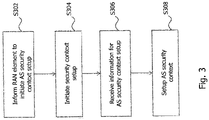
- Figure 3 shows a method embodiment which can be implemented in the wireless communication system 20 of Figure 2 .
- the first step S302 of Figure 3 shows a method embodiment which can be implemented in the CN element 300 of Figure 2
- the second step S304 of Figure 3 shows a method embodiment which can be implemented in the RAN element 200 of Figure 2
- the third step S306 and the fourth step S308 of Figure 3 show a method embodiment which can be implemented in the wireless communication device 100 of Figure 2 .
- the method of Figure 3 is supporting security context setup in a wireless communication network, the method comprising informing.
- the CN element, e.g. CN element 300, of the wireless communication network informs a RAN element, e.g. RAN element 200, of the wireless communication network, to initiate AS security context setup for a first RAT and a second RAT in a common signaling procedure.
- the informing component 320 of CN element 300 informs in step S302 a RAN element, e.g. RAN element 200, of the wireless communication network, to initiate AS security context setup for a first RAT and a second RAT in a common signaling procedure.
- step S304 the RAN element, e.g. RAN element 200, of the wireless communication network initiates AS security context setup for a first RAT and a second RAT in a common signaling procedure.
- the RAN element e.g. RAN element 200
- the RAN element 200 initiates AS security context setup for a first RAT and a second RAT in a common signaling procedure.
- a wireless communication device e.g. wireless communication device 100
- receives from a RAN element, e.g. RAN element 200, of the wireless communication network in a common signaling procedure, information enabling the wireless communication, e.g. wireless communication device 100, to set up an AS security context for a first RAT and a second RAT.
- receiving component 120 of wireless communication device 100 receives, from a RAN element, e.g. RAN element 200, of the wireless communication network in a common signaling procedure, information enabling the wireless communication, e.g. UE 100, to set up an AS security context for a first RAT and a second RAT in step S306.
- step S308 the wireless communication device, e.g. wireless communication device 100, sets up the AS security context for the first RAT and the second RAT.
- the setup component 140 of wireless communication device 100 sets up the AS security context for the first RAT and the second RAT in step S308.
- LTE wireless access networks and user equipments
- UEs user equipments
- LTE is used as an example technology where the proposed technique is suitable, and using LTE in the following therefore is useful for understanding the technique described herein.
- the radio access network element 200 will be referred to as eNB 200 to illustrate, by way of example, that the radio access network element 200 can be configured as a base station and that the technique proposed herein can be used and implemented in LTE.
- the wireless communication device 100 will be referred to as UE 100 to illustrate, by way of example, that the technique proposed herein can be used and implemented in LTE.
- the CN element 300 will be referred to as MME 300 to illustrate, by way of example, that the CN element 300 can be configured as a Mobility Management Entity and that the technique proposed herein can be used and implemented in LTE.
- eNB UE context context information
- the eNB UE context may be understood in the sense of 3GPP TS 36.401 as a block of information in an eNB associated to one active UE.
- the block of information may contain the necessary information required to maintain the E-UTRAN services towards the active UE.
- one or more or UE state information, security information, UE capability information and the identities of the UE-associated logical S1- connection may be included in the eNB UE context.
- Establishment of the eNB UE context may be considered completed when the transition to active state for a UE is completed or in target eNB after completion of handover to E-UTRAN.
- a new time-domain structure based on shorter transmission time intervals (TTIs) and a wider bandwidth for radio resource blocks compared to the one specified for LTE are likely to be defined for the new 5G air interface.
- LTE In parallel with the 5G research activities, 3GPP is continuously adding new features to LTE and it is likely that at the time 5G reaches the market, LTE should be capable of addressing many of the 5G requirements. In addition to this, LTE is also expected to be heavily deployed and, the fact that it operates in frequency bands with better propagation properties, makes the tight integration of LTE and the new air interface operating in higher frequency bands very appealing.
- 5G RAN architecture there is currently some ongoing discussion among the different involved parties about architecture alternatives to realize such a tight integration.
- interworking relies on inter-node interfaces, for both User Plane (UP) and Control Plane (CP).
- UP User Plane
- CP Control Plane
- MME and S-GW are inter-connected via S11 interface.
- Such architecture basically allows coverage continuity and load balancing only via hard handovers (always involving core network signalling) and semi-independent resource management for the multiple air interfaces. Details between the interworking between E-UTRAN and UTRAN can be found in TS 36.300 V13.1.0 (2015-09), for example, or other versions thereof.
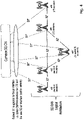
- AI denotes air interface, which is in the following sometimes referred to as NX, 5G NX or, in short, 5G
- a first RAT (RAT1) and a second RAT (RAT2) are supported by the same eNB, i.e. eNB 200, in Figure 6 .
- RAT1 and RAT2 may be supported by different eNBs, e.g. RAT1 by eNB 200 and RAT2 by a different eNB.
- the present disclosure is equally applicable independent of whether one BS implements both RATs or whether the two RATS are implemented separately in different BSs. It is assumed that there is only one RAN-CN connection per UE for both RATs.
- the first RAT and second RAT can be combined in one BS or can be distributed to two separate BSs. In case of separate BS for the first and second RATs, the BS of the first RAT is informed by the BS of the second RAT about security capabilities of the BS for the second RAT prior to the below method. Further, as mentioned above, in case of separate BS for the first and second RAT, the BS of the second RAT does not need a connection to the CN.
- 5G may refer to the LTE evolution, or another RAT which can be assumed as 5G.
- the security context may include security capabilities, keys, algorithms, and parameters available.
- a subset of multi-RAT security context e.g., security keys, parameters or algorithms
- this may not always be the case even if the related procedures are the same or similar for different RATs.
- context transformation may be needed in order not to break the compartmentalization principle mentioned in the background section even if the same type key material and related procedures can be reused.
- UE 100 could attach for "LTE only” or “5G only” or for “combined LTE and 5G".
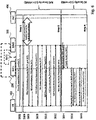
- the method comprised herein includes one or more of the steps as explained in the following with respect to Figure 6 .
- UE 100 attaches to CN for both 5G and LTE services.
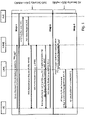
- UE 100 sends CN 300 (referring to a logical CN function and/or CN network element handling attach requests e.g. MME 300) its context information on the security capabilities for both RAT1 and RAT2 (e.g., supported security algorithms via UE Network Capability information available in Attach Request) when it attaches over RAT1 (e.g., in the Attach message) (step S602).
- UE 100 is indicated as an LTE+5G UE within the Attach Request.
- UE 100 informs CN 300 (in the following, it will sometimes be referred to MME 300 generally as CN element or in short just CN 300) about its security capabilities regarding the first RAT and the second RAT when sending an initial L3 message to the CN 300 (e.g. ATTACH REQUEST for the purpose for CN attachment; Tracking Area Update (TAU) Request for informing the CN about an IDLE mode mobility event via the first RAT).
- MME 300 in the following, it will sometimes be referred to MME 300 generally as CN element or in short just CN 300
- an initial L3 message e.g. ATTACH REQUEST for the purpose for CN attachment; Tracking Area Update (TAU) Request for informing the CN about an IDLE mode mobility event via the first RAT.
- TAU Tracking Area Update
- UE 100 can include an indicator for LTE as well as for 5G services. Therefore CN 300 can trigger RAN element 200 to combined activation as described herein.
- UE 100 can include its LTE security capabilities. These are the supported encryption and integrity algorithms for different access types. The indication of attach type could be implicit from which capabilities the UE includes in the Attach message. In general, it may be beneficial to keep the UE security capabilities for all the RATs that the UE supports in the CN for future inter-RAT handovers.
- CN 300 After informing the CN 300 about the UE 100 security capabilities, security set up for NAS (UE-CN for signaling) is performed in step step2. For this purpose, CN 300 requests authentication of UE 100 in a NAS authentication request message (step S606) and derives CN key material (common for both RATs or separate for each RAT). The UE verifies the authenticity of the authentication request and replies with an authentication response message (step S608) and derives the corresponding CN key material. In other words, CN 300 authenticates UE 100 for both 5G and LTE services and derives a CN-level key (e.g., K ASME ). In more detail, CN 300, e.g.
- MME 300 requests for the authentication vector (AV) related to the International Mobile Subscriber Identity (IMSI) by sending the Authentication Data Request to AuC/HSS 400 (step S604).
- the AV could be a dual vector related to both 5G and LTE.
- AuC 400 recognizes UE 100 is a dual RAT UE 100.
- CN retrieves security keys and parameters from dual AV related to both 5G and LTE.
- CN 300 sends the Authentication Request, which is valid for both 5G and LTE, to UE 100 in step S606.
- UE 100 authenticates the CN 300 by checking the received security parameters, deriving the security keys and other parameters. The derivation is done for both NX and LTE. This way, UE 100 will run a common or separate authentication algorithm(s) at the same time and prepare a single message (e.g., Authentication Response) in step S608.
- CN 300 derives further CN key material for integrity protection and ciphering of NAS communication and sends information enabling UE 100 to derive the further CN key material to UE 100 in a NAS security mode command message (step S610).
- This information may correspond to some information from which the CN key material, a RAN key material or both can be derived.
- the message may comprise an indication that the CN and/or RAN key material is for the first RAT, the second RAT or for both.
- UE 100 derives the further CN and RAN key material and replies to CN 300 in a NAS security mode command complete message (step S612) to confirm to CN 300 that the procedure is successfully completed in UE 100.
- deriving a key material does not necessarily need to be performed immediately but is typically derived when it should be used the first time (an encryption key does not need to be calculated by the sender until the first message is encrypted).
- CN 300 verifies the authentication for both 5G and LTE and derives keys and further parameters based on the selected security algorithms, which could be either common or separate to both RATs.
- CN 300 sends the NAS security command in step S610, with relevant security parameters, capabilities and integrity protection, for both LTE and 5G.
- UE 100 can derive further security keys and parameters; and verify the integrity of the Security Mode Command message.
- UE 100 sends CN 300 the NAS Security Mode Complete with relevant security parameters, capabilities and integrity protection, for both LTE and 5G in step S612.
- CN 300 derives from the CN key material the RAN key material (common for both RATs or separate for each RAT) and sends, in step S614, the RAN key material to RAN element 200 (also sometimes referred to as eNB 200 in the following), e.g. in a S1AP UE Initial Context Setup message (on NAS level). If eNB 200 has not received the RAN key material for the second RAT, eNB 200 derives this RAN key material from the RAN key material for the first RAT.
- RAN key material common for both RATs or separate for each RAT
- RAN element 200 also sometimes referred to as eNB 200 in the following
- eNB 200 sends to UE 100 information enabling UE 100 to derive the RAN key material and activating AS security for both RATs, e. g. in an AS Security Mode Command message (step S616).
- UE 100 derives this RAN key material and informs eNB 200 of the first RAT or the eNB 200 of the second RAT (e.g. piggy-backed in RRC message) in an AS security mode complete message thereof.
- the base station of the second RAT sends an X2AP indication to the base station of the first RAT. This indication indicates to the base station of the first RAT that the security is established for both RATs.
- CN 300 derives a common (e.g., K eNB ) or separate RAN-level key material for both 5G and LTE securities from a common (e.g., K ASME ) or separate CN-level key material, and sends the derived RAN-level key material to RAN element 200 (step S614).
- UE 100 also derives the same RAN-level key material (e.g., K eNB from K ASME ) so as to calculate other security keys and activate the end-to-end security for both 5G and LTE services.
- CN After receiving NAS Security Mode Complete from UE 100 in step S612, CN sends RAN-level key material (e.g., a common K eNB ) for both LTE and 5G to RAN element 200 in step S614 with S1AP Initial Context Setup Request attaching UE Security Capability and LTE and 5G keys or a common RAN-level key material for both LTE and 5G.
- RAN-level key material e.g., a common K eNB
- S1AP Initial Context Setup Request attaching UE Security Capability and LTE and 5G keys or a common RAN-level key material for both LTE and 5G.
- RAN element After receiving RAN-level key material, RAN element does the integrity check and calculates the required AS keys and parameters for both LTE and 5G from that. Then it sends a common AS Security Mode Command in step S616 with the required security parameters for both LTE and 5G with integrity protection.
- UE 100 After receiving AS Security Mode Command, UE 100 identifies the security algorithms and calculates the AS security keys for both LTE and 5G ; and verifies the integrity of the Security Mode Command message. Finally, UE 100 sends a common AS Security Mode Complete to RAN element with integrity protection in step S618.
- RAN element 200 derives an NX key from K eNB and uses the 5G key as a basis for any encryption and integrity key that should be used on 5G.
- NX key from K eNB
- 5G key is a basis for any encryption and integrity key that should be used on 5G.
- MME 300 derives a 5G and LTE keys or a common K eNB (e.g., from the common K ASME ) directly and gives that to the RAN element 200
- RAN element 200 can also derive a 5G key from K eNB and can use the 5G key as a basis for any encryption and integrity key that should be used on 5G. This may be mandated especially when the 5G and LTE RATs are not co-located (due to compartmentalization principle).
- sending information from which the RAN key can be derived from the CN element 300 to UE 100 is one option. Another option is sending such information from RAN element 200 to UE 100. It is also possible that both pieces of information are sent and the RAN key is derived from them both.
- the CN may need to explicitly indicate to the RAN what to do if some steps are considered transparent to the RAN e.g., especially when common key material, algorithms are used for setting up multiple RAT securities.
- UE 100 may need to explicitly be acknowledged on which RAT securities to be activated e.g., via Security Mode Command. The decision for the AS security context to be created and activated can be made on the RAN or CN level.
- RAN element 200 or CN 300 may reject the security setup for a specific RAT.
- MME 300 or eNB 200 can implicitly acknowledge the rejection of a security setup (e.g., RAT2 security) by responding only for one RAT (e.g., RAT1 security) as shown in Figure 6 .
- a security setup e.g., RAT2 security
- RAT1 security e.g., RAT1 security
- any reject or failure message can be signalled within a dedicated signalling procedure.
- the security activation for a certain RAT and security can be postponed. This is could be e.g., due to mobility, traffic load, security policy or any other reason.
- multi-RAT context for security is handled via a common procedure so as to enable fast, efficient and secure connection establishment for multi-RATs.
- UE can request multi-RAT security setup and the network (NW) can run a single procedure (e.g., Security Mode Command) to activate security for both LTE and 5G.
- the NW may need to get the required information from another network element related to both LTE and 5G for this UE.
- a mechanism for simultaneous signaling related to set up security between a UE and a network for two or more RATs e.g, LTE, 5G.
- Activation of the security might or might not be done simultaneously for both RANs.
- Security is activated for two strata. The first is between the UE and a CN node, and the second is between the UE and a RAN node.
- the mechanism comprises mutual authentication between the UE and CN by means of a first single NAS procedure.
- a second CN node informs the UE whether security shall be activated for two or more RATs simultaneously in a single procedure for the first NAS stratum.
- the first and second CN node can be the same.
- the informing may also indicate whether the security shall be activated for the second stratum (the AS for two or more RATs). If the informing did not apply to the AS, a RAN node activates security for AS using an AS procedure.
- a security context set-up for a UE capable of employing two RATs can be handled for the two RATs at the same time in one single procedure per stratum to reduce signaling overhead.
- the security context set-up can include authentication procedure, NAS (CN-UE) activation procedure and AS activation procedure (RAN-UE), wherein each procedure may use a common procedure for both RATs.
- NAS CN-UE
- AS activation procedure RAN-UE
- single AS security mode command request from BS to UE for both RATs may activate in UE security for two RATs.
- a single NAS security mode command request from CN to UE for both RATs may activate in UE security for the CN key for the two RATs, and possibly informs the UE about whether the AS security mode command should apply to one or both of the RATs.
- CN refers to a logical CN function and/or CN network element e.g., that handles Attach Requests
- RAN element denotes a RAN node or logical function where the multi-RAT connection (like a common RRC entity) is terminated at the network side.
- Creating the security context in advance for dual/multiple RATs also means that the user plane can be enabled faster while switching from one RAT to the other.
- Figure 7 is a block diagram schematically illustrating a device embodiment of a network element 2 supporting security context setup in a wireless communication network.
- the network element 2 is described to implement the functionalities of the radio access network element 200 according to the embodiment of Figure 2 .
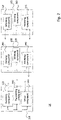
- the radio access network element 2 comprises a memory 4 and a processor 6 coupled to one another.
- the radio access network element may further comprise an optional interface coupled to the processor 6.
- the memory 4 contains control instructions executable by the processor 6.
- the processor 6 is configured to initiate Access Stratum (AS) security context setup for a first Radio Access Technology (RAT) and a second RAT in a common signaling procedure.
- AS Access Stratum
- RAT Radio Access Technology
- the interface may be configured to carry out any communication with other components of the communication network. For example, the interface may transmit information to other components of the communication network and/or may receive information from other components of the communication network.
- the radio access network element 2 comprises a memory 4 and a processor 6 coupled to one another.
- the radio access network element may further comprise an optional interface coupled to the processor 6.
- the memory 4 contains control instructions executable by the processor 6.
- the processor 6 is configured to inform a radio access network (RAN) element of the wireless communication network, to initiate Access Stratum (AS) security context setup for a first Radio Access Technology (RAT) and a second RAT in a common signaling procedure.
- the interface may be configured to carry out any communication with other components of the communication network. For example, the interface may transmit information to other components of the communication network and/or may receive information from other components of the communication network.
- the radio access network element 2 comprises a memory 4 and a processor 6 coupled to one another.
- the radio access network element may further comprise an optional interface coupled to the processor 6.
- the memory 4 contains control instructions executable by the processor 6.
- the processor 6 is configured to receive, from a radio access network (RAN) element of the wireless communication network in a common signaling procedure, information enabling the wireless communication to set up an Access Stratum (AS) security context for a first Radio Access Technology (RAT) and a second RAT.
- the processor is further configured to set up the AS security context for the first RAT and the second RAT.
- RAN radio access network
- AS Access Stratum
- RAT Radio Access Technology
- Figure 8 shows a functional block diagram of a radio access network element 20 configured in accordance with the principles of the disclosure as described above.
- the functional blocks of the network element 20 may be implemented by hardware, software, or a combination of hardware and software to carry out the principles of the disclosure. It is understood by a person skilled in the art that the functional blocks described in Figure 8 may be combined in one or more blocks or separated into sub-blocks to implement the principles of the disclosure as described above.
- the radio access network element 20 of Figure 8 is for supporting security context setup in a wireless communication network.
- the network element 20 comprises an initiating module 22 for initiating Access Stratum (AS) security context setup for a first Radio Access Technology (RAT) and a second RAT in a common signaling procedure.
- AS Access Stratum
- RAT Radio Access Technology
- the network element 20 may comprise a receiving module 24.
- the receiving module is for receiving, by the RAN element, first RAN key material from a core network (CN) element of the wireless communication network.
- the first RAN key material enables the RAN element to initiate the AS security context setup for the first RAT.
- the receiving module is further for receiving, by the RAN element, second RAN key material from the CN element of the wireless communication network.
- the second RAN key material enables the RAN element to initiate the AS security context setup for the second RAT.
- the receiving module may be for receiving, by the RAN element, first RAN key material from a CN element of the wireless communication network.
- the first RAN key material enables the RAN element to initiate the AS security context setup for the first RAT.
- the network element 20 may further comprise a deriving module for deriving, by the RAN element, second RAN key material from the received first RAN key material.
- the second RAN key material enables the RAN element to initiate the AS security context setup for the second RAT.
- the network element 20 may further comprise a transmitting module 26 for transmitting, by the RAN element, a common AS security mode command message for the first RAT and the second RAT to a wireless communication device of the wireless communication network.
- the receiving module may further be for receiving, by the RAN element, an AS security mode complete message informing the RAN element of the completion of the AS security context setup for the first RAT and the second RAT.
- the network element 20 may correspond to the RAN element implementing the first RAT and may correspond to or be different from the RAN element implementing the second RAT.
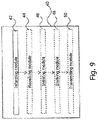
- Figure 9 shows a functional block diagram of a core network element 40 configured in accordance with the principles of the disclosure as described above.
- the functional blocks of the network element 40 may be implemented by hardware, software, or a combination of hardware and software to carry out the principles of the disclosure. It is understood by a person skilled in the art that the functional blocks described in Figure 9 may be combined in one or more blocks or separated into sub-blocks to implement the principles of the disclosure as described above. Therefore, the description herein may support any possible combination or separation or further definition of the functional blocks described herein.
- the core network element 40 of Figure 9 is supporting security context setup in a wireless communication network.
- the core network element 40 comprises an informing module 42 for informing a radio access network (RAN) element of the wireless communication network, to initiate Access Stratum (AS) security context setup for a first Radio Access Technology (RAT) and a second RAT in a common signaling procedure
- RAN radio access network
- AS Access Stratum
- the core network element 40 may comprise a receiving module 44 for receiving, by the CN element from a wireless communication device, information about security capabilities of the wireless communication device regarding the first RAT and the second RAT.
- the core network element 40 may comprise an initiating module 46 for initiating, by the CN element, Non Access Stratum (NAS) security context setup for the first RAT and the second RAT in a common signaling procedure.
- NAS Non Access Stratum
- the initiating module may further be for initiating the NAS security context setup comprises requesting, by the CN element, a wireless communication device to perform authentication towards the CN element.
- the core network element 40 may comprise a deriving module 48 for deriving, by the CN element, CN key material enabling a wireless communication device to perform authentication for the first RAT and enabling the wireless communication device to perform authentication for the second RAT.
- the core network element 40 may comprise a transmitting module 50 for transmitting, by the CN element, the CN key material to the wireless communication device.
- the receiving module may further be for receiving, by the CN element, an authentication response message from the wireless communication device.
- the deriving module may further be for deriving, by the CN element, CN key material for integrity protection and ciphering of NAS communication.
- the transmitting module may further be for transmitting, by the CN element, an NAS security mode command message for the first RAT and the second RAT to the wireless communication device, the NAS security mode command message enabling the wireless communication device to derive the CN key material for integrity protection and ciphering of NAS communication.
- the receiving module may further be for receiving, by the CN element, an NAS security mode complete message for the first RAT and the second RAT from the wireless communication device.
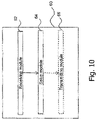
- Figure 10 shows a functional block diagram of a wireless communication device 60 configured in accordance with the principles of the disclosure as described above.
- the functional blocks of the wireless communication device 6 may be implemented by hardware, software, or a combination of hardware and software to carry out the principles of the disclosure. It is understood by a person skilled in the art that the functional blocks described in Figure 10 may be combined in one or more blocks or separated into sub-blocks to implement the principles of the disclosure as described above. Therefore, the description herein may support any possible combination or separation or further definition of the functional blocks described herein.
- the wireless communication device 60 of Figure 10 is supporting security context setup in a wireless communication network.
- the wireless communication device 60 comprises a receiving module 62 for receiving, from a radio access network (RAN) element of the wireless communication network in a common signaling procedure, information enabling the wireless communication to set up an Access Stratum (AS) security context for a first Radio Access Technology (RAT) and a second RAT.
- the wireless communication device 60 further comprises a setup module 64 for setting up the AS security context for the first RAT and the second RAT.
- the receiving module may further be for receiving, by the wireless communication device from the RAN element of the wireless communication network, a common AS security mode command message for the first RAT and the second RAT.
- the wireless communication device 60 may further comprise a transmitting module 66 for transmitting, by the wireless communication device, an AS security mode complete message to the RAN element, the AS security mode complete message informing the RAN element of the completion of the AS security context setup for the first RAT and the second RAT.
- the transmitting module may further be for transmitting, by the wireless communication device to a core network, CN, element of the wireless communication network, information about security capabilities of the wireless communication device regarding the first RAT and the second RAT.
- the receiving module may further be for receiving, by the wireless communication device from a CN element, a request to perform authentication towards the CN element.
- the transmitting module may further be for transmitting, by the wireless communication device, an authentication response message to the CN element.
- the receiving module may further be for receiving, by the wireless communication device, an NAS security mode command message for the first RAT and the second RAT from the CN element and deriving, by the wireless communication device, CN key material for integrity protection and ciphering of NAS communication for the first RAT and the second RAT from the received NAS security mode command message.
- the transmitting module may further be for transmitting, by the wireless communication device, an NAS security mode complete message for the first RAT and the second RAT to the CN element.
Landscapes
- Engineering & Computer Science (AREA)
- Computer Security & Cryptography (AREA)
- Computer Networks & Wireless Communication (AREA)
- Signal Processing (AREA)
- Mobile Radio Communication Systems (AREA)
Claims (18)
- Verfahren zum Unterstützen des Sicherheitskontextaufbaus in einem drahtlosen Kommunikationsnetz, wobei das Verfahren das Initiieren (S304), durch ein Funkzugangsnetz-, RAN-, Element (200) des drahtlosen Kommunikationsnetzes, eines Zugriffsschicht-, AS-, Sicherheitskontextaufbaus für eine erste Funkzugangstechnologie, RAT, und eine zweite RAT in einer gemeinsamen Signalisierungsprozedur umfasst, wobei das RAN-Element (200) dem RAN-Element entspricht, das die erste RAT implementiert und sich von dem RAN-Element unterscheidet, das die zweite RAT implementiert, dadurch gekennzeichnet, dass
der Schritt des Initiierens (S304) des AS-Sicherheitskontextaufbaus das Übermitteln, durch das RAN-Element (200), einer einzigen gemeinsamen AS-Sicherheitsmodus-Befehlsnachricht für die erste RAT und die zweite RAT an eine drahtlose Kommunikationsvorrichtung (100) des drahtlosen Kommunikationsnetzes umfasst. - Verfahren nach Anspruch 1, wobei das Verfahren das Empfangen, durch das RAN-Element (200), von erstem RAN-Schlüsselmaterial von einem Kernnetz-, CN-, Element (300) des drahtlosen Kommunikationsnetzes umfasst, wobei das erste RAN-Schlüsselmaterial dem RAN-Element ermöglicht, den AS-Sicherheitskontextaufbau für die erste RAT zu initiieren, und das Empfangen, durch das RAN-Element, von zweitem RAN-Schlüsselmaterial von dem CN-Element des drahtlosen Kommunikationsnetzes umfasst, wobei das zweite RAN-Schlüsselmaterial dem RAN-Element ermöglicht, den AS-Sicherheitskontextaufbau für die zweite RAT zu initiieren; oder das Verfahren das Empfangen, durch das RAN-Element (200), von erstem RAN-Schlüsselmaterial von einem CN-Element des drahtlosen Kommunikationsnetzes umfasst, wobei das erste RAN-Schlüsselmaterial dem RAN-Element (200) ermöglicht, den AS-Sicherheitskontextaufbau für die erste RAT zu initiieren, und das Ableiten, durch das RAN-Element (200), von zweitem RAN-Schlüsselmaterial aus dem empfangenen ersten RAN-Schlüsselmaterial umfasst, wobei das zweite RAN-Schlüsselmaterial dem RAN-Element (200) ermöglicht, den AS-Sicherheitskontextaufbau für die zweite RAT zu initiieren.
- Verfahren nach Anspruch 1 oder 2, wobei nur eine RAN-CN-Verbindung pro drahtloser Kommunikationsvorrichtung (100) für beide RATs vorhanden ist.
- Verfahren nach einem der Ansprüche 1 bis 3, wobei der Schritt des Initiierens des AS-Sicherheitskontextaufbaus umfasst:- direktes Verwenden des empfangenen ersten RAN-Schlüsselmaterials zum Initiieren des AS-Sicherheitskontextaufbaus für die erste RAT; oder- Ableiten von drittem RAN-Schlüsselmaterial aus dem empfangenen ersten RAN-Schlüsselmaterial und Verwenden des abgeleiteten dritten RAN-Schlüsselmaterials zum Initiieren des AS-Sicherheitskontextaufbaus für die erste RAT.
- Verfahren nach einem der Ansprüche 1 bis 4, wobei das Verfahren das Empfangen, durch das RAN-Element (200), einer AS-Sicherheitsmodus-Abschlussnachricht, die das RAN-Element über den Abschluss des AS-Sicherheitskontextaufbaus für die erste RAT und die zweite RAT informiert, umfasst, wobei optional die AS-Sicherheitsmodus-Abschlussnachricht eine von einer Basisstation der zweiten RAT empfangenen X2AP-Anzeige ist.
- Verfahren zum Unterstützen des Sicherheitskontextaufbaus in einem drahtlosen Kommunikationsnetz, wobei das Verfahren umfasst, durch ein Kernnetz-, CN-, Element (300) des drahtlosen Kommunikationsnetzes ein Funkzugangsnetz-, RAN-, Element (200) des drahtlosen Kommunikationsnetzes darüber zu informieren, den Zugangsschicht-, AS-, Sicherheitskontextaufbau für eine erste Funkzugangstechnologie, RAT, und eine zweite RAT in einer gemeinsamen Signalisierungsprozedur zu initiieren, wobei das RAN-Element (200) dem RAN-Element entspricht, das die erste RAT implementiert und sich von dem RAN-Element unterscheidet, das die zweite RAT implementiert, dadurch gekennzeichnet, dass
die Initiierung des AS-Sicherheitskontextaufbaus das Übermitteln, durch das RAN-Element (200), einer einzigen gemeinsamen AS-Sicherheitsmodus-Befehlsnachricht für die erste RAT und die zweite RAT an eine drahtlose Kommunikationsvorrichtung (100) des drahtlosen Kommunikationsnetzes umfasst. - Verfahren nach Anspruch 6, wobei das Verfahren das Empfangen, durch das CN-Element (300), von Informationen über die Sicherheitsfähigkeiten der drahtlosen Kommunikationsvorrichtung bezüglich der ersten RAT und der zweiten RAT von einer drahtlosen Kommunikationsvorrichtung (100) umfasst.
- Verfahren nach Anspruch 6 oder 7, wobei das Verfahren das Initiieren, durch das CN-Element (300), des Nicht-Zugriffsschicht-, NAS-, Sicherheitskontextaufbaus für die erste RAT und die zweite RAT in einer gemeinsamen Signalisierungsprozedur umfasst, wobei optional der Schritt des Initiierens des NAS-Sicherheitskontextaufbaus das Auffordern, durch das CN-Element (300), einer drahtlosen Kommunikationsvorrichtung (100), eine Authentifizierung gegenüber dem CN-Element (300) durchzuführen, umfasst; und/oder das Verfahren das Ableiten von CN-Schlüsselmaterial durch das CN-Element (300) umfasst, wodurch einer drahtlosen Kommunikationsvorrichtung ermöglicht wird, eine Authentifizierung für die erste RAT durchzuführen, und der drahtlosen Kommunikationsvorrichtung (100) ermöglicht wird, eine Authentifizierung für die zweite RAT durchzuführen, wobei das Verfahren beispielsweise das Übermitteln des CN-Schlüsselmaterials durch das CN-Element (300) an die drahtlose Kommunikationsvorrichtung (100) umfasst.
- Verfahren nach Anspruch 8, wobei das Verfahren das Empfangen, durch das CN-Element (300), einer Authentifizierungsantwortnachricht von der drahtlosen Vorrichtung (100) umfasst.
- Verfahren nach einem der Ansprüche 6 bis 9, wobei das Verfahren das Ableiten, durch das CN-Element (300), von CN-Schlüsselmaterial für den Integritätsschutz und die Chiffrierung von NAS-Kommunikation umfasst, wobei das Verfahren optional das Übermitteln, durch das CN-Element (300), einer NAS-Sicherheitsmodus-Befehlsnachricht für die erste RAT und die zweite RAT an die drahtlose Kommunikationsvorrichtung (100) umfasst, wobei die NAS-Sicherheitsmodus-Befehlsnachricht der drahtlosen Vorrichtung ermöglicht, das CN-Schlüsselmaterial für den Integritätsschutz und die Chiffrierung der NAS-Kommunikation abzuleiten, wobei das Verfahren beispielsweise ferner das Empfangen, durch das CN-Element (300), einer NAS-Sicherheitsmodus-Abschlussnachricht für die erste RAT und die zweite RAT von der drahtlosen Vorrichtung (100) umfasst.
- Verfahren zum Unterstützen des Sicherheitskontextaufbaus in einem drahtlosen Kommunikationsnetz, wobei das Verfahren umfasst:- Empfangen, durch eine drahtlose Kommunikationsvorrichtung (100) des drahtlosen Kommunikationsnetzes, von einem Funkzugangsnetz-, RAN-, Element (200) des drahtlosen Kommunikationsnetzes, in einer gemeinsamen Signalisierungsprozedur, von Informationen, die der drahtlosen Kommunikation ermöglichen, einen Zugriffsschicht-, AS-, Sicherheitskontext für eine erste Funkzugangstechnologie, RAT, und eine zweite RAT, aufzubauen,- und Aufbauen des AS-Sicherheitskontextes für die erste RAT und die zweite RAT durch die drahtlose Kommunikationsvorrichtung (100),wobei das RAN-Element (200) dem RAN-Element entspricht, das die erste RAT implementiert und sich von dem RAN-Element unterscheidet, das die zweite RAT implementiert, dadurch gekennzeichnet, dassdas Verfahren das Empfangen, durch die drahtlose Kommunikationsvorrichtung (100), einer einzigen gemeinsamen AS-Sicherheitsmodus-Befehlsnachricht für die erste RAT und die zweite RAT von dem RAN-Element (200) des drahtlosen Kommunikationsnetzes umfasst.
- Verfahren nach Anspruch 11, wobei das Verfahren das Übermitteln, durch die drahtlose Kommunikationsvorrichtung (100), einer AS-Sicherheitsmodus-Abschlussnachricht an das RAN-Element (200) umfasst, wobei die AS-Sicherheitsmodus-Abschlussnachricht das RAN-Element über den Abschluss des AS-Sicherheitskontextaufbaus für die erste RAT und die zweite RAT informiert; und/oder das Verfahren das Übermitteln, durch die drahtlose Kommunikationsvorrichtung (100), von Informationen über Sicherheitsfähigkeiten der drahtlosen Kommunikationsvorrichtung bezüglich der ersten RAT und der zweiten RAT an ein Kernnetz-, CN-Element (300) des drahtlosen Kommunikationsnetzes umfasst; und/oder das Verfahren das Empfangen, durch die drahtlose Kommunikationsvorrichtung (100), einer Aufforderung von einem CN-Element (300), eine Authentifizierung gegenüber dem CN-Element (300) durchzuführen, umfasst, wobei das Verfahren optional ferner das Übermitteln einer Authentifizierungsantwortnachricht an das CN-Element (300) durch die drahtlose Kommunikationsvorrichtung (100) umfasst.
- Verfahren nach Anspruch 11 oder 12, wobei das Verfahren das Empfangen, durch die drahtlose Kommunikationsvorrichtung (100), einer NAS-Sicherheitsmodus-Befehlsnachricht für die erste RAT und die zweite RAT von dem CN-Element und das Ableiten, durch die drahtlose Kommunikationsvorrichtung (100), von CN-Schlüsselmaterial für den Integritätsschutz und die Chiffrierung der NAS-Kommunikation für die erste RAT und die zweite RAT aus der empfangenen NAS Sicherheitsmodus-Befehlsnachricht umfasst; und/oder das Verfahren das Übermitteln, durch die drahtlose Kommunikationsvorrichtung (100), einer NAS-Sicherheitsmodus-Abschlussnachricht für die erste RAT und die zweite RAT an das CN-Element (300) umfasst.
- Funkzugangsnetz-, RAN-, Element (200) zum Unterstützen des Sicherheitskontextaufbaus in einem drahtlosen Kommunikationsnetz, wobei das RAN-Element dazu konfiguriert ist, das Verfahren nach einem der Ansprüche 1 bis 5 durchzuführen.
- RAN-Element (200) nach Anspruch 14, wobei das RAN-Element (200) eine Funkbasisstation, eine Funknetzsteuerung, einen NodeB, einen eNodeB, eine 5G-Funkeinheitssteuerung oder eine 5G-Basisstation umfasst oder als diese ausgebildet ist oder Teil davon ist.
- Kernnetz-, CN-, Element (300) zum Unterstützen des Sicherheitskontextaufbaus in einem drahtlosen Kommunikationsnetz, wobei das CN-Element (300) dazu konfiguriert ist, das Verfahren nach einem der Ansprüche 6 bis 10 auszuführen.
- Drahtlose Kommunikationsvorrichtung (100) zum Unterstützen des Sicherheitskontextaufbaus in einem drahtlosen Kommunikationsnetz, wobei die drahtlose Kommunikationsvorrichtung (100) dazu konfiguriert ist, das Verfahren nach einem der Ansprüche 11 bis 13 auszuführen.
- Drahtloses Kommunikationssystem (20), umfassend das RAN-Element (200) nach Anspruch 14 oder 15, das CN-Element (300) nach Anspruch 16 und eine oder mehrere drahtlose Kommunikationsvorrichtungen (100) nach Anspruch 17.
Priority Applications (1)
| Application Number | Priority Date | Filing Date | Title |
|---|---|---|---|
| EP22189016.3A EP4102871B1 (de) | 2015-12-03 | 2015-12-03 | Multi-rat-sicherheitsaufbau |
Applications Claiming Priority (1)
| Application Number | Priority Date | Filing Date | Title |
|---|---|---|---|
| PCT/EP2015/078520 WO2017092813A1 (en) | 2015-12-03 | 2015-12-03 | Multi-rat access stratum security |
Related Child Applications (2)
| Application Number | Title | Priority Date | Filing Date |
|---|---|---|---|
| EP22189016.3A Division EP4102871B1 (de) | 2015-12-03 | 2015-12-03 | Multi-rat-sicherheitsaufbau |
| EP22189016.3A Division-Into EP4102871B1 (de) | 2015-12-03 | 2015-12-03 | Multi-rat-sicherheitsaufbau |
Publications (2)
| Publication Number | Publication Date |
|---|---|
| EP3384698A1 EP3384698A1 (de) | 2018-10-10 |
| EP3384698B1 true EP3384698B1 (de) | 2022-09-14 |
Family
ID=54884000
Family Applications (2)
| Application Number | Title | Priority Date | Filing Date |
|---|---|---|---|
| EP15812985.8A Active EP3384698B1 (de) | 2015-12-03 | 2015-12-03 | Sicherheit einer multi-rat-zugangsschicht |
| EP22189016.3A Active EP4102871B1 (de) | 2015-12-03 | 2015-12-03 | Multi-rat-sicherheitsaufbau |
Family Applications After (1)
| Application Number | Title | Priority Date | Filing Date |
|---|---|---|---|
| EP22189016.3A Active EP4102871B1 (de) | 2015-12-03 | 2015-12-03 | Multi-rat-sicherheitsaufbau |
Country Status (5)
| Country | Link |
|---|---|
| US (4) | US10506438B2 (de) |
| EP (2) | EP3384698B1 (de) |
| CN (2) | CN108605224B (de) |
| ES (1) | ES3012708T3 (de) |
| WO (1) | WO2017092813A1 (de) |
Families Citing this family (26)
| Publication number | Priority date | Publication date | Assignee | Title |
|---|---|---|---|---|
| EP3384698B1 (de) | 2015-12-03 | 2022-09-14 | Telefonaktiebolaget LM Ericsson (publ) | Sicherheit einer multi-rat-zugangsschicht |
| WO2017092814A1 (en) | 2015-12-03 | 2017-06-08 | Telefonaktiebolaget Lm Ericsson (Publ) | Light-weight rrc connection setup in multi-rat network |
| CN109729096B (zh) * | 2016-01-05 | 2020-06-16 | 华为技术有限公司 | 移动通信方法、装置及设备 |
| KR102232093B1 (ko) * | 2016-01-08 | 2021-03-24 | 닛본 덴끼 가부시끼가이샤 | 무선국 시스템, 무선 단말, 및 이들의 방법 |
| KR20170112945A (ko) * | 2016-04-01 | 2017-10-12 | 삼성전자주식회사 | 이동통신 시스템에서 기기 간 통신과 셀룰라 통신의 공존 방법 및 장치 |
| US10334435B2 (en) * | 2016-04-27 | 2019-06-25 | Qualcomm Incorporated | Enhanced non-access stratum security |
| EP3481135B1 (de) * | 2016-07-01 | 2024-08-14 | KT Corporation | Verfahren und vorrichtung zum konfigurieren von dualkonnektivität |
| US11356838B2 (en) * | 2017-01-16 | 2022-06-07 | Telefonaktiebolaget Lm Ericsson (Publ) | Tracking area update in RRC_INACTIVE |
| US10470042B2 (en) * | 2017-07-27 | 2019-11-05 | Nokia Technologies Oy | Secure short message service over non-access stratum |
| US11297502B2 (en) | 2017-09-08 | 2022-04-05 | Futurewei Technologies, Inc. | Method and device for negotiating security and integrity algorithms |
| ES2973317T3 (es) * | 2017-10-30 | 2024-06-19 | Huawei Tech Co Ltd | Método y dispositivo para obtener capacidades de seguridad del equipo de usuario |
| CN109803261B (zh) * | 2017-11-17 | 2021-06-22 | 华为技术有限公司 | 鉴权方法、设备及系统 |
| PL3756373T3 (pl) * | 2018-02-19 | 2022-01-03 | Telefonaktiebolaget Lm Ericsson (Publ) | Obsługa współpracy i/lub mobilności pomiędzy różnymi systemami komunikacji bezprzewodowej |
| KR102425581B1 (ko) | 2018-02-23 | 2022-07-27 | 삼성전자주식회사 | 이동통신 시스템에서 통신을 수행하는 방법 및 장치 |
| CN110351722B (zh) * | 2018-04-08 | 2024-04-16 | 华为技术有限公司 | 一种信息发送方法、密钥生成方法以及装置 |
| JP6741882B1 (ja) * | 2018-04-16 | 2020-08-19 | テレフオンアクチーボラゲット エルエム エリクソン(パブル) | 非アクティブ状態からのrrc再開のためのセキュリティ処理 |
| US11611879B2 (en) | 2018-10-31 | 2023-03-21 | Apple Inc. | 5G new radio—avoiding redundant as security checks |
| CN112913282B (zh) | 2018-11-01 | 2024-09-03 | 瑞典爱立信有限公司 | 用于阻止由来自网络节点的不安全消息引起的切换的系统和方法 |
| IL283570B2 (en) * | 2019-01-15 | 2025-04-01 | Ericsson Telefon Ab L M | Wireless device radio access capabilities |
| US20200322795A1 (en) * | 2019-04-03 | 2020-10-08 | Mediatek Singapore Pte. Ltd. | Apparatuses and methods for alignment of common non access stratum (nas) security context |
| EP4489516A3 (de) * | 2019-08-19 | 2025-02-26 | QUALCOMM Incorporated | Planungslücke für multi-sim-benutzergerät |
| CN112469043B (zh) * | 2019-09-09 | 2022-10-28 | 华为技术有限公司 | 一种鉴权的方法及装置 |
| US11363501B2 (en) * | 2019-12-26 | 2022-06-14 | Qualcomm Incorporated | Intelligent connectivity switching mechanisms |
| WO2023105488A1 (en) * | 2021-12-09 | 2023-06-15 | Airties Kablosuz Iletisim Sanayi Ve Dis Ticaret A.S. | Security mode aware client connection management |
| US20240040650A1 (en) * | 2022-07-29 | 2024-02-01 | Skylo Technologies, Inc. | Managing a User Equipment Connection to a Wireless Network |
| WO2025123706A1 (en) * | 2024-08-02 | 2025-06-19 | Lenovo (Beijing) Limited | Methods and apparatuses for supporting multiple accesses of ue to core network |
Family Cites Families (57)
| Publication number | Priority date | Publication date | Assignee | Title |
|---|---|---|---|---|
| US965334A (en) * | 1907-06-13 | 1910-07-26 | Malleable Iron Range Company | Stove-top. |
| US4394254A (en) * | 1982-04-26 | 1983-07-19 | Texaco Inc. | Method for separating straight chain hydrocarbons using zeolites having large crystals |
| US4562537A (en) * | 1984-04-13 | 1985-12-31 | Texas Instruments Incorporated | High speed processor |
| US8037188B2 (en) | 2003-02-12 | 2011-10-11 | Qualcomm Incorporated | Soft handoff across different networks assisted by an end-to-end application protocol |
| GB2427324B (en) | 2005-06-14 | 2007-09-19 | Siemens Ag | A method of dual transfer mode handover |
| ES2526199T3 (es) | 2006-08-18 | 2015-01-08 | Telefonaktiebolaget Lm Ericsson (Publ) | Correlación que implica cambio inter sistema entre diferentes tipos de portadores radio |
| US20080076392A1 (en) * | 2006-09-22 | 2008-03-27 | Amit Khetawat | Method and apparatus for securing a wireless air interface |
| US8483174B2 (en) | 2007-04-20 | 2013-07-09 | Qualcomm Incorporated | Method and apparatus for providing gateway relocation |
| WO2009018164A2 (en) * | 2007-07-27 | 2009-02-05 | Interdigital Patent Holdings, Inc. | Method and apparatus for handling mobility between non-3gpp to 3gpp networks |
| CN101400059B (zh) * | 2007-09-28 | 2010-12-08 | 华为技术有限公司 | 一种active状态下的密钥更新方法和设备 |
| US20090262684A1 (en) * | 2008-04-18 | 2009-10-22 | Amit Khetawat | Method and Apparatus for Home Node B Registration using HNBAP |
| US8798632B2 (en) * | 2008-06-13 | 2014-08-05 | Nokia Corporation | Methods, apparatuses, and computer program products for providing fresh security context during intersystem mobility |
| US8391239B2 (en) | 2008-09-22 | 2013-03-05 | Qualcomm Incorporated | Bearer count alignment during inter-rat handover |
| US8538419B2 (en) | 2008-11-10 | 2013-09-17 | Qualcomm Incorporated | Method and apparatus to enable patching of user equipment context through retrieval of partial contexts from various network servers |
| EP2214444A1 (de) * | 2009-01-30 | 2010-08-04 | Nec Corporation | Verfahren zur Optimierung der Reduzierung von Mobilitätssignalisierung bei Inter-RAT-Wechsel |
| US20100272263A1 (en) * | 2009-04-27 | 2010-10-28 | Motorola, Inc. | Decrypting a nas message traced to an e-utran |
| US8842633B2 (en) | 2009-05-04 | 2014-09-23 | Blackberry Limited | Systems and methods for mobile stations to identify radio access technologies |
| US8374604B2 (en) * | 2009-05-26 | 2013-02-12 | Qualcomm Incorporated | System and methods for performing multiple registrations across different radio access technologies |
| US8682343B2 (en) * | 2009-06-18 | 2014-03-25 | Intel Mobile Communications GmbH | Mobile radio communication devices and methods for controlling mobile radio communication devices |
| US9002357B2 (en) * | 2009-06-26 | 2015-04-07 | Qualcomm Incorporated | Systems, apparatus and methods to facilitate handover security |
| GB2472580A (en) * | 2009-08-10 | 2011-02-16 | Nec Corp | A system to ensure that the input parameter to security and integrity keys is different for successive LTE to UMTS handovers |
| ES2362524B1 (es) | 2009-08-27 | 2012-05-18 | Vodafone España S.A.U. | Procedimiento, sistema y dispositivo para transmitir paquetes de datos de redes multi-rat. |
| EP2529566B1 (de) * | 2010-01-28 | 2015-09-16 | Koninklijke KPN N.V. | Effiziente endgeräteauthentifizierung in telekommunikationsnetzwerken |
| JP4772910B1 (ja) | 2010-04-05 | 2011-09-14 | 株式会社エヌ・ティ・ティ・ドコモ | 移動通信システムにおける基地局及び方法 |
| US9131412B2 (en) * | 2010-05-07 | 2015-09-08 | Nokia Technologies Oy | Signaling radio bearer security handling for single radio voice call continuity operation |
| JP5226036B2 (ja) | 2010-06-04 | 2013-07-03 | 株式会社エヌ・ティ・ティ・ドコモ | 移動通信方法、移動管理装置及び無線基地局 |
| EP2583527B1 (de) | 2010-06-15 | 2019-02-27 | Telefonaktiebolaget LM Ericsson (publ) | Verfahren und vorrichtungen für funkzugangsverwaltung einer trägeraggregation zwischen heterogenen drahtlosen netzen |
| US20120163336A1 (en) * | 2010-06-18 | 2012-06-28 | Interdigital Patent Holdings, Inc. | Distributed architecture for security keys derivation in support of non-involved core network handover |
| EP2641422B1 (de) | 2010-11-18 | 2019-05-01 | Nokia Solutions and Networks Oy | Verbesserter verbindungswiederaufbau für multi-rat netzwerke |
| FI3319395T3 (fi) * | 2010-12-03 | 2023-08-01 | Interdigital Patent Holdings Inc | Menetelmä ja laite moniradioliityntätekniikan kantoaaltojen yhdistämisen suorittamiseksi |
| CN102572819B (zh) * | 2010-12-22 | 2015-05-13 | 华为技术有限公司 | 一种密钥生成方法、装置及系统 |
| US8837405B2 (en) * | 2011-02-24 | 2014-09-16 | Qualcomm Incorporated | Methods and apparatus to reduce a time to transfer multiple PDN contexts during inter-radio access technology handoff |
| US20120238208A1 (en) * | 2011-03-17 | 2012-09-20 | Maik Bienas | Mobile radio communication devices and servers |
| US9661510B2 (en) | 2012-03-30 | 2017-05-23 | Mediatek Inc. | Failure event report extension for inter-RAT radio link failure |
| GB2492799B (en) | 2011-07-12 | 2014-06-25 | Samsung Electronics Co Ltd | Improved signalling in a wireless network |
| EP2745607A1 (de) * | 2011-08-19 | 2014-06-25 | Interdigital Patent Holdings, Inc. | Verfahren und vorrichtung zur verwendung von non-access-stratum-prozeduren in einer mobilstation zum zugriff auf ressourcen von zu unterschiedlichen funkzugangstechnologien gehörenden komponententrägern |
| CN105897385A (zh) | 2011-11-24 | 2016-08-24 | 华为技术有限公司 | Rlc数据包传输的确认方法及rlc am实体发送方 |
| WO2013137872A1 (en) * | 2012-03-14 | 2013-09-19 | Intel Corporation | Mobile terminal architecture for dual personality wireless devices |
| WO2013163815A1 (zh) * | 2012-05-04 | 2013-11-07 | 华为技术有限公司 | 一种网络切换过程中的安全处理方法及系统 |
| KR20140013870A (ko) | 2012-07-23 | 2014-02-05 | 주식회사 팬택 | 이종 네트워크 시스템에서 제어정보 전송방법 및 장치 |
| TWI488538B (zh) | 2012-09-24 | 2015-06-11 | 廣達電腦股份有限公司 | 建立資料傳輸通道的Wi-Fi無線網路存取點及系統 |
| EP2901766A2 (de) | 2012-09-27 | 2015-08-05 | Interdigital Patent Holdings, Inc. | End-to-end-architektur, api-rahmen, entdeckung und zugang in einem virtualisierten netz |
| US9817720B2 (en) * | 2012-10-29 | 2017-11-14 | Nokia Solutions And Networks Oy | Methods, apparatuses and computer program products enabling to improve handover security in mobile communication networks |
| US9686786B2 (en) * | 2013-01-10 | 2017-06-20 | Lg Electronics Inc. | Method for updating base station information in converged network supporting multiple communication systems, and device therefor |
| CN103929740B (zh) * | 2013-01-15 | 2017-05-10 | 中兴通讯股份有限公司 | 数据安全传输方法及lte接入网系统 |
| WO2014136434A1 (ja) | 2013-03-08 | 2014-09-12 | 日本電気株式会社 | 無線基地局、無線基地局通信制御プログラム記憶媒体および通信制御方法 |
| US20140269613A1 (en) * | 2013-03-18 | 2014-09-18 | Nokia Siemens Networks Oy | Integrity protection towards one CN after handovers involving multiple services to be handled by different CNs |
| GB201306351D0 (en) * | 2013-04-09 | 2013-05-22 | Gen Dynamics Broadband Inc | Apparatus and methods for device to device communications |
| US9699823B2 (en) * | 2013-07-19 | 2017-07-04 | Lg Electronics Inc. | Method and apparatus for performing random access procedure in wireless communication system |
| US9414430B2 (en) | 2013-08-16 | 2016-08-09 | Qualcomm, Incorporated | Techniques for managing radio link failure recovery for a user equipment connected to a WWAN and a WLAN |
| US9319901B2 (en) | 2013-09-04 | 2016-04-19 | Qualcomm Incorporated | Methods and apparatus for parameter selection and conflict resolution for multiple radio access technologies |
| WO2015037926A1 (en) * | 2013-09-11 | 2015-03-19 | Samsung Electronics Co., Ltd. | Method and system to enable secure communication for inter-enb transmission |
| US9294982B2 (en) | 2014-01-27 | 2016-03-22 | Cisco Technology, Inc. | System and method for robust multiple access network mobility in a network environment |
| US9609566B2 (en) * | 2014-06-03 | 2017-03-28 | Intel Corporation | Radio resource control (RRC) protocol for integrated WLAN/3GPP radio access technologies |
| DK3072351T3 (en) | 2015-02-13 | 2017-10-02 | ERICSSON TELEFON AB L M (publ) | Establishing dual connectivity |
| WO2017092814A1 (en) | 2015-12-03 | 2017-06-08 | Telefonaktiebolaget Lm Ericsson (Publ) | Light-weight rrc connection setup in multi-rat network |
| EP3384698B1 (de) | 2015-12-03 | 2022-09-14 | Telefonaktiebolaget LM Ericsson (publ) | Sicherheit einer multi-rat-zugangsschicht |
-
2015
- 2015-12-03 EP EP15812985.8A patent/EP3384698B1/de active Active
- 2015-12-03 WO PCT/EP2015/078520 patent/WO2017092813A1/en not_active Ceased
- 2015-12-03 EP EP22189016.3A patent/EP4102871B1/de active Active
- 2015-12-03 CN CN201580085791.5A patent/CN108605224B/zh active Active
- 2015-12-03 ES ES22189016T patent/ES3012708T3/es active Active
- 2015-12-03 CN CN202210238487.1A patent/CN114827995B/zh active Active
- 2015-12-03 US US15/500,285 patent/US10506438B2/en active Active
-
2019
- 2019-11-05 US US16/674,681 patent/US11032701B2/en active Active
-
2021
- 2021-04-20 US US17/235,409 patent/US11653199B2/en active Active
-
2023
- 2023-04-19 US US18/136,564 patent/US12185101B2/en active Active
Also Published As
| Publication number | Publication date |
|---|---|
| US20180041901A1 (en) | 2018-02-08 |
| CN114827995A (zh) | 2022-07-29 |
| US20230269578A1 (en) | 2023-08-24 |
| EP3384698A1 (de) | 2018-10-10 |
| CN108605224A (zh) | 2018-09-28 |
| EP4102871C0 (de) | 2025-02-05 |
| CN108605224B (zh) | 2022-02-22 |
| US20200077266A1 (en) | 2020-03-05 |
| CN114827995B (zh) | 2025-01-21 |
| US10506438B2 (en) | 2019-12-10 |
| US20210243597A1 (en) | 2021-08-05 |
| WO2017092813A1 (en) | 2017-06-08 |
| US11032701B2 (en) | 2021-06-08 |
| EP4102871A1 (de) | 2022-12-14 |
| US11653199B2 (en) | 2023-05-16 |
| US12185101B2 (en) | 2024-12-31 |
| ES3012708T3 (en) | 2025-04-09 |
| EP4102871B1 (de) | 2025-02-05 |
Similar Documents
| Publication | Publication Date | Title |
|---|---|---|
| US12185101B2 (en) | Multi-RAT access stratum security | |
| AU2017258596B2 (en) | Enhanced non-access stratum security | |
| KR102900737B1 (ko) | 무선 자원 제어 비활성 상태를 처리하기 위한 시스템 및 방법 | |
| US10064051B2 (en) | Dual connectivity mode of operation of a user equipment in a wireless communication network | |
| WO2018171703A1 (zh) | 通信方法与设备 | |
| CN110913393B (zh) | 切换方法和终端设备 | |
| KR102178000B1 (ko) | 통신 네트워크에서 사용하기 위한 네트워크 노드, 통신 디바이스 및 이를 동작시키는 방법들 | |
| EP3061222B1 (de) | Gesteuerte bereitstellung von nachweisen zwischen benutzergeräten | |
| US20170359719A1 (en) | Key generation method, device, and system | |
| US20220345883A1 (en) | Security key updates in dual connectivity | |
| WO2020056433A2 (en) | SECURE COMMUNICATION OF RADIO RESOURCE CONTROL (RRC) REQUEST OVER SIGNAL RADIO BEARER ZERO (SRBo) | |
| EP3360357A1 (de) | Funkzugangsknoten und verfahren zum betreiben desselben | |
| US20240340995A1 (en) | Communicating early and non-early data between a user device and a core network | |
| US20240406846A1 (en) | Managing ue measurements in an idle or inactive state | |
| CN102378168A (zh) | 多系统核心网通知密钥的方法和多系统网络 | |
| US20240306248A1 (en) | Managing an early data communication configuration | |
| CA3017611C (en) | Enhanced non-access stratum security |
Legal Events
| Date | Code | Title | Description |
|---|---|---|---|
| STAA | Information on the status of an ep patent application or granted ep patent |
Free format text: STATUS: THE INTERNATIONAL PUBLICATION HAS BEEN MADE |
|
| PUAI | Public reference made under article 153(3) epc to a published international application that has entered the european phase |
Free format text: ORIGINAL CODE: 0009012 |
|
| STAA | Information on the status of an ep patent application or granted ep patent |
Free format text: STATUS: REQUEST FOR EXAMINATION WAS MADE |
|
| 17P | Request for examination filed |
Effective date: 20171109 |
|
| AK | Designated contracting states |
Kind code of ref document: A1 Designated state(s): AL AT BE BG CH CY CZ DE DK EE ES FI FR GB GR HR HU IE IS IT LI LT LU LV MC MK MT NL NO PL PT RO RS SE SI SK SM TR |
|
| AX | Request for extension of the european patent |
Extension state: BA ME |
|
| DAV | Request for validation of the european patent (deleted) | ||
| DAX | Request for extension of the european patent (deleted) | ||
| STAA | Information on the status of an ep patent application or granted ep patent |
Free format text: STATUS: EXAMINATION IS IN PROGRESS |
|
| 17Q | First examination report despatched |
Effective date: 20190808 |
|
| GRAP | Despatch of communication of intention to grant a patent |
Free format text: ORIGINAL CODE: EPIDOSNIGR1 |
|
| STAA | Information on the status of an ep patent application or granted ep patent |
Free format text: STATUS: GRANT OF PATENT IS INTENDED |
|
| INTG | Intention to grant announced |
Effective date: 20220414 |
|
| GRAS | Grant fee paid |
Free format text: ORIGINAL CODE: EPIDOSNIGR3 |
|
| GRAA | (expected) grant |
Free format text: ORIGINAL CODE: 0009210 |
|
| STAA | Information on the status of an ep patent application or granted ep patent |
Free format text: STATUS: THE PATENT HAS BEEN GRANTED |
|
| AK | Designated contracting states |
Kind code of ref document: B1 Designated state(s): AL AT BE BG CH CY CZ DE DK EE ES FI FR GB GR HR HU IE IS IT LI LT LU LV MC MK MT NL NO PL PT RO RS SE SI SK SM TR |
|
| REG | Reference to a national code |
Ref country code: GB Ref legal event code: FG4D |
|
| REG | Reference to a national code |
Ref country code: CH Ref legal event code: EP |
|
| REG | Reference to a national code |
Ref country code: DE Ref legal event code: R096 Ref document number: 602015080817 Country of ref document: DE |
|
| REG | Reference to a national code |
Ref country code: IE Ref legal event code: FG4D |
|
| REG | Reference to a national code |
Ref country code: AT Ref legal event code: REF Ref document number: 1519435 Country of ref document: AT Kind code of ref document: T Effective date: 20221015 |
|
| REG | Reference to a national code |
Ref country code: NL Ref legal event code: FP |
|
| REG | Reference to a national code |
Ref country code: LT Ref legal event code: MG9D |
|
| PG25 | Lapsed in a contracting state [announced via postgrant information from national office to epo] |
Ref country code: SE Free format text: LAPSE BECAUSE OF FAILURE TO SUBMIT A TRANSLATION OF THE DESCRIPTION OR TO PAY THE FEE WITHIN THE PRESCRIBED TIME-LIMIT Effective date: 20220914 Ref country code: RS Free format text: LAPSE BECAUSE OF FAILURE TO SUBMIT A TRANSLATION OF THE DESCRIPTION OR TO PAY THE FEE WITHIN THE PRESCRIBED TIME-LIMIT Effective date: 20220914 Ref country code: NO Free format text: LAPSE BECAUSE OF FAILURE TO SUBMIT A TRANSLATION OF THE DESCRIPTION OR TO PAY THE FEE WITHIN THE PRESCRIBED TIME-LIMIT Effective date: 20221214 Ref country code: LV Free format text: LAPSE BECAUSE OF FAILURE TO SUBMIT A TRANSLATION OF THE DESCRIPTION OR TO PAY THE FEE WITHIN THE PRESCRIBED TIME-LIMIT Effective date: 20220914 Ref country code: LT Free format text: LAPSE BECAUSE OF FAILURE TO SUBMIT A TRANSLATION OF THE DESCRIPTION OR TO PAY THE FEE WITHIN THE PRESCRIBED TIME-LIMIT Effective date: 20220914 Ref country code: FI Free format text: LAPSE BECAUSE OF FAILURE TO SUBMIT A TRANSLATION OF THE DESCRIPTION OR TO PAY THE FEE WITHIN THE PRESCRIBED TIME-LIMIT Effective date: 20220914 |
|
| REG | Reference to a national code |
Ref country code: AT Ref legal event code: MK05 Ref document number: 1519435 Country of ref document: AT Kind code of ref document: T Effective date: 20220914 |
|
| PG25 | Lapsed in a contracting state [announced via postgrant information from national office to epo] |
Ref country code: HR Free format text: LAPSE BECAUSE OF FAILURE TO SUBMIT A TRANSLATION OF THE DESCRIPTION OR TO PAY THE FEE WITHIN THE PRESCRIBED TIME-LIMIT Effective date: 20220914 Ref country code: GR Free format text: LAPSE BECAUSE OF FAILURE TO SUBMIT A TRANSLATION OF THE DESCRIPTION OR TO PAY THE FEE WITHIN THE PRESCRIBED TIME-LIMIT Effective date: 20221215 |
|
| PG25 | Lapsed in a contracting state [announced via postgrant information from national office to epo] |
Ref country code: SM Free format text: LAPSE BECAUSE OF FAILURE TO SUBMIT A TRANSLATION OF THE DESCRIPTION OR TO PAY THE FEE WITHIN THE PRESCRIBED TIME-LIMIT Effective date: 20220914 Ref country code: RO Free format text: LAPSE BECAUSE OF FAILURE TO SUBMIT A TRANSLATION OF THE DESCRIPTION OR TO PAY THE FEE WITHIN THE PRESCRIBED TIME-LIMIT Effective date: 20220914 Ref country code: PT Free format text: LAPSE BECAUSE OF FAILURE TO SUBMIT A TRANSLATION OF THE DESCRIPTION OR TO PAY THE FEE WITHIN THE PRESCRIBED TIME-LIMIT Effective date: 20230116 Ref country code: ES Free format text: LAPSE BECAUSE OF FAILURE TO SUBMIT A TRANSLATION OF THE DESCRIPTION OR TO PAY THE FEE WITHIN THE PRESCRIBED TIME-LIMIT Effective date: 20220914 Ref country code: CZ Free format text: LAPSE BECAUSE OF FAILURE TO SUBMIT A TRANSLATION OF THE DESCRIPTION OR TO PAY THE FEE WITHIN THE PRESCRIBED TIME-LIMIT Effective date: 20220914 Ref country code: AT Free format text: LAPSE BECAUSE OF FAILURE TO SUBMIT A TRANSLATION OF THE DESCRIPTION OR TO PAY THE FEE WITHIN THE PRESCRIBED TIME-LIMIT Effective date: 20220914 |
|
| PG25 | Lapsed in a contracting state [announced via postgrant information from national office to epo] |
Ref country code: SK Free format text: LAPSE BECAUSE OF FAILURE TO SUBMIT A TRANSLATION OF THE DESCRIPTION OR TO PAY THE FEE WITHIN THE PRESCRIBED TIME-LIMIT Effective date: 20220914 Ref country code: PL Free format text: LAPSE BECAUSE OF FAILURE TO SUBMIT A TRANSLATION OF THE DESCRIPTION OR TO PAY THE FEE WITHIN THE PRESCRIBED TIME-LIMIT Effective date: 20220914 Ref country code: IS Free format text: LAPSE BECAUSE OF FAILURE TO SUBMIT A TRANSLATION OF THE DESCRIPTION OR TO PAY THE FEE WITHIN THE PRESCRIBED TIME-LIMIT Effective date: 20230114 Ref country code: EE Free format text: LAPSE BECAUSE OF FAILURE TO SUBMIT A TRANSLATION OF THE DESCRIPTION OR TO PAY THE FEE WITHIN THE PRESCRIBED TIME-LIMIT Effective date: 20220914 |
|
| REG | Reference to a national code |
Ref country code: DE Ref legal event code: R097 Ref document number: 602015080817 Country of ref document: DE |
|
| P01 | Opt-out of the competence of the unified patent court (upc) registered |
Effective date: 20230523 |
|
| PG25 | Lapsed in a contracting state [announced via postgrant information from national office to epo] |
Ref country code: AL Free format text: LAPSE BECAUSE OF FAILURE TO SUBMIT A TRANSLATION OF THE DESCRIPTION OR TO PAY THE FEE WITHIN THE PRESCRIBED TIME-LIMIT Effective date: 20220914 |
|
| PLBE | No opposition filed within time limit |
Free format text: ORIGINAL CODE: 0009261 |
|
| STAA | Information on the status of an ep patent application or granted ep patent |
Free format text: STATUS: NO OPPOSITION FILED WITHIN TIME LIMIT |
|
| PG25 | Lapsed in a contracting state [announced via postgrant information from national office to epo] |
Ref country code: DK Free format text: LAPSE BECAUSE OF FAILURE TO SUBMIT A TRANSLATION OF THE DESCRIPTION OR TO PAY THE FEE WITHIN THE PRESCRIBED TIME-LIMIT Effective date: 20220914 |
|
| REG | Reference to a national code |
Ref country code: CH Ref legal event code: PL |
|
| 26N | No opposition filed |
Effective date: 20230615 |
|
| REG | Reference to a national code |
Ref country code: BE Ref legal event code: MM Effective date: 20221231 |
|
| PG25 | Lapsed in a contracting state [announced via postgrant information from national office to epo] |
Ref country code: SI Free format text: LAPSE BECAUSE OF FAILURE TO SUBMIT A TRANSLATION OF THE DESCRIPTION OR TO PAY THE FEE WITHIN THE PRESCRIBED TIME-LIMIT Effective date: 20220914 Ref country code: LU Free format text: LAPSE BECAUSE OF NON-PAYMENT OF DUE FEES Effective date: 20221203 |
|
| PG25 | Lapsed in a contracting state [announced via postgrant information from national office to epo] |
Ref country code: LI Free format text: LAPSE BECAUSE OF NON-PAYMENT OF DUE FEES Effective date: 20221231 Ref country code: IE Free format text: LAPSE BECAUSE OF NON-PAYMENT OF DUE FEES Effective date: 20221203 Ref country code: CH Free format text: LAPSE BECAUSE OF NON-PAYMENT OF DUE FEES Effective date: 20221231 |
|
| PG25 | Lapsed in a contracting state [announced via postgrant information from national office to epo] |
Ref country code: FR Free format text: LAPSE BECAUSE OF NON-PAYMENT OF DUE FEES Effective date: 20221231 Ref country code: BE Free format text: LAPSE BECAUSE OF NON-PAYMENT OF DUE FEES Effective date: 20221231 |
|
| PG25 | Lapsed in a contracting state [announced via postgrant information from national office to epo] |
Ref country code: HU Free format text: LAPSE BECAUSE OF FAILURE TO SUBMIT A TRANSLATION OF THE DESCRIPTION OR TO PAY THE FEE WITHIN THE PRESCRIBED TIME-LIMIT; INVALID AB INITIO Effective date: 20151203 |
|
| PG25 | Lapsed in a contracting state [announced via postgrant information from national office to epo] |
Ref country code: CY Free format text: LAPSE BECAUSE OF FAILURE TO SUBMIT A TRANSLATION OF THE DESCRIPTION OR TO PAY THE FEE WITHIN THE PRESCRIBED TIME-LIMIT Effective date: 20220914 |
|
| PG25 | Lapsed in a contracting state [announced via postgrant information from national office to epo] |
Ref country code: MK Free format text: LAPSE BECAUSE OF FAILURE TO SUBMIT A TRANSLATION OF THE DESCRIPTION OR TO PAY THE FEE WITHIN THE PRESCRIBED TIME-LIMIT Effective date: 20220914 Ref country code: IT Free format text: LAPSE BECAUSE OF FAILURE TO SUBMIT A TRANSLATION OF THE DESCRIPTION OR TO PAY THE FEE WITHIN THE PRESCRIBED TIME-LIMIT Effective date: 20220914 |
|
| PG25 | Lapsed in a contracting state [announced via postgrant information from national office to epo] |
Ref country code: MC Free format text: LAPSE BECAUSE OF FAILURE TO SUBMIT A TRANSLATION OF THE DESCRIPTION OR TO PAY THE FEE WITHIN THE PRESCRIBED TIME-LIMIT Effective date: 20220914 |
|
| PG25 | Lapsed in a contracting state [announced via postgrant information from national office to epo] |
Ref country code: TR Free format text: LAPSE BECAUSE OF FAILURE TO SUBMIT A TRANSLATION OF THE DESCRIPTION OR TO PAY THE FEE WITHIN THE PRESCRIBED TIME-LIMIT Effective date: 20220914 Ref country code: MC Free format text: LAPSE BECAUSE OF FAILURE TO SUBMIT A TRANSLATION OF THE DESCRIPTION OR TO PAY THE FEE WITHIN THE PRESCRIBED TIME-LIMIT Effective date: 20220914 |
|
| PG25 | Lapsed in a contracting state [announced via postgrant information from national office to epo] |
Ref country code: BG Free format text: LAPSE BECAUSE OF FAILURE TO SUBMIT A TRANSLATION OF THE DESCRIPTION OR TO PAY THE FEE WITHIN THE PRESCRIBED TIME-LIMIT Effective date: 20220914 |
|
| PG25 | Lapsed in a contracting state [announced via postgrant information from national office to epo] |
Ref country code: MT Free format text: LAPSE BECAUSE OF FAILURE TO SUBMIT A TRANSLATION OF THE DESCRIPTION OR TO PAY THE FEE WITHIN THE PRESCRIBED TIME-LIMIT Effective date: 20220914 |
|
| PGFP | Annual fee paid to national office [announced via postgrant information from national office to epo] |
Ref country code: GB Payment date: 20251229 Year of fee payment: 11 |
|
| PGFP | Annual fee paid to national office [announced via postgrant information from national office to epo] |
Ref country code: NL Payment date: 20251226 Year of fee payment: 11 |
|
| PGFP | Annual fee paid to national office [announced via postgrant information from national office to epo] |
Ref country code: DE Payment date: 20251229 Year of fee payment: 11 |