EP3385490A1 - Abschirmkörper mit verbesserter witterungsbeständigkeit, verbessertem uv-widerstand sowie verbesserten laminierungseigenschaften - Google Patents
Abschirmkörper mit verbesserter witterungsbeständigkeit, verbessertem uv-widerstand sowie verbesserten laminierungseigenschaften Download PDFInfo
- Publication number
- EP3385490A1 EP3385490A1 EP18163303.3A EP18163303A EP3385490A1 EP 3385490 A1 EP3385490 A1 EP 3385490A1 EP 18163303 A EP18163303 A EP 18163303A EP 3385490 A1 EP3385490 A1 EP 3385490A1
- Authority
- EP
- European Patent Office
- Prior art keywords
- fabric
- screening
- layer
- screening body
- adhesive
- Prior art date
- Legal status (The legal status is an assumption and is not a legal conclusion. Google has not performed a legal analysis and makes no representation as to the accuracy of the status listed.)
- Granted
Links
Images



Classifications
-
- E—FIXED CONSTRUCTIONS
- E06—DOORS, WINDOWS, SHUTTERS, OR ROLLER BLINDS IN GENERAL; LADDERS
- E06B—FIXED OR MOVABLE CLOSURES FOR OPENINGS IN BUILDINGS, VEHICLES, FENCES OR LIKE ENCLOSURES IN GENERAL, e.g. DOORS, WINDOWS, BLINDS, GATES
- E06B9/00—Screening or protective devices for wall or similar openings, with or without operating or securing mechanisms; Closures of similar construction
- E06B9/02—Shutters, movable grilles, or other safety closing devices, e.g. against burglary
- E06B9/08—Roll-type closures
- E06B9/11—Roller shutters
- E06B9/15—Roller shutters with closing members formed of slats or the like
-
- E—FIXED CONSTRUCTIONS
- E06—DOORS, WINDOWS, SHUTTERS, OR ROLLER BLINDS IN GENERAL; LADDERS
- E06B—FIXED OR MOVABLE CLOSURES FOR OPENINGS IN BUILDINGS, VEHICLES, FENCES OR LIKE ENCLOSURES IN GENERAL, e.g. DOORS, WINDOWS, BLINDS, GATES
- E06B9/00—Screening or protective devices for wall or similar openings, with or without operating or securing mechanisms; Closures of similar construction
- E06B9/02—Shutters, movable grilles, or other safety closing devices, e.g. against burglary
- E06B9/08—Roll-type closures
- E06B9/11—Roller shutters
- E06B9/15—Roller shutters with closing members formed of slats or the like
- E06B2009/1505—Slat details
- E06B2009/1511—Coatings
Definitions
- the present invention relates to an improved screening body and a method for preparing the same.
- the screening body for a screening arrangement has improved properties in terms of ea. weather resistance, UV resistance and lamination properties.
- Screening bodies are traditionally used for screening an aperture of a building structure, most often the light-admitting aperture of windows, but also of doors and other building openings. They are either installed to extend substantially vertically in a building façade, in an obliquely positioned roof window installed in an inclined roof surface, or as a horizontally extending cover for openings in a horizontal surface. When not screening the aperture, the screening body is normally rolled up on a roller bar accommodated in a top element of a screening arrangement.
- the screening bodies can be used to block access to the aperture, to prevent light accessing the aperture and or/to help to moderate the temperature within a building.
- conventional screening bodies have a layered structure in which metal strips are bonded to a fabric web.
- One such system and a method of producing a metal foil - textile combination, particularly for use in roller shutters, is disclosed in EP1048817 .
- the shutter slats are affixed to the web of the fabric using an adhesive.
- the document discloses that to manufacture a roller shutter, adhesive is applied at the contact surface of the metal profile or the woven fabric.
- the article is then shaped into a semi-finished product.
- the semi-finished units are later assembled, with the metal profiles and the woven fabric pressed against each other at their contact surfaces.
- the adhesive is activated and set by heating and cooling under pressure.
- screening devices may be exposed to high and low temperature extremes.
- High temperature exposure and moisture exposure can cause accelerated degradation of the screening device as it promotes processes such as hydrolysis and oxidation within the components.
- Low temperature exposure can cause moisture trapped within the screening device to freeze.
- the expansion encountered as the water freezes can add stresses to the construction and can result in failure of parts of the screening device, particularly around adhesive interfaces.
- moisture can also lead to further problems with screening devices.
- water can cause hydrolysis of polymeric components as a result of the interaction of water molecules with the polymers thereby resulting in a breakdown of the molecular chains.
- UV radiation can also affect the screening devices, particularly as a result of polymer breakdown. UV radiation can stimulate the oxidation process which in turn can create free radicals which can cause breakdown of the polymer chains.
- air pollution and salt in the air particularly in coastal environments, can increase rates of corrosion of the metallic components of screening devices.
- a screening body for a screening arrangement including a top element defining a longitudinal direction, said screening body comprising a plurality of slats and a fabric layer having a top surface and a bottom surface, each slat extending in a longitudinal direction between two end edges and having first and second side edges parallel to the longitudinal direction, the screening body being adapted to be wound up in and rolled out from said top element in a direction perpendicular to said longitudinal direction to a screening position in which the screening body defines a general screening plane; in which each of the slats is composed of at least one metal strip connected to the fabric layer, the screening body being characterised in that the at least one metal strip is coated on at least the side facing the fabric layer and that an adhesive layer binds the metal strip to the fabric layer.
- the combination of the coating on the at least one metal strip and an adhesive composition used to bind the metal strip to the fabric layer results in a screening body that has improved properties.
- the metal is both protected from the adhesive and also primed to form a stronger bond with fabric through the adhesive.
- the at least first metal strip is arranged to contact the top surface of the fabric layer and a second metal strip is arranged to contact the bottom surface of the fabric layer.
- the screening body may have greater rigidity and strength.
- the at least one first metal strip comprises aluminium.
- the at least one metal strip may comprise an alloy having an Al content in an amount of at least 90 wt% or more preferably at least 93 wt%, most preferred at least 95 wt%.
- the coating of the at least one metal strip on at least the side facing the fabric layer may comprise epoxy, polyethylene, polyester, polyurethane, acrylic or melamine.
- the coating is not thermoplastic and preferably the coating is epoxy based. It has been observed that using coatings comprising epoxy groups gives rise to screening bodies with good adhesion properties to the aluminium and strong resistance to delamination, preferably the epoxy coating has aromatic groups.
- the metal strip comprises additional layers such as primers etc.
- the coating is a layer of the metal strip that faces the fabric layer.
- the metal strips may have further coatings such as paint.
- the adhesive composition may comprise thermoplastic polyurethane or polyethylene terephthalate. More preferably, the adhesive composition comprises an aliphatic thermoplastic polyurethane, even more preferred an aliphatic polyether polyurethane.
- the adhesives are resistant to degradation, offer strong adhesion and are capable of percolating through the fabric.
- the adhesive layer may be applied to only one side of the fabric.
- the adhesive is applied to the bottom surface of the fabric layer facing the inside of a building when in use. Thereby the end product will have an improved appearance.
- the adhesive composition may additionally comprise and/or possess a UV stabiliser.
- the adhesive layer may be applied to the top surface of the fabric layer facing the exterior side of a building when in use. This embodiment is particularly preferred when the fabric layer is not UV stable, the adhesive layer comprising or being an UV stabilizer offers protection from UV light.
- the adhesive layer is only applied to one side of the fabric layer, the adhesion of one and/or two of the at least one coated metal strips is sufficient since the adhesive percolates through the fabric.
- the fabric layer may comprise any material known in the art, preferably the fabric layer is made of acrylic, polyester, polyamide, glass fiber or a glass fiber reinforced fabric, most preferred the fabric layer is acrylic.
- the fabric layer is in a further preferred embodiment woven.
- the fabric can be impregnated with and oil and/or water repellant such as fluorocarbon systems known in the art.
- the porosity of the woven fabric is in the range of 50 to 500 mm, preferably 100 to 200, even more preferred 130 - 135, such as 133 when measured according to the Schmerber test in accordance to ISO 811. It is currently believed that the porosity or density of the fabric is important for improved adhesion. In some embodiments the fabric has a porosity that allows light through whilst the adhesive layer provides the darkening effect.
- the fabric layer comprises acrylic or polyester
- the at least one first metal strip comprises aluminium in an amount of at least 90 wt%
- the adhesive composition comprises a thermoplastic polyurethane and the coating comprises epoxy.
- the fabric layer is heated prior to being provided in step i. or that an adhesive composition is applied to the fabric under heating and is preferably allowed to cool down before being provided in step i. i.e. before another adhesive layer is applied to adhere the metal strip to the fabric layer.
- an adhesive composition is applied to the fabric under heating and is preferably allowed to cool down before being provided in step i. i.e. before another adhesive layer is applied to adhere the metal strip to the fabric layer.
- the final product will have improved lightproof properties as the heating and optional addition of adhesive will ensure dimensional stability of the final screen product after assembly.
- a screening arrangement for an aperture of a building structure comprising:
- a method of manufacturing a screening body according to the first aspect of the present invention comprising the steps of:
- step vi. may comprise providing heated metal strips to each sides of the fabric adhesive layer.
- the adhesive may be applied to the bottom surface of the fabric layer.
- the adhesive is provided as a lined adhesive layer, whereby the liner is removed concurrently with laminating the adhesive layer to the fabric. It is also contemplated that the adhesive is provided as a liner less sheet or as a liquid. In further embodiments the adhesive is provided by extrusion, of e.g. a granulate, and said extruded adhesive is brought into contact with the fabric layer in step ii. The extrusion is preferably an integrated part of the method.
- step iii. and vii. takes place at the same temperature, preferably in the same heating unit.
- a cooling step is provided after step vii.
- the cooling is preferably to ambient temperature.
- the at least one metal strip is applied to the surface of the fabric at a distance of 1 to 8 mm, more preferred 2 to 5 mm, most preferred 3 mm.
- the fabric layer is heated prior to being provided in step i. or an adhesive layer is provided to one or both sides of the fabric layer during heating and is preferably allowed to cool down prior to being provided in step i.
- the application of heat and/or a first adhesive to the fabric layer prior to assembly of the screen ensures dimensional stability of the fabric layer in the final product whereby the screen becomes more lightproof.
- the pressure applied in the lamination process is below 2 to 8 MPa, preferably 3 - 5 MPa, such as 4 MPa.
- the method of manufacturing the screening body may in preferred embodiments vary in accordance with the variations of materials as detailed in the first aspect of the invention.
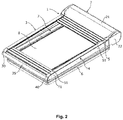
- the screening arrangement in the form of a roller shutter 1 has a top element 2 and two side rails 3 and 4 extending at right angles to the top element 2.
- a shutter body 5 includes a plurality of slats 51, of which some have been omitted for clarity reasons only.
- the roller shutter 1 can be mounted on a window, for instance a roof window adapted for installation in an inclined roof.
- the window comprises in a manner known per se a window frame 6 and a window sash 7 encasing a pane 8.
- the window sash 7 will most often be openable relative to the window frame 6, viz. hinge connected to the window frame 6, for instance by means of a set of pivot hinges positioned close to a central axis of the window to allow the window sash 7 to pivot relative to the window frame 6, or by a more traditional hinge positioned at the top of the window.
- the aperture to be screened is defined by the area limited by the top element 2, the side rails 3, 4, and the bottom of the window. This aperture thus corresponds in substance to the pane 8.
- the shutter body 5 is adapted to be moved from a non-screening position to a screening position.
- the shutter body 5 covers the pane 8 and other parts of the window to a larger or lesser degree.
- the shutter body 5 has been rolled out to cover the entire aperture and defines a general screening plane.
- the top element 2 is positioned at the top of the window and comprises in the embodiment shown a top cover 21 and two outer end covers, of which the right-hand end cover 22 is visible in Fig. 2 .
- the top cover 21 and outer end 20 covers 22 serve to hide and protect the inner parts of the roller shutter 1, such as for instance the drive mechanisms for the rolling up and unrolling of the shutter body 5.
- Terms such as “left-hand” and “right-hand” refer to the orientation shown in for instance Fig. 2 and are utilized for reasons of convenience only.
- the side rail 4 has a structure comprising parts that are movable relative to each other. In Fig. 2 , only an outer side rail part 41 is visible.
- the side rail 4 has a bottom cover 40 at the bottom of the window.
- the side rails 3, 4 are connected to each other at the bottom part of the roller shutter 1, namely by a cross bar 35 connected to the 30 bottom cover 40 of side rail 4 and its counterpart bottom cover 30 of side rail 3.
- the cross bar 35 may for instance be riveted to each bottom cover 30, 40.
- the cross bar 35 (not shown in the detailed figures) contributes to the strength and resistance as well. However, the cross bar 35 is not strictly necessary, as sufficient strength may be provided by the side rails 3,4 themselves.
- each slat 51 extends in a longitudinal direction between two end edges and has first and second side edges parallel to the longitudinal direction, i.e. in parallel with the top element 2.
- the shutter body 5 is adapted to be wound up in and rolled out from the top element 2 by means of a driving device (not shown) in a direction perpendicular to said longitudinal direction to a first screening position.
- FIG. 3a A cross section of an exemplary embodiment of the screening body of the present invention is shown in Fig. 3a .
- the screening body 5 has an acrylic fabric layer 301 having a top surface 302 and a bottom surface 303.
- Aluminium slats 305, 306 having an epoxy primer coating 307 on the surfaces facing the fabric are positioned adjacent the top and bottom surfaces 302, 303 of the fabric layer 301.
- Figure 3b shows the adhesive 304 on the top surface 302 and Figure 3c shows the adhesive 304 on both the top and bottom surfaces 302, 303.
- Acrylic fabric is well known to the skilled person.
- Acrylic fibers are synthetic fibers made from a polymer (polyacrylonitrile) with an average molecular weight of ⁇ 100,000, about 1900 monomer units.
- the polymer generally must contain at least 85% acrylonitrile monomer.
- Typical comonomers are vinyl acetate or methyl acrylate.
- Acryl fabrics are generally available for example from Dickson under the tradename sunacryl.
- the acrylic may be solution dyed and coated with an anti-smudge coating which results in very good weather resistance.
- any suitable fabric may be used in place of the acrylic fabric.
- a polyester fabric may be used in place of the acrylic in the embodiment described above.
- Fabrics usable according the invention are obtainable from JM textiles under the name RO Allegro transparent or from Hunter Douglas under the name Baseline Dust Blocks and Green Screen Balance.
- a polyamide such as Kevlar ® of DuPont may be used.
- the fabric layer may also be glass fiber or a glass fiber reinforced fabric.
- the fabric layer may be woven.
- the fabric layer comprises glass fiber it may be non-coated or coated.
- the coating may be selected from but not limited to PVC or PU.
- Coated glas fiber reinforced fabric layers suitable according to the invention are available from i.a. Copaco or Phifer.
- the fabric layer is preferably a square construction with the same mechanical performances in warp and weft directions.
- the warp and weft densities are in the range of 30 and 6 ends respectively per cm, preferably 16-8 ends per cm.
- the yarn used can have a linear mass density in the range of 76 - 540 dtex (i.e. mass in grams per 10,000 meters), preferable 167-420 dtex.
- Such preferred yarns provide a more uniform surface which contibutes to better fixation and an improved lightproof screen.
- the fabric surface is lean, meaning less hairy or complete free of loose single or bundles of loose filaments.
- the yarn in the fabric may be made of a staplefiber, preferably a combed version or multifilament or monofilament.
- the fabric weight is in the range of 80-300 g/m2, such as 100 to 200 g/m2.
- thermoplastic polyurethane is preferably aliphatic, such as Elastol-lan ® of BASF Polyurethanes GmbH.
- any suitable adhesive may be used including the thermoplastic copolyester hotmelt film of Gerlinger Industries.
- the coating may be selected from alkyd melamin, epoxy primer or high molecular PE primers, most preferred is epoxy primer. Coatings may also be selected from polyurethane and acrylic. Any other suitable coating known to the skilled person may be used. Epoxy primers are known to the skilled person, suitable epoxy primers according to the present invention include DPLF Epoxy Primer available from Deltron, or similar and usable primers are available from Beckers.
- aromatically based epoxy primers such as high molecular weight epoxy resins based on Bisphenol A, more specifically 2,2-bis(p-glycidyloxyphenyl) propane condensation product with 2,2-bis(p-hydroxyphenyl) propane and similar isomers and/or phenol, 4,4'-(1-methylethylidene)bis-, polymer with 2,2'-[(1-methylethylidene)bis(4,1- phenyleneoxymethylene)] bis(oxirane) illustrated below by formula (I)
- the metal slats are made from EN AW-5754, which is an aluminium alloy having an aluminium content of greater than 90 wt%. In particular, it has the following composition: aluminium: 94.2 to 97.4%, chromium: 0.3% max, copper: 0.1% max, iron: 0.4% max, magnesium: 2.6 to 3.6%, manganese: 0.5% max, silicon: 0.4% max, titanium: 0.15% max, zinc: 0.2% max and 0.15% max of residuals.
- Suitable alternatives include EN AW-5006 and EN AW-3005, although any suitable metal known to the skilled person may be used. Particularly preferred are EN AW-5754 or EN AW-3005 having a good stability towards corrosion.
- Metal strips usable according to the present invention may be obtained from Elval or Novelis.
- a fabric layer 401 and an adhesive layer 402 are simultaneously fed to a guide roll 403 to produce a combined fabric adhesive layer 404.
- the adhesive layer 402 has a removable liner 405 which prevents the adhesive becoming stuck to the guide roll 403. Once the fabric layer 401 and adhesive layer 402 have passed through the guide roll 403 the liner 405 can be removed.
- the combined fabric adhesive layer 404 can then be passed to a hot air oven 406.
- the adhesive softens and is thus primed for adhesion with further layers.
- the temperature to which the hot air oven should be heated will depend on the adhesive. Typically, a temperature in the range of around 120 ° to 180°C, preferably 130°C to 160°C, most preferred 145°C is appropriate.
- Rollers 407 can be used in the hot air oven 406. Alternatively and preferably, the heat is provided from the rollers 407 comprising a heating element.
- one or two preheated aluminium strips are brought into contact with the combined fabric adhesive layer. If one aluminium strip is used, it may be provided on the top or bottom surface of the combined fabric adhesive layer. If two aluminium strips are used, one will be provided on the top surface of the combined fabric adhesive layer and the other will be provided on the bottom surface said strips being provided to completely cover each other.
- aluminium strips are coated before the optional heating, preferably well before the manufacturing method to allow the coating to dry and cure.
- the combined fabric adhesive layer 404 and aluminium layers 408, 409 are then passed through further rollers 410 and into a further hot air oven 411 where the combination is heated. Again, a temperature of around 145°C is typically suitable.
- Non-stick rollers 412 in the hot air oven 411 encourage the layers to adhere to one another and allow the screening body 5 formed to move through the hot air oven 411.
- a cooling section 414 can then be used to allow the adhesive to set. If necessary, the screening body can then be cut to shape.
- a fabric layer 501, an adhesive layer 502 and aluminium layers 508, 509 are simultaneously fed to a guide roll 510.
- the aluminium layers 508, 509 are coated before being introduced, preferably well before the manufacturing method to allow the coating to dry and cure.
- the combination is then passed to a temperature controlled section 511 in which there is a heating section 520 and a cooling section 522. Whilst any suitable temperatures may be used, a temperature of around 120 ° to 180°C, preferably 130°C to 160°C, most preferred 145°C is typically appropriate for the heating section 520.
- Guide rolls 512 allow the screening body formed to move through the temperature controlled section 511. In addition to guide rolls 512, there may be further rollers in the heating section 520 and/or the cooling section 522. Belts 525 and 526 may be used in the heating section 520 and/or the cooling section 522 to apply a constant pressure to the screening body 5, the pressure applied is typically around 18 MPa.
- a fabric layer 601 and adhesive layer 602 are simultaneously fed to first rolling section 603a.
- the first rolling section 603a comprises a first guide roll 603b and a second guide roll 603c separated by a heating portion 603d.
- the fabric layer 601 and adhesive layer 602 pass through the first guide roll 603b and are heated to soften the adhesive in heating portion 603d.
- One or more belts 603e may be used in the heating portion 603d to maintain the desired pressure.
- the fabric and adhesive then pass through second guide roll 603c and removable liner 605 is removed from the adhesive.
- an intermediate heater 630 is used to keep the adhesive at a temperature at which it is sticky but not molten. It will be understood that the specific temperature required to achieve this will depend on factors such as the type of adhesive used, although typically a temperature of around 70°C to 90°C is appropriate.
- Aluminium layers 608 and 609 are fed with the fabric-adhesive combination to further rollers 610.
- Preheaters 632, 634 may be used to warm the aluminium sheets before they come into contact with the fabric.
- the combination is then passed to a temperature controlled section 611 in which there is a heating section 620 and a cooling section 622. Whilst any suitable temperatures may be used, a temperature of around 120 ° to 180°C, preferably 130°C to 160°C, most preferred 145°C is typically appropriate for the heating section 620.
- Guide rolls 612 allow the screening body formed to move through the temperature controlled section 611.
- Belts may be used in the heating section 620 and/or the cooling section 622 to apply a constant pressure and/or heat to the screening body 5.
- aluminium strips are coated before heating, preferably well before the manufacturing method to allow the coating to dry and cure.
- the pressure applied by guide rolls 603b, 603c, 610 and 612 and any corresponding belts can be tailored according to the requirements of the process.
- the pressure applied to the sample in the first rolling section 603a will be different from the pressure applied by the rollers 610 and/or the rollers 612.
- the heat applied in heating portion 603d may be different from the heat applied by heating section 620.
- the temperature in these sections may be independently adjustable.
- the peel test was carried out in accordance with the following industry standards: BS 5350-C12, ASTM D5170, ASTM F88 and ISO 11339.
- Embodiment 1 Embodiment 2
- Embodiment 3 Embodiment 4 Coating Epoxy Polyethylene Terephthalate Epoxy Polyethylene Tere phthalate Fabric Acrylic Acrylic Acrylic Acrylic Acrylic Adhesive Thermoplastic Polyurethane Thermoplastic Polyurethane Polyethylene Terephthalate Polyethylene Terephthalate Metal Aluminium Aluminium Aluminium Aluminium Aluminium Aluminium
- Tests indicated with "*" are future suitable tests to be performed
- the peel test was also conducted when no ageing process was applied to the samples.
- the samples in accordance with the present invention were able to withstand a greater load under at least some of the test conditions compared with the commercially available sample.
- Some of the samples, namely those of embodiments 1 and 3, were able to withstand a greater average load than the commercially available system in all of the tests.
- these samples have stronger adhesion characteristics and are more resistant to delamination. They would therefore exhibit a longer useable lifetime than the conventional system tested.
- Embodiment 1 represents a positive result
- 2 represents a need for further investigation
- 3 represents a result under average.
- the score was based on an overall evaluation of the sum of parameters and properties tested.
- Embodiment 1 Embodiment 3
- Embodiment 5 Embodiment 6
- UV Stability 1 2 2 2
- Black-out 1 1 1 1 1
- Resist humidity 1 3
- Embodiment 1 has the structure shown in Fig. 3 with aluminium metal layers, an epoxy coating on the aluminium, acrylic fabric and an aliphatic thermoplastic polyurethane adhesive.
- Embodiment 5 in which the structure is identical to embodiment 3 except that the fabric is polyester rather than acrylic, also showed surprisingly positive results.
Landscapes
- Engineering & Computer Science (AREA)
- Structural Engineering (AREA)
- Architecture (AREA)
- Civil Engineering (AREA)
- Laminated Bodies (AREA)
Applications Claiming Priority (1)
| Application Number | Priority Date | Filing Date | Title |
|---|---|---|---|
| DKPA201770241 | 2017-04-03 |
Publications (2)
| Publication Number | Publication Date |
|---|---|
| EP3385490A1 true EP3385490A1 (de) | 2018-10-10 |
| EP3385490B1 EP3385490B1 (de) | 2024-01-17 |
Family
ID=61750024
Family Applications (1)
| Application Number | Title | Priority Date | Filing Date |
|---|---|---|---|
| EP18163303.3A Active EP3385490B1 (de) | 2017-04-03 | 2018-03-22 | Abschirmkörper mit verbesserter witterungsbeständigkeit, verbessertem uv-widerstand sowie verbesserten laminierungseigenschaften |
Country Status (2)
| Country | Link |
|---|---|
| EP (1) | EP3385490B1 (de) |
| PL (1) | PL3385490T3 (de) |
Cited By (1)
| Publication number | Priority date | Publication date | Assignee | Title |
|---|---|---|---|---|
| WO2021104592A1 (en) * | 2019-11-25 | 2021-06-03 | Vkr Holding A/S | External screening arrangement with a set of lamellas |
Citations (3)
| Publication number | Priority date | Publication date | Assignee | Title |
|---|---|---|---|---|
| EP0806541A2 (de) * | 1996-05-08 | 1997-11-12 | Paul Baier | Rolladenlamelle, Verfahren zur Herstellung einer Rolladenlamelle und Rolladenbeschichtungsanlage |
| WO1998020225A1 (en) * | 1996-11-01 | 1998-05-14 | Velux Industri A/S | A roller shutter for windows, doors and the like and a method of manufacturing |
| EP1048817A1 (de) * | 1999-04-26 | 2000-11-02 | Johann Henkenjohann | Verfahren zur Herstellung eines Metallfolien-/Gewebebundes insbesondere für Rolladenpanzer |
-
2018
- 2018-03-22 PL PL18163303.3T patent/PL3385490T3/pl unknown
- 2018-03-22 EP EP18163303.3A patent/EP3385490B1/de active Active
Patent Citations (3)
| Publication number | Priority date | Publication date | Assignee | Title |
|---|---|---|---|---|
| EP0806541A2 (de) * | 1996-05-08 | 1997-11-12 | Paul Baier | Rolladenlamelle, Verfahren zur Herstellung einer Rolladenlamelle und Rolladenbeschichtungsanlage |
| WO1998020225A1 (en) * | 1996-11-01 | 1998-05-14 | Velux Industri A/S | A roller shutter for windows, doors and the like and a method of manufacturing |
| EP1048817A1 (de) * | 1999-04-26 | 2000-11-02 | Johann Henkenjohann | Verfahren zur Herstellung eines Metallfolien-/Gewebebundes insbesondere für Rolladenpanzer |
Cited By (1)
| Publication number | Priority date | Publication date | Assignee | Title |
|---|---|---|---|---|
| WO2021104592A1 (en) * | 2019-11-25 | 2021-06-03 | Vkr Holding A/S | External screening arrangement with a set of lamellas |
Also Published As
| Publication number | Publication date |
|---|---|
| EP3385490B1 (de) | 2024-01-17 |
| PL3385490T3 (pl) | 2024-09-02 |
Similar Documents
| Publication | Publication Date | Title |
|---|---|---|
| US12191797B2 (en) | Photovoltaic module for a roof with continuous fiber tape | |
| EP3357683B1 (de) | Raumverdunklungsmaterial und architektonische abdeckung daraus | |
| EP3421709A1 (de) | Abstandshalter für isolierverglasungen | |
| WO2013104507A1 (de) | Abstandshalter für isolierverglasungen | |
| KR20100112181A (ko) | 탄도 투명체, 차량 및 탄도 투명체 조립체 | |
| CA2339332A1 (en) | Hinged thermoplastic-fabric reinforced structural member, profile and methods therefore | |
| KR102493501B1 (ko) | 내화성능과 내오염성, 내구성, 내후성이 향상된 준불연 건축용 막구조물 | |
| US9140062B2 (en) | Easy roll stiff screen | |
| CA3105832A1 (en) | Multilayer composite material having light-transmission and tensile properties | |
| EP3385490B1 (de) | Abschirmkörper mit verbesserter witterungsbeständigkeit, verbessertem uv-widerstand sowie verbesserten laminierungseigenschaften | |
| US20160097155A1 (en) | Strength retention fabric | |
| US20250346021A1 (en) | Laminated glass retention system | |
| DE112016001081T5 (de) | Tür für Kühlbehältermöbel | |
| EP3433100B1 (de) | Architektonische membran | |
| DE202020106850U1 (de) | Asymmetrisches Hybrid-Automobillaminat | |
| WO2007137743A2 (de) | Träger-montagegruppe für eine solarzelleneinheit | |
| DE19803584C2 (de) | Licht-transmittierendes Hochbauelement | |
| DE102010018632A1 (de) | Solarbetriebener Luftkollektor | |
| EP3309501A1 (de) | Gerahmte, transparente, beschusshemmende verglasung mit verstärktem randbereich | |
| US20260110179A1 (en) | Weather Resistant Air Barriers | |
| US20230166489A1 (en) | Transparent fire-retardant composite material | |
| US20240416633A1 (en) | Composite film for the construction sector | |
| KR20260034141A (ko) | 난연성이 우수한 텐트 원단 | |
| WO2023198709A1 (de) | Abstandshalter mit verbesserter mechanischer steifigkeit | |
| DE202024107270U1 (de) | Verschlussanordnung |
Legal Events
| Date | Code | Title | Description |
|---|---|---|---|
| PUAI | Public reference made under article 153(3) epc to a published international application that has entered the european phase |
Free format text: ORIGINAL CODE: 0009012 |
|
| STAA | Information on the status of an ep patent application or granted ep patent |
Free format text: STATUS: THE APPLICATION HAS BEEN PUBLISHED |
|
| AK | Designated contracting states |
Kind code of ref document: A1 Designated state(s): AL AT BE BG CH CY CZ DE DK EE ES FI FR GB GR HR HU IE IS IT LI LT LU LV MC MK MT NL NO PL PT RO RS SE SI SK SM TR |
|
| AX | Request for extension of the european patent |
Extension state: BA ME |
|
| STAA | Information on the status of an ep patent application or granted ep patent |
Free format text: STATUS: REQUEST FOR EXAMINATION WAS MADE |
|
| 17P | Request for examination filed |
Effective date: 20190402 |
|
| RBV | Designated contracting states (corrected) |
Designated state(s): AL AT BE BG CH CY CZ DE DK EE ES FI FR GB GR HR HU IE IS IT LI LT LU LV MC MK MT NL NO PL PT RO RS SE SI SK SM TR |
|
| STAA | Information on the status of an ep patent application or granted ep patent |
Free format text: STATUS: EXAMINATION IS IN PROGRESS |
|
| 17Q | First examination report despatched |
Effective date: 20191122 |
|
| GRAP | Despatch of communication of intention to grant a patent |
Free format text: ORIGINAL CODE: EPIDOSNIGR1 |
|
| STAA | Information on the status of an ep patent application or granted ep patent |
Free format text: STATUS: GRANT OF PATENT IS INTENDED |
|
| INTG | Intention to grant announced |
Effective date: 20230929 |
|
| GRAS | Grant fee paid |
Free format text: ORIGINAL CODE: EPIDOSNIGR3 |
|
| GRAA | (expected) grant |
Free format text: ORIGINAL CODE: 0009210 |
|
| STAA | Information on the status of an ep patent application or granted ep patent |
Free format text: STATUS: THE PATENT HAS BEEN GRANTED |
|
| AK | Designated contracting states |
Kind code of ref document: B1 Designated state(s): AL AT BE BG CH CY CZ DE DK EE ES FI FR GB GR HR HU IE IS IT LI LT LU LV MC MK MT NL NO PL PT RO RS SE SI SK SM TR |
|
| REG | Reference to a national code |
Ref country code: GB Ref legal event code: FG4D |
|
| REG | Reference to a national code |
Ref country code: CH Ref legal event code: EP |
|
| REG | Reference to a national code |
Ref country code: DE Ref legal event code: R096 Ref document number: 602018064174 Country of ref document: DE |
|
| REG | Reference to a national code |
Ref country code: IE Ref legal event code: FG4D |
|
| REG | Reference to a national code |
Ref country code: NL Ref legal event code: FP |
|
| REG | Reference to a national code |
Ref country code: LT Ref legal event code: MG9D |
|
| REG | Reference to a national code |
Ref country code: AT Ref legal event code: MK05 Ref document number: 1650646 Country of ref document: AT Kind code of ref document: T Effective date: 20240117 |
|
| PG25 | Lapsed in a contracting state [announced via postgrant information from national office to epo] |
Ref country code: IS Free format text: LAPSE BECAUSE OF FAILURE TO SUBMIT A TRANSLATION OF THE DESCRIPTION OR TO PAY THE FEE WITHIN THE PRESCRIBED TIME-LIMIT Effective date: 20240517 |
|
| PG25 | Lapsed in a contracting state [announced via postgrant information from national office to epo] |
Ref country code: LT Free format text: LAPSE BECAUSE OF FAILURE TO SUBMIT A TRANSLATION OF THE DESCRIPTION OR TO PAY THE FEE WITHIN THE PRESCRIBED TIME-LIMIT Effective date: 20240117 |
|
| PG25 | Lapsed in a contracting state [announced via postgrant information from national office to epo] |
Ref country code: GR Free format text: LAPSE BECAUSE OF FAILURE TO SUBMIT A TRANSLATION OF THE DESCRIPTION OR TO PAY THE FEE WITHIN THE PRESCRIBED TIME-LIMIT Effective date: 20240418 |
|
| PG25 | Lapsed in a contracting state [announced via postgrant information from national office to epo] |
Ref country code: HR Free format text: LAPSE BECAUSE OF FAILURE TO SUBMIT A TRANSLATION OF THE DESCRIPTION OR TO PAY THE FEE WITHIN THE PRESCRIBED TIME-LIMIT Effective date: 20240117 Ref country code: RS Free format text: LAPSE BECAUSE OF FAILURE TO SUBMIT A TRANSLATION OF THE DESCRIPTION OR TO PAY THE FEE WITHIN THE PRESCRIBED TIME-LIMIT Effective date: 20240417 |
|
| PG25 | Lapsed in a contracting state [announced via postgrant information from national office to epo] |
Ref country code: ES Free format text: LAPSE BECAUSE OF FAILURE TO SUBMIT A TRANSLATION OF THE DESCRIPTION OR TO PAY THE FEE WITHIN THE PRESCRIBED TIME-LIMIT Effective date: 20240117 |
|
| PG25 | Lapsed in a contracting state [announced via postgrant information from national office to epo] |
Ref country code: AT Free format text: LAPSE BECAUSE OF FAILURE TO SUBMIT A TRANSLATION OF THE DESCRIPTION OR TO PAY THE FEE WITHIN THE PRESCRIBED TIME-LIMIT Effective date: 20240117 |
|
| PG25 | Lapsed in a contracting state [announced via postgrant information from national office to epo] |
Ref country code: RS Free format text: LAPSE BECAUSE OF FAILURE TO SUBMIT A TRANSLATION OF THE DESCRIPTION OR TO PAY THE FEE WITHIN THE PRESCRIBED TIME-LIMIT Effective date: 20240417 Ref country code: NO Free format text: LAPSE BECAUSE OF FAILURE TO SUBMIT A TRANSLATION OF THE DESCRIPTION OR TO PAY THE FEE WITHIN THE PRESCRIBED TIME-LIMIT Effective date: 20240417 Ref country code: LT Free format text: LAPSE BECAUSE OF FAILURE TO SUBMIT A TRANSLATION OF THE DESCRIPTION OR TO PAY THE FEE WITHIN THE PRESCRIBED TIME-LIMIT Effective date: 20240117 Ref country code: IS Free format text: LAPSE BECAUSE OF FAILURE TO SUBMIT A TRANSLATION OF THE DESCRIPTION OR TO PAY THE FEE WITHIN THE PRESCRIBED TIME-LIMIT Effective date: 20240517 Ref country code: HR Free format text: LAPSE BECAUSE OF FAILURE TO SUBMIT A TRANSLATION OF THE DESCRIPTION OR TO PAY THE FEE WITHIN THE PRESCRIBED TIME-LIMIT Effective date: 20240117 Ref country code: GR Free format text: LAPSE BECAUSE OF FAILURE TO SUBMIT A TRANSLATION OF THE DESCRIPTION OR TO PAY THE FEE WITHIN THE PRESCRIBED TIME-LIMIT Effective date: 20240418 Ref country code: FI Free format text: LAPSE BECAUSE OF FAILURE TO SUBMIT A TRANSLATION OF THE DESCRIPTION OR TO PAY THE FEE WITHIN THE PRESCRIBED TIME-LIMIT Effective date: 20240117 Ref country code: ES Free format text: LAPSE BECAUSE OF FAILURE TO SUBMIT A TRANSLATION OF THE DESCRIPTION OR TO PAY THE FEE WITHIN THE PRESCRIBED TIME-LIMIT Effective date: 20240117 Ref country code: BG Free format text: LAPSE BECAUSE OF FAILURE TO SUBMIT A TRANSLATION OF THE DESCRIPTION OR TO PAY THE FEE WITHIN THE PRESCRIBED TIME-LIMIT Effective date: 20240117 Ref country code: AT Free format text: LAPSE BECAUSE OF FAILURE TO SUBMIT A TRANSLATION OF THE DESCRIPTION OR TO PAY THE FEE WITHIN THE PRESCRIBED TIME-LIMIT Effective date: 20240117 |
|
| PG25 | Lapsed in a contracting state [announced via postgrant information from national office to epo] |
Ref country code: PT Free format text: LAPSE BECAUSE OF FAILURE TO SUBMIT A TRANSLATION OF THE DESCRIPTION OR TO PAY THE FEE WITHIN THE PRESCRIBED TIME-LIMIT Effective date: 20240517 |
|
| PG25 | Lapsed in a contracting state [announced via postgrant information from national office to epo] |
Ref country code: SE Free format text: LAPSE BECAUSE OF FAILURE TO SUBMIT A TRANSLATION OF THE DESCRIPTION OR TO PAY THE FEE WITHIN THE PRESCRIBED TIME-LIMIT Effective date: 20240117 Ref country code: PT Free format text: LAPSE BECAUSE OF FAILURE TO SUBMIT A TRANSLATION OF THE DESCRIPTION OR TO PAY THE FEE WITHIN THE PRESCRIBED TIME-LIMIT Effective date: 20240517 Ref country code: LV Free format text: LAPSE BECAUSE OF FAILURE TO SUBMIT A TRANSLATION OF THE DESCRIPTION OR TO PAY THE FEE WITHIN THE PRESCRIBED TIME-LIMIT Effective date: 20240117 |
|
| PG25 | Lapsed in a contracting state [announced via postgrant information from national office to epo] |
Ref country code: DK Free format text: LAPSE BECAUSE OF FAILURE TO SUBMIT A TRANSLATION OF THE DESCRIPTION OR TO PAY THE FEE WITHIN THE PRESCRIBED TIME-LIMIT Effective date: 20240117 |
|
| PG25 | Lapsed in a contracting state [announced via postgrant information from national office to epo] |
Ref country code: SM Free format text: LAPSE BECAUSE OF FAILURE TO SUBMIT A TRANSLATION OF THE DESCRIPTION OR TO PAY THE FEE WITHIN THE PRESCRIBED TIME-LIMIT Effective date: 20240117 |
|
| REG | Reference to a national code |
Ref country code: DE Ref legal event code: R097 Ref document number: 602018064174 Country of ref document: DE |
|
| PG25 | Lapsed in a contracting state [announced via postgrant information from national office to epo] |
Ref country code: EE Free format text: LAPSE BECAUSE OF FAILURE TO SUBMIT A TRANSLATION OF THE DESCRIPTION OR TO PAY THE FEE WITHIN THE PRESCRIBED TIME-LIMIT Effective date: 20240117 Ref country code: CZ Free format text: LAPSE BECAUSE OF FAILURE TO SUBMIT A TRANSLATION OF THE DESCRIPTION OR TO PAY THE FEE WITHIN THE PRESCRIBED TIME-LIMIT Effective date: 20240117 |
|
| PG25 | Lapsed in a contracting state [announced via postgrant information from national office to epo] |
Ref country code: SK Free format text: LAPSE BECAUSE OF FAILURE TO SUBMIT A TRANSLATION OF THE DESCRIPTION OR TO PAY THE FEE WITHIN THE PRESCRIBED TIME-LIMIT Effective date: 20240117 |
|
| PG25 | Lapsed in a contracting state [announced via postgrant information from national office to epo] |
Ref country code: SM Free format text: LAPSE BECAUSE OF FAILURE TO SUBMIT A TRANSLATION OF THE DESCRIPTION OR TO PAY THE FEE WITHIN THE PRESCRIBED TIME-LIMIT Effective date: 20240117 Ref country code: SK Free format text: LAPSE BECAUSE OF FAILURE TO SUBMIT A TRANSLATION OF THE DESCRIPTION OR TO PAY THE FEE WITHIN THE PRESCRIBED TIME-LIMIT Effective date: 20240117 Ref country code: RO Free format text: LAPSE BECAUSE OF FAILURE TO SUBMIT A TRANSLATION OF THE DESCRIPTION OR TO PAY THE FEE WITHIN THE PRESCRIBED TIME-LIMIT Effective date: 20240117 Ref country code: EE Free format text: LAPSE BECAUSE OF FAILURE TO SUBMIT A TRANSLATION OF THE DESCRIPTION OR TO PAY THE FEE WITHIN THE PRESCRIBED TIME-LIMIT Effective date: 20240117 Ref country code: DK Free format text: LAPSE BECAUSE OF FAILURE TO SUBMIT A TRANSLATION OF THE DESCRIPTION OR TO PAY THE FEE WITHIN THE PRESCRIBED TIME-LIMIT Effective date: 20240117 Ref country code: CZ Free format text: LAPSE BECAUSE OF FAILURE TO SUBMIT A TRANSLATION OF THE DESCRIPTION OR TO PAY THE FEE WITHIN THE PRESCRIBED TIME-LIMIT Effective date: 20240117 |
|
| REG | Reference to a national code |
Ref country code: CH Ref legal event code: PL |
|
| PG25 | Lapsed in a contracting state [announced via postgrant information from national office to epo] |
Ref country code: LU Free format text: LAPSE BECAUSE OF NON-PAYMENT OF DUE FEES Effective date: 20240322 |
|
| PG25 | Lapsed in a contracting state [announced via postgrant information from national office to epo] |
Ref country code: MC Free format text: LAPSE BECAUSE OF FAILURE TO SUBMIT A TRANSLATION OF THE DESCRIPTION OR TO PAY THE FEE WITHIN THE PRESCRIBED TIME-LIMIT Effective date: 20240117 |
|
| PLBE | No opposition filed within time limit |
Free format text: ORIGINAL CODE: 0009261 |
|
| STAA | Information on the status of an ep patent application or granted ep patent |
Free format text: STATUS: NO OPPOSITION FILED WITHIN TIME LIMIT |
|
| PG25 | Lapsed in a contracting state [announced via postgrant information from national office to epo] |
Ref country code: MC Free format text: LAPSE BECAUSE OF FAILURE TO SUBMIT A TRANSLATION OF THE DESCRIPTION OR TO PAY THE FEE WITHIN THE PRESCRIBED TIME-LIMIT Effective date: 20240117 Ref country code: LU Free format text: LAPSE BECAUSE OF NON-PAYMENT OF DUE FEES Effective date: 20240322 |
|
| REG | Reference to a national code |
Ref country code: BE Ref legal event code: MM Effective date: 20240331 |
|
| 26N | No opposition filed |
Effective date: 20241018 |
|
| GBPC | Gb: european patent ceased through non-payment of renewal fee |
Effective date: 20240417 |
|
| PG25 | Lapsed in a contracting state [announced via postgrant information from national office to epo] |
Ref country code: BE Free format text: LAPSE BECAUSE OF NON-PAYMENT OF DUE FEES Effective date: 20240331 |
|
| PG25 | Lapsed in a contracting state [announced via postgrant information from national office to epo] |
Ref country code: GB Free format text: LAPSE BECAUSE OF NON-PAYMENT OF DUE FEES Effective date: 20240417 |
|
| PG25 | Lapsed in a contracting state [announced via postgrant information from national office to epo] |
Ref country code: IE Free format text: LAPSE BECAUSE OF NON-PAYMENT OF DUE FEES Effective date: 20240322 |
|
| PG25 | Lapsed in a contracting state [announced via postgrant information from national office to epo] |
Ref country code: IE Free format text: LAPSE BECAUSE OF NON-PAYMENT OF DUE FEES Effective date: 20240322 Ref country code: GB Free format text: LAPSE BECAUSE OF NON-PAYMENT OF DUE FEES Effective date: 20240417 Ref country code: BE Free format text: LAPSE BECAUSE OF NON-PAYMENT OF DUE FEES Effective date: 20240331 Ref country code: CH Free format text: LAPSE BECAUSE OF NON-PAYMENT OF DUE FEES Effective date: 20240331 |
|
| PG25 | Lapsed in a contracting state [announced via postgrant information from national office to epo] |
Ref country code: SI Free format text: LAPSE BECAUSE OF FAILURE TO SUBMIT A TRANSLATION OF THE DESCRIPTION OR TO PAY THE FEE WITHIN THE PRESCRIBED TIME-LIMIT Effective date: 20240117 |
|
| PGFP | Annual fee paid to national office [announced via postgrant information from national office to epo] |
Ref country code: PL Payment date: 20250213 Year of fee payment: 8 |
|
| PG25 | Lapsed in a contracting state [announced via postgrant information from national office to epo] |
Ref country code: CY Free format text: LAPSE BECAUSE OF FAILURE TO SUBMIT A TRANSLATION OF THE DESCRIPTION OR TO PAY THE FEE WITHIN THE PRESCRIBED TIME-LIMIT; INVALID AB INITIO Effective date: 20180322 |
|
| PG25 | Lapsed in a contracting state [announced via postgrant information from national office to epo] |
Ref country code: HU Free format text: LAPSE BECAUSE OF FAILURE TO SUBMIT A TRANSLATION OF THE DESCRIPTION OR TO PAY THE FEE WITHIN THE PRESCRIBED TIME-LIMIT; INVALID AB INITIO Effective date: 20180322 |
|
| PG25 | Lapsed in a contracting state [announced via postgrant information from national office to epo] |
Ref country code: TR Free format text: LAPSE BECAUSE OF FAILURE TO SUBMIT A TRANSLATION OF THE DESCRIPTION OR TO PAY THE FEE WITHIN THE PRESCRIBED TIME-LIMIT Effective date: 20240117 |
|
| PGFP | Annual fee paid to national office [announced via postgrant information from national office to epo] |
Ref country code: NL Payment date: 20260213 Year of fee payment: 9 |
|
| PGFP | Annual fee paid to national office [announced via postgrant information from national office to epo] |
Ref country code: DE Payment date: 20260204 Year of fee payment: 9 |
|
| PGFP | Annual fee paid to national office [announced via postgrant information from national office to epo] |
Ref country code: IT Payment date: 20260220 Year of fee payment: 9 |
|
| PGFP | Annual fee paid to national office [announced via postgrant information from national office to epo] |
Ref country code: FR Payment date: 20260209 Year of fee payment: 9 |