EP3385751B1 - Système lidar et procédé - Google Patents
Système lidar et procédé Download PDFInfo
- Publication number
- EP3385751B1 EP3385751B1 EP18165673.7A EP18165673A EP3385751B1 EP 3385751 B1 EP3385751 B1 EP 3385751B1 EP 18165673 A EP18165673 A EP 18165673A EP 3385751 B1 EP3385751 B1 EP 3385751B1
- Authority
- EP
- European Patent Office
- Prior art keywords
- light
- lidar system
- lens array
- collimated
- lidar
- Prior art date
- Legal status (The legal status is an assumption and is not a legal conclusion. Google has not performed a legal analysis and makes no representation as to the accuracy of the status listed.)
- Active
Links
Images


Classifications
-
- G—PHYSICS
- G01—MEASURING; TESTING
- G01S—RADIO DIRECTION-FINDING; RADIO NAVIGATION; DETERMINING DISTANCE OR VELOCITY BY USE OF RADIO WAVES; LOCATING OR PRESENCE-DETECTING BY USE OF THE REFLECTION OR RERADIATION OF RADIO WAVES; ANALOGOUS ARRANGEMENTS USING OTHER WAVES
- G01S17/00—Systems using the reflection or reradiation of electromagnetic waves other than radio waves, e.g. lidar systems
- G01S17/02—Systems using the reflection of electromagnetic waves other than radio waves
- G01S17/06—Systems determining position data of a target
- G01S17/08—Systems determining position data of a target for measuring distance only
-
- G—PHYSICS
- G01—MEASURING; TESTING
- G01S—RADIO DIRECTION-FINDING; RADIO NAVIGATION; DETERMINING DISTANCE OR VELOCITY BY USE OF RADIO WAVES; LOCATING OR PRESENCE-DETECTING BY USE OF THE REFLECTION OR RERADIATION OF RADIO WAVES; ANALOGOUS ARRANGEMENTS USING OTHER WAVES
- G01S17/00—Systems using the reflection or reradiation of electromagnetic waves other than radio waves, e.g. lidar systems
- G01S17/02—Systems using the reflection of electromagnetic waves other than radio waves
- G01S17/06—Systems determining position data of a target
- G01S17/08—Systems determining position data of a target for measuring distance only
- G01S17/10—Systems determining position data of a target for measuring distance only using transmission of interrupted, pulse-modulated waves
-
- G—PHYSICS
- G01—MEASURING; TESTING
- G01S—RADIO DIRECTION-FINDING; RADIO NAVIGATION; DETERMINING DISTANCE OR VELOCITY BY USE OF RADIO WAVES; LOCATING OR PRESENCE-DETECTING BY USE OF THE REFLECTION OR RERADIATION OF RADIO WAVES; ANALOGOUS ARRANGEMENTS USING OTHER WAVES
- G01S17/00—Systems using the reflection or reradiation of electromagnetic waves other than radio waves, e.g. lidar systems
- G01S17/02—Systems using the reflection of electromagnetic waves other than radio waves
- G01S17/06—Systems determining position data of a target
- G01S17/42—Simultaneous measurement of distance and other co-ordinates
-
- G—PHYSICS
- G01—MEASURING; TESTING
- G01S—RADIO DIRECTION-FINDING; RADIO NAVIGATION; DETERMINING DISTANCE OR VELOCITY BY USE OF RADIO WAVES; LOCATING OR PRESENCE-DETECTING BY USE OF THE REFLECTION OR RERADIATION OF RADIO WAVES; ANALOGOUS ARRANGEMENTS USING OTHER WAVES
- G01S17/00—Systems using the reflection or reradiation of electromagnetic waves other than radio waves, e.g. lidar systems
- G01S17/88—Lidar systems specially adapted for specific applications
- G01S17/89—Lidar systems specially adapted for specific applications for mapping or imaging
-
- G—PHYSICS
- G01—MEASURING; TESTING
- G01S—RADIO DIRECTION-FINDING; RADIO NAVIGATION; DETERMINING DISTANCE OR VELOCITY BY USE OF RADIO WAVES; LOCATING OR PRESENCE-DETECTING BY USE OF THE REFLECTION OR RERADIATION OF RADIO WAVES; ANALOGOUS ARRANGEMENTS USING OTHER WAVES
- G01S17/00—Systems using the reflection or reradiation of electromagnetic waves other than radio waves, e.g. lidar systems
- G01S17/88—Lidar systems specially adapted for specific applications
- G01S17/93—Lidar systems specially adapted for specific applications for anti-collision purposes
- G01S17/931—Lidar systems specially adapted for specific applications for anti-collision purposes of land vehicles
-
- G—PHYSICS
- G01—MEASURING; TESTING
- G01S—RADIO DIRECTION-FINDING; RADIO NAVIGATION; DETERMINING DISTANCE OR VELOCITY BY USE OF RADIO WAVES; LOCATING OR PRESENCE-DETECTING BY USE OF THE REFLECTION OR RERADIATION OF RADIO WAVES; ANALOGOUS ARRANGEMENTS USING OTHER WAVES
- G01S7/00—Details of systems according to groups G01S13/00, G01S15/00, G01S17/00
- G01S7/48—Details of systems according to groups G01S13/00, G01S15/00, G01S17/00 of systems according to group G01S17/00
- G01S7/481—Constructional features, e.g. arrangements of optical elements
- G01S7/4811—Constructional features, e.g. arrangements of optical elements common to transmitter and receiver
- G01S7/4812—Constructional features, e.g. arrangements of optical elements common to transmitter and receiver transmitted and received beams following a coaxial path
-
- G—PHYSICS
- G01—MEASURING; TESTING
- G01S—RADIO DIRECTION-FINDING; RADIO NAVIGATION; DETERMINING DISTANCE OR VELOCITY BY USE OF RADIO WAVES; LOCATING OR PRESENCE-DETECTING BY USE OF THE REFLECTION OR RERADIATION OF RADIO WAVES; ANALOGOUS ARRANGEMENTS USING OTHER WAVES
- G01S7/00—Details of systems according to groups G01S13/00, G01S15/00, G01S17/00
- G01S7/48—Details of systems according to groups G01S13/00, G01S15/00, G01S17/00 of systems according to group G01S17/00
- G01S7/481—Constructional features, e.g. arrangements of optical elements
- G01S7/4814—Constructional features, e.g. arrangements of optical elements of transmitters alone
-
- G—PHYSICS
- G01—MEASURING; TESTING
- G01S—RADIO DIRECTION-FINDING; RADIO NAVIGATION; DETERMINING DISTANCE OR VELOCITY BY USE OF RADIO WAVES; LOCATING OR PRESENCE-DETECTING BY USE OF THE REFLECTION OR RERADIATION OF RADIO WAVES; ANALOGOUS ARRANGEMENTS USING OTHER WAVES
- G01S7/00—Details of systems according to groups G01S13/00, G01S15/00, G01S17/00
- G01S7/48—Details of systems according to groups G01S13/00, G01S15/00, G01S17/00 of systems according to group G01S17/00
- G01S7/481—Constructional features, e.g. arrangements of optical elements
- G01S7/4814—Constructional features, e.g. arrangements of optical elements of transmitters alone
- G01S7/4815—Constructional features, e.g. arrangements of optical elements of transmitters alone using multiple transmitters
-
- G—PHYSICS
- G01—MEASURING; TESTING
- G01S—RADIO DIRECTION-FINDING; RADIO NAVIGATION; DETERMINING DISTANCE OR VELOCITY BY USE OF RADIO WAVES; LOCATING OR PRESENCE-DETECTING BY USE OF THE REFLECTION OR RERADIATION OF RADIO WAVES; ANALOGOUS ARRANGEMENTS USING OTHER WAVES
- G01S7/00—Details of systems according to groups G01S13/00, G01S15/00, G01S17/00
- G01S7/48—Details of systems according to groups G01S13/00, G01S15/00, G01S17/00 of systems according to group G01S17/00
- G01S7/481—Constructional features, e.g. arrangements of optical elements
- G01S7/4816—Constructional features, e.g. arrangements of optical elements of receivers alone
-
- G—PHYSICS
- G01—MEASURING; TESTING
- G01S—RADIO DIRECTION-FINDING; RADIO NAVIGATION; DETERMINING DISTANCE OR VELOCITY BY USE OF RADIO WAVES; LOCATING OR PRESENCE-DETECTING BY USE OF THE REFLECTION OR RERADIATION OF RADIO WAVES; ANALOGOUS ARRANGEMENTS USING OTHER WAVES
- G01S7/00—Details of systems according to groups G01S13/00, G01S15/00, G01S17/00
- G01S7/48—Details of systems according to groups G01S13/00, G01S15/00, G01S17/00 of systems according to group G01S17/00
- G01S7/481—Constructional features, e.g. arrangements of optical elements
- G01S7/4817—Constructional features, e.g. arrangements of optical elements relating to scanning
-
- G—PHYSICS
- G02—OPTICS
- G02B—OPTICAL ELEMENTS, SYSTEMS OR APPARATUS
- G02B19/00—Condensers, e.g. light collectors or similar non-imaging optics
- G02B19/0033—Condensers, e.g. light collectors or similar non-imaging optics characterised by the use
- G02B19/0047—Condensers, e.g. light collectors or similar non-imaging optics characterised by the use for use with a light source
- G02B19/0052—Condensers, e.g. light collectors or similar non-imaging optics characterised by the use for use with a light source the light source comprising a laser diode
-
- G—PHYSICS
- G02—OPTICS
- G02B—OPTICAL ELEMENTS, SYSTEMS OR APPARATUS
- G02B27/00—Optical systems or apparatus not provided for by any of the groups G02B1/00 - G02B26/00, G02B30/00
- G02B27/30—Collimators
-
- H—ELECTRICITY
- H01—ELECTRIC ELEMENTS
- H01S—DEVICES USING THE PROCESS OF LIGHT AMPLIFICATION BY STIMULATED EMISSION OF RADIATION [LASER] TO AMPLIFY OR GENERATE LIGHT; DEVICES USING STIMULATED EMISSION OF ELECTROMAGNETIC RADIATION IN WAVE RANGES OTHER THAN OPTICAL
- H01S3/00—Lasers, i.e. devices using stimulated emission of electromagnetic radiation in the infrared, visible or ultraviolet wave range
- H01S3/02—Constructional details
- H01S3/04—Arrangements for thermal management
Definitions
- the subject matter described herein relates to distance measuring systems, such as LIDAR systems.
- Some known LiDAR systems use one or more points of light or light beams to determine distances to objects or the presence of an object.
- the point or points of light are moved, such as by moving the sources of the light, relative to the area being examined or monitored by the LiDAR system.
- This movement can involve rastering the point or points of light back-and-forth along opposite directions and gradually moving the back-and-forth rastering of the light in another direction, such as a downward direction. While this approach can allow the LiDAR system to cover a larger area, the rastering of the light adds additional mechanical complexity to the LiDAR system and additional cost to the LiDAR system.
- the signal-to-noise ratio (SNR) of the detection of the reflected light may suffer due to individual points of light covering much larger areas during the rastering movement of the light.
- the SNR may be increased by adding a significant number of light sources, but this also adds cost and complexity to the LiDAR system.
- US2007/181810 A1 discloses a vehicle LiDAR system.
- US2015/377696 A1 discloses a beam generating device.
- the inventive subject matter described herein provides LiDAR systems and methods that use elongated shapes of light (e.g., lines of light) to determine distances to objects and/or detect the presence of objects in an area being monitored by the systems and methods (e.g., fields of view of the LiDAR systems).
- the resultant measurements can then be used by the LiDAR system or another system to determine the size, shape, position, orientation, velocity, and the like, of objects that fall within the field of regard of the LiDAR system.
- the light formed by the lens array can be swept (e.g., moved) in one or more directions.
- the LiDAR system can move a scanning mirror actuated by a galvanometer, MEMS actuator, or the like, to move the light along horizontal directions. This can allow for the LiDAR system to cover a range of angles that constitutes the field of regard of the LiDAR system.
- a second scanning mirror can be used to sweep the beams of light over a fraction of the orthogonal field of regard to fill in the areas between the light arrays.
- the LiDAR can send a timed pulse from each of the light sources and monitor reflected light from objects in the field of regard using an array of photodetectors.
- the photodetectors are configured to receive light from different sections of the field of regard, and generate signals that are used by a controller of the LiDAR system to determine the time of flight of any light pulses reflected from objects within the field of regard.
- the pulses emitted from the light sources are synchronized with the corresponding element in the detector array via pulse encoding and the optical layout of the LiDAR system.
- the distance to the object can be determined by multiplying the time of flight (the amount of time between when the pulse was transmitted and when the reflection of the pulse of light was received) by the speed of light.
- the LiDAR system can integrate the reflected light from an object over a longer period of time. This results in improved SNRs for a given scan frequency, and/or can allow for a higher scan frequency to be used relative to some known LiDAR systems that do not include the lens arrays described herein.
- One or more embodiments of the lens arrays collimate the light from the light sources in multiple directions (according to the claimed subject-matter in the horizontal direction and in the vertical direction). This results in a fan of collimated light beams emanating from the lens array, which covers the vertical field of view of the LiDAR system.
- This fan of light beams is swept horizontally by a scanning MEMs mirror or a galvanometer with a large range (e.g., thirty to one hundred twenty degrees).
- a second scanning mirror deflects the light beams vertically to fill in the grid between the adjacent light sources with a small angular range between the angularly offset light sources (e.g., one to ten degrees). This generates a set of scanned beams (e.g., four to fifty light beams) that simultaneously probe the area within a section of the field of view of the LiDAR system.
- the LiDAR system can operate by emitting a short laser light pulse (or set of pulses) from each individual laser which is collimated and directed by the micro lens array in one direction.
- the collimated beams are swept over the field of view by a scanning mirror. If there is an object within the field of view, light will be scattered and reflected back towards the LIDAR.
- the reflected light is then incident on the receiving optic and focused onto an array of NIR detectors such as InGaAs or Ge, which are arranged such that they only receive light from the corresponding section of the FOV associated with a specific laser in the laser array.
- an array of the same number of detectors as there are light sources is arranged behind a focusing optic (e.g., one or more lenses) that receives scattered and de-scanned light from the field of regard.
- This light has been reflected off a polarizing beam splitter (PBS) placed between the scanning mirrors and the light sources.
- PBS polarizing beam splitter
- the outgoing light from the light sources is polarized and aligned with a transmission axis of the PBS.
- Light reflected and scattered from the field of view of the detector array experiences a polarization rotation which will allows some of the light to be received by the detector array after reflecting off the PBS.
- an array of near infrared (NIR) photodetectors (e.g., an array of 1280 by 1024 detectors, for example) which monitors the field of view through an imaging lens with a larger numerical aperture that collects more light from the field of view of the LiDAR system.
- the detector array can be alternative current (AC) coupled and can output a signal from a given pixel within a short period of time (e.g., two to five nanoseconds) of the time that the detector array detects an event (e.g., receipt of a reflected light pulse) within a field of view of the detector array. This can allow the detection of the reflected light pulse such that the detection can be correlated (e.g., matched) to the emission of a pulse by the light sources to allow the distance to the object to be determined.
- AC current
- At least one beneficial effect of the inventive subject matter described herein allows for mapping of the three-dimensional (3D) space in front of the LiDAR system.
- the output of the system can be used for applications such as navigation and detection of the presence of objects in front of moving vehicles, in front of autonomous devices such as robots and drones, in secure or monitored areas, etc. Detecting the presence of objects in front of or at the edge of roads can allow for navigation of vehicles, which allows the vehicles to avoid collisions.
- One or more embodiments of the LiDAR systems described herein utilize laser diodes with a wavelength in the 1500 to 1700 nanometer (nm) NIR wavelength range.
- the light sources e.g., laser diodes
- the longer wavelengths also experience reduced Rayleigh scattering during propagation through atmosphere.
- Rayleigh scattering is inversely proportional to the wavelength to the fourth power of the light wavelength, which enables one or more embodiments of the LiDAR systems to exhibit superior functionality in the presence of rain, fog, and particulates compared to prior art systems operating in the 700 to 1000 nm wavelength range. Additionally, lasers operating in the longer wavelength range are significantly less of an eye hazard than lasers operating in the shorter 700 to 1000 nm wavelength range, which reduces the hazard to people in the field of regard of the LiDAR system.
- One or more embodiments of the inventive subject matter described herein can achieve a higher fidelity map of the 3D space in front of a LiDAR system by using an array of light sources, each of which probe a section of the full field of regard of the LiDAR system at the same time (e.g., simultaneously). This can allow for a higher signal to noise ratio on the measured distance to objects while using less expensive components than other LiDAR systems that do not include the lens arrays described herein.
- the inventive subject matter described herein also can allow for longer sensing ranges and/or reduced sensitivity to rain, fog, and particulates due to the use of lasers operating in the 1500 to 1700 nm wavelength range in one embodiment.
- the LiDAR system can spend more time (e.g., processing time) checking for the presence of objects within the field of regard in front of the LIDAR system.
- the scan rate is divided by the number of light sources used in the LiDAR system, and may include four to fifty beams working in parallel in one example.
- the slower scan rate allows for more laser dwell time on the target, which provides for a higher signal to noise ratio on the detector or can be utilized to allow for the use of a lower power, and lower cost laser source for each beam.
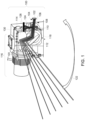
- FIG 1 illustrates one embodiment of a LiDAR system 100.
- the LiDAR system 100 includes an array 102 of multiple light sources (not visible in Figure 1 ) that separately generate light or light beams 104 toward a lens array assembly 106. These light sources can be photodiodes and/or laser diodes that generate different (e.g., separate) beams of light 104 into different areas of the lens array assembly 106.
- the lens array assembly 106 can include multiple micro lenses (also referred to as lens elements) that each receives light 104 from a different light source in the light source array 102.
- the light sources can all generate light having the same or substantially the same (e.g., within 3%) wavelength, such as 980 nanometers, 1550 nanometers, or 1570 nanometers.
- This light 104 is received by the lens elements in the lens array 106 into or through a back surface or side of each lens element.
- the light 104 that is generated by the light sources and received by the lens elements can be referred to as incoming light 104.
- the incoming light 104 passes through the lens elements in the lens array 106, is collimated by the lens elements, and exits or emanates from opposite front surfaces or sides of the lens elements as outgoing light 108.
- the lens elements in the lens array 106 collimate the incoming light 104 in multiple directions such that the outgoing light 108 emanating from the front surfaces or sides of the lens elements is collimated in a first direction (according to the claimed subject-matter a vertical direction) and is collimated in a different, second direction (according to the claimed subject-matter a horizontal direction).
- the collimated outgoing light 108 passes through a polarizing beam splitter 110 that allows the outgoing light 108 to pass through the beam splitter 110.
- This outgoing light 108 is reflected off multiple mirrors or reflective surfaces 112, 114 of a mirror assembly 116.
- a first mirror surface 112 is coupled with and moveable by a first motor 118 of the mirror assembly 116.
- the motor 118 rotates the first mirror surface 112 about an axis (that is approximately perpendicular to the page of Figure 1 ) to direct or move the outgoing light 108 along opposite first directions.
- the light 108 reflects off the first mirror surface 112 and strikes a second mirror surface 114 of the mirror assembly 116.
- the second mirror surface 114 is coupled with and moveable by a different, second motor 120 of the mirror assembly 116.
- the motor 120 rotates the second mirror surface 114 about a different axis (that is approximately parallel to the page of Figure 1 ) to direct or move the outgoing light 108 along opposite second directions.
- the light 108 reflects off the second mirror surface 114 and is directed toward a field of regard of the LiDAR system 100.
- a controller 130 of the mirror assembly 116 can control movement of the mirrors 112, 114 to control where the light 108 emanating from the LiDAR system 100 is directed.
- the controller can include hardware circuitry that includes and/or is connected with one or more processors (e.g., one or more microprocessors, field programmable gate arrays, and/or integrated circuits) that generate the control signals communicated to the motors 118, 120 to control where the light 108 is directed.
- processors e.g., one or more microprocessors, field programmable gate arrays, and/or integrated circuits
- the controller can control movement of the mirrors 112, 114 by the respective motors 118, 120 to cause the separate beams of light 108 to sweep back-and-forth across the field of regard, as shown in Figure 1 by an arrow 122 illustrating movement of the beams of light 108 back-and-forth from the perspective of the viewer.
- the light 108 can strike one or more objects within the field of regard of the LiDAR system 100 and at least partially reflect off the object(s).
- the reflected light is at least partially received by the mirror 114, reflected off the mirror 114 toward the mirror 112, and reflected off the mirror 112 toward the beam splitter 110.
- the reflected light (traveling in an opposite direction as the outgoing light 108 from the lens array 106) can have a randomized polarization.
- the portion of the reflected light having an orthogonal polarization to the outgoing light 108 is directed by the beam splitter 110 toward a lens 124.
- the lens 124 focuses the reflected light onto a detector array 126, which can include photodetectors that generate signals that are indicative of receipt of the light.
- These signals can be communicated to a controller (which may be the same controller that controls operation of the mirror assembly 116 or another controller), which calculates a time of flight as the time period between transmission of a pulse of the outgoing light 108 and receipt of the reflected light on the detector array 126. This time of flight can be used to calculate a distance to the object(s) off of which the light 108 was reflected to determine a presence and/or distance to the object(s).
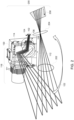
- FIG. 2 illustrates an example of a LiDAR system 200 useful for understanding the invention.
- the LiDAR system 200 includes the array 102 of light sources and the lens array assembly 106 described above.
- the incoming light 104 generated by the light sources passes through the lens elements in the lens array 106, is collimated by the lens elements (e.g., in both horizontal and vertical directions), and exits or emanates from opposite front surfaces or sides of the lens elements as the outgoing light 108.
- the outgoing light 108 is reflected off the moveable mirrors 112, 114 of the mirror assembly 116, as described above.
- the light 108 can strike one or more objects within the field of regard of the LiDAR system 200 and at least partially reflect off the object(s) as reflected light 202.
- the reflected light 202 is at least partially received by a lens 204 that focuses the light 202 toward a detector array 208, which can include photodetectors that generate signals that are indicative of receipt of the light, similar to as described above.
- the lens 204 of the LiDAR system 200 can have a larger numerical aperture than the lens 124 of the LiDAR system 100.
- the detector arrays 126, 208 can include silicon (Si) or indium gallium arsenic (InGaAs) photodetectors.
- One or more of the detector arrays 126, 208 may be a near infrared (NIR) photodetector array.
- NIR near infrared
- Use of the mirror assembly 116 in the LiDAR systems 100, 200 can provide for a field of regard of the systems 100, 200 that extends over one hundred twenty degrees, with the line of light 108 emanating toward the field of regard from the lens assembly 106 extending over sixty degrees.
- the mirrors 112, 114 in the mirror assembly 116 can rotate at a relatively slow velocity to allow the light 108 to dwell over longer periods of time in the field of regard. This can reduce the cost and complexity of the electronic hardware used to control movement of the mirrors 112, 114, while increasing the signal-to-noise ratio of the reflected light relative to LiDAR systems that do not use the mirror assembly 116.
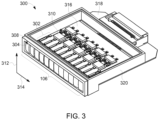
- FIG 3 illustrates one embodiment of a lighting assembly 300 that can be included in one or more of the LiDAR systems 100, 200 described herein.
- the lighting assembly 300 includes several light sources 302 that generate light toward the lens array assembly 106. These light sources 302 can be photodiodes and/or laser diodes that generate different beams of light into different areas of the lens array assembly 106.
- the lens array assembly 106 can include multiple micro lenses or lens elements 304 that each receives light from a different light source 302.
- the lens array assembly 106 includes twelve lens elements, or lenses, 304.
- the lens array assembly 106 can include a single lens element 304 or a different number of lens elements 304.
- the light sources 302 can all generate light having the same or substantially the same (e.g., within 3%) wavelength, such as 980 nanometers, 1550 nanometers, or 1570 nanometers. This light is received by the lens elements 304 into or through a back surface or side 306 (shown in Figure 5 ) of each lens element 304.
- the light that is generated by the light sources 302 and received by the lens elements 304 is the incoming light 104.
- the light 104 passes through the lens elements 304, is collimated by the lens elements 304, and exits or emanates from opposite front surfaces or sides 308 of the lens elements 304 as outgoing light.
- Current driving circuitry 310 can control the light output by each light source 302.
- another type of light source 302 can be used, or at least one of the light sources 302 can generate light that is received by two or more of the lens elements 304.
- the circuitry 310 and light sources 302 can be mounted onto a heat spreading substrate 316, such as a metal or other thermally conductive body.
- the substrate 316 can be formed from aluminum nitride, graphene, or a silicon-based interposer with integrated interconnects and bond pads for conductively coupling the light sources 302 with the circuitry 310.
- the substrate 316 is in a package 320 and bonded to a thermoelectric cooler or cooling device 318, with the lens array 106 disposed along one edge of the package 320.
- the package 320 optionally can be referred to as an outer housing or housing of the lighting assembly.
- the lens array 106 can be a single, integral body that includes the several different lens elements 304.
- the package 320 can be formed from metal, ceramic, and/or plastic, and can be created using three-dimensional printing, injection molding, and/or machining.
- a cover (not shown) can be placed over the package 320, and can be fused or metallurgically bonded to the package 320.
- the polarizing beam splitter 110 optionally is mounted to the front of the package 320, and the detector array 126 or 208 can be mounted adjacent to the package 320 orthogonal to the array of light sources 302.
- Each lens element 206 can be relatively small.
- each lens element 206 can have a width dimension that is no more than 2.2 millimeters and a height dimension that is no more than 3.4 millimeters.
- the lens elements 206 may have a larger width dimension and/or height dimension.
- Figure 4 illustrates a flowchart of a method 2000 for providing one or more embodiments of the LiDAR systems described herein.
- the light sources 302 are mounted onto the substrate 316.
- the light sources 302 are mounted to the substrate 316 using pick-and-place bonding.
- the substrate 316 is bonded to the thermoelectric cooler 318.
- the substrate 316 is mounted in the package 320 that includes the lens array 106.
- the package 320 can be three-dimensional printed, injection molded, machined, or the like.
- a cover is coupled with the package 320, such as by fusing, welding, or the like, the cover with the package 320.
- a polarizing beam splitter is coupled with the package.
- the detector array 126, 208 is coupled with the package 320.
- Figure 5 illustrates one embodiment of the lenses 304 in the lens array assembly 106 and the package 320 of the lighting assembly 300.
- the package 320 includes a window 2100, which represents a light-transmissive surface or part of the package 320.
- the window 2100 can be optically clear or otherwise allow light generated by the light sources 302 (shown in Figure 3 ) and collimated and/or diffracted by the lenses 304 in the lens array assembly 106 to pass through the window 2100.
- the window 2100 can form an outer surface of the package 320.
- the remaining components of the system 300 are not shown in Figure 21.
- the lenses 304 and/or outer surface of the window 2100 can be coated with an antireflection layer 2102.
- This layer 2102 can have broadband omni-directional antireflection properties.
- the layer 2102 can be nanostructured and composed of nanopillar or nanowire arrays.
- the layer 2102 can be applied to one or both surfaces of the lenses 304 or window 2100, even though the layer 2102 is shown in Figure 21 as only being disposed on one side of each of the lenses 304 and the window 2100.
- the layer 2102 can assist in improving the signal-to-noise ratio of the system 300 by increasing the amount of incoming light (reflected from outside objects) impacting the photodetectors 126, 208 (shown in Figures 1 and 2 ) in the system.
- the layer 2102 is disposed on non-Fresnel and non-diffractive based lenses 304 in the system 300, but not on other lenses or surfaces of the lenses.
- the lenses and outer window of the LiDAR system are coated with a layer that possesses broadband omni-directional antireflection properties.
- This layer may be nanostructured and composed of nanopillar or nanowire arrays.
- the coating may be applied to one or both surfaces of the lenses or window layers, and helps in improving the SNR of the system by increasing the amount of incoming light (reflected from outside objects) impacting the photodetectors in the system. These coatings are primarily intended for the non-Fresnel and non-diffractive based lenses in the system.
- a LiDAR system includes light sources configured to generate separate beams of light, a lens array configured to receive the separate beams of light from the light sources and to collimate the separate beams of light into collimated outgoing light that is directed toward an examined area of interest, a light sensitive detector configured to sense reflection of at least part of the collimated outgoing light, and one or more processors configured to determine a distance to one or more objects off which the at least part of the collimated outgoing light was reflected toward the light sensitive detector. The one or more processors are configured to determine the distance based on the reflection of the at least part of the collimated outgoing light.
- the lens array is configured to collimate each of the separate beams of light in different directions.
- the different directions in which each of the separate beams of light are collimated by the lens array include a horizontal direction and a vertical direction.
- the lens array can include plural lenses positioned to each receive a different beam of light from the separate beams of light.
- the system also includes a polarizing beam splitter disposed between the lens array and a mirror assembly that directs the collimated outgoing light in one or more directions.
- the mirror assembly includes a first scanning mirror configured to move and horizontally sweep the collimated outgoing light across the examined area of interest along the horizontal direction and a second scanning mirror configured to move and vertically sweep the collimated outgoing light across the examined area of interest along the vertical direction.
- the system also can include a thermoelectric cooler interconnected with the light sources.
- the system can include a window through which the collimated outgoing light passes after exiting the lens array, where the window includes an antireflection layer.
- the system also can include an antireflection layer on the lens array.
- a LiDAR system includes a lens array configured to receive separate points of light from light sources and to collimate the separate beams of light, a light sensitive detector configured to sense reflection of at least part of the light that is collimated, and one or more processors configured to determine a distance to one or more objects based on the reflection of the at least part of the light was reflected.
- the lens array is configured to collimate the separate beams of line in multiple different directions.
- the lens array can include plural lenses positioned to each receive a different point of light from the separate points of light.
- Each of the lenses can be configured to collimate the point of light received by the lens in both a first direction and a different, second direction.
- the system also includes a package having a window, where the lens array is disposed in the package and one or more of the lens array or the window includes an omnidirectional coating layer.
- the system also can include a polarizing beam splitter disposed between the lens array and a mirror assembly that directs the light that is collimated in one or more directions.
- the system optionally can include a mirror assembly having at least one moveable mirror configured to move and reflect the light that is collimated back-and-forth along a field of regard.
- the mirror assembly can be configured to move the light that is collimated without moving the light sources.
- the mirror assembly can be configured to move the light that is collimated without moving the lens array.
- a method includes coupling light sources onto a heat spreading substrate, coupling the substrate to a thermoelectric cooler, and coupling the substrate in a package having a bonded, integral lens array disposed along one edge of the package.
- the lens array is configured to receive separate beams of light from the light sources and to collimate the separate beams of light in multiple, different directions.
- the light sources can be coupled to the substrate using pick and place bonding.
- the method also can include mounting a polarizing beam splitter to the package.
Landscapes
- Engineering & Computer Science (AREA)
- Physics & Mathematics (AREA)
- General Physics & Mathematics (AREA)
- Computer Networks & Wireless Communication (AREA)
- Radar, Positioning & Navigation (AREA)
- Remote Sensing (AREA)
- Electromagnetism (AREA)
- Optics & Photonics (AREA)
- Plasma & Fusion (AREA)
- Optical Radar Systems And Details Thereof (AREA)
- Measurement Of Optical Distance (AREA)
Claims (5)
- Système de détection et télémétrie par ondes lumineuses, LiDAR (100) comprenant :des sources de lumière (302) configurées pour générer des faisceaux de lumière distincts (104) ;un réseau de lentilles (106) configuré pour recevoir les faisceaux de lumière distincts (104) des sources de lumière (302) et pour collimater les faisceaux de lumière distincts (104), à la fois dans une direction horizontale et dans une direction verticale, en une lumière sortante collimatée (108) qui est dirigée vers une zone d'intérêt examinée ;un ensemble de miroirs (116) comprenant un premier miroir de balayage configuré pour déplacer et balayer horizontalement la lumière collimatée sortante (108) sur la zone d'intérêt examinée le long de la direction horizontale et un second miroir de balayage configuré pour déplacer et balayer verticalement la lumière collimatée sortante (108) sur la zone d'intérêt examinée le long de la direction verticale ;un séparateur de faisceau polarisant disposé entre le réseau de lentilles (106) et l'ensemble de miroirs (116) ;un détecteur sensible à la lumière (126) configuré pour détecter une réflexion d'au moins une partie de la lumière collimatée sortante (108) ; etun ou plusieurs processeurs (130) configurés pour déterminer une distance par rapport à un ou plusieurs objets sur lesquels l'au moins une partie de la lumière collimatée sortante (108) a été réfléchie vers le détecteur sensible à la lumière, le ou les processeurs (130) étant configurés pour déterminer la distance sur la base de la réflexion de l'au moins une partie de la lumière collimatée sortante (108).
- Système LiDAR (100) selon la revendication 1, dans lequel le réseau de lentilles (106) comporte plusieurs lentilles positionnées pour recevoir chacune un faisceau de lumière différent des faisceaux de lumière distincts (104).
- Système LiDAR (100) selon l'une quelconque revendication précédente, comprenant en outre un refroidisseur thermoélectrique interconnecté avec les sources de lumière (302).
- Système LiDAR (100) selon l'une quelconque revendication précédente, comprenant en outre une fenêtre à travers laquelle la lumière collimatée sortante (108) passe après avoir quitté le réseau de lentilles (106), dans lequel la fenêtre comporte une couche antireflet.
- Système LiDAR (100) l'une quelconque revendication précédente, comprenant en outre une couche antireflet sur le réseau de lentilles (106).
Applications Claiming Priority (1)
| Application Number | Priority Date | Filing Date | Title |
|---|---|---|---|
| US15/482,339 US10908282B2 (en) | 2017-04-07 | 2017-04-07 | LiDAR system and method |
Publications (3)
| Publication Number | Publication Date |
|---|---|
| EP3385751A2 EP3385751A2 (fr) | 2018-10-10 |
| EP3385751A3 EP3385751A3 (fr) | 2019-01-02 |
| EP3385751B1 true EP3385751B1 (fr) | 2025-06-11 |
Family
ID=61906661
Family Applications (1)
| Application Number | Title | Priority Date | Filing Date |
|---|---|---|---|
| EP18165673.7A Active EP3385751B1 (fr) | 2017-04-07 | 2018-04-04 | Système lidar et procédé |
Country Status (5)
| Country | Link |
|---|---|
| US (2) | US10908282B2 (fr) |
| EP (1) | EP3385751B1 (fr) |
| JP (1) | JP2018179984A (fr) |
| KR (1) | KR20180113924A (fr) |
| CN (1) | CN108828611A (fr) |
Families Citing this family (36)
| Publication number | Priority date | Publication date | Assignee | Title |
|---|---|---|---|---|
| US11556000B1 (en) | 2019-08-22 | 2023-01-17 | Red Creamery Llc | Distally-actuated scanning mirror |
| US12399279B1 (en) | 2016-02-15 | 2025-08-26 | Red Creamery Llc | Enhanced hybrid LIDAR with high-speed scanning |
| US12399278B1 (en) | 2016-02-15 | 2025-08-26 | Red Creamery Llc | Hybrid LIDAR with optically enhanced scanned laser |
| US12123950B2 (en) | 2016-02-15 | 2024-10-22 | Red Creamery, LLC | Hybrid LADAR with co-planar scanning and imaging field-of-view |
| CN111279220A (zh) * | 2017-08-22 | 2020-06-12 | 李平 | 激光雷达用双轴谐振光束转向镜系统及方法 |
| WO2019139895A1 (fr) | 2018-01-09 | 2019-07-18 | Innovusion Ireland Limited | Systèmes et procédés de détection lidar utilisant des miroirs multi-plans |
| US11675050B2 (en) | 2018-01-09 | 2023-06-13 | Innovusion, Inc. | LiDAR detection systems and methods |
| CN112585492B (zh) | 2018-06-15 | 2024-10-25 | 图达通智能美国有限公司 | 用于聚焦感兴趣的范围的lidar系统和方法 |
| CN114114606B (zh) | 2018-11-14 | 2024-09-06 | 图达通智能美国有限公司 | 使用多面镜的lidar系统和方法 |
| US11269065B2 (en) * | 2018-11-19 | 2022-03-08 | Infineon Technologies Ag | Muilti-detector with interleaved photodetector arrays and analog readout circuits for lidar receiver |
| US11768273B2 (en) | 2018-11-27 | 2023-09-26 | Baidu Usa Llc | Light detection and range (LIDAR) device with a single spinning mirror for autonomous driving vehicles |
| JP7183739B2 (ja) * | 2018-11-28 | 2022-12-06 | 株式会社リコー | 半導体回路ユニット、光源装置、物体検出装置、センシング装置及び移動体 |
| US11391822B2 (en) * | 2018-11-30 | 2022-07-19 | Seagate Technology Llc | Rotating pyramidal mirror |
| US11353558B2 (en) * | 2018-12-29 | 2022-06-07 | Gm Cruise Holdings Llc | Multiple laser, single resonator lidar |
| CN111381239B (zh) * | 2018-12-29 | 2022-08-19 | 华为技术有限公司 | 一种激光测量模组和激光雷达 |
| US11561288B2 (en) * | 2019-04-18 | 2023-01-24 | Canon Kabushiki Kaisha | Optical apparatus, on-board system, and movement apparatus |
| US11880114B2 (en) | 2019-08-28 | 2024-01-23 | The Hong Kong University Of Science And Technology | Ferroelectric liquid crystals Dammann grating for light detection and ranging devices |
| AT522995B1 (de) * | 2019-10-07 | 2021-05-15 | Vexcel Imaging Gmbh | Sensoranordnung |
| KR102845981B1 (ko) * | 2019-10-11 | 2025-08-12 | 삼성전자주식회사 | 광학 장치 및 이를 포함하는 라이다 시스템 |
| KR102778266B1 (ko) * | 2019-10-18 | 2025-03-11 | 현대자동차주식회사 | 액정 기반 광 편향기 및 이를 이용한 광 스캐너 |
| WO2021081240A1 (fr) * | 2019-10-24 | 2021-04-29 | Lookit.ai | Système optique lidar avec optique plate et miroir rotatif permettant un champ de vision à 360 degrés à fréquence de trame élevée, une résolution spatiale élevée et une faible consommation d'énergie |
| WO2021092207A1 (fr) * | 2019-11-06 | 2021-05-14 | Lookit.ai | Optique plate à éléments passifs fonctionnant en tant qu'optique de transformation |
| JP7474853B2 (ja) * | 2019-12-27 | 2024-04-25 | ウェイモ エルエルシー | 光リダイレクタデバイス |
| US12468020B2 (en) | 2019-12-27 | 2025-11-11 | Waymo Llc | Optical redirector device |
| US11604258B2 (en) * | 2020-01-17 | 2023-03-14 | GM Global Technology Operations LLC | LiDAR system |
| CN111337934B (zh) * | 2020-03-13 | 2021-10-15 | 广东省科学院广州地理研究所 | 一种城市三维空间数据移动采集设备 |
| GB202009945D0 (en) * | 2020-06-30 | 2020-08-12 | Ams Int Ag | Time-of-flight window and mirror detection |
| CN113970748B (zh) * | 2020-07-23 | 2025-12-30 | 上海禾赛科技有限公司 | 激光雷达及其探测方法 |
| EP4206735A4 (fr) * | 2020-08-28 | 2024-05-22 | Hesai Technology Co., Ltd. | Radar laser et procédé de télémétrie |
| US11822018B2 (en) | 2020-10-14 | 2023-11-21 | Lg Innotek Co., Ltd. | Multi-detector LiDAR systems and methods for mitigating range aliasing |
| DE102020213163A1 (de) * | 2020-10-19 | 2022-04-21 | Robert Bosch Gesellschaft mit beschränkter Haftung | LiDAR-System mit Störquellen-Erkennung |
| CN112713929B (zh) * | 2020-12-02 | 2022-02-18 | 广东工业大学 | 一种基于啁啾脉冲的光时域反射计 |
| GB2612284B (en) * | 2021-02-02 | 2024-10-16 | Leonardo Mw Ltd | An active imaging system |
| US11555895B2 (en) | 2021-04-20 | 2023-01-17 | Innovusion, Inc. | Dynamic compensation to polygon and motor tolerance using galvo control profile |
| CN117413199A (zh) * | 2021-05-21 | 2024-01-16 | 图达通智能美国有限公司 | 使用lidar扫描仪内部的检流计镜进行智能扫描的移动配置文件 |
| WO2024241321A1 (fr) * | 2023-05-25 | 2024-11-28 | Innoviz Technologies Ltd. | Micro-optique sur trajet de détection de systèmes lidar |
Family Cites Families (22)
| Publication number | Priority date | Publication date | Assignee | Title |
|---|---|---|---|---|
| JP3608020B2 (ja) | 1997-06-11 | 2005-01-05 | 株式会社ニコン | 照準測距光学系 |
| JP4606152B2 (ja) | 2004-12-21 | 2011-01-05 | 三井造船株式会社 | レーザ光出射器およびレーザレーダ装置 |
| US7544945B2 (en) | 2006-02-06 | 2009-06-09 | Avago Technologies General Ip (Singapore) Pte. Ltd. | Vertical cavity surface emitting laser (VCSEL) array laser scanner |
| US7710639B2 (en) * | 2006-12-12 | 2010-05-04 | Northrop Grumman Space & Mission Systems Corporation | System and method for uniform illumination of a target area |
| US8244026B2 (en) | 2008-01-09 | 2012-08-14 | Tiltan Systems Engineering Ltd. | Apparatus and method for automatic airborne LiDAR data processing and mapping using data obtained thereby |
| US20090273770A1 (en) | 2008-04-30 | 2009-11-05 | Honeywell International Inc. | Systems and methods for safe laser imaging, detection and ranging (lidar) operation |
| US8531650B2 (en) * | 2008-07-08 | 2013-09-10 | Chiaro Technologies LLC | Multiple channel locating |
| KR101047171B1 (ko) | 2011-01-11 | 2011-07-07 | 김영태 | 엔코더용 레이저조사장치 |
| JP2012154806A (ja) | 2011-01-26 | 2012-08-16 | Sanyo Electric Co Ltd | レーザレーダおよび受光装置 |
| US9651417B2 (en) | 2012-02-15 | 2017-05-16 | Apple Inc. | Scanning depth engine |
| US9097800B1 (en) | 2012-10-11 | 2015-08-04 | Google Inc. | Solid object detection system using laser and radar sensor fusion |
| US9823351B2 (en) | 2012-12-18 | 2017-11-21 | Uber Technologies, Inc. | Multi-clad fiber based optical apparatus and methods for light detection and ranging sensors |
| US9063549B1 (en) | 2013-03-06 | 2015-06-23 | Google Inc. | Light detection and ranging device with oscillating mirror driven by magnetically interactive coil |
| US20150260830A1 (en) * | 2013-07-12 | 2015-09-17 | Princeton Optronics Inc. | 2-D Planar VCSEL Source for 3-D Imaging |
| US20150026083A1 (en) | 2013-07-18 | 2015-01-22 | InsideView Technologies, Inc. | Generating Connection Map for Intelligent Connections in Enterprises |
| US8836922B1 (en) * | 2013-08-20 | 2014-09-16 | Google Inc. | Devices and methods for a rotating LIDAR platform with a shared transmit/receive path |
| US9831630B2 (en) * | 2014-02-06 | 2017-11-28 | GM Global Technology Operations LLC | Low cost small size LiDAR for automotive |
| US9360554B2 (en) | 2014-04-11 | 2016-06-07 | Facet Technology Corp. | Methods and apparatus for object detection and identification in a multiple detector lidar array |
| US10088558B2 (en) * | 2014-08-15 | 2018-10-02 | Aeye, Inc. | Method and system for ladar transmission with spiral dynamic scan patterns |
| US10036801B2 (en) | 2015-03-05 | 2018-07-31 | Big Sky Financial Corporation | Methods and apparatus for increased precision and improved range in a multiple detector LiDAR array |
| US9501839B1 (en) | 2015-05-27 | 2016-11-22 | The Boeing Company | Methods and systems for detecting moving objects in a sequence of image frames produced by sensors with inconsistent gain, offset, and dead pixels |
| JP6531502B2 (ja) | 2015-06-11 | 2019-06-19 | 株式会社リコー | 光走査装置、物体検出装置及びセンシング装置 |
-
2017
- 2017-04-07 US US15/482,339 patent/US10908282B2/en active Active
-
2018
- 2018-04-03 KR KR1020180038658A patent/KR20180113924A/ko not_active Ceased
- 2018-04-04 EP EP18165673.7A patent/EP3385751B1/fr active Active
- 2018-04-04 CN CN201810297749.5A patent/CN108828611A/zh active Pending
- 2018-04-04 JP JP2018071985A patent/JP2018179984A/ja active Pending
-
2021
- 2021-07-09 US US17/371,347 patent/US11921204B2/en active Active
Also Published As
| Publication number | Publication date |
|---|---|
| US10908282B2 (en) | 2021-02-02 |
| US20180292532A1 (en) | 2018-10-11 |
| US11921204B2 (en) | 2024-03-05 |
| EP3385751A2 (fr) | 2018-10-10 |
| CN108828611A (zh) | 2018-11-16 |
| JP2018179984A (ja) | 2018-11-15 |
| EP3385751A3 (fr) | 2019-01-02 |
| KR20180113924A (ko) | 2018-10-17 |
| US20220035032A1 (en) | 2022-02-03 |
Similar Documents
| Publication | Publication Date | Title |
|---|---|---|
| US11921204B2 (en) | LiDAR system and method | |
| CN107148580B (zh) | 基于一维光学发射器的二维扫描的三维激光雷达传感器 | |
| CN115552282B (zh) | 同轴激光雷达结构中的增强偏振光收集 | |
| EP3859377B1 (fr) | Dispositif de détection de distance | |
| CN102253392B (zh) | 飞行时间摄像机单元和光学监视系统 | |
| KR102020037B1 (ko) | 하이브리드 라이다 스캐너 | |
| JP5644437B2 (ja) | 距離測定装置および距離測定方法 | |
| US11561287B2 (en) | LIDAR sensors and methods for the same | |
| KR101785253B1 (ko) | 라이다 장치 | |
| KR101785254B1 (ko) | 전방향 라이다 장치 | |
| US20030066954A1 (en) | Optoelectronic detection device | |
| EP2824418A1 (fr) | Système de détection d'ambiance | |
| WO2005100911A2 (fr) | Appareil et procede de determination optique de distances intermediaires | |
| JP2014029317A (ja) | レーザレーダ装置 | |
| KR20130140554A (ko) | 레이저 레이더 시스템 및 목표물 영상 획득 방법 | |
| KR100951243B1 (ko) | 레이저 측량장치 | |
| CN118715451A (zh) | 用于光检测和测距阻挡检测的系统和方法 | |
| WO2022110210A1 (fr) | Radar laser et plateforme mobile | |
| US7869006B2 (en) | Laser measuring device | |
| KR20190071998A (ko) | 차량용 라이다 장치 | |
| KR102711191B1 (ko) | 복수의 갈바노미터 스캐너를 적용한 광시야 라이더 및 차량 | |
| CN112219324A (zh) | 激光二极管芯片、封装模块、发射及测距装置、电子设备 | |
| US11500073B2 (en) | Acousto-optical beam deflecting unit for light detection and ranging (LiDAR) | |
| US20200056972A1 (en) | Particle sensor including at least two laser doppler sensors | |
| CN116113851A (zh) | 用于测试激光雷达模块的设备和用于测试的方法 |
Legal Events
| Date | Code | Title | Description |
|---|---|---|---|
| PUAI | Public reference made under article 153(3) epc to a published international application that has entered the european phase |
Free format text: ORIGINAL CODE: 0009012 |
|
| STAA | Information on the status of an ep patent application or granted ep patent |
Free format text: STATUS: THE APPLICATION HAS BEEN PUBLISHED |
|
| AK | Designated contracting states |
Kind code of ref document: A2 Designated state(s): AL AT BE BG CH CY CZ DE DK EE ES FI FR GB GR HR HU IE IS IT LI LT LU LV MC MK MT NL NO PL PT RO RS SE SI SK SM TR |
|
| AX | Request for extension of the european patent |
Extension state: BA ME |
|
| PUAL | Search report despatched |
Free format text: ORIGINAL CODE: 0009013 |
|
| AK | Designated contracting states |
Kind code of ref document: A3 Designated state(s): AL AT BE BG CH CY CZ DE DK EE ES FI FR GB GR HR HU IE IS IT LI LT LU LV MC MK MT NL NO PL PT RO RS SE SI SK SM TR |
|
| AX | Request for extension of the european patent |
Extension state: BA ME |
|
| RIC1 | Information provided on ipc code assigned before grant |
Ipc: G01S 17/89 20060101AFI20181129BHEP Ipc: G01S 17/93 20060101ALI20181129BHEP Ipc: G01S 7/481 20060101ALI20181129BHEP |
|
| STAA | Information on the status of an ep patent application or granted ep patent |
Free format text: STATUS: REQUEST FOR EXAMINATION WAS MADE |
|
| 17P | Request for examination filed |
Effective date: 20190702 |
|
| RBV | Designated contracting states (corrected) |
Designated state(s): AL AT BE BG CH CY CZ DE DK EE ES FI FR GB GR HR HU IE IS IT LI LT LU LV MC MK MT NL NO PL PT RO RS SE SI SK SM TR |
|
| STAA | Information on the status of an ep patent application or granted ep patent |
Free format text: STATUS: EXAMINATION IS IN PROGRESS |
|
| 17Q | First examination report despatched |
Effective date: 20210730 |
|
| REG | Reference to a national code |
Ref country code: DE Ref legal event code: R079 Ref country code: DE Ref legal event code: R079 Ref document number: 602018082509 Country of ref document: DE Free format text: PREVIOUS MAIN CLASS: G01S0017890000 Ipc: G01S0017100000 |
|
| GRAP | Despatch of communication of intention to grant a patent |
Free format text: ORIGINAL CODE: EPIDOSNIGR1 |
|
| STAA | Information on the status of an ep patent application or granted ep patent |
Free format text: STATUS: GRANT OF PATENT IS INTENDED |
|
| RIC1 | Information provided on ipc code assigned before grant |
Ipc: G01S 17/931 20200101ALI20241118BHEP Ipc: G01S 17/89 20060101ALI20241118BHEP Ipc: G01S 17/42 20060101ALI20241118BHEP Ipc: G01S 7/481 20060101ALI20241118BHEP Ipc: G01S 17/10 20060101AFI20241118BHEP |
|
| INTG | Intention to grant announced |
Effective date: 20241206 |
|
| GRAS | Grant fee paid |
Free format text: ORIGINAL CODE: EPIDOSNIGR3 |
|
| RAP3 | Party data changed (applicant data changed or rights of an application transferred) |
Owner name: GENERAL ELECTRIC COMPANY |
|
| GRAA | (expected) grant |
Free format text: ORIGINAL CODE: 0009210 |
|
| STAA | Information on the status of an ep patent application or granted ep patent |
Free format text: STATUS: THE PATENT HAS BEEN GRANTED |
|
| P01 | Opt-out of the competence of the unified patent court (upc) registered |
Free format text: CASE NUMBER: APP_19107/2025 Effective date: 20250422 |
|
| AK | Designated contracting states |
Kind code of ref document: B1 Designated state(s): AL AT BE BG CH CY CZ DE DK EE ES FI FR GB GR HR HU IE IS IT LI LT LU LV MC MK MT NL NO PL PT RO RS SE SI SK SM TR |
|
| REG | Reference to a national code |
Ref country code: GB Ref legal event code: FG4D |
|
| REG | Reference to a national code |
Ref country code: CH Ref legal event code: EP |
|
| REG | Reference to a national code |
Ref country code: DE Ref legal event code: R096 Ref document number: 602018082509 Country of ref document: DE |
|
| REG | Reference to a national code |
Ref country code: IE Ref legal event code: FG4D |
|
| PG25 | Lapsed in a contracting state [announced via postgrant information from national office to epo] |
Ref country code: ES Free format text: LAPSE BECAUSE OF FAILURE TO SUBMIT A TRANSLATION OF THE DESCRIPTION OR TO PAY THE FEE WITHIN THE PRESCRIBED TIME-LIMIT Effective date: 20250611 Ref country code: FI Free format text: LAPSE BECAUSE OF FAILURE TO SUBMIT A TRANSLATION OF THE DESCRIPTION OR TO PAY THE FEE WITHIN THE PRESCRIBED TIME-LIMIT Effective date: 20250611 |
|
| REG | Reference to a national code |
Ref country code: LT Ref legal event code: MG9D |
|
| PG25 | Lapsed in a contracting state [announced via postgrant information from national office to epo] |
Ref country code: NO Free format text: LAPSE BECAUSE OF FAILURE TO SUBMIT A TRANSLATION OF THE DESCRIPTION OR TO PAY THE FEE WITHIN THE PRESCRIBED TIME-LIMIT Effective date: 20250911 Ref country code: GR Free format text: LAPSE BECAUSE OF FAILURE TO SUBMIT A TRANSLATION OF THE DESCRIPTION OR TO PAY THE FEE WITHIN THE PRESCRIBED TIME-LIMIT Effective date: 20250912 |
|
| REG | Reference to a national code |
Ref country code: NL Ref legal event code: MP Effective date: 20250611 |
|
| PG25 | Lapsed in a contracting state [announced via postgrant information from national office to epo] |
Ref country code: BG Free format text: LAPSE BECAUSE OF FAILURE TO SUBMIT A TRANSLATION OF THE DESCRIPTION OR TO PAY THE FEE WITHIN THE PRESCRIBED TIME-LIMIT Effective date: 20250611 |
|
| PG25 | Lapsed in a contracting state [announced via postgrant information from national office to epo] |
Ref country code: HR Free format text: LAPSE BECAUSE OF FAILURE TO SUBMIT A TRANSLATION OF THE DESCRIPTION OR TO PAY THE FEE WITHIN THE PRESCRIBED TIME-LIMIT Effective date: 20250611 |
|
| PG25 | Lapsed in a contracting state [announced via postgrant information from national office to epo] |
Ref country code: RS Free format text: LAPSE BECAUSE OF FAILURE TO SUBMIT A TRANSLATION OF THE DESCRIPTION OR TO PAY THE FEE WITHIN THE PRESCRIBED TIME-LIMIT Effective date: 20250911 |
|
| PG25 | Lapsed in a contracting state [announced via postgrant information from national office to epo] |
Ref country code: LV Free format text: LAPSE BECAUSE OF FAILURE TO SUBMIT A TRANSLATION OF THE DESCRIPTION OR TO PAY THE FEE WITHIN THE PRESCRIBED TIME-LIMIT Effective date: 20250611 |
|
| PG25 | Lapsed in a contracting state [announced via postgrant information from national office to epo] |
Ref country code: NL Free format text: LAPSE BECAUSE OF FAILURE TO SUBMIT A TRANSLATION OF THE DESCRIPTION OR TO PAY THE FEE WITHIN THE PRESCRIBED TIME-LIMIT Effective date: 20250611 |
|
| PG25 | Lapsed in a contracting state [announced via postgrant information from national office to epo] |
Ref country code: PT Free format text: LAPSE BECAUSE OF FAILURE TO SUBMIT A TRANSLATION OF THE DESCRIPTION OR TO PAY THE FEE WITHIN THE PRESCRIBED TIME-LIMIT Effective date: 20251013 |
|
| REG | Reference to a national code |
Ref country code: AT Ref legal event code: MK05 Ref document number: 1802692 Country of ref document: AT Kind code of ref document: T Effective date: 20250611 |
|
| PG25 | Lapsed in a contracting state [announced via postgrant information from national office to epo] |
Ref country code: IS Free format text: LAPSE BECAUSE OF FAILURE TO SUBMIT A TRANSLATION OF THE DESCRIPTION OR TO PAY THE FEE WITHIN THE PRESCRIBED TIME-LIMIT Effective date: 20251011 |
|
| PG25 | Lapsed in a contracting state [announced via postgrant information from national office to epo] |
Ref country code: AT Free format text: LAPSE BECAUSE OF FAILURE TO SUBMIT A TRANSLATION OF THE DESCRIPTION OR TO PAY THE FEE WITHIN THE PRESCRIBED TIME-LIMIT Effective date: 20250611 Ref country code: SM Free format text: LAPSE BECAUSE OF FAILURE TO SUBMIT A TRANSLATION OF THE DESCRIPTION OR TO PAY THE FEE WITHIN THE PRESCRIBED TIME-LIMIT Effective date: 20250611 |
|
| PG25 | Lapsed in a contracting state [announced via postgrant information from national office to epo] |
Ref country code: CZ Free format text: LAPSE BECAUSE OF FAILURE TO SUBMIT A TRANSLATION OF THE DESCRIPTION OR TO PAY THE FEE WITHIN THE PRESCRIBED TIME-LIMIT Effective date: 20250611 |
|
| PG25 | Lapsed in a contracting state [announced via postgrant information from national office to epo] |
Ref country code: PL Free format text: LAPSE BECAUSE OF FAILURE TO SUBMIT A TRANSLATION OF THE DESCRIPTION OR TO PAY THE FEE WITHIN THE PRESCRIBED TIME-LIMIT Effective date: 20250611 |
|
| PG25 | Lapsed in a contracting state [announced via postgrant information from national office to epo] |
Ref country code: EE Free format text: LAPSE BECAUSE OF FAILURE TO SUBMIT A TRANSLATION OF THE DESCRIPTION OR TO PAY THE FEE WITHIN THE PRESCRIBED TIME-LIMIT Effective date: 20250611 |
|
| PG25 | Lapsed in a contracting state [announced via postgrant information from national office to epo] |
Ref country code: SK Free format text: LAPSE BECAUSE OF FAILURE TO SUBMIT A TRANSLATION OF THE DESCRIPTION OR TO PAY THE FEE WITHIN THE PRESCRIBED TIME-LIMIT Effective date: 20250611 Ref country code: RO Free format text: LAPSE BECAUSE OF FAILURE TO SUBMIT A TRANSLATION OF THE DESCRIPTION OR TO PAY THE FEE WITHIN THE PRESCRIBED TIME-LIMIT Effective date: 20250611 |
|
| REG | Reference to a national code |
Ref country code: DE Ref legal event code: R097 Ref document number: 602018082509 Country of ref document: DE |
|
| PGFP | Annual fee paid to national office [announced via postgrant information from national office to epo] |
Ref country code: GB Payment date: 20260319 Year of fee payment: 9 |
|
| PG25 | Lapsed in a contracting state [announced via postgrant information from national office to epo] |
Ref country code: DK Free format text: LAPSE BECAUSE OF FAILURE TO SUBMIT A TRANSLATION OF THE DESCRIPTION OR TO PAY THE FEE WITHIN THE PRESCRIBED TIME-LIMIT Effective date: 20250611 |
|
| PG25 | Lapsed in a contracting state [announced via postgrant information from national office to epo] |
Ref country code: IT Free format text: LAPSE BECAUSE OF FAILURE TO SUBMIT A TRANSLATION OF THE DESCRIPTION OR TO PAY THE FEE WITHIN THE PRESCRIBED TIME-LIMIT Effective date: 20250611 |
|
| PLBE | No opposition filed within time limit |
Free format text: ORIGINAL CODE: 0009261 |
|
| STAA | Information on the status of an ep patent application or granted ep patent |
Free format text: STATUS: NO OPPOSITION FILED WITHIN TIME LIMIT |
|
| PGFP | Annual fee paid to national office [announced via postgrant information from national office to epo] |
Ref country code: FR Payment date: 20260320 Year of fee payment: 9 |
|
| REG | Reference to a national code |
Ref country code: CH Ref legal event code: L10 Free format text: ST27 STATUS EVENT CODE: U-0-0-L10-L00 (AS PROVIDED BY THE NATIONAL OFFICE) Effective date: 20260423 |