EP3386142B1 - Iot-basiertes dingeverwaltungssystem und -verfahren unter verwendung von blockchain-authentifizierung - Google Patents
Iot-basiertes dingeverwaltungssystem und -verfahren unter verwendung von blockchain-authentifizierung Download PDFInfo
- Publication number
- EP3386142B1 EP3386142B1 EP16870932.7A EP16870932A EP3386142B1 EP 3386142 B1 EP3386142 B1 EP 3386142B1 EP 16870932 A EP16870932 A EP 16870932A EP 3386142 B1 EP3386142 B1 EP 3386142B1
- Authority
- EP
- European Patent Office
- Prior art keywords
- thing
- controller
- things
- block
- nodes
- Prior art date
- Legal status (The legal status is an assumption and is not a legal conclusion. Google has not performed a legal analysis and makes no representation as to the accuracy of the status listed.)
- Active
Links
Images



Classifications
-
- H—ELECTRICITY
- H04—ELECTRIC COMMUNICATION TECHNIQUE
- H04L—TRANSMISSION OF DIGITAL INFORMATION, e.g. TELEGRAPHIC COMMUNICATION
- H04L9/00—Cryptographic mechanisms or cryptographic arrangements for secret or secure communications; Network security protocols
- H04L9/32—Cryptographic mechanisms or cryptographic arrangements for secret or secure communications; Network security protocols including means for verifying the identity or authority of a user of the system or for message authentication, e.g. authorization, entity authentication, data integrity or data verification, non-repudiation, key authentication or verification of credentials
- H04L9/3236—Cryptographic mechanisms or cryptographic arrangements for secret or secure communications; Network security protocols including means for verifying the identity or authority of a user of the system or for message authentication, e.g. authorization, entity authentication, data integrity or data verification, non-repudiation, key authentication or verification of credentials using cryptographic hash functions
-
- H—ELECTRICITY
- H04—ELECTRIC COMMUNICATION TECHNIQUE
- H04L—TRANSMISSION OF DIGITAL INFORMATION, e.g. TELEGRAPHIC COMMUNICATION
- H04L63/00—Network architectures or network communication protocols for network security
- H04L63/06—Network architectures or network communication protocols for network security for supporting key management in a packet data network
- H04L63/062—Network architectures or network communication protocols for network security for supporting key management in a packet data network for key distribution, e.g. centrally by trusted party
-
- H—ELECTRICITY
- H04—ELECTRIC COMMUNICATION TECHNIQUE
- H04L—TRANSMISSION OF DIGITAL INFORMATION, e.g. TELEGRAPHIC COMMUNICATION
- H04L9/00—Cryptographic mechanisms or cryptographic arrangements for secret or secure communications; Network security protocols
- H04L9/08—Key distribution or management, e.g. generation, sharing or updating, of cryptographic keys or passwords
- H04L9/0816—Key establishment, i.e. cryptographic processes or cryptographic protocols whereby a shared secret becomes available to two or more parties, for subsequent use
- H04L9/0819—Key transport or distribution, i.e. key establishment techniques where one party creates or otherwise obtains a secret value, and securely transfers it to the other(s)
- H04L9/083—Key transport or distribution, i.e. key establishment techniques where one party creates or otherwise obtains a secret value, and securely transfers it to the other(s) involving central third party, e.g. key distribution center [KDC] or trusted third party [TTP]
-
- H—ELECTRICITY
- H04—ELECTRIC COMMUNICATION TECHNIQUE
- H04L—TRANSMISSION OF DIGITAL INFORMATION, e.g. TELEGRAPHIC COMMUNICATION
- H04L9/00—Cryptographic mechanisms or cryptographic arrangements for secret or secure communications; Network security protocols
- H04L9/30—Public key, i.e. encryption algorithm being computationally infeasible to invert or user's encryption keys not requiring secrecy
-
- H—ELECTRICITY
- H04—ELECTRIC COMMUNICATION TECHNIQUE
- H04L—TRANSMISSION OF DIGITAL INFORMATION, e.g. TELEGRAPHIC COMMUNICATION
- H04L9/00—Cryptographic mechanisms or cryptographic arrangements for secret or secure communications; Network security protocols
- H04L9/32—Cryptographic mechanisms or cryptographic arrangements for secret or secure communications; Network security protocols including means for verifying the identity or authority of a user of the system or for message authentication, e.g. authorization, entity authentication, data integrity or data verification, non-repudiation, key authentication or verification of credentials
- H04L9/3263—Cryptographic mechanisms or cryptographic arrangements for secret or secure communications; Network security protocols including means for verifying the identity or authority of a user of the system or for message authentication, e.g. authorization, entity authentication, data integrity or data verification, non-repudiation, key authentication or verification of credentials involving certificates, e.g. public key certificate [PKC] or attribute certificate [AC]; Public key infrastructure [PKI] arrangements
- H04L9/3265—Cryptographic mechanisms or cryptographic arrangements for secret or secure communications; Network security protocols including means for verifying the identity or authority of a user of the system or for message authentication, e.g. authorization, entity authentication, data integrity or data verification, non-repudiation, key authentication or verification of credentials involving certificates, e.g. public key certificate [PKC] or attribute certificate [AC]; Public key infrastructure [PKI] arrangements using certificate chains, trees or paths; Hierarchical trust model
-
- H—ELECTRICITY
- H04—ELECTRIC COMMUNICATION TECHNIQUE
- H04L—TRANSMISSION OF DIGITAL INFORMATION, e.g. TELEGRAPHIC COMMUNICATION
- H04L9/00—Cryptographic mechanisms or cryptographic arrangements for secret or secure communications; Network security protocols
- H04L9/32—Cryptographic mechanisms or cryptographic arrangements for secret or secure communications; Network security protocols including means for verifying the identity or authority of a user of the system or for message authentication, e.g. authorization, entity authentication, data integrity or data verification, non-repudiation, key authentication or verification of credentials
- H04L9/3271—Cryptographic mechanisms or cryptographic arrangements for secret or secure communications; Network security protocols including means for verifying the identity or authority of a user of the system or for message authentication, e.g. authorization, entity authentication, data integrity or data verification, non-repudiation, key authentication or verification of credentials using challenge-response
- H04L9/3273—Cryptographic mechanisms or cryptographic arrangements for secret or secure communications; Network security protocols including means for verifying the identity or authority of a user of the system or for message authentication, e.g. authorization, entity authentication, data integrity or data verification, non-repudiation, key authentication or verification of credentials using challenge-response for mutual authentication
-
- H—ELECTRICITY
- H04—ELECTRIC COMMUNICATION TECHNIQUE
- H04L—TRANSMISSION OF DIGITAL INFORMATION, e.g. TELEGRAPHIC COMMUNICATION
- H04L9/00—Cryptographic mechanisms or cryptographic arrangements for secret or secure communications; Network security protocols
- H04L9/50—Cryptographic mechanisms or cryptographic arrangements for secret or secure communications; Network security protocols using hash chains, e.g. blockchains or hash trees
-
- H—ELECTRICITY
- H04—ELECTRIC COMMUNICATION TECHNIQUE
- H04W—WIRELESS COMMUNICATION NETWORKS
- H04W12/00—Security arrangements; Authentication; Protecting privacy or anonymity
- H04W12/06—Authentication
-
- H—ELECTRICITY
- H04—ELECTRIC COMMUNICATION TECHNIQUE
- H04W—WIRELESS COMMUNICATION NETWORKS
- H04W4/00—Services specially adapted for wireless communication networks; Facilities therefor
- H04W4/70—Services for machine-to-machine communication [M2M] or machine type communication [MTC]
-
- H—ELECTRICITY
- H04—ELECTRIC COMMUNICATION TECHNIQUE
- H04L—TRANSMISSION OF DIGITAL INFORMATION, e.g. TELEGRAPHIC COMMUNICATION
- H04L2209/00—Additional information or applications relating to cryptographic mechanisms or cryptographic arrangements for secret or secure communication H04L9/00
- H04L2209/80—Wireless
-
- H—ELECTRICITY
- H04—ELECTRIC COMMUNICATION TECHNIQUE
- H04L—TRANSMISSION OF DIGITAL INFORMATION, e.g. TELEGRAPHIC COMMUNICATION
- H04L67/00—Network arrangements or protocols for supporting network services or applications
- H04L67/01—Protocols
- H04L67/12—Protocols specially adapted for proprietary or special-purpose networking environments, e.g. medical networks, sensor networks, networks in vehicles or remote metering networks
Definitions
- the present invention relates to an IoT-based thing management system and an IoT-based thing management method, using block chain authentication, and, more particularly, to an IoT-based thing management system and an IoT-based thing management method in which the authentication technique of bitcoin block chain is deformed and applied to the IoT-based things management system so as to be adaptively used in a home IoT management system, a building IoT management system, a farm IoT management system, a field and/or mountain IoT management system and the like.
- the communication security between each thing, or between each IoT-related machine poses an important challenge or major problem.
- the mutual authentication for allowing the machines to identify each other mainly features the radio frequency encryption sink/control technique and the Bluetooth technique. Because both techniques use their specific radio frequency bands, there are some problems in the techniques as follows:
- a machine-to-machine communication may occur in the specific frequency band which is temporally allocated or corresponds to a frequency continuously allocated to the related machines itself such that encrypted or decrypted control data of the communication may be used according to machine-to-machine characteristics.
- a minor time lag time loss in control speed to lead to some malfunction, which may occur more easily in the communication as the distance between reception and transmission of the communication increases longer.
- frequency bands are used in a communication, it is basically possible to make hacking through the used frequency. Specifically, in a case where a person having bad intention or a bad person interferes and catches the used specific frequency via another machine, it is difficult to prevent the bad person from gaining the control of the communication. Even though a person has no bad intention, it is also difficult to completely prevent the no-bad person from unintentionally interfering of the frequency which resultantly may cause the malfunction in the communication.
- the IoT-based mutual authentication of the Bluetooth paring has a problem similar to that of the authentication for the wireless channel technique mentioned above.
- the Bluetooth signal has relatively very shorter distance between reception and transmission as compared to the other wireless communication, and has a strong straightness, and thus, it is difficult to make mutual identifying between communication entities in a case where the communication distance between the entities is more than 10m, or in a case where the entities are in a wide space.
- up-to-date technique of the Bluetooth has been highly improved as compared to Bluetooth version 2.0, still mutual interferences tend to easily occurs under the Bluetooth environment, in a case where a plurality of machines are located in the same space.
- the Bluetooth has relatively lower interference and higher security as compared to the known technique using the radio frequency bands.
- the Bluetooth also has a problem similar to that of the technique using the radio frequency bands.
- an access authority often appears to be easily intercepted by a hacking.
- the Bluetooth-related technique may be further inferior to the technique using radio frequency bands in the security performance.
- the mutual authentication of the Bluetooth-related technique has an advantage in that relatively larger amount of data can be rapidly transmitted under the Bluetooth environment as compared to the technique using radio frequency bands. Therefore, the Bluetooth is used mainly in acoustic machines of small type, or the mutual authentication or mutual identification between digital equipments.
- the conventional electronic authentication or conventional electronic security technique uses a centralized security system based on a maximum 256 byte reference such that the conventional technique is vulnerable to a hacking, and thus causes operating and managing of the system for defending any possible hacking to cost too much.
- further improved electronic authentication and security solution is urgently needed, especially, in the next generation banking industry in which the fin-tech field is mainly focused.
- LPWAN Lower Power Wide Area Network
- ISM Industrial, Scientific, Medical
- this LPWAN using the ISM also has the problem of security weakness, and thus, it is difficult to increase or widen applications of the LPWAN to other areas.
- the conventional IoT or M2M (Machine to Machine) communication management system is operated mainly by a central server. Therefore, the management cost of the central sever becomes generally high to resultantly burden users with big costs. Also, the central server is easily exposed to external bad parties, and thus, the central server is potentially a target of hackers such that danger of hacking may continue and the cost for the prevention of hacking may increase high to greatly burden possible users or possible service providers.
- US 2015/071139 A1 discloses the interactions of IoT devices with a server in which an IoT device reads data from a sensor, encrypt and signs said data and sends the encrypted and signed data to a server.
- the server encrypts and signs an acknowledgement comprising instructions to be executed by the IoT device.
- Some embodiments include using the TCP protocol which implies implicit acknowledgements from the device towards the server.
- US 2015/332283 A1 discloses healthcare transaction validation systems and methods.
- Healthcare transactions associated with a stakeholder are compiled into a chain of healthcare transaction blocks.
- the chain can be considered a chronicle of person's healthcare path through life.
- the corresponding healthcare parameters e.g., inputs, outputs, clinical evidence, outcomes, etc.
- the devices establish a validity of the transaction and generate a new block via a proof-of-work principle. Once the new block has been calculated, it can be appended to the stakeholder's health care blockchain.
- the present invention is intended to solve the problems of the prior arts described above, and one of the objects is to provide an IoT-based thing management system and an IoT-based thing management method using block chain authentication wherein it is possible to fundamentally solve the problems such as communication security weakness and hacking in wire or wireless communication systems between things or machines, to reduce the possibility of communication failures generated during communications between things or machines, and to extend the system and the method of the present invention to various application areas.
- an IoT-based thing management system and an IoT-based thing management method are provided as specified by the appended claims.
- An aspect may be embodied in an IoT-based thing management system using block chain authentication wherein a plurality of unit nodes connect to each other through at least one of wire communication network and wireless communication network, things connect to each other in each of the unit nodes, and control instructions for causing the things to be operated are mutually authenticated by the plurality of unit nodes so as to confirm the validity of the instructions; wherein each of the unit nodes comprises: a plurality of things which connect directly or indirectly to at least one of the wire communication network or the wireless communication network, each of the things performing individual functions separately; and a core which includes n block chain having n blocks (n is a natural number) recording operation histories of the things thereon, the blocks being linked one after another in the form of a chain, and the core generating unique public keys and unique private keys based on the n block chain and providing the generated keys to each of the things, wherein one of the plurality of the things includes a controller which has a list of public keys provided by the core, each of the public keys is unique to each of
- the controller may include a mobile terminal, a computer, or an independent module having a microprocessor, a memory and a control program installed therein, and he core may be disposed in a node, or disposed in a controller, a mobile terminal, or a computer such that the core can be connected to other cores through the wire communication network or the wireless communication networks by using a part of resources of the controller, the mobile terminal or the computer.
- At least a part of the nodes may send, to other nodes, an approval confirmation signal for approving an n+1-th block corresponding to the spread block hash, and the approval confirmation signal may be generated by each node on the basis of the n block chain that each node has, and, in the things, the public keys and the private keys may be automatically and periodically renewed.
- the n+1-th block corresponding to the block hash may be linked and recorded to the n block chain to resultantly generate an n+1 block chain such that the generated n+1 block chain is spread to all of the nodes and the n block chain is renewed to be changed into the n+1 block chain.
- At least one of the control instructions and the response signals may include an issuing time, and the generation of the block hash is performed by a controller or a thing.
- the wire communication network may include internets and the wireless communication network includes at least one of mobile networks and Low Power Wide Area Network (LPWAN).
- LPWAN Low Power Wide Area Network
- the node may include a thing system in a home or a reception center, and the thing system may be capable of figuring out states of the elderly and infirm or a handicapped person on the basis of operation history patterns of each thing in the home or the reception center.
- the node may include one of thing systems in homes, buildings, farms, factories, distribution fields, roads or a field and mountain, and at least one of the nodes includes a drone, a car or a smart palm as a thing.
- an IoT-based thing management method using an IoT-based thing management system using block chain authentication wherein a plurality of unit nodes connect to each other through at least one of wire communication network and wireless communication network, things connect to each other in each of the unit nodes, and control instructions for causing the things to be operated are mutually authenticated by the plurality of unit nodes so as to confirm the validity of the instructions
- the IoT-based thing management system comprises: a plurality of things which connect directly or indirectly to at least one of the wire communication network or the wireless communication network, each of the things performing individual functions separately; a core which includes n block chain having n blocks (n is a natural number) recording operation histories of the things thereon, the blocks being linked one after another in the form of a chain, and the core generating unique public keys and unique private keys based on the n block chain and providing the generated keys to each of the things; and a controller which controls operations of the plurality of the things, wherein the method comprises: generating, by the
- the controller may include a mobile terminal, a computer, or an independent module having a microprocessor, a memory and a control program installed therein; and the core may be disposed in a node, or disposed in a controller, a mobile terminal, or a computer such that the core can be connected to other cores through the wire communication network or the wireless communication network by using a part of resources of the controller, the mobile terminal or the computer.
- At least one of the control signals and the response signals may include an issuing time, and the generation of the block hash is performed by a controller or a thing.
- the wire communication network may include internets and the wireless communication network includes at least one of mobile networks and Low Power Wide Area Network (LPWAN).
- LPWAN Low Power Wide Area Network
- the node may include a thing system in a home or a reception center, and the thing system is capable of figuring out states of the elderly and infirm or a handicapped person on the basis of operation history patterns of each thing in the home or the reception center.
- the node may include one of thing systems in homes, buildings, farms, factories, distribution fields, roads or a field and mountain, and at least one of the nodes includes a drone, a car or a smart palm as a thing.
- block chain mutual authentication technique one of the best features of the block chain mutual authentication technique is in that previously generated and recorded block chain address cannot be forged. More specifically, in a case where block chain addresses are used to perform mutual authentications between a machine and a user or between machines, the related addresses may be allowed to be inquired by outside intruders, but the related addresses cannot be allowed to be forged and any authority for gaining the related addresses cannot be obtained as long as the outside intruder does not have the addresses which are previously and mutually authenticated using block chain mutual authentication technique.
- the present invention uses a new block chain authentication technique in which the block chain authentication technique is modified to be adaptively applied to the communication between things or machines, and thus, a specific thing or a specific thing management system cannot be allowed to be controlled by anyone except for a controller that is authenticated to the specific thing or the specific thing management system. Therefore, it is possible to fundamentally solve the problem of the big security burden against a bad intruder and the problem of the big cost for the security burden.
- the security system for the thing management system can be realized with lower cost, and thus, the thing management system having the security system can be widely applied to not only homes, farms, factories, banking field and companies, but also, other systems which requires further strong security means, that is, for example, government official systems, military-related systems in a field warfare area or in a military equipment area, and the like.
- the IoT thing management system and the IoT thing management method are basically based on a premise that the distributed management system is applied thereto, and thus, the systems and the methods do not essentially require a centralized server which is subjected to a big load for intensively managing a totally-focused system. Accordingly, in the IoT thing management system or the IoT thing management method of the present invention, the cost for preparing and managing such a centralized server is relatively lower, the centralized server itself may not be essentially required which would be otherwise a target of hacking, and thus, a burden for preventing hacking can be removed.
- a communication in the system is performed using the coupling technique between a public key and a private key, which is applied to the block chain system, and thus, the coupling between information transmitter and receiver can be certainly assured. Further, because normalization of communication can be certainly restored even from the occurrence of communication interruption, it is possible to reduce possibility of communication failure and to totally construct a confidential thing communication system.
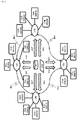
- FIG. 1 is a schematic view of a total structure of an IoT-based thing management system using block chain authentication, according to an embodiment of the present invention.
- the IoT-based thing management system using block chain authentication (hereinafter referred to as "thing management system”) is adapted to include a plurality of unit nodes ND1, ND2, ND3 and ND4 which are connected with each other through an internet 600, a mobile network 700, a Low Power Wide Area Network (hereinafter referred to as "LPWAN”) 500, a gateway (GW) 300 and 400 which may be included in or connect to the LPWAN 500, and the like.
- LPWAN Low Power Wide Area Network
- GW gateway
- the thing management system may further include a managing server 800 which may performs update, collection of data, or minimum-required management job.
- a managing server 800 which may performs update, collection of data, or minimum-required management job.
- the total thing management system can be adapted to be operated among or with the nodes ND1, ND2, ND3 and ND4.
- the total number of the unit nodes (hereinafter referred to as one of "unit node” or simply “node”) is showed to be four for convenience of the explanation, but in practice there may be countless nodes in the system and the number of nodes is not limited to a specific number.
- the nodes ND1, ND2, ND3 and ND4 may be different from each other in scales of involved constitutional elements or connections between the elements in the system.
- each node basically may be adapted to include a core C10, C20, C30 or C40 which has block chains, generates and provides unique public keys and unique private keys based on the previously existing block chains in the system; things D which are connected around the cores C10, C20, C30 or C40; and a controller CT10, CT20, CT30 or CT40 which provides control instructions such as an operation start, an operation stop, an operation time, an operation pattern and the like.
- a node ND1 (also, which may be referred to as "the first node”, and the other nodes will be referred to as in the similar way, hereinafter) is adapted to include a core C10 (also, which may be referred to as “the first core”, and the other cores will be referred to as in the similar way, hereinafter) around which three things D11, D12 and D13 (also which may be referred to as "the first thing, the second thing, and the third thing", and the other things will be referred to as in the similar way, hereinafter) are located and connect to the core C10 through wire lines.
- the node ND1 is adapted to include a controller CT10 (also which may be referred to as "the first controller", and the other controllers will be referred to as in the similar way, hereinafter) which may be a mobile terminal MT connected to the core C10 via a WiFi/BL (Bluetooth) Network 100 and an internet 600.
- a used terminology, mobile terminal (MT or MTCT10) may correspond to, all kinds of communication means such as, so called, "smart-phone", I-phone” and the like, which can be portable and capable of performing data communication.
- the mobile terminal MD can remotely control operation of target things D11, D12 and D13 from a remote site as long as the mobile terminal MD can reach the internet 600 via a wireless communication.
- the first node ND1 may be used, for good example, in thing management systems in environments such as a home or a building in which an internet is usually set up around and the involved things (or machines) can be easily connected to each other via wire lines.
- the things D11, D12 and D13 may correspond to, for example, an on-off valve of a gas supplying equipment, an electric heater, heating and cooling units, electric lamps, door locks, general home appliances or the like.
- the things may include, for example, general office equipments instead of home appliances.
- the second node ND2 is adapted to include a core C20 around which two things D21 and D22 are located and connect to the core C20 through wire lines and another thing D23 connects to the core 20 via a wireless communication such as a WiFi/Bluetooth network 200.
- the node ND2 is adapted to include a controller CT20 which may be a mobile terminal MT connected to the core C20 via a wireless communication such as a mobile network 700.
- the second node ND2 may be also applied to a general home or a general building in which a thing D23 may be connected via a short-range wireless network such as a WiFi/Bluetooth network 200.
- node ND2 may be applied to, for example, laptop computers, office equipments of wireless control type and the like which may be used in order to avoid inconvenience or cumbersome of wire lines. Further, the second node ND2 may be properly applied to an environment in which the controller CT20 cannot reach any internet via any means.
- the third node ND3 is adapted to include a core C30, a controller CT30 and things D31, D32 and D33 which are all connected to each other via wireless lines such as, so called, an LPWAN (Low Power Wide Area Network) 500 and a gateway 300 extended from the LPWAN 500.
- the LPWAN 500 may be very useful such that under the LPWAN, a short-range wireless communication distance of maximum 2Km can be provided in a downtown area, and another short-range wireless communication distance of more than 100Km provided in a field and mountain area or a farm area.
- License-Free Frequency Band that is, ISM (Industrial, Scientific, Medical) bands can be used, and thus, possible communication fees may be reduced.
- the LPWAN 500 Intrusion ability of radio wave is excellent and low power communication is available, and thus, in a farm area or a field and mountain area, even though sensors may be used for a long term (for example, one to five years), there is nothing to worry about drains of batteries mounted in the sensor modules. Accordingly, the LPWAN may be used in communications between one big building and another big building, or used in collecting an environment-related information data in a long-distance communication environment such as fields and mountains, and thus, the third node may be usefully applied to a farm area, small, middle or large scale factories, a large research complex, military equipments and the like.
- the third node has no limitation in configurations, locations, kinds of things and the like so that the third node may be applicable to very wide areas.
- the LPWAN 500 may include, for example, LoRaWANTM in USA, SigforTM in European, WeightlessTM of an open network style, the next generation technology LTE network and the like.
- the fourth node ND4 has a structure similar to the third node ND3. However, the fourth ND4 is different from the third node ND3 in that in the fourth node, a controller CT40 such as a computer or a PC (Personal Computer) and the like connects directly to the internet 600, and a core C40 connects to, or is integrally formed with, the controller CT40.
- the fourth node ND4 may be properly applied to environments in which the controller CT40 requires relatively bigger load, a controlling entity (or a user) is located in a room, and things D41, D42 and D43 are widely distributed through a field or a wide area.
- the fourth node ND4 may be properly operated in a military environment, a large scale factory, a reception center and the like.
- things D41, D42 and D43 may be located in a warfare field and a controlling headquarter may be located within a room in a barracks.
- the first to fourth nodes include exemplary specific numbers of cores, controllers and things for convenience's sake in the explanation, but the numbers is not limited thereto.
- the numbers is not limited thereto.
- two cores and a plurality of controller may be used.
- Fig. 2 is a schematic view of a process of the block chain authentication, according to an embodiment of the present invention. The process of the block chain authentication will be described, mainly based on the first core C10.
- the authentication techniques of both the controllers and things are identical, and thus, only the control instruction of the controller may be used to apply the block chain authentication to the system. Further, although only the controller may be authenticated through the block chain authentication technique, there is no problem in the security of the system (because the things do not response to anything without a control instruction from the controller). Accordingly, it may be also preferable to authenticate only the controllers with the block authentication technique in light of reduction of processing load in the system.
- a public key and a corresponding private key may be periodically and automatically renewed, or intentionally renewed according to a user's necessity.
- the memory storing public keys and private keys may include EEPROM, S-RAM and the like which are nonvolatile and capable of providing both of reading and writing functions.
- the authentication technique by which public keys and private keys are periodically renewed to things and data of the renewed public keys and private keys are reflected on the block chain is one of novel features of the present invention over the authentication of the existing bitcoin block chain.
- n+1 block chain is approved to be valid from the nodes of the effective numbers among all of the nodes. Therefore, after this, in a case where the hash block representing n+2-th block is generated, the n+1 block chain is a reference for providing validity to the n+2-th block.
- the process of Fig. 2 there is no any entity except for only the first controller and the first thing that sequentially generate the unique control instruction and the unique response signal. If a bad outsider tries to impair the validity of the first controller, it is required to decrypt and fake all of the past block hash encryptions, which is excessively time-consuming and totally impractical.
- Fig. 3 is a schematic view showing structures and connection relationships among a core, a controller and a managing server, which are involved in the block chain authentication, according to an embodiment of the present invention.
- a core C is generally included in each node D and basically may includes a block chain portion C1 which commonly stores, manages and renews block chains representing operation histories of controllers CT and things D of the corresponding node, and other operation histories of controllers CT and things D of other nodes, a key generating portion C2 which generates public keys and private keys of the controller CT and the things D in the node ND, a core's storage portion C3 which has an operation memory and an operation program of the core C, a core's controlling portion C4 which determines if approving a block hash and controls each constitutional element, a wire or wireless link portion C5 which is used for a communication with other constitutional elements, and a thing recording portion C6 which records functional characteristics and control characteristics of things and controllers included in a unit node.
- a block chain portion C1 which commonly stores, manages and renews block chains representing operation histories of controllers CT and things D of the corresponding node, and other operation histories of controllers CT and things D of other nodes
- the controller may include a mobile terminal (for example, a smart phone and the like), a computer (for example, a personal computer and the like), a mobile or fixed controller of a wire or wireless type having a user interface, and the like. And thus, the controller has a CPU or an MPU, operates with an independent application program in itself to control the operations of things D, and is capable of communicating with other nodes through a core C in a wire or wireless mode.
- the controller may be located in a home and a building or an outside field in the influence area of a node in which communication between nodes is also available.
- the controller CT basically includes a key managing portion CT1 which has a list including the controller's own public key and private key and other things' private keys and public keys such that the controller CT may send a control instruction to a thing and the thing also may send a response thereto within the node.
- the controller CT may have constitutional elements that include an operation selecting portion CT2 which can select one of operation kinds of things (and which may be an interface or app for letting a person select the kinds of operation) (The kinds of operation may include operation start, stop, operation time, strength (degree) of operation, an operation for providing data of current state information such as battery state, heat degree, operation speed and the like).
- the constitutional elements of the controller CT may further include a storage portion CT3 which stores an operational program of the controller CT and various kinds of data therein, a hash generating portion CT4 for making encryption, a CT's controller CT5 which controls each constitutional elements within the controller or has a function for analyzing and determining data of the storage portion CT3, and a wire or wireless link portion C6 which is used for a communication with other outside entities.
- the wire or wireless link portion CT6 may properly include an internet, a mobile communication network, an LPWAN and the like, according to hardware and application programs (app) of the controller.
- a thing D is basically similar to a controller in function, but there may be a difference between the thing D and the controller in a parameter portion D2 of the thing D and the operation selecting portion CT2 of the controller CT.
- the parameter portion D2 may collect effective data of things from sensors or provide parameters for representing operation characteristics of things to controlling portions of things D or the controller CT so that the controlling portions or the controllers may analyze and determine the received data using the parameter materials.
- Both of the controller CT and the thing D may be adapted to include, for example, an MPU, or an independent one-chip processor which includes a processor (CPU) and a memory, I/O, a wire or wireless communication portion and the like.
- the controller CT may be structured by a mobile terminal or a PC.
- the controller may be structured mainly by software functioning as a user interface in the form of an app program and a hardware resource itself of a mobile terminal or a PC.
- the managing server 800 may include a data collecting portion S1 which collects various kinds of data generated in the thing management system, a database S2 which manages various kinds of data of the system, and a system managing portion S4 which performs updating, system operating, billing and the like.
- the major operations of the thing management system are automatically and independently performed in the system, and the data collecting portion may be adapted to include a distributed structure such that the constitutional elements of the data collecting portions are widely distributed in each node.
- the managing server 800 of the present invention may not positively control all of the thing management system but may perform an auxiliary function for managing of a minimum required load essentially necessary in the system. More specifically, even without the managing server 800, the thing management system may be adapted to be operated in the main function by itself.
- communication lines COML1, COML2, COML3 and COML4 may include any one of wire lines, wireless lines, short-range communication lines or long-range communication lines.
- Fig. 4 is a flow chart showing an IoT-based thing management method using IoT-based thing management system, according to an embodiment of the present invention.
- the first core C10, the first thing D11 and the first controller CT10 in Fig. 2 are mainly focused for a brief description.
- Step S9 instead of the managing server 800, a specific node (a node which firstly decrypts an arithmetic code) may generate and record the n+1 block chain to be spread. This case is more preferable, particularly, because the management operation of the managing server 800 can be removed in this process.
- the present invention may be applied to not only homes, buildings, research centers, farms, factories and military fields, but also, a system for monitoring the disadvantaged such as a senior citizen who lives alone, a recipient of a death program who lives alone, or anyone who needs caring or monitoring of daily life and preventing solitary deaths of them.
- the system for the disadvantaged may be provided in homes, reception centers and the like which may include electrical power supplying equipments, piped water supplying facilities, gas supplying facilities, home appliances such as TVs, refrigerators and the like, and basic life pipeline measurement equipments, from which data may be monitored and collected by officers in charge of a public institution or a health center or a medical institution.
- the present invention can provide a solution for fundamentally preventing any bad communication intruder from intervening or intruding into the system during processing of the monitoring and collecting.
Landscapes
- Engineering & Computer Science (AREA)
- Computer Security & Cryptography (AREA)
- Computer Networks & Wireless Communication (AREA)
- Signal Processing (AREA)
- Computing Systems (AREA)
- Theoretical Computer Science (AREA)
- Computer Hardware Design (AREA)
- General Engineering & Computer Science (AREA)
- Telephonic Communication Services (AREA)
- Mobile Radio Communication Systems (AREA)
- Health & Medical Sciences (AREA)
- General Health & Medical Sciences (AREA)
- Medical Informatics (AREA)
- Power Engineering (AREA)
Claims (14)
- IoT-basiertes Dinge-Verwaltungssystem, das eine Blockchain-Authentifizierung verwendet, bei der eine Vielzahl von Einheitsknoten (ND1, ND2, ND3, ND4) über ein drahtgebundenes Kommunikationsnetzwerk und/oder ein Drahtloskommunikationsnetzwerk miteinander verbunden sind, in den Einheitsknoten jeweils Dinge (D11, D12, D13, D21, D22, D23, D31, D32, D33, D41, D42, D43) miteinander verbunden sind, und Steuerbefehle zum Veranlassen des Betreibens der Dinge durch die Vielzahl von Einheitsknoten wechselseitig authentifiziert werden, um die Gültigkeit der Befehle zu bestätigen,
wobei die Einheitsknoten (ND1, ND2, ND3, ND4) jeweils umfassen:eine Vielzahl von Dingen (D11, D12, D13, D21, D22, D23, D31, D32, D33, D41, D42, D43), die direkt oder indirekt mit dem drahtgebundenen Kommunikationsnetzwerk und/oder dem Drahtloskommunikationsnetzwerk verbunden sind, wobei die Dinge jeweils individuelle Funktionen getrennt durchführen, undein Kern (C10, C20, C30, C40), der eine n-Blockchain mit n Blöcken enthält, auf denen Betriebsgeschichten der Dinge aufgezeichnet sind, wobei n eine natürliche Zahl ist, wobei die Blöcke einer nach dem anderen in der Form einer Kette verknüpft sind, und der Kern zur Erzeugung eindeutiger öffentlicher Schlüssel und eindeutiger privater Schlüssel beruhend auf der n-Blockchain und Bereitstellung der erzeugten Schlüssel für jedes der Dinge eingerichtet ist,wobei eines der Vielzahl der Dinge eine Steuereinrichtung (CT10, CT20, CT30, CT40) enthält, die eine Liste von vom Kern bereitgestellten öffentlichen Schlüsseln aufweist, die öffentlichen Schlüssel jeweils für die jeweiligen Dinge eindeutig sind, die Steuereinrichtung zum Senden eines Steuerbefehls, in den der private Schlüssel der Steuereinrichtung kombiniert ist, zu einem Ding eingerichtet ist, dessen öffentlicher Schlüssel durch die Steuereinrichtung aus der Liste der öffentlichen Schlüssel ausgewählt ist, um Funktionen des Dings beruhend auf dem gesendeten Steuerbefehl zu steuern, und das Ding zum Senden eines Antwortsignals zu der Steuereinrichtung, in das der private Schlüssel des Dings kombiniert ist, im Ansprechen auf den Steuerbefehl und Durchführung einer Funktion gemäß dem Steuerbefehl eingerichtet ist, undwobei der Steuerbefehl, in den der private Schlüssel der Steuereinrichtung kombiniert ist, und/oder das Antwortsignal, in das der private Schlüssel des Dings kombiniert ist, einen n+l-ten Block enthält, der einen Block-Hash aufweist, der einen verschlüsselten Hash des effektiven n-ten Blocks enthält, der n+l-te Block zu den Knoten verteilt wird, und der n-te Block-Hash durch die Vielzahl von Knoten zuvor genehmigt und bestätigt wird. - System nach Anspruch 1, wobei die Steuereinrichtung ein mobiles Endgerät, einen Computer oder ein unabhängiges Modul mit einem Mikroprozessor, einem Speicher und einem darin installierten Steuerprogramm enthält, und
wobei der Kern in einem Knoten angeordnet ist, oder in einer Steuereinrichtung, einem mobilen Endgerät oder einem Computer derart angeordnet ist, dass der Kern mit anderen Kernen über das drahtgebundene Kommunikationsnetzwerk oder das Drahtloskommunikationsnetzwerk verbunden werden kann, indem ein Teil von Ressourcen der Steuereinrichtung, des mobilen Endgeräts oder des Computers verwendet wird. - System nach Anspruch 2, wobei zumindest ein Teil der Knoten zum Senden eines Genehmigungsbestätigungssignals zum Genehmigen eines dem verteilten Block-Hash entsprechenden n+l-ten Blocks zu anderen Knoten eingerichtet ist, und das Genehmigungsbestätigungssignal durch den jeweiligen Knoten auf der Grundlage der n-Blockchain erzeugt wird, die jeder Knoten besitzt, und wobei die öffentlichen Schlüssel und die privaten Schlüssel in den Dingen automatisch und periodisch erneuert werden.
- System nach Anspruch 3, wobei in einem Fall, wenn die Anzahl der Genehmigungsbestätigungssignale, die durch die Knoten bereitgestellt werden, eine vorbestimmte Anzahl erreicht, der dem Block-Hash entsprechende n+l-te Block mit der n-Blockchain verknüpft und in ihr aufgezeichnet wird, um schließlich eine n+1-Blockchain derart zu erzeugen, dass die erzeugte n+1-Blockchain zu allen Knoten verteilt wird und die n-Blockchain erneuert wird, um in die n+1-Blockchain geändert zu werden.
- System nach Anspruch 4, wobei die Steuerbefehle und/oder die Antwortsignale eine Ausgabezeit enthalten, und die Erzeugung des Block-Hashs durch eine Steuereinrichtung oder ein Ding durchgeführt wird.
- System nach Anspruch 1, wobei das drahtgebundene Kommunikationsnetzwerk Internet enthält, und das Drahtloskommunikationsnetzwerk mobile Netzwerke und/oder ein Low Power Wide Area Network, LPWAN, enthält.
- System nach einen der Ansprüche 1 bis 5, wobei der Knoten ein Dinge-System in einem Heim oder einem Auffangzentrum enthält, und das Dinge-System Zustände der Alten und Schwachen oder einer gehandicapten Person auf der Grundlage von Betriebsgeschichte-Mustern jedes Dings in dem Heim oder dem Auffangzentrum herausfinden kann.
- System nach einem der Ansprüche 1 bis 5, wobei der Knoten eines von Dinge-Systemen in Heimen, Gebäuden, Farmen, Fabriken, Verteilungsfeldern, Straßen oder Feld und Gebirge enthält, und zumindest einer der Knoten eine Drohne, ein Auto oder einen Smartpalm als Ding enthält.
- IoT-basiertes Dinge-Verwaltungsverfahren, das ein IoT-basiertes Dinge-Verwaltungssystem verwendet, das eine Blockchain-Authentifizierung verwendet, bei der eine Vielzahl von Einheitsknoten über ein drahtgebundenes Kommunikationsnetzwerk und/oder ein Drahtloskommunikationsnetzwerk miteinander verbunden sind, Dinge in den Einheitsknoten jeweils miteinander verbunden sind, und Steuerbefehle zur Veranlassung einer Betätigung der Dinge durch die Vielzahl von Einheitsknoten zum Bestätigen der Gültigkeit der Befehle wechselseitig authentifiziert werden,
wobei das IoT-basierte-Dinge-Verwaltungssystem umfasst: eine Vielzahl von Dingen, die direkt oder indirekt mit dem drahtgebundenen Kommunikationsnetzwerk und/oder dem Drahtloskommunikationsnetzwerk verbunden sind, wobei die Dinge jeweils individuelle Funktionen getrennt durchführen, einen Kern, der eine n-Blockchain mit n Blöcken enthält, auf denen Betriebsgeschichten der Dinge aufgezeichnet sind, wobei n eine natürliche Zahl ist, wobei die Blöcke einer nach dem anderen in der Form einer Kette verknüpft sind, und der Kern eindeutige öffentliche Schlüssel und eindeutige private Schlüssel beruhend auf der n-Blockchain erzeugt und den jeweiligen Dingen die erzeugten Schlüssel bereitstellt, und eine Steuereinrichtung, die Funktionen der Vielzahl der Dinge steuert, wobei das Verfahren umfasst:Erzeugen (S1) eindeutiger öffentlicher Schlüssel und privater Schlüssel durch den Kern beruhend auf einer n-Blockchain, individuelles Zuweisen der erzeugten Schlüssel zu den Dingen und der Steuereinrichtung und Bereitstellen einer Liste der öffentlichen Schlüssel und entsprechenden privaten Schlüssel für die Dinge und die Steuereinrichtung,Kombinieren (S2) eines Steuerbefehls mit dem privaten Schlüssel der Steuereinrichtung und dem öffentlichen Schlüssel eines ersten Dings als Steuerziel durch die Steuereinrichtung und Bereitstellen des resultierenden Steuerbefehls zu dem ersten Ding, undBestätigen (S3) einer Gültigkeit des Steuerbefehls unter Verwendung des privaten Schlüssels des ersten Dings durch das erste Ding und Senden (S4) eines Antwortsignals zu der Steuereinrichtung, in das der private Schlüssel des ersten Dings kombiniert ist, als Antwort auf den Steuerbefehl und Durchführen eines Vorgangs gemäß dem Steuerbefehl,wobei der Steuerbefehl, in den der private Schlüssel der Steuereinrichtung kombiniert ist, und/oder das Antwortsignal, in das der private Schlüssel des Dings kombiniert ist, einen n+l-ten Block enthält, der einen Block-Hash aufweist, der einen verschlüsselten Hash des effektiven n-ten Blocks enthält, wobei der n+l-te Block zu den Knoten verteilt wird, und der n-te Block-Hash zuvor durch die Vielzahl von Knoten genehmigt und bestätigt wird. - Verfahren nach Anspruch 9, wobei die Steuereinrichtung ein mobiles Endgerät, einen Computer oder ein unabhängiges Modul mit einem Mikroprozessor, einem Speicher und einem darauf installierten Steuerprogramm enthält, und
wobei der Kern in einem Knoten angeordnet ist, oder in einer Steuereinrichtung, einem mobilen Endgerät oder einem Computer derart angeordnet ist, dass der Kern mit anderen Kernen über das drahtgebundene Kommunikationsnetzwerk oder das Drahtloskommunikationsnetzwerk unter Verwendung eines Teils von Ressourcen der Steuereinrichtung, des mobilen Endgeräts oder des Computers verbunden werden kann. - Verfahren nach Anspruch 10, wobei die Steuersignale und/oder die Antwortsignale eine Ausgabezeit enthalten, und die Erzeugung des Block-Hashs durch eine Steuereinrichtung oder ein Ding durchgeführt wird.
- Verfahren nach Anspruch 9, wobei das drahtgebundene Kommunikationsnetzwerk Internet enthält, und das Drahtloskommunikationsnetzwerk mobile Netzwerke und/oder ein Low Power Wide Area Network, LPWAN, enthält.
- Verfahren nach einem der Ansprüche 9 bis 12, wobei der Knoten ein Dinge-System in einem Heim oder einem Auffangzentrum enthält, und das Dinge-System Zustände der Alten und Gebrechlichen oder einer gehandicapten Person beruhend auf Betriebsgeschichte-Mustern jedes Dings in dem Heim oder dem Auffangzentrum herausfinden kann.
- Verfahren nach einem der Ansprüche 9 bis 12, wobei der Knoten eines von Dinge-Systemen in Heimen, Gebäuden, Farmen, Fabriken, Verteilungsfeldern, Straßen oder Feld und Gebirge enthält, und zumindest einer der Knoten eine Drohne, ein Auto oder einen Smartpalm als Ding enthält.
Applications Claiming Priority (2)
| Application Number | Priority Date | Filing Date | Title |
|---|---|---|---|
| KR1020150168483A KR101678795B1 (ko) | 2015-11-30 | 2015-11-30 | 블록체인 인증을 이용하는 IoT 기반 사물 관리 시스템 및 방법 |
| PCT/KR2016/012768 WO2017095036A1 (ko) | 2015-11-30 | 2016-11-08 | 블록체인 인증을 이용하는 IoT 기반 사물 관리 시스템 및 방법 |
Publications (3)
| Publication Number | Publication Date |
|---|---|
| EP3386142A1 EP3386142A1 (de) | 2018-10-10 |
| EP3386142A4 EP3386142A4 (de) | 2019-04-10 |
| EP3386142B1 true EP3386142B1 (de) | 2020-03-04 |
Family
ID=57540187
Family Applications (1)
| Application Number | Title | Priority Date | Filing Date |
|---|---|---|---|
| EP16870932.7A Active EP3386142B1 (de) | 2015-11-30 | 2016-11-08 | Iot-basiertes dingeverwaltungssystem und -verfahren unter verwendung von blockchain-authentifizierung |
Country Status (5)
| Country | Link |
|---|---|
| US (1) | US10708069B2 (de) |
| EP (1) | EP3386142B1 (de) |
| JP (1) | JP6601828B2 (de) |
| KR (1) | KR101678795B1 (de) |
| WO (1) | WO2017095036A1 (de) |
Families Citing this family (136)
| Publication number | Priority date | Publication date | Assignee | Title |
|---|---|---|---|---|
| US9973341B2 (en) * | 2015-01-23 | 2018-05-15 | Daniel Robert Ferrin | Method and apparatus for the limitation of the mining of blocks on a block chain |
| US10979410B1 (en) | 2015-05-04 | 2021-04-13 | United Services Automobile Association (Usaa) | Systems and methods for utilizing cryptology with virtual ledgers in support of transactions and agreements |
| US9855785B1 (en) | 2016-04-04 | 2018-01-02 | Uipco, Llc | Digitally encoded seal for document verification |
| US10257270B2 (en) | 2016-04-26 | 2019-04-09 | International Business Machines Corporation | Autonomous decentralized peer-to-peer telemetry |
| US11854011B1 (en) | 2016-07-11 | 2023-12-26 | United Services Automobile Association (Usaa) | Identity management framework |
| EP3491611A1 (de) * | 2016-07-29 | 2019-06-05 | Nchain Holdings Limited | Blockchain-implementiertes verfahren und system |
| EP3497908B1 (de) * | 2016-08-12 | 2020-10-21 | Intel Corporation | Weitbereichsinternetprotokollkommunikation mit niedriger leistung |
| US11050763B1 (en) | 2016-10-21 | 2021-06-29 | United Services Automobile Association (Usaa) | Distributed ledger for network security management |
| US11671999B2 (en) * | 2016-12-12 | 2023-06-06 | Dell Products, Lp | Method and apparatus for context aware concurrent data transmission scheduling for pan radio technology |
| US11392947B1 (en) * | 2017-02-27 | 2022-07-19 | United Services Automobile Association (Usaa) | Distributed ledger for device management |
| CN107423152B (zh) * | 2017-04-24 | 2019-05-21 | 杭州趣链科技有限公司 | 一种区块链共识节点自动恢复方法 |
| KR101919590B1 (ko) * | 2017-05-10 | 2019-02-08 | 주식회사 코인플러그 | 블록체인 데이터베이스 및 이와 연동하는 머클 트리 구조를 통해 사물 인터넷 기기에 대한 비용을 결제하는 방법, 이를 이용한 서버, 서비스 제공 단말, 및 사용자 전자 지갑 |
| CN107194666A (zh) * | 2017-05-19 | 2017-09-22 | 中链科技有限公司 | 基于区块链技术的报表管理方法和终端设备 |
| EP3631720A1 (de) * | 2017-05-26 | 2020-04-08 | Nchain Holdings Limited | Scriptbasierte blockchain-interaktion |
| KR101851261B1 (ko) * | 2017-06-09 | 2018-04-23 | 씨토 주식회사 | 사설 블록체인 데이터 기반 중앙집중형 원격검침 보안시스템 |
| KR101972109B1 (ko) * | 2017-06-16 | 2019-04-25 | 서강대학교산학협력단 | 비공개적 분산형 데이터베이스 네트워크 환경에서의 브로드캐스팅을 이용한 계약 참조 방식의 스마트 가로등 시스템 및 제어 방법 |
| CN109218268A (zh) * | 2017-07-05 | 2019-01-15 | 中国银联股份有限公司 | 基于区块链结构的安全性数据交互系统及方法 |
| JP2019028549A (ja) * | 2017-07-26 | 2019-02-21 | 株式会社デンソー | 台帳管理ノード、台帳管理システム、車載の情報提供装置 |
| US11138322B2 (en) | 2017-08-01 | 2021-10-05 | Visa International Service Association | Private data processing |
| CN110998572B (zh) | 2017-08-04 | 2023-05-05 | 京镐渊 | 基于时间依赖性区块链的自验证用户认证方法 |
| US20190044609A1 (en) * | 2017-08-04 | 2019-02-07 | Walmart Apollo, Llc | Systems, devices, and methods for relaying communications using autonomous drones |
| WO2019028389A1 (en) | 2017-08-04 | 2019-02-07 | Walmart Apollo, Llc | SYSTEMS, DEVICES AND METHODS FOR GENERATING A DYNAMIC THREE-DIMENSIONAL COMMUNICATION CARD |
| CN107610279B (zh) * | 2017-08-11 | 2020-05-05 | 北京云知科技有限公司 | 一种车辆启动控制系统、方法和智能钥匙 |
| KR102041341B1 (ko) | 2017-09-14 | 2019-11-27 | 숭실대학교산학협력단 | 블록체인을 이용한 사물인터넷 보안 시스템 및 보안 방법 |
| KR102042739B1 (ko) | 2017-09-22 | 2019-11-08 | 서강대학교산학협력단 | 블록체인을 이용한 메시지 히스토리 기반의 보안 키를 이용하는 통신 장치 및 방법 |
| KR102024991B1 (ko) * | 2017-09-26 | 2019-11-04 | 한양대학교 산학협력단 | 이동체 기기 및 이의 데이터 전송 방법 |
| CN107665405B (zh) * | 2017-09-26 | 2021-04-20 | 北京邮电大学 | 一种车辆信誉管理方法及装置 |
| US10682981B2 (en) | 2017-10-11 | 2020-06-16 | Uniquid, Inc. | Systems and methods for networked device security |
| KR102452271B1 (ko) * | 2017-10-23 | 2022-10-06 | 지멘스 악티엔게젤샤프트 | 디바이스들을 제어 및/또는 모니터링하기 위한 방법 및 제어 시스템 |
| KR101936080B1 (ko) * | 2017-10-26 | 2019-04-03 | 순천향대학교 산학협력단 | 안전한 스마트 홈 환경을 위한 ksi 기반 인증 및 통신 방법 및 이를 위한 시스템 |
| EP3704606A1 (de) * | 2017-11-02 | 2020-09-09 | Nchain Holdings Limited | Computerimplementierte systeme und verfahren zum verbinden einer blockchain mit einem satz digitaler zwillinge |
| KR102472362B1 (ko) * | 2017-11-06 | 2022-11-29 | 주식회사 케이티 | 블록 체인 기반 사물 인터넷 장치 제어 시스템 및 방법 |
| US10798541B2 (en) | 2017-11-07 | 2020-10-06 | Pica Product Development, Llc | Systems, methods and devices for remote trap monitoring |
| US10909830B1 (en) * | 2017-11-07 | 2021-02-02 | Pica Product Development, Llc | Personal emergency alert system, method and device |
| US10694338B2 (en) | 2017-11-07 | 2020-06-23 | Pica Product Development, Llc | Cellular automated external defibrillator (AED) tracker |
| CN109818993B (zh) * | 2017-11-20 | 2021-08-24 | 西南交通大学 | 一种高效的区块链共识与交换系统 |
| CN108022100B (zh) * | 2017-11-29 | 2020-07-21 | 江苏安凰领御科技有限公司 | 一种基于区块链技术的交叉认证系统及方法 |
| KR101968424B1 (ko) * | 2017-12-08 | 2019-04-11 | 인제대학교 산학협력단 | 블록 체인 컨트롤러를 이용한 인증 시스템 및 방법 |
| KR102030905B1 (ko) * | 2017-12-08 | 2019-10-10 | 인제대학교 산학협력단 | 블록 체인 시스템 아키텍쳐 및 방법 |
| KR102050154B1 (ko) * | 2018-01-12 | 2019-11-28 | 인제대학교 산학협력단 | 블록 체인을 이용한 공급 체인 네트워크 시스템 및 방법 |
| WO2019112193A1 (ko) * | 2017-12-08 | 2019-06-13 | 인제대학교 산학협력단 | 블록 체인 시스템 아키텍쳐 및 방법 |
| US11170092B1 (en) | 2017-12-14 | 2021-11-09 | United Services Automobile Association (Usaa) | Document authentication certification with blockchain and distributed ledger techniques |
| KR102005111B1 (ko) | 2017-12-20 | 2019-07-29 | 주식회사 유니로보틱스 | 블록체인시스템을 이용한 사물간 재화 또는 서비스 제공방법 |
| WO2019139237A1 (ko) * | 2018-01-12 | 2019-07-18 | 인제대학교 산학협력단 | 트랜잭션 가치 추산을 통한 블록체인 참여 제어 시스템 |
| KR102050153B1 (ko) * | 2018-01-12 | 2019-11-28 | 인제대학교 산학협력단 | 트랜잭션 가치 추산을 통한 블록체인 콘트롤러 참여 제어 시스템 |
| US11122500B2 (en) * | 2018-01-16 | 2021-09-14 | Cisco Technology, Inc. | Using a blockchain for optimized fast-secure roaming on WLANs |
| CN110086755B (zh) | 2018-01-26 | 2022-06-21 | 巍乾全球技术有限责任公司 | 实现物联网服务的方法、应用服务器、物联网设备和介质 |
| KR102005177B1 (ko) * | 2018-02-07 | 2019-07-29 | 동국대학교 경주캠퍼스 산학협력단 | 이동체 정보 보안 방법 및 이를 이용한 이동체 정보 보안 시스템 |
| KR102454398B1 (ko) | 2018-02-19 | 2022-10-14 | 한국전자통신연구원 | 분산형 소프트웨어 정의 네트워킹 방법 및 장치 |
| KR102042339B1 (ko) | 2018-02-23 | 2019-11-07 | 에이치닥 테크놀로지 아게 | 블록체인 시스템을 이용한 기기들간 암호화 통신 방법 및 시스템 |
| US10681020B2 (en) * | 2018-03-12 | 2020-06-09 | The Boeing Company | Blockchain fortified aircraft communications addressing and reporting system (ACARS) communication |
| KR102078913B1 (ko) | 2018-03-16 | 2020-04-07 | 주식회사 아도스 | Pki 기반의 사물인터넷 기기 인증방법 및 인증시스템 |
| US11146545B2 (en) * | 2018-03-27 | 2021-10-12 | Exosite LLC | Apparatus and method for establishing secured connection |
| KR102050560B1 (ko) * | 2018-03-28 | 2020-01-08 | (주)자람테크놀로지 | IoT 단말을 위한 저전력 통신 장치 및 방법 |
| CN108632293B (zh) * | 2018-05-16 | 2021-08-06 | 山东建筑大学 | 基于区块链技术的建筑设备物联网系统与方法 |
| CN108492550B (zh) * | 2018-05-17 | 2020-01-31 | 浪潮集团有限公司 | 基于区块链的v2x高速车队自组织系统 |
| US10693716B2 (en) | 2018-05-29 | 2020-06-23 | At&T Mobility Ii Llc | Blockchain based device management |
| KR102617352B1 (ko) | 2018-06-04 | 2023-12-26 | 삼성전자주식회사 | 블록체인을 이용하는 사용자 장치, 이를 포함하는 블록체인 시스템 및 그것의 제품 정보 관리 방법 |
| CN108810007B (zh) * | 2018-06-26 | 2020-11-17 | 东北大学秦皇岛分校 | 一种物联网安全架构 |
| KR102120328B1 (ko) * | 2018-07-04 | 2020-06-08 | 충북대학교 산학협력단 | Ecc 공개키 방식과 해시 값을 이용한 사용자 인증 방법 |
| KR102138683B1 (ko) | 2018-07-12 | 2020-07-28 | 주식회사 에치에프알 | 블록체인 기반의 집단지성 무선랜 제어시스템 |
| US11201751B2 (en) * | 2018-07-18 | 2021-12-14 | iComply Investor Services Inc. | System and method for off-chain cryptographic transaction verification |
| CN108574699B (zh) * | 2018-07-20 | 2021-07-06 | 广东工业大学 | 一种通信连接方法、系统及物联网设备系统和存储介质 |
| US10887082B2 (en) | 2018-07-24 | 2021-01-05 | Vmware, Inc. | Internet of things blockchain auditing |
| KR102081274B1 (ko) * | 2018-07-25 | 2020-02-25 | (주)유비벨록스모바일 | 블록체인망을 이용한 iot 가전 상태 관제 시스템 |
| CN108881494B (zh) * | 2018-08-10 | 2021-06-29 | 三门峡速达交通节能科技股份有限公司 | 基于车载网络和区块链的安全信息传输方法 |
| US11112132B2 (en) * | 2018-08-22 | 2021-09-07 | Bao Tran | Systems and methods for monitoring water in a building |
| US10270770B1 (en) * | 2018-08-23 | 2019-04-23 | Xage Security, Inc. | Generic computing device attestation and enrollment |
| KR102189843B1 (ko) * | 2018-09-14 | 2020-12-11 | 류근웅 | 병렬형 블록체인 기반 정보 관리 및 운영 시스템 |
| CN109359479B (zh) * | 2018-09-21 | 2019-12-31 | 北京非对称区块链科技有限公司 | 证书生成和验证的方法、装置、存储介质及电子设备 |
| CN109346186A (zh) * | 2018-09-26 | 2019-02-15 | 东莞方凡智能科技有限公司 | 基于区块链的健康检测数据采集及管理系统 |
| CN111045690B (zh) * | 2018-10-12 | 2023-04-28 | 阿里巴巴集团控股有限公司 | 区块链节点服务部署方法、装置、系统、计算设备及介质 |
| KR102131292B1 (ko) * | 2018-10-19 | 2020-07-07 | 빅픽처랩 주식회사 | 블록체인 기반 신뢰도 정보 관리방법 |
| KR102009160B1 (ko) * | 2018-10-19 | 2019-08-09 | 빅픽처랩 주식회사 | 블록체인 기반 정보 트러스트 엔진 시스템 |
| KR102023749B1 (ko) * | 2018-10-25 | 2019-09-24 | 강원도 횡성군 | 소 관리 오픈 플랫폼 시스템 |
| KR102732485B1 (ko) | 2018-11-01 | 2024-11-21 | 현대자동차주식회사 | 블록체인 기반의 교통 정보 처리 방법 및 시스템 |
| CN109302415B (zh) * | 2018-11-09 | 2019-11-01 | 四川虹微技术有限公司 | 一种认证方法、区块链节点及存储介质 |
| DE102018128219B3 (de) | 2018-11-12 | 2019-12-05 | Schuler Pressen Gmbh | System mit mehreren als Blockchain organisierten Systemteilnehmern und mit Blockchain-Umschaltung |
| KR102222660B1 (ko) * | 2018-11-27 | 2021-03-04 | 김성호 | 온라인 통합 컨텐츠 커뮤니티 플랫폼 및 소비자 활동보상 시스템 |
| KR101997673B1 (ko) * | 2018-12-06 | 2019-07-08 | 주식회사 푸시풀시스템 | 가상 블록체인을 갖는 듀얼 블록체인 기반의 디지털 전자기기 |
| KR101992981B1 (ko) * | 2018-12-07 | 2019-06-25 | 한전케이디엔 주식회사 | IoT 허브와 블록체인을 활용한 IoT 플랫폼 시스템 |
| EP3672159A1 (de) * | 2018-12-19 | 2020-06-24 | Orange | Internet-der-dinge-konnektivitätsvorrichtung und -verfahren |
| KR102177794B1 (ko) | 2018-12-26 | 2020-11-12 | 서강대학교 산학협력단 | 사물인터넷 블록체인 환경에서의 디바이스 분산 인증 방법 및 이를 이용한 디바이스 분산 인증 시스템 |
| KR20200081533A (ko) | 2018-12-27 | 2020-07-08 | 서강대학교산학협력단 | 사물 인터넷 환경을 위한 동적 블라인드 투표기반의 블록체인 합의방법 |
| WO2020148250A1 (en) * | 2019-01-14 | 2020-07-23 | Signify Holding B.V. | Method of and device for operating a node device in a communication network based on chained datablock technology |
| KR20200088740A (ko) | 2019-01-15 | 2020-07-23 | 한국전자통신연구원 | 키오스크를 이용한 서비스 제공 방법 및 장치 |
| CN109769024A (zh) * | 2019-01-18 | 2019-05-17 | 东喜和仪(珠海市)数据科技有限公司 | 基于数据交易区块链的物联网构建方法和装置 |
| KR101976626B1 (ko) | 2019-01-21 | 2019-05-09 | 애니팬 주식회사 | 블록체인에 기반한 스마트 팩토리 구현을 위한 인공지능 IIoT 시스템 |
| KR101983652B1 (ko) | 2019-01-21 | 2019-05-29 | 애니팬 주식회사 | 블록체인에 기반한 인공지능 IoT 시스템 |
| KR102243182B1 (ko) * | 2019-01-23 | 2021-04-22 | (주)티비스톰 | 인공지능 개체에 대한 정보를 블록체인으로 관리하는 방법 및 그 플랫폼 |
| KR102170454B1 (ko) * | 2019-01-29 | 2020-10-28 | 주식회사 크로스앵글 | 블록체인 상의 정보를 제공하는 방법 및 장치 |
| KR101975213B1 (ko) | 2019-02-14 | 2019-05-07 | 해치랩스 주식회사 | 블록체인 스마트 컨트랙트에 기반하여 수행된 거래의 무결성을 검증하는 시스템 |
| KR101973632B1 (ko) | 2019-02-14 | 2019-04-29 | 해치랩스 주식회사 | 블록체인 스마트 컨트랙트의 검증을 수행하는 시스템 |
| KR101973629B1 (ko) | 2019-02-14 | 2019-04-29 | 해치랩스 주식회사 | 블록체인 기반 서비스의 검증을 수행하는 시스템 |
| KR20200106604A (ko) | 2019-03-05 | 2020-09-15 | 정상국 | 블록체인 기반의 합의 알고리즘에서 대표자 선정방법 |
| KR20200106603A (ko) | 2019-03-05 | 2020-09-15 | 정상국 | 블록체인 기반의 블록데이터 분산 저장방법 |
| KR20200106605A (ko) | 2019-03-05 | 2020-09-15 | 정상국 | 블록체인 기반의 합의 알고리즘에서 이중 합의방법 |
| US11456880B2 (en) | 2019-03-25 | 2022-09-27 | Micron Technology, Inc. | Cryptographically secure mechanism for remotely controlling an autonomous vehicle |
| US11128451B2 (en) | 2019-03-25 | 2021-09-21 | Micron Technology, Inc. | Remotely managing devices using blockchain and DICE-RIoT |
| KR102023094B1 (ko) | 2019-03-26 | 2019-09-19 | 국방과학연구소 | 블록체인 네트워크를 이용한 무인비행체 임무계획 관리 시스템 및 방법 |
| KR102037848B1 (ko) * | 2019-03-27 | 2019-10-29 | 주식회사 푸시풀시스템 | 가상 블록체인을 갖는 듀얼 블록체인 기반의 디지털 전자기기 운용 방법 |
| CN109995594B (zh) * | 2019-04-10 | 2022-06-24 | 广州致链科技有限公司 | 区块链网络资源管理方法、装置及区块链系统 |
| WO2020213125A1 (ja) | 2019-04-18 | 2020-10-22 | 三菱電機株式会社 | 入退管理システム、入退管理システムの認証装置、入退管理システムの管理装置、入退管理システムの携帯端末、入退管理データのデータ構造、入退管理プログラム、および入退管理システムの構築方法 |
| US11658821B2 (en) | 2019-04-23 | 2023-05-23 | At&T Mobility Ii Llc | Cybersecurity guard for core network elements |
| KR20200133140A (ko) | 2019-05-18 | 2020-11-26 | 주식회사 에이오엔 | 하이브리드 블록체인 기반 고속 거래 처리 방법 및 그 시스템 |
| CN110278255B (zh) * | 2019-06-13 | 2021-10-15 | 深圳前海微众银行股份有限公司 | 一种基于区块链的物联网iot设备间通信的方法及装置 |
| KR102353127B1 (ko) * | 2019-06-19 | 2022-01-19 | 대한민국 | 스마트 팜 블랙박스, 스마트 팜 데이터 관리 방법, 및 스마트 팜 시스템 |
| CN110310097A (zh) * | 2019-07-05 | 2019-10-08 | 匿名科技(重庆)集团有限公司 | 一种智能合约的公租房可信摇号方法 |
| KR102175891B1 (ko) | 2019-07-15 | 2020-11-06 | 장성균 | 블록체인을 이용한 1회용품 대체 사물의 사용 관리 방법 및 시스템, 그리고 1회용품 대체 사물의 사용에 적용되는 블록체인 포스 시스템 |
| KR102054828B1 (ko) * | 2019-07-18 | 2019-12-11 | 한화시스템(주) | 전술환경에서 블록체인에 기반한 명령 전송 방법 |
| CN110536300B (zh) * | 2019-09-06 | 2022-07-12 | 中国联合网络通信集团有限公司 | 一种通信控制方法、网络控制实体及系统 |
| KR102330347B1 (ko) * | 2019-09-23 | 2021-11-23 | 남승일 | 블록체인 기반의 스마트 팩토리 운영 시스템 |
| KR20200099460A (ko) | 2019-10-14 | 2020-08-24 | 해치랩스 주식회사 | 거래의 무결성을 검증하는 시스템 |
| US11489676B2 (en) | 2019-10-24 | 2022-11-01 | Hewlett Packard Enterprise Development Lp | Blockchain internet-of-things system and related method |
| KR20210091963A (ko) | 2020-01-15 | 2021-07-23 | 경북대학교 산학협력단 | 블록체인을 이용한 사물인터넷 데이터의 무결성 검증 시스템 및 방법 |
| CN111314334A (zh) * | 2020-02-10 | 2020-06-19 | 上海赛艾吉智能科技有限公司 | 一种基于物联网的智能区块链平台系统及运行方法 |
| KR102917013B1 (ko) | 2020-03-31 | 2026-01-23 | 삼성전자주식회사 | 블록체인 기반의 pki 도메인에 속하는 전자 장치, 인증 기관 기반의 pki 도메인에 속하는 전자 장치, 및 이들을 포함하는 암호화 통신 시스템 |
| CN111526022A (zh) * | 2020-04-13 | 2020-08-11 | 成都链向科技有限公司 | 一种适用于工业物联网的区块链令牌生成系统 |
| WO2021215401A1 (ja) * | 2020-04-24 | 2021-10-28 | パナソニック インテレクチュアル プロパティ コーポレーション オブ アメリカ | 制御方法、制御装置、および、プログラム |
| CN111601312B (zh) * | 2020-05-14 | 2022-09-02 | 中国联合网络通信集团有限公司 | 区块链接入认证方法、车联网终端、运营商系统 |
| DE102020115432A1 (de) | 2020-06-10 | 2021-12-16 | Audi Aktiengesellschaft | Verfahren zur kooperativen Ressourcenallokation zum Ausführen von Bewegungsmanövern in einem Straßenbereich sowie zugehörige Steuerschaltung und Kraftfahrzeug mit einer solchen Steuerschaltung |
| CN111738710B (zh) | 2020-07-23 | 2020-12-01 | 支付宝(杭州)信息技术有限公司 | 对智能合约的执行进行资源扣除的方法和处理器 |
| KR102193608B1 (ko) * | 2020-08-19 | 2020-12-22 | 주식회사 라젠 | 융복합 블록체인이 적용된 드론 인증 기반의 드론 보안관리 시스템 및 방법 |
| WO2022064497A1 (en) * | 2020-09-24 | 2022-03-31 | Michael Ratiner | Data security systems and methods on controlled devices |
| KR102486634B1 (ko) * | 2020-11-04 | 2023-01-10 | 주식회사 케이사인 | 건물 설비 관리 정보를 블록 체인에 등록하는 방법과, 상기 정보를 통한 설비 정보 관리 시스템의 자동 가상화 및 배포 방법 |
| KR20220072657A (ko) | 2020-11-25 | 2022-06-02 | 주식회사 푸시풀시스템 | 가상 블록체인이 결합된 이중 블록체인에 기반한 IoT 기기 플랫폼 보안 구축 방법 및 IoT 기기 플랫폼 보안 구축 시스템 |
| CN112702159B (zh) * | 2020-12-15 | 2023-04-07 | 浙江工商大学 | 一种基于区块链的线上专家评分方法和系统 |
| CN112671745A (zh) * | 2020-12-17 | 2021-04-16 | 思创数码科技股份有限公司 | 一种数据收发方法、发送端及接收端 |
| KR102607034B1 (ko) | 2020-12-23 | 2023-11-27 | 순천향대학교 산학협력단 | 블록체인 기반 스마트기기 원격 관리 시스템 및 방법 |
| WO2022153394A1 (ja) | 2021-01-13 | 2022-07-21 | 三菱電機株式会社 | 秘匿検索システムおよび秘匿検索方法 |
| US11849028B2 (en) * | 2021-01-13 | 2023-12-19 | Tata Consultancy Services Limited | Method and system for secure IoT device onboarding using a blockchain network |
| CN114867016A (zh) * | 2021-02-03 | 2022-08-05 | 北京邮电大学 | 一种节点认证方法、系统及装置 |
| US11804963B2 (en) | 2021-04-29 | 2023-10-31 | International Business Machines Corporation | System and method for permissioned blockchain access into a computing network |
| US11915242B2 (en) | 2021-12-30 | 2024-02-27 | The Adt Security Corporation | Premises security system with secure embedded cryptocurrency storage |
| US12388643B2 (en) | 2022-02-07 | 2025-08-12 | International Business Machines Corporation | Authorization management in an internet of things (IoT) network |
| CN115604011B (zh) * | 2022-10-19 | 2023-08-04 | 上海蜂高科技有限公司 | 一种基于机器人与区块链osi协议多点通信方法 |
Citations (1)
| Publication number | Priority date | Publication date | Assignee | Title |
|---|---|---|---|---|
| US20150071139A1 (en) * | 2013-09-10 | 2015-03-12 | John A. Nix | Power Management and Security for Wireless Modules in "Machine-to-Machine" Communications |
Family Cites Families (23)
| Publication number | Priority date | Publication date | Assignee | Title |
|---|---|---|---|---|
| EP2747335B1 (de) | 2011-08-16 | 2017-01-11 | ICTK Co., Ltd. | Vorrichtung und verfahren für puf-basierte sicherheitsauthentifizierung zwischen geräten in der maschine-maschine-kommunikation |
| US20150379510A1 (en) * | 2012-07-10 | 2015-12-31 | Stanley Benjamin Smith | Method and system to use a block chain infrastructure and Smart Contracts to monetize data transactions involving changes to data included into a data supply chain. |
| US10164966B2 (en) * | 2013-02-25 | 2018-12-25 | Lockstep Technologies Pty Ltd | Decoupling identity from devices in the internet of things |
| US20140244001A1 (en) | 2013-02-25 | 2014-08-28 | Qualcomm Incorporated | Controlling many different devices from a smart controller |
| KR101478902B1 (ko) * | 2013-04-05 | 2015-01-05 | 한국과학기술원 | 인스턴스 호스팅 환경에서 노드 별 특성에 따른 프로파일에 기초하여 서비스를 제공하는 방법 및 시스템 |
| KR101560470B1 (ko) | 2014-01-07 | 2015-10-16 | 한국과학기술원 | 스마트 연결 장치 및 스마트 연결 장치를 활용하여 IoT 장치를 제어하기 위한 방법 |
| US9510195B2 (en) * | 2014-02-10 | 2016-11-29 | Stmicroelectronics International N.V. | Secured transactions in internet of things embedded systems networks |
| EP4693151A3 (de) * | 2014-05-09 | 2026-04-08 | Veritaseum, Inc. | Vorrichtungen, systeme und verfahren zur ermöglichung von transfers von niedrigen und nullsicherheitswerten |
| US10340038B2 (en) * | 2014-05-13 | 2019-07-02 | Nant Holdings Ip, Llc | Healthcare transaction validation via blockchain, systems and methods |
| JP6425808B2 (ja) * | 2014-07-11 | 2018-11-21 | ロイヤル コーポレイション | 取引型および非取引型の商業を奨励する分散型台帳プロトコル |
| KR101560200B1 (ko) | 2014-09-05 | 2015-10-15 | (주)스파코사 | 크라우드 네트워크를 이용한 위치 관제 시스템 |
| US9716716B2 (en) * | 2014-09-17 | 2017-07-25 | Microsoft Technology Licensing, Llc | Establishing trust between two devices |
| US9698878B2 (en) * | 2014-10-31 | 2017-07-04 | Quantenna Communications, Inc. | Unsolicited channel sounding in a wireless local area network |
| US11250391B2 (en) * | 2015-01-30 | 2022-02-15 | Visa International Service Association | Token check offline |
| US9967333B2 (en) * | 2015-03-02 | 2018-05-08 | Dell Products Lp | Deferred configuration or instruction execution using a secure distributed transaction ledger |
| US9762392B2 (en) * | 2015-03-26 | 2017-09-12 | Eurotech S.P.A. | System and method for trusted provisioning and authentication for networked devices in cloud-based IoT/M2M platforms |
| US10420151B2 (en) * | 2015-03-30 | 2019-09-17 | Afero, Inc. | Apparatus and method for intermediary device data collection |
| CN104735164B (zh) * | 2015-04-10 | 2018-05-18 | 网易(杭州)网络有限公司 | 一种保存文件信息的方法和装置 |
| US9397985B1 (en) * | 2015-04-14 | 2016-07-19 | Manifold Technology, Inc. | System and method for providing a cryptographic platform for exchanging information |
| JP6571375B2 (ja) * | 2015-04-24 | 2019-09-04 | 国立大学法人 筑波大学 | 著作物保護支援装置 |
| US10402792B2 (en) * | 2015-08-13 | 2019-09-03 | The Toronto-Dominion Bank | Systems and method for tracking enterprise events using hybrid public-private blockchain ledgers |
| US9843929B2 (en) * | 2015-08-21 | 2017-12-12 | Afero, Inc. | Apparatus and method for sharing WiFi security data in an internet of things (IoT) system |
| US20170134280A1 (en) * | 2015-11-11 | 2017-05-11 | Mastercard International Incorporated | Method and system for validation of hashed data via acceptance frames |
-
2015
- 2015-11-30 KR KR1020150168483A patent/KR101678795B1/ko not_active Expired - Fee Related
-
2016
- 2016-11-08 EP EP16870932.7A patent/EP3386142B1/de active Active
- 2016-11-08 JP JP2018519671A patent/JP6601828B2/ja not_active Expired - Fee Related
- 2016-11-08 US US15/559,782 patent/US10708069B2/en active Active
- 2016-11-08 WO PCT/KR2016/012768 patent/WO2017095036A1/ko not_active Ceased
Patent Citations (1)
| Publication number | Priority date | Publication date | Assignee | Title |
|---|---|---|---|---|
| US20150071139A1 (en) * | 2013-09-10 | 2015-03-12 | John A. Nix | Power Management and Security for Wireless Modules in "Machine-to-Machine" Communications |
Also Published As
| Publication number | Publication date |
|---|---|
| EP3386142A1 (de) | 2018-10-10 |
| US10708069B2 (en) | 2020-07-07 |
| KR101678795B1 (ko) | 2016-11-22 |
| JP2018525952A (ja) | 2018-09-06 |
| JP6601828B2 (ja) | 2019-11-06 |
| EP3386142A4 (de) | 2019-04-10 |
| US20180254905A1 (en) | 2018-09-06 |
| WO2017095036A1 (ko) | 2017-06-08 |
Similar Documents
| Publication | Publication Date | Title |
|---|---|---|
| EP3386142B1 (de) | Iot-basiertes dingeverwaltungssystem und -verfahren unter verwendung von blockchain-authentifizierung | |
| Harbi et al. | Recent security trends in internet of things: A comprehensive survey | |
| Ashibani et al. | Cyber physical systems security: Analysis, challenges and solutions | |
| Hassija et al. | A survey on IoT security: application areas, security threats, and solution architectures | |
| Sha et al. | On security challenges and open issues in Internet of Things | |
| Hassan et al. | Secure smart home IoT ecosystem for public safety and privacy protection | |
| Jing et al. | Security of the Internet of Things: perspectives and challenges | |
| Fan et al. | Understanding security in smart city domains from the ANT-centric perspective | |
| US10848588B2 (en) | Reverse proxy server for an internet of things (“IoT”) network | |
| Suhail et al. | Data trustworthiness in IoT | |
| US11122037B2 (en) | Internet of things (“IoT”) protection retro-system | |
| Joshi et al. | Handling Security Aspects in the Internet of Things: Latest Challenges and Measures to Mitigate Risks | |
| Abbood et al. | Internet of things (IoT): A technology review, security issues, threats, and open challenges | |
| Uppuluri et al. | Review of security and privacy-based IoT smart home access control devices | |
| Alaba | The evolution of the IoT | |
| Qureshi et al. | Artificial Internet of Things: a new paradigm of connected networks | |
| Bhardwaj et al. | Taxonomy of security attacks on Internet of Things | |
| Moon et al. | Authentications for internet of things security: threats, challenges and studies | |
| AlDoaies et al. | Exploitation of the promising technology: using blockchain to enhance the security of IoT | |
| Balamurugan et al. | A review on privacy and security challenges in the Internet of things (IoT) to protect the device and communications networks | |
| Doghramachi et al. | Iot threats and solutions with blockchain and context-aware security design: A review | |
| Mykhalchuk et al. | The method of increasing the security of IoT devices by implementing the dynamic change of the Bluetooth address | |
| Roy et al. | Securing the Internet of Things: Current and future state of the art | |
| Singh et al. | A Case Study of Trust Management for Authorization and Authentication in IoT Devices Using Layered Approach | |
| Lesjak et al. | Facilitating a secured status data acquisition from industrial equipment via NFC |
Legal Events
| Date | Code | Title | Description |
|---|---|---|---|
| STAA | Information on the status of an ep patent application or granted ep patent |
Free format text: STATUS: THE INTERNATIONAL PUBLICATION HAS BEEN MADE |
|
| PUAI | Public reference made under article 153(3) epc to a published international application that has entered the european phase |
Free format text: ORIGINAL CODE: 0009012 |
|
| STAA | Information on the status of an ep patent application or granted ep patent |
Free format text: STATUS: REQUEST FOR EXAMINATION WAS MADE |
|
| 17P | Request for examination filed |
Effective date: 20171120 |
|
| AK | Designated contracting states |
Kind code of ref document: A1 Designated state(s): AL AT BE BG CH CY CZ DE DK EE ES FI FR GB GR HR HU IE IS IT LI LT LU LV MC MK MT NL NO PL PT RO RS SE SI SK SM TR |
|
| AX | Request for extension of the european patent |
Extension state: BA ME |
|
| DAV | Request for validation of the european patent (deleted) | ||
| DAX | Request for extension of the european patent (deleted) | ||
| A4 | Supplementary search report drawn up and despatched |
Effective date: 20190313 |
|
| RIC1 | Information provided on ipc code assigned before grant |
Ipc: H04L 9/06 20060101AFI20190306BHEP Ipc: H04W 4/70 20180101ALI20190306BHEP Ipc: H04W 12/06 20090101ALI20190306BHEP Ipc: H04L 29/08 20060101ALI20190306BHEP Ipc: H04L 9/32 20060101ALI20190306BHEP Ipc: H04L 12/24 20060101ALI20190306BHEP |
|
| GRAP | Despatch of communication of intention to grant a patent |
Free format text: ORIGINAL CODE: EPIDOSNIGR1 |
|
| STAA | Information on the status of an ep patent application or granted ep patent |
Free format text: STATUS: GRANT OF PATENT IS INTENDED |
|
| INTG | Intention to grant announced |
Effective date: 20190924 |
|
| GRAS | Grant fee paid |
Free format text: ORIGINAL CODE: EPIDOSNIGR3 |
|
| GRAA | (expected) grant |
Free format text: ORIGINAL CODE: 0009210 |
|
| STAA | Information on the status of an ep patent application or granted ep patent |
Free format text: STATUS: THE PATENT HAS BEEN GRANTED |
|
| AK | Designated contracting states |
Kind code of ref document: B1 Designated state(s): AL AT BE BG CH CY CZ DE DK EE ES FI FR GB GR HR HU IE IS IT LI LT LU LV MC MK MT NL NO PL PT RO RS SE SI SK SM TR |
|
| REG | Reference to a national code |
Ref country code: GB Ref legal event code: FG4D |
|
| REG | Reference to a national code |
Ref country code: CH Ref legal event code: EP |
|
| REG | Reference to a national code |
Ref country code: AT Ref legal event code: REF Ref document number: 1241648 Country of ref document: AT Kind code of ref document: T Effective date: 20200315 |
|
| REG | Reference to a national code |
Ref country code: DE Ref legal event code: R096 Ref document number: 602016031296 Country of ref document: DE |
|
| REG | Reference to a national code |
Ref country code: IE Ref legal event code: FG4D |
|
| PG25 | Lapsed in a contracting state [announced via postgrant information from national office to epo] |
Ref country code: FI Free format text: LAPSE BECAUSE OF FAILURE TO SUBMIT A TRANSLATION OF THE DESCRIPTION OR TO PAY THE FEE WITHIN THE PRESCRIBED TIME-LIMIT Effective date: 20200304 Ref country code: RS Free format text: LAPSE BECAUSE OF FAILURE TO SUBMIT A TRANSLATION OF THE DESCRIPTION OR TO PAY THE FEE WITHIN THE PRESCRIBED TIME-LIMIT Effective date: 20200304 Ref country code: NO Free format text: LAPSE BECAUSE OF FAILURE TO SUBMIT A TRANSLATION OF THE DESCRIPTION OR TO PAY THE FEE WITHIN THE PRESCRIBED TIME-LIMIT Effective date: 20200604 |
|
| REG | Reference to a national code |
Ref country code: NL Ref legal event code: MP Effective date: 20200304 |
|
| PG25 | Lapsed in a contracting state [announced via postgrant information from national office to epo] |
Ref country code: HR Free format text: LAPSE BECAUSE OF FAILURE TO SUBMIT A TRANSLATION OF THE DESCRIPTION OR TO PAY THE FEE WITHIN THE PRESCRIBED TIME-LIMIT Effective date: 20200304 Ref country code: BG Free format text: LAPSE BECAUSE OF FAILURE TO SUBMIT A TRANSLATION OF THE DESCRIPTION OR TO PAY THE FEE WITHIN THE PRESCRIBED TIME-LIMIT Effective date: 20200604 Ref country code: GR Free format text: LAPSE BECAUSE OF FAILURE TO SUBMIT A TRANSLATION OF THE DESCRIPTION OR TO PAY THE FEE WITHIN THE PRESCRIBED TIME-LIMIT Effective date: 20200605 Ref country code: LV Free format text: LAPSE BECAUSE OF FAILURE TO SUBMIT A TRANSLATION OF THE DESCRIPTION OR TO PAY THE FEE WITHIN THE PRESCRIBED TIME-LIMIT Effective date: 20200304 Ref country code: SE Free format text: LAPSE BECAUSE OF FAILURE TO SUBMIT A TRANSLATION OF THE DESCRIPTION OR TO PAY THE FEE WITHIN THE PRESCRIBED TIME-LIMIT Effective date: 20200304 |
|
| REG | Reference to a national code |
Ref country code: LT Ref legal event code: MG4D |
|
| PG25 | Lapsed in a contracting state [announced via postgrant information from national office to epo] |
Ref country code: NL Free format text: LAPSE BECAUSE OF FAILURE TO SUBMIT A TRANSLATION OF THE DESCRIPTION OR TO PAY THE FEE WITHIN THE PRESCRIBED TIME-LIMIT Effective date: 20200304 |
|
| PG25 | Lapsed in a contracting state [announced via postgrant information from national office to epo] |
Ref country code: EE Free format text: LAPSE BECAUSE OF FAILURE TO SUBMIT A TRANSLATION OF THE DESCRIPTION OR TO PAY THE FEE WITHIN THE PRESCRIBED TIME-LIMIT Effective date: 20200304 Ref country code: LT Free format text: LAPSE BECAUSE OF FAILURE TO SUBMIT A TRANSLATION OF THE DESCRIPTION OR TO PAY THE FEE WITHIN THE PRESCRIBED TIME-LIMIT Effective date: 20200304 Ref country code: SM Free format text: LAPSE BECAUSE OF FAILURE TO SUBMIT A TRANSLATION OF THE DESCRIPTION OR TO PAY THE FEE WITHIN THE PRESCRIBED TIME-LIMIT Effective date: 20200304 Ref country code: PT Free format text: LAPSE BECAUSE OF FAILURE TO SUBMIT A TRANSLATION OF THE DESCRIPTION OR TO PAY THE FEE WITHIN THE PRESCRIBED TIME-LIMIT Effective date: 20200729 Ref country code: IS Free format text: LAPSE BECAUSE OF FAILURE TO SUBMIT A TRANSLATION OF THE DESCRIPTION OR TO PAY THE FEE WITHIN THE PRESCRIBED TIME-LIMIT Effective date: 20200704 Ref country code: CZ Free format text: LAPSE BECAUSE OF FAILURE TO SUBMIT A TRANSLATION OF THE DESCRIPTION OR TO PAY THE FEE WITHIN THE PRESCRIBED TIME-LIMIT Effective date: 20200304 Ref country code: RO Free format text: LAPSE BECAUSE OF FAILURE TO SUBMIT A TRANSLATION OF THE DESCRIPTION OR TO PAY THE FEE WITHIN THE PRESCRIBED TIME-LIMIT Effective date: 20200304 Ref country code: SK Free format text: LAPSE BECAUSE OF FAILURE TO SUBMIT A TRANSLATION OF THE DESCRIPTION OR TO PAY THE FEE WITHIN THE PRESCRIBED TIME-LIMIT Effective date: 20200304 Ref country code: ES Free format text: LAPSE BECAUSE OF FAILURE TO SUBMIT A TRANSLATION OF THE DESCRIPTION OR TO PAY THE FEE WITHIN THE PRESCRIBED TIME-LIMIT Effective date: 20200304 |
|
| REG | Reference to a national code |
Ref country code: AT Ref legal event code: MK05 Ref document number: 1241648 Country of ref document: AT Kind code of ref document: T Effective date: 20200304 |
|
| REG | Reference to a national code |
Ref country code: DE Ref legal event code: R097 Ref document number: 602016031296 Country of ref document: DE |
|
| PLBE | No opposition filed within time limit |
Free format text: ORIGINAL CODE: 0009261 |
|
| STAA | Information on the status of an ep patent application or granted ep patent |
Free format text: STATUS: NO OPPOSITION FILED WITHIN TIME LIMIT |
|
| PG25 | Lapsed in a contracting state [announced via postgrant information from national office to epo] |
Ref country code: IT Free format text: LAPSE BECAUSE OF FAILURE TO SUBMIT A TRANSLATION OF THE DESCRIPTION OR TO PAY THE FEE WITHIN THE PRESCRIBED TIME-LIMIT Effective date: 20200304 Ref country code: AT Free format text: LAPSE BECAUSE OF FAILURE TO SUBMIT A TRANSLATION OF THE DESCRIPTION OR TO PAY THE FEE WITHIN THE PRESCRIBED TIME-LIMIT Effective date: 20200304 Ref country code: DK Free format text: LAPSE BECAUSE OF FAILURE TO SUBMIT A TRANSLATION OF THE DESCRIPTION OR TO PAY THE FEE WITHIN THE PRESCRIBED TIME-LIMIT Effective date: 20200304 |
|
| 26N | No opposition filed |
Effective date: 20201207 |
|
| PG25 | Lapsed in a contracting state [announced via postgrant information from national office to epo] |
Ref country code: SI Free format text: LAPSE BECAUSE OF FAILURE TO SUBMIT A TRANSLATION OF THE DESCRIPTION OR TO PAY THE FEE WITHIN THE PRESCRIBED TIME-LIMIT Effective date: 20200304 Ref country code: PL Free format text: LAPSE BECAUSE OF FAILURE TO SUBMIT A TRANSLATION OF THE DESCRIPTION OR TO PAY THE FEE WITHIN THE PRESCRIBED TIME-LIMIT Effective date: 20200304 |
|
| REG | Reference to a national code |
Ref country code: DE Ref legal event code: R119 Ref document number: 602016031296 Country of ref document: DE |
|
| PG25 | Lapsed in a contracting state [announced via postgrant information from national office to epo] |
Ref country code: MC Free format text: LAPSE BECAUSE OF FAILURE TO SUBMIT A TRANSLATION OF THE DESCRIPTION OR TO PAY THE FEE WITHIN THE PRESCRIBED TIME-LIMIT Effective date: 20200304 |
|
| REG | Reference to a national code |
Ref country code: CH Ref legal event code: PL |
|
| PG25 | Lapsed in a contracting state [announced via postgrant information from national office to epo] |
Ref country code: LU Free format text: LAPSE BECAUSE OF NON-PAYMENT OF DUE FEES Effective date: 20201108 |
|
| REG | Reference to a national code |
Ref country code: BE Ref legal event code: MM Effective date: 20201130 |
|
| PG25 | Lapsed in a contracting state [announced via postgrant information from national office to epo] |
Ref country code: CH Free format text: LAPSE BECAUSE OF NON-PAYMENT OF DUE FEES Effective date: 20201130 Ref country code: LI Free format text: LAPSE BECAUSE OF NON-PAYMENT OF DUE FEES Effective date: 20201130 |
|
| PG25 | Lapsed in a contracting state [announced via postgrant information from national office to epo] |
Ref country code: IE Free format text: LAPSE BECAUSE OF NON-PAYMENT OF DUE FEES Effective date: 20201108 Ref country code: FR Free format text: LAPSE BECAUSE OF NON-PAYMENT OF DUE FEES Effective date: 20201130 |
|
| PG25 | Lapsed in a contracting state [announced via postgrant information from national office to epo] |
Ref country code: DE Free format text: LAPSE BECAUSE OF NON-PAYMENT OF DUE FEES Effective date: 20210601 |
|
| PG25 | Lapsed in a contracting state [announced via postgrant information from national office to epo] |
Ref country code: TR Free format text: LAPSE BECAUSE OF FAILURE TO SUBMIT A TRANSLATION OF THE DESCRIPTION OR TO PAY THE FEE WITHIN THE PRESCRIBED TIME-LIMIT Effective date: 20200304 Ref country code: MT Free format text: LAPSE BECAUSE OF FAILURE TO SUBMIT A TRANSLATION OF THE DESCRIPTION OR TO PAY THE FEE WITHIN THE PRESCRIBED TIME-LIMIT Effective date: 20200304 Ref country code: CY Free format text: LAPSE BECAUSE OF FAILURE TO SUBMIT A TRANSLATION OF THE DESCRIPTION OR TO PAY THE FEE WITHIN THE PRESCRIBED TIME-LIMIT Effective date: 20200304 |
|
| PG25 | Lapsed in a contracting state [announced via postgrant information from national office to epo] |
Ref country code: MK Free format text: LAPSE BECAUSE OF FAILURE TO SUBMIT A TRANSLATION OF THE DESCRIPTION OR TO PAY THE FEE WITHIN THE PRESCRIBED TIME-LIMIT Effective date: 20200304 Ref country code: AL Free format text: LAPSE BECAUSE OF FAILURE TO SUBMIT A TRANSLATION OF THE DESCRIPTION OR TO PAY THE FEE WITHIN THE PRESCRIBED TIME-LIMIT Effective date: 20200304 |
|
| PG25 | Lapsed in a contracting state [announced via postgrant information from national office to epo] |
Ref country code: BE Free format text: LAPSE BECAUSE OF NON-PAYMENT OF DUE FEES Effective date: 20201130 |
|
| PGFP | Annual fee paid to national office [announced via postgrant information from national office to epo] |
Ref country code: GB Payment date: 20231023 Year of fee payment: 8 |
|
| GBPC | Gb: european patent ceased through non-payment of renewal fee |
Effective date: 20241108 |
|
| PG25 | Lapsed in a contracting state [announced via postgrant information from national office to epo] |
Ref country code: GB Free format text: LAPSE BECAUSE OF NON-PAYMENT OF DUE FEES Effective date: 20241108 |