EP3389096A1 - Fotovoltaikelement und verfahren zur herstellung davon - Google Patents
Fotovoltaikelement und verfahren zur herstellung davon Download PDFInfo
- Publication number
- EP3389096A1 EP3389096A1 EP17166454.3A EP17166454A EP3389096A1 EP 3389096 A1 EP3389096 A1 EP 3389096A1 EP 17166454 A EP17166454 A EP 17166454A EP 3389096 A1 EP3389096 A1 EP 3389096A1
- Authority
- EP
- European Patent Office
- Prior art keywords
- layer
- photo
- electrode layer
- charge carrier
- carrier transport
- Prior art date
- Legal status (The legal status is an assumption and is not a legal conclusion. Google has not performed a legal analysis and makes no representation as to the accuracy of the status listed.)
- Withdrawn
Links
Images





Classifications
-
- H—ELECTRICITY
- H10—SEMICONDUCTOR DEVICES; ELECTRIC SOLID-STATE DEVICES NOT OTHERWISE PROVIDED FOR
- H10F—INORGANIC SEMICONDUCTOR DEVICES SENSITIVE TO INFRARED RADIATION, LIGHT, ELECTROMAGNETIC RADIATION OF SHORTER WAVELENGTH OR CORPUSCULAR RADIATION
- H10F10/00—Individual photovoltaic cells, e.g. solar cells
- H10F10/10—Individual photovoltaic cells, e.g. solar cells having potential barriers
- H10F10/16—Photovoltaic cells having only PN heterojunction potential barriers
- H10F10/167—Photovoltaic cells having only PN heterojunction potential barriers comprising Group I-III-VI materials, e.g. CdS/CuInSe2 [CIS] heterojunction photovoltaic cells
-
- H—ELECTRICITY
- H10—SEMICONDUCTOR DEVICES; ELECTRIC SOLID-STATE DEVICES NOT OTHERWISE PROVIDED FOR
- H10F—INORGANIC SEMICONDUCTOR DEVICES SENSITIVE TO INFRARED RADIATION, LIGHT, ELECTROMAGNETIC RADIATION OF SHORTER WAVELENGTH OR CORPUSCULAR RADIATION
- H10F71/00—Manufacture or treatment of devices covered by this subclass
-
- H—ELECTRICITY
- H10—SEMICONDUCTOR DEVICES; ELECTRIC SOLID-STATE DEVICES NOT OTHERWISE PROVIDED FOR
- H10F—INORGANIC SEMICONDUCTOR DEVICES SENSITIVE TO INFRARED RADIATION, LIGHT, ELECTROMAGNETIC RADIATION OF SHORTER WAVELENGTH OR CORPUSCULAR RADIATION
- H10F77/00—Constructional details of devices covered by this subclass
- H10F77/10—Semiconductor bodies
- H10F77/14—Shape of semiconductor bodies; Shapes, relative sizes or dispositions of semiconductor regions within semiconductor bodies
- H10F77/147—Shapes of bodies
-
- H—ELECTRICITY
- H10—SEMICONDUCTOR DEVICES; ELECTRIC SOLID-STATE DEVICES NOT OTHERWISE PROVIDED FOR
- H10F—INORGANIC SEMICONDUCTOR DEVICES SENSITIVE TO INFRARED RADIATION, LIGHT, ELECTROMAGNETIC RADIATION OF SHORTER WAVELENGTH OR CORPUSCULAR RADIATION
- H10F77/00—Constructional details of devices covered by this subclass
- H10F77/20—Electrodes
- H10F77/206—Electrodes for devices having potential barriers
- H10F77/211—Electrodes for devices having potential barriers for photovoltaic cells
-
- H—ELECTRICITY
- H10—SEMICONDUCTOR DEVICES; ELECTRIC SOLID-STATE DEVICES NOT OTHERWISE PROVIDED FOR
- H10F—INORGANIC SEMICONDUCTOR DEVICES SENSITIVE TO INFRARED RADIATION, LIGHT, ELECTROMAGNETIC RADIATION OF SHORTER WAVELENGTH OR CORPUSCULAR RADIATION
- H10F77/00—Constructional details of devices covered by this subclass
- H10F77/20—Electrodes
- H10F77/206—Electrodes for devices having potential barriers
- H10F77/211—Electrodes for devices having potential barriers for photovoltaic cells
- H10F77/219—Arrangements for electrodes of back-contact photovoltaic cells
-
- H—ELECTRICITY
- H10—SEMICONDUCTOR DEVICES; ELECTRIC SOLID-STATE DEVICES NOT OTHERWISE PROVIDED FOR
- H10K—ORGANIC ELECTRIC SOLID-STATE DEVICES
- H10K71/00—Manufacture or treatment specially adapted for the organic devices covered by this subclass
- H10K71/621—Providing a shape to conductive layers, e.g. patterning or selective deposition
-
- H—ELECTRICITY
- H10—SEMICONDUCTOR DEVICES; ELECTRIC SOLID-STATE DEVICES NOT OTHERWISE PROVIDED FOR
- H10K—ORGANIC ELECTRIC SOLID-STATE DEVICES
- H10K85/00—Organic materials used in the body or electrodes of devices covered by this subclass
- H10K85/50—Organic perovskites; Hybrid organic-inorganic perovskites [HOIP], e.g. CH3NH3PbI3
-
- H—ELECTRICITY
- H10—SEMICONDUCTOR DEVICES; ELECTRIC SOLID-STATE DEVICES NOT OTHERWISE PROVIDED FOR
- H10K—ORGANIC ELECTRIC SOLID-STATE DEVICES
- H10K30/00—Organic devices sensitive to infrared radiation, light, electromagnetic radiation of shorter wavelength or corpuscular radiation
- H10K30/50—Photovoltaic [PV] devices
-
- H—ELECTRICITY
- H10—SEMICONDUCTOR DEVICES; ELECTRIC SOLID-STATE DEVICES NOT OTHERWISE PROVIDED FOR
- H10K—ORGANIC ELECTRIC SOLID-STATE DEVICES
- H10K39/00—Integrated devices, or assemblies of multiple devices, comprising at least one organic radiation-sensitive element covered by group H10K30/00
- H10K39/10—Organic photovoltaic [PV] modules; Arrays of single organic PV cells
- H10K39/12—Electrical configurations of PV cells, e.g. series connections or parallel connections
-
- Y—GENERAL TAGGING OF NEW TECHNOLOGICAL DEVELOPMENTS; GENERAL TAGGING OF CROSS-SECTIONAL TECHNOLOGIES SPANNING OVER SEVERAL SECTIONS OF THE IPC; TECHNICAL SUBJECTS COVERED BY FORMER USPC CROSS-REFERENCE ART COLLECTIONS [XRACs] AND DIGESTS
- Y02—TECHNOLOGIES OR APPLICATIONS FOR MITIGATION OR ADAPTATION AGAINST CLIMATE CHANGE
- Y02E—REDUCTION OF GREENHOUSE GAS [GHG] EMISSIONS, RELATED TO ENERGY GENERATION, TRANSMISSION OR DISTRIBUTION
- Y02E10/00—Energy generation through renewable energy sources
- Y02E10/50—Photovoltaic [PV] energy
- Y02E10/541—CuInSe2 material PV cells
-
- Y—GENERAL TAGGING OF NEW TECHNOLOGICAL DEVELOPMENTS; GENERAL TAGGING OF CROSS-SECTIONAL TECHNOLOGIES SPANNING OVER SEVERAL SECTIONS OF THE IPC; TECHNICAL SUBJECTS COVERED BY FORMER USPC CROSS-REFERENCE ART COLLECTIONS [XRACs] AND DIGESTS
- Y02—TECHNOLOGIES OR APPLICATIONS FOR MITIGATION OR ADAPTATION AGAINST CLIMATE CHANGE
- Y02E—REDUCTION OF GREENHOUSE GAS [GHG] EMISSIONS, RELATED TO ENERGY GENERATION, TRANSMISSION OR DISTRIBUTION
- Y02E10/00—Energy generation through renewable energy sources
- Y02E10/50—Photovoltaic [PV] energy
- Y02E10/549—Organic PV cells
-
- Y—GENERAL TAGGING OF NEW TECHNOLOGICAL DEVELOPMENTS; GENERAL TAGGING OF CROSS-SECTIONAL TECHNOLOGIES SPANNING OVER SEVERAL SECTIONS OF THE IPC; TECHNICAL SUBJECTS COVERED BY FORMER USPC CROSS-REFERENCE ART COLLECTIONS [XRACs] AND DIGESTS
- Y02—TECHNOLOGIES OR APPLICATIONS FOR MITIGATION OR ADAPTATION AGAINST CLIMATE CHANGE
- Y02P—CLIMATE CHANGE MITIGATION TECHNOLOGIES IN THE PRODUCTION OR PROCESSING OF GOODS
- Y02P70/00—Climate change mitigation technologies in the production process for final industrial or consumer products
- Y02P70/50—Manufacturing or production processes characterised by the final manufactured product
Definitions
- the present invention pertains to a photo-voltaic element.
- the present invention further pertains to a method of manufacturing the same.
- a photo-voltaic element is disclosed in CN105140398 that comprises a conductive substrate; a uniform electron transport layer; a dielectric layer; a metal layer; and a perovskite layer as a photo-electric conversion layer.
- the latter has a plurality of channels through the dielectric layer and the metal layer that contact the electron transport layer. Accordingly the perovskite photo-electric conversion layer has its electric contacts for delivering electrical energy at the same side. Therewith it can be avoided that light to be converted has to pass through an electrode layer, as a result of which it would be attenuated before conversion.
- the cited document also presents a method of manufacturing the photo-voltaic element disclosed therein.
- a substrate is provided of a transparent conductive glass and an electron transport layer is deposited thereon by magnetron sputtering ZnO.
- a layer of dispersed PS pellets having an original diameter of 2 um is deposited resulting in a hexagonal close-packed structure of said PS pellets.
- the PS ball diameter is subsequently reduced to 1 um by dry etching using RIE.
- a dielectric layer of Al2O3 is deposited thereon using ALD deposition followed by magneton sputtering of an Au layer.
- the PS pellets and the portions of the Al2O3 layer and the Au layer deposited thereon are removed, so that an Au mesh is obtained that is insulated from the electron transport layer.
- a perovskite layer is spin coated thereon that both contacts the Au mesh and the ZnO electron transport layer.
- a photo-voltaic element is provided as claimed in claim 1.
- a method of manufacturing a photo-voltaic element is provided as claimed in claim 8.
- the photo-voltaic element is provided as claimed in claim 1 comprises a stack of layers that at least include in the order named: a first electrode layer, a first charge carrier transport layer, an insulating layer, a second electrode layer, an second charge carrier transport layer, and a photo-electric conversion layer.
- the first electrode layer is provided for receiving charge carriers of a first polarity, for example electrons, or alternatively for receiving holes as the charge carrier.
- the first charge carrier transport layer is provided for transport of charge carriers having the first polarity.
- the first electrode layer is a cathode provided for receiving electrons as the charge carrier then the first charge carrier transport layer is an electron transport layer.
- the first electrode layer is an anode provided for receiving holes as the charge carrier then the first charge carrier transport layer is a hole transport layer.
- the insulating layer may be provided of any sufficiently insulating organic or inorganic material.
- the second electrode layer is provided for receiving charge carriers of a second polarity opposite to the first polarity.
- the second electrode layer is an anode and vice versa.
- the second charge carrier transport layer is provided for transport of charge carriers having the second polarity. Accordingly the second charge carrier transport layer is a hole transport layer if the second electrode layer is an anode and an electron transport layer if the second electrode layer is a cathode.
- the photo-electric conversion layer comprises a plurality of distributed extensions that extend through the second charge carrier transport layer, the second electrode layer and the insulating layer to the first charge carrier transport layer.
- the photo-electric conversion layer is electrically coupled to both the first charge carrier transport layer and the second charge carrier transport layer.
- solar radiation R does not need to traverse an electrode layer or a charge carrier transport layer, which contributes to an efficient operation of the photo-voltaic element.
- An optimal conversion efficiency is achieved by the presence of a charge carrier transport layer between the first electrode layer and the photo-electric conversion layer as well as between the second electrode layer and the photo-electric conversion layer.
- the extensions have an effective cross-section D eff in the range of 0.5 to 10 micron, and have an average pitch in the range of 1.1 to 5 times their effective cross-section.
- the extensions are typically cylindrical. Alternatively the extensions may taper inward or outward.
- the extensions may have any cross-section, such as circular, square or triangular.
- a circumference O of the extensions is less than 10 times the effective diameter D eff and even more preferably less than 5 times the effective diameter D eff .
- the photo-electric conversion layer is provided of a perovskite material.
- Perovskite materials typical have a crystal structure of ABX 3 , wherein A is an organic cation as methylammonium (CH 3 NH 3 ) + , B is an inorganic cation, usually lead (II) (Pb 2+ ), and X is a halogen atom such as iodine (I - ), chlorine (Cl - ) or bromine (Br - ).
- Perovskite materials are particularly advantageous in that they can be processed relatively easily and in that their bandgap can be set to a desired value by a proper choice of the halide content.
- a typical example is methylammonium lead trihalide (CH 3 NH 3 PbX 3 ), with an optical bandgap between 1.5 and 2.3 eV depending on halide content.
- Another more complex structure example is Cesium -formamidinum lead trihalide (C S0.05 (H 2 NCHNH 2 ) 0.95 PbI 2.85 Br 0.15 ) having a bandgap between 1.5 and 2.2 eV.
- Other metals such as tin may replace the role of Pb in perovskite materials.
- An example thereof is CH 3 NH 3 SnI 3 .
- combinations of Sn with Pb perovskites having a wider bandgap in the range of 1.2 to 2.2 eV are possible.
- the photo-electric conversion layer is made of copper indium gallium selenide (CIGS).
- the method as claimed in claim 8 enables manufacturing the photo-voltaic element of claim 1.
- the claimed method comprises the steps of:
- the method according to the present invention enables the deposition of a thicker stack of layers on the first charge carrier transport layer than would be possible when using the pellet based approach known from the prior art.
- the second charge carrier transport layer can be provided, therewith significantly improving efficiency of the photo-voltaic element.
- Various methods may be used for depositing and applying layers. These methods may include spin-coating, printing methods, slot-die coating and vapor deposition methods like physical vapor deposition (e.g. E-beam PVD, Sputter PVD), (spatial) Atomic Layer Deposition ((s)ALD), and chemical vapor deposition (e.g. plasma-enhanced chemical vapor deposition (PECVD)).
- physical vapor deposition e.g. E-beam PVD, Sputter PVD
- (s)ALD) spatialal Atomic Layer Deposition
- chemical vapor deposition e.g. plasma-enhanced chemical vapor deposition (PECVD)
- Etching processes may be applied to remove a material (or a part of the material) from a surface either by a chemical reaction generated by the use of a reactive mix of gases (plasma-etching) or by submerging the substrates in a reactive solution where the layer is removed by dissolution or chemical reaction (wet-etching).
- plasma-etching a reactive mix of gases
- wet-etching a reactive solution where the layer is removed by dissolution or chemical reaction
- a selective etching is made possible by using a mask that locally protects the underlying layer(s).
- a patterning in such a mask may be obtained for example by optical lithography wherein light is used to transfer a geometric pattern from a photo-mask to a light sensitive chemical photoresist on the substrate. Also imprinting can be applied to pattern the mask. Alternatively the mask may be directly applied in the desired pattern, for example by printing.
- Fig. 5 schematically shows a photo-voltaic element 1.
- the photo-voltaic element 1 comprises a substrate 10 and a stack of layers arranged thereon.
- the substrate 10 may be formed of a rigid material such as a metal (e.g. steel, copper or aluminum), silicon or glass or of a flexible material such as a polymer, e.g. a polymer like polyethylene terephthalate (PET), polyethylene naphthalate (PEN), or polyimide (PI). Also thin metal or glass are suitable substrates. If the substrate is conducting, an isolating layer may be deposited on that substrate to isolate the electrode from the substrate. Dependent on the application a thickness of the substrate may be selected in the range of a relatively small value e.g.
- the stack of layers subsequently includes at least a first electrode layer 20, a first charge carrier transport layer 30, an insulating layer 40, a second electrode layer 50, an second charge carrier transport layer 60, and a photo-electric conversion layer 70.
- the first electrode layer 20 is provided for receiving charge carriers of a first polarity.
- the first electrode layer 20 is an anode, i.e. arranged for receiving holes as the charge carriers.
- the first electrode layer 20 may for example have a thickness in the range of a few tens to a few hundreds of nanometers or even more.
- the first electrode layer 20 includes an aluminum sub layer having a thickness of 190 nm, which is sandwiched between a pair of nickel layers, each having a thickness of 5 nm.
- the first electrode layer is of molybdenum.
- the substrate is provided of a metal, it may also serve as a first electrode layer 20.
- the first charge carrier transport layer 30 is a hole transport layer, having a thickness in the range of 10 to 200 nm.
- the hole transport layer is formed by a nickeloxide layer having a thickness of 50 nm.
- the hole transport layer is formed by a MoSe layer.
- An insulating layer 40 is provided of an organic, e.g. a polymer, or inorganic insulating material, such as a metal oxide. Also a stack of materials can be used. Dependent on the material selected for the insulating layer, it may have a thickness in the range of 10 to 200 nm for example, but also a substantially thicker insulating layer may be applied. In the embodiment shown the insulating layer 40 is provided as an SiO2 layer having a thickness of 100 nm.
- a second electrode layer 50 for receiving charge carriers of a second polarity opposite to said first polarity is arranged on the insulating layer 40.
- the second electrode layer 50 is a cathode. Any sufficiently conducting material can be used for this purpose at a thickness depending on the lateral size of the photo-voltaic element 1.
- the thickness of the second electrode layer 50 is of the same order of magnitude as the thickness of the first electrode layer 20, so that they have approximately the same conductivity and neither of them forms a bottleneck.
- the second electrode layer 50 is an aluminum layer with a thickness of 200 nm.
- the second electrode layer 50 may have a thickness greater than that of the first electrode layer 20, e.g. 1.5 times a thickness of the first electrode layer 20, to compensate for the presence of the openings provided in the second electrode layer 50.
- a second charge carrier transport layer 60 for transport of charge carriers having said the second polarity, opposite to the first polarity layer is arranged upon the second electrode layer 50.
- the second charge carrier transport layer 60 is an electron transport layer.
- the second charge carrier transport layer 60 here an electron transport layer may have a thickness in the range of a few nm, e.g. 5 nm to a few tens of nm, e.g. 50 nm.
- the second charge carrier transport layer 60 is a TiO 2 layer having thickness of 15 nm.
- Other suitable materials for an electron transport layer are for example SnO 2 , ZrO 2 and ZnO:S.
- a photo-electric conversion layer 70 is provided upon the second charge carrier transport layer 60.
- the photo-electric conversion layer 70 has a plurality of distributed, typically cylindrical, extensions 72 that extend through the second charge carrier transport layer 60, the second electrode layer 50 and the insulating layer 40 to the first charge carrier transport layer 30. Therewith the photo-electric conversion layer 70 is electrically coupled to both the first charge carrier transport layer 30 and the second charge carrier transport layer 60.
- solar radiation R does not need to traverse an electrode layer or a charge carrier transport layer which contributes to an efficient operation of the photo-voltaic element 1.
- the extensions 72 have an effective cross-section D eff in the range of 0.5 to 10 micron, and have an average pitch in the range of 1.1 to 5 times their effective cross-section.
- the extensions may have any cross-section, such as circular, square or triangular.
- a circumference O of the extensions is less than 10 times the effective diameter D eff and even more preferably less than 5 times the effective diameter D eff .
- the photo-electric conversion layer is provided of a perovskite material, such as methylammonium lead trihalide (CH 3 NH 3 PbX 3 ), or Cesium-formamidinum lead trihalide (Cs 0.05 (H 2 NCHNH 2 ) 0.95 Pbl 2.85 Br 0.15 ) ..
- a tin based perovskite material such as CH 3 NH 3 SnI 3 may be used.
- more complex perovskite materials may be applied, for example containing a combination of different cations.
- other materials such as copper indium gallium selenide (CIGS) are suitable.
- the second electrode layer 50 has anodized edge surfaces 52 facing the extensions 72 of the photo-electric conversion layer 70. This avoids direct contact between the second electrode layer and the photo-electric conversion layer.
- FIG. 4G illustrates an alternative embodiment wherein such direct contact is avoided.
- the openings 82 are provided with an insulating wall 78, e.g. of a ceramic material.
- the specific steps for manufacturing this embodiment are described in more detail below with reference to FIG. 4D to FIG. 4G .
- FIG. 6 shows an embodiment of the photo-voltaic element 1 of the invention wherein an edge portion 22 of an upper surface of the first electrode layer 20 is kept free from material of the first charge carrier transport layer 30 and is provided with a first electrical contact 25. Also an edge portion 52 of an upper surface of the second electrode layer 50 is kept free from material of the second charge carrier transport layer 60 and is provided with a second electrical contact 55.
- Another possibility is to remove the carrier transport layer 30 and isolator 40 with e.g. laser ablation before deposition of electrode 50, so a contact can be made from electrode 50 to electrode 20. Also before deposition of charge carrier transport layer 30 a laser step could be used to interrupt the electrode 20.
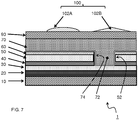
- FIGs. 8A and 8B show a further embodiment of a photo-voltaic element according to the invention.
- FIG. 8A shows a top-view
- FIG. 8B shows a cross-section of a portion of the device according to VIIIB-VIIIB in FIG. 8A .
- the first electrode layer 20, the first charge carrier transport layer 30, the insulating layer 40 and the second electrode layer 50 are provided as a plurality of layer segments.
- a plurality of lateral sub-stack segments is formed.
- two lateral sub-stack segments A,B are shown in this case.
- the photo-voltaic element may have a larger number of lateral sub-stack segments C,D, ... e.g. 10 or 100 or more, depending on a required lateral size of the photo-voltaic element.
- each layer segment A,B comprises a first electrode layer segment 20A, 20B, a first charge carrier transport layer segment 30A, 30B, an insulating layer segment 40A, 40B and a second electrode layer segment 50A, 50B.
- the second charge carrier transport layer 60 and the photo-electric conversion layer 70 are formed as continuous layers.
- a second electrode layer segment 50A of a lateral sub-stack segment A extends over a first electrode layer segment (20B) in a neighboring sub-stack segment B. Therewith an electrical connection is formed between the second electrode layer segment 50A of the lateral sub-stack segment A and the first electrode layer segment 20B in the neighboring lateral sub-stack segment.
- the photo-voltaic element is formed as a plurality of serially connected modules, which makes it possible to reduce resistive losses as compared to a photo-voltaic element that is not partitioned into serially connected modules. It could alternatively be contemplated to serially arrange a plurality of smaller photo-voltaic elements. It is however an advantage of the embodiment of FIG. 8A, 8B that external connection elements are avoided.
- a photo-voltaic element as shown in FIG. 8A, 8B could for example be provided as a single elongate product applied on a foil, e.g. delivered in a length of tens to hundreds of meter on a roll.
- a barrier 90 is arranged over said photo-electric conversion layer 70.
- Suitable materials for the barrier are metal oxides, such as SiOx and SiNx.
- the barrier 90 may comprise a plurality of layers, such as a stack of inorganic layers having a mutually different composition.
- a combination of inorganic layers and organic layers may be used.
- a barrier 90 may be formed by a first and a second inorganic layer that sandwich an organic layer.
- the materials used for the barrier 90 have a refractive index lower than that of the photo-electric conversion layer 70.
- light in coupling is further improved by a light in coupling structure 100 arranged over the barrier 90.
- the light in coupling structure comprises a plurality of light in coupling elements 102A, 102B.
- semi-spherical or pyramidal shaped light in coupling elements may be used.
- a method of manufacturing a photo-voltaic element is now disclosed with reference to FIG. 1 to 5 .
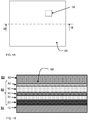
- FIG. 1A, 1B show the intermediate product obtained after a first three steps. Therein FIG. 1A shows a top-view and FIG. 1B shows a cross-section according to IB-IB in FIG. 1A .
- a substrate is 10 is provided in a first step S1.
- a stack of layers is deposited thereon that comprise at least in the order named a first electrode layer 20, a first charge carrier transport layer 30, an insulating layer 40, a second electrode layer 50 and a second charge carrier transport layer.
- the first electrode layer 20 is provided for receiving charge carriers of a first polarity.
- the first electrode layer 20 may for example be an anode, i.e. arranged for receiving holes as the charge carriers.
- the first electrode layer 20 may be a cathode, i.e. arranged for receiving electrons as the charge carriers.
- the first electrode layer 20 is deposited with a PVD (physical vapor deposition) method, for example using E-beam PVD.
- the first electrode layer 20 was provided as a stack of sub-layers obtained by subsequently depositing a first sub-layer of nickel having a thickness of 5 nm, an aluminum layer having a thickness of 190 nm and a second sub-layer of nickel also having a thickness of 5 nm. Then spin-coating (1000 rpm) was used to deposit a NiO layer as the first charge carrier transport layer 30, here a hole transport layer.
- An insulating layer 40 was then deposited in a first and a second stage.
- a first, 100 nm thick, sublayer of SiO x was deposited by electron-beam deposition and in the second stage a second sublayer of SiO x , also having a thickness of 100 nm was deposited by PECVD.
- a second electrode layer 50 here a cathode layer of aluminum at a thickness of 200 nm was formed using the same method and conditions as those applied for the deposition of the aluminum sub-layer of the first electrode layer 20.
- a second charge carrier transport layer 60 here an electron transport layer was then deposited.
- electron-beam vapor deposition was used to deposit a TiO x layer with a thickness of 15 nm of linear titanium dioxide (TiOx).
- the insulating layer 40 and the layers 50, 60 form a sub-stack having an upper surface 64.
- a third step S3 here using spin coating a resist layer 80, here a photo-resist layer having a thickness of 1.6 micron was deposited on this upper surface 64.
- the resist layer may be an imprint-resist layer.
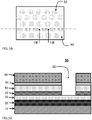
- FIG. 2A, 2B show a subsequent step S4.
- FIG. 2A shows a top-view of an intermediate product resulting from this step S4
- FIG. 2B shows a cross-section according to IIB-IIB in FIG. 2A .
- this subsequent step regularly distributed openings 82 giving access to the upper surface 64 are formed in the resist layer 80.
- contact lithography was used for this purpose.
- samples were prepared having openings with diameter in the range of 0,5 - 5 ⁇ m and a distance between neighboring openings in the range of 1 - 5 ⁇ m. Therewith a pitch between 1 and 10 ⁇ m is obtained.
- the openings having an effective cross-section D in the range of 0.5 to 10 micron, and have an average pitch in the range of 1.1 to 5 times the effective cross-section.
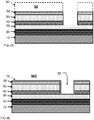
- FIGs. 3A and 3B show a subsequent step S5, wherein material of the sub-stack 40, 50, 60 facing the openings 82 is selectively removed.
- FIG. 3A shows a top-view of the semi-finished product obtained after this step S5 and
- FIG. 3B shows a cross-section according to IIIB-IIIB in FIG. 3A .
- Step S5 involves etching the upper layers 50, 60 by plasma etching. Then the insulating SiO x layer is etched with a further plasma etching process. The photo-resist layer 80 is then fully removed (Step S6), for example by oxygen plasma-etching as illustrated in FIGs. 4A and 4B .
- FIG. 4A is a top-view and FIG. 4B shows a cross-section according to IVB-IVB in FIG. 4A .
- a photo-electric conversion layer 70 is deposited (for example by spin-coating) and cured.
- Optional pre-processing steps, S6A and S6B may be performed after removal of the resist layer 80 and before deposition of the photo-electric conversion layer 70.
- a first optional pre-processing step S6A is illustrated in FIG. 4B .
- an edge surface 52 of the second electrode layer 50 is anodized.
- This edge surface 52 was formed by the step of etching S5.
- This anodization process an insulating layer is formed on the edge surface 52 therewith avoiding a direct contact between the second electrode layer 50 and the photo-electric conversion layer 70.
- FIG. 4C illustrates a second optional pre-processing step S6B.
- an atomic layer deposition process ALD may be used to deposit a thin growth layer 74, e.g. applying a TiO 2 layer with a few sALD cycles.
- FIG. 4D-4G shows an alternative approach for preventing a direct electrical contact between the second electrode layer 50 and the photo-electric conversion layer 70.
- a layer 76 of an insulating material is conformally deposited (Step S6C) on the semi-finished product of FIG. 4D , therewith obtaining the semifinished product of FIG. 4E .
- an anisotropic etch step S6D e.g. a plasma etch step is applied.
- the anisotropic etch step S6D removes the insulating material from the surface of the second charge carrier transport layer 60 and from the surface portions of the first charge carrier transport layer 30 within the openings 82 but keeps a layer of the insulating material on the walls of the openings 82 intact.
- the photo-electric conversion layer can be deposited (S6E) as shown in FIG. 4G .
- the substrate 10 may be removed.
- an electrode layer e.g. the first electrode layer 20 provides sufficient structural integrity.
- mechanical support may be provided by further layers applied on the photo-electric conversion layer 70.
Landscapes
- Engineering & Computer Science (AREA)
- Chemical & Material Sciences (AREA)
- Materials Engineering (AREA)
- Manufacturing & Machinery (AREA)
- Photovoltaic Devices (AREA)
- Life Sciences & Earth Sciences (AREA)
- Sustainable Energy (AREA)
- Sustainable Development (AREA)
Priority Applications (8)
| Application Number | Priority Date | Filing Date | Title |
|---|---|---|---|
| EP17166454.3A EP3389096A1 (de) | 2017-04-13 | 2017-04-13 | Fotovoltaikelement und verfahren zur herstellung davon |
| PCT/NL2018/050224 WO2018190711A1 (en) | 2017-04-13 | 2018-04-12 | Photo-voltaic element and method of manufacturing the same |
| CN201880034554.XA CN110692141B (zh) | 2017-04-13 | 2018-04-12 | 光伏元件及制造其的方法 |
| EP18723612.0A EP3610514B1 (de) | 2017-04-13 | 2018-04-12 | Fotovoltaikelement und verfahren zur herstellung davon |
| RU2019132233A RU2019132233A (ru) | 2017-04-13 | 2018-04-12 | Фотовольтаический элемент и способ его изготовления |
| US16/604,756 US20200381568A1 (en) | 2017-04-13 | 2018-04-12 | Photo-voltaic element and method of manufacturing the same |
| TW107112776A TW201904080A (zh) | 2017-04-13 | 2018-04-13 | 光伏打元件及其製造方法 |
| US18/370,622 US20240105866A1 (en) | 2017-04-13 | 2023-09-20 | Photo-voltaic element and method of manufacturing the same |
Applications Claiming Priority (1)
| Application Number | Priority Date | Filing Date | Title |
|---|---|---|---|
| EP17166454.3A EP3389096A1 (de) | 2017-04-13 | 2017-04-13 | Fotovoltaikelement und verfahren zur herstellung davon |
Publications (1)
| Publication Number | Publication Date |
|---|---|
| EP3389096A1 true EP3389096A1 (de) | 2018-10-17 |
Family
ID=58548596
Family Applications (2)
| Application Number | Title | Priority Date | Filing Date |
|---|---|---|---|
| EP17166454.3A Withdrawn EP3389096A1 (de) | 2017-04-13 | 2017-04-13 | Fotovoltaikelement und verfahren zur herstellung davon |
| EP18723612.0A Active EP3610514B1 (de) | 2017-04-13 | 2018-04-12 | Fotovoltaikelement und verfahren zur herstellung davon |
Family Applications After (1)
| Application Number | Title | Priority Date | Filing Date |
|---|---|---|---|
| EP18723612.0A Active EP3610514B1 (de) | 2017-04-13 | 2018-04-12 | Fotovoltaikelement und verfahren zur herstellung davon |
Country Status (6)
| Country | Link |
|---|---|
| US (2) | US20200381568A1 (de) |
| EP (2) | EP3389096A1 (de) |
| CN (1) | CN110692141B (de) |
| RU (1) | RU2019132233A (de) |
| TW (1) | TW201904080A (de) |
| WO (1) | WO2018190711A1 (de) |
Cited By (3)
| Publication number | Priority date | Publication date | Assignee | Title |
|---|---|---|---|---|
| EP3654389A1 (de) * | 2018-11-16 | 2020-05-20 | Nederlandse Organisatie voor toegepast- natuurwetenschappelijk onderzoek TNO | Fotovoltaische vorrichtung und verfahren zur herstellung davon |
| CN113380950A (zh) * | 2021-05-12 | 2021-09-10 | 郑州轻工业大学 | 一种背接触钙钛矿太阳能电池及其制备方法 |
| US20220115547A1 (en) * | 2020-10-09 | 2022-04-14 | Alliance For Sustainable Energy, Llc | All-back-contact perovskite solar cells |
Families Citing this family (9)
| Publication number | Priority date | Publication date | Assignee | Title |
|---|---|---|---|---|
| EP3840059A1 (de) | 2019-12-19 | 2021-06-23 | Nederlandse Organisatie voor toegepast- natuurwetenschappelijk Onderzoek TNO | Halbdurchsichtige fotovoltaische vorrichtung und verfahren zur herstellung davon |
| CN111293222B (zh) * | 2020-02-25 | 2024-03-22 | 南开大学 | 正交叉指全背接触钙钛矿太阳电池及其制备方法 |
| CN111312900A (zh) * | 2020-02-25 | 2020-06-19 | 南开大学 | 平行叉指全背接触钙钛矿太阳电池及其制备方法 |
| CN111312901A (zh) * | 2020-02-25 | 2020-06-19 | 南开大学 | 叠拼叉指全背接触钙钛矿太阳电池及其制备方法 |
| CN111599921B (zh) * | 2020-04-09 | 2023-07-21 | 南开大学 | 嵌套全背接触钙钛矿太阳电池及其制备方法 |
| WO2022174055A1 (en) * | 2021-02-12 | 2022-08-18 | First Solar, Inc. | Multilayer back contacts for perovskite photovoltaic devices |
| EP4302336A4 (de) * | 2021-03-04 | 2024-11-06 | Commonwealth Scientific and Industrial Research Organisation | Verfahren zur herstellung einer elektrodenverbindung in einer integrierten mehrschichtigen elektronischen dünnfilmvorrichtung |
| CN113540358B (zh) * | 2021-06-28 | 2023-04-25 | 苏州大学 | 一种无铅锡基钙钛矿室内光伏器件及其制备方法 |
| TWI808860B (zh) | 2022-08-05 | 2023-07-11 | 位速科技股份有限公司 | 薄膜光伏結構及其製作方法 |
Citations (4)
| Publication number | Priority date | Publication date | Assignee | Title |
|---|---|---|---|---|
| US20150123094A1 (en) * | 2012-05-09 | 2015-05-07 | Lg Chem, Ltd. | Organic electrochemical device, and method for manufacturing same |
| CN105140398A (zh) | 2015-07-02 | 2015-12-09 | 南京大学 | 一种背接触钙钛矿太阳电池 |
| WO2016038825A1 (en) * | 2014-09-10 | 2016-03-17 | Sharp Kabushiki Kaisha | Back contact perovskite solar cell |
| WO2017060700A1 (en) * | 2015-10-06 | 2017-04-13 | Oxford University Innovation Limited | Device architecture |
Family Cites Families (2)
| Publication number | Priority date | Publication date | Assignee | Title |
|---|---|---|---|---|
| EP2698836A1 (de) * | 2012-08-17 | 2014-02-19 | Nederlandse Organisatie voor toegepast -natuurwetenschappelijk onderzoek TNO | Folie, elektrooptisches Bauteil und Herstellungsverfahren dafür |
| US9425396B2 (en) * | 2013-11-26 | 2016-08-23 | Hunt Energy Enterprises L.L.C. | Perovskite material layer processing |
-
2017
- 2017-04-13 EP EP17166454.3A patent/EP3389096A1/de not_active Withdrawn
-
2018
- 2018-04-12 US US16/604,756 patent/US20200381568A1/en not_active Abandoned
- 2018-04-12 WO PCT/NL2018/050224 patent/WO2018190711A1/en not_active Ceased
- 2018-04-12 EP EP18723612.0A patent/EP3610514B1/de active Active
- 2018-04-12 CN CN201880034554.XA patent/CN110692141B/zh active Active
- 2018-04-12 RU RU2019132233A patent/RU2019132233A/ru unknown
- 2018-04-13 TW TW107112776A patent/TW201904080A/zh unknown
-
2023
- 2023-09-20 US US18/370,622 patent/US20240105866A1/en active Pending
Patent Citations (4)
| Publication number | Priority date | Publication date | Assignee | Title |
|---|---|---|---|---|
| US20150123094A1 (en) * | 2012-05-09 | 2015-05-07 | Lg Chem, Ltd. | Organic electrochemical device, and method for manufacturing same |
| WO2016038825A1 (en) * | 2014-09-10 | 2016-03-17 | Sharp Kabushiki Kaisha | Back contact perovskite solar cell |
| CN105140398A (zh) | 2015-07-02 | 2015-12-09 | 南京大学 | 一种背接触钙钛矿太阳电池 |
| WO2017060700A1 (en) * | 2015-10-06 | 2017-04-13 | Oxford University Innovation Limited | Device architecture |
Cited By (6)
| Publication number | Priority date | Publication date | Assignee | Title |
|---|---|---|---|---|
| EP3654389A1 (de) * | 2018-11-16 | 2020-05-20 | Nederlandse Organisatie voor toegepast- natuurwetenschappelijk onderzoek TNO | Fotovoltaische vorrichtung und verfahren zur herstellung davon |
| WO2020101494A1 (en) * | 2018-11-16 | 2020-05-22 | Nederlandse Organisatie Voor Toegepast- Natuurwetenschappelijk Onderzoek Tno | Photovoltaic device and method of manufacturing the same |
| US11476307B2 (en) | 2018-11-16 | 2022-10-18 | Nederlandse Organisatie Voor Toegepast-Natuurwetenschappelijk Onderzoek Tno | Photovoltaic device and method of manufacturing the same |
| US20220115547A1 (en) * | 2020-10-09 | 2022-04-14 | Alliance For Sustainable Energy, Llc | All-back-contact perovskite solar cells |
| US11742440B2 (en) * | 2020-10-09 | 2023-08-29 | Alliance For Sustainable Energy, Llc | All-back-contact perovskite solar cells |
| CN113380950A (zh) * | 2021-05-12 | 2021-09-10 | 郑州轻工业大学 | 一种背接触钙钛矿太阳能电池及其制备方法 |
Also Published As
| Publication number | Publication date |
|---|---|
| CN110692141B (zh) | 2023-10-31 |
| EP3610514A1 (de) | 2020-02-19 |
| EP3610514B1 (de) | 2021-06-09 |
| CN110692141A (zh) | 2020-01-14 |
| WO2018190711A8 (en) | 2019-10-31 |
| US20240105866A1 (en) | 2024-03-28 |
| US20200381568A1 (en) | 2020-12-03 |
| TW201904080A (zh) | 2019-01-16 |
| WO2018190711A1 (en) | 2018-10-18 |
| RU2019132233A (ru) | 2021-05-13 |
Similar Documents
| Publication | Publication Date | Title |
|---|---|---|
| EP3389096A1 (de) | Fotovoltaikelement und verfahren zur herstellung davon | |
| US4623751A (en) | Photovoltaic device and its manufacturing method | |
| EP3121840B1 (de) | Dünnschichttransistor und herstellungsverfahren dafür, arraysubstrat und anzeigetafel | |
| US8686459B2 (en) | Light-transmitting metal electrode and process for production thereof | |
| CN113258006B (zh) | 一种含有栅线的钙钛矿电池结构及其制备方法 | |
| EP2908348A1 (de) | Dünnfilmtransistor und herstellungsverfahren dafür, arraysubstrat und anzeigevorrichtung | |
| WO2018126508A1 (zh) | Tft基板的制作方法 | |
| CN101432888B (zh) | 重量超轻的光伏器件及其制造方法 | |
| EP3599642A1 (de) | Fotovoltaische vorrichtung und verfahren zur herstellung davon | |
| KR101682501B1 (ko) | 은 나노와이어 패턴층 및 그래핀층을 포함하는 투명전극 및 그 제조방법 | |
| US3671819A (en) | Metal-insulator structures and method for forming | |
| CN106935668A (zh) | 包含图案化金属功能层的透明导电层堆叠及其制造方法 | |
| EP3320555B1 (de) | Dünnschichttransistor, dünnschichttransistorarraysubstrat, herstellungsverfahren dafür und anzeigetafel | |
| KR20190099903A (ko) | 하이브리드 투명 전극의 패터닝 방법 | |
| EP3827465B1 (de) | Fotovoltaische vorrichtung und verfahren zur herstellung davon | |
| US10121990B2 (en) | Organic light emitting devices and methods of fabricating the same | |
| WO2019227804A1 (zh) | 一种太阳能电池及其制备方法 | |
| CN107513723A (zh) | 一种降低Ni/n‑Si光阳极光电化学分解水开启电位的方法 | |
| US10692889B2 (en) | Thin-film transistor array substrate and method of manufacturing the same, as well as display device | |
| CN113571539A (zh) | 显示面板的制作方法及显示面板 | |
| CN106981456B (zh) | Tft基板的制作方法 | |
| JP2001068709A (ja) | 薄膜太陽電池 | |
| CN210743965U (zh) | Msm光敏探测器及显示基板 | |
| JPS62221159A (ja) | 薄膜トランジスタマトリツクスの形成方法 | |
| CN117729824A (zh) | 一种具备间隔体结构的bc电池及制作方法 |
Legal Events
| Date | Code | Title | Description |
|---|---|---|---|
| PUAI | Public reference made under article 153(3) epc to a published international application that has entered the european phase |
Free format text: ORIGINAL CODE: 0009012 |
|
| AK | Designated contracting states |
Kind code of ref document: A1 Designated state(s): AL AT BE BG CH CY CZ DE DK EE ES FI FR GB GR HR HU IE IS IT LI LT LU LV MC MK MT NL NO PL PT RO RS SE SI SK SM TR |
|
| AX | Request for extension of the european patent |
Extension state: BA ME |
|
| STAA | Information on the status of an ep patent application or granted ep patent |
Free format text: STATUS: THE APPLICATION IS DEEMED TO BE WITHDRAWN |
|
| 18D | Application deemed to be withdrawn |
Effective date: 20190418 |