EP3390343B1 - Dérivés de résorcinol pour leur utilisation cosmétique - Google Patents
Dérivés de résorcinol pour leur utilisation cosmétique Download PDFInfo
- Publication number
- EP3390343B1 EP3390343B1 EP16815770.9A EP16815770A EP3390343B1 EP 3390343 B1 EP3390343 B1 EP 3390343B1 EP 16815770 A EP16815770 A EP 16815770A EP 3390343 B1 EP3390343 B1 EP 3390343B1
- Authority
- EP
- European Patent Office
- Prior art keywords
- radical
- linear
- denotes
- alkyl radical
- formula
- Prior art date
- Legal status (The legal status is an assumption and is not a legal conclusion. Google has not performed a legal analysis and makes no representation as to the accuracy of the status listed.)
- Active
Links
- FNVCMQJUERWABX-UHFFFAOYSA-N CC(CCOC(C)=O)c(c(O)c1)ccc1O Chemical compound CC(CCOC(C)=O)c(c(O)c1)ccc1O FNVCMQJUERWABX-UHFFFAOYSA-N 0.000 description 2
- PLUPTSSAMUYEID-UHFFFAOYSA-N CC(CCO1)c(ccc(OC(C)=O)c2)c2O/C(/C)=[O]\C1=O Chemical compound CC(CCO1)c(ccc(OC(C)=O)c2)c2O/C(/C)=[O]\C1=O PLUPTSSAMUYEID-UHFFFAOYSA-N 0.000 description 1
- VUCICABZBJVJDA-UHFFFAOYSA-N OCCCc(c(O)c1)ccc1O Chemical compound OCCCc(c(O)c1)ccc1O VUCICABZBJVJDA-UHFFFAOYSA-N 0.000 description 1
Classifications
-
- C—CHEMISTRY; METALLURGY
- C07—ORGANIC CHEMISTRY
- C07C—ACYCLIC OR CARBOCYCLIC COMPOUNDS
- C07C39/00—Compounds having at least one hydroxy or O-metal group bound to a carbon atom of a six-membered aromatic ring
- C07C39/02—Compounds having at least one hydroxy or O-metal group bound to a carbon atom of a six-membered aromatic ring monocyclic with no unsaturation outside the aromatic ring
- C07C39/11—Alkylated hydroxy benzenes containing also acyclically bound hydroxy groups, e.g. saligenol
-
- A—HUMAN NECESSITIES
- A61—MEDICAL OR VETERINARY SCIENCE; HYGIENE
- A61K—PREPARATIONS FOR MEDICAL, DENTAL OR TOILETRY PURPOSES
- A61K8/00—Cosmetics or similar toiletry preparations
- A61K8/18—Cosmetics or similar toiletry preparations characterised by the composition
- A61K8/30—Cosmetics or similar toiletry preparations characterised by the composition containing organic compounds
- A61K8/33—Cosmetics or similar toiletry preparations characterised by the composition containing organic compounds containing oxygen
- A61K8/34—Alcohols
- A61K8/347—Phenols
-
- A—HUMAN NECESSITIES
- A61—MEDICAL OR VETERINARY SCIENCE; HYGIENE
- A61K—PREPARATIONS FOR MEDICAL, DENTAL OR TOILETRY PURPOSES
- A61K8/00—Cosmetics or similar toiletry preparations
- A61K8/18—Cosmetics or similar toiletry preparations characterised by the composition
- A61K8/30—Cosmetics or similar toiletry preparations characterised by the composition containing organic compounds
- A61K8/33—Cosmetics or similar toiletry preparations characterised by the composition containing organic compounds containing oxygen
- A61K8/37—Esters of carboxylic acids
- A61K8/375—Esters of carboxylic acids the alcohol moiety containing more than one hydroxy group
-
- A—HUMAN NECESSITIES
- A61—MEDICAL OR VETERINARY SCIENCE; HYGIENE
- A61P—SPECIFIC THERAPEUTIC ACTIVITY OF CHEMICAL COMPOUNDS OR MEDICINAL PREPARATIONS
- A61P17/00—Drugs for dermatological disorders
-
- A—HUMAN NECESSITIES
- A61—MEDICAL OR VETERINARY SCIENCE; HYGIENE
- A61Q—SPECIFIC USE OF COSMETICS OR SIMILAR TOILETRY PREPARATIONS
- A61Q19/00—Preparations for care of the skin
- A61Q19/02—Preparations for care of the skin for chemically bleaching or whitening the skin
-
- C—CHEMISTRY; METALLURGY
- C07—ORGANIC CHEMISTRY
- C07C—ACYCLIC OR CARBOCYCLIC COMPOUNDS
- C07C69/00—Esters of carboxylic acids; Esters of carbonic or haloformic acids
- C07C69/02—Esters of acyclic saturated monocarboxylic acids having the carboxyl group bound to an acyclic carbon atom or to hydrogen
- C07C69/12—Acetic acid esters
- C07C69/18—Acetic acid esters of trihydroxylic compounds
Definitions
- the present invention relates to the cosmetic use of compounds derived from resorcinol for depigmenting and / or whitening the skin, as well as certain novel compounds derived from resorcinol.
- spots appear on the skin and more especially on the hands and face, conferring heterogeneity on the skin. These spots are due in particular to a high concentration of melanin in the keratinocytes located on the surface of the skin.
- the mechanism of the formation of skin pigmentation that is to say the formation of melanin, is particularly complex and schematically involves the following main steps: Tyrosine ⁇ Dopa ⁇ Dopaquinone ⁇ Dopachrome ⁇ Melanin
- Tyrosinase (monophenol dihydroxyl phenylalanine: oxygen oxidoreductase EC 1.14.18.1) is the essential enzyme involved in this series of reactions. It catalyzes in particular the reaction of transformation of tyrosine into Dopa (dihydroxyphenylalanine) thanks to its hydroxylase activity and the reaction of transformation of Dopa into dopaquinone thanks to its oxidase activity. This tyrosinase acts only when it is in the state of maturation under the action of certain biological factors.
- a substance is recognized as depigmenting if it acts directly on the vitality of the epidermal melanocytes where melanogenesis takes place, and / or if it interferes with one of the steps in the biosynthesis of melanin either by inhibiting one of the enzymes involved in melanogenesis, or by intercalating itself as a structural analogue of one of the chemical compounds of the melanin synthesis chain, a chain which can then be blocked and thus ensure depigmentation.
- Arbutin and kojic acid are known as skin depigmenting agents.
- the subject of the invention is compounds of formula (I) as defined below for their dermatological use for depigmenting the skin.
- a subject of the invention is also new compounds of formula (II) as defined below.
- a subject of the invention is also a method of non-therapeutic cosmetic treatment for depigmentation, lightening and / or bleaching of keratin materials, in particular of the skin, comprising the application to the skin of at least one compound of formula ( I) as defined below.
- a subject of the invention is also a composition comprising, in a physiologically acceptable medium, at least one compound of formula (II) as defined below.
- a subject of the invention is also a non-therapeutic cosmetic process for depigmentation, lightening and / or bleaching of keratin materials, in particular of the skin, comprising the application of the composition described above.
- this is the method for depigmenting, lightening and / or whitening the skin.
- the invention also relates to the non-therapeutic cosmetic use of at least one compound of formula (I) as defined below as an agent for whitening, lightening and / or depigmenting keratin materials, in particular the skin.
- the compounds in accordance with the invention make it possible to effectively depigment and / or lighten, or even whiten, the skin of human beings. humans. They are intended in particular to be applied to the skin of individuals exhibiting brownish pigmentation spots, spots of senescence, or to the skin of individuals wishing to combat the appearance of a brownish color originating from melanogenesis.
- R 1 and R 2 are identical.
- R 4 denotes H or a linear C 1 -C 4 alkyl radical, a branched C 3 -C 4 alkyl radical or a COR 5 radical, more preferably H or a COR 5 radical.
- salts of the compounds of formula (I) as defined below comprise the conventional non-toxic salts of said compounds such as those formed from acid or base.
- salts of amino acids such as, for example, lysine, arginine, guanidine, glutamic acid or aspartic acid.
- the salts of the compounds of formula (I) can be chosen from alkali or alkaline earth salts such as sodium, potassium, calcium, magnesium; ammonium salts.
- Acceptable solvates of the compounds described in the present invention include conventional solvates such as those formed during the preparation of said compounds due to the presence of solvents.
- solvates due to the presence of water or of linear or branched alcohols such as ethanol or isopropanol.
- optical isomers are in particular the enantiomers and the diastereoismers.
- a “(C x -C y ) alkyl group” denotes a linear and saturated alkyl group comprising from x to y carbon atoms.
- the saturated or branched linear alkyl groups can be chosen from: methyl, ethyl, propyl, isopropyl, butyl, isobutyl, tert-butyl, pentyl, hexyl.
- the particularly preferred compounds of formula (I) are chosen from: Structure Compound No. Chemical name 1 4- (3-Hydroxy-1-methyl-propyl) -benzene-1,3-diol 2 4- [4- (acetyloxy) butan-2-yl] benzene-1,3-diyl diacetate 3 3- (2,4-dihydroxyphenyl) butyl acetate as well as their salts, their solvates and their optical isomers, their racemates, alone or as a mixture.
- the compounds of formula (I) are new and constitute another subject of the invention, as well as the compositions, in particular the cosmetic compositions, which contain them;
- Resorcin A can react in the presence of a beta keto-ester B to lead to coumarin C.
- the latter is reduced by catalytic hydrogenation according to conditions known to those skilled in the art to lead to D.
- D can also be obtained from resorcinol A in the presence of an alpha beta unsaturated ester E.
- the lactonic function of D is then reduced by hydrides, after possible prior modifications of the phenolic functions by known reactions of the those skilled in the art such as protection / deprotection reactions.
- Obtaining the C and D derivatives via the reaction between (A and B) or (A and E) can be carried out in particular in the presence of an organic solvent which can be chosen from toluene, tetrahydrofuran, heptane, isooctane, methyltetrahydrofuran, methyl ethyl ketone, methyl isobutyl ketone, dioxane, ethyl acetate, isopropyl acetate, isododecane and their mixtures, in particular at a temperature between 15 and 200 ° C, optionally in the presence of a catalyst (acidic or basic) as described in the publications: Synthesis of 7-hydroxycoumarins by Pechmann reaction using Nafion resin / silica nanocomposites as catalysts: Laufer MC, Hausmann H, Hölderich WF, J of catalysis, 2003, 218, 315-320 ; Synthesis of 7-hydroxycoumarins catalysed by solid
- the compounds of formula (I) for which R 1 and or R 2 denote a COR 5 group can be obtained by acetylation / esterification.
- the acetylation / esterification reaction can be carried out with acetic anhydride when R 5 denotes a methyl radical (or more generally an R 5 COOCOR 5 anhydride) or acetyl chloride when R 5 denotes a methyl radical (or more generally an acid chloride R5COCl), especially in the presence of an aprotic solvent such as toluene, pyridine, tetrahydrofuran.
- the acetylation / esterification reaction can be selective by employing protective groups on the functions which must not be acetylated / esterified and by carrying out, after acetylation / esterification, a deprotection reaction, according to known techniques of organic synthesis.
- the reduction reaction of lactone D with hydrides to lead to derivative G can optionally be carried out in the presence of an aprotic organic solvent, in particular tetrahydrofuran, dioxane, dimethylformamide, dimethylsulfoxide, 2-methyltetrahydrofuran, dichloromethane, toluene, at a temperature between 0 ° C and 200 ° C, especially between 20 ° C and 60 ° C.
- an aprotic organic solvent in particular tetrahydrofuran, dioxane, dimethylformamide, dimethylsulfoxide, 2-methyltetrahydrofuran, dichloromethane, toluene
- the compounds of formula (I) according to the invention find very particular application in the cosmetics field.
- composition according to the invention comprises, in a physiologically acceptable medium, a compound of formula (I) as described above.
- physiologically acceptable medium By physiologically acceptable medium, one understands a medium compatible with the keratinous substances of human beings such as the skin of the body or of the face, the lips, the mucous membranes, the eyelashes, the nails, the scalp and / or the hair.
- the compound (I) can be present in the composition according to the invention in an amount which can be between 0.01 and 10% by weight, preferably between 0.1 to 5% by weight, in particular from 0.5 to 3% by weight, relative to the total weight of the composition.
- composition according to the invention is advantageously a cosmetic composition: it can comprise adjuvants usually used in the cosmetic field.
- Mention may in particular be made of water; organic solvents, in particular C2-C6 alcohols; oils, in particular hydrocarbon-based oils, silicone oils; waxes, pigments, fillers, dyes, surfactants, emulsifiers; cosmetic active ingredients, UV filters, polymers, thickeners, preservatives, perfumes, bactericides, ceramides, odor absorbers, antioxidants.
- organic solvents in particular C2-C6 alcohols
- oils in particular hydrocarbon-based oils, silicone oils
- waxes pigments, fillers, dyes, surfactants, emulsifiers
- cosmetic active ingredients UV filters, polymers, thickeners, preservatives, perfumes, bactericides, ceramides, odor absorbers, antioxidants.
- optional cosmetic adjuvants can be present in the composition in an amount of 0.001 to 80% by weight, in particular 0.1 to 40% by weight, relative to the total weight of the composition.
- these adjuvants, as well as their proportions, will be chosen by a person skilled in the art such that the advantageous properties of the compounds according to the invention are not, or not substantially, altered by the addition envisaged.
- compositions according to the invention at least one compound chosen from: desquamating agents; soothing agents, organic or inorganic photoprotective agents, moisturizing agents; depigmenting agents; anti-glycation agents; NO-synthase inhibitors; agents stimulating the synthesis of dermal or epidermal macromolecules and / or preventing their degradation; agents stimulating the proliferation of fibroblasts and / or keratinocytes or stimulating the differentiation of keratinocytes; muscle relaxants and / or dermo-relaxants; tensioning agents; anti-pollution and / or anti-radical agents; agents acting on the microcirculation; agents acting on the energy metabolism of cells; and their mixtures.
- desquamating agents desquamating agents
- soothing agents organic or inorganic photoprotective agents, moisturizing agents
- depigmenting agents anti-glycation agents
- NO-synthase inhibitors agents stimulating the synthesis of dermal or epidermal macromolecules and / or preventing their
- composition according to the invention can be provided in all the galenic forms normally used in the cosmetics field, and in particular in the form of an aqueous or hydroalcoholic solution, optionally gelled, of an optionally two-phase lotion-type dispersion, of an emulsion.
- compositions are prepared according to the usual methods. prefers to use according to this invention a composition in the form of an emulsion in particular oil-in-water.
- the composition according to the invention can constitute a skin care composition, and in particular a cream for cleaning, protecting, treating or caring for the face, for the hands, for the feet, for the large anatomical folds or for the body (eg day creams, night creams, makeup removing creams, foundation creams, sunscreen creams); a fluid foundation, a cleansing milk, a protective or care body milk, an anti-sun milk; a skin care lotion, gel or foam, such as a cleansing lotion.]
- reaction medium was cooled to 0 ° C. and 20 ml of water and then 250 ml of 1N HCl were carefully added.
- the THF was evaporated off, then the residue was extracted 3 times with diethyl ether.
- the combined organic phases were washed with saturated NaCl solution, then dried with Na2SO4, filtered and evaporated.
- normal human melanocytes are cultured and distributed in 384 wells. After 24 hours, the culture medium was replaced by a medium containing compounds of formula (I) to be evaluated. The cells were incubated 72 hours before the measurement of the final optical density which measures the amount of melanin produced by melanocytes. A dose effect is implemented by using a wide range of concentrations of the compounds evaluated. Thus, by matching the concentrations and measurements of melanin, it is possible to determine an IC50 in ⁇ M: concentration at which 50% reduction in melanin synthesis is reached.
- the value of the IC50 is 23.4 ⁇ M maximum concentration tested 200 ⁇ M.
- the compounds of the invention have an activity on the reduction of melanogenesis much greater than that of compound (A) outside the invention;
- a depigmenting composition for the skin comprising (in grams): Compound # 1 2 g PEG400 68 g Ethanol 30 g
- composition applied to the skin helps to reduce dark spots.
- a depigmenting gel for the skin comprising (% by weight): Compound # 2 0.25% Carbomer (Carbopol 981 from Lubrizol) 1% conservative qs water qsp 100%
- composition applied to the skin helps to reduce dark spots.
- Example 7 Demonstration of the depigmenting activity on a reconstructed pigmented epidermis
- the melanin was quantified by analysis of images on histological sections after revelation by Fontana Masson staining. Each colored epidermis is photographed along its entire length using a camera connected to a microscope.
Landscapes
- Health & Medical Sciences (AREA)
- Chemical & Material Sciences (AREA)
- Organic Chemistry (AREA)
- Life Sciences & Earth Sciences (AREA)
- Animal Behavior & Ethology (AREA)
- General Health & Medical Sciences (AREA)
- Public Health (AREA)
- Veterinary Medicine (AREA)
- Emergency Medicine (AREA)
- Birds (AREA)
- Epidemiology (AREA)
- Dermatology (AREA)
- Bioinformatics & Cheminformatics (AREA)
- Chemical Kinetics & Catalysis (AREA)
- General Chemical & Material Sciences (AREA)
- Medicinal Chemistry (AREA)
- Nuclear Medicine, Radiotherapy & Molecular Imaging (AREA)
- Engineering & Computer Science (AREA)
- Pharmacology & Pharmacy (AREA)
- Cosmetics (AREA)
Description
- La présente invention concerne l'utilisation cosmétique de composés dérivés de résorcinol pour dépigmenter et/ou blanchir la peau, ainsi que certains composés dérivés de résorcinol nouveaux.
- A différentes périodes de leur vie, certaines personnes voient apparaître sur la peau et plus spécialement sur les mains et le visage, des taches plus foncées et/ou plus colorées, conférant à la peau une hétérogénéité. Ces taches sont dues notamment à une concentration importante de mélanine dans les kératinocytes situés à la surface de la peau.
- L'utilisation de substances dépigmentantes topiques inoffensives présentant une bonne efficacité est toute particulièrement recherchée en vue de traiter les taches pigmentaires.
- Le mécanisme de formation de la pigmentation de la peau, c'est-à-dire de la formation de la mélanine est particulièrement complexe et fait intervenir schématiquement les principales étapes suivantes :
Tyrosine → Dopa → Dopaquinone → Dopachrome → Mélanine - La tyrosinase (monophénol dihydroxyl phénylalanine: oxygen oxydo-reductase EC 1.14.18.1) est l'enzyme essentielle intervenant dans cette suite de réactions. Elle catalyse notamment la réaction de transformation de la tyrosine en Dopa (dihydroxyphénylalanine) grâce à son activité hydroxylase et la réaction de transformation de la Dopa en dopaquinone grâce à son activité oxydase. Cette tyrosinase n'agit que lorsqu'elle est à l'état de maturation sous l'action de certains facteurs biologiques.
- Une substance est reconnue comme dépigmentante si elle agit directement sur la vitalité des mélanocytes épidermiques où se déroule la mélanogénèse, et/ou si elle interfère avec une des étapes de la biosynthèse de la mélanine soit en inhibant une des enzymes impliquées dans la mélanogénèse, soit en s'intercalant comme analogue structural d'un des composés chimiques de la chaîne de synthèse de la mélanine, chaîne qui peut alors être bloquée et ainsi assurer la dépigmentation.
- L'arbutine et l'acide kojique sont connus comme agents dépigmentants de la peau.
- On a cherché des substances qui présentent une action dépigmentante efficace, notamment supérieure à celle de l'arbutine et de l'acide kojique.
- Il subsiste le besoin d'un nouvel agent blanchissant de la peau humaine à action aussi efficace que ceux connus, mais n'ayant pas leurs inconvénients, c'est-à-dire qui soit non irritant, non toxique et/ou non allergisant pour la peau, tout en étant stable dans une composition, ou bien alternativement qui possède une action renforcée de façon à pouvoir être utilisé en quantité plus faible, ce qui diminue considérablement les effets secondaires observés.
- A cet égard la Demanderesse a de manière surprenante et inattendue découvert que certains composés de résorcinol présentaient une bonne activité dépigmentante, même à faible concentration, sans faire preuve de cytotoxicité.
- A cet égard, la Demanderesse a de manière surprenante et inattendue découvert que certains composés dérivés de résorcinol présentaient une bonne activité dépigmentante, même à faible concentration.
- Certains composés dérivés de résorcinol sont déjà connus dans l'art antérieur pour leur activité dépigmentante. A cet égard on peut citer en particulier les documents
JP 2007186445 de Kuraray - L'invention a pour objet des composés de formule (I) tels que définis ci-après pour leur utilisation dermatologique pour dépigmenter la peau.
- L'invention a également pour objet de nouveaux composés de formule (II) tels que définis ci-après.
- L'invention a aussi pour objet un procédé de traitement cosmétique non thérapeutique de dépigmentation, d'éclaircissement et/ou de blanchiment des matières kératiniques, notamment de la peau, comprenant l'application sur la peau d'au moins un composé de formule (I) telle que définie ci-après.
- L'invention a aussi pour objet une composition comprenant, dans un milieu physiologiquement acceptable, au moins un composé de formule (II) telle que définie ci-après.
- L'invention a également pour objet un procédé cosmétique non thérapeutique de dépigmentation, d'éclaircissement et/ou de blanchiment des matières kératiniques, notamment de la peau, comprenant l'application de la composition décrite précédemment.
- Plus préférablement, il s'agit du procédé pour dépigmenter, éclaircir et/ou blanchir la peau.
- L'invention concerne également l'utilisation cosmétique non thérapeutique d'au moins un composé de formule (I) telle que définie ci-après comme agent blanchissant, éclaircissant et/ou dépigmentant des matières kératiniques, notamment de la peau.
- Les composés conformes à l'invention, à savoir en particulier de formule (I) ou de formule (II) telles que définies ci-après, permettent de dépigmenter et/ou d'éclaircir efficacement, voire de blanchir, la peau d'êtres humains. Ils sont notamment destinés à être appliqués sur la peau d'individus présentant des taches de pigmentation brunâtres, des taches de sénescence, ou sur la peau d'individus désirant combattre l'apparition d'une couleur brunâtre provenant de la mélanogénèse.
- Ils peuvent également permettre de dépigmenter et/ou d'éclaircir les poils, les cils, les cheveux, ainsi que les lèvres et/ou les ongles.
- L'invention a donc pour objet des composés de formule (I) comme suit, pour leur utilisation pour dépigmenter, éclaircir et/ou blanchir la peau :
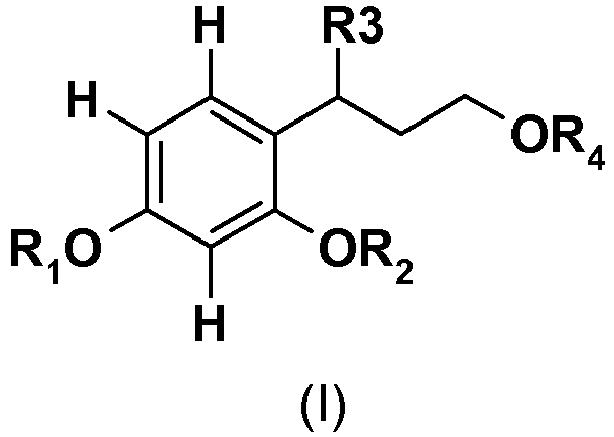
- R1, R2 : identiques ou différents, désignent
- a) hydrogène,
- b) un radical COR5 dans lequel R5 désigne un radical alkyle linéaire en C1-C10 ou ramifié en C3-C10, de préférence un radical alkyle linéaire en C1-C6 ou ramifié en C3-C6, plus préférentiellement un radical alkyle linéaire en C1-C4
- R3 désigne un radical alkyl linéaire en C1-C6 ou ramifié en C3-C6, de préférence un radical alkyle linéaire en C1-C4 ou ramifié en C3-C4,
- R4 désigne
- a) H,
- b) un radical alkyl linéaire en C1-C6 ou ramifié en C3-C6,
- c) un radical COR5,
- De préférence R1 et R2 sont identiques.
- De préférence R4 désigne H ou un radical alkyl linéaire en C1-C4, un radical alkyl ramifié en C3-C4 ou un radical COR5, plus préférentiellement H ou un radical COR5.
- Préférentiellement, les composés de formule (I) sont choisis parmi ceux pour lesquels :
- R1, R2, identiques ou différents, désignent H ou un radical COCH3, et de préférence R1 et R2 sont identiques.
- R3 désigne méthyle, éthyle ou isopropyle, et
- R4 désigne H ou un radical COCH3.
- Plus préférentiellement, les composés de formule (I) sont tels que :
- R1, R2, identiques ou différents, désignent H ou un radical COCH3, et de préférence R1 et R2 sont identiques.
- R3 désigne méthyle, et
- R4 désigne H ou un radical COCH3,
- Toujours dans le cadre de la présente invention, les sels des composés de formule (I) telle que définie ci-après comprennent les sels non toxiques conventionnels desdits composés tels que ceux formés à partir d'acide ou de base.
- Comme sels du composé de formule (I) on peut citer :
- les sels obtenus par addition du composé de formule (I) (lorsqu'il comprend un groupe acide) avec une base minérale, telle que la soude, la potasse, l'hydroxyde de calcium, l'hydroxyde d'ammonium, l'hydroxyde de magnésium, l'hydroxyde de lithium, et les carbonates ou hydrogénocarbonates de sodium, de potassium ou de calcium par exemple ;
- ou avec une base organique telle qu'une alkylamine primaire, secondaire ou tertiaire, par exemple la triéthylamine ou la butylamine. Cette alkylamine primaire, secondaire ou tertiaire peut comporter un ou plusieurs atomes d'azote et/ou d'oxygène et peut donc comporter par exemple une ou plusieurs fonctions alcool; on peut notamment citer l'amino-2-méthyl-2-propanol, l'éthanolamine, la triéthanolamine, la diméthylamino-2-propanol, le 2-amino-2-(hydroxyméthyl)-1,3-propanediol, la 3-(diméthylamino) propylamine.
- On peut encore citer les sels d'acides aminés tels que par exemple, la lysine, l'arginine, la guanidine, l'acide glutamique, l'acide aspartique. Avantageusement, les sels des composés de formule (I) (lorsqu'il comprend un groupe acide) peuvent être choisis parmi les sels alcalins ou alcalinoterreux tels que sodium, potassium, calcium, magnésium ; les sels d'ammonium.
- Les solvates acceptables des composés décrits dans la présente invention comprennent des solvates conventionnels tels que ceux formés lors de la préparation desdits composés du fait de la présence de solvants. A titre d'exemple, on peut citer les solvates dus à la présence d'eau ou d'alcools linéaires ou ramifiés comme l'éthanol ou l'isopropanol.
- Les isomères optiques sont notamment les énantiomères et les diastéréoismères.
- Toujours dans le cadre de la présente invention :
Sans indication contraire, un « groupe (Cx-Cy)alkyle » désigne un groupe alkyle linéaire et saturé comprenant de x à y atomes de carbone. - De façon préférentielle, les groupes alkyles linéaires saturés ou ramifiés peuvent être choisis parmi : méthyle, éthyle, propyle, isopropyle, butyle, isobutyle, tertio-butyle, pentyle, hexyle.
- Les composés de formule (I) particulièrement préférés sont choisis parmi :
Structure Composé n° Nom chimique 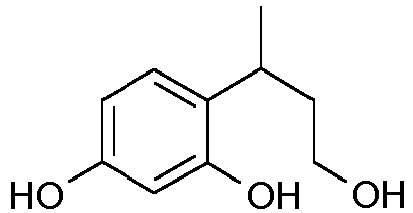
1 4-(3-Hydroxy-1-méthyl-propyl)-benzène-1,3-diol 
2 4-[4-(acétyloxy)butan-2-yl]benzène-1,3-diyl diacétate 
3 3-(2,4-dihydroxyphényl)butyl acétate - Les composés de formule (I) sont nouveaux et constituent un autre objet de l'invention, ainsi que les compositions, en particulier les compositions cosmétiques, qui les contiennent ;
- Les composés de l'invention de formule (I) peuvent être préparés selon le schéma 1 suivant.


- Selon ce schéma 1, la synthèse des composés (I) passe par l'intermédiaire clef de type dihydrocoumarine D dont la synthèse est entre autre décrite dans
WO2005/085169 . L'homme de l'art peut en adapter la stratégie en fonction des groupements R3. - La résorcine A peut réagir en présence d'un beta céto-ester B pour conduire à la coumarine C. Cette dernière est réduite par une hydrogénation catalytique selon les conditions connues de l'homme du métier pour conduire à D.
- D peut également être obtenu à partir de la résorcine A en présence d'un ester alpha beta insaturé E. La fonction lactonique de D est ensuite réduite par des hydrures, après d'éventuelles modifications préalables des fonctions phénoliques par des réactions connues de l'homme du métier telles que des réactions de protection/déprotection.
- L'obtention des dérivés C et D via la réaction entre (A et B) ou (A et E) peut être réalisée notamment en présence d'un solvant organique pouvant être choisi parmi le toluène, le tétrahydrofurane, l'heptane, l'isooctane, le méthyltétrahydrofurane, la méthyléthyle cétone, la méthylisobutyle cétone, le dioxane, l'acétate d'éthyle, l'acétate d'isopropyle, l'isododécane et leurs mélanges, notamment à une température comprise entre 15 et 200 °C, éventuellement en présence d'un catalyseur (acide ou basique) tel que décrit dans les publications : Synthesis of 7-hydroxycoumarins by Pechmann reaction using Nafion resin/silica nanocomposites as catalysts : Laufer MC, Hausmann H, Hölderich WF, J of catalysis, 2003, 218, 315-320 ; Synthesis of 7-hydroxycoumarins catalysed by solid acid catalysts Hoefnagel A, Gunnewegh E, Downing R, van Bekkum H, J Chem Soc Chem Commun, 1995, 225-226 ; les dérivés C et D peuvent ainsi être obtenus en particulier en présence d'un catalyseur acide tel que l'acide sulfurique, l'acide méthanesulfonique, l'acide triflique, l'acide paratoluène sulfonique, des résines sulfoniques telles que les Dowex® ou les Amberlyst® (vendues par la société Aldrich).
- Les composés de formule (I) pour lesquels R1 et ou R2 désignent un groupe COR5 peuvent être obtenus par acétylation/estérification. La réaction d'acétylation/estérification peut être effectuée avec l'anhydride acétique lorsque R5 désigne un radical méthyle (ou plus généralement un anhydride R5COOCOR5) ou le chlorure d'acétyle lorsque R5 désigne un radical méthyle (ou plus généralement un chlorure d'acide R5COCl), notamment en présence de solvant aprotique tel que le toluène, la pyridine, le tétrahydrofurane. La réaction d'acétylation/estérification peut être sélective en employant des groupements protecteurs sur les fonctions ne devant pas être acétylées/estérifiées et en effectuant après acétylation/esterification une réaction de déprotection, selon les techniques connues de la synthèse organique.
- La réaction de réduction de la lactone D par des hydrures pour conduire au dérivé G peut être réalisée éventuellement en présence d'un solvant organique aprotique notamment le tétrahydrofurane, le dioxane, le diméthylformamide, le diméthylsulfoxyde, le 2-méthyltétrahydrofurane, le dichlorométhane , le toluène, à une température comprise entre 0 °C et 200 °C, notamment entre 20 °C et 60 °C.
- L'ensemble de ces étapes peuvent également faire appel à des stratégies de protection/déprotection usuellement utilisées en chimie organique et compilées dans l'ouvrage « Protecting Groups in Organic Synthesis » Greene, Wuts, Wiley Interscience, en fonction de la nature des radicaux, afin de placer sélectivement les groupements R1, R2 et/ou R4 tels que précédemment définis à partir du composé G.
- A titre illustratif du schéma de synthèse général ci-dessus, on peut par exemple synthétiser les composés de formule (I) pour lesquels R1=R2=R4 = H et R3= méthyle, respectivement R3 = Ethyle) selon les schémas 2, ou 4 (respectivement selon le schéma 3) ci-dessous :
Dans ces schémas « t.a. » signifie température ambiante.


- Selon le schéma 3, les réactifs, propionylacétate d'éthyle 5 et résorcinol réagissent comme décrit dans le schéma 1 ci-dessus pour donner le composé 6, qui peut être réduit par des hydrures pour conduire au composé de formule (I) correspondant. Une description de cette chimie peut être trouvée dans le document suivant Asian Journal of Chemistry, 2010, 22 (7), 5694-5698
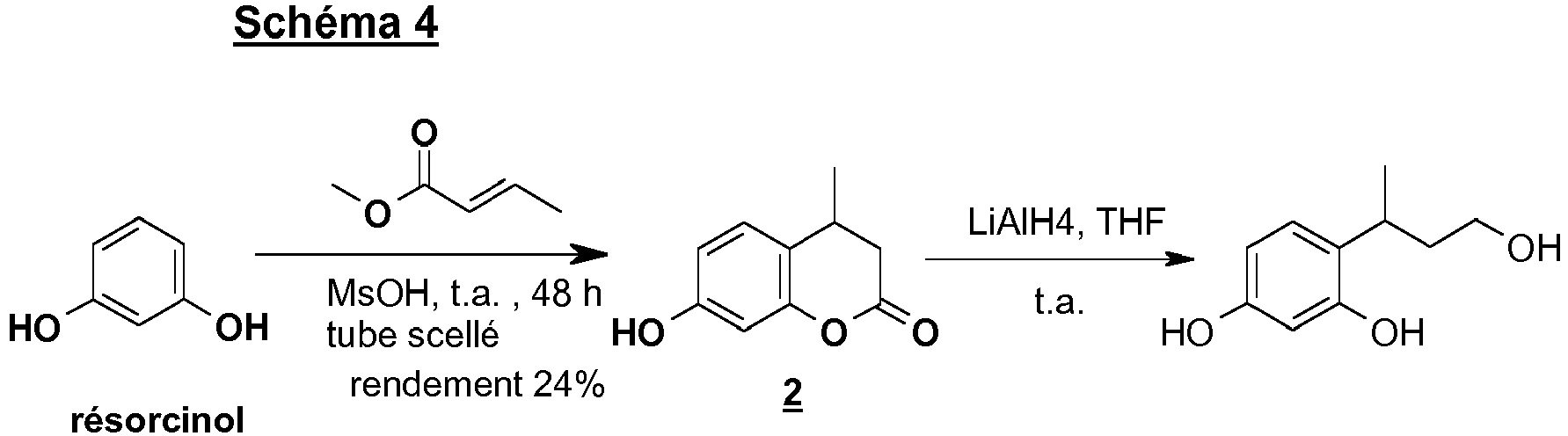
- Selon le schéma 4, on met à réagir du résorcinol avec de l'ester crotonique de méthyle en présence de MSOH en excès pour donner la 7-hydroxy-4-méthyl-3,4-dihydrocoumarine 2 qui après réduction par des hydrures, conduit au composé de formule (I) correspondant.
- Les composés de formule (I) selon l'invention trouvent une application toute particulière dans le domaine cosmétique.
- La composition selon l'invention comprend, dans un milieu physiologiquement acceptable, un composé de formule (I) tel que décrite précédemment.
- Par milieu physiologiquement acceptable, on comprend un milieu compatible avec les matières kératiniques d'êtres humains comme la peau du corps ou du visage, les lèvres, les muqueuses, les cils, les ongles, le cuir chevelu et/ou les cheveux.
- Le composé (I) peut être présent dans la composition selon l'invention en une quantité qui peut être comprise entre 0,01 et 10 % en poids, de préférence entre 0,1 à 5 % en poids, notamment de 0,5 à 3 % en poids, par rapport au poids total de la composition.
- La composition selon l'invention est avantageusement une composition cosmétique : elle peut comprendre des adjuvants usuellement employés dans le domaine cosmétique.
- On peut notamment citer l'eau; les solvants organiques, notamment les alcools en C2-C6 ; les huiles, notamment les huiles hydrocarbonées, les huiles siliconées ; les cires, les pigments, les charges, les colorants, les tensioactifs, les émulsionnants ; les actifs cosmétiques, les filtres UV, les polymères, les épaississants, les conservateurs, les parfums, les bactéricides, les céramides, les absorbeurs d'odeur, les antioxydants.
- Ces éventuels adjuvants cosmétiques peuvent être présents dans la composition à raison de 0,001 à 80 % en poids, notamment 0,1 à 40 % en poids, par rapport au poids total de la composition. En tout état de cause, ces adjuvants, ainsi que leurs proportions, seront choisis par l'homme du métier de manière telle que les propriétés avantageuses des composés selon l'invention ne soient pas, ou substantiellement pas, altérées par l'adjonction envisagée.
- Comme actifs, il sera avantageux d'introduire dans la composition selon l'invention au moins un composé choisi parmi: les agents desquamants; les agents apaisants, les agents photoprotecteurs organique ou inorganique, les agents hydratants; les agents dépigmentants ; les agents anti-glycation; les inhibiteurs de NO-synthase; les agents stimulant la synthèse de macromolécules dermiques ou épidermiques et/ou empêchant leur dégradation; les agents stimulant la prolifération des fibroblastes et/ou des kératinocytes ou stimulant la différenciation des kératinocytes; les agents myorelaxants et/ou les agents dermo-décontractants; les agents tenseurs; les agents anti-pollution et/ou anti-radicalaire; les agents agissant sur la microcirculation; les agents agissant sur le métabolisme énergétique des cellules; et leurs mélanges.
- La composition selon l'invention peut se présenter sous toutes les formes galéniques normalement utilisées dans le domaine cosmétique, et notamment sous forme d'une solution aqueuse ou hydroalcoolique, éventuellement gélifiée, d'une dispersion du type lotion éventuellement biphasée, d'une émulsion huile-dans-eau ou eau-dans-huile ou multiple ((E/H/E ou H/E/H par exemple), d'un gel aqueux, d'une dispersion d'huile dans une phase aqueuse à l'aide de sphérules, ces sphérules pouvant être des nanoparticules polymériques telles que les nanosphères et les nanocapsules ou, mieux, des vésicules lipidiques de type ionique et/ou non ionique; de gel aqueux ou huileux. Ces compositions sont préparées selon les méthodes usuelles. On préfère utiliser selon cette invention une composition sous la forme d'une émulsion notamment huile-dans-eau.
- La composition selon l'invention peut constituer une composition de soin de la peau, et notamment une crème de nettoyage, de protection, de traitement ou de soin pour le visage, pour les mains, pour les pieds, pour les grands plis anatomiques ou pour le corps (par exemple crèmes de jour, crèmes de nuit, crèmes démaquillantes, crèmes de fond de teint, crèmes anti-solaires); un fond de teint fluide, un lait de démaquillage, un lait corporel de protection ou de soin, un lait anti-solaire; une lotion, gel ou mousse pour le soin de la peau, comme une lotion de nettoyage.]
- L'invention est illustrée plus en détail par les exemples non limitatifs suivants.
-
-
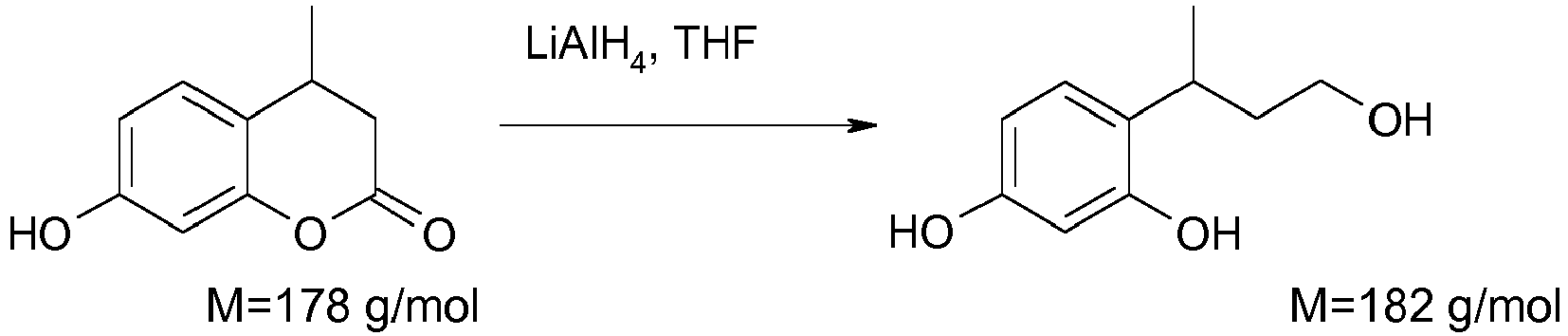
- 7-HYDROXY-4-METHYL-3,4-DIHYDRO-2H-1-BENZOPYRAN-2-ONE : 5.7 g
- LiAIH4 poudre (3 eq) : 3.7 g
- THF anhydre : 250 ml
- Dans un ballon, on a introduit le LiAlH4, le THF (en partie), puis goutte à goutte la coumarine en solution. On a laissé sous agitation une nuit à Température ambiante.
- On a refroidit le milieu réactionnel à 0°C et on a ajouté avec précaution 20 ml d'eau puis 250 ml d'HCl 1 N. Le THF a été évaporé , puis le résidu a été extrait 3 fois à l'éther diéthylique. Les phases organiques réunies ont été lavées avec une solution de NaCl saturé, puis séchées avec Na2SO4, filtrées et évaporées.
- On a récupéré 5 g d'une poudre légèrement rosée correspondant au composé attendu (rendement 86 %).
- Les spectres RMN 1H et de masse sont conformes à la structure.
Point de fusion : 128.8-129.4°C (tube capillaire) -

-
- 4-(4-hydroxybutan-2-yl)benzene-1,3-diol : 0.8 g
- Anhydride acétique (3 eq) : 1.2 ml
- Pyridine : 5 ml
- Dans un ballon, on a introduit le 4-(4-hydroxybutan-2-yl)benzène-1,3-diol, puis la pyridine. On a refroidit le milieu à 0°C et puis on a ajouté l'anhydride acétique. On a laissé sous agitation une nuit à température ambiante.
- On a ajouté 50 ml d'acétate d'éthyle et 50 ml HCl 1 N. On a lavé la phase organique avec 2 fois 50 ml HCl 1 N , puis 50 ml d'eau et 50 ml d'une solution saturée de NaCl. La phase organique a été séchée avec Na2SO4, filtrée et évaporée.
- On a récupéré 1 g d'une huile jaune correspondant au composé attendu. (rendement 77 %).
- Les spectres RMN 1H et de masse sont conformes à la structure.
-

-
- 4-[4-(acétyloxy)butan-2-yl]benzène-1,3-diyl diacétate : 0.4 g
- Hydrogénocarbonate de potassium (2 eq) : 260 mg
- Eau : 1 ml
- Ethanol : 2 ml
- Dans un ballon, on a introduit le 4-[4-(acétyloxy)butan-2-yl]benzene-1,3-diyl diacétate et l'éthanol, puis on a ajouté l'eau et le KHCO3.
- On a laissé 1h à température ambiante. On a évaporé l'éthanol et on a extrait à l'acétate d'éthyle. La phase organique a été séchée avec Na2SO4, puis filtrée et évaporée.
- On a récupéré 0, 25 g d'une huile jaune correspondant au composé attendu . (rendement 86 %).
- Les spectres RMN 1H et de masse sont conformes à la structure attendue.
- L'efficacité a été démontrée sur la base du test suivant :
Les évaluations de l'effet de prévention ou de diminution de la pigmentation de la peau et / ou de l'éclaircissement de celle-ci peau les exemples sont réalisés de la manière suivante. - La mesure de l'activité dépigmentante (réduction de la production de mélanine) de composés de formule (I) a été effectuée par dosage des mélanocytes humains normaux in vitro comme suit.
- Tout d'abord, des mélanocytes humains normaux sont cultivés et distribués dans 384puits. Après 24 heures, le milieu de culture a été remplacé par un milieu contenant des composés de formule (I) à évaluer. Les cellules ont été incubées 72 heures avant la mesure de la densité optique finale qui mesure la quantité de mélanine produite par les mélanocytes. Un effet dose est mis en œuvre en utilisant une large gamme de concentration des composés évalués. Ainsi, en faisant correspondre les concentrations et les mesures de mélanine, il est possible de déterminer une CI50 en µM: concentration à laquelle 50 % de diminution de la synthèse de mélanine est atteinte.
- Les composés de formule (I) ont montré un effet dépigmentant fort.
N° Composé IC50 (µM) Concentration maximale testée (µM) 1 3,61 200 2 4,08 200 3 4,96 200 - Ces résultats ont été comparés à ceux obtenus avec le composé le plus proche décrit dans l'art antérieur, dans le brevet
JP 2007186445 de Kuraray 
- Pour ce composé (A), la valeur de l'IC50 est de 23,4 µM concentration maximale testée 200µM.
- Les composés de l'invention ont une activité sur la réduction de la mélanogénèse beaucoup plus importante que celle du composé (A) hors invention ;
- On prépare une composition dépigmentante pour la peau comprenant (en gramme) :
Composé n°1 2 g PEG400 68 g Ethanol 30 g - La composition appliquée sur la peau permet d'estomper les taches brunes.
- On prépare un gel dépigmentant pour la peau comprenant (% en poids) :
Composé n°2 0,25% Carbomer (Carbopol 981 de chez Lubrizol) 1% conservateur qs eau qsp 100 % - La composition appliquée sur la peau permet d'estomper les taches brunes.
- Le but de ce test est d'évaluer la modulation de la mélanogénèse dans les épidermes reconstruits pigmentés après application « systémique » des produits.
- Les composés sont testés à 30µM dans le DMSO.
- Les épidermes pigmentés sont reconstruits à l'aide de kératinocytes et mélanocytes d'origine européenne ensemencés sur le substrat BPER (EPISKIN). Les produits à tester sont ajoutés au milieu de culture dès l'ensemencement des cellules et à tous les changements de milieu.
- Le modèle d'étude type épiderme reconstruit pigmenté a été publié par :
Regnier M, Duval C, Galey JB, Philippe M, Lagrange A, Tuloup R, Schmidt R, Cellular and Molecular Biology, 1999, 45, 7, 969-980 : « Keratinocyte-Melanocyte co-cultures and pigmented reconstructed human epidermis : models to study modulation of melanogenesis ». - La mélanine a été quantifiée par analyse d'images sur coupes histologiques après révélation par coloration Fontana Masson. Chaque épiderme coloré est photographié sur toute sa longueur à l'aide d'une caméra reliée à un microscope.
- Les résultats sont rassemblés dans le tableau suivant :
La diminution de la quantité de mélanine est évaluée par rapport au solvant (DMSO)Activité dépigmentante/DMSO Lucinol -41% Composé 1 -59% - Les résultats obtenus montrent que le composé 1 selon l'invention a une action dépigmentante plus importante que celle du lucinol.
Claims (13)
- Utilisation cosmétique non thérapeutique d'au moins un composé de formule (I) comme agent blanchissant, éclaircissant et/ou dépigmentant des matières kératiniques, notamment de la peau
 R1, R2 : identiques ou différents, désignenta) hydrogène,b) un radical COR5 dans lequel R5 désigne un radical alkyle linéaire en C1-C10 ou ramifié en C3-C10, de préférence un radical alkyle linéaire en C1-C6 ou ramifié en C3-C6, plus préférentiellement un radical alkyle linéaire en C1-C4 R3 désigne un radical alkyl linéaire en C1-C6 ou ramifié en C3-C6, de préférence un radical alkyle linéaire en C1-C4 ou ramifié en C3-C4R4 désigneainsi que leurs sels, leurs solvates et leurs isomères optiques, leurs racémiques, seuls ou en mélange.a) H,b) un radical alkyle linéaire en C1-C6 ou ramifié en C3-C6,c) un radical COR5,
- Utilisation selon la revendication 1, caractérisée en ce que R4 désigne H ou un radical alkyl linéaire en C1-C4, un radical alkyl ramifié en C3-C4 ou un radical COR5, plus préférentiellement H ou un radical COR5.
- Utilisation selon l'une des revendications 1 ou 2, caractérisée en ce que les composés de formule (I) sont choisis parmi ceux pour lesquels :R1, R2, identiques ou différents, désignent H ou un radical COCH3, et de préférence R1 et R2 sont identiques.R3 désigne méthyle, éthyle ou isopropyle, etR4 désigne H ou un radical COCH3ainsi que leurs sels, leurs solvates et leurs isomères optiques, leurs racémiques, seuls ou en mélange.
- Utilisation selon l'une des revendications 1 à 3, caractérisée en ce que les composés de formule (I) sont choisis parmi ceux pour lesquels :R1, R2, identiques ou différents, désignent H ou un radical COCH3, et de préférence R1 et R2 sont identiques,R3 désigne méthyle, etR4 désigne H ou un radical COCH3,ainsi que leurs sels, leurs solvates et leurs isomères optiques, leurs racémiques.
- Utilisation selon l'une des revendications 1 à 4, caractérisée en ce que les composés de formule (I) sont choisis parmi :
Structure Composé n° Nom chimique 
1 4-(3-Hydroxy-1-méthyl-propyl)-benzène-1,3-diol 
2 4-[4-(acétyloxy)butan-2-yl]benzène-1,3-diyl diacétate 
3 3-(2,4-dihydroxyphényl)butyl acétate - Composés de formule (I) suivante :
 R1, R2 : identiques ou différents, désignenta) hydrogène,b) un radical COR5 dans lequel R5 désigne un radical alkyle linéaire en C1-C10 ou ramifié en C3-C10, de préférence un radical alkyle linéaire en C1-C6 ou ramifié en C3-C6, plus préférentiellement un radical alkyle linéaire en C1-C4,R3 désigne un radical alkyl linéaire en C1-C6 ou ramifié en C3-C6, de préférence un radical alkyle linéaire en C1-C4 ou ramifié en C3-C4R4 désignea) H,b) un radical alkyl linéaire en C1-C6 ou ramifié en C3-C6,c) un radical COR5 dans lequel R5 désigne un radical alkyle linéaire en C1-C10 ou ramifié en C3-C10, de préférence un radical alkyle linéaire en C1-C6 ou ramifié en C3-C6, plus préférentiellement un radical alkyle linéaire en C1-C4,ainsi que leurs sels, leurs solvates et leurs isomères optiques, leurs racémiques, seuls ou en mélange.
- Composé de formule (I) selon la revendication 6, caractérisé en ce que R4 désigne H ou un radical alkyl linéaire en C1-C4, un radical alkyl ramifié en C3-C4 ou un radical COR5, plus préférentiellement H ou un radical COR5.
- Composé de formule (I) selon l'une des revendications 6 ou 7, caractérisé en ce que:R1, R2, identiques ou différents, désignent H ou un radical COCH3, et de préférence R1 et R2 sont identiques.R3 désigne méthyle, éthyle ou isopropyle, etR4 désigne H ou un radical COCH3ainsi que leurs sels, leurs solvates et leurs isomères optiques, leurs racémiques, seuls ou en mélange.
- Composé de formule (I) selon l'une des revendications 6 à 8, caractérisé en ce que:R1, R2, identiques ou différents, désignent H ou un radical COCH3, et de préférence R1 et R2 sont identiques,R3 désigne méthyle, etR4 désigne H ou un radical COCH3,ainsi que leurs sels, leurs solvates et leurs isomères optiques, leurs racémiques.
- Composé de formule (I) selon l'une des revendications 6 à 9, caractérisé en ce que les composés de formule (I) sont choisis parmi :
Structure Composé n° Nom chimique 
1 4-(3-Hydroxy-1-méthyl-propyl)-benzene-1,3-diol 
2 4-[4-(acétyloxy)butan-2-yl]benzène-1,3-diyl diacétate 
3 3-(2,4-dihydroxyphényl)butyl acétate - Composition comprenant, dans un milieu physiologiquement acceptable, au moins un composé de formule (I) selon l'une quelconque des revendications 6 à 10.
- Composition selon la revendication précédente, caractérisée en ce que ledit composé de formule (I) est présent en une quantité comprise entre 0,01 et 10 % en poids, de préférence entre 0,1 à 5 % en poids, notamment de 0,5 à 3 % en poids, par rapport au poids total de la composition.
- Procédé cosmétique non thérapeutique de dépigmentation, d'éclaircissement et/ou de blanchiment des matières kératiniques, notamment de la peau, comprenant l'application de la composition selon la revendication 11 ou 12.
Applications Claiming Priority (2)
| Application Number | Priority Date | Filing Date | Title |
|---|---|---|---|
| FR1562542A FR3045600B1 (fr) | 2015-12-16 | 2015-12-16 | Derives de resorcinol pour leur utilisation cosmetique |
| PCT/EP2016/080237 WO2017102536A1 (fr) | 2015-12-16 | 2016-12-08 | Dérivés de résorcinol pour leur utilisation cosmétique |
Publications (2)
| Publication Number | Publication Date |
|---|---|
| EP3390343A1 EP3390343A1 (fr) | 2018-10-24 |
| EP3390343B1 true EP3390343B1 (fr) | 2020-10-14 |
Family
ID=55862893
Family Applications (1)
| Application Number | Title | Priority Date | Filing Date |
|---|---|---|---|
| EP16815770.9A Active EP3390343B1 (fr) | 2015-12-16 | 2016-12-08 | Dérivés de résorcinol pour leur utilisation cosmétique |
Country Status (6)
| Country | Link |
|---|---|
| US (1) | US10457619B2 (fr) |
| EP (1) | EP3390343B1 (fr) |
| CN (1) | CN108368026B (fr) |
| ES (1) | ES2843728T3 (fr) |
| FR (1) | FR3045600B1 (fr) |
| WO (1) | WO2017102536A1 (fr) |
Families Citing this family (3)
| Publication number | Priority date | Publication date | Assignee | Title |
|---|---|---|---|---|
| FR3067027B1 (fr) * | 2017-05-31 | 2019-06-21 | L'oreal | Derives de resorcinol pour leur utilisation cosmetique |
| FR3068353B1 (fr) * | 2017-06-30 | 2020-05-08 | L'oreal | Derives de resorcinol pour leur utilisation cosmetique |
| CN114375291B (zh) * | 2019-08-28 | 2024-03-08 | 联合利华知识产权控股有限公司 | 用于亮肤的新型化合物 |
Family Cites Families (6)
| Publication number | Priority date | Publication date | Assignee | Title |
|---|---|---|---|---|
| US7300646B2 (en) | 2004-02-27 | 2007-11-27 | Unilever Home & Personal Care Usa, Division Of Conopco, Inc. | Skin lightening agents, compositions and methods |
| US20060210497A1 (en) * | 2005-03-18 | 2006-09-21 | Unilever Home & Personal Care Usa, Division Of Conopco, Inc. | Novel resorcinol derivatives |
| JP4986110B2 (ja) * | 2006-01-12 | 2012-07-25 | 国立大学法人九州大学 | レゾルシノール誘導体を含有するメラニン生成抑制剤 |
| DE102007038097A1 (de) * | 2007-08-13 | 2009-02-19 | Merck Patent Gmbh | Tyrosinaseinhibitoren |
| AU2009274158C1 (en) * | 2008-07-21 | 2019-09-05 | Unigen, Inc. | Series of skin-whitening (lightening) compounds |
| FR2971249B1 (fr) * | 2011-02-07 | 2013-10-18 | Fabre Pierre Dermo Cosmetique | Derives heterocycliques du resorcinol, leur preparation et leurs utilisations cosmetiques |
-
2015
- 2015-12-16 FR FR1562542A patent/FR3045600B1/fr not_active Expired - Fee Related
-
2016
- 2016-12-08 CN CN201680073090.4A patent/CN108368026B/zh active Active
- 2016-12-08 ES ES16815770T patent/ES2843728T3/es active Active
- 2016-12-08 US US16/061,913 patent/US10457619B2/en active Active
- 2016-12-08 WO PCT/EP2016/080237 patent/WO2017102536A1/fr not_active Ceased
- 2016-12-08 EP EP16815770.9A patent/EP3390343B1/fr active Active
Non-Patent Citations (1)
| Title |
|---|
| None * |
Also Published As
| Publication number | Publication date |
|---|---|
| FR3045600B1 (fr) | 2018-01-26 |
| EP3390343A1 (fr) | 2018-10-24 |
| CN108368026B (zh) | 2021-10-22 |
| US10457619B2 (en) | 2019-10-29 |
| CN108368026A (zh) | 2018-08-03 |
| FR3045600A1 (fr) | 2017-06-23 |
| ES2843728T3 (es) | 2021-07-20 |
| US20180370886A1 (en) | 2018-12-27 |
| WO2017102536A1 (fr) | 2017-06-22 |
Similar Documents
| Publication | Publication Date | Title |
|---|---|---|
| EP0820767B2 (fr) | Utilisation de dérivés de la mélatonine pour la dépigmentation de la peau et compositions les comprenant | |
| EP0966434B1 (fr) | Derives d'aminophenol et leur utilisation en cosmetique | |
| FR3045604A1 (fr) | Procede de depigmentation des matieres keratiniques a l'aide de composes thiopyridinones | |
| FR2968661A1 (fr) | Procede de depigmentation des matieres keratiniques a l'aide de composes thiopyridinones | |
| FR2843963A1 (fr) | Nouvelles molecules derivees de la noraporphine | |
| WO1999032077A1 (fr) | Utilisation de derives amides d'amino phenol comme agents depigmentants | |
| FR2767689A1 (fr) | Utilisation de derives oxamates comme agents depigmentants | |
| FR3045039A1 (fr) | Derives de resorcinol pour leur utilisation cosmetique | |
| EP0819692B1 (fr) | Dérivé de l'acide kojique et son utilisation comme agent dépigmentant | |
| EP1878470B1 (fr) | Procédé de dépigmentation de la peau | |
| WO2017102536A1 (fr) | Dérivés de résorcinol pour leur utilisation cosmétique | |
| EP0820763A2 (fr) | Utilisation de dérivés de l'acide N,N'-dibenzyl éthylenediamine n,n'-dépigmentants | |
| FR3067027B1 (fr) | Derives de resorcinol pour leur utilisation cosmetique | |
| WO2008129188A1 (fr) | Procédé de dépigmentation des matières kératiniques à l'aide de composés carbamates de vitamine c, et utilisations desdits composés | |
| FR3071731A1 (fr) | Derives de resorcinol pour leur utilisation cosmetique | |
| FR2991986A1 (fr) | Nouveaux derives de resorcinol et leurs applications cosmetiques | |
| EP2935231B1 (fr) | Composés c-xylosides,compositions et leur utilisation pour dépigmenter la peau | |
| EP1745008A1 (fr) | Composition, notamment cosmetique, comprenant un ester de ((dialkylamino)alcoxy) ethanol | |
| FR2886844A1 (fr) | Utilisation de composes 2-oxy-acetamide pour favoriser et/ou induire et/ou stimuler la pigmentation des matieres keratiniques et/ou limiter leur depigmentation et/ou leur blanchiment | |
| FR3068353A1 (fr) | Derives de resorcinol pour leur utilisation cosmetique | |
| FR3066492A1 (fr) | Derives de resorcinol pour leur utilisation cosmetique | |
| FR3097435A1 (fr) | Dérivés xylosides de resvératrol pour leur utilisation en cosmétique | |
| EP1420008A1 (fr) | Composition, notamment cosmétique, comprenant une amine secondaire ou tertiaire | |
| EP1738741A2 (fr) | Utilisation de composés benzylidène-1,3-thiazolidine-2,4-diones pour favoriser et/ou induire et/ou stimuler la pigmentation des matières kératiniques et/ou limiter leur dépigmentation et/ou leur blanchiment. | |
| FR2913422A1 (fr) | Procede de traitement cosmetique employant des analogues d'ascorbigene, compositions cosmetiques et composes |
Legal Events
| Date | Code | Title | Description |
|---|---|---|---|
| STAA | Information on the status of an ep patent application or granted ep patent |
Free format text: STATUS: UNKNOWN |
|
| STAA | Information on the status of an ep patent application or granted ep patent |
Free format text: STATUS: THE INTERNATIONAL PUBLICATION HAS BEEN MADE |
|
| PUAI | Public reference made under article 153(3) epc to a published international application that has entered the european phase |
Free format text: ORIGINAL CODE: 0009012 |
|
| STAA | Information on the status of an ep patent application or granted ep patent |
Free format text: STATUS: REQUEST FOR EXAMINATION WAS MADE |
|
| 17P | Request for examination filed |
Effective date: 20180716 |
|
| AK | Designated contracting states |
Kind code of ref document: A1 Designated state(s): AL AT BE BG CH CY CZ DE DK EE ES FI FR GB GR HR HU IE IS IT LI LT LU LV MC MK MT NL NO PL PT RO RS SE SI SK SM TR |
|
| AX | Request for extension of the european patent |
Extension state: BA ME |
|
| DAV | Request for validation of the european patent (deleted) | ||
| DAX | Request for extension of the european patent (deleted) | ||
| STAA | Information on the status of an ep patent application or granted ep patent |
Free format text: STATUS: EXAMINATION IS IN PROGRESS |
|
| 17Q | First examination report despatched |
Effective date: 20190718 |
|
| GRAP | Despatch of communication of intention to grant a patent |
Free format text: ORIGINAL CODE: EPIDOSNIGR1 |
|
| STAA | Information on the status of an ep patent application or granted ep patent |
Free format text: STATUS: GRANT OF PATENT IS INTENDED |
|
| INTG | Intention to grant announced |
Effective date: 20200604 |
|
| GRAS | Grant fee paid |
Free format text: ORIGINAL CODE: EPIDOSNIGR3 |
|
| GRAA | (expected) grant |
Free format text: ORIGINAL CODE: 0009210 |
|
| STAA | Information on the status of an ep patent application or granted ep patent |
Free format text: STATUS: THE PATENT HAS BEEN GRANTED |
|
| AK | Designated contracting states |
Kind code of ref document: B1 Designated state(s): AL AT BE BG CH CY CZ DE DK EE ES FI FR GB GR HR HU IE IS IT LI LT LU LV MC MK MT NL NO PL PT RO RS SE SI SK SM TR |
|
| REG | Reference to a national code |
Ref country code: GB Ref legal event code: FG4D Free format text: NOT ENGLISH |
|
| REG | Reference to a national code |
Ref country code: AT Ref legal event code: REF Ref document number: 1323426 Country of ref document: AT Kind code of ref document: T Effective date: 20201015 Ref country code: CH Ref legal event code: EP |
|
| REG | Reference to a national code |
Ref country code: DE Ref legal event code: R096 Ref document number: 602016045946 Country of ref document: DE |
|
| REG | Reference to a national code |
Ref country code: IE Ref legal event code: FG4D Free format text: LANGUAGE OF EP DOCUMENT: FRENCH |
|
| REG | Reference to a national code |
Ref country code: AT Ref legal event code: MK05 Ref document number: 1323426 Country of ref document: AT Kind code of ref document: T Effective date: 20201014 |
|
| REG | Reference to a national code |
Ref country code: NL Ref legal event code: MP Effective date: 20201014 |
|
| PG25 | Lapsed in a contracting state [announced via postgrant information from national office to epo] |
Ref country code: RS Free format text: LAPSE BECAUSE OF FAILURE TO SUBMIT A TRANSLATION OF THE DESCRIPTION OR TO PAY THE FEE WITHIN THE PRESCRIBED TIME-LIMIT Effective date: 20201014 Ref country code: PT Free format text: LAPSE BECAUSE OF FAILURE TO SUBMIT A TRANSLATION OF THE DESCRIPTION OR TO PAY THE FEE WITHIN THE PRESCRIBED TIME-LIMIT Effective date: 20210215 Ref country code: NO Free format text: LAPSE BECAUSE OF FAILURE TO SUBMIT A TRANSLATION OF THE DESCRIPTION OR TO PAY THE FEE WITHIN THE PRESCRIBED TIME-LIMIT Effective date: 20210114 Ref country code: GR Free format text: LAPSE BECAUSE OF FAILURE TO SUBMIT A TRANSLATION OF THE DESCRIPTION OR TO PAY THE FEE WITHIN THE PRESCRIBED TIME-LIMIT Effective date: 20210115 Ref country code: FI Free format text: LAPSE BECAUSE OF FAILURE TO SUBMIT A TRANSLATION OF THE DESCRIPTION OR TO PAY THE FEE WITHIN THE PRESCRIBED TIME-LIMIT Effective date: 20201014 |
|
| REG | Reference to a national code |
Ref country code: LT Ref legal event code: MG4D |
|
| PG25 | Lapsed in a contracting state [announced via postgrant information from national office to epo] |
Ref country code: SE Free format text: LAPSE BECAUSE OF FAILURE TO SUBMIT A TRANSLATION OF THE DESCRIPTION OR TO PAY THE FEE WITHIN THE PRESCRIBED TIME-LIMIT Effective date: 20201014 Ref country code: AT Free format text: LAPSE BECAUSE OF FAILURE TO SUBMIT A TRANSLATION OF THE DESCRIPTION OR TO PAY THE FEE WITHIN THE PRESCRIBED TIME-LIMIT Effective date: 20201014 Ref country code: BG Free format text: LAPSE BECAUSE OF FAILURE TO SUBMIT A TRANSLATION OF THE DESCRIPTION OR TO PAY THE FEE WITHIN THE PRESCRIBED TIME-LIMIT Effective date: 20210114 Ref country code: LV Free format text: LAPSE BECAUSE OF FAILURE TO SUBMIT A TRANSLATION OF THE DESCRIPTION OR TO PAY THE FEE WITHIN THE PRESCRIBED TIME-LIMIT Effective date: 20201014 Ref country code: PL Free format text: LAPSE BECAUSE OF FAILURE TO SUBMIT A TRANSLATION OF THE DESCRIPTION OR TO PAY THE FEE WITHIN THE PRESCRIBED TIME-LIMIT Effective date: 20201014 Ref country code: IS Free format text: LAPSE BECAUSE OF FAILURE TO SUBMIT A TRANSLATION OF THE DESCRIPTION OR TO PAY THE FEE WITHIN THE PRESCRIBED TIME-LIMIT Effective date: 20210214 |
|
| PG25 | Lapsed in a contracting state [announced via postgrant information from national office to epo] |
Ref country code: NL Free format text: LAPSE BECAUSE OF FAILURE TO SUBMIT A TRANSLATION OF THE DESCRIPTION OR TO PAY THE FEE WITHIN THE PRESCRIBED TIME-LIMIT Effective date: 20201014 Ref country code: HR Free format text: LAPSE BECAUSE OF FAILURE TO SUBMIT A TRANSLATION OF THE DESCRIPTION OR TO PAY THE FEE WITHIN THE PRESCRIBED TIME-LIMIT Effective date: 20201014 |
|
| REG | Reference to a national code |
Ref country code: DE Ref legal event code: R097 Ref document number: 602016045946 Country of ref document: DE |
|
| REG | Reference to a national code |
Ref country code: ES Ref legal event code: FG2A Ref document number: 2843728 Country of ref document: ES Kind code of ref document: T3 Effective date: 20210720 |
|
| PG25 | Lapsed in a contracting state [announced via postgrant information from national office to epo] |
Ref country code: SM Free format text: LAPSE BECAUSE OF FAILURE TO SUBMIT A TRANSLATION OF THE DESCRIPTION OR TO PAY THE FEE WITHIN THE PRESCRIBED TIME-LIMIT Effective date: 20201014 Ref country code: LT Free format text: LAPSE BECAUSE OF FAILURE TO SUBMIT A TRANSLATION OF THE DESCRIPTION OR TO PAY THE FEE WITHIN THE PRESCRIBED TIME-LIMIT Effective date: 20201014 Ref country code: CZ Free format text: LAPSE BECAUSE OF FAILURE TO SUBMIT A TRANSLATION OF THE DESCRIPTION OR TO PAY THE FEE WITHIN THE PRESCRIBED TIME-LIMIT Effective date: 20201014 Ref country code: EE Free format text: LAPSE BECAUSE OF FAILURE TO SUBMIT A TRANSLATION OF THE DESCRIPTION OR TO PAY THE FEE WITHIN THE PRESCRIBED TIME-LIMIT Effective date: 20201014 Ref country code: SK Free format text: LAPSE BECAUSE OF FAILURE TO SUBMIT A TRANSLATION OF THE DESCRIPTION OR TO PAY THE FEE WITHIN THE PRESCRIBED TIME-LIMIT Effective date: 20201014 Ref country code: RO Free format text: LAPSE BECAUSE OF FAILURE TO SUBMIT A TRANSLATION OF THE DESCRIPTION OR TO PAY THE FEE WITHIN THE PRESCRIBED TIME-LIMIT Effective date: 20201014 |
|
| REG | Reference to a national code |
Ref country code: CH Ref legal event code: PL |
|
| PLBE | No opposition filed within time limit |
Free format text: ORIGINAL CODE: 0009261 |
|
| STAA | Information on the status of an ep patent application or granted ep patent |
Free format text: STATUS: NO OPPOSITION FILED WITHIN TIME LIMIT |
|
| PG25 | Lapsed in a contracting state [announced via postgrant information from national office to epo] |
Ref country code: DK Free format text: LAPSE BECAUSE OF FAILURE TO SUBMIT A TRANSLATION OF THE DESCRIPTION OR TO PAY THE FEE WITHIN THE PRESCRIBED TIME-LIMIT Effective date: 20201014 Ref country code: MC Free format text: LAPSE BECAUSE OF FAILURE TO SUBMIT A TRANSLATION OF THE DESCRIPTION OR TO PAY THE FEE WITHIN THE PRESCRIBED TIME-LIMIT Effective date: 20201014 |
|
| REG | Reference to a national code |
Ref country code: BE Ref legal event code: MM Effective date: 20201231 |
|
| 26N | No opposition filed |
Effective date: 20210715 |
|
| PG25 | Lapsed in a contracting state [announced via postgrant information from national office to epo] |
Ref country code: LU Free format text: LAPSE BECAUSE OF NON-PAYMENT OF DUE FEES Effective date: 20201208 Ref country code: AL Free format text: LAPSE BECAUSE OF FAILURE TO SUBMIT A TRANSLATION OF THE DESCRIPTION OR TO PAY THE FEE WITHIN THE PRESCRIBED TIME-LIMIT Effective date: 20201014 Ref country code: IE Free format text: LAPSE BECAUSE OF NON-PAYMENT OF DUE FEES Effective date: 20201208 |
|
| PG25 | Lapsed in a contracting state [announced via postgrant information from national office to epo] |
Ref country code: SI Free format text: LAPSE BECAUSE OF FAILURE TO SUBMIT A TRANSLATION OF THE DESCRIPTION OR TO PAY THE FEE WITHIN THE PRESCRIBED TIME-LIMIT Effective date: 20201014 Ref country code: CH Free format text: LAPSE BECAUSE OF NON-PAYMENT OF DUE FEES Effective date: 20201231 Ref country code: LI Free format text: LAPSE BECAUSE OF NON-PAYMENT OF DUE FEES Effective date: 20201231 |
|
| PGFP | Annual fee paid to national office [announced via postgrant information from national office to epo] |
Ref country code: IT Payment date: 20211110 Year of fee payment: 6 |
|
| PG25 | Lapsed in a contracting state [announced via postgrant information from national office to epo] |
Ref country code: IS Free format text: LAPSE BECAUSE OF FAILURE TO SUBMIT A TRANSLATION OF THE DESCRIPTION OR TO PAY THE FEE WITHIN THE PRESCRIBED TIME-LIMIT Effective date: 20210214 Ref country code: TR Free format text: LAPSE BECAUSE OF FAILURE TO SUBMIT A TRANSLATION OF THE DESCRIPTION OR TO PAY THE FEE WITHIN THE PRESCRIBED TIME-LIMIT Effective date: 20201014 Ref country code: MT Free format text: LAPSE BECAUSE OF FAILURE TO SUBMIT A TRANSLATION OF THE DESCRIPTION OR TO PAY THE FEE WITHIN THE PRESCRIBED TIME-LIMIT Effective date: 20201014 Ref country code: CY Free format text: LAPSE BECAUSE OF FAILURE TO SUBMIT A TRANSLATION OF THE DESCRIPTION OR TO PAY THE FEE WITHIN THE PRESCRIBED TIME-LIMIT Effective date: 20201014 |
|
| PGFP | Annual fee paid to national office [announced via postgrant information from national office to epo] |
Ref country code: ES Payment date: 20220105 Year of fee payment: 6 |
|
| PG25 | Lapsed in a contracting state [announced via postgrant information from national office to epo] |
Ref country code: MK Free format text: LAPSE BECAUSE OF FAILURE TO SUBMIT A TRANSLATION OF THE DESCRIPTION OR TO PAY THE FEE WITHIN THE PRESCRIBED TIME-LIMIT Effective date: 20201014 |
|
| PG25 | Lapsed in a contracting state [announced via postgrant information from national office to epo] |
Ref country code: BE Free format text: LAPSE BECAUSE OF NON-PAYMENT OF DUE FEES Effective date: 20201231 |
|
| REG | Reference to a national code |
Ref country code: ES Ref legal event code: FD2A Effective date: 20240126 |
|
| PG25 | Lapsed in a contracting state [announced via postgrant information from national office to epo] |
Ref country code: IT Free format text: LAPSE BECAUSE OF NON-PAYMENT OF DUE FEES Effective date: 20221208 |
|
| PG25 | Lapsed in a contracting state [announced via postgrant information from national office to epo] |
Ref country code: ES Free format text: LAPSE BECAUSE OF NON-PAYMENT OF DUE FEES Effective date: 20221209 |
|
| PG25 | Lapsed in a contracting state [announced via postgrant information from national office to epo] |
Ref country code: ES Free format text: LAPSE BECAUSE OF NON-PAYMENT OF DUE FEES Effective date: 20221209 |
|
| PGFP | Annual fee paid to national office [announced via postgrant information from national office to epo] |
Ref country code: FR Payment date: 20250930 Year of fee payment: 10 |
|
| PGFP | Annual fee paid to national office [announced via postgrant information from national office to epo] |
Ref country code: DE Payment date: 20250930 Year of fee payment: 10 |
|
| PGFP | Annual fee paid to national office [announced via postgrant information from national office to epo] |
Ref country code: GB Payment date: 20251001 Year of fee payment: 10 |