EP3394335B1 - Tissu industriel, notamment bande transporteuse - Google Patents
Tissu industriel, notamment bande transporteuse Download PDFInfo
- Publication number
- EP3394335B1 EP3394335B1 EP17717702.9A EP17717702A EP3394335B1 EP 3394335 B1 EP3394335 B1 EP 3394335B1 EP 17717702 A EP17717702 A EP 17717702A EP 3394335 B1 EP3394335 B1 EP 3394335B1
- Authority
- EP
- European Patent Office
- Prior art keywords
- threads
- cross
- longitudinal threads
- section
- transverse
- Prior art date
- Legal status (The legal status is an assumption and is not a legal conclusion. Google has not performed a legal analysis and makes no representation as to the accuracy of the status listed.)
- Active
Links
Images

Classifications
-
- D—TEXTILES; PAPER
- D03—WEAVING
- D03D—WOVEN FABRICS; METHODS OF WEAVING; LOOMS
- D03D1/00—Woven fabrics designed to make specified articles
- D03D1/0094—Belts
-
- B—PERFORMING OPERATIONS; TRANSPORTING
- B65—CONVEYING; PACKING; STORING; HANDLING THIN OR FILAMENTARY MATERIAL
- B65G—TRANSPORT OR STORAGE DEVICES, e.g. CONVEYORS FOR LOADING OR TIPPING, SHOP CONVEYOR SYSTEMS OR PNEUMATIC TUBE CONVEYORS
- B65G15/00—Conveyors having endless load-conveying surfaces, i.e. belts and like continuous members, to which tractive effort is transmitted by means other than endless driving elements of similar configuration
- B65G15/30—Belts or like endless load-carriers
- B65G15/54—Endless load-carriers made of interwoven ropes or wires
-
- D—TEXTILES; PAPER
- D03—WEAVING
- D03D—WOVEN FABRICS; METHODS OF WEAVING; LOOMS
- D03D11/00—Double or multi-ply fabrics not otherwise provided for
-
- D—TEXTILES; PAPER
- D03—WEAVING
- D03D—WOVEN FABRICS; METHODS OF WEAVING; LOOMS
- D03D15/00—Woven fabrics characterised by the material, structure or properties of the fibres, filaments, yarns, threads or other warp or weft elements used
- D03D15/20—Woven fabrics characterised by the material, structure or properties of the fibres, filaments, yarns, threads or other warp or weft elements used characterised by the material of the fibres or filaments constituting the yarns or threads
- D03D15/292—Conjugate, i.e. bi- or multicomponent, fibres or filaments
-
- D—TEXTILES; PAPER
- D03—WEAVING
- D03D—WOVEN FABRICS; METHODS OF WEAVING; LOOMS
- D03D15/00—Woven fabrics characterised by the material, structure or properties of the fibres, filaments, yarns, threads or other warp or weft elements used
- D03D15/30—Woven fabrics characterised by the material, structure or properties of the fibres, filaments, yarns, threads or other warp or weft elements used characterised by the structure of the fibres or filaments
- D03D15/37—Woven fabrics characterised by the material, structure or properties of the fibres, filaments, yarns, threads or other warp or weft elements used characterised by the structure of the fibres or filaments with specific cross-section or surface shape
-
- D—TEXTILES; PAPER
- D03—WEAVING
- D03D—WOVEN FABRICS; METHODS OF WEAVING; LOOMS
- D03D15/00—Woven fabrics characterised by the material, structure or properties of the fibres, filaments, yarns, threads or other warp or weft elements used
- D03D15/40—Woven fabrics characterised by the material, structure or properties of the fibres, filaments, yarns, threads or other warp or weft elements used characterised by the structure of the yarns or threads
- D03D15/43—Woven fabrics characterised by the material, structure or properties of the fibres, filaments, yarns, threads or other warp or weft elements used characterised by the structure of the yarns or threads with differing diameters
-
- D—TEXTILES; PAPER
- D03—WEAVING
- D03D—WOVEN FABRICS; METHODS OF WEAVING; LOOMS
- D03D15/00—Woven fabrics characterised by the material, structure or properties of the fibres, filaments, yarns, threads or other warp or weft elements used
- D03D15/40—Woven fabrics characterised by the material, structure or properties of the fibres, filaments, yarns, threads or other warp or weft elements used characterised by the structure of the yarns or threads
- D03D15/44—Woven fabrics characterised by the material, structure or properties of the fibres, filaments, yarns, threads or other warp or weft elements used characterised by the structure of the yarns or threads with specific cross-section or surface shape
- D03D15/46—Flat yarns, e.g. tapes or films
-
- D—TEXTILES; PAPER
- D03—WEAVING
- D03D—WOVEN FABRICS; METHODS OF WEAVING; LOOMS
- D03D15/00—Woven fabrics characterised by the material, structure or properties of the fibres, filaments, yarns, threads or other warp or weft elements used
- D03D15/40—Woven fabrics characterised by the material, structure or properties of the fibres, filaments, yarns, threads or other warp or weft elements used characterised by the structure of the yarns or threads
- D03D15/47—Woven fabrics characterised by the material, structure or properties of the fibres, filaments, yarns, threads or other warp or weft elements used characterised by the structure of the yarns or threads multicomponent, e.g. blended yarns or threads
-
- D—TEXTILES; PAPER
- D03—WEAVING
- D03D—WOVEN FABRICS; METHODS OF WEAVING; LOOMS
- D03D15/00—Woven fabrics characterised by the material, structure or properties of the fibres, filaments, yarns, threads or other warp or weft elements used
- D03D15/50—Woven fabrics characterised by the material, structure or properties of the fibres, filaments, yarns, threads or other warp or weft elements used characterised by the properties of the yarns or threads
- D03D15/56—Woven fabrics characterised by the material, structure or properties of the fibres, filaments, yarns, threads or other warp or weft elements used characterised by the properties of the yarns or threads elastic
-
- D—TEXTILES; PAPER
- D03—WEAVING
- D03D—WOVEN FABRICS; METHODS OF WEAVING; LOOMS
- D03D3/00—Woven fabrics characterised by their shape
- D03D3/04—Endless fabrics
-
- D—TEXTILES; PAPER
- D04—BRAIDING; LACE-MAKING; KNITTING; TRIMMINGS; NON-WOVEN FABRICS
- D04H—MAKING TEXTILE FABRICS, e.g. FROM FIBRES OR FILAMENTARY MATERIAL; FABRICS MADE BY SUCH PROCESSES OR APPARATUS, e.g. FELTS, NON-WOVEN FABRICS; COTTON-WOOL; WADDING ; NON-WOVEN FABRICS FROM STAPLE FIBRES, FILAMENTS OR YARNS, BONDED WITH AT LEAST ONE WEB-LIKE MATERIAL DURING THEIR CONSOLIDATION
- D04H1/00—Non-woven fabrics formed wholly or mainly of staple fibres or like relatively short fibres
- D04H1/40—Non-woven fabrics formed wholly or mainly of staple fibres or like relatively short fibres from fleeces or layers composed of fibres without existing or potential cohesive properties
- D04H1/54—Non-woven fabrics formed wholly or mainly of staple fibres or like relatively short fibres from fleeces or layers composed of fibres without existing or potential cohesive properties by welding together the fibres, e.g. by partially melting or dissolving
- D04H1/56—Non-woven fabrics formed wholly or mainly of staple fibres or like relatively short fibres from fleeces or layers composed of fibres without existing or potential cohesive properties by welding together the fibres, e.g. by partially melting or dissolving in association with fibre formation, e.g. immediately following extrusion of staple fibres
-
- D—TEXTILES; PAPER
- D04—BRAIDING; LACE-MAKING; KNITTING; TRIMMINGS; NON-WOVEN FABRICS
- D04H—MAKING TEXTILE FABRICS, e.g. FROM FIBRES OR FILAMENTARY MATERIAL; FABRICS MADE BY SUCH PROCESSES OR APPARATUS, e.g. FELTS, NON-WOVEN FABRICS; COTTON-WOOL; WADDING ; NON-WOVEN FABRICS FROM STAPLE FIBRES, FILAMENTS OR YARNS, BONDED WITH AT LEAST ONE WEB-LIKE MATERIAL DURING THEIR CONSOLIDATION
- D04H3/00—Non-woven fabrics formed wholly or mainly of yarns or like filamentary material of substantial length
- D04H3/02—Non-woven fabrics formed wholly or mainly of yarns or like filamentary material of substantial length characterised by the method of forming fleeces or layers, e.g. reorientation of yarns or filaments
-
- D—TEXTILES; PAPER
- D10—INDEXING SCHEME ASSOCIATED WITH SUBLASSES OF SECTION D, RELATING TO TEXTILES
- D10B—INDEXING SCHEME ASSOCIATED WITH SUBLASSES OF SECTION D, RELATING TO TEXTILES
- D10B2331/00—Fibres made from polymers obtained otherwise than by reactions only involving carbon-to-carbon unsaturated bonds, e.g. polycondensation products
- D10B2331/04—Fibres made from polymers obtained otherwise than by reactions only involving carbon-to-carbon unsaturated bonds, e.g. polycondensation products polyesters, e.g. polyethylene terephthalate [PET]
-
- D—TEXTILES; PAPER
- D10—INDEXING SCHEME ASSOCIATED WITH SUBLASSES OF SECTION D, RELATING TO TEXTILES
- D10B—INDEXING SCHEME ASSOCIATED WITH SUBLASSES OF SECTION D, RELATING TO TEXTILES
- D10B2401/00—Physical properties
- D10B2401/04—Heat-responsive characteristics
- D10B2401/041—Heat-responsive characteristics thermoplastic; thermosetting
-
- D—TEXTILES; PAPER
- D10—INDEXING SCHEME ASSOCIATED WITH SUBLASSES OF SECTION D, RELATING TO TEXTILES
- D10B—INDEXING SCHEME ASSOCIATED WITH SUBLASSES OF SECTION D, RELATING TO TEXTILES
- D10B2401/00—Physical properties
- D10B2401/16—Physical properties antistatic; conductive
Definitions
- the invention relates to a plant for producing a nonwoven, the plant having a conveyor belt for transporting a web of a nonwoven, in particular during its manufacture or handling in the plant, with a product side that is in contact with the nonwoven, and a machine side that with Transport devices of the system is in contact, the conveyor belt having longitudinal threads running in the running direction of the web of the nonwoven and transverse threads running perpendicular thereto, which are interwoven with one another.
- the warp threads of the conveyor belt form its longitudinal threads and the weft threads form its transverse threads, although this is not mandatory.
- the conveyor belt is woven endlessly and then the warp threads form the transverse threads and the weft threads the longitudinal threads of the conveyor belt.
- the longitudinal threads of the finished conveyor belt are often also referred to as MD threads (machine direction threads) and the transverse threads as CMD threads (cross machine direction threads).
- Non-woven fabrics so-called “non-wovens” or “non-woven fabrics” (or French “non-tisse”) are typically produced directly from fibers without the steps for thread production and processing, as in the case of classic textile fabrics weaving, knitting or knitting.
- nonwoven it is to be understood to mean a structure of fibers of limited length, continuous fibers (filaments) or cut yarns of any kind and of any origin, which are combined in any way to form a nonwoven (a layer of fibers, a pile of fibers) and are connected in some way. The most widespread is the production of so-called “spunbond” or "meltblown".
- the just extruded and stretched fibers are placed on a conveyor belt so as to form a flat web, namely the later nonwoven, the fibers being in a hot and sticky state at this moment, which is why they adhere to one another and form a coherent nonwoven web.
- the process of so-called "airlaying" is also known, in which the nonwoven web is consolidated after the fiber deposition, using a mechanical needling step or a water jet.
- the conveyor belts used in the manufacturing process of the nonwovens play a decisive role in the quality of the nonwoven and the reliability of the production process.
- the conveyor belts consist of fabrics made of plastic monofilaments, but alternatively metal fabrics can also be used if the temperature conditions in the nonwoven fabric manufacture do not allow the use of plastic-based conveyor belts.
- Most of the plastic monofilaments or metal threads used have a smooth surface, which is why the surface areas of the woven conveyor belt formed therefrom are also correspondingly smooth.
- a smooth surface can lead to problems in the manufacturing process in the production of nonwovens, which results in particular from a relative movement between the fibers of the nonwoven and the surface of the conveyor belt, that is to say "slippage".
- a certain level of adhesion of the nonwoven layer to the conveyor belt is important, however, since uniform removal or removal is necessary for constant production and high-quality product. This plays an important role especially in view of increasing machine speeds.
- the adhesion of the fibers must not be too great, since otherwise it would not be able to continue at the delivery position, i.e. Transfer to the next conveyor belt, comes.
- a conveyor belt which is to be used in the production of nonwovens, in which threads are used which have a rough surface and are intended to prevent the nonwoven to be formed from slipping through.
- the deliberately rough threads can be in the form of structured, for example grooved, monofilaments or else in the form of twisted yarns. It can also be provided that the roughness and thus the anti-slip effect are direction-dependent, ie only occur in the running direction of the conveyor belt.
- an optional core-shell structure of the threads having the roughness is also proposed.
- a base fabric is described from which a covering for paper machines or a textile for others is made with the aid of further production steps industrial processes are to be generated.
- the base fabric comprises at least one combination yarn made of filaments which are made of polyamide and thermoplastic polyurethane.
- the known base fabric is to be needled over the entire surface with one or more nonwoven fabrics in order to obtain a press felt for use in the press section of a paper machine.
- the base fabric as such which contains the thermoplastic polyurethane threads, is not intended for direct use, but always requires the application of further layers.
- the thermoplastic polyurethane in the middle base fabric is intended to increase the water absorption capacity and to improve the elasticity and compressibility of the press felt in the thickness direction.
- the DE 10 2007 047 880 A1 a paper machine clothing that is to be used either as a press felt or as a dryer fabric.
- the key idea in this known paper machine clothing is to provide a varying filament diameter in the longitudinal direction of the threads connected to form a fabric.
- the threads used also have a core-shell structure, the thread core being made, for example, of polyamide and intended to absorb the longitudinal forces, whereas the thread shell is made of a thermoplastic elastomer, in particular a thermoplastic polyurethane. Even if the thread jacket can come into contact with the paper web to be transported, the thermoplastic elastomer has therefore been selected in order to achieve improved damping against vibrations in the clothing during operation of the paper machine.
- the invention has for its object to propose a system for producing a nonwoven fabric with a conveyor belt for transporting a web of a nonwoven fabric during its manufacture or handling, in which the risk of slipping between the transported web and the conveyor belt is further reduced.
- the aforementioned object is achieved in that at least partial areas of the surface lying on the product side of the conveyor belt consist of at least part of the longitudinal threads and / or transverse threads made of a polymer material which contains at least a portion of a thermoplastic elastomer.
- the conveyor belt of the system according to the invention can be advantageous to have at least two layers of longitudinal threads which are stacked in pairs above and below one another and product side longitudinal threads and Form non-product side longitudinal threads.
- the product side longitudinal threads can be optimized especially with regard to the adhesive properties in order to minimize the slipping effect
- the non-product side longitudinal threads can be tailored, for example with regard to the mechanical properties of the conveyor belt, for example to a particularly high one Tensile strength of the conveyor belt as well as high abrasion resistance and thus to ensure a long service life.
- the arrangement of the two layers of the longitudinal threads, which are stacked in pairs makes it possible to achieve a comparatively small thickness of the conveyor belt despite these longitudinal threads, which are typically designed as warp threads.
- the conveyor belt has a single layer of transverse threads, preferably alternately one transverse thread with a larger diameter and one transverse thread with a smaller diameter being arranged one behind the other in the direction of the longitudinal threads. More preferably, the transverse threads with the smaller diameter bind with the longitudinal threads, whereas the transverse threads with the larger diameter run between the product side longitudinal threads and the non-product side longitudinal threads and form a kind of "filler threads". This type of binding results in a conveyor belt with a particularly smooth surface, which nevertheless has very good adhesive properties, at least on the product side, due to the material properties according to the invention.
- a respective cross section of the product side longitudinal threads and / or the product side cross threads to have at least two regions, of which a first region consists of said thermoplastic elastomer with special adhesive properties and a second region consists of a different material, wherein an essential, preferably predominant, portion of a tensile force acting on the respective product side longitudinal threads can be transmitted from the second region.
- the cross section of the product side longitudinal threads has a first area in the form of a jacket and a second area in the form of a core, the jacket enclosing the core.
- the strength properties (due to the core) and wear resistance as well as the adhesive properties (due to the sheath) of the thread can be combined well, whereby the orientation of the thread within the conveyor belt is not important due to the covering with the material with the good adhesion properties , which simplifies the production of the conveyor belt of the system according to the invention and in particular also allows the use of threads with a round outer contour.
- the product side longitudinal threads and / or the product side cross threads are coextruded and / or extruded in two successive steps, the soul being extruded in a first step in the latter case and the in a second step in cross section, preferably an annular jacket is extruded or coated around the core.
- two cross-sectional areas of the respective thread to be extruded next to one another in the form of a so-called "side-by-side extrusion”. This is possible both for threads which are round in cross section, the partial cross sections then preferably forming semicircles, but also for flat threads which are then preferably composed of two likewise flat partial cross sections in a “stacked” arrangement.
- a ratio of a height of the cross section to a width of the cross section can preferably be between 1: 1.2 and 1:10, more preferably between 1: 1.5 and 1 : 4.
- the longitudinal threads have a round cross-section and at least a partial area of the surface of these longitudinal threads consists of a thermoplastic elastomer, preferably several identical longitudinal threads, each with a round cross-section, running parallel to one another and the same path through the Describe the conveyor belt.
- a thermoplastic elastomer preferably several identical longitudinal threads, each with a round cross-section, running parallel to one another and the same path through the Describe the conveyor belt.
- every second, every third, every fourth or every fifth warp and / or weft thread is a thermoplastic elastomer having.
- the threads that have the thermoplastic elastomer can all have the same thread course, but can also run through the conveyor belt in different ways, such as, for example, in the case of a conveyor belt with different types of weft threads, with each type having a certain number of threads the thermoplastic Has elastomer.
- the adhesive properties should not be maximized, since there is then a risk of the nonwoven being detached too badly and the nonwoven web being transferred poorly to the next conveyor belt.
- the longitudinal threads and / or the transverse threads are preferably monofilaments, more preferably they are made entirely of plastic. However, it is also conceivable that the longitudinal threads and / or transverse threads have a metal wire core around which a sheath consisting of plastic material, in particular of thermoplastic elastomer, extends.
- An endlessly woven conveyor belt of the system according to the invention must be put together to form an "endless" belt or belt before it is used as a conveyor belt, if it has not already been produced as a hose in terms of weaving technology.
- the section of the conveyor belt that is to be formed into a band is connected with the aid of a seam.
- This seam can be, for example, a spiral seam, which has seam spirals that extend over the entire width of the conveyor belt, which are each twisted or hooked into loops of longitudinal threads at the opposite ends of the conveyor belt, and both by means of one that extends over the entire width of the conveyor belt Closing wire are coupled together.
- the seam can also be designed as a chain loop seam, again with one or more closing wires, or as a welded seam.
- a welded seam can be used using, for example, laser welding or ultrasonic welding.
- the conveyor belt can either be closed irreversibly by means of such a seam, but also reversibly, for example in that seam elements which can be reversibly opened and closed by means of a closing wire are irreversibly connected to the opposite ends of the conveyor belt by means of welding (see. WO 2011/069259 A1 , WO 2011/069258 A1 and WO 2010/121360 A1 ).
- the seam spirals can likewise each consist of a thread, the cross section of which has at least two areas, namely, for example, on the one hand in the form of a core and on the other hand in the form of a shell enclosing the core or in other cross-sectional divisions, the product side facing area, in particular the jacket, preferably consists of a thermoplastic elastomer.
- the adhesive properties of the conveyor belt are the same over its entire circumferential length, so that the risk of slipping is not increased even in the seam area.
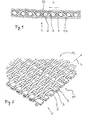
- Figure 1 shows a conveyor belt 1 for a plant for producing a spunbonded nonwoven.
- the conveyor belt 1 is made in one layer and has round monofilaments 2 with a larger diameter in cross-section, which form a lower transverse thread layer facing a machine side MS, and transverse threads 3 which form an upper layer facing the product side PS form.
- the transverse threads 2 and 3 each form weft threads of the conveyor belt 1.
- the conveyor belt 1 has longitudinal threads 4, each of which extends with floatings both on the product side PS and on the machine side MS of the conveyor belt 1. Both floats are of the same length and each extend over three transverse threads 2, 3. Which form the warp threads of the conveyor belt 1 Longitudinal threads 4 likewise have a round cross section, the diameter of the longitudinal threads 4 corresponding to that of the transverse threads 3 with the smaller diameter.
- either all the longitudinal threads 4 or transverse threads 2, 3 can have a thermoplastic elastomer or only a few, such as every 3rd, 4th or xth longitudinal thread. It is also conceivable that the threads having a thermoplastic elastomer are arranged only in one or both edge region (s) or only in the central region of the conveyor belt.
- the longitudinal threads 4 largely consist of PET, a certain number of longitudinal threads 4 having electrically conductive properties. Every 4th longitudinal thread 4 consists of a thermoplastic elastomer in the form of sheath-soul threads.
- these longitudinal threads 4 can also consist of up to 50% by weight of co-extruded threads, the remainder of the material consisting of plastics which can be extruded as monofilaments such as PET, PA, PPS, PEEK, PLA and / or antistatic and PU-containing monofilaments.
- the coefficient of friction of the material of the longitudinal threads 4 compared to paper based on DIN 53375 is between 0.30 ⁇ and 0.99 ⁇ , preferably between 0.30 ⁇ and 0.80 ⁇ , further preferably between 0.40 ⁇ and 0.70 ⁇ . Even if the conveyor belt 1 of the system according to the invention is used to transport a nonwoven web, the aforementioned friction coefficient based on paper is meaningful and the interval is advantageous.
- the transverse threads 3, which also extend in part on the product side of the conveyor belt 1, (also) consist of sheath-core threads or at least 50% by weight of co-extruded threads, the outer sheath in each case made of a thermoplastic elastomer consists.
- the transverse threads 2 with the larger diameter generally consist of conventional plastics that can be extruded as monofilaments, such as PET, PA, PPS, PEEK, PLA and / or of antistatic and PU-containing monofilaments. However, it can also be provided that these consist entirely or partially of thermoplastic elastomers.
- the longitudinal threads 4 of the conveyor belt 1 'according to Figure 2 consist entirely or partially of thermoplastic elastomer, the transverse threads 3 in turn have the same diameter as the longitudinal threads 4 and are made of the same material as this.
- the transverse threads 2 'of the conveyor belt 1' according to Figure 2 provided with a flattened, namely rectangular, cross section.
- the flattened cross threads 2 ' that are not extend to the surface forming the product side PS, consist of conventional monofilmable plastics such as PET, PA, PPS, PEEK, PLA and / or of antistatic and PU-containing monofilaments. However, it can also be provided that these consist entirely or partially of thermoplastic elastomers.
- conveyor belts 1 and 1 indicates this Figure 3 apparent conveyor belt 1 "only a single weft position, on the other hand two warp layers, which are in a vertically stacked arrangement in the conveyor belt 1". A longitudinal section through the conveyor belt is in Figure 4 shown.
- An upper warp layer is formed by longitudinal threads 4 ", which are each arranged in groups of three next to one another, with all longitudinal threads 4" each of a group of three having an identical course through the conveyor belt 1 "(apart from the lateral offset by the diameter of a longitudinal thread 4" in each case) .
- the longitudinal threads 4 form a surface of the conveyor belt 1" facing the product side PS.
- the longitudinal threads 4 can be made of different materials, depending on how much adhesion has to be generated.
- the longitudinal threads 4 '' facing the machine side MS are formed by ribbon-like monofilaments whose width measured transversely to the running direction L of the conveyor belt 1 '' is three times the diameter of the longitudinal threads 4 '' facing the product side PS.
- Three longitudinal threads 4 "forming a group and one in each Vertical alignment of the longitudinal thread 4 '' underneath is in a stacked arrangement within the conveyor belt 1 ''.
- the conveyor belt 1 has only a single weft layer, which is alternately formed by transverse threads 2 with a larger diameter and transverse threads 3 with a smaller diameter.
- the transverse threads 3 function as so-called" binding wefts "with which the longitudinal threads 4" and 4 '"bind , whereas the transverse threads 2 with a larger diameter act as filling wefts, which keep the longitudinal threads 4 ", 4 '" at a distance in the area of the floats and ensure a smooth surface both on the product side PS and on the machine side MS.
- the longitudinal threads 4 "with a round cross-section arranged on the product side PS consist entirely or partially of thermoplastic elastomer in the form of sheath-soul threads or co-extruded threads.
- the longitudinal threads 4 '" located on the machine side MS consist of conventional plastics such as monofilament extrudable PET, PA, PPS, PEEK, PLA and / or from antistatic and PU-containing monofilaments. However, it can also be provided that these consist entirely or partially of thermoplastic elastomers.
- the transverse threads 2 with the larger diameter generally consist of conventional plastics extrudable as monofilaments such as PET, PA, PPS, PEEK, PLA and / or of antistatic and PU-containing mnofilaments. However, it can also be provided that these consist entirely or partially of thermoplastic elastomers.
- the transverse threads 3, which also extend in part on the product side of the conveyor belt 1, can also be formed entirely or partially as threads made of a thermoplastic elastomer.
Landscapes
- Engineering & Computer Science (AREA)
- Textile Engineering (AREA)
- Mechanical Engineering (AREA)
- Woven Fabrics (AREA)
- Belt Conveyors (AREA)
- Nonwoven Fabrics (AREA)
Claims (15)
- Installation, destinée à la fabrication d'un non-tissé, l'installation comportant une bande de transport (1, 1', 1") pour le transport d'une nappe en non-tissé, pourvue d'un côté produit (PS), qui est en contact avec le non-tissé, et d'un côté machine (MS), qui est en contact avec des systèmes de transport de l'installation, la bande de transport (1, 1', 1") comportant des fils longitudinaux (4, 4', 4", 4"') s'écoulant dans la direction de défilement (L) de la nappe de non-tissé et des fils transversaux (2, 3) s'écoulant à la perpendiculaire de ceux-ci, qui sont entremêlés les uns avec les autres, caractérisée en ce qu'au moins des zones partielles de la surface qui fait face au côté produit (PS) de la bande de transport (1, 1', 1") d'au moins une partie des fils longitudinaux et/ou des fils transversaux (2, 3) sont constituées d'une matière polymère qui contient au moins une proportion d'un élastomère thermoplastique.
- Installation selon la revendication 1, caractérisée en ce qu'au moins deux couches de fils longitudinaux (4", 4"') sont présentes, qui sont placées au-dessus ou en-dessous l'une de l'autre, en étant empilées par paire et forment des fils longitudinaux (4") du côté produit et des fils longitudinaux du côté non-produit.
- Installation selon la revendication 1 ou 2, caractérisée en ce que la bande de transport (1") détient une seule couche de fils transversaux (2, 3), de préférence en alternance, respectivement un fil transversal (2) d'un diamètre plus important et un fil transversal (3) d'un diamètre plus faible étant placés l'un derrière l'autre dans la direction des fils longitudinaux (4", 4"'), de manière préférentielle par ailleurs, les fils transversaux (3) du plus faible diamètre étant liés avec les fils longitudinaux (4", 4"') et les fils transversaux (2) de diamètre plus important s'écoulant à travers les fils longitudinaux (4") du côté produit et les fils longitudinaux (4"') du côté non-produit.
- Installation selon l'une quelconque des revendications 1 à 3, caractérisée en ce qu'une section transversale respective des fils longitudinaux (4") du côté produit et/ou der fils transversaux (2, 3) comporte au moins deux zones, dont une première zone est constituée de l'élastomère thermoplastique et une deuxième zone est constituée d'une autre matière, à partir de la deuxième zone étant transmissible une proportion essentielle, de préférence majeure d'une force de traction agissant sur le fil longitudinal (4") respectif du côté produit.
- Installation selon la revendication 4, caractérisée en ce que la section transversale des fils longitudinaux (4") du côté produit et/ou de fils transversaux (2, 3) comporte une première zone sous la forme d'une enveloppe et une deuxième zone sous la forme d'une âme, le manteau enrobant l'âme.
- Installation selon la revendication 4, caractérisée en ce que les fils longitudinaux (4") du côté produit sont coextrudés ou extrudés en deux étapes consécutives, dans le dernier cas cité- dans une première étape, l'âme étant extrudée et dans une deuxième étape, le manteau de préférence de forme annulaire dans la section transversale étant extrudé ou revêtu autour de l'âme, et/ou- deux zones de la section transversale étant extrudées côte à côte, les zones étant soit respectivement de forme semi-circulaire et formant dans l'ensemble une section transversale circulaire ou formant respectivement une section transversale plate et se complétant en une section transversale plate dans l'ensemble.
- Installation selon l'une quelconque des revendications 1 à 6, caractérisée en ce que les fils longitudinaux (4"') et/ou les fils transversaux (2, 3) détiennent une section transversale aplatie, de préférence rectangulaire, un rapport d'une hauteur de la section transversale à une largeur de la section transversale se situant de préférence entre 1 : 1,2 et 1 : 10, de préférence entre 1 : 1,5 et 1 : 4, et/ou en ce qu'au moins une partie des fils longitudinaux (4, 4") détient une section transversale ronde et au moins une zone partielle de la surface desdits fils longitudinaux (4, 4") est constituée d'un élastomère thermoplastique, de préférence plusieurs fils longitudinaux (4") identiques de section transversale respectivement ronde s'écoulant à la parallèle côte à côte et décrivant le même chemin à travers la bande de transport (1").
- Installation selon l'une quelconque des revendications 1 à 7, caractérisée en ce qu'une partie des fils longitudinaux (4, 4", 4"') et/ou des fils transversaux (2, 3) est conductrice d'électricité, notamment- comporte du carbone sur une enveloppe extérieure de la section transversale des fils concernés, est notamment munie d'un revêtement de carbone, et/ou- la matière polymère des fils concernés contient de préférence en distribution homogène des nanotubes de carbone, de préférence dans une proportion d'au moins 15 % en poids, de manière plus préférentielle, d'au moins 20 % en poids.
- Installation selon l'une quelconque des revendications 1 à 8, caractérisée en ce que l'élastomère thermoplastique- est un copolymère séquencé pourvu de segments mous et durs en alternance ou- est un mélange ou un alliage d'un polymère caoutchouteux avec un polymère thermoplastique ou- est une composition d'un polymère caoutchouteux et d'un polymère thermoplastique avec un polymère caoutchouteux fortement vulcanisé/réticulé dans un polymère thermoplastique distribué en dispersion fine.
- Installation selon la revendication 9, caractérisée en ce que l'élastomère thermoplastique- est un copolymère de styrène séquencé, notamment un styrène-butadiène-styrène ou- est une polyoléfine thermoplastique, notamment un mélange/alliage de polypropylène et de caoutchouc EPDM réticulé ou- est un produit vulcanisé thermoplastique, notamment un mélange de polypropylène et de caoutchouc d'éthylènepropylène-diène (EPDM), les deux derniers composants cités étant vulcanisés/réticulés de manière dynamique pendant le processus de compoundage ou- est un polyuréthane thermoplastique, notamment à base d'un polyester-uréthane ou d'un polyéther-uréthane ou- est un copolyester thermoplastique ou- est un caoutchouc EPDM susceptible d'être mis en œuvre par fusion ou- est un polyéther bloc amide thermoplastique, de préférence avec des composés amides entre des segments durs et mous ou- est un élastomère thermoplastique ionomérique.
- Installation selon l'une quelconque des revendications 1 à 10, caractérisée en ce que la bande de transport est fermée par une couture reliant deux extrémités de la bande de transport en une bande de transport continue, la couture étant une couture en spirale, qui comporte deux spirales de couture s'étendant sur toute la largeur de la bande de transport, qui sont respectivement entournées ou accrochées dans des boucles de fils longitudinaux respectivement des extrémités mutuellement opposées de la bande de transport, et les deux sont couplées l'une à l'autre au moyen d'un fil métallique de fermeture s'étendant sur toute la largeur de la bande de transport, de préférence les spirales de couture étant respectivement constituées d'un fil dont la section transversale comporte au moins deux zones, à savoir d'une part en forme d'une âme et d'autre part en forme d'une enveloppe enrobant l'âme, l'enveloppe étant constituée de préférence d'un élastomère thermoplastique.
- Installation selon l'une quelconque des revendications 1 à 11, caractérisée en ce que la matière polymère des fils longitudinaux (4, 4', 4", 4'") contenant l'élastomère thermoplastique et/ou des fils transversaux fait preuve à l'égard de papier d'un coefficient de friction mesuré en appui sur la norme DIN 53375 compris entre 0,3 µ et 0,99 µ, de préférence entre 0,3 µ et 0,8 µ, de manière plus préférentielle, entre 0,4 µ et 0,7 µ.
- Installation selon l'une quelconque des revendications 1 à 12, caractérisée en ce qu'au plus un fil longitudinal côté produit et/ou un fil transversal sur trois, de préférence au plus un sur quatre, de manière plus préférentielle au plus un sur six, de manière encore plus préférentielle, au plus un sur huit est constitué au moins dans des zones partielles de la surface qui fait face au côté produit d'une matière polymère, qui contient au moins une proportion d'un élastomère thermoplastique.
- Procédé, destiné à fabriquer un crêpe, un voile ou un non-tissé, notamment par procédé de filé-lié ou de filage par fusion, au moyen d'une installation dédiée à la fabrication d'un crêpe, d'un voile ou d'un non-tissé, une nappe du crêpe, du voile, du non-tissé étant créée sur une surface d'une bande de transport et déplacée à cet effet, caractérisé en ce que le procédé est réalisé au moyen d'une installation selon l'une quelconque des revendications 1 à 13.
- Utilisation d'une bande de transport (1, 1', 1") comportant un côté produit (PS) et un côté machine (MS) pour le transport d'une nappe d'un crêpe, d'un voile, d'un non-tissé pendant sa fabrication, notamment pendant sa création par voie d'un procédé de filé-lié ou de filage par fusion dans une installation selon l'une quelconque des revendications 1 à 13.
Applications Claiming Priority (2)
| Application Number | Priority Date | Filing Date | Title |
|---|---|---|---|
| DE102016107811.5A DE102016107811A1 (de) | 2016-04-27 | 2016-04-27 | Industrielles Gewebe, insbesondere Transportband |
| PCT/EP2017/058947 WO2017186512A1 (fr) | 2016-04-27 | 2017-04-13 | Tissu industriel, notamment bande transporteuse |
Publications (2)
| Publication Number | Publication Date |
|---|---|
| EP3394335A1 EP3394335A1 (fr) | 2018-10-31 |
| EP3394335B1 true EP3394335B1 (fr) | 2020-06-24 |
Family
ID=58548704
Family Applications (1)
| Application Number | Title | Priority Date | Filing Date |
|---|---|---|---|
| EP17717702.9A Active EP3394335B1 (fr) | 2016-04-27 | 2017-04-13 | Tissu industriel, notamment bande transporteuse |
Country Status (8)
| Country | Link |
|---|---|
| US (1) | US20190024270A1 (fr) |
| EP (1) | EP3394335B1 (fr) |
| CN (1) | CN109072518A (fr) |
| BR (1) | BR112018071806B1 (fr) |
| CA (1) | CA3022038C (fr) |
| DE (1) | DE102016107811A1 (fr) |
| MX (1) | MX378224B (fr) |
| WO (1) | WO2017186512A1 (fr) |
Families Citing this family (7)
| Publication number | Priority date | Publication date | Assignee | Title |
|---|---|---|---|---|
| JP7156941B2 (ja) * | 2018-12-28 | 2022-10-19 | 日本フイルコン株式会社 | 不織布用多層織物 |
| DE102020004186A1 (de) * | 2020-03-27 | 2021-09-30 | GKD - Gebr. Kufferath AG. | Prozessband mit einem Flächengefüge, Vorrichtung mit umlaufendem Endlosband und Verwendung eines Prozessbandes |
| JP7561644B2 (ja) * | 2020-10-23 | 2024-10-04 | 日本フイルコン株式会社 | 不織布用織物および搬送ベルト |
| KR102941868B1 (ko) * | 2020-10-23 | 2026-03-23 | 닛폰 휘루콘 가부시키가이샤 | 부직포용 직물 및 반송 벨트 |
| CN112663199A (zh) * | 2020-12-23 | 2021-04-16 | 青岛九山纤维布有限公司 | 一种橡胶轮胎垫布及其制备工艺 |
| FI131402B1 (en) * | 2021-10-06 | 2025-04-02 | Valmet Technologies Inc | Industrial textiles |
| WO2024120723A1 (fr) * | 2022-12-06 | 2024-06-13 | Contitech Transportbandsysteme Gmbh | Bandes transporteuses à câbles et cordages textiles |
Family Cites Families (22)
| Publication number | Priority date | Publication date | Assignee | Title |
|---|---|---|---|---|
| GB1096204A (en) * | 1965-09-01 | 1967-12-20 | Angus George Co Ltd | Solid woven belting |
| DE2053624A1 (en) * | 1970-10-31 | 1972-05-10 | Olbo Textil werke GmbH, 5650 Solingen-Ohligs | Conveyor belt woven fabric - made of yarns coated externally with pvc or latex bonding agents |
| DE2255115A1 (de) * | 1972-11-10 | 1974-05-16 | Walter Kauffeldt | Aus polyestergarnen hergestelltes filtertuch oder -band |
| US5092373A (en) * | 1990-06-06 | 1992-03-03 | Asten Group, Inc. | Papermakers fabric with orthogonal machine direction yarn seaming loops |
| DE59701916D1 (de) * | 1996-03-19 | 2000-07-27 | Asten S C V | Nahtverbindung für hochzugfeste gewebe |
| DE19910201A1 (de) * | 1999-03-09 | 2000-09-14 | Richard Pott | Kettfaden-Faserschicht |
| DE20001177U1 (de) * | 2000-01-25 | 2001-03-01 | Thomas Josef Heimbach GmbH & Co., 52353 Düren | Preßpolster |
| ATE372404T1 (de) * | 2001-07-05 | 2007-09-15 | Astenjohnson Inc | Technisches gewebe mit garnverbänden |
| US6790796B2 (en) * | 2001-10-05 | 2004-09-14 | Albany International Corp. | Nonwovens forming or conveying fabrics with enhanced surface roughness and texture |
| GB2391557A (en) * | 2002-08-06 | 2004-02-11 | Richard Stone | Forming fabric for papermaking |
| DE10346246A1 (de) * | 2003-10-06 | 2005-04-28 | Bayer Faser Gmbh | Kombinationszwirne für Papiermaschinenfilze und Verfahren zu ihrer Hestellung |
| US7798795B2 (en) * | 2005-03-12 | 2010-09-21 | Saurer Gmbh & Co. Kg | Method and apparatus for forming a non-woven web by deposition of synthetic filaments |
| CN1908277A (zh) * | 2005-08-02 | 2007-02-07 | 卡尔弗罗伊登柏格两合公司 | 无纺织物及其制造方法 |
| JP5062815B2 (ja) * | 2006-11-01 | 2012-10-31 | イチカワ株式会社 | 湿紙搬送用ベルト |
| DE102007047880A1 (de) * | 2007-11-28 | 2009-06-10 | Voith Patent Gmbh | Papiermaschinenbespannung |
| GB2469651A (en) | 2009-04-21 | 2010-10-27 | Allan Richard Manninen | Seaming device for an industrial fabric |
| WO2011069528A1 (fr) | 2009-12-09 | 2011-06-16 | Curevac Gmbh | Lyophilisation d'acides nucléiques dans des solutions contenant du lactate |
| CA2688470A1 (fr) | 2009-12-11 | 2011-06-11 | Allan Manninen | Tissu industriel fait d'une pellicule gaufree munie de fentes selectives |
| GB2492644B (en) * | 2011-07-04 | 2018-12-05 | Don & Low Ltd | Improved polymer fabrics |
| DE102013100433A1 (de) * | 2013-01-16 | 2014-07-31 | Hueck Rheinische Gmbh | Presspolster für eine Ein- oder Mehretagenheizpresse |
| WO2015012395A1 (fr) * | 2013-07-25 | 2015-01-29 | Jnc株式会社 | Composition de résine thermodurcissable, film durci, substrat pourvu d'un film durci et composant électronique |
| US10858766B2 (en) * | 2013-07-31 | 2020-12-08 | Nippon Filcon Co., Ltd. | Industrial fabric |
-
2016
- 2016-04-27 DE DE102016107811.5A patent/DE102016107811A1/de not_active Withdrawn
-
2017
- 2017-04-13 EP EP17717702.9A patent/EP3394335B1/fr active Active
- 2017-04-13 CA CA3022038A patent/CA3022038C/fr active Active
- 2017-04-13 BR BR112018071806-8A patent/BR112018071806B1/pt active IP Right Grant
- 2017-04-13 MX MX2018012975A patent/MX378224B/es unknown
- 2017-04-13 CN CN201780018223.2A patent/CN109072518A/zh active Pending
- 2017-04-13 WO PCT/EP2017/058947 patent/WO2017186512A1/fr not_active Ceased
-
2018
- 2018-08-24 US US16/112,120 patent/US20190024270A1/en not_active Abandoned
Non-Patent Citations (1)
| Title |
|---|
| None * |
Also Published As
| Publication number | Publication date |
|---|---|
| EP3394335A1 (fr) | 2018-10-31 |
| BR112018071806B1 (pt) | 2022-08-16 |
| BR112018071806A2 (pt) | 2019-07-02 |
| MX2018012975A (es) | 2019-01-17 |
| CA3022038A1 (fr) | 2017-11-02 |
| MX378224B (es) | 2025-03-10 |
| DE102016107811A1 (de) | 2017-11-02 |
| US20190024270A1 (en) | 2019-01-24 |
| WO2017186512A1 (fr) | 2017-11-02 |
| CA3022038C (fr) | 2024-05-21 |
| CN109072518A (zh) | 2018-12-21 |
Similar Documents
| Publication | Publication Date | Title |
|---|---|---|
| EP3394335B1 (fr) | Tissu industriel, notamment bande transporteuse | |
| DE3877794T2 (de) | Vliesstoff und verfahren zur herstellung desselben. | |
| DE60018969T2 (de) | Stützstruktur für verbundbauteile | |
| EP3587664B1 (fr) | Toile pour machines à papier ou pour machines de drainage de pâte à papier et utilisation d'une telle toile | |
| DE2157830A1 (de) | Verfahren zur Herstellung von teilweise fibrillierten Filmen aus thermoplastischem Material und daraus hergestellte Faserstruktur laminate | |
| EP1357223B1 (fr) | Toile pour machine à papier et son procédé de fabrication | |
| EP0544167B1 (fr) | Toile pour machine à papier, en particulier toile de séchage | |
| EP1333120B1 (fr) | Tissu pour papeterie, en particulier feutre de presse | |
| DE102018110773A1 (de) | Abstandsgewirk mit einer Solltrennstelle | |
| EP3058120B1 (fr) | Support de garniture | |
| DE102005032779C5 (de) | Sicherheitseinlage, insbesondere Schnittschutzeinlage | |
| DE102008001150A1 (de) | Papiermaschinenbespannung | |
| DE102007000578A1 (de) | Papiermaschinenbespannungen, insbesondere für Pressfilze, und Verfahren zu deren Herstellung | |
| DE69719205T2 (de) | Papiermaschinensieb | |
| DE102013224678A1 (de) | Bespannung aus Polymerfolien | |
| DE202022101383U1 (de) | Transportband, insbesondere Transferband für eine Papiermaschine | |
| DE102007024509A1 (de) | Pressfilz mit profilierten Fäden | |
| CH680435A5 (fr) | ||
| DE202019103237U1 (de) | Gewebtes Flächengebilde mit verbesserten Haft- und Trenneigenschaften | |
| WO2012140046A1 (fr) | Procédé de production d'un module, en particulier d'un module sans fin, pour l'habillage d'une machine à papier, et module sans fin associé | |
| DE102007055687A1 (de) | Industriestoff zur Verwendung in einer Papiermaschinenbespannung, insbesondere als Pressfilz | |
| EP2065515A1 (fr) | Habillage de machine à papier | |
| DE102007024507A1 (de) | Papiermaschinenbespannung | |
| EP4638861A1 (fr) | Habillage pour machine à papier | |
| DE202017101585U1 (de) | Transferband für eine Papiermaschine sowie Verwendung des Transferbandes in einer Papiermaschine |
Legal Events
| Date | Code | Title | Description |
|---|---|---|---|
| STAA | Information on the status of an ep patent application or granted ep patent |
Free format text: STATUS: UNKNOWN |
|
| STAA | Information on the status of an ep patent application or granted ep patent |
Free format text: STATUS: THE INTERNATIONAL PUBLICATION HAS BEEN MADE |
|
| PUAI | Public reference made under article 153(3) epc to a published international application that has entered the european phase |
Free format text: ORIGINAL CODE: 0009012 |
|
| STAA | Information on the status of an ep patent application or granted ep patent |
Free format text: STATUS: REQUEST FOR EXAMINATION WAS MADE |
|
| 17P | Request for examination filed |
Effective date: 20180725 |
|
| AK | Designated contracting states |
Kind code of ref document: A1 Designated state(s): AL AT BE BG CH CY CZ DE DK EE ES FI FR GB GR HR HU IE IS IT LI LT LU LV MC MK MT NL NO PL PT RO RS SE SI SK SM TR |
|
| AX | Request for extension of the european patent |
Extension state: BA ME |
|
| STAA | Information on the status of an ep patent application or granted ep patent |
Free format text: STATUS: EXAMINATION IS IN PROGRESS |
|
| 17Q | First examination report despatched |
Effective date: 20190529 |
|
| DAV | Request for validation of the european patent (deleted) | ||
| DAX | Request for extension of the european patent (deleted) | ||
| GRAP | Despatch of communication of intention to grant a patent |
Free format text: ORIGINAL CODE: EPIDOSNIGR1 |
|
| STAA | Information on the status of an ep patent application or granted ep patent |
Free format text: STATUS: GRANT OF PATENT IS INTENDED |
|
| INTG | Intention to grant announced |
Effective date: 20200414 |
|
| GRAS | Grant fee paid |
Free format text: ORIGINAL CODE: EPIDOSNIGR3 |
|
| GRAA | (expected) grant |
Free format text: ORIGINAL CODE: 0009210 |
|
| STAA | Information on the status of an ep patent application or granted ep patent |
Free format text: STATUS: THE PATENT HAS BEEN GRANTED |
|
| AK | Designated contracting states |
Kind code of ref document: B1 Designated state(s): AL AT BE BG CH CY CZ DE DK EE ES FI FR GB GR HR HU IE IS IT LI LT LU LV MC MK MT NL NO PL PT RO RS SE SI SK SM TR |
|
| REG | Reference to a national code |
Ref country code: GB Ref legal event code: FG4D Free format text: NOT ENGLISH |
|
| REG | Reference to a national code |
Ref country code: CH Ref legal event code: EP |
|
| REG | Reference to a national code |
Ref country code: AT Ref legal event code: REF Ref document number: 1284003 Country of ref document: AT Kind code of ref document: T Effective date: 20200715 |
|
| REG | Reference to a national code |
Ref country code: DE Ref legal event code: R096 Ref document number: 502017005864 Country of ref document: DE |
|
| REG | Reference to a national code |
Ref country code: IE Ref legal event code: FG4D Free format text: LANGUAGE OF EP DOCUMENT: GERMAN |
|
| PG25 | Lapsed in a contracting state [announced via postgrant information from national office to epo] |
Ref country code: NO Free format text: LAPSE BECAUSE OF FAILURE TO SUBMIT A TRANSLATION OF THE DESCRIPTION OR TO PAY THE FEE WITHIN THE PRESCRIBED TIME-LIMIT Effective date: 20200924 Ref country code: SE Free format text: LAPSE BECAUSE OF FAILURE TO SUBMIT A TRANSLATION OF THE DESCRIPTION OR TO PAY THE FEE WITHIN THE PRESCRIBED TIME-LIMIT Effective date: 20200624 Ref country code: FI Free format text: LAPSE BECAUSE OF FAILURE TO SUBMIT A TRANSLATION OF THE DESCRIPTION OR TO PAY THE FEE WITHIN THE PRESCRIBED TIME-LIMIT Effective date: 20200624 Ref country code: GR Free format text: LAPSE BECAUSE OF FAILURE TO SUBMIT A TRANSLATION OF THE DESCRIPTION OR TO PAY THE FEE WITHIN THE PRESCRIBED TIME-LIMIT Effective date: 20200925 Ref country code: LT Free format text: LAPSE BECAUSE OF FAILURE TO SUBMIT A TRANSLATION OF THE DESCRIPTION OR TO PAY THE FEE WITHIN THE PRESCRIBED TIME-LIMIT Effective date: 20200624 |
|
| REG | Reference to a national code |
Ref country code: LT Ref legal event code: MG4D |
|
| PG25 | Lapsed in a contracting state [announced via postgrant information from national office to epo] |
Ref country code: RS Free format text: LAPSE BECAUSE OF FAILURE TO SUBMIT A TRANSLATION OF THE DESCRIPTION OR TO PAY THE FEE WITHIN THE PRESCRIBED TIME-LIMIT Effective date: 20200624 Ref country code: HR Free format text: LAPSE BECAUSE OF FAILURE TO SUBMIT A TRANSLATION OF THE DESCRIPTION OR TO PAY THE FEE WITHIN THE PRESCRIBED TIME-LIMIT Effective date: 20200624 Ref country code: LV Free format text: LAPSE BECAUSE OF FAILURE TO SUBMIT A TRANSLATION OF THE DESCRIPTION OR TO PAY THE FEE WITHIN THE PRESCRIBED TIME-LIMIT Effective date: 20200624 Ref country code: BG Free format text: LAPSE BECAUSE OF FAILURE TO SUBMIT A TRANSLATION OF THE DESCRIPTION OR TO PAY THE FEE WITHIN THE PRESCRIBED TIME-LIMIT Effective date: 20200924 |
|
| REG | Reference to a national code |
Ref country code: NL Ref legal event code: MP Effective date: 20200624 |
|
| PG25 | Lapsed in a contracting state [announced via postgrant information from national office to epo] |
Ref country code: NL Free format text: LAPSE BECAUSE OF FAILURE TO SUBMIT A TRANSLATION OF THE DESCRIPTION OR TO PAY THE FEE WITHIN THE PRESCRIBED TIME-LIMIT Effective date: 20200624 Ref country code: AL Free format text: LAPSE BECAUSE OF FAILURE TO SUBMIT A TRANSLATION OF THE DESCRIPTION OR TO PAY THE FEE WITHIN THE PRESCRIBED TIME-LIMIT Effective date: 20200624 |
|
| PG25 | Lapsed in a contracting state [announced via postgrant information from national office to epo] |
Ref country code: IT Free format text: LAPSE BECAUSE OF FAILURE TO SUBMIT A TRANSLATION OF THE DESCRIPTION OR TO PAY THE FEE WITHIN THE PRESCRIBED TIME-LIMIT Effective date: 20200624 Ref country code: RO Free format text: LAPSE BECAUSE OF FAILURE TO SUBMIT A TRANSLATION OF THE DESCRIPTION OR TO PAY THE FEE WITHIN THE PRESCRIBED TIME-LIMIT Effective date: 20200624 Ref country code: SM Free format text: LAPSE BECAUSE OF FAILURE TO SUBMIT A TRANSLATION OF THE DESCRIPTION OR TO PAY THE FEE WITHIN THE PRESCRIBED TIME-LIMIT Effective date: 20200624 Ref country code: PT Free format text: LAPSE BECAUSE OF FAILURE TO SUBMIT A TRANSLATION OF THE DESCRIPTION OR TO PAY THE FEE WITHIN THE PRESCRIBED TIME-LIMIT Effective date: 20201026 Ref country code: EE Free format text: LAPSE BECAUSE OF FAILURE TO SUBMIT A TRANSLATION OF THE DESCRIPTION OR TO PAY THE FEE WITHIN THE PRESCRIBED TIME-LIMIT Effective date: 20200624 Ref country code: ES Free format text: LAPSE BECAUSE OF FAILURE TO SUBMIT A TRANSLATION OF THE DESCRIPTION OR TO PAY THE FEE WITHIN THE PRESCRIBED TIME-LIMIT Effective date: 20200624 |
|
| PG25 | Lapsed in a contracting state [announced via postgrant information from national office to epo] |
Ref country code: SK Free format text: LAPSE BECAUSE OF FAILURE TO SUBMIT A TRANSLATION OF THE DESCRIPTION OR TO PAY THE FEE WITHIN THE PRESCRIBED TIME-LIMIT Effective date: 20200624 Ref country code: PL Free format text: LAPSE BECAUSE OF FAILURE TO SUBMIT A TRANSLATION OF THE DESCRIPTION OR TO PAY THE FEE WITHIN THE PRESCRIBED TIME-LIMIT Effective date: 20200624 Ref country code: IS Free format text: LAPSE BECAUSE OF FAILURE TO SUBMIT A TRANSLATION OF THE DESCRIPTION OR TO PAY THE FEE WITHIN THE PRESCRIBED TIME-LIMIT Effective date: 20201024 |
|
| REG | Reference to a national code |
Ref country code: DE Ref legal event code: R097 Ref document number: 502017005864 Country of ref document: DE |
|
| PG25 | Lapsed in a contracting state [announced via postgrant information from national office to epo] |
Ref country code: DK Free format text: LAPSE BECAUSE OF FAILURE TO SUBMIT A TRANSLATION OF THE DESCRIPTION OR TO PAY THE FEE WITHIN THE PRESCRIBED TIME-LIMIT Effective date: 20200624 |
|
| PLBE | No opposition filed within time limit |
Free format text: ORIGINAL CODE: 0009261 |
|
| STAA | Information on the status of an ep patent application or granted ep patent |
Free format text: STATUS: NO OPPOSITION FILED WITHIN TIME LIMIT |
|
| 26N | No opposition filed |
Effective date: 20210325 |
|
| PG25 | Lapsed in a contracting state [announced via postgrant information from national office to epo] |
Ref country code: SI Free format text: LAPSE BECAUSE OF FAILURE TO SUBMIT A TRANSLATION OF THE DESCRIPTION OR TO PAY THE FEE WITHIN THE PRESCRIBED TIME-LIMIT Effective date: 20200624 |
|
| PG25 | Lapsed in a contracting state [announced via postgrant information from national office to epo] |
Ref country code: MC Free format text: LAPSE BECAUSE OF FAILURE TO SUBMIT A TRANSLATION OF THE DESCRIPTION OR TO PAY THE FEE WITHIN THE PRESCRIBED TIME-LIMIT Effective date: 20200624 |
|
| GBPC | Gb: european patent ceased through non-payment of renewal fee |
Effective date: 20210413 |
|
| PG25 | Lapsed in a contracting state [announced via postgrant information from national office to epo] |
Ref country code: LU Free format text: LAPSE BECAUSE OF NON-PAYMENT OF DUE FEES Effective date: 20210413 |
|
| REG | Reference to a national code |
Ref country code: BE Ref legal event code: MM Effective date: 20210430 |
|
| PG25 | Lapsed in a contracting state [announced via postgrant information from national office to epo] |
Ref country code: GB Free format text: LAPSE BECAUSE OF NON-PAYMENT OF DUE FEES Effective date: 20210413 Ref country code: LI Free format text: LAPSE BECAUSE OF NON-PAYMENT OF DUE FEES Effective date: 20210430 Ref country code: CH Free format text: LAPSE BECAUSE OF NON-PAYMENT OF DUE FEES Effective date: 20210430 |
|
| REG | Reference to a national code |
Ref country code: DE Ref legal event code: R082 Ref document number: 502017005864 Country of ref document: DE Representative=s name: BAUER WAGNER PELLENGAHR SROKA PATENT- & RECHTS, DE Ref country code: DE Ref legal event code: R082 Ref document number: 502017005864 Country of ref document: DE Representative=s name: BAUER PSU PARTG MBB, DE |
|
| PG25 | Lapsed in a contracting state [announced via postgrant information from national office to epo] |
Ref country code: IE Free format text: LAPSE BECAUSE OF NON-PAYMENT OF DUE FEES Effective date: 20210413 |
|
| PG25 | Lapsed in a contracting state [announced via postgrant information from national office to epo] |
Ref country code: IS Free format text: LAPSE BECAUSE OF FAILURE TO SUBMIT A TRANSLATION OF THE DESCRIPTION OR TO PAY THE FEE WITHIN THE PRESCRIBED TIME-LIMIT Effective date: 20201024 |
|
| PG25 | Lapsed in a contracting state [announced via postgrant information from national office to epo] |
Ref country code: BE Free format text: LAPSE BECAUSE OF NON-PAYMENT OF DUE FEES Effective date: 20210430 |
|
| P01 | Opt-out of the competence of the unified patent court (upc) registered |
Effective date: 20230522 |
|
| PG25 | Lapsed in a contracting state [announced via postgrant information from national office to epo] |
Ref country code: CY Free format text: LAPSE BECAUSE OF FAILURE TO SUBMIT A TRANSLATION OF THE DESCRIPTION OR TO PAY THE FEE WITHIN THE PRESCRIBED TIME-LIMIT Effective date: 20200624 |
|
| PG25 | Lapsed in a contracting state [announced via postgrant information from national office to epo] |
Ref country code: HU Free format text: LAPSE BECAUSE OF FAILURE TO SUBMIT A TRANSLATION OF THE DESCRIPTION OR TO PAY THE FEE WITHIN THE PRESCRIBED TIME-LIMIT; INVALID AB INITIO Effective date: 20170413 |
|
| PG25 | Lapsed in a contracting state [announced via postgrant information from national office to epo] |
Ref country code: MK Free format text: LAPSE BECAUSE OF FAILURE TO SUBMIT A TRANSLATION OF THE DESCRIPTION OR TO PAY THE FEE WITHIN THE PRESCRIBED TIME-LIMIT Effective date: 20200624 |
|
| PG25 | Lapsed in a contracting state [announced via postgrant information from national office to epo] |
Ref country code: MT Free format text: LAPSE BECAUSE OF FAILURE TO SUBMIT A TRANSLATION OF THE DESCRIPTION OR TO PAY THE FEE WITHIN THE PRESCRIBED TIME-LIMIT Effective date: 20200624 |
|
| PGFP | Annual fee paid to national office [announced via postgrant information from national office to epo] |
Ref country code: DE Payment date: 20250430 Year of fee payment: 9 |
|
| PGFP | Annual fee paid to national office [announced via postgrant information from national office to epo] |
Ref country code: FR Payment date: 20250424 Year of fee payment: 9 |
|
| PGFP | Annual fee paid to national office [announced via postgrant information from national office to epo] |
Ref country code: AT Payment date: 20250417 Year of fee payment: 9 |
|
| PGFP | Annual fee paid to national office [announced via postgrant information from national office to epo] |
Ref country code: CZ Payment date: 20250401 Year of fee payment: 9 |
|
| PG25 | Lapsed in a contracting state [announced via postgrant information from national office to epo] |
Ref country code: TR Free format text: LAPSE BECAUSE OF FAILURE TO SUBMIT A TRANSLATION OF THE DESCRIPTION OR TO PAY THE FEE WITHIN THE PRESCRIBED TIME-LIMIT Effective date: 20200624 |