EP3395918A1 - Composition formant une couche de revêtement dur et élément optique - Google Patents
Composition formant une couche de revêtement dur et élément optique Download PDFInfo
- Publication number
- EP3395918A1 EP3395918A1 EP16878414.8A EP16878414A EP3395918A1 EP 3395918 A1 EP3395918 A1 EP 3395918A1 EP 16878414 A EP16878414 A EP 16878414A EP 3395918 A1 EP3395918 A1 EP 3395918A1
- Authority
- EP
- European Patent Office
- Prior art keywords
- hard coat
- coat layer
- forming composition
- organic silicon
- silicon compound
- Prior art date
- Legal status (The legal status is an assumption and is not a legal conclusion. Google has not performed a legal analysis and makes no representation as to the accuracy of the status listed.)
- Granted
Links
Images
Classifications
-
- C—CHEMISTRY; METALLURGY
- C08—ORGANIC MACROMOLECULAR COMPOUNDS; THEIR PREPARATION OR CHEMICAL WORKING-UP; COMPOSITIONS BASED THEREON
- C08J—WORKING-UP; GENERAL PROCESSES OF COMPOUNDING; AFTER-TREATMENT NOT COVERED BY SUBCLASSES C08B, C08C, C08F, C08G or C08H
- C08J7/00—Chemical treatment or coating of shaped articles made of macromolecular substances
- C08J7/04—Coating
- C08J7/043—Improving the adhesiveness of the coatings per se, e.g. forming primers
-
- B—PERFORMING OPERATIONS; TRANSPORTING
- B32—LAYERED PRODUCTS
- B32B—LAYERED PRODUCTS, i.e. PRODUCTS BUILT-UP OF STRATA OF FLAT OR NON-FLAT, e.g. CELLULAR OR HONEYCOMB, FORM
- B32B27/00—Layered products comprising a layer of synthetic resin
-
- B—PERFORMING OPERATIONS; TRANSPORTING
- B32—LAYERED PRODUCTS
- B32B—LAYERED PRODUCTS, i.e. PRODUCTS BUILT-UP OF STRATA OF FLAT OR NON-FLAT, e.g. CELLULAR OR HONEYCOMB, FORM
- B32B27/00—Layered products comprising a layer of synthetic resin
- B32B27/18—Layered products comprising a layer of synthetic resin characterised by the use of special additives
- B32B27/26—Layered products comprising a layer of synthetic resin characterised by the use of special additives using curing agents
-
- B—PERFORMING OPERATIONS; TRANSPORTING
- B32—LAYERED PRODUCTS
- B32B—LAYERED PRODUCTS, i.e. PRODUCTS BUILT-UP OF STRATA OF FLAT OR NON-FLAT, e.g. CELLULAR OR HONEYCOMB, FORM
- B32B27/00—Layered products comprising a layer of synthetic resin
- B32B27/38—Layered products comprising a layer of synthetic resin comprising epoxy resins
-
- C—CHEMISTRY; METALLURGY
- C08—ORGANIC MACROMOLECULAR COMPOUNDS; THEIR PREPARATION OR CHEMICAL WORKING-UP; COMPOSITIONS BASED THEREON
- C08J—WORKING-UP; GENERAL PROCESSES OF COMPOUNDING; AFTER-TREATMENT NOT COVERED BY SUBCLASSES C08B, C08C, C08F, C08G or C08H
- C08J7/00—Chemical treatment or coating of shaped articles made of macromolecular substances
- C08J7/04—Coating
- C08J7/042—Coating with two or more layers, where at least one layer of a composition contains a polymer binder
-
- C—CHEMISTRY; METALLURGY
- C08—ORGANIC MACROMOLECULAR COMPOUNDS; THEIR PREPARATION OR CHEMICAL WORKING-UP; COMPOSITIONS BASED THEREON
- C08J—WORKING-UP; GENERAL PROCESSES OF COMPOUNDING; AFTER-TREATMENT NOT COVERED BY SUBCLASSES C08B, C08C, C08F, C08G or C08H
- C08J7/00—Chemical treatment or coating of shaped articles made of macromolecular substances
- C08J7/04—Coating
- C08J7/046—Forming abrasion-resistant coatings; Forming surface-hardening coatings
-
- C—CHEMISTRY; METALLURGY
- C09—DYES; PAINTS; POLISHES; NATURAL RESINS; ADHESIVES; COMPOSITIONS NOT OTHERWISE PROVIDED FOR; APPLICATIONS OF MATERIALS NOT OTHERWISE PROVIDED FOR
- C09D—COATING COMPOSITIONS, e.g. PAINTS, VARNISHES OR LACQUERS; FILLING PASTES; CHEMICAL PAINT OR INK REMOVERS; INKS; CORRECTING FLUIDS; WOODSTAINS; PASTES OR SOLIDS FOR COLOURING OR PRINTING; USE OF MATERIALS THEREFOR
- C09D183/00—Coating compositions based on macromolecular compounds obtained by reactions forming in the main chain of the macromolecule a linkage containing silicon, with or without sulfur, nitrogen, oxygen, or carbon only; Coating compositions based on derivatives of such polymers
- C09D183/04—Polysiloxanes
- C09D183/06—Polysiloxanes containing silicon bound to oxygen-containing groups
-
- C—CHEMISTRY; METALLURGY
- C09—DYES; PAINTS; POLISHES; NATURAL RESINS; ADHESIVES; COMPOSITIONS NOT OTHERWISE PROVIDED FOR; APPLICATIONS OF MATERIALS NOT OTHERWISE PROVIDED FOR
- C09D—COATING COMPOSITIONS, e.g. PAINTS, VARNISHES OR LACQUERS; FILLING PASTES; CHEMICAL PAINT OR INK REMOVERS; INKS; CORRECTING FLUIDS; WOODSTAINS; PASTES OR SOLIDS FOR COLOURING OR PRINTING; USE OF MATERIALS THEREFOR
- C09D7/00—Features of coating compositions, not provided for in group C09D5/00; Processes for incorporating ingredients in coating compositions
- C09D7/40—Additives
-
- C—CHEMISTRY; METALLURGY
- C09—DYES; PAINTS; POLISHES; NATURAL RESINS; ADHESIVES; COMPOSITIONS NOT OTHERWISE PROVIDED FOR; APPLICATIONS OF MATERIALS NOT OTHERWISE PROVIDED FOR
- C09D—COATING COMPOSITIONS, e.g. PAINTS, VARNISHES OR LACQUERS; FILLING PASTES; CHEMICAL PAINT OR INK REMOVERS; INKS; CORRECTING FLUIDS; WOODSTAINS; PASTES OR SOLIDS FOR COLOURING OR PRINTING; USE OF MATERIALS THEREFOR
- C09D7/00—Features of coating compositions, not provided for in group C09D5/00; Processes for incorporating ingredients in coating compositions
- C09D7/40—Additives
- C09D7/60—Additives non-macromolecular
- C09D7/61—Additives non-macromolecular inorganic
-
- G—PHYSICS
- G02—OPTICS
- G02B—OPTICAL ELEMENTS, SYSTEMS OR APPARATUS
- G02B1/00—Optical elements characterised by the material of which they are made; Optical coatings for optical elements
- G02B1/10—Optical coatings produced by application to, or surface treatment of, optical elements
- G02B1/14—Protective coatings, e.g. hard coatings
-
- C—CHEMISTRY; METALLURGY
- C08—ORGANIC MACROMOLECULAR COMPOUNDS; THEIR PREPARATION OR CHEMICAL WORKING-UP; COMPOSITIONS BASED THEREON
- C08G—MACROMOLECULAR COMPOUNDS OBTAINED OTHERWISE THAN BY REACTIONS ONLY INVOLVING UNSATURATED CARBON-TO-CARBON BONDS
- C08G77/00—Macromolecular compounds obtained by reactions forming a linkage containing silicon with or without sulfur, nitrogen, oxygen or carbon in the main chain of the macromolecule
- C08G77/04—Polysiloxanes
- C08G77/14—Polysiloxanes containing silicon bound to oxygen-containing groups
-
- C—CHEMISTRY; METALLURGY
- C08—ORGANIC MACROMOLECULAR COMPOUNDS; THEIR PREPARATION OR CHEMICAL WORKING-UP; COMPOSITIONS BASED THEREON
- C08J—WORKING-UP; GENERAL PROCESSES OF COMPOUNDING; AFTER-TREATMENT NOT COVERED BY SUBCLASSES C08B, C08C, C08F, C08G or C08H
- C08J2300/00—Characterised by the use of unspecified polymers
- C08J2300/22—Thermoplastic resins
-
- C—CHEMISTRY; METALLURGY
- C08—ORGANIC MACROMOLECULAR COMPOUNDS; THEIR PREPARATION OR CHEMICAL WORKING-UP; COMPOSITIONS BASED THEREON
- C08J—WORKING-UP; GENERAL PROCESSES OF COMPOUNDING; AFTER-TREATMENT NOT COVERED BY SUBCLASSES C08B, C08C, C08F, C08G or C08H
- C08J2475/00—Characterised by the use of polyureas or polyurethanes; Derivatives of such polymers
- C08J2475/04—Polyurethanes
-
- C—CHEMISTRY; METALLURGY
- C08—ORGANIC MACROMOLECULAR COMPOUNDS; THEIR PREPARATION OR CHEMICAL WORKING-UP; COMPOSITIONS BASED THEREON
- C08J—WORKING-UP; GENERAL PROCESSES OF COMPOUNDING; AFTER-TREATMENT NOT COVERED BY SUBCLASSES C08B, C08C, C08F, C08G or C08H
- C08J2483/00—Characterised by the use of macromolecular compounds obtained by reactions forming in the main chain of the macromolecule a linkage containing silicon with or without sulfur, nitrogen, oxygen, or carbon only; Derivatives of such polymers
- C08J2483/04—Polysiloxanes
- C08J2483/06—Polysiloxanes containing silicon bound to oxygen-containing groups
-
- C—CHEMISTRY; METALLURGY
- C08—ORGANIC MACROMOLECULAR COMPOUNDS; THEIR PREPARATION OR CHEMICAL WORKING-UP; COMPOSITIONS BASED THEREON
- C08K—Use of inorganic or non-macromolecular organic substances as compounding ingredients
- C08K3/00—Use of inorganic substances as compounding ingredients
- C08K3/18—Oxygen-containing compounds, e.g. metal carbonyls
- C08K3/20—Oxides; Hydroxides
- C08K3/22—Oxides; Hydroxides of metals
- C08K2003/2231—Oxides; Hydroxides of metals of tin
-
- C—CHEMISTRY; METALLURGY
- C08—ORGANIC MACROMOLECULAR COMPOUNDS; THEIR PREPARATION OR CHEMICAL WORKING-UP; COMPOSITIONS BASED THEREON
- C08K—Use of inorganic or non-macromolecular organic substances as compounding ingredients
- C08K3/00—Use of inorganic substances as compounding ingredients
- C08K3/18—Oxygen-containing compounds, e.g. metal carbonyls
- C08K3/20—Oxides; Hydroxides
- C08K3/22—Oxides; Hydroxides of metals
- C08K2003/2237—Oxides; Hydroxides of metals of titanium
-
- C—CHEMISTRY; METALLURGY
- C08—ORGANIC MACROMOLECULAR COMPOUNDS; THEIR PREPARATION OR CHEMICAL WORKING-UP; COMPOSITIONS BASED THEREON
- C08K—Use of inorganic or non-macromolecular organic substances as compounding ingredients
- C08K3/00—Use of inorganic substances as compounding ingredients
- C08K3/18—Oxygen-containing compounds, e.g. metal carbonyls
- C08K3/20—Oxides; Hydroxides
- C08K3/22—Oxides; Hydroxides of metals
- C08K2003/2237—Oxides; Hydroxides of metals of titanium
- C08K2003/2241—Titanium dioxide
-
- C—CHEMISTRY; METALLURGY
- C08—ORGANIC MACROMOLECULAR COMPOUNDS; THEIR PREPARATION OR CHEMICAL WORKING-UP; COMPOSITIONS BASED THEREON
- C08K—Use of inorganic or non-macromolecular organic substances as compounding ingredients
- C08K3/00—Use of inorganic substances as compounding ingredients
- C08K3/18—Oxygen-containing compounds, e.g. metal carbonyls
- C08K3/20—Oxides; Hydroxides
- C08K3/22—Oxides; Hydroxides of metals
- C08K2003/2244—Oxides; Hydroxides of metals of zirconium
-
- G—PHYSICS
- G02—OPTICS
- G02B—OPTICAL ELEMENTS, SYSTEMS OR APPARATUS
- G02B1/00—Optical elements characterised by the material of which they are made; Optical coatings for optical elements
- G02B1/10—Optical coatings produced by application to, or surface treatment of, optical elements
- G02B1/11—Anti-reflection coatings
-
- G—PHYSICS
- G02—OPTICS
- G02C—SPECTACLES; SUNGLASSES OR GOGGLES INSOFAR AS THEY HAVE THE SAME FEATURES AS SPECTACLES; CONTACT LENSES
- G02C7/00—Optical parts
- G02C7/02—Lenses; Lens systems ; Methods of designing lenses
Definitions
- the present disclosure relates to a hard coat layer-forming composition and an optical member.
- Patent Literature 1 a composition containing metal oxide particles and ⁇ -glycidoxypropyltrimethoxysilane is used to form a hard coat layer.
- Patent Literature 1 JP 2010-33021 A
- the present disclosure relates to a hard coat layer-forming composition used to form a hard coat layer on a plastic base, the hard coat layer-forming composition comprising: metal oxide particles; a component X that is at least one selected from the group consisting of an organic silicon compound represented by Formula (1) stated later, a hydrolysate thereof and a hydrolyzed condensate thereof; and a component Y that is at least one selected from the group consisting of an organic silicon compound represented by Formula (2) stated later, a hydrolysate thereof and a hydrolyzed condensate thereof, and a glycoluril crosslinking agent represented by Formula (3), a hydrolysate thereof and a hydrolyzed condensate thereof.
- an optical member including a plastic base is required to be excellent not only in scratch resistance but also in so-called crack resistance,
- the present inventor studied properties of a hard coat layer described in Patent Literature 1 and found that its scratch resistance satisfies specified demand but its crack resistance needs to be further improved.
- scratch resistance and crack resistance are in a trade-off relationship, and it is difficult to achieve both properties at high level.
- the present embodiment provides a hard coat layer-forming composition that can form a hard coat layer having excellent scratch resistance and crack resistance.
- the present embodiment provides an optical member including the hard coat layer formed from the hard coat layer-forming composition.
- any numerical range specified using “to” refers to a range including the upper and lower limits of the range.
- the numerical range of “10 to 20” includes “10” and “20.”
- the hard coat layer-forming composition of the embodiment is characterized in that use is made of, in combination, an organic silicon compound (or its hydrolysate or hydrolyzed condensate) in which a total number of carbon atoms of an alkylene group connecting an epoxy group and a silicon atom is small, and either an organic silicon compound (or its hydrolysate or hydrolyzed condensate) in which a total number of carbon atoms of an alkylene group connecting an epoxy group and a silicon atom is large or a glycoluril crosslinking agent (or its hydrolysate or hydrolyzed condensate).
- the hard coat layer-forming composition (hereinafter also simply called “composition”) contains metal oxide particles, a component X to be described later, and a component Y to be described later.
- the composition contains the metal oxide particles.
- metal oxide particles known metal oxide particles can be used.
- One preferred example of the metal oxide particles is particles of an oxide of at least one metal selected from Al, Sn, Sb, Ta, Ce, La, Fe, Zn, W, Zr, In and Ti.
- a preferred example of the metal oxide particles is particles containing oxide(s) of the above metals.
- the metal oxide particles may contain, among the metals listed above, one type of metal (metallic atoms) alone or two or more types of metals (metallic atoms). In short, the metal oxide particles may be composite oxide particles.
- the average particle size of the metal oxide particles is not particularly limited, and it is generally preferred to select the size in the range from 1 to 100 nm. When the average particle size is within the above range, the composition is excellent in dispersion stability while whitening of a cured product can be further suppressed.
- Various functional groups may optionally be introduced to surfaces of the metal oxide particles.
- the composition contains the component X that is at least one selected from the group consisting of an organic silicon compound represented by Formula (1), a hydrolysate thereof and a hydrolyzed condensate thereof.
- the component X may include two or more selected from the group consisting of an organic silicon compound represented by Formula (1), a hydrolysate thereof, and a hydrolyzed condensate thereof.
- R A denotes an epoxy group
- L A denotes an alkylene group that has 5 or less total carbon atoms and that optionally includes a heteroatom.
- the total number of carbon atoms in the alkylene group is 5 or less and is preferably 4 or less because the effect(s) can be more excellent.
- the lower limit thereof is not particularly specified and is normally not less than 1.
- the total carbon atoms refer to the total number of carbon atoms included in the alkylene group, and when the alkylene group is for instance -C 3 H 6 -O-CH 2 -, the total number of carbon atoms is calculated to be 4.
- the alkylene group may include a heteroatom.
- the type of the heteroatom is not particularly limited, and examples thereof include an oxygen atom (-O-), a sulfur atom (-S-) and a nitrogen atom (-NH-).
- the position where the heteroatom is introduced to the alkylene group is not particularly limited and may be an end of the alkylene group or an intermediate point of a chain.
- the alkylene group may be a linear or branched group.
- a cyclic structure may also be included.
- L A is an alkylene group that has 5 or less total carbon atoms and that optionally includes an oxygen atom because the effect(s) can be more excellent.
- the L A moieties may be the same or different.
- X denotes a hydrolyzable group
- the hydrolyzable group is directly connected to Si (silicon atom) and may promote a hydrolysis reaction and/or a condensation reaction, and examples thereof include an alkoxy group, a halogen atom, an acyloxy group, an alkenyloxy group and an isocyanate group.
- the X moieties may be the same or different.
- n denotes an integer of 1 to 3.
- n is preferably an integer of 1 because the effect(s) can be more excellent.
- a hydrolysate of the organic silicon compound represented by Formula (1) refers to a compound obtained through hydrolysis of one or more hydrolyzable groups in the organic silicon compound represented by Formula (1).
- the hydrolysate may be a product obtained through hydrolysis of all the hydrolyzable groups (complete hydrolysate) or a product obtained through hydrolysis of some of the hydrolyzable groups (partial hydrolysate). That is, the hydrolysate may be a complete hydrolysate, a partial hydrolysate or a mixture thereof.
- a hydrolyzed condensate of the organic silicon compound represented by Formula (1) refers to a compound obtained through hydrolysis of one or more hydrolyzable groups in the organic silicon compound represented by Formula (1) and subsequent condensation of the resulting hydrolysate.
- the hydrolyzed condensate may be a product obtained through hydrolysis of all the hydrolyzable groups and subsequent condensation of the whole of the resulting hydrolysate (completely hydrolyzed condensate) or a product obtained through hydrolysis of some of the hydrolyzable groups and subsequent condensation of part of the resulting hydrolysate (partially hydrolyzed condensate). That is, the hydrolyzed condensate may be a completely hydrolyzed condensate, a partially hydrolyzed condensate or a mixture thereof.
- the composition contains the component Y that is at least one selected from the group consisting of an organic silicon compound represented by Formula (2), a hydrolysate thereof and a hydrolyzed condensate thereof, and a glycoluril crosslinking agent represented by Formula (3), a hydrolysate thereof and a hydrolyzed condensate thereof.
- the component Y may include two or more of the compounds listed above. (R B -L B ) m -Si-(X) 4-m Formula (2)
- RB denotes an epoxy group
- the R B moieties may be the same or different.
- L B denotes an alkylene group that has 6 or more total carbon atoms and that optionally includes a heteroatom.
- the total number of carbon atoms in the alkylene group is 6 or more and is preferably 8 or more because the effect(s) can be more excellent.
- the upper limit thereof is not particularly specified and is normally not more than 20.
- the total carbon atoms refer to the total number of carbon atoms included in the alkylene group, and when the alkylene group is for instance -C 8 H 16 -O-CH 2 -, the total number of carbon atoms is calculated to be 9.
- the alkylene group may include a heteroatom.
- the type of the heteroatom is not particularly limited, and examples thereof include an oxygen atom (-O-), a sulfur atom (-S-) and a nitrogen atom (-NH-).
- the position where the heteroatom is introduced to the alkylene group is not particularly limited and may be an end of the alkylene group or an intermediate point of a chain.
- the alkylene group may be a linear or branched group.
- a cyclic structure may also be included.
- L B is an alkylene group that has 6 or more total carbon atoms and that optionally includes an oxygen atom because the effect(s) can be more excellent.
- the L B moieties may be the same or different.
- X denotes a hydrolyzable group.
- the definition of the hydrolyzable group and a relevant preferred range are as described above.
- n denotes an integer of 1 to 3.
- m is preferably an integer of 1 because the effect(s) can be more excellent.
- a hydrolysate of the organic silicon compound represented by Formula (2) refers to a compound obtained through hydrolysis of one or more hydrolyzable groups in the organic silicon compound represented by Formula (2).
- the hydrolysate may be a product obtained through hydrolysis of all the hydrolyzable groups (complete hydrolysate) or a product obtained through hydrolysis of some of the hydrolyzable groups (partial hydrolysate). That is, the hydrolysate may be a complete hydrolysate, a partial hydrolysate or a mixture thereof.
- a hydrolyzed condensate of the organic silicon compound represented by Formula (2) refers to a compound obtained through hydrolysis of one or more hydrolyzable groups in the organic silicon compound represented by Formula (2) and subsequent condensation of the resulting hydrolysate.
- the hydrolyzed condensate may be a product obtained through hydrolysis of all the hydrolyzable groups and subsequent condensation of the whole of the resulting hydrolysate (completely hydrolyzed condensate) or a product obtained through hydrolysis of some of the hydrolyzable groups and subsequent condensation of part of the resulting hydrolysate (partially hydrolyzed condensate). That is, the hydrolyzed condensate may be a completely hydrolyzed condensate, a partially hydrolyzed condensate or a mixture thereof.
- each Rc independently represents a hydroxy group, an alkoxy group or an alkoxysilyl group.
- the number of carbon atoms in the alkoxy group is not particularly limited and is preferably 1 to 6.
- the alkoxysilyl group refers to a silyl group having at least one alkoxy group and may be, for example, any of a dialkylalkoxysilyl group, an alkyldialkoxysilyl group and a trialkoxysilyl group.
- the number of carbon atoms in the alkoxy group included in the alkoxysilyl group is not particularly limited and is preferably 1 to 4.
- Each L C independently represents an alkylene group that has 2 or more total carbon atoms and that optionally includes a heteroatom.
- the total number of carbon atoms in the alkylene group is 2 or more and is preferably 2 to 5 because the effect(s) can be more excellent.
- the alkylene group may include a heteroatom.
- the type of the heteroatom is not particularly limited, and examples thereof include an oxygen atom (-O-), a sulfur atom (-S-) and a nitrogen atom (-NH-).
- the position where the heteroatom is introduced to the alkylene group is not particularly limited and may be an end of the alkylene group or an intermediate point of a chain.
- the alkylene group may be a linear or branched group.
- a cyclic structure may also be included.
- Lc is an alkylene group of 2 or more total carbon atoms because the effect(s) can be more excellent.
- a hydrolysate of the glycoluril crosslinking agent represented by Formula (3) refers to a compound obtained through hydrolysis of alkoxysilyl groups in the glycoluril crosslinking agent represented by Formula (3) in which at least one Rc moiety is the alkoxysilyl group.
- the hydrolysate may be a product obtained through hydrolysis of all the alkoxysilyl groups (complete hydrolysate) or a product obtained through hydrolysis of some of the alkoxysilyl groups (partial hydrolysate). That is, the hydrolysate may be a complete hydrolysate, a partial hydrolysate or a mixture thereof.
- a hydrolyzed condensate of the glycoluril crosslinking agent represented by Formula (3) refers to a compound obtained through hydrolysis of alkoxysilyl groups in the glycoluril crosslinking agent represented by Formula (3) in which at least one Rc moiety is the alkoxysilyl group and subsequent condensation of the resulting hydrolysate.
- the hydrolyzed condensate may be a product obtained through hydrolysis of all the alkoxysilyl groups and subsequent condensation of the whole of the resulting hydrolysate (completely hydrolyzed condensate) or a product obtained through hydrolysis of some of the alkoxysilyl groups and subsequent condensation of part of the resulting hydrolysate (partially hydrolyzed condensate). That is, the hydrolyzed condensate may be a completely hydrolyzed condensate, a partially hydrolyzed condensate or a mixture thereof.
- the composition contains at least the metal oxide particles, the component X and the component Y as described above and may further contain other components.
- the composition may contain a solvent.
- the solvent may be water or an organic solvent.
- the organic solvent is not particularly limited in type, and examples thereof include: alcoholic solvents such as methanol, ethanol, propanol, butanol, methoxyethanol, ethoxyethanol, butoxyethanol, methoxypropanol, ethoxypropanol and diacetone alcohol; ketone solvents such as acetone, methyl ethyl ketone, cyclohexanone, 2-heptanone and 3-heptanone; ether solvents such as diethyl ether, tetrahydrofuran and ethylene glycol dimethyl ether; ester solvents such as methyl acetate, butyl acetate, benzyl benzoate, dimethyl carbonate, ethylene carbonate, ⁇ -butyrolactone and caprolactone; hydrocarbon solvents such as benzene, toluene, ethylbenzene and tetralin; halogenated hydrocarbon solvents such as dichloromethane, trichloroethan
- the composition may contain a surfactant. When a surfactant is contained, the composition can have improved coatability.
- the surfactant is not particularly limited in type and any known surfactant may be used.
- examples of the surfactant include nonionic surfactants and ionic surfactants (e.g., anionic surfactants, cationic surfactants, amphoteric surfactants).
- the composition may contain a curing catalyst that accelerates a hydrolysis reaction and a condensation reaction of the organic silicon compound represented by Formula (1) or (2) or the glycoluril crosslinking agent represented by Formula (3) (in cases where Rc is an alkoxysilyl group) described above.
- the curing catalyst is not particularly limited in type and any known curing catalyst may be used.
- the curing catalyst include: acetylacetone aluminum; and carboxylates of such metals as zinc, titanium, zirconium, tin and magnesium.
- composition contains the foregoing various components.
- the metal oxide particle content is not particularly limited. In most cases, the metal oxide particle content falls within a range from 1 to 30 vol% with respect to the volume of the total solids in the hard coat layer-forming composition, and within the range, is preferably not less than 5 vol%, more preferably not less than 7.5 vol% and even more preferably not less than 10 vol%, and preferably not more than 28 vol%, more preferably not more than 20 vol%, even more preferably not more than 15 vol% and particularly preferably not more than 12.5 vol% because the effect(s) can be more excellent.
- the solids above refer to components forming a hard coat layer and normally do not include the solvent. Even if a component is a liquid, this component is considered as a solid and its volume is included as long as the component is one element forming the hard coat layer.
- the total content of the component X and the component Y is not particularly limited. In most cases, the total content falls within a range from 20 to 90 wt% with respect to the weight of the total solids in the hard coat layer-forming composition, and within the range, is preferably 30 to 80 wt% and more preferably 40 to 70 wt% because the effect(s) can be more excellent.
- the amount of the component X in the total amount of the component X and the component Y is not particularly limited and is preferably 75 to 97 mol%, more preferably 85 to 95 mol%, even more preferably more than 85 mol% but not more than 95 mol%, and particularly preferably 90 to 95 mol% with respect to the total molar quantity of the component X and the component Y because the effect(s) can be more excellent.
- the amount of the component Y in the total amount of the component X and the component Y is not particularly limited and is preferably not less than 3 mol%, more preferably not less than 5 mol% and even more preferably not less than 7.5 mol% and preferably not more than 25 mol%, more preferably not more than 15 mol%, even more preferably less than 15 mol% and particularly preferably not more than 10 mol% with respect to the total molar quantity of the component X and the component Y because the effect(s) of the invention can be more excellent.
- the solid concentration of the composition is preferably 20 to 40 wt% and more preferably 25 to 35 wt% for the sake of handleability.
- the method of producing the hard coat layer-forming composition is not limited, and any known method is applicable.
- One exemplary method involves: preparing a first solution by charging the organic silicon compound represented by Formula (1) into a first reaction vessel to prompt a hydrolysis reaction and a condensation reaction; preparing a second solution by charging the organic silicon compound represented by Formula (2) into a second reaction vessel to prompt a hydrolysis reaction and a condensation reaction; and mixing the first solution and the second solution while adding the metal oxide particles and optional components to the mixture, thereby preparing the composition.
- Another exemplary method involves: mixing the metal oxide particles, the organic silicon compound represented by Formula (1), the organic silicon compound represented by Formula (2) and optional components; and prompting a hydrolysis reaction and a condensation reaction if necessary, thereby preparing the composition.
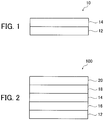
- FIG. 1 is a cross-sectional view of a first embodiment of an optical member.
- An optical member 10 shown in FIG. 1 includes a plastic base 12 and a hard coat layer 14 disposed on the plastic base 12.
- the hard coat layer 14 is a layer formed from the hard coat layer-forming composition described above.
- the plastic base 12 and the hard coat layer 14 are arranged so as to be in direct contact with each other in FIG. 1 , the arrangement is not limited thereto, and another layer (e.g., a primer layer) may be disposed between the plastic base 12 and the hard coat layer 14 as described later in detail. That is, the hard coat layer 14 may be disposed directly on or indirectly, via another layer, above the plastic base 12.
- another layer e.g., a primer layer
- a plastic base is a base constituted of plastic.
- the plastic (so-called resin) constituting the plastic base is not particularly limited in type, and examples thereof include acrylic resin, thiourethane resin, methacrylic resin, allyl resin, episulfide resin, polycarbonate resin, polyurethane resin, polyester resin, polystyrene resin, polyethersulfone resin, poly-4-methylpentene-1 resin, diethylene glycol bis(allyl carbonate) resin (CR-39), polyvinyl chloride resin, halogen-containing copolymer, and sulfur-containing copolymer.
- a plastic lens base is preferably used because it is advantageous for application to a lens.
- the plastic lens base may be a finished product having desired optical surfaces on both sides (lens for spectacles), a semi-finished product with its convex surface having been finished to a desired shape (semi-finished lens), or a lens blank having not undergone lens processing such as grinding and polishing.
- the thickness of the plastic base is not particularly limited and, in most cases, falls within the range from about 1 to about 30 mm for the sake of handleability.
- the plastic base need not be transparent as long as it is translucent, and may be colored.
- the plastic base 12 has flat surfaces in FIG. 1 , the surface shape thereof is not particularly limited and selected from given shapes such as a convex face and a concave face.
- a hard coat layer is a layer that is disposed on or above the plastic base and provides scratch resistance and crack resistance to the resultant optical member.
- the plastic base may be provided on its both sides with the hard coat layers.
- the hard coat layer is a layer formed from the hard coat layer-forming composition described above.
- the method of forming the hard coat layer is not particularly limited, and one exemplary method involves applying the hard coat layer-forming composition described above onto the plastic base to form a coating, followed by curing treatment.
- the method of applying the hard coat layer-forming composition onto the plastic base is not particularly limited, and any known method (e.g., dip coating, spin coating, spray coating, flow coating) may be employed.
- dip coating e.g., the plastic base is immersed in the hard coat layer-forming composition and then pulled out and dried, whereby a coating with a predetermined thickness can be formed on the plastic base.
- the thickness of the coating formed on the plastic base is not particularly limited and suitably selected so as to allow the resulting hard coat layer to have a predetermined thickness.
- Application of the hard coat layer-forming composition onto the plastic base may optionally be followed by drying treatment to thereby remove the solvent.
- the remaining solvent is preferably removed because, owing to this, microcracks or voids caused by evaporation and expansion of the solvent are prevented from occurring in the hard coat layer during curing treatment to be described later.
- a hot air dryer or the like may be used, and heating treatment may be carried out at a temperature of 30°C to 70°C.
- the method of the curing treatment is not particularly limited, and heating treatment is normally carried out.
- the conditions of the heating treatment are not particularly limited, and it is generally preferred to carry out the heating treatment at a temperature of 90°C to 120°C for 1 to 5 hours.
- the thickness of the hard coat layer is not particularly limited and is preferably 0.5 to 6 ⁇ m, more preferably 1 to 5 ⁇ m and even more preferably 2 to 4 ⁇ m because the effect(s) can be more excellent.
- the above thickness is the average thickness, which is obtained by measuring the thickness of the hard coat layer at given five points and calculating the arithmetic mean of the measurements.
- the refractive index of the hard coat layer is about the same as the refractive index of the plastic base, it is possible to further suppress generation of interference fringes and decrease in transmittance that may be caused by reflection at the interface between the plastic base and the hard coat layer.
- the refractive index of the hard coat layer as above can be adjusted by adjusting the type of used raw materials and the type and amount of used metal oxide particles.
- the embodiment of the optical member is not particularly limited to that shown in FIG. 1 and may include other layers as described later in detail.
- FIG. 2 is a cross-sectional view of a second embodiment of an optical member.
- An optical member 100 shown in FIG. 2 includes the plastic base 12, a primer layer 16 disposed on the plastic base 12, the hard coat layer 14 disposed on the primer layer 16, an antireflective layer 18 disposed on the hard coat layer 14, and a water and oil repellent layer 20 disposed on the antireflective layer 18.
- optical member 100 shown in FIG. 2 has the same layers as the optical member 10 shown in FIG. 1 except the primer layer 16, the antireflective layer 18 and the water and oil repellent layer 20, like constituent elements are denoted by the same reference numerals and their descriptions are omitted.
- the primer layer is a layer disposed between the plastic base and the hard coat layer and serves to improve adhesion of the hard coat layer to the plastic base.
- Materials constituting the primer layer are not particularly limited, and any known materials may be used.
- resin is mainly used.
- the resin for use is not particularly limited in type, and examples thereof include urethane resin, epoxy resin, phenol resin, polyimide resin, polyester resin, bismaleimide resin and polyolefin resin.
- the primer layer may optionally contain a component other than the resin.
- the primer layer may contain inorganic particles.
- Exemplary inorganic particles include metal particles and metal oxide particles.
- the refractive index of the primer layer is about the same as the refractive index of the plastic base, it is possible to further suppress generation of interference fringes and decrease in transmittance that may be caused by reflection at the interface between the plastic base and the primer layer.
- the refractive index of the primer layer as above can be adjusted by adjusting the type of the resin and the type and amount of the inorganic particles.
- the method of forming the primer layer is not particularly limited, and any known method may be employed.
- One exemplary method involves applying a primer layer-forming composition containing a predetermined resin onto the plastic base, optionally followed by curing treatment, thereby forming the primer layer.
- the method of applying the primer layer-forming composition is not particularly limited, and for example, the method of applying the hard coat layer-forming composition described above can be employed.
- the thickness of the primer layer is not particularly limited and is preferably selected within the range from 0.3 to 2 ⁇ m because the effect(s) can be more excellent.
- the antireflective layer is a layer having a function of preventing the reflection of incident light.
- the antireflective layer preferably has low reflection characteristics over the entire visible range from 400 nm to 700 nm (wide-band low reflection characteristics). Physical properties such as abrasion resistance, heat resistance and chemical resistance may be imparted to the optical member through provision of the antireflective layer.
- the antireflective layer is not particularly limited in structure and may be of a single layer structure or a multilayer structure.
- a low refractive index layer(s) and a high refractive index layer(s) are alternately stacked.
- Exemplary materials constituting the high refractive index layer include oxides of titanium, zircon, aluminum, tantalum and lanthanum.
- Exemplary materials constituting the low refractive index layer include oxides such as silica.
- a wet antireflective layer using hollow silicon oxide may be used.
- the method of producing the antireflective layer is not particularly limited, and preferred examples thereof include dry methods such as vacuum evaporation, sputtering, ion plating, ion-beam assisted deposition and CVD.
- the thickness of the antireflective layer is typically 0.2 to 0.6 ⁇ m because of its characteristics.
- the water and oil repellent layer is a layer having water and oil repellency.
- the water and oil repellent layer is disposed uppermost (as the outermost layer) in the optical member.
- the water and oil repellent layer decreases surface energy of the optical member whereby the optical member can have improved contamination preventing function.
- the water and oil repellent layer improves sliding properties of a surface of the optical member whereby the optical member can have improved abrasion resistance.
- a material (water and oil repellent) constituting the water and oil repellent layer is not particularly limited, and examples thereof include a compound containing fluorine atoms and a compound containing silicon atoms.
- a fluorine-containing silane compound is preferably used because this brings about further excellent water and oil repellency.
- the fluorine-containing silane compound is a compound having a hydrolyzable group bonded to a silicon atom and also having a fluorine atom.
- the definition of the hydrolyzable group is as described above.
- the fluorine-containing silane compound preferably contains a perfluoroalkyl group or a perfluoropolyether group.
- the method of forming the water and oil repellent layer is not particularly limited and varies depending on the used material.
- one method may be employed which involves applying a water and oil repellent layer-forming composition containing the fluorine-containing silane compound onto a predetermined base, optionally followed by curing treatment.
- the method of applying the water and oil repellent layer-forming composition is not particularly limited, and for example, the method of applying the hard coat layer-forming composition described above can be employed.
- one coating method may be employed which involves immersing the plastic base in the water and oil repellent layer-forming composition obtained by dissolving the fluorine-containing silane compound in an organic solvent, and then pulling out the plastic base with certain conditions.
- organic solvent for use in the above method examples include perfluorohexane, perfluoro-4-methoxybutane, perfluoro-4-ethoxybutane and m-xylene hexafluoride.
- the concentration of the compound is preferably 0.01 to 0.5 wt% and more preferably 0.03 to 0.1 wt%. With a concentration of 0.01 wt% or higher, the water and oil repellent function further increases. With a concentration of 0.5 wt% or lower, uneven coating can be prevented while material costs can be lowered.
- the water and oil repellent layer may be formed by a dry method such as vacuum evaporation according to the material for use.
- the thickness of the water and oil repellent layer is not particularly limited, and it is generally preferred to select the thickness in the range from 5 to 20 nm.
- colloidal titanium oxide manufactured by JGC Catalysts and Chemicals Ltd.; commercial name: NE58
- a solid content of 30% as metal oxide particles 21 parts by weight of acetylacetone aluminum as a metal catalyst, 531 parts by weight of methyl alcohol, and 1 part by weight of surfactant (manufactured by Dow Corning Toray Co., Ltd.; commercial name: L7001) were added, and the resulting mixture was stirred to thereby obtain a hard coat layer-forming composition H-7.
- colloidal zirconium oxide manufactured by Nissan Chemical Industries, Ltd.; commercial name: HZ-400M7
- a solid content of 40% as metal oxide particles 15 parts by weight of acetylacetone aluminum as a metal catalyst, 332 parts by weight of methyl alcohol, and 1 part by weight of surfactant (manufactured by Dow Corning Toray Co., Ltd.; commercial name: L7001) were added, and the resulting mixture was stirred to thereby obtain a hard coat layer-forming composition H-11.
- a glycoluril crosslinking agent (1,3,4,6-tetrakis(trimethoxysilylmethyl)glycoluril; manufactured by Shikoku Chemicals Corporation) was charged, and 2 parts by weight of 0.1 N aqueous hydrochloric acid solution was gradually added dropwise to the glycoluril crosslinking agent under stirring of the glycoluril crosslinking agent. Thereafter, the mixture was stirred for a whole day and night, thereby obtaining a mixture Y13 containing a hydrolysate and a partially hydrolyzed condensate of the glycoluril crosslinking agent.
- a glycoluril crosslinking agent 1,3,4,6-tetrakis(trimethoxysilylmethyl)glycoluril; manufactured by Shikoku Chemicals Corporation
- Added amount in the "(D) Glycoluril crosslinking agent” section represents the content of the (D) glycoluril crosslinking agent in mole percent with respect to the total molar quantity of the (B) organic silicon compound and the (D) glycoluril crosslinking agent.
- the primer layer-forming composition P-1 was applied onto a plastic base by dip coating to thereby form a coating. Next, the coating was cured by heating at 70°C for 20 minutes to thereby form a primer layer (thickness: 1 ⁇ m).
- each of the hard coat layer-forming compositions H-1 to H-13 described above was applied onto the primer layer by dip coating to thereby form a coating.
- the coating was cured by heating at 100°C for 3 hours to thereby form a hard coat layer (thickness: 2 ⁇ m).
- an antireflective layer and a water and oil repellent layer were formed according to the procedures described in (Formation of Antireflective Layer) and (Formation of Water and Oil Repellent Layer) below, thus producing an optical member including the primer layer, the hard coat layer, the antireflective layer and the water and oil repellent layer in this order on the plastic base.
- the plastic lens base on which the primer layer and the hard coat layer had been formed was placed in a vapor deposition device to deposit a vapor deposition material onto the hard coat layer by an electron beam heating process.
- the structure of the antireflective layer is stated below in order from the hard coat layer side.
- n ⁇ the film thickness
- a cup for a lens edger (a half-eye lens cup manufactured by NIDEK Co., Ltd.) was adhered to the optical center of each of the optical members in Examples and Comparative Examples produced according to the foregoing procedures by the aid of locking tape (LEAPIII) manufactured by 3M. Subsequently, the optical member was mounted on the lens edger with the chucking pressure being adjusted to 70 kg or 85 kg and was subjected to lens edging to a predetermined lens shape. Thereafter, the optical member thus worked was washed with acetone to remove dirt. Then, whether a crack was present or not in the optical member was visually observed in front of a blackout curtain and under a fluorescent lamp and a light condensing lamp. The evaluation was made according to the following criteria. "Good" or a higher evaluation result is preferred in practical use.
- each optical member was rubbed back and forth 30 times with steel wool under a load of 600 g. Thereafter, the optical member was washed with acetone to remove dirt. Then, whether a scratch was present or not in the optical member was visually observed in front of a blackout curtain and under a fluorescent lamp.
- the evaluation was made according to the following criteria. "Average" or a higher evaluation result is preferred in practical use.
- Table 2 reveals that optical members each having a hard coat layer formed from a predetermined hard coat layer-forming composition exhibited desired effects.
- the present inventor has made an intensive study and as a result found that use of a predetermined compound enables to provide a hard coat layer-forming composition that can form a hard coat layer having excellent scratch resistance and crack resistance.
- the present inventor found that it is possible to provide an optical member including the hard coat layer formed from the hard coat layer-forming composition.
- the present inventor found that it is possible to provide the hard coat layer-forming composition and the optical member by the characteristic features below.
Landscapes
- Chemical & Material Sciences (AREA)
- Organic Chemistry (AREA)
- Chemical Kinetics & Catalysis (AREA)
- Physics & Mathematics (AREA)
- Health & Medical Sciences (AREA)
- Medicinal Chemistry (AREA)
- Polymers & Plastics (AREA)
- Materials Engineering (AREA)
- Engineering & Computer Science (AREA)
- Wood Science & Technology (AREA)
- Life Sciences & Earth Sciences (AREA)
- General Physics & Mathematics (AREA)
- Optics & Photonics (AREA)
- Inorganic Chemistry (AREA)
- Surface Treatment Of Optical Elements (AREA)
- Coating Of Shaped Articles Made Of Macromolecular Substances (AREA)
- Paints Or Removers (AREA)
Applications Claiming Priority (2)
| Application Number | Priority Date | Filing Date | Title |
|---|---|---|---|
| JP2015255224 | 2015-12-25 | ||
| PCT/JP2016/086715 WO2017110522A1 (fr) | 2015-12-25 | 2016-12-09 | Composition formant une couche de revêtement dur et élément optique |
Publications (3)
| Publication Number | Publication Date |
|---|---|
| EP3395918A1 true EP3395918A1 (fr) | 2018-10-31 |
| EP3395918A4 EP3395918A4 (fr) | 2019-07-17 |
| EP3395918B1 EP3395918B1 (fr) | 2020-03-25 |
Family
ID=59090125
Family Applications (1)
| Application Number | Title | Priority Date | Filing Date |
|---|---|---|---|
| EP16878414.8A Active EP3395918B1 (fr) | 2015-12-25 | 2016-12-09 | Composition formant une couche de revêtement dur et élément optique |
Country Status (6)
| Country | Link |
|---|---|
| US (2) | US11525044B2 (fr) |
| EP (1) | EP3395918B1 (fr) |
| JP (1) | JP6488025B2 (fr) |
| CN (1) | CN108368382B (fr) |
| CA (1) | CA3009603C (fr) |
| WO (1) | WO2017110522A1 (fr) |
Cited By (1)
| Publication number | Priority date | Publication date | Assignee | Title |
|---|---|---|---|---|
| EP3759545B1 (fr) | 2018-03-01 | 2023-12-20 | Essilor International | Élément de lentille |
Families Citing this family (5)
| Publication number | Priority date | Publication date | Assignee | Title |
|---|---|---|---|---|
| JP2020050714A (ja) * | 2018-09-25 | 2020-04-02 | 横浜ゴム株式会社 | オルガノポリシロキサン、シリコーン樹脂組成物及び光半導体装置 |
| JP7410949B2 (ja) * | 2019-06-18 | 2024-01-10 | 日本精化株式会社 | 樹脂基材のハードコート形成用組成物およびそれを用いた積層体 |
| JP7699063B2 (ja) * | 2020-01-30 | 2025-06-26 | 株式会社カネカ | ハードコーフィルムおよびその製造方法 |
| JPWO2023008492A1 (fr) * | 2021-07-28 | 2023-02-02 | ||
| JP2023067161A (ja) * | 2021-10-29 | 2023-05-16 | ニデック株式会社 | プラスチックレンズ、およびレンズユニット |
Family Cites Families (15)
| Publication number | Priority date | Publication date | Assignee | Title |
|---|---|---|---|---|
| WO2001088048A1 (fr) * | 2000-05-18 | 2001-11-22 | Itoh Optical Industrial Co.,Ltd. | Element optique |
| JP4772953B2 (ja) * | 2000-09-08 | 2011-09-14 | 東レ・ダウコーニング株式会社 | 水性塗料組成物、およびその製造方法 |
| JP2007086751A (ja) * | 2005-08-22 | 2007-04-05 | Fujifilm Corp | 反射防止フィルム、その製造方法、並びにそれを用いた偏光板、及び画像表示装置 |
| US20070042173A1 (en) * | 2005-08-22 | 2007-02-22 | Fuji Photo Film Co., Ltd. | Antireflection film, manufacturing method thereof, and polarizing plate using the same, and image display device |
| EP2161126A4 (fr) * | 2007-07-03 | 2010-09-29 | Nippon Soda Co | Feuille de moulage pour former une couche de revêtement dure |
| EP2239301B1 (fr) | 2008-01-28 | 2016-04-27 | Toray Industries, Inc. | Compositions de résine siloxane |
| EP2128657A1 (fr) | 2008-05-30 | 2009-12-02 | Hoya Corporation | Lentille plastique, son procédé de fabrication, et procédé de fabrication de liquide à revêtement dur |
| JP2010033021A (ja) | 2008-06-25 | 2010-02-12 | Hoya Corp | プラスチックレンズ及びその製造方法 |
| WO2010073772A1 (fr) * | 2008-12-27 | 2010-07-01 | 日揮触媒化成株式会社 | Composition de revêtement contenant de fines particules d'oxyde métallique ayant un indice de réfraction élevé et film de revêtement durcissable obtenu par application de la composition de revêtement sur une base |
| CN102272254B (zh) * | 2009-01-13 | 2014-04-30 | 株式会社德山 | 涂层组合物、该组合物的制造方法及具有硬涂层的层叠体 |
| JPWO2013191154A1 (ja) * | 2012-06-18 | 2016-05-26 | イーエイチエス レンズ フィリピン インク | 光学物品及びコーティング液 |
| JP6412867B2 (ja) * | 2013-06-21 | 2018-10-24 | 株式会社カネカ | 活性エネルギー線硬化性組成物 |
| US20160326344A1 (en) * | 2013-12-26 | 2016-11-10 | Kaneka Corporation | Curable composition and cured product thereof |
| US9926405B2 (en) * | 2014-03-17 | 2018-03-27 | Namics Corporation | Resin composition |
| EP3290488B1 (fr) * | 2015-04-30 | 2022-10-19 | Nissan Chemical Corporation | Composition de revêtement et élément optique |
-
2016
- 2016-12-09 CA CA3009603A patent/CA3009603C/fr active Active
- 2016-12-09 JP JP2017557875A patent/JP6488025B2/ja active Active
- 2016-12-09 WO PCT/JP2016/086715 patent/WO2017110522A1/fr not_active Ceased
- 2016-12-09 CN CN201680074357.1A patent/CN108368382B/zh active Active
- 2016-12-09 EP EP16878414.8A patent/EP3395918B1/fr active Active
-
2018
- 2018-06-20 US US16/013,211 patent/US11525044B2/en active Active
-
2020
- 2020-07-20 US US16/933,638 patent/US20210001615A1/en not_active Abandoned
Cited By (1)
| Publication number | Priority date | Publication date | Assignee | Title |
|---|---|---|---|---|
| EP3759545B1 (fr) | 2018-03-01 | 2023-12-20 | Essilor International | Élément de lentille |
Also Published As
| Publication number | Publication date |
|---|---|
| CA3009603A1 (fr) | 2017-06-29 |
| US11525044B2 (en) | 2022-12-13 |
| JP6488025B2 (ja) | 2019-03-20 |
| CA3009603C (fr) | 2020-06-09 |
| CN108368382B (zh) | 2020-04-24 |
| EP3395918A4 (fr) | 2019-07-17 |
| US20180297343A1 (en) | 2018-10-18 |
| US20210001615A1 (en) | 2021-01-07 |
| CN108368382A (zh) | 2018-08-03 |
| EP3395918B1 (fr) | 2020-03-25 |
| WO2017110522A1 (fr) | 2017-06-29 |
| JPWO2017110522A1 (ja) | 2018-11-22 |
Similar Documents
| Publication | Publication Date | Title |
|---|---|---|
| US11525044B2 (en) | Hard-coat-layer-forming composition and optical member | |
| JP3344199B2 (ja) | 防汚膜形成用組成物および反射防止フィルター | |
| KR100792301B1 (ko) | 플라스틱 렌즈 및 플라스틱 렌즈의 제조 방법 | |
| EP2928616B1 (fr) | Procédé permettant de revêtir un article optique avec une couche de finition à l'aide d'un traitement par plasma d'air sous vide | |
| US12146040B2 (en) | Water-repellent, oil-repellent member and method for manufacturing water-repellent, oil-repellent member | |
| US20230079905A1 (en) | Eyeglass lens, composition for primer layer formation, and method for manufacturing eyeglass lens | |
| CN100590460C (zh) | 塑料透镜以及制造塑料透镜的方法 | |
| KR101712060B1 (ko) | 광학 부재 및 광학 부재의 제조 방법 | |
| US11905368B2 (en) | Water-repellent member and method for manufacturing water-repellent member | |
| CN104955909A (zh) | 涂层组合物及光学物品的制造方法 | |
| US20220073760A1 (en) | Antifouling layer-provided transparent substrate | |
| JP3787988B2 (ja) | 反射防止フィルタおよびこの反射防止フィルタを用いた文字画像表示装置 | |
| CN115516343B (zh) | 光学部件 | |
| JP2016224192A (ja) | 光学部品 | |
| KR101681964B1 (ko) | 습식 저반사코팅 안경렌즈의 제조방법 및 그 제조방법을 이용한 안경렌즈 | |
| JP2983237B2 (ja) | 高屈折率プラスチックレンズ | |
| WO2013111878A1 (fr) | Procédé de fabrication d'une lentille polarisante | |
| JPH095679A (ja) | 眼鏡用プラスチックレンズ | |
| JP4725073B2 (ja) | コーティング材組成物及び塗装品 | |
| JP4744176B2 (ja) | 薄膜及び光学部材の製造方法 | |
| HK1122872A (en) | Plastic lens and manufacturing method of plastic lens |
Legal Events
| Date | Code | Title | Description |
|---|---|---|---|
| STAA | Information on the status of an ep patent application or granted ep patent |
Free format text: STATUS: THE INTERNATIONAL PUBLICATION HAS BEEN MADE |
|
| PUAI | Public reference made under article 153(3) epc to a published international application that has entered the european phase |
Free format text: ORIGINAL CODE: 0009012 |
|
| STAA | Information on the status of an ep patent application or granted ep patent |
Free format text: STATUS: REQUEST FOR EXAMINATION WAS MADE |
|
| 17P | Request for examination filed |
Effective date: 20180625 |
|
| AK | Designated contracting states |
Kind code of ref document: A1 Designated state(s): AL AT BE BG CH CY CZ DE DK EE ES FI FR GB GR HR HU IE IS IT LI LT LU LV MC MK MT NL NO PL PT RO RS SE SI SK SM TR |
|
| AX | Request for extension of the european patent |
Extension state: BA ME |
|
| DAV | Request for validation of the european patent (deleted) | ||
| DAX | Request for extension of the european patent (deleted) | ||
| A4 | Supplementary search report drawn up and despatched |
Effective date: 20190619 |
|
| RIC1 | Information provided on ipc code assigned before grant |
Ipc: B32B 27/38 20060101ALI20190613BHEP Ipc: C09D 183/06 20060101AFI20190613BHEP Ipc: G02B 1/11 20150101ALI20190613BHEP Ipc: G02C 7/02 20060101ALI20190613BHEP Ipc: G02B 1/14 20150101ALI20190613BHEP Ipc: B32B 27/00 20060101ALI20190613BHEP Ipc: C08J 7/04 20060101ALI20190613BHEP Ipc: C09D 7/40 20180101ALI20190613BHEP Ipc: B32B 27/26 20060101ALI20190613BHEP |
|
| GRAP | Despatch of communication of intention to grant a patent |
Free format text: ORIGINAL CODE: EPIDOSNIGR1 |
|
| STAA | Information on the status of an ep patent application or granted ep patent |
Free format text: STATUS: GRANT OF PATENT IS INTENDED |
|
| RIC1 | Information provided on ipc code assigned before grant |
Ipc: B32B 27/38 20060101ALI20191016BHEP Ipc: C09D 183/06 20060101AFI20191016BHEP Ipc: B32B 27/00 20060101ALI20191016BHEP Ipc: C08J 7/04 20060101ALI20191016BHEP Ipc: G02B 1/14 20150101ALI20191016BHEP Ipc: G02B 1/11 20150101ALI20191016BHEP Ipc: B32B 27/26 20060101ALI20191016BHEP Ipc: G02C 7/02 20060101ALI20191016BHEP Ipc: C09D 7/40 20180101ALI20191016BHEP Ipc: C08G 77/14 20060101ALI20191016BHEP |
|
| INTG | Intention to grant announced |
Effective date: 20191118 |
|
| GRAS | Grant fee paid |
Free format text: ORIGINAL CODE: EPIDOSNIGR3 |
|
| GRAA | (expected) grant |
Free format text: ORIGINAL CODE: 0009210 |
|
| STAA | Information on the status of an ep patent application or granted ep patent |
Free format text: STATUS: THE PATENT HAS BEEN GRANTED |
|
| AK | Designated contracting states |
Kind code of ref document: B1 Designated state(s): AL AT BE BG CH CY CZ DE DK EE ES FI FR GB GR HR HU IE IS IT LI LT LU LV MC MK MT NL NO PL PT RO RS SE SI SK SM TR |
|
| REG | Reference to a national code |
Ref country code: GB Ref legal event code: FG4D |
|
| REG | Reference to a national code |
Ref country code: AT Ref legal event code: REF Ref document number: 1248521 Country of ref document: AT Kind code of ref document: T Effective date: 20200415 Ref country code: IE Ref legal event code: FG4D |
|
| REG | Reference to a national code |
Ref country code: DE Ref legal event code: R096 Ref document number: 602016032760 Country of ref document: DE |
|
| PG25 | Lapsed in a contracting state [announced via postgrant information from national office to epo] |
Ref country code: RS Free format text: LAPSE BECAUSE OF FAILURE TO SUBMIT A TRANSLATION OF THE DESCRIPTION OR TO PAY THE FEE WITHIN THE PRESCRIBED TIME-LIMIT Effective date: 20200325 Ref country code: FI Free format text: LAPSE BECAUSE OF FAILURE TO SUBMIT A TRANSLATION OF THE DESCRIPTION OR TO PAY THE FEE WITHIN THE PRESCRIBED TIME-LIMIT Effective date: 20200325 Ref country code: NO Free format text: LAPSE BECAUSE OF FAILURE TO SUBMIT A TRANSLATION OF THE DESCRIPTION OR TO PAY THE FEE WITHIN THE PRESCRIBED TIME-LIMIT Effective date: 20200625 |
|
| PG25 | Lapsed in a contracting state [announced via postgrant information from national office to epo] |
Ref country code: BG Free format text: LAPSE BECAUSE OF FAILURE TO SUBMIT A TRANSLATION OF THE DESCRIPTION OR TO PAY THE FEE WITHIN THE PRESCRIBED TIME-LIMIT Effective date: 20200625 Ref country code: LV Free format text: LAPSE BECAUSE OF FAILURE TO SUBMIT A TRANSLATION OF THE DESCRIPTION OR TO PAY THE FEE WITHIN THE PRESCRIBED TIME-LIMIT Effective date: 20200325 Ref country code: SE Free format text: LAPSE BECAUSE OF FAILURE TO SUBMIT A TRANSLATION OF THE DESCRIPTION OR TO PAY THE FEE WITHIN THE PRESCRIBED TIME-LIMIT Effective date: 20200325 Ref country code: HR Free format text: LAPSE BECAUSE OF FAILURE TO SUBMIT A TRANSLATION OF THE DESCRIPTION OR TO PAY THE FEE WITHIN THE PRESCRIBED TIME-LIMIT Effective date: 20200325 Ref country code: GR Free format text: LAPSE BECAUSE OF FAILURE TO SUBMIT A TRANSLATION OF THE DESCRIPTION OR TO PAY THE FEE WITHIN THE PRESCRIBED TIME-LIMIT Effective date: 20200626 |
|
| REG | Reference to a national code |
Ref country code: NL Ref legal event code: MP Effective date: 20200325 |
|
| REG | Reference to a national code |
Ref country code: LT Ref legal event code: MG4D |
|
| PG25 | Lapsed in a contracting state [announced via postgrant information from national office to epo] |
Ref country code: NL Free format text: LAPSE BECAUSE OF FAILURE TO SUBMIT A TRANSLATION OF THE DESCRIPTION OR TO PAY THE FEE WITHIN THE PRESCRIBED TIME-LIMIT Effective date: 20200325 |
|
| PG25 | Lapsed in a contracting state [announced via postgrant information from national office to epo] |
Ref country code: IS Free format text: LAPSE BECAUSE OF FAILURE TO SUBMIT A TRANSLATION OF THE DESCRIPTION OR TO PAY THE FEE WITHIN THE PRESCRIBED TIME-LIMIT Effective date: 20200725 Ref country code: SK Free format text: LAPSE BECAUSE OF FAILURE TO SUBMIT A TRANSLATION OF THE DESCRIPTION OR TO PAY THE FEE WITHIN THE PRESCRIBED TIME-LIMIT Effective date: 20200325 Ref country code: RO Free format text: LAPSE BECAUSE OF FAILURE TO SUBMIT A TRANSLATION OF THE DESCRIPTION OR TO PAY THE FEE WITHIN THE PRESCRIBED TIME-LIMIT Effective date: 20200325 Ref country code: CZ Free format text: LAPSE BECAUSE OF FAILURE TO SUBMIT A TRANSLATION OF THE DESCRIPTION OR TO PAY THE FEE WITHIN THE PRESCRIBED TIME-LIMIT Effective date: 20200325 Ref country code: EE Free format text: LAPSE BECAUSE OF FAILURE TO SUBMIT A TRANSLATION OF THE DESCRIPTION OR TO PAY THE FEE WITHIN THE PRESCRIBED TIME-LIMIT Effective date: 20200325 Ref country code: LT Free format text: LAPSE BECAUSE OF FAILURE TO SUBMIT A TRANSLATION OF THE DESCRIPTION OR TO PAY THE FEE WITHIN THE PRESCRIBED TIME-LIMIT Effective date: 20200325 Ref country code: SM Free format text: LAPSE BECAUSE OF FAILURE TO SUBMIT A TRANSLATION OF THE DESCRIPTION OR TO PAY THE FEE WITHIN THE PRESCRIBED TIME-LIMIT Effective date: 20200325 Ref country code: PT Free format text: LAPSE BECAUSE OF FAILURE TO SUBMIT A TRANSLATION OF THE DESCRIPTION OR TO PAY THE FEE WITHIN THE PRESCRIBED TIME-LIMIT Effective date: 20200818 |
|
| REG | Reference to a national code |
Ref country code: AT Ref legal event code: MK05 Ref document number: 1248521 Country of ref document: AT Kind code of ref document: T Effective date: 20200325 |
|
| REG | Reference to a national code |
Ref country code: DE Ref legal event code: R097 Ref document number: 602016032760 Country of ref document: DE |
|
| PG25 | Lapsed in a contracting state [announced via postgrant information from national office to epo] |
Ref country code: AT Free format text: LAPSE BECAUSE OF FAILURE TO SUBMIT A TRANSLATION OF THE DESCRIPTION OR TO PAY THE FEE WITHIN THE PRESCRIBED TIME-LIMIT Effective date: 20200325 Ref country code: DK Free format text: LAPSE BECAUSE OF FAILURE TO SUBMIT A TRANSLATION OF THE DESCRIPTION OR TO PAY THE FEE WITHIN THE PRESCRIBED TIME-LIMIT Effective date: 20200325 Ref country code: ES Free format text: LAPSE BECAUSE OF FAILURE TO SUBMIT A TRANSLATION OF THE DESCRIPTION OR TO PAY THE FEE WITHIN THE PRESCRIBED TIME-LIMIT Effective date: 20200325 Ref country code: IT Free format text: LAPSE BECAUSE OF FAILURE TO SUBMIT A TRANSLATION OF THE DESCRIPTION OR TO PAY THE FEE WITHIN THE PRESCRIBED TIME-LIMIT Effective date: 20200325 |
|
| PLBE | No opposition filed within time limit |
Free format text: ORIGINAL CODE: 0009261 |
|
| STAA | Information on the status of an ep patent application or granted ep patent |
Free format text: STATUS: NO OPPOSITION FILED WITHIN TIME LIMIT |
|
| PG25 | Lapsed in a contracting state [announced via postgrant information from national office to epo] |
Ref country code: PL Free format text: LAPSE BECAUSE OF FAILURE TO SUBMIT A TRANSLATION OF THE DESCRIPTION OR TO PAY THE FEE WITHIN THE PRESCRIBED TIME-LIMIT Effective date: 20200325 |
|
| 26N | No opposition filed |
Effective date: 20210112 |
|
| PG25 | Lapsed in a contracting state [announced via postgrant information from national office to epo] |
Ref country code: SI Free format text: LAPSE BECAUSE OF FAILURE TO SUBMIT A TRANSLATION OF THE DESCRIPTION OR TO PAY THE FEE WITHIN THE PRESCRIBED TIME-LIMIT Effective date: 20200325 |
|
| REG | Reference to a national code |
Ref country code: CH Ref legal event code: PL |
|
| PG25 | Lapsed in a contracting state [announced via postgrant information from national office to epo] |
Ref country code: MC Free format text: LAPSE BECAUSE OF FAILURE TO SUBMIT A TRANSLATION OF THE DESCRIPTION OR TO PAY THE FEE WITHIN THE PRESCRIBED TIME-LIMIT Effective date: 20200325 |
|
| REG | Reference to a national code |
Ref country code: BE Ref legal event code: MM Effective date: 20201231 |
|
| PG25 | Lapsed in a contracting state [announced via postgrant information from national office to epo] |
Ref country code: LU Free format text: LAPSE BECAUSE OF NON-PAYMENT OF DUE FEES Effective date: 20201209 Ref country code: IE Free format text: LAPSE BECAUSE OF NON-PAYMENT OF DUE FEES Effective date: 20201209 |
|
| PG25 | Lapsed in a contracting state [announced via postgrant information from national office to epo] |
Ref country code: CH Free format text: LAPSE BECAUSE OF NON-PAYMENT OF DUE FEES Effective date: 20201231 Ref country code: LI Free format text: LAPSE BECAUSE OF NON-PAYMENT OF DUE FEES Effective date: 20201231 |
|
| PG25 | Lapsed in a contracting state [announced via postgrant information from national office to epo] |
Ref country code: TR Free format text: LAPSE BECAUSE OF FAILURE TO SUBMIT A TRANSLATION OF THE DESCRIPTION OR TO PAY THE FEE WITHIN THE PRESCRIBED TIME-LIMIT Effective date: 20200325 Ref country code: MT Free format text: LAPSE BECAUSE OF FAILURE TO SUBMIT A TRANSLATION OF THE DESCRIPTION OR TO PAY THE FEE WITHIN THE PRESCRIBED TIME-LIMIT Effective date: 20200325 Ref country code: CY Free format text: LAPSE BECAUSE OF FAILURE TO SUBMIT A TRANSLATION OF THE DESCRIPTION OR TO PAY THE FEE WITHIN THE PRESCRIBED TIME-LIMIT Effective date: 20200325 |
|
| PG25 | Lapsed in a contracting state [announced via postgrant information from national office to epo] |
Ref country code: MK Free format text: LAPSE BECAUSE OF FAILURE TO SUBMIT A TRANSLATION OF THE DESCRIPTION OR TO PAY THE FEE WITHIN THE PRESCRIBED TIME-LIMIT Effective date: 20200325 Ref country code: AL Free format text: LAPSE BECAUSE OF FAILURE TO SUBMIT A TRANSLATION OF THE DESCRIPTION OR TO PAY THE FEE WITHIN THE PRESCRIBED TIME-LIMIT Effective date: 20200325 |
|
| PG25 | Lapsed in a contracting state [announced via postgrant information from national office to epo] |
Ref country code: BE Free format text: LAPSE BECAUSE OF NON-PAYMENT OF DUE FEES Effective date: 20201231 |
|
| P01 | Opt-out of the competence of the unified patent court (upc) registered |
Effective date: 20230523 |
|
| PGFP | Annual fee paid to national office [announced via postgrant information from national office to epo] |
Ref country code: DE Payment date: 20251028 Year of fee payment: 10 |
|
| PGFP | Annual fee paid to national office [announced via postgrant information from national office to epo] |
Ref country code: GB Payment date: 20251030 Year of fee payment: 10 |
|
| PGFP | Annual fee paid to national office [announced via postgrant information from national office to epo] |
Ref country code: FR Payment date: 20251110 Year of fee payment: 10 |