EP3396033A1 - Reflektierendes textil - Google Patents
Reflektierendes textil Download PDFInfo
- Publication number
- EP3396033A1 EP3396033A1 EP17167954.1A EP17167954A EP3396033A1 EP 3396033 A1 EP3396033 A1 EP 3396033A1 EP 17167954 A EP17167954 A EP 17167954A EP 3396033 A1 EP3396033 A1 EP 3396033A1
- Authority
- EP
- European Patent Office
- Prior art keywords
- reflective
- polymer material
- beads
- textile
- range
- Prior art date
- Legal status (The legal status is an assumption and is not a legal conclusion. Google has not performed a legal analysis and makes no representation as to the accuracy of the status listed.)
- Withdrawn
Links
- 239000004753 textile Substances 0.000 title claims abstract description 70
- 239000011324 bead Substances 0.000 claims abstract description 92
- 239000002861 polymer material Substances 0.000 claims abstract description 79
- 239000000835 fiber Substances 0.000 claims abstract description 72
- 239000000203 mixture Substances 0.000 claims abstract description 40
- 238000000034 method Methods 0.000 claims abstract description 34
- 238000002074 melt spinning Methods 0.000 claims abstract description 26
- 229920000642 polymer Polymers 0.000 claims description 20
- 239000000463 material Substances 0.000 claims description 17
- 229910052751 metal Inorganic materials 0.000 claims description 16
- 239000002184 metal Substances 0.000 claims description 16
- 238000002156 mixing Methods 0.000 claims description 13
- 238000001125 extrusion Methods 0.000 claims description 12
- 239000004952 Polyamide Substances 0.000 claims description 9
- 239000011521 glass Substances 0.000 claims description 9
- 229920002647 polyamide Polymers 0.000 claims description 9
- 239000000049 pigment Substances 0.000 claims description 8
- 238000009940 knitting Methods 0.000 claims description 7
- 229920000728 polyester Polymers 0.000 claims description 7
- 239000004433 Thermoplastic polyurethane Substances 0.000 claims description 6
- 229910052782 aluminium Inorganic materials 0.000 claims description 6
- XAGFODPZIPBFFR-UHFFFAOYSA-N aluminium Chemical compound [Al] XAGFODPZIPBFFR-UHFFFAOYSA-N 0.000 claims description 6
- 229920000098 polyolefin Polymers 0.000 claims description 6
- 229920002803 thermoplastic polyurethane Polymers 0.000 claims description 6
- 238000009954 braiding Methods 0.000 claims description 5
- 238000009950 felting Methods 0.000 claims description 5
- 238000009941 weaving Methods 0.000 claims description 5
- 238000004519 manufacturing process Methods 0.000 description 10
- 210000002268 wool Anatomy 0.000 description 10
- 238000010438 heat treatment Methods 0.000 description 7
- 229920002292 Nylon 6 Polymers 0.000 description 4
- -1 polyethylene Polymers 0.000 description 4
- 230000005855 radiation Effects 0.000 description 4
- 239000007787 solid Substances 0.000 description 3
- 238000009987 spinning Methods 0.000 description 3
- 238000001816 cooling Methods 0.000 description 2
- 230000002708 enhancing effect Effects 0.000 description 2
- 230000001965 increasing effect Effects 0.000 description 2
- 239000004005 microsphere Substances 0.000 description 2
- 229920003023 plastic Polymers 0.000 description 2
- 239000004033 plastic Substances 0.000 description 2
- XLYOFNOQVPJJNP-UHFFFAOYSA-N water Substances O XLYOFNOQVPJJNP-UHFFFAOYSA-N 0.000 description 2
- 241001082241 Lythrum hyssopifolia Species 0.000 description 1
- 239000004698 Polyethylene Substances 0.000 description 1
- 239000004793 Polystyrene Substances 0.000 description 1
- 229920003802 Ultramid® B24 N 03 Polymers 0.000 description 1
- 229920003806 Ultramid® B33 L Polymers 0.000 description 1
- 239000000853 adhesive Substances 0.000 description 1
- 230000001070 adhesive effect Effects 0.000 description 1
- 229910052788 barium Inorganic materials 0.000 description 1
- DSAJWYNOEDNPEQ-UHFFFAOYSA-N barium atom Chemical compound [Ba] DSAJWYNOEDNPEQ-UHFFFAOYSA-N 0.000 description 1
- JRPBQTZRNDNNOP-UHFFFAOYSA-N barium titanate Chemical compound [Ba+2].[Ba+2].[O-][Ti]([O-])([O-])[O-] JRPBQTZRNDNNOP-UHFFFAOYSA-N 0.000 description 1
- 229910002113 barium titanate Inorganic materials 0.000 description 1
- 239000011248 coating agent Substances 0.000 description 1
- 238000000576 coating method Methods 0.000 description 1
- 239000002131 composite material Substances 0.000 description 1
- 238000010276 construction Methods 0.000 description 1
- 230000000694 effects Effects 0.000 description 1
- 230000005670 electromagnetic radiation Effects 0.000 description 1
- 230000005484 gravity Effects 0.000 description 1
- 238000010030 laminating Methods 0.000 description 1
- 238000001000 micrograph Methods 0.000 description 1
- 238000012986 modification Methods 0.000 description 1
- 230000004048 modification Effects 0.000 description 1
- 229920001778 nylon Polymers 0.000 description 1
- 229920003229 poly(methyl methacrylate) Polymers 0.000 description 1
- 229920000058 polyacrylate Polymers 0.000 description 1
- 229920006267 polyester film Polymers 0.000 description 1
- 229920000573 polyethylene Polymers 0.000 description 1
- 229920000139 polyethylene terephthalate Polymers 0.000 description 1
- 239000005020 polyethylene terephthalate Substances 0.000 description 1
- 239000004926 polymethyl methacrylate Substances 0.000 description 1
- 229920002223 polystyrene Polymers 0.000 description 1
- 230000001681 protective effect Effects 0.000 description 1
- 239000002904 solvent Substances 0.000 description 1
- 238000001228 spectrum Methods 0.000 description 1
- 239000000126 substance Substances 0.000 description 1
- 239000010409 thin film Substances 0.000 description 1
Images



Classifications
-
- D—TEXTILES; PAPER
- D01—NATURAL OR MAN-MADE THREADS OR FIBRES; SPINNING
- D01D—MECHANICAL METHODS OR APPARATUS IN THE MANUFACTURE OF ARTIFICIAL FILAMENTS, THREADS, FIBRES, BRISTLES OR RIBBONS
- D01D5/00—Formation of filaments, threads, or the like
- D01D5/28—Formation of filaments, threads, or the like while mixing different spinning solutions or melts during the spinning operation; Spinnerette packs therefor
- D01D5/30—Conjugate filaments; Spinnerette packs therefor
- D01D5/34—Core-skin structure; Spinnerette packs therefor
-
- D—TEXTILES; PAPER
- D01—NATURAL OR MAN-MADE THREADS OR FIBRES; SPINNING
- D01F—CHEMICAL FEATURES IN THE MANUFACTURE OF ARTIFICIAL FILAMENTS, THREADS, FIBRES, BRISTLES OR RIBBONS; APPARATUS SPECIALLY ADAPTED FOR THE MANUFACTURE OF CARBON FILAMENTS
- D01F1/00—General methods for the manufacture of artificial filaments or the like
- D01F1/02—Addition of substances to the spinning solution or to the melt
- D01F1/10—Other agents for modifying properties
- D01F1/106—Radiation shielding agents, e.g. absorbing, reflecting agents
-
- G—PHYSICS
- G02—OPTICS
- G02B—OPTICAL ELEMENTS, SYSTEMS OR APPARATUS
- G02B5/00—Optical elements other than lenses
- G02B5/12—Reflex reflectors
- G02B5/126—Reflex reflectors including curved refracting surface
- G02B5/128—Reflex reflectors including curved refracting surface transparent spheres being embedded in matrix
-
- A—HUMAN NECESSITIES
- A41—WEARING APPAREL
- A41D—OUTERWEAR; PROTECTIVE GARMENTS; ACCESSORIES
- A41D31/00—Materials specially adapted for outerwear
- A41D31/04—Materials specially adapted for outerwear characterised by special function or use
- A41D31/32—Retroreflective
-
- D—TEXTILES; PAPER
- D01—NATURAL OR MAN-MADE THREADS OR FIBRES; SPINNING
- D01F—CHEMICAL FEATURES IN THE MANUFACTURE OF ARTIFICIAL FILAMENTS, THREADS, FIBRES, BRISTLES OR RIBBONS; APPARATUS SPECIALLY ADAPTED FOR THE MANUFACTURE OF CARBON FILAMENTS
- D01F1/00—General methods for the manufacture of artificial filaments or the like
- D01F1/02—Addition of substances to the spinning solution or to the melt
- D01F1/04—Pigments
-
- D—TEXTILES; PAPER
- D01—NATURAL OR MAN-MADE THREADS OR FIBRES; SPINNING
- D01F—CHEMICAL FEATURES IN THE MANUFACTURE OF ARTIFICIAL FILAMENTS, THREADS, FIBRES, BRISTLES OR RIBBONS; APPARATUS SPECIALLY ADAPTED FOR THE MANUFACTURE OF CARBON FILAMENTS
- D01F1/00—General methods for the manufacture of artificial filaments or the like
- D01F1/02—Addition of substances to the spinning solution or to the melt
- D01F1/06—Dyes
Definitions
- the invention relates to a reflective textile and a method of fabricating the same.
- Textiles which are retro-reflective, i.e. reflective textiles are generally used in clothes worn whenever there is a need for increasing personal safety. Such clothes have for a long time been worn by a variety of professions, e.g. by polices, by road workers, by construction workers etc., but it is also commonly used by anyone wishing to be more visible when e.g. walking, running or bicycling, in traffic. In addition, it has recently become a fashion statement wearing clothes made from a reflective textile.
- the reflective textiles are not only used in clothes, these textiles may also be used in other products, such as signs, bags, accessories, sporting goods etc., used or worn by people desiring to be more visible in the dark. Hence, the demand for reflective textiles has lately grown tremendously.
- Reflective textiles may be made from reflective yarns which may comprise one or several reflective fibers. As of today, there are two main techniques used for fabrication of such reflective yarn.
- the yarn can be fabricated by laminating a thin film of retro-reflective material on top of a polyester film which is cut into stripes or fibers. The stripes or fibers may subsequently be twisted together with a yarn made from another material.
- the reflective yarn may also be manufactured by coating a spun filament yarn with a retro-reflective material comprising adhesive and reflective beads. Both techniques are expensive and time consuming since they comprise many process steps. Due to the increased demands for reflective textiles the producing cost and times must be reduced and it is therefore a need for improving the current state-of-the-art regarding fabrication of reflective textiles.
- a method for fabricating a reflective textile comprises the steps of:
- the melt-spinning process described herein allows for a more cost-effective way for producing a reflective yarn and thereby a more cost-effective fabrication of reflective textile is achieved.
- the yarn is made from bi-component fibers comprising an inner core of an extruded first polymer material and a sheath layer extruded around the inner core, i.e. around the extruded first polymer material.
- the sheath layer comprises a second polymer material mixed with reflective beads.
- the reflective textile is retro-reflective. Hence, it increases the amount of electromagnetic radiation which is reflected back to the source as compared with textile not having retro-reflective properties. According to one example at least 50 %, or at least 60 %, or at least 70 % or at least 80 % of the incident sunlight energy is reflected by the textile.
- the light may be diffusely or/or specularly reflected, and the reflected rays may partially be parallel to the incident rays.
- the retro-reflective properties of the textile is achieved by the reflective beads in the sheath layer of each fiber.
- the reflective textile reflects radiation with wavelengths within the spectra of infrared radiation, visible light and/or ultra-violet radiation. Additionally, or alternatively, it may reflect radiation with a wavelength within the interval of 100-1000 nm, or within the interval of 300-800 nm, or within the interval of 400-700 nm.
- the reflective textile fabricated according the method described herein may be used in a variety of applications. It may for example be used within the fashion industry for manufacturing of clothes and accessories, or it may be used in safety applications such as protective clothes. Moreover, it may for example be used in variety of products, e.g. signs or sport equipment, which need to be more visible in the dark or providing the user of the product to be more visible in the dark.
- the reflective beads may be of a variety of geometrical shapes.
- the reflective beads may be for example spheres, tetrahedrons, polyhedrons, rectangular prisms, cubes, cuboids, elliptical prisms, cones.
- the inner core may comprise a pigment or dye.
- the first polymer material may be colored.
- the pigment or dye may be chosen in order to provide the reflective textile with any desired color.
- the sheath layer may be transparent or semi-transparent.
- parts of the reflective beads may be opaque and hence may the sheath layer not be fully transparent.
- the second polymer material may have transparent properties.
- the reflective textile is a woven or a non-woven textile and wherein the step of fabricating a reflective textile comprises weaving or a non-woven technique such as knitting, braiding or felting.
- a woven textile comprises two sets of threads which are interlaced at right angles.
- the set of threads is normally known as warp and weft.
- the yarn is bonded together, e.g. different strands of the yarn or different parts of the yarn is bonded together, by mechanical, thermal, chemical and/or solvent means in order to form a textile.
- non-woven techniques is knitting, braiding or felting.
- the reflective yarn as manufactured by melt-spinning as described herein may be used alone or together with an additional yarn, which additional yarn may or may not have reflective properties, for fabricating the reflective textile.
- said step of providing a mixture of said second polymer material and said plurality of reflective beads comprises a said step of mixing said second polymer material with said reflective beads at a mixing temperature within a range 150-350°C, or within a range of 200-300 °C, or within a range of 220-280 °C.
- the step of mixing the second polymer material with the plurality of reflective beads is performed at a mixing temperature of at least 150 °C, or at least 175 °C, or at least 200 °C, or at least 225 °C, or at least 250 °C. Additionally, or alternatively, the step of mixing the second polymer material with the reflective beads is performed at a mixing temperature lower than 350 °C, or lower than 325 °C, or lower than 300 °C, or lower than 275 °C, or lower than 250 °C, or lower than 225 °C.
- the mixing temperature is defined by the temperature settings of the equipment, e.g. an extruder, used for the mixing.
- a predetermined temperature within the above mentioned ranges may typically be set to the equipment, e.g. the extruder.
- the equipment used for mixing is an extruder, e.g. a twin screw extruder.
- This extruder may be divided into different heating zones, each heating zone having its own predetermined value.
- the heating zones may be set to same temperature or different temperatures within the above mentioned ranges.
- said steps forming said first and second bi-component fiber comprises extruding said first polymer material and/or extruding said mixture of said second polymer material and said plurality of reflective beads at an extrusion temperature within in a range of 150-350°C, or within a range of 200-300 °C, or within a range of 220-280 °C.
- the extrusion temperature is determined by the extruder equipment which may typically be set to a predetermined value within the above mentioned ranges.
- the extrusion temperature of said first polymer material and said mixture of said second polymer material and said plurality of reflective beads may be the same or different, it may e.g. be in the same range of those mentioned above, or it may be in different ranges.
- the extrusion of said first polymer material and/or said mixture of said second polymer material and the plurality of reflective beads is performed at an extrusion temperature of at least 150 °C, or at least 175 °C, or at least 200 °C, or at least 225 °C, or at least 250 °C. Additionally, or alternatively, the extrusion of said first polymer material and/or said mixture of said second polymer material and the plurality of reflective beads is performed at an extrusion temperature lower than 350 °C, or lower than 325 °C, or lower than 300 °C, or lower than 275 °C, or lower than 250 °C, or lower than 225 °C.
- the extrusion temperature is defined by the temperature settings of the equipment, i.e. an extruder, used for the extrusion.
- a predetermined temperature within the above mentioned ranges may typically be set to the equipment, i.e. to the extruder.
- said step of melt-spinning comprises melt-spinning of said first and second bi-component fibers at a melt-spinning temperature within the range of 150-350°C, or within a range of 200-300 °C, or within a range of 220-280 °C.
- the step of melt-spinning of the first and second bi-component fibers is performed at a melt-spinning temperature of at least 150 °C, or at least 175 °C, or at least 200 °C, or at least 225 °C, or at least 250 °C. Additionally, or alternatively, the step of melt-spinning of the first and the second bi-component fibers is performed at a melt-spinning temperature lower than 350 °C, or lower than 325 °C, or lower than 300 °C, or lower than 275 °C, or lower than 250 °C, or lower than 225 °C.
- the melt-spinning temperature is defined by the temperature settings of the equipment, e.g. a spinneret, used for the melt-spinning.
- a predetermined temperature within the above mentioned ranges may typically be set to the equipment, e.g. a spinneret.
- the steps of extruding and melt-spinning of said reflective fibers is performed in a melt-spinning line which at least comprises a first and a second extruder, a first and a second gear pump, a spinneret, a plurality of rollers and a winder.
- the first extruder is extruding the first polymer material forming the core of a first bi-component fiber and the second extruder is extruding the mixture of the second polymer material and the reflective beads as a sheath layer around the inner core.
- the first gear pump defines the extruding speed of the first extruder and the second gear pump defines the extruding speed of the second extruder.
- the geometrical shape of the cross-section of each fiber may be defined in the spinneret.
- the cross-section may be circular, or it may be a square.
- the extruding speed of the first and the second extruder defines the speed of which the fibers leaves the spinneret.
- the plurality of rollers comprises a take-off roller and a plurality of stretching rollers, e.g. a pair of bottom rollers, a pair of middle rollers and a pair of top roller.
- the take-off roller and the plurality of stretching rollers may spin with the same or with different speeds.
- the temperature of the stretching rolls may be varied.
- the stretching rolls may have the same temperature or they may have different temperatures.
- the temperatures may be varied within the ration of 30-100 °C, or between 50-90 °C.
- the fibers are drawn or stretched in their melted state during cooling and/or in their solid state, i.e. after cooling of the fibers. Depending on the choice it may for example be necessary to draw or stretch the fiber in the melted state.
- the dimensions, such size of the area of the cross-section of each fiber, i.e. the thickness of the fiber, may be defined by the melt-draw ration and/or the solid-draw ration.
- the melt-draw ratio may be defined by the speed of which the fibers leave the spinneret and the speed of the take-off roller.
- the solid-draw ratio is defined by the speed of the take-off roller and a stretching roller, e.g. the speed of one of the top-rollers.
- the spinneret can be used for manufacturing one or several bi-component fibers.
- it may be used for manufacturing two, or three, or five, or ten, or twenty, or thirty fibers at once which a being melt-spun to a reflective yarn.
- the number of fibers corresponds to the number of holes in the spinneret.
- said first extruder is extruding said first polymer material simultaneously as said second extruder is extruding said mixture of said second polymer material and said reflective beads around said inner core.
- the first and/or the second extruder may be divided into different heating zones, each heating zone having its own predetermined temperature.
- the heating zones may be set to same temperature or different temperatures within the above mentioned ranges.
- said first and/or second polymer material comprises a polymer which is chosen from a group comprising polyamides, polyesters, polyolefins and thermoplastic polyurethanes and wherein said polymer of said first material and said polymer of said second material may be the same or different.
- the polymer first polymer material may be a polyamide, e.g. polyamide 6.
- Polyamides e.g. nylons, are commonly used in yarns and textiles and hence it is a suitable material for a reflective textile.
- the second polymer material may be a polyester, e.g. polyethylene therephthalate (PET) or it may be a polyamide, e.g. polyamide 6.
- PET polyethylene therephthalate
- polyamide e.g. polyamide 6.
- said reflective beads have a diameter in the range of 20-60 ⁇ m, or in the range of 20-40 ⁇ m, or in the range of 25-35 ⁇ m.
- the size of the reflective beads affects the spinnability of the fibers since the size of the reflective beads in the mixture comprising the second polymer material and the reflective beads alters the viscosity of the mixture.
- the texture and hence the feeling of the fiber surface may vary depending on the size of the reflective beads in the sheath layer.
- the reflective beads may have a diameter of at least 20 ⁇ m, or at least 25 ⁇ m, or at least 30 ⁇ m, or at least 35 ⁇ m. Additionally, or alternatively, the reflective beads may have a diameter of at most 60 ⁇ m, or at most 55 ⁇ m, or at most 50 ⁇ m, or at most 45 ⁇ m, or at most 40 ⁇ m, or at most 35 ⁇ m.
- the amount of said reflective beads in said mixture of said second polymer material and said plurality of reflective beads is at least 35 vol %, or at least 40 vol%, or at least 45 vol%, or at least 50 vol%.
- the relative content of the reflective beads in the sheath layer affects the spinnability of the fibers since the amount of the reflective beads in the mixture comprising the second polymer material and the reflective beads alters the viscosity of the mixture.
- the texture and hence the feeling of the fiber surface may vary depending on the relative content of reflective beads in the sheath layer.
- the reflective beads may be made from a variety of materials.
- the reflective beads may be glass beads or plastic beads.
- Plastic beads may for example be made from a polymer material, e.g. polystyrene or a polyacrylate, e.g. poly(methyl methacrylate).
- the reflective beads may comprise a reflective metal layer giving the reflective beads their retro-reflective properties.
- the metal layer may for example be aluminum.
- the reflective beads may comprise metal flakes enhancing the retro-reflective properties.
- the metal flakes may for example be made from aluminum.
- the reflective beads is glass beads comprising a reflective metal layer, which reflective metal layer optionally comprises aluminum.
- the reflective beads is partially or fully coated with the metal layer.
- spherical reflective beads may be hemispherically coated with the metal layer.
- the metal layer is covering half of the surface of the spherical reflective bead.
- said inner core and/or said sheath layer further comprises metal flakes and/or pigment.
- the inner core may further comprise metal flakes for enhancing the retro-reflective properties of the reflective textile.
- the sheath layer may be transparent or semi-transparent. To ensure that the electromagnetic rays reach the reflective beads closest to the inner core.
- the inner core may comprise one or several pigments giving the bi-component fiber a desired color.
- the pigment(s) is used to achieve a desired appearance of the reflective textile.
- a reflective textile comprising a reflective yarn.
- the reflective yarn comprises at least comprises at least two bi-component fibers, which fibers comprises an inner core comprising a first polymer material and a sheath layer comprising a second polymer material and a plurality of reflective beads each with a diameter of 5-70 ⁇ m; wherein said plurality of said reflective beads constitutes at least 30 vol% of said reflective yarn.
- said first and second polymer material comprises a polymer which is chosen from a group comprising polyamide, polyester, polyolefins and thermoplastic polyurethanes and wherein said polymer is chosen independently for said first polymer material and for said second polymer material.
- said reflective textile is provided by weaving and/or a non-woven technique, such as knitting, braiding or felting.
- said inner core comprises a pigment or a dye and wherein said sheath layer transparent or semi-transparent.
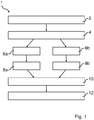
- Fig. 1 shows a schematic view of a method 1 for fabricating a reflective textile.
- a first step 2 of the method comprises providing a first and a second polymer material and a plurality of reflective beads with a diameter of 5-70 ⁇ m. Subsequently, in a next step 4, the second polymer material will be mixed with the plurality of reflective beads. The mixture achieved in this step 4 may comprise at least 30 vol% of reflective beads.
- This step 4 may be performed in a twin screw extruder at a temperature in a range of 150-350 °C. The extruded material is subsequently solidified in water and pelletized in a strand cutter.
- the first polymer material is provided to a first extruder from which it is extruded 6a to form an inner core of a first fiber. Subsequently, or simultaneously, the first material is extruded 8a to form an inner core of a second fiber.
- the mixture of the second polymer and the reflective beads is provided to a second extruder from which it is extruded 6b to form a sheath layer of the first fiber such that a first bi-component fiber is formed. Subsequently, or simultaneously, the mixture of the second polymer and the reflective beads is extruded 8b to for a sheath layer of the second fiber such that a second bi-component fiber is formed.
- the mixture of the second polymer and the reflective beads may be extruded 6b,8b simultaneously or subsequently as the first material is extruded 6a,8a to form the inner core of the fibers.
- These steps of extruding 6a,6b,8a,8b is performed within a temperature range of 150-350 °C. All steps may be performed at the same temperature or they may be performed at different temperatures depending on the material choice of the first and the second polymer material. Further, the temperature may or may not vary during the extrusion. In other words, the temperature may be different in different zones of the extruder or the temperature may be the same at these zones.
- the first and the second fiber will subsequently be melt-spun 10 to provide a reflective yarn. This may be done by passing a spinneret at a temperature within in the range of 150-350 °C.
- the reflective yarn is used to fabricate a reflective textile.
- the step of fabricating 12 the reflective textile may be e.g. knitting, weaving or embodying.
- Fig. 2 shows a melt-spinning line 100 which is used for producing a reflective yarn which may be used for fabricating a reflective textile.
- the melt-spinning line comprises a first 104a and a second extruder 104b, a first 106a and a second gear pump 106b, a spinneret 108, a take-off roller 110, a plurality of stretching rollers 112,114,116 and a winder 118.
- the first 104a and the second extruder 104b further comprise respective feeding equipment 102a,102b.
- the plurality of stretching rollers comprises two bottom rollers 116, two middle rollers 114 and two top rollers 112.
- the first polymer will be provided to the feeding equipment 102a of the first extruder 104a.
- the first polymer material is extruded from the first extruder 104a and fed to the first gear pump 106a. Subsequently, the first polymer material is feed to the spinneret 108.
- the mixture of the second polymer material and the reflective beads is provided to the feeding equipment 102b of the second extruder 104b. The mixture is extruded from the second extruder 104b and fed to the second gear pump 106b. Subsequently, the mixture is feed to the spinneret 108.
- the spinneret 108 is configured to melt-spinning of a plurality of bi-component fibers.
- the plurality of fibers 102 leaving the spinneret 108 is melt-spun into a reflective yarn 122.
- the volumetric speed of the fibers when leaving the spinneret 108 are given by the first and second gear pump 106a, 106b.
- the melt-draw ratio v 1 /v 0 is defined by the volumetric speed v 0 of the fibers 102 when leaving the spinneret 108 and the linear speed v 1 of the take-off roller.
- the plurality fibers 120 are cooled and thereby solidified.
- the yarn 122 After passing the take-off roller 110, the yarn 122 is stretched or drawn in its solid state between the take-off roller 110 and the top rollers 112.
- the solid-draw ratio v 2 /v 1 is defined by the linear speed v 1 of the take-off roller 110 and the linear speed v 2 of the top rollers 112.
- the melt-draw ratio v 1 /v 0 and the solid-draw ratio v 2 /v 1 may be to varied to produce a reflective yarn 122 with desired dimensions and the desired strength.
- the process may need to be adapted to e.g. different material choice so that desired yarn dimensions are achieved.
- Such an adaption may be done by changing the melt-draw ratio v 1 /v 0 and the solid-draw ratio v 2 /v 1 may be to varied.
- the process may be adapted to the choice of material by changing the speeds of the take-off roller 110 and/or the top rollers 112.
- the desired dimension and strength may be achieved by solely the stretching or drawing in the melted state.
- Fig. 3a shows a schematic, cross-sectional view of a reflective fiber 201
- Fig. 3b shows a micrograph of two such reflective fibers 201.
- the fiber comprises a core 202 comprising a first polymer material 204, a sheath layer 206 comprising a second polymer material 208 and reflective beads 210.
- the first polymer material 204 comprises a polymer which is chosen from a group comprising polyamides, polyesters, polyolefins and thermoplastic polyurethanes.
- the first polymer material 204 may comprise polyamide 6 (PA6).
- the second polymer material 206 comprises a polymer which is chosen from a group comprising polyamides, polyesters, polyolefins and thermoplastic polyurethanes.
- the second polymer material 206 may comprise polyethylene terephthalate (PET).
- the reflective beads 210 may be glass beads comprising a reflective metal layer, which reflective metal layer optionally comprises aluminum have The diameter of the reflective beads may be in the range of 5-70 ⁇ m, or in the range of 20-60 ⁇ m, or in the range of 25-50 ⁇ m.
- the sheath layer 206 may comprise at least 35 vol % of reflective beads 210, or at least 40 vol% of reflective beads 210, or at least 45 vol% of reflective beads 210, or at least 50 vol% of reflective beads 210.
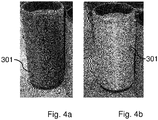
- Figs. 4a and 4b shows photographs of a roll of reflective yarn 301.
- the roll 301 is illuminated and the light is being reflected by the reflective beads in the reflective yarn.
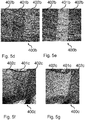
- Figs. 5a-g shows photographs of knitted textiles produced with a reflective yarn.
- the knitted textiles were produced in an industrial flat knitting machine.
- Figs. 5a-c show a textile 400a knitted with reflective yarn and wool yarn where the reflective yarn is used to form the red area 401 a.
- the wool yarn is used to form the blue area 402a.
- the textile 400a is a tubular knit with a layer of wool behind the reflective knit and with a fineness of 10 gauge (GG).
- the photograph shown in Fig. 5a was taken without a flash.
- the textile is illuminated by the flash of the camera and the light is being reflected by the reflective beads in the reflective yarn as seen in the change in contrast between the red 401 a and the blue area 402a when comparing Fig. 5a and 5b.
- Fig. 5c shows a close up of the knitted textile.
- Figs. 5d-e show a textile 400b knitted with a mix of reflective yarn and wool yarn (melange yarn), where the mix of reflective yarn and wool yarn is used to form the red area 401 b.
- the grey areas 402b are knitted with only a wool yarn. Hence, the grey areas 402b do not comprise any reflective yarn.
- the textile 400b is a tubular knit with a layer of wool behind the reflective knit and with a fineness of 10 gauge (GG). The photograph shown in Fig. 5d was taken without a flash. In Fig.
- the textile is illuminated by the flash of the camera and the light is being reflected by the reflective beads in the reflective yarn as seen in the change in contrast between the red 401 b and the grey areas 402b when comparing Fig. 5d and 5e .
- Figs. 5f-g show a textile 400c knitted with a mix of reflective thread and wool thread (melange yarn) where the mixture of the reflective yarn and the wool yarn is used to form the area 401 c.
- the grey areas 402b are knitted with only a wool yarn. Hence, the grey areas 402b do not comprise any reflective yarn.
- the textile 400c is a chess knit with a fineness of the textile of 10 gauge (GG).
- the photograph shown in Fig. 5f was taken without a flash.
- the textile is illuminated by the flash of the camera and the light is being reflected by the reflective beads in the reflective yarn as seen in the change in contrast between the red 401 c and the grey areas 402c when comparing Fig. 5f and 5g .
- the steps of the method may be combined differently. For example, there may be more steps, other than what is described above, which may be performed simultaneously. Further, all steps may be performed after each other.
- the method may comprise additional steps, e.g. the method may comprise a step of mixing said first polymer material with a dye.
- the polymer used in the core i.e. the first polymer material
- Polyamide 6, Ultramid B33L obtained from BASF, Germany with a density of 1130 kg/m 3
- the polymer used in the sheath mixture, i.e. the second polymer material was Polymamide 6, Ultramid B24 N 03 obtained from BASF Germany with a density of 1120-1150 kg/m 3 .
- the mixture comprising the second polymer material and the reflective beads was compounded using a Coperion (ZSK 26 K 10,6, Germany) co-rotational twin screw extruder with 10 heating zones.
- the barrel temperature profile was set to: zone 1: 240°C and zones 2-10: 240°C, starting from the hopper inlet.
- the screw speed was 230 rpm.
- the relative content of beads was controlled by adjusting the feeding rate of the polymer and beads, the total throughput being set to 10 kg/h.
- the extrudate was solidified in a water bath and pelletized using a strand cutter. The final bead content was 50 vol%.
- Table 1 Spinning parameters for the fiber manufacturing is presented in Table 1.
- Table 2 shows fiber properties of fibers with a core/sheath ratio of 60/40 and 50 vol% glass beads (type 1) in the sheath produced according to the parameters in Table 1.
- Table 1 Spinning parameters for the fibers produced.
Landscapes
- Engineering & Computer Science (AREA)
- Textile Engineering (AREA)
- Physics & Mathematics (AREA)
- Manufacturing & Machinery (AREA)
- Chemical & Material Sciences (AREA)
- Chemical Kinetics & Catalysis (AREA)
- General Chemical & Material Sciences (AREA)
- General Physics & Mathematics (AREA)
- Optics & Photonics (AREA)
- Mechanical Engineering (AREA)
- Multicomponent Fibers (AREA)
Priority Applications (1)
| Application Number | Priority Date | Filing Date | Title |
|---|---|---|---|
| EP17167954.1A EP3396033A1 (de) | 2017-04-25 | 2017-04-25 | Reflektierendes textil |
Applications Claiming Priority (1)
| Application Number | Priority Date | Filing Date | Title |
|---|---|---|---|
| EP17167954.1A EP3396033A1 (de) | 2017-04-25 | 2017-04-25 | Reflektierendes textil |
Publications (1)
| Publication Number | Publication Date |
|---|---|
| EP3396033A1 true EP3396033A1 (de) | 2018-10-31 |
Family
ID=58664501
Family Applications (1)
| Application Number | Title | Priority Date | Filing Date |
|---|---|---|---|
| EP17167954.1A Withdrawn EP3396033A1 (de) | 2017-04-25 | 2017-04-25 | Reflektierendes textil |
Country Status (1)
| Country | Link |
|---|---|
| EP (1) | EP3396033A1 (de) |
Cited By (3)
| Publication number | Priority date | Publication date | Assignee | Title |
|---|---|---|---|---|
| CN112411017A (zh) * | 2020-11-26 | 2021-02-26 | 杭州罗松贸易有限公司 | 一种熔喷无纺布加工生产工艺 |
| CN114953614A (zh) * | 2022-03-17 | 2022-08-30 | 江苏康大无纺有限公司 | 一种热区岛礁防潮被及其制备方法 |
| CN116406434A (zh) * | 2020-11-20 | 2023-07-07 | 美国阿拉丁制造公司 | 具有改进光亮度的纤丝 |
Citations (4)
| Publication number | Priority date | Publication date | Assignee | Title |
|---|---|---|---|---|
| US2937668A (en) * | 1956-10-29 | 1960-05-24 | Minnesota Mining & Mfg | Reflex-reflecting textile yarns and fabrics |
| US3050824A (en) * | 1959-09-01 | 1962-08-28 | Jerome H Lemelson | Reflective thread |
| EP0573772A1 (de) * | 1992-05-18 | 1993-12-15 | Minnesota Mining And Manufacturing Company | Fluoreszierendes retrorefelktives nichtgewebtes Textilmaterial |
| US20160076170A1 (en) * | 2014-09-11 | 2016-03-17 | Clopay Plastic Products Company, Inc. | Polymeric materials providing improved infrared emissivity |
-
2017
- 2017-04-25 EP EP17167954.1A patent/EP3396033A1/de not_active Withdrawn
Patent Citations (4)
| Publication number | Priority date | Publication date | Assignee | Title |
|---|---|---|---|---|
| US2937668A (en) * | 1956-10-29 | 1960-05-24 | Minnesota Mining & Mfg | Reflex-reflecting textile yarns and fabrics |
| US3050824A (en) * | 1959-09-01 | 1962-08-28 | Jerome H Lemelson | Reflective thread |
| EP0573772A1 (de) * | 1992-05-18 | 1993-12-15 | Minnesota Mining And Manufacturing Company | Fluoreszierendes retrorefelktives nichtgewebtes Textilmaterial |
| US20160076170A1 (en) * | 2014-09-11 | 2016-03-17 | Clopay Plastic Products Company, Inc. | Polymeric materials providing improved infrared emissivity |
Cited By (6)
| Publication number | Priority date | Publication date | Assignee | Title |
|---|---|---|---|---|
| CN116406434A (zh) * | 2020-11-20 | 2023-07-07 | 美国阿拉丁制造公司 | 具有改进光亮度的纤丝 |
| US20230407528A1 (en) * | 2020-11-20 | 2023-12-21 | Aladdin Manufacturing Corporation | Filaments with improved luster |
| CN112411017A (zh) * | 2020-11-26 | 2021-02-26 | 杭州罗松贸易有限公司 | 一种熔喷无纺布加工生产工艺 |
| CN112411017B (zh) * | 2020-11-26 | 2021-10-22 | 浦江海工机械有限公司 | 一种熔喷无纺布加工生产工艺 |
| CN114953614A (zh) * | 2022-03-17 | 2022-08-30 | 江苏康大无纺有限公司 | 一种热区岛礁防潮被及其制备方法 |
| CN114953614B (zh) * | 2022-03-17 | 2024-05-03 | 江苏康大无纺有限公司 | 一种热区岛礁防潮被及其制备方法 |
Similar Documents
| Publication | Publication Date | Title |
|---|---|---|
| DE69820206T2 (de) | Faser mit optischer Interferenzfunktion und ihre Verwendung | |
| KR100412246B1 (ko) | 비권축성 폴리에스테르계 모노필라멘트 및 그 제조 방법 | |
| JPWO1998046815A1 (ja) | 光学干渉機能を有する繊維およびその利用 | |
| EP3396033A1 (de) | Reflektierendes textil | |
| CN104066875B (zh) | 隔热性及显色性优异的聚酯类复合纤维 | |
| KR20200083274A (ko) | 폴리에틸렌 멀티필라멘트 교락사 및 그 제조방법 | |
| CN109952395B (zh) | 光泽纤维 | |
| US20210130991A1 (en) | Radiative cooling fabric and fabrication method for the same | |
| CN105908271A (zh) | 具有中空截面的彩色涤纶丝的生产方法 | |
| US20040180199A1 (en) | Recurrent reflective synthetic filament yarn and method of producing the same | |
| CN105926059A (zh) | 一种单板多异聚酯加弹丝的加工工艺 | |
| KR100355011B1 (ko) | 재귀 반사 필라멘트, 그를 이용하여 제조되는 재귀 반사원사, 및 재귀 반사 필라멘트의 제조 방법 | |
| KR100446820B1 (ko) | 반사 섬유 및 이의 제조방법 | |
| US20030215631A1 (en) | Reflective yarn and method of producing the same | |
| KR101713415B1 (ko) | 섬세한 멜란지 발현성이 우수한 태세섬도 혼합가연사의 제조방법 | |
| CN115852505B (zh) | 一种吸湿排汗聚酯纤维及其制备方法 | |
| TW202403136A (zh) | 複絲 | |
| CN104294394B (zh) | Poy复合长丝多道预网络长丝的加工工艺 | |
| TWI744108B (zh) | 由膜材切割製成並細化以提昇物性之絲及其製法 | |
| KR101738148B1 (ko) | 기능성 모노필라멘트사 및 이를 이용한 망 | |
| KR101723518B1 (ko) | 섬세한 멜란지 발현성이 우수한 태세섬도 혼합 에어텍스쳐사의 제조방법 | |
| CN1200775A (zh) | 高支长丝细聚酯纱的制造 | |
| US20070014986A1 (en) | False twist beaded yarn | |
| KR20210147796A (ko) | 재활용 소재를 이용한 블라인드용 폴리에스테르 복합사의 제조방법 | |
| CN219326876U (zh) | 一种多组份聚酯复合单丝 |
Legal Events
| Date | Code | Title | Description |
|---|---|---|---|
| PUAI | Public reference made under article 153(3) epc to a published international application that has entered the european phase |
Free format text: ORIGINAL CODE: 0009012 |
|
| AK | Designated contracting states |
Kind code of ref document: A1 Designated state(s): AL AT BE BG CH CY CZ DE DK EE ES FI FR GB GR HR HU IE IS IT LI LT LU LV MC MK MT NL NO PL PT RO RS SE SI SK SM TR |
|
| AX | Request for extension of the european patent |
Extension state: BA ME |
|
| STAA | Information on the status of an ep patent application or granted ep patent |
Free format text: STATUS: THE APPLICATION IS DEEMED TO BE WITHDRAWN |
|
| 18D | Application deemed to be withdrawn |
Effective date: 20190501 |