EP3396202A1 - Courroie de transmission à frottement et son procédé de fabrication - Google Patents
Courroie de transmission à frottement et son procédé de fabrication Download PDFInfo
- Publication number
- EP3396202A1 EP3396202A1 EP16878679.6A EP16878679A EP3396202A1 EP 3396202 A1 EP3396202 A1 EP 3396202A1 EP 16878679 A EP16878679 A EP 16878679A EP 3396202 A1 EP3396202 A1 EP 3396202A1
- Authority
- EP
- European Patent Office
- Prior art keywords
- power transmission
- belt
- lubricant
- frictional power
- rubber
- Prior art date
- Legal status (The legal status is an assumption and is not a legal conclusion. Google has not performed a legal analysis and makes no representation as to the accuracy of the status listed.)
- Granted
Links
Images



Classifications
-
- C—CHEMISTRY; METALLURGY
- C10—PETROLEUM, GAS OR COKE INDUSTRIES; TECHNICAL GASES CONTAINING CARBON MONOXIDE; FUELS; LUBRICANTS; PEAT
- C10M—LUBRICATING COMPOSITIONS; USE OF CHEMICAL SUBSTANCES EITHER ALONE OR AS LUBRICATING INGREDIENTS IN A LUBRICATING COMPOSITION
- C10M169/00—Lubricating compositions characterised by containing as components a mixture of at least two types of ingredient selected from base-materials, thickeners or additives, covered by the preceding groups, each of these compounds being essential
- C10M169/04—Mixtures of base-materials and additives
- C10M169/044—Mixtures of base-materials and additives the additives being a mixture of non-macromolecular and macromolecular compounds
-
- B—PERFORMING OPERATIONS; TRANSPORTING
- B29—WORKING OF PLASTICS; WORKING OF SUBSTANCES IN A PLASTIC STATE IN GENERAL
- B29D—PRODUCING PARTICULAR ARTICLES FROM PLASTICS OR FROM SUBSTANCES IN A PLASTIC STATE
- B29D29/00—Producing belts or bands
- B29D29/10—Driving belts having wedge-shaped cross-section
- B29D29/106—Cogged driving belts
-
- F—MECHANICAL ENGINEERING; LIGHTING; HEATING; WEAPONS; BLASTING
- F16—ENGINEERING ELEMENTS AND UNITS; GENERAL MEASURES FOR PRODUCING AND MAINTAINING EFFECTIVE FUNCTIONING OF MACHINES OR INSTALLATIONS; THERMAL INSULATION IN GENERAL
- F16G—BELTS, CABLES, OR ROPES, PREDOMINANTLY USED FOR DRIVING PURPOSES; CHAINS; FITTINGS PREDOMINANTLY USED THEREFOR
- F16G5/00—V-belts, i.e. belts of tapered cross-section
- F16G5/04—V-belts, i.e. belts of tapered cross-section made of rubber
- F16G5/06—V-belts, i.e. belts of tapered cross-section made of rubber with reinforcement bonded by the rubber
- F16G5/08—V-belts, i.e. belts of tapered cross-section made of rubber with reinforcement bonded by the rubber with textile reinforcement
-
- F—MECHANICAL ENGINEERING; LIGHTING; HEATING; WEAPONS; BLASTING
- F16—ENGINEERING ELEMENTS AND UNITS; GENERAL MEASURES FOR PRODUCING AND MAINTAINING EFFECTIVE FUNCTIONING OF MACHINES OR INSTALLATIONS; THERMAL INSULATION IN GENERAL
- F16G—BELTS, CABLES, OR ROPES, PREDOMINANTLY USED FOR DRIVING PURPOSES; CHAINS; FITTINGS PREDOMINANTLY USED THEREFOR
- F16G5/00—V-belts, i.e. belts of tapered cross-section
- F16G5/20—V-belts, i.e. belts of tapered cross-section with a contact surface of special shape, e.g. toothed
-
- C—CHEMISTRY; METALLURGY
- C10—PETROLEUM, GAS OR COKE INDUSTRIES; TECHNICAL GASES CONTAINING CARBON MONOXIDE; FUELS; LUBRICANTS; PEAT
- C10M—LUBRICATING COMPOSITIONS; USE OF CHEMICAL SUBSTANCES EITHER ALONE OR AS LUBRICATING INGREDIENTS IN A LUBRICATING COMPOSITION
- C10M2201/00—Inorganic compounds or elements as ingredients in lubricant compositions
- C10M2201/04—Elements
- C10M2201/041—Carbon; Graphite; Carbon black
-
- C—CHEMISTRY; METALLURGY
- C10—PETROLEUM, GAS OR COKE INDUSTRIES; TECHNICAL GASES CONTAINING CARBON MONOXIDE; FUELS; LUBRICANTS; PEAT
- C10M—LUBRICATING COMPOSITIONS; USE OF CHEMICAL SUBSTANCES EITHER ALONE OR AS LUBRICATING INGREDIENTS IN A LUBRICATING COMPOSITION
- C10M2201/00—Inorganic compounds or elements as ingredients in lubricant compositions
- C10M2201/04—Elements
- C10M2201/043—Sulfur; Selenenium; Tellurium
-
- C—CHEMISTRY; METALLURGY
- C10—PETROLEUM, GAS OR COKE INDUSTRIES; TECHNICAL GASES CONTAINING CARBON MONOXIDE; FUELS; LUBRICANTS; PEAT
- C10M—LUBRICATING COMPOSITIONS; USE OF CHEMICAL SUBSTANCES EITHER ALONE OR AS LUBRICATING INGREDIENTS IN A LUBRICATING COMPOSITION
- C10M2201/00—Inorganic compounds or elements as ingredients in lubricant compositions
- C10M2201/06—Metal compounds
- C10M2201/062—Oxides; Hydroxides; Carbonates or bicarbonates
-
- C—CHEMISTRY; METALLURGY
- C10—PETROLEUM, GAS OR COKE INDUSTRIES; TECHNICAL GASES CONTAINING CARBON MONOXIDE; FUELS; LUBRICANTS; PEAT
- C10M—LUBRICATING COMPOSITIONS; USE OF CHEMICAL SUBSTANCES EITHER ALONE OR AS LUBRICATING INGREDIENTS IN A LUBRICATING COMPOSITION
- C10M2205/00—Organic macromolecular hydrocarbon compounds or fractions, whether or not modified by oxidation as ingredients in lubricant compositions
- C10M2205/14—Synthetic waxes, e.g. polythene waxes
-
- C—CHEMISTRY; METALLURGY
- C10—PETROLEUM, GAS OR COKE INDUSTRIES; TECHNICAL GASES CONTAINING CARBON MONOXIDE; FUELS; LUBRICANTS; PEAT
- C10M—LUBRICATING COMPOSITIONS; USE OF CHEMICAL SUBSTANCES EITHER ALONE OR AS LUBRICATING INGREDIENTS IN A LUBRICATING COMPOSITION
- C10M2205/00—Organic macromolecular hydrocarbon compounds or fractions, whether or not modified by oxidation as ingredients in lubricant compositions
- C10M2205/16—Paraffin waxes; Petrolatum, e.g. slack wax
-
- C—CHEMISTRY; METALLURGY
- C10—PETROLEUM, GAS OR COKE INDUSTRIES; TECHNICAL GASES CONTAINING CARBON MONOXIDE; FUELS; LUBRICANTS; PEAT
- C10M—LUBRICATING COMPOSITIONS; USE OF CHEMICAL SUBSTANCES EITHER ALONE OR AS LUBRICATING INGREDIENTS IN A LUBRICATING COMPOSITION
- C10M2207/00—Organic non-macromolecular hydrocarbon compounds containing hydrogen, carbon and oxygen as ingredients in lubricant compositions
- C10M2207/10—Carboxylix acids; Neutral salts thereof
- C10M2207/12—Carboxylix acids; Neutral salts thereof having carboxyl groups bound to acyclic or cycloaliphatic carbon atoms
- C10M2207/125—Carboxylix acids; Neutral salts thereof having carboxyl groups bound to acyclic or cycloaliphatic carbon atoms having hydrocarbon chains of eight up to twenty-nine carbon atoms, i.e. fatty acids
- C10M2207/126—Carboxylix acids; Neutral salts thereof having carboxyl groups bound to acyclic or cycloaliphatic carbon atoms having hydrocarbon chains of eight up to twenty-nine carbon atoms, i.e. fatty acids monocarboxylic
-
- C—CHEMISTRY; METALLURGY
- C10—PETROLEUM, GAS OR COKE INDUSTRIES; TECHNICAL GASES CONTAINING CARBON MONOXIDE; FUELS; LUBRICANTS; PEAT
- C10M—LUBRICATING COMPOSITIONS; USE OF CHEMICAL SUBSTANCES EITHER ALONE OR AS LUBRICATING INGREDIENTS IN A LUBRICATING COMPOSITION
- C10M2213/00—Organic macromolecular compounds containing halogen as ingredients in lubricant compositions
- C10M2213/02—Organic macromolecular compounds containing halogen as ingredients in lubricant compositions obtained from monomers containing carbon, hydrogen and halogen only
-
- C—CHEMISTRY; METALLURGY
- C10—PETROLEUM, GAS OR COKE INDUSTRIES; TECHNICAL GASES CONTAINING CARBON MONOXIDE; FUELS; LUBRICANTS; PEAT
- C10M—LUBRICATING COMPOSITIONS; USE OF CHEMICAL SUBSTANCES EITHER ALONE OR AS LUBRICATING INGREDIENTS IN A LUBRICATING COMPOSITION
- C10M2215/00—Organic non-macromolecular compounds containing nitrogen as ingredients in lubricant Compositions
- C10M2215/08—Amides [having hydrocarbon substituents containing less than thirty carbon atoms]
-
- C—CHEMISTRY; METALLURGY
- C10—PETROLEUM, GAS OR COKE INDUSTRIES; TECHNICAL GASES CONTAINING CARBON MONOXIDE; FUELS; LUBRICANTS; PEAT
- C10M—LUBRICATING COMPOSITIONS; USE OF CHEMICAL SUBSTANCES EITHER ALONE OR AS LUBRICATING INGREDIENTS IN A LUBRICATING COMPOSITION
- C10M2215/00—Organic non-macromolecular compounds containing nitrogen as ingredients in lubricant Compositions
- C10M2215/086—Imides [having hydrocarbon substituents containing less than thirty carbon atoms]
-
- C—CHEMISTRY; METALLURGY
- C10—PETROLEUM, GAS OR COKE INDUSTRIES; TECHNICAL GASES CONTAINING CARBON MONOXIDE; FUELS; LUBRICANTS; PEAT
- C10M—LUBRICATING COMPOSITIONS; USE OF CHEMICAL SUBSTANCES EITHER ALONE OR AS LUBRICATING INGREDIENTS IN A LUBRICATING COMPOSITION
- C10M2217/00—Organic macromolecular compounds containing nitrogen as ingredients in lubricant compositions
- C10M2217/04—Macromolecular compounds from nitrogen-containing monomers obtained otherwise than by reactions only involving carbon-to-carbon unsaturated bonds
- C10M2217/044—Polyamides
-
- C—CHEMISTRY; METALLURGY
- C10—PETROLEUM, GAS OR COKE INDUSTRIES; TECHNICAL GASES CONTAINING CARBON MONOXIDE; FUELS; LUBRICANTS; PEAT
- C10N—INDEXING SCHEME ASSOCIATED WITH SUBCLASS C10M RELATING TO LUBRICATING COMPOSITIONS
- C10N2020/00—Specified physical or chemical properties or characteristics, i.e. function, of component of lubricating compositions
- C10N2020/01—Physico-chemical properties
- C10N2020/055—Particles related characteristics
- C10N2020/063—Fibrous forms
-
- C—CHEMISTRY; METALLURGY
- C10—PETROLEUM, GAS OR COKE INDUSTRIES; TECHNICAL GASES CONTAINING CARBON MONOXIDE; FUELS; LUBRICANTS; PEAT
- C10N—INDEXING SCHEME ASSOCIATED WITH SUBCLASS C10M RELATING TO LUBRICATING COMPOSITIONS
- C10N2030/00—Specified physical or chemical properties which is improved by the additive characterising the lubricating composition, e.g. multifunctional additives
- C10N2030/06—Oiliness; Film-strength; Anti-wear; Resistance to extreme pressure
-
- C—CHEMISTRY; METALLURGY
- C10—PETROLEUM, GAS OR COKE INDUSTRIES; TECHNICAL GASES CONTAINING CARBON MONOXIDE; FUELS; LUBRICANTS; PEAT
- C10N—INDEXING SCHEME ASSOCIATED WITH SUBCLASS C10M RELATING TO LUBRICATING COMPOSITIONS
- C10N2050/00—Form in which the lubricant is applied to the material being lubricated
- C10N2050/023—Multi-layer lubricant coatings
- C10N2050/025—Multi-layer lubricant coatings in the form of films or sheets
Definitions
- the present invention relates to a frictional power transmission belt in which a frictional power transmission surface is formed to be inclined in V-shape, such as a V-belt and a V-ribbed belt, and a manufacturing method thereof, and in particular relates to a frictional power transmission belt capable of improving a lateral pressure resistance received from a pulley, and a manufacturing method thereof.
- PTL 4 discloses a double cogged V-belt in which a lower cog forming portion and an upper cog forming portion are formed of a rubber composition having specific dynamic viscoelasticity by containing 40 to 80 parts by weight of filler based on 100 parts by weight of rubber in which the filler contains 30% or more of silica. That is, in these literatures, various techniques for achieving both the lateral pressure resistance and the fuel saving performance have been disclosed.
- Another object of the present invention is to provide a frictional power transmission belt which can improve power transmission efficiency under a high load condition and/or high speed condition even when applied to a variable speed belt and can suppress occurrence of cracks even when used over a long period of time, and a manufacturing method thereof.
- the present inventors found that by bringing a lubricant containing wax on at least a portion of a frictional power transmission surface of a frictional power transmission belt provided with a compression rubber layer formed of a vulcanization product of a rubber composition containing a rubber component and short fibers, lateral pressure resistance can be improved while maintaining fuel saving performance, and completed the present invention.
- the lubricant may contain a lubricant having a melting point with a difference of ⁇ 30°C from an operating temperature of the belt.
- the lubricant may further contain a fatty acid amide.
- the rubber composition may contain the lubricant.
- a proportion of the lubricant may be approximately 0.5 to 10 parts by mass based on 100 parts by mass of the rubber component.
- a proportion of the short fibers may be 30 parts by mass or less based on 100 parts by mass of the rubber component.
- the short fibers may protrude on the frictional power transmission surface, and in particular, the lubricant may form a lubricant layer on the frictional power transmission surface and the short fibers may protrude from the surface of the lubricant layer.
- the short fibers may be oriented in a width direction of the belt.
- the rubber component may contain chloroprene rubber.
- the frictional power transmission belt of the present invention may be a raw-edge cogged V-belt.
- both the lateral pressure resistance and bending easiness of the belt can be achieved. That is, since the friction coefficient of the frictional power transmission surface is decreased by the wax, the short fibers are not excessively increased and thus, occurrence of cracks starting from the short fibers can be suppressed. In addition, in the case where the short fibers are caused to protrude on the frictional power transmission surface, the friction coefficient can be further reduced by the combined effect of the short fibers and the wax. Therefore, even in the case of being applied to a variable speed belt, the power transmission efficiency can be improved under the high load condition and/or high speed condition, and the occurrence of cracks can be suppressed even when used over a long period of time.
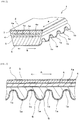
- the frictional power transmission belt 1 has a laminated structure, and a reinforcing fabric 2, a tension rubber layer 3, an adhesion rubber layer 4, a compression rubber layer 5, and a reinforcing fabric 6 are sequentially laminated from the outer peripheral side of the belt toward the inner peripheral side (side where cog portion 1a is formed).
- the cross-sectional shape in the width direction of the belt has the trapezoidal shape in which the belt width decreases from the outer peripheral side to the inner peripheral side of the belt.
- a tension member 4a is buried in the adhesion rubber layer 4, and the cog portion 1a is formed on the compression rubber layer 5 by a mold with a cog.
- the lubricant may be added in the rubber composition forming the compression rubber layer, and after vulcanization, the belt sleeve may be cut in the longitudinal direction of the belt, so that the lubricant may be made to bloom from the inside of the compression rubber layer to adhere to the surface (frictional power transmission surface).
- the blending amount of the short fibers can be adjusted to the minimum necessary due to the presence of the lubricant, the bending rigidity of the belt can be kept small while maintaining the lateral pressure resistance. Therefore, both the friction coefficient (improvement of slidability) and the bending rigidity (improvement of flexibility) can be reduced, and small transmission loss and fuel saving performance can be ensured. That is, by using a combination of the short fibers and the lubricant (wax), the lateral pressure resistance and the fuel saving performance (both flexibility and slidability) can be improved.
- a lubricant layer in which the entire frictional power transmission surface is coated with a lubricant is preferably formed.
- a lubricant layer in which the entire region of the frictional power transmission surface excluding the protruding portions of the short fibers (or vicinity of tip end of protruding portion) is coated with a lubricant is preferably formed.
- wax examples include aliphatic hydrocarbon waxes (e.g., poly C 2-4 olefin wax such as polyethylene wax, ethylene copolymer wax and polypropylene wax, paraffin wax such as natural paraffin and synthetic paraffin, microcrystalline wax, etc.), vegetable or animal wax (e.g., carnauba wax, bees wax, shellac wax, montan wax, etc.), and the like.
- poly C 2-4 olefin wax such as polyethylene wax, ethylene copolymer wax and polypropylene wax
- paraffin wax such as natural paraffin and synthetic paraffin, microcrystalline wax, etc.
- vegetable or animal wax e.g., carnauba wax, bees wax, shellac wax, montan wax, etc.
- fatty acid amide examples include higher fatty acid monoamides, for example, saturated or unsaturated higher fatty acid amides or monoamides such as behenic acid amide, arachidic acid amide, stearic acid amide, hydroxystearic acid amide, palmitic acid amide, myristic acid amide, lauric acid amide, erucic acid amide, oleic acid amide, and ricinoleic acid amide; saturated or unsaturated higher fatty acid bis-amides such as alkylene bis-saturated or unsaturated higher fatty acid amides (e.g., C 1-10 alkylene bis-saturated or unsaturated higher fatty acid amides such as methylene bis-stearic acid amide, methylene bis-lauric acid amide, methylene bis-hydroxystearic acid amide, methylene bis-oleic acid amide, ethylene bis-behenic acid amide, ethylene bis-stearic acid amide, ethylene bis
- fatty acid amides can be used alone or in combination of two or more kinds thereof.
- saturated or unsaturated higher fatty acid monoamides such as stearic acid amide and oleic acid amide (particularly, saturated or unsaturated higher fatty acid monoamides having a higher fatty acid carbon number of 16 to 20) are preferable.
- the melting point of the fatty acid amide can be selected from the range of approximately 50°C to 200°C, and normally may be approximately 65°C to 150°C, preferably 80°C to 140°C, and more preferably 90°C to 130°C (particularly 100°C to 120°C).
- the proportion of the fatty acid amide is, for example, approximately 25 to 100 parts by mass, preferably 30 to 80 parts by mass, and more preferably 40 to 50 parts by mass, based on 100 parts by mass of the wax.
- the proportion of the fatty acid amide is too small, there is a possibility that the lubricity in use at a high temperature may decrease.
- the proportion of too large there is a possibility that blooming may be suppressed in the case of being blended in the compression rubber layer.
- polyolefin fibers polyethylene fiber, polypropylene fiber, etc.
- polyamide fibers polyamide 6 fiber, polyamide 66 fiber, polyamide 46 fiber, aramid fiber, etc.
- polyalkylene arylate fibers polyC 2-4 alkyleneC 6-14 arylate fibers such as polyethylene terephthalate (PET) fiber, polyethylene naphthalate (PEN) fiber, etc.] vinylon fibers, polyvinyl alcohol fibers, and polyparaphenylene benzobisoxazole (PBO) fiber
- natural fibers such as cotton, hemp, and wool
- inorganic fibers such as a carbon fiber.
- the mechanical characteristic e.g., modulus
- the mechanical characteristic e.g., modulus
- the mechanical characteristic e.g., modulus
- too long there is a possibility that poor dispersion of the short fibers in the rubber composition may occur, cracks may occur in rubber, and the belt may be damaged at an early stage.
- the average protrusion height of the short fibers on the entire frictional power transmission surface is preferably 50 ⁇ m or more and, for example, approximately 50 to 200 ⁇ m, preferably 60 to 180 ⁇ m, and more preferably 70 to 160 ⁇ m (particularly 80 to 150 ⁇ m).
- the average protrusion height is too small, there is a possibility that the friction coefficient of the surface may not be sufficiently reduced. On the contrary, in the case of too large, damage and falling are likely to occur.
- the average protrusion height can be determined by observing the section cut in the width direction of the belt with an electron microscope or the like with a magnification, measuring a plurality (e.g., 10 to 1,000, preferably 30 to 500, more preferably 50 to 200, and particularly approximately 100) of lengths (protrusion height) of short fibers protruding from the side surface of the belt, and averaging them.
- a plurality e.g. 10 to 1,000, preferably 30 to 500, more preferably 50 to 200, and particularly approximately 100
- the shape of the short fibers in the protruding portion is not particularly limited, and may be a shape protruding substantially perpendicularly from the side surface, a shape curled in one direction (e.g., grinding direction), a shape in which the tip portion is fibrillated, and a shape such as a flowering shape melted by heat during grinding. Furthermore, it may be a shape described in JP-A-H07-98044 and JP-A-H07-151191 .
- Chloroprene rubber "Denka Chloroprene DCR” manufactured by Denka KK Aramid short fiber: “Conex Short Fiber” manufactured by Teijin Techno Products Co., Ltd., average fiber length of 3 mm, average fiber diameter of 14 ⁇ m
- Vinyl pyridine-styrene-butadiene copolymer latex manufactured by Zeon Corporation Wax A: “Santite C” manufactured by Seiko Chemical Co., Ltd., a mixture of paraffin and microcrystalline wax, melting point of approximately 50°C Wax B: “Santite R” manufactured by Seiko Chemical Co., Ltd., a mixture of paraffin and microcrystalline wax, melting point of approximately 80°C Wax C: "Santite SW” manufactured by Seiko Chemical Co., Ltd., a mixture of paraffin and oleic acid amide, melting point of approximately 120°C Fatty acid amide: "Amide AP-1" manufactured by Nippon Kasei Chemical Co., Ltd., stearic acid amide
- a laminated body of a reinforcing fabric and a compression rubber layer sheet (unvulcanized rubber) was installed on a flat cogged mold in which tooth portions and groove portions were alternately disposed, with the reinforcing fabric downward, and pressed at 75°C to prepare a cog pad having a cog portion molded (which was not completely vulcanized, and was in a semi-vulcanized state). Thereafter, both ends of the cog pad were cut perpendicularly from a top portion of a cog ridge portion.
- the mold was covered by a jacket, installed in a vulcanizing can, and vulcanized at a temperature of 160°C and for 20 minutes to obtain a belt sleeve.
- the belt sleeve was cut into a V-shape cross-sectional shape with a cutter and both side surfaces of the belt were ground, to thereby prepare a raw-edge cogged V-belt (size: upper width of 22.0 mm, thickness of 11.0 mm, and outer peripheral length of 800 mm) which was a belt having the structure illustrated in FIG. 2 , that is, a variable speed belt having a cog on the inner peripheral side of the belt.
- the lubricant layer was formed on the surface of the compression rubber layer (frictional power transmission surface) after grinding, and the short fibers protruded from the surface of the lubricant layer at an average height of 60 ⁇ m. Furthermore, an electron micrograph of the surface of the compression rubber layer of Example 4 is shown in FIG. 12 . The white portion of the drawing is the short fibers and the black portion is the lubricant.
- Comparative Examples 2 and 3 are examples in which wax was not added and the blending amount of the short fibers was increased as compared with Comparative Example 1. Although as the amount of short fibers increased, the friction coefficient decreased and the power transmission efficiency (fuel saving performance) improved, the occurrence rate of cracks increased in the durability test.
- fatty acid amide (Comparative Example 4), ether ester plasticizer (Comparative Example 5), graphite (Comparative Example 6), or silicone oil (Comparative Example 7) was used without including wax.
- the friction coefficient did not decrease much from Comparative Example 1, and the power transmission efficiency was not improved.
- the occurrence rate of cracks slightly increased.
- Example 1 In Examples 1 to 11 to which wax was added, the friction coefficient was decreased and the power transmission efficiency was improved as compared with Comparative Example 1. In addition, except for Examples 1, 5, and 10, the cracks did not occur and the durability was good. In Example 5 in which 10 parts by mass of wax was blended and in Example 10 in which 20 parts by mass of short fibers were blended, although the cracks were slightly generated, the occurrence rate of cracks was significantly reduced as compared with Comparative Examples 2 and 3 in which only the amount of short fibers was increased.
- Example 9 in which 6 parts by mass of wax C having a high melting point (melting point of approximately 120°C) was blended, as compared with Example 4 in which the same 6 parts by mass of wax A having a low melting point (melting point of approximately 50°C) was blended, the power transmission efficiency at the high-load condition (maximum 90°C) was high and the power transmission efficiency at the high-speed condition (surface temperature of belt was maximum 60°C) was low.
- the reason why the power transmission efficiency was low at the high-speed condition is considered to be because the melting point of wax was higher than the belt surface temperature by approximately 60°C and it was difficult to bloom on the frictional power transmission surface.
- Examples 6 to 8 in which waxes having different melting points were used in combination achieved good balance between the power transmission efficiency and the durability in that good power transmission efficiency in both the high-load condition (maximum 90°C) and the high-speed condition (maximum 60°C) was achieved and no cracks occurred.
- Example 10 is the same as Example 8 in that 2 parts by mass of each of waxes A, B, and C were blended. Although the power transmission efficiency is good, the occurrence rate of cracks slightly increased, probably because the amount of short fibers was larger than that in Example 8.
- Example 11 is an example in which wax and the fatty acid amide were used in combination as the lubricant.
- Comparative Example 4 in which only the fatty acid amide was blended, the durability was insufficient, and in Example 3 in which only the wax was blended, the power transmission efficiency at the high-load condition was slightly lower.
- Example 11 in which the wax and the fatty acid amide were used in combination, both the power transmission efficiency and the durability were evaluated to be A, and remarkable effects were obtained by combining these lubricants.
- the wax C used in Example 9 was a mixture of paraffin and oleic acid amide, and both the power transmission efficiency and the durability could be achieved without separately adding the fatty acid amide.
- the frictional power transmission belt of the present invention can be applied to, for example, a V-belt (wrapped V-belt, raw-edge V-belt, and raw-edge cogged V-belt), a V-ribbed belt, a flat belt, or the like.
- a V-belt variable speed belt
- a transmission continuously variable transmission device
- a raw-edge cogged V-belt and a raw-edge double cogged V-belt used for a continuously variable transmission device of a motorcycle, an ATV (4 wheel buggy), a snowmobile, and the like.
Landscapes
- Engineering & Computer Science (AREA)
- General Engineering & Computer Science (AREA)
- Mechanical Engineering (AREA)
- Chemical & Material Sciences (AREA)
- Textile Engineering (AREA)
- Chemical Kinetics & Catalysis (AREA)
- General Chemical & Material Sciences (AREA)
- Oil, Petroleum & Natural Gas (AREA)
- Organic Chemistry (AREA)
- Compositions Of Macromolecular Compounds (AREA)
Applications Claiming Priority (3)
| Application Number | Priority Date | Filing Date | Title |
|---|---|---|---|
| JP2015250509 | 2015-12-22 | ||
| JP2016240728A JP6435311B2 (ja) | 2015-12-22 | 2016-12-12 | 摩擦伝動ベルト及びその製造方法 |
| PCT/JP2016/087905 WO2017110790A1 (fr) | 2015-12-22 | 2016-12-20 | Courroie de transmission à frottement et son procédé de fabrication |
Publications (3)
| Publication Number | Publication Date |
|---|---|
| EP3396202A1 true EP3396202A1 (fr) | 2018-10-31 |
| EP3396202A4 EP3396202A4 (fr) | 2019-08-21 |
| EP3396202B1 EP3396202B1 (fr) | 2021-06-09 |
Family
ID=59234180
Family Applications (1)
| Application Number | Title | Priority Date | Filing Date |
|---|---|---|---|
| EP16878679.6A Active EP3396202B1 (fr) | 2015-12-22 | 2016-12-20 | Courroie de transmission à frottement et son procédé de fabrication |
Country Status (3)
| Country | Link |
|---|---|
| EP (1) | EP3396202B1 (fr) |
| JP (1) | JP6435311B2 (fr) |
| CN (1) | CN108431450B (fr) |
Cited By (1)
| Publication number | Priority date | Publication date | Assignee | Title |
|---|---|---|---|---|
| US11867258B2 (en) | 2017-07-04 | 2024-01-09 | Mitsuboshi Belting Ltd. | V-ribbed belt |
Families Citing this family (4)
| Publication number | Priority date | Publication date | Assignee | Title |
|---|---|---|---|---|
| CN107868349B (zh) * | 2017-12-12 | 2020-04-24 | 无锡市贝尔特胶带有限公司 | 传动带用橡胶组合物和使用该橡胶组合物的传动带 |
| CN111088700A (zh) * | 2019-12-03 | 2020-05-01 | 浙江尤夫科技工业有限公司 | 橡胶帆布浸胶配方及其制备方法和橡胶帆布的制备方法 |
| KR102407441B1 (ko) * | 2020-06-23 | 2022-06-10 | 황상노 | 신장 변화가 적고 내마모성이 개선된 구동벨트용 고무조성물 |
| KR102571363B1 (ko) * | 2021-11-24 | 2023-08-25 | 강유영 | 에어컨 컴프레셔용 마찰 패드 및 그 제조방법 |
Family Cites Families (7)
| Publication number | Priority date | Publication date | Assignee | Title |
|---|---|---|---|---|
| JP2848518B2 (ja) * | 1994-04-19 | 1999-01-20 | 三ツ星ベルト株式会社 | Vリブドベルト |
| JP2941674B2 (ja) * | 1994-12-28 | 1999-08-25 | 三ツ星ベルト株式会社 | Vリブドベルトの駆動装置 |
| US6824485B2 (en) * | 2002-07-09 | 2004-11-30 | The Gates Corporation | Power transmission belt |
| JP2008144965A (ja) * | 2006-11-14 | 2008-06-26 | Mitsuboshi Belting Ltd | ポリウレタン製歯付ベルト及びその製造方法 |
| JP5445922B2 (ja) * | 2009-09-03 | 2014-03-19 | Nok株式会社 | 歯付ベルト |
| JP5813996B2 (ja) * | 2011-05-20 | 2015-11-17 | 三ツ星ベルト株式会社 | 伝動用ベルト |
| JP5997712B2 (ja) * | 2013-01-30 | 2016-09-28 | 三ツ星ベルト株式会社 | 摩擦伝動ベルト |
-
2016
- 2016-12-12 JP JP2016240728A patent/JP6435311B2/ja active Active
- 2016-12-20 EP EP16878679.6A patent/EP3396202B1/fr active Active
- 2016-12-20 CN CN201680075221.2A patent/CN108431450B/zh active Active
Cited By (1)
| Publication number | Priority date | Publication date | Assignee | Title |
|---|---|---|---|---|
| US11867258B2 (en) | 2017-07-04 | 2024-01-09 | Mitsuboshi Belting Ltd. | V-ribbed belt |
Also Published As
| Publication number | Publication date |
|---|---|
| CN108431450B (zh) | 2021-05-18 |
| JP6435311B2 (ja) | 2018-12-05 |
| CN108431450A (zh) | 2018-08-21 |
| EP3396202A4 (fr) | 2019-08-21 |
| EP3396202B1 (fr) | 2021-06-09 |
| JP2017116101A (ja) | 2017-06-29 |
Similar Documents
| Publication | Publication Date | Title |
|---|---|---|
| EP2843258B1 (fr) | Courroie de transmission | |
| JP5813996B2 (ja) | 伝動用ベルト | |
| EP3396202B1 (fr) | Courroie de transmission à frottement et son procédé de fabrication | |
| JP6483745B2 (ja) | 摩擦伝動ベルト | |
| EP2980445A1 (fr) | Courroie de transmission | |
| US11300178B2 (en) | Friction drive belt | |
| JP6809985B2 (ja) | 摩擦伝動ベルト | |
| US11674561B2 (en) | Friction transmission belt | |
| WO2017110790A1 (fr) | Courroie de transmission à frottement et son procédé de fabrication | |
| EP3396201B1 (fr) | Courroie d'entraînement par frottement | |
| EP3444500B1 (fr) | Courroie de transmission à frottement | |
| JP5710192B2 (ja) | 摩擦伝動ベルト | |
| EP4296537A1 (fr) | Courroie trapézoïdale de transmission | |
| WO2017179690A1 (fr) | Courroie de transmission à friction | |
| JP2007298162A (ja) | 摩擦伝動ベルト | |
| JP2008157319A (ja) | 摩擦伝動ベルト |
Legal Events
| Date | Code | Title | Description |
|---|---|---|---|
| STAA | Information on the status of an ep patent application or granted ep patent |
Free format text: STATUS: THE INTERNATIONAL PUBLICATION HAS BEEN MADE |
|
| PUAI | Public reference made under article 153(3) epc to a published international application that has entered the european phase |
Free format text: ORIGINAL CODE: 0009012 |
|
| STAA | Information on the status of an ep patent application or granted ep patent |
Free format text: STATUS: REQUEST FOR EXAMINATION WAS MADE |
|
| 17P | Request for examination filed |
Effective date: 20180611 |
|
| AK | Designated contracting states |
Kind code of ref document: A1 Designated state(s): AL AT BE BG CH CY CZ DE DK EE ES FI FR GB GR HR HU IE IS IT LI LT LU LV MC MK MT NL NO PL PT RO RS SE SI SK SM TR |
|
| AX | Request for extension of the european patent |
Extension state: BA ME |
|
| DAV | Request for validation of the european patent (deleted) | ||
| DAX | Request for extension of the european patent (deleted) | ||
| A4 | Supplementary search report drawn up and despatched |
Effective date: 20190719 |
|
| RIC1 | Information provided on ipc code assigned before grant |
Ipc: F16G 5/20 20060101ALI20190715BHEP Ipc: F16G 5/00 20060101ALI20190715BHEP Ipc: F16G 1/08 20060101AFI20190715BHEP Ipc: C10M 159/06 20060101ALI20190715BHEP Ipc: C10N 40/00 20060101ALI20190715BHEP Ipc: B29D 29/10 20060101ALI20190715BHEP Ipc: C10N 30/00 20060101ALI20190715BHEP Ipc: F16G 1/00 20060101ALI20190715BHEP Ipc: F16G 5/06 20060101ALI20190715BHEP Ipc: C10M 133/16 20060101ALI20190715BHEP |
|
| GRAP | Despatch of communication of intention to grant a patent |
Free format text: ORIGINAL CODE: EPIDOSNIGR1 |
|
| STAA | Information on the status of an ep patent application or granted ep patent |
Free format text: STATUS: GRANT OF PATENT IS INTENDED |
|
| INTG | Intention to grant announced |
Effective date: 20210302 |
|
| GRAS | Grant fee paid |
Free format text: ORIGINAL CODE: EPIDOSNIGR3 |
|
| GRAA | (expected) grant |
Free format text: ORIGINAL CODE: 0009210 |
|
| STAA | Information on the status of an ep patent application or granted ep patent |
Free format text: STATUS: THE PATENT HAS BEEN GRANTED |
|
| AK | Designated contracting states |
Kind code of ref document: B1 Designated state(s): AL AT BE BG CH CY CZ DE DK EE ES FI FR GB GR HR HU IE IS IT LI LT LU LV MC MK MT NL NO PL PT RO RS SE SI SK SM TR |
|
| REG | Reference to a national code |
Ref country code: GB Ref legal event code: FG4D |
|
| REG | Reference to a national code |
Ref country code: CH Ref legal event code: EP Ref country code: AT Ref legal event code: REF Ref document number: 1400767 Country of ref document: AT Kind code of ref document: T Effective date: 20210615 |
|
| REG | Reference to a national code |
Ref country code: DE Ref legal event code: R096 Ref document number: 602016059240 Country of ref document: DE |
|
| REG | Reference to a national code |
Ref country code: IE Ref legal event code: FG4D |
|
| REG | Reference to a national code |
Ref country code: LT Ref legal event code: MG9D |
|
| PG25 | Lapsed in a contracting state [announced via postgrant information from national office to epo] |
Ref country code: FI Free format text: LAPSE BECAUSE OF FAILURE TO SUBMIT A TRANSLATION OF THE DESCRIPTION OR TO PAY THE FEE WITHIN THE PRESCRIBED TIME-LIMIT Effective date: 20210609 Ref country code: LT Free format text: LAPSE BECAUSE OF FAILURE TO SUBMIT A TRANSLATION OF THE DESCRIPTION OR TO PAY THE FEE WITHIN THE PRESCRIBED TIME-LIMIT Effective date: 20210609 Ref country code: BG Free format text: LAPSE BECAUSE OF FAILURE TO SUBMIT A TRANSLATION OF THE DESCRIPTION OR TO PAY THE FEE WITHIN THE PRESCRIBED TIME-LIMIT Effective date: 20210909 Ref country code: HR Free format text: LAPSE BECAUSE OF FAILURE TO SUBMIT A TRANSLATION OF THE DESCRIPTION OR TO PAY THE FEE WITHIN THE PRESCRIBED TIME-LIMIT Effective date: 20210609 |
|
| REG | Reference to a national code |
Ref country code: AT Ref legal event code: MK05 Ref document number: 1400767 Country of ref document: AT Kind code of ref document: T Effective date: 20210609 |
|
| REG | Reference to a national code |
Ref country code: NL Ref legal event code: MP Effective date: 20210609 |
|
| PG25 | Lapsed in a contracting state [announced via postgrant information from national office to epo] |
Ref country code: NO Free format text: LAPSE BECAUSE OF FAILURE TO SUBMIT A TRANSLATION OF THE DESCRIPTION OR TO PAY THE FEE WITHIN THE PRESCRIBED TIME-LIMIT Effective date: 20210909 Ref country code: SE Free format text: LAPSE BECAUSE OF FAILURE TO SUBMIT A TRANSLATION OF THE DESCRIPTION OR TO PAY THE FEE WITHIN THE PRESCRIBED TIME-LIMIT Effective date: 20210609 Ref country code: RS Free format text: LAPSE BECAUSE OF FAILURE TO SUBMIT A TRANSLATION OF THE DESCRIPTION OR TO PAY THE FEE WITHIN THE PRESCRIBED TIME-LIMIT Effective date: 20210609 Ref country code: GR Free format text: LAPSE BECAUSE OF FAILURE TO SUBMIT A TRANSLATION OF THE DESCRIPTION OR TO PAY THE FEE WITHIN THE PRESCRIBED TIME-LIMIT Effective date: 20210910 Ref country code: LV Free format text: LAPSE BECAUSE OF FAILURE TO SUBMIT A TRANSLATION OF THE DESCRIPTION OR TO PAY THE FEE WITHIN THE PRESCRIBED TIME-LIMIT Effective date: 20210609 |
|
| PG25 | Lapsed in a contracting state [announced via postgrant information from national office to epo] |
Ref country code: CZ Free format text: LAPSE BECAUSE OF FAILURE TO SUBMIT A TRANSLATION OF THE DESCRIPTION OR TO PAY THE FEE WITHIN THE PRESCRIBED TIME-LIMIT Effective date: 20210609 Ref country code: EE Free format text: LAPSE BECAUSE OF FAILURE TO SUBMIT A TRANSLATION OF THE DESCRIPTION OR TO PAY THE FEE WITHIN THE PRESCRIBED TIME-LIMIT Effective date: 20210609 Ref country code: AT Free format text: LAPSE BECAUSE OF FAILURE TO SUBMIT A TRANSLATION OF THE DESCRIPTION OR TO PAY THE FEE WITHIN THE PRESCRIBED TIME-LIMIT Effective date: 20210609 Ref country code: NL Free format text: LAPSE BECAUSE OF FAILURE TO SUBMIT A TRANSLATION OF THE DESCRIPTION OR TO PAY THE FEE WITHIN THE PRESCRIBED TIME-LIMIT Effective date: 20210609 Ref country code: PT Free format text: LAPSE BECAUSE OF FAILURE TO SUBMIT A TRANSLATION OF THE DESCRIPTION OR TO PAY THE FEE WITHIN THE PRESCRIBED TIME-LIMIT Effective date: 20211011 Ref country code: RO Free format text: LAPSE BECAUSE OF FAILURE TO SUBMIT A TRANSLATION OF THE DESCRIPTION OR TO PAY THE FEE WITHIN THE PRESCRIBED TIME-LIMIT Effective date: 20210609 Ref country code: ES Free format text: LAPSE BECAUSE OF FAILURE TO SUBMIT A TRANSLATION OF THE DESCRIPTION OR TO PAY THE FEE WITHIN THE PRESCRIBED TIME-LIMIT Effective date: 20210609 Ref country code: SM Free format text: LAPSE BECAUSE OF FAILURE TO SUBMIT A TRANSLATION OF THE DESCRIPTION OR TO PAY THE FEE WITHIN THE PRESCRIBED TIME-LIMIT Effective date: 20210609 Ref country code: SK Free format text: LAPSE BECAUSE OF FAILURE TO SUBMIT A TRANSLATION OF THE DESCRIPTION OR TO PAY THE FEE WITHIN THE PRESCRIBED TIME-LIMIT Effective date: 20210609 |
|
| PG25 | Lapsed in a contracting state [announced via postgrant information from national office to epo] |
Ref country code: PL Free format text: LAPSE BECAUSE OF FAILURE TO SUBMIT A TRANSLATION OF THE DESCRIPTION OR TO PAY THE FEE WITHIN THE PRESCRIBED TIME-LIMIT Effective date: 20210609 |
|
| REG | Reference to a national code |
Ref country code: DE Ref legal event code: R097 Ref document number: 602016059240 Country of ref document: DE |
|
| PLBE | No opposition filed within time limit |
Free format text: ORIGINAL CODE: 0009261 |
|
| STAA | Information on the status of an ep patent application or granted ep patent |
Free format text: STATUS: NO OPPOSITION FILED WITHIN TIME LIMIT |
|
| PG25 | Lapsed in a contracting state [announced via postgrant information from national office to epo] |
Ref country code: DK Free format text: LAPSE BECAUSE OF FAILURE TO SUBMIT A TRANSLATION OF THE DESCRIPTION OR TO PAY THE FEE WITHIN THE PRESCRIBED TIME-LIMIT Effective date: 20210609 |
|
| 26N | No opposition filed |
Effective date: 20220310 |
|
| PG25 | Lapsed in a contracting state [announced via postgrant information from national office to epo] |
Ref country code: AL Free format text: LAPSE BECAUSE OF FAILURE TO SUBMIT A TRANSLATION OF THE DESCRIPTION OR TO PAY THE FEE WITHIN THE PRESCRIBED TIME-LIMIT Effective date: 20210609 |
|
| PG25 | Lapsed in a contracting state [announced via postgrant information from national office to epo] |
Ref country code: MC Free format text: LAPSE BECAUSE OF FAILURE TO SUBMIT A TRANSLATION OF THE DESCRIPTION OR TO PAY THE FEE WITHIN THE PRESCRIBED TIME-LIMIT Effective date: 20210609 |
|
| REG | Reference to a national code |
Ref country code: CH Ref legal event code: PL |
|
| GBPC | Gb: european patent ceased through non-payment of renewal fee |
Effective date: 20211220 |
|
| REG | Reference to a national code |
Ref country code: BE Ref legal event code: MM Effective date: 20211231 |
|
| PG25 | Lapsed in a contracting state [announced via postgrant information from national office to epo] |
Ref country code: LU Free format text: LAPSE BECAUSE OF NON-PAYMENT OF DUE FEES Effective date: 20211220 Ref country code: IE Free format text: LAPSE BECAUSE OF NON-PAYMENT OF DUE FEES Effective date: 20211220 Ref country code: GB Free format text: LAPSE BECAUSE OF NON-PAYMENT OF DUE FEES Effective date: 20211220 |
|
| PG25 | Lapsed in a contracting state [announced via postgrant information from national office to epo] |
Ref country code: BE Free format text: LAPSE BECAUSE OF NON-PAYMENT OF DUE FEES Effective date: 20211231 |
|
| PG25 | Lapsed in a contracting state [announced via postgrant information from national office to epo] |
Ref country code: LI Free format text: LAPSE BECAUSE OF NON-PAYMENT OF DUE FEES Effective date: 20211231 Ref country code: CH Free format text: LAPSE BECAUSE OF NON-PAYMENT OF DUE FEES Effective date: 20211231 |
|
| P01 | Opt-out of the competence of the unified patent court (upc) registered |
Effective date: 20230420 |
|
| PG25 | Lapsed in a contracting state [announced via postgrant information from national office to epo] |
Ref country code: CY Free format text: LAPSE BECAUSE OF FAILURE TO SUBMIT A TRANSLATION OF THE DESCRIPTION OR TO PAY THE FEE WITHIN THE PRESCRIBED TIME-LIMIT Effective date: 20210609 |
|
| PG25 | Lapsed in a contracting state [announced via postgrant information from national office to epo] |
Ref country code: HU Free format text: LAPSE BECAUSE OF FAILURE TO SUBMIT A TRANSLATION OF THE DESCRIPTION OR TO PAY THE FEE WITHIN THE PRESCRIBED TIME-LIMIT; INVALID AB INITIO Effective date: 20161220 |
|
| PG25 | Lapsed in a contracting state [announced via postgrant information from national office to epo] |
Ref country code: MK Free format text: LAPSE BECAUSE OF FAILURE TO SUBMIT A TRANSLATION OF THE DESCRIPTION OR TO PAY THE FEE WITHIN THE PRESCRIBED TIME-LIMIT Effective date: 20210609 |
|
| PG25 | Lapsed in a contracting state [announced via postgrant information from national office to epo] |
Ref country code: MT Free format text: LAPSE BECAUSE OF FAILURE TO SUBMIT A TRANSLATION OF THE DESCRIPTION OR TO PAY THE FEE WITHIN THE PRESCRIBED TIME-LIMIT Effective date: 20210609 |
|
| PG25 | Lapsed in a contracting state [announced via postgrant information from national office to epo] |
Ref country code: TR Free format text: LAPSE BECAUSE OF FAILURE TO SUBMIT A TRANSLATION OF THE DESCRIPTION OR TO PAY THE FEE WITHIN THE PRESCRIBED TIME-LIMIT Effective date: 20210609 |
|
| PGFP | Annual fee paid to national office [announced via postgrant information from national office to epo] |
Ref country code: DE Payment date: 20251028 Year of fee payment: 10 |
|
| PGFP | Annual fee paid to national office [announced via postgrant information from national office to epo] |
Ref country code: IT Payment date: 20251121 Year of fee payment: 10 |
|
| PGFP | Annual fee paid to national office [announced via postgrant information from national office to epo] |
Ref country code: FR Payment date: 20251110 Year of fee payment: 10 |