EP3396267A1 - Dispositif à clapet pour la régulation du débit d'air dans une ouverture - Google Patents
Dispositif à clapet pour la régulation du débit d'air dans une ouverture Download PDFInfo
- Publication number
- EP3396267A1 EP3396267A1 EP18166028.3A EP18166028A EP3396267A1 EP 3396267 A1 EP3396267 A1 EP 3396267A1 EP 18166028 A EP18166028 A EP 18166028A EP 3396267 A1 EP3396267 A1 EP 3396267A1
- Authority
- EP
- European Patent Office
- Prior art keywords
- wall
- air
- support
- opening
- valve device
- Prior art date
- Legal status (The legal status is an assumption and is not a legal conclusion. Google has not performed a legal analysis and makes no representation as to the accuracy of the status listed.)
- Granted
Links
Images
Classifications
-
- F—MECHANICAL ENGINEERING; LIGHTING; HEATING; WEAPONS; BLASTING
- F24—HEATING; RANGES; VENTILATING
- F24F—AIR-CONDITIONING; AIR-HUMIDIFICATION; VENTILATION; USE OF AIR CURRENTS FOR SCREENING
- F24F13/00—Details common to, or for air-conditioning, air-humidification, ventilation or use of air currents for screening
- F24F13/08—Air-flow control members, e.g. louvres, grilles, flaps or guide plates
- F24F13/10—Air-flow control members, e.g. louvres, grilles, flaps or guide plates movable, e.g. dampers
- F24F13/14—Air-flow control members, e.g. louvres, grilles, flaps or guide plates movable, e.g. dampers built up of tilting members, e.g. louvre
- F24F13/1413—Air-flow control members, e.g. louvres, grilles, flaps or guide plates movable, e.g. dampers built up of tilting members, e.g. louvre using more than one tilting member, e.g. with several pivoting blades
-
- E—FIXED CONSTRUCTIONS
- E06—DOORS, WINDOWS, SHUTTERS, OR ROLLER BLINDS IN GENERAL; LADDERS
- E06B—FIXED OR MOVABLE CLOSURES FOR OPENINGS IN BUILDINGS, VEHICLES, FENCES OR LIKE ENCLOSURES IN GENERAL, e.g. DOORS, WINDOWS, BLINDS, GATES
- E06B7/00—Special arrangements or measures in connection with doors or windows
- E06B7/02—Special arrangements or measures in connection with doors or windows for providing ventilation, e.g. through double windows; Arrangement of ventilation roses
- E06B7/04—Special arrangements or measures in connection with doors or windows for providing ventilation, e.g. through double windows; Arrangement of ventilation roses with ventilation wings
- E06B7/06—Special arrangements or measures in connection with doors or windows for providing ventilation, e.g. through double windows; Arrangement of ventilation roses with ventilation wings with one ventilation wing only
-
- E—FIXED CONSTRUCTIONS
- E06—DOORS, WINDOWS, SHUTTERS, OR ROLLER BLINDS IN GENERAL; LADDERS
- E06B—FIXED OR MOVABLE CLOSURES FOR OPENINGS IN BUILDINGS, VEHICLES, FENCES OR LIKE ENCLOSURES IN GENERAL, e.g. DOORS, WINDOWS, BLINDS, GATES
- E06B9/00—Screening or protective devices for wall or similar openings, with or without operating or securing mechanisms; Closures of similar construction
- E06B9/02—Shutters, movable grilles, or other safety closing devices, e.g. against burglary
- E06B9/08—Roll-type closures
- E06B9/11—Roller shutters
- E06B9/17—Parts or details of roller shutters, e.g. suspension devices, shutter boxes, wicket doors, ventilation openings
- E06B9/17007—Shutter boxes; Details or component parts thereof
-
- F—MECHANICAL ENGINEERING; LIGHTING; HEATING; WEAPONS; BLASTING
- F24—HEATING; RANGES; VENTILATING
- F24F—AIR-CONDITIONING; AIR-HUMIDIFICATION; VENTILATION; USE OF AIR CURRENTS FOR SCREENING
- F24F11/00—Control or safety arrangements
- F24F11/30—Control or safety arrangements for purposes related to the operation of the system, e.g. for safety or monitoring
-
- F—MECHANICAL ENGINEERING; LIGHTING; HEATING; WEAPONS; BLASTING
- F24—HEATING; RANGES; VENTILATING
- F24F—AIR-CONDITIONING; AIR-HUMIDIFICATION; VENTILATION; USE OF AIR CURRENTS FOR SCREENING
- F24F2110/00—Control inputs relating to air properties
- F24F2110/20—Humidity
-
- F—MECHANICAL ENGINEERING; LIGHTING; HEATING; WEAPONS; BLASTING
- F24—HEATING; RANGES; VENTILATING
- F24F—AIR-CONDITIONING; AIR-HUMIDIFICATION; VENTILATION; USE OF AIR CURRENTS FOR SCREENING
- F24F13/00—Details common to, or for air-conditioning, air-humidification, ventilation or use of air currents for screening
- F24F13/08—Air-flow control members, e.g. louvres, grilles, flaps or guide plates
- F24F13/10—Air-flow control members, e.g. louvres, grilles, flaps or guide plates movable, e.g. dampers
- F24F13/14—Air-flow control members, e.g. louvres, grilles, flaps or guide plates movable, e.g. dampers built up of tilting members, e.g. louvre
- F24F13/1426—Air-flow control members, e.g. louvres, grilles, flaps or guide plates movable, e.g. dampers built up of tilting members, e.g. louvre characterised by actuating means
- F24F2013/1433—Air-flow control members, e.g. louvres, grilles, flaps or guide plates movable, e.g. dampers built up of tilting members, e.g. louvre characterised by actuating means with electric motors
-
- F—MECHANICAL ENGINEERING; LIGHTING; HEATING; WEAPONS; BLASTING
- F24—HEATING; RANGES; VENTILATING
- F24F—AIR-CONDITIONING; AIR-HUMIDIFICATION; VENTILATION; USE OF AIR CURRENTS FOR SCREENING
- F24F13/00—Details common to, or for air-conditioning, air-humidification, ventilation or use of air currents for screening
- F24F13/08—Air-flow control members, e.g. louvres, grilles, flaps or guide plates
- F24F13/10—Air-flow control members, e.g. louvres, grilles, flaps or guide plates movable, e.g. dampers
- F24F13/14—Air-flow control members, e.g. louvres, grilles, flaps or guide plates movable, e.g. dampers built up of tilting members, e.g. louvre
- F24F2013/1493—Air-flow control members, e.g. louvres, grilles, flaps or guide plates movable, e.g. dampers built up of tilting members, e.g. louvre using an elastic membrane
-
- F—MECHANICAL ENGINEERING; LIGHTING; HEATING; WEAPONS; BLASTING
- F24—HEATING; RANGES; VENTILATING
- F24F—AIR-CONDITIONING; AIR-HUMIDIFICATION; VENTILATION; USE OF AIR CURRENTS FOR SCREENING
- F24F2110/00—Control inputs relating to air properties
- F24F2110/50—Air quality properties
- F24F2110/65—Concentration of specific substances or contaminants
- F24F2110/70—Carbon dioxide
-
- Y—GENERAL TAGGING OF NEW TECHNOLOGICAL DEVELOPMENTS; GENERAL TAGGING OF CROSS-SECTIONAL TECHNOLOGIES SPANNING OVER SEVERAL SECTIONS OF THE IPC; TECHNICAL SUBJECTS COVERED BY FORMER USPC CROSS-REFERENCE ART COLLECTIONS [XRACs] AND DIGESTS
- Y02—TECHNOLOGIES OR APPLICATIONS FOR MITIGATION OR ADAPTATION AGAINST CLIMATE CHANGE
- Y02B—CLIMATE CHANGE MITIGATION TECHNOLOGIES RELATED TO BUILDINGS, e.g. HOUSING, HOUSE APPLIANCES OR RELATED END-USER APPLICATIONS
- Y02B30/00—Energy efficient heating, ventilation or air conditioning [HVAC]
- Y02B30/70—Efficient control or regulation technologies, e.g. for control of refrigerant flow, motor or heating
Definitions
- the present invention very generally relates to the field of building ventilation, in particular but not exclusively in association with roller shutters. Ventilation involving the management of air passage openings to and from the building, it is more specifically door and window joinery or shutter boxes and boxes which are concerned in the case of such an association.
- the invention is particularly interesting and well adapted to the renovation, for which it allows a technical as well as normative upgrade of individual houses, residential dwellings or collective buildings, with a view to improving the quality of the building. the indoor air.
- VMC controlled mechanical ventilation
- variable flow means which, depending on their setting, allow a greater or lesser volume of air to pass through openings connecting delimited interior spaces (rooms of the dwelling ) with the outside.
- variable flow means which, depending on their setting, allow a greater or lesser volume of air to pass through openings connecting delimited interior spaces (rooms of the dwelling ) with the outside.
- solutions that vary the air passage surface in proportion to the rate of measured humidity. These solutions are supposed to adjust the volume of air exchange at the level of occupation of the premises.
- the variations are, however, of limited amplitudes, for example obtained by deformation of membranes under the effect of hygrometric conditions.
- the invention relates to a valve system adapted to vary a flow of air by displacement relative to an opening, to participate in individual and possibly collective management of flows to optimize the treatment of air on the scale of a residential dwelling.
- the main function of the invention is to manage air flows exchanged between the interior and exterior of a building, the problems that underlie the treatment of air in the home cover a relatively wider spectrum, and concern multiple parameters.
- the simple flow flow management can be considered in the light of the respect of normative thresholds or to adjust to seasonal criteria characterized by external temperatures or a variable rate of sunshine, to answer to rates of CO 2 or humidity of the air inside the rooms etc.
- Airflow management can also be thought of individually, at the scale of each air passage, or be carried out in a network, especially to share information or to influence the pressure losses in the air circulation circuit.
- air management can also be linked to the existence of mechanical ventilation by insufflation (VMI), and take into account air flows possibly cooled or reheated according to the local climatic conditions of the moment, knowing that the The operational implications of a VMI are independent of those resulting from indoor air quality measurements and should be considered in addition to these.
- VMI mechanical ventilation by insufflation
- the invention is centered on the valve itself, ultimately organizing the regulation of the air flow, it must be usable in any type of environment, coupled with measuring or control means reflecting various operating protocols such as for example described in the document EP 3,075,944 the applicant.
- the device of the invention is designed to operate to evacuate air (for example with a VMI) as to renew air (in cooperation with a VMC), that is to say that it can be used regardless of the direction of passage of the airflow managed.
- the type of valve concerned by the invention in fact combines an air flow control function and a non-return function in the opposite direction, to prevent uncontrollable parasitic phenomena such as gusts of wind disturbing the controlled management. flow.
- these two functions are implemented independently, which generally implies a double mechanism and if necessary a double command, substantially increasing the technical complexity of the assembly. This double mechanism proves to be economically more expensive to manufacture as well as to maintain, the increased complexity of the systems having inevitable consequences on their reliability.
- the present invention overcomes these shortcomings, by proposing an original valve configuration that first allows a modulable flow rate regulation, and which then integrates in a single combined solution the flow control and the anti-return function.
- the solution of the invention is mechanically simple and elegant, and technically robust.
- the valve device of the invention allowing the regulation of the air flow rate in an air passage opening made in a wall, comprises a valve conventionally arranged on one side of the wall at the outlet of the opening, and is such that said valve comprises a rigid support pivotable along a first axis parallel to and adjacent said face between two positions relative to the opening, the support cooperating with a film of dimensions able to obstruct the opening in the wall, said film being pivotable independently of the support along an axis parallel and adjacent or identical to the first axis between a position in contact with the support and a position of obstruction of the opening.
- the film is in fact provided, and this concerns in particular the properties of the material which constitutes it, so that it can move easily between the two positions in the direction of the air flows coming from inside or outside. , in order to be pressed alternately against the opening of which the device of the invention regulates the flow and against the support.
- the film used is thin and lightweight, in sheet form, so that it is particularly sensitive to the pressure differentials applied to it.
- a positive pressure for example due to a wind surge occurs, the film is pushed into contact with the wall of the opening, resulting in obstructing. In this case, the parasitic outside air flow is prevented from entering the premises.
- the film is therefore used in the two previously mentioned functions, the flow control and the anti-return, contributing to the simplicity of the solution.
- it is a part of the regulating valve itself, also obeying the same kinematic logic, which performs the anti-return function, resulting in greatly simplifying the structure of the valve.
- the support 3 consists of a perforated frame, the film resting simply on said frame and at least partially obstructing one or more openings in the frame.
- the structure of the set is in this case simplified to the extreme, since the film does not even need a mechanical connection to the frame: it is content to rely on it.
- the axis of pivoting of the support is placed in a wall of vertical shape, under the opening of the opening in the face of the wall opposite the valve.
- This configuration makes it possible to take advantage of the gravity in particular in the "normal" operating position of the device, allowing the regulation of air.
- the support of the valve is inclined relative to the face opposite the wall and the film can therefore rest by gravity on said support without mechanical attachment to the latter.
- the support and / or the hinge means may then comprise means for retaining the film in the lower part.
- the pivot axis of the support can obviously be placed in the vertical wall above the opening of the opening.
- the device may even include means for returning the film in contact with the support so that during the evacuation of stale air, in "normal" operation of the valve, it is instead pressed against the support, and constitutes with it - At least seen by the hydraulic control circuit - an obstacle whose surface is actually that of the film, which exceeds that of the support. The return force is then provided to the extent of the features mentioned previously for the film, and is low in this case. We have seen that these means of recall are not essential, some configurations making them useless.
- the film may be made of flexible material and secured to the wall along the pivot axis and in the vicinity of the opening. Its flexible nature makes it mobile, under the effect of pressure differentials existing across the opening, between a position in contact with the wall, and a position in contact with the support. Pivoting occurs in fact at the "line" of securing the film to the wall, it is actually a bending, comparable in this case to a pivoting.
- This solution accommodates in practice both a pivot axis located under or above the opening, and it also does not require return means.
- the device of the invention comprises means for articulating the support between two stops delimiting the amplitude of the pivoting and modulating the air passage surface between two non-zero values. These two values define a minimum flow rate and a maximum flow rate, the setting corresponding to the minimum flow rate being preferably at least equal to the normative sanitary flow rate provided by the texts. This is often insufficient to ensure proper "cleaning" of stale air, the position corresponding to the maximum flow allows over-ventilation often desirable in terms of health.
- the device of the invention comprises means for adjusting the position of at least one of the stops so as to modify the amplitude of the pivoting of the valve.
- a different setting can indeed be applied depending on the premises, or even in the same premises for various situations, particularly related to climatic or seasonal considerations.
- the support and its articulation mechanism can be configured so that the film is laterally guided during any displacement between a first position in contact with the support and a second position of obstruction of the opening in the wall .
- the hinge means may have on either side of the support surfaces perpendicular to the pivot axis, particularly suitable for guiding the support and the film during their movements.
- the hinge means may comprise ears protruding perpendicularly from the wall on either side of the opening, each having an orifice for the housing to pivot a lug of the support and curvilinear lights of guiding a stud according to an angular sector, the lug and the stud protruding symmetrically on each side of the support.
- the curvilinear lights in practice define the amplitude of the pivoting, according to the angular sector covered. They are positioned so that their ends, forming a mechanical stop during the movement, define two different openings positions of the valve.
- the support may be provided with a rectangular shape, the pivot axis then being example located at a large side of the support rectangle.
- the aforementioned pins can then be replaced by a shaft constituting in particular said large side and protruding from the support at both ends.
- the two ears are located vertically on either side of the support and the 'opening.
- the ears therefore placed on each side of the support and forming somehow side walls regardless of the position of said support, can help guide the pivoting of the film between a position pressed against the support and a position pressed against the wall. This is also the case if the pivot axis is placed above the opening.
- the support may comprise a frame surrounding a central plate on at least a part of its periphery, said plate not covering the entire surface of the film.
- the movement of the support is actuated by motorized drive means. It may be an electric motor for example placed on an electronic card that simultaneously manages the connection with a power source supplying its power.
- These drive means can be controlled by an electronic control unit connected to the drive means and at least one sensor for measuring a parameter reflecting the quality of the air. They can also optionally provide, in addition to controlling the activation / deactivation of the drive means according to the measured values, ancillary functions such as communication with other homologous devices in the event that the clutch device of the The invention operates in a network in the context of residential housing.
- each sensor is provided for measuring the CO 2 content and / or humidity in the indoor air.
- the choice of sensor can in this respect depend on technical or economic considerations.
- the invention furthermore relates secondarily to a roller shutter comprising a winding box provided with a valve device according to the preceding description, a vertical wall of the box being then provided with an opening in front of which said valve device is mounted. It can also be implemented in the absence of roller shutters, on a window or door joinery on which a flap device is mounted according to the characteristics mentioned above, in front of an opening made in a cross member of the frame, for example the upper rail.
- the idea underlying the design of the invention is to provide a preferably motorized valve, and therefore controllable by an electronic control unit, movable between a minimum flow and a maximum flow, the passage from one to the other when a threshold of at least one air quality measurement parameter is reached.
- the valve device is placed in front of an opening 1 made in a wall 2, for example a rolling shutter box wall or a frame window or door window frame.
- a wall 2 for example a rolling shutter box wall or a frame window or door window frame.
- Such an opening may for example take the form of a slot of horizontal shape.
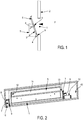
- the device comprises a pivoting support 3 via a lug 9 along an axis 4 and a film 5 appearing pressed against said support 3 and which is able to pivot independently, along the same axis 4, between the support 3 and the wall 2.
- the support 3 pivots between two extreme positions delimited by a rounded light 6 made in a side lug 7, for example fixed to the wall 2, or to an intermediate wall secured to the wall 2 if the device of the invention is designed as an independent unit ( see for example in figure 2 ), which is the case in most configurations.
- Pivoting is effected by cooperation of the lugs 9 protruding from the support 3 at the axis 4 in corresponding orifices of each lug 7 side.
- the support 3 is for example a rectangular frame comprising at least one inner window, as shown in FIG. figure 2 or a crenellated frame having a main branch on the side of the pivot axis and secondary branches perpendicular and crenellated, maintaining openings in some way between the teeth of the comb. It can take other forms, insofar as they have openings to ensure the anti-return function when a reverse flow occurs that is normally managed.
- the guiding light 6 is curvilinear, delimiting an angular sector marking the amplitude of the angular displacement of the pivoting support 3. Guiding is actually carried out in two lugs 7 placed on each side of the support 3, and provided with symmetrical lights 6 housing studs 8 protruding laterally from said support 3. It makes it possible to confer on the support two distinct positions, abutting the ends of the lights 6, for a motorized operation for example binary, that is to say at two predetermined rates of discharge of stale air, in the direction of the arrow F, when the film 5 is pressed against the support 3 as shown in figure 1 in a position corresponding to a minimum flow.
- valve is directed towards the interior of the part, whereas in the hypothesis of a VMI, it is directed towards the outside, or towards the inside of a box of shutter in the case of an association of the invention with a roller shutter.
- the film 5 is itself pivotable relative to the support 3, and able to obstruct the opening 1 in the event of an overpressure in the opposite direction of the arrow F, for example in the event of a gust of wind in an operation intended to the evacuation of stale air.
- valve In operation of the valve to regulate the air evacuation flow, it is pressed against the support, as shown in FIG. Figures 1 and 2 , preferably by simple gravity as illustrated in the figures, according to the arrangement of the valve and in particular of its axis of rotation relative to the opening 1.
- the film being provided in a very light material, for example in flexible plastic of thickness very reduced, it can also be fixed at the edge of the opening 1, at the axis 4. Its bending relative to this almost linear fixing area is then comparable to a pivoting axis 4.
- an electric motor 10 is placed at the end of a shaft extending a side 11 of a frame 13 forming the support 3.
- the film 5 appears in a window 12 made inside the frame 13, so that it can obstruct a opening 14 formed in a plate 15 which supports the entire valve device of the invention, wherein the opening 14 is located in front of the film 5.
- the valve device of the invention is envisaged as an independent unit solidarisable to a wall 2 for example provided with an aeration slot constituting the opening 1.
- the opening 14 must then be centered on said slot.
- the film 5 rests without constraint, if not gravity, in the frame 13, and a reverse flow through the or the windows 12 of the frame 13 result in making it rotate naturally about an axis in the vicinity of the axis 4, in the direction of the wall 2.
- a branch of shape perpendicular to said plate 15 constitutes the lugs 7 provided with the curvilinear guide lights 6 of the support 3.
- the pads 8 exceeding the level lateral sides of the frame 13 cooperate with said lights 6 for the motorized movement of the support 3, and therefore the film 5 in most cases, between two operating positions providing two separate flow rates of exhaust air or exhaust air. opening to fresh air. These positions correspond to the arrival in abutment of the studs 8 at the ends of the angular sectors of the slots 6.
- the device of the invention can however be used to manage the opposite air flow.
- the valves will be able to optimize the fresh air flow by reducing the airflow losses at the air outlets in the unpolluted rooms.
- Such a possibility obviously involves the implementation of a communication between devices, and a positioning of the valves which is not necessarily binary, but requires at least a third intermediate position.
- a three-position system for example makes it possible to optimize the circulation of air inside the premises. Playing on the pressure drop in some rooms can be interesting to optimize the evacuation in other rooms. For example, it is possible to increase the pressure drop in unpolluted rooms in order to promote the circulation of air in other rooms requiring a renewal of air.
Landscapes
- Engineering & Computer Science (AREA)
- Chemical & Material Sciences (AREA)
- Combustion & Propulsion (AREA)
- Mechanical Engineering (AREA)
- General Engineering & Computer Science (AREA)
- Structural Engineering (AREA)
- Civil Engineering (AREA)
- Life Sciences & Earth Sciences (AREA)
- Atmospheric Sciences (AREA)
- Architecture (AREA)
- Air-Flow Control Members (AREA)
- Lift Valve (AREA)
Abstract
Description
- La présente invention concerne très généralement le domaine de la ventilation de bâtiments, notamment mais non exclusivement en association avec des volets roulants. La ventilation impliquant la gestion d'orifices de passage de l'air depuis et vers le bâtiment, ce sont plus spécifiquement les menuiseries de portes et fenêtres ou les caissons et coffres des volets roulants qui sont concernés dans le cas d'une telle association.
- L'invention s'avère particulièrement intéressante et bien adaptée à la rénovation, pour laquelle elle permet une mise à niveau autant technique que normative de maisons individuelles, de logements d'habitation ou de bâtiments collectifs, en vue d'y améliorer la qualité de l'air intérieur.
- Les normes actuelles imposent de ventiler en permanence les espaces résidentiels, et des circuits de circulation d'air doivent par conséquent être assurés dans les locaux d'habitation en vue de générer des échanges de flux d'air entre l'intérieur et l'extérieur. Dans les locaux plus anciens, des passages d'air sont en général à minima prévus au moins dans les parties considérées comme humides ou donnant lieu à humidité comme les pièces sanitaires (salles de bain, toilettes) ou les cuisines. Les flux sont alors par exemple gérés par une ventilation mécanique contrôlée (VMC) extrayant l'air humide des locaux.
- Des configurations plus récentes prévoient des possibilités d'échange d'air également dans les pièces à vivre. Le contrôle des débits extraits peut alors se faire par des moyens à débit variable qui, selon leur réglage, autorisent un volume d'air plus ou moins important à passer par des ouïes mettant en relation des espaces intérieurs délimités (des pièces de l'habitation) avec l'extérieur. En particulier, selon l'hygrométrie d'une pièce - qui témoigne d'une présence humaine et par conséquent d'une nécessité de renouvellement d'air - il existe des solutions faisant varier la surface de passage de l'air proportionnellement au taux d'humidité mesuré. Ces solutions sont supposées ajuster le volume de renouvellement d'air au niveau d'occupation des locaux. Les variations sont cependant d'amplitudes limitées, par exemple obtenues par déformation de membranes sous l'effet des conditions hygrométriques.
- De fait, c'est à cette problématique du volume variable de flux d'air échangés que s'applique l'invention, qui a trait à un système de clapet apte à faire varier un débit d'air par déplacement relativement à une ouverture, en vue de participer à une gestion individuelle et éventuellement collective des flux pour optimiser le traitement de l'air à l'échelle d'un local d'habitation résidentielle.
- Plus précisément, si la fonction principale de l'invention consiste à gérer des débits d'air échangés entre l'intérieur et l'extérieur d'un bâtiment, les problématiques qui sont sous-jacentes au traitement de l'air dans l'habitat couvrent un spectre relativement plus large, et concernent de multiples paramètres. Ainsi, la simple gestion du débit des flux peut être envisagée à l'aune du respect de seuils normatifs ou pour s'ajuster à des critères saisonniers caractérisés par des températures extérieures ou un taux d'ensoleillement variables, pour répondre à des taux de CO2 ou d'humidité de l'air à l'intérieur des pièces etc. La gestion des flux d'air peut par ailleurs être pensée individuellement, à l'échelle de chaque lieu de passage d'air, ou s'effectuer en réseau notamment en vue de mutualiser des informations ou d'influer sur les pertes de charge dans le circuit de circulation d'air. La gestion de l'air peut enfin également être liée à l'existence d'une ventilation mécanique par insufflation (VMI), et prendre en compte des flux d'air éventuellement rafraîchis ou réchauffés selon les conditions climatiques locales du moment, sachant que les incidences sur le fonctionnement liées à une VMI sont indépendantes de celles qui résultent des mesure de la qualité de l'air intérieur et doivent être envisagées en sus de ces dernières.
- Bien que l'invention soit centrée sur le clapet proprement dit, organisant in fine la régulation du débit d'air, elle doit pouvoir être utilisable dans tout type d'environnement, couplée à des moyens de mesure ou de contrôle reflétant des protocoles de fonctionnement divers tels que par exemple décrits dans le document
EP 3 075 944 du déposant. De manière générale, le dispositif de l'invention est conçu pour fonctionner pour évacuer de l'air (par exemple avec une VMI) comme pour renouveler de l'air (en coopération avec une VMC), c'est-à-dire qu'il peut être utilisé quel que soit le sens de passage du flux d'air géré. - Le type de clapet concerné par l'invention combine en fait une fonction de régulation du débit d'air et une fonction anti-retour dans le sens inverse, pour empêcher que des phénomènes parasites non contrôlables du type rafales de vent ne perturbent la gestion contrôlée des flux. Dans les configurations connues, ces deux fonctions sont mises en oeuvre de façon indépendante, ce qui implique en général un double mécanisme et le cas échéant une double commande, alourdissant sensiblement la complexité technique de l'ensemble. Ce mécanisme double s'avère au surplus économiquement plus onéreux à la fabrication autant qu'à l'entretien, la complexité accrue des systèmes ayant des conséquences inévitables sur leur fiabilité.
- La présente invention remédie à ces insuffisances, en proposant une configuration de clapet originale qui permet d'abord une régulation des débits modulable, et qui intègre ensuite en une unique solution combinée le réglage du débit et la fonction anti-retour. La solution de l'invention est mécaniquement simple et élégante, et techniquement robuste.
- Pour remplir ces objectifs, le dispositif à clapet de l'invention, permettant la régulation du débit d'air dans une ouverture de passage de l'air pratiquée dans une paroi, comporte un clapet classiquement disposé sur une face de la paroi au débouché de l'ouverture, et est tel que ledit clapet comporte un support rigide pivotable selon un premier axe parallèle et voisin de ladite face entre deux positions par rapport à l'ouverture, le support coopérant avec un film de dimensions aptes à obstruer l'ouverture dans la paroi, ledit film étant pivotable indépendamment du support selon un axe parallèle et voisin ou identique au premier axe entre une position au contact du support et une position d'obstruction de l'ouverture.
- Le film est en fait prévu, et cela concerne notamment les propriétés du matériau qui le constitue, pour qu'il puisse se déplacer facilement entre les deux positions selon la direction des flux d'air en provenance de l'intérieur ou de l'extérieur, en vue d'être plaqué alternativement contre l'ouverture dont le dispositif de l'invention régule le débit et contre le support. En pratique, le film utilisé est fin et léger, en feuille, de sorte qu'il est particulièrement sensible aux différentiels de pression qui lui sont appliqués. Ainsi, en fonctionnement d'évacuation d'air vicié, si une surpression contraire par exemple due à une saute de vent apparaît, le film est repoussé au contact de la paroi de l'ouverture, aboutissant à l'obstruer. Dans ce cas, le flux d'air extérieur parasite est empêché de rentrer vers l'intérieur des locaux.
- Le film est donc utilisé dans les deux fonctions mentionnées auparavant, la régulation de débit et l'anti-retour, contribuant à la simplicité de la solution. En pratique, c'est une partie du clapet de régulation même, obéissant d'ailleurs à la même logique cinématique, qui réalise la fonction anti-retour, aboutissant à simplifier considérablement la structure du clapet.
- De préférence, le support 3 est constitué d'un cadre ajouré, le film reposant simplement sur ledit cadre et obstruant au moins partiellement un ou plusieurs ajours pratiqués dans le cadre. La structure de l'ensemble est en l'espèce simplifiée à l'extrême, puisque le film n'a même pas besoin de liaison mécanique au cadre : il se contente de reposer sur ce dernier.
- De préférence encore, l'axe de pivotement du support est placé, dans une paroi d'allure verticale, sous le débouché de l'ouverture dans la face de la paroi en regard du clapet. Cette configuration permet de tirer profit de la gravité en particulier dans la position de fonctionnement « normale » du dispositif, permettant la régulation d'air. Dans ce cas, en effet, le support du clapet est incliné par rapport à la face en regard de la paroi et le film peut dès lors reposer par gravité sur ledit support sans solidarisation mécanique à ce dernier. Le support et/ou les moyens d'articulation peuvent alors comporter des moyens de rétention du film en partie inférieure.
- Alternativement, l'axe de pivotement du support peut évidemment être placé, dans la paroi d'allure verticale, au-dessus du débouché de l'ouverture. Le dispositif peut même comporter des moyens de rappel du film au contact du support de sorte que lors de l'évacuation de l'air vicié, en fonctionnement « normal » du clapet, il soit au contraire plaqué contre le support, et constitue avec lui - au moins vu par le circuit de régulation hydraulique - un obstacle dont la surface est en réalité celle du film, qui excède celle du support. L'effort de rappel est alors prévu à la mesure des caractéristiques mentionnées auparavant pour le film, et est en l'occurrence faible. On a vu que ces moyens de rappel ne sont pas indispensables, certaines configurations les rendant inutiles.
- Selon une variante à la configuration selon laquelle le film est simplement déposé dans un cadre, le film peut être réalisé en matériau flexible et solidarisé à la paroi selon l'axe de pivotement et au voisinage de l'ouverture. Son caractère flexible le rend mobile, sous l'effet des différentiels de pression existant d'un côté à l'autre de l'ouverture, entre une position au contact de la paroi, et une position au contact du support. Le pivotement intervient de fait au niveau de la « ligne » de solidarisation du film à la paroi, c'est en réalité une flexion, assimilable en l'occurrence à un pivotement. Cette solution s'accommode en pratique aussi bien d'un axe de pivotement situé sous ou au-dessus de l'ouverture, et elle ne nécessite pas non plus de moyens de rappel.
- Pour satisfaire le caractère permanent des transferts de flux, et en particulier du renouvellement de l'air vicié imposé par les contraintes normatives, le dispositif de l'invention comporte des moyens d'articulation du support entre deux butées délimitant l'amplitude du pivotement et modulant la surface de passage de l'air entre deux valeurs non nulles. Ces deux valeurs définissent un débit minimal et un débit maximal, le réglage correspondant au débit minimal étant de préférence au moins égal au débit sanitaire normatif prévu par les textes. Celui-ci s'avérant souvent insuffisant pour assurer un « nettoyage » correct de l'air vicié, la position correspondant au débit maximal permet une surventilation souvent souhaitable, en termes de santé.
- Le dispositif de l'invention comporte des moyens de réglage de la position d'au moins une des butées de manière à modifier l'amplitude du pivotement du clapet. Un réglage différent peut en effet être appliqué selon les locaux, voire dans les mêmes locaux pour diverses situations notamment liées à des considérations climatiques ou saisonnières.
- De fait, le support et son mécanisme d'articulation peuvent être configurés de sorte que le film y soit guidé latéralement lors de tout déplacement entre une première position au contact du support et une seconde position d'obstruction de l'ouverture pratiquée dans la paroi. Plus précisément, selon l'invention, les moyens d'articulation peuvent présenter de part et d'autre du support des surfaces perpendiculaires à l'axe de pivotement, notamment aptes au guidage du support et du film au cours de leurs déplacements.
- Selon une configuration possible, les moyens d'articulation peuvent comporter des oreilles dépassant perpendiculairement de la paroi de part et d'autre de l'ouverture, présentant chacune un orifice pour le logement à pivotement d'un ergot du support et des lumières curvilignes de guidage d'un plot selon un secteur angulaire, l'ergot et le plot dépassant symétriquement de chaque côté du support. Les lumières curvilignes définissent en pratique l'amplitude du pivotement, selon le secteur angulaire couvert. Elles sont positionnées de manière telles que leurs extrémités, formant butée mécanique au cours du déplacement, définissent deux positions d'ouvertures distinctes du clapet.
- Notamment pour des raisons de simplification dans l'industrialisation autant que dans l'utilisation le support peut être prévu d'allure rectangulaire, l'axe de pivotement étant alors par exemple localisé au niveau d'un grand côté du rectangle du support. Les ergots précités peuvent alors être remplacés par un arbre constituant notamment ledit grand côté et dépassant du support à ses deux extrémités.
- Dans ce cas, si l'on considère un axe de pivotement situé au niveau du chant rectiligne inférieur du support rectangulaire, sous l'ouverture pratiquée dans la paroi, les deux oreilles sont situées verticalement de part et d'autre du support et de l'ouverture. Les oreilles, dès lors placées de chaque côté du support et formant en quelque sorte des parois latérales quelle que soit la position dudit support, peuvent aider à guider le pivotement du film entre une position plaquée contre le support et une position plaquée contre la paroi. C'est également le cas si l'axe de pivotement est placé au-dessus de l'ouverture.
- Selon une structure alternative au cadre ajouré, le support peut comporter un cadre entourant une plaque centrale sur au moins une partie de sa périphérie, ladite plaque ne recouvrant pas la totalité de la surface du film.
- De préférence, le déplacement du support est actionné par des moyens d'entraînement motorisés. Il peut s'agir d'un moteur électrique par exemple placé sur une carte électronique gérant en même temps la connexion avec une source d'énergie fournissant son alimentation. Ces moyens d'entraînement peuvent être pilotés par une unité de contrôle électronique reliée aux moyens d'entraînement et à au moins un capteur de mesure d'un paramètre reflétant la qualité de l'air. Ils peuvent également optionnellement assurer, outre la commande de l'activation/désactivation des moyens d'entraînement en fonction des valeurs mesurées, des fonctions annexes telles que la communication avec d'autres dispositifs homologues dans l'hypothèse où le dispositif à clapet de l'invention fonctionne en réseau dans le cadre d'un habitat résidentiel.
- Selon une configuration possible, chaque capteur est prévu pour mesurer le taux de CO2 et/ou d'humidité dans l'air intérieur. Le choix du capteur peut à cet égard dépendre de considérations techniques ou économiques.
- L'invention concerne par ailleurs secondairement un volet à tablier roulant comportant un coffre d'enroulement doté d'un dispositif à clapet selon la description qui précède, une paroi verticale du coffre étant alors munie d'une ouverture devant laquelle ledit dispositif à clapet est monté. Elle peut aussi être mise en oeuvre en l'absence de volets roulants, sur une menuiserie de fenêtre ou de porte sur laquelle on monte un dispositif à clapet selon les caractéristiques mentionnées auparavant, devant une ouverture pratiquée dans une traverse du dormant, par exemple la traverse supérieure.
- Dans tous les cas, l'idée à la base de la conception de l'invention est de fournir un clapet de préférence motorisé, et par conséquent contrôlable par une unité de pilotage électronique, déplaçable entre un débit minimal et un débit maximal, le passage de l'un à l'autre se faisant lorsqu'un seuil d'au moins un paramètre de mesure de qualité de l'air est atteint.
- C'est donc un fonctionnement binaire qui est de préférence mis en oeuvre, au sens de l'invention, avec passage d'un état de fonctionnement à un autre par exemple en termes de débit d'air vicié évacué, dès lors que les mesures intérieures reflètent des modifications de l'état de l'air intérieur entre des valeurs respectivement considérée comme acceptables et nécessitant une surventilation. Il est à noter que le seuil de passage d'un débit à l'autre est fixé indépendamment des normes, le débit sanitaire normatif à respecter étant de préférence celui de l'un des deux états de fonctionnement (débit minimal). L'invention intervient précisément parce que ce débit minimal est considéré comme apportant une réponse insuffisante, dans de nombreuses situations, à la nécessité du renouvellement de l'air intérieur vicié.
- L'invention va à présent être décrite plus en détail, en référence aux figures annexées qui représentent un exemple de mise en oeuvre non limitatif de l'invention, et pour lesquelles :
- la
figure 1 représente un schéma simplifié du fonctionnement du dispositif à clapet de l'invention ; - la
figure 2 montre en vue perspective de face une configuration possible de dispositif à clapet selon l'invention. - En référence à la
figure 1 , le dispositif à clapet est placé devant une ouverture 1 pratiquée dans une paroi 2, par exemple une paroi de coffre de volet roulant ou un dormant de menuiserie de fenêtre ou de porte. Une telle ouverture peut par exemple prendre la forme d'une fente d'allure horizontale. Le dispositif comporte un support 3 pivotant via un ergot 9 selon un axe 4 et un film 5 apparaissant plaqué contre ledit support 3 et qui est apte à pivoter indépendamment, selon le même axe 4, entre le support 3 et la paroi 2. Le support 3 pivote entre deux positions extrêmes délimitées par une lumière 6 arrondie pratiquée dans une oreille latérale 7 par exemple fixée à la paroi 2, ou à une paroi intermédiaire solidarisée à la paroi 2 si le dispositif de l'invention est conçu comme une unité indépendante (voir par exemple enfigure 2 ), ce qui est le cas dans la plupart des configurations. Le pivotement s'effectue par coopération des ergots 9 dépassant du support 3 au niveau de l'axe 4 dans des orifices correspondants de chaque oreille 7 latérale. Le support 3 est par exemple un cadre rectangulaire comportant au moins une fenêtre intérieure, comme montré enfigure 2 , ou encore un cadre crénelé comportant une branche principale du côté de l'axe de pivotement et des branches secondaires d'allure perpendiculaire et en créneaux, maintenant des ouvertures en quelque sorte entre les dents du peigne. Il peut prendre encore d'autres formes, dans la mesure où elles présentent des ouvertures permettant d'assurer la fonction anti-retour lorsque survient un flux inverse de celui qui est normalement géré. - La lumière 6 de guidage est curviligne, délimitant un secteur angulaire marquant l'amplitude du débattement angulaire du support 3 pivotant. Le guidage s'effectue en réalité dans deux oreilles 7 placées de chaque côté du support 3, et munies de lumières 6 symétriques logeant des plots 8 dépassant latéralement dudit support 3. Il permet de conférer au support deux position distinctes, en butée aux extrémités des lumières 6, pour un fonctionnement motorisé par exemple binaire, c'est-à-dire à deux débits prédéterminés d'évacuation de l'air vicié, dans le sens de la flèche F, lorsque le film 5 est plaqué contre le support 3 comme montré en
figure 1 dans une position correspondant à un débit minimal. Le fonctionnement est exactement le même dans toutes les hypothèses envisagées, seuls changeant le côté intérieur et le côté extérieur par exemple dans les deux fonctionnements basés sur une VMI et sur une VMC. Ainsi, dans ce dernier cas, le clapet est dirigé vers l'intérieur de la pièce, alors que dans l'hypothèse d'une VMI, il est dirigé vers l'extérieur, ou vers l'intérieur d'un caisson de volet dans le cas d'une association de l'invention avec un volet roulant. - Le film 5 est lui-même pivotable par rapport au support 3, et apte à obstruer l'ouverture 1 dans l'hypothèse d'une surpression en sens inverse de la flèche F, par exemple en cas de coup de vent dans un fonctionnement destiné à l'évacuation d'air vicié.
- En fonctionnement du clapet visant à réguler le débit d'évacuation d'air, il est plaqué contre le support, comme montré aux
figures 1 et 2 , de préférence par simple gravité comme illustré sur les figures, selon la disposition du clapet et notamment de son axe de rotation par rapport à l'ouverture 1. Le film étant prévu en un matériau très léger, par exemple en plastique flexible d'épaisseur très réduite, il peut également être fixé en bordure de l'ouverture 1, au niveau de l'axe 4. Sa flexion par rapport à cette zone de fixation presque linéaire est alors assimilable à un pivotement d'axe 4. - Dans la configuration motorisée apparaissant en
figure 2 , un moteur électrique 10 est placé en bout d'un arbre prolongeant un côté 11 d'un cadre 13 formant le support 3. Le film 5 apparaît dans une fenêtre 12 pratiquée à l'intérieur du cadre 13, de sorte à pouvoir obstruer une ouverture 14 pratiquée dans une plaque 15 qui supporte l'ensemble du dispositif à clapet de l'invention, dans lequel l'ouverture 14 est située en face du film 5. Dans la configuration présentée enfigure 2 , le dispositif à clapet de l'invention est envisagé comme une unité indépendante solidarisable à une paroi 2 par exemple dotée d'une fente d'aération constituant l'ouverture 1. L'ouverture 14 doit alors être centrée sur ladite fente. Le film 5 repose sans contrainte, sinon la gravité, dans le cadre 13, et un flux inverse traversant la ou les fenêtres 12 du cadre 13 aboutit à le faire naturellement pivoter autour d'un axe au voisinage de l'axe 4, en direction de la paroi 2. - De part et d'autre du cadre 13 sont fixées à la plaque 15 des équerres 16 dont une branche d'allure perpendiculaire à ladite plaque 15 constitue les oreilles 7 munies des lumières 6 curvilignes de guidage du support 3. Des plots 8 dépassant au niveau côtés latéraux du cadre 13 coopèrent avec lesdites lumières 6 en vue du déplacement motorisé du support 3, et par conséquent du film 5 dans la plupart des hypothèses, entre deux positions de fonctionnement assurant deux débits distincts d'évacuation de l'air vicié ou d'ouverture à de l'air frais. Ces positions correspondent à l'arrivée en butée des plots 8 aux extrémités des secteurs angulaires des lumières 6.
- Compte tenu que l'un des fonctions principales de l'invention est l'évacuation d'air vicié, la description précédente a donné comme exemple la gestion des flux d'air vers l'extérieur. Dans une perspective inversée, par exemple pour aider au rafraichissement ou au réchauffement des locaux à l'aide d'air extérieur, le dispositif de l'invention peut cependant être utilisé pour gérer des flux d'air contraires. Dans cette hypothèse, les clapets pourront optimiser les flux d'air neuf en réduisant les pertes de charge aérauliques au niveau des sorties d'air dans les pièces non polluées. Une telle possibilité implique évidemment la mise en oeuvre d'une communication entre dispositifs, et un positionnement des clapets qui n'est pas forcément binaire, mais requiert au moins une troisième position intermédiaire. Un système par exemple à trois positions permet en effet d'optimiser la circulation de l'air à l'intérieur des locaux. Jouer sur la perte de charge dans certaines pièces peut ainsi s'avérer intéressant pour optimiser l'évacuation dans d'autres pièces. On peut par exemple augmenter la perte de charge dans des pièces non polluées pour favoriser la circulation d'air dans d'autres pièces nécessitant un renouvellement d'air.
- L'invention ne se limite par ailleurs pas à l'exemple structurel décrit et expliqué en référence aux figures, qui ne doit être considéré que comme une simple illustration non exhaustive de celle-ci. Elle englobe au contraire les variantes notamment de forme entrant dans la portée des revendications.
Claims (14)
- Dispositif à clapet pour la régulation du débit d'air dans une ouverture 1 de passage de l'air pratiquée dans une paroi, comportant un clapet disposé sur une face de la paroi 2 au débouché de l'ouverture 1, caractérisé en ce que ledit clapet comporte un support 3 rigide pivotable selon un premier axe 4 parallèle et voisin de ladite face entre deux positions par rapport à l'ouverture 1, le support 3 coopérant avec un film 5 de dimensions aptes à obstruer l'ouverture 1 dans la paroi 2, ledit film 5 étant pivotable indépendamment du support 3 selon un axe parallèle et voisin ou identique au premier axe 4 entre une position au contact du support 3 et une position d'obstruction de l'ouverture 1.
- Dispositif à clapet pour le contrôle du passage de l'air dans une paroi 2 selon la revendication précédente, caractérisé en ce que le support 3 est constitué d'un cadre 13 ajouré, le film reposant sur ledit cadre 13 et obstruant au moins partiellement un ou plusieurs ajours 12 pratiqués dans le cadre.
- Dispositif à clapet pour le contrôle du passage de l'air dans une paroi 2 selon l'une des revendications précédentes, caractérisé en ce que l'axe 4 de pivotement du support 3 est placé, dans une paroi d'allure verticale, sous le débouché de l'ouverture 1 dans la face de la paroi 2 en regard du clapet.
- Dispositif à clapet pour le contrôle du passage de l'air dans une paroi 2 selon l'une des revendications précédentes, caractérisé en ce que le film est réalisé en matériau flexible et solidarisé à la paroi selon l'axe de pivotement 4 et au voisinage de l'ouverture 1.
- Dispositif à clapet pour le contrôle du passage de l'air dans une paroi 2 selon l'une des revendications précédentes, caractérisé en ce qu'il comporte des moyens d'articulation du support 3 entre deux butées délimitant l'amplitude du pivotement et modulant la surface de passage de l'air entre deux valeurs non nulles.
- Dispositif à clapet pour le contrôle du passage de l'air dans une paroi 2 selon la revendication précédente, caractérisé en ce qu'il comporte des moyens de réglage de la position d'au moins une des butées.
- Dispositif à clapet pour le contrôle du passage de l'air dans une paroi selon l'une des revendications précédentes, caractérisé en ce que les moyens d'articulation présentent de part et d'autre du support 3 des surfaces perpendiculaires à l'axe 4 de pivotement aptes au guidage du support 3 et du film 5 au cours de leurs déplacements.
- Dispositif à clapet pour le contrôle du passage de l'air dans une paroi 2 selon la revendication précédente, caractérisé en ce que les moyens d'articulation comportent des oreilles 7 dépassant perpendiculairement de la paroi 2 de part et d'autre de l'ouverture 1, présentant chacune un orifice pour le logement à pivotement d'un ergot 9 du support 3 et des lumières 6 curvilignes de guidage d'un plot 8 selon un secteur angulaire, l'ergot 9 et le plot 8 dépassant symétriquement de chaque côté du support 3.
- Dispositif à clapet pour le contrôle du passage de l'air dans une paroi 2 selon l'une des revendications précédentes, caractérisé en ce que le support 3 est d'allure rectangulaire, l'axe 4 de pivotement étant localisé au niveau d'un grand côté du rectangle du support 3.
- Dispositif à clapet pour le contrôle du passage de l'air dans une paroi 2 selon l'une des revendications précédentes, caractérisé en ce que le déplacement du support 3 est actionné par des moyens d'entraînement 10 motorisés.
- Dispositif à clapet pour le contrôle du passage de l'air dans une paroi 2 selon la revendication précédente, caractérisé en ce que les moyens d'entraînement 10 sont pilotés par une unité de contrôle électronique reliée aux moyens d'entraînement 10 et à au moins un capteur de mesure d'un paramètre reflétant la qualité de l'air.
- Dispositif à clapet pour le contrôle du passage de l'air dans une paroi 2 selon la revendication précédente, caractérisé en ce que chaque capteur mesure le taux de CO2 et/ou d'humidité dans l'air intérieur.
- Volet roulant comportant un coffre d'enroulement d'un tablier doté d'un dispositif à clapet selon les revendications précédentes, une paroi verticale du coffre étant munie d'une ouverture 1 devant laquelle un dispositif à clapet est monté.
- Menuiserie de fenêtre ou de porte comportant un dispositif à clapet selon les revendications 1 à 12 monté devant une ouverture 1 pratiquée dans une traverse du dormant de ladite menuiserie.
Priority Applications (1)
| Application Number | Priority Date | Filing Date | Title |
|---|---|---|---|
| PL18166028T PL3396267T3 (pl) | 2017-04-26 | 2018-04-06 | Urządzenie zaworowe do regulacji przepływu powietrza w otworze |
Applications Claiming Priority (1)
| Application Number | Priority Date | Filing Date | Title |
|---|---|---|---|
| FR1753649A FR3065790B1 (fr) | 2017-04-26 | 2017-04-26 | Dispositif a clapet pour la regulation du debit d'air dans une ouverture. |
Publications (2)
| Publication Number | Publication Date |
|---|---|
| EP3396267A1 true EP3396267A1 (fr) | 2018-10-31 |
| EP3396267B1 EP3396267B1 (fr) | 2020-06-10 |
Family
ID=59070921
Family Applications (1)
| Application Number | Title | Priority Date | Filing Date |
|---|---|---|---|
| EP18166028.3A Active EP3396267B1 (fr) | 2017-04-26 | 2018-04-06 | Dispositif à clapet pour la régulation du débit d'air dans une ouverture |
Country Status (4)
| Country | Link |
|---|---|
| EP (1) | EP3396267B1 (fr) |
| ES (1) | ES2811024T3 (fr) |
| FR (1) | FR3065790B1 (fr) |
| PL (1) | PL3396267T3 (fr) |
Cited By (1)
| Publication number | Priority date | Publication date | Assignee | Title |
|---|---|---|---|---|
| EP4040061A1 (fr) * | 2021-02-05 | 2022-08-10 | Bhg | Clapet bistable |
Citations (4)
| Publication number | Priority date | Publication date | Assignee | Title |
|---|---|---|---|---|
| EP0327186A1 (fr) * | 1988-02-04 | 1989-08-09 | Buva Rationele Bouwprodukten Bv | Aérateur |
| FR2652106A1 (fr) * | 1989-09-20 | 1991-03-22 | Barbarin Laurent | Bouche d'entree d'air autoreglable a clapet ainti-retour integre pour la ventilation des locaux. |
| EP1063384A2 (fr) * | 1999-06-21 | 2000-12-27 | Siegenia-Frank Kg | Dispositif de ventilation |
| EP3075944A1 (fr) | 2015-02-19 | 2016-10-05 | Bubendorff | Menuiserie permettant une gestion de la circulation d'air dans un bâtiment |
-
2017
- 2017-04-26 FR FR1753649A patent/FR3065790B1/fr not_active Expired - Fee Related
-
2018
- 2018-04-06 ES ES18166028T patent/ES2811024T3/es active Active
- 2018-04-06 PL PL18166028T patent/PL3396267T3/pl unknown
- 2018-04-06 EP EP18166028.3A patent/EP3396267B1/fr active Active
Patent Citations (4)
| Publication number | Priority date | Publication date | Assignee | Title |
|---|---|---|---|---|
| EP0327186A1 (fr) * | 1988-02-04 | 1989-08-09 | Buva Rationele Bouwprodukten Bv | Aérateur |
| FR2652106A1 (fr) * | 1989-09-20 | 1991-03-22 | Barbarin Laurent | Bouche d'entree d'air autoreglable a clapet ainti-retour integre pour la ventilation des locaux. |
| EP1063384A2 (fr) * | 1999-06-21 | 2000-12-27 | Siegenia-Frank Kg | Dispositif de ventilation |
| EP3075944A1 (fr) | 2015-02-19 | 2016-10-05 | Bubendorff | Menuiserie permettant une gestion de la circulation d'air dans un bâtiment |
Cited By (2)
| Publication number | Priority date | Publication date | Assignee | Title |
|---|---|---|---|---|
| EP4040061A1 (fr) * | 2021-02-05 | 2022-08-10 | Bhg | Clapet bistable |
| FR3119666A1 (fr) * | 2021-02-05 | 2022-08-12 | Bhg | Clapet bistable |
Also Published As
| Publication number | Publication date |
|---|---|
| PL3396267T3 (pl) | 2020-11-30 |
| ES2811024T3 (es) | 2021-03-10 |
| FR3065790A1 (fr) | 2018-11-02 |
| EP3396267B1 (fr) | 2020-06-10 |
| FR3065790B1 (fr) | 2019-05-10 |
Similar Documents
| Publication | Publication Date | Title |
|---|---|---|
| EP3396267B1 (fr) | Dispositif à clapet pour la régulation du débit d'air dans une ouverture | |
| EP3075944A1 (fr) | Menuiserie permettant une gestion de la circulation d'air dans un bâtiment | |
| FR2966494A1 (fr) | Volet roulant pour ouvrant de batiment | |
| FR3028537A1 (fr) | Procede et systeme destines a permettre une isolation installee a posteriori | |
| EP3190256B1 (fr) | Installation domotique et procédé de commande associé | |
| KR100508797B1 (ko) | 건축물용 환기장치 | |
| EP0801183B1 (fr) | Exutoire de désenfumage pour une voûte cintrée allongée | |
| EP3190253B1 (fr) | Fenêtre oscillo-battante pour un bâtiment et installation domotique comprenant une telle fenêtre oscillo-battante | |
| EP2905413A1 (fr) | Installation de volet roulant et methodes d'ouverture et de fermeture selective d'un clapet d'une telle installation | |
| FR3083815A1 (fr) | Dispositif de ventilation de batiment | |
| FR3069008A1 (fr) | Fenetre coulissante pour un batiment et installation domotique comprenant une telle fenetre coulissante, ainsi que procede de commande associe | |
| EP3584386B1 (fr) | Dispositif d'ombrage adapte pour couvrir au moins partiellement une ouverture murale et un bloc-fenetre comprenant un tel dispositif | |
| FR3119666A1 (fr) | Clapet bistable | |
| EP0383709A1 (fr) | Dispositif d'obturation mobile pour une ouverture ménagée dans une cloison | |
| EP1553357A1 (fr) | Dispositif de régulation de la ventilation d'une pièce d'un bâtiment | |
| EP0771928B1 (fr) | Châssis de fenêtre ou analogue, à volet roulant integré | |
| FR3078357A1 (fr) | Procede de commande en fonctionnement d'un dispositif d'entrainement motorise d'une fenetre pour un batiment, fenetre et installation domotique associes | |
| EP2186991A1 (fr) | Support de traversée de paroi pour dispositif de manoeuvre a manivelle | |
| FR3092607A1 (fr) | Installation pour un bâtiment comprenant un dispositif d’occultation, une fenêtre et un dispositif de ventilation | |
| FR2956683A1 (fr) | Dispositif d'obturation d'une ouverture prevue en partie haute d'un mur, au-dessus d'un dormant. | |
| EP3457041A1 (fr) | Système de ventilation d'un bâtiment | |
| FR3120648A1 (fr) | Actionneur électromécanique et dispositif d’occultation comprenant un tel actionneur | |
| FR3137162A1 (fr) | Dispositif de renouvellement d’air à capteur de pression différentielle et procédé associé | |
| EP1245778A3 (fr) | Lamelle pour diminuer ou diriger la lumière dans les bâtiments | |
| WO2017046761A1 (fr) | Dispositif d'ouverture et de fermeture de vantail, et porte ou fenêtre comportant un tel dispositif |
Legal Events
| Date | Code | Title | Description |
|---|---|---|---|
| PUAI | Public reference made under article 153(3) epc to a published international application that has entered the european phase |
Free format text: ORIGINAL CODE: 0009012 |
|
| STAA | Information on the status of an ep patent application or granted ep patent |
Free format text: STATUS: THE APPLICATION HAS BEEN PUBLISHED |
|
| AK | Designated contracting states |
Kind code of ref document: A1 Designated state(s): AL AT BE BG CH CY CZ DE DK EE ES FI FR GB GR HR HU IE IS IT LI LT LU LV MC MK MT NL NO PL PT RO RS SE SI SK SM TR |
|
| AX | Request for extension of the european patent |
Extension state: BA ME |
|
| STAA | Information on the status of an ep patent application or granted ep patent |
Free format text: STATUS: REQUEST FOR EXAMINATION WAS MADE |
|
| RAP1 | Party data changed (applicant data changed or rights of an application transferred) |
Owner name: BUBENDORFF SA |
|
| 17P | Request for examination filed |
Effective date: 20181231 |
|
| RBV | Designated contracting states (corrected) |
Designated state(s): AL AT BE BG CH CY CZ DE DK EE ES FI FR GB GR HR HU IE IS IT LI LT LU LV MC MK MT NL NO PL PT RO RS SE SI SK SM TR |
|
| GRAP | Despatch of communication of intention to grant a patent |
Free format text: ORIGINAL CODE: EPIDOSNIGR1 |
|
| STAA | Information on the status of an ep patent application or granted ep patent |
Free format text: STATUS: GRANT OF PATENT IS INTENDED |
|
| RIC1 | Information provided on ipc code assigned before grant |
Ipc: E06B 9/17 20060101ALI20190527BHEP Ipc: E06B 7/06 20060101ALI20190527BHEP Ipc: F24F 13/14 20060101AFI20190527BHEP Ipc: F24F 11/30 20180101ALI20190527BHEP Ipc: F24F 110/70 20180101ALI20190527BHEP |
|
| INTG | Intention to grant announced |
Effective date: 20190703 |
|
| GRAJ | Information related to disapproval of communication of intention to grant by the applicant or resumption of examination proceedings by the epo deleted |
Free format text: ORIGINAL CODE: EPIDOSDIGR1 |
|
| STAA | Information on the status of an ep patent application or granted ep patent |
Free format text: STATUS: REQUEST FOR EXAMINATION WAS MADE |
|
| GRAP | Despatch of communication of intention to grant a patent |
Free format text: ORIGINAL CODE: EPIDOSNIGR1 |
|
| STAA | Information on the status of an ep patent application or granted ep patent |
Free format text: STATUS: GRANT OF PATENT IS INTENDED |
|
| INTC | Intention to grant announced (deleted) | ||
| INTG | Intention to grant announced |
Effective date: 20191025 |
|
| GRAJ | Information related to disapproval of communication of intention to grant by the applicant or resumption of examination proceedings by the epo deleted |
Free format text: ORIGINAL CODE: EPIDOSDIGR1 |
|
| STAA | Information on the status of an ep patent application or granted ep patent |
Free format text: STATUS: REQUEST FOR EXAMINATION WAS MADE |
|
| INTC | Intention to grant announced (deleted) | ||
| GRAP | Despatch of communication of intention to grant a patent |
Free format text: ORIGINAL CODE: EPIDOSNIGR1 |
|
| STAA | Information on the status of an ep patent application or granted ep patent |
Free format text: STATUS: GRANT OF PATENT IS INTENDED |
|
| INTG | Intention to grant announced |
Effective date: 20200129 |
|
| GRAS | Grant fee paid |
Free format text: ORIGINAL CODE: EPIDOSNIGR3 |
|
| GRAA | (expected) grant |
Free format text: ORIGINAL CODE: 0009210 |
|
| STAA | Information on the status of an ep patent application or granted ep patent |
Free format text: STATUS: THE PATENT HAS BEEN GRANTED |
|
| AK | Designated contracting states |
Kind code of ref document: B1 Designated state(s): AL AT BE BG CH CY CZ DE DK EE ES FI FR GB GR HR HU IE IS IT LI LT LU LV MC MK MT NL NO PL PT RO RS SE SI SK SM TR |
|
| REG | Reference to a national code |
Ref country code: GB Ref legal event code: FG4D Free format text: NOT ENGLISH |
|
| REG | Reference to a national code |
Ref country code: CH Ref legal event code: EP Ref country code: AT Ref legal event code: REF Ref document number: 1279508 Country of ref document: AT Kind code of ref document: T Effective date: 20200615 |
|
| REG | Reference to a national code |
Ref country code: DE Ref legal event code: R096 Ref document number: 602018005133 Country of ref document: DE |
|
| REG | Reference to a national code |
Ref country code: IE Ref legal event code: FG4D Free format text: LANGUAGE OF EP DOCUMENT: FRENCH |
|
| RAP2 | Party data changed (patent owner data changed or rights of a patent transferred) |
Owner name: BHG |
|
| REG | Reference to a national code |
Ref country code: DE Ref legal event code: R081 Ref document number: 602018005133 Country of ref document: DE Owner name: BHG, FR Free format text: FORMER OWNER: BUBENDORFF SA, ATTENSCHWILLER, FR |
|
| REG | Reference to a national code |
Ref country code: LT Ref legal event code: MG4D |
|
| PG25 | Lapsed in a contracting state [announced via postgrant information from national office to epo] |
Ref country code: SE Free format text: LAPSE BECAUSE OF FAILURE TO SUBMIT A TRANSLATION OF THE DESCRIPTION OR TO PAY THE FEE WITHIN THE PRESCRIBED TIME-LIMIT Effective date: 20200610 Ref country code: NO Free format text: LAPSE BECAUSE OF FAILURE TO SUBMIT A TRANSLATION OF THE DESCRIPTION OR TO PAY THE FEE WITHIN THE PRESCRIBED TIME-LIMIT Effective date: 20200910 Ref country code: FI Free format text: LAPSE BECAUSE OF FAILURE TO SUBMIT A TRANSLATION OF THE DESCRIPTION OR TO PAY THE FEE WITHIN THE PRESCRIBED TIME-LIMIT Effective date: 20200610 Ref country code: LT Free format text: LAPSE BECAUSE OF FAILURE TO SUBMIT A TRANSLATION OF THE DESCRIPTION OR TO PAY THE FEE WITHIN THE PRESCRIBED TIME-LIMIT Effective date: 20200610 Ref country code: GR Free format text: LAPSE BECAUSE OF FAILURE TO SUBMIT A TRANSLATION OF THE DESCRIPTION OR TO PAY THE FEE WITHIN THE PRESCRIBED TIME-LIMIT Effective date: 20200911 |
|
| REG | Reference to a national code |
Ref country code: NL Ref legal event code: MP Effective date: 20200610 |
|
| PG25 | Lapsed in a contracting state [announced via postgrant information from national office to epo] |
Ref country code: LV Free format text: LAPSE BECAUSE OF FAILURE TO SUBMIT A TRANSLATION OF THE DESCRIPTION OR TO PAY THE FEE WITHIN THE PRESCRIBED TIME-LIMIT Effective date: 20200610 Ref country code: RS Free format text: LAPSE BECAUSE OF FAILURE TO SUBMIT A TRANSLATION OF THE DESCRIPTION OR TO PAY THE FEE WITHIN THE PRESCRIBED TIME-LIMIT Effective date: 20200610 Ref country code: BG Free format text: LAPSE BECAUSE OF FAILURE TO SUBMIT A TRANSLATION OF THE DESCRIPTION OR TO PAY THE FEE WITHIN THE PRESCRIBED TIME-LIMIT Effective date: 20200910 Ref country code: HR Free format text: LAPSE BECAUSE OF FAILURE TO SUBMIT A TRANSLATION OF THE DESCRIPTION OR TO PAY THE FEE WITHIN THE PRESCRIBED TIME-LIMIT Effective date: 20200610 |
|
| REG | Reference to a national code |
Ref country code: AT Ref legal event code: MK05 Ref document number: 1279508 Country of ref document: AT Kind code of ref document: T Effective date: 20200610 |
|
| PG25 | Lapsed in a contracting state [announced via postgrant information from national office to epo] |
Ref country code: NL Free format text: LAPSE BECAUSE OF FAILURE TO SUBMIT A TRANSLATION OF THE DESCRIPTION OR TO PAY THE FEE WITHIN THE PRESCRIBED TIME-LIMIT Effective date: 20200610 Ref country code: AL Free format text: LAPSE BECAUSE OF FAILURE TO SUBMIT A TRANSLATION OF THE DESCRIPTION OR TO PAY THE FEE WITHIN THE PRESCRIBED TIME-LIMIT Effective date: 20200610 |
|
| PG25 | Lapsed in a contracting state [announced via postgrant information from national office to epo] |
Ref country code: RO Free format text: LAPSE BECAUSE OF FAILURE TO SUBMIT A TRANSLATION OF THE DESCRIPTION OR TO PAY THE FEE WITHIN THE PRESCRIBED TIME-LIMIT Effective date: 20200610 Ref country code: CZ Free format text: LAPSE BECAUSE OF FAILURE TO SUBMIT A TRANSLATION OF THE DESCRIPTION OR TO PAY THE FEE WITHIN THE PRESCRIBED TIME-LIMIT Effective date: 20200610 Ref country code: EE Free format text: LAPSE BECAUSE OF FAILURE TO SUBMIT A TRANSLATION OF THE DESCRIPTION OR TO PAY THE FEE WITHIN THE PRESCRIBED TIME-LIMIT Effective date: 20200610 Ref country code: SM Free format text: LAPSE BECAUSE OF FAILURE TO SUBMIT A TRANSLATION OF THE DESCRIPTION OR TO PAY THE FEE WITHIN THE PRESCRIBED TIME-LIMIT Effective date: 20200610 Ref country code: AT Free format text: LAPSE BECAUSE OF FAILURE TO SUBMIT A TRANSLATION OF THE DESCRIPTION OR TO PAY THE FEE WITHIN THE PRESCRIBED TIME-LIMIT Effective date: 20200610 Ref country code: PT Free format text: LAPSE BECAUSE OF FAILURE TO SUBMIT A TRANSLATION OF THE DESCRIPTION OR TO PAY THE FEE WITHIN THE PRESCRIBED TIME-LIMIT Effective date: 20201012 |
|
| PG25 | Lapsed in a contracting state [announced via postgrant information from national office to epo] |
Ref country code: SK Free format text: LAPSE BECAUSE OF FAILURE TO SUBMIT A TRANSLATION OF THE DESCRIPTION OR TO PAY THE FEE WITHIN THE PRESCRIBED TIME-LIMIT Effective date: 20200610 Ref country code: IS Free format text: LAPSE BECAUSE OF FAILURE TO SUBMIT A TRANSLATION OF THE DESCRIPTION OR TO PAY THE FEE WITHIN THE PRESCRIBED TIME-LIMIT Effective date: 20201010 |
|
| REG | Reference to a national code |
Ref country code: ES Ref legal event code: FG2A Ref document number: 2811024 Country of ref document: ES Kind code of ref document: T3 Effective date: 20210310 |
|
| REG | Reference to a national code |
Ref country code: DE Ref legal event code: R097 Ref document number: 602018005133 Country of ref document: DE |
|
| PLBE | No opposition filed within time limit |
Free format text: ORIGINAL CODE: 0009261 |
|
| STAA | Information on the status of an ep patent application or granted ep patent |
Free format text: STATUS: NO OPPOSITION FILED WITHIN TIME LIMIT |
|
| PG25 | Lapsed in a contracting state [announced via postgrant information from national office to epo] |
Ref country code: DK Free format text: LAPSE BECAUSE OF FAILURE TO SUBMIT A TRANSLATION OF THE DESCRIPTION OR TO PAY THE FEE WITHIN THE PRESCRIBED TIME-LIMIT Effective date: 20200610 |
|
| 26N | No opposition filed |
Effective date: 20210311 |
|
| PG25 | Lapsed in a contracting state [announced via postgrant information from national office to epo] |
Ref country code: SI Free format text: LAPSE BECAUSE OF FAILURE TO SUBMIT A TRANSLATION OF THE DESCRIPTION OR TO PAY THE FEE WITHIN THE PRESCRIBED TIME-LIMIT Effective date: 20200610 |
|
| PG25 | Lapsed in a contracting state [announced via postgrant information from national office to epo] |
Ref country code: MC Free format text: LAPSE BECAUSE OF FAILURE TO SUBMIT A TRANSLATION OF THE DESCRIPTION OR TO PAY THE FEE WITHIN THE PRESCRIBED TIME-LIMIT Effective date: 20200610 |
|
| PG25 | Lapsed in a contracting state [announced via postgrant information from national office to epo] |
Ref country code: LU Free format text: LAPSE BECAUSE OF NON-PAYMENT OF DUE FEES Effective date: 20210406 |
|
| REG | Reference to a national code |
Ref country code: BE Ref legal event code: MM Effective date: 20210430 |
|
| PG25 | Lapsed in a contracting state [announced via postgrant information from national office to epo] |
Ref country code: CH Free format text: LAPSE BECAUSE OF NON-PAYMENT OF DUE FEES Effective date: 20210430 Ref country code: LI Free format text: LAPSE BECAUSE OF NON-PAYMENT OF DUE FEES Effective date: 20210430 |
|
| PG25 | Lapsed in a contracting state [announced via postgrant information from national office to epo] |
Ref country code: IE Free format text: LAPSE BECAUSE OF NON-PAYMENT OF DUE FEES Effective date: 20210406 |
|
| PG25 | Lapsed in a contracting state [announced via postgrant information from national office to epo] |
Ref country code: IS Free format text: LAPSE BECAUSE OF FAILURE TO SUBMIT A TRANSLATION OF THE DESCRIPTION OR TO PAY THE FEE WITHIN THE PRESCRIBED TIME-LIMIT Effective date: 20201010 |
|
| PG25 | Lapsed in a contracting state [announced via postgrant information from national office to epo] |
Ref country code: BE Free format text: LAPSE BECAUSE OF NON-PAYMENT OF DUE FEES Effective date: 20210430 |
|
| GBPC | Gb: european patent ceased through non-payment of renewal fee |
Effective date: 20220406 |
|
| PG25 | Lapsed in a contracting state [announced via postgrant information from national office to epo] |
Ref country code: GB Free format text: LAPSE BECAUSE OF NON-PAYMENT OF DUE FEES Effective date: 20220406 |
|
| PG25 | Lapsed in a contracting state [announced via postgrant information from national office to epo] |
Ref country code: CY Free format text: LAPSE BECAUSE OF FAILURE TO SUBMIT A TRANSLATION OF THE DESCRIPTION OR TO PAY THE FEE WITHIN THE PRESCRIBED TIME-LIMIT Effective date: 20200610 |
|
| PG25 | Lapsed in a contracting state [announced via postgrant information from national office to epo] |
Ref country code: HU Free format text: LAPSE BECAUSE OF FAILURE TO SUBMIT A TRANSLATION OF THE DESCRIPTION OR TO PAY THE FEE WITHIN THE PRESCRIBED TIME-LIMIT; INVALID AB INITIO Effective date: 20180406 |
|
| PG25 | Lapsed in a contracting state [announced via postgrant information from national office to epo] |
Ref country code: MK Free format text: LAPSE BECAUSE OF FAILURE TO SUBMIT A TRANSLATION OF THE DESCRIPTION OR TO PAY THE FEE WITHIN THE PRESCRIBED TIME-LIMIT Effective date: 20200610 |
|
| PG25 | Lapsed in a contracting state [announced via postgrant information from national office to epo] |
Ref country code: TR Free format text: LAPSE BECAUSE OF FAILURE TO SUBMIT A TRANSLATION OF THE DESCRIPTION OR TO PAY THE FEE WITHIN THE PRESCRIBED TIME-LIMIT Effective date: 20200610 |
|
| PG25 | Lapsed in a contracting state [announced via postgrant information from national office to epo] |
Ref country code: MT Free format text: LAPSE BECAUSE OF FAILURE TO SUBMIT A TRANSLATION OF THE DESCRIPTION OR TO PAY THE FEE WITHIN THE PRESCRIBED TIME-LIMIT Effective date: 20200610 |
|
| PGFP | Annual fee paid to national office [announced via postgrant information from national office to epo] |
Ref country code: PL Payment date: 20250319 Year of fee payment: 8 |
|
| PGFP | Annual fee paid to national office [announced via postgrant information from national office to epo] |
Ref country code: ES Payment date: 20250512 Year of fee payment: 8 |
|
| PGFP | Annual fee paid to national office [announced via postgrant information from national office to epo] |
Ref country code: IT Payment date: 20250409 Year of fee payment: 8 |
|
| PGFP | Annual fee paid to national office [announced via postgrant information from national office to epo] |
Ref country code: FR Payment date: 20260323 Year of fee payment: 9 |
|
| PGFP | Annual fee paid to national office [announced via postgrant information from national office to epo] |
Ref country code: DE Payment date: 20260416 Year of fee payment: 9 |