EP3396646A1 - Systeme und verfahren zur reduzierung eines dezibel- oder lautstärkepegels eines von einem alarmsystem oder einem sicherheitssystem ausgegebenen alarmtons - Google Patents
Systeme und verfahren zur reduzierung eines dezibel- oder lautstärkepegels eines von einem alarmsystem oder einem sicherheitssystem ausgegebenen alarmtons Download PDFInfo
- Publication number
- EP3396646A1 EP3396646A1 EP18166687.6A EP18166687A EP3396646A1 EP 3396646 A1 EP3396646 A1 EP 3396646A1 EP 18166687 A EP18166687 A EP 18166687A EP 3396646 A1 EP3396646 A1 EP 3396646A1
- Authority
- EP
- European Patent Office
- Prior art keywords
- control panel
- security system
- disarm
- user
- volume level
- Prior art date
- Legal status (The legal status is an assumption and is not a legal conclusion. Google has not performed a legal analysis and makes no representation as to the accuracy of the status listed.)
- Withdrawn
Links
Images

Classifications
-
- G—PHYSICS
- G08—SIGNALLING
- G08B—SIGNALLING SYSTEMS, e.g. PERSONAL CALLING SYSTEMS; ORDER TELEGRAPHS; ALARM SYSTEMS
- G08B3/00—Audible signalling systems, e.g. audible personal calling systems
- G08B3/10—Audible signalling systems, e.g. audible personal calling systems using electric transmission; using electromagnetic transmission
-
- G—PHYSICS
- G08—SIGNALLING
- G08B—SIGNALLING SYSTEMS, e.g. PERSONAL CALLING SYSTEMS; ORDER TELEGRAPHS; ALARM SYSTEMS
- G08B25/00—Alarm systems in which the location of the alarm condition is signalled to a central station, e.g. fire or police telegraphic systems
- G08B25/008—Alarm setting and unsetting, i.e. arming or disarming of the security system
-
- H—ELECTRICITY
- H04—ELECTRIC COMMUNICATION TECHNIQUE
- H04R—LOUDSPEAKERS, MICROPHONES, GRAMOPHONE PICK-UPS OR LIKE ACOUSTIC ELECTROMECHANICAL TRANSDUCERS; ELECTRIC HEARING AIDS; PUBLIC ADDRESS SYSTEMS
- H04R2430/00—Signal processing covered by H04R, not provided for in its groups
- H04R2430/01—Aspects of volume control, not necessarily automatic, in sound systems
Definitions
- the present invention relates generally to alarm systems. More particularly, the present invention relates to systems and methods for reducing a decibel or volume level of an alarm sound emitted by an alarm system or a security system.
- an alarm sound emitted is very loud and can be on the order of 90 dB or higher, which can be painful to a user within range of the alarm sound, especially a user located proximate a control panel of the alarm system.
- many alarms in known alarm systems are false alarms. Accordingly, while the alarm sound is being emitted, the user may approach the control panel of the alarm system to disable or disarm the alarm system, but the loudness of the alarm sound at the control panel may cause increased stress to the user and lead to more user errors.
- Embodiments disclosed herein can include systems and methods for reducing a decibel or volume level of an alarm sound emitted by an alarm system or a security system from a first level to a second level that can improve a user experience and reduce user error when disabling or disarming the alarm system or the security system.
- a control panel of the alarm system or the security system can include a camera that can recognize an identified user proximate the control panel and/or that can recognize that the identified user is attempting to use the control panel or a user interface of the control panel, for example, to disable or disarm the alarm system or the security system.
- the camera can recognize that the identified user is an authorized user, such as a household member, and not an unauthorized user, such as a potentially nefarious party.
- the control panel can compare an image captured from the camera to stored images of authorized users of the alarm system or the security system.
- the control panel can use low quality facial recognition or can match other distinct characteristics of the authorized user, such as height and body type. It is to be understood that the control panel can use a low quality matching system that does not identify a detailed, exact match, but that saves time and computing resources to recognize that the identified user is the authorized user because the control panel does not disable or disarm the alarm system or the security system responsive to recognizing that the identified user is the authorized user.
- the camera can include a passive infrared (PIR) camera that can recognize a presence of the identified user within a predetermined distance thereof.
- PIR passive infrared
- the control panel responsive to recognizing that the identified user is the authorized user and responsive to identifying that the identified user is within a predetermined distance of the camera and, therefore, the control panel, the control panel can reduce the decibel or volume level of the alarm sound emitted from the first level to the second level, which can be lower than the first level.
- the alarm sound can be emitted at the second level for a predetermined period of time, and in some embodiments, the alarm sound can be emitted at the second level until the identified user disables or disarms the alarm system or the security system, thereby allowing the identified user to disable or disarm the alarm system or the security system in a manner that is less stressful than doing so while the alarm sound is emitted at the first level.
- the control panel can reduce the decibel or volume level of the alarm sound emitted from the first level to the second level.
- the alarm sound can be emitted at the second level for a predetermined period of time, and in some embodiments, the alarm sound can be emitted at the second level until the identified user disables or disarms the alarm system or the security system, thereby allowing the identified user to disable or disarm the alarm system or the security system in a manner that is less stressful than doing so while the alarm sound is emitted at the first level.
- control panel can temporarily reduce the decibel or volume level of the alarm sound emitted from the first level to the second level responsive to recognizing any generic user proximate or within the predetermined distance of the control panel, for example, via the camera or via received user input. If the control panel fails to recognize the generic user as the authorized user within a predetermined period of time, for example, by receiving a valid pin code associated with the authorized user, then the control panel can determine that the generic user is an unauthorized nefarious party and can increase the decibel or volume level of the alarm sound emitted back to the first level.
- control panel after the control panel reduces the alarm sound emitted to the second level, if the alarm system or the security system fails to be disabled or disarmed within a predetermined period of time thereof, then the control panel can increase the alarm sound emitted back to the first level.
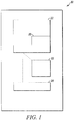
- FIG. 1 is a block diagram of an alarm system or security system 20 in accordance with disclosed embodiments.
- the alarm system or security system 20 can include a control panel 22, a camera or sensor 23, and an alarm sounder 24.
- the camera or sensor 23 and the alarm sounder 24 can communicate with the control panel 22 via a wireless or wired communications medium.
- the control panel 22 can include a user interface 26 for use in disarming the alarm system or security system 20 and deactivating the alarm sounder 24.
- the camera or sensor 23 can include a passive infrared camera or sensor that can detect a presence of an identified user proximate or within a predetermined distance of the control panel 22.
- FIG. 2 is a flow diagram of a method 100 in accordance with disclosed embodiments.
- the alarm system or security system 20 may be in an active alarm mode with the alarm sounder 24 broadcasting an alarm sound at a first volume level, as in 102.
- the control panel 22 may determine whether the identified user is attempting to use the control panel 22 or the user interface 26 to disarm the alarm system or security system 20, as in 104, and the alarm sounder 24 may continue to broadcast the alarm sound at the first volume level when the control panel determines that the identified user is not attempting to use the control panel 22 or the user interface 26 to disarm the alarm system or security system 20, as in 106.
- control panel 22 may lower the first volume level of the alarm sound broadcast by the alarm sounder 24 to a second volume level, as in 110.
- the second volume level can be less than 90 decibels.
- control panel 22 can determine that the identified user is attempting to use the control panel 22 or the user interface 26 to disarm the alarm system or security system 20 responsive to the camera or sensor 23 determining that the identified user is an authorized user of the alarm system or security system 20. Additionally or alternatively, in some embodiments, the control panel 22 can determine that the identified user is attempting to use the control panel 22 or the user interface 26 to disarm the alarm system or security system 20 responsive to detecting an initial user input to the user interface 26. Additionally or alternatively, in some embodiments, the control panel 22 can determine that the identified user is attempting to use the control panel 22 or the user interface 26 to disarm the alarm system or security system 20 responsive to detecting the identified user being within a predetermined distance of the control panel 22.
- the control panel 22 can make a security determination and can take a specific action based on a type of the security determination, as in 112. For example, in some embodiments, the control panel 22 can make a negative security determination responsive to the alarm system or security system 20 failing to disarm within a predetermined time period following the control panel 22 determining that the identified user is attempting to use the control panel 22 to disarm the alarm system or security system 20. Additionally or alternatively, in some embodiments, the control panel 22 can make the negative security determination responsive to the control panel 22 receiving a predetermined number of failed disarm attempts. In some embodiments, the control panel 22 can make a positive security determination responsive to the control panel 22 receiving a successful disarm attempt.
- the control panel 22 in response to the negative security determination, can increase the second volume level of the alarm sound broadcast by the alarm sounder 24 back to the first volume level, as in 114. Furthermore, in some embodiments, the control panel 22 can lock the alarm sounder 24 at the first volume level for a predetermined period of time. It is to be understood that locking the alarm sounder 24 at the first volume level following the negative security determination can increase security because the negative security determination can indicate that it is likely that the identified user is an intruder or other potentially nefarious party. Further still in some embodiments, in response to the negative security determination, the control panel 22 can increase the second volume level broadcast by the alarm sounder 24 to a third volume level that is louder than the first volume level.
- control panel 22 in response to the positive security determination, can deactivate the alarm sounder 24, as in 116.
Landscapes
- Physics & Mathematics (AREA)
- General Physics & Mathematics (AREA)
- Electromagnetism (AREA)
- Engineering & Computer Science (AREA)
- Computer Security & Cryptography (AREA)
- Business, Economics & Management (AREA)
- Emergency Management (AREA)
- Lock And Its Accessories (AREA)
- Alarm Systems (AREA)
- Facsimiles In General (AREA)
- Emergency Alarm Devices (AREA)
Applications Claiming Priority (2)
| Application Number | Priority Date | Filing Date | Title |
|---|---|---|---|
| US201762491026P | 2017-04-27 | 2017-04-27 | |
| US15/946,014 US20180315295A1 (en) | 2017-04-27 | 2018-04-05 | Systems and methods for reducing a decibel or volume level of an alarm sound emitted by an alarm system or a security system |
Publications (1)
| Publication Number | Publication Date |
|---|---|
| EP3396646A1 true EP3396646A1 (de) | 2018-10-31 |
Family
ID=61965831
Family Applications (1)
| Application Number | Title | Priority Date | Filing Date |
|---|---|---|---|
| EP18166687.6A Withdrawn EP3396646A1 (de) | 2017-04-27 | 2018-04-10 | Systeme und verfahren zur reduzierung eines dezibel- oder lautstärkepegels eines von einem alarmsystem oder einem sicherheitssystem ausgegebenen alarmtons |
Country Status (4)
| Country | Link |
|---|---|
| US (1) | US20180315295A1 (de) |
| EP (1) | EP3396646A1 (de) |
| CN (1) | CN108806136A (de) |
| CA (1) | CA3001576A1 (de) |
Citations (4)
| Publication number | Priority date | Publication date | Assignee | Title |
|---|---|---|---|---|
| US20150109128A1 (en) * | 2012-09-21 | 2015-04-23 | Google Inc. | Visitor feedback to visitor interaction with a doorbell at a smart-home |
| EP3048594A2 (de) * | 2015-01-26 | 2016-07-27 | Honeywell International Inc. | Anonyme deaktivierungserkennung mit eingebauter kamera |
| EP3089128A2 (de) * | 2015-04-08 | 2016-11-02 | Google, Inc. | Dynamische volumenanpassung |
| US20160379471A1 (en) * | 2015-06-24 | 2016-12-29 | Vivint, Inc. | Smart stay day |
-
2018
- 2018-04-05 US US15/946,014 patent/US20180315295A1/en not_active Abandoned
- 2018-04-10 EP EP18166687.6A patent/EP3396646A1/de not_active Withdrawn
- 2018-04-13 CA CA3001576A patent/CA3001576A1/en not_active Abandoned
- 2018-04-26 CN CN201810384874.XA patent/CN108806136A/zh active Pending
Patent Citations (4)
| Publication number | Priority date | Publication date | Assignee | Title |
|---|---|---|---|---|
| US20150109128A1 (en) * | 2012-09-21 | 2015-04-23 | Google Inc. | Visitor feedback to visitor interaction with a doorbell at a smart-home |
| EP3048594A2 (de) * | 2015-01-26 | 2016-07-27 | Honeywell International Inc. | Anonyme deaktivierungserkennung mit eingebauter kamera |
| EP3089128A2 (de) * | 2015-04-08 | 2016-11-02 | Google, Inc. | Dynamische volumenanpassung |
| US20160379471A1 (en) * | 2015-06-24 | 2016-12-29 | Vivint, Inc. | Smart stay day |
Also Published As
| Publication number | Publication date |
|---|---|
| US20180315295A1 (en) | 2018-11-01 |
| CN108806136A (zh) | 2018-11-13 |
| CA3001576A1 (en) | 2018-10-27 |
Similar Documents
| Publication | Publication Date | Title |
|---|---|---|
| US8634808B1 (en) | Mobile device loss prevention | |
| EP3428819B1 (de) | Mobile sicherheitsgegenmassnahmen | |
| US7856558B2 (en) | Biometric verification and duress detection system and method | |
| US9779614B2 (en) | System and method of alerting CMS and registered users about a potential duress situation using a mobile application | |
| US20150040453A1 (en) | Weapon control system | |
| KR101617872B1 (ko) | 지문인식장치의 경보방법 및 시스템 | |
| EP2945135A2 (de) | Verfahren zur rauschunterdrückung für sprachbasierte interaktive vorrichtungen | |
| CN105160806A (zh) | 实现报警的穿戴设备及其报警方法 | |
| CN108230517B (zh) | 门禁解除方法、装置及电子设备 | |
| US11783655B1 (en) | Biometric authentication for security sensor bypass | |
| US10037686B1 (en) | Systems and methods for preventing false alarms during alarm sensitivity threshold changes in fire alarm systems | |
| EP3291505B1 (de) | Mehrstufiger sicherheitsmechanismus für den zugriff auf eine tafel | |
| EP3048594B1 (de) | Anonyme deaktivierungserkennung mit eingebauter kamera | |
| US11820328B2 (en) | Vehicle anti-theft device, vehicle anti-theft method, and computer program | |
| US20180315295A1 (en) | Systems and methods for reducing a decibel or volume level of an alarm sound emitted by an alarm system or a security system | |
| US10580271B1 (en) | Wireless security tracking for weapons | |
| WO2016150282A1 (zh) | 一种实现家庭安全控制的方法和安防主机 | |
| EP3379497A1 (de) | Sichere Authentifizierung für Zugangskontrolle, Häusliche Steuerung und Alarmsysteme | |
| CN113645045B (zh) | Tee中的安全控制方法、装置及设备、存储介质 | |
| US20210209930A1 (en) | Smart home security system and method of disarming a security setting | |
| US11163864B2 (en) | Detection of unauthorized user assistance of an electronic device based on the detection of spoken words | |
| KR102052734B1 (ko) | 스마트 방범 도어 및 그 제어방법 | |
| CN106598273B (zh) | 开发者模式启动方法、装置及电子设备 | |
| US12435936B1 (en) | Methods, devices, and systems for facilitating firearms safety | |
| US11436912B2 (en) | Signalling duress |
Legal Events
| Date | Code | Title | Description |
|---|---|---|---|
| PUAI | Public reference made under article 153(3) epc to a published international application that has entered the european phase |
Free format text: ORIGINAL CODE: 0009012 |
|
| 17P | Request for examination filed |
Effective date: 20180410 |
|
| AK | Designated contracting states |
Kind code of ref document: A1 Designated state(s): AL AT BE BG CH CY CZ DE DK EE ES FI FR GB GR HR HU IE IS IT LI LT LU LV MC MK MT NL NO PL PT RO RS SE SI SK SM TR |
|
| AX | Request for extension of the european patent |
Extension state: BA ME |
|
| GRAP | Despatch of communication of intention to grant a patent |
Free format text: ORIGINAL CODE: EPIDOSNIGR1 |
|
| STAA | Information on the status of an ep patent application or granted ep patent |
Free format text: STATUS: GRANT OF PATENT IS INTENDED |
|
| INTG | Intention to grant announced |
Effective date: 20200903 |
|
| RIN1 | Information on inventor provided before grant (corrected) |
Inventor name: PETERSON, BRIAN CRAIG |
|
| STAA | Information on the status of an ep patent application or granted ep patent |
Free format text: STATUS: THE APPLICATION IS DEEMED TO BE WITHDRAWN |
|
| 18D | Application deemed to be withdrawn |
Effective date: 20201103 |