EP3397103B1 - Fussballschuh - Google Patents
Fussballschuh Download PDFInfo
- Publication number
- EP3397103B1 EP3397103B1 EP16869423.0A EP16869423A EP3397103B1 EP 3397103 B1 EP3397103 B1 EP 3397103B1 EP 16869423 A EP16869423 A EP 16869423A EP 3397103 B1 EP3397103 B1 EP 3397103B1
- Authority
- EP
- European Patent Office
- Prior art keywords
- heel
- sole
- cleats
- frictional support
- football boot
- Prior art date
- Legal status (The legal status is an assumption and is not a legal conclusion. Google has not performed a legal analysis and makes no representation as to the accuracy of the status listed.)
- Active
Links
Images



Classifications
-
- A—HUMAN NECESSITIES
- A43—FOOTWEAR
- A43B—CHARACTERISTIC FEATURES OF FOOTWEAR; PARTS OF FOOTWEAR
- A43B13/00—Soles; Sole-and-heel integral units
- A43B13/14—Soles; Sole-and-heel integral units characterised by the constructive form
- A43B13/141—Soles; Sole-and-heel integral units characterised by the constructive form with a part of the sole being flexible, e.g. permitting articulation or torsion
-
- A—HUMAN NECESSITIES
- A43—FOOTWEAR
- A43B—CHARACTERISTIC FEATURES OF FOOTWEAR; PARTS OF FOOTWEAR
- A43B13/00—Soles; Sole-and-heel integral units
- A43B13/14—Soles; Sole-and-heel integral units characterised by the constructive form
- A43B13/18—Resilient soles
- A43B13/181—Resiliency achieved by the structure of the sole
-
- A—HUMAN NECESSITIES
- A43—FOOTWEAR
- A43B—CHARACTERISTIC FEATURES OF FOOTWEAR; PARTS OF FOOTWEAR
- A43B13/00—Soles; Sole-and-heel integral units
- A43B13/14—Soles; Sole-and-heel integral units characterised by the constructive form
- A43B13/22—Soles made slip-preventing or wear-resisting, e.g. by impregnation or spreading a wear-resisting layer
- A43B13/24—Soles made slip-preventing or wear-resisting, e.g. by impregnation or spreading a wear-resisting layer by use of insertions
- A43B13/26—Soles made slip-preventing or wear-resisting, e.g. by impregnation or spreading a wear-resisting layer by use of insertions projecting beyond the sole surface
-
- A—HUMAN NECESSITIES
- A43—FOOTWEAR
- A43B—CHARACTERISTIC FEATURES OF FOOTWEAR; PARTS OF FOOTWEAR
- A43B5/00—Footwear for sporting purposes
- A43B5/02—Football boots or shoes, i.e. for soccer, football or rugby
-
- A—HUMAN NECESSITIES
- A43—FOOTWEAR
- A43B—CHARACTERISTIC FEATURES OF FOOTWEAR; PARTS OF FOOTWEAR
- A43B5/00—Footwear for sporting purposes
- A43B5/06—Running shoes; Track shoes
-
- A—HUMAN NECESSITIES
- A43—FOOTWEAR
- A43C—FASTENINGS OR ATTACHMENTS OF FOOTWEAR; LACES IN GENERAL
- A43C15/00—Non-skid devices or attachments
- A43C15/16—Studs or cleats for football or like boots
- A43C15/162—Studs or cleats for football or like boots characterised by the shape
-
- A—HUMAN NECESSITIES
- A43—FOOTWEAR
- A43C—FASTENINGS OR ATTACHMENTS OF FOOTWEAR; LACES IN GENERAL
- A43C15/00—Non-skid devices or attachments
- A43C15/16—Studs or cleats for football or like boots
- A43C15/162—Studs or cleats for football or like boots characterised by the shape
- A43C15/164—Studs or cleats for football or like boots characterised by the shape having a circular cross section
- A43C15/167—Studs or cleats for football or like boots characterised by the shape having a circular cross section frusto-conical or cylindrical
-
- A—HUMAN NECESSITIES
- A43—FOOTWEAR
- A43C—FASTENINGS OR ATTACHMENTS OF FOOTWEAR; LACES IN GENERAL
- A43C15/00—Non-skid devices or attachments
- A43C15/16—Studs or cleats for football or like boots
- A43C15/168—Studs or cleats for football or like boots with resilient means, e.g. shock absorbing means
Definitions
- the invention has been developed primarily for use in playing football in one or more of various codes whether soccer, Australian Rules, Rugby or Grid Iron and will be described hereinafter with reference to this application.
- sporting footwear comprises: i) flat soles; ii) football or outdoor boots having stops over the entire sole and heel to provide an anti-slip or friction control system; and iii) sharp spikes located to penetrate specialist surfaces and provide substantially forward only progress.
- the invention of a football boot provides the benefit of allowing improved mobility while still retaining grip.
- the football boot includes an improved primary front foot support with improved longitudinal and lateral control such that only front of foot is primarily ground engaging to provide frictional control.
- the football boot includes stops on the front sole and wherein the improved footwear includes no stops or substantial protrusions on the rear sole relative to the front sole.
- the improved pivot front foot support can be integral with the front or be attachable to the front sole.
- the football boot can have a front sole plate with a plurality of sockets each for receiving a protrudable stop providing the primary front frictional support sole.
- the football boot has at least some of the plurality of sockets each for receiving a protrudable stop form substantially opposing lines near lateral edges of the sole plate.
- a majority of the plurality of sockets each for receiving a protrudable stop can be located at the rear of the front sole plate form substantially opposing lines near lateral edges of the sole plate.
- At least one of the plurality of sockets each for receiving a protrudable stop can be locatable in a central position of the front sole plate spaced from other stops to form a rotating pivot point.
- the football boot is flexible to angle the heel relative to the front sole.
- the football boot has a front sole and heel with the front sole having a primary frictional support and the heel having a secondary frictional support which has substantially less frictional support than the primary frictional support, stops and cleats projecting from the front sole and heel of the footwear, wherein the stops are only on the front sole forming part of the primary frictional support and not on the heel having a secondary frictional support; and wherein the cleats are smaller projections than the stops; and the sole having the primary frictional support at an angle to the heel such that only front of foot is primarily ground engaging to provide frictional control.
- the cleats are shaped projections having a leading front and a broader rear wherein the cleats are generally a triangular pyramidal shaped projections having a leading front and a broader rear with inward leaning rear and side faces.
- the cleats are generally a triangular pyramidal shaped projections having a leading front and a broader rear with inward leaning rear and side faces; the cleats are arranged on the front sole to have the broader rear of the shaped projections facing forward on the footwear so as to aid stopping actions by the primary frictional support, and the cleats are arranged on the rear heel to have the narrower front of the shaped projections facing forward on the footwear so as to aid frontwards sliding motion by the secondary frictional support.
- the inward leaning rear and side faces are shaped and located on the sole or heel such that the outer leaning wall leans less inwardly than the inner leaning wall; and the inward leaning rear and side faces are shaped and located on the sole or heel such that if the cleat is centrally located on the sole or heel the outer leaning wall leans substantially equally to the inner leaning wall.
- the football boot can be substantially assembled with improving structure including any one or more of the following:
- the football boot 1 1 has a front sole 21 and rear heel 23 with the sole having a primary frictional support and the heel having a secondary frictional support which has substantially less frictional support than the primary frictional support.
- the front sole has the primary frictional support at an angle Z to the heel such that only the front of foot is primarily ground engaging to provide frictional control.
- the cleats are shaped projections having a leading front and a broader rear. This shaping allows a general sliding direction in line with the leading front while the broader rear is more of an anti-slide aspect in that direction.
- the cleats are formed as a triangular pyramidal shaped projections having a leading front and a broader rear with inward leaning rear and side faces. Therefore the cleats in this form of triangular pyramidal shaped projections have three substantially planar sides forming a leading front and a broader rear with inward leaning rear and side faces.
- the shaping of the cleats changes according to their location on the front sole or heel. If the cleats are arranged on the front sole to have the broader rear of the shaped projections facing forward on the footwear so as to aid stopping actions by the primary frictional support. If the cleats are arranged on the rear heel to have the narrower front of the shaped projections facing forward on the footwear so as to aid frontwards sliding motion by the secondary frictional support.
- the inward leaning rear and side faces are shaped and located on the sole or heel such that the outer leaning wall leans substantially equally to the inner leaning wall as shown in Fig. 7 .
- the inward leaning rear and side faces 45, 46 and 47 are shaped and located on the sole or heel such that the outer leaning wall 46 leans less inwardly than the inner leaning wall 47. This provides more of an anti-slide such as shown by AS1 and AS2 in Figs 8 and 9 .
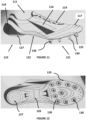
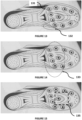
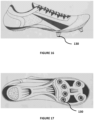
- FIG. 11 to 20 there is shown a further form of an example of a football boot 111 having an upper 116 extending from a toe portion 117 to a heel portion 118 closeable by laces 119 in a top section.
- a front sole plate 125 extending to a middle instep or arch support area 122 and to a rear heel section 123.
- a football boot having improved primary front foot support with improved longitudinal and lateral control such that only front of foot is primarily ground engaging to provide frictional control.
- This can be achieved in which a football boot has a rear heel 127 design with roll or stability characteristics but not with frictional characteristics such that only front of foot is primarily ground engaging to provide frictional control while rear of boot is aiding correct movement whether laterally or longitudinally.
- the football boot has at least some of the plurality of sockets each for receiving a protrudable stop form substantially opposing lines near lateral edges of the sole plate and form substantially opposing lines 131, 132 near lateral edges of the sole plate 125.
- a majority of the plurality of sockets each for receiving a protrudable stop are located at the rear 133 of the front sole plate 125.
- the rear heel has no protrusions and therefore no friction with the ground.
- at least one of the plurality of sockets each for receiving a protrudable stop is locatable in a central position 135 of the front sole plate 125 spaced from other stops to form a rotating pivot point.
- the football boot 1 1 1 has rear heel design 127 with roll or stability characteristics but not with frictional characteristics such that only front of foot is primarily ground engaging to provide frictional control while rear of boot is aiding correct movement laterally or longitudinally.
- the heel 127 is a moulded continuous heel.
- the heel has little or no protrusions. More particularly the boot 1 1 1 is flexible to angle the heel 121 relative to the front sole 125. In this way a football boot requires only a primary front sole frictional support by use of stops or the like.
- a football boot has a sole and heel with the sole having a primary frictional support and the heel having a secondary frictional support which has substantially less frictional support than the primary frictional support.
- a football boot having improved primary front foot support with improved longitudinal and lateral control such that only front of foot is primarily ground engaging to provide frictional control is disclosed.
- the front emphasis of primary frictional support is achieved through use of one or more of:
- the football boot shown in Figs 1 to 6 has stops and cleats projecting from the sole and heel of the footwear.
- the stops are only on the sole forming part of the primary frictional support and not on the heel having a secondary frictional support wherein the stops are receivable in receiving screw in slots.
- a football boot can have improved pivot front foot support with improved longitudinal and lateral control such that only front of foot is primarily ground engaging to provide frictional control.
- An improved pivot front foot support includes stops on the front sole.
- the sole having the primary frictional support is at an angle to the heel having the secondary frictional support which has substantially less frictional support than the primary frictional support such that only front of foot is primarily ground engaging to provide frictional control.
- the normal non flexed angle of the heel with the secondary frictional support to the sole with the primary frictional support is about 30° to 45°.
- the angle of the heel with the secondary frictional support to the sole with the primary frictional support flexes between about 0° to about the non-flexed angle.
- the angle of the heel with the secondary frictional support to the sole with the primary frictional support resiliently flexes back to the non-flexed angle.
- the lesser emphasis of secondary frictional support on the heel rather than the front sole of the footwear can be achieved by combination of one or more of:
- relative frictional support it is understood that this is related to the provision of anti-slip or lessening slip when the footwear hits the ground. Generally you wish to have control when playing sporting games with control of when and what to slip and when and what to not to slip (anti-slip).
- the front emphasis of primary frictional support and the lesser emphasis of secondary frictional support means that the normal pivoting or front control of the foot is able to be used in the field of football and related sports.
- the cleats have a range of important elements and the cleats of the proposed invention can be any one or more of: a) Relative sizing to the stops; b) Mouldable protrusions; c) Shaped protrusions; d) Location of cleats; e) Direction of shaped cleats; and/or f) Relative width, length and/or height of cleats;
- the cleats 41 are shaped projections having a leading front and a broader rear.
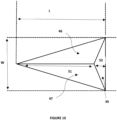
- Fig. 7 there is shown a triangular prismatic shaped projections having a leading front and a broader rear with inward leaning rear and side faces 45, 46, 47.
- the cleats project about less than 60% of the projection of the stops to form smaller projections than the stops. However more preferably the cleats project about 50% of the projection of the stops to form smaller projections than the stops. In one example the cleats project about 7.5 millimetres while the stops project about 15.0 millimetres.
- the cleats are arranged on the front sole to have the broader rear of the shaped projections facing forward on the footwear so as to aid stopping actions by the primary frictional support. Therefore the primary frictional surface is improved by the directional arrangement of the cleat with the rear plane 45 of the cleat facing forward.
- This cleat rear wall 45 can be inclined higher towards a 90° plane by shortening the length S2 and lengthening S1 for a particular length L of shaped cleat.
- the cleat rear wall is partially inclined so as to not instantly catch the ground but to provide a controlled element of slide then grip.
- the incline and particularly the triangular pyramidal shape provides a flow over of the ground and a directional control of the slide in line with the vertex of the two inward leaning side planes 46, 47.
- the cleats on or near the circumference of the heel are generally arranged the rear heel to have the narrower front of the shaped projections facing forwardly towards a region or point on the instep on the football boot.
- the cleats are arranged on the front sole to have the narrower front of the shaped projections facing rearwardly towards a region or point on the instep on the footwear.
- This arrangement of the direction of the rear plane 47 of the cleat thereby provides a definable support of the football boot so that the heel provides a backwards anti- slide so that the foot will not slide backwards when the wearer is kicking with the other foot. Also this arrangement of the direction of the rear plane 47 of the cleat on the front sole thereby provides a definable support of the football boot so that the front sole provides a frontwards anti-slide or controlled slide to stop so that the foot will not continue to slide forwards when the wearer is trying to stop.
- the inward leaning rear and side faces are substantially planar. In order to minimise contact injuries with other players the intersection of the inward leaning side faces are rounded or the intersection of the inward leaning side faces are beaded. Another option is to have the intersection of the inward leaning side faces are chamfered.
- FIG. 7 another adjustment is the relative leaning of the outer cleat wall 46 to the inner cleat wall 47.
- the inward leaning rear and side faces are shaped and located on the sole or heel such that the outer leaning wall leans less inwardly than the inner leaning wall. That is the outer leaning wall 46 is closer to 90° rather than the inner leaning wall 47.
- the inward leaning rear and side faces 46, 47 are shaped and located on the sole or heel such that if the cleat is centrally located on the sole or heel the outer leaning wall leans substantially equally to the inner leaning wall.
- the stop arrangement can provide a number of benefits.
- the first benefit is that by only having stops on the front sole of the and not on the heel then there is a direct emphasis of frictional importance to the front of the football boot. Further the density and relative protrusion to any other protrusion on
- a football boot For the benefit of pivoting a football boot includes stops on the front sole and includes no stops on the heel.
- This pivot can be further emphasised by having a primary stop in a central portion of the front sole.
- This can be provided by at least one of the plurality of sockets for receiving a protrudable stop being locatable in a central position of the front sole plate spaced from other stops to form a rotating pivot point.
- the pivot stop could be moulded to the sole plate.
- At least some of the plurality of stops are in location in substantially opposing lines near lateral edges of the sole. Still further a majority of the plurality of sockets each for receiving a protrudable stop are located at the rear of the front sole.
Landscapes
- Health & Medical Sciences (AREA)
- General Health & Medical Sciences (AREA)
- Physical Education & Sports Medicine (AREA)
- Footwear And Its Accessory, Manufacturing Method And Apparatuses (AREA)
Claims (8)
- Fußballschuh (11) zur Verwendung auf Rasen mit einer Vordersohle (21) und einem Absatz (23), wobei die Vordersohle eine primäre Reibungsstütze und der Absatz (23) eine sekundäre Reibungsstütze aufweist, wobei die primäre Reibungsstütze in einem nicht gebogenen Zustand zu der sekundären Reibungsstütze abgewinkelt ist, so dass nur die Vordersohle des Schuhs primär mit dem Boden in Eingriff kommt, um Reibungskontrolle bereitzustellen;eine Vielzahl breiter, kegelstumpfförmiger Vorsprünge, die Anschläge (30) bilden, die von der Vordersohle des Fußballschuhs (11) vorstehen, und eine Vielzahl dreieckiger, pyramidenförmiger Vorsprünge, die Stollen (25) bilden, die von der Vordersohle (21) und dem Absatz (23) des Fußballschuhs (11) vorstehen, wobei die Stollen (25) von der Vordersohle (21) des Fußballschuhs (11) um einen geringeren Abstand als die Anschläge (30) abstehen;und wobei sich die Anschläge (30) nur an der Vordersohle (21) und nicht am Absatz (23) befinden, wobei die Anschläge (30) und Stollen (25) an der Vordersohle (21) die primäre Reibungsunterstützung bilden und der Absatz (23) nur Stollen (25) aufweist, die die sekundäre Reibungsunterstützung bilden, wobei die sekundären Reibungsunterstützungen im Vergleich zu der primären Reibungsunterstützung eine geringere Reibungsunterstützung aufweisen;wobei die Stollen (25) dreieckige pyramidenförmige Vorsprünge mit drei im Wesentlichen ebenen Seiten sind, die ein vorderes Ende und ein breiteres Ende gegenüber dem vorderen Ende mit nach innen geneigten Flächen auf jeder im Wesentlichen ebenen Seite bilden;wobei sich die Ausrichtung der Stollen (25) entsprechend ihrer Position an der Vordersohle (21) oder dem Absatz (23) ändert, wobei die Stollen (25) so an der Vordersohle (21) angeordnet sind, dass das vordere Ende auf dem Fußballschuh (11) nach hinten weist, um Stoppvorgänge durch die primäre Reibungsunterstützung zu unterstützen, und wobei die Stollen (25) so auf dem Absatz (23) angeordnet sind, dass das vordere Ende auf dem Fußballschuh (11) nach vorn weist, um eine Gleitbewegung nach vorn durch die sekundäre Reibungsunterstützung zu unterstützen;und wobei der Fußballschuh (11) eine verbesserte primäre Vorderfußunterstützung mit einer verbesserten Längs- und Seitenkontrolle aufweist, wobei die Vordersohle (21) die primäre Reibungsunterstützung in einem Winkel zum Absatz (23) aufweist, so dass nur ein vorderer Teil eines Fußes primär mit dem Boden in Eingriff kommt, um eine Reibungskontrolle bereitzustellen.
- Fußballschuh nach Anspruch 1, wobei die Stollen (25) kleinerere Vorsprünge als die Anschläge (30) sind, so dass die Stollen (25) um weniger als 60 % des Vorsprungs der Anschläge vorstehen, um kleinere Vorsprünge als die Anschläge (30) zu bilden.
- Fußballschuh nach Anspruch 2, wobei die Stollen (25) 7,5 Millimeter und die Anschläge (30) 15,0 Millimeter vorstehen.
- Fußballschuh nach Anspruch 1, wobei die Sohle (20) mit der primären Reibungsunterstützung in einem Winkel zum Absatz (23) mit der sekundären Reibungsunterstützung steht, die eine geringere Reibungsunterstützung als die primäre Reibungsunterstützung aufweist, so dass nur der Vorderfuß primär mit dem Boden in Eingriff kommt, um Reibungskontrolle bereitzustellen,
wobei der normale, nicht gebogene Winkel des Absatzes (23) mit der sekundären Reibungsunterstützung zur Sohle (20) mit der primären Reibungsunterstützung zwischen 30° und 45° beträgt, und wobei sich der Winkel des Absatzes (23) mit der sekundären Reibungsunterstützung zur Sohle mit der primären Reibungsunterstützung zwischen 0° und dem nicht gebogenen Winkel biegt. - Fußballschuh nach Anspruch 4, wobei sich der Winkel des Absatzes (23) mit der sekundären Reibungsunterstützung zurr Sohle (20) mit der primären Reibungsunterstützung elastisch in den nicht gebogenen Winkel zurückbiegt.
- Fußballschuh nach Anspruch 1, wobei die Stollen (25) an der Sohle (21) so angeordnet sind, dass das vordere Ende der geformten Vorsprünge nach hinten zu einem Bereich oder Punkt auf einem Spann an der Sohle weist.
- Fußballschuh nach Anspruch 1, wobei die Stollen (25) auf oder nahe des Umfangs der Ferse so an der Ferse (23) angeordnet sind, dass das vordere Ende der geformten Vorsprünge nach vorn zu einem Bereich oder Punkt auf einem Spann an der Sohle weist.
- Fußballschuh nach Anspruch 1, wobei die nach innen geneigten hinteren und Seitenflächen so geformt und auf der Sohle oder dem Absatz angeordnet sind, dass die äußere Neigungswand weniger nach innen geneigt ist als die innere Neigungswand, und wobei die nach innen geneigten hinteren und Seitenflächen der Stollen so geformt und auf der Sohle oder dem Absatz angeordnet sind, dass, wenn der Stollen mittig auf der Sohle oder dem Absatz angeordnet ist, die äußere Neigungswand gleich der inneren Neigungswand geneigt ist.
Applications Claiming Priority (2)
| Application Number | Priority Date | Filing Date | Title |
|---|---|---|---|
| AU2015905017A AU2015905017A0 (en) | 2015-12-03 | Sporting footwear | |
| PCT/AU2016/051197 WO2017091871A1 (en) | 2015-12-03 | 2016-12-05 | Sporting footwear |
Publications (3)
| Publication Number | Publication Date |
|---|---|
| EP3397103A1 EP3397103A1 (de) | 2018-11-07 |
| EP3397103A4 EP3397103A4 (de) | 2019-07-03 |
| EP3397103B1 true EP3397103B1 (de) | 2025-01-29 |
Family
ID=58795966
Family Applications (1)
| Application Number | Title | Priority Date | Filing Date |
|---|---|---|---|
| EP16869423.0A Active EP3397103B1 (de) | 2015-12-03 | 2016-12-05 | Fussballschuh |
Country Status (6)
| Country | Link |
|---|---|
| US (1) | US10993500B2 (de) |
| EP (1) | EP3397103B1 (de) |
| JP (1) | JP7450335B2 (de) |
| AU (2) | AU2016363119A1 (de) |
| WO (1) | WO2017091871A1 (de) |
| ZA (1) | ZA201804416B (de) |
Families Citing this family (13)
| Publication number | Priority date | Publication date | Assignee | Title |
|---|---|---|---|---|
| AU2016314145B2 (en) * | 2015-08-31 | 2021-12-02 | Ronald Frederick SCHUMANN | Shoe sole |
| USD940444S1 (en) * | 2020-03-12 | 2022-01-11 | Puma SE | Shoe sole |
| US12225968B2 (en) * | 2021-01-20 | 2025-02-18 | Puma SE | Article of footwear having a sole plate |
| USD988695S1 (en) * | 2021-04-12 | 2023-06-13 | Nike, Inc. | Shoe |
| USD988694S1 (en) * | 2021-04-12 | 2023-06-13 | Nike, Inc. | Shoe |
| US20220346495A1 (en) * | 2021-05-02 | 2022-11-03 | Larry Donnell Jones | Techlete 70 Meter Ambitions |
| USD974013S1 (en) * | 2021-06-25 | 2023-01-03 | Shengtong Ji | Football sole with spikes |
| USD1010297S1 (en) | 2021-06-30 | 2024-01-09 | Puma SE | Shoe |
| US12114735B2 (en) | 2021-12-16 | 2024-10-15 | Jeffery Stuart Goff | Multiple cleat plate sole |
| JP1751584S (ja) * | 2023-02-14 | 2023-08-24 | 靴底 | |
| USD1123341S1 (en) * | 2023-02-14 | 2026-04-28 | Asics Corporation | Shoe sole |
| US12507765B2 (en) * | 2023-04-12 | 2025-12-30 | Acushnet Company | Golf shoe with traction elements |
| US12389979B2 (en) * | 2023-04-12 | 2025-08-19 | Acushnet Company | Golf shoe with traction elements |
Family Cites Families (16)
| Publication number | Priority date | Publication date | Assignee | Title |
|---|---|---|---|---|
| US2582053A (en) * | 1949-12-02 | 1952-01-08 | Alfred G Merlin | Shoe spike |
| US3577663A (en) * | 1969-08-11 | 1971-05-04 | Howard Bruce Mershon | Athletic shoe and cleat |
| FR2320068A1 (fr) * | 1975-08-07 | 1977-03-04 | Adidas | Semelle pour chaussure d'athletisme et son procede de fabrication |
| DE3233792A1 (de) | 1982-09-11 | 1984-03-15 | Puma-Sportschuhfabriken Rudolf Dassler Kg, 8522 Herzogenaurach | Sportschuh fuer die leichtathletik |
| US4559724A (en) * | 1983-11-08 | 1985-12-24 | Nike, Inc. | Track shoe with a improved sole |
| JP2824500B2 (ja) | 1994-02-17 | 1998-11-11 | 株式会社アシックス | 陸上競技用スパイクシューズの硬質板 |
| JP2871537B2 (ja) * | 1995-06-14 | 1999-03-17 | 美津濃株式会社 | ランニングシューズの靴底 |
| JP3827280B2 (ja) | 2001-02-23 | 2006-09-27 | 美津濃株式会社 | フットボール用シューズのアウトソール構造 |
| US6857205B1 (en) * | 2002-05-09 | 2005-02-22 | Nike, Inc. | Article of footwear having a sole structure with a split plate |
| US7100309B2 (en) * | 2004-01-16 | 2006-09-05 | Nike, Inc. | Track shoe with heel plate and support columns |
| US7827705B2 (en) | 2007-03-08 | 2010-11-09 | Nike, Inc. | Article of footwear with multiple cleat sizes |
| US8997381B2 (en) | 2011-08-29 | 2015-04-07 | Nike, Inc. | Interchangeable cleat system for footwear |
| CN108741393B (zh) | 2012-12-19 | 2021-06-11 | 新平衡运动公司 | 定制鞋类以及用于设计且制造其的方法 |
| US9414642B2 (en) | 2013-01-22 | 2016-08-16 | Nike, Inc. | Cleated footwear |
| US10123588B2 (en) | 2013-12-31 | 2018-11-13 | Nike, Inc. | Footwear ground engaging members having concave portions |
| US10595587B2 (en) * | 2014-07-03 | 2020-03-24 | Nike, Inc. | Article of footwear with a segmented plate having a heel region |
-
2016
- 2016-12-05 WO PCT/AU2016/051197 patent/WO2017091871A1/en not_active Ceased
- 2016-12-05 US US15/781,426 patent/US10993500B2/en active Active
- 2016-12-05 JP JP2018548248A patent/JP7450335B2/ja active Active
- 2016-12-05 AU AU2016363119A patent/AU2016363119A1/en not_active Abandoned
- 2016-12-05 EP EP16869423.0A patent/EP3397103B1/de active Active
-
2018
- 2018-07-02 ZA ZA2018/04416A patent/ZA201804416B/en unknown
-
2022
- 2022-05-25 AU AU2022203546A patent/AU2022203546B2/en active Active
Also Published As
| Publication number | Publication date |
|---|---|
| ZA201804416B (en) | 2020-07-29 |
| EP3397103A1 (de) | 2018-11-07 |
| JP2018535814A (ja) | 2018-12-06 |
| WO2017091871A1 (en) | 2017-06-08 |
| US10993500B2 (en) | 2021-05-04 |
| AU2016363119A1 (en) | 2018-07-19 |
| US20180352902A1 (en) | 2018-12-13 |
| EP3397103A4 (de) | 2019-07-03 |
| JP7450335B2 (ja) | 2024-03-15 |
| AU2022203546A1 (en) | 2022-06-16 |
| AU2022203546B2 (en) | 2024-07-18 |
Similar Documents
| Publication | Publication Date | Title |
|---|---|---|
| AU2022203546B2 (en) | Sporting footwear | |
| KR101002375B1 (ko) | 유연한 및/또는 측방으로 안정한 발 지지 구조체 및 그러한지지 구조체를 포함하는 제품 | |
| US7954258B2 (en) | Article of footwear with walled cleat system | |
| CN101404906B (zh) | 柔性足部支撑结构以及包含这种支撑结构的制品 | |
| CN104023578B (zh) | 带有鞋前部辅助鞋钉的鞋类物品 | |
| CN104507344B (zh) | 用于鞋类鞋底结构的增强型鞋芯垫片装置 | |
| US4045888A (en) | Athletic shoe | |
| JP5620944B2 (ja) | ゴルフシューズアウトソール | |
| US8789298B2 (en) | Article of footwear with ball control portion | |
| CN103619204B (zh) | 具有触球构件的鞋类物件 | |
| CN104010542B (zh) | 具有地面啮合构件支撑特征的鞋底布置 | |
| US12256807B2 (en) | Article of footwear with athletic cleats | |
| US20100293815A1 (en) | Midfoot insert construction | |
| CN106072988A (zh) | 包括定向的地面啮合构件支撑特征的鞋类物品 | |
| US11617412B2 (en) | Foot support systems including tiltable forefoot components | |
| US10034520B1 (en) | Sports shoe with cleat | |
| CN105876989A (zh) | 运动鞋 |
Legal Events
| Date | Code | Title | Description |
|---|---|---|---|
| STAA | Information on the status of an ep patent application or granted ep patent |
Free format text: STATUS: THE INTERNATIONAL PUBLICATION HAS BEEN MADE |
|
| PUAI | Public reference made under article 153(3) epc to a published international application that has entered the european phase |
Free format text: ORIGINAL CODE: 0009012 |
|
| STAA | Information on the status of an ep patent application or granted ep patent |
Free format text: STATUS: REQUEST FOR EXAMINATION WAS MADE |
|
| 17P | Request for examination filed |
Effective date: 20180703 |
|
| AK | Designated contracting states |
Kind code of ref document: A1 Designated state(s): AL AT BE BG CH CY CZ DE DK EE ES FI FR GB GR HR HU IE IS IT LI LT LU LV MC MK MT NL NO PL PT RO RS SE SI SK SM TR |
|
| AX | Request for extension of the european patent |
Extension state: BA ME |
|
| DAV | Request for validation of the european patent (deleted) | ||
| DAX | Request for extension of the european patent (deleted) | ||
| A4 | Supplementary search report drawn up and despatched |
Effective date: 20190603 |
|
| RIC1 | Information provided on ipc code assigned before grant |
Ipc: A43B 5/02 20060101AFI20190527BHEP Ipc: A43C 15/16 20060101ALI20190527BHEP |
|
| STAA | Information on the status of an ep patent application or granted ep patent |
Free format text: STATUS: EXAMINATION IS IN PROGRESS |
|
| 17Q | First examination report despatched |
Effective date: 20200420 |
|
| P01 | Opt-out of the competence of the unified patent court (upc) registered |
Effective date: 20230601 |
|
| GRAP | Despatch of communication of intention to grant a patent |
Free format text: ORIGINAL CODE: EPIDOSNIGR1 |
|
| STAA | Information on the status of an ep patent application or granted ep patent |
Free format text: STATUS: GRANT OF PATENT IS INTENDED |
|
| RIC1 | Information provided on ipc code assigned before grant |
Ipc: A43C 15/16 20060101ALI20240708BHEP Ipc: A43B 13/26 20060101ALI20240708BHEP Ipc: A43B 13/14 20060101ALI20240708BHEP Ipc: A43B 5/06 20060101ALI20240708BHEP Ipc: A43B 5/02 20060101AFI20240708BHEP |
|
| INTG | Intention to grant announced |
Effective date: 20240725 |
|
| GRAS | Grant fee paid |
Free format text: ORIGINAL CODE: EPIDOSNIGR3 |
|
| GRAA | (expected) grant |
Free format text: ORIGINAL CODE: 0009210 |
|
| STAA | Information on the status of an ep patent application or granted ep patent |
Free format text: STATUS: THE PATENT HAS BEEN GRANTED |
|
| AK | Designated contracting states |
Kind code of ref document: B1 Designated state(s): AL AT BE BG CH CY CZ DE DK EE ES FI FR GB GR HR HU IE IS IT LI LT LU LV MC MK MT NL NO PL PT RO RS SE SI SK SM TR |
|
| REG | Reference to a national code |
Ref country code: GB Ref legal event code: FG4D |
|
| REG | Reference to a national code |
Ref country code: CH Ref legal event code: EP |
|
| REG | Reference to a national code |
Ref country code: DE Ref legal event code: R096 Ref document number: 602016091116 Country of ref document: DE |
|
| REG | Reference to a national code |
Ref country code: IE Ref legal event code: FG4D |
|
| REG | Reference to a national code |
Ref country code: NL Ref legal event code: MP Effective date: 20250129 |
|
| PG25 | Lapsed in a contracting state [announced via postgrant information from national office to epo] |
Ref country code: NL Free format text: LAPSE BECAUSE OF FAILURE TO SUBMIT A TRANSLATION OF THE DESCRIPTION OR TO PAY THE FEE WITHIN THE PRESCRIBED TIME-LIMIT Effective date: 20250129 |
|
| PG25 | Lapsed in a contracting state [announced via postgrant information from national office to epo] |
Ref country code: RS Free format text: LAPSE BECAUSE OF FAILURE TO SUBMIT A TRANSLATION OF THE DESCRIPTION OR TO PAY THE FEE WITHIN THE PRESCRIBED TIME-LIMIT Effective date: 20250429 |
|
| PG25 | Lapsed in a contracting state [announced via postgrant information from national office to epo] |
Ref country code: FI Free format text: LAPSE BECAUSE OF FAILURE TO SUBMIT A TRANSLATION OF THE DESCRIPTION OR TO PAY THE FEE WITHIN THE PRESCRIBED TIME-LIMIT Effective date: 20250129 |
|
| PG25 | Lapsed in a contracting state [announced via postgrant information from national office to epo] |
Ref country code: PL Free format text: LAPSE BECAUSE OF FAILURE TO SUBMIT A TRANSLATION OF THE DESCRIPTION OR TO PAY THE FEE WITHIN THE PRESCRIBED TIME-LIMIT Effective date: 20250129 |
|
| PG25 | Lapsed in a contracting state [announced via postgrant information from national office to epo] |
Ref country code: ES Free format text: LAPSE BECAUSE OF FAILURE TO SUBMIT A TRANSLATION OF THE DESCRIPTION OR TO PAY THE FEE WITHIN THE PRESCRIBED TIME-LIMIT Effective date: 20250129 |
|
| REG | Reference to a national code |
Ref country code: LT Ref legal event code: MG9D |
|
| PG25 | Lapsed in a contracting state [announced via postgrant information from national office to epo] |
Ref country code: IS Free format text: LAPSE BECAUSE OF FAILURE TO SUBMIT A TRANSLATION OF THE DESCRIPTION OR TO PAY THE FEE WITHIN THE PRESCRIBED TIME-LIMIT Effective date: 20250529 Ref country code: NO Free format text: LAPSE BECAUSE OF FAILURE TO SUBMIT A TRANSLATION OF THE DESCRIPTION OR TO PAY THE FEE WITHIN THE PRESCRIBED TIME-LIMIT Effective date: 20250429 |
|
| REG | Reference to a national code |
Ref country code: AT Ref legal event code: MK05 Ref document number: 1762543 Country of ref document: AT Kind code of ref document: T Effective date: 20250129 |
|
| PG25 | Lapsed in a contracting state [announced via postgrant information from national office to epo] |
Ref country code: HR Free format text: LAPSE BECAUSE OF FAILURE TO SUBMIT A TRANSLATION OF THE DESCRIPTION OR TO PAY THE FEE WITHIN THE PRESCRIBED TIME-LIMIT Effective date: 20250129 |
|
| PG25 | Lapsed in a contracting state [announced via postgrant information from national office to epo] |
Ref country code: PT Free format text: LAPSE BECAUSE OF FAILURE TO SUBMIT A TRANSLATION OF THE DESCRIPTION OR TO PAY THE FEE WITHIN THE PRESCRIBED TIME-LIMIT Effective date: 20250529 Ref country code: LV Free format text: LAPSE BECAUSE OF FAILURE TO SUBMIT A TRANSLATION OF THE DESCRIPTION OR TO PAY THE FEE WITHIN THE PRESCRIBED TIME-LIMIT Effective date: 20250129 |
|
| PG25 | Lapsed in a contracting state [announced via postgrant information from national office to epo] |
Ref country code: BG Free format text: LAPSE BECAUSE OF FAILURE TO SUBMIT A TRANSLATION OF THE DESCRIPTION OR TO PAY THE FEE WITHIN THE PRESCRIBED TIME-LIMIT Effective date: 20250129 Ref country code: GR Free format text: LAPSE BECAUSE OF FAILURE TO SUBMIT A TRANSLATION OF THE DESCRIPTION OR TO PAY THE FEE WITHIN THE PRESCRIBED TIME-LIMIT Effective date: 20250430 |
|
| PG25 | Lapsed in a contracting state [announced via postgrant information from national office to epo] |
Ref country code: AT Free format text: LAPSE BECAUSE OF FAILURE TO SUBMIT A TRANSLATION OF THE DESCRIPTION OR TO PAY THE FEE WITHIN THE PRESCRIBED TIME-LIMIT Effective date: 20250129 |
|
| PG25 | Lapsed in a contracting state [announced via postgrant information from national office to epo] |
Ref country code: SE Free format text: LAPSE BECAUSE OF FAILURE TO SUBMIT A TRANSLATION OF THE DESCRIPTION OR TO PAY THE FEE WITHIN THE PRESCRIBED TIME-LIMIT Effective date: 20250129 |
|
| PG25 | Lapsed in a contracting state [announced via postgrant information from national office to epo] |
Ref country code: SM Free format text: LAPSE BECAUSE OF FAILURE TO SUBMIT A TRANSLATION OF THE DESCRIPTION OR TO PAY THE FEE WITHIN THE PRESCRIBED TIME-LIMIT Effective date: 20250129 |
|
| PG25 | Lapsed in a contracting state [announced via postgrant information from national office to epo] |
Ref country code: DK Free format text: LAPSE BECAUSE OF FAILURE TO SUBMIT A TRANSLATION OF THE DESCRIPTION OR TO PAY THE FEE WITHIN THE PRESCRIBED TIME-LIMIT Effective date: 20250129 |
|
| PG25 | Lapsed in a contracting state [announced via postgrant information from national office to epo] |
Ref country code: IT Free format text: LAPSE BECAUSE OF FAILURE TO SUBMIT A TRANSLATION OF THE DESCRIPTION OR TO PAY THE FEE WITHIN THE PRESCRIBED TIME-LIMIT Effective date: 20250129 |
|
| PG25 | Lapsed in a contracting state [announced via postgrant information from national office to epo] |
Ref country code: EE Free format text: LAPSE BECAUSE OF FAILURE TO SUBMIT A TRANSLATION OF THE DESCRIPTION OR TO PAY THE FEE WITHIN THE PRESCRIBED TIME-LIMIT Effective date: 20250129 Ref country code: CZ Free format text: LAPSE BECAUSE OF FAILURE TO SUBMIT A TRANSLATION OF THE DESCRIPTION OR TO PAY THE FEE WITHIN THE PRESCRIBED TIME-LIMIT Effective date: 20250129 |
|
| PG25 | Lapsed in a contracting state [announced via postgrant information from national office to epo] |
Ref country code: RO Free format text: LAPSE BECAUSE OF FAILURE TO SUBMIT A TRANSLATION OF THE DESCRIPTION OR TO PAY THE FEE WITHIN THE PRESCRIBED TIME-LIMIT Effective date: 20250129 |
|
| PG25 | Lapsed in a contracting state [announced via postgrant information from national office to epo] |
Ref country code: SK Free format text: LAPSE BECAUSE OF FAILURE TO SUBMIT A TRANSLATION OF THE DESCRIPTION OR TO PAY THE FEE WITHIN THE PRESCRIBED TIME-LIMIT Effective date: 20250129 |
|
| REG | Reference to a national code |
Ref country code: DE Ref legal event code: R097 Ref document number: 602016091116 Country of ref document: DE |
|
| PLBE | No opposition filed within time limit |
Free format text: ORIGINAL CODE: 0009261 |
|
| STAA | Information on the status of an ep patent application or granted ep patent |
Free format text: STATUS: NO OPPOSITION FILED WITHIN TIME LIMIT |
|
| 26N | No opposition filed |
Effective date: 20251030 |
|
| PGFP | Annual fee paid to national office [announced via postgrant information from national office to epo] |
Ref country code: DE Payment date: 20251211 Year of fee payment: 10 |
|
| PGFP | Annual fee paid to national office [announced via postgrant information from national office to epo] |
Ref country code: GB Payment date: 20251219 Year of fee payment: 10 |
|
| PGFP | Annual fee paid to national office [announced via postgrant information from national office to epo] |
Ref country code: FR Payment date: 20251229 Year of fee payment: 10 |