EP3398351B1 - Réduction de bruit pour une enceinte à évent pour un array de transducteur - Google Patents
Réduction de bruit pour une enceinte à évent pour un array de transducteur Download PDFInfo
- Publication number
- EP3398351B1 EP3398351B1 EP16813338.7A EP16813338A EP3398351B1 EP 3398351 B1 EP3398351 B1 EP 3398351B1 EP 16813338 A EP16813338 A EP 16813338A EP 3398351 B1 EP3398351 B1 EP 3398351B1
- Authority
- EP
- European Patent Office
- Prior art keywords
- port
- enclosure
- acoustic
- resistive element
- transducers
- Prior art date
- Legal status (The legal status is an assumption and is not a legal conclusion. Google has not performed a legal analysis and makes no representation as to the accuracy of the status listed.)
- Active
Links
Images


Classifications
-
- H—ELECTRICITY
- H04—ELECTRIC COMMUNICATION TECHNIQUE
- H04R—LOUDSPEAKERS, MICROPHONES, GRAMOPHONE PICK-UPS OR LIKE ACOUSTIC ELECTROMECHANICAL TRANSDUCERS; ELECTRIC HEARING AIDS; PUBLIC ADDRESS SYSTEMS
- H04R1/00—Details of transducers, loudspeakers or microphones
- H04R1/20—Arrangements for obtaining desired frequency or directional characteristics
- H04R1/22—Arrangements for obtaining desired frequency or directional characteristics for obtaining desired frequency characteristic only
- H04R1/28—Transducer mountings or enclosures modified by provision of mechanical or acoustic impedances, e.g. resonator, damping means
- H04R1/2869—Reduction of undesired resonances, i.e. standing waves within enclosure, or of undesired vibrations, i.e. of the enclosure itself
- H04R1/2876—Reduction of undesired resonances, i.e. standing waves within enclosure, or of undesired vibrations, i.e. of the enclosure itself by means of damping material, e.g. as cladding
- H04R1/288—Reduction of undesired resonances, i.e. standing waves within enclosure, or of undesired vibrations, i.e. of the enclosure itself by means of damping material, e.g. as cladding for loudspeaker transducers
-
- H—ELECTRICITY
- H04—ELECTRIC COMMUNICATION TECHNIQUE
- H04R—LOUDSPEAKERS, MICROPHONES, GRAMOPHONE PICK-UPS OR LIKE ACOUSTIC ELECTROMECHANICAL TRANSDUCERS; ELECTRIC HEARING AIDS; PUBLIC ADDRESS SYSTEMS
- H04R1/00—Details of transducers, loudspeakers or microphones
- H04R1/20—Arrangements for obtaining desired frequency or directional characteristics
- H04R1/22—Arrangements for obtaining desired frequency or directional characteristics for obtaining desired frequency characteristic only
- H04R1/227—Arrangements for obtaining desired frequency or directional characteristics for obtaining desired frequency characteristic only using transducers reproducing the same frequency band
-
- H—ELECTRICITY
- H04—ELECTRIC COMMUNICATION TECHNIQUE
- H04R—LOUDSPEAKERS, MICROPHONES, GRAMOPHONE PICK-UPS OR LIKE ACOUSTIC ELECTROMECHANICAL TRANSDUCERS; ELECTRIC HEARING AIDS; PUBLIC ADDRESS SYSTEMS
- H04R1/00—Details of transducers, loudspeakers or microphones
- H04R1/20—Arrangements for obtaining desired frequency or directional characteristics
- H04R1/22—Arrangements for obtaining desired frequency or directional characteristics for obtaining desired frequency characteristic only
- H04R1/28—Transducer mountings or enclosures modified by provision of mechanical or acoustic impedances, e.g. resonator, damping means
- H04R1/2803—Transducer mountings or enclosures modified by provision of mechanical or acoustic impedances, e.g. resonator, damping means for loudspeaker transducers
-
- H—ELECTRICITY
- H04—ELECTRIC COMMUNICATION TECHNIQUE
- H04R—LOUDSPEAKERS, MICROPHONES, GRAMOPHONE PICK-UPS OR LIKE ACOUSTIC ELECTROMECHANICAL TRANSDUCERS; ELECTRIC HEARING AIDS; PUBLIC ADDRESS SYSTEMS
- H04R1/00—Details of transducers, loudspeakers or microphones
- H04R1/20—Arrangements for obtaining desired frequency or directional characteristics
- H04R1/22—Arrangements for obtaining desired frequency or directional characteristics for obtaining desired frequency characteristic only
- H04R1/28—Transducer mountings or enclosures modified by provision of mechanical or acoustic impedances, e.g. resonator, damping means
- H04R1/2807—Enclosures comprising vibrating or resonating arrangements
- H04R1/2811—Enclosures comprising vibrating or resonating arrangements for loudspeaker transducers
-
- H—ELECTRICITY
- H04—ELECTRIC COMMUNICATION TECHNIQUE
- H04R—LOUDSPEAKERS, MICROPHONES, GRAMOPHONE PICK-UPS OR LIKE ACOUSTIC ELECTROMECHANICAL TRANSDUCERS; ELECTRIC HEARING AIDS; PUBLIC ADDRESS SYSTEMS
- H04R1/00—Details of transducers, loudspeakers or microphones
- H04R1/20—Arrangements for obtaining desired frequency or directional characteristics
- H04R1/22—Arrangements for obtaining desired frequency or directional characteristics for obtaining desired frequency characteristic only
- H04R1/28—Transducer mountings or enclosures modified by provision of mechanical or acoustic impedances, e.g. resonator, damping means
- H04R1/2807—Enclosures comprising vibrating or resonating arrangements
- H04R1/2815—Enclosures comprising vibrating or resonating arrangements of the bass reflex type
- H04R1/2823—Vents, i.e. ports, e.g. shape thereof or tuning thereof with damping material
- H04R1/2826—Vents, i.e. ports, e.g. shape thereof or tuning thereof with damping material for loudspeaker transducers
-
- H—ELECTRICITY
- H04—ELECTRIC COMMUNICATION TECHNIQUE
- H04R—LOUDSPEAKERS, MICROPHONES, GRAMOPHONE PICK-UPS OR LIKE ACOUSTIC ELECTROMECHANICAL TRANSDUCERS; ELECTRIC HEARING AIDS; PUBLIC ADDRESS SYSTEMS
- H04R1/00—Details of transducers, loudspeakers or microphones
- H04R1/20—Arrangements for obtaining desired frequency or directional characteristics
- H04R1/22—Arrangements for obtaining desired frequency or directional characteristics for obtaining desired frequency characteristic only
- H04R1/28—Transducer mountings or enclosures modified by provision of mechanical or acoustic impedances, e.g. resonator, damping means
- H04R1/2807—Enclosures comprising vibrating or resonating arrangements
- H04R1/2838—Enclosures comprising vibrating or resonating arrangements of the bandpass type
- H04R1/2846—Vents, i.e. ports, e.g. shape thereof or tuning thereof with damping material
- H04R1/2849—Vents, i.e. ports, e.g. shape thereof or tuning thereof with damping material for loudspeaker transducers
-
- H—ELECTRICITY
- H04—ELECTRIC COMMUNICATION TECHNIQUE
- H04R—LOUDSPEAKERS, MICROPHONES, GRAMOPHONE PICK-UPS OR LIKE ACOUSTIC ELECTROMECHANICAL TRANSDUCERS; ELECTRIC HEARING AIDS; PUBLIC ADDRESS SYSTEMS
- H04R1/00—Details of transducers, loudspeakers or microphones
- H04R1/20—Arrangements for obtaining desired frequency or directional characteristics
- H04R1/22—Arrangements for obtaining desired frequency or directional characteristics for obtaining desired frequency characteristic only
- H04R1/28—Transducer mountings or enclosures modified by provision of mechanical or acoustic impedances, e.g. resonator, damping means
- H04R1/2807—Enclosures comprising vibrating or resonating arrangements
- H04R1/2853—Enclosures comprising vibrating or resonating arrangements using an acoustic labyrinth or a transmission line
- H04R1/2857—Enclosures comprising vibrating or resonating arrangements using an acoustic labyrinth or a transmission line for loudspeaker transducers
-
- H—ELECTRICITY
- H04—ELECTRIC COMMUNICATION TECHNIQUE
- H04R—LOUDSPEAKERS, MICROPHONES, GRAMOPHONE PICK-UPS OR LIKE ACOUSTIC ELECTROMECHANICAL TRANSDUCERS; ELECTRIC HEARING AIDS; PUBLIC ADDRESS SYSTEMS
- H04R1/00—Details of transducers, loudspeakers or microphones
- H04R1/20—Arrangements for obtaining desired frequency or directional characteristics
- H04R1/32—Arrangements for obtaining desired frequency or directional characteristics for obtaining desired directional characteristic only
- H04R1/40—Arrangements for obtaining desired frequency or directional characteristics for obtaining desired directional characteristic only by combining a number of identical transducers
- H04R1/403—Arrangements for obtaining desired frequency or directional characteristics for obtaining desired directional characteristic only by combining a number of identical transducers loud-speakers
-
- H—ELECTRICITY
- H04—ELECTRIC COMMUNICATION TECHNIQUE
- H04R—LOUDSPEAKERS, MICROPHONES, GRAMOPHONE PICK-UPS OR LIKE ACOUSTIC ELECTROMECHANICAL TRANSDUCERS; ELECTRIC HEARING AIDS; PUBLIC ADDRESS SYSTEMS
- H04R1/00—Details of transducers, loudspeakers or microphones
- H04R1/20—Arrangements for obtaining desired frequency or directional characteristics
- H04R1/32—Arrangements for obtaining desired frequency or directional characteristics for obtaining desired directional characteristic only
- H04R1/34—Arrangements for obtaining desired frequency or directional characteristics for obtaining desired directional characteristic only by using a single transducer with sound reflecting, diffracting, directing or guiding means
- H04R1/345—Arrangements for obtaining desired frequency or directional characteristics for obtaining desired directional characteristic only by using a single transducer with sound reflecting, diffracting, directing or guiding means for loudspeakers
-
- H—ELECTRICITY
- H04—ELECTRIC COMMUNICATION TECHNIQUE
- H04R—LOUDSPEAKERS, MICROPHONES, GRAMOPHONE PICK-UPS OR LIKE ACOUSTIC ELECTROMECHANICAL TRANSDUCERS; ELECTRIC HEARING AIDS; PUBLIC ADDRESS SYSTEMS
- H04R2201/00—Details of transducers, loudspeakers or microphones covered by H04R1/00 but not provided for in any of its subgroups
- H04R2201/40—Details of arrangements for obtaining desired directional characteristic by combining a number of identical transducers covered by H04R1/40 but not provided for in any of its subgroups
- H04R2201/401—2D or 3D arrays of transducers
-
- H—ELECTRICITY
- H04—ELECTRIC COMMUNICATION TECHNIQUE
- H04R—LOUDSPEAKERS, MICROPHONES, GRAMOPHONE PICK-UPS OR LIKE ACOUSTIC ELECTROMECHANICAL TRANSDUCERS; ELECTRIC HEARING AIDS; PUBLIC ADDRESS SYSTEMS
- H04R2201/00—Details of transducers, loudspeakers or microphones covered by H04R1/00 but not provided for in any of its subgroups
- H04R2201/40—Details of arrangements for obtaining desired directional characteristic by combining a number of identical transducers covered by H04R1/40 but not provided for in any of its subgroups
- H04R2201/403—Linear arrays of transducers
-
- H—ELECTRICITY
- H04—ELECTRIC COMMUNICATION TECHNIQUE
- H04R—LOUDSPEAKERS, MICROPHONES, GRAMOPHONE PICK-UPS OR LIKE ACOUSTIC ELECTROMECHANICAL TRANSDUCERS; ELECTRIC HEARING AIDS; PUBLIC ADDRESS SYSTEMS
- H04R2203/00—Details of circuits for transducers, loudspeakers or microphones covered by H04R3/00 but not provided for in any of its subgroups
- H04R2203/12—Beamforming aspects for stereophonic sound reproduction with loudspeaker arrays
Definitions
- This document relates to enclosures for transducers, in particular, designs for improving acoustical performance of ported transducer array enclosures.
- Loudspeakers can be considered as including at least two primary components: a transducer that converts electrical signals into mechanical motion, and an enclosure designed to convert mechanical motion into radiated sound. While some enclosures are sealed, another enclosure design includes a port that allows air to pass between the interior and exterior of the enclosure. By incorporating a port, smaller enclosures can be produced that are efficient (in terms of the sound radiated for a given electrical power input), and more sensitive (in terms of the sound radiated for a given electrical signal input) relative to sealed enclosures.
- EP 1 577 880 A2 discloses an apparatus which includes an acoustic device comprising a waveguide having a sound opening at one end facing a space, an audio source, an acoustic driver at another end of the waveguide, the acoustic driver facing a listening area, and structure supporting the acoustic device, the audio source, and the acoustic driver, as an integrated audio system, the acoustic driver and the opening in the waveguide facing in substantially different directions from the structure.
- WO 2012/021713 A1 discloses a three-way audio system that uses directional arrays for radiating mid frequency acoustic energy and passive directional devices to radiate the high frequencies.
- the system includes a left channel, a right channel, and a center channel.
- a crossover network separates the left channel and the right channel into low frequency content, midrange frequency content, and high frequency content.
- An omnidirectional acoustical device radiates acoustic energy corresponding to the low frequency content of the combined left channel, right channel and center channel.
- US 3 047 090 A relates to a tuned acoustical filter device. More particularly, it deals with an acoustical cabinet for a loudspeaker which may employ a plurality of acoustically tuned filters or horns to accentuate certain basic musical tones and damp other and undesirable tones present in said circuit, as well as to increase the bass and treble boost of the device as the volume level is decreased so as to conform better to the Fletcher-Munson hearing curves.
- the invention provides an apparatus according to claim 1. Further embodiments are defined in the dependent claims.
- the disclosure provides a technique to improve the acoustical characteristics of a ported transducer enclosure with an array of transducers.
- acoustical characteristics e.g., modes
- unwanted acoustic effects e.g., spectral peaks of the port's signature appearing within the frequency band of the played content
- an apparatus in one aspect, includes an array of transducers for converting electrical signals into steered audible signals.
- the apparatus also includes an enclosure that includes each transducer in the array of transducers.
- the apparatus also includes one or more structures within the enclosure defining a port having one end located within the enclosure and another end that is external to the enclosure.
- the apparatus also includes an acoustic resistive element located in the one of the one or more structures, the acoustic resistive element being capable of reducing effects of the acoustic characteristics of the port for audible signals being produced by the array of transducers.
- the acoustic resistive element may be configured to change the acoustical signature of one or more channels included in the port.
- the acoustic element may be shared by the port and another port included in the enclosure.
- the port may include a first channel portion and a second channel portion, the resistive element being located in a wall structure being shared by the first and second channel portions.
- the resistive element may be located in a wall structure being shared by a channel included in the port and the exterior of the enclosure.
- the acoustic resistance element may include a single layer.
- the acoustic resistance element may include multiple layers.
- the acoustic resistance element may include a layer of fabric material.
- the acoustic resistance element may include a metallic mesh.
- the acoustic resistance element may be generally rectangular in shape.
- an apparatus in another aspect, includes an array of transducers for converting electrical signals into steered audible signals.
- the apparatus also includes an enclosure that includes each transducer in the array of transducers.
- the apparatus also includes one or more structures within the enclosure defining a port having one end located within the enclosure and another end that is external to the enclosure.
- the apparatus also includes an acoustic resistive element located in the one of the one or more structures, the acoustic resistive element being capable of reducing effects of the acoustic characteristics of the port for audible signals being produced by the array of transducers.
- the acoustic resistive element may be configured to change the acoustical signature of one or more channels included in the port.
- the acoustic element may be shared by the port and another port included in the enclosure.
- the port may include a first channel portion and a second channel portion, the resistive element being located in a wall structure being shared by the first and second channel portions.
- the resistive element may be located in a wall structure being shared by a channel included in the port and the exterior of the enclosure.
- the acoustic resistance element may include a single layer.
- the acoustic resistance element may include multiple layers.
- the acoustic resistance element may include a layer of fabric material.
- the acoustic resistance element may include a metallic mesh.
- the acoustic resistance element may be generally rectangular in shape.
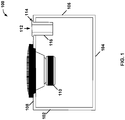
- a cross sectional view of a ported enclosure 100 of a loudspeaker is presented that includes four walls 102, 104, 106, 108 that generally define the structure of the enclosure.
- a transducer that converts electrical signals into audible signals is mounted into the upper wall 108; however, the transducer may be oriented differently in other examples.
- a port 112 is incorporated into the upper wall 108 of the enclosure.
- the port is realized by a cylindrical structure; however, other designs (e.g., different shapes, cross sections, etc.) may be employed.
- the port 112 includes a port interface 114 that allows air to enter the port from the ambient environment and to exit the port.
- the port 112 also includes a port channel 116 that directs the air into and out of the interior of the enclosure.
- ports can have undesirable acoustical attributes that enclosure designs may address (e.g., minimize) to provide appropriate performance and still be relatively small in size.
- unwanted noise and distortion can be produced.
- the geometry of the port e.g., port channel length
- the geometry of the port can produce acoustic standing waves that may alter the desired frequency response of the loudspeaker by introducing resonances, reinforcing noise and/or distortion, etc. through excitation of the standing waves.
- standing waves in the port can occur at frequencies that are within the operating band of the loudspeaker (that includes the port and the transducer(s)). Through controlling techniques (e.g., damping), their corrupting effects can be reduced. Additionally, by properly dampening of such standing waves, the waves and/or resonances can be exploited to improve (e.g., increase) the output, efficiency, etc. of the loudspeaker.
- the port 112 can contribute to noise being added output of the loudspeaker (that includes the enclosure 100 and the transducer 110).
- both the port interface 114 and the port channel 116 can cause the introduction of resonances, standing waves, etc. that may be considered noise sources.
- resonant tones may be excited by the port interface's structure, the structure of the port channel, etc.
- Such noise tones can be particularly distracting to a listener when the spectral range of the audible content being played-back by the speaker includes the frequencies of the resonant tones.
- the bass tones of the content may be affected by the tonal resonance, standing waves, etc. and thereby corrupt playback.
- waveguide type enclosures can be considered as a port that consumes nearly the entire volume of the enclosure (e.g., a small percentage of an enclosure, 10%, is used by the transducer or transducer in the enclosure). Similar to the illustrated enclosure, standing waves may form in waveguide enclosures and potentially corrupt the output of the loudspeaker. Examples of such waveguides are described in U.S. Patent No. 7,565,948 , entitled “Acoustic Waveguiding," and U.S. Patent No. 8,295,525 , entitled “Low Frequency Enclosure for Video Display Devices".
- an enclosure 200 includes an array of transducers 202 (e.g., five transducers 204, 206, 208, 210, 212) and a port 214.
- the port 214 includes a port interface 216 and a port channel 218 that allows air to flow between the interior of the enclosure 200 and the ambient environment external to the enclosure.
- the port channel 218 begins at the port interface 216 and extends along a back wall 220 of the enclosure before opening into a cavity 222 that contains the transducer array 202.
- the enclosure 200 can be utilized in producing a sound bar product (also referred to as a media bar) that can produce a multi-channel surround effect while using a single enclosure.
- a sound bar product also referred to as a media bar
- the multiple transducers are often orientated along a particular dimension (e.g., along the horizontal direction or vertical direction). Often the orientation of the speakers is determined for acoustic effects of interest, the mounting location of the sound bar (e.g., above or below a display device such as a television, computing device display, etc.).
- both the port interface 216 and the port channel 218 can be noise sources capable of effecting the performance of the enclosure 200 of the transducer array 202.
- noise sources capable of effecting the performance of the enclosure 200 of the transducer array 202.
- standing waves may form in the port 214 based upon the movement of air within the open-ended channel created by the port.
- the acoustic effects of such standing waves may appear at various frequencies (e.g., 1 KHz, etc.) that are also included in the spectrum of the audio content being played, thereby potentially corrupting the audible signals being produced by the enclosure 200.
- these noise sources can also effect the output of the transducer array 202.
- beamforming operations may be executed upon the signals input to the individual transducers 204-212, for example, to steer an audible signal in one or more directions, to one or more locations external to the enclosure, etc. Since the phase of the noise created by the port components is difficult to control, a steered beam (or beams) produced by the transducer array 202 can potentially be affected and the acoustic quality of the audio content being produced can be degraded (along with the listening experience).
- one or more techniques may be implemented to reduce the effects of the port noise sources from corrupting the acoustics of the individual speakers and the overall performance of the transducer array.
- one or more elements that reduce acoustical effects may be incorporated into one or more structures (e.g., a wall) that define the port components (e.g., port channel) of the transducer array enclosure.
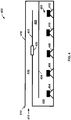
- An enclosure 300 is illustrated that includes a transducer array 302 (including five transducers 304, 306, 308, 310, and 312) and a port 314 that includes a port interface 316 and a port channel 318 (that has one end at the port interface and another end that opens into a cavity 320 that contains the transducer arrange 302).
- a resistive acoustic element 322 is incorporated into a structure (e.g., wall structure 324) to reduce the acoustic resonant features of the port interface 306, the port channel 318, etc.
- the geometry e.g., size, shape, etc.
- the element 322 is graphically illustrated to visually highlight the element.
- the element 322 is illustrated as extending outward from both surfaces of the wall structure 324; however, in various implementations the geometry of the element may be designed such that the element is substantially flush to one or both wall surfaces.
- the element 322 may be a screen incorporated into the wall.
- the sound pressure difference across the element may be low (e.g., the difference between the sound pressure present at the port channel 318 side of element 322 and the sound pressure present at the cavity 320 side of element 322 near transducer 306).
- a single acoustic resistive element is incorporated into the wall structure 324; however additional elements may similarly be incorporated into the wall.
- one or more resistive elements may be incorporated into other structures of the port channel 318; for example, one or multiple resistive elements may be included in a wall structure shared by the port channel and another portion of the enclosure 300.
- one or more elements can be incorporated into an exterior wall structure (e.g., wall 326) that is shared with the port channel 318. Similar positions on each wall structure may be selected for incorporating such resistive elements, or, different position locations may be selected for multiple elements.
- Various types of design parameters of the elements may be adjusted to reduce the acoustical characteristics of a port (e.g., port interface, port channel, etc.). For example, the size and shape of one or more elements may be adjusted. Similarly the orientation of the elements (as embedded in wall structures) may be adjusted (e.g., translated, rotated, etc.) individually or in concert (e.g., to create particular patterns) to address certain resonance effects.
- a single layer element e.g., a single layer screen
- a multi-layer element e.g., stacked screens
- one or more separation distances may be employed for the design.
- air may be allowed to flow between the multiple layers, or, one or more materials may be used to create structures between the screens.
- different patterns e.g., ridges, channels, etc.
- Such screens can also incorporate one or more geometries (e.g., generally rectangular shapes, etc.).
- one or more screens included in the resistive element 322 may be metallic in composition and include one or more metals (along with other types of materials in some arrangements).
- a substantially solid metal layer (or layers) may be used to produce a screen.
- Meshes and other types of pattern designs may be employed in one or more screens.
- One or more fabrics may be employed in the resistive element; for example, a relatively stiff fabric may be used that is capable to withstanding the environmental effects (e.g., temperatures, sound pressures, vibrations, etc.) of the transducer array enclosure 300.
- Composite materials may also be used to create a screen, a screen frame, or other structural components of the resistive element 322. Combinations of different materials may also be used for producing components of the resistive element 322; for example, one or more composites (e.g., plastics) and metals may be employed.
- an enclosure 400 includes a transducer array 402 (including transducers 404, 406, 408, and 410) and a relatively more complex port (compared to the cylindrical shaped port 112 of FIG. 1 ).
- a port 413 includes a port channel comprised of a series of segments that produce a pathway that alternates in direction.
- a port interface 414 (that interfaces the enclosure 400 to the exterior environment) is followed by a first segment 416 of the port channel and extends from left to right along a back wall 418 of the enclosure.
- a second segment 420 of the port channel extends along the first segment 416 (in the opposite direction). Being adjacent, the two segments 416 and 420 share a common wall structure 422 within the interior of the enclosure. Moving along the port channel segment 420 (from right to left) between the wall structure 422 and an opposite wall structure 424, after another turn the segment opens into a cavity 426 that contains the transducer array 402. Similar to the port interfaces and channels shown in FIGs. 1-3 , the overlapping segment design of the port 413 (e.g., the port interface 414, and the multiple segments of the port channel) can be a noise source capable of limiting the performance of transducer array.
- standing waves may form in the port 413 based upon the movement of the air within the open-ended channel created by the port.
- the acoustic effects of such standing waves may appear at frequencies (e.g., 1 KHz, etc.) which may also be included in the spectrum of the playback content, thereby potentially corrupting the produced sound.
- standing waves may affect the beamforming capabilities of the transducer array 402.
- a resistive acoustic element 428 is incorporated into the shared wall structure 422 to reduce the acoustic resonant features of the port interface 414, the port channel (e.g., segments 416, 420), etc. that could affect the performance of the transducer array 402.
- a single acoustic resistive element is incorporated into the wall 422; however additional elements may similarly be incorporated into the wall.
- one or more resistive elements may be incorporated into other structures of the port channel segments; for example, one or multiple resistive elements may be included in other wall structures.
- one or more elements can be incorporated into wall structure 418 that is shared by the port channel segment 416 and the exterior environment of the enclosure 400.
- one or more elements may be embedded in the wall structure 424 that is shared by port channel segment 420 and the cavity 426 (within which the transducer array 402 is mounted). Similar positions on each wall structure may be selected for incorporating such resistive elements, or, different position locations may be selected for two or more elements.
- different geometries, materials, features e.g., single layer, multi-layer, etc.
- other designs may be employed in the acoustic resistive elements.
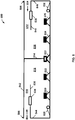
- a transducer enclosure 500 (e.g., for a sound bar design) includes two separate ports within which acoustic resistive elements may be positioned to improve the enclosed transducer array performance.
- Ports 502 and 504 respectively include port interfaces 506, 508 and port channels 510, 512.
- a wall structure 514 separates the two ports 502 and 504; however, other design variants may be employed to separate the ports.
- Each of the port channels respectively opens into cavities 516 and 518 that contain transducers of an array for sound production.
- Each cavity contains two transducers (e.g., cavity 516 includes transducers 520 and 522, and, cavity 518 includes transducers 524 and 526). Additionally, each cavity includes other types of device for producing sound; for example, transmission tubes 528 and 530 that are capable of steering sound in particular directions. Examples of such transmission tube devices are described in U.S. Patent No. 8,351,630 entitled “Passive Directional Acoustical Radiating" and U.S. Patent No. 8,358,798 entitled “Passive Directional Acoustical Radiating”.
- Another transducer 532 e.g., a tweeter speaker
- one or more acoustic resistive elements can be embedded in structures (e.g., wall structures) within the enclosure 500.
- acoustic resistive elements are incorporated into respective wall structures of the two ports 502 and 504.
- one resistive element 534 is incorporated into a wall structure 536 that is shared by port channel 510 and cavity 516
- another resistive element 538 is incorporated into a wall structure 540 that is shared by port channel 512 and cavity 518.
- each resistive element is capable of reducing the sound pressure differential between the respective port channel and cavity.
- acoustic elements may be positioned in other locations within the transducer array enclosure 500; for example as mentioned above one or more elements may be embedded in other structures.
- an element (or elements) may be incorporated into a wall structure 542 that is shared by a port channel (e.g., port channel 510) and the environment external to the enclosure 500.
- elements may be positioned in wall structures that are shared between the cavities (e.g., wall structure 514), positioned in a wall structure shared by a cavity and the exterior of the enclosure 500 (e.g., wall structure 544, 546, etc.), etc.
- two ports 510 and 512 are employed to allow air flow between the exterior of the enclosure 500 and the enclosure's interior.
- a single port or more than two ports may be used to provide air flow path(s).
- Such designs can produce noise sources that may corrupt the sound out of the enclosure.
- one or more lossy material acoustic resistive elements may be incorporated into one or more structures (e.g., wall structures) of these designs. Similar to previously described designs, to reduce such affects the resistive element may be a screen, a stack of screens (e.g., a multi-screen design), etc. that is embedded to be substantially flush to the surfaces of both sides of the wall structure.
- the resistive element may incorporate a variety of designs, use various design parameters (e.g., geometries, materials, orientations, positioning), etc.
- a resistive element may be provided by (or incorporated into) a three dimensional design (e.g., a tubular structure) that connects portions of an enclosure that do not share a structure (e.g., wall structure).
- a structure e.g., wall structure
- one resistive element may be incorporated into a wall structure (e.g., a shared wall structure)
- additional resistive elements can be incorporated into the wall; for example, multiple resistive elements (e.g., oriented in a particular pattern) can be embedded in the wall.
- resistive elements may be incorporated at other locations of the transducer array enclosure; for example, resistive elements into wall structures 514, 542, 544, 546, etc. to reduce the potential corrupting of the output of the transducers included in the enclosure 500 (e.g., the transducer array).
- resistive elements into wall structures 514, 542, 544, 546, etc. may be used to reduce acoustical modes caused by the ports, cavities and other enclosure portions that may affect the content being played by a transducer array.
Landscapes
- Health & Medical Sciences (AREA)
- Otolaryngology (AREA)
- Physics & Mathematics (AREA)
- Engineering & Computer Science (AREA)
- Acoustics & Sound (AREA)
- Signal Processing (AREA)
- Circuit For Audible Band Transducer (AREA)
- Details Of Audible-Bandwidth Transducers (AREA)
- Soundproofing, Sound Blocking, And Sound Damping (AREA)
Claims (15)
- Appareil comprenant :un réseau de transducteurs (520, 522, 524, 526) pour convertir des signaux électriques en signaux audibles dirigés ;une enceinte (400, 500) incluant le réseau de transducteurs ;l'enceinte comprenant deux évents (502, 504) et deux cavités (516, 518), dans lequel une première cavité (516) des deux cavités comprend une première pluralité de transducteurs (520, 522) du réseau de transducteurs ;une seconde cavité (518) des deux cavités comprend une seconde pluralité de transducteurs (524, 526) du réseau de transducteurs ; dans lequel l'appareil comprend en outre :des premières structures multiples (536, 542, 514) au sein de l'enceinte définissant un premier évent (502) ayant une extrémité située au sein de l'enceinte qui débouche dans la première cavité (516) et une autre extrémité qui est externe à l'enceinte (500) et débouche dans un environnement ambiant ;des secondes structures multiples (540, 514) au sein de l'enceinte définissant un second évent (504) ayant une extrémité située au sein de l'enceinte qui débouche dans la seconde cavité (518) et une autre extrémité qui est externe à l'enceinte (500) et débouche dans l'environnement ambiant, dans lequel le premier évent (502) est séparé du second évent (504) ;un premier élément résistif acoustique (534) situé dans les premières structures multiples (536), l'élément résistif acoustique étant capable de réduire des effets des caractéristiques acoustiques du premier évent (502) pour des signaux audibles qui sont produits par le réseau de transducteurs ; etun second élément résistif acoustique (538) situé dans les secondes structures multiples (540), l'élément résistif acoustique étant capable de réduire des effets des caractéristiques acoustiques du second évent (504) pour des signaux audibles qui sont produits par le réseau de transducteurs.
- Appareil selon la revendication 1, dans lequel la première cavité (516) est configurée pour recevoir un premier élément acoustique directionnel passif (528).
- Appareil selon la revendication 1, dans lequel la seconde cavité (518) est configurée pour recevoir un second élément acoustique directionnel passif (530).
- Appareil selon la revendication 1, dans lequel le premier évent (502) est séparé du second évent (504) par une structure de paroi (514).
- Appareil selon la revendication 1, dans lequel l'enceinte comprend un autre transducteur (532) agencé entre les première et seconde cavités.
- Appareil selon la revendication 5, dans lequel l'autre transducteur est un haut-parleur d'aigus.
- Appareil selon la revendication 1, dans lequel l'élément résistif acoustique (534, 538) est configuré pour modifier la signature acoustique d'un ou de plusieurs canaux (510, 512) inclus dans l'évent (502, 504).
- Appareil selon la revendication 1, dans lequel l'élément résistif acoustique est partagé par l'évent et un autre évent inclus dans l'enceinte.
- Appareil selon la revendication 1, dans lequel l'évent (413) inclut une première portion de canal (416) et une seconde portion de canal (420), l'élément résistif (428) étant situé dans une structure de paroi (422) qui est partagée par les première et seconde portions de canal.
- Appareil selon la revendication 1, dans lequel l'élément résistif est situé dans une structure de paroi qui est partagée par un canal inclus dans l'évent et l'extérieur de l'enceinte.
- Appareil selon la revendication 1, dans lequel l'élément résistif acoustique inclut une couche unique.
- Appareil selon la revendication 1, dans lequel l'élément résistif acoustique inclut de multiples couches.
- Appareil selon la revendication 1, dans lequel l'élément résistif acoustique inclut une couche de matériau en étoffe.
- Appareil selon la revendication 1, dans lequel l'élément résistif acoustique inclut un maillage métallique.
- Appareil selon la revendication 1, dans lequel l'élément résistif acoustique est de forme généralement rectangulaire.
Applications Claiming Priority (2)
| Application Number | Priority Date | Filing Date | Title |
|---|---|---|---|
| US14/981,380 US9906855B2 (en) | 2015-12-28 | 2015-12-28 | Reducing ported transducer array enclosure noise |
| PCT/US2016/065375 WO2017116641A1 (fr) | 2015-12-28 | 2016-12-07 | Réduction de bruit d'enceinte de réseau de transducteurs résonnants |
Publications (2)
| Publication Number | Publication Date |
|---|---|
| EP3398351A1 EP3398351A1 (fr) | 2018-11-07 |
| EP3398351B1 true EP3398351B1 (fr) | 2020-02-26 |
Family
ID=57570662
Family Applications (1)
| Application Number | Title | Priority Date | Filing Date |
|---|---|---|---|
| EP16813338.7A Active EP3398351B1 (fr) | 2015-12-28 | 2016-12-07 | Réduction de bruit pour une enceinte à évent pour un array de transducteur |
Country Status (5)
| Country | Link |
|---|---|
| US (1) | US9906855B2 (fr) |
| EP (1) | EP3398351B1 (fr) |
| JP (1) | JP6810158B2 (fr) |
| CN (1) | CN108702563B (fr) |
| WO (1) | WO2017116641A1 (fr) |
Cited By (1)
| Publication number | Priority date | Publication date | Assignee | Title |
|---|---|---|---|---|
| US11470417B1 (en) | 2021-07-30 | 2022-10-11 | Klipsch Group, Inc. | Horn-loaded loudspeaker |
Families Citing this family (6)
| Publication number | Priority date | Publication date | Assignee | Title |
|---|---|---|---|---|
| CN104378711B (zh) * | 2014-12-02 | 2018-06-22 | 北京京东方多媒体科技有限公司 | 一种扬声器及设有该扬声器的电视机 |
| KR102079372B1 (ko) * | 2019-06-26 | 2020-04-07 | 대홍테크뉴(주) | 라인 어레이 스피커 |
| US11064309B2 (en) * | 2019-07-12 | 2021-07-13 | Bose Corporation | Multi-tuned speaker system |
| US11310587B2 (en) | 2019-10-08 | 2022-04-19 | Bose Corporation | Horn loudspeakers |
| US11178797B2 (en) * | 2019-10-31 | 2021-11-16 | Bose Corporation | Loudspeaker system cooling |
| EP4118839A4 (fr) * | 2020-03-10 | 2024-02-28 | Sonos, Inc. | Réseau de transducteurs d'un dispositif audio et systèmes et procédés associés |
Citations (1)
| Publication number | Priority date | Publication date | Assignee | Title |
|---|---|---|---|---|
| US20100202619A1 (en) * | 2007-07-26 | 2010-08-12 | Nexo | Sound reproduction system comprising a loudspeaker enclosure with ports, and associated processing circuit |
Family Cites Families (20)
| Publication number | Priority date | Publication date | Assignee | Title |
|---|---|---|---|---|
| US3047090A (en) | 1958-05-07 | 1962-07-31 | Robert G Pruden | Tuned acoustical device |
| US3993162A (en) * | 1975-06-20 | 1976-11-23 | Kenneth Juuti | Acoustic speaker system |
| CA1279270C (fr) * | 1986-07-11 | 1991-01-22 | Matsushita Electric Industrial Co., Ltd. | Lecteur audio pour vehicule |
| JPH01241297A (ja) * | 1988-03-23 | 1989-09-26 | Yamaha Corp | 音響装置 |
| US4884655A (en) * | 1988-10-03 | 1989-12-05 | Sparkomatic Corporation | Tower-type speaker cabinet with pivoted plural speaker subassembly |
| JPH05137193A (ja) * | 1991-11-09 | 1993-06-01 | Sony Corp | スピーカ装置 |
| US5821471A (en) * | 1995-11-30 | 1998-10-13 | Mcculler; Mark A. | Acoustic system |
| JP2002232982A (ja) * | 2001-01-30 | 2002-08-16 | Sanyo Electric Co Ltd | スピーカ装置 |
| US7463744B2 (en) * | 2003-10-31 | 2008-12-09 | Bose Corporation | Porting |
| US7584820B2 (en) | 2004-03-19 | 2009-09-08 | Bose Corporation | Acoustic radiating |
| US7565948B2 (en) * | 2004-03-19 | 2009-07-28 | Bose Corporation | Acoustic waveguiding |
| US7760899B1 (en) | 2006-02-27 | 2010-07-20 | Graber Curtis E | Subwoofer with cascaded array of drivers arranged with staggered spacing |
| US7886869B2 (en) * | 2007-09-27 | 2011-02-15 | Kevin Bastyr | Acoustic waveguide mode controlling |
| US8295526B2 (en) | 2008-02-21 | 2012-10-23 | Bose Corporation | Low frequency enclosure for video display devices |
| US8351630B2 (en) | 2008-05-02 | 2013-01-08 | Bose Corporation | Passive directional acoustical radiating |
| CN103109545B (zh) | 2010-08-12 | 2015-08-19 | 伯斯有限公司 | 音频系统及用于操作音频系统的方法 |
| US8553894B2 (en) * | 2010-08-12 | 2013-10-08 | Bose Corporation | Active and passive directional acoustic radiating |
| US9820033B2 (en) | 2012-09-28 | 2017-11-14 | Apple Inc. | Speaker assembly |
| FR3020737B1 (fr) * | 2014-05-05 | 2017-10-20 | Chene Richard | Dispositif de transmission de sons pour ecouteur intra-auriculaire et ecouteur intra-auriculaire |
| US9913024B2 (en) * | 2015-12-28 | 2018-03-06 | Bose Corporation | Acoustic resistive elements for ported transducer enclosure |
-
2015
- 2015-12-28 US US14/981,380 patent/US9906855B2/en active Active
-
2016
- 2016-12-07 JP JP2018552635A patent/JP6810158B2/ja active Active
- 2016-12-07 EP EP16813338.7A patent/EP3398351B1/fr active Active
- 2016-12-07 WO PCT/US2016/065375 patent/WO2017116641A1/fr not_active Ceased
- 2016-12-07 CN CN201680082173.XA patent/CN108702563B/zh active Active
Patent Citations (1)
| Publication number | Priority date | Publication date | Assignee | Title |
|---|---|---|---|---|
| US20100202619A1 (en) * | 2007-07-26 | 2010-08-12 | Nexo | Sound reproduction system comprising a loudspeaker enclosure with ports, and associated processing circuit |
Cited By (2)
| Publication number | Priority date | Publication date | Assignee | Title |
|---|---|---|---|---|
| US11470417B1 (en) | 2021-07-30 | 2022-10-11 | Klipsch Group, Inc. | Horn-loaded loudspeaker |
| US11985477B2 (en) | 2021-07-30 | 2024-05-14 | Klipsch Group, Inc. | Horn-loaded loudspeaker |
Also Published As
| Publication number | Publication date |
|---|---|
| JP2019506105A (ja) | 2019-02-28 |
| EP3398351A1 (fr) | 2018-11-07 |
| CN108702563B (zh) | 2020-04-10 |
| JP6810158B2 (ja) | 2021-01-06 |
| US20170188134A1 (en) | 2017-06-29 |
| US9906855B2 (en) | 2018-02-27 |
| WO2017116641A1 (fr) | 2017-07-06 |
| CN108702563A (zh) | 2018-10-23 |
Similar Documents
| Publication | Publication Date | Title |
|---|---|---|
| EP3398351B1 (fr) | Réduction de bruit pour une enceinte à évent pour un array de transducteur | |
| EP3282714B1 (fr) | Ensemble et système de haut-parleur | |
| JP5405598B2 (ja) | スピーカ | |
| EP3398352B1 (fr) | Enceinte à évent avec des éléments resistives acoustiques | |
| TWI599233B (zh) | 耳機總成 | |
| EP1577880B1 (fr) | Un ensemble audio comprenant une source audio à une extrémité d'un guide d'onde, et un actionneur acoustique à l'autre | |
| CN101198197B (zh) | 具有减小的后部声波辐射的扬声器系统 | |
| CN107079208B (zh) | 具有波导的扩音装置 | |
| CN101978705A (zh) | 声学无源辐射 | |
| EP2976892B1 (fr) | Dispositif acoustique | |
| CN101926180A (zh) | 多音室带端口立体声音箱 | |
| KR20170117478A (ko) | 밀폐형 음향 서스펜션 챔버를 구비한 라우드스피커 인클로저 | |
| CN114430913B (zh) | 具有波导的指向式多路扩音装置 | |
| US20190058954A1 (en) | Layered speaker assembly | |
| US6038326A (en) | Loudspeaker and horn with an additional transducer | |
| US10250968B2 (en) | Loudspeaker system | |
| JP2013513266A (ja) | フラットスピーカ | |
| EP3449642B1 (fr) | Tube basse reflex pour haut-parleur | |
| JP4701614B2 (ja) | アレイスピーカ用のキャビネット及びアレイスピーカシステム | |
| JP2008131540A (ja) | スピーカ装置 | |
| Unruh et al. | Linear Array Transducer Technology | |
| JP2007129281A (ja) | 部屋 |
Legal Events
| Date | Code | Title | Description |
|---|---|---|---|
| STAA | Information on the status of an ep patent application or granted ep patent |
Free format text: STATUS: UNKNOWN |
|
| STAA | Information on the status of an ep patent application or granted ep patent |
Free format text: STATUS: THE INTERNATIONAL PUBLICATION HAS BEEN MADE |
|
| PUAI | Public reference made under article 153(3) epc to a published international application that has entered the european phase |
Free format text: ORIGINAL CODE: 0009012 |
|
| STAA | Information on the status of an ep patent application or granted ep patent |
Free format text: STATUS: REQUEST FOR EXAMINATION WAS MADE |
|
| 17P | Request for examination filed |
Effective date: 20180706 |
|
| AK | Designated contracting states |
Kind code of ref document: A1 Designated state(s): AL AT BE BG CH CY CZ DE DK EE ES FI FR GB GR HR HU IE IS IT LI LT LU LV MC MK MT NL NO PL PT RO RS SE SI SK SM TR |
|
| AX | Request for extension of the european patent |
Extension state: BA ME |
|
| DAV | Request for validation of the european patent (deleted) | ||
| DAX | Request for extension of the european patent (deleted) | ||
| GRAP | Despatch of communication of intention to grant a patent |
Free format text: ORIGINAL CODE: EPIDOSNIGR1 |
|
| STAA | Information on the status of an ep patent application or granted ep patent |
Free format text: STATUS: GRANT OF PATENT IS INTENDED |
|
| INTG | Intention to grant announced |
Effective date: 20191218 |
|
| GRAS | Grant fee paid |
Free format text: ORIGINAL CODE: EPIDOSNIGR3 |
|
| GRAA | (expected) grant |
Free format text: ORIGINAL CODE: 0009210 |
|
| STAA | Information on the status of an ep patent application or granted ep patent |
Free format text: STATUS: THE PATENT HAS BEEN GRANTED |
|
| AK | Designated contracting states |
Kind code of ref document: B1 Designated state(s): AL AT BE BG CH CY CZ DE DK EE ES FI FR GB GR HR HU IE IS IT LI LT LU LV MC MK MT NL NO PL PT RO RS SE SI SK SM TR |
|
| REG | Reference to a national code |
Ref country code: GB Ref legal event code: FG4D |
|
| REG | Reference to a national code |
Ref country code: CH Ref legal event code: EP |
|
| REG | Reference to a national code |
Ref country code: AT Ref legal event code: REF Ref document number: 1239139 Country of ref document: AT Kind code of ref document: T Effective date: 20200315 |
|
| REG | Reference to a national code |
Ref country code: IE Ref legal event code: FG4D |
|
| REG | Reference to a national code |
Ref country code: DE Ref legal event code: R096 Ref document number: 602016030732 Country of ref document: DE |
|
| PG25 | Lapsed in a contracting state [announced via postgrant information from national office to epo] |
Ref country code: NO Free format text: LAPSE BECAUSE OF FAILURE TO SUBMIT A TRANSLATION OF THE DESCRIPTION OR TO PAY THE FEE WITHIN THE PRESCRIBED TIME-LIMIT Effective date: 20200526 Ref country code: FI Free format text: LAPSE BECAUSE OF FAILURE TO SUBMIT A TRANSLATION OF THE DESCRIPTION OR TO PAY THE FEE WITHIN THE PRESCRIBED TIME-LIMIT Effective date: 20200226 Ref country code: RS Free format text: LAPSE BECAUSE OF FAILURE TO SUBMIT A TRANSLATION OF THE DESCRIPTION OR TO PAY THE FEE WITHIN THE PRESCRIBED TIME-LIMIT Effective date: 20200226 |
|
| REG | Reference to a national code |
Ref country code: NL Ref legal event code: MP Effective date: 20200226 |
|
| REG | Reference to a national code |
Ref country code: LT Ref legal event code: MG4D |
|
| PG25 | Lapsed in a contracting state [announced via postgrant information from national office to epo] |
Ref country code: BG Free format text: LAPSE BECAUSE OF FAILURE TO SUBMIT A TRANSLATION OF THE DESCRIPTION OR TO PAY THE FEE WITHIN THE PRESCRIBED TIME-LIMIT Effective date: 20200526 Ref country code: IS Free format text: LAPSE BECAUSE OF FAILURE TO SUBMIT A TRANSLATION OF THE DESCRIPTION OR TO PAY THE FEE WITHIN THE PRESCRIBED TIME-LIMIT Effective date: 20200626 Ref country code: GR Free format text: LAPSE BECAUSE OF FAILURE TO SUBMIT A TRANSLATION OF THE DESCRIPTION OR TO PAY THE FEE WITHIN THE PRESCRIBED TIME-LIMIT Effective date: 20200527 Ref country code: HR Free format text: LAPSE BECAUSE OF FAILURE TO SUBMIT A TRANSLATION OF THE DESCRIPTION OR TO PAY THE FEE WITHIN THE PRESCRIBED TIME-LIMIT Effective date: 20200226 Ref country code: SE Free format text: LAPSE BECAUSE OF FAILURE TO SUBMIT A TRANSLATION OF THE DESCRIPTION OR TO PAY THE FEE WITHIN THE PRESCRIBED TIME-LIMIT Effective date: 20200226 Ref country code: LV Free format text: LAPSE BECAUSE OF FAILURE TO SUBMIT A TRANSLATION OF THE DESCRIPTION OR TO PAY THE FEE WITHIN THE PRESCRIBED TIME-LIMIT Effective date: 20200226 |
|
| PG25 | Lapsed in a contracting state [announced via postgrant information from national office to epo] |
Ref country code: NL Free format text: LAPSE BECAUSE OF FAILURE TO SUBMIT A TRANSLATION OF THE DESCRIPTION OR TO PAY THE FEE WITHIN THE PRESCRIBED TIME-LIMIT Effective date: 20200226 |
|
| PG25 | Lapsed in a contracting state [announced via postgrant information from national office to epo] |
Ref country code: DK Free format text: LAPSE BECAUSE OF FAILURE TO SUBMIT A TRANSLATION OF THE DESCRIPTION OR TO PAY THE FEE WITHIN THE PRESCRIBED TIME-LIMIT Effective date: 20200226 Ref country code: EE Free format text: LAPSE BECAUSE OF FAILURE TO SUBMIT A TRANSLATION OF THE DESCRIPTION OR TO PAY THE FEE WITHIN THE PRESCRIBED TIME-LIMIT Effective date: 20200226 Ref country code: SM Free format text: LAPSE BECAUSE OF FAILURE TO SUBMIT A TRANSLATION OF THE DESCRIPTION OR TO PAY THE FEE WITHIN THE PRESCRIBED TIME-LIMIT Effective date: 20200226 Ref country code: PT Free format text: LAPSE BECAUSE OF FAILURE TO SUBMIT A TRANSLATION OF THE DESCRIPTION OR TO PAY THE FEE WITHIN THE PRESCRIBED TIME-LIMIT Effective date: 20200719 Ref country code: ES Free format text: LAPSE BECAUSE OF FAILURE TO SUBMIT A TRANSLATION OF THE DESCRIPTION OR TO PAY THE FEE WITHIN THE PRESCRIBED TIME-LIMIT Effective date: 20200226 Ref country code: LT Free format text: LAPSE BECAUSE OF FAILURE TO SUBMIT A TRANSLATION OF THE DESCRIPTION OR TO PAY THE FEE WITHIN THE PRESCRIBED TIME-LIMIT Effective date: 20200226 Ref country code: SK Free format text: LAPSE BECAUSE OF FAILURE TO SUBMIT A TRANSLATION OF THE DESCRIPTION OR TO PAY THE FEE WITHIN THE PRESCRIBED TIME-LIMIT Effective date: 20200226 Ref country code: CZ Free format text: LAPSE BECAUSE OF FAILURE TO SUBMIT A TRANSLATION OF THE DESCRIPTION OR TO PAY THE FEE WITHIN THE PRESCRIBED TIME-LIMIT Effective date: 20200226 Ref country code: RO Free format text: LAPSE BECAUSE OF FAILURE TO SUBMIT A TRANSLATION OF THE DESCRIPTION OR TO PAY THE FEE WITHIN THE PRESCRIBED TIME-LIMIT Effective date: 20200226 |
|
| REG | Reference to a national code |
Ref country code: AT Ref legal event code: MK05 Ref document number: 1239139 Country of ref document: AT Kind code of ref document: T Effective date: 20200226 |
|
| REG | Reference to a national code |
Ref country code: DE Ref legal event code: R097 Ref document number: 602016030732 Country of ref document: DE |
|
| PLBE | No opposition filed within time limit |
Free format text: ORIGINAL CODE: 0009261 |
|
| STAA | Information on the status of an ep patent application or granted ep patent |
Free format text: STATUS: NO OPPOSITION FILED WITHIN TIME LIMIT |
|
| PG25 | Lapsed in a contracting state [announced via postgrant information from national office to epo] |
Ref country code: IT Free format text: LAPSE BECAUSE OF FAILURE TO SUBMIT A TRANSLATION OF THE DESCRIPTION OR TO PAY THE FEE WITHIN THE PRESCRIBED TIME-LIMIT Effective date: 20200226 Ref country code: AT Free format text: LAPSE BECAUSE OF FAILURE TO SUBMIT A TRANSLATION OF THE DESCRIPTION OR TO PAY THE FEE WITHIN THE PRESCRIBED TIME-LIMIT Effective date: 20200226 |
|
| 26N | No opposition filed |
Effective date: 20201127 |
|
| PG25 | Lapsed in a contracting state [announced via postgrant information from national office to epo] |
Ref country code: PL Free format text: LAPSE BECAUSE OF FAILURE TO SUBMIT A TRANSLATION OF THE DESCRIPTION OR TO PAY THE FEE WITHIN THE PRESCRIBED TIME-LIMIT Effective date: 20200226 Ref country code: SI Free format text: LAPSE BECAUSE OF FAILURE TO SUBMIT A TRANSLATION OF THE DESCRIPTION OR TO PAY THE FEE WITHIN THE PRESCRIBED TIME-LIMIT Effective date: 20200226 |
|
| REG | Reference to a national code |
Ref country code: CH Ref legal event code: PL |
|
| PG25 | Lapsed in a contracting state [announced via postgrant information from national office to epo] |
Ref country code: MC Free format text: LAPSE BECAUSE OF FAILURE TO SUBMIT A TRANSLATION OF THE DESCRIPTION OR TO PAY THE FEE WITHIN THE PRESCRIBED TIME-LIMIT Effective date: 20200226 |
|
| REG | Reference to a national code |
Ref country code: BE Ref legal event code: MM Effective date: 20201231 |
|
| PG25 | Lapsed in a contracting state [announced via postgrant information from national office to epo] |
Ref country code: LU Free format text: LAPSE BECAUSE OF NON-PAYMENT OF DUE FEES Effective date: 20201207 Ref country code: IE Free format text: LAPSE BECAUSE OF NON-PAYMENT OF DUE FEES Effective date: 20201207 |
|
| PG25 | Lapsed in a contracting state [announced via postgrant information from national office to epo] |
Ref country code: LI Free format text: LAPSE BECAUSE OF NON-PAYMENT OF DUE FEES Effective date: 20201231 Ref country code: CH Free format text: LAPSE BECAUSE OF NON-PAYMENT OF DUE FEES Effective date: 20201231 |
|
| PG25 | Lapsed in a contracting state [announced via postgrant information from national office to epo] |
Ref country code: TR Free format text: LAPSE BECAUSE OF FAILURE TO SUBMIT A TRANSLATION OF THE DESCRIPTION OR TO PAY THE FEE WITHIN THE PRESCRIBED TIME-LIMIT Effective date: 20200226 Ref country code: MT Free format text: LAPSE BECAUSE OF FAILURE TO SUBMIT A TRANSLATION OF THE DESCRIPTION OR TO PAY THE FEE WITHIN THE PRESCRIBED TIME-LIMIT Effective date: 20200226 Ref country code: CY Free format text: LAPSE BECAUSE OF FAILURE TO SUBMIT A TRANSLATION OF THE DESCRIPTION OR TO PAY THE FEE WITHIN THE PRESCRIBED TIME-LIMIT Effective date: 20200226 |
|
| PG25 | Lapsed in a contracting state [announced via postgrant information from national office to epo] |
Ref country code: MK Free format text: LAPSE BECAUSE OF FAILURE TO SUBMIT A TRANSLATION OF THE DESCRIPTION OR TO PAY THE FEE WITHIN THE PRESCRIBED TIME-LIMIT Effective date: 20200226 Ref country code: AL Free format text: LAPSE BECAUSE OF FAILURE TO SUBMIT A TRANSLATION OF THE DESCRIPTION OR TO PAY THE FEE WITHIN THE PRESCRIBED TIME-LIMIT Effective date: 20200226 |
|
| PG25 | Lapsed in a contracting state [announced via postgrant information from national office to epo] |
Ref country code: BE Free format text: LAPSE BECAUSE OF NON-PAYMENT OF DUE FEES Effective date: 20201231 |
|
| PGFP | Annual fee paid to national office [announced via postgrant information from national office to epo] |
Ref country code: DE Payment date: 20251126 Year of fee payment: 10 |
|
| PGFP | Annual fee paid to national office [announced via postgrant information from national office to epo] |
Ref country code: GB Payment date: 20251120 Year of fee payment: 10 |
|
| PGFP | Annual fee paid to national office [announced via postgrant information from national office to epo] |
Ref country code: FR Payment date: 20251120 Year of fee payment: 10 |