EP3398505B1 - Brain activity analysis apparatus - Google Patents
Brain activity analysis apparatus Download PDFInfo
- Publication number
- EP3398505B1 EP3398505B1 EP17175004.5A EP17175004A EP3398505B1 EP 3398505 B1 EP3398505 B1 EP 3398505B1 EP 17175004 A EP17175004 A EP 17175004A EP 3398505 B1 EP3398505 B1 EP 3398505B1
- Authority
- EP
- European Patent Office
- Prior art keywords
- brain
- signals
- brain activity
- modulation
- activity analysis
- Prior art date
- Legal status (The legal status is an assumption and is not a legal conclusion. Google has not performed a legal analysis and makes no representation as to the accuracy of the status listed.)
- Active
Links
Images





Classifications
-
- A—HUMAN NECESSITIES
- A61—MEDICAL OR VETERINARY SCIENCE; HYGIENE
- A61B—DIAGNOSIS; SURGERY; IDENTIFICATION
- A61B5/00—Measuring for diagnostic purposes; Identification of persons
- A61B5/24—Detecting, measuring or recording bioelectric or biomagnetic signals of the body or parts thereof
- A61B5/316—Modalities, i.e. specific diagnostic methods
- A61B5/369—Electroencephalography [EEG]
- A61B5/372—Analysis of electroencephalograms
-
- A—HUMAN NECESSITIES
- A61—MEDICAL OR VETERINARY SCIENCE; HYGIENE
- A61B—DIAGNOSIS; SURGERY; IDENTIFICATION
- A61B5/00—Measuring for diagnostic purposes; Identification of persons
- A61B5/24—Detecting, measuring or recording bioelectric or biomagnetic signals of the body or parts thereof
- A61B5/316—Modalities, i.e. specific diagnostic methods
- A61B5/369—Electroencephalography [EEG]
- A61B5/37—Intracranial electroencephalography [IC-EEG], e.g. electrocorticography [ECoG]
-
- A—HUMAN NECESSITIES
- A61—MEDICAL OR VETERINARY SCIENCE; HYGIENE
- A61B—DIAGNOSIS; SURGERY; IDENTIFICATION
- A61B5/00—Measuring for diagnostic purposes; Identification of persons
- A61B5/24—Detecting, measuring or recording bioelectric or biomagnetic signals of the body or parts thereof
- A61B5/316—Modalities, i.e. specific diagnostic methods
- A61B5/369—Electroencephalography [EEG]
- A61B5/372—Analysis of electroencephalograms
- A61B5/374—Detecting the frequency distribution of signals, e.g. detecting delta, theta, alpha, beta or gamma waves
-
- A—HUMAN NECESSITIES
- A61—MEDICAL OR VETERINARY SCIENCE; HYGIENE
- A61B—DIAGNOSIS; SURGERY; IDENTIFICATION
- A61B5/00—Measuring for diagnostic purposes; Identification of persons
- A61B5/24—Detecting, measuring or recording bioelectric or biomagnetic signals of the body or parts thereof
- A61B5/316—Modalities, i.e. specific diagnostic methods
- A61B5/369—Electroencephalography [EEG]
- A61B5/384—Recording apparatus or displays specially adapted therefor
-
- A—HUMAN NECESSITIES
- A61—MEDICAL OR VETERINARY SCIENCE; HYGIENE
- A61B—DIAGNOSIS; SURGERY; IDENTIFICATION
- A61B5/00—Measuring for diagnostic purposes; Identification of persons
- A61B5/40—Detecting, measuring or recording for evaluating the nervous system
- A61B5/4076—Diagnosing or monitoring particular conditions of the nervous system
- A61B5/4094—Diagnosing or monitoring seizure diseases, e.g. epilepsy
-
- A—HUMAN NECESSITIES
- A61—MEDICAL OR VETERINARY SCIENCE; HYGIENE
- A61B—DIAGNOSIS; SURGERY; IDENTIFICATION
- A61B5/00—Measuring for diagnostic purposes; Identification of persons
- A61B5/72—Signal processing specially adapted for physiological signals or for diagnostic purposes
- A61B5/7235—Details of waveform analysis
-
- A—HUMAN NECESSITIES
- A61—MEDICAL OR VETERINARY SCIENCE; HYGIENE
- A61B—DIAGNOSIS; SURGERY; IDENTIFICATION
- A61B5/00—Measuring for diagnostic purposes; Identification of persons
- A61B5/72—Signal processing specially adapted for physiological signals or for diagnostic purposes
- A61B5/7235—Details of waveform analysis
- A61B5/7264—Classification of physiological signals or data, e.g. using neural networks, statistical classifiers, expert systems or fuzzy systems
-
- A—HUMAN NECESSITIES
- A61—MEDICAL OR VETERINARY SCIENCE; HYGIENE
- A61B—DIAGNOSIS; SURGERY; IDENTIFICATION
- A61B5/00—Measuring for diagnostic purposes; Identification of persons
- A61B5/72—Signal processing specially adapted for physiological signals or for diagnostic purposes
- A61B5/7271—Specific aspects of physiological measurement analysis
- A61B5/7282—Event detection, e.g. detecting unique waveforms indicative of a medical condition
-
- G—PHYSICS
- G16—INFORMATION AND COMMUNICATION TECHNOLOGY [ICT] SPECIALLY ADAPTED FOR SPECIFIC APPLICATION FIELDS
- G16H—HEALTHCARE INFORMATICS, i.e. INFORMATION AND COMMUNICATION TECHNOLOGY [ICT] SPECIALLY ADAPTED FOR THE HANDLING OR PROCESSING OF MEDICAL OR HEALTHCARE DATA
- G16H40/00—ICT specially adapted for the management or administration of healthcare resources or facilities; ICT specially adapted for the management or operation of medical equipment or devices
- G16H40/60—ICT specially adapted for the management or administration of healthcare resources or facilities; ICT specially adapted for the management or operation of medical equipment or devices for the operation of medical equipment or devices
- G16H40/63—ICT specially adapted for the management or administration of healthcare resources or facilities; ICT specially adapted for the management or operation of medical equipment or devices for the operation of medical equipment or devices for local operation
-
- G—PHYSICS
- G16—INFORMATION AND COMMUNICATION TECHNOLOGY [ICT] SPECIALLY ADAPTED FOR SPECIFIC APPLICATION FIELDS
- G16H—HEALTHCARE INFORMATICS, i.e. INFORMATION AND COMMUNICATION TECHNOLOGY [ICT] SPECIALLY ADAPTED FOR THE HANDLING OR PROCESSING OF MEDICAL OR HEALTHCARE DATA
- G16H50/00—ICT specially adapted for medical diagnosis, medical simulation or medical data mining; ICT specially adapted for detecting, monitoring or modelling epidemics or pandemics
- G16H50/20—ICT specially adapted for medical diagnosis, medical simulation or medical data mining; ICT specially adapted for detecting, monitoring or modelling epidemics or pandemics for computer-aided diagnosis, e.g. based on medical expert systems
-
- A—HUMAN NECESSITIES
- A61—MEDICAL OR VETERINARY SCIENCE; HYGIENE
- A61B—DIAGNOSIS; SURGERY; IDENTIFICATION
- A61B5/00—Measuring for diagnostic purposes; Identification of persons
- A61B5/72—Signal processing specially adapted for physiological signals or for diagnostic purposes
- A61B5/7228—Signal modulation applied to the input signal sent to patient or subject; Demodulation to recover the physiological signal
-
- A—HUMAN NECESSITIES
- A61—MEDICAL OR VETERINARY SCIENCE; HYGIENE
- A61B—DIAGNOSIS; SURGERY; IDENTIFICATION
- A61B5/00—Measuring for diagnostic purposes; Identification of persons
- A61B5/74—Details of notification to user or communication with user or patient; User input means
- A61B5/742—Details of notification to user or communication with user or patient; User input means using visual displays
-
- G—PHYSICS
- G06—COMPUTING OR CALCULATING; COUNTING
- G06F—ELECTRIC DIGITAL DATA PROCESSING
- G06F2218/00—Aspects of pattern recognition specially adapted for signal processing
- G06F2218/08—Feature extraction
Definitions
- the present invention relates to a brain wave analysis technology, particularly to a brain activity analysis method able to evaluate brain activity and an apparatus thereof.
- the conventional brain wave analysis includes waveform analysis, time-frequency analysis, complexity analysis, etc.
- the result of time-frequency analysis is an important reference in the related field.
- the evaluation of brain activity based on time-frequency analysis is constrained by the limitations of spectral calculation, such as the mathematic assumption, timescale resolution, information distortion, and harmonics influences.
- the applicability of time-frequency analysis is greatly degraded.
- the current time-frequency analysis technology is less likely to analyze the result of multiplication but can only analyze the result of linear addition.
- the conventional seizure detection which based on time-frequency analysis method, adopts frequency measurement (by increasing a 30-40Hz oscillation component) and amplitude measurement for seizure detection.
- a physiological signal such as brain electrical signal
- the mathematic neural network model consists of addition and multiplication within multiple layer structure.
- the brain wave signal is resulting from the neural network and is sensed by the electroencephalography.
- the conventional technology of brain wave analysis is to analyze the "features appearing in neuron operation" or the "brain function states corresponding to brain waves".
- the existing technology is hard to analyze the signal modulation of multiplication and is limited for relevant applications.
- the prior art of published related patents respectively have different disadvantages.
- the U.S. patent No. 6,480,743 disclosed a "system and method for adaptive brain stimulation", which is intended to be used as a treatment of neurological diseases.
- the patent adopts a half-wave analysis technology to acquire the parameters for setting the waveform of the electric stimulus of treatment.
- the parameter setting of the prior art is mainly according to the fundamental characteristics of primitive brain wave signal.
- the result of identification is mainly affected by the interferences of the primitive brain wave signal.
- the U.S. patent No. 8,131,352 disclosed a "system and method for automatically adjusting detection thresholds in a feedback-controlled neurological event detector", which adopts the amplitude features of the primitive brain wave with a threshold value for the event detection.
- the amplitude features consists of various physiological information and is much sensitive to the bias of the target signal, which might cause the detection error.
- the U.S. patent No. 6,810,285 disclosed "seizure sensing and detection using an implantable device", which adopts waveform morphology analysis (including time-domain analysis and feature extraction analysis) to detect neurological events. All the operations thereof are based on the primitive waveform of the brain wave signal. Thus, the detection results are sensitive to the interferences of waveform distortion caused by noises. Further, the accuracy thereof is limited by the fact that a part of regulations of neurological functions are presented in the modulated signals and unlikely to be evaluated and estimated with the features of the primitive waveform.
- an automatic sleep staging device which uses entropy analysis to evaluate the brain activity.
- the prior art cannot deal with the changes of the time-frequency features of brain wave signal but can only estimate the complexity feature.
- the prior art adopts the filtering and smoothing respectively before and after the main waveform processing, which might reduce the key intrinsic characteristics and practically cause detection error.
- Patent publication CN 102824173 B discloses an EEG analysis method comprising the steps of decomposition, demodulation, wave filtering and calculating an instantaneous frequency by calculating quadrature components or an instant phase or by performing frequency modulation, e.g.
- Intrinsic time-scale decomposition time-frequency-energy analysis and real-time filtering of non-stationary signals
- M.G. Frei et. al. Proceedings of the Royal Society, Mathematical, Physical and Engineering Sciences, vol. 463, no. 2078, 15 August 2006, pages 321-342
- the present invention constructs a novel algorithm to implement a brain activity analysis method and an apparatus thereof to analyze the features appearing in neuron operation and the brain function status, named brain activity, corresponding to the brain waves.
- the primary objective of the present invention is to provide a brain activity analysis method and an apparatus thereof, which decomposes and analyzes frequency modulations and amplitude modulations to construct a multilayer and multidimensional feature space presenting the nonstationary features in brain activities.
- Another objective of the present invention is to provide a brain activity analysis method and an apparatus thereof, which uses a feature mask to greatly reduce the computation complexity of the conventional decomposition technology and thus obviously reduce computation loading, whereby to improve the feasibility of the brain wave analysis technology.
- a further objective of the present invention is to provide a brain activity analysis method and an apparatus thereof, which can improve the detection rate of the brain wave analysis.
- the brain activity analysis apparatus comprises at least one sensing unit, a signal processing unit, and a display unit.
- the sensing unit collects the brain wave signal of a subject to acquire at least one brain electrical signal.
- the signal processing unit is in communication with the sensing unit to receive the brain electrical signal and decomposes and demodulates the brain electrical signal.
- the signal processing unit determines whether to proceed with the recursive iteration of the processing or selects modulation signals of interest from all the modulation signals as feature modulation signals.
- the signal processing unit After acquiring the feature modulation signals, the signal processing unit performs quantitation processes and identification processes of all the feature modulation signals to obtain an analysis result corresponding to the brain electrical signal. Then, the signal processing unit presents the analysis result as brain activity on a display unit.
- the brain activity analysis apparatus further comprises a storage unit electrically connected with the signal processing unit to store the signals, data, and results, which are processed or generated by the signal processing unit.
- the brain activity analysis method and apparatus of the present invention is corresponding to the fundamental operation architecture of a neural network, using a nonlinear waveform decomposition technology to explore features of variations of different modulations and work out multilayer-multidimensional intrinsic variations, whereby to provide a multidimensional and low-distortion analysis technology of neurological function, wherefore the accuracy of using brain waves to diagnose neurological diseases is increased.
- the brain activity analysis apparatus 1 of the present invention comprises a sensing unit 10 detecting the brain wave signal of a subject to acquire a brain electrical signal; a signal processing unit 12 in communication with the sensing unit10; a storage unit 14 electrically connected with the signal processing unit 12; and a display unit 16 electrically connected with the signal processing unit 12.
- the signal processing unit 12 is an application-specific integrated circuit (ASIC), a microcontroller unit (MCU) or a microprocessor.
- the signal processing unit 12 receives the brain electrical signal and performs calculations of the intrinsic feature components to obtain an analysis result corresponding to the brain electrical signal, such as the status of brain activity.
- the models, data, and signals used in processing and analysis and the results are stored in the storage unit 14, which may be an external or built-in storage device.
- the display unit 16 presents the information output by the signal processing unit 12 and the results of evaluating the status of brain activity.
- the brain activity analysis method of the present invention comprises Steps S10-S24.
- Step S10 use the sensing unit 10 to measure the brain wave of at least one subject to acquire at least one brain electrical signal, as shown in Fig.3(a) .
- the brain electrical signal may be an electroencephalography (EEG) signal, an intracranial electroencephalogram (iEEG) signal, or an electrocorticography (ECoG) signal.
- EEG electroencephalography
- iEEG intracranial electroencephalogram
- EoG electrocorticography
- Step S12 use a nonstationary decomposition method, such as the empirical mode decomposition (EMD) method, to decompose the brain electrical signal to acquire a plurality of sub-signals carrying intrinsic feature components, as Components 1-7 shown in Fig.3(b) .
- Step S14 demodulate each of the sub-signals, wherein a normalization operation is used to decompose the sub-signals, which respectively carry different intrinsic feature components, to acquire modulation signals respectively corresponding to the sub-signals.
- the modulation signals include frequency-modulation parts and amplitude-modulation parts.
- Step S16 perform recursive iteration, wherein a preset feature mask is used to determine whether to perform recursive iteration of the acquired modulation signal (including the frequency-modulation parts and the amplitude-modulation parts), i.e. determine whether to perform a further decomposition-demodulation process of the acquired signals. If no, the process directly proceeds to Step S20. If yes, the process proceeds to Step S18: continue decomposition and demodulation of the signals.
- Step S18 The details of the decomposition and demodulation in Step S18 are respectively identical to Step S12 and Step S14.
- Step S18 the process returns to Step S16 for determining whether to proceed a further decomposition-demodulation process of the signals until the number of decomposition and demodulation has reached the number determined by the feature mask.
- the number of recursive iteration (the number of decomposition and demodulation of signals) is exactly the number of the layers that the signal is decomposed into.
- the number of recursive iteration required to analyze the feature is dependent on the characteristics of the signal.
- the components of Layer 1 are further decomposed and demodulated for the second time and the third time to generate the Layer 2 modulation signals shown in Fig.3(c) and the Layer 3 modulation signals shown in Fig.3(d) .
- Step S20 set a feature mask M to determine the feature components.
- the feature mask M is used to select modulation signals of interest as feature modulation signals from Layer 1 modulation signals, Layer 2 modulation signals and Layer 3 modulation signals.
- the feature modulation signals are to be used in the succeeding calculation to obtain the multidimensional variation of the intrinsic features of the brain wave.
- Step S22 perform quantitation processes of the features of interest, such as calculation of power densities, instantaneous frequencies, or averaged periods of the features of interest.
- Step S24 use a classification model to perform identification processes.
- the classification model is constructed according to the personal history and the pre-trained parameters. Thereby, the present invention can obtain the analysis result corresponding to the abovementioned brain electrical signal, i.e. the status of brain activity. After obtaining the status of brain activity, the signal processing unit 12 presents the result on the display unit 16.
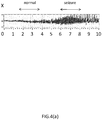
- Fig.4(a) and Fig.4(b) are used to illustrate the technical contents of the present invention.
- Fig.4(a) shows the brain electrical signal detected in seizure.
- the signal in Fig.4(a) is decomposed into a plurality of intrinsic feature sub-signals in a nonstationary decomposition method, as shown in Fig.4(b) .
- Each of the sub-signals in Fig.4(b) is demodulated into a frequency-modulation part and an amplitude-modulation part, as shown in Fig.4(c) .
- the modulation signals x(FM[2]) and x(AM[1,2]) are selected as the features to be used in the succeeding calculation.
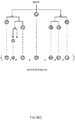
- the modulation signal x(AM[1]) is further decomposed to develop the intrinsic feature variation of the modulation signal, as shown in Fig.4(d) .
- Each of the signals in Fig.4(d) is further demodulated into a frequency-modulation part and an amplitude-modulation part, as shown in Fig.4(e) .
- the modulation signals x(AM[1(FM[1,2])]) and x(AM[1(AM[1,2])]) are selected as the feature modulation signals to be used in the succeeding calculation.
- all the feature modulation signals of interest can be obtained according to the feature mask to implement the succeeding calculation.
- the main application of the feature mask is to determine the number of decomposition and demodulation of signals and the positions of the selected feature modulation signals.
- M x(FM[2],AM[1(FM[1,2],AM[1,2]),2]
- the feature mask can also be expressed by a sequence matrix, wherein the odd-numbered matrix dimensions are the sequences of the post-decomposition sub-signals, and the even-numbered matrix dimensions are the sequences of the post-demodulation modulation signals, and wherein the number denotes the feature modulation signal selected by the matrix dimension.
- FM is arranged in the front
- AM is arranged in the rear.
- x(AM[1(FM[1,2])]) and x(AM[1(AM[1,2])]) can be denoted by ([2], [([1, 2] [1, 2]), 2]).
- the feature mask can also be expressed by a multidimensional matrix, such as a multidimensional Boolean matrix (abbreviated as T/F).
- T/F multidimensional Boolean matrix
- the demodulation converts the sub-signals into 2-dimensinal sequences having two modulation parts in form of [([],[]) ([],[]) ([],[])] with FM arranged before and AM arranged behind, wherein
- the modulation component is decomposed into three sub-signals of 3-dimensional sequences in form of [([() () ()],[() () ()]) ([() () ()],[() () ()]) ([() () ()],[() () ()])].
- the iterative demodulation converts the sub-signals into 4-dimensional sequences having two modulation components in form of [([([],[]) ([],[])([],[])],[([],[]) ([],[])([],[])]) ([([],[]) ([],[])],[([],[]) ([],[])]) ([([],[]) ([],[])]) ([([],[]) ([],[])]) ([([],[]) ([],[])])])] with FM arranged before and AM arranged behind.
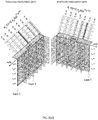
- a portion of the selected feature mask can be expressed as follows:
- x(FM[2], AM[1(FM[1,2], AM[1,2]), 2]) in the abovementioned example can be expressed by a multidimensional matrix denoted by [([F],[([T],[T]) ([T],[T]) ([F],[F])]) ([T],[T]) ([F],[F])].
- the present invention further provides calculations of intrinsic features, which are particularly useful for the multilayer neural network where many intrinsic features are not obvious in the primitive wave and the primitive frequency spectrum.
- the present invention not only presents variations of brain wave to enhance accuracy of the identification but also performs decomposition and analyzation with respect to different frequency modulations and amplitude modulations to form a multilayer and multidimensional feature space, which is sufficient to reveal nonstationary features of brain activity.
- the feature mask used by the present invention can significantly reduce the complexity the conventional technology suffers in decomposing signals and effectively reduce the load in computation. Therefore, the present invention can greatly promote the practicability of brain wave-based diagnosis in neurological diseases.
Landscapes
- Health & Medical Sciences (AREA)
- Life Sciences & Earth Sciences (AREA)
- Engineering & Computer Science (AREA)
- Biomedical Technology (AREA)
- Public Health (AREA)
- Medical Informatics (AREA)
- General Health & Medical Sciences (AREA)
- Physics & Mathematics (AREA)
- Pathology (AREA)
- Heart & Thoracic Surgery (AREA)
- Biophysics (AREA)
- Veterinary Medicine (AREA)
- Molecular Biology (AREA)
- Surgery (AREA)
- Animal Behavior & Ethology (AREA)
- Psychiatry (AREA)
- Psychology (AREA)
- Artificial Intelligence (AREA)
- Physiology (AREA)
- Neurosurgery (AREA)
- Neurology (AREA)
- Computer Vision & Pattern Recognition (AREA)
- Signal Processing (AREA)
- Epidemiology (AREA)
- Primary Health Care (AREA)
- Evolutionary Computation (AREA)
- Mathematical Physics (AREA)
- Fuzzy Systems (AREA)
- Databases & Information Systems (AREA)
- Data Mining & Analysis (AREA)
- Business, Economics & Management (AREA)
- General Business, Economics & Management (AREA)
- Measurement And Recording Of Electrical Phenomena And Electrical Characteristics Of The Living Body (AREA)
Applications Claiming Priority (1)
| Application Number | Priority Date | Filing Date | Title |
|---|---|---|---|
| TW106114720A TWI620546B (zh) | 2017-05-04 | 2017-05-04 | 腦波分析方法及其裝置 |
Publications (2)
| Publication Number | Publication Date |
|---|---|
| EP3398505A1 EP3398505A1 (en) | 2018-11-07 |
| EP3398505B1 true EP3398505B1 (en) | 2020-11-18 |
Family
ID=59034512
Family Applications (1)
| Application Number | Title | Priority Date | Filing Date |
|---|---|---|---|
| EP17175004.5A Active EP3398505B1 (en) | 2017-05-04 | 2017-06-08 | Brain activity analysis apparatus |
Country Status (6)
| Country | Link |
|---|---|
| US (2) | US10702175B2 (pt) |
| EP (1) | EP3398505B1 (pt) |
| CN (1) | CN107361765B (pt) |
| ES (1) | ES2854705T3 (pt) |
| PT (1) | PT3398505T (pt) |
| TW (1) | TWI620546B (pt) |
Families Citing this family (7)
| Publication number | Priority date | Publication date | Assignee | Title |
|---|---|---|---|---|
| CN109325402B (zh) * | 2018-08-06 | 2022-04-15 | 高维度(深圳)生物信息智能应用有限公司 | 一种信号处理方法、系统及计算机存储介质 |
| US11123564B2 (en) * | 2019-05-30 | 2021-09-21 | A-Neuron Electronic Corporation | Electrical stimulation controlling device and electrical stimulation system |
| US11602299B2 (en) * | 2020-06-16 | 2023-03-14 | A-Neuron Electronic Corporation | Method and system for processing electroencephalogram signal |
| CN111973179B (zh) * | 2020-08-25 | 2021-06-25 | 北京智源人工智能研究院 | 脑电波信号处理方法、装置、电子设备及存储介质 |
| US11697020B2 (en) | 2020-11-19 | 2023-07-11 | A-Neuron Electronic Corporation | Method for generating stimulation parameters, electrical stimulation control apparatus and electrical stimulation system |
| TWI839176B (zh) * | 2023-04-10 | 2024-04-11 | 臺北醫學大學 | 睡眠分期資訊偵測方法以及使用該方法的電子裝置與伺服器 |
| CN117390531B (zh) * | 2023-11-20 | 2024-04-02 | 兰州交通大学 | 一种基于ieemd脑电信号分解的抑郁症自动识别方法 |
Family Cites Families (13)
| Publication number | Priority date | Publication date | Assignee | Title |
|---|---|---|---|---|
| US6480743B1 (en) | 2000-04-05 | 2002-11-12 | Neuropace, Inc. | System and method for adaptive brain stimulation |
| US6810285B2 (en) | 2001-06-28 | 2004-10-26 | Neuropace, Inc. | Seizure sensing and detection using an implantable device |
| WO2005117693A1 (en) * | 2004-05-27 | 2005-12-15 | Children's Medical Center Corporation | Patient-specific seizure onset detection system |
| CN101259016A (zh) * | 2007-03-06 | 2008-09-10 | 李小俚 | 实时自动检测癫痫特征波的方法 |
| US8131352B2 (en) | 2007-06-20 | 2012-03-06 | Neuropace, Inc. | System and method for automatically adjusting detection thresholds in a feedback-controlled neurological event detector |
| CN101810479B (zh) * | 2009-12-16 | 2011-09-14 | 天津大学 | 复合下肢想象动作脑电的相位特征提取方法 |
| CN101869477B (zh) * | 2010-05-14 | 2011-09-14 | 北京工业大学 | 一种自适应脑电信号中眼电伪迹的自动去除方法 |
| DK2663229T3 (da) * | 2011-01-12 | 2021-09-20 | T&W Eng A/S | Bi-hemisfærisk hjernebølgesystem og fremgangsmåde til at udføre bi-hemisfærisk hjernebølgemålinger |
| TWI487503B (zh) | 2012-02-01 | 2015-06-11 | Univ Nat Cheng Kung | 自動睡眠分期裝置 |
| CN102824173B (zh) * | 2012-09-17 | 2014-04-02 | 北京理工大学 | 一种脑电图信号分类方法 |
| CN104757968A (zh) * | 2014-08-08 | 2015-07-08 | 沈阳工业大学 | 儿童失神性癫痫发作情况的中间数据统计评价方法 |
| US20160045127A1 (en) * | 2014-08-15 | 2016-02-18 | The Regents Of The University Of Michigan | Automated detector and classifier of high frequency oscillations and indicator seizure onset |
| CN106539582A (zh) * | 2015-09-17 | 2017-03-29 | 中央大学 | 脑功能成像辨识的方法及系统 |
-
2017
- 2017-05-04 TW TW106114720A patent/TWI620546B/zh active
- 2017-05-12 CN CN201710335642.0A patent/CN107361765B/zh active Active
- 2017-06-08 EP EP17175004.5A patent/EP3398505B1/en active Active
- 2017-06-08 PT PT171750045T patent/PT3398505T/pt unknown
- 2017-06-08 ES ES17175004T patent/ES2854705T3/es active Active
- 2017-07-06 US US15/642,510 patent/US10702175B2/en active Active
-
2020
- 2020-05-21 US US16/880,007 patent/US11638562B2/en active Active
Non-Patent Citations (1)
| Title |
|---|
| None * |
Also Published As
| Publication number | Publication date |
|---|---|
| TWI620546B (zh) | 2018-04-11 |
| US11638562B2 (en) | 2023-05-02 |
| ES2854705T3 (es) | 2021-09-22 |
| US20200281492A1 (en) | 2020-09-10 |
| EP3398505A1 (en) | 2018-11-07 |
| PT3398505T (pt) | 2021-02-19 |
| US10702175B2 (en) | 2020-07-07 |
| US20180317792A1 (en) | 2018-11-08 |
| CN107361765A (zh) | 2017-11-21 |
| CN107361765B (zh) | 2020-03-31 |
| TW201842881A (zh) | 2018-12-16 |
Similar Documents
| Publication | Publication Date | Title |
|---|---|---|
| EP3398505B1 (en) | Brain activity analysis apparatus | |
| Atal et al. | Arrhythmia classification with ECG signals based on the optimization-enabled deep convolutional neural network | |
| Liu et al. | Epileptic seizure detection and prediction in EEGs using power spectra density parameterization | |
| Safieddine et al. | Removal of muscle artifact from EEG data: comparison between stochastic (ICA and CCA) and deterministic (EMD and wavelet-based) approaches | |
| US5749367A (en) | Heart monitoring apparatus and method | |
| Chen et al. | Epileptic focus localization using discrete wavelet transform based on interictal intracranial EEG | |
| Bouaziz et al. | Multiresolution wavelet‐based QRS complex detection algorithm suited to several abnormal morphologies | |
| Kelwade et al. | Radial basis function neural network for prediction of cardiac arrhythmias based on heart rate time series | |
| Kelwade et al. | Prediction of cardiac arrhythmia using artificial neural network | |
| CN107303177B (zh) | 一种心电图t波、p波的检测方法及系统 | |
| Thai et al. | Toward an IoT-based expert system for heart disease diagnosis | |
| Murthy et al. | Design and implementation of hybrid techniques and DA-based reconfigurable FIR filter design for noise removal in EEG signals on FPGA | |
| Chandar et al. | False Alarm Reduction in ICU Using Ensemble Classifier Approach. | |
| Faes et al. | A method for the time-varying nonlinear prediction of complex nonstationary biomedical signals | |
| Tun et al. | Analysis of heart rate variability based on quantitative approach | |
| Cohen et al. | Adaptive real-time wavelet detection | |
| Karim et al. | Analysis of empirical mode decomposition method of heart rate extraction from motion artifact corrupted PPG Signal | |
| Bhavsar | Improved ECG Denoising using CEEMAN based on Complexity Measure and Nonlocal Mean Approach. | |
| EP3925537B1 (en) | Method and system for processing an electroencephalogram signal | |
| KR101418332B1 (ko) | 간질 뇌파 데이터 분석 방법 및 이를 지원하는 단말기 | |
| Kulcickis-Gutas et al. | Wavelet Based Denoising and Cross Correlation for Identifying Features in CTG Traces | |
| Gomes et al. | A lightweight embedded solution for ECG filtering and QRS complexes localization using wavelets | |
| Lee et al. | Multiscale sample entropy based on discrete wavelet transform for clinical heart rate variability recognition | |
| CN121754198A (zh) | 一种神经系统功能状态评估方法、系统、设备及介质 | |
| Conigliaro et al. | Early detection of epileptic seizures in sparse domains |
Legal Events
| Date | Code | Title | Description |
|---|---|---|---|
| PUAI | Public reference made under article 153(3) epc to a published international application that has entered the european phase |
Free format text: ORIGINAL CODE: 0009012 |
|
| STAA | Information on the status of an ep patent application or granted ep patent |
Free format text: STATUS: REQUEST FOR EXAMINATION WAS MADE |
|
| 17P | Request for examination filed |
Effective date: 20170901 |
|
| AK | Designated contracting states |
Kind code of ref document: A1 Designated state(s): AL AT BE BG CH CY CZ DE DK EE ES FI FR GB GR HR HU IE IS IT LI LT LU LV MC MK MT NL NO PL PT RO RS SE SI SK SM TR |
|
| AX | Request for extension of the european patent |
Extension state: BA ME |
|
| GRAP | Despatch of communication of intention to grant a patent |
Free format text: ORIGINAL CODE: EPIDOSNIGR1 |
|
| STAA | Information on the status of an ep patent application or granted ep patent |
Free format text: STATUS: GRANT OF PATENT IS INTENDED |
|
| RIC1 | Information provided on ipc code assigned before grant |
Ipc: G16H 50/20 20180101ALI20200514BHEP Ipc: A61B 5/048 20060101ALI20200514BHEP Ipc: A61B 5/00 20060101AFI20200514BHEP Ipc: A61B 5/0476 20060101ALI20200514BHEP |
|
| INTG | Intention to grant announced |
Effective date: 20200605 |
|
| GRAS | Grant fee paid |
Free format text: ORIGINAL CODE: EPIDOSNIGR3 |
|
| GRAA | (expected) grant |
Free format text: ORIGINAL CODE: 0009210 |
|
| STAA | Information on the status of an ep patent application or granted ep patent |
Free format text: STATUS: THE PATENT HAS BEEN GRANTED |
|
| AK | Designated contracting states |
Kind code of ref document: B1 Designated state(s): AL AT BE BG CH CY CZ DE DK EE ES FI FR GB GR HR HU IE IS IT LI LT LU LV MC MK MT NL NO PL PT RO RS SE SI SK SM TR |
|
| REG | Reference to a national code |
Ref country code: GB Ref legal event code: FG4D |
|
| REG | Reference to a national code |
Ref country code: CH Ref legal event code: EP |
|
| REG | Reference to a national code |
Ref country code: IE Ref legal event code: FG4D |
|
| REG | Reference to a national code |
Ref country code: DE Ref legal event code: R096 Ref document number: 602017027628 Country of ref document: DE |
|
| REG | Reference to a national code |
Ref country code: AT Ref legal event code: REF Ref document number: 1334835 Country of ref document: AT Kind code of ref document: T Effective date: 20201215 |
|
| REG | Reference to a national code |
Ref country code: PT Ref legal event code: SC4A Ref document number: 3398505 Country of ref document: PT Date of ref document: 20210219 Kind code of ref document: T Free format text: AVAILABILITY OF NATIONAL TRANSLATION Effective date: 20210215 |
|
| REG | Reference to a national code |
Ref country code: NL Ref legal event code: FP |
|
| REG | Reference to a national code |
Ref country code: SE Ref legal event code: TRGR |
|
| PG25 | Lapsed in a contracting state [announced via postgrant information from national office to epo] |
Ref country code: RS Free format text: LAPSE BECAUSE OF FAILURE TO SUBMIT A TRANSLATION OF THE DESCRIPTION OR TO PAY THE FEE WITHIN THE PRESCRIBED TIME-LIMIT Effective date: 20201118 Ref country code: NO Free format text: LAPSE BECAUSE OF FAILURE TO SUBMIT A TRANSLATION OF THE DESCRIPTION OR TO PAY THE FEE WITHIN THE PRESCRIBED TIME-LIMIT Effective date: 20210218 Ref country code: FI Free format text: LAPSE BECAUSE OF FAILURE TO SUBMIT A TRANSLATION OF THE DESCRIPTION OR TO PAY THE FEE WITHIN THE PRESCRIBED TIME-LIMIT Effective date: 20201118 Ref country code: GR Free format text: LAPSE BECAUSE OF FAILURE TO SUBMIT A TRANSLATION OF THE DESCRIPTION OR TO PAY THE FEE WITHIN THE PRESCRIBED TIME-LIMIT Effective date: 20210219 |
|
| PG25 | Lapsed in a contracting state [announced via postgrant information from national office to epo] |
Ref country code: BG Free format text: LAPSE BECAUSE OF FAILURE TO SUBMIT A TRANSLATION OF THE DESCRIPTION OR TO PAY THE FEE WITHIN THE PRESCRIBED TIME-LIMIT Effective date: 20210218 Ref country code: PL Free format text: LAPSE BECAUSE OF FAILURE TO SUBMIT A TRANSLATION OF THE DESCRIPTION OR TO PAY THE FEE WITHIN THE PRESCRIBED TIME-LIMIT Effective date: 20201118 Ref country code: LV Free format text: LAPSE BECAUSE OF FAILURE TO SUBMIT A TRANSLATION OF THE DESCRIPTION OR TO PAY THE FEE WITHIN THE PRESCRIBED TIME-LIMIT Effective date: 20201118 Ref country code: IS Free format text: LAPSE BECAUSE OF FAILURE TO SUBMIT A TRANSLATION OF THE DESCRIPTION OR TO PAY THE FEE WITHIN THE PRESCRIBED TIME-LIMIT Effective date: 20210318 |
|
| REG | Reference to a national code |
Ref country code: LT Ref legal event code: MG9D |
|
| PG25 | Lapsed in a contracting state [announced via postgrant information from national office to epo] |
Ref country code: HR Free format text: LAPSE BECAUSE OF FAILURE TO SUBMIT A TRANSLATION OF THE DESCRIPTION OR TO PAY THE FEE WITHIN THE PRESCRIBED TIME-LIMIT Effective date: 20201118 |
|
| PG25 | Lapsed in a contracting state [announced via postgrant information from national office to epo] |
Ref country code: SK Free format text: LAPSE BECAUSE OF FAILURE TO SUBMIT A TRANSLATION OF THE DESCRIPTION OR TO PAY THE FEE WITHIN THE PRESCRIBED TIME-LIMIT Effective date: 20201118 Ref country code: RO Free format text: LAPSE BECAUSE OF FAILURE TO SUBMIT A TRANSLATION OF THE DESCRIPTION OR TO PAY THE FEE WITHIN THE PRESCRIBED TIME-LIMIT Effective date: 20201118 Ref country code: SM Free format text: LAPSE BECAUSE OF FAILURE TO SUBMIT A TRANSLATION OF THE DESCRIPTION OR TO PAY THE FEE WITHIN THE PRESCRIBED TIME-LIMIT Effective date: 20201118 Ref country code: LT Free format text: LAPSE BECAUSE OF FAILURE TO SUBMIT A TRANSLATION OF THE DESCRIPTION OR TO PAY THE FEE WITHIN THE PRESCRIBED TIME-LIMIT Effective date: 20201118 Ref country code: EE Free format text: LAPSE BECAUSE OF FAILURE TO SUBMIT A TRANSLATION OF THE DESCRIPTION OR TO PAY THE FEE WITHIN THE PRESCRIBED TIME-LIMIT Effective date: 20201118 Ref country code: CZ Free format text: LAPSE BECAUSE OF FAILURE TO SUBMIT A TRANSLATION OF THE DESCRIPTION OR TO PAY THE FEE WITHIN THE PRESCRIBED TIME-LIMIT Effective date: 20201118 |
|
| REG | Reference to a national code |
Ref country code: DE Ref legal event code: R097 Ref document number: 602017027628 Country of ref document: DE |
|
| PG25 | Lapsed in a contracting state [announced via postgrant information from national office to epo] |
Ref country code: DK Free format text: LAPSE BECAUSE OF FAILURE TO SUBMIT A TRANSLATION OF THE DESCRIPTION OR TO PAY THE FEE WITHIN THE PRESCRIBED TIME-LIMIT Effective date: 20201118 |
|
| REG | Reference to a national code |
Ref country code: ES Ref legal event code: FG2A Ref document number: 2854705 Country of ref document: ES Kind code of ref document: T3 Effective date: 20210922 |
|
| PLBE | No opposition filed within time limit |
Free format text: ORIGINAL CODE: 0009261 |
|
| STAA | Information on the status of an ep patent application or granted ep patent |
Free format text: STATUS: NO OPPOSITION FILED WITHIN TIME LIMIT |
|
| 26N | No opposition filed |
Effective date: 20210819 |
|
| PG25 | Lapsed in a contracting state [announced via postgrant information from national office to epo] |
Ref country code: AL Free format text: LAPSE BECAUSE OF FAILURE TO SUBMIT A TRANSLATION OF THE DESCRIPTION OR TO PAY THE FEE WITHIN THE PRESCRIBED TIME-LIMIT Effective date: 20201118 |
|
| PG25 | Lapsed in a contracting state [announced via postgrant information from national office to epo] |
Ref country code: SI Free format text: LAPSE BECAUSE OF FAILURE TO SUBMIT A TRANSLATION OF THE DESCRIPTION OR TO PAY THE FEE WITHIN THE PRESCRIBED TIME-LIMIT Effective date: 20201118 |
|
| PG25 | Lapsed in a contracting state [announced via postgrant information from national office to epo] |
Ref country code: MC Free format text: LAPSE BECAUSE OF FAILURE TO SUBMIT A TRANSLATION OF THE DESCRIPTION OR TO PAY THE FEE WITHIN THE PRESCRIBED TIME-LIMIT Effective date: 20201118 |
|
| PG25 | Lapsed in a contracting state [announced via postgrant information from national office to epo] |
Ref country code: LU Free format text: LAPSE BECAUSE OF NON-PAYMENT OF DUE FEES Effective date: 20210608 |
|
| PG25 | Lapsed in a contracting state [announced via postgrant information from national office to epo] |
Ref country code: IS Free format text: LAPSE BECAUSE OF FAILURE TO SUBMIT A TRANSLATION OF THE DESCRIPTION OR TO PAY THE FEE WITHIN THE PRESCRIBED TIME-LIMIT Effective date: 20210318 |
|
| REG | Reference to a national code |
Ref country code: AT Ref legal event code: UEP Ref document number: 1334835 Country of ref document: AT Kind code of ref document: T Effective date: 20201118 |
|
| PG25 | Lapsed in a contracting state [announced via postgrant information from national office to epo] |
Ref country code: CY Free format text: LAPSE BECAUSE OF FAILURE TO SUBMIT A TRANSLATION OF THE DESCRIPTION OR TO PAY THE FEE WITHIN THE PRESCRIBED TIME-LIMIT Effective date: 20201118 |
|
| P01 | Opt-out of the competence of the unified patent court (upc) registered |
Effective date: 20230602 |
|
| PG25 | Lapsed in a contracting state [announced via postgrant information from national office to epo] |
Ref country code: HU Free format text: LAPSE BECAUSE OF FAILURE TO SUBMIT A TRANSLATION OF THE DESCRIPTION OR TO PAY THE FEE WITHIN THE PRESCRIBED TIME-LIMIT; INVALID AB INITIO Effective date: 20170608 |
|
| PG25 | Lapsed in a contracting state [announced via postgrant information from national office to epo] |
Ref country code: MK Free format text: LAPSE BECAUSE OF FAILURE TO SUBMIT A TRANSLATION OF THE DESCRIPTION OR TO PAY THE FEE WITHIN THE PRESCRIBED TIME-LIMIT Effective date: 20201118 |
|
| PG25 | Lapsed in a contracting state [announced via postgrant information from national office to epo] |
Ref country code: MT Free format text: LAPSE BECAUSE OF FAILURE TO SUBMIT A TRANSLATION OF THE DESCRIPTION OR TO PAY THE FEE WITHIN THE PRESCRIBED TIME-LIMIT Effective date: 20201118 |
|
| PGFP | Annual fee paid to national office [announced via postgrant information from national office to epo] |
Ref country code: DE Payment date: 20250618 Year of fee payment: 9 |
|
| PGFP | Annual fee paid to national office [announced via postgrant information from national office to epo] |
Ref country code: GB Payment date: 20250618 Year of fee payment: 9 |
|
| PGFP | Annual fee paid to national office [announced via postgrant information from national office to epo] |
Ref country code: NL Payment date: 20250618 Year of fee payment: 9 Ref country code: BE Payment date: 20250618 Year of fee payment: 9 |
|
| PGFP | Annual fee paid to national office [announced via postgrant information from national office to epo] |
Ref country code: PT Payment date: 20250529 Year of fee payment: 9 |
|
| PGFP | Annual fee paid to national office [announced via postgrant information from national office to epo] |
Ref country code: FR Payment date: 20250625 Year of fee payment: 9 |
|
| PGFP | Annual fee paid to national office [announced via postgrant information from national office to epo] |
Ref country code: AT Payment date: 20250620 Year of fee payment: 9 |
|
| PGFP | Annual fee paid to national office [announced via postgrant information from national office to epo] |
Ref country code: IE Payment date: 20250618 Year of fee payment: 9 |
|
| PGFP | Annual fee paid to national office [announced via postgrant information from national office to epo] |
Ref country code: SE Payment date: 20250618 Year of fee payment: 9 |
|
| PGFP | Annual fee paid to national office [announced via postgrant information from national office to epo] |
Ref country code: ES Payment date: 20250728 Year of fee payment: 9 |
|
| PGFP | Annual fee paid to national office [announced via postgrant information from national office to epo] |
Ref country code: IT Payment date: 20250624 Year of fee payment: 9 |
|
| PGFP | Annual fee paid to national office [announced via postgrant information from national office to epo] |
Ref country code: CH Payment date: 20250701 Year of fee payment: 9 |
|
| PG25 | Lapsed in a contracting state [announced via postgrant information from national office to epo] |
Ref country code: TR Free format text: LAPSE BECAUSE OF FAILURE TO SUBMIT A TRANSLATION OF THE DESCRIPTION OR TO PAY THE FEE WITHIN THE PRESCRIBED TIME-LIMIT Effective date: 20201118 |