EP3398679A1 - Cluster-geträgerter katalysator und herstellungsverfahren dafür - Google Patents
Cluster-geträgerter katalysator und herstellungsverfahren dafür Download PDFInfo
- Publication number
- EP3398679A1 EP3398679A1 EP16881742.7A EP16881742A EP3398679A1 EP 3398679 A1 EP3398679 A1 EP 3398679A1 EP 16881742 A EP16881742 A EP 16881742A EP 3398679 A1 EP3398679 A1 EP 3398679A1
- Authority
- EP
- European Patent Office
- Prior art keywords
- catalyst
- cluster
- temperature
- supporting
- supported
- Prior art date
- Legal status (The legal status is an assumption and is not a legal conclusion. Google has not performed a legal analysis and makes no representation as to the accuracy of the status listed.)
- Pending
Links
Images









Classifications
-
- B—PERFORMING OPERATIONS; TRANSPORTING
- B01—PHYSICAL OR CHEMICAL PROCESSES OR APPARATUS IN GENERAL
- B01J—CHEMICAL OR PHYSICAL PROCESSES, e.g. CATALYSIS OR COLLOID CHEMISTRY; THEIR RELEVANT APPARATUS
- B01J23/00—Catalysts comprising metals or metal oxides or hydroxides, not provided for in group B01J21/00
- B01J23/70—Catalysts comprising metals or metal oxides or hydroxides, not provided for in group B01J21/00 of the iron group metals or copper
- B01J23/72—Copper
-
- B—PERFORMING OPERATIONS; TRANSPORTING
- B01—PHYSICAL OR CHEMICAL PROCESSES OR APPARATUS IN GENERAL
- B01D—SEPARATION
- B01D53/00—Separation of gases or vapours; Recovering vapours of volatile solvents from gases; Chemical or biological purification of waste gases, e.g. engine exhaust gases, smoke, fumes, flue gases, aerosols
- B01D53/34—Chemical or biological purification of waste gases
- B01D53/74—General processes for purification of waste gases; Apparatus or devices specially adapted therefor
- B01D53/86—Catalytic processes
-
- B—PERFORMING OPERATIONS; TRANSPORTING
- B01—PHYSICAL OR CHEMICAL PROCESSES OR APPARATUS IN GENERAL
- B01J—CHEMICAL OR PHYSICAL PROCESSES, e.g. CATALYSIS OR COLLOID CHEMISTRY; THEIR RELEVANT APPARATUS
- B01J23/00—Catalysts comprising metals or metal oxides or hydroxides, not provided for in group B01J21/00
- B01J23/38—Catalysts comprising metals or metal oxides or hydroxides, not provided for in group B01J21/00 of noble metals
- B01J23/40—Catalysts comprising metals or metal oxides or hydroxides, not provided for in group B01J21/00 of noble metals of the platinum group metals
- B01J23/42—Platinum
-
- B—PERFORMING OPERATIONS; TRANSPORTING
- B01—PHYSICAL OR CHEMICAL PROCESSES OR APPARATUS IN GENERAL
- B01J—CHEMICAL OR PHYSICAL PROCESSES, e.g. CATALYSIS OR COLLOID CHEMISTRY; THEIR RELEVANT APPARATUS
- B01J23/00—Catalysts comprising metals or metal oxides or hydroxides, not provided for in group B01J21/00
- B01J23/38—Catalysts comprising metals or metal oxides or hydroxides, not provided for in group B01J21/00 of noble metals
- B01J23/40—Catalysts comprising metals or metal oxides or hydroxides, not provided for in group B01J21/00 of noble metals of the platinum group metals
- B01J23/44—Palladium
-
- B—PERFORMING OPERATIONS; TRANSPORTING
- B01—PHYSICAL OR CHEMICAL PROCESSES OR APPARATUS IN GENERAL
- B01J—CHEMICAL OR PHYSICAL PROCESSES, e.g. CATALYSIS OR COLLOID CHEMISTRY; THEIR RELEVANT APPARATUS
- B01J23/00—Catalysts comprising metals or metal oxides or hydroxides, not provided for in group B01J21/00
- B01J23/38—Catalysts comprising metals or metal oxides or hydroxides, not provided for in group B01J21/00 of noble metals
- B01J23/40—Catalysts comprising metals or metal oxides or hydroxides, not provided for in group B01J21/00 of noble metals of the platinum group metals
- B01J23/46—Ruthenium, rhodium, osmium or iridium
- B01J23/464—Rhodium
-
- B—PERFORMING OPERATIONS; TRANSPORTING
- B01—PHYSICAL OR CHEMICAL PROCESSES OR APPARATUS IN GENERAL
- B01J—CHEMICAL OR PHYSICAL PROCESSES, e.g. CATALYSIS OR COLLOID CHEMISTRY; THEIR RELEVANT APPARATUS
- B01J23/00—Catalysts comprising metals or metal oxides or hydroxides, not provided for in group B01J21/00
- B01J23/38—Catalysts comprising metals or metal oxides or hydroxides, not provided for in group B01J21/00 of noble metals
- B01J23/48—Silver or gold
- B01J23/52—Gold
-
- B—PERFORMING OPERATIONS; TRANSPORTING
- B01—PHYSICAL OR CHEMICAL PROCESSES OR APPARATUS IN GENERAL
- B01J—CHEMICAL OR PHYSICAL PROCESSES, e.g. CATALYSIS OR COLLOID CHEMISTRY; THEIR RELEVANT APPARATUS
- B01J23/00—Catalysts comprising metals or metal oxides or hydroxides, not provided for in group B01J21/00
- B01J23/70—Catalysts comprising metals or metal oxides or hydroxides, not provided for in group B01J21/00 of the iron group metals or copper
- B01J23/74—Iron group metals
- B01J23/745—Iron
-
- B—PERFORMING OPERATIONS; TRANSPORTING
- B01—PHYSICAL OR CHEMICAL PROCESSES OR APPARATUS IN GENERAL
- B01J—CHEMICAL OR PHYSICAL PROCESSES, e.g. CATALYSIS OR COLLOID CHEMISTRY; THEIR RELEVANT APPARATUS
- B01J29/00—Catalysts comprising molecular sieves
- B01J29/04—Catalysts comprising molecular sieves having base-exchange properties, e.g. crystalline zeolites
- B01J29/06—Crystalline aluminosilicate zeolites; Isomorphous compounds thereof
- B01J29/064—Crystalline aluminosilicate zeolites; Isomorphous compounds thereof containing iron group metals, noble metals or copper
- B01J29/072—Iron group metals or copper
-
- B—PERFORMING OPERATIONS; TRANSPORTING
- B01—PHYSICAL OR CHEMICAL PROCESSES OR APPARATUS IN GENERAL
- B01J—CHEMICAL OR PHYSICAL PROCESSES, e.g. CATALYSIS OR COLLOID CHEMISTRY; THEIR RELEVANT APPARATUS
- B01J29/00—Catalysts comprising molecular sieves
- B01J29/04—Catalysts comprising molecular sieves having base-exchange properties, e.g. crystalline zeolites
- B01J29/06—Crystalline aluminosilicate zeolites; Isomorphous compounds thereof
- B01J29/08—Crystalline aluminosilicate zeolites; Isomorphous compounds thereof of the faujasite type, e.g. type X or Y
- B01J29/10—Crystalline aluminosilicate zeolites; Isomorphous compounds thereof of the faujasite type, e.g. type X or Y containing iron group metals, noble metals or copper
- B01J29/106—Y-type faujasite
-
- B—PERFORMING OPERATIONS; TRANSPORTING
- B01—PHYSICAL OR CHEMICAL PROCESSES OR APPARATUS IN GENERAL
- B01J—CHEMICAL OR PHYSICAL PROCESSES, e.g. CATALYSIS OR COLLOID CHEMISTRY; THEIR RELEVANT APPARATUS
- B01J29/00—Catalysts comprising molecular sieves
- B01J29/04—Catalysts comprising molecular sieves having base-exchange properties, e.g. crystalline zeolites
- B01J29/06—Crystalline aluminosilicate zeolites; Isomorphous compounds thereof
- B01J29/08—Crystalline aluminosilicate zeolites; Isomorphous compounds thereof of the faujasite type, e.g. type X or Y
- B01J29/10—Crystalline aluminosilicate zeolites; Isomorphous compounds thereof of the faujasite type, e.g. type X or Y containing iron group metals, noble metals or copper
- B01J29/12—Noble metals
- B01J29/126—Y-type faujasite
-
- B—PERFORMING OPERATIONS; TRANSPORTING
- B01—PHYSICAL OR CHEMICAL PROCESSES OR APPARATUS IN GENERAL
- B01J—CHEMICAL OR PHYSICAL PROCESSES, e.g. CATALYSIS OR COLLOID CHEMISTRY; THEIR RELEVANT APPARATUS
- B01J29/00—Catalysts comprising molecular sieves
- B01J29/04—Catalysts comprising molecular sieves having base-exchange properties, e.g. crystalline zeolites
- B01J29/06—Crystalline aluminosilicate zeolites; Isomorphous compounds thereof
- B01J29/08—Crystalline aluminosilicate zeolites; Isomorphous compounds thereof of the faujasite type, e.g. type X or Y
- B01J29/10—Crystalline aluminosilicate zeolites; Isomorphous compounds thereof of the faujasite type, e.g. type X or Y containing iron group metals, noble metals or copper
- B01J29/14—Iron group metals or copper
- B01J29/146—Y-type faujasite
-
- B—PERFORMING OPERATIONS; TRANSPORTING
- B01—PHYSICAL OR CHEMICAL PROCESSES OR APPARATUS IN GENERAL
- B01J—CHEMICAL OR PHYSICAL PROCESSES, e.g. CATALYSIS OR COLLOID CHEMISTRY; THEIR RELEVANT APPARATUS
- B01J29/00—Catalysts comprising molecular sieves
- B01J29/04—Catalysts comprising molecular sieves having base-exchange properties, e.g. crystalline zeolites
- B01J29/06—Crystalline aluminosilicate zeolites; Isomorphous compounds thereof
- B01J29/40—Crystalline aluminosilicate zeolites; Isomorphous compounds thereof of the pentasil type, e.g. types ZSM-5, ZSM-8 or ZSM-11, as exemplified by patent documents US3702886, GB1334243 and US3709979, respectively
-
- B—PERFORMING OPERATIONS; TRANSPORTING
- B01—PHYSICAL OR CHEMICAL PROCESSES OR APPARATUS IN GENERAL
- B01J—CHEMICAL OR PHYSICAL PROCESSES, e.g. CATALYSIS OR COLLOID CHEMISTRY; THEIR RELEVANT APPARATUS
- B01J29/00—Catalysts comprising molecular sieves
- B01J29/04—Catalysts comprising molecular sieves having base-exchange properties, e.g. crystalline zeolites
- B01J29/06—Crystalline aluminosilicate zeolites; Isomorphous compounds thereof
- B01J29/40—Crystalline aluminosilicate zeolites; Isomorphous compounds thereof of the pentasil type, e.g. types ZSM-5, ZSM-8 or ZSM-11, as exemplified by patent documents US3702886, GB1334243 and US3709979, respectively
- B01J29/42—Crystalline aluminosilicate zeolites; Isomorphous compounds thereof of the pentasil type, e.g. types ZSM-5, ZSM-8 or ZSM-11, as exemplified by patent documents US3702886, GB1334243 and US3709979, respectively containing iron group metals, noble metals or copper
- B01J29/44—Noble metals
-
- B—PERFORMING OPERATIONS; TRANSPORTING
- B01—PHYSICAL OR CHEMICAL PROCESSES OR APPARATUS IN GENERAL
- B01J—CHEMICAL OR PHYSICAL PROCESSES, e.g. CATALYSIS OR COLLOID CHEMISTRY; THEIR RELEVANT APPARATUS
- B01J29/00—Catalysts comprising molecular sieves
- B01J29/04—Catalysts comprising molecular sieves having base-exchange properties, e.g. crystalline zeolites
- B01J29/06—Crystalline aluminosilicate zeolites; Isomorphous compounds thereof
- B01J29/40—Crystalline aluminosilicate zeolites; Isomorphous compounds thereof of the pentasil type, e.g. types ZSM-5, ZSM-8 or ZSM-11, as exemplified by patent documents US3702886, GB1334243 and US3709979, respectively
- B01J29/42—Crystalline aluminosilicate zeolites; Isomorphous compounds thereof of the pentasil type, e.g. types ZSM-5, ZSM-8 or ZSM-11, as exemplified by patent documents US3702886, GB1334243 and US3709979, respectively containing iron group metals, noble metals or copper
- B01J29/46—Iron group metals or copper
-
- B—PERFORMING OPERATIONS; TRANSPORTING
- B01—PHYSICAL OR CHEMICAL PROCESSES OR APPARATUS IN GENERAL
- B01J—CHEMICAL OR PHYSICAL PROCESSES, e.g. CATALYSIS OR COLLOID CHEMISTRY; THEIR RELEVANT APPARATUS
- B01J29/00—Catalysts comprising molecular sieves
- B01J29/04—Catalysts comprising molecular sieves having base-exchange properties, e.g. crystalline zeolites
- B01J29/06—Crystalline aluminosilicate zeolites; Isomorphous compounds thereof
- B01J29/70—Crystalline aluminosilicate zeolites; Isomorphous compounds thereof of types characterised by their specific structure not provided for in groups B01J29/08 - B01J29/65
-
- B—PERFORMING OPERATIONS; TRANSPORTING
- B01—PHYSICAL OR CHEMICAL PROCESSES OR APPARATUS IN GENERAL
- B01J—CHEMICAL OR PHYSICAL PROCESSES, e.g. CATALYSIS OR COLLOID CHEMISTRY; THEIR RELEVANT APPARATUS
- B01J29/00—Catalysts comprising molecular sieves
- B01J29/04—Catalysts comprising molecular sieves having base-exchange properties, e.g. crystalline zeolites
- B01J29/06—Crystalline aluminosilicate zeolites; Isomorphous compounds thereof
- B01J29/70—Crystalline aluminosilicate zeolites; Isomorphous compounds thereof of types characterised by their specific structure not provided for in groups B01J29/08 - B01J29/65
- B01J29/7007—Zeolite Beta
-
- B—PERFORMING OPERATIONS; TRANSPORTING
- B01—PHYSICAL OR CHEMICAL PROCESSES OR APPARATUS IN GENERAL
- B01J—CHEMICAL OR PHYSICAL PROCESSES, e.g. CATALYSIS OR COLLOID CHEMISTRY; THEIR RELEVANT APPARATUS
- B01J29/00—Catalysts comprising molecular sieves
- B01J29/04—Catalysts comprising molecular sieves having base-exchange properties, e.g. crystalline zeolites
- B01J29/06—Crystalline aluminosilicate zeolites; Isomorphous compounds thereof
- B01J29/70—Crystalline aluminosilicate zeolites; Isomorphous compounds thereof of types characterised by their specific structure not provided for in groups B01J29/08 - B01J29/65
- B01J29/7015—CHA-type, e.g. Chabazite, LZ-218
-
- B—PERFORMING OPERATIONS; TRANSPORTING
- B01—PHYSICAL OR CHEMICAL PROCESSES OR APPARATUS IN GENERAL
- B01J—CHEMICAL OR PHYSICAL PROCESSES, e.g. CATALYSIS OR COLLOID CHEMISTRY; THEIR RELEVANT APPARATUS
- B01J29/00—Catalysts comprising molecular sieves
- B01J29/04—Catalysts comprising molecular sieves having base-exchange properties, e.g. crystalline zeolites
- B01J29/06—Crystalline aluminosilicate zeolites; Isomorphous compounds thereof
- B01J29/70—Crystalline aluminosilicate zeolites; Isomorphous compounds thereof of types characterised by their specific structure not provided for in groups B01J29/08 - B01J29/65
- B01J29/72—Crystalline aluminosilicate zeolites; Isomorphous compounds thereof of types characterised by their specific structure not provided for in groups B01J29/08 - B01J29/65 containing iron group metals, noble metals or copper
- B01J29/74—Noble metals
-
- B—PERFORMING OPERATIONS; TRANSPORTING
- B01—PHYSICAL OR CHEMICAL PROCESSES OR APPARATUS IN GENERAL
- B01J—CHEMICAL OR PHYSICAL PROCESSES, e.g. CATALYSIS OR COLLOID CHEMISTRY; THEIR RELEVANT APPARATUS
- B01J29/00—Catalysts comprising molecular sieves
- B01J29/04—Catalysts comprising molecular sieves having base-exchange properties, e.g. crystalline zeolites
- B01J29/06—Crystalline aluminosilicate zeolites; Isomorphous compounds thereof
- B01J29/70—Crystalline aluminosilicate zeolites; Isomorphous compounds thereof of types characterised by their specific structure not provided for in groups B01J29/08 - B01J29/65
- B01J29/72—Crystalline aluminosilicate zeolites; Isomorphous compounds thereof of types characterised by their specific structure not provided for in groups B01J29/08 - B01J29/65 containing iron group metals, noble metals or copper
- B01J29/74—Noble metals
- B01J29/7415—Zeolite Beta
-
- B—PERFORMING OPERATIONS; TRANSPORTING
- B01—PHYSICAL OR CHEMICAL PROCESSES OR APPARATUS IN GENERAL
- B01J—CHEMICAL OR PHYSICAL PROCESSES, e.g. CATALYSIS OR COLLOID CHEMISTRY; THEIR RELEVANT APPARATUS
- B01J29/00—Catalysts comprising molecular sieves
- B01J29/04—Catalysts comprising molecular sieves having base-exchange properties, e.g. crystalline zeolites
- B01J29/06—Crystalline aluminosilicate zeolites; Isomorphous compounds thereof
- B01J29/70—Crystalline aluminosilicate zeolites; Isomorphous compounds thereof of types characterised by their specific structure not provided for in groups B01J29/08 - B01J29/65
- B01J29/72—Crystalline aluminosilicate zeolites; Isomorphous compounds thereof of types characterised by their specific structure not provided for in groups B01J29/08 - B01J29/65 containing iron group metals, noble metals or copper
- B01J29/76—Iron group metals or copper
- B01J29/763—CHA-type, e.g. Chabazite, LZ-218
-
- B—PERFORMING OPERATIONS; TRANSPORTING
- B01—PHYSICAL OR CHEMICAL PROCESSES OR APPARATUS IN GENERAL
- B01J—CHEMICAL OR PHYSICAL PROCESSES, e.g. CATALYSIS OR COLLOID CHEMISTRY; THEIR RELEVANT APPARATUS
- B01J37/00—Processes, in general, for preparing catalysts; Processes, in general, for activation of catalysts
- B01J37/02—Impregnation, coating or precipitation
- B01J37/0201—Impregnation
- B01J37/0203—Impregnation the impregnation liquid containing organic compounds
-
- B—PERFORMING OPERATIONS; TRANSPORTING
- B01—PHYSICAL OR CHEMICAL PROCESSES OR APPARATUS IN GENERAL
- B01J—CHEMICAL OR PHYSICAL PROCESSES, e.g. CATALYSIS OR COLLOID CHEMISTRY; THEIR RELEVANT APPARATUS
- B01J37/00—Processes, in general, for preparing catalysts; Processes, in general, for activation of catalysts
- B01J37/02—Impregnation, coating or precipitation
- B01J37/0201—Impregnation
- B01J37/0211—Impregnation using a colloidal suspension
-
- B—PERFORMING OPERATIONS; TRANSPORTING
- B01—PHYSICAL OR CHEMICAL PROCESSES OR APPARATUS IN GENERAL
- B01J—CHEMICAL OR PHYSICAL PROCESSES, e.g. CATALYSIS OR COLLOID CHEMISTRY; THEIR RELEVANT APPARATUS
- B01J37/00—Processes, in general, for preparing catalysts; Processes, in general, for activation of catalysts
- B01J37/02—Impregnation, coating or precipitation
- B01J37/0201—Impregnation
- B01J37/0213—Preparation of the impregnating solution
-
- B—PERFORMING OPERATIONS; TRANSPORTING
- B01—PHYSICAL OR CHEMICAL PROCESSES OR APPARATUS IN GENERAL
- B01J—CHEMICAL OR PHYSICAL PROCESSES, e.g. CATALYSIS OR COLLOID CHEMISTRY; THEIR RELEVANT APPARATUS
- B01J37/00—Processes, in general, for preparing catalysts; Processes, in general, for activation of catalysts
- B01J37/02—Impregnation, coating or precipitation
- B01J37/0215—Coating
- B01J37/0221—Coating of particles
-
- B—PERFORMING OPERATIONS; TRANSPORTING
- B01—PHYSICAL OR CHEMICAL PROCESSES OR APPARATUS IN GENERAL
- B01J—CHEMICAL OR PHYSICAL PROCESSES, e.g. CATALYSIS OR COLLOID CHEMISTRY; THEIR RELEVANT APPARATUS
- B01J37/00—Processes, in general, for preparing catalysts; Processes, in general, for activation of catalysts
- B01J37/06—Washing
-
- B—PERFORMING OPERATIONS; TRANSPORTING
- B01—PHYSICAL OR CHEMICAL PROCESSES OR APPARATUS IN GENERAL
- B01J—CHEMICAL OR PHYSICAL PROCESSES, e.g. CATALYSIS OR COLLOID CHEMISTRY; THEIR RELEVANT APPARATUS
- B01J37/00—Processes, in general, for preparing catalysts; Processes, in general, for activation of catalysts
- B01J37/16—Reducing
-
- B—PERFORMING OPERATIONS; TRANSPORTING
- B01—PHYSICAL OR CHEMICAL PROCESSES OR APPARATUS IN GENERAL
- B01J—CHEMICAL OR PHYSICAL PROCESSES, e.g. CATALYSIS OR COLLOID CHEMISTRY; THEIR RELEVANT APPARATUS
- B01J37/00—Processes, in general, for preparing catalysts; Processes, in general, for activation of catalysts
- B01J37/34—Irradiation by, or application of, electric, magnetic or wave energy, e.g. ultrasonic waves ; Ionic sputtering; Flame or plasma spraying; Particle radiation
-
- B—PERFORMING OPERATIONS; TRANSPORTING
- B01—PHYSICAL OR CHEMICAL PROCESSES OR APPARATUS IN GENERAL
- B01J—CHEMICAL OR PHYSICAL PROCESSES, e.g. CATALYSIS OR COLLOID CHEMISTRY; THEIR RELEVANT APPARATUS
- B01J37/00—Processes, in general, for preparing catalysts; Processes, in general, for activation of catalysts
- B01J37/34—Irradiation by, or application of, electric, magnetic or wave energy, e.g. ultrasonic waves ; Ionic sputtering; Flame or plasma spraying; Particle radiation
- B01J37/341—Irradiation by, or application of, electric, magnetic or wave energy, e.g. ultrasonic waves ; Ionic sputtering; Flame or plasma spraying; Particle radiation making use of electric or magnetic fields, wave energy or particle radiation
- B01J37/344—Irradiation by, or application of, electric, magnetic or wave energy, e.g. ultrasonic waves ; Ionic sputtering; Flame or plasma spraying; Particle radiation making use of electric or magnetic fields, wave energy or particle radiation of electromagnetic wave energy
- B01J37/346—Irradiation by, or application of, electric, magnetic or wave energy, e.g. ultrasonic waves ; Ionic sputtering; Flame or plasma spraying; Particle radiation making use of electric or magnetic fields, wave energy or particle radiation of electromagnetic wave energy of microwave energy
-
- B—PERFORMING OPERATIONS; TRANSPORTING
- B01—PHYSICAL OR CHEMICAL PROCESSES OR APPARATUS IN GENERAL
- B01J—CHEMICAL OR PHYSICAL PROCESSES, e.g. CATALYSIS OR COLLOID CHEMISTRY; THEIR RELEVANT APPARATUS
- B01J37/00—Processes, in general, for preparing catalysts; Processes, in general, for activation of catalysts
- B01J37/34—Irradiation by, or application of, electric, magnetic or wave energy, e.g. ultrasonic waves ; Ionic sputtering; Flame or plasma spraying; Particle radiation
- B01J37/341—Irradiation by, or application of, electric, magnetic or wave energy, e.g. ultrasonic waves ; Ionic sputtering; Flame or plasma spraying; Particle radiation making use of electric or magnetic fields, wave energy or particle radiation
- B01J37/347—Ionic or cathodic spraying; Electric discharge
-
- B—PERFORMING OPERATIONS; TRANSPORTING
- B01—PHYSICAL OR CHEMICAL PROCESSES OR APPARATUS IN GENERAL
- B01J—CHEMICAL OR PHYSICAL PROCESSES, e.g. CATALYSIS OR COLLOID CHEMISTRY; THEIR RELEVANT APPARATUS
- B01J37/00—Processes, in general, for preparing catalysts; Processes, in general, for activation of catalysts
- B01J37/34—Irradiation by, or application of, electric, magnetic or wave energy, e.g. ultrasonic waves ; Ionic sputtering; Flame or plasma spraying; Particle radiation
- B01J37/349—Irradiation by, or application of, electric, magnetic or wave energy, e.g. ultrasonic waves ; Ionic sputtering; Flame or plasma spraying; Particle radiation making use of flames, plasmas or lasers
-
- H—ELECTRICITY
- H01—ELECTRIC ELEMENTS
- H01M—PROCESSES OR MEANS, e.g. BATTERIES, FOR THE DIRECT CONVERSION OF CHEMICAL ENERGY INTO ELECTRICAL ENERGY
- H01M4/00—Electrodes
- H01M4/86—Inert electrodes with catalytic activity, e.g. for fuel cells
- H01M4/90—Selection of catalytic material
- H01M4/9041—Metals or alloys
-
- H—ELECTRICITY
- H01—ELECTRIC ELEMENTS
- H01M—PROCESSES OR MEANS, e.g. BATTERIES, FOR THE DIRECT CONVERSION OF CHEMICAL ENERGY INTO ELECTRICAL ENERGY
- H01M4/00—Electrodes
- H01M4/86—Inert electrodes with catalytic activity, e.g. for fuel cells
- H01M4/90—Selection of catalytic material
- H01M4/9041—Metals or alloys
- H01M4/905—Metals or alloys specially used in fuel cell operating at high temperature, e.g. SOFC
- H01M4/9058—Metals or alloys specially used in fuel cell operating at high temperature, e.g. SOFC of noble metals or noble-metal based alloys
-
- H—ELECTRICITY
- H01—ELECTRIC ELEMENTS
- H01M—PROCESSES OR MEANS, e.g. BATTERIES, FOR THE DIRECT CONVERSION OF CHEMICAL ENERGY INTO ELECTRICAL ENERGY
- H01M4/00—Electrodes
- H01M4/86—Inert electrodes with catalytic activity, e.g. for fuel cells
- H01M4/90—Selection of catalytic material
- H01M4/9075—Catalytic material supported on carriers, e.g. powder carriers
-
- B—PERFORMING OPERATIONS; TRANSPORTING
- B01—PHYSICAL OR CHEMICAL PROCESSES OR APPARATUS IN GENERAL
- B01D—SEPARATION
- B01D2255/00—Catalysts
- B01D2255/10—Noble metals or compounds thereof
- B01D2255/102—Platinum group metals
- B01D2255/1021—Platinum
-
- B—PERFORMING OPERATIONS; TRANSPORTING
- B01—PHYSICAL OR CHEMICAL PROCESSES OR APPARATUS IN GENERAL
- B01D—SEPARATION
- B01D2255/00—Catalysts
- B01D2255/10—Noble metals or compounds thereof
- B01D2255/102—Platinum group metals
- B01D2255/1023—Palladium
-
- B—PERFORMING OPERATIONS; TRANSPORTING
- B01—PHYSICAL OR CHEMICAL PROCESSES OR APPARATUS IN GENERAL
- B01D—SEPARATION
- B01D2255/00—Catalysts
- B01D2255/10—Noble metals or compounds thereof
- B01D2255/102—Platinum group metals
- B01D2255/1025—Rhodium
-
- B—PERFORMING OPERATIONS; TRANSPORTING
- B01—PHYSICAL OR CHEMICAL PROCESSES OR APPARATUS IN GENERAL
- B01D—SEPARATION
- B01D2255/00—Catalysts
- B01D2255/10—Noble metals or compounds thereof
- B01D2255/106—Gold
-
- B—PERFORMING OPERATIONS; TRANSPORTING
- B01—PHYSICAL OR CHEMICAL PROCESSES OR APPARATUS IN GENERAL
- B01D—SEPARATION
- B01D2255/00—Catalysts
- B01D2255/20—Metals or compounds thereof
- B01D2255/207—Transition metals
- B01D2255/20761—Copper
-
- B—PERFORMING OPERATIONS; TRANSPORTING
- B01—PHYSICAL OR CHEMICAL PROCESSES OR APPARATUS IN GENERAL
- B01J—CHEMICAL OR PHYSICAL PROCESSES, e.g. CATALYSIS OR COLLOID CHEMISTRY; THEIR RELEVANT APPARATUS
- B01J2229/00—Aspects of molecular sieve catalysts not covered by B01J29/00
- B01J2229/10—After treatment, characterised by the effect to be obtained
- B01J2229/16—After treatment, characterised by the effect to be obtained to increase the Si/Al ratio; Dealumination
-
- B—PERFORMING OPERATIONS; TRANSPORTING
- B01—PHYSICAL OR CHEMICAL PROCESSES OR APPARATUS IN GENERAL
- B01J—CHEMICAL OR PHYSICAL PROCESSES, e.g. CATALYSIS OR COLLOID CHEMISTRY; THEIR RELEVANT APPARATUS
- B01J2229/00—Aspects of molecular sieve catalysts not covered by B01J29/00
- B01J2229/10—After treatment, characterised by the effect to be obtained
- B01J2229/18—After treatment, characterised by the effect to be obtained to introduce other elements into or onto the molecular sieve itself
- B01J2229/186—After treatment, characterised by the effect to be obtained to introduce other elements into or onto the molecular sieve itself not in framework positions
-
- B—PERFORMING OPERATIONS; TRANSPORTING
- B01—PHYSICAL OR CHEMICAL PROCESSES OR APPARATUS IN GENERAL
- B01J—CHEMICAL OR PHYSICAL PROCESSES, e.g. CATALYSIS OR COLLOID CHEMISTRY; THEIR RELEVANT APPARATUS
- B01J23/00—Catalysts comprising metals or metal oxides or hydroxides, not provided for in group B01J21/00
- B01J23/70—Catalysts comprising metals or metal oxides or hydroxides, not provided for in group B01J21/00 of the iron group metals or copper
- B01J23/74—Iron group metals
-
- Y—GENERAL TAGGING OF NEW TECHNOLOGICAL DEVELOPMENTS; GENERAL TAGGING OF CROSS-SECTIONAL TECHNOLOGIES SPANNING OVER SEVERAL SECTIONS OF THE IPC; TECHNICAL SUBJECTS COVERED BY FORMER USPC CROSS-REFERENCE ART COLLECTIONS [XRACs] AND DIGESTS
- Y02—TECHNOLOGIES OR APPLICATIONS FOR MITIGATION OR ADAPTATION AGAINST CLIMATE CHANGE
- Y02E—REDUCTION OF GREENHOUSE GAS [GHG] EMISSIONS, RELATED TO ENERGY GENERATION, TRANSMISSION OR DISTRIBUTION
- Y02E60/00—Enabling technologies; Technologies with a potential or indirect contribution to GHG emissions mitigation
- Y02E60/30—Hydrogen technology
- Y02E60/50—Fuel cells
Definitions
- the present invention relates to a cluster-supporting catalyst and a production method thereof. More specifically, the present invention relates to a cluster-supporting catalyst for exhaust gas purification, liquid-phase chemical synthesis reaction, gas-phase chemical synthesis reaction, fuel cell reaction, etc., and a production method thereof.
- a supported catalyst obtained by supporting a catalyst metal on a carrier is used in many fields and is used as a catalyst for exhaust gas purification, liquid-phase chemical synthesis reaction, gas-phase chemical synthesis reaction, fuel cell reaction, etc.
- Patent Document 1 has proposed a supported catalyst in which catalyst metal particles having a size of 1 to 10 nm are supported on a carrier of alumina, silica, titania, zirconia or a combination thereof.
- Patent Document 2 has proposed a catalyst for nitrogen oxide, in which copper ion is supported on zeolite by ion exchange.
- Patent Document 3 has proposed a technique where palladium supported on zeolite by ion exchange is dried and then clustered by a reduction treatment to prepare a cluster-supporting catalyst, and the cluster-supporting catalyst is used for a coupling reaction, etc.
- the cluster-supporting catalyst described in Patent Document 3 can exhibit reaction properties different from conventional catalysts, but there is room for improvement in regard to the heat resistance.
- a supported catalyst having an improved low-temperature activity for nitrogen oxide (NOx) reduction and/or carbon monoxide (CO) oxidation after thermal endurance is demanded.
- the present invention provides a cluster-supporting catalyst having improved heat resistance, and a production method thereof.
- the present invention provides a method for evaluating the size of catalyst metal particles in a supported catalyst. [Means to Solve the Problems]
- the present inventors have found that a specific cluster-supporting catalyst has improved heat resistance, and arrived at the present invention described below.
- an improved catalytic activity can be provided. Furthermore, according to the method of the present invention for evaluating the size of catalyst metal particles, the size of catalyst metal particles can be evaluated in a supported catalyst.
- a cluster-supporting catalyst particularly, the cluster-supporting catalyst of the present invention, including porous carrier particles having acid sites, and catalyst metal clusters supported within the pores of the porous carrier particles, is produced.
- This method includes: providing a dispersion liquid containing a dispersion medium and porous carrier particles dispersed in the dispersion medium; and in the dispersion liquid, forming catalyst metal clusters having a positive charge, and supporting the catalyst metal clusters on the acid sites within the pores of the porous carrier particles through an electrostatic interaction.
- the method may further include drying and firing the porous carrier particles having supported thereon the catalyst metal clusters.
- catalyst metal clusters are formed and the formed catalyst metal clusters are supported within the pores of the porous carrier particles, whereby catalyst metal clusters having a controlled size, particularly, catalyst metal clusters having a relatively uniform size, can be supported within the pores of the porous carrier particle.
- the size of the catalyst metal clusters can be controlled by adjusting the conditions for forming the catalyst metal clusters in the dispersion liquid.
- catalyst metal clusters can be supported within the pores of the porous carrier particles through an electrostatic interaction.
- the electrostatic interaction enables the catalyst metal clusters having a positive charge to be supported on the acid sites within the pores of the porous carrier particles having a negative charge.
- the catalyst metal constituting the catalyst metal clusters may be any metal or half-metal usable as a catalyst in the intended application.
- the catalyst metal is selected, for example, from the group consisting of gold, silver, platinum, palladium, rhodium, iridium, ruthenium, titanium, vanadium, chromium, manganese, iron, cobalt, nickel, copper, zinc, molybdenum, tungsten, rhenium, silicon, germanium, and a combination thereof.
- the cluster-supporting catalyst obtained by the method of the present invention can stably maintain the catalytic activity of the catalyst metal, and the catalytic activity of the catalyst metal can thereby be provided while reducing the use amount of the catalyst metal. Accordingly, the method of the present invention is effective particularly when an expensive catalyst metal is used, for example, when a catalyst metal selected from the group consisting of platinum, palladium, rhodium, iridium ruthenium and a combination thereof is used as the catalyst metal.
- the catalyst metal is preferably particles having a fine particle diameter.
- the catalyst metal particles can be confirmed to have a fine particle diameter by utilizing a phenomenon that when the metal particles have a particle diameter of 1 nm or less, particularly, when the metal particles are of a cluster size, the metal particles emits fluorescence upon irradiation with excitation light.
- the porous carrier particles may be any porous carrier particles usable in the intended application, and may be, for example, particles of a material selected from the group consisting of a microporous material, a mesoporous material, a macroporous material, and a combination thereof.
- the microporous material means a porous material in which a maximum peak in the volume-based pore diameter distribution is present in the range from more than 0.1 nm to 2 nm; the mesoporous material means a porous material in which a maximum peak in the pore diameter distribution above is present in the range from more than 2 nm to 50 nm; and the macroporous material means a porous material in which a maximum peak in the pore diameter distribution above is present in the range of more than 50 nm.
- the volume-based pore diameter distribution is a value by the nitrogen adsorption method and can be obtained according to BET equation (adsorption isotherm equation) by using, for example, an automatic specific surface area/porosimetry analyzer Tristar II 3020 Series (Shimadzu Corporation).
- the microporous material includes a material selected from the group consisting of activated carbon, zeolite, clay silicate, and a combination thereof.
- the zeolite may be a zeolite derivative or a heteroelement-doped zeolite, and the dissimilar element doped in the heteroelement-doped zeolite may be, for example, an element selected from the group consisting of boron, iron, germanium, gallium, lanthanum, titanium, and a combination thereof.
- the zeolite may be arbitrary zeolite usable in the intended application and includes, for example, A-type (code: LTA), ferrierite type (code: FER), MCM-22 type (code: MWW), ZSM-5 type, silicalite type (code: MFI), mordenite type (code: MOR), L-type (code: LTL), Y-type and X-type (code: FAU), beta-type (code: BEA), SSZ-type (code: CHA), and a combination thereof.
- A-type code: LTA
- FER ferrierite type
- MCM-22 type code: MWW
- ZSM-5 type ZSM-5 type
- silicalite type code: MFI
- mordenite type code: MOR
- L-type code: LTL
- Y-type and X-type code: FAU
- beta-type code: BEA
- SSZ-type code: CHA
- the mesoporous material includes a material selected from the group consisting of porous ionic crystal, mesoporous silica, mesoporous titania, and a combination thereof, which is, for example, MCM-41 and FSM-16.
- the mesoporous material includes Porous Coordination Polymer (PCP)/Metal-Organic Framework (MOF), which may have a pore diameter ranging from 0 to several nm.
- the macroporous material includes a macroporous metal oxide, a macroporous semiconductor oxide, and a combination thereof, for example, macroporous titanium oxide, macroporous tin oxide, and macroporous zinc oxide.
- the porous carrier particles are preferably a porous carrier having acid sites (i.e., electron-rich sites or sites having negative charges) in the pore, for example, zeolite, in order to stably support the catalyst metal within the pores and/or successfully bring out the activity of the catalyst metal supported.
- acid sites i.e., electron-rich sites or sites having negative charges
- zeolite particles are preferably used as the porous carrier particles. Because, in the case of using zeolite particles as the porous carrier particles, the catalyst metal clusters having a positive charge can be supported on the acid sites within the pores of the zeolite particles having a negative charge. Accordingly, the zeolite particles preferably have a relatively small zeta potential and may have a zeta potential of, for example, -50 mV or less, -70 mV or less, -90 mV or less, or -100 mV or less.
- the zeolite particles preferably has a relatively large number of acid sites, i.e., has a relatively small Si/Al ratio, and may have an Si/Al ratio of, for example, 500 or less, 300 or less, 100 or less, or 50 or less.
- the dispersion liquid can be provided by pulverizing the porous carrier particle and dispersing the pulverized porous carrier particles in the dispersion medium.
- the catalyst metal clusters can be accelerated to be supported within the pores of the porous carrier particle.
- a pulverized porous carrier particles have sometimes become amorphous, and the porous carrier particles may therefore be recrystallized, if desired, by annealing before or after the catalyst metal clusters are supported.
- any dispersion medium capable of drawing the catalyst metal clusters into the pores of the porous carrier particles through an electrostatic interaction between the catalyst metal clusters and the acid sites of the porous carrier particles can be used.
- the dispersion medium in the case where the catalyst metal clusters are supported within the pores of the porous carrier particles through an electrostatic interaction, can be selected so that the surface of the catalyst metal clusters can have a positive charge and the acid sites within the pores of the porous carrier particles can have a negative charge. Accordingly, in order to accelerate the catalyst metal clusters to be supported within the pores of the porous carrier particles, the zeta potential and/or the ionization rate of the catalyst metal clusters and/or the porous carrier particles can be adjusted by adjusting the pH of the dispersion medium and/or adding a salt to the dispersion medium.
- the surface potentials of the catalyst metal clusters and the porous carrier particles cannot be directly measured but can be known indirectly by measuring the zeta potential (interfacial electrokinetic potential).
- the zeta potential of platinum cluster greatly depends on pH and when the pH is 8 or less, the zeta potential slightly increases as the pH decreases. This is considered to occur because the platinum atom on the surface of the platinum cluster has been partially oxidized and the platinum atom on a part of the platinum cluster surface is protonated into Pt-H + the moment the oxidized platinum atom enters the Pt-OH state along with decrease in pH, as a result, the positive charge density increases, leading to an increase in the zeta potential.
- the zeta potential of the platinum cluster rapidly decreases as the pH increases. This is considered to occur because the platinum atom oxidized along with increase in pH becomes Pt-O - and furthermore, the platinum cluster surface is partially deprotonated, as a result, the positive charge density decreases, leading to a decrease in the zeta potential.
- the dispersion medium may be aqueous or nonaqueous, but it is generally preferable to use a nonaqueous dispersion medium, for example, an organic solvent. Because, if an aqueous dispersion medium is used, stabilization of the catalyst metal clusters occurs in the dispersion medium due to the high dielectric constant of water (dielectric constant: 80), i.e., the high polarity, and the catalyst metal clusters may thereby not be sufficiently supported within the pores of the porous carrier particle.
- dielectric constant of water dielectric constant: 80
- the catalyst metal clusters are not stabilized in the dispersion medium and can be supported within the pores of the porous carrier particles through an electrostatic interaction and stabilized there.
- a dispersion medium having a lower dielectric constant than that of water for example, a dispersion medium having a dielectric constant of 50 or less, 40 or less, 30 or less, 25 or less, or 20 or less
- acetone for example, a dispersion medium having a dielectric constant of 50 or less, 40 or less, 30 or less, 25 or less, or 20 or less
- acetone for example, a dispersion medium having a dielectric constant of 50 or less, 40 or less, 30 or less, 25 or less, or 20 or less
- acetone dielectric constant: 20
- 2-propanol for example, a dispersion medium having a dielectric constant of 50 or less, 40 or less, 30 or less, 25 or less, or 20 or less
- ethanol for example, a dispersion medium having a dielectric constant of 50 or less, 40 or less, 30 or less, 25 or less, or 20 or less
- acetone for example, a dispersion medium having a dielectric constant of 50 or less, 40
- the catalyst metal cluster particularly, the catalyst metal clusters having a positive charge, can be formed by any method in the dispersion medium.
- the method for forming such catalyst metal clusters includes methods such as method of laser ablation in liquid, method of microwave ablation in liquid, method of plasma abrasion in liquid, positive-negative inversion method, and method of reduction in liquid (liquid-phase reduction method).
- the method of laser ablation in liquid, method of microwave ablation in liquid and method of plasma ablation in liquid are a method of forming catalyst metal clusters by irradiating a catalyst metal target disposed in a dispersion medium with laser, microwave or plasma.
- zeolite and a metal ion source having a negative charge are caused to be present together in a solution, particularly, in an aqueous solution.
- a solution particularly, in an aqueous solution.
- platinum is caused to be present as a negative ion of [PtCl 6 ] 2- .
- an ion exchanger is not produced due to repulsive force between negative charges.
- a pulsed laser is converged and introduced into this solution.
- a plasma is generated in the laser focus region to produce various chemical species (a metal ion from which a ligand is removed, a plasma metal ion produced after electron detachment of a negative metal ion source, etc.) from the metal ion source, and furthermore, a neutral metal atom forms an aggregate with a positive metal ion to produce a positively charged metal clusters.
- the positively charged metal cluster produced in this way is supported on the acid sites of zeolite through an electrostatic interaction.
- the method of reduction in liquid is a method of forming catalyst metal clusters by reducing the catalyst metal ion with use of a reducing agent.
- any reducing agent capable of reducing the catalyst metal ion in liquid can be used.
- a hydride reducing agent such as sodium borohydride, and an alcohol such as propanol
- a dispersion medium stable to the reducing agent used which is a dispersion medium capable of dissolving a metal salt as a catalyst metal ion supply source and the reducing agent.
- the same compound can be used for both the reducing agent and the dispersant, for example, an alcohol can be used for both the reducing agent and the dispersant.
- the reduction of the catalyst metal ion may be promoted by optionally using microwave or plasma in liquid, in addition to the reducing agent,
- catalyst metal clusters having a controlled size e.g., catalyst metal clusters having a relatively uniform size
- uniform reduction of the catalyst metal ion can be promoted in the dispersion liquid by optionally using microwave or plasma in liquid, in addition to the reducing agent.
- the cluster-supporting catalyst of the present invention includes porous carrier particles having acid sites, and catalyst metal clusters supported within the pores of the porous carrier particle.
- the cluster-supporting catalyst of the present invention has excellent low-temperature activity even after thermal endurance treatment, and this means that the cluster in the porous carrier is stably maintained despite being subjected to thermal endurance treatment.
- the stability of the clusters are believed to be attributable to the fact that, for example, the clusters having a positive charge are stably fixed to the acid sites having a negative charge, and/or the clusters supported within the pores have a relatively uniform size.
- the clusters supported within the pores have a relatively non-uniform size and is thereby likely to become unstable and aggregate when thermal endurance treatment is performed.
- catalyst metal clusters having a positive charge which is formed in a dispersion liquid containing a dispersion medium and porous carrier particles dispersed in the dispersion medium, is supported on the acid sites within the pores of the porous carrier particles through an electrostatic interaction, and the catalyst metal clusters supported within the pores of the porous carrier particles are thereby formed.
- the cluster-supporting catalyst of the present invention satisfies any of the following properties (a) to (d).
- the "first thermal endurance treatment for rhodium” is a treatment of subjecting the cluster-supporting catalyst to heating for 2 hours in an atmosphere at 800°C containing 20 vol% of oxygen and the balance helium and then to heating for 1 hour in an atmosphere at 800°C containing 0.5 vol% of hydrogen and the balance helium.
- the "oxygen adsorption pretreatment” is a treatment of adsorbing oxygen to the cluster-supporting catalyst at 30°C for 1 hour in an oxygen atmosphere and removing excess oxygen at 500°C for 1 hour in a helium atmosphere.
- test by hydrogen temperature-programmed reduction method is a test of flowing a reducing gas containing 0.5 vol% of hydrogen and the balance helium at a spatial velocity of 10,000 h -1 for the cluster-supporting catalyst while raising the temperature at a rate of 10°C/min from 20°C.
- the "second thermal endurance treatment for rhodium” is a treatment of heating the cluster-supporting catalyst for 1 hour in an atmosphere at 800°C containing 8 vol% of oxygen, 0.3 vol% of carbon monoxide and the balance helium.
- the "nitric oxide reduction test” is a test of flowing a model gas containing 0.1 vol% of 15 NO, 0.65 vol% of CO and the balance helium at a spatial velocity of 10,000 h -1 , performing a temperature rising process of raising the temperature at a rate of 10°C/min to 800°C from room temperature, and then performing a temperature dropping process of lowering the temperature to room temperature.
- the "cleaning treatment” consists of the following steps (i) to (iv):
- the adsorbed carbon monoxide oxidation test is a test of adsorbing carbon monoxide to the cluster-supporting catalyst by holding the cluster-supporting catalyst at 800°C for 1 hour in an atmosphere containing 500 ppm by volume of carbon monoxide and the balance helium, and thereafter oxidizing the carbon monoxide adsorbed to the cluster-supporting catalyst into carbon dioxide with oxygen by heating the cluster-supporting catalyst having adsorbed thereto carbon monoxide at a rate of 10°C/min to 800°C in an atmosphere containing 10 vol% of oxygen and the balance helium.
- the "thermal endurance treatment for palladium” is a treatment of heating the cluster-supporting catalyst for 10 hours in an atmosphere at 800°C containing 20 vol% of oxygen and the balance helium.
- the "carbon monoxide purification test for palladium” is a test of flowing a model gas containing 0.3 vol% of carbon monoxide, 8.0 vol% of oxygen and the balance helium at a spatial velocity of 10,000 h -1 for the cluster-carried catalyst, performing a temperature rising process of raising the temperature at a rate of 10°C/min to 800°C from room temperature, then performing a temperature dropping process of lowering the temperature to room temperature, and measuring the catalytic activity at a temperature of 100°C in the temperature dropping process.
- the "thermal endurance treatment for platinum” is a treatment of heating the cluster-supporting catalyst for 10 hours in an atmosphere at 800°C containing 20 vol% of oxygen and the balance helium.
- the "carbon monoxide purification test for platinum” is a test of flowing a model gas containing 0.3 vol% of carbon monoxide, 8.0 vol% of oxygen and the balance helium at a spatial velocity of 10,000 h -1 for the cluster-carried catalyst, performing a temperature rising process of raising the temperature at a rate of 10°C/min to 800°C from room temperature, then performing a temperature dropping process of lowering the temperature to room temperature, and measuring the catalytic activity at a temperature of 60°C in the temperature dropping process.
- the "cleaning treatment” consists of the following steps (i) to (iv):
- the "adsorbed carbon monoxide oxidation test” is a test of adsorbing carbon monoxide to the cluster-supporting catalyst by holding the cluster-supporting catalyst at 800°C for 1 hour in an atmosphere containing 500 ppm by volume of carbon monoxide and the balance helium, and thereafter oxidizing the carbon monoxide adsorbed to the cluster-supporting catalyst into carbon dioxide with oxygen by heating the cluster-supporting catalyst having adsorbed thereto carbon monoxide at a rate of 10°C/min to 800°C in an atmosphere containing 10 vol% of oxygen and the balance helium.
- the "nitric oxide temperature-programmed desorption test” is a test of adsorbing nitric oxide to the supported catalyst through heating at 800°C for 1 hour in an atmosphere containing 10 vol% of oxygen and the balance helium, heating at 800°C for 30 minutes in an atmosphere containing 100 vol% of helium, lowering of the ambient temperature to 25°C, holding for 1 hour in an atmosphere containing 500 ppm by volume of nitric oxide and the balance helium, and holding for 1 hour in an atmosphere containing 100 vol% of helium, and thereafter heating the supported catalyst having adsorbed thereto nitric oxide at a temperature rise rate of 10°C/min to 800°C in an atmosphere containing 100 vol% of helium.
- the "peak” as used herein means a portion where when a graph of gas concentration is obtained, the ratio (S/N ratio) between peak signal (S) and noise (N) has a minimum value of 2.0 or more, 3.0 or more, 4.0 or more, or 5.0 or more, or a maximum value.
- the noise (N) can be specified as a concentration variation range at 30°C selected such that the concentration variation in a place around the peak, which is not the peak, becomes minimum near the peak in the graph of gas concentration.
- the peak signal (S) can be measured as the distance from the center value of the noise portion near the peak.
- the catalyst metal supporting rate in pores may be 10 mol% or more, 20 mol% or more, 30 mol% or more, 40 mol% or more, 50 mol% or more, 60 mol% or more, or 62.5 mol% or more.
- the catalyst metal supporting rate in pores may be less than 100 ml%, 90 mol% or less, 80 mol% or less, or 70 mol% or less.
- the “cluster” is generally defined as an aggregate of up to several hundred chemical species, but in the present invention, the “cluster-supporting catalyst” means a catalyst in which a fine catalyst metal including a clusters are supported on the carrier particle.
- the "catalyst metal supporting rate in pore” is an indicator of the ratio of the catalyst metal entered the pores of the porous carrier particles to all the catalyst metal supported on the porous carrier particle.
- the "catalyst metal supporting rate in pore” is represented by the formula: B/A.
- the number of atoms "A" of the catalyst metal means the number of atoms of all the catalyst metal supported on the porous carrier particle.
- the number of atoms "A” of the catalyst metal means the number of atoms of all the catalyst metal supported on the porous carrier particles, irrespective of whether the catalyst metal is present in the state of one atomic ion, in the state of a cluster, or in the state of a particle larger than a cluster, or whether the catalyst metal is supported within the pores or supported on the outer surface.
- the number of atoms of the catalyst metal can be measured by dissolving the catalyst metal and the carrier particles supporting the catalyst metal in an acid, etc., and performing inductively coupled plasma spectrometry (ICP-OES).
- ICP-OES inductively coupled plasma spectrometry
- SPS5100 or SPS3000 of Hitachi High-Tech Science Corporation can be used as the ICP-OES apparatus.
- the number of atoms "B” corresponds of the number of atoms of the catalyst metal present as clusters and particles within the pores of the porous carrier particles. Specifically, the number of atoms “B” is the number of atoms (mol/g) of the catalyst metal, determined by ether the following evaluation standard (B1) or (B2).
- the number of atoms of the catalyst metal determined by the evaluation standard (B1) is the number of atoms (mol/g) of the catalyst metal obtained by subtracting the catalyst metal present as one atomic ion and the catalyst metal supported on the outer surface of the porous carrier particles, from the number of atoms of all the catalyst metal supported on the porous carrier particle.
- the evaluation standard (B1) is based on the assumption that: the "catalyst metal present as one atomic ion” is removable on the ion exchange principle; the "catalyst metal supported on the outer surface of the porous carrier particle” is removable by cleaning with a reducing agent, an acid, an alkali, an organic compound cleaner, a surfactant, and a chelating agent; and whether the catalyst metal supported on the outer surface could be removed can be confirmed by electron microscope observation.
- the number of atoms "B" of the catalyst metal determined according to (B2) corresponds to the amount of the catalyst metal present within the pores of the porous carrier particle.
- the number of atoms of the catalyst metal determined by the evaluation standard (B2) is the number of atoms (mol/g) of the catalyst metal supported in the cluster-supporting catalyst after the following treatments (i) to (iv):
- the number of atoms of the catalyst metal means the number of atoms of the catalyst metal supported within the pores of the porous carrier particles after the catalyst metal present as one atomic ion within the pores or on the outer surface of the porous carrier particles is dissolved in a salt solution and thereby removed (treatments (i) and (ii)) and the catalyst metal present on the outer surface of the porous carrier particles without entering the pores of the porous carrier particles is removed using a nonionic surfactant, a chelating agent, and a reducing agent (treatments (iii) and (iv)).
- the number of atoms "B" of the catalyst metal determined by the evaluation standard (B2) corresponds to the amount of the catalyst metal present within the pores of the porous carrier particle.
- Catalyst metal clusters larger than the pores of the porous carrier particles are of course prevented from entering the pores of the porous carrier particle.
- the catalyst metal being present within the pores of the porous carrier particles means that the size of the catalyst metal clusters are smaller than the size of the pores of the porous carrier particle.
- the catalyst metal being present, for example, within the pores of a microporous material, i.e., a porous material mainly having a pores of 2.0 nm or less suggests that the catalyst metal clusters are clusters having a particle diameter of 2.0 nm or less, particularly, 1.0 nm or less.
- the number of atoms "B" of the catalyst metal present within the porous carrier particles as a microporous material corresponds to the amount of the cluster within the pore.
- the number of atoms of the catalyst metal can be measured by dissolving the catalyst metal and the carrier particles supporting the catalyst metal in an acid, etc., and performing inductively coupled plasma spectrometry (ICP-OES).
- ICP-OES inductively coupled plasma spectrometry
- SPS5100 or SPS3000 of Hitachi High-Tech Science Corporation can be used as the ICP-OES apparatus.
- the catalyst metal is present in a fine state, whereby high and/or inherent catalytic activity can be provided. Furthermore, in the cluster-supporting catalyst of the present invention, the catalyst metal supporting rate in pore, i.e., the ratio of the catalyst metal entered the pores of the porous carrier particles to all the catalyst metal supported on the porous carrier particles, is large, whereby the catalytic activity of the catalyst metal can be stably maintained and/or high efficiency can be brought out.
- the cluster-supporting catalyst of the present invention can be preferably used, for example, as an exhaust gas purification catalyst, a catalyst for liquid-phase compound synthesis reaction, a catalyst for gas-phase synthesis reaction or a catalyst for fuel cell reaction, particularly, as an exhaust gas purification catalyst.
- the description regarding the method of the present invention may be referred to.
- porous carrier particles usable in the cluster-supporting catalyst of the present invention the description regarding the method of the present invention may be referred to.
- the catalyst device of the preened invention includes the cluster-supporting catalyst of the present invention, a substrate supporting the cluster-supporting catalyst, and optionally, a vessel holding the substrate.
- a honeycomb substrate particularly, a cordierite-made honeycomb substrate
- a vessel made of a metal such as stainless steel can be used as the optional vessel.
- the method of the present invention for evaluating the size of catalyst metal particles supported in a supported catalyst includes the following steps:
- the supported catalyst is a catalyst including porous carrier particles having acid sites, and catalyst metal clusters supported on the porous carrier particle
- the method of the present invention utilizes a phenomenon that when the metal particles have a particle diameter of 1 nm or less, particularly, when the metal particles are of cluster size, the metal particles emit fluorescence upon irradiation with excitation light. More specifically, in the method of the present invention, whether the catalyst metal particles of the supported catalyst are in the size of a particle emitting fluorescence, i.e., whether the catalyst metal particles have a particle diameter of 1 nm or less, particularly, whether the catalyst metal particles are of cluster size, can be evaluated in the state of the catalyst metal particles being supported on the porous carrier particle.
- any dispersion medium enabling the supported catalyst to be dispersed therein and not reacting in particular with the supported catalyst can be used.
- a long-wavelength ultraviolet ray for example, an ultraviolet ray having a wavelength of about 350 nm
- a fluorescent spectrometer can be used for confirming the presence or absence of fluorescence. Furthermore, in a simplified manner, the presence or absence of fluorescence can be confirmed with an eye by using black light as the light source of excitation light.
- the catalyst metal particles are preferably subjected to a reduction treatment before evaluating the size of the catalyst metal particle. While metal particles having a particle diameter of 1 nm or less emit fluorescence, a metal oxide particles having the same size do not emit fluorescence. On the other hand, according to the reduction treatment, a metal oxide particle can be reduced to emit fluorescence, and the size of the catalyst metal particles can thereby be evaluated more accurately.
- Examples 1 and 2 and Comparative Example 1 gold clusters were formed by a laser ablation method of gold target in acetone, and the gold clusters were supported on carrier particle to prepare a supported gold-cluster catalyst.
- the catalysts obtained in Examples 1 and 2 and Comparative Example 1 were evaluated for the fluorescence spectrum.
- the catalyst of Example 1 was evaluated also for the supporting rate in pore.
- acetone 11 as a dispersion medium having dispersed therein carrier particles (not shown) was put in a vessel 13, a plate 12 of gold was placed in acetone 11, the plate 12 of gold in acetone 11 was irradiated with a laser 15 through a lens 14, and a gold cluster 16 was formed in the acetone by laser ablation.
- the thus-formed gold cluster 16 took on a positive charge and therefore, as illustrated in Fig. 1B , was electrically drawn to sites having a negative charge, i.e., acid sites, of the carrier particles of zeolite carrier particles 20, and supported there.
- the laser light was the basic wave (1,064 nm, 10 Hz) of a Nd:YAG laser, and the intensity thereof was 2 W.
- the carrier particles supporting the clusters were taken out from the acetone, dried at about 25°C for about 1 hour, and fired at 300°C for 2 hours to obtain the supported gold-cluster catalyst of Example 1.
- Example 1 the carrier particles and the laser irradiation time were as follows:
- the supported gold-cluster catalyst of Example 2 was obtained in the same manner as in Example 1 except that the carrier particles and the laser irradiation time were as follows:
- Example 2 and Comparative Example 1 since the ablation efficiency differs depending on the surface state of the carrier particles or the plate of gold, in Example 2 and Comparative Example 1, the laser ablation time was adjusted to provide the same amount of ablation of gold as in Example 1. The amount of ablation of gold was judged from the change in color of the dispersion medium.
- the supported gold-cluster catalyst of Comparative Example 1 was obtained in the same manner as in Example 1 except that the carrier particles and the laser irradiation time were as follows:
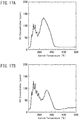
- Fig. 2A depicts a graph illustrating the evaluation results of fluorescence spectrum normalized to the intensity per 1 mg of gold.
- the result as to Example 1 is indicated by the spectrum (i)
- the result as to Example 2 is indicated by the spectrum (ii)
- the result as to Comparative Example 1 is indicated by the spectrum (iii).
- the fluorescence signal at near 400 nm is a spectrum in which fluorescent emissions from the gold cluster of about 8-mer were overlapped. Accordingly, Fig. 2A indicates that in the supported gold-cluster catalysts of Examples 1 and 2, particularly, in the supported gold-cluster catalyst of Example 1, a relatively large amount of a gold cluster around 8-mer is supported on the carrier particle.
- Fig. 2B for the sake of examination, based on the spectra of Fig. 2A , the result as to Example 1 (spectrum (i)) is depicted at 1-fold magnification, the result as to Example 2 (spectrum (ii)) is depicted at 8-fold magnification, and the result as to Comparative Example 1 (spectrum (iii)) is depicted at 60-fold magnification.
- the supported gold-cluster catalyst of Example 1 was evaluated for the gold, as the catalyst metal, supporting rate in pore.
- the supporting rate in pores was 62.5 mol%.
- Catalyst metal supporting rate in pores mol% B / A
- Example 1 a gold clusters were formed by using a gold target.
- clusters of the metal can be formed in the same manner as in Example 1 by the method of laser ablation in liquid using the metal as the target: Aluminum, silicon, titanium vanadium, chromium, manganese, iron, cobalt, nickel, copper, zinc, gallium, germanium zirconium niobium, silver, rhodium ruthenium, palladium, indium, tin, tantalum, tungsten, iridium, platinum, and cerium.
- Example 3 a supported copper-cluster catalyst in which copper clusters are supported on a zeolite carrier particles was prepared in the same manner as in Example 1 except that a copper target was used in place of the gold target and a ZSM-5 zeolite carrier particles (MFI) (Si/Al ratio: 40) were used as the zeolite carrier particle.
- MFI ZSM-5 zeolite carrier particles
- the copper is oxidized in air, and the copper cluster immediately after preparation was in the oxide state. Accordingly, the supported copper-cluster catalyst immediately after preparation did not emit fluorescence.
- the obtained supported copper-cluster catalyst was heated at 300°C for 2 hours in a hydrogen atmosphere, effecting a reduction treatment, and thereafter evaluated for the fluorescence intensity. Consequently, the supported copper-cluster catalyst subjected to a reduction treatment exhibited fluorescence.
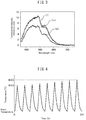
- the result of the fluorescence intensity evaluation (excitation wavelength: 350 nm) is illustrated as the spectrum (i) in Fig. 3 .
- the fluorescence of 400 to 500 nm corresponds to the already-reported fluorescence signals of 8-mer and 9-mer of copper.
- the supported copper-cluster catalyst was left standing overnight in an air atmosphere, effecting an oxidation treatment, and again evaluated for the fluorescence intensity. Consequently, the supported copper-cluster catalyst left standing in an air atmosphere exhibited fluorescence, though the intensity was weak compared with that before the treatment in an air atmosphere.
- the result of fluorescence intensity evaluation is illustrated as the spectrum (ii) in Fig. 3 .
- the supported copper-cluster catalyst left standing in an air atmosphere was again subjected to the above-described reduction treatment and again evaluated for the fluorescence intensity. Consequently, the supported copper-cluster catalyst again subjected to the reduction treatment exhibited the same fluorescence as that before the treatment in an air atmosphere.
- the result of the fluorescence intensity evaluation is illustrated as the spectrum (iii) in Fig. 3 .
- the supported copper-cluster catalyst after performing oxidation treatment and reduction treatment thus exhibited the same fluorescence as that before these treatments, and this suggests that the copper clusters are held within the pores of the zeolite carrier particles and in turn, a change such as aggregation of the copper clusters are not caused by these treatments.
- Example 4 the rhodium cluster-supporting catalyst (Example 4) and a commercially available exhaust gas purification catalyst (Comparative Example 2) were evaluated for the catalytic activity.
- Example 4 and Comparative Example 2 were conducted as follows.
- Example 4 rhodium clusters were supported on a zeolite carrier particles in the same manner as in Example 1 except that a rhodium target was used in place of the gold target and a beta-type zeolite carrier particles (BEA) (Si/Al ratio: 40) were used as the zeolite carrier particle.
- BEA beta-type zeolite carrier particles
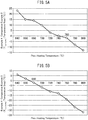
- the temperature (T CO(50%) ) when consuming 50% of the supplied carbon monoxide was evaluated by repeating an operation of heating 30 mg of the obtained rhodium cluster-supporting catalyst (Rh cluster /BEA) for about 24 hours in an electric furnace at a heating rate of 12°C/min to a peak heating temperature of 640 to 800°C from room temperature while flowing an evaluation gas having the following composition over the catalyst, and cooling it to room temperature.
- the evaluation was performed while raising the evaluation gas temperature to the peak heating temperature, i.e., in the temperature rising process. Similarly, in the repetitive step of heating and cooling, the evaluation was performed while lowering the evaluation gas temperature from the peak heating temperature, i.e., in the temperature dropping process.
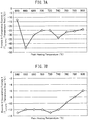
- Figs. 5A and 5B The evaluation results in the temperature rising process and the temperature dropping process are illustrated respectively in Figs. 5A and 5B as the difference between the result of Example 4 and the result of Comparative Example 2 (T CO(50%) of Example 4)-(T CO(50%) of Comparative Example 2).
- T CO(50%) of Example 4 is lower than T CO(50%) of Comparative Example 2, i.e., the low-temperature activity of the catalyst of Example 4 is excellent.
- the abscissa indicates the temperature (the peak temperature in Fig. 4 ) at which an accelerated deterioration treatment was performed.
- the catalyst of Example 4 provides an excellent exhaust gas purification performance relative to the catalyst of Comparative Example 2 as the peak heating temperature becomes higher. This indicates that the catalyst of Example 4 is less likely to deteriorate compared with the catalyst of Comparative Example 2.
- the change when the peak heating temperature is 640°C and 660°C is a change in the firing process of removing water molecules adsorbed to zeolite and therefore, the catalytic activity needs to be evaluated from the change substantially when the peak heating temperature is 700°C or more.
- Example 5 a catalyst in which rhodium clusters are supported on zeolite carrier particles or fumed silica carrier particles was obtained, and with respect to the obtained catalysts, the durability of the catalyst was evaluated.
- Example 5 and Comparative Example 3 were conducted as follows.
- Example 5 rhodium clusters were supported on zeolite carrier particles in the same manner as in Example 1 except that a rhodium target was used in place of the gold target and beta-type zeolite carrier particles (BEA) (Si/Al ratio: 40) were used as the zeolite carrier particle.
- BEA beta-type zeolite carrier particles
- Comparative Example 3 rhodium clusters were supported on a fumed silica particle in the same manner as in Example 1 except that a rhodium target was used in place of the gold target and a fumed silica particle was used as the carrier particle.
- Figs. 6A and 6B The evaluation results in the temperature rising process and the temperature dropping process are illustrated respectively in Figs. 6A and 6B as the difference between the result of Example 5 and the result of Comparative Example 3 (T CO(50%) of Example 5)-(T CO(50%) of Comparative Example 3).
- T CO(50%) of Example 5 is lower than T CO(50%) of Comparative Example 3, i.e., the low-temperature activity of the catalyst of Example 5 is excellent.
- the abscissa indicates the temperature (the peak temperature in Fig. 4 ) at which an accelerated deterioration treatment was performed.
- Example 6 a catalyst was obtained by supporting or not supporting a rhodium cluster on zeolite carrier particles, and the obtained catalysts were evaluated for the durability.
- Example 6 and Comparative Example 4 were conducted as follows.
- Example 6 rhodium clusters were supported on zeolite carrier particles in the same manner as in Example 1 except that a rhodium target was used in place of the gold target and ZSM-5 zeolite carrier particles (MFI) (Si/Al ratio: 40) were used as the zeolite carrier particle.
- MFI ZSM-5 zeolite carrier particles
- Comparative Example 4 rhodium clusters were dispersed in acetone in the same manner as in Example 1 except that a rhodium target was used in place of the gold target and carrier particles was not used. Thereafter, at the stage where the rhodium clusters were aggregated to form a rhodium cluster aggregate particles, ZSM-5 zeolite carrier particles (MFI) (Si/Al ratio: 40) was added as the zeolite carrier particles to the acetone to prepare the catalyst (Rh particle /MFI) of Comparative Example 4 in which the rhodium cluster aggregate particle was supported on the ZSM-5 zeolite carrier particles (MFI).
- MFI ZSM-5 zeolite carrier particles
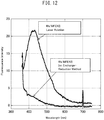
- Figs. 7A and 7B The evaluation results in the temperature rising process and the temperature dropping process are illustrated respectively in Figs. 7A and 7B as the difference between the result of Example 6 and the result of Comparative Example 4 (T CO(50%) of Example 6)-(T CO(50%) of Comparative Example 4).
- T CO(50%) of Example 6 is lower than T CO(50%) of Comparative Example 4, i.e., the low-temperature activity of the catalyst of Example 6 is excellent.
- the abscissa indicates the temperature (the peak temperature in Fig. 4 ) at which an accelerated deterioration treatment was performed.
- a catalyst was obtained by supporting a rhodium cluster on zeolite carrier particles, and the obtained catalysts were evaluated for the durability.
- Examples 7 to 10 were conducted as follows.
- rhodium clusters were supported on zeolite carrier particles in the same manner as in Example 1 except that a rhodium target was used in place of the gold target and the following carrier particles were used as the zeolite carrier particle.
- Figs. 8A and 8B The evaluation results in the temperature rising process and the temperature dropping process are illustrated respectively in Figs. 8A and 8B as the difference between the results of Examples 7 to 10 and the result of Comparative Example 2 (commercially available exhaust gas purification catalyst) (T CO(50%) of Examples 7 to 10)-(T CO(50%) of Comparative Example 2).
- T CO(50%) of Examples 7 to 10 is lower than T CO(50%) of Comparative Example 2, i.e., the low-temperature activity of the catalysts of Examples 7 to 10 is excellent.
- the abscissa indicates the temperature (the peak temperature in Fig. 4 ) at which an accelerated deterioration treatment was performed.
- the catalyst of Example 7 showed a poor catalyst performance in the temperature range of up to 800°C compared with the catalyst of Comparative Example 2, but it is clearly understood from the curves of Figs. 8A and 8B that when the accelerated deterioration treatment is further continued, the performance of the catalyst of Example 7 surpasses the performance of the catalyst of Comparative Example 2.
- Example 10 using a ZSM-5 zeolite carrier particles (MFI) as the carrier, the catalyst of Example 10 using ZSM-5 zeolite carrier particles (MFI(40)) having an Si/Al ratio of 40 exhibited good catalyst performance, compared with the catalyst of Example 7 using ZSM-5 zeolite carrier particles (MFI(1500)) having an Si/Al ratio of 1,500.
- MFI ZSM-5 zeolite carrier particles
- the ZSM-5 zeolite carrier particles (MFI(40)) having an Si/Al ratio of 40 has a larger number of acid sites than the ZSM-5 zeolite carrier particles (MFI(1500)) having an Si/Al ratio of 1,500 and supporting of the rhodium cluster on the zeolite carrier particles was successfully performed by an electrostatic action.
- Example 9 using a beta-type zeolite carrier particles (BEA(40)) having an Si/Al ratio of 40, i.e., a zeolite carrier particles having a relatively large number of acid sites exhibited good catalyst performance, compared with the catalyst of Example 8 using beta-type zeolite carrier particles (BEA(1500)) having an Si/Al ratio of 1,500, i.e., zeolite carrier particles having a relatively small number of acid sites.
- BEA(40) beta-type zeolite carrier particles having an Si/Al ratio of 40
- BEA(1500) beta-type zeolite carrier particles having an Si/Al ratio of 1,500
- beta-type zeolite carrier particles BEA
- the difference in the catalyst performance due to the different in the Si/Al ratio was not so large as in the case of using ZSM-5 zeolite carrier particles (MFI). This is considered to occur because the beta-type zeolite carrier particle (BEA) substantially has a large surface solid acid strength and the effect of the difference in the amount of acid sites was less likely to develop.
- the zeta potential (indicator of solid acid strength) of the zeolite carrier particles used in Examples 7 to 10 is as follows:
- a rhodium particle was supported on MFI(40) (zeta potential: -87 mV) and on MFI(1500) (zeta potential: -72.7 mV) by laser ablation in liquid, as a result, coloring of the carrier caused by the supporting of rhodium particle on the carrier particle occurred more prominently in MFI(40) than in MFI(1500).
- a supported copper-cluster catalyst was obtained by a method of reduction in liquid, and the obtained catalysts were evaluated by means of fluorescence.
- Example 11 a zeolite carrier particle was dispersed in 2-propanol to produce a zeolite carrier particle dispersion liquid, and copper(II) chloride as a copper ion source and sodium borohydride (NaBH 4 ) as a reducing agent were mixed with the dispersion liquid to synthesize a copper cluster in the dispersion liquid.
- the thus-synthesized copper cluster had a positive charge and was thereby electrically drawn to acid sites of the zeolite carrier particle and supported thereon.
- a water bath 82 at about 10°C was disposed on a magnetic stirrer 81, a flask 83 was disposed thereon, a dropping funnel 84 was disposed on the flask 83, and the contents 84a of the dropping funnel 84 were added dropwise to the contents 83a of the flask 83 with stirring by means of a stirring bar 81a.
- the dropwise addition was performed for 1 hour while keeping the temperature by the water bath, and after the completion of dropwise addition, stirring was further performed for 1 hour while keeping the temperature by the water bath. Thereafter, stirring was further performed at room temperature for 2 hours, and the contents of the flask were then filtered and fired at a temperature of 300°C for 2 hours in the atmosphere to obtain the supported copper-cluster catalyst of Example 11.
- the supported copper-cluster catalyst of Example 12 was obtained in the same manner as in Example 11 except that the contents 84a of the dropping funnel 84 and the contents 83a of the flask 83 were changed as shown in Table 1 below.
- Example 11 Dropping funnel sodium borohydride 25 ⁇ mol copper chloride 12 ⁇ m ⁇ l 2-propanol 10 mL 2-propanol 5 mL Flask copper chloride 12 ⁇ mol sodium borohydride 80 ⁇ mol zeolite carrier particle 200 mg zeolite carrier particle 200 mg 2-propanol 200 mL 2-propanol 200 mL
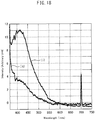
- the supported copper-cluster catalysts prepared in Examples 11 and 12 and as reference samples, a copper ion-exchanged zeolite carrier particle and a proton-type zeolite carrier particle were measured for the fluorescence spectrum at an excitation wavelength of 350 nm. The results are illustrated in Fig. 10 .
- the result as to Example 11 is indicated by the spectrum (i)
- the result as to Example 12 is indicated by the spectrum (ii)
- the result as to the copper ion-exchanged zeolite carrier particle as a reference sample is indicated by the spectrum (iii)
- the result as to the proton-type zeolite carrier particle as a reference sample is indicated by the spectrum (iv).
- the supported copper-cluster catalysts obtained in Examples 11 and 12, particularly in Example 11, showed a peak at about 440 nm. This peak is considered to be derived from the copper clusters.
- the peak above is as broad as having a half width of about 100 nm and is considered to be derived from the copper clusters.
- Example 11 the supported copper-cluster catalyst obtained in Example 11 was measured for the fluorescence spectrum at an excitation wavelength of 350 nm and the excitation spectrum at a fluorescence monitor wavelength of 440 nm and 520 nm. The results are illustrated in Fig. 11 .
- the result as to the excitation wavelength of 350 nm is indicated by the fluorescence spectrum (i)
- the result as to the fluorescence monitor wavelength of 440 nm is indicated by the spectrum (ii)
- the result as to the fluorescence monitor wavelength of 520 nm is indicated by the spectrum (iii).
- Example 13 and Comparative Example 5 rhodium cluster-supporting catalysts were obtained by using a method of laser ablation in liquid and an ion exchange-reduction method, respectively.
- Example 13 rhodium clusters were supported on a zeolite carrier particle by a method of laser ablation in liquid in the same manner as in Example 1 except that a rhodium target was used in place of the gold target and ZSM-5 zeolite carrier particles (Si/A1 ratio: 40) were used as the zeolite carrier particle.
- a rhodium ion was supported on ZSM-5 zeolite carrier particles (Si/A1 ratio: 40) by ion exchange, and then a metallic rhodium particle was supported on the zeolite carrier particle by reducing the rhodium ion, whereby rhodium clusters were supported on the zeolite carrier particle (ion exchange-reduction method).
- Rh(NO 3 ) 3 was used as a rhodium ion source and NaBH 4 was used as a reducing agent.
- Example 13 The supported catalysts of Example 13 and Comparative Example 5 were measured for the fluorescence spectrum (excitation wavelength: 350 nm). The evaluation results of fluorescence spectrum normalized to the intensity per 1 mg of rhodium are illustrated in Fig. 12 .
- Example 14 supported gold-cluster catalysts were obtained by using a method of laser ablation in liquid and an ion exchange-reduction method, respectively.
- Example 14 gold clusters were supported on a zeolite carrier particle by a method of laser ablation in liquid in the same manner as in Example 1 except that ZSM-5 zeolite carrier particles (MFI) (Si/Al ratio: 1,500) were used as the zeolite carrier particle.
- MFI ZSM-5 zeolite carrier particles
- a gold ion was supported on ZSM-5 zeolite carrier particles (MFI) (Si/Al ratio: 1,500) by ion exchange, and then gold clusters were supported on the zeolite carrier particle by reducing the gold ion (ion exchange-reduction method).
- MFI ZSM-5 zeolite carrier particles
- AuCl 4 Chloroauric acid
- NaBH 4 NaBH 4
- Example 14 With respect to the supported catalysts of Example 14 and Comparative Example 6, the elemental composition of the supported catalyst as a whole was evaluated using inductively coupled plasma spectrometer (ICP-OES apparatus) (Agilent 5100 manufactured by Agilent Technologies, Inc. and SPS3000 manufactured by Hitachi High-Tech Science Corporation). The results are shown in Table 2 below.
- ICP-OES apparatus inductively coupled plasma spectrometer
- Example 14 With respect to the supported catalysts of Example 14 and Comparative Example 6, the elemental composition of the supported catalyst surface was evaluated using a transmission electron microscope-energy dispersive X-ray spectroscopy (TEM-EDX) (JEM-2100F and JED-2300, manufactured by JEOL Ltd.). The results are shown in Table 2 below.
- TEM-EDX transmission electron microscope-energy dispersive X-ray spectroscopy
- Example 14 (Au laser ablation/MFI(1500)) Comparative Example 6 (Au ion change-reduction/ MFI(1500)) Whole (ICP-MASS) Au (wt%) 0.015 0.005 Si (wt%) 38 41 Au/Si 3.95 ⁇ 10 -4 1.22 ⁇ 10 -4 Surface (TEM- EDX) Au (wt%) 0.46 0.44 Si (wt%) 66.94 59.82 Au/Si 6.87 ⁇ 10 -3 7.36 ⁇ 10 -3 Heterogeneity index (Au/Si (surface))/(Au/Si (whole)) 17.39 60.33
- Example 15 rhodium cluster-supporting catalysts were obtained by using a method of laser ablation in liquid and an ion exchange-reduction method, respectively.
- Example 15 rhodium clusters were supported on a zeolite carrier particle by a method of laser ablation in liquid in the same manner as in Example 1 except that a rhodium target was used in place of the gold target and ZSM-5 zeolite carrier particles (Si/Al ratio: 40) were used as the zeolite carrier particle.
- the amount of rhodium supported was 0.1 mass% relative to the zeolite carrier particle.
- a rhodium ion was supported on ZSM-5 zeolite carrier particles (Si/Al ratio: 40) by ion exchange, and then a metallic rhodium particle was supported on the zeolite carrier particle by reducing the rhodium ion, whereby rhodium clusters were supported on the zeolite carrier particle (ion exchange-reduction method).
- Rh(NO 3 ) 3 was used as a rhodium ion source and NaBH 4 was used as a reducing agent.
- the amount of rhodium supported was 0.051 mass% relative to the zeolite carrier particle.
- Example 15 With respect to the supported catalysts of Example 15 and Comparative Example 7, a pretreatment was performed by adsorbing oxygen to the supported catalyst at 30°C for 1 hour in a 100 vol% oxygen atmosphere and removing excess oxygen at 500°C for 1 hour in a helium atmosphere.
- H 2 -TPR hydrogen temperature-programmed reduction method
- the result as to the supported catalyst of Example 15 is illustrated in Fig. 13A
- the result as to the supported catalyst of Comparative Example 7 is illustrated in Fig. 14A .
- the peak/noise ratio of the peak indicated by an arrow of Fig. 13A was 35.7 (noise level: 0.000215%), and the peak/noise ratio of the peak indicated by an arrow of Fig. 13B was 5.12 (noise level: 0.000394%).
- both of the supported catalysts of Example 15 and Comparative Example 7 have a relatively large peak of reaction between hydrogen supplied and oxygen adsorbed to the cluster-supporting catalyst, i.e., a peak with a peak/noise ratio of 2.0 or more, in the temperature range of 150°C or less, i.e., have low-temperature activity.
- Example 15 With respect to the supported catalysts of Example 15 and Comparative Example 7, a thermal endurance treatment was performed by subjecting the supported catalyst to heating for 2 hours in an atmosphere at 800°C containing 20 vol% of oxygen and the balance helium and then to heating for 1 hour in an atmosphere at 800°C containing 0.5 vol% of hydrogen and the balance helium.
- the result as to the supported catalyst of Example 15 is illustrated in Fig. 13B
- the result as to the supported catalyst of Comparative Example 7 is illustrated in Fig. 14B .
- the peak/noise ratio of the peak indicated by an arrow of Fig. 14A was 7.76 (noise level: 0.000326%), and the peak/noise ratio of the peak indicated by an arrow of Fig. 14B was 1.62 (noise level: 0.000377%).
- the supported catalyst of Example 15 has a relatively large reaction peak in the temperature range of 150°C or less, i.e., has low-temperature activity.
- the supported catalyst of Comparative Example 7 does not have a substantial peak in the temperature range of 150°C or less, i.e., does not have a peak with a peak/noise ratio of 2.0 or more. In this way, the supported catalyst of Comparative Example 7 does not have a substantial peak in the temperature range of 150°C or less, and this means that the supported catalyst does not have low-temperature activity. That is, it is understood that in the supported catalyst of Comparative Example 7 obtained by the ion exchange-reduction method, the dispersibility of the cluster particle was low and in turn, the heat resistance was poor.
- Example 16 and Comparative Example 8 palladium cluster-supporting catalysts were obtained by using a method of laser ablation in liquid and an ion exchange-reduction method, respectively.
- Example 16 palladium clusters were supported on a zeolite carrier particle by a method of laser ablation in liquid in the same manner as in Example 1 except that a palladium target was used in place of the gold target and ZSM-5 zeolite carrier particles (Si/Al ratio: 40) were used as the zeolite carrier particle.
- the amount of palladium supported was 0.09 mass% relative to the zeolite carrier particle.
- a palladium ion was supported on ZSM-5 zeolite carrier particles (Si/Al ratio: 40) by ion exchange, and then a metallic palladium particle was supported on the zeolite carrier particle by reducing the palladium ion, whereby palladium clusters were supported on the zeolite carrier particle (ion exchange-reduction method).
- Pd(NH 3 ) 4 Cl 2 ⁇ H 2 O tetraamminepalladium(II) chloride monohydrate
- NaBH 4 was used as a reducing agent.
- the amount of palladium supported was 0.86 mass% relative to the zeolite carrier particle.
- a thermal endurance treatment was performed by subjecting the supported catalyst to heating for 2 hours in an atmosphere at 800°C containing 20 vol% of oxygen and the balance helium and then to heating for 1 hour in an atmosphere at 800°C containing 0.5 vol% of hydrogen and the balance helium.
- a model gas containing 0.3 vol% of carbon monoxide, 8.0 vol% of oxygen and the balance helium was flowed at a spatial velocity of 10,000 h -1 over the supported catalysts subjected to the thermal endurance treatment, and the number of molecules of the carbon monoxide molecule capable of being oxidized to carbon dioxide molecule by one palladium atom at a temperature of 100°C in the temperature dropping process was evaluated by performing a temperature rising process of raising the temperature at a rate of 10°C/min to 800°C from room temperature and then performing a temperature dropping process of lowering the temperature to room temperature.
- the number of molecules can be obtained by dividing the molar number of the carbon dioxide molecule in the model gas flowing per second after reaction by the molar number of palladium as a catalyst metal in the supported catalyst.
- Fig. 15 The results as to the supported catalysts of Example 16 and Comparative Example 8 are illustrated in Fig. 15 . It is seen from Fig. 15 that in the supported catalyst of Example 16 obtained by the laser ablation method, the number of molecules of the carbon monoxide molecule capable of being oxidized to carbon dioxide molecule by one palladium atom was near 0.008 and on the other hand, in the supported catalyst of Comparative Example 8 obtained by the ion exchange-reduction method, the number did not reach 0.002. This indicates that in the supported catalyst of Comparative Example 8 obtained by the ion exchange-reduction method, the dispersibility of the cluster particle was low and in turn, the heat resistance was poor.
- Example 17 and Comparative Example 9 platinum cluster-supporting catalysts were obtained by using a method of laser ablation in liquid and an ion exchange-reduction method, respectively.
- Example 17 platinum clusters were supported on a zeolite carrier particle by a method of laser ablation in liquid in the same manner as in Example 1 except that a platinum target was used in place of the gold target and ZSM-5 zeolite carrier particles (Si/A1 ratio: 40) were used as the zeolite carrier particle.
- the amount of platinum supported was 1.1 mass% relative to the zeolite carrier particle.
- a platinum ion was supported on ZSM-5 zeolite carrier particles (Si/Al ratio: 40) by ion exchange, and then a metallic platinum particle was supported on the zeolite carrier particle by reducing the platinum ion, whereby platinum clusters were supported on the zeolite carrier particle (ion exchange-reduction method).
- Pt(NH 3 ) 4 Cl 2 ⁇ xH 2 O tetraammineplatinum(II) chloride monohydrate
- NaBH 4 was used as a reducing agent.
- the amount of platinum supported was 1.9 mass% relative to the zeolite carrier particle.
- a thermal endurance treatment was performed by subjecting the supported catalyst to heating for 2 hours in an atmosphere at 800°C containing 20 vol% of oxygen and the balance helium and then to heating for 1 hour in an atmosphere at 800°C containing 0.5 vol% of hydrogen and the balance helium.
- a model gas containing 0.3 vol% of carbon monoxide, 8.0 vol% of oxygen and the balance helium was flowed at a spatial velocity of 10,000 h -1 over the supported catalysts subjected to the thermal endurance treatment, and the number of molecules of the carbon monoxide molecule capable of being oxidized to carbon dioxide molecule by one platinum atom at a temperature of 60°C in the temperature dropping process was evaluated by performing a temperature rising process of raising the temperature at a rate of 10°C/min to 800°C from room temperature and then performing a temperature dropping process of lowering the temperature to room temperature.
- Fig. 16 The results as to the supported catalysts of Example 17 and Comparative Example 9 are illustrated in Fig. 16 . It is seen from Fig. 16 that in the supported catalyst of Example 17 obtained by the laser ablation method, the number of molecules of the carbon monoxide molecule capable of being oxidized to carbon dioxide molecule by one platinum atom was near 0.0002 and on the other hand, in the supported catalyst of Comparative Example 9 obtained by the ion exchange-reduction method, the number did not reach 0.0001. This indicates that in the supported catalyst of Comparative Example 9 obtained by the ion exchange-reduction method, the dispersibility of the cluster particle was low and in turn, the heat resistance was poor.
- Example 18 supported copper-cluster catalysts were obtained by using a method of laser ablation in liquid and an ion exchange-reduction method, respectively.
- Example 18 copper clusters were supported on a zeolite carrier particle by a method of laser ablation in liquid in the same manner as in Example 1 except that a copper target was used in place of the gold target and a chavazite (CHA)-type zeolite carrier particle were used as the zeolite carrier particle.
- the amount of copper supported was 0.9 mass% relative to the zeolite carrier particle.
- a copper ion was supported on a chavazite (CHA)-type zeolite carrier particle by ion exchange, and then a metallic copper particle was supported on the zeolite carrier particle by reducing the copper ion, whereby copper clusters were supported on the zeolite carrier particle (ion exchange-reduction method).
- Copper nitrate was used as a copper ion source and NaBH 4 was used as a reducing agent.
- the amount of copper supported was 0.9 mass% relative to the zeolite carrier particle.
- nitric oxide was adsorbed to the supported catalyst through heating at 800°C for 1 hour in an atmosphere containing 10 vol% of oxygen and the balance helium, heating at 800°C for 30 minutes in an atmosphere containing 100 vol% of helium, lowering of the ambient temperature to 25°C, holding for 1 hour in an atmosphere containing 500 ppm by volume of nitric oxide and the balance helium, and holding for 1 hour in an atmosphere containing 100 vol% of helium.
- the supported catalyst having adsorbed thereto nitric oxide was heated at a temperature rise rate of 10°C/min to 800°C in an atmosphere containing 100 vol% of helium, and the amount of nitric oxide desorbed during the heating was detected by a mass spectrometer to obtain a nitric oxide temperature-programmed desorption spectrum.
- the gas flow rate in the atmosphere was 10 sccm in all cases.
- the difference in the temperature between maximum peaks illustrated in Figs. 17A and 17B indicates that the supported catalyst of Example 18 obtained by the laser ablation method and the supported catalyst of Comparative Example 10 obtained by the ion exchange-reduction method have different structures from each other.
- Example 19 platinum cluster-supporting catalysts were obtained by using an positive-negative inversion method and an ion exchange-reduction method, respectively.
- Example 19 zeolite MFI(40) was added to 200 ml of an aqueous solution containing 10 mM of H 2 [PtCl 6 ] in pure water, a pulsed laser is converged and introduced into this aqueous solution to decompose H 2 [PtCl 6 ] and produce a positively charged platinum cluster, and the positively charged platinum clusters were supported on the acid sites of zeolite through an electrostatic interaction.
- Example 19 The platinum cluster-supporting catalysts of Example 19 and Comparative Example 11 were measured for the fluorescence spectrum (excitation wavelength: 350 nm).
- the evaluation results of fluorescence spectrum are illustrated in Fig. 18 .
- Fig. 18 the results as to Example 18 is indicated by the spectrum (i), and the result as to Comparative Example 11 is indicated by the spectrum (ii).
- the fluorescence signal at near 410 nm is a spectrum in which fluorescent emissions from the gold cluster of about tetramer were overlapped. Accordingly, Fig. 18 reveals that in the platinum cluster-supporting catalyst of Example 18, a relatively large amount of a platinum cluster around tetramer is supported on the carrier particle and on the other hand, in the supported-platinum catalyst of Comparative Example 11, such clusters are not present in a significant manner.
- Example 20 rhodium cluster-supporting catalysts were obtained by using a method of laser ablation in liquid and an ion exchange-reduction method, respectively.
- Example 20 rhodium clusters were supported on a zeolite carrier particle by a method of laser ablation in liquid in the same manner as in Example 1 except that a rhodium target was used in place of the gold target and ZSM-5 zeolite carrier particles (Si/A1 ratio: 40) were used as the zeolite carrier particle.
- the amount of rhodium supported was 0.1 mass% relative to the zeolite carrier particle.
- a rhodium ion was supported on ZSM-5 zeolite carrier particles (Si/Al ratio: 40) by ion exchange, and then rhodium clusters were supported on the zeolite carrier particle by reducing the rhodium ion.
- Rh(NO 3 ) 3 was used as a rhodium ion source and NaBH 4 was used as a reducing agent.
- the amount of rhodium supported was 0.051 mass% relative to the zeolite carrier particle.
- a thermal endurance treatment was performed by heating the supported catalyst for 1 hour in an atmosphere at 800°C containing 8 vol% of oxygen, 0.3 vol% of carbon monoxide and the balance helium.
- a model gas containing 0.1 vol% of 15 NO, 0.65 vol% of CO and the balance helium was flowed at a spatial velocity of 10,000 h -1 over the supported catalysts subjected to the thermal endurance treatment, and the nitric oxide reduction reaction was measured by raising the temperature at a rate of 10°C/min to 800°C from room temperature (temperature rising process) and then lowering the temperature to room temperature (temperature dropping process).
- the evaluation result as to the catalyst of Example 20 is illustrated in Fig. 19A
- the evaluation result as to the catalyst of Comparative Example 12 is illustrated in Fig. 19B .
- a peak of nitrogen oxide appears in the range of 100 to 200°C, and this is a concentration rise due to desorption of nitric oxide adsorbed to the catalyst.
- the concentration of nitric oxide decreases, and a reaction of reducing nitric oxide ( 15 NO) by carbon monoxide (CO) to produce nitrogen (N 2 ) starts.
- the reaction temperature at the time of half of the nitric oxide supplied being reduced into nitrogen i.e., the reaction temperature at the time of the nitrogen concentration becoming 0.05 vol%
- the reaction temperature at the time of the nitrogen concentration becoming 0.05 vol% is about 272°C in the temperature rising process and 254°C in the temperature dropping process
- the reaction temperature was about 321°C in the temperature rising process and 279°C in the temperature dropping process. It is therefore revealed that the catalyst of Example 20 obtained by the method of laser ablation in liquid has excellent low-temperature activity, compared with the catalyst of Comparative Example 12 obtained by the ion exchange-reduction method.
- Fig. 20 The evaluation results of the number of molecules of the nitric oxide molecule capable of being reduced to nitrogen by one rhodium atom at a temperature of 250°C in the temperature dropping process are illustrated in Fig. 20 .
- Fig. 20 reveals that in the supported catalyst of Example 20 obtained by the laser ablation method, the number of molecules of nitrogen monoxide molecule capable of being purified in 1 second by one rhodium atom exceeded 0.007 and on the other hand, in the catalyst of Comparative Example 12 obtained by the ion exchange-reduction method, the number did not reach 0.004. It is therefore apparent that the catalyst of Example 20 obtained by the laser ablation method has excellent low-temperature activity, compared with the catalyst of Comparative Example 12 obtained by the ion exchange-reduction method.
- Example 21 a platinum cluster-supporting catalyst and a rhodium cluster-supporting catalyst were obtained respectively by using a method of laser ablation in liquid.
- Comparative Example 13 a general three-way catalyst in which platinum, rhodium and palladium are supported on a mixed powder of alumina carrier particles and ceria-zirconia carrier particles was used.
- Example 21 platinum clusters were supported on a zeolite carrier particle by a method of laser ablation in liquid in the same manner as in Example 1 except that a platinum target was used in place of the gold target and ZSM-5 zeolite carrier particles (Si/Al ratio: 40) were used as the zeolite carrier particle.
- the amount of platinum supported was 0.59 mass% relative to the zeolite carrier particle.
- Example 22 rhodium clusters were supported on a zeolite carrier particle by a method of laser ablation in liquid in the same manner as in Example 1 except that a rhodium target was used in place of the gold target and ZSM-5 zeolite carrier particles (Si/Al ratio: 40) were used as the zeolite carrier particle.
- the amount of rhodium supported was 0.1 mass% relative to the zeolite carrier particle.
- Comparative Example 13 a general three-way catalyst in which platinum, rhodium and palladium are supported on a mixed powder of alumina carrier particles and ceria-zirconia carrier particles was used.
- the amounts of platinum, rhodium and palladium supported were 0.2 mass%, 0.19 mass% and 0.25 mass%, respectively, relative to the carrier powder.
- the catalysts of Examples 21 and 22 and Comparative Example 13 were held at 800°C for 1 hour in an atmosphere containing 500 ppm by volume of carbon monoxide and the balance helium to adsorb carbon monoxide to the supported catalyst, and then an oxygen oxidation reaction test of adsorbed carbon monoxide was performed by heating the supported catalyst having adsorbed thereto carbon monoxide at a temperature rise rate of 10°C/min to 800°C in an atmosphere containing 10 vol% of oxygen and the balance helium. During these treatments, the spatial velocity was 10,000 h -1 .
- the catalysts of Examples 21 and 22 and Comparative Example 13 subjected to the cleaning treatment were subjected to the above-described oxygen oxidation reaction test of adsorbed carbon monoxide.
Landscapes
- Chemical & Material Sciences (AREA)
- Engineering & Computer Science (AREA)
- Chemical Kinetics & Catalysis (AREA)
- Materials Engineering (AREA)
- Organic Chemistry (AREA)
- Crystallography & Structural Chemistry (AREA)
- Physics & Mathematics (AREA)
- Health & Medical Sciences (AREA)
- Plasma & Fusion (AREA)
- Toxicology (AREA)
- Optics & Photonics (AREA)
- Environmental & Geological Engineering (AREA)
- General Chemical & Material Sciences (AREA)
- Biomedical Technology (AREA)
- Analytical Chemistry (AREA)
- Oil, Petroleum & Natural Gas (AREA)
- Electrochemistry (AREA)
- Electromagnetism (AREA)
- Catalysts (AREA)
- Exhaust Gas After Treatment (AREA)
- Exhaust Gas Treatment By Means Of Catalyst (AREA)
- Inert Electrodes (AREA)
Priority Applications (1)
| Application Number | Priority Date | Filing Date | Title |
|---|---|---|---|
| EP19170650.6A EP3536401A1 (de) | 2015-12-28 | 2016-12-26 | Cluster-geträgerter katalysator und herstellungsverfahren dafür |
Applications Claiming Priority (2)
| Application Number | Priority Date | Filing Date | Title |
|---|---|---|---|
| JP2015257320 | 2015-12-28 | ||
| PCT/JP2016/088792 WO2017115767A1 (ja) | 2015-12-28 | 2016-12-26 | クラスター担持触媒及びその製造方法 |
Related Child Applications (1)
| Application Number | Title | Priority Date | Filing Date |
|---|---|---|---|
| EP19170650.6A Division EP3536401A1 (de) | 2015-12-28 | 2016-12-26 | Cluster-geträgerter katalysator und herstellungsverfahren dafür |
Publications (2)
| Publication Number | Publication Date |
|---|---|
| EP3398679A4 EP3398679A4 (de) | 2018-11-07 |
| EP3398679A1 true EP3398679A1 (de) | 2018-11-07 |
Family
ID=59225678
Family Applications (2)
| Application Number | Title | Priority Date | Filing Date |
|---|---|---|---|
| EP16881742.7A Pending EP3398679A1 (de) | 2015-12-28 | 2016-12-26 | Cluster-geträgerter katalysator und herstellungsverfahren dafür |
| EP19170650.6A Withdrawn EP3536401A1 (de) | 2015-12-28 | 2016-12-26 | Cluster-geträgerter katalysator und herstellungsverfahren dafür |
Family Applications After (1)
| Application Number | Title | Priority Date | Filing Date |
|---|---|---|---|
| EP19170650.6A Withdrawn EP3536401A1 (de) | 2015-12-28 | 2016-12-26 | Cluster-geträgerter katalysator und herstellungsverfahren dafür |
Country Status (5)
| Country | Link |
|---|---|
| US (3) | US11219884B2 (de) |
| EP (2) | EP3398679A1 (de) |
| JP (1) | JP6235764B1 (de) |
| CN (2) | CN107405612B (de) |
| WO (1) | WO2017115767A1 (de) |
Families Citing this family (33)
| Publication number | Priority date | Publication date | Assignee | Title |
|---|---|---|---|---|
| US10987735B2 (en) | 2015-12-16 | 2021-04-27 | 6K Inc. | Spheroidal titanium metallic powders with custom microstructures |
| EP4324577A1 (de) | 2015-12-16 | 2024-02-21 | 6K Inc. | Verfahren zur herstellung von kugelförmigen, dehydrierten titanlegierungspartikeln |
| EP3398679A1 (de) * | 2015-12-28 | 2018-11-07 | Toyota Jidosha Kabushiki Kaisha | Cluster-geträgerter katalysator und herstellungsverfahren dafür |
| JP6831292B2 (ja) | 2017-05-09 | 2021-02-17 | トヨタ自動車株式会社 | クラスター担持触媒及びその製造方法 |
| DE112018003257T5 (de) | 2017-06-27 | 2020-03-05 | Genesis Research Institute, Inc. | Cluster-tragender, poröser Träger und Verfahren zur Herstellung desselben |
| JP6683656B2 (ja) | 2017-06-27 | 2020-04-22 | トヨタ自動車株式会社 | クラスター担持触媒及びその製造方法 |
| WO2019246257A1 (en) | 2018-06-19 | 2019-12-26 | Amastan Technologies Inc. | Process for producing spheroidized powder from feedstock materials |
| CN111715203A (zh) * | 2019-03-19 | 2020-09-29 | 南开大学 | 一种新型碳基材料负载锌单原子催化剂的制备方法 |
| US11311938B2 (en) | 2019-04-30 | 2022-04-26 | 6K Inc. | Mechanically alloyed powder feedstock |
| US11766663B2 (en) | 2019-07-19 | 2023-09-26 | Arizona Board Of Regents On Behalf Of Arizona State University | Functional nanoscale metal oxides for stable metal single atom and cluster catalysts |
| CN110449176B (zh) * | 2019-08-16 | 2021-01-29 | 江南大学 | 一种非贵金属单原子催化剂的制备方法及应用 |
| ES2994209T3 (en) | 2019-11-18 | 2025-01-20 | 6K Inc | Unique feedstocks for spherical powders and methods of manufacturing |
| CN111092234B (zh) * | 2019-12-04 | 2022-04-12 | 东南大学 | 一种高性能氧还原催化剂的制备方法 |
| US11590568B2 (en) | 2019-12-19 | 2023-02-28 | 6K Inc. | Process for producing spheroidized powder from feedstock materials |
| CN111420691B (zh) * | 2020-03-20 | 2022-12-16 | 南方科技大学 | 金属单原子催化剂及其制备方法 |
| US20230183870A1 (en) * | 2020-04-15 | 2023-06-15 | The Regents Of The University Of California | Electrocatalysts for h2o2 production |
| US11446637B2 (en) * | 2020-06-18 | 2022-09-20 | GM Global Technology Operations LLC | Bi-metallic three-way catalyst materials and appurtenant devices and systems |
| KR20230029836A (ko) | 2020-06-25 | 2023-03-03 | 6케이 인크. | 마이크로복합 합금 구조 |
| KR102811425B1 (ko) | 2020-09-24 | 2025-05-26 | 6케이 인크. | 플라즈마를 개시하기 위한 시스템, 디바이스 및 방법 |
| EP4237174A1 (de) | 2020-10-30 | 2023-09-06 | 6K Inc. | Systeme und verfahren zur synthese von sphäroidisierten metallpulvern |
| EP4275239A4 (de) | 2021-01-11 | 2024-12-18 | 6K Inc. | Verfahren und systeme zur rückgewinnung von li-ionen-kathodenmaterialien mittels mikrowellenplasmaverarbeitung |
| JP2024515034A (ja) | 2021-03-31 | 2024-04-04 | シックスケー インコーポレイテッド | 金属窒化物セラミックの積層造形のためのシステム及び方法 |
| CN113198541B (zh) * | 2021-05-19 | 2023-05-26 | 北京单原子催化科技有限公司 | 一种MOFs@M1-多酸的单原子位点催化剂、制备及应用 |
| CN118922382A (zh) * | 2022-03-25 | 2024-11-08 | 三井金属矿业株式会社 | 沸石、其制造方法、烃吸附材料以及废气净化催化剂 |
| WO2023229928A1 (en) | 2022-05-23 | 2023-11-30 | 6K Inc. | Microwave plasma apparatus and methods for processing materials using an interior liner |
| US12040162B2 (en) | 2022-06-09 | 2024-07-16 | 6K Inc. | Plasma apparatus and methods for processing feed material utilizing an upstream swirl module and composite gas flows |
| WO2024044498A1 (en) | 2022-08-25 | 2024-02-29 | 6K Inc. | Plasma apparatus and methods for processing feed material utilizing a powder ingress preventor (pip) |
| CN116351441B (zh) * | 2023-03-21 | 2024-07-02 | 北京化工大学 | 具有协同位点负载型选择性加氢催化剂及其制备方法和应用 |
| US12195338B2 (en) | 2022-12-15 | 2025-01-14 | 6K Inc. | Systems, methods, and device for pyrolysis of methane in a microwave plasma for hydrogen and structured carbon powder production |
| CN116371442B (zh) * | 2023-03-13 | 2024-07-23 | 安徽大学 | 一种类卟啉金属中心氮掺杂碳和金纳米团簇复合材料及其制备方法和应用 |
| CN116371451B (zh) * | 2023-04-14 | 2024-05-17 | 西安交通大学 | 一种适用于甲烷干重整的铈掺杂镍基催化剂及其制备方法 |
| CN120749177B (zh) * | 2025-09-03 | 2026-04-14 | 华侨大学 | 一种铂纳米氧还原催化剂及其制备方法和应用 |
| CN121623786B (zh) * | 2026-02-03 | 2026-04-17 | 四川能投节能环保投资有限公司 | 飞灰基多效催化剂及其制备方法 |
Family Cites Families (47)
| Publication number | Priority date | Publication date | Assignee | Title |
|---|---|---|---|---|
| FR2151605A6 (en) * | 1971-09-06 | 1973-04-20 | Raffinage Cie Francaise | Halogen-contg hydroforming catalysts - contg a platinum -gp metal, rhenium and lead, germanium and/or tin |
| AU5206273A (en) * | 1973-02-12 | 1974-08-15 | E. I. Dupont De Nemours And Company | Adsorbent oxidation catalyst |
| US4552855A (en) | 1982-12-30 | 1985-11-12 | Ozin Geoffrey A | Metal zeolite catalyst preparation |
| EP0115188B1 (de) | 1982-12-30 | 1986-12-03 | Geoffrey Alan Ozin | Herstellung eines Katalysators welcher einen Metallzeolith enthält |
| US4652311A (en) * | 1984-05-07 | 1987-03-24 | Shipley Company Inc. | Catalytic metal of reduced particle size |
| AU5965390A (en) | 1990-01-26 | 1991-08-21 | Chevron Research And Technology Company | Reforming naphtha with boron-containing large-pore zeolites |
| JP3254742B2 (ja) * | 1992-07-03 | 2002-02-12 | 堺化学工業株式会社 | 亜酸化窒素分解用触媒 |
| US5965475A (en) * | 1997-05-02 | 1999-10-12 | Exxon Research And Engineering Co. | Processes an catalyst for upgrading waxy, paraffinic feeds |
| JPH10337476A (ja) | 1997-06-05 | 1998-12-22 | Toho Gas Co Ltd | メタン酸化触媒 |
| US6362123B1 (en) | 1998-12-30 | 2002-03-26 | Mobil Oil Corporation | Noble metal containing low acidic hydrocracking catalysts |
| US6210563B1 (en) | 1998-12-30 | 2001-04-03 | Mobil Oil Corporation | Process for producing diesel fuel with increased cetane number |
| JP4496630B2 (ja) * | 2000-09-27 | 2010-07-07 | 株式会社豊田中央研究所 | 金属細線触媒 |
| JP2002224573A (ja) | 2001-02-02 | 2002-08-13 | Cataler Corp | 排ガス浄化用触媒及びその製造方法 |
| JP2004209323A (ja) * | 2002-12-27 | 2004-07-29 | Nissan Motor Co Ltd | 排気ガス浄化触媒及びその製造方法 |
| JP4195319B2 (ja) * | 2003-03-11 | 2008-12-10 | トヨタ自動車株式会社 | 多元系金属コロイドを用いて製造される触媒 |
| CN1838992A (zh) * | 2003-05-29 | 2006-09-27 | 独立行政法人科学技术振兴机构 | 碳纳米线圈制造用催化剂、其制造方法、碳纳米线圈制造方法及碳纳米线圈 |
| JP4578820B2 (ja) * | 2004-02-19 | 2010-11-10 | トヨタ自動車株式会社 | 金触媒の製造方法およびその使用方法 |
| US7589041B2 (en) | 2004-04-23 | 2009-09-15 | Massachusetts Institute Of Technology | Mesostructured zeolitic materials, and methods of making and using the same |
| WO2005120703A1 (ja) * | 2004-06-10 | 2005-12-22 | Sumitomo Electric Industries, Ltd. | 金属触媒とその製造方法 |
| JP2006212464A (ja) | 2005-02-01 | 2006-08-17 | Tanaka Kikinzoku Kogyo Kk | 金属触媒及び金属触媒の製造方法 |
| ES2277531B2 (es) | 2005-08-03 | 2008-07-16 | Universidad De Santiago De Compostela | Procedimiento para la obtencion de clusteres cuanticos atomicos. |
| JP4984678B2 (ja) * | 2006-06-28 | 2012-07-25 | 株式会社日立製作所 | Co酸化方法 |
| MY145792A (en) * | 2006-11-17 | 2012-04-30 | Dow Global Technologies Inc | Hydro-oxidation process using a catalyst prepared from a gold cluster complex |
| JP5152859B2 (ja) * | 2008-09-18 | 2013-02-27 | 国立大学法人鳥取大学 | ゼオライト−パラジウム複合体、その複合体の製造方法、その複合体を含む触媒、およびその触媒を用いるカップリング化合物の製造方法 |
| JP2010105055A (ja) * | 2008-10-28 | 2010-05-13 | Osaka Univ | 金属クラスターの作製方法 |
| DE102008057134A1 (de) | 2008-11-13 | 2010-05-27 | Süd-Chemie AG | Metallhaltige kristalline Silikate |
| EP2380663A4 (de) * | 2009-01-22 | 2017-05-10 | Mitsubishi Plastics, Inc. | Katalysator zur entfernung von stickstoffoxiden und verfahren zu seiner herstellung |
| WO2010097108A1 (en) | 2009-02-27 | 2010-09-02 | Haldor Topsøe A/S | Process for the preparation of hybrid zeolite or zeolite-like materials |
| WO2010106966A1 (ja) | 2009-03-16 | 2010-09-23 | 三井化学株式会社 | オレフィンの製造方法 |
| DE102009015592A1 (de) * | 2009-03-30 | 2010-10-07 | Süd-Chemie AG | Alterungsstabiler Katalysator zur Oxidation von NO zu NO2 in Abgasströmen |
| WO2011004912A1 (ja) * | 2009-07-09 | 2011-01-13 | トヨタ自動車株式会社 | 排ガス浄化触媒及びその製造方法 |
| US20120093703A1 (en) * | 2010-10-13 | 2012-04-19 | General Electric Company | Catalyst and method of manufacture |
| WO2012068645A2 (en) | 2010-11-25 | 2012-05-31 | Katholieke Universiteit Leuven | Method for the production of conjugated polyunsaturated fatty acids with heterogenous catalysts |
| US20130281284A1 (en) | 2010-12-27 | 2013-10-24 | Mitsubishi Plastics, Inc. | Catalyst for nitrogen oxide removal |
| CN102847553A (zh) * | 2011-06-27 | 2013-01-02 | 三菱树脂株式会社 | 含过渡金属的沸石 |
| JP5920046B2 (ja) * | 2011-08-26 | 2016-05-18 | 住友大阪セメント株式会社 | 排気浄化触媒、排気浄化触媒の製造方法及び内燃機関の排気浄化装置 |
| GB201118228D0 (en) | 2011-10-21 | 2011-12-07 | Ingen Gtl Ltd | Methods of preparation and forming supported active metal catalysts and precursors |
| WO2013057319A2 (en) * | 2011-10-21 | 2013-04-25 | Ingen Gtl Limited | Methods of preparation and forming supported active metal catalysts and precursors |
| US9358527B2 (en) * | 2012-07-09 | 2016-06-07 | Toyota Jidosha Kabushiki Kaisha | Exhaust gas purification catalyst and production method thereof |
| US9931623B2 (en) * | 2012-11-30 | 2018-04-03 | Hiroshima University | Method for producing metal nanoparticle complex, and metal nanoparticle complex produced by said method |
| JP5880412B2 (ja) * | 2012-12-03 | 2016-03-09 | トヨタ自動車株式会社 | 触媒金属粒子の担持方法及び排ガス除去用触媒の製造方法 |
| JP5994808B2 (ja) * | 2014-03-05 | 2016-09-21 | トヨタ自動車株式会社 | 排ガス浄化用触媒及びその製造方法 |
| EP3398679A1 (de) * | 2015-12-28 | 2018-11-07 | Toyota Jidosha Kabushiki Kaisha | Cluster-geträgerter katalysator und herstellungsverfahren dafür |
| WO2017205388A1 (en) | 2016-05-25 | 2017-11-30 | The Regents Of The University Of California | Zeolitic materials having encapsulated bimetallic clusters |
| JP6831292B2 (ja) | 2017-05-09 | 2021-02-17 | トヨタ自動車株式会社 | クラスター担持触媒及びその製造方法 |
| DE112018003257T5 (de) | 2017-06-27 | 2020-03-05 | Genesis Research Institute, Inc. | Cluster-tragender, poröser Träger und Verfahren zur Herstellung desselben |
| JP6683656B2 (ja) | 2017-06-27 | 2020-04-22 | トヨタ自動車株式会社 | クラスター担持触媒及びその製造方法 |
-
2016
- 2016-12-26 EP EP16881742.7A patent/EP3398679A1/de active Pending
- 2016-12-26 EP EP19170650.6A patent/EP3536401A1/de not_active Withdrawn
- 2016-12-26 WO PCT/JP2016/088792 patent/WO2017115767A1/ja not_active Ceased
- 2016-12-26 CN CN201680012813.XA patent/CN107405612B/zh active Active
- 2016-12-26 US US16/066,928 patent/US11219884B2/en not_active Expired - Fee Related
- 2016-12-26 JP JP2017522681A patent/JP6235764B1/ja active Active
- 2016-12-26 CN CN202010459068.1A patent/CN111569936B/zh active Active
-
2021
- 2021-05-24 US US17/327,915 patent/US11998896B2/en active Active
- 2021-05-24 US US17/327,969 patent/US12128383B2/en active Active
Also Published As
| Publication number | Publication date |
|---|---|
| CN111569936B (zh) | 2023-12-05 |
| US20190001306A1 (en) | 2019-01-03 |
| US12128383B2 (en) | 2024-10-29 |
| EP3398679A4 (de) | 2018-11-07 |
| CN107405612A (zh) | 2017-11-28 |
| EP3536401A1 (de) | 2019-09-11 |
| US20210331144A1 (en) | 2021-10-28 |
| WO2017115767A1 (ja) | 2017-07-06 |
| US11998896B2 (en) | 2024-06-04 |
| JPWO2017115767A1 (ja) | 2018-01-11 |
| US20210331143A1 (en) | 2021-10-28 |
| JP6235764B1 (ja) | 2017-11-22 |
| CN111569936A (zh) | 2020-08-25 |
| CN107405612B (zh) | 2020-09-15 |
| US11219884B2 (en) | 2022-01-11 |
Similar Documents
| Publication | Publication Date | Title |
|---|---|---|
| US11998896B2 (en) | Cluster supported catalyst and production method therefor | |
| US11014073B2 (en) | Cluster supported catalyst and method for producing same | |
| US10576460B2 (en) | Cluster-supporting catalyst and process for producing the same | |
| JP7068432B2 (ja) | クラスター担持多孔質担体及びその製造方法 | |
| EP3632543A1 (de) | Ammoniak-zersetzungskatalysatorstruktur und brennstoffzelle | |
| JP5628225B2 (ja) | 金属含有コロイド粒子担持担体およびその製造方法 | |
| JP4272916B2 (ja) | 三層コア/シェル構造を有する三元系金属コロイド及び該三元系金属コロイドの製造方法 | |
| JP2013027869A (ja) | 金属粒子担持触媒の製造方法 | |
| EP3466879A1 (de) | Chabazitzeolith mit hoher hydrothermaler beständigkeit und verfahren zur herstellung davon | |
| CN100336595C (zh) | 贵金属负载介孔氮氧化硅复合催化剂及其制备方法 | |
| JP5533782B2 (ja) | 排ガス浄化用触媒及びその製造方法 | |
| JP2025017706A (ja) | 二酸化炭素還元用電極触媒及び二酸化炭素還元方法 |
Legal Events
| Date | Code | Title | Description |
|---|---|---|---|
| STAA | Information on the status of an ep patent application or granted ep patent |
Free format text: STATUS: THE INTERNATIONAL PUBLICATION HAS BEEN MADE |
|
| PUAI | Public reference made under article 153(3) epc to a published international application that has entered the european phase |
Free format text: ORIGINAL CODE: 0009012 |
|
| STAA | Information on the status of an ep patent application or granted ep patent |
Free format text: STATUS: REQUEST FOR EXAMINATION WAS MADE |
|
| 17P | Request for examination filed |
Effective date: 20180723 |
|
| A4 | Supplementary search report drawn up and despatched |
Effective date: 20180925 |
|
| AK | Designated contracting states |
Kind code of ref document: A1 Designated state(s): AL AT BE BG CH CY CZ DE DK EE ES FI FR GB GR HR HU IE IS IT LI LT LU LV MC MK MT NL NO PL PT RO RS SE SI SK SM TR |
|
| AX | Request for extension of the european patent |
Extension state: BA ME |
|
| DAV | Request for validation of the european patent (deleted) | ||
| DAX | Request for extension of the european patent (deleted) | ||
| STAA | Information on the status of an ep patent application or granted ep patent |
Free format text: STATUS: EXAMINATION IS IN PROGRESS |
|
| 17Q | First examination report despatched |
Effective date: 20210226 |