EP3398700A1 - Procédé d'obtention de nanoparticules de cuivre et utilisation desdites particules - Google Patents
Procédé d'obtention de nanoparticules de cuivre et utilisation desdites particules Download PDFInfo
- Publication number
- EP3398700A1 EP3398700A1 EP16881386.3A EP16881386A EP3398700A1 EP 3398700 A1 EP3398700 A1 EP 3398700A1 EP 16881386 A EP16881386 A EP 16881386A EP 3398700 A1 EP3398700 A1 EP 3398700A1
- Authority
- EP
- European Patent Office
- Prior art keywords
- copper
- acid
- derivatives
- poly
- copper nanoparticles
- Prior art date
- Legal status (The legal status is an assumption and is not a legal conclusion. Google has not performed a legal analysis and makes no representation as to the accuracy of the status listed.)
- Withdrawn
Links
Images





Classifications
-
- B—PERFORMING OPERATIONS; TRANSPORTING
- B22—CASTING; POWDER METALLURGY
- B22F—WORKING METALLIC POWDER; MANUFACTURE OF ARTICLES FROM METALLIC POWDER; MAKING METALLIC POWDER; APPARATUS OR DEVICES SPECIALLY ADAPTED FOR METALLIC POWDER
- B22F9/00—Making metallic powder or suspensions thereof
- B22F9/16—Making metallic powder or suspensions thereof using chemical processes
- B22F9/18—Making metallic powder or suspensions thereof using chemical processes with reduction of metal compounds
- B22F9/24—Making metallic powder or suspensions thereof using chemical processes with reduction of metal compounds starting from liquid metal compounds, e.g. solutions
-
- B—PERFORMING OPERATIONS; TRANSPORTING
- B22—CASTING; POWDER METALLURGY
- B22F—WORKING METALLIC POWDER; MANUFACTURE OF ARTICLES FROM METALLIC POWDER; MAKING METALLIC POWDER; APPARATUS OR DEVICES SPECIALLY ADAPTED FOR METALLIC POWDER
- B22F1/00—Metallic powder; Treatment of metallic powder, e.g. to facilitate working or to improve properties
- B22F1/05—Metallic powder characterised by the size or surface area of the particles
- B22F1/054—Nanosized particles
-
- B—PERFORMING OPERATIONS; TRANSPORTING
- B22—CASTING; POWDER METALLURGY
- B22F—WORKING METALLIC POWDER; MANUFACTURE OF ARTICLES FROM METALLIC POWDER; MAKING METALLIC POWDER; APPARATUS OR DEVICES SPECIALLY ADAPTED FOR METALLIC POWDER
- B22F1/00—Metallic powder; Treatment of metallic powder, e.g. to facilitate working or to improve properties
- B22F1/05—Metallic powder characterised by the size or surface area of the particles
- B22F1/054—Nanosized particles
- B22F1/056—Submicron particles having a size above 100 nm up to 300 nm
-
- B—PERFORMING OPERATIONS; TRANSPORTING
- B22—CASTING; POWDER METALLURGY
- B22F—WORKING METALLIC POWDER; MANUFACTURE OF ARTICLES FROM METALLIC POWDER; MAKING METALLIC POWDER; APPARATUS OR DEVICES SPECIALLY ADAPTED FOR METALLIC POWDER
- B22F1/00—Metallic powder; Treatment of metallic powder, e.g. to facilitate working or to improve properties
- B22F1/10—Metallic powder containing lubricating or binding agents; Metallic powder containing organic material
-
- B—PERFORMING OPERATIONS; TRANSPORTING
- B22—CASTING; POWDER METALLURGY
- B22F—WORKING METALLIC POWDER; MANUFACTURE OF ARTICLES FROM METALLIC POWDER; MAKING METALLIC POWDER; APPARATUS OR DEVICES SPECIALLY ADAPTED FOR METALLIC POWDER
- B22F2201/00—Treatment under specific atmosphere
- B22F2201/05—Water or water vapour
-
- B—PERFORMING OPERATIONS; TRANSPORTING
- B22—CASTING; POWDER METALLURGY
- B22F—WORKING METALLIC POWDER; MANUFACTURE OF ARTICLES FROM METALLIC POWDER; MAKING METALLIC POWDER; APPARATUS OR DEVICES SPECIALLY ADAPTED FOR METALLIC POWDER
- B22F2301/00—Metallic composition of the powder or its coating
- B22F2301/10—Copper
-
- B—PERFORMING OPERATIONS; TRANSPORTING
- B22—CASTING; POWDER METALLURGY
- B22F—WORKING METALLIC POWDER; MANUFACTURE OF ARTICLES FROM METALLIC POWDER; MAKING METALLIC POWDER; APPARATUS OR DEVICES SPECIALLY ADAPTED FOR METALLIC POWDER
- B22F2304/00—Physical aspects of the powder
- B22F2304/05—Submicron size particles
- B22F2304/054—Particle size between 1 and 100 nm
-
- B—PERFORMING OPERATIONS; TRANSPORTING
- B22—CASTING; POWDER METALLURGY
- B22F—WORKING METALLIC POWDER; MANUFACTURE OF ARTICLES FROM METALLIC POWDER; MAKING METALLIC POWDER; APPARATUS OR DEVICES SPECIALLY ADAPTED FOR METALLIC POWDER
- B22F2304/00—Physical aspects of the powder
- B22F2304/05—Submicron size particles
- B22F2304/056—Particle size above 100 nm up to 300 nm
-
- B—PERFORMING OPERATIONS; TRANSPORTING
- B82—NANOTECHNOLOGY
- B82Y—SPECIFIC USES OR APPLICATIONS OF NANOSTRUCTURES; MEASUREMENT OR ANALYSIS OF NANOSTRUCTURES; MANUFACTURE OR TREATMENT OF NANOSTRUCTURES
- B82Y30/00—Nanotechnology for materials or surface science, e.g. nanocomposites
-
- B—PERFORMING OPERATIONS; TRANSPORTING
- B82—NANOTECHNOLOGY
- B82Y—SPECIFIC USES OR APPLICATIONS OF NANOSTRUCTURES; MEASUREMENT OR ANALYSIS OF NANOSTRUCTURES; MANUFACTURE OR TREATMENT OF NANOSTRUCTURES
- B82Y40/00—Manufacture or treatment of nanostructures
Definitions
- the present invention relates to a process for obtaining copper nanoparticles (NPs), specifically with a size between 10 nm and 200 nm.
- the present invention relates to a method for obtaining said copper nanoparticles that uses low amounts of stabilizers, antioxidants and counter-ion of the copper salt, generating a maturation towards non-spherical morphologies of the NPs that finally present optical properties such as birefringence.
- a composition of metallic nanoparticles is described, its method of manufacture and use thereof, by converting a metal (1) to a metal (O) and to form one or more metallic nanoparticles of metal (O).
- One or more metallic nanoparticles are stabilized with one or more biocompatible stabilizers (Chitosan) to prevent agglomeration and make them susceptible for biomedical applications.
- the invention is a process comprising the steps of mixing a first heated solution comprising a base and/or a reducing agent (eg, a non-polyol reducing agent), a polyol and a vinylpyrrolidone polymer with a second solution comprising a metal precursor that is capable of being reduced to a metal by the polyol.
- a reducing agent eg, a non-polyol reducing agent
- the invention is a process that includes the steps of heating a powder of a vinylpyrrolidone polymer; forming a first solution comprising the powder and a polyol; and mixing the first solution with a second solution comprising a metal precursor capable of being reduced to a metal by the polyol.
- the range of pH > 5, preferably a pH between 5 and 12.5; of the present invention is greater than those reported in the state of the art. This offers a greater versatility in the regulation of the parameters of the synthesis and a greater chemical stability of the nanoparticles in moderately acidic or basic media.
- the method for obtaining copper nanoparticles (NPs) stable under environmental conditions through environmentally benign processes succeeds in replacing gold or silver nanoparticles (NPs) with metallic NPs with similar properties but at a lower cost for use in commercial applications.
- Figure 1 shows the general scheme of the method for obtaining copper nanoparticles of the present invention.
- A Salt or Copper Oxide
- B Molecule or stabilizing polymer
- C Primary Complexing
- D alkali to adjust pH
- E Antifoam
- F Reducer
- G Antioxidant
- H Secondary complexing
- 1 Cleaning and/or purification of nanoparticles with water, ethanol, etc .
- J Secondary polymer or modifying molecule
- synthesis conditions e, T" t, Y t2.
- the method for obtaining stable copper nanoparticles and under benign environmental conditions comprises the following stages:
- the secondary polymer is selected from the group of polymers such as poly (vinylpyrrolidone) (PVP), polyvinyl alcohol, polycarbonates, polyphenols, polyethylene glycol and polyols such as ethylene glycol, diethylene glycol, tri-ethylene glycol, propylene glycols, alkyldiols such as butanediols, dipropylene glycol and polyethylene glycols, chitosan and its derivatives, polyacids and derivatives thereof, mercaptoalkanoates, and oxybenzoic acids; wherein the polyacids include one or more of those selected from the group of poly (acrylic acid), poly (maleic acid), poly (methyl methacrylate), poly (acrylic acid-co-methacrylic
- nanoparticles of sizes between 10 nm and 200 nm are obtained, wherein the size of the nanoparticles can be regulated by varying the molar ratio between the copper salt and the polymeric stabilizer. In addition, they show a UV-Vis spectrum with a plasmon that moves from 579 nm to 595 nm.
- polymer membranes were prepared in a matrix based on chitosan and another depolymethyl methacrylate (PMMA) by the gel-casting method with nanoparticle contents of up to 15%, based on the matrix.
- PMMA depolymethyl methacrylate
- Two previously prepared solutions are mixed: one by the solution of 0.9983 g of the copper salt (CH 3 COO) 2 Cu in 20 mL of distilled water and the other by the solution of 5.550 g of PVP (40 kDa) as polymeric stabilizer in 20 mL of distilled water, for 30 min with stirring in the range of 5 to 10,000 rpm. To the mixture is added 3.0 mL of NH 3 . The mixture is stirred for 30 min. It is added 0.050 g of NaOH to the above mixture, to adjust the pH to a value greater than 10.5.
- the mixture is allowed to mature for 2 hours at a temperature of 25°C with stirring in the range of 5 to 10,000 rpm and then it is allowed to mature 1 day at a temperature of 60°C without stirring in the range of 5 to 10,000 rpm.
- the obtained nanoparticles are washed with ethanol by dialysis.
- Figure 2 shows the size distribution (by number, according to DLS analysis) of the metallic copper nanoparticles. A homogeneous distribution of 40 nm nanoparticles is presented.
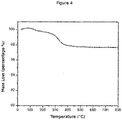
- Figure 4 shows that the residual stabilizer in the nanoparticles after cleaning them is not higher than 6%.
- Two previously prepared solutions are mixed: one by dissolving 4.9913 g of (CH 3 COO) 2 Cu in 100 mL of distilled water and the other by dissolving 13.8750 g of PVP (140 kD) in 100 mL of distilled water; with 30 min of stirring in the range of 5 to 10,000 rpm. It is added 14.95 mL of NH 3 to the mixture as a complexing agent. The mixture is stirred for 30 min. It is added 10 mL of 5M NaOH to the above mixture, to adjust the pH to a value greater than 10.5.
- the mixture is allowed to mature for 2 hours at a temperature of 25°C with stirring in the range of 5 to 10,000 rpm and then it is left to mature for 2 days at a temperature of 25°C without stirring, in the range of 5 to 10,000 rpm.
- the nanoparticles thus obtained are washed by dialysis with deionized water.
- FIG 5 the UV-Vis spectrum of a sample of this example is shown after being synthesized (24 hours) in comparison with that obtained for the nanoparticles after washing them after 3 days.
- the Plasmon moves from 579 nm to 595 nm evidencing that there is no excessive growth of nanoparticles.
- Two previously prepared solutions are mixed: one by dissolving 4.9913 g of (CH 3 COO) 2 Cu in 100 mL of distilled water and the other by dissolving 13.8750 g of PVP (140 kD) in 100 mL of distilled water; with 30 min of stirring in the range of 5 to 10,000 rpm. It is added 14.95 mL of NH 3 to the mixture as a complexing agent. The mixture is stirred for 30 min. It is added 10 mL of 5M NaOH to the above mixture, to adjust the pH to a value greater than 10.5.
- the mixture is allowed to mature for 2 hours at a temperature of 25°C with stirring in the range of 5 to 10,000 rpm and then it is allowed to mature 15 days at a temperature of 25°C without stirring in the range of 5 to 10,000 rpm.
- the nanoparticles thus obtained are washed by dialysis with deionized water.
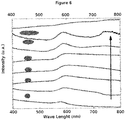
- FIG. 6 the UV-Vis Spectra of a sample of nanoparticles at different stages of maturation and/or growth are shown.
- a Resonance Plasmon is presented at 580 nm
- a second plasmon appears near 700 nm when anisotropic growth begins.
- the third phase clearly shows the presence of the two plasmons with the same intensity, after this, the maturation finally causes the second plasmon to increase its intensity causing the spectrum to change the shape
- Example of copper nanoparticles with a size of 150 nm with optical properties Example of copper nanoparticles with a size of 150 nm with optical properties.
- Two previously prepared solutions are mixed: one by dissolving 9.9825 g of (CH 3 COO) 2 Cu in 200 mL of distilled water and the other by dissolving 55.5000 g of PVP (140 kD) in 200 mL of distilled water; with 30 min of stirring in the range of 5 to 10,000 rpm. It is added 30 mL of NH 3 to the mixture as complexing agent. The mixture is stirred for 30 min. It is added 20 mL of 5M NaOH to the above mixture, to adjust the pH to a value greater than 10.5. It is added 0.3 mL of the defoamer (1-octanol) to the reaction mixture, and the reaction mixture is heated to 70°C with stirring in the range of 5 to 10,000 rpm.
- Example 4 With the nanoparticles obtained in Example 4, then it is prepared two polymer membranes, one matrix based on chitosan and another based on polymethylmethacrylate (PMMA) by the gel-casting method with nanoparticle contents of up to 15% of the base matrix.
- PMMA polymethylmethacrylate
- the membranes showed a different color when observed with different lighting angles.
- the absorption spectrum of UV-visible light was measured by two methods, one by means of the measurement with diffuse reflectance (reflected light) and another one of absorption (transmitted light).
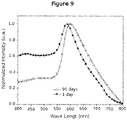
- Figure 7 shows the results of this analysis of the optical properties of nanoparticles due to anisotropic growth.
- the continuous line with squares is the spectrum taken by diffuse reflectance and the dashed line with circles is the spectrum taken by transmission (absorption spectrum).
- the change in profile indicates that there are differences in the form in which nanoparticles interact with light (transmitted and/or reflected form).
Landscapes
- Chemical & Material Sciences (AREA)
- Engineering & Computer Science (AREA)
- Nanotechnology (AREA)
- Inorganic Chemistry (AREA)
- Chemical Kinetics & Catalysis (AREA)
- General Chemical & Material Sciences (AREA)
- Manufacture Of Metal Powder And Suspensions Thereof (AREA)
- Processes Of Treating Macromolecular Substances (AREA)
Applications Claiming Priority (2)
| Application Number | Priority Date | Filing Date | Title |
|---|---|---|---|
| CL2015003794A CL2015003794A1 (es) | 2015-12-30 | 2015-12-30 | Método de obtención de nano partículas de cobre y uso de dichas partículas |
| PCT/IB2016/058110 WO2017115330A1 (fr) | 2015-12-30 | 2016-12-30 | Procédé d'obtention de nanoparticules de cuivre et utilisation desdites particules |
Publications (2)
| Publication Number | Publication Date |
|---|---|
| EP3398700A1 true EP3398700A1 (fr) | 2018-11-07 |
| EP3398700A4 EP3398700A4 (fr) | 2019-08-07 |
Family
ID=56610122
Family Applications (1)
| Application Number | Title | Priority Date | Filing Date |
|---|---|---|---|
| EP16881386.3A Withdrawn EP3398700A4 (fr) | 2015-12-30 | 2016-12-30 | Procédé d'obtention de nanoparticules de cuivre et utilisation desdites particules |
Country Status (5)
| Country | Link |
|---|---|
| US (1) | US20180297121A1 (fr) |
| EP (1) | EP3398700A4 (fr) |
| CN (1) | CN108778569B (fr) |
| CL (1) | CL2015003794A1 (fr) |
| WO (1) | WO2017115330A1 (fr) |
Families Citing this family (23)
| Publication number | Priority date | Publication date | Assignee | Title |
|---|---|---|---|---|
| US10987663B2 (en) * | 2017-12-22 | 2021-04-27 | Universidad De Chile | Method for preparing laminar zinc hydroxide organic-inorganic nanocomposites for use in the removal and degradation of dyes from textile effluents |
| CN109467984B (zh) * | 2018-10-17 | 2021-08-31 | 深圳先进技术研究院 | 一种自组装铜球、导电油墨及其制备方法和应用 |
| CN111715888B (zh) * | 2019-03-20 | 2023-10-24 | 香港科技大学 | 铜基纳米结构体、其制备方法、透明导电膜及电子装置 |
| CN110052232A (zh) * | 2019-03-21 | 2019-07-26 | 常州大学 | 一种高吸附性能纳米Cu2O超声辅助制备方法 |
| CN110697680A (zh) * | 2019-10-18 | 2020-01-17 | 龙岩学院 | 一种高比表面积的杂原子掺杂多孔碳材料及其制备方法 |
| CN111097923A (zh) * | 2020-02-25 | 2020-05-05 | 南宁师范大学 | 一种以间氨基苯酚为还原剂制备金纳米棒的方法 |
| CN111529756B (zh) * | 2020-06-23 | 2021-04-06 | 北京大学 | 一种骨科植入器械表面涂层的制备方法 |
| CN111715891B (zh) * | 2020-06-29 | 2023-06-20 | 太原师范学院 | 一种铜纳米颗粒溶液及其制备方法和应用 |
| CN111889692B (zh) * | 2020-07-09 | 2022-10-14 | 荆楚理工学院 | 一种单分散超细铜粉及其制备方法 |
| CN111975011B (zh) * | 2020-07-20 | 2022-01-18 | 华南理工大学 | 一种芯片无压烧结互连用纳米铜浆及其制备方法与应用 |
| CN112497374A (zh) * | 2020-11-28 | 2021-03-16 | 无锡市森泰木制品有限公司 | 一种环保抗菌实木地板的制备方法 |
| CN112548096A (zh) * | 2020-12-14 | 2021-03-26 | 中北大学 | 一种钴包覆陶瓷复合粉末及其制备方法和应用 |
| BR102020026481A2 (pt) * | 2020-12-22 | 2022-07-05 | Cecil S/A Laminação De Metais | Processo para produção de agente antimicrobiano e antiviral híbrido de nanopartículas de cobre e compostos orgânicos ativos, agente antimicrobiano e antiviral assim produzido e, uso do agente antimicrobiano e antiviral |
| CN112919526A (zh) * | 2021-03-31 | 2021-06-08 | 辽宁工程技术大学 | 一种氧化亚铜纳米材料制备方法 |
| CN113229292B (zh) * | 2021-05-17 | 2022-03-11 | 泉州师范学院 | 一种Cu/C复合纳米片层材料及其制备方法与应用 |
| CN113996799B (zh) * | 2021-10-08 | 2024-02-02 | 郑州工程技术学院 | 铜纳米材料的制备方法 |
| CN115121259B (zh) * | 2022-05-10 | 2024-03-22 | 陕西师范大学 | 氧化亚铜@金纳米模拟酶及制备方法和应用 |
| CN115255381B (zh) * | 2022-08-08 | 2024-06-25 | 淮安中顺环保科技有限公司 | 一种水溶性纳米铜粉的宏量制备方法 |
| CN115283689B (zh) * | 2022-08-09 | 2024-06-21 | 北京化工大学 | 具有自身抗氧化性的铜纳米材料的制备方法和由该方法制得的铜纳米材料 |
| CN115386226B (zh) * | 2022-08-25 | 2023-08-18 | 四川大学 | 一种聚醚砜抗氧化微球、其制备方法及用途 |
| CN115676871B (zh) * | 2022-11-04 | 2023-12-05 | 安徽铜冠产业技术研究院有限责任公司 | 一种纳米氧化铜粉体的制备工艺 |
| US11801553B1 (en) | 2022-11-29 | 2023-10-31 | King Faisal University | Method for making carbon-coated copper nanoparticles |
| CN116689750B (zh) * | 2023-06-27 | 2025-12-26 | 河南科技大学 | 一种水相制备微米级球形或类球形Cu粉的方法 |
Family Cites Families (9)
| Publication number | Priority date | Publication date | Assignee | Title |
|---|---|---|---|---|
| US20070144305A1 (en) * | 2005-12-20 | 2007-06-28 | Jablonski Gregory A | Synthesis of Metallic Nanoparticle Dispersions |
| JP5593699B2 (ja) * | 2008-02-07 | 2014-09-24 | 旭硝子株式会社 | 水素化銅ナノ粒子、その製造方法、金属ペーストおよび物品 |
| DE102009015470A1 (de) * | 2008-12-12 | 2010-06-17 | Byk-Chemie Gmbh | Verfahren zur Herstellung von Metallnanopartikeln und auf diese Weise erhaltene Metallnanopartikel und ihre Verwendung |
| US20100172997A1 (en) * | 2008-12-30 | 2010-07-08 | University Of North Texas | Gold, silver, and copper nanoparticles stabilized in biocompatible aqueous media |
| AU2010227626B2 (en) * | 2009-03-24 | 2014-03-27 | Basf Se | Preparation of shaped metal particles and their uses |
| CN101693297B (zh) * | 2009-10-16 | 2011-06-08 | 厦门大学 | 一种不同粒径铜纳米粒子的制备方法 |
| CN102205422A (zh) * | 2011-01-17 | 2011-10-05 | 深圳市圣龙特电子有限公司 | 一种电子浆料用纳米铜粉及其制作工艺 |
| JP5450725B2 (ja) * | 2011-08-30 | 2014-03-26 | 富士フイルム株式会社 | コラーゲンペプチド被覆銅ナノ粒子、コラーゲンペプチド被覆銅ナノ粒子分散物、コラーゲンペプチド被覆銅ナノ粒子の製造方法、導電性インク、導電膜の製造方法、及び導体配線 |
| GB201403731D0 (en) * | 2014-03-03 | 2014-04-16 | P V Nano Cell Ltd | Nanometric copper formulations |
-
2015
- 2015-12-30 CL CL2015003794A patent/CL2015003794A1/es unknown
-
2016
- 2016-12-30 CN CN201680081407.9A patent/CN108778569B/zh not_active Expired - Fee Related
- 2016-12-30 EP EP16881386.3A patent/EP3398700A4/fr not_active Withdrawn
- 2016-12-30 US US16/067,298 patent/US20180297121A1/en not_active Abandoned
- 2016-12-30 WO PCT/IB2016/058110 patent/WO2017115330A1/fr not_active Ceased
Also Published As
| Publication number | Publication date |
|---|---|
| US20180297121A1 (en) | 2018-10-18 |
| CL2015003794A1 (es) | 2016-07-29 |
| CN108778569B (zh) | 2021-10-29 |
| EP3398700A4 (fr) | 2019-08-07 |
| CN108778569A (zh) | 2018-11-09 |
| WO2017115330A1 (fr) | 2017-07-06 |
Similar Documents
| Publication | Publication Date | Title |
|---|---|---|
| EP3398700A1 (fr) | Procédé d'obtention de nanoparticules de cuivre et utilisation desdites particules | |
| Fatimah et al. | Ultrasound-assisted biosynthesis of silver and gold nanoparticles using Clitoria ternatea flower | |
| US9080255B2 (en) | Method of producing silver nanowires in large quantities | |
| Suriati et al. | Synthesis of silver nanoparticles by chemical reduction method: Effect of reducing agent and surfactant concentration | |
| Lignier et al. | Scalable strategies for the synthesis of well-defined copper metal and oxide nanocrystals | |
| Zhu et al. | Microwave-assisted preparation of inorganic nanostructures in liquid phase | |
| Sobczak-Kupiec et al. | Influence of silver nitrate concentration on the properties of silver nanoparticles | |
| CN100569418C (zh) | 制造金属纳米颗粒的方法以及由此制造的金属纳米颗粒 | |
| EP2883922B1 (fr) | Synthèse de nanoparticules métalliques et formulation d'encre conductrice | |
| US8529963B2 (en) | Method for preparing dispersions of precious metal nanoparticles and for isolating such nanoparticles from said dispersions | |
| JP2008075181A (ja) | マイクロ波を用いた銅ナノ粒子の製造方法 | |
| Li et al. | Rapid microwave-assisted preparation and characterization of cellulose–silver nanocomposites | |
| KR20160053352A (ko) | 다기능성 고분자와 환원제를 이용한 금속나노입자의 제조방법 | |
| KR101423563B1 (ko) | 금속 및 금속 산화물 나노입자 및 나노 플레이트의 제조방법 | |
| Gönen et al. | Zinc stearate production by precipitation and fusion processes | |
| Zhang et al. | Synthesis of PVP-stabilized ruthenium colloids with low boiling point alcohols | |
| Khachatryan et al. | Formation of nanometal particles in the dialdehyde starch matrix | |
| Boey et al. | Formation and morphology of colloidal chitosan-stabilized copper sulfides | |
| CN110181074B (zh) | 一种复合软模板法绿色制备高长径比银纳米线的方法 | |
| Logutenko et al. | A novel method to prepare copper microspheres via chemical reduction route | |
| Dang-Bao et al. | Tuning polyol-mediated process towards augmentation of zero-valent copper nanoparticles | |
| Li et al. | Metal ion redox potential plays an important role in high-yield synthesis of monodisperse silver nanoparticles | |
| Rodríguez et al. | Oxide copper nanoparticles stabilized by acrylonitrile and methyl methacrylate polar monomers through a ligand exchange reaction | |
| Shown et al. | Synthesis of-Cyclodextrin-Modified Water-Dispersible Ag-TiO2 Core–Shell Nanoparticles and Their Photocatalytic Activity | |
| KR101138220B1 (ko) | 나노입자의 제조방법 |
Legal Events
| Date | Code | Title | Description |
|---|---|---|---|
| STAA | Information on the status of an ep patent application or granted ep patent |
Free format text: STATUS: THE INTERNATIONAL PUBLICATION HAS BEEN MADE |
|
| PUAI | Public reference made under article 153(3) epc to a published international application that has entered the european phase |
Free format text: ORIGINAL CODE: 0009012 |
|
| STAA | Information on the status of an ep patent application or granted ep patent |
Free format text: STATUS: REQUEST FOR EXAMINATION WAS MADE |
|
| 17P | Request for examination filed |
Effective date: 20180706 |
|
| AK | Designated contracting states |
Kind code of ref document: A1 Designated state(s): AL AT BE BG CH CY CZ DE DK EE ES FI FR GB GR HR HU IE IS IT LI LT LU LV MC MK MT NL NO PL PT RO RS SE SI SK SM TR |
|
| AX | Request for extension of the european patent |
Extension state: BA ME |
|
| DAV | Request for validation of the european patent (deleted) | ||
| DAX | Request for extension of the european patent (deleted) | ||
| A4 | Supplementary search report drawn up and despatched |
Effective date: 20190704 |
|
| RIC1 | Information provided on ipc code assigned before grant |
Ipc: B82Y 40/00 20110101ALI20190628BHEP Ipc: B22F 1/00 20060101AFI20190628BHEP Ipc: B22F 9/24 20060101ALI20190628BHEP Ipc: B01D 69/00 20060101ALI20190628BHEP Ipc: B82Y 30/00 20110101ALI20190628BHEP Ipc: B22F 9/18 20060101ALI20190628BHEP Ipc: C22C 1/04 20060101ALI20190628BHEP |
|
| R17P | Request for examination filed (corrected) |
Effective date: 20180706 |
|
| STAA | Information on the status of an ep patent application or granted ep patent |
Free format text: STATUS: EXAMINATION IS IN PROGRESS |
|
| 17Q | First examination report despatched |
Effective date: 20210811 |
|
| STAA | Information on the status of an ep patent application or granted ep patent |
Free format text: STATUS: THE APPLICATION IS DEEMED TO BE WITHDRAWN |
|
| 18D | Application deemed to be withdrawn |
Effective date: 20211222 |