EP3399082A1 - Tissu double face ayant une structure à trou définie - Google Patents
Tissu double face ayant une structure à trou définie Download PDFInfo
- Publication number
- EP3399082A1 EP3399082A1 EP17168917.7A EP17168917A EP3399082A1 EP 3399082 A1 EP3399082 A1 EP 3399082A1 EP 17168917 A EP17168917 A EP 17168917A EP 3399082 A1 EP3399082 A1 EP 3399082A1
- Authority
- EP
- European Patent Office
- Prior art keywords
- segment
- fabric
- fibers
- double
- weft
- Prior art date
- Legal status (The legal status is an assumption and is not a legal conclusion. Google has not performed a legal analysis and makes no representation as to the accuracy of the status listed.)
- Granted
Links
Images


Classifications
-
- D—TEXTILES; PAPER
- D03—WEAVING
- D03D—WOVEN FABRICS; METHODS OF WEAVING; LOOMS
- D03D1/00—Woven fabrics designed to make specified articles
- D03D1/02—Inflatable articles
-
- D—TEXTILES; PAPER
- D03—WEAVING
- D03D—WOVEN FABRICS; METHODS OF WEAVING; LOOMS
- D03D11/00—Double or multi-ply fabrics not otherwise provided for
- D03D11/02—Fabrics formed with pockets, tubes, loops, folds, tucks or flaps
-
- D—TEXTILES; PAPER
- D03—WEAVING
- D03D—WOVEN FABRICS; METHODS OF WEAVING; LOOMS
- D03D13/00—Woven fabrics characterised by the special disposition of the warp or weft threads, e.g. with curved weft threads, with discontinuous warp threads, with diagonal warp or weft
- D03D13/004—Woven fabrics characterised by the special disposition of the warp or weft threads, e.g. with curved weft threads, with discontinuous warp threads, with diagonal warp or weft with weave pattern being non-standard or providing special effects
-
- D—TEXTILES; PAPER
- D10—INDEXING SCHEME ASSOCIATED WITH SUBLASSES OF SECTION D, RELATING TO TEXTILES
- D10B—INDEXING SCHEME ASSOCIATED WITH SUBLASSES OF SECTION D, RELATING TO TEXTILES
- D10B2403/00—Details of fabric structure established in the fabric forming process
- D10B2403/02—Cross-sectional features
- D10B2403/022—Lofty fabric with variably spaced front and back plies, e.g. spacer fabrics
Definitions
- the present invention relates to a double fabric, a method for producing the double fabric, an inflatable structure comprising the double fabric and the use of the double fabric and the structure.
- Double tissue is a form of multiple tissue. They consist of two superimposed fabrics, which are selectively connected to each other during weaving. Double fabric, also called double wall fabric, spacer fabric or two-ply fabric, are well known and widely used.
- a specific form of such a double tissue is 2-wall tissue, i. Spacer fabric with two fabric layers, which are interconnected by a plurality of spacer threads.
- the sides of such 2-wall fabrics are always open after manufacture of the fabrics, i. the two fabric layers are not connected by a common edge.
- the edges of the fabric layers can be joined together, which can be built up for example by a built-in valve, a gas pressure. This results in inflated spacer fabric, wherein a plurality of spacer threads is arranged vertically to the two fabric layers.
- Such inflated spacer fabrics with spacer threads arranged vertically to the spacer fabric layers can be produced cost-effectively and are well suited, for example, for upholstery.
- the individual spacer fabric layers connected to the spacer yarns can easily be displaced laterally to the opposite spacer fabric layer, they do not provide the inflated spacer fabric with sufficient stability for many applications. Therefore, such are enough Fabric no static requirements.
- the distance between the two fabric layers is limited, whereby they can be used less versatile.
- the object of the present invention is therefore to provide a fabric having an inner hollow structure and outer common edge, which can be produced in a simple manner in a weaving process.
- a gas such as air
- the fabric should be easy to produce and - especially after side lamination - can withstand high physical demands. Contains the fabric and the structure little or no gas, they should be stored and transported in a small space and also have a low weight.
- an inflatable structure comprising the inventive double fabric, wherein the double fabric in the beginning and / or end of the warp K, in particular with a continuous edge and / or attached lid, is closed and a closable opening, such as a valve, and / or a gas generator and / or gas pressure vessel, wherein at least one of the segments A H , A L , B H and / or B L of the double fabric provided with at least one coating and / or with a sheet member BT, preferably a rigid material laminated ,
- inventive double fabric the double fabric according to the invention and the inventive structure in the Agrotech, Buildtech, Clothtech, Geotech, Hometech, Indutech, Medtech, Mobiltech, Oekotech, Packtech, Protech and / or Sporttech, and their use as a device for lightweight construction in buildings, vehicles and / or shipbuilding; for greening surfaces, in particular surfaces such as facades; as insulation material against cold, heat and / or sound; for the filtration of gases, liquids and / or suspensions; as protective covers; (Construction) beams and / or as prefabricated buildings or building parts.
- the double fabric according to the invention, the double fabric produced according to the invention, the structural body according to the invention and the use according to the invention surprisingly have many advantages.
- the inventive double fabric can be produced in a simple manner with existing weaving technology and weaving machines. Despite the novel process, the weaving machines do not have to be converted or only with little effort.
- the inventive double fabric with inner, defined hollow structure and outer common edge cost-effectively in a weaving process in a simple manner are produced, whereby a 4-wall fabric is obtained.
- This 4-wall fabric can be easily coated and laminated and / or further processed, for example, to the inventive structure, whereby the double fabric obtained according to the invention, ie the 4-wall fabric, resp. the building gets completely new properties. Are the beginning and end of the double tissue resp.
- the structure includes a closable opening, a valve, and / or a gas generator and / or gas pressure vessel, the double fabric and the building, for example, factory-made, folded or pressed flat with minimum volume and weight stored and transported.
- the inventive double fabric ie the 4-wall fabric, respectively the structure can be filled, for example by pressing a gas or gas mixture.
- the double fabric resp. Unfolds. the building not only and takes a larger volume, but it also receives a much greater stability.
- the double fabric and the structure if processed in attached form, for example, even be used as a building or part of a building.
- the double fabric and in particular the structure have an exceptionally large ratio of the load capacity resp. the transmittable force to its own weight.
- Double fabrics consist of two interwoven fabrics in different ways. They are usually made with two warp and two weft systems.
- the term fabric is according to the invention for a variety of - usually perpendicular - each other crossed thread systems - the warp K and the weft threads S.
- the warp threads K run in the production direction of the fabric and are wound in the desired number and thread density on the so-called warp beam.
- the weft threads S are parallel threads of the fabric, which lie in the manufacture of the fabric transversely, that is typically perpendicular to the warp threads spanned in the loom.
- weft thread S is used according to the present invention as an umbrella term for all weft threads specified in greater detail, in particular as an umbrella term for the weft threads S H , S L , S (A H B L ) and S (A L B H ).
- weft threads S H , S L , S (A H B L ) and S (A L B H ) are automatically included when mentioning weft S or weft threads. If the term "weft" without further specification in the singular called, also the plurality of corresponding weft threads is called.
- warp K is used according to the present invention as an umbrella term for all closer specified warp threads, in particular as an umbrella term for the warp threads K R , K H and K L.
- the warp yarns K R , K H and K L are automatically included when mentioning warp K or warp K respectively. If the term "warp" without further specification in the singular called, also the plurality of corresponding warp threads is called.
- the double fabric according to the invention, the double fabric produced according to the invention and the structural body according to the invention comprise an upper fabric G H and a lower fabric G L.
- the weft threads S of the fabric G H and G L usually have a very large length, whereby the weft threads S during weaving many times through the entirety of the warp K from left to right and from right to left "shot" can be.
- the length of the weft threads S understood that length which limits the weft thread S from the warp K, which the inventive double fabric on one side, eg left side, to the warp K, which the inventive double fabric on the other side, eg right side, limited, understood.
- the weft thread S has two end regions located at the edges R and R '. Also, in each case only one weft direction of the weft threads is called, for example, from left to right. For the purposes of the present invention, however, this also applies to the other weft direction - in this case from right to left.
- warp threads K which laterally delimit the double fabric according to the invention, the double fabric produced according to the invention and the structural body according to the invention, are typically woven with the weft threads S to a left edge R and right edge R 'in the direction of production.
- These warp threads K are hereafter called warp threads K R.
- the upper fabric G H and the lower fabric G L are at the edges R and R '- and thus in the end region of the weft threads S - positively connected to each other, in particular woven together and each form a common (border) tissue, while between the edges the tissues G H and G L represent separate tissues.
- the edge R may comprise the same or a different number of warp threads K R as the edge R '.
- edges R and R ' may be the same or different in width.
- the edge R and / or R 'in different Kettfadenide have a different width, ie, the edge R and / or the edge R', for example, at the beginning and / or against resp. be wider at the end of the double tissue than in the middle of the double tissue.
- the weft threads S of the inventive double fabric, the double fabric according to the invention and the inventive Structures are essentially interwoven with all the warp threads K R to the edges R and R '.
- at least one weft thread S hereafter called weft thread S H
- warp threads K H with a part of the warp threads K, hereafter called warp threads K H , woven into the upper fabric G H.
- warp threads K L a part of the warp threads K, hereinafter called warp threads K L , woven into the lower fabric G L.
- the warp yarns K H and K L are uniformly distributed between the two edges.
- weft threads S H extend from the left edge R over the entire upper fabric G H to the right edge R 'and the weft threads S L extend from the left edge R over the entire lower fabric G L to the right edge R'.
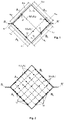
- the upper fabric G H of the inventive double fabric, the double fabric according to the invention and the inventive structure is divided in the weft direction, ie along the weft threads S, into a segment A H and a segment B H.
- the lower fabric G L of the inventive double fabric is divided into a segment A L and a segment B L , wherein the length of the segment A H is substantially the length of the segment B L and the length of the segment A L corresponds substantially to the length of the segment B H.
- the segment A H differs from the segment B H in that at least one weft thread S (A H B L ) connects the segment A H to the segment B L , while the segment B H connects to at least one weft thread S (A L B H ) is connected to the segment A L.
- the length of the weft thread S (A H B L ) typically corresponds to the length of the segment A H and the length of the weft thread S (A L B H ) the length of the segment B H , wherein the length of the segments A H , A L , B H and B L in the direction of the weft threads S (A H B L ) and S (A L B H ) are measured.
- all segments A H , A L , B H and B L have the same length, whereby the double fabric and the structure produced therefrom in the inflated, ie in the filled state, have a square cross-section.
- At least one weft thread S connects the segment A H of the upper fabric G H to the segment B L of the lower fabric G L and thus forms the weft thread S (A H B L ), and at least one weft thread S the segment A L of the lower fabric G L connects to the segment B H of the upper fabric G H and thus forms the weft thread S (A L B H ), the weft thread S (A H B L ) preferably parallel to the segment B H and the weft thread S ( A L B H ) is preferably arranged parallel to the segment A H.
- the weft thread S (A H B L ) thus divides the segment A H of the upper fabric G H into a subsegment a H1 and a subsegment a H2 , the subsegment a H1 at the left edge R and the subsegment a H2 at the segment B H adjoins.
- the weft thread S (A H B L ) also subdivides the segment B L of the lower tissue G L into a subsegment b L1 and a subsegment b L2 , wherein the subsegment b L1 adjoins the segment A L and the subsegment b L2 to the right Rand R 'adjoins.
- the weft thread S (A L B H ) subdivides the segment A L of the lower fabric G L into a subsegment a L1 and a subsegment a L2 , the subsegment a L1 at the left edge R and the subsegment a L2 at the segment B L adjoins.
- the weft thread S (A L B H ) also divides the segment B H of the upper fabric G H into a subsegment b H1 and a sub-segment b H2 , wherein the sub-segment b H1 adjacent to the segment A H and the sub-segment b H2 to the right edge R '.
- weft threads S (A H B L ) and S (A L B H ) are therefore part of those subsegments which adjoin the edges R and R '.
- the weft thread S (A H B L ) is part of the lower segment a H1 and part of the lower segment b L2 , but not part of the subsegments a H2 and b L1 .
- the weft thread S (A L B H ) is part of the subsegment a L1 and part of the subsegment b H2 , but not part of the subsegments a L2 and b H1 .
- the weft thread S (A H B L ) thus extends from the left edge R coming along the lower segment a H1 to the point where the subsegment a H2 begins. From there, the weft thread S (A H B L ) continues to the intersection of the subsegments b L1 and b L2 of the segment B L of the lower fabric G L. Subsequently, the weft thread S (A H B L ) extends further along the lower segment b L2 to the right edge R '.
- weft thread S (A L B H ) extends from the left edge R coming along the subsegment a L1 to the point where the subsegment a L2 starts. From there, the weft thread S (A L B H ) continues to the intersection of the subsegments b H1 and b H2 of the segment B H of the upper fabric G H. Subsequently, the weft thread S (A L B H ) extends further along the lower segment b H2 to the right edge R '.
- the weft thread S (A H B L ) is at least in the areas W, where the subsegment a H1 adjacent to the subsegment a H2 , with the segment A H of the fabric G H , and, where the sub-segment b L2 is adjacent to the sub-segment b L1 , interwoven with the segment B L of the fabric G L.
- Analog is the weft S (A L B H ) at least in the areas W, where the subsegment a L1 adjacent to the subsegment a L2 , with the segment A L of the fabric G L , and, where the subsegment b H2 adjacent to the subsegment b H1 , with woven into the segment B H of the fabric G H.
- any chosen large, ie the weft thread S (A H B L ) and / or the weft thread S (A L B H ) can only with some or all warp threads K H resp. K L be interwoven.
- weft thread S (A H B L ) and / or the weft thread S (A L B H ) can be woven in different regions W along the subregions a H1 , a L2 , b H2 and / or b L2 , where these areas W can be the same or different sizes.
- the double fabric according to the invention, the double fabric produced in accordance with the invention and the structural body according to the invention in the filled state assumes a substantially rectangular shape, wherein in cross section at two diagonally opposite edges, the edges R and R 'are arranged.
- the weft threads S (A H B L ) and S (A L B H ) - when they are arranged parallel to the respective segments A L and B H and A H and B L - to each other at right angles, ie at right angles.
- At least two weft threads S (A H B L ) and at least two weft threads S (A L B H ) are used, which have a different length of the lower segment a H1, respectively. of the subsegment a L1 .
- the lengths of the subsegments a H2 and a L2 are different.
- the subsegments b L1 , b L2 , b H1 and b H2 have a different length.
- Such an arrangement results in a variety of different rectangles such as squares located within the upper fabric G H and lower fabric G L.
- a plurality of different weft threads S (A H B L ) and S (A L B H ) subdivide the segments A H and B L and A L and B H into subsegments a H1 , a H2 , b L1 of different lengths and b L2 and a L1 , a L2 , b H1 and b H2 .
- the length of the subsegments a H1 , a H2 , b L1 and b L2 and a L1 , a L2 , b H1 and b H2 is selected such that the subsegments a H1 and a L1 for each successive weft thread S (A H B L ) and S (A L B H ) is slightly larger - for example, always at the same distance.
- the length of the subsegments a H1 and a L1 almost the length of the segments A H resp. A L , a unit is completed and it can again with the smallest length of the subsegments a H1 and a L1 - and thus continue with the next unit.
- Such units can be repeated any number of times.
- defined, typically rectangular and / or square channels can be formed in the cavities in the inflated, inventive double fabric and double fabric produced according to the invention and in the inflated structural body according to the invention - viewed from the cross section in the direction of the warp threads, their size being chosen arbitrarily and for the appropriate use can be optimized.
- the length of the subsegments a H1 , a H2 , b L1 and b L2 and a L1 , a L2 , b H1 and b H2 is selected such that the subsegments a H1 and a L1 for each successive weft thread S (A H B L ) and S (A L B H ) have a completely different length.
- inventive double fabric and double fabric prepared according to the invention as well as in the inflated, inventive structure cavities arise, which are relatively dense by a plurality of weft threads S (A H B L ) and S (A L B H ).
- Such double fabric and structure may, for example, be suitable for retaining material distributed therein.
- the number of weft threads S H which extend over the entire upper fabric G H , about the same size as the number of weft threads S L , which extend over the entire lower fabric G L.
- the ratio of the number of weft threads S H to the number of weft threads S L is between about 70:30 and 30:70, preferably between about 60:40 and 40:60.
- the ratio of the number of warp yarns K H of the upper fabric G H to the number of warp yarns K L of the lower fabric G L is between about 70:30 and 30:70, preferably between about 60:40 and 40:60.
- the number of weft threads S (A H B L ), which connects the segment A H of the upper fabric G H with the segment B L of the lower fabric G L about the same size as the number of weft threads S ( A L B H ) which connects the segment A L of the lower fabric G L to the segment B H of the upper fabric G H. Consequently
- the ratio of the number of weft threads S (A H B L ) to the number of weft threads S (A L B H ) is between about 80:20 and 20:80, preferably between about 70:30 and 30:70.
- the number of weft yarns S (A H B L ) is not more than 20%, preferably not more than 10%, in particular not more than 5%, of the Number of weft threads S (A L B H ) deviates in the same length range.
- the ratio of the sum of the weft threads S H and S L to the sum of the weft threads S (A H B L ) and S (A L B H ) can be varied within a very wide range.
- the ratio of the sum of the weft threads S H and S L to the sum of the weft threads S (A H B L ) and S (A L B H ) is approximately between 100,000: 1 and 1: 100 between about 10'000: 1 and 1:50.
- the double fabric and the inventive structure of the weft S (A H B L ) is preferably parallel to the segment B H and the weft S (A L B H ) preferably arranged parallel to the segment A H.
- the length of the lower segment a H1 is equal to the length of the lower segment b L1 and the length of the lower segment a H2 is equal to the length of the lower segment b L2 .
- the length of the lower segment a L1 is the same size as the length of the lower segment b H1 and the length of the lower segment a L2 is the same size as the length of the lower segment b H2 .
- the segment A H is not connected to the segment A L by one or more weft threads S (A H B L ) and / or S (A L B H ) in the double fabric according to the invention, in the double fabric produced according to the invention and in the building according to the invention at the triple point, where the segments A H and A L combine with the edge R.
- the same applies to the segment B H which is advantageously not connected to the segment B L via one or more weft threads S (A H B L ) and / or S (A L B H ), except at the triple point of the segments B H , B L and the edge R '.
- the length of the at least one weft thread S (A H B L ) between the segments A H and B L of the inventive double fabric advantageously has the same length as the segment B H.
- the length of the at least one weft thread S (A L B H ) between the segments A L and B H advantageously has the same length as the segment A H , whereby the double fabric in the inflated state has a cavity with defined hollow structures ,
- all the weft threads S, S H , S L , S (A H B L ) and S (A L B H ) have the same length.
- the maximum length and width of the inventive double fabric is essentially limited by the looms available and is defined in particular by the respective application. While there are almost no limits to the length of the double weave due to the weaving technique, the width of the double weave may be, for example, up to 10 meters or more.
- the length of the segments A H and B L and B H and A L is about 0.5 to 300 cm, preferably each about 1 - 100 cm, in particular each about 1 - 50 cm.
- the warp threads K and the weft threads S of the double fabric according to the invention, the double fabric and the inventive structure are essentially unlimited in terms of the material, the size and the method of manufacturing the threads, as long as the threads are suitable for the production of fabrics.
- warp threads K and weft threads S can also select suitable warp threads K and weft threads S to give the inventive double fabric the desired material properties.
- the warp threads K and weft threads S may be identical or different, in particular they may consist of the same or different material. Often it is advantageous if all used warp threads K are made of the same material. Also, all weft threads S can be made of the same material.
- the warp threads K and / or the weft threads S are preferably based on natural fibers, in particular vegetable fibers, animal fibers and / or mineral fibers;
- Man-made fibers of natural polymers of vegetable or animal origin in particular cellulose fibers, such as cuprofibres, viscose fibers, modal fibers, acetate fibers, triacetate fibers, starch-based and / or glucose-based fibers, alginate fibers, chitosan fibers, Elostidium fibers, rubber fibers, protein fibers, such as vegetable protein fibers, zein fibers, animal protein fibers and / or casein fibers;
- Synthetic fibers of synthetic polymers in particular polymerisation fibers such as polyethylene fibers, polypropylene fibers, polychloride fibers, fluorine fibers, polyacrylonitrile fibers, modacrylic fibers, vinylate fibers, trivinyl fibers and / or elastodiene fibers, polyconden
- the double fabric according to the invention when finished, has a continuous edge at the beginning and / or end of the warp threads K, ie an edge which along the entire length of the weft threads S is arranged.
- the tissue G H and tissue G L are connected to the edges R, and R connected 'not just lateral to each other - for example interwoven, but along the weft yarns S. also at the beginning and / or at the end of the warp yarns K This results in a fillable double tissue.
- the double fabric and / or the structural body at the beginning and / or at the end of the warp threads K comprises such an edge passing in the direction of the weft threads S, it is often advantageous if the left edge R arranged in the central region of the warp thread length and / or the enlarge right edge R 'to the continuous edge, wherein the upper tissue G H and the lower tissue G L taper towards the continuous edge.
- This taper may have, for example, a conical and / or curved shape.
- the upper fabric G H and the lower fabric G L at the beginning and / or at the end of the double fabric and / or the building body with a closure, for example a lid.
- a closure for example a lid.
- Such a degree, resp. Lid may be of the same material as the double weave and woven, sewn, glued and / or otherwise attached thereto.
- the continuous edge and / or the attached lid may be based on the same and / or different material than the double fabric.
- the closable opening, the gas generator and / or the gas pressure vessel are preferably arranged in the starting region and / or end region of the warp threads K.
- This allows easy filling - and usually also emptying - of the double fabric and the structure.
- gases in particular air, carbon dioxide (CO 2 ) and / or nitrogen (N 2 ); with one or more liquids, in particular with aqueous liquid such as water; and / or filled with solids, suspensions, sludges, gels, and / or expandable foams.
- CO 2 carbon dioxide
- N 2 nitrogen
- liquids in particular with aqueous liquid such as water
- solids, suspensions, sludges, gels, and / or expandable foams solids, suspensions, sludges, gels, and / or expandable foams.
- a suitable triggering mechanism is always included.
- the amount of gas to be escaped is advantageously chosen so that the inflated double fabric and / or the inflated structure have an overpressure, so that they are filled up, but not burst by the generated gas pressure, i. be destroyed.
- a suitable gas pressure vessel may be a small gas cartridge or a gas generator such as are used in airbags application.
- the double fabric according to the invention the double fabric produced according to the invention and / or the building according to the invention is filled with one or more gases, it is often advantageous if a slight overpressure is generated within the double fabric.
- This can be 5 bar or more.
- an overpressure of up to 3 bar, preferably up to 2 bar, in particular up to 1 bar is sufficient. It is known to the person skilled in the art how the overpressure is determined.
- the fabrics G H and / or G L of the inventive double fabric, the double fabric prepared according to the invention and the inventive structure are provided with at least one coating, wherein the coating is preferably a coating based on polyvinyl chloride (PVC), thermoplastic polyurethane (TPU ), Polyolefin (PO), thermoplastic polyolefin (TPO), ethylene-tetrafluoroethylene copolymer (ETFE), polytetrafluoroethylene polymer (PTFE), a PVC / PU blend, and / or mixtures thereof.
- This coating is applied to at least one, preferably to two opposite, and in particular all, segments A H , A L , B H and / or B L , and / or on the edges.
- the application takes place in the form of an emulsion, suspension, liquid, a foam, aerosol and / or liquid mixture on the double fabric, or a part thereof.
- At least one of the segments A H , A L , B H and / or B L with a planar component BT preferably a rigid, ie rigid resp. stiff, material, laminated. It is often advantageous that the opposing segments A H and B L and / or A L and B H are laminated with the same or another sheet-like component BT.
- all segments A H , A L , B H and / or B L which each form a wall of the 4-wall fabric, with a flat component BT, preferably a rigid, ie rigid resp. stiff, material, laminated.
- rigid material is understood to mean a material with an E-modulus of less than 1000 kN / mm 2 , measured according to EN ISO 527-1.
- the planar component BT preferably comprises a plastic, fiber-reinforced plastic, also called fiber-plastic composite or fiber composite plastic, a fiberglass composite, carbon fiber composite, fiber-cement composite, wood, cardboard, glass, a flagstone, lightweight board, cement fiber board, Metal plate and / or spring steel plate.
- the inventive method for producing the double fabric and the inventive structure can be carried out by means of known web technologies.
- the jacquard weaving technique and / or shank weaving technique are preferably produced.
- the person skilled in these weaving techniques are known. He can also make the process-relevant settings in the weaving machines without inventive step.
- the inflatable building according to the invention comprises the double fabric according to the invention or the double fabric produced according to the invention, i. 4 wall tissue. This is closed in the starting region and / or end region of the warp threads K, for example, with a continuous edge and / or a lid attached.
- the lid can be woven together with the double fabric, i. be prepared.
- the lid may be made up, i. be attached to the double fabric, for example by sewing and / or gluing.
- the double fabric in the initial region and in the end region of all warp threads K preferably with a continuous edge, as well as along the lateral edges R and R 'closed, in particular interwoven.
- the inflatable structure comprises at least one closable opening, for example a valve, and / or a gas generator and / or gas pressure vessel to fill the building.
- the building comprises an opening, for example in a valve
- At least one of the segments A H , A L , B H and / or B L of the double fabric of the building according to the invention is provided with at least one coating, and / or at least one of the segments A is H , A is L , B is H and / or B is L with a sheet-like component BT, preferably a rigid material, laminated.
- the entire upper fabric G H ie both segments A H and B H and / or the entire lower fabric G L , ie both segments A L and B L provided with at least one coating, ie coated and / or with a sheet-like component BT, preferably a rigid material, laminated.
- the opposing segments A H and B L or the opposing segments A L and B H are provided with at least one coating.
- the other segments are then laminated with a sheet-like component BT, preferably a rigid material.
- the double fabric according to the invention, the double fabric produced by the process according to the invention and also the structure according to the invention can surprisingly be used extremely versatile. Due to the significant advantages over conventional double fabrics they find, if necessary, after further processing, a variety of uses.
- Non-limiting areas of application include Agrotech, such as fabrics for agriculture, forestry, horticulture, as planting aids and / or Irrigation systems; the Buildtech, such as components for lightweight construction in buildings, vehicles and / or shipbuilding, as prefabricated buildings and / or building parts, as a fabric for building construction, reinforcing mesh, insulating materials against cold, heat and sound and / or tissue for planting areas, in particular surfaces such as facades; the clothtech, such as functional fabrics for clothing and / or shoes; the geotech, such as landscaping fabric, dike construction, drainage, the Hometech, such as for Einstelltude and / or for insulation; Indutech, such as for industry, for example for filtration; medtech, such as dressings, protective covers and /
- the inventive double fabric the double fabric produced by the method according to the invention as well as the inventive structure as a component for lightweight construction in buildings, vehicles and / or shipbuilding; for greening surfaces, in particular surfaces such as facades; as insulation material against cold, heat and / or sound; for the filtration of gases, liquids and / or suspensions; be used as protective covers and / or as prefabricated buildings or parts of buildings.
Landscapes
- Engineering & Computer Science (AREA)
- Textile Engineering (AREA)
- Woven Fabrics (AREA)
Priority Applications (1)
| Application Number | Priority Date | Filing Date | Title |
|---|---|---|---|
| EP17168917.7A EP3399082B1 (fr) | 2017-05-02 | 2017-05-02 | Tissu double face ayant une structure à trou définie |
Applications Claiming Priority (1)
| Application Number | Priority Date | Filing Date | Title |
|---|---|---|---|
| EP17168917.7A EP3399082B1 (fr) | 2017-05-02 | 2017-05-02 | Tissu double face ayant une structure à trou définie |
Publications (2)
| Publication Number | Publication Date |
|---|---|
| EP3399082A1 true EP3399082A1 (fr) | 2018-11-07 |
| EP3399082B1 EP3399082B1 (fr) | 2021-04-14 |
Family
ID=58664548
Family Applications (1)
| Application Number | Title | Priority Date | Filing Date |
|---|---|---|---|
| EP17168917.7A Active EP3399082B1 (fr) | 2017-05-02 | 2017-05-02 | Tissu double face ayant une structure à trou définie |
Country Status (1)
| Country | Link |
|---|---|
| EP (1) | EP3399082B1 (fr) |
Citations (2)
| Publication number | Priority date | Publication date | Assignee | Title |
|---|---|---|---|---|
| JPS4113588Y1 (fr) * | 1964-08-22 | 1966-06-25 | ||
| JPH03234840A (ja) * | 1990-02-05 | 1991-10-18 | Shikishima Kanbasu Kk | 筒状織物および該織物を用いた複合材料 |
-
2017
- 2017-05-02 EP EP17168917.7A patent/EP3399082B1/fr active Active
Patent Citations (2)
| Publication number | Priority date | Publication date | Assignee | Title |
|---|---|---|---|---|
| JPS4113588Y1 (fr) * | 1964-08-22 | 1966-06-25 | ||
| JPH03234840A (ja) * | 1990-02-05 | 1991-10-18 | Shikishima Kanbasu Kk | 筒状織物および該織物を用いた複合材料 |
Also Published As
| Publication number | Publication date |
|---|---|
| EP3399082B1 (fr) | 2021-04-14 |
Similar Documents
| Publication | Publication Date | Title |
|---|---|---|
| DE1479604C3 (de) | Sack od.dgl. aus einem Gewebe und Verfahren zu seiner Herstellung | |
| DE4107633C2 (de) | Doppelgewebe für eine Papiermaschine | |
| DE6903057U (de) | Matte aus zwei gewebebahnen. | |
| EP2214800B1 (fr) | Élément filtrant | |
| DE2105428A1 (de) | Sicherheitsvorrichtung in Fahrzeugen zur Verminderung des Aufpralles | |
| EP1991160A1 (fr) | Implant en nappe, notamment filet pour hernie | |
| EP2988922B1 (fr) | Élément facilitant l'écoulement pour structure d'infusion, structure d'infusion dotée d'un élément facilitant l'écoulement ainsi que procédé d'infiltration de matériau fibreux par de la résine | |
| DE1901379A1 (de) | Dreiachsiges Gewebe | |
| DE102005005621B4 (de) | Balg eines Übergangs zwischen zwei gelenkig miteinander verbundenen Fahrzeugen oder Balg einer Fluggastbrücke | |
| DE3139402A1 (de) | Mehrlagige gewirkte bahn sowie ihre verwendung als waermeaustauscherelement und als faserverstaerkung | |
| DE102016109070A1 (de) | Mehrschichtiges Flächengebilde aufweisend zumindest ein textiles Flächengebilde, Übergangselement aufweisend ein derartiges mehrschichtiges Flächengebilde, sowie Fahrzeug, Fluggastbrücke oder -treppe mit einem derartigen Übergangselement | |
| DE4232319A1 (de) | Mehrlagiges Pressensieb für Naßpressen einer Papiermaschine | |
| WO2007101582A1 (fr) | Ensemble de construction constitue de structures a fils et de corps moules | |
| EP0664749B1 (fr) | Airbag pour systeme de retenue situe dans un vehicule et tissu servant a sa fabrication | |
| DE1535442B2 (de) | Dreiachsiges gewebe | |
| DE4229828C2 (de) | Papiermaschinensieb in Form eines Verbundgewebes | |
| EP2106286A1 (fr) | Materiau filtrant | |
| EP3399082B1 (fr) | Tissu double face ayant une structure à trou définie | |
| WO2019011482A1 (fr) | Structure textile | |
| DE2143982C3 (de) | Mit Kunststoff beschichtete, doppelt liegende Gewebebahn | |
| DE112005000212T5 (de) | Ein Airbag | |
| DE69215220T2 (de) | Gasdurchlässiges gewebe | |
| EP0346826B1 (fr) | Matière de renforcement pour résine durcissable | |
| EP3899118A1 (fr) | Membrane pour une architecture textile | |
| DE1965260A1 (de) | Durch Druckbeaufschlagung in Struktur und Geometrie veraenderbares Gewebehalbzeug zur Ausbildung von Stuetz- und/oder Daempfungskonstruktionen |
Legal Events
| Date | Code | Title | Description |
|---|---|---|---|
| PUAI | Public reference made under article 153(3) epc to a published international application that has entered the european phase |
Free format text: ORIGINAL CODE: 0009012 |
|
| STAA | Information on the status of an ep patent application or granted ep patent |
Free format text: STATUS: THE APPLICATION HAS BEEN PUBLISHED |
|
| AK | Designated contracting states |
Kind code of ref document: A1 Designated state(s): AL AT BE BG CH CY CZ DE DK EE ES FI FR GB GR HR HU IE IS IT LI LT LU LV MC MK MT NL NO PL PT RO RS SE SI SK SM TR |
|
| AX | Request for extension of the european patent |
Extension state: BA ME |
|
| STAA | Information on the status of an ep patent application or granted ep patent |
Free format text: STATUS: REQUEST FOR EXAMINATION WAS MADE |
|
| 17P | Request for examination filed |
Effective date: 20190506 |
|
| RBV | Designated contracting states (corrected) |
Designated state(s): AL AT BE BG CH CY CZ DE DK EE ES FI FR GB GR HR HU IE IS IT LI LT LU LV MC MK MT NL NO PL PT RO RS SE SI SK SM TR |
|
| GRAP | Despatch of communication of intention to grant a patent |
Free format text: ORIGINAL CODE: EPIDOSNIGR1 |
|
| STAA | Information on the status of an ep patent application or granted ep patent |
Free format text: STATUS: GRANT OF PATENT IS INTENDED |
|
| INTG | Intention to grant announced |
Effective date: 20200408 |
|
| GRAJ | Information related to disapproval of communication of intention to grant by the applicant or resumption of examination proceedings by the epo deleted |
Free format text: ORIGINAL CODE: EPIDOSDIGR1 |
|
| STAA | Information on the status of an ep patent application or granted ep patent |
Free format text: STATUS: REQUEST FOR EXAMINATION WAS MADE |
|
| INTC | Intention to grant announced (deleted) | ||
| GRAP | Despatch of communication of intention to grant a patent |
Free format text: ORIGINAL CODE: EPIDOSNIGR1 |
|
| STAA | Information on the status of an ep patent application or granted ep patent |
Free format text: STATUS: GRANT OF PATENT IS INTENDED |
|
| INTG | Intention to grant announced |
Effective date: 20200916 |
|
| GRAJ | Information related to disapproval of communication of intention to grant by the applicant or resumption of examination proceedings by the epo deleted |
Free format text: ORIGINAL CODE: EPIDOSDIGR1 |
|
| GRAL | Information related to payment of fee for publishing/printing deleted |
Free format text: ORIGINAL CODE: EPIDOSDIGR3 |
|
| GRAS | Grant fee paid |
Free format text: ORIGINAL CODE: EPIDOSNIGR3 |
|
| STAA | Information on the status of an ep patent application or granted ep patent |
Free format text: STATUS: REQUEST FOR EXAMINATION WAS MADE |
|
| GRAP | Despatch of communication of intention to grant a patent |
Free format text: ORIGINAL CODE: EPIDOSNIGR1 |
|
| STAA | Information on the status of an ep patent application or granted ep patent |
Free format text: STATUS: GRANT OF PATENT IS INTENDED |
|
| INTC | Intention to grant announced (deleted) | ||
| GRAA | (expected) grant |
Free format text: ORIGINAL CODE: 0009210 |
|
| STAA | Information on the status of an ep patent application or granted ep patent |
Free format text: STATUS: THE PATENT HAS BEEN GRANTED |
|
| INTG | Intention to grant announced |
Effective date: 20210216 |
|
| AK | Designated contracting states |
Kind code of ref document: B1 Designated state(s): AL AT BE BG CH CY CZ DE DK EE ES FI FR GB GR HR HU IE IS IT LI LT LU LV MC MK MT NL NO PL PT RO RS SE SI SK SM TR |
|
| REG | Reference to a national code |
Ref country code: GB Ref legal event code: FG4D Free format text: NOT ENGLISH |
|
| REG | Reference to a national code |
Ref country code: CH Ref legal event code: EP |
|
| REG | Reference to a national code |
Ref country code: DE Ref legal event code: R096 Ref document number: 502017010054 Country of ref document: DE |
|
| REG | Reference to a national code |
Ref country code: IE Ref legal event code: FG4D Free format text: LANGUAGE OF EP DOCUMENT: GERMAN |
|
| REG | Reference to a national code |
Ref country code: AT Ref legal event code: REF Ref document number: 1382467 Country of ref document: AT Kind code of ref document: T Effective date: 20210515 |
|
| REG | Reference to a national code |
Ref country code: LT Ref legal event code: MG9D |
|
| REG | Reference to a national code |
Ref country code: NL Ref legal event code: MP Effective date: 20210414 |
|
| PG25 | Lapsed in a contracting state [announced via postgrant information from national office to epo] |
Ref country code: HR Free format text: LAPSE BECAUSE OF FAILURE TO SUBMIT A TRANSLATION OF THE DESCRIPTION OR TO PAY THE FEE WITHIN THE PRESCRIBED TIME-LIMIT Effective date: 20210414 Ref country code: BG Free format text: LAPSE BECAUSE OF FAILURE TO SUBMIT A TRANSLATION OF THE DESCRIPTION OR TO PAY THE FEE WITHIN THE PRESCRIBED TIME-LIMIT Effective date: 20210714 Ref country code: NL Free format text: LAPSE BECAUSE OF FAILURE TO SUBMIT A TRANSLATION OF THE DESCRIPTION OR TO PAY THE FEE WITHIN THE PRESCRIBED TIME-LIMIT Effective date: 20210414 Ref country code: FI Free format text: LAPSE BECAUSE OF FAILURE TO SUBMIT A TRANSLATION OF THE DESCRIPTION OR TO PAY THE FEE WITHIN THE PRESCRIBED TIME-LIMIT Effective date: 20210414 Ref country code: LT Free format text: LAPSE BECAUSE OF FAILURE TO SUBMIT A TRANSLATION OF THE DESCRIPTION OR TO PAY THE FEE WITHIN THE PRESCRIBED TIME-LIMIT Effective date: 20210414 |
|
| PG25 | Lapsed in a contracting state [announced via postgrant information from national office to epo] |
Ref country code: IS Free format text: LAPSE BECAUSE OF FAILURE TO SUBMIT A TRANSLATION OF THE DESCRIPTION OR TO PAY THE FEE WITHIN THE PRESCRIBED TIME-LIMIT Effective date: 20210814 Ref country code: GR Free format text: LAPSE BECAUSE OF FAILURE TO SUBMIT A TRANSLATION OF THE DESCRIPTION OR TO PAY THE FEE WITHIN THE PRESCRIBED TIME-LIMIT Effective date: 20210715 Ref country code: LV Free format text: LAPSE BECAUSE OF FAILURE TO SUBMIT A TRANSLATION OF THE DESCRIPTION OR TO PAY THE FEE WITHIN THE PRESCRIBED TIME-LIMIT Effective date: 20210414 Ref country code: PT Free format text: LAPSE BECAUSE OF FAILURE TO SUBMIT A TRANSLATION OF THE DESCRIPTION OR TO PAY THE FEE WITHIN THE PRESCRIBED TIME-LIMIT Effective date: 20210816 Ref country code: PL Free format text: LAPSE BECAUSE OF FAILURE TO SUBMIT A TRANSLATION OF THE DESCRIPTION OR TO PAY THE FEE WITHIN THE PRESCRIBED TIME-LIMIT Effective date: 20210414 Ref country code: NO Free format text: LAPSE BECAUSE OF FAILURE TO SUBMIT A TRANSLATION OF THE DESCRIPTION OR TO PAY THE FEE WITHIN THE PRESCRIBED TIME-LIMIT Effective date: 20210714 Ref country code: RS Free format text: LAPSE BECAUSE OF FAILURE TO SUBMIT A TRANSLATION OF THE DESCRIPTION OR TO PAY THE FEE WITHIN THE PRESCRIBED TIME-LIMIT Effective date: 20210414 Ref country code: SE Free format text: LAPSE BECAUSE OF FAILURE TO SUBMIT A TRANSLATION OF THE DESCRIPTION OR TO PAY THE FEE WITHIN THE PRESCRIBED TIME-LIMIT Effective date: 20210414 |
|
| REG | Reference to a national code |
Ref country code: DE Ref legal event code: R097 Ref document number: 502017010054 Country of ref document: DE |
|
| PG25 | Lapsed in a contracting state [announced via postgrant information from national office to epo] |
Ref country code: SK Free format text: LAPSE BECAUSE OF FAILURE TO SUBMIT A TRANSLATION OF THE DESCRIPTION OR TO PAY THE FEE WITHIN THE PRESCRIBED TIME-LIMIT Effective date: 20210414 Ref country code: SM Free format text: LAPSE BECAUSE OF FAILURE TO SUBMIT A TRANSLATION OF THE DESCRIPTION OR TO PAY THE FEE WITHIN THE PRESCRIBED TIME-LIMIT Effective date: 20210414 Ref country code: RO Free format text: LAPSE BECAUSE OF FAILURE TO SUBMIT A TRANSLATION OF THE DESCRIPTION OR TO PAY THE FEE WITHIN THE PRESCRIBED TIME-LIMIT Effective date: 20210414 Ref country code: ES Free format text: LAPSE BECAUSE OF FAILURE TO SUBMIT A TRANSLATION OF THE DESCRIPTION OR TO PAY THE FEE WITHIN THE PRESCRIBED TIME-LIMIT Effective date: 20210414 Ref country code: EE Free format text: LAPSE BECAUSE OF FAILURE TO SUBMIT A TRANSLATION OF THE DESCRIPTION OR TO PAY THE FEE WITHIN THE PRESCRIBED TIME-LIMIT Effective date: 20210414 Ref country code: DK Free format text: LAPSE BECAUSE OF FAILURE TO SUBMIT A TRANSLATION OF THE DESCRIPTION OR TO PAY THE FEE WITHIN THE PRESCRIBED TIME-LIMIT Effective date: 20210414 Ref country code: CZ Free format text: LAPSE BECAUSE OF FAILURE TO SUBMIT A TRANSLATION OF THE DESCRIPTION OR TO PAY THE FEE WITHIN THE PRESCRIBED TIME-LIMIT Effective date: 20210414 Ref country code: MC Free format text: LAPSE BECAUSE OF FAILURE TO SUBMIT A TRANSLATION OF THE DESCRIPTION OR TO PAY THE FEE WITHIN THE PRESCRIBED TIME-LIMIT Effective date: 20210414 Ref country code: LU Free format text: LAPSE BECAUSE OF NON-PAYMENT OF DUE FEES Effective date: 20210502 |
|
| REG | Reference to a national code |
Ref country code: BE Ref legal event code: MM Effective date: 20210531 |
|
| PLBE | No opposition filed within time limit |
Free format text: ORIGINAL CODE: 0009261 |
|
| STAA | Information on the status of an ep patent application or granted ep patent |
Free format text: STATUS: NO OPPOSITION FILED WITHIN TIME LIMIT |
|
| 26N | No opposition filed |
Effective date: 20220117 |
|
| PG25 | Lapsed in a contracting state [announced via postgrant information from national office to epo] |
Ref country code: IE Free format text: LAPSE BECAUSE OF NON-PAYMENT OF DUE FEES Effective date: 20210502 |
|
| PG25 | Lapsed in a contracting state [announced via postgrant information from national office to epo] |
Ref country code: IS Free format text: LAPSE BECAUSE OF FAILURE TO SUBMIT A TRANSLATION OF THE DESCRIPTION OR TO PAY THE FEE WITHIN THE PRESCRIBED TIME-LIMIT Effective date: 20210814 Ref country code: AL Free format text: LAPSE BECAUSE OF FAILURE TO SUBMIT A TRANSLATION OF THE DESCRIPTION OR TO PAY THE FEE WITHIN THE PRESCRIBED TIME-LIMIT Effective date: 20210414 |
|
| PG25 | Lapsed in a contracting state [announced via postgrant information from national office to epo] |
Ref country code: IT Free format text: LAPSE BECAUSE OF FAILURE TO SUBMIT A TRANSLATION OF THE DESCRIPTION OR TO PAY THE FEE WITHIN THE PRESCRIBED TIME-LIMIT Effective date: 20210414 Ref country code: BE Free format text: LAPSE BECAUSE OF NON-PAYMENT OF DUE FEES Effective date: 20210531 |
|
| PG25 | Lapsed in a contracting state [announced via postgrant information from national office to epo] |
Ref country code: CY Free format text: LAPSE BECAUSE OF FAILURE TO SUBMIT A TRANSLATION OF THE DESCRIPTION OR TO PAY THE FEE WITHIN THE PRESCRIBED TIME-LIMIT Effective date: 20210414 |
|
| PG25 | Lapsed in a contracting state [announced via postgrant information from national office to epo] |
Ref country code: HU Free format text: LAPSE BECAUSE OF FAILURE TO SUBMIT A TRANSLATION OF THE DESCRIPTION OR TO PAY THE FEE WITHIN THE PRESCRIBED TIME-LIMIT; INVALID AB INITIO Effective date: 20170502 |
|
| PG25 | Lapsed in a contracting state [announced via postgrant information from national office to epo] |
Ref country code: MK Free format text: LAPSE BECAUSE OF FAILURE TO SUBMIT A TRANSLATION OF THE DESCRIPTION OR TO PAY THE FEE WITHIN THE PRESCRIBED TIME-LIMIT Effective date: 20210414 |
|
| PG25 | Lapsed in a contracting state [announced via postgrant information from national office to epo] |
Ref country code: MT Free format text: LAPSE BECAUSE OF FAILURE TO SUBMIT A TRANSLATION OF THE DESCRIPTION OR TO PAY THE FEE WITHIN THE PRESCRIBED TIME-LIMIT Effective date: 20210414 |
|
| PGFP | Annual fee paid to national office [announced via postgrant information from national office to epo] |
Ref country code: DE Payment date: 20250528 Year of fee payment: 9 |
|
| PGFP | Annual fee paid to national office [announced via postgrant information from national office to epo] |
Ref country code: GB Payment date: 20250520 Year of fee payment: 9 |
|
| PGFP | Annual fee paid to national office [announced via postgrant information from national office to epo] |
Ref country code: FR Payment date: 20250527 Year of fee payment: 9 |
|
| PGFP | Annual fee paid to national office [announced via postgrant information from national office to epo] |
Ref country code: CH Payment date: 20250601 Year of fee payment: 9 |
|
| PGFP | Annual fee paid to national office [announced via postgrant information from national office to epo] |
Ref country code: AT Payment date: 20250521 Year of fee payment: 9 |
|
| PG25 | Lapsed in a contracting state [announced via postgrant information from national office to epo] |
Ref country code: TR Free format text: LAPSE BECAUSE OF FAILURE TO SUBMIT A TRANSLATION OF THE DESCRIPTION OR TO PAY THE FEE WITHIN THE PRESCRIBED TIME-LIMIT Effective date: 20210414 |
|
| REG | Reference to a national code |
Ref country code: DE Ref legal event code: R082 Ref document number: 502017010054 Country of ref document: DE Representative=s name: WESCH, ARNO, DR. RER. NAT., DE Ref country code: DE Ref legal event code: R082 Ref document number: 502017010054 Country of ref document: DE Representative=s name: STOLMAR & PARTNER PATENTANWAELTE PARTG MBB, DE |
|
| REG | Reference to a national code |
Ref country code: DE Ref legal event code: R082 Ref document number: 502017010054 Country of ref document: DE Representative=s name: STOLMAR & PARTNER PATENTANWAELTE PARTG MBB, DE |