EP3399100B1 - Method for producing cellulose pulp, cellulose pulp and use thereof, paper - Google Patents
Method for producing cellulose pulp, cellulose pulp and use thereof, paper Download PDFInfo
- Publication number
- EP3399100B1 EP3399100B1 EP16880207.2A EP16880207A EP3399100B1 EP 3399100 B1 EP3399100 B1 EP 3399100B1 EP 16880207 A EP16880207 A EP 16880207A EP 3399100 B1 EP3399100 B1 EP 3399100B1
- Authority
- EP
- European Patent Office
- Prior art keywords
- pulp
- enzyme
- cellulose
- carbohydrate
- cellulose pulp
- Prior art date
- Legal status (The legal status is an assumption and is not a legal conclusion. Google has not performed a legal analysis and makes no representation as to the accuracy of the status listed.)
- Active
Links
Images



Classifications
-
- D—TEXTILES; PAPER
- D21—PAPER-MAKING; PRODUCTION OF CELLULOSE
- D21C—PRODUCTION OF CELLULOSE BY REMOVING NON-CELLULOSE SUBSTANCES FROM CELLULOSE-CONTAINING MATERIALS; REGENERATION OF PULPING LIQUORS; APPARATUS THEREFOR
- D21C3/00—Pulping cellulose-containing materials
- D21C3/02—Pulping cellulose-containing materials with inorganic bases or alkaline reacting compounds, e.g. sulfate processes
-
- D—TEXTILES; PAPER
- D21—PAPER-MAKING; PRODUCTION OF CELLULOSE
- D21C—PRODUCTION OF CELLULOSE BY REMOVING NON-CELLULOSE SUBSTANCES FROM CELLULOSE-CONTAINING MATERIALS; REGENERATION OF PULPING LIQUORS; APPARATUS THEREFOR
- D21C3/00—Pulping cellulose-containing materials
- D21C3/22—Other features of pulping processes
-
- D—TEXTILES; PAPER
- D21—PAPER-MAKING; PRODUCTION OF CELLULOSE
- D21C—PRODUCTION OF CELLULOSE BY REMOVING NON-CELLULOSE SUBSTANCES FROM CELLULOSE-CONTAINING MATERIALS; REGENERATION OF PULPING LIQUORS; APPARATUS THEREFOR
- D21C5/00—Other processes for obtaining cellulose, e.g. cooking cotton linters ; Processes characterised by the choice of cellulose-containing starting materials
- D21C5/005—Treatment of cellulose-containing material with microorganisms or enzymes
-
- D—TEXTILES; PAPER
- D21—PAPER-MAKING; PRODUCTION OF CELLULOSE
- D21C—PRODUCTION OF CELLULOSE BY REMOVING NON-CELLULOSE SUBSTANCES FROM CELLULOSE-CONTAINING MATERIALS; REGENERATION OF PULPING LIQUORS; APPARATUS THEREFOR
- D21C9/00—After-treatment of cellulose pulp, e.g. of wood pulp, or cotton linters ; Treatment of dilute or dewatered pulp or process improvement taking place after obtaining the raw cellulosic material and not provided for elsewhere
- D21C9/10—Bleaching ; Apparatus therefor
-
- D—TEXTILES; PAPER
- D21—PAPER-MAKING; PRODUCTION OF CELLULOSE
- D21H—PULP COMPOSITIONS; PREPARATION THEREOF NOT COVERED BY SUBCLASSES D21C OR D21D; IMPREGNATING OR COATING OF PAPER; TREATMENT OF FINISHED PAPER NOT COVERED BY CLASS B31 OR SUBCLASS D21G; PAPER NOT OTHERWISE PROVIDED FOR
- D21H21/00—Non-fibrous material added to the pulp, characterised by its function, form or properties; Paper-impregnating or coating material, characterised by its function, form or properties
- D21H21/06—Paper forming aids
- D21H21/10—Retention agents or drainage improvers
-
- D—TEXTILES; PAPER
- D21—PAPER-MAKING; PRODUCTION OF CELLULOSE
- D21H—PULP COMPOSITIONS; PREPARATION THEREOF NOT COVERED BY SUBCLASSES D21C OR D21D; IMPREGNATING OR COATING OF PAPER; TREATMENT OF FINISHED PAPER NOT COVERED BY CLASS B31 OR SUBCLASS D21G; PAPER NOT OTHERWISE PROVIDED FOR
- D21H27/00—Special paper not otherwise provided for, e.g. made by multi-step processes
- D21H27/002—Tissue paper; Absorbent paper
-
- D—TEXTILES; PAPER
- D21—PAPER-MAKING; PRODUCTION OF CELLULOSE
- D21H—PULP COMPOSITIONS; PREPARATION THEREOF NOT COVERED BY SUBCLASSES D21C OR D21D; IMPREGNATING OR COATING OF PAPER; TREATMENT OF FINISHED PAPER NOT COVERED BY CLASS B31 OR SUBCLASS D21G; PAPER NOT OTHERWISE PROVIDED FOR
- D21H21/00—Non-fibrous material added to the pulp, characterised by its function, form or properties; Paper-impregnating or coating material, characterised by its function, form or properties
- D21H21/14—Non-fibrous material added to the pulp, characterised by its function, form or properties; Paper-impregnating or coating material, characterised by its function, form or properties characterised by function or properties in or on the paper
- D21H21/18—Reinforcing agents
Definitions
- the present invention relates to an improved process for the production of cellulose pulps with increased quality and applicability of said pulps, especially their physical resistance properties and degree of resistance to drainage, through an enzymatic treatment step comprised in the production process of said cellulose pulp, concomitantly with the polymer dosage based on carbohydrates.
- Document WO2003/021033 describes a process for producing tissue paper in a machine, where the paper product contains cellulose fibers.
- An enzymatic treatment is carried out on the cellulose fibers in order to increase the number of reactive aldehyde groups on the surface of said fibers.
- the treatment disclosed in said document consists of mixing an aqueous suspension of cellulose fibers with one or more hydrolytic enzymes, optionally in the presence of surfactants, other non-cellulase/hemicellulase enzymes or non-hydrolytic chemical reagents wherein the aldehyde groups are formed in the the surface of the fibers or in their proximity.
- hydrolytic enzymes in particular cellulases, is responsible for the degradation of the fibrous cell wall, impairing the tensile properties of the paper.
- Gonzales et al. (2013) describes a process of pulp enzymatic treatment combined with the addition of nanofibrillated celluloses (NFC) which results in the improvement of the physical and mechanical properties of a pulp suspension used in papermaking.
- NFC nanofibrillated celluloses
- Pommier et al. (1989) describes the enzymatic action on cellulose pulp as a "peeling effect" and suggests that the enzymes defibrillate the cellulose fibers by removing molecules with high affinity for water, but with a small contribution to the overall hydrogen bonding potential of the fibers. This reduction in pulp-water interactions allows a greater drainage of the pulp. However, it leads to a reduction in the strength and length of the fiber, in addition to an excessive production of fines. As a consequence, paper strength is dramatically affected.
- Document WO00/68500 is related to a process for producing paper materials such as paper, liberboard or corrugated linerboard with improved wet strength.
- Document WO03/048449 refers to methods of presence of the bleaching pulp that combine xylanase enzymes with hydrogen peroxide, peracids, or a combination thereof, wherein the hydrogen peroxide and peracids do not destroy the activity of the xylanase.
- Document WO94/20672 is related to a method for the bleaching of hardwood and softwood pulp without chlorine or chlorine derivatives that provides a pulp with high brightness, good physical strength and a low degree of brightness reversion.
- Document WO2013/090272 refers to methods for reducing the effects of wetlapping, drying, and hornification of pulp fibers and, consequently, increasing the pulp drainage and strength properties in the final pulp or paper product.
- the present invention aims to provide cellulose pulps with improved surface properties, these properties being also observed on paper produced from said cellulose pulp.
- a first embodiment of the present invention relates to a process for producing cellulose pulp from cellulosic feedstock by dosing enzymes at certain concentrations and process step.
- the present invention relates to a process for the production of cellulose pulp with increased quality and applicability of said pulps, especially their physical resistance properties, at least the maintenance of their degree of resistance to drainage, through an enzymatic treatment step, concomitantly with the dosage of a carbohydrate-based polymer comprised in the production process of said cellulose pulp.
- the carbohydrate-based polymer may be selected from the group consisting of: starch, carboxymethylcellulose, guar gum, among others.
- the enzymatic treatment comprises the use of enzyme or mixture of hydrolytic enzymes (EZ), known to one skilled in the art and commercially available, and which may be selected from the group consisting of: ⁇ -amilase,2 ⁇ -amilase, glucan 1,4- ⁇ -glucosidase, cellulase, endo-1,3(4)- ⁇ -glucanase, inulinase, endo-1,4- ⁇ -xylanase, oligo-1,6-glucosidase, dextranase, chitinase, polygalacturonase, lisozime, exo- ⁇ -sialidase, ⁇ -glucosidase, ⁇ -glucosidase.
- EZ hydrolytic enzymes
- ⁇ -galactosidase ⁇ -galactosidase, ⁇ -galactosidase, ⁇ -mannosidase, ⁇ -mannosidase, ⁇ -fructofuranosidase, ⁇ , ⁇ -trehalase, ⁇ -glucuronidase, endo-1,3- ⁇ -xilanase, amilo-1,6-glucosidase, hialuronoglucosaminidase, hialuronoglucuronidase, xilan 1,4- ⁇ -xilosidase, ⁇ -D-fucosidase, glucan endo-1,3- ⁇ -D-glucosidase, ⁇ -L-rhamnosidase, pululanase, GDP-glucosidase, ⁇ -L-rhamnosidase, fucoidanase, glucosilceramidase, galactosilceramidase, galact
- the performance of the enzyme or enzyme mixture (EZ) available in the market occurs in the surface area of the cellulose fiber, potentiating the adsorption capacity of the fiber modifying chemicals during the pulp production process.
- the inventors have found increased physical strength and, surprisingly, at least the maintenance of the degree of drainability of the cellulose pulp obtained by the process described herein, by defining specific enzyme levels to be dosed together with the carbohydrate-based polymer, in the step after bleaching of the pulp and before drying of said pulp.
- Figure 1 shows the steps of the process of the present invention.
- the process for producing the cellulose pulp comprises the steps of:
- Figure 2 shows that the dosage of 50, 100 or 200 g/ton of enzyme causes an increase in the fiber surface area when compared with a reference sample.
- the reference sample is a white slurry pulp that has not been doped, that is, it did not receive a dosage of the carbohydrate-based polymer and enzyme or mixture of enzymes.
- Figure 3 shows the increased reactivity of the fiber produced by the process of the present invention.
- the reactivity is represented by the zeta potential.
- Figures 4 and 5 demonstrate the physical strength gains of the pulp obtained by the process described in the present invention when compared to the reference pulp. Furthermore, Figure 6 proves the maintenance of the degree of resistance to drainage of the pulp of the present invention in comparison with the reference pulp.
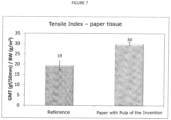
- the paper obtained from the pulp of the present invention reproduces these gains in physical resistance as shown in Figure 7 .
- the cellulose pulp production process comprises the steps of:
- the cellulose pulp production process can be described as:
- the chemical pulping process comprises treating the fibers of vegetable origin, including the following steps:
- the step (b) of bleaching a brown cellulose pulp (BC) from the pulping process of the cellulose pulp of the present invention may be selected from the group consisting of:
- the carbohydrate-based polymer and commercial enzyme or enzyme mixture are dosed, which are then conveyed to and through a homogenization device, which ensures the greatest contact between the products dosed and the fiber. Then, this mixture is transferred to a mixing pump where effective mixing of the additives takes places. Thereafter, the carbohydrate-based polymer-doped pulp and commercial enzyme or enzyme mixture is pumped into a reaction tower, where the mixture remains for 10 to 300 minutes, preferably for 30 to 120 minutes, at a temperature between 40 and 90°C, preferably between 50 and 80°C, and pH ranging from 3.0 to 9.0, preferably ranging from 3.5 to 8.0, using sodium hydroxide or sulfuric acid for pH adjustment, in order to complete the reaction.
- the obtained pulp is then diluted and pumped into the drying step. Then, the cellulose pulp (CL) is obtained for the paper market.
- the enzymatic treatment is carried out by the action of hydrolytic enzymes, for example, cellulases, or mixture of cellulases with other enzymes available on the market with fillers ranging from 20 to 100 grams of enzyme per ton of cellulose.
- hydrolytic enzymes for example, cellulases, or mixture of cellulases with other enzymes available on the market with fillers ranging from 20 to 100 grams of enzyme per ton of cellulose.
- Said enzymatic treatment (E) is conducted in a step subsequent to the bleaching process of the pulp obtained by the chemical pulping process, and prior to the drying step (D) of the pulp so that it is then used in papermaking.
- the enzymatic treatment has a retention time in the range of 30 to 120 minutes, a pH in the range of 3.5 to 8.0, a temperature in the range of 50 to 80°C, preferably when the hydrolytic enzyme is a cellulase.
- the fibers used in the process of the present invention may be so-called vegetable fibers, preferably short fibers, more preferably eucalyptus fibers.
- the cellulose pulp of the present invention obtained by a process including an enzymatic treatment step, concurrently dosing a carbohydrate-based polymer, surprisingly presents an increased surface area of the cellulose fiber without compromising the physical properties of the treated fiber, and also ensuring that the obtained cellulose pulp exhibits greater physical resistance - to traction and tear - and at least maintain its degree of resistance to drainage.
- the carbohydrate-based polymer but specifically starch, was used in a dosage of 3 to 10 kg/ton of cellulose pulp from short fibers. Thereafter, 30 to 50 g of EZ per ton of cellulose were added, wherein the reaction conditions are as follows: temperature from 50 to 90°C, pH 3.0 to 8.0, over a period from 60 to 240 minutes.
- the used bleaching sequence was an ECF sequence.
- EXAMPLE 2 POLYMER PRODUCTION PROCESS - ADDITION OF ENZYME FOLLOWED BY POLYMER ADDITION
- EXAMPLE 3 DESCRIPTION OF THE COMPARATIVE TESTS WITH THE REFERENCES.
- Comparative tests for evaluating the characteristics of the cellulose pulp obtained from the process of the present invention were carried out with the concomitant addition of carbohydrate-based polymer and commercially available enzyme or enzyme mixture.
- the equipment used was a cellulose bleach reactor with a capacity of 300 g of dry fibers and total automatic control of the process conditions, which were adjusted to: temperature of 50°C, pH of 7.0 and reaction time of 120 minutes.
- the amount of enzyme or enzyme mixture used ranged from 0 (Reference) to 50 to 200 g/tsa (Samples A, B, C and D).
- the comparative tests were followed by tests on larger scale, when the reactor having a dry pulp capacity of 100 kg and having automatic control of the process variables was used.
- the variables were maintained: temperature of 50°C, pH of 7.0 and reaction time of 120 minutes.
- the amount of enzyme or enzyme mixture used was 50 g/t.
- the preparation of the slurry was carried out in batch, where 4.2 tons of slurry were prepared.
- the slurry was sent for testing in a commercially-available tissue paper machine, as shown in Figure 8 .
Landscapes
- Life Sciences & Earth Sciences (AREA)
- Chemical & Material Sciences (AREA)
- Biochemistry (AREA)
- Microbiology (AREA)
- Engineering & Computer Science (AREA)
- Wood Science & Technology (AREA)
- Inorganic Chemistry (AREA)
- Paper (AREA)
Applications Claiming Priority (2)
| Application Number | Priority Date | Filing Date | Title |
|---|---|---|---|
| BR102015329113 | 2015-12-29 | ||
| PCT/BR2016/050355 WO2017112995A1 (pt) | 2015-12-29 | 2016-12-27 | Processo para produção de polpa de celulose, polpa de celulose e seu uso, papel |
Publications (4)
| Publication Number | Publication Date |
|---|---|
| EP3399100A1 EP3399100A1 (en) | 2018-11-07 |
| EP3399100A4 EP3399100A4 (en) | 2019-08-14 |
| EP3399100C0 EP3399100C0 (en) | 2025-03-26 |
| EP3399100B1 true EP3399100B1 (en) | 2025-03-26 |
Family
ID=63683364
Family Applications (1)
| Application Number | Title | Priority Date | Filing Date |
|---|---|---|---|
| EP16880207.2A Active EP3399100B1 (en) | 2015-12-29 | 2016-12-27 | Method for producing cellulose pulp, cellulose pulp and use thereof, paper |
Country Status (3)
| Country | Link |
|---|---|
| EP (1) | EP3399100B1 (pl) |
| ES (1) | ES3027193T3 (pl) |
| PL (1) | PL3399100T3 (pl) |
Families Citing this family (1)
| Publication number | Priority date | Publication date | Assignee | Title |
|---|---|---|---|---|
| EP4259879A4 (en) * | 2020-12-14 | 2024-10-09 | Buckman Laboratories International, Inc. | System and method of dynamic corrective enzyme selection and formulation for pulp and paper production |
Family Cites Families (8)
| Publication number | Priority date | Publication date | Assignee | Title |
|---|---|---|---|---|
| CA2115881C (en) * | 1993-02-25 | 2000-05-23 | Michael G. Paice | Non-chlorine bleaching of kraft pulp |
| CA2150810A1 (en) * | 1993-03-12 | 1994-09-15 | Karl-Erik L. Eriksson | Process for bleaching pulp |
| JPH1046495A (ja) * | 1996-07-24 | 1998-02-17 | Oji Paper Co Ltd | 印刷用塗被紙及びその製造方法 |
| US6066233A (en) * | 1996-08-16 | 2000-05-23 | International Paper Company | Method of improving pulp freeness using cellulase and pectinase enzymes |
| US6179962B1 (en) * | 1997-12-31 | 2001-01-30 | Hercules Incorporated | Paper having improved strength characteristics and process for making same |
| WO2000068500A1 (en) * | 1999-05-06 | 2000-11-16 | Novozymes A/S | A process for production of paper materials with improved wet strength |
| CN1293261C (zh) * | 2001-12-03 | 2007-01-03 | 埃欧金生物制品公司 | 利用木聚糖酶和过氧化氢、过酸或其组合物的漂白段 |
| BRPI0605651B1 (pt) * | 2006-11-09 | 2018-04-03 | Fibria Celulose S.A. | Processo para tratamento de polpa celulósica utilizando carboximetilcelulose e polpa assim obtida |
-
2016
- 2016-12-27 EP EP16880207.2A patent/EP3399100B1/en active Active
- 2016-12-27 ES ES16880207T patent/ES3027193T3/es active Active
- 2016-12-27 PL PL16880207.2T patent/PL3399100T3/pl unknown
Also Published As
| Publication number | Publication date |
|---|---|
| EP3399100C0 (en) | 2025-03-26 |
| EP3399100A1 (en) | 2018-11-07 |
| PL3399100T3 (pl) | 2025-12-22 |
| EP3399100A4 (en) | 2019-08-14 |
| ES3027193T3 (en) | 2025-06-13 |
Similar Documents
| Publication | Publication Date | Title |
|---|---|---|
| Buchert et al. | Paper industry | |
| Gil et al. | Use of enzymes to improve the refining of a bleached Eucalyptus globulus kraft pulp | |
| Christov et al. | The potential of biosulfite pulping in dissolving pulp production | |
| US20190257031A1 (en) | Use of Cellulase to improve Viscosity Control of Dissolving Pulp | |
| Garcia-Ubasart et al. | Biomodification of cellulose flax fibers by a new cellulase | |
| Cadena et al. | Influence of the hexenuronic acid content on refining and ageing in eucalyptus TCF pulp | |
| Lecourt et al. | Energy reduction of refining by cellulases. | |
| CA2079000C (en) | Method for the use of enzymes in processing and bleaching of paper pulp, and apparatus for use thereof | |
| EP3887596A1 (en) | Method of producing holocellulose and paper strength agent, process for the production of paper, the paper produced and use of the produced paper | |
| US12305332B2 (en) | Method for producing cellulose pulp, cellulose pulp and use thereof, paper | |
| Shatalov et al. | Effect of xylanases on peroxide bleachability of eucalypt (E. globulus) kraft pulp | |
| CN101558197B (zh) | 通过最终高温臭氧处理漂白化学纸浆的方法 | |
| Zhao et al. | Alkaline peroxide mechanical pulping of wheat straw with enzyme treatment | |
| Shatalov et al. | Xylanase pre-treatment of giant reed organosolv pulps: Direct bleaching effect and bleach boosting | |
| Valls et al. | New xylanases to obtain modified eucalypt fibres with high-cellulose content | |
| Cadena et al. | Can the laccase mediator system affect the chemical and refining properties of the eucalyptus pulp? | |
| EP3399100A1 (en) | Method for producing cellulose pulp, cellulose pulp and use thereof, paper | |
| Rashmi et al. | Enzymatic refining of pulps: an overview | |
| Pathak et al. | Microbial enzymes for pulp and paper industry | |
| AU2013323332B2 (en) | Chemical treatment of lignocellulosic fiber bundle material, and methods and systems relating thereto | |
| Poshina et al. | Modification of spruce sulphite pulp by cellulase treatment | |
| Tyagi et al. | Effect of two fungal strains of Coprinellus disseminatus SH-1 NTCC-1163 and SH-2 NTCC-1164 on pulp refining and mechanical strength properties of wheat straw-AQ pulp | |
| Singh et al. | Environmentally friendly totally chlorine free bleaching of wheat straw pulp using novel cellulase-poor xylanases of wild strains of Coprinellus disseminatus | |
| Rashmi et al. | Enzymatic treatment of secondary fibres for improving drainage: An overview | |
| CA2436765A1 (en) | Bleaching stage using xylanase with hydrogen peroxide, peracids, or a combination thereof |
Legal Events
| Date | Code | Title | Description |
|---|---|---|---|
| STAA | Information on the status of an ep patent application or granted ep patent |
Free format text: STATUS: THE INTERNATIONAL PUBLICATION HAS BEEN MADE |
|
| PUAI | Public reference made under article 153(3) epc to a published international application that has entered the european phase |
Free format text: ORIGINAL CODE: 0009012 |
|
| STAA | Information on the status of an ep patent application or granted ep patent |
Free format text: STATUS: REQUEST FOR EXAMINATION WAS MADE |
|
| 17P | Request for examination filed |
Effective date: 20180727 |
|
| AK | Designated contracting states |
Kind code of ref document: A1 Designated state(s): AL AT BE BG CH CY CZ DE DK EE ES FI FR GB GR HR HU IE IS IT LI LT LU LV MC MK MT NL NO PL PT RO RS SE SI SK SM TR |
|
| AX | Request for extension of the european patent |
Extension state: BA ME |
|
| DAV | Request for validation of the european patent (deleted) | ||
| DAX | Request for extension of the european patent (deleted) | ||
| A4 | Supplementary search report drawn up and despatched |
Effective date: 20190716 |
|
| RIC1 | Information provided on ipc code assigned before grant |
Ipc: D21C 3/02 20060101ALI20190710BHEP Ipc: D21C 5/00 20060101ALI20190710BHEP Ipc: D21H 21/18 20060101ALI20190710BHEP Ipc: D21H 11/04 20060101ALI20190710BHEP Ipc: D21H 17/21 20060101ALI20190710BHEP Ipc: D21C 9/10 20060101AFI20190710BHEP Ipc: D21H 21/10 20060101ALI20190710BHEP |
|
| STAA | Information on the status of an ep patent application or granted ep patent |
Free format text: STATUS: EXAMINATION IS IN PROGRESS |
|
| 17Q | First examination report despatched |
Effective date: 20220328 |
|
| GRAP | Despatch of communication of intention to grant a patent |
Free format text: ORIGINAL CODE: EPIDOSNIGR1 |
|
| STAA | Information on the status of an ep patent application or granted ep patent |
Free format text: STATUS: GRANT OF PATENT IS INTENDED |
|
| INTG | Intention to grant announced |
Effective date: 20240613 |
|
| GRAJ | Information related to disapproval of communication of intention to grant by the applicant or resumption of examination proceedings by the epo deleted |
Free format text: ORIGINAL CODE: EPIDOSDIGR1 |
|
| STAA | Information on the status of an ep patent application or granted ep patent |
Free format text: STATUS: EXAMINATION IS IN PROGRESS |
|
| GRAP | Despatch of communication of intention to grant a patent |
Free format text: ORIGINAL CODE: EPIDOSNIGR1 |
|
| STAA | Information on the status of an ep patent application or granted ep patent |
Free format text: STATUS: GRANT OF PATENT IS INTENDED |
|
| INTG | Intention to grant announced |
Effective date: 20241018 |
|
| GRAS | Grant fee paid |
Free format text: ORIGINAL CODE: EPIDOSNIGR3 |
|
| GRAA | (expected) grant |
Free format text: ORIGINAL CODE: 0009210 |
|
| STAA | Information on the status of an ep patent application or granted ep patent |
Free format text: STATUS: THE PATENT HAS BEEN GRANTED |
|
| AK | Designated contracting states |
Kind code of ref document: B1 Designated state(s): AL AT BE BG CH CY CZ DE DK EE ES FI FR GB GR HR HU IE IS IT LI LT LU LV MC MK MT NL NO PL PT RO RS SE SI SK SM TR |
|
| REG | Reference to a national code |
Ref country code: GB Ref legal event code: FG4D |
|
| REG | Reference to a national code |
Ref country code: CH Ref legal event code: EP |
|
| REG | Reference to a national code |
Ref country code: DE Ref legal event code: R096 Ref document number: 602016091711 Country of ref document: DE |
|
| REG | Reference to a national code |
Ref country code: IE Ref legal event code: FG4D |
|
| U01 | Request for unitary effect filed |
Effective date: 20250410 |
|
| U07 | Unitary effect registered |
Designated state(s): AT BE BG DE DK EE FI FR IT LT LU LV MT NL PT RO SE SI Effective date: 20250417 |
|
| REG | Reference to a national code |
Ref country code: ES Ref legal event code: FG2A Ref document number: 3027193 Country of ref document: ES Kind code of ref document: T3 Effective date: 20250613 |
|
| PG25 | Lapsed in a contracting state [announced via postgrant information from national office to epo] |
Ref country code: RS Free format text: LAPSE BECAUSE OF FAILURE TO SUBMIT A TRANSLATION OF THE DESCRIPTION OR TO PAY THE FEE WITHIN THE PRESCRIBED TIME-LIMIT Effective date: 20250626 |
|
| PG25 | Lapsed in a contracting state [announced via postgrant information from national office to epo] |
Ref country code: NO Free format text: LAPSE BECAUSE OF FAILURE TO SUBMIT A TRANSLATION OF THE DESCRIPTION OR TO PAY THE FEE WITHIN THE PRESCRIBED TIME-LIMIT Effective date: 20250626 |
|
| PG25 | Lapsed in a contracting state [announced via postgrant information from national office to epo] |
Ref country code: HR Free format text: LAPSE BECAUSE OF FAILURE TO SUBMIT A TRANSLATION OF THE DESCRIPTION OR TO PAY THE FEE WITHIN THE PRESCRIBED TIME-LIMIT Effective date: 20250326 |
|
| PG25 | Lapsed in a contracting state [announced via postgrant information from national office to epo] |
Ref country code: SM Free format text: LAPSE BECAUSE OF FAILURE TO SUBMIT A TRANSLATION OF THE DESCRIPTION OR TO PAY THE FEE WITHIN THE PRESCRIBED TIME-LIMIT Effective date: 20250326 |
|
| PG25 | Lapsed in a contracting state [announced via postgrant information from national office to epo] |
Ref country code: SK Free format text: LAPSE BECAUSE OF FAILURE TO SUBMIT A TRANSLATION OF THE DESCRIPTION OR TO PAY THE FEE WITHIN THE PRESCRIBED TIME-LIMIT Effective date: 20250326 |
|
| PG25 | Lapsed in a contracting state [announced via postgrant information from national office to epo] |
Ref country code: IS Free format text: LAPSE BECAUSE OF FAILURE TO SUBMIT A TRANSLATION OF THE DESCRIPTION OR TO PAY THE FEE WITHIN THE PRESCRIBED TIME-LIMIT Effective date: 20250726 |
|
| PGFP | Annual fee paid to national office [announced via postgrant information from national office to epo] |
Ref country code: GB Payment date: 20251215 Year of fee payment: 10 |
|
| PG25 | Lapsed in a contracting state [announced via postgrant information from national office to epo] |
Ref country code: CZ Free format text: LAPSE BECAUSE OF FAILURE TO SUBMIT A TRANSLATION OF THE DESCRIPTION OR TO PAY THE FEE WITHIN THE PRESCRIBED TIME-LIMIT Effective date: 20250326 |
|
| PGFP | Annual fee paid to national office [announced via postgrant information from national office to epo] |
Ref country code: PL Payment date: 20251215 Year of fee payment: 10 |
|
| U20 | Renewal fee for the european patent with unitary effect paid |
Year of fee payment: 10 Effective date: 20251219 |
|
| PLBE | No opposition filed within time limit |
Free format text: ORIGINAL CODE: 0009261 |
|
| STAA | Information on the status of an ep patent application or granted ep patent |
Free format text: STATUS: NO OPPOSITION FILED WITHIN TIME LIMIT |
|
| REG | Reference to a national code |
Ref country code: CH Ref legal event code: L10 Free format text: ST27 STATUS EVENT CODE: U-0-0-L10-L00 (AS PROVIDED BY THE NATIONAL OFFICE) Effective date: 20260211 |
|
| 26N | No opposition filed |
Effective date: 20260105 |
|
| PGFP | Annual fee paid to national office [announced via postgrant information from national office to epo] |
Ref country code: ES Payment date: 20260105 Year of fee payment: 10 |
|
| PG25 | Lapsed in a contracting state [announced via postgrant information from national office to epo] |
Ref country code: MC Free format text: LAPSE BECAUSE OF FAILURE TO SUBMIT A TRANSLATION OF THE DESCRIPTION OR TO PAY THE FEE WITHIN THE PRESCRIBED TIME-LIMIT Effective date: 20250326 |
|
| REG | Reference to a national code |
Ref country code: CH Ref legal event code: H13 Free format text: ST27 STATUS EVENT CODE: U-0-0-H10-H13 (AS PROVIDED BY THE NATIONAL OFFICE) Effective date: 20260723 |