EP3399582B1 - Pile rechargeable au lithium - Google Patents
Pile rechargeable au lithium Download PDFInfo
- Publication number
- EP3399582B1 EP3399582B1 EP17756892.0A EP17756892A EP3399582B1 EP 3399582 B1 EP3399582 B1 EP 3399582B1 EP 17756892 A EP17756892 A EP 17756892A EP 3399582 B1 EP3399582 B1 EP 3399582B1
- Authority
- EP
- European Patent Office
- Prior art keywords
- carbonate
- secondary battery
- lithium secondary
- electrolyte
- separator
- Prior art date
- Legal status (The legal status is an assumption and is not a legal conclusion. Google has not performed a legal analysis and makes no representation as to the accuracy of the status listed.)
- Active
Links
Images
Classifications
-
- H—ELECTRICITY
- H01—ELECTRIC ELEMENTS
- H01M—PROCESSES OR MEANS, e.g. BATTERIES, FOR THE DIRECT CONVERSION OF CHEMICAL ENERGY INTO ELECTRICAL ENERGY
- H01M10/00—Secondary cells; Manufacture thereof
- H01M10/05—Accumulators with non-aqueous electrolyte
- H01M10/052—Li-accumulators
- H01M10/0525—Rocking-chair batteries, i.e. batteries with lithium insertion or intercalation in both electrodes; Lithium-ion batteries
-
- H—ELECTRICITY
- H01—ELECTRIC ELEMENTS
- H01M—PROCESSES OR MEANS, e.g. BATTERIES, FOR THE DIRECT CONVERSION OF CHEMICAL ENERGY INTO ELECTRICAL ENERGY
- H01M10/00—Secondary cells; Manufacture thereof
- H01M10/05—Accumulators with non-aqueous electrolyte
- H01M10/052—Li-accumulators
-
- H—ELECTRICITY
- H01—ELECTRIC ELEMENTS
- H01M—PROCESSES OR MEANS, e.g. BATTERIES, FOR THE DIRECT CONVERSION OF CHEMICAL ENERGY INTO ELECTRICAL ENERGY
- H01M10/00—Secondary cells; Manufacture thereof
- H01M10/05—Accumulators with non-aqueous electrolyte
- H01M10/056—Accumulators with non-aqueous electrolyte characterised by the materials used as electrolytes, e.g. mixed inorganic/organic electrolytes
- H01M10/0561—Accumulators with non-aqueous electrolyte characterised by the materials used as electrolytes, e.g. mixed inorganic/organic electrolytes the electrolyte being constituted of inorganic materials only
- H01M10/0563—Liquid materials, e.g. for Li-SOCl2 cells
-
- H—ELECTRICITY
- H01—ELECTRIC ELEMENTS
- H01M—PROCESSES OR MEANS, e.g. BATTERIES, FOR THE DIRECT CONVERSION OF CHEMICAL ENERGY INTO ELECTRICAL ENERGY
- H01M10/00—Secondary cells; Manufacture thereof
- H01M10/05—Accumulators with non-aqueous electrolyte
- H01M10/056—Accumulators with non-aqueous electrolyte characterised by the materials used as electrolytes, e.g. mixed inorganic/organic electrolytes
- H01M10/0564—Accumulators with non-aqueous electrolyte characterised by the materials used as electrolytes, e.g. mixed inorganic/organic electrolytes the electrolyte being constituted of organic materials only
- H01M10/0566—Liquid materials
-
- H—ELECTRICITY
- H01—ELECTRIC ELEMENTS
- H01M—PROCESSES OR MEANS, e.g. BATTERIES, FOR THE DIRECT CONVERSION OF CHEMICAL ENERGY INTO ELECTRICAL ENERGY
- H01M4/00—Electrodes
- H01M4/02—Electrodes composed of, or comprising, active material
- H01M4/13—Electrodes for accumulators with non-aqueous electrolyte, e.g. for lithium-accumulators; Processes of manufacture thereof
-
- H—ELECTRICITY
- H01—ELECTRIC ELEMENTS
- H01M—PROCESSES OR MEANS, e.g. BATTERIES, FOR THE DIRECT CONVERSION OF CHEMICAL ENERGY INTO ELECTRICAL ENERGY
- H01M4/00—Electrodes
- H01M4/02—Electrodes composed of, or comprising, active material
- H01M4/13—Electrodes for accumulators with non-aqueous electrolyte, e.g. for lithium-accumulators; Processes of manufacture thereof
- H01M4/131—Electrodes based on mixed oxides or hydroxides, or on mixtures of oxides or hydroxides, e.g. LiCoOx
-
- H—ELECTRICITY
- H01—ELECTRIC ELEMENTS
- H01M—PROCESSES OR MEANS, e.g. BATTERIES, FOR THE DIRECT CONVERSION OF CHEMICAL ENERGY INTO ELECTRICAL ENERGY
- H01M4/00—Electrodes
- H01M4/02—Electrodes composed of, or comprising, active material
- H01M4/36—Selection of substances as active materials, active masses, active liquids
- H01M4/58—Selection of substances as active materials, active masses, active liquids of inorganic compounds other than oxides or hydroxides, e.g. sulfides, selenides, tellurides, halogenides or LiCoFy; of polyanionic structures, e.g. phosphates, silicates or borates
- H01M4/583—Carbonaceous material, e.g. graphite-intercalation compounds or CFx
-
- H—ELECTRICITY
- H01—ELECTRIC ELEMENTS
- H01M—PROCESSES OR MEANS, e.g. BATTERIES, FOR THE DIRECT CONVERSION OF CHEMICAL ENERGY INTO ELECTRICAL ENERGY
- H01M4/00—Electrodes
- H01M4/02—Electrodes composed of, or comprising, active material
- H01M4/64—Carriers or collectors
- H01M4/66—Selection of materials
- H01M4/661—Metal or alloys, e.g. alloy coatings
-
- H—ELECTRICITY
- H01—ELECTRIC ELEMENTS
- H01M—PROCESSES OR MEANS, e.g. BATTERIES, FOR THE DIRECT CONVERSION OF CHEMICAL ENERGY INTO ELECTRICAL ENERGY
- H01M50/00—Constructional details or processes of manufacture of the non-active parts of electrochemical cells other than fuel cells, e.g. hybrid cells
- H01M50/40—Separators; Membranes; Diaphragms; Spacing elements inside cells
- H01M50/409—Separators, membranes or diaphragms characterised by the material
- H01M50/411—Organic material
- H01M50/414—Synthetic resins, e.g. thermoplastics or thermosetting resins
-
- H—ELECTRICITY
- H01—ELECTRIC ELEMENTS
- H01M—PROCESSES OR MEANS, e.g. BATTERIES, FOR THE DIRECT CONVERSION OF CHEMICAL ENERGY INTO ELECTRICAL ENERGY
- H01M50/00—Constructional details or processes of manufacture of the non-active parts of electrochemical cells other than fuel cells, e.g. hybrid cells
- H01M50/40—Separators; Membranes; Diaphragms; Spacing elements inside cells
- H01M50/409—Separators, membranes or diaphragms characterised by the material
- H01M50/411—Organic material
- H01M50/414—Synthetic resins, e.g. thermoplastics or thermosetting resins
- H01M50/417—Polyolefins
-
- H—ELECTRICITY
- H01—ELECTRIC ELEMENTS
- H01M—PROCESSES OR MEANS, e.g. BATTERIES, FOR THE DIRECT CONVERSION OF CHEMICAL ENERGY INTO ELECTRICAL ENERGY
- H01M50/00—Constructional details or processes of manufacture of the non-active parts of electrochemical cells other than fuel cells, e.g. hybrid cells
- H01M50/40—Separators; Membranes; Diaphragms; Spacing elements inside cells
- H01M50/463—Separators, membranes or diaphragms characterised by their shape
-
- H—ELECTRICITY
- H01—ELECTRIC ELEMENTS
- H01M—PROCESSES OR MEANS, e.g. BATTERIES, FOR THE DIRECT CONVERSION OF CHEMICAL ENERGY INTO ELECTRICAL ENERGY
- H01M50/00—Constructional details or processes of manufacture of the non-active parts of electrochemical cells other than fuel cells, e.g. hybrid cells
- H01M50/40—Separators; Membranes; Diaphragms; Spacing elements inside cells
- H01M50/489—Separators, membranes, diaphragms or spacing elements inside the cells, characterised by their physical properties, e.g. swelling degree, hydrophilicity or shut down properties
-
- H—ELECTRICITY
- H01—ELECTRIC ELEMENTS
- H01M—PROCESSES OR MEANS, e.g. BATTERIES, FOR THE DIRECT CONVERSION OF CHEMICAL ENERGY INTO ELECTRICAL ENERGY
- H01M50/00—Constructional details or processes of manufacture of the non-active parts of electrochemical cells other than fuel cells, e.g. hybrid cells
- H01M50/40—Separators; Membranes; Diaphragms; Spacing elements inside cells
- H01M50/489—Separators, membranes, diaphragms or spacing elements inside the cells, characterised by their physical properties, e.g. swelling degree, hydrophilicity or shut down properties
- H01M50/491—Porosity
-
- H—ELECTRICITY
- H01—ELECTRIC ELEMENTS
- H01M—PROCESSES OR MEANS, e.g. BATTERIES, FOR THE DIRECT CONVERSION OF CHEMICAL ENERGY INTO ELECTRICAL ENERGY
- H01M10/00—Secondary cells; Manufacture thereof
- H01M10/05—Accumulators with non-aqueous electrolyte
- H01M10/056—Accumulators with non-aqueous electrolyte characterised by the materials used as electrolytes, e.g. mixed inorganic/organic electrolytes
- H01M10/0564—Accumulators with non-aqueous electrolyte characterised by the materials used as electrolytes, e.g. mixed inorganic/organic electrolytes the electrolyte being constituted of organic materials only
- H01M10/0566—Liquid materials
- H01M10/0567—Liquid materials characterised by the additives
-
- H—ELECTRICITY
- H01—ELECTRIC ELEMENTS
- H01M—PROCESSES OR MEANS, e.g. BATTERIES, FOR THE DIRECT CONVERSION OF CHEMICAL ENERGY INTO ELECTRICAL ENERGY
- H01M10/00—Secondary cells; Manufacture thereof
- H01M10/05—Accumulators with non-aqueous electrolyte
- H01M10/056—Accumulators with non-aqueous electrolyte characterised by the materials used as electrolytes, e.g. mixed inorganic/organic electrolytes
- H01M10/0564—Accumulators with non-aqueous electrolyte characterised by the materials used as electrolytes, e.g. mixed inorganic/organic electrolytes the electrolyte being constituted of organic materials only
- H01M10/0566—Liquid materials
- H01M10/0568—Liquid materials characterised by the solutes
-
- H—ELECTRICITY
- H01—ELECTRIC ELEMENTS
- H01M—PROCESSES OR MEANS, e.g. BATTERIES, FOR THE DIRECT CONVERSION OF CHEMICAL ENERGY INTO ELECTRICAL ENERGY
- H01M10/00—Secondary cells; Manufacture thereof
- H01M10/05—Accumulators with non-aqueous electrolyte
- H01M10/056—Accumulators with non-aqueous electrolyte characterised by the materials used as electrolytes, e.g. mixed inorganic/organic electrolytes
- H01M10/0564—Accumulators with non-aqueous electrolyte characterised by the materials used as electrolytes, e.g. mixed inorganic/organic electrolytes the electrolyte being constituted of organic materials only
- H01M10/0566—Liquid materials
- H01M10/0569—Liquid materials characterised by the solvents
-
- H—ELECTRICITY
- H01—ELECTRIC ELEMENTS
- H01M—PROCESSES OR MEANS, e.g. BATTERIES, FOR THE DIRECT CONVERSION OF CHEMICAL ENERGY INTO ELECTRICAL ENERGY
- H01M4/00—Electrodes
- H01M4/02—Electrodes composed of, or comprising, active material
- H01M2004/021—Physical characteristics, e.g. porosity, surface area
-
- H—ELECTRICITY
- H01—ELECTRIC ELEMENTS
- H01M—PROCESSES OR MEANS, e.g. BATTERIES, FOR THE DIRECT CONVERSION OF CHEMICAL ENERGY INTO ELECTRICAL ENERGY
- H01M4/00—Electrodes
- H01M4/02—Electrodes composed of, or comprising, active material
- H01M2004/026—Electrodes composed of, or comprising, active material characterised by the polarity
- H01M2004/027—Negative electrodes
-
- H—ELECTRICITY
- H01—ELECTRIC ELEMENTS
- H01M—PROCESSES OR MEANS, e.g. BATTERIES, FOR THE DIRECT CONVERSION OF CHEMICAL ENERGY INTO ELECTRICAL ENERGY
- H01M4/00—Electrodes
- H01M4/02—Electrodes composed of, or comprising, active material
- H01M2004/026—Electrodes composed of, or comprising, active material characterised by the polarity
- H01M2004/028—Positive electrodes
-
- H—ELECTRICITY
- H01—ELECTRIC ELEMENTS
- H01M—PROCESSES OR MEANS, e.g. BATTERIES, FOR THE DIRECT CONVERSION OF CHEMICAL ENERGY INTO ELECTRICAL ENERGY
- H01M4/00—Electrodes
- H01M4/02—Electrodes composed of, or comprising, active material
- H01M4/36—Selection of substances as active materials, active masses, active liquids
- H01M4/48—Selection of substances as active materials, active masses, active liquids of inorganic oxides or hydroxides
- H01M4/50—Selection of substances as active materials, active masses, active liquids of inorganic oxides or hydroxides of manganese
- H01M4/505—Selection of substances as active materials, active masses, active liquids of inorganic oxides or hydroxides of manganese of mixed oxides or hydroxides containing manganese for inserting or intercalating light metals, e.g. LiMn2O4 or LiMn2OxFy
-
- H—ELECTRICITY
- H01—ELECTRIC ELEMENTS
- H01M—PROCESSES OR MEANS, e.g. BATTERIES, FOR THE DIRECT CONVERSION OF CHEMICAL ENERGY INTO ELECTRICAL ENERGY
- H01M4/00—Electrodes
- H01M4/02—Electrodes composed of, or comprising, active material
- H01M4/36—Selection of substances as active materials, active masses, active liquids
- H01M4/48—Selection of substances as active materials, active masses, active liquids of inorganic oxides or hydroxides
- H01M4/52—Selection of substances as active materials, active masses, active liquids of inorganic oxides or hydroxides of nickel, cobalt or iron
- H01M4/525—Selection of substances as active materials, active masses, active liquids of inorganic oxides or hydroxides of nickel, cobalt or iron of mixed oxides or hydroxides containing iron, cobalt or nickel for inserting or intercalating light metals, e.g. LiNiO2, LiCoO2 or LiCoOxFy
-
- H—ELECTRICITY
- H01—ELECTRIC ELEMENTS
- H01M—PROCESSES OR MEANS, e.g. BATTERIES, FOR THE DIRECT CONVERSION OF CHEMICAL ENERGY INTO ELECTRICAL ENERGY
- H01M50/00—Constructional details or processes of manufacture of the non-active parts of electrochemical cells other than fuel cells, e.g. hybrid cells
- H01M50/40—Separators; Membranes; Diaphragms; Spacing elements inside cells
- H01M50/489—Separators, membranes, diaphragms or spacing elements inside the cells, characterised by their physical properties, e.g. swelling degree, hydrophilicity or shut down properties
- H01M50/497—Ionic conductivity
-
- Y—GENERAL TAGGING OF NEW TECHNOLOGICAL DEVELOPMENTS; GENERAL TAGGING OF CROSS-SECTIONAL TECHNOLOGIES SPANNING OVER SEVERAL SECTIONS OF THE IPC; TECHNICAL SUBJECTS COVERED BY FORMER USPC CROSS-REFERENCE ART COLLECTIONS [XRACs] AND DIGESTS
- Y02—TECHNOLOGIES OR APPLICATIONS FOR MITIGATION OR ADAPTATION AGAINST CLIMATE CHANGE
- Y02E—REDUCTION OF GREENHOUSE GAS [GHG] EMISSIONS, RELATED TO ENERGY GENERATION, TRANSMISSION OR DISTRIBUTION
- Y02E60/00—Enabling technologies; Technologies with a potential or indirect contribution to GHG emissions mitigation
- Y02E60/10—Energy storage using batteries
-
- Y—GENERAL TAGGING OF NEW TECHNOLOGICAL DEVELOPMENTS; GENERAL TAGGING OF CROSS-SECTIONAL TECHNOLOGIES SPANNING OVER SEVERAL SECTIONS OF THE IPC; TECHNICAL SUBJECTS COVERED BY FORMER USPC CROSS-REFERENCE ART COLLECTIONS [XRACs] AND DIGESTS
- Y02—TECHNOLOGIES OR APPLICATIONS FOR MITIGATION OR ADAPTATION AGAINST CLIMATE CHANGE
- Y02T—CLIMATE CHANGE MITIGATION TECHNOLOGIES RELATED TO TRANSPORTATION
- Y02T10/00—Road transport of goods or passengers
- Y02T10/60—Other road transportation technologies with climate change mitigation effect
- Y02T10/70—Energy storage systems for electromobility, e.g. batteries
Definitions
- the present disclosure relates to a lithium secondary battery. More particularly, the present disclosure relates to a lithium secondary battery having high capacity characteristics.
- Such a lithium secondary battery includes a positive electrode, a negative electrode and an electrolyte. Lithium ions deintercalated from the positive electrode active material during the first charging are intercalated into the negative electrode active material, such as carbon particles, and then deintercalated again therefrom during the discharging. Such movement of lithium ions between both electrodes contributes to transport energy and allow the charge/discharge of the battery.
- the high-loading electrode generally has a thick thickness as it comprises an increased amount of an active material for the purpose of high loading. However, the thick electrode undergoes non-uniform reaction in its thickness direction, resulting in degradation of cycle characteristics.
- US 2008/199764 A1 relates to a lithium secondary cell including a plurality of stacked layers.
- US 2014/356695 A1 relates to a battery including a positive electrode, a negative electrode, a separator at least including a porous film, and an electrolyte.
- the present disclosure is designed to solve the problems of the related art, and therefore the present disclosure is directed to providing a high-loading electrode which allows controlling the movement of a lithium ion to satisfy an adequate range, by leading to uniform electrode reaction and thus providing a lithium secondary battery with excellent cycle characteristics.
- a lithium secondary battery which includes: an electrode assembly including a positive electrode, a negative electrode and a separator interposed between the positive electrode and the negative electrode; an electrolyte including a lithium salt and an organic solvent; and a battery casing receiving the electrode assembly and the electrolyte, wherein the positive electrode has a loading amount of 3.5 mAh/cm 2 or more, the separator has an air permeability of 300-1200 sec/100 mL, and the electrolyte has a lithium ion conductivity of 11-20 mS/cm and a viscosity of 1.0-4.0 cP at 25°C, according to independent claim 1.
- the separator may have an air permeability of 300-1000 sec/100 mL, and the electrolyte may have a lithium ion conductivity of 12-19 mS/cm.
- the separator may have an air permeability of 300-800 sec/100 mL, and the electrolyte may have a lithium ion conductivity of 14-18 mS/cm.
- the separator may have a thickness of 2-50 ⁇ m.
- the separator may be a porous polymer substrate.
- the porous polymer substrate may include any one polymer selected from the group consisting of: polyethylene, polypropylene, polyethylene terephthalate, polybutylene terephthalate, polyester, polyacetal, polyamide, polycarbonate, polycarbonate, polyimide, polyetherether ketone, polyarylether ketone, polyether imide, polyamideimide, polybenzimidazole, polyether sulfone, polyphenylene oxide, cyclic olefin copolymer, polyphenylene sulfide and polyethylene naphthalene, or a combination of two or more thereof.
- the electrolyte may have a viscosity of 1.0-3.0 cP.
- the electrolyte may further include an additive.
- the lithium salt may be any one selected from the group consisting of LiPF 6 , LiBF 4 , LiSbF 6 , LiAsF 6 , LiClO 4 , LiN(C 2 F 5 SO 2 ) 2 , LiN(CF 3 SO 2 ) 2 , CF 3 SO 3 Li and LiC(CF 3 SO 2 ) 3 , or a combination of two or more thereof.
- the organic solvent may be any one selected from the group consisting of ethylene carbonate (EC), propylene carbonate (PC), 1,2-butylene carbonate, 2,3-butylene carbonate, 1,2-pentylene carbonate, 2,3-pentylene carbonate, vinylene carbonate, vinylethylene carbonate, fluoroethylene carbonate (FEC), dimethyl carbonate (DMC), diethyl carbonate (DEC), dipropyl carbonate, ethyl methyl carbonate (EMC), methyl propyl carbonate, ethyl propyl carbonate, dimethyl ether, diethyl ether, dipropyl ether, methylethyl ether, methylpropyl ether, ethylpropyl ether, methyl acetate, ethyl acetate, propyl acetate, methyl propionate, ethyl propionate, propyl propionate, ⁇ -butryolactone, ⁇ -valerolactone
- the positive electrode may have a thickness of 50-200 ⁇ m.
- the lithium secondary battery according to the present disclosure ensures reaction uniformity even though it uses a high-loading electrode, and thus has high capacity and improved cycle characteristics.
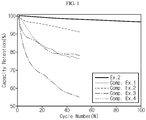
- FIG. 1 is a graph illustrating the results of measurement of capacity for each of the batteries prepared in Examples and Comparative Examples.
- the movement of lithium ions may be not good due to the thickness increase of the electrode, making the reaction of the electrode non-uniform in the thickness direction thereof, from which the cycle characteristics of a battery may be deteriorated.
- lithium ions fail to be diffused into the electrode active material, so are retained and accumulated on the electrode surface.
- lithium ions can be diffused well into the electrode active material to allow uniform reaction in the electrode, and thus to improve the cycle characteristics of a battery.
- the lithium secondary battery according to the present disclosure like the conventional lithium secondary battery, includes: an electrode assembly including a positive electrode, a negative electrode and a separator interposed between the positive electrode and the negative electrode; an electrolyte including a lithium salt and an organic solvent; and a battery casing receiving the electrode assembly and the electrolyte.
- the lithium secondary battery according to the present disclosure is a high-loading battery having a positive electrode loading amount of 3.5 mAh/cm 2 or more.
- the positive electrode may have a thickness of 50-200 ⁇ m.
- the separator is controlled to have an air permeability of 300-1200 sec/100 mL for the purpose of ensuring the movement of lithium ions satisfying an adequate range, making it allow the good diffusion of the lithium ions into the electrode active material and eventually uniform electrode reaction.
- the separator has an air permeability less than 200 sec/100 mL, the movement of lithium ions increases, so the battery undergoes rapid degradation in terms of safety, and the movement rate of lithium ions in the electrode cannot keep up with the movement rate of lithium ions in the separator.
- the separator has an air permeability larger than 1200 sec/100 mL, the movement of lithium ions in the separator decreases, resulting in degradation of efficiency and cycle characteristics after repeated charge/discharge procedures.
- the separator may have an air permeability of 300-1000 sec/100 mL, more preferably 300-900 sec/100 mL.
- the method for determining the air permeability of a separator is not particularly limited, and any conventional method in the art, such as the Gurley method according to the Japanese Industrial Standard (JIS), may be used to determine the air permeability by using Gurley type Densometer (No. 158) available from Toyoseiki Co.
- the air permeability of a separator may be determined by measuring the time required for 100 mL (or 100 cc) of air to pass through 1 cm 2 of the separator at room temperature under a pressure of 0.05 MPa.
- the separator according to the present disclosure may have a thickness of 5-20 ⁇ m and a porosity of 30-60% to obtain the above-defined air permeability.
- the electrolyte is controlled to have a lithium ion conductivity of 11-20 mS/cm, for the purpose of ensuring the movement of lithium ions satisfying an adequate range, making it allow the good diffusion of the lithium ions into the electrode active material and eventually uniform electrode reaction.
- the electrolyte has a lithium ion conductivity less than 11 mS/cm, it may cause the decreased movement of lithium ions in the electrode, thereby incurring non-uniform reaction on the surface and the inside of the electrode surface, from which the battery may undergo degradation of charge/discharge efficiency and cycle characteristics.
- the electrolyte When the electrolyte has a lithium ion conductivity larger than 20 mS/cm, it may cause the decreased movement of lithium ions in the separator as compared to the intercalation/deintercalation rate of the lithium ions in the positive electrode, so the negative electrode and lithium ions may be accumulated at the interface between the electrode and the separator, thereby causing side reactions with the electrolyte.
- the electrolyte may have a lithium ion conductivity of 12-19 mS/cm, more preferably 14-18 mS/cm.
- the electrolyte can satisfy the above-defined lithium ion conductivity by adjusting the concentration of salt in the electrolyte and solvent. Further, the lithium ion conductivity may be varied on a solvent lot or a measuring instrument condition.
- the method for determining lithium ion conductivity is not particularly limited, and any conventional method in the art may be used.
- lithium ion conductivity may be determined by using a conductivity measuring instrument, such as Inolab 731.
- the positive electrode includes a positive electrode current collector and a positive electrode layer formed on at least one surface of the positive electrode current collector.
- the negative electrode includes a negative electrode current collector and a negative electrode layer formed on at least one surface of the negative electrode current collector.
- the positive electrode current collector may have a thickness of 10-500 ⁇ m.
- the positive electrode current collector is not particularly limited, as long as it has high conductivity while not causing any chemical change in the corresponding battery.
- the current collector may have fine surface irregularities to increase the adhesion of the positive electrode active material thereto, and may have various shapes, such as a film, sheet, foil, net, porous body, foam, and non-woven body.
- the negative electrode current collector may have a thickness of 10-500 ⁇ m.
- the negative electrode current collector is not particularly limited, as long as it has conductivity while not causing any chemical change in the corresponding battery.
- the negative electrode current collector may have fine surface irregularities to reinforce the binding force of the negative electrode, and may have various shapes, such as a film, sheet, foil, net, porous body, foam, non-woven body, or the like.
- the positive electrode active material may be a lithium-containing oxide, preferably a lithium-containing transition metal oxide.
- the negative electrode active material is capable of lithium ion intercalation/deintercalation and may include lithium metal, a carbonaceous material, metal compound or a combination thereof.
- the carbonaceous material may include both low-crystalline carbon and high-crystalline carbon.
- Typical examples of the low-crystalline carbon include soft carbon and hard carbon.
- Typical examples of the high-crystalline carbon include high-temperature baked carbon, such as natural graphite, Kish graphite, pyrolytic carbon, mesophase pitch based carbon fiber, meso-carbon microbeads, mesophase pitches, and petroleum or coal tar pitch derived cokes.
- the metal compound include compounds containing at least one metal element, such as Si, Ge, Sn, Pb, P, Sb, Bi, Al, Ga, In, Ti, Mn, Fe, Co, Ni, Cu, Zn, Ag, Mg, Sr and Ba.
- metal compounds may be used in any one of the forms, including simple substance, alloy, oxides (TiO 2 , SnO 2 , etc.), nitride, sulfide, boride and alloy with lithium, simple substance, oxides and alloy with lithium may have high capacity.
- metal compounds, which contain at least one element selected from Si, Ge and Sn, especially Si and Sn can provide a battery with higher capacity.
- the separator may be a porous polymer substrate.
- the pore size and porosity of the porous polymer substrate are not particularly limited but may be about 0.01-50 ⁇ m and about 10-95%, respectively.
- the porous polymer substrate may include a porous coating layer containing inorganic particles and a polymer binder on at least one surface of the porous polymer substrate in order to improve the mechanical strength and to inhibit a short-circuit between the positive electrode and the negative electrode.
- Non-limiting examples of the porous polymer substrate include any one selected from the group consisting of: polyethylene, polypropylene, polyethylene terephthalate, polybutylene terephthalate, polyester, polyacetal, polyamide, polycarbonate, polycarbonate, polyimide, polyetherether ketone, polyarylether ketone, polyether imide, polyamideimide, polybenzimidazole, polyether sulfone, polyphenylene oxide, cyclic olefin copolymer, polyphenylene sulfide and polyethylene naphthalene, or a combination of two or more thereof.
- the electrolyte has a viscosity of 1.0-4.0 cP, preferably 1.0-3.0 cP at room temperature (25°C).
- the electrolyte may further include an additive which may affect ion conductivity, formation of a solid electrolyte interphase (SEI) on the surface of the negative electrode, viscosity, or the like.
- SEI solid electrolyte interphase
- the lithium salt may be any one selected from the group consisting of LiCl, LiBr, LiI, LiClO 4 , LiBF 4 , LiB 10 Cl 10 , LiPF 6 , LiCF 3 SO 3 , LiCF 3 CO 2 , LiAsF 6 , LiSbF 6 , LiAlCl 4 , CH 3 SO 3 Li, CF 3 SO 3 Li, (CF 3 SO 2 ) 2 NLi, lithium chloroborate, lower aliphatic lithium carboxylate and lithium tetraphenylborate, or a combination of two or more thereof.
- such a lithium salt may be used at a concentration of 1.0-1.5 M, preferably 1.0-1.3 M, in order for the electrolyte to satisfy the above-defined range of lithium ion conductivity.
- the organic solvent may be any one selected from the group consisting of ethylene carbonate (EC), propylene carbonate (PC), 1,2-butylene carbonate, 2,3-butylene carbonate, 1,2-pentylene carbonate, 2,3-pentylene carbonate, vinylene carbonate, vinylethylene carbonate, fluoroethylene carbonate (FEC), dimethyl carbonate (DMC), diethyl carbonate (DEC), dipropyl carbonate, ethyl methyl carbonate (EMC), methyl propyl carbonate, ethyl propyl carbonate, dimethyl ether, diethyl ether, dipropyl ether, methylethyl ether, methylpropyl ether, ethylpropyl ether, methyl acetate, ethyl acetate, propyl acetate, methyl propionate, ethyl propionate, propyl propionate, ⁇ -butryolactone, ⁇ -valerolactone, ⁇
- a cyclic carbonate such as ethylene carbonate (EC)
- EC ethylene carbonate
- DMC dimethyl carbonate
- EMC ethylmethyl carbonate
- EA ethyl acetate
- MP methyl propionate
- a cyclic carbonate such as ethylene carbonate (EC)
- EC ethylene carbonate
- DMC dimethyl carbonate
- EMC ethylmethyl carbonate
- EA ethyl acetate
- MP methyl propionate
- dimethyl carbonate may be used in an amount of 50 vol% or more, or ethyl acetate (EA) or methyl propionate (MP) having high ion conductivity and low viscosity may be used in an amount of 30 vol% or more.
- EA ethyl acetate
- MP methyl propionate
- the additive may be at least one selected from the group consisting of sultone compounds having a carbon-carbon saturated bond in a ring, sulfate compounds having a carbon-carbon saturated bond in a ring, vinyl group-containing cyclic carbonate compounds and halogen-substituted cyclic oxalatoborate compounds.
- Particular examples of such additives include 1,3-propane sultone (PS), vinylene carbonate (VC), ethylene sulfate (ESA), or the like.
- the negative electrode and the positive electrode obtained as described above were used, and a polyolefin separator having an air permeability of 900 sec/100 mL was interposed between the negative electrode and the positive electrolyte.
- the electrolyte had a lithium ion conductivity of 13.5 mS/cm.
- the negative electrode and the positive electrode obtained as described above were used, and a polyolefin separator having an air permeability of 900 sec/100 mL was interposed between the negative electrode and the positive electrolyte.
- the electrolyte had a lithium ion conductivity of 14 mS/cm.
- a mono-cell was obtained in the same manner as described in Example 1, except that the separator had an air permeability of 100 sec/100 mL, and lithium ion conductivity was controlled to 10.9 mS/cm by using an electrolyte containing 1M LiPF6 dissolved in ethylene carbonate (EC), dimethyl carbonate (DMC) and ethyl methyl carbonate (EMC) mixed at a volume ratio of 3:3:4, in combination with additives including 3 wt% of vinylene carbonate (VC), 0.5 wt% of 1,3-propane sultone (PS) and 1 wt% of ethylene sulfate (ESA).
- EC ethylene carbonate
- DMC dimethyl carbonate
- EMC ethyl methyl carbonate
- a mono-cell was obtained in the same manner as described in Example 1, except that the separator had an air permeability of 900 sec/100 mL, and lithium ion conductivity was controlled to 10.9 mS/cm by using an electrolyte containing 1M LiPF6 dissolved in ethylene carbonate (EC), dimethyl carbonate (DMC) and ethyl methyl carbonate (EMC) mixed at a volume ratio of 3:3:4, in combination with additives including 3 wt% of vinylene carbonate (VC), 0.5 wt% of 1,3-propane sultone (PS) and 1 wt% of ethylene sulfate (ESA).
- EC ethylene carbonate
- DMC dimethyl carbonate
- EMC ethyl methyl carbonate
- a mono-cell was obtained in the same manner as described in Example 1, except that the separator had an air permeability of 1400 sec/100 mL, and lithium ion conductivity was controlled to 16.2 mS/cm by using an electrolyte containing 1M LiPF6 dissolved in ethylene carbonate (EC), dimethyl carbonate (DMC) and ethyl acetate (EA) mixed at a volume ratio of 3:3:4, in combination with additives including 3 wt% of vinylene carbonate (VC), 0.5 wt% of 1,3-propane sultone (PS) and 1 wt% of ethylene sulfate (ESA).
- EC ethylene carbonate
- DMC dimethyl carbonate
- EA ethyl acetate
- a mono-cell was obtained in the same manner as described in Example 1, except that the separator had an air permeability of 1400 sec/100 mL, and lithium ion conductivity was controlled to 10.9 mS/cm by using an electrolyte containing 1M LiPF6 dissolved in ethylene carbonate (EC), dimethyl carbonate (DMC) and ethyl methyl carbonate (EMC) mixed at a volume ratio of 3:3:4, in combination with additives including 3 wt% of vinylene carbonate (VC), 0.5 wt% of 1,3-propane sultone (PS) and 1 wt% of ethylene sulfate (ESA).
- EC ethylene carbonate
- DMC dimethyl carbonate
- EMC ethyl methyl carbonate
- EMC ethyl methyl carbonate
- additives including 3 wt% of vinylene carbonate (VC), 0.5 wt% of 1,3-propane sultone (PS) and 1
- Each of the mono-cells according to Example 2 and Comparative Examples 1-4 was determined for the capacity after repeating cycles as compared to the initial capacity under the conditions of charging at 1C, discharging at 1C and 25°C.
- Example using a separator having an air permeability of 200-1200 sec/100 mL and an electrolyte having a lithium ion conductivity of 11-16 mS/cm provide excellent cycle characteristics, as compared to Comparative Examples 1-4 not satisfying either or both of the above-defined physical properties.
Landscapes
- Chemical & Material Sciences (AREA)
- Chemical Kinetics & Catalysis (AREA)
- Electrochemistry (AREA)
- General Chemical & Material Sciences (AREA)
- Engineering & Computer Science (AREA)
- Manufacturing & Machinery (AREA)
- Inorganic Chemistry (AREA)
- Materials Engineering (AREA)
- General Physics & Mathematics (AREA)
- Condensed Matter Physics & Semiconductors (AREA)
- Physics & Mathematics (AREA)
- Secondary Cells (AREA)
- Battery Electrode And Active Subsutance (AREA)
- Cell Separators (AREA)
Claims (11)
- Batterie secondaire au lithium qui comprend : un ensemble électrode incluant une électrode positive, une électrode négative et un séparateur intercalé entre l'électrode positive et l'électrode négative ; un électrolyte incluant un sel de lithium et un solvant organique ; et un boîtier de batterie recevant l'ensemble électrode et l'électrolyte,
caractérisée en ce que l'électrode positive présente une quantité de charge de 3,5 mAh/cm2 ou plus, le séparateur présente une perméabilité à l'air de 300 à 1 200 sec/100 ml, et l'électrolyte présente une conductivité d'ion de lithium de 11 à 20 mS/cm et une viscosité de 1,0 à 4,0 cP à 25 °C,
la perméabilité à l'air étant déterminée en mesurant le temps nécessaire pour que 100 ml (ou 100 cc) d'air passent à travers 1 cm2 du séparateur à température ambiante sous une pression de 0,05 MPa, et
la conductivité d'ion de lithium étant déterminée en utilisant un instrument de mesure de conductivité. - Batterie secondaire au lithium selon la revendication 1, dans laquelle le séparateur présente une perméabilité à l'air de 250 à 1 000 sec/100 ml, et l'électrolyte présente une conductivité d'ion de lithium de 12 à 19 mS/cm.
- Batterie secondaire au lithium selon la revendication 1, dans laquelle le séparateur présente une perméabilité à l'air de 300 à 800 sec/100 ml, et l'électrolyte présente une conductivité d'ion de lithium de 14 à 18 mS/cm.
- Batterie secondaire au lithium selon la revendication 1, dans laquelle le séparateur présente une épaisseur de 2 à 50 µm.
- Batterie secondaire au lithium selon la revendication 1, dans laquelle le séparateur est un substrat polymère poreux.
- Batterie secondaire au lithium selon la revendication 5, dans laquelle le substrat polymère poreux comprend n'importe quel polymère sélectionné dans le groupe constitué : d'un polyéthylène, d'un polypropylène, d'un polytéréphtalate d'éthylène, d'un polytéréphtalate de butylène, d'un polyester, d'un polyacétal, d'un polyamide, d'un polycarbonate, d'un polycarbonate, d'un polyimide, d'une polyétheréther cétone, d'une polyaryléther cétone, d'un polyéther imide, d'un polyamideimide, d'un polybenzimidazole, d'une polyéther sulfone, d'un polyoxyde de phénylène, d'un copolymère d'oléfine cyclique, d'un polysulfure de phénylène et d'un polynaphtalène d'éthylène, ou une combinaison de deux ou plus de deux de ceux-ci.
- Batterie secondaire au lithium selon la revendication 1, dans laquelle l'électrolyte présente une viscosité de 1,0 à 3,0 cP.
- Batterie secondaire au lithium selon la revendication 1, dans laquelle l'électrolyte comprend en outre un additif.
- Batterie secondaire au lithium selon la revendication 1, dans laquelle le sel de lithium est l'un quelconque sélectionné dans le groupe constitué de LiPF6, LiBF4, LiSbF6, LiAsF6, LiClO4, LiN(C2F5SO2)2, LiN(CF3SO2)2, CF3SO3Li et LiC(CF3SO2)3, ou une combinaison de deux ou plus de deux de ceux-ci.
- Batterie secondaire au lithium selon la revendication 1, dans laquelle le solvant organique est l'un quelconque sélectionné dans le groupe constitué du carbonate d'éthylène (EC), du carbonate de propylène (PC), du carbonate de 1,2-butylène, du carbonate de 2,3-butylène, du carbonate de 1,2-pentylène, du carbonate de 2,3-pentylène, du carbonate de vinylène, du carbonate de vinyléthylène, du carbonate de fluoroéthylène (FEC), du carbonate de diméthyle (DMC), du carbonate de diéthyle (DEC), du carbonate de dipropyle, du carbonate de méthyle et d'éthyle (EMC), du carbonate de méthyle et de propyle, du carbonate d'éthyle et de propyle, du diméthyléther, du diéthyléther, du dipropyléther, du méthyléthyléther, du méthylpropyléther, de l'éthylpropyléther, de l'acétate de méthyle, de l'acétate d'éthyle, de l'acétate de propyle, du propionate de méthyle, du propionate d'éthyle, du propionate de propyle, de la γ-butyrolactone, de la γ-valérolactone, de la γ-caprolactone, de la σ-valérolactone et de l'ε-caprolactone, ou une combinaison de deux ou plus de deux de ceux-ci.
- Batterie secondaire au lithium selon la revendication 1, dans laquelle l'électrode positive présente une épaisseur de 50 à 200 µm.
Applications Claiming Priority (2)
| Application Number | Priority Date | Filing Date | Title |
|---|---|---|---|
| KR20160023442 | 2016-02-26 | ||
| PCT/KR2017/002171 WO2017146555A1 (fr) | 2016-02-26 | 2017-02-27 | Pile rechargeable au lithium |
Publications (3)
| Publication Number | Publication Date |
|---|---|
| EP3399582A1 EP3399582A1 (fr) | 2018-11-07 |
| EP3399582A4 EP3399582A4 (fr) | 2019-03-06 |
| EP3399582B1 true EP3399582B1 (fr) | 2020-04-01 |
Family
ID=59685641
Family Applications (1)
| Application Number | Title | Priority Date | Filing Date |
|---|---|---|---|
| EP17756892.0A Active EP3399582B1 (fr) | 2016-02-26 | 2017-02-27 | Pile rechargeable au lithium |
Country Status (6)
| Country | Link |
|---|---|
| US (1) | US10818960B2 (fr) |
| EP (1) | EP3399582B1 (fr) |
| JP (1) | JP6704457B2 (fr) |
| KR (1) | KR102155332B1 (fr) |
| CN (1) | CN108352560B (fr) |
| WO (1) | WO2017146555A1 (fr) |
Families Citing this family (9)
| Publication number | Priority date | Publication date | Assignee | Title |
|---|---|---|---|---|
| JP7068851B2 (ja) * | 2018-02-20 | 2022-05-17 | 三星エスディアイ株式会社 | リチウムイオン二次電池 |
| KR102486136B1 (ko) * | 2018-03-26 | 2023-01-10 | 주식회사 엘지에너지솔루션 | 광학 현미경을 이용한 고로딩 전극의 반응 분포 분석 방법 |
| KR102389888B1 (ko) | 2018-06-07 | 2022-04-25 | 주식회사 엘지에너지솔루션 | 저온 특성 및 고온 특성이 향상된 리튬 이차전지 |
| WO2019235883A1 (fr) * | 2018-06-07 | 2019-12-12 | 주식회사 엘지화학 | Accumulateur au lithium ayant des propriétés améliorées dans des conditions de basses et de hautes températures |
| JP7124885B2 (ja) | 2018-11-30 | 2022-08-24 | 株式会社村田製作所 | 二次電池 |
| CN114256502B (zh) * | 2021-12-20 | 2024-09-06 | 珠海冠宇电池股份有限公司 | 非水电解液二次电池 |
| KR20250043142A (ko) * | 2023-09-21 | 2025-03-28 | 삼성에스디아이 주식회사 | 리튬 이차 전지용 전해액 및 이를 포함하는 리튬 이차 전지 |
| EP4715946A1 (fr) * | 2023-12-04 | 2026-03-25 | LG Energy Solution, Ltd. | Batterie secondaire cylindrique au lithium |
| WO2025135564A1 (fr) * | 2023-12-22 | 2025-06-26 | 주식회사 엘지에너지솔루션 | Batterie secondaire au lithium |
Family Cites Families (12)
| Publication number | Priority date | Publication date | Assignee | Title |
|---|---|---|---|---|
| DE69936706T2 (de) | 1998-12-03 | 2008-04-30 | Sumitomo Electric Industries, Ltd. | Lithiumspeicherbatterie |
| JP3578015B2 (ja) * | 1998-12-03 | 2004-10-20 | 住友電気工業株式会社 | リチウム二次電池 |
| JP2005032670A (ja) * | 2003-07-11 | 2005-02-03 | Hitachi Maxell Ltd | コイン形非水二次電池 |
| WO2006113924A2 (fr) * | 2005-04-20 | 2006-10-26 | A123 Systems, Inc. | Batterie grande capacite plus sure |
| JP5192710B2 (ja) * | 2006-06-30 | 2013-05-08 | 三井金属鉱業株式会社 | 非水電解液二次電池用負極 |
| US9142819B2 (en) | 2008-09-03 | 2015-09-22 | Lg Chem, Ltd. | Separator having porous coating layer, and electrochemical device containing the same |
| US9673446B2 (en) | 2012-02-28 | 2017-06-06 | Hitachi Maxell, Ltd. | Lithium ion secondary battery containing a negative electrode material layer containing Si and O as constituent elements |
| KR101495314B1 (ko) * | 2012-04-18 | 2015-02-25 | 주식회사 엘지화학 | 이차전지용 전극 및 이를 포함하는 리튬 이차전지 |
| JP6070421B2 (ja) * | 2013-05-31 | 2017-02-01 | ソニー株式会社 | 電池、電池パック、電子機器、電動車両、蓄電装置および電力システム |
| KR101458468B1 (ko) * | 2013-06-27 | 2014-11-10 | 한국화학연구원 | 신규한 공중합체를 함유하는 제조가 용이한 리튬 이차전지용 겔 고분자 전해질 |
| WO2015056385A1 (fr) * | 2013-10-15 | 2015-04-23 | ソニー株式会社 | Batterie, bloc batterie, dispositif électronique, véhicule électrique, dispositif de stockage électrique et système électrique |
| KR20160002173A (ko) | 2014-06-30 | 2016-01-07 | 주식회사 엘지화학 | 리튬염을 포함하는 다공성 코팅층을 구비하는 이차 전지용 분리막 및 이의 제조 방법 |
-
2017
- 2017-02-27 JP JP2018537603A patent/JP6704457B2/ja active Active
- 2017-02-27 US US15/769,245 patent/US10818960B2/en active Active
- 2017-02-27 WO PCT/KR2017/002171 patent/WO2017146555A1/fr not_active Ceased
- 2017-02-27 CN CN201780003672.XA patent/CN108352560B/zh active Active
- 2017-02-27 KR KR1020170025755A patent/KR102155332B1/ko active Active
- 2017-02-27 EP EP17756892.0A patent/EP3399582B1/fr active Active
Non-Patent Citations (1)
| Title |
|---|
| None * |
Also Published As
| Publication number | Publication date |
|---|---|
| US10818960B2 (en) | 2020-10-27 |
| JP6704457B2 (ja) | 2020-06-03 |
| KR20170101161A (ko) | 2017-09-05 |
| WO2017146555A1 (fr) | 2017-08-31 |
| KR102155332B1 (ko) | 2020-09-11 |
| CN108352560A (zh) | 2018-07-31 |
| JP2018530142A (ja) | 2018-10-11 |
| US20180309161A1 (en) | 2018-10-25 |
| CN108352560B (zh) | 2020-12-29 |
| EP3399582A4 (fr) | 2019-03-06 |
| EP3399582A1 (fr) | 2018-11-07 |
Similar Documents
| Publication | Publication Date | Title |
|---|---|---|
| EP3399582B1 (fr) | Pile rechargeable au lithium | |
| US11335909B2 (en) | Negative electrode active material for electrochemical device, negative electrode including the negative electrode active material and electrochemical device including the same | |
| KR102402110B1 (ko) | 이차전지용 음극의 전리튬화 방법 | |
| KR20070106821A (ko) | 저온 출력 특성이 개선된 리튬 이차전지 | |
| US20240106009A1 (en) | Method of producing lithium secondary battery | |
| CN111357139B (zh) | 锂钴类正极活性材料、其制造方法、包含所述锂钴类正极活性材料的正极和二次电池 | |
| KR100908571B1 (ko) | 안전성과 저온 출력 특성이 우수한 리튬 이차전지 | |
| CN114830378B (zh) | 正极用水性浆料、正极组合物、包含所述正极组合物的锂离子二次电池及其制造方法 | |
| EP3598534B1 (fr) | Électrode positive et batterie secondaire au lithium la comprenant | |
| KR20210065831A (ko) | 도핑 원소가 도핑된 리튬 니켈계 산화물을 포함하는 양극 활물질, 및 이를 포함하는 이차전지 | |
| KR102278995B1 (ko) | 리튬 이차전지용 양극재 및 이를 포함하는 리튬 이차전지용 양극 및 리튬 이차전지 | |
| KR101499588B1 (ko) | 이차전지용 전극 및 이의 제조방법 | |
| US9979051B2 (en) | Method for preparing lithium secondary battery and lithium secondary battery prepared therefrom | |
| KR101293269B1 (ko) | 과충전에 대한 안전성이 우수한 리튬 이차전지용 전해질 및 이를 포함하는 리튬 이차전지 | |
| KR20240006347A (ko) | 비수 전해액 첨가제, 이를 포함하는 비수 전해액 및 이차전지 | |
| KR20140071549A (ko) | 리튬 이차전지용 전해액 및 이를 포함하는 리튬 이차전지 | |
| KR20240008578A (ko) | 비수 전해액 첨가제, 이를 포함하는 비수 전해액 및 이차전지 | |
| KR102961293B1 (ko) | 복합전극, 그의 제조방법 및 그를 포함하는 이차전지 | |
| KR101283342B1 (ko) | 리튬 이차전지용 음극 활물질 | |
| KR20240021599A (ko) | 비수 전해액 첨가제, 이를 포함하는 비수 전해액 및 이차전지 | |
| KR20230158773A (ko) | 비수 전해액 첨가제, 이를 포함하는 비수 전해액 및 이차전지 | |
| KR20240030182A (ko) | 비수 전해액 첨가제, 이를 포함하는 비수 전해액 및 이차전지 | |
| KR20230131632A (ko) | 비수 전해액 첨가제, 이를 포함하는 비수 전해액 및 이차전지 | |
| KR20230157110A (ko) | 비수 전해액 첨가제, 이를 포함하는 비수 전해액 및 이차전지 | |
| KR20240006346A (ko) | 비수 전해액 첨가제, 이를 포함하는 비수 전해액 및 이차전지 |
Legal Events
| Date | Code | Title | Description |
|---|---|---|---|
| STAA | Information on the status of an ep patent application or granted ep patent |
Free format text: STATUS: THE INTERNATIONAL PUBLICATION HAS BEEN MADE |
|
| PUAI | Public reference made under article 153(3) epc to a published international application that has entered the european phase |
Free format text: ORIGINAL CODE: 0009012 |
|
| STAA | Information on the status of an ep patent application or granted ep patent |
Free format text: STATUS: REQUEST FOR EXAMINATION WAS MADE |
|
| 17P | Request for examination filed |
Effective date: 20180418 |
|
| AK | Designated contracting states |
Kind code of ref document: A1 Designated state(s): AL AT BE BG CH CY CZ DE DK EE ES FI FR GB GR HR HU IE IS IT LI LT LU LV MC MK MT NL NO PL PT RO RS SE SI SK SM TR |
|
| AX | Request for extension of the european patent |
Extension state: BA ME |
|
| A4 | Supplementary search report drawn up and despatched |
Effective date: 20190131 |
|
| RIC1 | Information provided on ipc code assigned before grant |
Ipc: H01M 10/0566 20100101ALI20190125BHEP Ipc: H01M 4/525 20100101ALN20190125BHEP Ipc: H01M 4/131 20100101ALI20190125BHEP Ipc: H01M 2/16 20060101AFI20190125BHEP Ipc: H01M 10/0525 20100101ALI20190125BHEP Ipc: H01M 4/505 20100101ALN20190125BHEP Ipc: H01M 4/02 20060101ALN20190125BHEP Ipc: H01M 10/0568 20100101ALN20190125BHEP Ipc: H01M 10/0567 20100101ALN20190125BHEP Ipc: H01M 10/0569 20100101ALN20190125BHEP |
|
| DAV | Request for validation of the european patent (deleted) | ||
| DAX | Request for extension of the european patent (deleted) | ||
| REG | Reference to a national code |
Ref country code: DE Ref legal event code: R079 Ref document number: 602017014092 Country of ref document: DE Free format text: PREVIOUS MAIN CLASS: H01M0010052000 Ipc: H01M0002160000 |
|
| GRAP | Despatch of communication of intention to grant a patent |
Free format text: ORIGINAL CODE: EPIDOSNIGR1 |
|
| STAA | Information on the status of an ep patent application or granted ep patent |
Free format text: STATUS: GRANT OF PATENT IS INTENDED |
|
| RIC1 | Information provided on ipc code assigned before grant |
Ipc: H01M 4/505 20100101ALN20191031BHEP Ipc: H01M 4/525 20100101ALN20191031BHEP Ipc: H01M 10/0525 20100101ALI20191031BHEP Ipc: H01M 4/131 20100101ALI20191031BHEP Ipc: H01M 2/16 20060101AFI20191031BHEP Ipc: H01M 10/0566 20100101ALI20191031BHEP Ipc: H01M 4/02 20060101ALN20191031BHEP Ipc: H01M 10/0569 20100101ALN20191031BHEP Ipc: H01M 10/0567 20100101ALN20191031BHEP Ipc: H01M 10/0568 20100101ALN20191031BHEP |
|
| RIC1 | Information provided on ipc code assigned before grant |
Ipc: H01M 10/0566 20100101ALI20191108BHEP Ipc: H01M 10/0525 20100101ALI20191108BHEP Ipc: H01M 4/505 20100101ALN20191108BHEP Ipc: H01M 4/02 20060101ALN20191108BHEP Ipc: H01M 2/16 20060101AFI20191108BHEP Ipc: H01M 4/131 20100101ALI20191108BHEP Ipc: H01M 10/0567 20100101ALN20191108BHEP Ipc: H01M 10/0568 20100101ALN20191108BHEP Ipc: H01M 10/0569 20100101ALN20191108BHEP Ipc: H01M 4/525 20100101ALN20191108BHEP |
|
| INTG | Intention to grant announced |
Effective date: 20191129 |
|
| GRAS | Grant fee paid |
Free format text: ORIGINAL CODE: EPIDOSNIGR3 |
|
| GRAA | (expected) grant |
Free format text: ORIGINAL CODE: 0009210 |
|
| STAA | Information on the status of an ep patent application or granted ep patent |
Free format text: STATUS: THE PATENT HAS BEEN GRANTED |
|
| AK | Designated contracting states |
Kind code of ref document: B1 Designated state(s): AL AT BE BG CH CY CZ DE DK EE ES FI FR GB GR HR HU IE IS IT LI LT LU LV MC MK MT NL NO PL PT RO RS SE SI SK SM TR |
|
| REG | Reference to a national code |
Ref country code: GB Ref legal event code: FG4D |
|
| REG | Reference to a national code |
Ref country code: AT Ref legal event code: REF Ref document number: 1252531 Country of ref document: AT Kind code of ref document: T Effective date: 20200415 Ref country code: CH Ref legal event code: EP |
|
| REG | Reference to a national code |
Ref country code: DE Ref legal event code: R096 Ref document number: 602017014092 Country of ref document: DE |
|
| REG | Reference to a national code |
Ref country code: IE Ref legal event code: FG4D |
|
| PG25 | Lapsed in a contracting state [announced via postgrant information from national office to epo] |
Ref country code: BG Free format text: LAPSE BECAUSE OF FAILURE TO SUBMIT A TRANSLATION OF THE DESCRIPTION OR TO PAY THE FEE WITHIN THE PRESCRIBED TIME-LIMIT Effective date: 20200701 |
|
| REG | Reference to a national code |
Ref country code: NL Ref legal event code: MP Effective date: 20200401 |
|
| REG | Reference to a national code |
Ref country code: LT Ref legal event code: MG4D |
|
| PG25 | Lapsed in a contracting state [announced via postgrant information from national office to epo] |
Ref country code: FI Free format text: LAPSE BECAUSE OF FAILURE TO SUBMIT A TRANSLATION OF THE DESCRIPTION OR TO PAY THE FEE WITHIN THE PRESCRIBED TIME-LIMIT Effective date: 20200401 Ref country code: IS Free format text: LAPSE BECAUSE OF FAILURE TO SUBMIT A TRANSLATION OF THE DESCRIPTION OR TO PAY THE FEE WITHIN THE PRESCRIBED TIME-LIMIT Effective date: 20200801 Ref country code: CZ Free format text: LAPSE BECAUSE OF FAILURE TO SUBMIT A TRANSLATION OF THE DESCRIPTION OR TO PAY THE FEE WITHIN THE PRESCRIBED TIME-LIMIT Effective date: 20200401 Ref country code: GR Free format text: LAPSE BECAUSE OF FAILURE TO SUBMIT A TRANSLATION OF THE DESCRIPTION OR TO PAY THE FEE WITHIN THE PRESCRIBED TIME-LIMIT Effective date: 20200702 Ref country code: SE Free format text: LAPSE BECAUSE OF FAILURE TO SUBMIT A TRANSLATION OF THE DESCRIPTION OR TO PAY THE FEE WITHIN THE PRESCRIBED TIME-LIMIT Effective date: 20200401 Ref country code: NO Free format text: LAPSE BECAUSE OF FAILURE TO SUBMIT A TRANSLATION OF THE DESCRIPTION OR TO PAY THE FEE WITHIN THE PRESCRIBED TIME-LIMIT Effective date: 20200701 Ref country code: NL Free format text: LAPSE BECAUSE OF FAILURE TO SUBMIT A TRANSLATION OF THE DESCRIPTION OR TO PAY THE FEE WITHIN THE PRESCRIBED TIME-LIMIT Effective date: 20200401 Ref country code: PT Free format text: LAPSE BECAUSE OF FAILURE TO SUBMIT A TRANSLATION OF THE DESCRIPTION OR TO PAY THE FEE WITHIN THE PRESCRIBED TIME-LIMIT Effective date: 20200817 Ref country code: LT Free format text: LAPSE BECAUSE OF FAILURE TO SUBMIT A TRANSLATION OF THE DESCRIPTION OR TO PAY THE FEE WITHIN THE PRESCRIBED TIME-LIMIT Effective date: 20200401 |
|
| REG | Reference to a national code |
Ref country code: AT Ref legal event code: MK05 Ref document number: 1252531 Country of ref document: AT Kind code of ref document: T Effective date: 20200401 |
|
| REG | Reference to a national code |
Ref country code: DE Ref legal event code: R079 Ref document number: 602017014092 Country of ref document: DE Free format text: PREVIOUS MAIN CLASS: H01M0002160000 Ipc: H01M0050409000 |
|
| PG25 | Lapsed in a contracting state [announced via postgrant information from national office to epo] |
Ref country code: LV Free format text: LAPSE BECAUSE OF FAILURE TO SUBMIT A TRANSLATION OF THE DESCRIPTION OR TO PAY THE FEE WITHIN THE PRESCRIBED TIME-LIMIT Effective date: 20200401 Ref country code: HR Free format text: LAPSE BECAUSE OF FAILURE TO SUBMIT A TRANSLATION OF THE DESCRIPTION OR TO PAY THE FEE WITHIN THE PRESCRIBED TIME-LIMIT Effective date: 20200401 Ref country code: RS Free format text: LAPSE BECAUSE OF FAILURE TO SUBMIT A TRANSLATION OF THE DESCRIPTION OR TO PAY THE FEE WITHIN THE PRESCRIBED TIME-LIMIT Effective date: 20200401 |
|
| PG25 | Lapsed in a contracting state [announced via postgrant information from national office to epo] |
Ref country code: AL Free format text: LAPSE BECAUSE OF FAILURE TO SUBMIT A TRANSLATION OF THE DESCRIPTION OR TO PAY THE FEE WITHIN THE PRESCRIBED TIME-LIMIT Effective date: 20200401 |
|
| REG | Reference to a national code |
Ref country code: DE Ref legal event code: R097 Ref document number: 602017014092 Country of ref document: DE |
|
| PG25 | Lapsed in a contracting state [announced via postgrant information from national office to epo] |
Ref country code: IT Free format text: LAPSE BECAUSE OF FAILURE TO SUBMIT A TRANSLATION OF THE DESCRIPTION OR TO PAY THE FEE WITHIN THE PRESCRIBED TIME-LIMIT Effective date: 20200401 Ref country code: SM Free format text: LAPSE BECAUSE OF FAILURE TO SUBMIT A TRANSLATION OF THE DESCRIPTION OR TO PAY THE FEE WITHIN THE PRESCRIBED TIME-LIMIT Effective date: 20200401 Ref country code: DK Free format text: LAPSE BECAUSE OF FAILURE TO SUBMIT A TRANSLATION OF THE DESCRIPTION OR TO PAY THE FEE WITHIN THE PRESCRIBED TIME-LIMIT Effective date: 20200401 Ref country code: AT Free format text: LAPSE BECAUSE OF FAILURE TO SUBMIT A TRANSLATION OF THE DESCRIPTION OR TO PAY THE FEE WITHIN THE PRESCRIBED TIME-LIMIT Effective date: 20200401 Ref country code: EE Free format text: LAPSE BECAUSE OF FAILURE TO SUBMIT A TRANSLATION OF THE DESCRIPTION OR TO PAY THE FEE WITHIN THE PRESCRIBED TIME-LIMIT Effective date: 20200401 Ref country code: ES Free format text: LAPSE BECAUSE OF FAILURE TO SUBMIT A TRANSLATION OF THE DESCRIPTION OR TO PAY THE FEE WITHIN THE PRESCRIBED TIME-LIMIT Effective date: 20200401 Ref country code: RO Free format text: LAPSE BECAUSE OF FAILURE TO SUBMIT A TRANSLATION OF THE DESCRIPTION OR TO PAY THE FEE WITHIN THE PRESCRIBED TIME-LIMIT Effective date: 20200401 |
|
| PLBE | No opposition filed within time limit |
Free format text: ORIGINAL CODE: 0009261 |
|
| STAA | Information on the status of an ep patent application or granted ep patent |
Free format text: STATUS: NO OPPOSITION FILED WITHIN TIME LIMIT |
|
| PG25 | Lapsed in a contracting state [announced via postgrant information from national office to epo] |
Ref country code: SK Free format text: LAPSE BECAUSE OF FAILURE TO SUBMIT A TRANSLATION OF THE DESCRIPTION OR TO PAY THE FEE WITHIN THE PRESCRIBED TIME-LIMIT Effective date: 20200401 Ref country code: PL Free format text: LAPSE BECAUSE OF FAILURE TO SUBMIT A TRANSLATION OF THE DESCRIPTION OR TO PAY THE FEE WITHIN THE PRESCRIBED TIME-LIMIT Effective date: 20200401 |
|
| 26N | No opposition filed |
Effective date: 20210112 |
|
| PG25 | Lapsed in a contracting state [announced via postgrant information from national office to epo] |
Ref country code: SI Free format text: LAPSE BECAUSE OF FAILURE TO SUBMIT A TRANSLATION OF THE DESCRIPTION OR TO PAY THE FEE WITHIN THE PRESCRIBED TIME-LIMIT Effective date: 20200401 |
|
| PG25 | Lapsed in a contracting state [announced via postgrant information from national office to epo] |
Ref country code: MC Free format text: LAPSE BECAUSE OF FAILURE TO SUBMIT A TRANSLATION OF THE DESCRIPTION OR TO PAY THE FEE WITHIN THE PRESCRIBED TIME-LIMIT Effective date: 20200401 |
|
| REG | Reference to a national code |
Ref country code: BE Ref legal event code: MM Effective date: 20210228 |
|
| PG25 | Lapsed in a contracting state [announced via postgrant information from national office to epo] |
Ref country code: LU Free format text: LAPSE BECAUSE OF NON-PAYMENT OF DUE FEES Effective date: 20210227 Ref country code: LI Free format text: LAPSE BECAUSE OF NON-PAYMENT OF DUE FEES Effective date: 20210228 Ref country code: CH Free format text: LAPSE BECAUSE OF NON-PAYMENT OF DUE FEES Effective date: 20210228 |
|
| PG25 | Lapsed in a contracting state [announced via postgrant information from national office to epo] |
Ref country code: IE Free format text: LAPSE BECAUSE OF NON-PAYMENT OF DUE FEES Effective date: 20210227 |
|
| PG25 | Lapsed in a contracting state [announced via postgrant information from national office to epo] |
Ref country code: BE Free format text: LAPSE BECAUSE OF NON-PAYMENT OF DUE FEES Effective date: 20210228 |
|
| REG | Reference to a national code |
Ref country code: DE Ref legal event code: R081 Ref document number: 602017014092 Country of ref document: DE Owner name: LG ENERGY SOLUTION, LTD., KR Free format text: FORMER OWNER: LG CHEM. LTD., SEOUL, KR |
|
| P01 | Opt-out of the competence of the unified patent court (upc) registered |
Effective date: 20230512 |
|
| PG25 | Lapsed in a contracting state [announced via postgrant information from national office to epo] |
Ref country code: CY Free format text: LAPSE BECAUSE OF FAILURE TO SUBMIT A TRANSLATION OF THE DESCRIPTION OR TO PAY THE FEE WITHIN THE PRESCRIBED TIME-LIMIT Effective date: 20200401 |
|
| PG25 | Lapsed in a contracting state [announced via postgrant information from national office to epo] |
Ref country code: HU Free format text: LAPSE BECAUSE OF FAILURE TO SUBMIT A TRANSLATION OF THE DESCRIPTION OR TO PAY THE FEE WITHIN THE PRESCRIBED TIME-LIMIT; INVALID AB INITIO Effective date: 20170227 |
|
| REG | Reference to a national code |
Ref country code: GB Ref legal event code: 732E Free format text: REGISTERED BETWEEN 20230824 AND 20230831 |
|
| PG25 | Lapsed in a contracting state [announced via postgrant information from national office to epo] |
Ref country code: MK Free format text: LAPSE BECAUSE OF FAILURE TO SUBMIT A TRANSLATION OF THE DESCRIPTION OR TO PAY THE FEE WITHIN THE PRESCRIBED TIME-LIMIT Effective date: 20200401 |
|
| PG25 | Lapsed in a contracting state [announced via postgrant information from national office to epo] |
Ref country code: MT Free format text: LAPSE BECAUSE OF FAILURE TO SUBMIT A TRANSLATION OF THE DESCRIPTION OR TO PAY THE FEE WITHIN THE PRESCRIBED TIME-LIMIT Effective date: 20200401 |
|
| PG25 | Lapsed in a contracting state [announced via postgrant information from national office to epo] |
Ref country code: TR Free format text: LAPSE BECAUSE OF FAILURE TO SUBMIT A TRANSLATION OF THE DESCRIPTION OR TO PAY THE FEE WITHIN THE PRESCRIBED TIME-LIMIT Effective date: 20200401 |
|
| PGFP | Annual fee paid to national office [announced via postgrant information from national office to epo] |
Ref country code: GB Payment date: 20260122 Year of fee payment: 10 |
|
| PGFP | Annual fee paid to national office [announced via postgrant information from national office to epo] |
Ref country code: DE Payment date: 20260120 Year of fee payment: 10 |
|
| PGFP | Annual fee paid to national office [announced via postgrant information from national office to epo] |
Ref country code: FR Payment date: 20260121 Year of fee payment: 10 |