EP3399795A1 - Système et procédé pour fournir une mobilité de flux de protocole internet dans un environnement de réseau - Google Patents
Système et procédé pour fournir une mobilité de flux de protocole internet dans un environnement de réseau Download PDFInfo
- Publication number
- EP3399795A1 EP3399795A1 EP18179581.6A EP18179581A EP3399795A1 EP 3399795 A1 EP3399795 A1 EP 3399795A1 EP 18179581 A EP18179581 A EP 18179581A EP 3399795 A1 EP3399795 A1 EP 3399795A1
- Authority
- EP
- European Patent Office
- Prior art keywords
- rat
- bearer
- rat type
- pgw
- pcef
- Prior art date
- Legal status (The legal status is an assumption and is not a legal conclusion. Google has not performed a legal analysis and makes no representation as to the accuracy of the status listed.)
- Granted
Links
Images











Classifications
-
- H—ELECTRICITY
- H04—ELECTRIC COMMUNICATION TECHNIQUE
- H04W—WIRELESS COMMUNICATION NETWORKS
- H04W48/00—Access restriction; Network selection; Access point selection
- H04W48/18—Selecting a network or a communication service
-
- H—ELECTRICITY
- H04—ELECTRIC COMMUNICATION TECHNIQUE
- H04L—TRANSMISSION OF DIGITAL INFORMATION, e.g. TELEGRAPHIC COMMUNICATION
- H04L69/00—Network arrangements, protocols or services independent of the application payload and not provided for in the other groups of this subclass
- H04L69/16—Implementation or adaptation of Internet protocol [IP], of transmission control protocol [TCP] or of user datagram protocol [UDP]
-
- H—ELECTRICITY
- H04—ELECTRIC COMMUNICATION TECHNIQUE
- H04L—TRANSMISSION OF DIGITAL INFORMATION, e.g. TELEGRAPHIC COMMUNICATION
- H04L12/00—Data switching networks
- H04L12/02—Details
- H04L12/14—Charging, metering or billing arrangements specially adapted for data communications, e.g. authentication, authorisation and accounting [AAA] framework
- H04L12/1403—Architecture for metering, charging or billing
- H04L12/1407—Policy-and-charging control [PCC] architecture
-
- H—ELECTRICITY
- H04—ELECTRIC COMMUNICATION TECHNIQUE
- H04L—TRANSMISSION OF DIGITAL INFORMATION, e.g. TELEGRAPHIC COMMUNICATION
- H04L69/00—Network arrangements, protocols or services independent of the application payload and not provided for in the other groups of this subclass
- H04L69/30—Definitions, standards or architectural aspects of layered protocol stacks
- H04L69/32—Architecture of open systems interconnection [OSI] 7-layer type protocol stacks, e.g. the interfaces between the data link level and the physical level
- H04L69/322—Intralayer communication protocols among peer entities or protocol data unit [PDU] definitions
- H04L69/326—Intralayer communication protocols among peer entities or protocol data unit [PDU] definitions in the transport layer [OSI layer 4]
-
- H—ELECTRICITY
- H04—ELECTRIC COMMUNICATION TECHNIQUE
- H04M—TELEPHONIC COMMUNICATION
- H04M15/00—Arrangements for metering, time-control or time indication ; Metering, charging or billing arrangements for voice wireline or wireless communications, e.g. VoIP
- H04M15/66—Policy and charging system
-
- H—ELECTRICITY
- H04—ELECTRIC COMMUNICATION TECHNIQUE
- H04W—WIRELESS COMMUNICATION NETWORKS
- H04W4/00—Services specially adapted for wireless communication networks; Facilities therefor
- H04W4/24—Accounting or billing
-
- H—ELECTRICITY
- H04—ELECTRIC COMMUNICATION TECHNIQUE
- H04W—WIRELESS COMMUNICATION NETWORKS
- H04W40/00—Communication routing or communication path finding
- H04W40/02—Communication route or path selection, e.g. power-based or shortest path routing
- H04W40/04—Communication route or path selection, e.g. power-based or shortest path routing based on wireless node resources
- H04W40/06—Communication route or path selection, e.g. power-based or shortest path routing based on wireless node resources based on characteristics of available antennas
-
- H—ELECTRICITY
- H04—ELECTRIC COMMUNICATION TECHNIQUE
- H04W—WIRELESS COMMUNICATION NETWORKS
- H04W74/00—Wireless channel access
- H04W74/002—Transmission of channel access control information
-
- H—ELECTRICITY
- H04—ELECTRIC COMMUNICATION TECHNIQUE
- H04W—WIRELESS COMMUNICATION NETWORKS
- H04W74/00—Wireless channel access
- H04W74/04—Scheduled access
-
- H—ELECTRICITY
- H04—ELECTRIC COMMUNICATION TECHNIQUE
- H04L—TRANSMISSION OF DIGITAL INFORMATION, e.g. TELEGRAPHIC COMMUNICATION
- H04L41/00—Arrangements for maintenance, administration or management of data switching networks, e.g. of packet switching networks
- H04L41/08—Configuration management of networks or network elements
- H04L41/0893—Assignment of logical groups to network elements
-
- H—ELECTRICITY
- H04—ELECTRIC COMMUNICATION TECHNIQUE
- H04L—TRANSMISSION OF DIGITAL INFORMATION, e.g. TELEGRAPHIC COMMUNICATION
- H04L41/00—Arrangements for maintenance, administration or management of data switching networks, e.g. of packet switching networks
- H04L41/08—Configuration management of networks or network elements
- H04L41/0894—Policy-based network configuration management
-
- H—ELECTRICITY
- H04—ELECTRIC COMMUNICATION TECHNIQUE
- H04W—WIRELESS COMMUNICATION NETWORKS
- H04W36/00—Hand-off or reselection arrangements
- H04W36/0005—Control or signalling for completing the hand-off
- H04W36/0011—Control or signalling for completing the hand-off for data sessions of end-to-end connection
- H04W36/0033—Control or signalling for completing the hand-off for data sessions of end-to-end connection with transfer of context information
-
- H—ELECTRICITY
- H04—ELECTRIC COMMUNICATION TECHNIQUE
- H04W—WIRELESS COMMUNICATION NETWORKS
- H04W36/00—Hand-off or reselection arrangements
- H04W36/14—Reselecting a network or an air interface
- H04W36/144—Reselecting a network or an air interface over a different radio air interface technology
- H04W36/1446—Reselecting a network or an air interface over a different radio air interface technology wherein at least one of the networks is unlicensed
-
- H—ELECTRICITY
- H04—ELECTRIC COMMUNICATION TECHNIQUE
- H04W—WIRELESS COMMUNICATION NETWORKS
- H04W84/00—Network topologies
- H04W84/02—Hierarchically pre-organised networks, e.g. paging networks, cellular networks, WLAN [Wireless Local Area Network] or WLL [Wireless Local Loop]
- H04W84/04—Large scale networks; Deep hierarchical networks
- H04W84/042—Public Land Mobile systems, e.g. cellular systems
-
- H—ELECTRICITY
- H04—ELECTRIC COMMUNICATION TECHNIQUE
- H04W—WIRELESS COMMUNICATION NETWORKS
- H04W84/00—Network topologies
- H04W84/02—Hierarchically pre-organised networks, e.g. paging networks, cellular networks, WLAN [Wireless Local Area Network] or WLL [Wireless Local Loop]
- H04W84/10—Small scale networks; Flat hierarchical networks
- H04W84/12—WLAN [Wireless Local Area Networks]
Definitions
- This disclosure relates in general to the field of communications and, more particularly, to a system and method for providing Internet protocol (IP) flow mobility in a network environment.
- IP Internet protocol
- Networking architectures have grown increasingly complex in communications environments, particularly mobile wireless environments.
- network providers have developed architectures in which the provider includes both mobile networks and WiFi networks that are each accessible from user equipment having multi-mode capability.
- the network provider may allow user equipment to connect simultaneously to both the mobile and WiFi networks.
- there are significant challenges in managing mobility of user equipment within mobile and WiFi networks particularly when the user equipment connects to the same access point name through the mobile network and the WiFi network.
- a method may include receiving an indication of a radio access technology (RAT) change for a user equipment (UE); determining availability of a preferred RAT type for a policy related rule associated with the UE, wherein the policy related rule includes, at least in part, the preferred RAT type for one or more service data flows for the UE; and configuring the one or more service data flows for the UE based, at least in part, on a change in availability of the preferred RAT type following the RAT change.
- the method can include routing downlink packets to the UE using the one or more service data flows for the preferred RAT type if the preferred RAT type is available.
- determining can include one of: determining that the preferred RAT type for the one or more service data flows has become available following the RAT change; determining that the preferred RAT type for the one or more service data flows has become unavailable following the RAT change; and determining that the preferred RAT type for the one or more service data flows has remained available following the RAT change.
- the configuring can include moving the one or more service data flows to the preferred RAT type.
- the configuring can include removing the policy related rule for a current RAT type to which the UE is connected and installing another policy related rule for the preferred RAT type which has become available.
- the preferred RAT type can be WiFi for the one or more service data flows.
- the configuring can include: determining whether the one or more service data flows can be moved to a non-preferred RAT type, which is currently available to the UE, based, at least in part, on a session continuity indicator for the one or more service data flows; and moving the one or more service data flows to the non-preferred RAT type if the session continuity indicator provides for inter-RAT session continuity.
- the method can include determining whether an uplink packet for the policy related rule is received from the UE using the preferred RAT type; and applying an exception rating group for charging a session associated with the UE if the uplink packet is not received from the UE using the preferred RAT type.
- FIGURE 1 is a simplified block diagram illustrating a communication system 10 to provide IP flow mobility (IFOM) in a network environment according to one embodiment of the present disclosure.
- This particular configuration may be tied to the 3rd Generation Partnership Project (3GPP) Evolved Packet System (EPS) architecture, also sometimes referred to as the Long-term Evolution (LTE) EPS architecture.
- 3GPP standards such as, for example, Release 11 (Rel-11), define interworking between a wireless local access network (WLAN) and LTE access systems for S2a Mobility based on general packet radio service (GPRS) tunneling protocol (GTP), generally referred to using the term 'SaMOG'.
- WLAN wireless local access network
- LTE Long-term Evolution
- GTP general packet radio service
- the example architecture of FIGURE 1 includes user equipment (UE) 12, an LTE evolved Node B (eNodeB) 14, a mobility management entity (MME) 16, a home subscriber server (HSS) 18, a serving gateway (SGW) 20, a packet data network (PDN) gateway 22, a policy and charging rules function (PCRF) 26, a WLAN access point (AP) 28, a wireless LAN controller (WLC) 30, a SaMOG access gateway (AGW) 32, an IP Multimedia Subsystem (IMS) 42 and one or more packet network(s) 50.
- PGW 22 may include a policy and charging enforcement function (PCEF) 24.
- PCEF policy and charging enforcement function
- communication system 10 may include a configuration capable of transmission control protocol/Internet protocol (TCP/IP) communications for the transmission or reception of packets in a network.
- TCP/IP transmission control protocol/Internet protocol
- Communication system 10 may also operate in conjunction with a user datagram protocol/IP (UDP/IP) or any other suitable protocol where appropriate and based on particular needs.
- UDP/IP user datagram protocol/IP
- UE 12 is a mobile device having multi-mode capabilities and is able to simultaneously communicate with LTE eNodeB 14 using one or more mobile wireless connections such as LTE connections and communicate with WLAN AP 28 using one or more wireless LAN access connections such as WiFi access connections and/or Worldwide Interoperability for Microwave Access (WiMAX) access connections.
- UE 12 can be associated with clients or customers wishing to initiate a flow in communication system 10 via some network.
- the terms 'user equipment', 'mobile node', 'end user', 'and 'subscriber' are inclusive of devices used to initiate a communication, such as a computer, a personal digital assistant (PDA), a laptop or electronic notebook, a cellular telephone, an i-Phone®, i-Pad®, a Google® Droid® phone, an IP phone, or any other device, component, element, or object capable of initiating voice, audio, video, media, or data exchanges within communication system 10 using multiple access technologies.
- PDA personal digital assistant
- UE 12 may also be inclusive of a suitable interface to the human user such as a microphone, a display, a keyboard, or other terminal equipment. UE 12 may also be any device that seeks to initiate a communication on behalf of another entity or element such as a program, a database, or any other component, device, element, or object capable of initiating an exchange within communication system 10. Data, as used herein in this document, refers to any type of numeric, voice, video, media, or script data, or any type of source or object code, or any other suitable information in any appropriate format that may be communicated from one point to another. In certain embodiments, UE 12 may have a bundled subscription for network access and application services (AS) (e.g., voice over LTE (VoLTE), etc.). Once an access session is established, a user can register for application services as well. IP addresses can be assigned to UE 12 using dynamic host configuration protocol (DHCP), Stateless Address Auto-configuration, default bearer activation, etc., or any suitable variation thereof.
- DHCP
- LTE eNodeB 14 may be further communication with MME 16.
- MME 16 may provide tracking area list management, idle mode UE tracking, bearer activation and deactivation, serving gateway and packet data network gateway selection for UEs and authentication services.
- MME 16 may be in communication with HSS 18 which may include one or more databases containing user-related and subscription-related information.
- HSS 18 may perform functionalities such as mobility management, call and session establishment support, user authentication and access authorization.
- LTE eNodeB 14 and MME 16 may be in further communication with SGW 20.
- SGW 20 may route and forward user data packets (e.g., flows) and may also act as the mobility anchor for the user plane during inter-eNodeB handovers and as the anchor for mobility between LTE and other 3GPP technologies.
- SGW 20 may be in further communication with PGW 22, including PCEF 24.
- PGW 22 may provide IP connectivity access network (IP-CAN) session connectivity from UE 12 to external packet data network(s) 50 and IMS 42 by being the point of exit and entry of traffic for UE 12.
- PGW 22 and PCEF 24 may be in further communication with PCRF 26.
- IP-CAN IP connectivity access network
- PCRF 26 IP connectivity access network
- PCRF 26 may aggregate information to and from the network, operational support systems, such as IMS 42, and other sources (such as portals) in real time, supporting the creation of rules and then automatically making policy decisions for each subscriber.
- PCRF 26 can be configured to use user subscription information as a basis for the policy and charging control decisions. The subscription information may apply for both session-based and non-session based services.
- PCRF 26 may provision policy charging and control (PCC) rules for PGW 22 and PCEF 24.
- PCRF 26 may determine PCC rules based on an application or service described to the PCRF from an application function (AF), which can be provisioned by a network operator within IMS 42.
- An AF may describe applications/services to PCRF 26 that may require dynamic policy and/or charging control for UE 12.
- the dynamic policy and/or charging controls may include, but not be limited to, controlling the detection for service data flows, setting charging instructions or rules for service data flows (SDFs), setting quality of service (QoS) levels for SDFs and/or gating
- PCRF 26 may communicate PCC rules to PGW 22 and PCEF 26.
- PGW 22 and PCEF 24 may serve as policy enforcement points to manage QoS, online/offline flow-based charging, data generation, deep-packet inspection and intercept.
- IMS 42 may provide, among other things, voice over LTE (VoLTE) capabilities for UE 12 via one or more call session control functions (CSCFs), which may be referred to collectively as Session Initiation Protocol (SIP) servers.
- VoIP voice over LTE
- CSCFs call session control functions
- SIP Session Initiation Protocol
- WLAN AP 28 may be in further communication with WLC 30.
- WLC 30 may be responsible for system wide wireless LAN functions, such as security policies, intrusion prevention, RF management, QoS, and mobility.
- WLC 30 may be in further communication with SaMOG AGW 32.
- SaMOG AGW 32 may be in communication with PGW 22 and may provide connectivity from UE 12 to external packet data network(s) 50 and IMS 42.
- Access networks may be 3GPP access networks including legacy access networks such as Global System for Mobile communications (GSM) Enhanced Data rates for GSM Evolution (EDGE) Radio Access Network (GERAN), Universal Mobile Telecommunications System (UMTS) Terrestrial Radio Access Network (UTRAN), generally referred to as 3G, and/or LTE access networks such as Evolved UTRAN (EUTRAN), generally referred to as 4G/LTE/LTE-Advanced (LTE-A), or they may be non-3GPP IP access networks such as digital subscriber line (DSL), Cable, WLAN (e.g., WiMAX, WiFi) or the Internet.
- GSM Global System for Mobile communications
- EDGERAN Enhanced Data rates for GSM Evolution
- UMTS Universal Mobile Telecommunications System
- LTE access networks such as Evolved UTRAN (EUTRAN), generally referred to as 4G/LTE/LTE-Advanced (LTE-A)
- DSL digital subscriber line
- Cable e.g., WiMAX, WiFi
- Non-3GPP IP access networks can be divided into trusted and untrusted segments.
- a viable relationship exists between a service provider and the core network, including PGW 22, PCRF 26, etc.
- Trusted IP access networks support mobility and policy interfaces as well as authentication, authorization and accounting (AAA) interfaces to the core network, whereas untrusted networks do not. Instead, access from untrusted access networks may be achieved via an evolved packet data gateway (ePDG) (not shown), which may provide for security associations to the user equipment over the untrusted IP access network.
- ePDG evolved packet data gateway
- interfaces can offer mobility, policy control, AAA functions and/or charging activities (offline and online) for various network elements.
- interfaces can be used to exchange point of attachment, location, and/or access data for one or more end users, for example, users operating UE 12.
- Resource information, accounting information, location information, access network information, network address translation (NAT) control, etc. can be exchanged using a remote authentication dial in user service (RADIUS) protocol or any other suitable protocol where appropriate.
- RADIUS remote authentication dial in user service
- Other protocols that can be used in communication system 10 can include DIAMETER protocol, service gateway interface (SGI), terminal access controller access-control system (TACACS), TACACS+, etc.
- a DIAMETER-based interface, Rx may be maintained between IMS 42 (e.g., one or more application function (AF) included therein) and PCRF 26 for communicating information between IMS 42 and PCRF 26.
- a DIAMETER-based interface, Sh may be maintained between HSS 18 and IMS 42 (e.g., one or more application service (AS) included therein) and a DIAMETER based interface, Cx, may be maintained between HSS 18 and IMS 42 (e.g., one or more CSCFs included therein).
- PCRF 26 may provision policy charging and control (PCC) rules for PGW 22 and PCEF 24 using a DIAMETER-based Gx interface.
- PCC policy charging and control
- a DIAMETER-based interface S2a may be provisioned between SaMOG AGW 32 and PGW 22, including PCEF 24.
- Other signaling interfaces are illustrated between various components of FIGURE 1 (e.g., an S5/S8 interface between SGW 20 and PGW 22), according to 3GPP standards, which are not described in detail for purposes of brevity.
- a given UE may be initially connected to an LTE network and subsequently undergo handover to a Wi-Fi network.
- the UE may initially be connected to the Wi-Fi network and subsequently undergo a handover to LTE.
- the expectation is that the UE's IP address is preserved across handover.
- the UE is expected to "move" its PDN connection from one access to another as well as provide a handover indication to the network. Charging and policy are performed for only one PDN connection.
- a handover takes place when the APN is the same for the new access as in the previous access.
- PDN handover does not imply relinquishing the radio access as a UE can be connected to LTE on a different PDN while it moves a PDN from LTE to WiFi.
- IFOM IP flow mobility
- the procedure is considered a handover, which implies that either the LTE PDN or the WiFi PDN is maintained, but not both.
- the PCRF maintains PCC rules per UE session and a RAT change trigger is received at the PCRF for the entire IP-CAN session for the UE.
- the PCRF Upon receiving the RAT change Gx trigger, the PCRF currently removes all the rules for the UE and reconfigures new rules for the newly available RAT.
- communication system 10 can provide for maintaining flows on both LTE and WiFi radio access technology (RAT) types simultaneously through operation of policy rules and their enforcement to allow flows on bearers to be selectively moved to desired radio access technology types. For example, upon WiFi attachment, some flows could be moved to WiFi while the remaining flows can be maintained on the LTE network.
- RAT radio access technology
- the terms 'WiFi' and 'WLAN' can be RAT types referred to interchangeably and the terms 'LTE' and 'EUTRAN' can be RAT types referred to interchangeably.
- communication system 10 may provide a mechanism between PCEF 24 and PCRF 26 wherein the PCRF may operate on each rule for a Gx interface-based policy trigger and may specify how a given SDF should be treated upon a RAT change, rather than deleting and updating the entire IP-CAN session upon such RAT changes.
- PCRF 26 can, depending upon a preferred RAT for a given flow and inter RAT continuity for the flow, reconfigure the rules to move flows from one RAT to another RAT.
- one or more embodiments may provide network-based IP flow mobility at the granularity of a SDF using a single PDN connection, which may be conceptually referred to as 'SDF Mobility' henceforth.
- certain embodiments may provide various Policy methods and operations for achieving such flow Mobility.
- UEs are unmodified and incapable of providing indications such as handover, APN, etc.; UEs are capable of handling the same IP address across physical interfaces; and if IFOM is enabled, the UE is configured with flow rules that determine the access type to use for individual flows.
- each bearer of a PDN can be associated with certain PCC rules.
- the PCC rules can consist of many parameters, including, but not limited to, rule name, Service Data Flow (SDF) filters, charging information, QoS information, such as QoS class identifier (QCI), allocation and retention priority (ARP), bit rates and so on.
- SDF Service Data Flow
- QCI QoS class identifier
- ARP allocation and retention priority
- bit rates bit rates and so on.
- Multiple PCC rules can map to a given bearer but multiple bearers cannot map to an SDF.
- by associating a RAT type with a PCC rule it is possible to achieve flow mobility.
- a PCC rule consists of information as described in 3GPP TS 29.21., Section 4.3.1.
- the solution provided by communication system 10 can include defining new data structures for PCC rules, which in addition to the parameters noted previously can further include an Inter-RAT-Session-Continuity attribute value pair (AVP), a Preferred-RAT-Type AVP, and an Exception-Rating-Group AVP.
- AVP Inter-RAT-Session-Continuity attribute value pair
- Preferred-RAT-Type AVP Preferred-RAT-Type AVP
- Exception-Rating-Group AVP may be included in PCC rules to enable flow level mobility.
- the Inter-RAT-Session-Continuity AVP may be of a type Enumerated and may be used to identify whether it is possible to move all flows in an SDF from one RAT to another RAT.
- the following values may be defined for the Inter-RAT-Session-Continuity AVP:
- the Preferred-RAT-Type AVP may be of a type Enumerated and may be used to identify the preferred radio access technology (RAT) on which a given SDF should preferably be placed.
- RAT radio access technology
- a preferred RAT type for one SDF e.g., one PCC rule
- a preferred RAT for a different SDF e.g., a different PCC rule
- the following values may be defined for the Preferred-RAT-Type AVP (which may be the same as provided for in TS 29.212, Section 5.3.31):
- the Preferred-RAT-Type is EUTRAN (e.g., LTE) and Inter-RAT-Session-Continuity is not defined, it is implied that all the flows in a given SDF would be on LTE when LTE is available, and the all the flows in that SDF would be dropped if LTE is not available (e.g., not moved to WiFi (even if available)).
- TABLE 1 Preferred RAT Use case EUTRAN with Inter-RAT-Session-continuity
- a user may want video flows to be moved to WiFi (when available) and maintain the audio flows on LTE.
- QOS QOS
- a user may desire a certain QOS (QCI/ARP) which can be ensured only on LTE, the user may desire a set of flows to be dropped if LTE is not available rather than using WiFi.
- QOS QOS
- subscriber policy may be set to maintain a particular kind of application flow on a specific access type, e.g., due to Service Level Agreement (SLA) reasons.
- WLAN with Inter-RAT-Session-continuity For any normal internet access, a user may desire to use WiFi (when available). WLAN without Inter-RAT-Session-continuity A user engaged in a heavy download (e.g., a movie, game, etc.) on WiFi may not desire to continue the download on LTE due to higher charges, which can be incurred.
- Inter-RAT-Session-Continuity settings for various RAT types can be established by a user or by a network operator/service provider.
- the above uses are just a few of the many motivations for configuring flows for a preferred RAT type.
- Virtually any other motivations and/or configurations can be used to provide SDF mobility using similar means and methods as described herein, and, thus, are clearly within the scope of the present disclosure.
- the Exception-Rating-Group AVP may be of a type Unsigned32 and may be used in a manner similar to that as the Rating-Group AVP described in RFC 4006, Section 8.29.
- the Exception-Rating-Group may be applied for charging a given UE when a preferred RAT type is available for a given bearer, but the UE is not sending uplink (UL) data using the preferred RAT type for that bearer.
- the Inter-RAT-Session-Continuity AVP, the Preferred-RAT-Type AVP, and the Exception-Rating-Group AVP can be sent by PCRF 26 as part of a Charging-Rule-Definition.
- An example Charging-Rule-Definition, which can be used in one or embodiments described herein is shown in TABLE 2, below. TABLE 2
- communication system 10 can provide support for multiple RAT types using Credit Control Request (CCR) message(s), which can be communicated from PCEF 24 to PCRF 26 for changes in RAT types available to UE 12.
- CCR Credit Control Request
- PCEF 24 may communicate a CCR to PCRF 26 including an indication of all the RAT types available to UE 12 when a new RAT type becomes available and/or when a given RAT type becomes unavailable. Such communication may be provided so that PCRF 26 can determine whether to move SDFs from one RAT to another RAT.
- a 'Gx trigger' the action of communicating a CCR message to indicate a RAT type availability change may be referred to herein in this Specification as a 'Gx trigger' as the CCR message may be communicated over the Gx interface to PCRF 26 from PGW 22 / PCEF 24.
- the terms 'accessible' and 'available' may be used herein in this Specification interchangeably and the terms 'inaccessible' and 'unavailable' may be used herein in this Specification interchangeably.
- a PCRF maintains PCC rules per UE session and a RAT change trigger is received at the PCRF for the entire IP-CAN session for the UE.
- the PCRF Upon receiving the RAT change Gx trigger, the PCRF currently removes all the rules for the UE and reconfigures new rules for the newly available RAT.
- PCRF 26 may include logic to provide for enhanced Gx trigger (e.g., RAT change) processing to enable SDF Mobility for IP flow mobility.
- Gx trigger e.g., RAT change
- PCRF 26 may determine one or more actions for configuring and/or reconfiguring the PCC rule and its associated SDF(s) based on the RAT change, the preferred RAT type for the PCC rule and/or how Inter-RAT session continuity may be defined for the PCC rule.
- the configuring and/or reconfiguring can include, among other things, removing an existing PCC rule from PCEF 24 and installing a new PCC rule for a newly available RAT type (depending on configuration) and/or removing an existing PCC rule from PCEF 24 and not installing any new PCC rule, which would mean that the bearer (for the removed PCC rule(s)) may be dropped (e.g., no Inter-RAT session continuity allowed or if session continuity is not possible from one RAT to another RAT, depending on availability/unavailability of a RAT type following the RAT change).
- PCRF 26 may, for example, configure the PCC rules and accordingly bearers may be created for the corresponding PCC rules.
- PCRF 26 may determine whether to configure or reconfigure any PCC rule(s) and their corresponding SDF(s), which may be affected by the RAT change.
- a PCC rule may be affected: (a) if one or more SDF(s) associated with the PCC rule are not on a preferred RAT type, which has become available; or (b) if one or more SDF(s) associated with the PCC rule are on a preferred RAT type, which has become unavailable.
- expected actions of PCRF 26 for a RAT change Gx trigger can depend upon the preferred RAT type for an affected rule and can be characterized as follows:
- PGW 22 / PCEF 24 may include logic to perform actions for managing the context for UE 12 to enable SDF Mobility for IP flow mobility in light of receiving access requests from multiple RAT types for UE 12.
- PGW 22 / PCEF 24 should not replace an existing PDN context for UE 12 when a new access request arrives from the UE. For example, when an LTE S5 context exists for UE 12 and a new trusted WLAN S2a PDN access request arrives, PGW 22 / PCEF 24 should not replace the S5 context, but instead update the context to also include S2a tunnel information for the WLAN access.
- PCEF 24 (and/or PGW 22) can perform one or more actions based, at least in part, on the availability (accessibility) of a given RAT to enable SDF mobility for IP flow mobility.
- PCRF 26 may provide to PCEF 24 the preferred RAT type for each configured PCC rule.
- PCEF 24 may create bearers for a corresponding PCC rule when a new RAT becomes accessible and/or when an existing RAT becomes inaccessible.
- PCEF 24 may initiate a Gx trigger (RAT Change indication) and communicate a list of all the available RAT type(s) to PCRF 26.
- RAT Change indication When a RAT is becomes inaccessible, PCEF 24 may also initiate a Gx trigger (RAT Change indication) and send a list of all the available RAT type(s) to PCRF 26.
- PGW 22 / PCEF 24 actions can also include applying charging according the Exception Rating Group if uplink (UL) packets for UE 12 for one of more SDF(s) are received on a RAT, which is not the preferred RAT type even though the preferred RAT is available.
- PCEF 24 actions can also include applying one or more SDF filter(s) to the packet to determine whether the DL packet matches any SDF for an available RAT. If so, PGW 22 / PCEF 24 may route the DL packet to the available RAT. If none of the filter(s) matches, then the DL packet may be routed on LTE, if available.
- the Exception Rating Group can also be used to apply charging when a flow having inter-RAT session continuity enabled is retained in an un-preferred available RAT type.
- PCRF 26 may install an any-match rule (e.g., a wildcard rule) for WiFi so that unmatched packets may be sent to UE 12 over WiFi if such packets were intended to be communicated over WiFi. Absence of an any-match rule for WiFi would simply mean that the default bearer on LTE could be used for any unmatched packets. In some cases, if the LTE default bearer for UE 12 has specific a SDF associated to it, and PCRF 26 has not installed an any-match rule for WiFi, then unmatched packets may be dropped at PGW 22. In certain embodiments, an any-match rule may be installed for the LTE default bearer to avoid unmatched packet drops when a specific SDF may also be associated to the LTE default bearer.
- an any-match rule may be installed for the LTE default bearer to avoid unmatched packet drops when a specific SDF may also be associated to the LTE default bearer.
- TABLE 3 shown below summarizes various possible actions, which can be performed by PCRF 26 and/or PGW 22 / PCEF 24 based on availability of a preferred RAT type for use cases when the preferred RAT type may be set to LTE for one or more particular SDF(s) and when the preferred RAT type may be set to WiFi for the particular SDF(s). It should be noted that the example actions shown in TABLE 3 are provided for illustrative purposes only and are not meant to limit the broad scope of the present disclosure. It should be understood that other actions could be performed for PCRF 26 and/or PGW 22 / PCEF 24 within the scope of the present disclosure.
- embodiments described herein may provide for IP flow mobility using a single APN and PDN connection. Further embodiments provided herein may provide for IP flow mobility, which may be initiated by the network rather than by a given UE.
- FIGURE 2 is a simplified block diagram illustrating additional details associated with one potential embodiment of communication system 10.
- FIGURE 2 includes UE 12, LTE eNodeB 14, MME 16, HSS 18, SGW 20, PGW 22, PCRF 26, WLAN AP 28, wireless LAN controller 30 and SaMOG AGW 32 of communication system 10.
- Each of these elements may include a respective processor 70a-70j and a respective memory element 72a-72j.
- PGW 22 may additionally include PCEF 24, an SDF mobility module 64a and mobility context storage 66.
- PCRF 26 may additionally include SDF mobility module 64b.
- SDF mobility module 64a may be configured to execute various tasks of PGW 22 and/or PCEF 24 to implement the various SDF mobility functions as further described herein to achieve IP flow mobility for communication system 10.
- Mobility context storage 66 may be configured to store mobility context information for UE 12 including, but not limited to, RAT type availability and PCC rules for one or more SDF(s) for one or more user equipment such as UE 12 as further described herein.
- SDF mobility module 64b may be configured to execute various tasks of PCRF 26 to implement the various SDF mobility functions as further described herein to achieve IP flow mobility for communication system 10.
- UE 12 LTE eNodeB 14, MME 16, HSS 18, SGW 20, PGW 22, PCRF 26, WLAN AP 28, wireless LAN controller 30 and SaMOG AGW 32 in order to facilitate IP flow mobility in the network environment of communication system 10.
- certain databases e.g., for storing mobility context, RAT availability, preferred RAT type for one or more SDF(s), preferred RAT type for a default bearer, combinations thereof or the like
- memory elements or vice versa
- UE 12, LTE eNodeB 14, MME 16, HSS 18, SGW 20, PGW 22, PCRF 26, WLAN AP 28, wireless LAN controller 30 and SaMOG AGW 32 are network elements, which are meant to encompass network appliances, servers, routers, switches, gateways, bridges, loadbalancers, firewalls, processors, modules, or any other suitable device, component, element, or object operable to exchange information that facilitates or otherwise helps to provide for IP flow mobility.
- these operations and/or features may be provided external to these elements, or included in some other network device to achieve this intended functionality.
- one or more of these elements can include software (or reciprocating software) that can coordinate in order to achieve the operations and/or features, as outlined herein.
- one or more of these devices may include any suitable algorithms, hardware, software, components, modules, interfaces, or objects that facilitate the operations thereof. This may be inclusive of appropriate algorithms and communication protocols that allow for the effective exchange of data or information.
- each of UE 12, LTE eNodeB 14, MME 16, HSS 18, SGW 20, PGW 22, PCRF 26, WLAN AP 28, wireless LAN controller 30 and SaMOG AGW 32 can include memory elements for storing information to be used in achieving IP flow mobility, as outlined herein. Additionally, each of these devices may include a processor that can execute software or an algorithm to perform the IP flow mobility activities as discussed in this Specification.
- RAM random access memory
- ROM read only memory
- EPROM erasable programmable read only memory
- ASIC application specific integrated circuit
- the information being tracked or sent to UE 12, LTE eNodeB 14, MME 16, HSS 18, SGW 20, PGW 22, PCRF 26, WLAN AP 28, wireless LAN controller 30 and SaMOG AGW 32 could be provided in any database, register, control list, cache, or storage structure: all of which can be referenced at any suitable timeframe. Any such storage options may be included within the broad term 'memory element' as used herein. Similarly, any of the potential processing elements, modules, and machines described herein should be construed as being encompassed within the broad term 'processor'. Each of the network elements and user equipment can also include suitable interfaces for receiving, transmitting, and/or otherwise communicating data or information in a network environment.
- the IP flow mobility activities as outlined herein may be implemented by logic encoded in one or more tangible media, which may be inclusive of non-transitory media (e.g., embedded logic provided in an ASIC, in digital signal processing (DSP) instructions, software [potentially inclusive of object code and source code] to be executed by a processor, or other similar machine, etc.).
- non-transitory media e.g., embedded logic provided in an ASIC, in digital signal processing (DSP) instructions, software [potentially inclusive of object code and source code] to be executed by a processor, or other similar machine, etc.
- memory elements [as shown in FIGURE 2 ] can store data or information used for the operations described herein. This includes the memory elements being able to store software, logic, code, or processor instructions that are executed to carry out the activities described herein.
- a processor can execute any type of instructions associated with the data or information to achieve the operations detailed herein.
- processors [as shown in FIGURE 2 ] can transform an element or an article (e.g., data) from one state or thing to another state or thing.
- the activities outlined herein may be implemented with fixed logic or programmable logic (e.g., software/computer instructions executed by a processor) and the elements identified herein could be some type of a programmable processor, programmable digital logic (e.g., a field programmable gate array (FPGA), a DSP processor, an EPROM, an electrically erasable programmable read only memory (EEPROM)) or an ASIC that includes digital logic, software, code, electronic instructions, or any suitable combination thereof.
- FPGA field programmable gate array
- EEPROM electrically erasable programmable read only memory
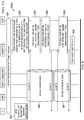
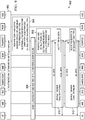
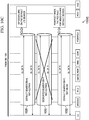
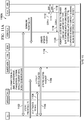
- FIGURES 3A-3C are simplified flow diagrams 300A-300C illustrating potential flows and activities associated with providing SDF mobility to enable IP flow mobility in accordance with one potential embodiment of the present disclosure.
- these flows and activities may be carried out via UE 12, MME 16, SGW 20, PGW 22 (including PCEF 24), PCRF 26 and SaMOG AGW 32.
- UE 12 is attached via EUTRAN (e.g., over LTE) to a given APN identified as 'apn1.name.com'.
- EUTRAN e.g., over LTE
- PGW 22 and PCRF 26 have an active IP-CAN session and that PCRF 26, during the initial attach of UE 12 to LTE, has communicated a credit control answer update (CCA-U) message including, at least in part, an Inter-RAT-Session-Continuity AVP, a preferred-RAT-Type AVP and an Exception-Rating-Group AVP for each SDF for the LTE access network.
- CCA-U credit control answer update
- UE 12 is allocated an Internet protocol (IP) address, IP1, and has two IP bearers defined as shown at 304-308.
- IP Internet protocol
- EBI evolved bearer identity
- PGW 22 has UE context in LTE as following 301-308. It should be understood that uplink (UL) packets are packets coming from UE 12 toward PGW 22 and downlink (DL) packets are packets sent toward UE 12 from PGW 22.
- UE 12 turns on its WiFi capabilities.
- radius accounting is initiated for UE 12 via SaMOG AGW 32.
- SaMOG AGW 32 communicates a create session request (CSR) to PGW 22.
- the IFOM indication can be provided by toggling a handover indication (HI) to identify whether a CS request pertains to a handover related scenario or an IFOM related scenario.
- PGW 22 may process the CSR to determine whether WiFi is available or not accessible.
- Certain embodiments may provide a heuristic process to determine whether WiFi is available or not accessible (e.g., not available).
- FIGURE 4 discussed in further detail below, illustrates a heuristic process to determine whether WiFi is available according to one potential embodiment of the present disclosure. It should be noted that, regardless of the preferred RAT type setting for one or more SDF(s), if any UL packet on WiFi (e.g., via WLAN access) is received, it is assumed that WiFi is working (e.g., available/accessible).
- a bearer may be created on WiFi and various PCC rules may be configured and/or reconfigured accordingly.
- PGW 22 / PCEF 24 may use a CCR to provide a Gx trigger (RAT change) to PCRF 26 indicating available RAT types for a given UE, such as, for example, UE 12.
- PCRF 26 process the Gx trigger (RAT change indication) based on the available RAT types (e.g., LTE and WiFi) and, at least in part, on the indicated Preferred-RAT-Type AVP and Session-Continuity AVP for each of SDF 40, SDF 60 and SDF 80 to determine that both of SDF 40 and SDF 80 should be moved to WLAN access and SDF 60 on the default LTE bearer should be retained on LTE.
- CCR-I credit control answer initial
- PGW 22 / PCEF 24 and PCRF 26 interact to modify the rules previously configured at 305, 306 and 308 in order to move SDF 40 and SDF 80 to WLAN access.
- PGW 22 has UE context in LTE and WiFi. Accordingly, at 320 UE 12 is attached to apn1.name.com via EUTRAN and WLAN.
- the bearers, PCC Rules and corresponding SDF configurations for UE 12 are shown at 321-325. It should be noted that the bearers, PCC Rules and SDF configurations shown at 321-325 may be configured and/or reconfigured at 317, as discussed previously. Thus, 321-325 merely illustrate the result of the configuring and/or reconfiguring of bearers, PCC rules and SDF configurations performed at 317.
- PCC Rule 1 has been removed from the LTE default bearer and moved to the dedicated WLAN bearer having SDF 40 configured thereon.
- PGW 22 may accept uplink (UL) packets from UE 12 on either LTE or WiFi.
- UL uplink
- PGW 22 / PCEF 24 may apply charging to the UE based on the exception rating group for the UE as indicated via the Exception-Rating-Group AVP, which may be configured by a network operator.
- PGW 22 / PCEF 24 may forward or route the packets to their corresponding SDF on the appropriate SDF RAT type.
- communication system 10 may provide for SDF mobility for a given UE, such as UE 12.
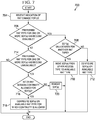
- FIGURE 4 is a simplified flow diagram 400 illustrating example operations associated with determining WiFi availability for SDF mobility to enable IP flow mobility in accordance with one potential embodiment of the present disclosure.
- PGW 22 / PCEF 24 may determine whether WiFi is available or not accessible (e.g., not available), which, based on the availability, may invoke a Gx trigger (e.g., CCR (update or initial) message) to be communicated to PCRF 26 indicating available RAT types for a given UE, such as, for example UE 12.
- Gx trigger e.g., CCR (update or initial) message
- PGW 22 / PCEF 24 may maintain a single context, referred to as mobility context for UE 12, in which primary access type(s) (e.g., available RAT types) are designated and/or updated for UE 12.
- the primary access type(s) are what PGW 22 / PCEF 24 uses to forward or route traffic associated with UE 12 on both uplink (UL) and downlink (DL) directions.
- uplink (UL) packets are packets coming from UE 12 toward PGW 22 / PCEF 24 and downlink (DL) packets are packets sent toward UE 12 from PGW 22 / PCEF 24.
- PGW 22 / PCEF 24 may update the mobility context for UE 12 based on determinations of changes in RAT type availability.
- the mobility context can be used by PGW 22 / PCEF 24 to ensure appropriate forwarding or routing of packets based on access availability (e.g., RAT type availability, such as WiFi, 4G, LTE, 3G, etc.), which is indicated in the context for UE 12.
- access availability e.g., RAT type availability, such as WiFi, 4G, LTE, 3G, etc.
- processing may start at 402 where PGW 22 / PCEF 24 may set both access types (e.g., LTE, WiFi) for the mobility context of UE 12 to primary when UE 12 attaches to both access types.
- WIFI_UP_COUNTER is set to an initial value of 10.
- PGW 22 / PCEF 24 determines whether an explicit detach has been received for UE 12 for either RAT type. If so, operations may continue to 430 where PGW 22 / PCEF 24 may update the mobility context for UE to reflect the RAT type change (e.g., mark a corresponding RAT type as unavailable). Operations may continue to 432 wherein PGW 22 / PCEF 24 may invoke a Gx trigger (e.g., a CCR message indicating a RAT change for one or more affected bearers) and/or may invoke any configured policy procedures for UE 12 such as, for example, charging policies and/or QoS policies; operations may then return to 406.
- a Gx trigger e.g., a CCR message indicating a RAT change for one or more affected bearers
- the operations continue to 408, in which PGW 22 / PCEF 24 determines whether a packet has been received. If no packet has been received, the operations return to 406. If a packet has been received, the operations continue to 410. At 410, PGW 22 / PCEF 24 determines whether the received packet is an uplink (UL) packet. If the received packet is an uplink packet, the operations continue to 412, in which PGW 22 / PCEF 24 determines if the UL has been received on WiFi. If so, PGW 22 / PCEF 24 determines at 414 whether wifi_data_count is equal to zero (0).
- UL uplink
- wifi_data_count is not equal to zero
- PGW 22 / PCEF 24 resets wifi_data_count back to the initial value of WIFI_UP_COUNTER at 414 and the operations return to 406.
- wifi_data_count is equal to zero
- the operations continue to 416, in which PGW 22 / PCEF 24 resets wifi_data_count back to the initial value of WIFI_UP_COUNTER and the operations continue 430 where PGW 22 / PCEF 24 may update the mobility context for UE to reflect the RAT type change (e.g., mark a WiFi as unavailable).
- the operations may continue to 432 as describe previously and return to 408.
- the operations continue to 420, in which PGW 22 / PCEF 24 determines whether the UL packet has been received on a non-preferred RAT while the preferred RAT is set to WiFi for a particular bearer. If the UL packet is received on a non-preferred RAT while the preferred RAT for the particular bearer is set to WiFi, PGW 22 / PCEF 24 decrements wifi_data_count by one (1) at 422 and the operations continue to 424. Otherwise, the operations return to 406.
- PGW 22 / PCEF 24 may assume that WiFi is working (e.g., available/accessible) and the wifi_data_count may be reset to the value of WIFI_UP_COUNTER, as shown at 418.
- PGW 22 / PCEF 24 determines at 424 whether wifi_data_count is equal to zero. If so, the operations continue to 430 wherein PGW 22 / PCEF 24 may update the mobility context of UE 12 to reflect the RAT type change (e.g., WiFi access marked as unavailable) and, at 432, may invoke a Gx trigger (e.g., a CCR message indicating a RAT change for one or more affected bearers) and/or may invoke any configured policy procedures for UE 12 such as, for example, charging policies and/or QoS policies; operations may then return to 406.
- RAT type change e.g., WiFi access marked as unavailable
- Gx trigger e.g., a CCR message indicating a RAT change for one or more affected bearers
- the received packet is a downlink (DL) packet and the operations continue to 440, in which PCEF 24 applies appropriate SDF filter(s) to the DL packet based on the settings for each of the one or more SDF(s) configured for various bearers to determine an appropriate SDF for communicated the DL packet to UE 12.
- PGW 22 / PCEF 24 routes the DL data according to the SDF filter(s) and the operations return to 406.
- embodiments of the above described operations may key off of uplink packets received from UE 12 and/or an explicit detach for UE 12 to determine whether WiFi is available or not accessible (e.g., not available) to the UE. For example, if WiFi may be switched off for the UE at some point or if the UE may be out of range of a given WLAN AP, such as WLAN AP 28, then UE 12 may communicate UL packets toward PGW 22 / PCEF 24 using LTE, regardless of the preferred RAT type for a particular SDF.
- PGW 22 / PCEF 24 may determine using the operations discussed that WiFi is unavailable or not accessible by the UE, which can invoke a Gx trigger indicating the RAT type change as well as one or more bearer modifications, PCC rule modifications and/or SDF configurations.
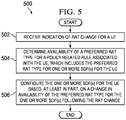
- FIGURE 5 is a simplified flow diagram 500 illustrating example operations associated with providing service data flow mobility to enable IP flow mobility in accordance with one potential embodiment of the present disclosure.
- a given UE such as UE 12 may attach to both LTE and WiFi, based on the availability of each RAT type.
- PGW 22 / PCEF 24 may invoke a Gx trigger to be communicated to PCRF.
- PCRF 26 may receive an indication of a RAT change for a given UE, such as UE 12.
- the indication of the RAT change may be communicated in the Gx trigger (e.g., a CCR message) communicated from including changes in available RAT types for UE 12.
- PCRF determines the availability of a preferred RAT type for a policy related rule, which includes the preferred RAT type for one or more SDF(s) for the UE.
- PCRF 26 and PGW / PCEF 24 may configure the one or more SDF(s) for the UE based, at least in part on a change in availability of the preferred RAT type following the RAT change.
- a policy related rule can be a PCC rule.
- communication system 10 may provide for SDF mobility to enable IP flow mobility by configuring and/or reconfiguring one or more SDF(s) affected by a change in RAT type by removing, moving, and/or installing PCC rules and their associated SDF(s) among different access bearers for multiple access types based, at least in part, on the availability and/or unavailability of a preferred RAT type and inter-RAT session continuity indication, which can be configured for different PCC rules / SDF(s).
- FIGURE 6 is a simplified flow diagram 600 illustrating other example operations associated with providing service data flow mobility to enable IP flow mobility in accordance with one potential embodiment of the present disclosure.
- PGW 22 / PCEF 24 may establish a mobility context associated with UE 12.
- the mobility context may include designation(s) one of or more RAT type(s) set to primary access type(s) for UE 12, based on the availability of the one or more RAT type(s).
- a given UE such as UE 12, may attach to LTE and/or WiFi, based on the availability of each RAT type.
- primary access is the access over which PGW 22 / PCEF 24 forwards and/or routes packets in the downlink (DL) to UE 12 and accepts packets in the uplink (UL) from UE 12.
- a first RAT type is associated with a WLAN access type, such as WiFi access.
- a second RAT type is associated with a EUTRAN access type such as LTE access.
- the data count variable is representative of a number of consecutive uplink packets received from UE 12 over the second RAT type when the first RAT type is the preferred RAT type for the bearer associated with the packets. For example, when WiFi is the preferred RAT type for a bearer, but uplink packets for the bearer are received over LTE.
- PGW 22 / PCEF 24 receives at least one uplink packet associated with UE 12 from at least one of the first RAT type and the second RAT type. In 608, PGW 22 / PCEF 24 determines whether the uplink packet is received over the first RAT type or the second RAT type. If it is received over the first RAT type, the operations continue to 610, in which PGW 22 / PCEF 24 determines whether the data count variable is equal to a predetermined value. If the data count variable is not equal to the predetermined value, the operations continue to 612, in which PGW 22 / PCEF 24 sets the value of the data count variable to the initial value at 612 and operations return to 606.
- operations in 610 and 614 may be representative of receiving an uplink packet over the first RAT type (e.g., WiFi access) when the first RAT type has been previously marked unavailable for the UE.
- the first RAT type e.g., WiFi access
- PGW 22 / PCEF 24 modifies the mobility context for UE 12.
- modifying the mobility context can include marking the first RAT type and/or the second RAT type as available or accessible and modifying the primary access type(s) for UE 12 based on the corresponding RAT type availability.
- modifying the mobility context can include marking the first RAT type and/or the second RAT type as unavailable or not accessible and modifying the primary access type(s) for UE 12 based on the corresponding RAT type availability.
- PGW 22 / PCEF 24 generates an indication of a change in RAT type availability.
- generating the indication can include invoking a Gx trigger (e.g., a CCR message) communicated to PCRF 26 indicating available RAT types for UE 12.
- operations continue to 616, in which PGW / PCEF determines whether the first RAT type (for example, WiFi) is the preferred RAT type for the bearer associated with the packet. If not, operations return to 606. If the first RAT type is the preferred RAT type for the bearer, operations continue to 618, in which PGW 22 / PCEF 24 modifies the value of the data count variable. In a particular embodiment, modifying the value can include decrementing the value of the data count variable.
- the first RAT type for example, WiFi
- PGW 22 / PCEF 24 determines whether the data count variable is equal to the predetermined value. If it is not equal to the predetermined value, operations return to 606. If it is determined that the data count variable is equal to the predetermined value, operations continue to 630. At 630, as discussed previously, PGW 22 / PCEF 24 modifies the mobility context for UE 12. At 632, PGW 22 / PCEF 24 generates an indication of a change in RAT type availability.
- FIGURE 7 is a simplified flow diagram 700 illustrating other example operations associated with providing service data flow mobility to enable IP flow mobility in accordance with one potential embodiment of the present disclosure.
- a given UE such as UE 12 may attach to both LTE and WiFi, based on the availability of each RAT type.
- PGW 22 / PCEF 24 may generate an indication of a RAT change for UE 12.
- generating of an indication of a RAT change may include invoking a Gx trigger (e.g., a CCR message) including an indication of available RAT types for UE 12.
- PCRF 26 receives an indication of a RAT change for a given UE, such as UE 12.
- PCRF 26 determines whether a preferred RAT type for one or more SDF(s) for UE 12 has become available, based on the RAT change indication received from PGW 22 / PCEF 24. If so, operations continue to 708, in which PCRF 26 determines whether the one or more SDF(s) are on a bearer for another access type. If so, at 710, PCRF 26 and PGW 22 / PCEF 24 move the one or more SDF(s) from the other RAT type to the available (preferred) RAT type for the one or more SDF(s). If it is determined that the one or more SDF(s) are not being serviced via another RAT type, then at 712, PCRF 26 and PGW 22 / PCEF 24 configure the one or more SDF(s) on the available (preferred) RAT type.
- PCRF 26 determines whether a preferred RAT for one or more SDF(s) has become unavailable. If the indicated RAT change neither indicates the a preferred RAT type for one or more SDF(s) has become available or unavailable, PCRF 26 can assume that the RAT change does not affect one or more SDF(s) and the operations may end.
- a preferred RAT types for one or more SDF(s) could be LTE, but WiFi availability for the UE may change between available/unavailable, which may invoke one or more Gx triggers to be communicated to PCRF 26.
- RAT type changes would not affect the one or more SDF(s) having a preferred RAT type set to LTE.
- PCRF 26 determines for the one or more SDF(s) whose preferred RAT type has become unavailable whether inter-RAT session continuity is allowed and/or whether it is allowed for a RAT type, which is still available to the UE.
- PCRF 26 and PGW 22 / PCEF 24 may configure the one or more SDF(s) on the available RAT type for which inter-RAT session continuity is allowed at 718.
- PCRF 26 and PGW 22 / PCEF 24 may, at 720, remove the one or more associated SDF(s) altogether.
- communication system 10 may provide for SDF mobility to enable IP flow mobility by configuring and/or reconfiguring one or more SDF(s) based, at least in part, on the availability and/or unavailability of a preferred RAT type and inter-RAT session continuity indication, which can be configured for different PCC rules / SDF(s).
- Some particular embodiments may provide for one or more of the following advantages: provide for IP flow mobility with a single APN and PDN connection; and provide for IP flow mobility initiated by the network and not the UE.
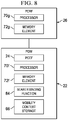
- FIGURE 8 is a simplified block diagram illustrating other details associated with one potential embodiment of the communication system.
- FIGURE 8 includes PGW 22 and PCRF 26.
- PGW 22 includes PCEF 24, processor 70f, memory element 72f, mobility context storage 66 and a bearer binding function 84.
- PCRF 26 includes processor 70g and memory element 72g.
- a bearer binding mechanism is the association of a PCC rule and a QoS rule to an IP-CAN bearer within a given IP-CAN Session.
- the bearer binding mechanism in PCEF is typically based on a combination of a QoS class identifier (QCI) and an evolved allocation and retention priority (eARP) setting.
- QCI QoS class identifier
- eARP evolved allocation and retention priority
- the typical QCI, eARP combination may not provide a unique identifier for binding these rule.
- the PCRF sends the rules to the PGW/PCEF identifying the bearer using QCI, EARP, the PGW/PCEF does not know whether to bind these rules on WiFi or on EUTRAN.
- communication system 10 can overcome these shortcomings (and others) by providing a new bearer binding function, which can differentiate the bearers on the WiFi and those on LTE based on a RAT type identifier being provided as an additional key in the identification of a bearer on the PCC interface (e.g., the Gx interface).
- a bearer (default or dedicated) can be identified by QCI, eARP and RAT type on the PCC interface.
- PGW 22 may include bearer binding function (BBF) 84, which may provide enhanced functionality to match rules to bearers based on QCI, eARP and RAT type to perform bearer binding.
- BBF bearer binding function
- PGW 22 / PCEF 24 may support handling for multiple default bearers (e.g., one default bearer on LTE and another default bearer on WLAN) to enable IP flow mobility for communication system 10.
- PGW 22 may accept uplink (UL) packets on both WLAN and LTE to enable IP flow mobility.
- the Default-EPS-Bearer-QoS AVP as defined in 3GPP TS 29.212 can be updated to additionally include RAT-Type as a new parameter that may provide a corresponding RAT type to be used in matching rules to a default bearer.
- the QoS-Information AVP for the Charging-Rule-Definition AVP as defined in 3GPP TS 29.212, can be updated to additionally include RAT-Type as a new parameter that may provide a corresponding RAT type to be used in matching rules to a dedicated bearer.
- the RAT-Type parameter may be set to indicate a RAT type such as EUTRAN, WLAN, etc. based on the definition(s) provided in TS 29.212.
- the inclusion of the RAT-Type parameter in the Default-EPS-Bearer-QoS AVP and the QoS-Information AVP is illustrated in TABLE 4, below. TABLE 4
- the solution provided by communication system 10 may further include defining a new default-EPS-Preferred-RAT-Type AVP that may be used to identify, based on a preferred RAT type, a preferred default bearer for handling (e.g., forwarding or routing) DL data.
- PGW 22 / PCEF 24 may apply the default-EPS-Preferred-RAT-type received from PCRF 26 for downlink (DL) packets to route the packets on the preferred default bearer RAT type.
- DL data can be routed according to the default bearer preferred RAT type if the DL data does not match a rule configured for any other bearer.
- the default-EPS-Preferred-RAT-Type AVP may be returned by HSS 18 to PCRF 26 in a DIAMETER-based Server Assignment Answer (SAA) on the Sh interface.
- PCRF 26 can indicate to PGW 22 / PCEF 24 to provide a re-request of PCC rule for changes in default-EPS-Preferred-RAT-Type, by communicating an Event-Report-Indication AVP to PGW 22 / PCEF 24 including an Event-Trigger AVP of a new type DEFAULT_EPS_PREFERRED_RAT_CHANGE (46).
- the new type of Event-Trigger can be used to subscribe PGW 22 / PCEF 24 to re-request PCC rules from PCRF 26 for changes in default-EPS-Preferred-RAT-type.
- PGW 22 / PCEF 24 may subscribe to such events using a DIAMETER-based Re-Authorization Request (RAR) command.
- RAR DIAMETER-based Re-Authorization Request
- Table 5 shown below, illustrates an example default-EPS-Preferred-RAT-Type AVP and an example Event-Trigger AVP addition, which can be used in various embodiments described herein. TABLE 5
- the solution provided by communication system 10 may include extending the credit control answer update (CCA-U) message to include the default-EPS-Preferred-RAT-Type to provide an indication of such.
- PCRF 26 may provide this value in a CCA-U message based on the value returned from HSS 18 in a Sh interface SAA message.
- the solution can also include extending a credit control request update (CCR-U) message to include the default-EPS-Preferred-RAT-Type AVP such that PGW 22 / PCEF 24 can inform the change of a default-EPS-Preferred-RAT-Type event to PCRF 26.
- CCR-U credit control request update
- TABLE 6 shown below, illustrates an example CC-Answer and an example CC-Request extended according to certain embodiments to include support for the default-EPS-Preferred-RAT-type AVP.
- BBF bearer binding function
- FIGURE 9 is a simplified flow diagram 900 illustrating example call flows and activities associated with providing bearer binding to enable robust LTE-WiFi IP flow mobility in accordance with one potential embodiment of the present disclosure.
- an IFOM capable UE such as UE 12 is LTE attached and has a dedicated bearer for video.
- the UE decides to open connection on WiFi.
- the PGW/PCEF now has a LTE default bearer carrying the SIP signaling, an LTE-dedicated bearer carrying video and a WiFi default bearer.
- the PCRF installs PCC rules on the WiFi default bearer for video and indicates the WiFi as the preferred RAT Type.
- the PGW/PCEF moves the video onto the WiFi default bearer. If the WiFi PDN connection is lost then the PGW/PCEF moves the video downlink to back to the LTE connection.
- FIGURE 9 includes various example flows and activities, which further illustrate various features of the above described example.
- a given IFOM capable UE such as UE 12 is attached to a single APN identified by apn1.name.com via EUTRAN (e.g., LTE) and WLAN (e.g., WiFi).
- EUTRAN e.g., LTE
- WLAN e.g., WiFi
- PGW 22 / PCEF 24 and PCRF 26 have active session(s) for EUTRAN and WLAN.
- PCRF 26 provides RAT type, QCI and eARP for one or more PCC rule(s) to PGW 22 / PCEF 24 via one or more CCA messages.
- PCRF 26 can also provide default-EPS-Preferred-RAT-Type to PGW 22 / PCEF 24.
- UE 12 is allocated IP address IP1 (e.g., via a create session response message from PGW 22 / PCEF 24) and has two default bearers associated thereto, as shown in 910, 912.
- PGW 22 / PCEF 24 provides support for two default bearers (EUTRAN and WLAN) with a default bearer preferred RAT type equal to WLAN for handling downlink (DL) packets toward UE 12.
- PGW 22 / PCEF 24 may receive uplink (UL) packets from UE 12 via UTRAN, yet there is no traffic flow template (TFT) provided for downlink (DL) packets as the default bearer preferred RAT type is set to WLAN in the particular embodiment.
- TFT traffic flow template
- the default WLAN bearer is identified by QCI, eARP and RAT type.
- PGW 22 / PCEF 24 may receive uplink (UL) packets via WLAN and may forward or route downlink (DL) packets via WLAN as provided by the default bearer preferred RAT type being identified as WLAN.
- FIGURES 10A-10C are simplified flow diagrams 1000A-1000C illustrating potential call flows and activities associated with providing bearer binding to enable robust LTE-WiFi IP flow mobility in accordance with one potential embodiment of the present disclosure.
- a given UE such as UE 12 is connected via LTE (e.g., over EUTRAN access) to a particular APN identified as apn1.name.com.
- PGW 22 / PCEF 24 and PCRF 26 have active session(s) for EUTRAN RAT type.
- UE 12 is allocated IP address IP1 and has two bearers associated thereto as shown in 1008 and 1010.
- Session Initiation Protocol (SIP) signaling may be provided on the default LTE bearer.
- Video Real-time Transport Protocol (RTP) communications may be provided on the dedicated LTE bearer.
- IFOM capable UE 12 switches on WiFi to attach to apn1.name.com for IFOM creation.
- UE 12 attaches to WLC 30 and at 1016 WLC 30 opens at least one connection at SaMOG AGW 32 for UE 12.
- SaMOG AGW 32 creates a PDN connection with PGW 22 / PCEF 24 (e.g., using a create session (CS) request) and includes an IFOM indication during the creation to signal to PGW 22 / PCEF 24 that the PDN connection is for an IFOM scenario as opposed to a handover scenario.
- the IFOM indication can be provided by toggling a handover indication (HI) to identify whether a CS request pertains to a handover related scenario or an IFOM related scenario.
- HI handover indication
- PGW 22 / PCEF 24 sends a credit control request update (CCR-U) message to PCRF 26 including the default-EPS-Bearer-QoS AVP for the WLAN, which includes RAT type set to WLAN and also includes the IFOM indication.
- the CCR-U can include a list of all RAT types available to a given UE (e.g., WLAN, EUTRAN, etc.)
- PCRF 26 determines one or more PCC Rule(s) for UE 12 for the corresponding RAT type as well as the default preferred RAT type for handling DL data.
- PCRF 26 communicates a CCA-U to PGW 22 / PCEF 24 including PCC Rule(s) for the corresponding authorized default-EPS-Bearer-QoS, the default-EPS-Preferred-RAT-Type AVP and/or any other QoS info, such as, for example, bit rate(s), Rating Groups, etc.
- PCRF 26 provides PCC-Rule-1 to delete the Video bearer on LTE and provides a second PCC Rule, PCC-Rule-2, which provides for the video bearer to be bound to the WiFi default bearer.
- the resulting default bearers are shown at 1028 and 1032.
- the default LTE bearer is shown for SIP signaling.
- the deleted dedicated LTE bearer is shown at 1030.
- the default WiFi bearer is shown in which PGW 22 / PCEF 24 binds the PCC rule for Video on the WiFi default bearer.
- PGW 22 / PCEF 24 can support handling of data for two default bearers attached to the same single APN and PDN connection via identification of PCC Rules and bearers according to QCI, eARP (or ARP, depending on configuration) and RAT type.
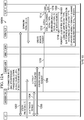
- FIGURES 11A-11C are simplified flow diagrams 1100A-1100C illustrating potential call flows and activities associated with providing bearer binding to enable robust LTE-WiFi IP flow mobility in accordance with one potential embodiment of the present disclosure.
- FIGURES 11A-11C illustrate features related to interactions with HSS 18, updating mobility context for UE 12, downlink (DL) packet handling in various use cases and changes in preferred default bearer RAT type.
- DL downlink
- a packet data network (PDN) connection in LTE is established for IFOM capable UE 12.
- IPv4 Internet protocol version 4
- the allocated IP address can also be an IP version 6 (IPv6) address.
- uplink and downlink packet(s) for UE 12 at this point in the flow diagram are communicated via LTE.
- UE 12 switches on WiFi and attaches to WLC 30.
- UE 12 is fully authenticated via SaMOG AGW 32.
- the generic access request can include the Proxy Request flag set to TRUE, the mobile node identifier (MN-ID) for UE 12 (e.g., IMSI), the handover indication (HI) set to FALSE (e.g., indicating an IFOM creation) and RAT type set to WLAN.
- MN-ID mobile node identifier
- HI handover indication
- FALSE e.g., indicating an IFOM creation
- SaMOG AGW 32 communicates a create session (CS) request to PGW 22 / PCEF 24.
- PGW 22 / PCEF 24 communicates a credit control request update (CCR-U) to PCRF 26.
- CCR-U credit control request update
- the CCR-U includes, among other information, the IMSI network address identifier (IMSI-NAI), APN, IP address, default-EPS-bearer-QoS AVP for QCI-1, eARP-1 and WLAN for the default bearer.
- IMSI network address identifier IMSI network address identifier
- APN IP address
- default-EPS-bearer-QoS AVP for QCI-1, eARP-1 and WLAN for the default bearer.
- PCRF 26 communicates a DIAMETER-based Server Assignment Request (SAR) to HSS 18.
- HSS 18 provides the default bearer preferred RAT type to PCRF 26 via a DIAMETER-based sever assignment answer (SAA) including the default-EPS-Preferred-RAT-Type AVP indicating WLAN as the preferred RAT type.
- SAA DIAMETER-based sever assignment answer
- HSS 18 can provide to PCRF 26 other subscriber related policy and/or charging related information, which can be provided via a subscription profile repository (
- PCRF 26 communicates a credit control answer update (CCA-U) to PGW 22 / PCEF 24.
- the CCA-U includes the authorized default-EPS-Bearer-QoS AVP for QCI-1, eARP-1 and WLAN; one or more associated bit rate(s), PCC Rule(s), rating group, etc.; and the default-EPS-Preferred-RAT-Type set to WLAN.
- PCRF 26 identifies the WLAN bearer using QCI, eARP and RAT type for the bearer (e.g., QCI-1, eARP-1, WLAN).
- PGW 22 / PCEF 24 via bearer binding function 84, identifies the bearer according to QCI, eARP and RAT type; performs bearer binding based on matching the received QCI-1, eARP-1 and WLAN for the default WLAN bearer; updates the mobility context for UE to reflect the bearer binding(s); and marks WLAN as the preferred default bearer in the mobility context based on the default-EPS-Preferred-RAT-Type AVP received from PCRF 26.
- the resulting bearers, bearer bindings (represented by dashed lines) and corresponding QCI, eARP and RAT type identifiers for each bearer policy charging and control (PCC) context is shown in 1122a and 1122b.
- the PCC context provides a contextual mapping of PCC Rules to corresponding bearers.
- the PCC context is the context of the UE's context at PGW 22 / PCEF 24, which can contain PCRF side information such as bearer binding, etc.
- PGW 22 / PCEF 24 sets the same IP address for the LTE and WLAN bearers and, at 1126, communicates a create session (CS) response to SaMOG AGW 32.
- the CS response includes the PDN address allocation (PAA) set to the IPv4 address allocated on LTE and the WLAN default bearer context including the authorized QCI-1, eARP-1 and bit rate(s) for the WLAN default bearer.
- PDA PDN address allocation
- WLC wireless LAN controller
- the access response may include the IPv4 Home Address allocated on LTE, proxy request flag set to TRUE, MN-ID for UE 12, the Home Address Request option set, the handover indication (HI) set to FALSE and WLAN identifier.
- WLC 30 may use dynamic host configuration protocol (DHCP) to convey to UE 12 the IP address.
- DHCP dynamic host configuration protocol
- PGW 22 / PCEF 24 accepts uplink (UL) packet(s) from both LTE and WLAN and sends downlink (DL) packet(s) on the preferred RAT type WLAN.
- PGW 22 / PCEF 24 can also be configured to route DL packet(s) over LTE in various cases, including but not limited to, when the WiFi PDN becomes disconnected for UE 12 or when pause charging is received (e.g., using a modify bearer (MB) request) due to loss of radio (e.g., WiFi) connection with UE 12.
- PGW 22 / PCEF 24 can send DL packet(s) on LTE if WiFi is unavailable or inaccessible.
- PGW 22 / PCEF 24 can indicate a change of default bearer preferred RAT type to PCRF 26 via CCR-U and CCA-U messages.
- PCRF 26 can indicate to PGW 22 / PCEF 24 to change the default preferred RAT type based on the type of content and/or data.
- PCRF 26 can set the default preferred RAT type based on APN. Say for example, that the default preferred RAT type is set to LTE for an IMS APN and for, say internet browsing, it is set to WLAN.
- PCRF 26 could also configure the default preferred RAT type to be changed to WLAN from LTE whenever WLAN becomes available to conserve LTE radio resources.
- the above examples are just a few of the many configurations that can be provided to change the default preferred RAT type. Virtually any other configurations can be used using similar means and methods as described herein, and, thus, are clearly within the scope of the present disclosure.
- FIGURES 12A-12D are simplified flow diagrams 1200A-1200D illustrating potential call flows and activities associated with providing bearer binding to enable robust LTE-WiFi IP flow mobility in accordance with one potential embodiment of the present disclosure.
- FIGURES 12A-12D illustrate features related to interactions handling creation of dedicated bearers and updating of the mobility context for UE 12.
- PCC rule PCC-Rule-1
- the PCC context for UE 12 is updated via PCRF 26 as shown at 1246b to include the mapping of QCI-3, eARP-3 for PCC-Rule-1 to the corresponding LTE dedicated bearer.
- PGW 22 / PCEF 24 Various functions for PGW 22 / PCEF 24 are illustrated at 1250.
- PGW 22 / PCEF 24 accepts or routes uplink packet(s) from LTE and WLAN default bearers and PGW 22 / PCEF 24 sends downlink packet(s) on the preferred RAT type, e.g., WLAN for these example flows.
- PGW 22 / PCEF 24 accepts or routes traffic from the dedicated bearer(s) (e.g., a traffic flow template for uplink packets are applied at the UE) based on the provided PCC Rule(s) and PGW 22 / PCEF 24 applied the PCC Rule(s) for the dedicated bearer(s) for routing downlink packets.
- PGW 22 / PCEF 24 can be configured to route traffic for multiple default bearers and multiple dedicated bearers according to various embodiments.
- FIGURE 13 is a simplified flow diagram 1300 illustrating example operations associated with providing bearer binding to enable IP flow mobility in accordance with one potential embodiment of the present disclosure.
- PGW 22 / PCEF 24 receives a policy related rule for a given UE, such as IFOM capable UE 12, while the UE is currently accessing a given APN using a first RAT type associated with a first default bearer for the UE, where the policy related rule is associated with the UE accessing the APN using a second RAT type.
- the policy related rule is a given PCC rule for the UE.
- the PCC rule is identified according to parameters such as a QoS Class Identifier (QCI), an allocation and retention policy (ARP) or evolved ARP (eARP) and a RAT type.
- QCI QoS Class Identifier
- ARP allocation and retention policy
- eARP evolved ARP
- PGW 22 / PCEF 24 via bearer binding function 84, binds the policy related rule to a second default bearer for the UE to access the APN, where the second default bearer is associated with the second RAT type.
- PGW 22 / PCEF 24 updates the mobility context for UE 12 to include the second default bearer.
- communication system 10 (and its teachings) are readily scalable and can accommodate a large number of components, as well as more complicated/sophisticated arrangements and configurations. Accordingly, the examples provided should not limit the scope or inhibit the broad teachings of communication system 10 as potentially applied to a myriad of other architectures.
- An example method may include receiving an indication of a radio access technology (RAT) change for a user equipment (UE); determining availability of a preferred RAT type for a policy related rule associated with the UE, wherein the policy related rule includes, at least in part, the preferred RAT type for one or more service data flows for the UE; and configuring the one or more service data flows for the UE based, at least in part, on a change in availability of the preferred RAT type following the RAT change.
- the method can include routing downlink packets to the UE using the one or more service data flows for the preferred RAT type if the preferred RAT type is available.
- communication system 10 may be applicable to other exchanges, routing protocols, or routed protocols to provide IP flow mobility in a network.
- communication system 10 has been illustrated with reference to particular elements and operations that facilitate the communication process, these elements and operations may be replaced by any suitable architecture or process that achieves the intended functionality of communication system 10.
Landscapes
- Engineering & Computer Science (AREA)
- Computer Networks & Wireless Communication (AREA)
- Signal Processing (AREA)
- Computer Security & Cryptography (AREA)
- Business, Economics & Management (AREA)
- Accounting & Taxation (AREA)
- Mobile Radio Communication Systems (AREA)
Applications Claiming Priority (3)
| Application Number | Priority Date | Filing Date | Title |
|---|---|---|---|
| US14/538,334 US9674764B2 (en) | 2014-11-11 | 2014-11-11 | System and method for providing Internet protocol flow mobility in a network environment |
| US14/540,082 US9635686B2 (en) | 2014-11-11 | 2014-11-13 | System and method for providing internet protocol flow mobility in a network environment |
| EP15194130.9A EP3021616B1 (fr) | 2014-11-11 | 2015-11-11 | Système et procédé pour fournir une mobilité de flux de protocole internet dans un environnement de réseau |
Related Parent Applications (1)
| Application Number | Title | Priority Date | Filing Date |
|---|---|---|---|
| EP15194130.9A Division EP3021616B1 (fr) | 2014-11-11 | 2015-11-11 | Système et procédé pour fournir une mobilité de flux de protocole internet dans un environnement de réseau |
Publications (2)
| Publication Number | Publication Date |
|---|---|
| EP3399795A1 true EP3399795A1 (fr) | 2018-11-07 |
| EP3399795B1 EP3399795B1 (fr) | 2020-06-10 |
Family
ID=54539980
Family Applications (2)
| Application Number | Title | Priority Date | Filing Date |
|---|---|---|---|
| EP18179581.6A Active EP3399795B1 (fr) | 2014-11-11 | 2015-11-11 | Système et procédé pour fournir une mobilité de flux de protocole internet dans un environnement de réseau |
| EP15194130.9A Active EP3021616B1 (fr) | 2014-11-11 | 2015-11-11 | Système et procédé pour fournir une mobilité de flux de protocole internet dans un environnement de réseau |
Family Applications After (1)
| Application Number | Title | Priority Date | Filing Date |
|---|---|---|---|
| EP15194130.9A Active EP3021616B1 (fr) | 2014-11-11 | 2015-11-11 | Système et procédé pour fournir une mobilité de flux de protocole internet dans un environnement de réseau |
Country Status (3)
| Country | Link |
|---|---|
| US (1) | US9635686B2 (fr) |
| EP (2) | EP3399795B1 (fr) |
| CN (1) | CN105592068B (fr) |
Families Citing this family (26)
| Publication number | Priority date | Publication date | Assignee | Title |
|---|---|---|---|---|
| US9642060B2 (en) * | 2013-12-20 | 2017-05-02 | Industrial Technology Research Institute | Communication methods of IP flow mobility with radio access network level enhancement |
| US9930716B2 (en) * | 2014-06-30 | 2018-03-27 | Apple Inc. | Methods and apparatus to support network-based IP flow mobility via multiple wireless accesses for a wireless device |
| US9674764B2 (en) * | 2014-11-11 | 2017-06-06 | Cisco Technology, Inc. | System and method for providing Internet protocol flow mobility in a network environment |
| CN107409121B (zh) * | 2015-03-12 | 2021-02-23 | 瑞典爱立信有限公司 | 用于多路径业务聚合的方法和布置 |
| US9788247B1 (en) * | 2015-03-13 | 2017-10-10 | Sprint Communications Company L.P. | Long term evolution (LTE) communication system to transfer communications from non-LTE to LTE networks |
| US9936422B2 (en) * | 2015-03-16 | 2018-04-03 | Aruba Networks, Inc. | Client association management for improving MU-MIMO transmissions |
| KR102461929B1 (ko) * | 2015-09-25 | 2022-11-02 | 삼성전자주식회사 | 다수의 무선 접속 인터페이스를 지원하는 이동 통신 시스템에서 스트리밍 서비스 데이터를 수신하는 장치 및 방법 |
| US10123372B2 (en) * | 2015-09-30 | 2018-11-06 | Apple Inc. | Device, system and method to avoid voice call setup failure due to network congestion |
| CN106789117A (zh) * | 2015-11-19 | 2017-05-31 | 中兴通讯股份有限公司 | Pcc规则的处理方法及装置 |
| US10263886B2 (en) * | 2016-02-23 | 2019-04-16 | Avaya Inc. | Mobile endpoint network interface selection using merged policies |
| US10091692B2 (en) | 2016-06-14 | 2018-10-02 | Juniper Networks, Inc. | Preserving mobile network session data during radio access technology handover |
| CN109644481B (zh) * | 2016-08-24 | 2022-07-22 | 瑞典爱立信有限公司 | 无线设备及其中用于将数据分组映射到无线通信网络中的无线电承载的方法 |
| US10361958B2 (en) * | 2016-09-02 | 2019-07-23 | Openet Telecom Ltd. | System and method for managing and distributing packet flow descriptions in a telecommunications network |
| WO2018137777A1 (fr) * | 2017-01-27 | 2018-08-02 | Telefonaktiebolaget Lm Ericsson (Publ) | Procédé et appareil d'indication et d'utilisation de préférences de technologie d'accès radio dans un réseau de communication sans fil |
| US10791443B2 (en) * | 2017-03-03 | 2020-09-29 | Verizon Patent And Licensing Inc. | System and method for enhanced messaging using external identifiers |
| US10506492B2 (en) | 2017-06-14 | 2019-12-10 | Cisco Technology, Inc. | System and method to facilitate link aggregation using network-based internet protocol (IP) flow mobility in a network environment |
| EP3777461B1 (fr) * | 2018-03-29 | 2024-08-07 | British Telecommunications public limited company | Gestion de porteuse dédiée |
| US10548177B2 (en) * | 2018-04-17 | 2020-01-28 | Verizon Patent And Licensing Inc. | Bearer activation for multiple radio access technology dual connectivity scenarios |
| US10785813B2 (en) * | 2018-07-23 | 2020-09-22 | International Business Machines Corporation | Mobile communication network attachment to Wi-Fi |
| CN110972216B (zh) * | 2018-09-30 | 2022-04-29 | 华为技术有限公司 | 通信方法和装置 |
| CN113518470B (zh) * | 2019-01-11 | 2023-03-24 | Oppo广东移动通信有限公司 | 信道接入方案的确定方法及装置、终端设备、网络设备 |
| US11147041B2 (en) * | 2019-02-27 | 2021-10-12 | At&T Intellectual Property I, L.P. | Device contexts, operational modes, and policy driven enhancements for paging in advanced networks |
| CN112994905B (zh) * | 2019-12-18 | 2024-01-30 | 中兴通讯股份有限公司 | 策略和计费的控制方法、系统、电子设备以及存储介质 |
| CN116847021A (zh) * | 2021-06-16 | 2023-10-03 | 荣耀终端有限公司 | 通道切换方法、电子设备及存储介质 |
| US12520206B2 (en) | 2022-05-24 | 2026-01-06 | Cisco Technology, Inc. | User equipment (UE) policy for selection of radio access technology (RAT) type for mobility from non-3GPP to 3GPP accesses |
| JP7249469B1 (ja) * | 2022-09-30 | 2023-03-30 | 株式会社インターネットイニシアティブ | ベアラ設定のための方法、情報処理装置、およびシステム |
Citations (3)
| Publication number | Priority date | Publication date | Assignee | Title |
|---|---|---|---|---|
| US20110065435A1 (en) * | 2008-04-30 | 2011-03-17 | Maria Belen Pancorbo Marcos | Bearer control mode (nw-only or user-only) handling in intersystem handover |
| WO2014086431A1 (fr) * | 2012-12-07 | 2014-06-12 | Telefonaktiebolaget L M Ericsson (Publ) | Rapport d'événement sélectif dans un réseau de télécommunications mobiles |
| WO2014130091A1 (fr) * | 2013-02-22 | 2014-08-28 | Intel IP Corporation | Systèmes et procédés pour la sélection d'un réseau d'accès et l'acheminement du trafic |
Family Cites Families (36)
| Publication number | Priority date | Publication date | Assignee | Title |
|---|---|---|---|---|
| JP4180236B2 (ja) | 1999-12-28 | 2008-11-12 | 株式会社エヌ・ティ・ティ・ドコモ | ハンドオーバ制御方法及びシステム |
| BRPI0621918B8 (pt) | 2006-07-21 | 2020-09-08 | Ericsson Telefon Ab L M | método para criar uma relação entre dispositivos móveis e um veículo de uma rede de comunicações sem fio, dispositivo destinado a ser usado a bordo de um veículo, e, servidor em uma rede de comunicações sem fio |
| FR2904914B1 (fr) | 2006-08-09 | 2008-09-26 | Alcatel Sa | Procede de gestion d'interfonctionnement pour le transfert de sessions de service d'un reseau local sans fil vers un reseau mobile, et noeuds sgsn correspondants |
| US8856860B2 (en) | 2006-08-18 | 2014-10-07 | Cisco Technology, Inc. | System and method for implementing policy server based application interaction manager |
| WO2009006630A1 (fr) | 2007-07-05 | 2009-01-08 | Starent Networks, Corp | Système et procédé de réduction de latence dans l'établissement d'appel et l'interruption d'appel |
| US8160638B2 (en) | 2008-04-15 | 2012-04-17 | Cisco Technology, Inc. | Controlling multi-mode devices |
| US7848756B2 (en) | 2008-09-22 | 2010-12-07 | Telefonaktiebolaget L M Ericsson (Publ) | Radio access technology selection |
| KR20110063776A (ko) | 2008-09-26 | 2011-06-14 | 쿄세라 코포레이션 | 액세스 포인트, 무선 통신 단말, 및 서버 |
| CN101841797B (zh) * | 2009-03-21 | 2014-11-05 | 中兴通讯股份有限公司 | 一种终端通过多接入网接入的计费方法和系统及上报方法 |
| JP5108826B2 (ja) | 2009-04-27 | 2012-12-26 | 株式会社エヌ・ティ・ティ・ドコモ | 移動通信方法、移動通信システム、配信サーバ、加入者情報管理サーバ及びセッション管理サーバ |
| US8989087B2 (en) | 2010-06-15 | 2015-03-24 | Telefonaktiebolaget L M Ericsson (Publ) | Methods and devices for managing radio access in a communication system |
| US8787172B2 (en) * | 2010-06-21 | 2014-07-22 | Qualcomm Incorporated | Method and apparatus for QoS context transfer during inter radio access technology handover in a wireless communication system |
| US8400916B2 (en) | 2010-06-28 | 2013-03-19 | Alcatel Lucent | Method of authorizing AF sessions using external subscriber database |
| WO2012052064A1 (fr) * | 2010-10-22 | 2012-04-26 | Telefonaktiebolaget L M Ericsson (Publ) | Adaptation de la qualité de service dans la gestion du trafic d'un réseau |
| EP2445266B1 (fr) | 2010-10-25 | 2016-03-16 | Alcatel Lucent | Contrôle de sélection de technologie d'accès/réseau d'accès pour le routage d'un trafic IP par un équipement d'utilisateur, et support QoS, dans un système de communication à accès multiple |
| FI3319395T3 (fi) * | 2010-12-03 | 2023-08-01 | Interdigital Patent Holdings Inc | Menetelmä ja laite moniradioliityntätekniikan kantoaaltojen yhdistämisen suorittamiseksi |
| TWI595764B (zh) | 2011-04-11 | 2017-08-11 | 內數位專利控股公司 | 無線傳輸/接收單元及其執行的方法 |
| US8848640B2 (en) | 2011-05-06 | 2014-09-30 | Interdigital Patent Holdings, Inc. | Method and apparatus for bandwidth aggregation for IP flow |
| EP2708062A1 (fr) * | 2011-05-09 | 2014-03-19 | Telefonaktiebolaget LM Ericsson (PUBL) | Adaptation de niveau de qualité de service pour des services visuels dans des réseaux de communication mobiles |
| US8717880B2 (en) * | 2011-07-28 | 2014-05-06 | Motorola Solutions, Inc. | Detecting abnormal bearer termination and dynamically restoring flows utilizing an alternative bearer |
| US8942099B2 (en) | 2011-09-21 | 2015-01-27 | Mediatek Inc. | Method and apparatus of IP flow mobility in 4G wireless communication networks |
| KR101797051B1 (ko) | 2011-10-18 | 2017-11-13 | 삼성전자 주식회사 | 근거리 무선 통신망에서 광역 무선 통신망으로의 핸드오버 방법 및 장치 |
| CA2768483C (fr) * | 2011-12-30 | 2019-08-20 | Sandvine Incorporated Ulc | Systemes et procedes pour gerer la qualite du service |
| US20130208605A1 (en) | 2012-01-04 | 2013-08-15 | Qualcomm Incorporated | Method and apparatus for ue-based handover during network coverage holes |
| CN103248451B (zh) | 2012-02-09 | 2016-12-07 | 华为技术有限公司 | 业务速率控制方法和系统以及设备 |
| CN103298004A (zh) * | 2012-02-28 | 2013-09-11 | 北京三星通信技术研究有限公司 | 汇报无线链路失败信息的方法 |
| US20140064068A1 (en) | 2012-08-30 | 2014-03-06 | Qualcomm Incorporated | Interactions between ran-based and legacy wlan mobility |
| CN104854773B (zh) * | 2013-01-14 | 2018-05-11 | 英特尔Ip公司 | 无线网络中的能量采集设备 |
| US9591617B2 (en) | 2013-03-11 | 2017-03-07 | Intel Deutschland Gmbh | Communication controller and method for transmitting data |
| US10039039B2 (en) * | 2013-07-02 | 2018-07-31 | Lg Electronics Inc. | Method and apparatus for performing handover in wireless communication system |
| CN105359571A (zh) | 2013-08-12 | 2016-02-24 | 英特尔公司 | 管理多个无线电接入网中的通信 |
| WO2015043662A1 (fr) * | 2013-09-27 | 2015-04-02 | Telefonaktiebolaget L M Ericsson (Publ) | Procédés, dispositifs et programmes d'ordinateur pour fournir un service ou un composant de service nécessitant un traitement de réacheminement de paquet spécifique |
| CN105794251B (zh) | 2013-12-20 | 2019-06-25 | 英特尔公司 | 利用多个无线接入网络,测量链路性能 |
| US9294982B2 (en) | 2014-01-27 | 2016-03-22 | Cisco Technology, Inc. | System and method for robust multiple access network mobility in a network environment |
| US10237791B2 (en) | 2014-03-27 | 2019-03-19 | Acer Incorporated | Method of updating network detection and selection information and traffic routing information |
| US9674764B2 (en) | 2014-11-11 | 2017-06-06 | Cisco Technology, Inc. | System and method for providing Internet protocol flow mobility in a network environment |
-
2014
- 2014-11-13 US US14/540,082 patent/US9635686B2/en active Active
-
2015
- 2015-11-10 CN CN201510763425.2A patent/CN105592068B/zh not_active Expired - Fee Related
- 2015-11-11 EP EP18179581.6A patent/EP3399795B1/fr active Active
- 2015-11-11 EP EP15194130.9A patent/EP3021616B1/fr active Active
Patent Citations (3)
| Publication number | Priority date | Publication date | Assignee | Title |
|---|---|---|---|---|
| US20110065435A1 (en) * | 2008-04-30 | 2011-03-17 | Maria Belen Pancorbo Marcos | Bearer control mode (nw-only or user-only) handling in intersystem handover |
| WO2014086431A1 (fr) * | 2012-12-07 | 2014-06-12 | Telefonaktiebolaget L M Ericsson (Publ) | Rapport d'événement sélectif dans un réseau de télécommunications mobiles |
| WO2014130091A1 (fr) * | 2013-02-22 | 2014-08-28 | Intel IP Corporation | Systèmes et procédés pour la sélection d'un réseau d'accès et l'acheminement du trafic |
Also Published As
| Publication number | Publication date |
|---|---|
| CN105592068A (zh) | 2016-05-18 |
| US9635686B2 (en) | 2017-04-25 |
| US20160135222A1 (en) | 2016-05-12 |
| EP3021616A2 (fr) | 2016-05-18 |
| EP3399795B1 (fr) | 2020-06-10 |
| EP3021616B1 (fr) | 2018-06-27 |
| EP3021616A3 (fr) | 2016-08-10 |
| CN105592068B (zh) | 2019-07-05 |
Similar Documents
| Publication | Publication Date | Title |
|---|---|---|
| EP3399795B1 (fr) | Système et procédé pour fournir une mobilité de flux de protocole internet dans un environnement de réseau | |
| US9674764B2 (en) | System and method for providing Internet protocol flow mobility in a network environment | |
| EP3254406B1 (fr) | Système et procédé de découverte d'une fonction pcrf (policy charging and rules function) dans un environnement de réseau | |
| EP2950509B1 (fr) | Gestion des demandes de sessions parasite dans un environnement de réseau | |
| EP3583790B1 (fr) | Système et procédé permettant de faciliter une détection de défaillance d'élément de réseau et une restauration de session dans un environnement de réseau | |
| EP2945329B1 (fr) | Système et procédé pour transporter des informations à un service dans un environnement de réseau | |
| US9379931B2 (en) | System and method for transporting information to services in a network environment | |
| US20170048074A1 (en) | Method and device of a policy control and charging (pcc) system in a communication network | |
| EP3162122A1 (fr) | Procédés et appareils pour prendre en charge la mobilité de flux ip basée sur réseau par l'intermédiaire de multiples accès sans fil pour un dispositif sans fil | |
| US10516783B2 (en) | Method and device for processing PCC rule | |
| EP3078186A1 (fr) | Attribution d'une adresse ip pour un ue dans 3gpp | |
| US9531756B2 (en) | System and method for providing error handling in an untrusted network environment |
Legal Events
| Date | Code | Title | Description |
|---|---|---|---|
| PUAI | Public reference made under article 153(3) epc to a published international application that has entered the european phase |
Free format text: ORIGINAL CODE: 0009012 |
|
| STAA | Information on the status of an ep patent application or granted ep patent |
Free format text: STATUS: REQUEST FOR EXAMINATION WAS MADE |
|
| 17P | Request for examination filed |
Effective date: 20180625 |
|
| AC | Divisional application: reference to earlier application |
Ref document number: 3021616 Country of ref document: EP Kind code of ref document: P |
|
| AK | Designated contracting states |
Kind code of ref document: A1 Designated state(s): AL AT BE BG CH CY CZ DE DK EE ES FI FR GB GR HR HU IE IS IT LI LT LU LV MC MK MT NL NO PL PT RO RS SE SI SK SM TR |
|
| RBV | Designated contracting states (corrected) |
Designated state(s): AL AT BE BG CH CY CZ DE DK EE ES FI FR GB GR HR HU IE IS IT LI LT LU LV MC MK MT NL NO PL PT RO RS SE SI SK SM TR |
|
| GRAP | Despatch of communication of intention to grant a patent |
Free format text: ORIGINAL CODE: EPIDOSNIGR1 |
|
| STAA | Information on the status of an ep patent application or granted ep patent |
Free format text: STATUS: GRANT OF PATENT IS INTENDED |
|
| RIC1 | Information provided on ipc code assigned before grant |
Ipc: H04L 12/24 20060101ALI20191212BHEP Ipc: H04M 15/00 20060101ALN20191212BHEP Ipc: H04W 84/04 20090101ALN20191212BHEP Ipc: H04W 4/24 20180101ALN20191212BHEP Ipc: H04W 48/18 20090101ALN20191212BHEP Ipc: H04W 40/06 20090101ALN20191212BHEP Ipc: H04W 36/00 20090101AFI20191212BHEP Ipc: H04W 84/12 20090101ALN20191212BHEP Ipc: H04L 12/14 20060101ALN20191212BHEP Ipc: H04W 36/24 20090101ALN20191212BHEP Ipc: H04W 74/04 20090101ALN20191212BHEP Ipc: H04W 36/14 20090101ALN20191212BHEP Ipc: H04W 74/00 20090101ALN20191212BHEP |
|
| INTG | Intention to grant announced |
Effective date: 20200107 |
|
| GRAS | Grant fee paid |
Free format text: ORIGINAL CODE: EPIDOSNIGR3 |
|
| GRAA | (expected) grant |
Free format text: ORIGINAL CODE: 0009210 |
|
| STAA | Information on the status of an ep patent application or granted ep patent |
Free format text: STATUS: THE PATENT HAS BEEN GRANTED |
|
| AC | Divisional application: reference to earlier application |
Ref document number: 3021616 Country of ref document: EP Kind code of ref document: P |
|
| AK | Designated contracting states |
Kind code of ref document: B1 Designated state(s): AL AT BE BG CH CY CZ DE DK EE ES FI FR GB GR HR HU IE IS IT LI LT LU LV MC MK MT NL NO PL PT RO RS SE SI SK SM TR |
|
| REG | Reference to a national code |
Ref country code: GB Ref legal event code: FG4D |
|
| REG | Reference to a national code |
Ref country code: CH Ref legal event code: EP Ref country code: AT Ref legal event code: REF Ref document number: 1280158 Country of ref document: AT Kind code of ref document: T Effective date: 20200615 |
|
| REG | Reference to a national code |
Ref country code: DE Ref legal event code: R096 Ref document number: 602015054225 Country of ref document: DE |
|
| REG | Reference to a national code |
Ref country code: IE Ref legal event code: FG4D |
|
| REG | Reference to a national code |
Ref country code: LT Ref legal event code: MG4D |
|
| PG25 | Lapsed in a contracting state [announced via postgrant information from national office to epo] |
Ref country code: FI Free format text: LAPSE BECAUSE OF FAILURE TO SUBMIT A TRANSLATION OF THE DESCRIPTION OR TO PAY THE FEE WITHIN THE PRESCRIBED TIME-LIMIT Effective date: 20200610 Ref country code: NO Free format text: LAPSE BECAUSE OF FAILURE TO SUBMIT A TRANSLATION OF THE DESCRIPTION OR TO PAY THE FEE WITHIN THE PRESCRIBED TIME-LIMIT Effective date: 20200910 Ref country code: LT Free format text: LAPSE BECAUSE OF FAILURE TO SUBMIT A TRANSLATION OF THE DESCRIPTION OR TO PAY THE FEE WITHIN THE PRESCRIBED TIME-LIMIT Effective date: 20200610 Ref country code: SE Free format text: LAPSE BECAUSE OF FAILURE TO SUBMIT A TRANSLATION OF THE DESCRIPTION OR TO PAY THE FEE WITHIN THE PRESCRIBED TIME-LIMIT Effective date: 20200610 Ref country code: GR Free format text: LAPSE BECAUSE OF FAILURE TO SUBMIT A TRANSLATION OF THE DESCRIPTION OR TO PAY THE FEE WITHIN THE PRESCRIBED TIME-LIMIT Effective date: 20200911 |
|
| REG | Reference to a national code |
Ref country code: NL Ref legal event code: MP Effective date: 20200610 |
|
| PG25 | Lapsed in a contracting state [announced via postgrant information from national office to epo] |
Ref country code: BG Free format text: LAPSE BECAUSE OF FAILURE TO SUBMIT A TRANSLATION OF THE DESCRIPTION OR TO PAY THE FEE WITHIN THE PRESCRIBED TIME-LIMIT Effective date: 20200910 Ref country code: RS Free format text: LAPSE BECAUSE OF FAILURE TO SUBMIT A TRANSLATION OF THE DESCRIPTION OR TO PAY THE FEE WITHIN THE PRESCRIBED TIME-LIMIT Effective date: 20200610 Ref country code: LV Free format text: LAPSE BECAUSE OF FAILURE TO SUBMIT A TRANSLATION OF THE DESCRIPTION OR TO PAY THE FEE WITHIN THE PRESCRIBED TIME-LIMIT Effective date: 20200610 Ref country code: HR Free format text: LAPSE BECAUSE OF FAILURE TO SUBMIT A TRANSLATION OF THE DESCRIPTION OR TO PAY THE FEE WITHIN THE PRESCRIBED TIME-LIMIT Effective date: 20200610 |
|
| REG | Reference to a national code |
Ref country code: AT Ref legal event code: MK05 Ref document number: 1280158 Country of ref document: AT Kind code of ref document: T Effective date: 20200610 |
|
| PG25 | Lapsed in a contracting state [announced via postgrant information from national office to epo] |
Ref country code: NL Free format text: LAPSE BECAUSE OF FAILURE TO SUBMIT A TRANSLATION OF THE DESCRIPTION OR TO PAY THE FEE WITHIN THE PRESCRIBED TIME-LIMIT Effective date: 20200610 Ref country code: AL Free format text: LAPSE BECAUSE OF FAILURE TO SUBMIT A TRANSLATION OF THE DESCRIPTION OR TO PAY THE FEE WITHIN THE PRESCRIBED TIME-LIMIT Effective date: 20200610 |
|
| PG25 | Lapsed in a contracting state [announced via postgrant information from national office to epo] |
Ref country code: ES Free format text: LAPSE BECAUSE OF FAILURE TO SUBMIT A TRANSLATION OF THE DESCRIPTION OR TO PAY THE FEE WITHIN THE PRESCRIBED TIME-LIMIT Effective date: 20200610 Ref country code: PT Free format text: LAPSE BECAUSE OF FAILURE TO SUBMIT A TRANSLATION OF THE DESCRIPTION OR TO PAY THE FEE WITHIN THE PRESCRIBED TIME-LIMIT Effective date: 20201012 Ref country code: EE Free format text: LAPSE BECAUSE OF FAILURE TO SUBMIT A TRANSLATION OF THE DESCRIPTION OR TO PAY THE FEE WITHIN THE PRESCRIBED TIME-LIMIT Effective date: 20200610 Ref country code: AT Free format text: LAPSE BECAUSE OF FAILURE TO SUBMIT A TRANSLATION OF THE DESCRIPTION OR TO PAY THE FEE WITHIN THE PRESCRIBED TIME-LIMIT Effective date: 20200610 Ref country code: CZ Free format text: LAPSE BECAUSE OF FAILURE TO SUBMIT A TRANSLATION OF THE DESCRIPTION OR TO PAY THE FEE WITHIN THE PRESCRIBED TIME-LIMIT Effective date: 20200610 Ref country code: RO Free format text: LAPSE BECAUSE OF FAILURE TO SUBMIT A TRANSLATION OF THE DESCRIPTION OR TO PAY THE FEE WITHIN THE PRESCRIBED TIME-LIMIT Effective date: 20200610 Ref country code: IT Free format text: LAPSE BECAUSE OF FAILURE TO SUBMIT A TRANSLATION OF THE DESCRIPTION OR TO PAY THE FEE WITHIN THE PRESCRIBED TIME-LIMIT Effective date: 20200610 Ref country code: SM Free format text: LAPSE BECAUSE OF FAILURE TO SUBMIT A TRANSLATION OF THE DESCRIPTION OR TO PAY THE FEE WITHIN THE PRESCRIBED TIME-LIMIT Effective date: 20200610 |
|
| PG25 | Lapsed in a contracting state [announced via postgrant information from national office to epo] |
Ref country code: SK Free format text: LAPSE BECAUSE OF FAILURE TO SUBMIT A TRANSLATION OF THE DESCRIPTION OR TO PAY THE FEE WITHIN THE PRESCRIBED TIME-LIMIT Effective date: 20200610 Ref country code: PL Free format text: LAPSE BECAUSE OF FAILURE TO SUBMIT A TRANSLATION OF THE DESCRIPTION OR TO PAY THE FEE WITHIN THE PRESCRIBED TIME-LIMIT Effective date: 20200610 Ref country code: IS Free format text: LAPSE BECAUSE OF FAILURE TO SUBMIT A TRANSLATION OF THE DESCRIPTION OR TO PAY THE FEE WITHIN THE PRESCRIBED TIME-LIMIT Effective date: 20201010 |
|
| REG | Reference to a national code |
Ref country code: DE Ref legal event code: R097 Ref document number: 602015054225 Country of ref document: DE |
|
| PLBE | No opposition filed within time limit |
Free format text: ORIGINAL CODE: 0009261 |
|
| STAA | Information on the status of an ep patent application or granted ep patent |
Free format text: STATUS: NO OPPOSITION FILED WITHIN TIME LIMIT |
|
| PG25 | Lapsed in a contracting state [announced via postgrant information from national office to epo] |
Ref country code: DK Free format text: LAPSE BECAUSE OF FAILURE TO SUBMIT A TRANSLATION OF THE DESCRIPTION OR TO PAY THE FEE WITHIN THE PRESCRIBED TIME-LIMIT Effective date: 20200610 |
|
| 26N | No opposition filed |
Effective date: 20210311 |
|
| PG25 | Lapsed in a contracting state [announced via postgrant information from national office to epo] |
Ref country code: SI Free format text: LAPSE BECAUSE OF FAILURE TO SUBMIT A TRANSLATION OF THE DESCRIPTION OR TO PAY THE FEE WITHIN THE PRESCRIBED TIME-LIMIT Effective date: 20200610 |
|
| PG25 | Lapsed in a contracting state [announced via postgrant information from national office to epo] |
Ref country code: MC Free format text: LAPSE BECAUSE OF FAILURE TO SUBMIT A TRANSLATION OF THE DESCRIPTION OR TO PAY THE FEE WITHIN THE PRESCRIBED TIME-LIMIT Effective date: 20200610 |
|
| REG | Reference to a national code |
Ref country code: CH Ref legal event code: PL |
|
| PG25 | Lapsed in a contracting state [announced via postgrant information from national office to epo] |
Ref country code: LU Free format text: LAPSE BECAUSE OF NON-PAYMENT OF DUE FEES Effective date: 20201111 |
|
| REG | Reference to a national code |
Ref country code: BE Ref legal event code: MM Effective date: 20201130 |
|
| PG25 | Lapsed in a contracting state [announced via postgrant information from national office to epo] |
Ref country code: CH Free format text: LAPSE BECAUSE OF NON-PAYMENT OF DUE FEES Effective date: 20201130 Ref country code: LI Free format text: LAPSE BECAUSE OF NON-PAYMENT OF DUE FEES Effective date: 20201130 |
|
| PG25 | Lapsed in a contracting state [announced via postgrant information from national office to epo] |
Ref country code: IE Free format text: LAPSE BECAUSE OF NON-PAYMENT OF DUE FEES Effective date: 20201111 |
|
| PG25 | Lapsed in a contracting state [announced via postgrant information from national office to epo] |
Ref country code: TR Free format text: LAPSE BECAUSE OF FAILURE TO SUBMIT A TRANSLATION OF THE DESCRIPTION OR TO PAY THE FEE WITHIN THE PRESCRIBED TIME-LIMIT Effective date: 20200610 Ref country code: MT Free format text: LAPSE BECAUSE OF FAILURE TO SUBMIT A TRANSLATION OF THE DESCRIPTION OR TO PAY THE FEE WITHIN THE PRESCRIBED TIME-LIMIT Effective date: 20200610 Ref country code: CY Free format text: LAPSE BECAUSE OF FAILURE TO SUBMIT A TRANSLATION OF THE DESCRIPTION OR TO PAY THE FEE WITHIN THE PRESCRIBED TIME-LIMIT Effective date: 20200610 |
|
| PG25 | Lapsed in a contracting state [announced via postgrant information from national office to epo] |
Ref country code: MK Free format text: LAPSE BECAUSE OF FAILURE TO SUBMIT A TRANSLATION OF THE DESCRIPTION OR TO PAY THE FEE WITHIN THE PRESCRIBED TIME-LIMIT Effective date: 20200610 |
|
| PG25 | Lapsed in a contracting state [announced via postgrant information from national office to epo] |
Ref country code: BE Free format text: LAPSE BECAUSE OF NON-PAYMENT OF DUE FEES Effective date: 20201130 |
|
| P01 | Opt-out of the competence of the unified patent court (upc) registered |
Effective date: 20230525 |
|
| PGFP | Annual fee paid to national office [announced via postgrant information from national office to epo] |
Ref country code: GB Payment date: 20231129 Year of fee payment: 9 |
|
| PGFP | Annual fee paid to national office [announced via postgrant information from national office to epo] |
Ref country code: FR Payment date: 20231129 Year of fee payment: 9 Ref country code: DE Payment date: 20231122 Year of fee payment: 9 |
|
| REG | Reference to a national code |
Ref country code: DE Ref legal event code: R119 Ref document number: 602015054225 Country of ref document: DE |
|
| GBPC | Gb: european patent ceased through non-payment of renewal fee |
Effective date: 20241111 |
|
| PG25 | Lapsed in a contracting state [announced via postgrant information from national office to epo] |
Ref country code: DE Free format text: LAPSE BECAUSE OF NON-PAYMENT OF DUE FEES Effective date: 20250603 |
|
| PG25 | Lapsed in a contracting state [announced via postgrant information from national office to epo] |
Ref country code: GB Free format text: LAPSE BECAUSE OF NON-PAYMENT OF DUE FEES Effective date: 20241111 |
|
| PG25 | Lapsed in a contracting state [announced via postgrant information from national office to epo] |
Ref country code: FR Free format text: LAPSE BECAUSE OF NON-PAYMENT OF DUE FEES Effective date: 20241130 |