EP3401236B1 - Système intelligent d'élimination des déchets et procédé - Google Patents
Système intelligent d'élimination des déchets et procédé Download PDFInfo
- Publication number
- EP3401236B1 EP3401236B1 EP18167657.8A EP18167657A EP3401236B1 EP 3401236 B1 EP3401236 B1 EP 3401236B1 EP 18167657 A EP18167657 A EP 18167657A EP 3401236 B1 EP3401236 B1 EP 3401236B1
- Authority
- EP
- European Patent Office
- Prior art keywords
- waste
- waste collection
- packed
- collection container
- vacuum
- Prior art date
- Legal status (The legal status is an assumption and is not a legal conclusion. Google has not performed a legal analysis and makes no representation as to the accuracy of the status listed.)
- Active
Links
Images

Classifications
-
- G—PHYSICS
- G06—COMPUTING OR CALCULATING; COUNTING
- G06Q—INFORMATION AND COMMUNICATION TECHNOLOGY [ICT] SPECIALLY ADAPTED FOR ADMINISTRATIVE, COMMERCIAL, FINANCIAL, MANAGERIAL OR SUPERVISORY PURPOSES; SYSTEMS OR METHODS SPECIALLY ADAPTED FOR ADMINISTRATIVE, COMMERCIAL, FINANCIAL, MANAGERIAL OR SUPERVISORY PURPOSES, NOT OTHERWISE PROVIDED FOR
- G06Q10/00—Administration; Management
- G06Q10/04—Forecasting or optimisation specially adapted for administrative or management purposes, e.g. linear programming or "cutting stock problem"
-
- B—PERFORMING OPERATIONS; TRANSPORTING
- B65—CONVEYING; PACKING; STORING; HANDLING THIN OR FILAMENTARY MATERIAL
- B65F—GATHERING OR REMOVAL OF DOMESTIC OR LIKE REFUSE
- B65F1/00—Refuse receptacles; Accessories therefor
- B65F1/0033—Refuse receptacles; Accessories therefor specially adapted for segregated refuse collecting, e.g. receptacles with several compartments; Combination of receptacles
-
- B—PERFORMING OPERATIONS; TRANSPORTING
- B65—CONVEYING; PACKING; STORING; HANDLING THIN OR FILAMENTARY MATERIAL
- B65F—GATHERING OR REMOVAL OF DOMESTIC OR LIKE REFUSE
- B65F1/00—Refuse receptacles; Accessories therefor
- B65F1/0033—Refuse receptacles; Accessories therefor specially adapted for segregated refuse collecting, e.g. receptacles with several compartments; Combination of receptacles
- B65F1/004—Refuse receptacles; Accessories therefor specially adapted for segregated refuse collecting, e.g. receptacles with several compartments; Combination of receptacles the receptacles being divided in compartments by partitions
- B65F1/0046—Refuse receptacles; Accessories therefor specially adapted for segregated refuse collecting, e.g. receptacles with several compartments; Combination of receptacles the receptacles being divided in compartments by partitions the partitions being movable, e.g. for varying the volume of the compartments
-
- B—PERFORMING OPERATIONS; TRANSPORTING
- B65—CONVEYING; PACKING; STORING; HANDLING THIN OR FILAMENTARY MATERIAL
- B65F—GATHERING OR REMOVAL OF DOMESTIC OR LIKE REFUSE
- B65F1/00—Refuse receptacles; Accessories therefor
- B65F1/14—Other constructional features; Accessories
- B65F1/1426—Housings, cabinets or enclosures for refuse receptacles
-
- G—PHYSICS
- G06—COMPUTING OR CALCULATING; COUNTING
- G06Q—INFORMATION AND COMMUNICATION TECHNOLOGY [ICT] SPECIALLY ADAPTED FOR ADMINISTRATIVE, COMMERCIAL, FINANCIAL, MANAGERIAL OR SUPERVISORY PURPOSES; SYSTEMS OR METHODS SPECIALLY ADAPTED FOR ADMINISTRATIVE, COMMERCIAL, FINANCIAL, MANAGERIAL OR SUPERVISORY PURPOSES, NOT OTHERWISE PROVIDED FOR
- G06Q10/00—Administration; Management
- G06Q10/30—Administration of product recycling or disposal
-
- Y—GENERAL TAGGING OF NEW TECHNOLOGICAL DEVELOPMENTS; GENERAL TAGGING OF CROSS-SECTIONAL TECHNOLOGIES SPANNING OVER SEVERAL SECTIONS OF THE IPC; TECHNICAL SUBJECTS COVERED BY FORMER USPC CROSS-REFERENCE ART COLLECTIONS [XRACs] AND DIGESTS
- Y02—TECHNOLOGIES OR APPLICATIONS FOR MITIGATION OR ADAPTATION AGAINST CLIMATE CHANGE
- Y02W—CLIMATE CHANGE MITIGATION TECHNOLOGIES RELATED TO WASTEWATER TREATMENT OR WASTE MANAGEMENT
- Y02W30/00—Technologies for solid waste management
- Y02W30/10—Waste collection, transportation, transfer or storage, e.g. segregated refuse collecting, electric or hybrid propulsion
-
- Y—GENERAL TAGGING OF NEW TECHNOLOGICAL DEVELOPMENTS; GENERAL TAGGING OF CROSS-SECTIONAL TECHNOLOGIES SPANNING OVER SEVERAL SECTIONS OF THE IPC; TECHNICAL SUBJECTS COVERED BY FORMER USPC CROSS-REFERENCE ART COLLECTIONS [XRACs] AND DIGESTS
- Y02—TECHNOLOGIES OR APPLICATIONS FOR MITIGATION OR ADAPTATION AGAINST CLIMATE CHANGE
- Y02W—CLIMATE CHANGE MITIGATION TECHNOLOGIES RELATED TO WASTEWATER TREATMENT OR WASTE MANAGEMENT
- Y02W90/00—Enabling technologies or technologies with a potential or indirect contribution to greenhouse gas [GHG] emissions mitigation
Definitions
- the invention relates to an intelligent waste disposal system and method.
- garbage containers are emptied according to a static collection system, i.e. at set intervals of, for example, one week or 14 days, regardless of the actual fill level of the garbage containers and along set garbage collection routes.
- garbage containers reach their maximum filling level before they are due to be emptied.
- the excess garbage is often stored next to the garbage container until it is emptied, which can lead to odor nuisance, contamination and hygiene problems.
- improper storage of garbage makes its disposal more difficult and delayed, which further reduces the efficiency of a static waste system.
- US 2014/172174 A1 discloses a generic waste disposal system and a generic waste disposal method.
- a waste disposal system in which collection routes are determined on the basis of sensor data from waste collection containers is also known from US 2014/278630 A1 known.
- the object of the present invention is to further develop intelligent waste disposal systems and corresponding waste disposal methods in such a way that the efficiency and flexibility of waste disposal is increased and the burden on the infrastructure is reduced.
- this object is achieved by a waste disposal system having the features of claim 1 and by a corresponding method for waste disposal having the features of claim 9.
- the waste disposal system comprises at least one waste collection container for receiving waste, wherein the at least one waste collection container is equipped with at least one sensor for detecting at least one status parameter of the waste collection container contents and/or the waste collection container location, at least one waste collection vehicle for receiving the contents of the at least one waste collection container and a program system for calculating an optimal route of the at least one waste collection vehicle for collecting the contents of the at least one waste collection container.
- the route can be optimized with regard to a specific parameter or a combination of parameters, such as the route length, the time required, the amount of fuel required, the type of waste, the accessibility of waste collection containers or other economic parameters.
- the optimal route can be the fastest or shortest route.
- the program system can be a computer-based database structure, a computer cloud, a computer network or server system or another electronic system that enables the calculation of an optimal waste collection route and that can receive and send one or more signals wirelessly.
- the program system communicates wirelessly with the at least one garbage collection container and the at least one garbage collection vehicle, whereby the data from the at least one sensor of the at least one garbage collection container is transmitted to the program system and taken into account when calculating the optimal route.
- the optimal route is then transmitted to the at least a refuse collection vehicle.
- traffic-related real-time data, the current fill level of at least one refuse collection vehicle, its location or its fuel level or any combination of these parameters are also included in the calculation of the optimal route.
- the communication between the program system, the at least one garbage collection container and the at least one garbage collection vehicle preferably takes place at periodic intervals, particularly preferably in real time.
- the waste disposal system further comprises at least one portable or stationary manual actuator which is assigned to at least one waste collection container and by means of which emptying of the assigned at least one waste collection container can be requested directly within a definable time window.
- at least one manual actuator is actuated, a signal is transmitted wirelessly to the program system.
- the program system is set up to adapt the optimal collection route in response to the signal and to transmit it to the at least one waste collection vehicle in such a way that the at least one waste collection container is approached within the definable time window.
- the at least one manual actuator can either communicate directly with the program system or it transmits a signal wirelessly to the associated at least one garbage collection container, which in turn communicates wirelessly with the program system.
- the manual mobile or stationary actuator enables the user to react quickly and flexibly to changes in the amount of waste and to request that at least one of the assigned waste collection containers be emptied without overfilling. At the same time, the flexibility of waste disposal is significantly increased, as the collection route is optimized not only based on automatically recorded sensor data, but also based on emptying requests made in real time. Because the manual actuator is preferably designed to be portable, an emptying request can be made directly and promptly at any location, for example in the house or within the assigned residential or commercial unit.
- the optimal route is not recalculated if emptying of the assigned at least one garbage collection container is already planned within the definable time window.
- the waste disposal system further comprises at least one vacuuming device for vacuum-tight packaging of waste and at least one parcel delivery vehicle for receiving waste that has been vacuum-tightly packaged by means of the vacuuming device.
- the program system is designed to wirelessly transmit a signal to the at least one parcel delivery vehicle or to a second program system for route planning of the at least one parcel delivery vehicle.
- At least one actuator is designed to wirelessly transmit a signal to the program system when actuated, thereby enabling a pickup of Waste that has been vacuum-tightly packed using the vacuum sealing device is requested by a parcel delivery service vehicle within a specified time window.
- the at least one manual actuator can be designed as a mobile communication device, in particular as a smartphone, which means that the presence of an additional device can be dispensed with.
- integration can be carried out particularly easily using an app that provides a graphical user interface for easily requesting the emptying of the associated at least one garbage collection container.
- the vacuum sealing device can be designed as kitchen furniture, which allows easy integration into the household or into a residential or commercial unit.
- the waste disposal system additionally comprises at least one locker arrangement for the secure reception and storage of vacuum-packed waste or waste or recyclables packed in a box and/or packages delivered by a parcel delivery service.
- the locker arrangement can be arranged, for example, in the entrance area of the residential or commercial unit assigned to the respective waste collection container or also in its outdoor area.
- the lockers of the locker arrangement can advantageously each have at least one variably attachable partition wall for the variable creation of separate areas within the lockers. This allows packages and vacuum-packed waste or waste or recyclables packed in a box to be stored in separate areas.
- the locker arrangement has a security system which blocks the opening of the individual lockers, with an input unit being attached to the outside of each locker which, when a definable security key is correctly entered, allows the corresponding locker to be opened and the lockers can be locked by entering the corresponding security key into the respective input unit.
- the input field can in particular be a number field and the security key can be a combination of numbers.
- the position, the current fill level, the content type, the capacity or the probable time the maximum filling level of the respective waste collection container is reached is reached.
- the present invention further relates to a method for disposing of waste by means of the waste disposal system according to the invention.
- the method comprises the following steps: detection of the at least one status parameter of the respective garbage collection container contents and/or of the garbage collection container by means of the at least one sensor of the at least one garbage collection container, wireless transmission of the sensor data to the program system, calculation of an optimal route, in particular a fastest, shortest or economically optimal route, taking into account the currently transmitted sensor data and preferably also traffic-based real-time data by the program system, and wireless transmission of the updated route data by the program system to the at least one garbage collection vehicle.
- an emptying of the assigned at least one garbage collection container is directly requested within a definable time window, wherein a signal is transmitted wirelessly to the program system, whereupon the route of the at least one garbage collection vehicle is adapted by the program system in such a way that an emptying of the at least one garbage collection container assigned to the actuator is carried out within the definable time window.
- the time window within which emptying is guaranteed provides a convenient waste disposal process tailored to the producer. This means that waste disposal can be initiated and planned while it is being generated, thus creating the possibility of overfilling the assigned waste collection containers right from the start.
- the optimal route is not recalculated if emptying of the assigned at least one garbage collection container is already planned within the definable time window.
- waste is vacuum-tight packed by means of the vacuum sealing device, so that it can be stored in any location without the problem of odor nuisance or contamination.
- a collection of the vacuum-packed waste is requested within a definable time window by a parcel delivery service vehicle, wherein a signal is transmitted wirelessly to the program system and wherein the program system wirelessly transmits a signal to the parcel delivery service vehicle or the second program system
- the vacuum-packed waste is picked up by a parcel delivery service and handed over to a disposal facility or a disposal service or a recycling facility or a recycling service. It is particularly advantageous if the packages to be delivered and the vacuum-packed waste that has been picked up are stored in areas of the parcel delivery vehicle that are separated from one another by at least one variably attachable partition wall.
- a parcel delivery vehicle is typically fully loaded with parcels to be delivered at the start of the delivery tour. Over the course of the day, the storage space empties as the parcels are delivered to the various recipients. This space, which becomes available during the day, can then be used to collect and store the vacuum-packed waste from the recipients who have received the delivery and, for example, from other waste producers.
- the variable partition wall ensures that parcels and vacuum-packed waste are strictly separated, with the size of the respective storage areas being continuously adjusted.
- the parcel delivery vehicle is fully loaded with vacuum-packed or boxed waste or recyclables.
- both vacuum-packed garbage or garbage or recyclables packed in a box and packages delivered by a parcel delivery service are securely received and stored by means of a locker arrangement, whereby the lockers of the locker arrangement preferably each have at least one variably attachable partition wall for the variable creation of separate areas within the lockers.
- a definable security key in particular a combination of numbers, must be entered into an input unit, in particular a numeric keypad, which is attached to the outside of the lockers of the locker arrangement.
- the security key is exchanged between the user of the locker and the parcel delivery service.
- the at least one garbage collection vehicle transmits data wirelessly to the program system at set intervals, preferably in real time, whereby the optimal route is adapted by the program system depending on the data and transmitted wirelessly back to the at least one garbage collection vehicle.
- the data transmitted by the garbage collection vehicle relate to the current vehicle position and/or the current fill level and/or the current fuel level.
- Figure 1 is an example of a waste disposal system 10 not according to the invention with two waste collection vehicles 14 and their collection routes 18, 18 ⁇ (as black arrows).
- the garbage collection vehicles 14 are in wireless contact with the program system 16 (shown as dashed double arrows), which transmits the data of the routes 18, 18 ⁇ to be traveled to the garbage collection vehicles 14.
- each residential or commercial unit 11 is assigned a garbage collection container 12 and a manual actuator 20, which can be designed as a portable push button.
- each residential or commercial unit 11 can of course be assigned several garbage collection containers 12, which are then simultaneously approached by a garbage collection vehicle 14.
- several manual actuators 20 can be assigned to at least one common garbage collection container 12 within a residential or commercial unit 11.
- Residential or commercial unit 11 is generally referred to here as individual units or groups of several residential or commercial sub-units which together dispose of the waste they produce in one or more waste collection containers 12 and which thus represent a single collection point on the route 18, 18' of a waste collection vehicle 14.
- a residential or commercial unit 11 can represent a residential building with several parties who use a common residual waste bin as a waste collection container 12.
- the garbage collection containers 12 shown each have a sensor 13 which detects the fill level of the respective garbage collection container 12. In this embodiment, this is transmitted wirelessly to the program system 16 together with the position of the garbage collection container 12, its content type and capacity (shown as a dashed arrow). This data is regularly transmitted to the program system 16 at fixed time intervals. Alternatively, however, the transmission can also take place continuously.
- the program system 16 calculates the expected time for each waste collection container 12 of reaching the maximum fill level. Alternatively, this can also be done by a circuit on the garbage collection container 12 itself and transmitted together with the other data directly to the program system 16. In addition, the garbage collection vehicles 14 transmit their current fill level, fuel level and their current position at regular intervals (or alternatively continuously).
- the program system 16 calculates an optimal route 18, 18 ⁇ for each garbage collection vehicle 14. This can be, for example, the fastest or the shortest route 18, 18'.
- Each residential or commercial unit 11 represents a collection point along the route 18 at which the garbage collection vehicle 14 empties the assigned garbage collection container 12.
- a manual actuator 20 is assigned to the garbage collection container 12 shown. When actuated, this wirelessly transmits a signal to the program system 16 and thereby requests that the assigned garbage collection container 12 be emptied within a definable time window.
- the signal transmitted by a manual actuator 20 in turn initiates a recalculation of the optimal route 18 such that the associated residential or commercial unit 11 is approached by a garbage collection vehicle 14 within the definable time window. If emptying of the assigned garbage collection container within the definable time window was already planned beforehand, no recalculation of the route 18 is required.
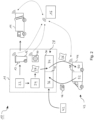
- FIG 2 an embodiment of the waste disposal system 10 according to the invention is shown.
- a single residential or commercial unit 11 is shown as well as two different ways in which the waste 22 generated there can be disposed of.
- the garbage 22 can be disposed of in a garbage collection container 12 assigned to the residential or commercial unit 11.
- a garbage collection vehicle 14 which moves along an optimal route 18 calculated by the program system 16.
- a locker arrangement 28 is provided with a locker 30, which has two storage areas 34 and 36 separated by a variable partition 32 for vacuum-packed garbage or garbage or recyclable material 26 packed in a box and delivered packages 46.
- the locker arrangement 28 can have its own locker 30 for each sub-unit.
- the locker arrangement 28 can also be located in the entrance area, preferably near the mailbox units, of the residential or commercial unit 11.
- the locker 30 is also equipped with a security system 38, which blocks and thus prevents unauthorized opening of the locker 30.
- a numeric keypad 40 is provided on the outside of the locker 30, into which a numeric code 42 can be entered. If the numerical code 42 is entered correctly, the security system 38 releases the locker 30 for opening or locks the locker 30 again when it is entered again.
- Vacuum-packed garbage 26 and delivered packages 46 can be stored independently and separately in the locker 30.
- a package 46 is delivered by a parcel delivery service 43
- the latter can place the delivered package 46 in the compartment 36 of the locker 30 provided for this purpose, for example when the residents or users of the residential or commercial unit 11 are absent.
- the Parcel delivery service 43 accesses the numerical code 42 of the security system 38, or the numerical code 42 is exchanged electronically or by other means between residents or users of the residential or commercial unit 11 and the parcel delivery service 43.
- the parcel service 43 can pick up the vacuum-packed garbage or garbage or recyclable material 26 packed in a box and store it in its parcel delivery vehicle 44.
- the parcel delivery vehicle 44 In order to store the collected vacuum-packed garbage or garbage or recyclable material 26 packed in a box separately from the packages 46 still to be delivered, the parcel delivery vehicle 44 has a variable partition 48 which can be adapted to the current space requirements of the packages 46 still to be delivered.
- the parcel delivery vehicle 44 At the start of the delivery tour, the parcel delivery vehicle 44 is completely or almost completely filled with packages 46, so that the storage area 52 intended for the packages must take up a correspondingly large amount of space.
- the various packages are gradually delivered to different recipients, so that the space 52 in the parcel delivery vehicle 44 taken up by the packages 46 still to be delivered gradually decreases.
- the variable partition 48 By adjusting the variable partition 48 accordingly, the space 50 intended for the storage of collected vacuum-packed garbage or garbage or recyclable material 26 packed in a box can also be gradually enlarged.
- the parcel delivery service vehicle 44 is almost completely filled with collected vacuum-packed garbage or garbage or recyclable material 26 packed in a box. This can then be handed over by the parcel delivery service 43, for example, to a disposal facility or a disposal service or a recycling facility or a recycling service.
- the parcel delivery service vehicles 44 communicate wirelessly with the program system 16 and transmit to them, for example, their current position and the current fill level of collected vacuum-packed waste or waste or recyclable material packed in a box 26.
- the program system 16 receives signals from the manual actuators 20, which can be designed as portable buttons, for example. For this purpose, it can be provided to use different portable buttons or a single portable button with different buttons for the emptying request for garbage collection containers 12 on the one hand and vacuum-packed garbage or garbage or recyclables 26 packed in a box on the other. In the case of a smartphone app and a corresponding smartphone as the manual actuator 20, the selection of the different collection requests is particularly easy to implement.
- the program system 16 transmits one or more signals wirelessly to one or more parcel delivery vehicles 44. It is also conceivable that only the location and time of the request together with the guaranteed time window for collection are transmitted to the parcel delivery vehicle 44 responsible for delivering to the corresponding residential or commercial unit 11, which then carries out a collection.
- the program system 16 transmits this or other information to another program system which is responsible for route planning of the various parcel delivery vehicles 44 and which then adapts the delivery routes of the parcel delivery vehicles 44 in such a way that the requested collection of the vacuum-packed garbage or the garbage or recyclable material 26 packed in a box is carried out within the definable time window.
- the program system 16 takes over the route planning of the parcel delivery vehicles 44 in addition to the route planning of the garbage collection vehicles 14 and thus coordinates the different collection and emptying requests.
- vacuum-packed garbage or garbage or recyclables packed in a box are not only delivered together with the delivery of Parcels 46 but are picked up independently by a parcel delivery service vehicle 44, even if no parcel 46 is currently being delivered.
Landscapes
- Engineering & Computer Science (AREA)
- Business, Economics & Management (AREA)
- Human Resources & Organizations (AREA)
- Economics (AREA)
- Mechanical Engineering (AREA)
- Strategic Management (AREA)
- General Physics & Mathematics (AREA)
- Physics & Mathematics (AREA)
- Marketing (AREA)
- Operations Research (AREA)
- Quality & Reliability (AREA)
- Theoretical Computer Science (AREA)
- Tourism & Hospitality (AREA)
- Entrepreneurship & Innovation (AREA)
- General Business, Economics & Management (AREA)
- Life Sciences & Earth Sciences (AREA)
- Sustainable Development (AREA)
- Development Economics (AREA)
- Game Theory and Decision Science (AREA)
- Refuse Collection And Transfer (AREA)
- Refuse-Collection Vehicles (AREA)
Claims (14)
- Système d'évacuation des déchets (10), comprenant :au moins un récipient de collecte de déchets (12) destiné à la réception de déchets, l'au moins un récipient de collecte de déchets (12) étant équipé d'au moins un capteur (13) destiné à la détection d'au moins un paramètre d'état du contenu du récipient de collecte de déchets et/ou du récipient de collecte de déchets (12),au moins un actionneur (20) manuel mobile ou fixe, qui est associé à au moins un récipient de collecte de déchets (12) et réalisé de manière portative ou fixe, au moins un véhicule de collecte de déchets (14) destiné à la réception du contenu de l'au moins un récipient de collecte de déchets (12) etune systématique de programme (16) destinée au calcul d'un itinéraire (18, 18') optimal, en particulier un itinéraire économiquement optimal ou le plus rapide, de l'au moins un véhicule de collecte de déchets (14) pour la collecte du contenu de l'au moins un récipient de collecte de déchets (12),la systématique de programme (16) communiquant sans fil avec l'au moins un récipient de collecte de déchets (12) ainsi que l'au moins un véhicule de collecte de déchets (14), etles données de l'au moins un capteur (13) de l'au moins un récipient de collecte de déchets (12) ainsi que, de préférence, également des données en temps réel relatives à la circulation, étant prises en compte lors du calcul de l'itinéraire (18, 18') optimal,caractérisé en ce quele système d'évacuation des déchets (10) comprend en outre au moins un dispositif de mise sous vide (24) destiné à l'emballage étanche au vide de déchets (22) et au moins un véhicule de service de livraison de colis (44) destiné à la réception de déchets (22) emballés de manière étanche au vide au moyen du dispositif de mise sous vide (24),la systématique de programme (16) est configurée pour transmettre sans fil un signal à l'au moins un véhicule de service de livraison de colis (44) ou à une seconde systématique de programme destinée à la planification d'itinéraire de l'au moins un véhicule de service de livraison de colis (44),au moins un actionneur (20) est configuré pour, lors de l'actionnement, transmettre sans fil un signal à la systématique de programme (16),moyennant quoi un vidage de l'au moins un récipient de collecte de déchets (12) associé pendant une fenêtre temporelle définissable est directement demandé,la systématique de programme est configurée pour, en réaction au signal, adapter l'itinéraire (18, 18') optimal et le transmettre à l'au moins un véhicule de collecte de déchets (14), de telle sorte que l'au moins un récipient de collecte de déchets (12) est desservi pendant la fenêtre temporelle définissable, un nouveau calcul de l'itinéraire (18, 18') optimal n'ayant pas lieu quand un vidage de l'au moins un récipient de collecte de déchets (12) associé est déjà planifié pendant la fenêtre temporelle définissable, etau moins un actionneur (20) est configuré pour, lors de l'actionnement, transmettre sans fil un signal à la systématique de programme (16),moyennant quoi un enlèvement de déchets (22) emballés de manière étanche au vide au moyen du dispositif de mise sous vide (24), pendant une fenêtre temporelle définissable, par un véhicule de service de livraison de colis (44), est demandé.
- Système d'évacuation des déchets (10) selon la revendication 1, caractérisé en ce que l'au moins un actionneur (20) manuel est réalisé sous la forme d'un appareil de communication mobile.
- Système d'évacuation des déchets (10) selon la revendication 1 ou 2, caractérisé en ce que le système d'évacuation des déchets (10) comprend en outre au moins un agencement de casiers (28) destinés à la réception et à la conservation sécurisées de déchets (26) ou matières recyclables mis sous vide ou emballés et/ou de colis livrés par un service de livraison de colis.
- Système d'évacuation des déchets (10) selon la revendication 3, caractérisé en ce que les casiers (30) de l'agencement de casiers (28) possèdent respectivement au moins une paroi de séparation (32) apte à être fixée de manière variable, destinée à l'établissement variable de zones (34, 36) séparées les unes des autres au sein des casiers (30).
- Système d'évacuation des déchets (10) selon l'une des revendications 3 ou 4, caractérisé en ce que l'agencement de casiers (28) possède un système de sécurité (38) qui bloque l'ouverture des différents casiers (30), une unité d'entrée (40), en particulier un pavé numérique, étant fixée sur le côté extérieur de chaque casier (30), ladite unité d'entrée débloquant l'ouverture du casier (30) correspondant lors de l'entrée correcte d'une clé de sécurité (42) définissable, en particulier une combinaison de chiffres, et les casiers (30) pouvant être verrouillés par l'entrée de la clé de sécurité (42) correspondante dans l'unité d'entrée (40) respective.
- Système d'évacuation des déchets (10) selon l'une des revendications 3 à 5, caractérisé en ce que l'agencement de casiers (28) est disposé à l'intérieur de la zone d'entrée de l'unité d'habitation ou commerciale (11) associée à l'au moins un récipient de collecte de déchets (12) respectif.
- Système d'évacuation des déchets (10) selon l'une des revendications précédentes, caractérisé en ce que la position, le niveau actuel de remplissage, le type de contenu, la contenance ou le moment probable d'atteinte du niveau de remplissage maximal du récipient de collecte de déchets (12) respectif peuvent être détectés au moyen de l'au moins un capteur (13) de l'au moins un récipient de collecte de déchets (12).
- Procédé d'évacuation des déchets (22) au moyen d'un système d'évacuation des déchets (10) selon la revendication 1, le procédé comportant les étapes suivantes :détection de l'au moins un paramètre d'état du contenu du récipient de collecte de déchets respectif et/ou du récipient de collecte de déchets (12) au moyen de l'au moins un capteur (13) de l'au moins un récipient de collecte de déchets (12),transmission sans fil des données de capteur à la systématique de programme (16),calcul d'un itinéraire (18, 18') optimal, en particulier un itinéraire le plus rapide, le plus court ou économiquement optimal, avec prise en compte par la systématique de programme (16) des données de capteur actuelles transmises ainsi que, de préférence, également de données en temps réel basées sur la circulation, ettransmission sans fil des données d'itinéraire mises à jour par la systématique de programme (16) à l'au moins un véhicule de collecte de déchets (14), caractérisé en ce quepar l'actionnement de l'au moins un actionneur (20) manuel, un vidage de l'au moins un récipient de collecte de déchets (12) associé pendant une fenêtre temporelle définissable est directement demandé, un signal étant transmis sans fil à la systématique de programme (16), à la suite de quoi l'itinéraire (18, 18') de l'au moins un véhicule de collecte de déchets (14) est adapté de telle manière qu'un vidage de l'au moins un récipient de collecte de déchets (12) associé à l'actionneur (20) est effectué pendant la fenêtre temporelle définissable, un nouveau calcul de l'itinéraire (18, 18') optimal n'ayant pas lieu quand un vidage de l'au moins un récipient de collecte de déchets (12) associé est déjà planifié pendant la fenêtre temporelle définissable,et en ce que des déchets (22) sont emballés de manière étanche au vide au moyen du dispositif de mise sous vide (24), un enlèvement des déchets (22) emballés sous vide pendant une fenêtre temporelle définissable par un véhicule de service de livraison de colis (44) étant demandé par l'actionnement de l'au moins un actionneur (20) manuel, un signal étant transmis sans fil à la systématique de programme (16) et la systématique de programme (16) transmettant, sans fil, un signal au véhicule de service de livraison de colis (44) ou à la seconde systématique de programme.
- Procédé selon la revendication 8, caractérisé en ce que les déchets emballés sous vide ou des matières formant déchets ou matières recyclables (26) emballées dans une caisse sont enlevés par un service de livraison de colis (43) et transférés à une installation d'évacuation des déchets ou un service d'évacuation des déchets, les colis (46) à livrer et les déchets sous vide enlevés ou les matières formant déchets ou matières recyclables (26) emballées dans une caisse étant stockés de manière particulièrement avantageuse dans des zones (50, 52) du véhicule de service de livraison de colis (44) séparées les unes des autres par au moins une paroi de séparation (48) apte à être fixée de manière variable.
- Procédé selon la revendication 9, caractérisé en ce qu'aussi bien des déchets sous vide ou des matières formant déchets ou matières recyclables (26) emballées dans une caisse que des colis (46) livrés par un service de livraison de colis (43) sont reçus et conservés de manière sécurisée au moyen d'un agencement de casiers (28) et peuvent ainsi être échangés à des moments arbitraires, les casiers (30) de l'agencement de casiers (28) possédant de préférence respectivement au moins une paroi de séparation (32) apte à être fixée de manière variable, destinée à l'établissement variable de zones (34, 36) séparées les unes des autres au sein des casiers (30).
- Procédé selon la revendication 10, caractérisé en ce que, pour déposer ou enlever des déchets (26) sous vide et/ou colis (46), une clé de sécurité (42) définissable, en particulier une combinaison de chiffres, doit être entrée dans une unité d'entrée (40), en particulier un pavé numérique, qui est fixée sur le côté extérieur des casiers (30) de l'agencement de casiers (28), la clé de sécurité (42) étant de préférence échangée entre l'utilisateur du casier (30) et le service de livraison de colis (43).
- Procédé selon l'une des revendications 9 à 11, caractérisé en ce que, par l'actionnement de l'au moins un actionneur (20) manuel, un enlèvement de déchets sous vide ou de matières formant déchets ou matières recyclables (26) emballées dans une caisse, de préférence pendant une fenêtre temporelle définissable, par un service de livraison de colis (43), est demandé.
- Procédé selon l'une des revendications 8 à 12, caractérisé en ce que l'au moins un véhicule de collecte de déchets (14) transmet, sans fil, à des intervalles définis, de préférence en temps réel, des données à la systématique de programme (16), l'itinéraire (18, 18') optimal étant adapté par la systématique de programme (16) en fonction des données et transmis sans fil en retour à l'au moins un véhicule de collecte de déchets (14).
- Procédé selon la revendication 13, caractérisé en ce que les données transmises par le véhicule de collecte de déchets (14) concernent la position actuelle du véhicule et/ou le niveau de remplissage actuel et/ou le niveau de carburant actuel.
Priority Applications (1)
| Application Number | Priority Date | Filing Date | Title |
|---|---|---|---|
| PCT/EP2018/062209 WO2018206766A1 (fr) | 2017-05-11 | 2018-05-11 | Système et procédé intelligents de traitement d'ordures |
Applications Claiming Priority (1)
| Application Number | Priority Date | Filing Date | Title |
|---|---|---|---|
| DE102017004557.7A DE102017004557A1 (de) | 2017-05-11 | 2017-05-11 | Intelligentes Müllentsorgungssystem und -verfahren |
Publications (3)
| Publication Number | Publication Date |
|---|---|
| EP3401236A1 EP3401236A1 (fr) | 2018-11-14 |
| EP3401236B1 true EP3401236B1 (fr) | 2024-08-14 |
| EP3401236C0 EP3401236C0 (fr) | 2024-08-14 |
Family
ID=62062822
Family Applications (1)
| Application Number | Title | Priority Date | Filing Date |
|---|---|---|---|
| EP18167657.8A Active EP3401236B1 (fr) | 2017-05-11 | 2018-04-17 | Système intelligent d'élimination des déchets et procédé |
Country Status (5)
| Country | Link |
|---|---|
| EP (1) | EP3401236B1 (fr) |
| DE (1) | DE102017004557A1 (fr) |
| ES (1) | ES2986326T3 (fr) |
| PL (1) | PL3401236T3 (fr) |
| WO (1) | WO2018206766A1 (fr) |
Families Citing this family (12)
| Publication number | Priority date | Publication date | Assignee | Title |
|---|---|---|---|---|
| US10594991B1 (en) | 2018-01-09 | 2020-03-17 | Wm Intellectual Property Holdings, Llc | System and method for managing service and non-service related activities associated with a waste collection, disposal and/or recycling vehicle |
| US11475416B1 (en) | 2019-08-23 | 2022-10-18 | Wm Intellectual Property Holdings Llc | System and method for auditing the fill status of a customer waste container by a waste services provider during performance of a waste service activity |
| US11961135B2 (en) | 2019-10-21 | 2024-04-16 | Ecube Labs Co., Ltd. | Bidding process and price calculation formula in method of requesting waste collection services |
| US11386362B1 (en) | 2020-12-16 | 2022-07-12 | Wm Intellectual Property Holdings, L.L.C. | System and method for optimizing waste / recycling collection and delivery routes for service vehicles |
| US11373536B1 (en) | 2021-03-09 | 2022-06-28 | Wm Intellectual Property Holdings, L.L.C. | System and method for customer and/or container discovery based on GPS drive path and parcel data analysis for a waste / recycling service vehicle |
| US12361432B1 (en) | 2021-03-09 | 2025-07-15 | Wm Intellectual Property Holdings, L.L.C. | System and method for customer and/or container discovery based on GPS drive path analysis for a waste / recycling service vehicle |
| CN113093731B (zh) * | 2021-03-12 | 2025-03-21 | 广东来个碗网络科技有限公司 | 智能回收箱的移动控制方法及装置 |
| US11488118B1 (en) | 2021-03-16 | 2022-11-01 | Wm Intellectual Property Holdings, L.L.C. | System and method for auditing overages and contamination for a customer waste container by a waste services provider during performance of a waste service activity |
| US12332073B1 (en) | 2021-11-02 | 2025-06-17 | Wm Intellectual Property Holdings, L.L.C. | System and method for efficient customer and container on-property service based on collection of off-street data for a waste / recycling service vehicle |
| US11977381B1 (en) | 2022-04-01 | 2024-05-07 | Wm Intellectual Property Holdings, L.L.C. | System and method for autonomous waste collection by a waste services provider during performance of a waste service activity |
| AT526096B1 (de) * | 2022-04-20 | 2023-12-15 | Saubermacher Dienstleistungs Ag | Verfahren zum Steuern von Entleerungsfahrzeugen zum Entleeren von Wertstoffbehältern |
| CN115258465A (zh) * | 2022-06-24 | 2022-11-01 | 光大环境科技(中国)有限公司 | 一种垃圾收运管理方法和系统 |
Citations (3)
| Publication number | Priority date | Publication date | Assignee | Title |
|---|---|---|---|---|
| GB2433871A (en) * | 2006-01-05 | 2007-07-11 | Simon Levesley | Compacting waste material in a bag or other receptacle by vacuum |
| GB2452587A (en) * | 2007-08-22 | 2009-03-11 | Robert Frederick Dytham | A household waste vacuum compactor |
| US20120141247A1 (en) * | 2006-03-22 | 2012-06-07 | Laundry Locker, Inc. | Storage Locker |
Family Cites Families (11)
| Publication number | Priority date | Publication date | Assignee | Title |
|---|---|---|---|---|
| DE19730684A1 (de) * | 1997-07-17 | 1999-01-28 | Tils Peter | Verfahren zum Verpacken von zu entsorgendem Gut wie beispielsweise Hausmüll oder Speiseresten |
| FI20095369A0 (fi) * | 2009-04-03 | 2009-04-03 | Maricap Oy | Menetelmä ja väline jätteenkäsittelyssä |
| US9352887B2 (en) * | 2010-07-28 | 2016-05-31 | Big Belly Solar, Inc. | Electrically-powered programmable waste enclosure |
| GB2508209A (en) | 2012-11-25 | 2014-05-28 | Enevo Oy | Waste collection management system |
| WO2014099190A1 (fr) * | 2012-12-19 | 2014-06-26 | Big Belly Solar, Inc. | Commander des compacteurs et réceptacles d'ordures à alimentation électrique |
| US20140278630A1 (en) * | 2013-03-15 | 2014-09-18 | Compology, Inc. | System and method for waste material managment |
| WO2015137997A1 (fr) | 2013-03-15 | 2015-09-17 | Compology, Inc. | Système et procédé de gestion d'inventaire |
| TR201315018A2 (tr) | 2013-12-20 | 2014-03-21 | Ffps Bilgi Teknolojileri Danismanlik Dis Ticaret Ve Egitim Hizmetleri San Ve Tic Ltd Sti | Atık ölçüm ve izleme sistemi. |
| US10152737B2 (en) * | 2014-04-25 | 2018-12-11 | Vivint, Inc. | Automated waste management |
| US10099854B2 (en) * | 2014-09-11 | 2018-10-16 | Poubelle Llc | Trashcan system and related methods of use |
| US20160260142A1 (en) * | 2015-03-06 | 2016-09-08 | Wal-Mart Stores, Inc. | Shopping facility assistance systems, devices and methods to support requesting in-person assistance |
-
2017
- 2017-05-11 DE DE102017004557.7A patent/DE102017004557A1/de not_active Ceased
-
2018
- 2018-04-17 ES ES18167657T patent/ES2986326T3/es active Active
- 2018-04-17 PL PL18167657.8T patent/PL3401236T3/pl unknown
- 2018-04-17 EP EP18167657.8A patent/EP3401236B1/fr active Active
- 2018-05-11 WO PCT/EP2018/062209 patent/WO2018206766A1/fr not_active Ceased
Patent Citations (3)
| Publication number | Priority date | Publication date | Assignee | Title |
|---|---|---|---|---|
| GB2433871A (en) * | 2006-01-05 | 2007-07-11 | Simon Levesley | Compacting waste material in a bag or other receptacle by vacuum |
| US20120141247A1 (en) * | 2006-03-22 | 2012-06-07 | Laundry Locker, Inc. | Storage Locker |
| GB2452587A (en) * | 2007-08-22 | 2009-03-11 | Robert Frederick Dytham | A household waste vacuum compactor |
Also Published As
| Publication number | Publication date |
|---|---|
| WO2018206766A1 (fr) | 2018-11-15 |
| EP3401236A1 (fr) | 2018-11-14 |
| PL3401236T3 (pl) | 2024-11-04 |
| DE102017004557A1 (de) | 2018-11-15 |
| EP3401236C0 (fr) | 2024-08-14 |
| ES2986326T3 (es) | 2024-11-11 |
Similar Documents
| Publication | Publication Date | Title |
|---|---|---|
| EP3401236B1 (fr) | Système intelligent d'élimination des déchets et procédé | |
| EP2944512B1 (fr) | Procédé de livraison et/ou de ramassage d'au moins un envoi | |
| EP1497618B1 (fr) | Procede et systeme de guidage dynamique d'un vehicule | |
| DE4445582C1 (de) | Verfahren und Einrichtung zur Ausgabe von Verkehrsstörungsmeldungen in einem Fahrzeug | |
| EP1921586A1 (fr) | Procédé et agencement de dispositifs destinés à l'utilisation d'une installation électronique de paquets | |
| DE102021134631A1 (de) | Systeme und verfahren zur abfallsammlungsverwaltung | |
| CN101169843A (zh) | 基于地理信息的垃圾收运方法 | |
| WO2012052495A1 (fr) | Procédé et dispositif de planification des tournées | |
| US6563433B2 (en) | Liquefied raw garbage collection method and system | |
| DE112013005752B4 (de) | Verfahren und Vorrichtung zum Hochladen von Daten | |
| EP2056263A1 (fr) | Ensemble des compartements; procédé de transfert de données sur des ensembles de compartement | |
| DE19638749A1 (de) | Verfahren und Einrichtung zur Erfassung von Sammelmengen, insbesondere von Abfall aus Haushalten | |
| EP2862485A1 (fr) | Dispositif de dépôt et/ou de retrait de marchandises | |
| EP1708144A2 (fr) | Dispositif et procédé destinés à l'échange de données de péage dans des systèmes d'identification par radiofréquence | |
| DE102020103786B4 (de) | Verfahren und System für ein automatisiertes Abfallmanagement | |
| DE4341899A1 (de) | Müllerfassungsstation für aufwandsgerechte Erfassung der vom Verursacher angelieferten Müllmengen | |
| EP1714914B1 (fr) | Dispositif de collecte d'ordures | |
| DE102019220332B4 (de) | Verfahren und System zum Bereitstellen eines Fahrzeugs in einem Abholbereich | |
| EP3456661B1 (fr) | Récipient de déchets avcec système de capteur | |
| DE29613111U1 (de) | Einrichtung zur Erfassung von Sammelmengen, insbesondere von Abfall aus Haushalten | |
| WO2020016151A1 (fr) | Procédé pour effectuer un achat | |
| DE19546521A1 (de) | Bereitstellungseinrichtung für Schubgepäckwagen | |
| RU2230015C1 (ru) | Система обращения с твердыми отходами потребления | |
| DE102020113792A1 (de) | Verfahren und Transportsystem zum Entsorgen von Abfall | |
| CN108820634A (zh) | 一种封闭式垃圾收集处理的方法、装置及系统 |
Legal Events
| Date | Code | Title | Description |
|---|---|---|---|
| PUAI | Public reference made under article 153(3) epc to a published international application that has entered the european phase |
Free format text: ORIGINAL CODE: 0009012 |
|
| STAA | Information on the status of an ep patent application or granted ep patent |
Free format text: STATUS: THE APPLICATION HAS BEEN PUBLISHED |
|
| AK | Designated contracting states |
Kind code of ref document: A1 Designated state(s): AL AT BE BG CH CY CZ DE DK EE ES FI FR GB GR HR HU IE IS IT LI LT LU LV MC MK MT NL NO PL PT RO RS SE SI SK SM TR |
|
| AX | Request for extension of the european patent |
Extension state: BA ME |
|
| STAA | Information on the status of an ep patent application or granted ep patent |
Free format text: STATUS: REQUEST FOR EXAMINATION WAS MADE |
|
| 17P | Request for examination filed |
Effective date: 20190513 |
|
| STAA | Information on the status of an ep patent application or granted ep patent |
Free format text: STATUS: EXAMINATION IS IN PROGRESS |
|
| 17Q | First examination report despatched |
Effective date: 20200122 |
|
| APBK | Appeal reference recorded |
Free format text: ORIGINAL CODE: EPIDOSNREFNE |
|
| APBN | Date of receipt of notice of appeal recorded |
Free format text: ORIGINAL CODE: EPIDOSNNOA2E |
|
| APBR | Date of receipt of statement of grounds of appeal recorded |
Free format text: ORIGINAL CODE: EPIDOSNNOA3E |
|
| APAF | Appeal reference modified |
Free format text: ORIGINAL CODE: EPIDOSCREFNE |
|
| APBT | Appeal procedure closed |
Free format text: ORIGINAL CODE: EPIDOSNNOA9E |
|
| P01 | Opt-out of the competence of the unified patent court (upc) registered |
Effective date: 20230602 |
|
| GRAP | Despatch of communication of intention to grant a patent |
Free format text: ORIGINAL CODE: EPIDOSNIGR1 |
|
| STAA | Information on the status of an ep patent application or granted ep patent |
Free format text: STATUS: GRANT OF PATENT IS INTENDED |
|
| INTG | Intention to grant announced |
Effective date: 20240506 |
|
| GRAS | Grant fee paid |
Free format text: ORIGINAL CODE: EPIDOSNIGR3 |
|
| GRAA | (expected) grant |
Free format text: ORIGINAL CODE: 0009210 |
|
| STAA | Information on the status of an ep patent application or granted ep patent |
Free format text: STATUS: THE PATENT HAS BEEN GRANTED |
|
| AK | Designated contracting states |
Kind code of ref document: B1 Designated state(s): AL AT BE BG CH CY CZ DE DK EE ES FI FR GB GR HR HU IE IS IT LI LT LU LV MC MK MT NL NO PL PT RO RS SE SI SK SM TR |
|
| REG | Reference to a national code |
Ref country code: GB Ref legal event code: FG4D Free format text: NOT ENGLISH |
|
| REG | Reference to a national code |
Ref country code: CH Ref legal event code: EP |
|
| REG | Reference to a national code |
Ref country code: DE Ref legal event code: R096 Ref document number: 502018015005 Country of ref document: DE |
|
| REG | Reference to a national code |
Ref country code: IE Ref legal event code: FG4D Free format text: LANGUAGE OF EP DOCUMENT: GERMAN |
|
| U01 | Request for unitary effect filed |
Effective date: 20240830 |
|
| P04 | Withdrawal of opt-out of the competence of the unified patent court (upc) registered |
Free format text: CASE NUMBER: APP_51060/2024 Effective date: 20240909 |
|
| U07 | Unitary effect registered |
Designated state(s): AT BE BG DE DK EE FI FR IT LT LU LV MT NL PT RO SE SI Effective date: 20240911 |
|
| REG | Reference to a national code |
Ref country code: ES Ref legal event code: FG2A Ref document number: 2986326 Country of ref document: ES Kind code of ref document: T3 Effective date: 20241111 |
|
| P05 | Withdrawal of opt-out of the competence of the unified patent court (upc) changed |
Free format text: CASE NUMBER: APP_51060/2024 Effective date: 20240911 |
|
| PG25 | Lapsed in a contracting state [announced via postgrant information from national office to epo] |
Ref country code: NO Free format text: LAPSE BECAUSE OF FAILURE TO SUBMIT A TRANSLATION OF THE DESCRIPTION OR TO PAY THE FEE WITHIN THE PRESCRIBED TIME-LIMIT Effective date: 20241114 |
|
| PG25 | Lapsed in a contracting state [announced via postgrant information from national office to epo] |
Ref country code: GR Free format text: LAPSE BECAUSE OF FAILURE TO SUBMIT A TRANSLATION OF THE DESCRIPTION OR TO PAY THE FEE WITHIN THE PRESCRIBED TIME-LIMIT Effective date: 20241115 |
|
| PG25 | Lapsed in a contracting state [announced via postgrant information from national office to epo] |
Ref country code: IS Free format text: LAPSE BECAUSE OF FAILURE TO SUBMIT A TRANSLATION OF THE DESCRIPTION OR TO PAY THE FEE WITHIN THE PRESCRIBED TIME-LIMIT Effective date: 20241214 |
|
| PG25 | Lapsed in a contracting state [announced via postgrant information from national office to epo] |
Ref country code: HR Free format text: LAPSE BECAUSE OF FAILURE TO SUBMIT A TRANSLATION OF THE DESCRIPTION OR TO PAY THE FEE WITHIN THE PRESCRIBED TIME-LIMIT Effective date: 20240814 |
|
| PG25 | Lapsed in a contracting state [announced via postgrant information from national office to epo] |
Ref country code: RS Free format text: LAPSE BECAUSE OF FAILURE TO SUBMIT A TRANSLATION OF THE DESCRIPTION OR TO PAY THE FEE WITHIN THE PRESCRIBED TIME-LIMIT Effective date: 20241114 |
|
| PG25 | Lapsed in a contracting state [announced via postgrant information from national office to epo] |
Ref country code: RS Free format text: LAPSE BECAUSE OF FAILURE TO SUBMIT A TRANSLATION OF THE DESCRIPTION OR TO PAY THE FEE WITHIN THE PRESCRIBED TIME-LIMIT Effective date: 20241114 Ref country code: NO Free format text: LAPSE BECAUSE OF FAILURE TO SUBMIT A TRANSLATION OF THE DESCRIPTION OR TO PAY THE FEE WITHIN THE PRESCRIBED TIME-LIMIT Effective date: 20241114 Ref country code: IS Free format text: LAPSE BECAUSE OF FAILURE TO SUBMIT A TRANSLATION OF THE DESCRIPTION OR TO PAY THE FEE WITHIN THE PRESCRIBED TIME-LIMIT Effective date: 20241214 Ref country code: HR Free format text: LAPSE BECAUSE OF FAILURE TO SUBMIT A TRANSLATION OF THE DESCRIPTION OR TO PAY THE FEE WITHIN THE PRESCRIBED TIME-LIMIT Effective date: 20240814 Ref country code: GR Free format text: LAPSE BECAUSE OF FAILURE TO SUBMIT A TRANSLATION OF THE DESCRIPTION OR TO PAY THE FEE WITHIN THE PRESCRIBED TIME-LIMIT Effective date: 20241115 |
|
| PG25 | Lapsed in a contracting state [announced via postgrant information from national office to epo] |
Ref country code: SM Free format text: LAPSE BECAUSE OF FAILURE TO SUBMIT A TRANSLATION OF THE DESCRIPTION OR TO PAY THE FEE WITHIN THE PRESCRIBED TIME-LIMIT Effective date: 20240814 |
|
| PG25 | Lapsed in a contracting state [announced via postgrant information from national office to epo] |
Ref country code: CZ Free format text: LAPSE BECAUSE OF FAILURE TO SUBMIT A TRANSLATION OF THE DESCRIPTION OR TO PAY THE FEE WITHIN THE PRESCRIBED TIME-LIMIT Effective date: 20240814 |
|
| PG25 | Lapsed in a contracting state [announced via postgrant information from national office to epo] |
Ref country code: SK Free format text: LAPSE BECAUSE OF FAILURE TO SUBMIT A TRANSLATION OF THE DESCRIPTION OR TO PAY THE FEE WITHIN THE PRESCRIBED TIME-LIMIT Effective date: 20240814 |
|
| U20 | Renewal fee for the european patent with unitary effect paid |
Year of fee payment: 8 Effective date: 20250424 |
|
| PLBE | No opposition filed within time limit |
Free format text: ORIGINAL CODE: 0009261 |
|
| STAA | Information on the status of an ep patent application or granted ep patent |
Free format text: STATUS: NO OPPOSITION FILED WITHIN TIME LIMIT |
|
| PGFP | Annual fee paid to national office [announced via postgrant information from national office to epo] |
Ref country code: PL Payment date: 20250407 Year of fee payment: 8 |
|
| PGFP | Annual fee paid to national office [announced via postgrant information from national office to epo] |
Ref country code: ES Payment date: 20250519 Year of fee payment: 8 |
|
| 26N | No opposition filed |
Effective date: 20250515 |
|
| PGFP | Annual fee paid to national office [announced via postgrant information from national office to epo] |
Ref country code: CH Payment date: 20250501 Year of fee payment: 8 |
|
| PG25 | Lapsed in a contracting state [announced via postgrant information from national office to epo] |
Ref country code: MC Free format text: LAPSE BECAUSE OF FAILURE TO SUBMIT A TRANSLATION OF THE DESCRIPTION OR TO PAY THE FEE WITHIN THE PRESCRIBED TIME-LIMIT Effective date: 20240814 |
|
| PGFP | Annual fee paid to national office [announced via postgrant information from national office to epo] |
Ref country code: GB Payment date: 20260324 Year of fee payment: 9 |
|
| PG25 | Lapsed in a contracting state [announced via postgrant information from national office to epo] |
Ref country code: IE Free format text: LAPSE BECAUSE OF NON-PAYMENT OF DUE FEES Effective date: 20250417 |