EP3401849A1 - Détermination de la maturité de produit d'un système technique - Google Patents
Détermination de la maturité de produit d'un système technique Download PDFInfo
- Publication number
- EP3401849A1 EP3401849A1 EP17170127.9A EP17170127A EP3401849A1 EP 3401849 A1 EP3401849 A1 EP 3401849A1 EP 17170127 A EP17170127 A EP 17170127A EP 3401849 A1 EP3401849 A1 EP 3401849A1
- Authority
- EP
- European Patent Office
- Prior art keywords
- test
- tests
- sut
- result
- successful
- Prior art date
- Legal status (The legal status is an assumption and is not a legal conclusion. Google has not performed a legal analysis and makes no representation as to the accuracy of the status listed.)
- Ceased
Links
Images



Classifications
-
- G—PHYSICS
- G06—COMPUTING OR CALCULATING; COUNTING
- G06Q—INFORMATION AND COMMUNICATION TECHNOLOGY [ICT] SPECIALLY ADAPTED FOR ADMINISTRATIVE, COMMERCIAL, FINANCIAL, MANAGERIAL OR SUPERVISORY PURPOSES; SYSTEMS OR METHODS SPECIALLY ADAPTED FOR ADMINISTRATIVE, COMMERCIAL, FINANCIAL, MANAGERIAL OR SUPERVISORY PURPOSES, NOT OTHERWISE PROVIDED FOR
- G06Q10/00—Administration; Management
-
- G—PHYSICS
- G06—COMPUTING OR CALCULATING; COUNTING
- G06Q—INFORMATION AND COMMUNICATION TECHNOLOGY [ICT] SPECIALLY ADAPTED FOR ADMINISTRATIVE, COMMERCIAL, FINANCIAL, MANAGERIAL OR SUPERVISORY PURPOSES; SYSTEMS OR METHODS SPECIALLY ADAPTED FOR ADMINISTRATIVE, COMMERCIAL, FINANCIAL, MANAGERIAL OR SUPERVISORY PURPOSES, NOT OTHERWISE PROVIDED FOR
- G06Q10/00—Administration; Management
- G06Q10/06—Resources, workflows, human or project management; Enterprise or organisation planning; Enterprise or organisation modelling
- G06Q10/063—Operations research, analysis or management
- G06Q10/0639—Performance analysis of employees; Performance analysis of enterprise or organisation operations
- G06Q10/06395—Quality analysis or management
-
- G—PHYSICS
- G06—COMPUTING OR CALCULATING; COUNTING
- G06N—COMPUTING ARRANGEMENTS BASED ON SPECIFIC COMPUTATIONAL MODELS
- G06N7/00—Computing arrangements based on specific mathematical models
- G06N7/01—Probabilistic graphical models, e.g. probabilistic networks
Definitions
- the invention relates to a method and a test system for product maturity determination of a technical system according to the preamble of patent claim 1.
- Test coverage is generally understood to mean the ratio of tests performed to the total number of tests that can be performed on the technical system, or the ratio of successful tests to the total number of tests that can be performed on the technical system.
- European patent application EP3082000A1 the product maturity is determined by means of test coverage and suggestions for improving the test coverage are made.
- the object of the invention is to provide a device which further develops the prior art.
- a method for determining a product maturity by means of tests comprises executing a test case by means of a test environment applied to a test object, and there is no result for at least one test, and the method comprises the steps of setting rules for calculating a probability that a test for which there is no result will be successful or unsuccessful, the rules using input or expected results of tests as inputs, and returning probabilities as output variables, calculating the Probability that a test for which there is no result will be successful, by means of at least part of the predetermined rules, as well as representing the product maturity depending on the probabilities calculated in the previous step.
- An advantage of the method according to the invention is that the product maturity of a technical system is evaluated not only on the basis of already performed tests, but also tests that have not yet been carried out are taken into account in the evaluation. In the event that not all tests are carried out, this results in a more complete picture of the product's maturity; otherwise, one obtains a more informative statement on product maturity at an earlier point in time, since the tests still in the future are included in the evaluation. Furthermore, based on this forward-looking consideration, an improved selection of the tests still to be performed and their order can be made. Furthermore, it is advantageous that by means of the method easier easily accessible but meaningful representations of the product maturity can be found and displayed. Product maturity statements may simply be made in accordance with the present criteria, e.g. the present test cases, test environments or test objects are summarized or grouped.
- test case or a test environment or a test object in a first and a second version, wherein the second version represents a state of development of the test case or the test environment or the test object, the time of development of the first version of the test case or the test environment or the test object.
- a part of the present and expected results of the test is not taken into account in calculating the probability that a test will be successful or unsuccessful, the part not considering the results of one or more versions of at least one test case, at least one Test environment and / or at least one test object, wherein the at least one test case, the at least one test environment and / or the at least one test object is included in the test.
- the predetermined rules represent a technical or statistical relationship between a first test case, a first test environment or a first test object in the first or second version and a second test case, a second test environment or a second test object in the first or second version.
- the result of a test may take at least the values "Test Success” (passed) and "Test Failed”.
- the predetermined rules are automatically created and / or verified by analyzing a database of at least a portion of the tests, including test cases, test environments, test objects, and results.
- the analysis comprises a static evaluation of relationships of tests, in particular relationships of tests with positive results.
- a first group of tests is determined by means of a statistical distribution, wherein results are present or generated for the first group of tests.
- the determination of the tests of the first group of tests is based on one or more further static distributions of the test cases, the test environments and / or the test objects.
- the static distribution and / or one or more of the further static distributions are random distributions.
- the calculation of the probability that a test for which there is no result will be successful depends on the static distribution of the tests, the test cases, the test environments and / or the test objects.
- the presentation of the product maturity takes place in the form of a numerical, in particular percentage, test coverage or in the form of a, in particular color-coded graphic.
- one or more criteria are specified and some of the tests for which in the second method step a probability that the test will be successful or unsuccessful have been calculated will be executed or suggested for execution, with the ones to be executed or executed proposed tests meet at least one of the given criteria.
- At least one of the predetermined criteria is above or below a threshold for the probability that the test will be successful or unsuccessful.
- a weighting is assigned to a test case (TC), a test environment (TE), a test object (SUT) or a combination of at least two elements from test case (TC), test environment (TE) and test object (SUT) and the weighting is taken into account in calculating the likelihood that a test for which no result will be successful or unsuccessful in the second step and / or in the presentation of the product maturity in the last step.
- test system for testing a technical system, wherein the test system carries out one of the methods described above.
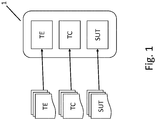
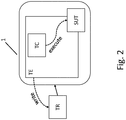
- a test (1) comprises at least one test environment (TE) from a possible plurality of test environments (TE), one test case (TC) from a possible plurality of test cases (TC) and a system under test (SUT) from a possible plurality of test objects (SUT).
- TE test environment
- TC test case
- SUT system under test
- the aim of the maturity determination of a technical system is to evaluate product characteristics such as performance, reliability or user-friendliness. From this it follows whether a next stage, a so-called milestone, has been reached in the development of the technical system. The final milestone in most cases is the release of the product for sale or delivery of the product.
- product maturity plays a major role, above all in terms of reliability and safety, is the automotive sector and, in this connection, the development of electronic control units (ECUs).
- the test objects (SUT) can therefore be control devices, the software to be executed on the control devices or part of this software.
- the selection of test cases (TC) depends, among other things, on the functionality to be tested and the goals to be achieved for security and reliability.
- test cases can be developed and executed on the HIL test environments (usually special real-time computers).
- An example of such a test tool is the software product AutomationDesk from dSPACE.
- simulation environments so-called offline simulators, are also used, some of which can be run on commercially available PCs.
- TE test environments
- HIL HIL
- offline simulator several similar or different can be used for testing.
- TE test environments
- test environment TE
- test object SUT
- TR result of a test (1)
- data are collected which represent, at least partially, a result (TR) of the test (1) or from which a result (TR) of the test (1) can be derived.
- TR result of the test (1)
- TC test case
- TE Test environment
- SUT test object
- results (TR) are assigned to the test (1) in order to be able to understand the conditions of the corresponding test execution in the later evaluation of the test results (TR).
- Typical results (TR) of tests (1) are "passed” and "failed". Since the use of the English terms “fitting” and “failed” in the field of testing and test administration are generally more common, they are also used in the following.
- the test object (SUT) is typically a prototype of this control device which is connected to an HIL simulator.
- the HIL simulator and the executable test software then represent a test environment (TE).
- the exact configuration of the HIL simulator is relevant for the traceability and reproducibility of the tests (1) and is defined as a test environment (TE). Changes to the hardware or software of the HIL simulator result in a new test environment (TE).
- the results (TR) of the test (1) are stored and traced for the purpose of traceability with the test (1 ) connected.
- This data is preferably stored in a database and managed by a test management tool with connection to the database.
- An example of such a test management tool is the SYNECT software from dSPACE.
- test cases (TC) and test objects (SUT) in a data storage (3) are shown.
- the data storage can be a file system, a database or another, known from the prior art, electronic data storage. It is also possible that in the data storage only representatives of the actual test cases (TC) or test objects (SUT) or References to the actual test cases (TC) or test objects (SUT) are stored. This is useful or even necessary if the test objects are not electronically available data but physically present objects (eg electronic devices). From the stored test cases (TC) and test objects (SUT) different tests (1) can then be generated by distribution to one or more test environments (TE).
- TE test environments
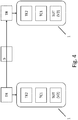
- the expected result of the test comprising version 2 (V2) of the test object (SUT) is calculated by means of a rule (5) from the present test result (TR) of test (1) comprising version 1 (V1) of the test object (SUT) and the expected result of the test comprising version 3 (V3) of the test object (SUT) is calculated by means of a rule (5) from the expected test result (TR) of test (1) comprising version 2 (V2) of the test object (SUT). It will in the second calculation takes into account the probability of the expected test result (TR) from the previous calculation. An example of this is given if in the previous example too FIG.
- the result (TR) of the test (1) comprising the test object (SUT) in version 2 (V2) is not present, but analogously from a present test result (TR) of a test (1) comprising the test object (SUT) in Version 1 (V1), calculated with a probability of 99%.
- the calculation of the test result (TR) for test (1) comprising the test object (SUT) in version 3 (V3) by means of the same rule (5) also results in the test result (TR) for the test (1) comprising the Test object (SUT) in version 3 (V3) 99% equal to the test result (TR) for test (1), comprising the test object (SUT) in version 2 (V2).
- V1, V2, V3 other variations of the test cases (TC), test environments (TE) or test objects (SUT), such as variants or different elements of a related group, are also possible.
- FIG. 7 In the picture of the FIG. 7 is tabular and analogous to the tables in FIG. 5 the product maturity of version 3 of the test object (SUT) is shown.
- the individual fields of the table contain, according to the method of the invention, calculated expected results of the illustrated test (1), as well as the correspondingly calculated associated probabilities. It is readily apparent that the means of the invention and in FIG. 7
- the presentation shown in Figure 3 gives a much better, more complete overview of the product maturity of the test object (SUT) in version 3 than the comparable representation in the lower third of the FIG. 6 .
- the fields of the table can also be displayed in color or in addition to the textual contents. Typically, green is used for tests (1) with the result passed and red for tests (1) with the result failed. To represent the probabilities it is additionally possible to vary the hue or the color intensity of the green and red fields.
- test objects SUT
- the test environments TE1, TE2, TE3
- the test cases could be HIL simulators with different software configurations representing different types of vehicles.
- the test cases TC1, TC2, TC3) could be, for example, the prevention of window closing (TC1), the emergency opening of the window in an accident (TC2), and the automatic closing of the window when the car is locked.
- the inventively resulting product maturity, as in FIG. 7 can now be used for various conclusions, depending on the scale of evaluation and the status of the development.
- the lack of positive test results for the test case TC3 can lead to it being executed again or possibly after any improvement in the corresponding functionality. It could also be decided that the current milestone in development (eg safety-related tests with over 90% probability passed) has been achieved and the next stage of development is being addressed.
- FIG. 8 schematically shows an automatic derivation of the rules (5), represented by the solid arrow, from a, stored in a data storage (3), data, comprising tests (1) and test results (TR) shown.
- data comprising tests (1) and test results (TR) shown.
- test results (TR) are assigned to tests (1).
- the automatic derivation can, for example, create one or more rules (5) from a frequently existing correlation.
- test (1) comprising a specific combination of test case (TC) and test object (SUT) is associated with a result (TR) percentage more frequently than a predefined threshold and from this the rule (5) is derived it will be that other tests (1) comprising the same combination of test case (TC) and test object (SUT) with a probability equal to the threshold will have the same result (TR) as the previously determined tests (1).
Landscapes
- Business, Economics & Management (AREA)
- Engineering & Computer Science (AREA)
- Human Resources & Organizations (AREA)
- Physics & Mathematics (AREA)
- General Physics & Mathematics (AREA)
- Theoretical Computer Science (AREA)
- Strategic Management (AREA)
- Entrepreneurship & Innovation (AREA)
- Economics (AREA)
- Development Economics (AREA)
- Educational Administration (AREA)
- Marketing (AREA)
- Operations Research (AREA)
- Quality & Reliability (AREA)
- Tourism & Hospitality (AREA)
- General Business, Economics & Management (AREA)
- Game Theory and Decision Science (AREA)
- Probability & Statistics with Applications (AREA)
- Algebra (AREA)
- Artificial Intelligence (AREA)
- Computational Mathematics (AREA)
- Data Mining & Analysis (AREA)
- Evolutionary Computation (AREA)
- Mathematical Analysis (AREA)
- Mathematical Optimization (AREA)
- Pure & Applied Mathematics (AREA)
- Computing Systems (AREA)
- General Engineering & Computer Science (AREA)
- Mathematical Physics (AREA)
- Software Systems (AREA)
- Debugging And Monitoring (AREA)
- Stored Programmes (AREA)
Priority Applications (5)
| Application Number | Priority Date | Filing Date | Title |
|---|---|---|---|
| EP17170127.9A EP3401849A1 (fr) | 2017-05-09 | 2017-05-09 | Détermination de la maturité de produit d'un système technique |
| CN201880030479.XA CN110603546A (zh) | 2017-05-09 | 2018-05-08 | 技术系统以及尤其是自主驾驶车辆的产品成熟度确定 |
| EP18720650.3A EP3622451A1 (fr) | 2017-05-09 | 2018-05-08 | Détermination de la maturité d'un système technique et en particulier d'un véhicule circulant de manière autonome |
| PCT/EP2018/061759 WO2018206522A1 (fr) | 2017-05-09 | 2018-05-08 | Détermination de la maturité d'un système technique et en particulier d'un véhicule circulant de manière autonome |
| US16/678,459 US20200074375A1 (en) | 2017-05-09 | 2019-11-08 | Product maturity determination in a technical system and in particular in an autonomously driving vehicle |
Applications Claiming Priority (1)
| Application Number | Priority Date | Filing Date | Title |
|---|---|---|---|
| EP17170127.9A EP3401849A1 (fr) | 2017-05-09 | 2017-05-09 | Détermination de la maturité de produit d'un système technique |
Publications (1)
| Publication Number | Publication Date |
|---|---|
| EP3401849A1 true EP3401849A1 (fr) | 2018-11-14 |
Family
ID=58709788
Family Applications (2)
| Application Number | Title | Priority Date | Filing Date |
|---|---|---|---|
| EP17170127.9A Ceased EP3401849A1 (fr) | 2017-05-09 | 2017-05-09 | Détermination de la maturité de produit d'un système technique |
| EP18720650.3A Pending EP3622451A1 (fr) | 2017-05-09 | 2018-05-08 | Détermination de la maturité d'un système technique et en particulier d'un véhicule circulant de manière autonome |
Family Applications After (1)
| Application Number | Title | Priority Date | Filing Date |
|---|---|---|---|
| EP18720650.3A Pending EP3622451A1 (fr) | 2017-05-09 | 2018-05-08 | Détermination de la maturité d'un système technique et en particulier d'un véhicule circulant de manière autonome |
Country Status (4)
| Country | Link |
|---|---|
| US (1) | US20200074375A1 (fr) |
| EP (2) | EP3401849A1 (fr) |
| CN (1) | CN110603546A (fr) |
| WO (1) | WO2018206522A1 (fr) |
Cited By (1)
| Publication number | Priority date | Publication date | Assignee | Title |
|---|---|---|---|---|
| CN111782499A (zh) * | 2019-04-03 | 2020-10-16 | 北京车和家信息技术有限公司 | 测试用例生成方法及系统 |
Families Citing this family (2)
| Publication number | Priority date | Publication date | Assignee | Title |
|---|---|---|---|---|
| EP4390699A1 (fr) * | 2022-12-20 | 2024-06-26 | dSPACE GmbH | Procédé mis en uvre par ordinateur pour déterminer des éléments de système compatibles et système |
| DE102022134027A1 (de) * | 2022-12-20 | 2024-06-20 | Dspace Gmbh | Computer-implementiertes Verfahren zum Bestimmen Algorithmusversions-kompatibler Test- und/oder Simulationsdaten und entsprechendes System |
Citations (3)
| Publication number | Priority date | Publication date | Assignee | Title |
|---|---|---|---|---|
| DE102013006011A1 (de) * | 2013-04-09 | 2014-10-09 | Airbus Defence and Space GmbH | Modulare Testumgebung für eine Mehrzahl von Testobjekten |
| DE102013006012A1 (de) * | 2013-04-09 | 2014-10-09 | Airbus Defence and Space GmbH | Mehrbenutzerfähige Testumgebung für eine Mehrzahl von Testobjekten |
| EP3082000A1 (fr) | 2015-04-15 | 2016-10-19 | dSPACE digital signal processing and control engineering GmbH | Procédé et système de test d'un système mécatronique |
Family Cites Families (19)
| Publication number | Priority date | Publication date | Assignee | Title |
|---|---|---|---|---|
| US6167545A (en) * | 1998-03-19 | 2000-12-26 | Xilinx, Inc. | Self-adaptive test program |
| US7272752B2 (en) * | 2001-09-05 | 2007-09-18 | International Business Machines Corporation | Method and system for integrating test coverage measurements with model based test generation |
| US7216339B2 (en) * | 2003-03-14 | 2007-05-08 | Lockheed Martin Corporation | System and method of determining software maturity using Bayesian design of experiments |
| US6853952B2 (en) * | 2003-05-13 | 2005-02-08 | Pa Knowledge Limited | Method and systems of enhancing the effectiveness and success of research and development |
| US8869116B2 (en) * | 2006-11-13 | 2014-10-21 | Accenture Global Services Limited | Software testing capability assessment framework |
| CN100451988C (zh) * | 2006-11-14 | 2009-01-14 | 无敌科技(西安)有限公司 | 一种实现单元测试的方法及系统 |
| MY148164A (en) * | 2009-12-31 | 2013-03-15 | Petroliam Nasional Berhad Petronas | Method and apparatus for monitoring performance and anticipate failures of plant instrumentation |
| CN101901298A (zh) * | 2010-05-19 | 2010-12-01 | 上海闻泰电子科技有限公司 | 一种通讯产品成熟度输出系统及方法 |
| CN101908020B (zh) * | 2010-08-27 | 2012-05-09 | 南京大学 | 一种基于分类挖掘和版本变更的测试用例优先化方法 |
| CN106342306B (zh) * | 2011-06-24 | 2013-01-16 | 中国人民解放军国防科学技术大学 | 漏检情况下的产品测试性指标获取方法 |
| WO2013088565A1 (fr) * | 2011-12-15 | 2013-06-20 | 富士通株式会社 | Détecteur, programme de détection et procédé de détection |
| US20140122182A1 (en) * | 2012-11-01 | 2014-05-01 | Tata Consultancy Services Limited | System and method for assessing product maturity |
| CN103646147A (zh) * | 2013-12-23 | 2014-03-19 | 中国空间技术研究院 | 一种宇航元器件的成熟度综合评价方法 |
| US20180068248A1 (en) * | 2015-02-16 | 2018-03-08 | Lawrence Fu | Method and system for attributing and predicting success of research and development processes |
| JP6387777B2 (ja) * | 2014-06-13 | 2018-09-12 | 富士通株式会社 | 評価プログラム、評価方法、および評価装置 |
| CN104881551B (zh) * | 2015-06-15 | 2018-02-06 | 北京航空航天大学 | 电工电子产品成熟度评估方法 |
| US10417119B2 (en) * | 2016-03-11 | 2019-09-17 | Intuit Inc. | Dynamic testing based on automated impact analysis |
| EP3828657A1 (fr) * | 2016-12-23 | 2021-06-02 | Mobileye Vision Technologies Ltd. | Système de navigation |
| US11086761B2 (en) * | 2017-03-20 | 2021-08-10 | Devfactory Innovations Fz-Llc | Defect prediction operation |
-
2017
- 2017-05-09 EP EP17170127.9A patent/EP3401849A1/fr not_active Ceased
-
2018
- 2018-05-08 EP EP18720650.3A patent/EP3622451A1/fr active Pending
- 2018-05-08 WO PCT/EP2018/061759 patent/WO2018206522A1/fr not_active Ceased
- 2018-05-08 CN CN201880030479.XA patent/CN110603546A/zh active Pending
-
2019
- 2019-11-08 US US16/678,459 patent/US20200074375A1/en not_active Abandoned
Patent Citations (3)
| Publication number | Priority date | Publication date | Assignee | Title |
|---|---|---|---|---|
| DE102013006011A1 (de) * | 2013-04-09 | 2014-10-09 | Airbus Defence and Space GmbH | Modulare Testumgebung für eine Mehrzahl von Testobjekten |
| DE102013006012A1 (de) * | 2013-04-09 | 2014-10-09 | Airbus Defence and Space GmbH | Mehrbenutzerfähige Testumgebung für eine Mehrzahl von Testobjekten |
| EP3082000A1 (fr) | 2015-04-15 | 2016-10-19 | dSPACE digital signal processing and control engineering GmbH | Procédé et système de test d'un système mécatronique |
Cited By (2)
| Publication number | Priority date | Publication date | Assignee | Title |
|---|---|---|---|---|
| CN111782499A (zh) * | 2019-04-03 | 2020-10-16 | 北京车和家信息技术有限公司 | 测试用例生成方法及系统 |
| CN111782499B (zh) * | 2019-04-03 | 2023-09-22 | 北京车和家信息技术有限公司 | 测试用例生成方法及系统 |
Also Published As
| Publication number | Publication date |
|---|---|
| WO2018206522A1 (fr) | 2018-11-15 |
| EP3622451A1 (fr) | 2020-03-18 |
| CN110603546A (zh) | 2019-12-20 |
| US20200074375A1 (en) | 2020-03-05 |
Similar Documents
| Publication | Publication Date | Title |
|---|---|---|
| EP3082000B1 (fr) | Procédé et système de test d'un système mécatronique | |
| EP2186003B1 (fr) | Procédé et dispositif de détermination d'une probabilité d'admission | |
| DE102019124018B4 (de) | Verfahren zum Optimieren von Tests von Regelsystemen für automatisierte Fahrdynamiksysteme | |
| DE102018128890A1 (de) | Verfahren und Testvorrichtung zum Testen eines Fahrassistenzsystems für ein Kraftfahrzeug | |
| DE102019134053A1 (de) | Verfahren zur kontinuierlichen Absicherung im Fahrversuch applizierter automatisierter Fahrfunktionen | |
| DE102011088805A1 (de) | Verfahren zum Entwickeln und/oder Testen eines Fahrerassistenzsystems | |
| WO2023006888A1 (fr) | Intégration d'évaluation de risque de collision entre un dispositif robotique et un opérateur humain | |
| EP3622451A1 (fr) | Détermination de la maturité d'un système technique et en particulier d'un véhicule circulant de manière autonome | |
| WO2021089499A1 (fr) | Procédé et système pour vérifier une fonction de conduite automatisée par apprentissage par renforcement | |
| DE102020206327A1 (de) | Verfahren und Vorrichtung zum Prüfen eines technischen Systems | |
| DE102023103652A1 (de) | Computerimplementiertes Verfahren zur Berechnung einer Berechnungsausgangsgröße aus einer Berechnungseingangsgröße | |
| EP3779619B1 (fr) | Procédé et dispositif pour la détermination de risques émergents d'un système technique | |
| DE102020215387A1 (de) | Verfahren zum Optimieren eines Testsatzes zur automatischen Qualifizierung eines virtuellen Modells für eine Kraftfahrzeugkomponente | |
| DE102021200927A1 (de) | Verfahren und Vorrichtung zur Analyse eines insbesondere in einen zumindest teilautonomen Roboter oder Fahrzeug eingebetteten Systems | |
| EP2990941A1 (fr) | Procédé assisté par ordinateur de production d'un code de programme de dispositif de commande et environnement correspondant de gestion de messages | |
| EP4174660B1 (fr) | Procédé d'essai des dispositifs de contrôle | |
| EP4174600B1 (fr) | Procédé de test des dispositifs de contrôle | |
| EP4092535B1 (fr) | Procédé d'essai d'appareils de commande | |
| WO2007039371A2 (fr) | Procede et dispositif d'analyse informatisee de la fiabilite d'un systeme technique et systeme technique correspondant | |
| EP2402832A1 (fr) | Procédé et système d'affichage pour le calibrage d'affichages normalisés de grandeurs de processus | |
| DE102004006089A1 (de) | Testfälle für eine Testvorrichtung | |
| WO2026077495A1 (fr) | Procédé d'interaction homme-machine avec validation | |
| DE102024209608A1 (de) | Verfahren und Vorrichtung zum Anpassen eines Systems zur Objektdetektion | |
| DE102004007053A1 (de) | Verfahren zum Erzeugen von Testfällen | |
| DE102024200435A1 (de) | Verfahren zum Analysieren eines Signalverarbeitungsnetzwerks |
Legal Events
| Date | Code | Title | Description |
|---|---|---|---|
| PUAI | Public reference made under article 153(3) epc to a published international application that has entered the european phase |
Free format text: ORIGINAL CODE: 0009012 |
|
| STAA | Information on the status of an ep patent application or granted ep patent |
Free format text: STATUS: THE APPLICATION HAS BEEN PUBLISHED |
|
| AK | Designated contracting states |
Kind code of ref document: A1 Designated state(s): AL AT BE BG CH CY CZ DE DK EE ES FI FR GB GR HR HU IE IS IT LI LT LU LV MC MK MT NL NO PL PT RO RS SE SI SK SM TR |
|
| AX | Request for extension of the european patent |
Extension state: BA ME |
|
| STAA | Information on the status of an ep patent application or granted ep patent |
Free format text: STATUS: REQUEST FOR EXAMINATION WAS MADE |
|
| 17P | Request for examination filed |
Effective date: 20190514 |
|
| RBV | Designated contracting states (corrected) |
Designated state(s): AL AT BE BG CH CY CZ DE DK EE ES FI FR GB GR HR HU IE IS IT LI LT LU LV MC MK MT NL NO PL PT RO RS SE SI SK SM TR |
|
| STAA | Information on the status of an ep patent application or granted ep patent |
Free format text: STATUS: EXAMINATION IS IN PROGRESS |
|
| 17Q | First examination report despatched |
Effective date: 20200204 |
|
| RAP3 | Party data changed (applicant data changed or rights of an application transferred) |
Owner name: DSPACE GMBH |
|
| STAA | Information on the status of an ep patent application or granted ep patent |
Free format text: STATUS: THE APPLICATION HAS BEEN REFUSED |
|
| 18R | Application refused |
Effective date: 20220319 |