EP3402304A1 - Procédé, dispositif et système de transmission de données - Google Patents
Procédé, dispositif et système de transmission de données Download PDFInfo
- Publication number
- EP3402304A1 EP3402304A1 EP16887491.5A EP16887491A EP3402304A1 EP 3402304 A1 EP3402304 A1 EP 3402304A1 EP 16887491 A EP16887491 A EP 16887491A EP 3402304 A1 EP3402304 A1 EP 3402304A1
- Authority
- EP
- European Patent Office
- Prior art keywords
- network element
- terminal
- data packet
- pdcp
- pdcp data
- Prior art date
- Legal status (The legal status is an assumption and is not a legal conclusion. Google has not performed a legal analysis and makes no representation as to the accuracy of the status listed.)
- Granted
Links
Images




Classifications
-
- H—ELECTRICITY
- H04—ELECTRIC COMMUNICATION TECHNIQUE
- H04W—WIRELESS COMMUNICATION NETWORKS
- H04W80/00—Wireless network protocols or protocol adaptations to wireless operation
- H04W80/02—Data link layer protocols
-
- H—ELECTRICITY
- H04—ELECTRIC COMMUNICATION TECHNIQUE
- H04W—WIRELESS COMMUNICATION NETWORKS
- H04W72/00—Local resource management
- H04W72/50—Allocation or scheduling criteria for wireless resources
- H04W72/56—Allocation or scheduling criteria for wireless resources based on priority criteria
- H04W72/566—Allocation or scheduling criteria for wireless resources based on priority criteria of the information or information source or recipient
- H04W72/569—Allocation or scheduling criteria for wireless resources based on priority criteria of the information or information source or recipient of the traffic information
-
- H—ELECTRICITY
- H04—ELECTRIC COMMUNICATION TECHNIQUE
- H04W—WIRELESS COMMUNICATION NETWORKS
- H04W28/00—Network traffic management; Network resource management
- H04W28/02—Traffic management, e.g. flow control or congestion control
- H04W28/0273—Traffic management, e.g. flow control or congestion control adapting protocols for flow control or congestion control to wireless environment, e.g. adapting transmission control protocol [TCP]
-
- H—ELECTRICITY
- H04—ELECTRIC COMMUNICATION TECHNIQUE
- H04W—WIRELESS COMMUNICATION NETWORKS
- H04W28/00—Network traffic management; Network resource management
- H04W28/02—Traffic management, e.g. flow control or congestion control
- H04W28/06—Optimizing the usage of the radio link, e.g. header compression, information sizing, discarding information
-
- H—ELECTRICITY
- H04—ELECTRIC COMMUNICATION TECHNIQUE
- H04W—WIRELESS COMMUNICATION NETWORKS
- H04W28/00—Network traffic management; Network resource management
- H04W28/02—Traffic management, e.g. flow control or congestion control
- H04W28/10—Flow control between communication endpoints
-
- H—ELECTRICITY
- H04—ELECTRIC COMMUNICATION TECHNIQUE
- H04W—WIRELESS COMMUNICATION NETWORKS
- H04W72/00—Local resource management
- H04W72/12—Wireless traffic scheduling
- H04W72/121—Wireless traffic scheduling for groups of terminals or users
-
- H—ELECTRICITY
- H04—ELECTRIC COMMUNICATION TECHNIQUE
- H04W—WIRELESS COMMUNICATION NETWORKS
- H04W80/00—Wireless network protocols or protocol adaptations to wireless operation
- H04W80/08—Upper layer protocols
-
- H—ELECTRICITY
- H04—ELECTRIC COMMUNICATION TECHNIQUE
- H04W—WIRELESS COMMUNICATION NETWORKS
- H04W24/00—Supervisory, monitoring or testing arrangements
- H04W24/10—Scheduling measurement reports ; Arrangements for measurement reports
Definitions
- the present invention relates to the field of communications technologies, and in particular, to a data transmission method, an apparatus, and a system.
- obtained PDCP data packets may be split to different network elements for processing and sent to the terminal.
- the terminal After receiving the data packets, the terminal aggregates the data packets at the PDCP layer.
- Embodiments of the present invention provide a data transmission method, an apparatus, and a system, so as to reduce a data packet loss.
- an embodiment of the present invention provides a data transmission method, including: after configuring a PDCP reordering time for a terminal, sending, by a first network element, the PDCP reordering time of the terminal to a second network element; sending a PDCP data packet of the terminal to the second network element, where the PDCP reordering time of the terminal is used to determine a transmission priority of the PDCP data packet of the terminal on the second network element.
- the first network element further sends the PDCP reordering time of the terminal to the second network element.
- the second network element may determine the transmission priority of the PDCP data packet of the terminal according to the PDCP reordering time of the terminal, so that a data packet loss is reduced.
- a specific implementation in which the first network element sends the PDCP reordering time of the terminal to the second network element is: sending, by the first network element, an aggregation request to the second network element, where the aggregation request carries the PDCP reordering time of the terminal.
- the method further includes: receiving, by the first network element, a response message that is sent by the second network element and that is of the aggregation request, where the response message includes at least one of initial flow control information of the terminal, traffic that is recommended by the second network element and that is of sending the PDCP data packet by the first network element to the second network element, and a rate that is recommended by the second network element and that is of sending the PDCP data packet by the first network element to the second network element, and the sending, by the first network element, a PDCP data packet of the terminal to the second network element includes: sending, by the first network element, the PDCP data packet of the terminal to the second network element according to at least one of the initial flow control information of the terminal, the recommended traffic, and the recommended rate.
- the flow control information includes at least one of a rate of splitting the PDCP data packet of the terminal by the second network element, a quantity of PDCP data packets of the terminal split by the second network element, and a packet length of the PDCP data packet of the terminal split by the second network element, the rate of splitting the PDCP data packet of the terminal is determined by the second network element according to a capability of sending data by using an air interface of the terminal and a buffer size used by the terminal on the second network element, the quantity of the split PDCP data packets of the terminal is determined by the second network element according to a quantity of times that the terminal can be scheduled, and the packet length of the split PDCP data packet of the terminal is determined by the second network element according to a capability of sending the data packet by the terminal.
- the method further includes: if at least one PDCP data packet of the terminal fails to be sent within a preset quantity of retransmission times, sending, by the first network element, indication information to the second network element, where the indication information includes a sequence number of the at least one PDCP data packet, and the indication information is used to instruct the second network element to trigger the terminal to reconfigure the first network element and instruct the second network element to deliver the at least one PDCP data packet to the first network element according to the sequence number of the at least one PDCP data packet.
- the data packets are re-sent in a timely manner, so that a data packet loss is further reduced.
- an embodiment of the present invention provides a data transmission method, including: receiving, by a second network element, a PDCP reordering time of a terminal sent by a first network element; receiving a PDCP data packet of the terminal sent by the first network element; and determining, by the second network element, a transmission priority of the PDCP data packet of the terminal according to the PDCP reordering time of the terminal. It can be learned that after configuring the PDCP reordering time of the terminal for the terminal, the first network element further sends the PDCP reordering time of the terminal to the second network element. In comparison with the prior art, in this solution, the second network element may determine the transmission priority of the PDCP data packet of the terminal according to the PDCP reordering time of the terminal, so that a data packet loss is reduced.
- a specific implementation in which the second network element determines the transmission priority of the PDCP data packet of the terminal according to the PDCP reordering time of the terminal is: determining, by the second network element, remaining duration of the PDCP reordering time of the terminal; and determining, by the second network element, the transmission priority of the PDCP data packet of the terminal according to the remaining duration, where the remaining duration is a difference between the PDCP reordering time and a waiting time of the PDCP data packet on the second network element.
- the transmission priority of the PDCP data packet of the terminal is greater than a transmission priority of a PDCP data packet of the another terminal; or when the remaining duration of the PDCP reordering time of the terminal is greater than remaining duration of a PDCP reordering time of another terminal, the transmission priority of the PDCP data packet of the terminal is less than a transmission priority of a PDCP data packet of the another terminal.
- the method further includes: when the remaining duration of the PDCP reordering time of the terminal is less than or equal to a preset threshold, instructing, by the second network element, the first network element to send a decreasing quantity of PDCP data packets or stop sending a PDCP data packet to the second network element. It can be learned that when a channel of the second network element is congested, the second network element instructs the first network element to send a decreasing quantity of PDCP data packets or stop sending a PDCP data packet to the second network element, so that a data packet loss is further reduced.
- the method further includes: when a difference between a sequence number of a latest PDCP data packet received by the second network element and a sequence number of an un-sent earliest PDCP data packet received by the second network element is greater than or equal to a maximum sending quantity of PDCP data packets within the PDCP reordering time of the terminal, instructing, by the second network element, the first network element to send a decreasing quantity of PDCP data packets or stop sending a PDCP data packet to the second network element, where the latest PDCP data packet and the earliest PDCP data packet are PDCP data packets on a same bearer of the terminal.
- the second network element instructs the first network element to send a decreasing quantity of PDCP data packets or stop sending a PDCP data packet to the second network element, so that a data packet loss is further reduced.
- a specific implementation in which the second network element receives the PDCP reordering time of the terminal sent by the first network element is: receiving, by the second network element, an aggregation request sent by the first network element, where the aggregation request carries the PDCP reordering time of the terminal.
- the method further includes: sending, by the second network element, a response message for the aggregation request to the first network element, where the response message includes traffic or a rate that is recommended by the second network element and that is of sending the PDCP data packet by the first network element to the second network element.
- the present invention provides a network element, including modules that are configured to perform the method according to the first aspect.
- the present invention provides a network element, including modules that are configured to perform the method according to the second aspect.
- the present invention provides a network element, the network element includes a processor, and the processor is configured to support the network element to perform corresponding functions in the data transmission method according to the first aspect.
- the network element may further include a memory.
- the memory is coupled to the processor, and stores necessary program instructions and data of the network element.
- the network element may further include a communications interface used for communication between the network element and another device or a communications network.
- the present invention provides a network element, the network element includes a processor, and the processor is configured to support the network element to perform corresponding functions in the data transmission method according to the second aspect.
- the network element may further include a memory.
- the memory is coupled to the processor, and stores necessary program instructions and data of the network element.
- the network element may further include a communications interface used for communication between the network element and another device or a communications network.
- the present invention provides a computer storage medium that is configured to store a computer software instruction used by the foregoing network element according to the fifth aspect, and the computer software instruction includes a program designed for performing the foregoing aspect.
- the present invention provides a computer storage medium that is configured to store a computer software instruction used by the foregoing network element according to the sixth aspect, and the computer software instruction includes a program designed for performing the foregoing aspect.
- a PDCP reordering time of a terminal may be considered during data transmission, so that a data packet loss can be reduced.
- the terms “first”, “second”, “third”, “fourth”, and so on are intended to distinguish between different objects but do not indicate a particular order.
- the terms “including”, “including”, or any other variant thereof, are intended to cover a non-exclusive inclusion.
- a process, a method, a system, a product, or a device that includes a series of steps or units is not limited to the listed steps or units, but optionally further includes an unlisted step or unit, or optionally further includes another inherent step or unit of the process, the method, the product, or the device.
- FIG. 1 is a schematic diagram of a communications system according to an embodiment of the present invention.
- the communications system shown in FIG. 1 includes a first network element 110 and a second network element 120.
- the first network element 110 performs PDCP processing on data of a terminal 131 to obtain PDCP data packets, and then may send some PDCP data packets to the second network element 120, so that the PDCP data packets may be sent to the terminal 131 by using the first network element 110 and the second network element 120 separately.
- the terminal 131 completes aggregation at a PDCP layer.
- a PDCP reordering time may be configured for the terminal 131. Within the reordering time, the terminal buffers the PDCP data packet, so that the problem of out-of-order of the PDCP data packets can be resolved to some extent.
- the second network element 120 may undertake data transmission of more than one terminal.
- processing capabilities or buffer capabilities of these terminals are often different, and therefore PDCP reordering time configurations of the terminals may be different.
- the second network element 120 undertakes data transmission of the terminal 131 and a terminal 132, where a PDCP reordering time of the terminal 131 is 200 ms, and a PDCP reordering time of the terminal 132 is 20 ms.
- the second network element 120 performs scheduling according to an existing scheduling mechanism.
- a specific quality of service (Quality of Service, QoS) requirement of the terminal 131 is relatively high, the terminal 131 is scheduled first, and when the terminal 132 is scheduled, data of the terminal 132 is discarded because the data is out of a PDCP reordering window. It can be learned that the existing scheduling mechanism still cannot resolve a packet loss problem in a PDCP splitting system.
- QoS Quality of Service
- the reordering times are used to adjust transmission priorities of the terminals, so that occurrence of a packet loss may be reduced.
- the first network element in which the PDCP anchor is located may send the PDCP reordering time configured for the terminal to the second network element that undertakes PDCP splitting, so that the second network element may determine the transmission priority of the terminal according to the parameter.
- the second network element may determine, according to PDCP reordering times of the terminals, data of which terminal is to be transmitted first, so that the terminal receives the data in a PDCP reordering window.
- This solution may be applicable to any system that uses a PDCP splitting technology, such as a DC system and an LTE and WiFi link aggregation (LTE-WiFi Aggregation, LWA) system.
- DC DC system
- LTE-WiFi Aggregation LTE-WiFi Aggregation
- both the first network element and the second network element are RAN devices.
- An LTE system is used as an example, the first network element is a master eNB (master eNB, MeNB), and the second network element is a secondary eNB (secondary eNB, SeNB).
- the first network element is a RAN device, and the second network element is a wireless local area network termination (Wireless LAN Termination, WT).
- the WT is a logical network element, and may be deployed on a WLAN AC, a WLAN gateway, or a WLAN AP, or may be independently disposed, and this is not limited in the present invention.
- a data transmission method provided in an embodiment of the present invention includes the following steps:
- the first network element may determine the PDCP reordering time of the terminal according to a processing capability or a buffer capability of the terminal.
- the terminal may report capability information such as the processing capability or the buffer capability of the terminal to the first network element, so that the first network element configures the PDCP reordering time.
- the first network element may configure the PDCP reordering time autonomously, for example, may configure the PDCP reordering time of the terminal according to information such as a current service type of the terminal.
- the PDCP reordering time is sent to the terminal by using PDCP configuration information.
- the PDCP configuration information may carry a t-Reordering information element, which is used to indicate the PDCP reordering time.
- the PDCP reordering time may include 0 ms, or a time that is an integer multiple of 20 ms, for example, 20 ms, 40 ms, ..., or 300 ms.
- the PDCP reordering time may be, for example, 500 ms or 750 ms.
- corresponding space may be reserved for configuration of another required time.
- the PDCP reordering time in this application may be time information, or may be other information that can reflect the PDCP reordering time, for example, a sequence number interval of the PDCP data packet that can reflect the PDCP reordering time.
- 20 data packets may be sent within the PDCP reordering time, and the sequence number interval 20 may be used to reflect the PDCP reordering time.
- the first network element may directly send the PDCP reordering time configured for the terminal to the second network element, or may convert the PDCP reordering time into another parameter that can reflect the reordering time and send the parameter to the second network element, for example, the reordering time is converted into a PDCP sequence number (SN).
- SN PDCP sequence number
- the first network element may add the PDCP reordering time to an existing message exchanged between the first network element and the second network element, and send the message to the second network element.
- the PDCP reordering time is sent to the second network element by using an aggregation request.
- the reordering time may be sent to the second network element by using an SeNB addition request (SeNB addition request); in an LWA system, the reordering time may be sent to the second network element by using a WT addition request (WT addition request) or a WT modification request (WT modification request).
- a message may be newly added to send the PDCP reordering time.
- the first network element performs PDCP processing on data of the terminal to obtain PDCP data packets, and then may send some PDCP data packets to the second network element, so as to send the PDCP data packets to the terminal through the second network element, and send remaining PDCP data packets to the terminal autonomously.
- the first network element may send all PDCP data packets to the second network element.
- step S204 that the second network element determines a transmission priority of the PDCP data packet of the terminal according to the PDCP reordering time may include the following process:
- the transmission priority of the PDCP data packet of the terminal is greater than a transmission priority of a PDCP data packet of the another terminal.
- the transmission priority of the PDCP data packet of the terminal is less than a transmission priority of a PDCP data packet of the another terminal.
- a PDCP reordering time of a first terminal is 100 ms
- a time at which the second network element receives a PDCP data packet of the first terminal is 9:56:30:30
- a PDCP reordering time of a second terminal is 40 ms
- a time at which the second network element receives a PDCP data packet of the second terminal is 9:56:30:60
- the current system time is 9:56:30:70.
- the second network element determines that remaining duration of the PDCP reordering time of the first terminal is 60 ms, and remaining duration of the PDCP reordering time of the second terminal is 30 ms.
- the remaining duration of the PDCP reordering time of the second terminal is less than the remaining duration of the PDCP reordering time of the first terminal, and therefore it is more urgent to transmit the PDCP data packet of the second terminal by comparing the second terminal with the first terminal. Therefore, a transmission priority of the PDCP data packet of the second terminal is higher than a transmission priority of the PDCP data packet of the first terminal, and in this case, the second network element schedules the PDCP data packet of the second terminal.
- scheduling priorities of the two terminals may be determined according to an existing scheduling mechanism.
- remaining durations may not be compared between terminals, and a remaining duration threshold is directly set.
- a scheduling priority of the terminal is high, that is, a PDCP data packet of the terminal is scheduled first.
- a scheduling priority may be determined according to an existing scheduling mechanism, or a terminal with smallest remaining duration may be scheduled first according to the foregoing method.
- the threshold may be set according to a requirement of an operator, and is not limited.
- the second network element may send, to the first network element, at least one of initial flow control information of the terminal, a PDPC data packet traffic that is recommended by the first network element and may be borne by the second network element, and a PDPC data packet rate that is recommended by the first network element and may be borne by the second network element.
- the second network element may add the initial flow control information of the terminal, the traffic that is recommended by the second network element and that is of sending the PDCP data packet by the first network element to the second network element, or rate that is recommended by the second network element and that is of sending the PDCP data packet by the first network element to the second network element into a response message.
- the first network element sends the PDCP data packet of the terminal to the second network element according to at least one of the initial flow control information of the terminal, the recommended traffic, and the recommended rate.
- the second network element may accept the aggregation request of the first network element, or may reject the aggregation request of the first network element, and inform the first network element by using the response message of the aggregation request.
- the first network element sends the PDCP data packet to the second network element when the second network element accepts the aggregation.
- the second network element may determine, in any one of the following manners, whether to receive the aggregation request of the first network element: (1) The second network element determines whether a current air interface resource of the second network element is sufficient to bear the terminal. (2) The second network element determines whether a quantity of terminals for current PDCP splitting is greater than or equal to a preset threshold.
- the second network element determines whether remaining duration of a PDCP reordering time of a currently borne terminal is less than or equal to preset duration. (4) The second network element determines a service delay of the terminal and PDCP splitting traffic according to the PDCP reordering time of the terminal and a QoS parameter of the terminal, and the second network element determines whether the second network element satisfies service delay and traffic requirements of the terminal, and so on.
- the second network element determines that the second network element can bear the terminal, and accepts the aggregation request of the first network element. If the second network element cannot bear the terminal, the second network element sends a reject response for the aggregation request to the first network element, where the reject response is used to notify the first network element that the second network element cannot bear the terminal. After receiving the reject response, the first network element may send an aggregation request to another network element, or may perform no operation.
- the first network element may be further instructed to perform flow control on the PDCP data packet.
- this may be implemented in the following manner:
- the second network element instructs the first network element to send a decreasing quantity of PDCP data packets or stop sending a PDCP data packet to the second network element, where the latest PDCP data packet and the earliest PDCP data packet are PDCP data packets on a same bearer of the terminal.
- the maximum sending quantity of PDCP data packets within the PDCP reordering time of the terminal may be determined by the second network element according to the PDCP reordering time of the terminal.
- Maximum sending quantity of PDCP data packets PDCP reordering time of the terminal/Delay of the PDCP data packet of the terminal. It is assumed that the PDCP reordering time of the terminal is 60 ms, and the delay of the PDCP data packet of the terminal is 1 ms, the maximum sending quantity of PDCP data packets is equal to 60.
- the maximum sending quantity of PDCP data packets within the PDCP reordering time of the terminal may be preset by the second network element. This is not limited in the present invention.
- the sequence number of the latest PDCP data packet is 20
- the sequence number of the earliest PDCP data packet is 5
- the maximum sending quantity of PDCP data packets within the PDCP reordering time of the terminal is 10
- the bearer channel that is of the second network element and in which the foregoing PDCP data packet of the terminal is located is congested, and therefore the second network element instructs the first network element to send a decreasing quantity of PDCP data packets or stop sending a PDCP data packet to the second network element.
- the first network element receives the instruction, sent by the second network element, that is used to instruct to send a decreasing quantity of PDCP data packets or stop sending a PDCP data packet to the second network element
- the first network element sends a decreasing quantity of PDCP data packets or stops sending a PDCP data packet to the second network element, so that a congestion problem of the channel of the second network element is resolved, and a data packet loss is further reduced.
- the second network element instructs the first network element to send a decreasing quantity of PDCP data packets or stop sending a PDCP data packet to the second network element.
- the foregoing preset threshold may be equal to 0 ms, 0.1 ms, 1 ms, 2 ms, or another value.
- the second network element instructs the first network element to send a decreasing quantity of PDCP data packets or stop sending a PDCP data packet to the second network element.
- the first network element When the first network element receives the instruction, sent by the second network element, that is used to instruct to send a decreasing quantity of PDCP data packets or stop sending a PDCP data packet to the second network element, the first network element sends a decreasing quantity of PDCP data packets or stops sending a PDCP data packet to the second network element, so that a congestion problem of the channel of the second network element is resolved, and a data packet loss is further reduced.
- the second network element may send adjusted flow control information of the terminal to the first network element.
- the second network element sends the adjusted flow control information of the terminal to the first network element periodically or by means of an event trigger.
- a periodic mechanism may be that the second network element sends the flow control information of the terminal to the first network element periodically according to a period agreed with the first network element
- an event trigger mechanism may be that the second network element sends the flow control information of the terminal to the first network element only when the flow control information of the terminal is changed and adjusted.
- the flow control information includes at least one of a rate at which the second network element may split the PDCP data packet of the terminal, a quantity of PDCP data packets of the terminal that may be split by the second network element, and a packet length of the PDCP data packet of the terminal that may be split by the second network element.
- a method for calculating the rate at which the second network element may split the PDCP data packet of the terminal is as follows: The second network element controls the flow control information according to a rate of successfully sending data of a current interface of the terminal and a size or a quantity of to-be-sent data packets of the terminal that are in a buffer of the first network element.
- a traffic value in current flow control information is reduced; if data in the buffer is greater than data that can be transmitted in M flow control reporting periods, a traffic value in current flow control information is adjusted to 0, which indicates that no data needs to be split in a next period.
- data in the buffer is less than data that can be transmitted in N flow control reporting periods, data is split to the first network element in a next flow control period according to data that can be transmitted in one flow control reporting period.
- N and M are different thresholds, and N is an integer greater than or equal to M.
- a method for calculating a maximum data packet of the terminal that may be split by the second network element is as follows: The second network element calculates, according to a QoS scheduling result in preceding several flow control periods, an opportunity that a channel may be occupied in each flow control period, so as to determine a quantity of data packets of the terminal that may be sent.
- a quantity of flow packets in current flow control information is reduced; if a quantity of data packets in the buffer is greater than a quantity of data packets that can be transmitted in M flow control reporting periods, a quantity of flow packets in current flow control information is adjusted to 0, which indicates that no data packet needs to be split in a next period.
- a quantity of data packets in the buffer is less than a quantity of data packets that can be transmitted in N flow control reporting periods, data is split to the first network element in a next flow control period according to a quantity of data packets that can be transmitted in one flow control reporting period.
- a method for calculating a maximum data packet length of the UE that can be split by the second network element is as follows: The second network element determines, according to a service agreement of the UE in a WiFi cell, a maximum PDCP packet length that can be supported by the second network element, and sends the length to a PCC.
- the first network element when at least one PDCP data packet of the terminal fails to be sent within a preset quantity of retransmission times, in this case, the first network element is not available for the terminal, and the first network element sends indication information to the second network element, where the indication information includes a sequence number of the at least one PDCP data packet.
- the second network element After the second network element receives the indication information, the second network element sends a reconfiguration instruction to the terminal, and sends the at least one PDCP data packet to the first network element according to the sequence number of the at least one PDCP data packet.
- the terminal After the terminal receives the reconfiguration instruction, the terminal reconfigures the first network element.
- each terminal may be configured with one bearer, or may be configured with a plurality of bearers.
- a PDCP reordering time may be configured for each terminal, and a data transmission priority of each bearer may be determined by using the foregoing method, that is, may be determined according to the PDCP reordering time of the terminal and a waiting time of a PDCP data packet corresponding to the bearer. Therefore, transmission priorities of PDCP data packets of different bearers of a same terminal may be different.
- the second network element receives the PDCP reordering time of the terminal sent by the first network element, and receives the PDCP data packet of the terminal sent by the first network element, and the second network element determines the transmission priority of the PDCP data packet of the terminal according to the PDCP reordering time of the terminal. It can be learned that after configuring the PDCP reordering time of the terminal for the terminal, the first network element further sends the PDCP reordering time of the terminal to the second network element. In comparison with the prior art, in this solution, the second network element may determine the transmission priority of the PDCP data packet of the terminal according to the PDCP reordering time of the terminal, so that a data packet loss is reduced.
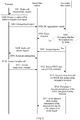
- FIG. 4 is a schematic flowchart of an LWA system-based data transmission method.
- a first network element is a base station, and a second network element is a WT.
- the method includes the following steps.
- the base station sends a radio cell measurement request to a terminal, where the radio cell measurement request carries a measurement configuration parameter.
- the measurement configuration parameter includes an identifier of a radio cell, a preset signal strength, and the like.
- the radio cell is a WiFi cell
- the identifier of the radio cell may be a basic service set identifier (Basic Service Set Identifier, BSSID) or the like.
- BSSID Basic Service Set Identifier
- the terminal receives the radio cell measurement request sent by the base station, and the terminal performs radio cell measurement according to the measurement configuration parameter carried in the radio cell measurement request to obtain a measurement report.
- a specific implementation in which the terminal performs the radio cell measurement according to the measurement configuration parameter to obtain the measurement report may be as follows: The terminal obtains a signal strength of a radio cell corresponding to the identifier of the radio cell; the UE determines a target radio cell, where the target radio cell is a radio cell of which a signal strength is greater than or equal to the preset signal strength; and the UE generates the measurement report according to configuration information of the target radio cell.
- the measurement report includes radio cell configuration information, and the radio cell configuration information includes an identifier, a signal strength, and the like of the target radio cell.
- the terminal sends the measurement report to the base station.
- the base station receives the measurement report sent by the terminal, and the base station sends an LWA aggregation request to the WT according to the measurement report, where the WT is a WT of the target radio cell, and the LWA aggregation request carries a PDCP reordering time of the terminal.
- the radio cell configuration information includes a plurality of target radio cells
- a specific implementation in which the base station sends the LWA aggregation request to the WT according to the radio cell configuration information may be as follows: The base station sends the LWA aggregation request to WTs of all the target radio cells; or the base station determines a target radio cell with a greatest signal strength according to the radio cell configuration information, and sends the LWA aggregation request to a WT associated with the target radio cell with the greatest signal strength, and so on.
- the WT receives the LWA aggregation request sent by the base station, and determines whether the WT can bear the terminal.
- step S406 is performed.
- step S407 is performed.
- the WT sends a reject response for the LWA aggregation request to the base station.
- the WT sends an accept response for the LWA aggregation request to the base station, where the accept response carries at least one of initial flow control information of the terminal, traffic that is recommended by the WT and that is of sending a PDCP data packet by the base station, and a rate that is recommended by the WT and that is of sending a PDCP data packet by the base station.
- the base station receives the accept response sent by the WT, and the base station sends a radio cell access request to the terminal, where the radio cell access request carries configuration information of the radio cell.
- the terminal receives the radio cell access request sent by the base station, and the terminal sends response information to the base station, where the response information is used to notify the base station that the terminal has received the radio cell access request.
- the terminal accesses the WT according to the configuration information of the radio cell carried in the radio cell access request.
- the terminal sends a radio cell access completion response to the base station, where the access completion response is used to notify the base station that the terminal has accessed the WT.
- the base station receives the radio cell access completion response sent by the terminal, and the base station sends a PDCP data packet of the terminal to the WT according to at least one of the initial flow control information of the terminal, the traffic recommended by the WT, and the rate recommended by the WT.
- the WT determines a transmission priority of the PDCP data packet of the terminal.
- the WT sends adjusted flow control information of the terminal to the base station periodically or by means of an event trigger, and the base station receives the adjusted flow control information of the terminal.
- step S401 to step S413 when step S401 to step S413 are performed, the WT may further perform step S414.
- step S401 to step S414 in this embodiment of the present invention, refer to the foregoing data transmission method, and details are not described herein.
- FIG. 5 is a schematic flowchart of a DC system-based data transmission method.
- a first network element is a master base station, and a second network element is a secondary base station.
- the method includes the following steps.
- the master base station sends a radio cell measurement request to a terminal, where the radio cell measurement request carries a measurement configuration parameter.
- the measurement configuration parameter includes an identifier of a radio cell, a preset signal strength, and the like.
- the radio cell is an LTE cell
- the identifier of the radio cell may be a physical cell identifier (Physical Cell Identifier, PCI) or the like.
- PCI Physical Cell Identifier
- the terminal receives the radio cell measurement request sent by the master base station, and the terminal performs radio cell measurement according to the measurement configuration parameter carried in the radio cell measurement request to obtain a measurement report.
- a specific implementation in which the terminal performs the radio cell measurement according to the measurement configuration parameter to obtain the measurement report may be as follows: The terminal obtains a signal strength of a radio cell corresponding to the identifier of the radio cell; the UE determines a target radio cell, where the target radio cell is a radio cell of which a signal strength is greater than or equal to the preset signal strength; and the UE generates the measurement report according to configuration information of the target radio cell.
- the measurement report includes radio cell configuration information, and the radio cell configuration information includes an identifier, the signal strength, and the like of the target radio cell.
- the terminal sends the measurement report to the master base station.
- the master base station receives the measurement report sent by the terminal, and the master base station sends a DC aggregation request to the secondary base station according to the measurement report, where the secondary base station is a base station in which the target radio cell is located, and the DC aggregation request carries a PDCP reordering time of the terminal and a QoS parameter of the terminal.
- the radio cell configuration information includes a plurality of target radio cells
- a specific implementation in which the master base station sends the DC aggregation request to the secondary base station according to the radio cell configuration information may be as follows: The master base station sends the DC aggregation request to secondary base stations of all the target radio cells; or the master base station determines a target radio cell with a greatest signal strength according to the radio cell configuration information, and sends the DC aggregation request to a secondary base station associated with the target radio cell with the greatest signal strength, and so on.
- the secondary base station receives the DC aggregation request sent by the master base station, and determines whether the secondary base station can bear the terminal.
- step S506 is performed.
- the secondary base station sends a reject response for the DC aggregation request to the master base station.
- the secondary base station sends an accept response for the DC aggregation request to the master base station, where the accept response carries at least one of initial flow control information of the terminal, traffic that is recommended by the secondary base station and that is of sending a PDCP data packet by the master base station, and a rate that is recommended by the secondary base station and that is of sending a PDCP data packet by the master base station.
- the master base station receives the accept response sent by the secondary base station, and the master base station sends a radio cell access request to the terminal, where the radio cell access request carries configuration information of the radio cell.
- the terminal receives the radio cell access request sent by the master base station, and the terminal sends response information to the master base station, where the response information is used to notify the master base station that the terminal has received the radio cell access request.
- the terminal accesses the secondary base station according to the configuration information of the radio cell carried in the radio cell access request.
- the terminal sends a radio cell access completion response to the master base station, where the access completion response is used to notify the master base station that the terminal has accessed the secondary base station.
- the master base station receives the radio cell access completion response sent by the terminal, and the master base station sends a PDCP data packet of the terminal to the secondary base station according to at least one of the initial flow control information of the terminal, the traffic recommended by the secondary base station, and the rate recommended by the secondary base station.
- the secondary base station receives the PDCP data packet of the terminal sent by the master base station, and records a time at which the PDCP data packet of the terminal is received.
- the secondary base station sends adjusted flow control information of the terminal to the master base station periodically or by means of an event trigger, and the master base station receives the adjusted flow control information of the terminal.
- step S501 to step S513 when step S501 to step S513 are performed, the secondary base station may further perform step S514.
- step S501 to step S514 in this embodiment of the present invention, refer to the foregoing data transmission method, and details are not described herein.
- FIG. 6 is a schematic structural diagram of a second network element according to an embodiment of the present invention.
- the second network element 600 may include a receiving module 601 and a determining module 602.
- the receiving module 601 is configured to receive a PDCP reordering time of a terminal sent by a first network element, and is further configured to receive a PDCP data packet of the terminal sent by the first network element.
- the determining module 602 is configured to determine a transmission priority of the PDCP data packet of the terminal according to the PDCP reordering time of the terminal.
- a manner in which the determining module 602 determines the transmission priority of the PDCP data packet of the terminal may be the same as that in the foregoing method embodiment.
- the determining module 602 is specifically configured to: determine remaining duration of the PDCP reordering time of the terminal; and determine the transmission priority of the PDCP data packet of the terminal according to the remaining duration, where the remaining duration is a difference between the PDCP reordering time and a waiting time of the PDCP data packet on the second network element.
- the transmission priority of the PDCP data packet of the terminal is greater than a transmission priority of a PDCP data packet of the another terminal.
- the transmission priority of the PDCP data packet of the terminal is less than a transmission priority of a PDCP data packet of the another terminal.
- the second network element shown in FIG. 6 further includes an instruction module 603, configured to instruct the first network element to perform flow control on the PDCP data packet sent to the second network element.
- the instruction module 603 may be, for example, a first instruction module or a second instruction module.
- the first instruction module is configured to: when a difference between a sequence number of a latest PDCP data packet received by the second network element and a sequence number of an un-sent earliest PDCP data packet received by the second network element is greater than or equal to a maximum sending quantity of PDCP data packets within the PDCP reordering time of the terminal, instruct the first network element to send a decreasing quantity of PDCP data packets or stop sending a PDCP data packet to the second network element, where the latest PDCP data packet and the earliest PDCP data packet are PDCP data packets on a same bearer of the terminal.
- the second instruction module is configured to: when the remaining duration of the PDCP reordering time of the terminal is less than or equal to a preset threshold, instruct the first network element to send a decreasing quantity of PDCP data packets or stop sending a PDCP data packet to the second network element.
- the instruction module 603 may include both the first instruction module and the second instruction module. That is, when any of the foregoing conditions is satisfied, the first network element is instructed to perform flow control on the PDCP data packet sent to the second network element.
- the receiving module 601 is specifically configured to: receive an aggregation request sent by the first network element, where the aggregation request carries the PDCP reordering time of the terminal.
- the second network element may further include a sending module 604, configured to: after the receiving module 601 receives the aggregation request sent by the first network element, determine whether the second network element can bear the terminal, and respond to the aggregation request according to a determining result; and when the second network element can bear the terminal, send an accept response to the first network element, or when the second network element cannot bear the terminal, send a reject response to the first network element.
- a sending module 604 configured to: after the receiving module 601 receives the aggregation request sent by the first network element, determine whether the second network element can bear the terminal, and respond to the aggregation request according to a determining result; and when the second network element can bear the terminal, send an accept response to the first network element, or when the second network element cannot bear the terminal, send a reject response to the first network element.
- the response message may include at least one of initial flow control information of the terminal, traffic that is recommended by the second network element and that is of sending the PDCP data packet by the first network element to the second network element, and a rate that is recommended by the second network element and that is of sending the PDCP data packet by the first network element to the second network element.
- the initial flow control information of the terminal, the recommended traffic, or the recommended rate may be sent to the first network element in another manner, for example, sent to the first network element by using a newly added message, or sent to the first network element by using another message.
- the sending module 604 is further configured to send adjusted flow control information of the terminal to the first network element periodically or by means of an event trigger.
- the flow control information includes at least one of a rate of splitting the PDCP data packet of the terminal by the second network element, a quantity of PDCP data packets of the terminal split by the second network element, and a packet length of the PDCP data packet of the terminal split by the second network element.
- the rate of splitting the PDCP data packet of the terminal is determined by the second network element according to a capability of sending data by using an air interface of the terminal and a buffer size used by the terminal on the second network element.
- the quantity of the split PDCP data packets of the terminal is determined by the second network element according to a quantity of times that the terminal can be scheduled.
- the packet length of the split PDCP data packet of the terminal is determined by the second network element according to a capability of sending the data packet by the terminal.
- the receiving module 601 is further configured to receive indication information sent by the first network element when at least one PDCP data packet of the terminal fails to be sent within a preset quantity of retransmission times, where the indication information includes a sequence number of the at least one PDCP data packet.
- the sending module 604 is further configured to: send a reconfiguration instruction to the terminal, and send the at least one PDCP data packet to the first network element according to the sequence number of the at least one PDCP data packet, where the reconfiguration instruction is used to instruct the terminal to reconfigure the first network element.
- the foregoing modules are configured to perform related steps of the foregoing method.
- the second network element 600 is presented in a module form.
- the "module” herein may refer to an application-specific integrated circuit (application-specific integrated circuit, ASIC), a processor and a memory that execute one or more software or firmware programs, an integrated logic circuit, and/or another component that can provide the foregoing functions.
- the foregoing receiving module 601 and the response module 604 may receive, by using a communications interface between the second network element and the first network element, information sent by the first network element, and the response module 604 and the instruction module 603 may send information to the first network element by using the communications interface between the second network element and the first network element.
- FIG. 7 is a schematic structural diagram of a first network element according to an embodiment of the present invention.
- the first network element 700 may include a configuration module 701 and a sending module 702.
- the configuration module 701 is configured to configure a PDCP reordering time for a terminal.
- the sending module 702 is configured to send the PDCP reordering time of the terminal configured by the configuration module to a second network element.
- the sending module 702 is further configured to send a PDCP data packet of the terminal to the second network element, where the PDCP reordering time of the terminal is used to determine a transmission priority of the PDCP data packet of the terminal on the second network element.
- the sending module 702 sends a decreasing quantity of PDCP data packets or stops sending a PDCP data packet to the second network element.
- the sending module 702 may send the PDCP reordering time of the terminal to the second network element by using an aggregation request.
- the first network element further includes a receiving module 703, configured to receive a response message that is sent by the second network element and that is of the aggregation request, where the response message includes at least one of initial flow control information of the terminal, traffic that is recommended by the second network element and that is of sending the PDCP data packet by the first network element to the second network element, and a rate that is recommended by the second network element and that is of sending the PDCP data packet by the first network element to the second network element.
- the sending module 702 may send the PDCP data packet of the terminal to the second network element according to the recommended traffic or rate.
- the receiving module 703 is further configured to receive adjusted flow control information of the terminal sent by the second network element periodically or by means of an event trigger.
- the flow control information includes at least one of a rate of splitting the PDCP data packet of the terminal by the second network element, a quantity of PDCP data packets of the terminal split by the second network element, and a packet length of the PDCP data packet of the terminal split by the second network element.
- the rate of splitting the PDCP data packet of the terminal is determined by the second network element according to a capability of sending data by using an air interface of the terminal and a buffer size used by the terminal on the second network element.
- the quantity of the split PDCP data packets of the terminal is determined by the second network element according to a quantity of times that the terminal can be scheduled.
- the packet length of the split PDCP data packet of the terminal is determined by the second network element according to a capability of sending the data packet by the terminal.
- the sending module 702 is further configured to: if at least one PDCP data packet of the terminal fails to be sent within a preset quantity of retransmission times, send indication information to the second network element, where the indication information includes a sequence number of the at least one PDCP data packet, and the indication information is used to instruct the second network element to trigger the terminal to reconfigure the first network element and instruct the second network element to deliver the at least one PDCP data packet according to the sequence number of the at least one PDCP data packet.
- the foregoing modules are configured to perform related steps of the foregoing method.
- the first network element 700 is presented in a module form.
- the "module” herein may refer to an application-specific integrated circuit (application-specific integrated circuit, ASIC), a processor and a memory that execute one or more software or firmware programs, an integrated logic circuit, and/or another component that can provide the foregoing functions.
- the sending module 702 and the receiving module 703 are respectively configured to send information to the first network element and receive information from the first network element by using a communications interface between the first network element and the second network element.
- the communications interface is, for example, a wired interface, or certainly may be a wireless interface.
- the second network element 600 and the first network element 700 may use a form shown in FIG. 8 .
- the first network element 700 and the second network element 600 may be implemented by using a structure in FIG. 8 .
- the network element 800 includes at least one processor 801, at least one memory 802, and at least one communications interface 803.
- the network element may further include a general component such as an antenna, and details are not described herein.
- the processor 801 may be a general-purpose central processing unit (CPU), a microprocessor, an application-specific integrated circuit (application-specific integrated circuit, ASIC), or one or more integrated circuits configured to control program execution of the foregoing solution.
- CPU central processing unit
- ASIC application-specific integrated circuit
- the communications interface 803 is configured to communicate with another device or communications network, such as an Ethernet network, a radio access network (RAN), or a wireless local area network (Wireless Local Area Networks, WLAN).
- another device or communications network such as an Ethernet network, a radio access network (RAN), or a wireless local area network (Wireless Local Area Networks, WLAN).
- RAN radio access network
- WLAN Wireless Local Area Networks
- the memory 802 may be a read-only memory (read-only memory, ROM), or another type of static storage device that can store static information and a static instruction, or a random access memory (random access memory, RAM), or another type of dynamic storage device that can store information and an instruction; or may be an electrically erasable programmable read-only memory (Electrically Erasable Programmable Read-Only Memory, EEPROM), a compact disc read-only memory (Compact Disc Read-Only Memory, CD-ROM) or another optical disk storage or optical disc storage (including a compact disc, a laser disc, an optical disc, a digital versatile disc, a Blu-ray disc, and the like), a disk storage medium or another magnetic storage device, or any other medium that can be used to carry or store expected program code in a form of an instruction or a data structure and that can be accessed by a computer.
- the memory may exist independently and is connected to the processor by using the bus.
- the memory may also be integrated with the processor.
- the memory 802 is configured to store application program code that is used to execute the foregoing solution, and the processor 801 controls and executes the application program code.
- the processor 801 is configured to execute the application program code stored in the memory 802.
- the code stored in the memory 802 may be used to perform the data transmission method performed by the foregoing second network element.
- the second network element determines a transmission priority of a PDCP data packet of a terminal according to a PDCP reordering time of the terminal sent by the first network element.
- the processor 801 may be a processor on a board of the base station, or may be one or more integrated circuits or chips on a board of the base station.
- the processor 801 may be a processor of an apparatus in which the WT is located, for example, a WLAN AC, a WLAN gateway, or a WLAN AP, or may be one or more integrated circuits or chips of an apparatus in which the WT is located.
- the memory 802 may be integrated with the processor 801, or may be disposed separately.
- the code stored in the memory 802 may be used to perform the data transmission method performed by the foregoing first network element.
- the first network element sends a PDCP reordering time of a terminal to the second network element, so that the second network element determines a transmission priority of a PDCP data packet of the terminal according to the PDCP reordering time of the terminal.
- the processor 801 may be a processor on a board of the base station, or may be one or more integrated circuits or chips on a board of the base station.
- the memory 802 may be integrated with the processor 801, or may be disposed separately.
- An embodiment of the present invention further provides a computer storage medium, which is configured to store a computer software instruction used by the first network element.
- the computer software instruction includes a program designed for executing the method embodiment. Data transmission may be implemented by executing the stored program.
- An embodiment of the present invention further provides a computer storage medium, which is configured to store a computer software instruction used by the second network element.
- the computer software instruction includes a program designed for executing the method embodiment. Data transmission may be implemented by executing the stored program.
- the embodiments of the present invention may be provided as a method, an apparatus (device), or a computer program product. Therefore, the present invention may use a form of hardware only embodiments, software only embodiments, or embodiments with a combination of software and hardware. Moreover, the present invention may use a form of a computer program product that is implemented on one or more computer-usable storage media (including but not limited to a disk memory, a CD-ROM, an optical memory, and the like) that include computer-usable program code.
- the computer program is stored/distributed in a proper medium and is provided as or used as a part of the hardware together with another hardware, or may also use another allocation form, such as by using the Internet or another wired or wireless telecommunications system.
- These computer program instructions may be provided for a general-purpose computer, a dedicated computer, an embedded processor, or a processor of any other programmable data processing device to generate a machine, so that the instructions executed by a computer or a processor of any other programmable data processing device generate an apparatus for implementing a specific function in one or more processes in the flowcharts and/or in one or more blocks in the block diagrams.
- These computer program instructions may also be stored in a computer readable memory that can instruct the computer or any other programmable data processing device to work in a specific manner, so that the instructions stored in the computer readable memory generate an artifact that includes an instruction apparatus.
- the instruction apparatus implements a specific function in one or more processes in the flowcharts and/or in one or more blocks in the block diagrams.
- These computer program instructions may also be loaded onto a computer or another programmable data processing device, so that a series of operations and steps are performed on the computer or the another programmable device, thereby generating computer-implemented processing. Therefore, the instructions executed on the computer or the another programmable device provide steps for implementing a specific function in one or more processes in the flowcharts and/or in one or more blocks in the block diagrams.
Landscapes
- Engineering & Computer Science (AREA)
- Computer Networks & Wireless Communication (AREA)
- Signal Processing (AREA)
- Mobile Radio Communication Systems (AREA)
- Communication Control (AREA)
Applications Claiming Priority (2)
| Application Number | Priority Date | Filing Date | Title |
|---|---|---|---|
| CN2016072926 | 2016-01-30 | ||
| PCT/CN2016/087022 WO2017128609A1 (fr) | 2016-01-30 | 2016-06-24 | Procédé, dispositif et système de transmission de données |
Publications (3)
| Publication Number | Publication Date |
|---|---|
| EP3402304A1 true EP3402304A1 (fr) | 2018-11-14 |
| EP3402304A4 EP3402304A4 (fr) | 2019-01-02 |
| EP3402304B1 EP3402304B1 (fr) | 2020-02-05 |
Family
ID=59397296
Family Applications (1)
| Application Number | Title | Priority Date | Filing Date |
|---|---|---|---|
| EP16887491.5A Active EP3402304B1 (fr) | 2016-01-30 | 2016-06-24 | Procédé et dispositif de transmission de données |
Country Status (4)
| Country | Link |
|---|---|
| US (1) | US10701715B2 (fr) |
| EP (1) | EP3402304B1 (fr) |
| CN (1) | CN108476548B (fr) |
| WO (1) | WO2017128609A1 (fr) |
Families Citing this family (9)
| Publication number | Priority date | Publication date | Assignee | Title |
|---|---|---|---|---|
| KR102464567B1 (ko) * | 2017-01-16 | 2022-11-09 | 삼성전자 주식회사 | 무선 통신 시스템에서 데이터 처리 방법 및 장치 |
| CN113141311B (zh) * | 2020-01-19 | 2025-07-15 | 华为技术有限公司 | 一种用于获取转发信息的方法及装置 |
| WO2021142848A1 (fr) * | 2020-01-19 | 2021-07-22 | Oppo广东移动通信有限公司 | Procédé et appareil de configuration de temporisateur de réordonnancement de pdcp, dispositif de terminal et dispositif de réseau |
| WO2022026102A1 (fr) * | 2020-07-31 | 2022-02-03 | Dish Wireless L.L.C. | Mise en forme de trafic au niveau du/cu pour réduire artificiellement la charge de trafic sur le récepteur radio |
| EP4241405A4 (fr) * | 2020-11-05 | 2024-10-16 | Qualcomm Incorporated | Techniques de reprise à la suite d'un blocage de données à connectivité double |
| CN113609049A (zh) * | 2021-08-11 | 2021-11-05 | 联想长风科技(北京)有限公司 | 一种cpu与fpga之间的数据传输方法及系统 |
| CN115835400A (zh) * | 2021-09-16 | 2023-03-21 | 大唐移动通信设备有限公司 | 数据传输方法、装置及存储介质 |
| CN114598560B (zh) * | 2022-03-17 | 2023-05-30 | 中国联合网络通信集团有限公司 | 无线网络策略下发方法、装置、电子设备及存储介质 |
| TWI820965B (zh) * | 2022-07-18 | 2023-11-01 | 財團法人資訊工業策進會 | 在無線通訊系統中的基地台、終端裝置及傳輸方法 |
Family Cites Families (8)
| Publication number | Priority date | Publication date | Assignee | Title |
|---|---|---|---|---|
| CN101932091B (zh) * | 2009-06-22 | 2016-04-27 | 中国移动通信集团公司 | 协作多点传输系统、方法及相关装置 |
| US8989004B2 (en) | 2010-11-08 | 2015-03-24 | Qualcomm Incorporated | System and method for multi-point HSDPA communication utilizing a multi-link PDCP sublayer |
| CN102685816A (zh) | 2011-03-09 | 2012-09-19 | 中兴通讯股份有限公司 | 一种用户面配置参数的处理方法及装置 |
| CN104349385B (zh) * | 2013-07-26 | 2018-01-19 | 电信科学技术研究院 | 一种承载分流场景的数据传输方法和装置 |
| WO2015133767A1 (fr) * | 2014-03-02 | 2015-09-11 | Lg Electronics Inc. | Procédé pour réordonner une unité de données de paquet de protocole de convergence de données de paquet au niveau d'un équipement utilisateur dans un système à double connectivité et dispositif associé |
| JP6231660B2 (ja) * | 2014-03-20 | 2017-11-15 | 京セラ株式会社 | 通信制御方法 |
| CN104935414B (zh) | 2014-03-21 | 2019-05-24 | 上海诺基亚贝尔股份有限公司 | 一种在双连接系统中传输信息的方法和装置 |
| US9838282B2 (en) * | 2014-05-09 | 2017-12-05 | Telefonaktiebolaget Lm Ericsson (Publ) | PDCP and flow control for split bearer |
-
2016
- 2016-06-24 WO PCT/CN2016/087022 patent/WO2017128609A1/fr not_active Ceased
- 2016-06-24 CN CN201680078582.2A patent/CN108476548B/zh active Active
- 2016-06-24 EP EP16887491.5A patent/EP3402304B1/fr active Active
-
2018
- 2018-07-27 US US16/047,860 patent/US10701715B2/en active Active
Also Published As
| Publication number | Publication date |
|---|---|
| US10701715B2 (en) | 2020-06-30 |
| US20180376488A1 (en) | 2018-12-27 |
| CN108476548A (zh) | 2018-08-31 |
| EP3402304A4 (fr) | 2019-01-02 |
| WO2017128609A1 (fr) | 2017-08-03 |
| CN108476548B (zh) | 2020-12-01 |
| EP3402304B1 (fr) | 2020-02-05 |
Similar Documents
| Publication | Publication Date | Title |
|---|---|---|
| US10701715B2 (en) | Data transmission method, apparatus, and system for packet data convergence protocol (PDCP) data packets | |
| US11153778B2 (en) | Buffer status report reporting method and apparatus | |
| US11503100B2 (en) | Method for supporting quality of service of time-sensitive communication and communication device | |
| US12192743B2 (en) | V2X message sending method, apparatus, and system | |
| JP7367838B2 (ja) | サイドリンクスケジューリングリクエストのトリガー方法、装置及びシステム | |
| CN110996391B (zh) | 一种资源分配方法及终端 | |
| KR20190137890A (ko) | 사이드링크 데이터 복제를 위한 방법 및 디바이스 | |
| US20190082436A1 (en) | Uplink information transmission method, base station, and user equipment | |
| US20200068602A1 (en) | Data packet transmission method and device | |
| EP3910878A1 (fr) | Procédé permettant une communication chronosensible et dispositif de communication | |
| JP6627966B2 (ja) | 無線アクセスネットワークノード、外部ノード、及びこれらの方法 | |
| WO2015148157A1 (fr) | Nœud b évolué et entité de gestion de la mobilité, et équipement utilisateur et procédés pour la prise en charge de services avec et sans surveillance | |
| US10993246B2 (en) | User equipment, network node and methods in a wireless communications network | |
| JP6566123B2 (ja) | 無線アクセスネットワークノード、無線端末、ネットワークノード、及びこれらの方法 | |
| WO2013064124A1 (fr) | Procédé, station de base et contrôleur de réseau de radiocommunication permettant de déterminer un intervalle de temps de transmission | |
| JP2023544579A (ja) | スモールデータの送信に関与する送受信機装置およびスケジューリング装置 | |
| CN105557019B (zh) | 一种资源分配、业务传输方法及装置 | |
| CN114145062A (zh) | 促进侧链路上的逻辑信道传输的终端设备、网络节点和方法 | |
| EP3264842A1 (fr) | Procédé et dispositif de configuration de porteuses | |
| WO2016133126A1 (fr) | Terminal et procédé de commande de communication | |
| CN116582918B (zh) | 通信方法和装置 | |
| CN117897934A (zh) | 用于切片调度的方法和装置 | |
| WO2025065627A1 (fr) | Procédé et appareil de traitement d'informations de retard, procédé et appareil de déclenchement d'informations, dispositif et support | |
| WO2017072410A1 (fr) | Procédé et appareil de mise en œuvre d'une signalisation pour reconfigurer des canaux logiques |
Legal Events
| Date | Code | Title | Description |
|---|---|---|---|
| STAA | Information on the status of an ep patent application or granted ep patent |
Free format text: STATUS: THE INTERNATIONAL PUBLICATION HAS BEEN MADE |
|
| PUAI | Public reference made under article 153(3) epc to a published international application that has entered the european phase |
Free format text: ORIGINAL CODE: 0009012 |
|
| STAA | Information on the status of an ep patent application or granted ep patent |
Free format text: STATUS: REQUEST FOR EXAMINATION WAS MADE |
|
| 17P | Request for examination filed |
Effective date: 20180807 |
|
| AK | Designated contracting states |
Kind code of ref document: A1 Designated state(s): AL AT BE BG CH CY CZ DE DK EE ES FI FR GB GR HR HU IE IS IT LI LT LU LV MC MK MT NL NO PL PT RO RS SE SI SK SM TR |
|
| AX | Request for extension of the european patent |
Extension state: BA ME |
|
| A4 | Supplementary search report drawn up and despatched |
Effective date: 20181205 |
|
| RIC1 | Information provided on ipc code assigned before grant |
Ipc: H04W 80/02 20090101AFI20181129BHEP |
|
| DAV | Request for validation of the european patent (deleted) | ||
| DAX | Request for extension of the european patent (deleted) | ||
| GRAP | Despatch of communication of intention to grant a patent |
Free format text: ORIGINAL CODE: EPIDOSNIGR1 |
|
| STAA | Information on the status of an ep patent application or granted ep patent |
Free format text: STATUS: GRANT OF PATENT IS INTENDED |
|
| INTG | Intention to grant announced |
Effective date: 20190911 |
|
| GRAS | Grant fee paid |
Free format text: ORIGINAL CODE: EPIDOSNIGR3 |
|
| GRAA | (expected) grant |
Free format text: ORIGINAL CODE: 0009210 |
|
| STAA | Information on the status of an ep patent application or granted ep patent |
Free format text: STATUS: THE PATENT HAS BEEN GRANTED |
|
| AK | Designated contracting states |
Kind code of ref document: B1 Designated state(s): AL AT BE BG CH CY CZ DE DK EE ES FI FR GB GR HR HU IE IS IT LI LT LU LV MC MK MT NL NO PL PT RO RS SE SI SK SM TR |
|
| REG | Reference to a national code |
Ref country code: GB Ref legal event code: FG4D |
|
| REG | Reference to a national code |
Ref country code: AT Ref legal event code: REF Ref document number: 1230836 Country of ref document: AT Kind code of ref document: T Effective date: 20200215 |
|
| REG | Reference to a national code |
Ref country code: DE Ref legal event code: R096 Ref document number: 602016029325 Country of ref document: DE |
|
| REG | Reference to a national code |
Ref country code: IE Ref legal event code: FG4D |
|
| REG | Reference to a national code |
Ref country code: CH Ref legal event code: EP |
|
| REG | Reference to a national code |
Ref country code: NL Ref legal event code: MP Effective date: 20200205 |
|
| PG25 | Lapsed in a contracting state [announced via postgrant information from national office to epo] |
Ref country code: PT Free format text: LAPSE BECAUSE OF FAILURE TO SUBMIT A TRANSLATION OF THE DESCRIPTION OR TO PAY THE FEE WITHIN THE PRESCRIBED TIME-LIMIT Effective date: 20200628 Ref country code: NO Free format text: LAPSE BECAUSE OF FAILURE TO SUBMIT A TRANSLATION OF THE DESCRIPTION OR TO PAY THE FEE WITHIN THE PRESCRIBED TIME-LIMIT Effective date: 20200505 Ref country code: RS Free format text: LAPSE BECAUSE OF FAILURE TO SUBMIT A TRANSLATION OF THE DESCRIPTION OR TO PAY THE FEE WITHIN THE PRESCRIBED TIME-LIMIT Effective date: 20200205 Ref country code: FI Free format text: LAPSE BECAUSE OF FAILURE TO SUBMIT A TRANSLATION OF THE DESCRIPTION OR TO PAY THE FEE WITHIN THE PRESCRIBED TIME-LIMIT Effective date: 20200205 |
|
| REG | Reference to a national code |
Ref country code: LT Ref legal event code: MG4D |
|
| PG25 | Lapsed in a contracting state [announced via postgrant information from national office to epo] |
Ref country code: HR Free format text: LAPSE BECAUSE OF FAILURE TO SUBMIT A TRANSLATION OF THE DESCRIPTION OR TO PAY THE FEE WITHIN THE PRESCRIBED TIME-LIMIT Effective date: 20200205 Ref country code: GR Free format text: LAPSE BECAUSE OF FAILURE TO SUBMIT A TRANSLATION OF THE DESCRIPTION OR TO PAY THE FEE WITHIN THE PRESCRIBED TIME-LIMIT Effective date: 20200506 Ref country code: SE Free format text: LAPSE BECAUSE OF FAILURE TO SUBMIT A TRANSLATION OF THE DESCRIPTION OR TO PAY THE FEE WITHIN THE PRESCRIBED TIME-LIMIT Effective date: 20200205 Ref country code: LV Free format text: LAPSE BECAUSE OF FAILURE TO SUBMIT A TRANSLATION OF THE DESCRIPTION OR TO PAY THE FEE WITHIN THE PRESCRIBED TIME-LIMIT Effective date: 20200205 Ref country code: IS Free format text: LAPSE BECAUSE OF FAILURE TO SUBMIT A TRANSLATION OF THE DESCRIPTION OR TO PAY THE FEE WITHIN THE PRESCRIBED TIME-LIMIT Effective date: 20200605 Ref country code: BG Free format text: LAPSE BECAUSE OF FAILURE TO SUBMIT A TRANSLATION OF THE DESCRIPTION OR TO PAY THE FEE WITHIN THE PRESCRIBED TIME-LIMIT Effective date: 20200505 |
|
| PG25 | Lapsed in a contracting state [announced via postgrant information from national office to epo] |
Ref country code: NL Free format text: LAPSE BECAUSE OF FAILURE TO SUBMIT A TRANSLATION OF THE DESCRIPTION OR TO PAY THE FEE WITHIN THE PRESCRIBED TIME-LIMIT Effective date: 20200205 |
|
| PG25 | Lapsed in a contracting state [announced via postgrant information from national office to epo] |
Ref country code: ES Free format text: LAPSE BECAUSE OF FAILURE TO SUBMIT A TRANSLATION OF THE DESCRIPTION OR TO PAY THE FEE WITHIN THE PRESCRIBED TIME-LIMIT Effective date: 20200205 Ref country code: SK Free format text: LAPSE BECAUSE OF FAILURE TO SUBMIT A TRANSLATION OF THE DESCRIPTION OR TO PAY THE FEE WITHIN THE PRESCRIBED TIME-LIMIT Effective date: 20200205 Ref country code: SM Free format text: LAPSE BECAUSE OF FAILURE TO SUBMIT A TRANSLATION OF THE DESCRIPTION OR TO PAY THE FEE WITHIN THE PRESCRIBED TIME-LIMIT Effective date: 20200205 Ref country code: EE Free format text: LAPSE BECAUSE OF FAILURE TO SUBMIT A TRANSLATION OF THE DESCRIPTION OR TO PAY THE FEE WITHIN THE PRESCRIBED TIME-LIMIT Effective date: 20200205 Ref country code: DK Free format text: LAPSE BECAUSE OF FAILURE TO SUBMIT A TRANSLATION OF THE DESCRIPTION OR TO PAY THE FEE WITHIN THE PRESCRIBED TIME-LIMIT Effective date: 20200205 Ref country code: LT Free format text: LAPSE BECAUSE OF FAILURE TO SUBMIT A TRANSLATION OF THE DESCRIPTION OR TO PAY THE FEE WITHIN THE PRESCRIBED TIME-LIMIT Effective date: 20200205 Ref country code: RO Free format text: LAPSE BECAUSE OF FAILURE TO SUBMIT A TRANSLATION OF THE DESCRIPTION OR TO PAY THE FEE WITHIN THE PRESCRIBED TIME-LIMIT Effective date: 20200205 Ref country code: CZ Free format text: LAPSE BECAUSE OF FAILURE TO SUBMIT A TRANSLATION OF THE DESCRIPTION OR TO PAY THE FEE WITHIN THE PRESCRIBED TIME-LIMIT Effective date: 20200205 |
|
| REG | Reference to a national code |
Ref country code: DE Ref legal event code: R097 Ref document number: 602016029325 Country of ref document: DE |
|
| REG | Reference to a national code |
Ref country code: AT Ref legal event code: MK05 Ref document number: 1230836 Country of ref document: AT Kind code of ref document: T Effective date: 20200205 |
|
| PLBE | No opposition filed within time limit |
Free format text: ORIGINAL CODE: 0009261 |
|
| STAA | Information on the status of an ep patent application or granted ep patent |
Free format text: STATUS: NO OPPOSITION FILED WITHIN TIME LIMIT |
|
| 26N | No opposition filed |
Effective date: 20201106 |
|
| PG25 | Lapsed in a contracting state [announced via postgrant information from national office to epo] |
Ref country code: MC Free format text: LAPSE BECAUSE OF FAILURE TO SUBMIT A TRANSLATION OF THE DESCRIPTION OR TO PAY THE FEE WITHIN THE PRESCRIBED TIME-LIMIT Effective date: 20200205 Ref country code: IT Free format text: LAPSE BECAUSE OF FAILURE TO SUBMIT A TRANSLATION OF THE DESCRIPTION OR TO PAY THE FEE WITHIN THE PRESCRIBED TIME-LIMIT Effective date: 20200205 Ref country code: AT Free format text: LAPSE BECAUSE OF FAILURE TO SUBMIT A TRANSLATION OF THE DESCRIPTION OR TO PAY THE FEE WITHIN THE PRESCRIBED TIME-LIMIT Effective date: 20200205 |
|
| REG | Reference to a national code |
Ref country code: CH Ref legal event code: PL |
|
| PG25 | Lapsed in a contracting state [announced via postgrant information from national office to epo] |
Ref country code: PL Free format text: LAPSE BECAUSE OF FAILURE TO SUBMIT A TRANSLATION OF THE DESCRIPTION OR TO PAY THE FEE WITHIN THE PRESCRIBED TIME-LIMIT Effective date: 20200205 Ref country code: SI Free format text: LAPSE BECAUSE OF FAILURE TO SUBMIT A TRANSLATION OF THE DESCRIPTION OR TO PAY THE FEE WITHIN THE PRESCRIBED TIME-LIMIT Effective date: 20200205 |
|
| GBPC | Gb: european patent ceased through non-payment of renewal fee |
Effective date: 20200624 |
|
| PG25 | Lapsed in a contracting state [announced via postgrant information from national office to epo] |
Ref country code: LU Free format text: LAPSE BECAUSE OF NON-PAYMENT OF DUE FEES Effective date: 20200624 |
|
| REG | Reference to a national code |
Ref country code: BE Ref legal event code: MM Effective date: 20200630 |
|
| PG25 | Lapsed in a contracting state [announced via postgrant information from national office to epo] |
Ref country code: FR Free format text: LAPSE BECAUSE OF NON-PAYMENT OF DUE FEES Effective date: 20200630 Ref country code: GB Free format text: LAPSE BECAUSE OF NON-PAYMENT OF DUE FEES Effective date: 20200624 Ref country code: IE Free format text: LAPSE BECAUSE OF NON-PAYMENT OF DUE FEES Effective date: 20200624 Ref country code: LI Free format text: LAPSE BECAUSE OF NON-PAYMENT OF DUE FEES Effective date: 20200630 Ref country code: CH Free format text: LAPSE BECAUSE OF NON-PAYMENT OF DUE FEES Effective date: 20200630 |
|
| PG25 | Lapsed in a contracting state [announced via postgrant information from national office to epo] |
Ref country code: BE Free format text: LAPSE BECAUSE OF NON-PAYMENT OF DUE FEES Effective date: 20200630 |
|
| PG25 | Lapsed in a contracting state [announced via postgrant information from national office to epo] |
Ref country code: TR Free format text: LAPSE BECAUSE OF FAILURE TO SUBMIT A TRANSLATION OF THE DESCRIPTION OR TO PAY THE FEE WITHIN THE PRESCRIBED TIME-LIMIT Effective date: 20200205 Ref country code: MT Free format text: LAPSE BECAUSE OF FAILURE TO SUBMIT A TRANSLATION OF THE DESCRIPTION OR TO PAY THE FEE WITHIN THE PRESCRIBED TIME-LIMIT Effective date: 20200205 Ref country code: CY Free format text: LAPSE BECAUSE OF FAILURE TO SUBMIT A TRANSLATION OF THE DESCRIPTION OR TO PAY THE FEE WITHIN THE PRESCRIBED TIME-LIMIT Effective date: 20200205 |
|
| PG25 | Lapsed in a contracting state [announced via postgrant information from national office to epo] |
Ref country code: MK Free format text: LAPSE BECAUSE OF FAILURE TO SUBMIT A TRANSLATION OF THE DESCRIPTION OR TO PAY THE FEE WITHIN THE PRESCRIBED TIME-LIMIT Effective date: 20200205 Ref country code: AL Free format text: LAPSE BECAUSE OF FAILURE TO SUBMIT A TRANSLATION OF THE DESCRIPTION OR TO PAY THE FEE WITHIN THE PRESCRIBED TIME-LIMIT Effective date: 20200205 |
|
| PGFP | Annual fee paid to national office [announced via postgrant information from national office to epo] |
Ref country code: DE Payment date: 20250429 Year of fee payment: 10 |