EP3402862B1 - Verwendung von seltenerdkomplexen als marker von erdölprodukten, rohölen, biokraftstoffen oder schmiermitteln - Google Patents
Verwendung von seltenerdkomplexen als marker von erdölprodukten, rohölen, biokraftstoffen oder schmiermitteln Download PDFInfo
- Publication number
- EP3402862B1 EP3402862B1 EP17702428.8A EP17702428A EP3402862B1 EP 3402862 B1 EP3402862 B1 EP 3402862B1 EP 17702428 A EP17702428 A EP 17702428A EP 3402862 B1 EP3402862 B1 EP 3402862B1
- Authority
- EP
- European Patent Office
- Prior art keywords
- rare earth
- time
- earth complex
- ligand
- ppb
- Prior art date
- Legal status (The legal status is an assumption and is not a legal conclusion. Google has not performed a legal analysis and makes no representation as to the accuracy of the status listed.)
- Active
Links
Images










Classifications
-
- C—CHEMISTRY; METALLURGY
- C10—PETROLEUM, GAS OR COKE INDUSTRIES; TECHNICAL GASES CONTAINING CARBON MONOXIDE; FUELS; LUBRICANTS; PEAT
- C10L—FUELS NOT OTHERWISE PROVIDED FOR; NATURAL GAS; SYNTHETIC NATURAL GAS OBTAINED BY PROCESSES NOT COVERED BY SUBCLASSES C10G OR C10K; LIQUIFIED PETROLEUM GAS; USE OF ADDITIVES TO FUELS OR FIRES; FIRE-LIGHTERS
- C10L1/00—Liquid carbonaceous fuels
- C10L1/003—Marking, e.g. coloration by addition of pigments
-
- C—CHEMISTRY; METALLURGY
- C10—PETROLEUM, GAS OR COKE INDUSTRIES; TECHNICAL GASES CONTAINING CARBON MONOXIDE; FUELS; LUBRICANTS; PEAT
- C10L—FUELS NOT OTHERWISE PROVIDED FOR; NATURAL GAS; SYNTHETIC NATURAL GAS OBTAINED BY PROCESSES NOT COVERED BY SUBCLASSES C10G OR C10K; LIQUIFIED PETROLEUM GAS; USE OF ADDITIVES TO FUELS OR FIRES; FIRE-LIGHTERS
- C10L1/00—Liquid carbonaceous fuels
- C10L1/10—Liquid carbonaceous fuels containing additives
- C10L1/14—Organic compounds
- C10L1/30—Organic compounds compounds not mentioned before (complexes)
- C10L1/301—Organic compounds compounds not mentioned before (complexes) derived from metals
-
- C—CHEMISTRY; METALLURGY
- C10—PETROLEUM, GAS OR COKE INDUSTRIES; TECHNICAL GASES CONTAINING CARBON MONOXIDE; FUELS; LUBRICANTS; PEAT
- C10M—LUBRICATING COMPOSITIONS; USE OF CHEMICAL SUBSTANCES EITHER ALONE OR AS LUBRICATING INGREDIENTS IN A LUBRICATING COMPOSITION
- C10M171/00—Lubricating compositions characterised by purely physical criteria, e.g. containing as base-material, thickener or additive, ingredients which are characterised exclusively by their numerically specified physical properties, i.e. containing ingredients which are physically well-defined but for which the chemical nature is either unspecified or only very vaguely indicated
- C10M171/007—Coloured or dyes-containing lubricant compositions
-
- G—PHYSICS
- G01—MEASURING; TESTING
- G01N—INVESTIGATING OR ANALYSING MATERIALS BY DETERMINING THEIR CHEMICAL OR PHYSICAL PROPERTIES
- G01N21/00—Investigating or analysing materials by the use of optical means, i.e. using sub-millimetre waves, infrared, visible or ultraviolet light
- G01N21/62—Systems in which the material investigated is excited whereby it emits light or causes a change in wavelength of the incident light
- G01N21/63—Systems in which the material investigated is excited whereby it emits light or causes a change in wavelength of the incident light optically excited
- G01N21/64—Fluorescence; Phosphorescence
- G01N21/6408—Fluorescence; Phosphorescence with measurement of decay time, time resolved fluorescence
-
- C—CHEMISTRY; METALLURGY
- C10—PETROLEUM, GAS OR COKE INDUSTRIES; TECHNICAL GASES CONTAINING CARBON MONOXIDE; FUELS; LUBRICANTS; PEAT
- C10L—FUELS NOT OTHERWISE PROVIDED FOR; NATURAL GAS; SYNTHETIC NATURAL GAS OBTAINED BY PROCESSES NOT COVERED BY SUBCLASSES C10G OR C10K; LIQUIFIED PETROLEUM GAS; USE OF ADDITIVES TO FUELS OR FIRES; FIRE-LIGHTERS
- C10L2230/00—Function and purpose of a components of a fuel or the composition as a whole
- C10L2230/16—Tracers which serve to track or identify the fuel component or fuel composition
-
- C—CHEMISTRY; METALLURGY
- C10—PETROLEUM, GAS OR COKE INDUSTRIES; TECHNICAL GASES CONTAINING CARBON MONOXIDE; FUELS; LUBRICANTS; PEAT
- C10M—LUBRICATING COMPOSITIONS; USE OF CHEMICAL SUBSTANCES EITHER ALONE OR AS LUBRICATING INGREDIENTS IN A LUBRICATING COMPOSITION
- C10M2227/00—Organic non-macromolecular compounds containing atoms of elements not provided for in groups C10M2203/00, C10M2207/00, C10M2211/00, C10M2215/00, C10M2219/00 or C10M2223/00 as ingredients in lubricant compositions
- C10M2227/09—Complexes with metals
-
- C—CHEMISTRY; METALLURGY
- C10—PETROLEUM, GAS OR COKE INDUSTRIES; TECHNICAL GASES CONTAINING CARBON MONOXIDE; FUELS; LUBRICANTS; PEAT
- C10N—INDEXING SCHEME ASSOCIATED WITH SUBCLASS C10M RELATING TO LUBRICATING COMPOSITIONS
- C10N2010/00—Metal present as such or in compounds
- C10N2010/06—Groups 3 or 13
-
- C—CHEMISTRY; METALLURGY
- C10—PETROLEUM, GAS OR COKE INDUSTRIES; TECHNICAL GASES CONTAINING CARBON MONOXIDE; FUELS; LUBRICANTS; PEAT
- C10N—INDEXING SCHEME ASSOCIATED WITH SUBCLASS C10M RELATING TO LUBRICATING COMPOSITIONS
- C10N2040/00—Specified use or application for which the lubricating composition is intended
- C10N2040/42—Flashing oils or marking oils
Definitions
- the present invention relates to the marking of petroleum products, crude oils, biofuels or lubricants.
- Petroleum products are commonly marked with substances to enable later identification of these products.
- the most commonly used markers are dyes.
- the color of the petroleum product is then specifically changed by the addition of the marker and this change is visible to the naked eye.
- Solvent Yellow 124 a yellow dye, is used to mark certain diesel and kerosene.
- markers that are not detectable by the naked eye can also be used.
- the markers are detectable by chemical analysis techniques such as plasma torch spectrometry (ICP) and high-performance liquid chromatography (HPLC).
- ICP plasma torch spectrometry
- HPLC high-performance liquid chromatography
- Fluorescence is an interesting analytical technique because it can be performed easily and does not require heavy experimental techniques. This technique has already been used to detect petroleum product markers.
- the Petroleum products often inherently exhibit significant fluorescence, making it difficult to differentiate the fluorescence of the marker from the fluorescence naturally emitted by petroleum products. This requires high concentrations of markers or compounds capable of emitting a signal in wavelengths, particularly infrared, that are distinct from those of the fluorescent compounds naturally present in petroleum products.
- WO2004/068113 describes the use of organic molecules at a concentration of 1 ppm as labeling agents for petroleum products. These markers are detected by ion mobility spectrometry.
- the document WO96/10620 describes squaraine, phthalocyanine or naphthalocyanine-based petroleum product markers that can be used at sub-ppm concentrations. They are detected by near-infrared fluorescence.
- the concentration of markers actually used in petroleum products remains high for effective marking, and is often greater than one ppm.
- One of the objectives of the present invention is therefore to provide new markers, detectable at very low concentrations in crude oils, biofuels, lubricants or petroleum products, and in particular gasoline, diesel, fuel oil or kerosene.
- Another objective of the invention is to provide new markers for petroleum products, crude oils, biofuels or lubricants, which are stable over time, so that their use is optimal.
- the present invention also aims to provide a method for marking petroleum products, crude oils, biofuels or lubricants and a method for detecting these markers which are simple and which can be easily implemented.
- the invention also relates to a method for time-resolved fluorescence detection of these complexes in petroleum products, crude oils, biofuels or lubricants.
- rare earth complexes could be used as markers for petroleum products, crude oils, biofuels or lubricants.
- these complexes can be detected simply at concentrations below 1 ppm and even 100 ppb, or even 1 ppb.
- these complexes are detectable by time-resolved fluorescence, this technique allowing simple and rapid detection of the marker in a sample of petroleum product, crude oil, biofuel or lubricant.
- the invention therefore relates to the use, as markers for petroleum products, crude oils, biofuels or lubricants, of a rare earth complex.
- a “marker” is a chemical substance introduced alone or in combination into a product, and having specific physicochemical properties that allow the origin to be authenticated or the integrity of a product to be verified, previously marked by a quantitative, semi-quantitative or qualitative physical or chemical analysis method. The marker must therefore be detectable in the marked product to ensure its traceability.
- a "rare earth complex” means a polyatomic structure comprising at least the following constituents: (i) a rare earth metal cation and (ii) one or more ligands, said metal cation being associated with said ligands by non-covalent bonds to form the rare earth complex.
- the term "rare earths" refers to the group consisting of scandium, yttrium and the lanthanides.
- the rare earth of the metal complex is a metal from the lanthanide series.
- the metals of the lanthanide series are the elements with atomic numbers ranging from 57 (lanthanum) to 71 (lutetium).
- the lanthanides will be chosen from the group consisting of: Pr, Nd, Sm, Eu, Gd, Tb, Dy, Ho, Er, Tm and Yb.
- ligand we mean any molecule capable of forming a complex with a metal cation.
- the same metal cation can be complexed by one or more ligands.
- the metal complex comprises several ligands, these may be identical or different.
- the ligand is chosen so that the metal complex has a dissociation constant Kd of less than 1 ⁇ 10 -5 and preferably less than 1 ⁇ 10 -10 corresponding to a pKd of greater than 5 and preferably greater than 10.
- the term "dissociation constant” means the value of the equilibrium constant between the metal cation in the state complexed by the complexing agent, and the free metal cation and complexing agent dissociated in the solvent (Kd).
- the pKd is the opposite of the base 10 logarithm of the dissociation constant (-log(Kd)), defined as the equilibrium constant of the reaction which reflects the transition from the complexed state to the ionic state.
- the ligand is preferably a polydentate ligand comprising at least 3, preferably at least 4, coordination sites.
- the ligand is chosen from molecules of the polyamine and/or polycarboxylic acid type and their derivatives, among which esters and amides may be mentioned. It is preferably a cyclic molecule.
- the polydentate ligand comprises a heterocycle and at least 3, preferably 4, coordination sites of said polydentate ligand form, with other atoms, said heterocycle.
- EDTA ethylenediaminetetraacetic acid
- NTA nitriloacetic acid
- GLDA glutamic diacetic acid
- phosphonates cyclodextrins and their derivatives
- chitosan chitosan and bacterial or algal polysaccharides.
- the rare earth complex is detectable by time-resolved fluorescence.
- the time-resolved fluorescence detection method i.e. triggered with a delay after excitation (i.e. a few microseconds), is for example described in the article “Ultrasensitive Bioanalytical Assays Using Time-Resolved Fluorescence Detection”, Pharmac. Ther. Flight. 66, p. 207-235, 1995 This method makes it possible to eliminate a large part of the luminescence intrinsic to the marked petroleum product and to measure only that relative to the marker.
- the ligand comprises an aromatic cycle comprising at least one nitrogen or sulfur atom or several conjugated aromatic cycles which act as an antenna, that is to say they amplify the fluorescent signal emitted by the marker.
- petroleum product we mean derivatives of crude oils resulting from the refining of these.
- gasoline, diesel, kerosene, fuel oil, LPG, bitumen, tar Preferably, the petroleum product is gasoline, diesel, fuel oil or kerosene.
- Caste oils means mineral oils composed of an unrefined mixture of hydrocarbons.
- biofuel refers to a fuel derived from biomass. Biofuels can be used alone or in combination with a fossil fuel. Examples of biofuels include biodiesel and bioethanol.
- Example 3 A solution of PCTA(Dy) complex is prepared according to the procedure described in Example 1 using dysprosium trichloride hexahydrate (DyCl 3 .6H 2 O) instead of EuCl 3 .6H 2 O.
- DyCl 3 .6H 2 O dysprosium trichloride hexahydrate
- Example 5 A solution of DOTA(Tb) complex is prepared according to the procedure described in Example 1 using DOTA (2,2',2",2"'-(1,4,7,10-tetraazacyclododecane-1,4,7,10-tetrayl)tetraacetic acid) in place of PCTA and using terbium trichloride hexahydrate (TbCl 3 .6H 2 O) in place of EuCl 3 .6H 2 O.
- DOTA 2,2',2",2"'-(1,4,7,10-tetraazacyclododecane-1,4,7,10-tetrayl)tetraacetic acid
- Example 7 A solution of TMPAC(Eu) complex is prepared according to the procedure described in Example 1 using TMPAC (Tetra-6-(methylene)picolinic acid cyclen) instead of PCTA.
- Example 8 A solution of TMPAC(Tb) complex is prepared according to the procedure described in Example 1 using TMPAC (Tetra-6-(methylene)picolinic acid cyclen) instead of PCTA and using terbium trichloride hexahydrate (TbCl 3 .6H 2 O) instead of EuCl 3 .6H 2 O.
- TMPAC Tetra-6-(methylene)picolinic acid cyclen
- TbCl 3 .6H 2 O terbium trichloride hexahydrate
- Example 9 A solution of TMPAC(Dy) complex is prepared according to the procedure described in Example 1 using TMPAC (Tetra-6-(methylene)picolinic acid cyclen) instead of PCTA and using dysprosium trichloride hexahydrate (DyCl 3 .6H 2 O) instead of EuCl 3 .6H 2 O.
- TMPAC Tetra-6-(methylene)picolinic acid cyclen
- DyCl 3 .6H 2 O dysprosium trichloride hexahydrate
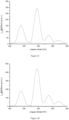
- FIGS 1A, 1B , 1C and 1D represent the time-resolved emission spectra of the complexes DOTA(Tb), DOTA(Eu), PCTA(Tb) and TMPAC(Tb) in n -hexanol.
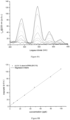
- the Figures 2A and 2B represent the emission spectra of the DOTA(Tb) complex at different concentrations in n -hexanol and the correlation between concentration and emission intensity. These data show that it is possible to make quantitative analyses of the complexes down to very low concentrations, below 100 ppb.
- the complexes obtained are tested as markers of unleaded 95 and diesel.
- Example 10 A PCTA(Tb) solution obtained according to example 2 is diluted in diesel to reach a PCTA(Tb) concentration of 100 ppb. The solution obtained is then diluted by 10 in n -hexanol. This mixture is analyzed by time-resolved fluorescence at a rate of 500 ⁇ l placed in a cuvette (ref: semi-micro cuvette in PMMA, BRAND ® ).
- Example 11 A PCTA(Tb) solution obtained according to example 2 is diluted in lead-free 95 to reach a PCTA(Tb) concentration of 100 ppb. The solution obtained is then diluted by 10 in n -hexanol. This mixture is analyzed by time-resolved fluorescence at a rate of 500 ⁇ l placed in a cuvette (ref: semi-micro cuvette in PMMA, BRAND ® ).
- Example 12 A solution of TMPAC(Tb) obtained according to example 8 is diluted in diesel to reach a TMPAC(Tb) concentration of 100 ppb. The solution obtained is then diluted by 10 in n -hexanol. This mixture is analyzed by time-resolved fluorescence at a rate of 500 ⁇ l placed in a cuvette (ref: semi-micro cuvette in PMMA, BRAND ® ).
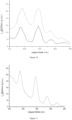
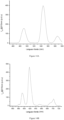
- THE figures 3 (A and B) and 4 (A and B) represent the time-resolved excitation and emission spectra of the PCTA(Tb) complex in unleaded 95 and diesel fuel and the time-resolved excitation and emission spectra of the TMPAC(Tb) complex in diesel fuel, respectively. These data show that unleaded 95 and diesel fuel can be labeled with rare earth complexes.
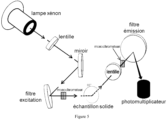
- Example 13 A PCTA(Tb) solution obtained according to example 2 is diluted in lead-free 95 to reach a PCTA(Tb) concentration of 100 ppb, 50 ppb or 25 ppb. After incubating a nylon membrane (ref: Magna Nylon Membrane Filter 47 mm NY Membrane 0.45 ⁇ m) for 30 seconds in one of the solutions obtained, the membrane is analyzed by time-resolved fluorescence using a solid sample holder (ref: Agilent Cary Eclipse solid sample holder). The measurements are carried out with a sample placed at 45° in the beam according to the device shown in figure 5 .
- a nylon membrane ref: Magna Nylon Membrane Filter 47 mm NY Membrane 0.45 ⁇ m
- Example 14 A TMPAC(Tb) solution obtained according to Example 8 is diluted in lead-free 95 to reach a TMPAC(Tb) concentration of 50 ppb or 25 ppb, then analyzed according to the protocol described in Example 13.
- Example 15 A PCTA(Eu) solution obtained according to Example 1 is diluted in lead-free 95 to reach a PCTA(Eu) concentration of 200 ppb or 50 ppb, then the mixture is analyzed according to the protocol described in Example 13.
- Example 16 A TMPAC(Eu) solution obtained according to Example 7 is diluted in lead-free 95 to reach a TMPAC(Eu) concentration of 200 ppb or 50 ppb, then the mixture is analyzed according to the protocol described in Example 13.
- Example 17 A TMPAC(Eu) solution obtained according to Example 7 is diluted in diesel to reach a TMPAC(Eu) concentration of 200 ppb or 50 ppb. The solution is then diluted by 10 in isopropanol and the mixture is analyzed according to the protocol described in Example 13.
- FIGS 6A and 6B represent the time-resolved emission spectra of the PCTA(Tb) and TMPAC(Tb) complexes in lead-free 95.
- the Figures 7A and 7B represent the time-resolved emission spectra of the PCTA(Eu) complexes and TMPAC(Eu) in unleaded 95.
- the Figure 7C represents the time-resolved emission spectrum of the TMPAC(Eu) complex in diesel.
- Example 18 A DOTA(Tb) solution obtained according to Example 5 is diluted in lead-free 95 to reach a DOTA(Tb) concentration of 100 ppb. This solution is then diluted in lead-free 95 to reach the desired DOTA(Tb) concentration and 25 mL are placed in the presence of 5 mL of ultrapure water in a suitable bottle. The whole is shaken vigorously for 30 seconds. The bottle is then opened to allow the separation of the two phases. After approximately 10 minutes, 500 ⁇ l of the aqueous phase are taken and then analyzed by time-resolved fluorescence in a microcuvette. Between each analysis, the microcuvette is first washed with hydrochloric acid (12 M) then rinsed thoroughly with water and finally with ethanol.
- hydrochloric acid (12 M
- Example 19 A DOTA(Tb) solution obtained according to Example 5 is diluted in diesel to reach a DOTA(Tb) concentration of 100 ppb. This solution is then diluted in diesel to reach the desired DOTA(Tb) concentration and 25 mL are placed in the presence of 5 mL of ultrapure water in a suitable bottle. The whole is shaken vigorously for 30 seconds. The bottle is then opened to allow the separation of the two phases. After approximately 10 minutes, 500 ⁇ l of the aqueous phase are taken and then analyzed by time-resolved fluorescence in a microcuvette. Between each analysis, the microcuvette is first washed with hydrochloric acid (12 M) then rinsed thoroughly with water and finally with ethanol.
- hydrochloric acid (12 M
- Example 20 A DOTA(Tb) solution obtained according to Example 5 is diluted in lead-free 95 to reach a DOTA(Tb) concentration of 80 ppb. This solution is then diluted in lead-free 95 to reach a DOTA(Tb) concentration of 0.8 ppb and 100 mL are placed in the presence of 10 mL of ultrapure water in a 250 mL single-necked flask. The mixture is stirred vigorously. Then, approximately 95 mL of the mixture is evaporated. 5 mL of water is then added and the mixture is stirred. After 5 minutes of rest, 500 ⁇ l of the aqueous phase are taken and then analyzed by time-resolved fluorescence in a micro-cuvette.
- Example 21 A DOTA(Tb) solution obtained according to Example 5 is diluted in n-hexanol to reach a DOTA(Tb) concentration of 10 ppm. 100 mL of crude oil are then labeled at 160 ppb using this solution. After adding 10 mL of water to the labeled crude oil, the mixture is stirred for at least 1 hour. The whole is placed in a 250 mL separating funnel. 100 mL of cyclohexane are then added. After closing the funnel, it is stirred, taking care to degas the system under pressure. The funnel is then left to stand after opening. Once the phases are separated, the aqueous phase is sampled and then analyzed by time-resolved fluorescence in a microcuvette.
- Example 28 250 ⁇ L of ligand solution prepared according to example 25 are introduced into a 10 mL vial and 9.75 mL of diesel are then added. This 5 ppm ligand solution is then diluted in diesel to the desired concentration. 1 mL of the solution obtained is placed in the presence of 1 mL of europium revealing solution, prepared according to example 22, in a cuvette (ref: Sarstedt ® PMMA cuvette 2.5-4.5 mL). 100 ⁇ L of ultrapure water are then added to the cuvette. After approximately 10 minutes, the contents of the cuvette are analyzed by time-resolved fluorescence.
- Example 29 250 ⁇ L of the ligand solution prepared according to Example 25 are introduced into a 10 mL vial and 9.75 mL of lead-free 95 are then added. This 5 ppm ligand solution is then diluted in lead-free 95 to the desired concentration. 1 mL of the solution obtained is placed in the presence of 1 mL of europium revealing solution, prepared according to Example 22, in a cuvette (ref: Sarstedt ® cuvette in PMMA 2.5-4.5 mL). 100 ⁇ L of ultrapure water are then added in the cuvette. After about 10 minutes, the contents of the cuvette are analyzed by time-resolved fluorescence.
- FIGS. 12A and 12B represent the time-resolved emission spectra of the rare earth complex after addition of a developer solution to a ligand solution in diesel fuel and in unleaded 95 gasoline. These data show that it is possible to perform indirect labeling by adding only the ligand to the petroleum product.
- Example 30 250 ⁇ L of the terbium chloride solution prepared according to Example 27 are introduced into a 60 mL flask with 49.75 mL of 95 unleaded gasoline. The system is then stirred. This 200 ppb rare earth salt solution is then diluted in 95 unleaded to the desired concentration. 200 ⁇ L of the solution obtained are placed in the presence of 1.8 mL of developer solution, prepared according to Example 23, in a cuvette (ref: Sarstedt ® PMMA cuvette 2.5-4.5 mL). After approximately 10 minutes, the contents of the cuvette are analyzed by time-resolved fluorescence.
- FIGS. 13A and 13B represent the time-resolved emission spectra of the complex after addition of a developer solution to a rare earth salt solution in unleaded 95 gasoline. These data show that it is possible to perform indirect labeling by adding only the rare earth salt to the petroleum product.
- Example 33 250 ⁇ L of the europium chloride solution prepared in Example 26 are introduced into a 60 mL flask with 49.75 mL of crude oil. The system is then stirred. 2 mL of the 200 ppb rare earth salt solution obtained are placed in a 50 mL centrifuge tube and 18 mL of the developer solution prepared according to Example 24 are then added. The sample thus prepared is stirred vigorously for 30 seconds and then centrifuged at 1500 rpm for 5 minutes. 3 mL of aqueous phase are taken and then placed in a cuvette (ref: Sarstedt ® PMMA cuvette 2.5-4.5 mL). The contents of the cuvette are then analyzed by time-resolved fluorescence.
- a cuvette Ref: Sarstedt ® PMMA cuvette 2.5-4.5 mL
- FIGS. 14A and 14B represent the time-resolved emission spectra of europium and terbium complexes after addition of a developer solution to crude oil comprising a rare earth salt. These data show that indirect labeling is also possible in crude oil.
- Example 34 Unleaded 95 solutions comprising both terbium salt and europium salt are prepared. The different concentrations are obtained after successive dilutions from the stock solutions of unleaded 95 gasoline labeled at 200 ppb in terbium or europium salt (respectively examples 27 and 26). 200 ⁇ L of the solution obtained are placed in the presence of 1.8 mL of developer solution, prepared according to example 23, in a cuvette (ref: Sarstedt ® PMMA cuvette 2.5-4.5 mL). The contents of the cuvette are then analyzed by time-resolved fluorescence.
Landscapes
- Chemical & Material Sciences (AREA)
- Oil, Petroleum & Natural Gas (AREA)
- Chemical Kinetics & Catalysis (AREA)
- Organic Chemistry (AREA)
- General Chemical & Material Sciences (AREA)
- Engineering & Computer Science (AREA)
- Health & Medical Sciences (AREA)
- Biochemistry (AREA)
- General Physics & Mathematics (AREA)
- Immunology (AREA)
- Pathology (AREA)
- General Health & Medical Sciences (AREA)
- Life Sciences & Earth Sciences (AREA)
- Analytical Chemistry (AREA)
- Nuclear Medicine, Radiotherapy & Molecular Imaging (AREA)
- Physics & Mathematics (AREA)
- Investigating, Analyzing Materials By Fluorescence Or Luminescence (AREA)
- Lubricants (AREA)
Claims (15)
- Verwendung eines Seltene-Erden-Komplexes als Marker für Erdölprodukte, Rohöle, Biokraftstoffe oder Schmiermittel.
- Verwendung nach Anspruch 1, dadurch gekennzeichnet, dass die Seltene Erde aus den Lanthaniden gewählt ist, bevorzugt aus Pr, Nd, Sm, Eu, Gd, Tb, Dy, Ho, Er, Tm und Yb.
- Verwendung nach einem der Ansprüche 1 oder 2, dadurch gekennzeichnet, dass der Seltene-Erden-Komplex wenigstens einen mehrzähnigen Liganden umfasst, der wenigstens 3, bevorzugt wenigstens 4, Koordinationsstellen umfasst.
- Verwendung nach Anspruch 3, dadurch gekennzeichnet, dass der mehrzähnige Ligand einen Heterocyclus umfasst und wenigstens 3, bevorzugt 4, Koordinationsstellen des mehrzähnigen Liganden zusammen mit anderen Atomen den Heterocyclus bilden.
- Verwendung nach einem der vorhergehenden Ansprüche, dadurch gekennzeichnet, dass der Seltene-Erden-Komplex einen Liganden umfasst, der aus Molekülen vom Typ Polyamin und/oder Polycarbonsäure gewählt ist, wobei der Ligand bevorzugt aus DOTA, NOTA, DOTAM, PCTA, TMPAC und deren Derivaten gewählt ist.
- Verwendung nach einem der vorhergehenden Ansprüche, dadurch gekennzeichnet, dass der Seltene-Erden-Komplex durch zeitaufgelöste Fluoreszenz nachweisbar ist.
- Verwendung nach einem der vorhergehenden Ansprüche, dadurch gekennzeichnet, dass der Seltene-Erden-Komplex einen Liganden umfasst, wobei der Ligand wenigstens einen aromatischen Ring mit wenigstens einem Stickstoff- oder Schwefelatom oder konjugierte aromatische Ringe umfasst, um eine Antennenwirkung zu erzielen.
- Verwendung nach einem der vorhergehenden Ansprüche, dadurch gekennzeichnet, dass das Erdölprodukt Benzin, Heizöl, Kerosin oder Dieselkraftstoff ist.
- Erdölprodukt, Rohöl, Biokraftstoff oder Schmiermittel, dadurch gekennzeichnet, dass es als Marker wenigstens einen Seltene-Erden-Komplex wie in den vorhergehenden Ansprüchen definiert umfasst und dass der Seltene-Erden-Komplex in dem Erdölprodukt, Biokraftstoff oder Schmiermittel in einer Konzentration von weniger als oder gleich 1 ppm, bevorzugt weniger als oder gleich 100 ppb, beispielsweise zwischen 1 ppb und 1 ppm, und insbesondere zwischen 10 ppb und 100 ppb enthalten ist.
- Verfahren zur Markierung von Erdölprodukten, Rohölen, Biokraftstoffen oder Schmiermitteln, dadurch gekennzeichnet, dass es im Wesentlichen darin besteht, einem Erdölprodukt, Rohöl, Biokraftstoff oder Schmiermittel einen Seltene-Erden-Komplex oder ein Seltene-Erden-Salz zuzusetzen, wobei das Seltene-Erden-Salz nach Zugabe einer Entwicklerlösung, die einen Liganden umfasst, einen Seltene-Erden-Komplex bilden kann.
- Verfahren zum Nachweis eines Seltene-Erden-Komplexes als Marker für Erdölprodukte, Rohöle, Biokraftstoffe oder Schmiermittel, dadurch gekennzeichnet, dass es den zeitaufgelösten Fluoreszenznachweis des Seltene-Erden-Komplexes in einer Probe eines Erdölprodukts, Rohöls, Biokraftstoffs oder Schmiermittels umfasst.
- Verfahren nach Anspruch 11, dadurch gekennzeichnet, dass es die folgenden Schritte umfasst:a) Herstellung einer Probe eines Erdölprodukts, Rohöls, Biokraftstoffs oder Schmiermittels, die einen Liganden umfasst, wobei der Ligand nach Zugabe einer Entwicklerlösung, die ein Seltene-Erden-Salz umfasst, einen Seltene-Erden-Komplex bilden kann, der durch zeitaufgelöste Fluoreszenz nachweisbar ist;b) Bildung des Seltene-Erden-Komplexes durch Zugabe einer Entwicklerlösung, die ein Seltene-Erden-Salz umfasst;c) Nachweis des Seltene-Erden-Komplexes durch zeitaufgelöste Fluoreszenz.
- Verfahren nach Anspruch 11, dadurch gekennzeichnet, dass es die folgenden Schritte umfasst:a) Herstellung einer Probe eines Erdölprodukts, Rohöls, Biokraftstoffs oder Schmiermittels, das ein Seltene-Erden-Salz umfasst, wobei das Seltene-Erden-Salz nach Zugabe einer Entwicklerlösung, die einen Liganden umfasst, einen Seltene-Erden-Komplex bilden kann, der durch zeitaufgelöste Fluoreszenz nachweisbar ist;b) Bildung des Seltene-Erden-Komplexes durch Zugabe einer Entwicklerlösung, die einen Liganden umfasst;c) Nachweis des Seltene-Erden-Komplexes durch zeitaufgelöste Fluoreszenz.
- Verfahren nach Anspruch 11, dadurch gekennzeichnet, dass es die folgenden Schritte umfasst:a) Mischen einer Probe eines Erdölprodukts, Rohöls, Biokraftstoffs oder Schmiermittels, das als Markierung einen Seltene-Erden-Komplex umfasst, der durch zeitaufgelöste Fluoreszenz nachweisbar ist, mit einer nicht mischbaren Lösung, bevorzugt einer wässrigen Lösung;b) Nachweis des Seltene-Erden-Komplexes durch zeitaufgelöste Fluoreszenz der nicht mischbaren Lösung.
- Verfahren nach Anspruch 11, dadurch gekennzeichnet, dass es die folgenden Schritte umfasst:a) Imprägnierung eines festen Trägers mit dem Erdölprodukt, Rohöl, Biokraftstoff oder Schmiermittel, das als Markierung einen Seltene-Erden-Komplex umfasst;b) Nachweis des Seltene-Erden-Komplexes durch zeitaufgelöste Fluoreszenz, die auf dem festen Träger durchgeführt wird.
Applications Claiming Priority (2)
| Application Number | Priority Date | Filing Date | Title |
|---|---|---|---|
| FR1650208A FR3046611B1 (fr) | 2016-01-12 | 2016-01-12 | Utilisation de complexes de terres rares comme marqueurs de produits petroliers, de petroles bruts, de biocarburants ou de lubrifiants |
| PCT/FR2017/050062 WO2017121958A1 (fr) | 2016-01-12 | 2017-01-12 | Utilisation de complexes de terres rares comme marqueurs de produits pétroliers, de pétroles bruts, de biocarburants ou de lubrifiants |
Publications (3)
| Publication Number | Publication Date |
|---|---|
| EP3402862A1 EP3402862A1 (de) | 2018-11-21 |
| EP3402862B1 true EP3402862B1 (de) | 2025-01-08 |
| EP3402862C0 EP3402862C0 (de) | 2025-01-08 |
Family
ID=55542927
Family Applications (1)
| Application Number | Title | Priority Date | Filing Date |
|---|---|---|---|
| EP17702428.8A Active EP3402862B1 (de) | 2016-01-12 | 2017-01-12 | Verwendung von seltenerdkomplexen als marker von erdölprodukten, rohölen, biokraftstoffen oder schmiermitteln |
Country Status (6)
| Country | Link |
|---|---|
| US (1) | US10975318B2 (de) |
| EP (1) | EP3402862B1 (de) |
| CA (1) | CA3010669C (de) |
| FR (1) | FR3046611B1 (de) |
| MA (1) | MA43863A (de) |
| WO (1) | WO2017121958A1 (de) |
Families Citing this family (2)
| Publication number | Priority date | Publication date | Assignee | Title |
|---|---|---|---|---|
| CN112206724B (zh) * | 2020-09-30 | 2021-08-10 | 华中科技大学 | 壳聚糖或其水溶性衍生物掺杂的稀土超分子凝胶、其制备及应用 |
| CN115477517B (zh) * | 2022-09-27 | 2023-05-09 | 山东省公路桥梁建设集团有限公司 | 一种高速公路病害修复材料及修复方法 |
Citations (2)
| Publication number | Priority date | Publication date | Assignee | Title |
|---|---|---|---|---|
| EP2726585A1 (de) * | 2011-06-30 | 2014-05-07 | ANGUS Chemical Company | Biphenoletherverbindungen als marker für flüssige kohlenwasserstoffe sowie andere brennstoffe und öle |
| WO2014088898A1 (en) * | 2012-12-06 | 2014-06-12 | Angus Chemical Company | Thpe ethers |
Family Cites Families (9)
| Publication number | Priority date | Publication date | Assignee | Title |
|---|---|---|---|---|
| US3794473A (en) * | 1972-09-20 | 1974-02-26 | K Eisentraut | Rare earth beta-ketoenolate anti-knock additives in gasolines |
| SE428332B (sv) * | 1979-03-08 | 1983-06-20 | Wallac Oy | Forfarande for fluorescensspektroskopisk bestemning av biologiskt aktivt emne, sasom hapten, antikropp eller antigen |
| MX9304188A (es) * | 1992-07-23 | 1994-03-31 | Basf Ag | Uso de compuestos absorbentes y/o fluorescentes enla region infrarroja como marcadores para liquidos. |
| US5525516B1 (en) * | 1994-09-30 | 1999-11-09 | Eastman Chem Co | Method for tagging petroleum products |
| US5498808A (en) | 1995-01-20 | 1996-03-12 | United Color Manufacturing, Inc. | Fluorescent petroleum markers |
| US7157611B2 (en) * | 2002-07-11 | 2007-01-02 | Rohm And Haas Company | Pyrazinoporphyrazines as markers for liquid hydrocarbons |
| US7208451B2 (en) | 2003-01-29 | 2007-04-24 | Authentic Inc. | IMS detection of chemical markers in petroleum products |
| FR2999223B1 (fr) * | 2012-12-11 | 2014-11-21 | Total Sa | Traceurs fluorescents pour le marquage d'eaux d'injection de champs petroliers |
| FR3016440B1 (fr) * | 2014-01-10 | 2017-06-09 | Univ Claude Bernard Lyon | Procede de marquage de la nacre |
-
2016
- 2016-01-12 FR FR1650208A patent/FR3046611B1/fr active Active
-
2017
- 2017-01-12 MA MA043863A patent/MA43863A/fr unknown
- 2017-01-12 US US16/068,258 patent/US10975318B2/en active Active
- 2017-01-12 EP EP17702428.8A patent/EP3402862B1/de active Active
- 2017-01-12 WO PCT/FR2017/050062 patent/WO2017121958A1/fr not_active Ceased
- 2017-01-12 CA CA3010669A patent/CA3010669C/fr active Active
Patent Citations (2)
| Publication number | Priority date | Publication date | Assignee | Title |
|---|---|---|---|---|
| EP2726585A1 (de) * | 2011-06-30 | 2014-05-07 | ANGUS Chemical Company | Biphenoletherverbindungen als marker für flüssige kohlenwasserstoffe sowie andere brennstoffe und öle |
| WO2014088898A1 (en) * | 2012-12-06 | 2014-06-12 | Angus Chemical Company | Thpe ethers |
Non-Patent Citations (1)
| Title |
|---|
| HAN CUI-TING ET AL: "Synthesis of rare earth metal complexes based on phenol ether bidentate ligands and polymerization of 2-vinylpyridine", POLYHEDRON, PERGAMON PRESS, OXFORD, GB, vol. 202, 16 April 2021 (2021-04-16), XP086574895, ISSN: 0277-5387, [retrieved on 20210416], DOI: 10.1016/J.POLY.2021.115219 * |
Also Published As
| Publication number | Publication date |
|---|---|
| CA3010669C (fr) | 2024-01-16 |
| FR3046611B1 (fr) | 2019-10-25 |
| CA3010669A1 (fr) | 2017-07-20 |
| WO2017121958A1 (fr) | 2017-07-20 |
| EP3402862A1 (de) | 2018-11-21 |
| US10975318B2 (en) | 2021-04-13 |
| MA43863A (fr) | 2018-11-21 |
| EP3402862C0 (de) | 2025-01-08 |
| FR3046611A1 (fr) | 2017-07-14 |
| US20190010413A1 (en) | 2019-01-10 |
Similar Documents
| Publication | Publication Date | Title |
|---|---|---|
| EP2673345B1 (de) | Verwendung flüssiger zusammensetzungen zum markieren von flüssigen kraftstoffen und brennstoffen auf kohlenwasserstoffbasis, und verfahren zur detektion der marker | |
| Fu et al. | Application of dispersive liquid–liquid microextraction for the analysis of triazophos and carbaryl pesticides in water and fruit juice samples | |
| Li et al. | Extraction and mechanism investigation of trace roxithromycin in real water samples by use of ionic liquid–salt aqueous two-phase system | |
| Manzoori et al. | Spectrofluorimetric study of host–guest complexation of ibuprofen with β-cyclodextrin and its analytical application | |
| FR2976826A1 (fr) | Nanotraceurs pour le marquage d'eaux d'injection de champs petroliers | |
| Cacho et al. | Evaluation of the contamination of spirits by polycyclic aromatic hydrocarbons using ultrasound-assisted emulsification microextraction coupled to gas chromatography–mass spectrometry | |
| EP3402862B1 (de) | Verwendung von seltenerdkomplexen als marker von erdölprodukten, rohölen, biokraftstoffen oder schmiermitteln | |
| Hennessy et al. | The reactivity of gamma-hydroxybutyric acid (GHB) and gamma-butyrolactone (GBL) in alcoholic solutions | |
| García-Fonseca et al. | Coacervative extraction of Ochratoxin A in wines prior to liquid chromatography/fluorescence determination | |
| Dalmaz et al. | Simultaneous microextraction of Brilliant Blue FCF, Malachite Green, and Rhodamine B in children’s play materials: Assessment of greenness approach | |
| WO2014091144A2 (fr) | Traceurs fluorescents pour le marquage d'eaux d'injection de champs petroliers | |
| Nalewajko-Sieliwoniuk et al. | Flow injection chemiluminescence determination of the total phenolics levels in plant-derived beverages using soluble manganese (IV) | |
| CA2835560C (en) | Method of marking hydrocarbon liquids | |
| García-Ruiz et al. | Enantioselective room temperature phosphorescence detection of non-phosphorescent analytes based on interaction with β-cyclodextrin/1-bromonaphthalene complexes | |
| WO2018124862A1 (fr) | Méthode et kit d'extraction pour la détermination des teneurs en amines aromatiques et aliphatiques dans différentes matrices | |
| WO2012042185A2 (fr) | Solvants pour le dosage d'amines dans l'eau | |
| Serio et al. | Solvent effects in the extraction and detection of polycyclic aromatic hydrocarbons from complex oils in complex environments | |
| Sun et al. | Reusable fluorescent sensor for captopril based on energy transfer from photoluminescent graphene oxide self-assembly multilayers to silver nanoparticles | |
| BE1001279A3 (fr) | Procede de determination de la polarite chimique d'une huile ou d'un petrole brut et de ses fractions lourdes. | |
| Xie et al. | Determination of sodium monofluoroacetate (1080) in biological samples as its 4-bromomethyl-7-methoxycoumarin derivative by RP-HPLC | |
| Kazemi | Quenching effect of l-tyrosine on peroxyoxalate chemiluminescence of berberine as the fluorophore | |
| FR3068470A1 (fr) | Procede de marquage de semences | |
| WO2024039329A2 (en) | Use of anthrapyridone dyes for marking liquid products | |
| WO2014049261A1 (fr) | Méthode et dispositif d'analyse des acides gras volatils en chromatographie basse pression | |
| RU2286564C1 (ru) | Способ определения олова (ii) |
Legal Events
| Date | Code | Title | Description |
|---|---|---|---|
| STAA | Information on the status of an ep patent application or granted ep patent |
Free format text: STATUS: UNKNOWN |
|
| STAA | Information on the status of an ep patent application or granted ep patent |
Free format text: STATUS: THE INTERNATIONAL PUBLICATION HAS BEEN MADE |
|
| PUAI | Public reference made under article 153(3) epc to a published international application that has entered the european phase |
Free format text: ORIGINAL CODE: 0009012 |
|
| STAA | Information on the status of an ep patent application or granted ep patent |
Free format text: STATUS: REQUEST FOR EXAMINATION WAS MADE |
|
| 17P | Request for examination filed |
Effective date: 20180705 |
|
| AK | Designated contracting states |
Kind code of ref document: A1 Designated state(s): AL AT BE BG CH CY CZ DE DK EE ES FI FR GB GR HR HU IE IS IT LI LT LU LV MC MK MT NL NO PL PT RO RS SE SI SK SM TR |
|
| AX | Request for extension of the european patent |
Extension state: BA ME |
|
| STAA | Information on the status of an ep patent application or granted ep patent |
Free format text: STATUS: EXAMINATION IS IN PROGRESS |
|
| 17Q | First examination report despatched |
Effective date: 20210715 |
|
| GRAP | Despatch of communication of intention to grant a patent |
Free format text: ORIGINAL CODE: EPIDOSNIGR1 |
|
| STAA | Information on the status of an ep patent application or granted ep patent |
Free format text: STATUS: GRANT OF PATENT IS INTENDED |
|
| RIC1 | Information provided on ipc code assigned before grant |
Ipc: C10N 40/00 20060101ALI20240731BHEP Ipc: C10N 10/06 20060101ALI20240731BHEP Ipc: C10M 171/00 20060101ALI20240731BHEP Ipc: C10L 1/30 20060101ALI20240731BHEP Ipc: C10L 1/00 20060101AFI20240731BHEP |
|
| INTG | Intention to grant announced |
Effective date: 20240809 |
|
| RIN1 | Information on inventor provided before grant (corrected) |
Inventor name: GHILLEBAERT, FRANCOIS Inventor name: VANLAER, ANTOINE Inventor name: TILLEMENT, OLIVIER Inventor name: ROSSETTI, FABIEN Inventor name: MARTINI, MATTEO Inventor name: COLLET, ANATOLE Inventor name: LEPOIVRE, FLORIAN Inventor name: OULD-METIDJI, MAHMOUD Inventor name: MARAIS, ARTHUR |
|
| GRAS | Grant fee paid |
Free format text: ORIGINAL CODE: EPIDOSNIGR3 |
|
| GRAA | (expected) grant |
Free format text: ORIGINAL CODE: 0009210 |
|
| STAA | Information on the status of an ep patent application or granted ep patent |
Free format text: STATUS: THE PATENT HAS BEEN GRANTED |
|
| AK | Designated contracting states |
Kind code of ref document: B1 Designated state(s): AL AT BE BG CH CY CZ DE DK EE ES FI FR GB GR HR HU IE IS IT LI LT LU LV MC MK MT NL NO PL PT RO RS SE SI SK SM TR |
|
| RAP3 | Party data changed (applicant data changed or rights of an application transferred) |
Owner name: CENTRE NATIONAL DE LA RECHERCHE SCIENTIFIQUE(CNRS) Owner name: UNIVERSITE CLAUDE BERNARD LYON 1 Owner name: INOVENTEAM |
|
| REG | Reference to a national code |
Ref country code: GB Ref legal event code: FG4D Free format text: NOT ENGLISH |
|
| REG | Reference to a national code |
Ref country code: CH Ref legal event code: EP |
|
| REG | Reference to a national code |
Ref country code: DE Ref legal event code: R096 Ref document number: 602017087228 Country of ref document: DE |
|
| REG | Reference to a national code |
Ref country code: IE Ref legal event code: FG4D Free format text: LANGUAGE OF EP DOCUMENT: FRENCH |
|
| U01 | Request for unitary effect filed |
Effective date: 20250108 |
|
| U07 | Unitary effect registered |
Designated state(s): AT BE BG DE DK EE FI FR IT LT LU LV MT NL PT RO SE SI Effective date: 20250114 |
|
| U20 | Renewal fee for the european patent with unitary effect paid |
Year of fee payment: 9 Effective date: 20250131 |
|
| PG25 | Lapsed in a contracting state [announced via postgrant information from national office to epo] |
Ref country code: RS Free format text: LAPSE BECAUSE OF FAILURE TO SUBMIT A TRANSLATION OF THE DESCRIPTION OR TO PAY THE FEE WITHIN THE PRESCRIBED TIME-LIMIT Effective date: 20250408 |
|
| PG25 | Lapsed in a contracting state [announced via postgrant information from national office to epo] |
Ref country code: PL Free format text: LAPSE BECAUSE OF FAILURE TO SUBMIT A TRANSLATION OF THE DESCRIPTION OR TO PAY THE FEE WITHIN THE PRESCRIBED TIME-LIMIT Effective date: 20250108 |
|
| PG25 | Lapsed in a contracting state [announced via postgrant information from national office to epo] |
Ref country code: ES Free format text: LAPSE BECAUSE OF FAILURE TO SUBMIT A TRANSLATION OF THE DESCRIPTION OR TO PAY THE FEE WITHIN THE PRESCRIBED TIME-LIMIT Effective date: 20250108 |
|
| PG25 | Lapsed in a contracting state [announced via postgrant information from national office to epo] |
Ref country code: IS Free format text: LAPSE BECAUSE OF FAILURE TO SUBMIT A TRANSLATION OF THE DESCRIPTION OR TO PAY THE FEE WITHIN THE PRESCRIBED TIME-LIMIT Effective date: 20250508 Ref country code: NO Free format text: LAPSE BECAUSE OF FAILURE TO SUBMIT A TRANSLATION OF THE DESCRIPTION OR TO PAY THE FEE WITHIN THE PRESCRIBED TIME-LIMIT Effective date: 20250408 |
|
| PG25 | Lapsed in a contracting state [announced via postgrant information from national office to epo] |
Ref country code: HR Free format text: LAPSE BECAUSE OF FAILURE TO SUBMIT A TRANSLATION OF THE DESCRIPTION OR TO PAY THE FEE WITHIN THE PRESCRIBED TIME-LIMIT Effective date: 20250108 |
|
| PG25 | Lapsed in a contracting state [announced via postgrant information from national office to epo] |
Ref country code: GR Free format text: LAPSE BECAUSE OF FAILURE TO SUBMIT A TRANSLATION OF THE DESCRIPTION OR TO PAY THE FEE WITHIN THE PRESCRIBED TIME-LIMIT Effective date: 20250409 |
|
| PG25 | Lapsed in a contracting state [announced via postgrant information from national office to epo] |
Ref country code: SM Free format text: LAPSE BECAUSE OF FAILURE TO SUBMIT A TRANSLATION OF THE DESCRIPTION OR TO PAY THE FEE WITHIN THE PRESCRIBED TIME-LIMIT Effective date: 20250108 |
|
| PG25 | Lapsed in a contracting state [announced via postgrant information from national office to epo] |
Ref country code: MC Free format text: LAPSE BECAUSE OF FAILURE TO SUBMIT A TRANSLATION OF THE DESCRIPTION OR TO PAY THE FEE WITHIN THE PRESCRIBED TIME-LIMIT Effective date: 20250108 |
|
| VS25 | Lapsed in a validation state [announced via postgrant information from nat. office to epo] |
Ref country code: MD Free format text: LAPSE BECAUSE OF FAILURE TO SUBMIT A TRANSLATION OF THE DESCRIPTION OR TO PAY THE FEE WITHIN THE PRESCRIBED TIME-LIMIT Effective date: 20250108 |
|
| PG25 | Lapsed in a contracting state [announced via postgrant information from national office to epo] |
Ref country code: CZ Free format text: LAPSE BECAUSE OF FAILURE TO SUBMIT A TRANSLATION OF THE DESCRIPTION OR TO PAY THE FEE WITHIN THE PRESCRIBED TIME-LIMIT Effective date: 20250108 |
|
| PG25 | Lapsed in a contracting state [announced via postgrant information from national office to epo] |
Ref country code: SK Free format text: LAPSE BECAUSE OF FAILURE TO SUBMIT A TRANSLATION OF THE DESCRIPTION OR TO PAY THE FEE WITHIN THE PRESCRIBED TIME-LIMIT Effective date: 20250108 |
|
| PLBE | No opposition filed within time limit |
Free format text: ORIGINAL CODE: 0009261 |
|
| STAA | Information on the status of an ep patent application or granted ep patent |
Free format text: STATUS: NO OPPOSITION FILED WITHIN TIME LIMIT |
|
| REG | Reference to a national code |
Ref country code: CH Ref legal event code: L10 Free format text: ST27 STATUS EVENT CODE: U-0-0-L10-L00 (AS PROVIDED BY THE NATIONAL OFFICE) Effective date: 20251119 |
|
| 26N | No opposition filed |
Effective date: 20251009 |
|
| PG25 | Lapsed in a contracting state [announced via postgrant information from national office to epo] |
Ref country code: IE Free format text: LAPSE BECAUSE OF NON-PAYMENT OF DUE FEES Effective date: 20250112 |
|
| U20 | Renewal fee for the european patent with unitary effect paid |
Year of fee payment: 10 Effective date: 20251216 |
|
| REG | Reference to a national code |
Ref country code: CH Ref legal event code: U11 Free format text: ST27 STATUS EVENT CODE: U-0-0-U10-U11 (AS PROVIDED BY THE NATIONAL OFFICE) Effective date: 20260201 |
|
| PGFP | Annual fee paid to national office [announced via postgrant information from national office to epo] |
Ref country code: GB Payment date: 20260127 Year of fee payment: 10 |
|
| VS25 | Lapsed in a validation state [announced via postgrant information from nat. office to epo] |
Ref country code: MA Free format text: LAPSE BECAUSE OF FAILURE TO SUBMIT A TRANSLATION OF THE DESCRIPTION OR TO PAY THE FEE WITHIN THE PRESCRIBED TIME-LIMIT; INVALID AB INITIO Effective date: 20170112 |
|
| PGFP | Annual fee paid to national office [announced via postgrant information from national office to epo] |
Ref country code: CH Payment date: 20260201 Year of fee payment: 10 |