EP3402939B1 - Ensemble de panneaux comportant une bande de verrouillage, procede de fabrication d'un tel ensemble de panneaux, et assemblage des panneaux - Google Patents
Ensemble de panneaux comportant une bande de verrouillage, procede de fabrication d'un tel ensemble de panneaux, et assemblage des panneaux Download PDFInfo
- Publication number
- EP3402939B1 EP3402939B1 EP17700366.2A EP17700366A EP3402939B1 EP 3402939 B1 EP3402939 B1 EP 3402939B1 EP 17700366 A EP17700366 A EP 17700366A EP 3402939 B1 EP3402939 B1 EP 3402939B1
- Authority
- EP
- European Patent Office
- Prior art keywords
- panel
- rim
- locking profile
- edge
- groove
- Prior art date
- Legal status (The legal status is an assumption and is not a legal conclusion. Google has not performed a legal analysis and makes no representation as to the accuracy of the status listed.)
- Active
Links
Images





Classifications
-
- E—FIXED CONSTRUCTIONS
- E04—BUILDING
- E04F—FINISHING WORK ON BUILDINGS, e.g. STAIRS, FLOORS
- E04F13/00—Coverings or linings, e.g. for walls or ceilings
- E04F13/07—Coverings or linings, e.g. for walls or ceilings composed of covering or lining elements; Sub-structures therefor; Fastening means therefor
- E04F13/08—Coverings or linings, e.g. for walls or ceilings composed of covering or lining elements; Sub-structures therefor; Fastening means therefor composed of a plurality of similar covering or lining elements
- E04F13/0801—Separate fastening elements
- E04F13/0803—Separate fastening elements with load-supporting elongated furring elements between wall and covering elements
-
- E—FIXED CONSTRUCTIONS
- E04—BUILDING
- E04F—FINISHING WORK ON BUILDINGS, e.g. STAIRS, FLOORS
- E04F13/00—Coverings or linings, e.g. for walls or ceilings
- E04F13/07—Coverings or linings, e.g. for walls or ceilings composed of covering or lining elements; Sub-structures therefor; Fastening means therefor
- E04F13/08—Coverings or linings, e.g. for walls or ceilings composed of covering or lining elements; Sub-structures therefor; Fastening means therefor composed of a plurality of similar covering or lining elements
- E04F13/0801—Separate fastening elements
-
- E—FIXED CONSTRUCTIONS
- E04—BUILDING
- E04F—FINISHING WORK ON BUILDINGS, e.g. STAIRS, FLOORS
- E04F13/00—Coverings or linings, e.g. for walls or ceilings
- E04F13/07—Coverings or linings, e.g. for walls or ceilings composed of covering or lining elements; Sub-structures therefor; Fastening means therefor
- E04F13/08—Coverings or linings, e.g. for walls or ceilings composed of covering or lining elements; Sub-structures therefor; Fastening means therefor composed of a plurality of similar covering or lining elements
- E04F13/0889—Coverings or linings, e.g. for walls or ceilings composed of covering or lining elements; Sub-structures therefor; Fastening means therefor composed of a plurality of similar covering or lining elements characterised by the joints between neighbouring elements, e.g. with joint fillings or with tongue and groove connections
- E04F13/0894—Coverings or linings, e.g. for walls or ceilings composed of covering or lining elements; Sub-structures therefor; Fastening means therefor composed of a plurality of similar covering or lining elements characterised by the joints between neighbouring elements, e.g. with joint fillings or with tongue and groove connections with tongue and groove connections
-
- E—FIXED CONSTRUCTIONS
- E04—BUILDING
- E04F—FINISHING WORK ON BUILDINGS, e.g. STAIRS, FLOORS
- E04F15/00—Flooring
- E04F15/02—Flooring or floor layers composed of a number of similar elements
-
- E—FIXED CONSTRUCTIONS
- E04—BUILDING
- E04F—FINISHING WORK ON BUILDINGS, e.g. STAIRS, FLOORS
- E04F15/00—Flooring
- E04F15/02—Flooring or floor layers composed of a number of similar elements
- E04F15/02005—Construction of joints, e.g. dividing strips
-
- E—FIXED CONSTRUCTIONS
- E04—BUILDING
- E04F—FINISHING WORK ON BUILDINGS, e.g. STAIRS, FLOORS
- E04F15/00—Flooring
- E04F15/02—Flooring or floor layers composed of a number of similar elements
- E04F15/02038—Flooring or floor layers composed of a number of similar elements characterised by tongue and groove connections between neighbouring flooring elements
-
- E—FIXED CONSTRUCTIONS
- E04—BUILDING
- E04F—FINISHING WORK ON BUILDINGS, e.g. STAIRS, FLOORS
- E04F15/00—Flooring
- E04F15/02—Flooring or floor layers composed of a number of similar elements
- E04F15/02044—Separate elements for fastening to an underlayer
-
- E—FIXED CONSTRUCTIONS
- E04—BUILDING
- E04F—FINISHING WORK ON BUILDINGS, e.g. STAIRS, FLOORS
- E04F15/00—Flooring
- E04F15/02—Flooring or floor layers composed of a number of similar elements
- E04F15/04—Flooring or floor layers composed of a number of similar elements only of wood or with a top layer of wood, e.g. with wooden or metal connecting members
-
- E—FIXED CONSTRUCTIONS
- E04—BUILDING
- E04F—FINISHING WORK ON BUILDINGS, e.g. STAIRS, FLOORS
- E04F15/00—Flooring
- E04F15/02—Flooring or floor layers composed of a number of similar elements
- E04F15/02044—Separate elements for fastening to an underlayer
- E04F2015/0205—Separate elements for fastening to an underlayer with load-supporting elongated furring elements between the flooring elements and the underlayer
-
- E—FIXED CONSTRUCTIONS
- E04—BUILDING
- E04F—FINISHING WORK ON BUILDINGS, e.g. STAIRS, FLOORS
- E04F2201/00—Joining sheets or plates or panels
- E04F2201/01—Joining sheets, plates or panels with edges in abutting relationship
- E04F2201/0107—Joining sheets, plates or panels with edges in abutting relationship by moving the sheets, plates or panels substantially in their own plane, perpendicular to the abutting edges
- E04F2201/0115—Joining sheets, plates or panels with edges in abutting relationship by moving the sheets, plates or panels substantially in their own plane, perpendicular to the abutting edges with snap action of the edge connectors
-
- E—FIXED CONSTRUCTIONS
- E04—BUILDING
- E04F—FINISHING WORK ON BUILDINGS, e.g. STAIRS, FLOORS
- E04F2201/00—Joining sheets or plates or panels
- E04F2201/01—Joining sheets, plates or panels with edges in abutting relationship
- E04F2201/0153—Joining sheets, plates or panels with edges in abutting relationship by rotating the sheets, plates or panels around an axis which is parallel to the abutting edges, possibly combined with a sliding movement
-
- E—FIXED CONSTRUCTIONS
- E04—BUILDING
- E04F—FINISHING WORK ON BUILDINGS, e.g. STAIRS, FLOORS
- E04F2201/00—Joining sheets or plates or panels
- E04F2201/02—Non-undercut connections, e.g. tongue and groove connections
- E04F2201/023—Non-undercut connections, e.g. tongue and groove connections with a continuous tongue or groove
-
- E—FIXED CONSTRUCTIONS
- E04—BUILDING
- E04F—FINISHING WORK ON BUILDINGS, e.g. STAIRS, FLOORS
- E04F2201/00—Joining sheets or plates or panels
- E04F2201/04—Other details of tongues or grooves
- E04F2201/042—Other details of tongues or grooves with grooves positioned on the rear-side of the panel
-
- E—FIXED CONSTRUCTIONS
- E04—BUILDING
- E04F—FINISHING WORK ON BUILDINGS, e.g. STAIRS, FLOORS
- E04F2201/00—Joining sheets or plates or panels
- E04F2201/04—Other details of tongues or grooves
- E04F2201/043—Other details of tongues or grooves with tongues and grooves being formed by projecting or recessed parts of the panel layers
-
- E—FIXED CONSTRUCTIONS
- E04—BUILDING
- E04F—FINISHING WORK ON BUILDINGS, e.g. STAIRS, FLOORS
- E04F2201/00—Joining sheets or plates or panels
- E04F2201/05—Separate connectors or inserts, e.g. pegs, pins, keys or strips
- E04F2201/0511—Strips or bars, e.g. nailing strips
-
- E—FIXED CONSTRUCTIONS
- E04—BUILDING
- E04F—FINISHING WORK ON BUILDINGS, e.g. STAIRS, FLOORS
- E04F2201/00—Joining sheets or plates or panels
- E04F2201/05—Separate connectors or inserts, e.g. pegs, pins, keys or strips
- E04F2201/0517—U- or C-shaped brackets and clamps
Definitions
- the invention generally relates to the field of sets of panels for covering floors, ceilings or walls, in particular sets of panels comprising a plurality of panels to be joined at their adjacent edges.
- such locking profiles and in particular the metallic locking profiles are manufactured starting from metal sheets punched into a desired shape that is subsequently fixed to a panel along an edge thereof.
- a first drawback of the method and locking mechanism disclosed in the prior art is that mechanically fixing the locking profiles to panels is a very slow process slowing down the entire production process of the panels. Another drawback is that the punching of metal sheets is a slow process providing only very limited design options and requiring large capex for each variation in the design of the locking profiles. Further improvements of this locking system have therefore been rare.
- WO2015/005860 and US2009/0151290 disclose other embodiments of locking profiles comprising non-continuous rims for fixation of the locking profile to the panels. Such locking profiles having the same drawbacks as the ones described supra.
- WO00/20706 and EP2492416 disclose sets of panels locked to one another by locking profiles having rims interacting with the panels over a larger extent of the panel length, however these locking profiles are manufactured in a (highly) flexible polymeric material that does not allow a high strength fixation of the panels to one another and hence are not suitable for eg. heavy duty flooring systems.
- the present invention relates to a set of panels (1,2), each panel comprising:
- the Applicant has discovered that by manufacturing the locking profile with a continuous second rim, the angles of the rims of the locking profile interacting with the panels can be designed such as to strongly increase the locking strength when compared to locking profiles made of punched metal sheets and that, apart from the increased strength, the locking between adjacent panels with the locking profile according to the invention provides an improved stability of the lock.
- the preferred method of manufacturing the locking profile of the set of panels according to the present invention is by extrusion.
- the present invention relates to method of manufacturing a set of panels (1, 2), the method comprising:
- the present invention relates to an assembly of panels comprising a set of panels (1, 2) as defined in any of claims 1-12.
- the present invention concerns a set of panels, typically for covering floors, ceilings or walls.
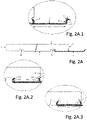
- FIG. 2A shows a panel (1) of such a set of panels, with a locking profile (3) clamped thereon.
- Each panel of the set of panels has a bottom surface (4), a top surface (5) - preferably finished with a decor and/or a wear layer, not shown in the figures - and a plurality of edges extending between the bottom and top surfaces.
- the panels are rectangular shaped with a pair of parallel longitudinal (long) edges (6-7) and a pair of parallel transversal (short) edges (8-9).
- a groove is provided in the bottom surface (4) of each panel, a first groove (10) extending parallel to and along the first edge (6) over the entire length of the panel and a second groove (11) extending parallel to and along the second edge (7).
- the first groove (10) is partially delimited by a sidewall or abutment surface (12) that at least partially extends slanting in view of the direction normal to the bottom surface (4) such that this sidewall inclines towards the first edge of the panel in a direction from the bottom surface (4) towards the top surface (5) of the panel and as such defines a wedge shaped section (13) in the panel between this sidewall (12) and the first edge (6).
- this sidewall (12) comprises two wall parts, a first wall part (12.1), most proximate to the bottom surface (4) of the panel extending substantially parallel to the direction normal to the bottom surface (4) and a second wall part (12.2) slanting in view of the first wall part (12.1) to define the wedge shaped section (13) as described supra.
- the first panel (1) further comprises a recess (14) provided in the first edge (6) that in this case is delimited by a sidewall (15) comprising a first part (15.1), most proximate to the bottom surface (4) of the panel extending substantially parallel to the direction normal to the bottom surface (4) and a second wall part (15.2) slanting in view of the first wall part inclined towards the second edge (7) of the panel in a direction from the bottom surface (4) towards the top surface (5) of the panel and as such defines the wedge shaped section (13) in the panel between the first edge (6) and the first groove (10).
- a sidewall comprising a first part (15.1), most proximate to the bottom surface (4) of the panel extending substantially parallel to the direction normal to the bottom surface (4) and a second wall part (15.2) slanting in view of the first wall part inclined towards the second edge (7) of the panel in a direction from the bottom surface (4) towards the top surface (5) of the panel and as such defines the wedge shaped section (13) in the panel
- the locking profile (3) comprises a base (16) and at least three protruding rims (17, 18, 19) extending parallel to one another in the longitudinal direction of the locking profile (3).
- a first rim (17) is lodged in the first groove (10) along the first edge (6) of the first panel and a third rim (19) that, in an assembled state of the set of panels, is lodged in the second groove (11) along the second edge (7) of the second panel.
- the second rim (18) is situated in the recess (14) provided in the first edge (6) of the first panel (1).
- both the first rim (17) and the second rim (18) are continuous and extends over the entire length of the locking profile (3).
- the third rims (17, 19) is continuous and extends over the entire length of the locking profile (3).
- the first rim (17) of the locking profile (3) preferably comprises two parts: a first part (17.1), most proximate to the base (16), extending in a direction substantially normal to the bottom surface (4) of the panel (1) when the locking profile (3) is clamped thereon; and a second part (17.2), most distant from the base (16) that is inclined in view of the first part (17.1) towards the second rim (18) over an angle ⁇ ranging between 50° and 90°, preferably between 60° and 70°.
- the first and second parts (17.1 and 17.2) of the first rim (17) thereby cooperate with, respectively, the first wall part (12.1) and second wall part (12.2) of the first groove (10).
- the second rim (18) of the locking profile (3) preferably comprises two parts: a first part (18.1), most proximate to the base (16), extending in a direction substantially normal to the bottom surface (4) of the panel when the locking profile (3) is clamped thereon; and a second part (18.2), most distant from the base (16) that is inclined in view of the first part (18.1) towards the first rim (17) over an angle ⁇ ranging between 60° and 80°, preferably between 65° and 75°.
- the first and second parts (18.1 and 18.2) of the second rim (18) thereby cooperate with, respectively, the first wall part (15.1) and second wall part (15.2) of the recess (14).
- first groove (10) and recess (14) of the first panel (1) and of the first and second rims (17, 18) of the locking profile (3) allows obtaining a strong and fail-proof clamping of the locking profile (3) on the first panel (1), whereby accidental release of the locking profile (3) is prevented.
- the third rim (19) of the locking profile (3) preferably comprises two parts: a first part (19.1), most proximate to the base (16) of the locking profile (3); and a second part (19.2), most distant from the base (16).
- the first part (19.1) is inclined away from the second rim (18) over an angle ⁇ with the base (16) of the locking profile (3) of at least 75°, preferably between 80°-90°, most preferably between 80°-86°.
- any or all can be designed as a rim extending in a same direction over its entire height, in which case this direction is preferably inclined at angles ⁇ , ⁇ and ⁇ respectively as described hereinabove.
- the locking profile (3) is an extruded profile manufactured in a plastic material (e.g. a glass-fiber reinforced plastic material, such as polystyrene) or preferably, in a metal material such as aluminum.
- a plastic material e.g. a glass-fiber reinforced plastic material, such as polystyrene
- a metal material such as aluminum
- the first panel (1) is positioned in place, with its bottom surface (4) and the base (16) of the locking profile (3) resting on a support surface (not shown). In this position, the part of the locking profile (3) between the second rim (18) and the third rim (19) is exposed and ready to receive an edge portion of the second panel (2).
- the third rim (19) of the locking profile is pressed in the second groove (11) of the second panel (2) such that it firmly contacts a sidewall (20) of that second groove (11) most proximate to the second edge (7) of the second panel and thereby locks the second panel from moving in view of the first panel in a direction perpendicular to the first and second edges (6, 7) of the first and second panels (1, 2) in the plane of the bottom surfaces (4) of both panels (1, 2).
- Such locking is commonly addressed as a horizontal lock between the panels.
- the strength of the horizontal lock defined as the force needed to tear both panels apart in the direction perpendicular to the first and second edges (6, 7) of the first and second panels (1, 2) in the plane of the bottom surfaces (4) of both panels (1, 2), is apart from material failure of the panels, dependent on the strength of the locking profile.
- a locking strength F MAX of at least 3 kN/m can be achieved when measured according to ISO24334 (2006), more preferably at least 4 kN/m.
- the thickness of the base (16) and the rims (17, 18, 19) preferably ranges between 0,4 mm and 1,2 mm, preferably between 0,5 mm and 0,8 mm. In some embodiments of the locking profile as explained further, the first and/or second rim may deviate from these ranges.
- the thickness of the base (16) of the locking profile (3) may vary between a first section (16.1) extending between the first rim (17) and the second rim (18) and a second section (16.2) extending between the second rim (18) and third rim (19).
- the thickness is preferably chosen to allow elastic bending of the locking profile (3) as shown in figure 7B while yet providing sufficient stretch resistance, this to allow easy assembly of the set of panels (1,2) by inserting the second edge (7) of the second panel (2) between the second and third rims (17, 18) of the locking profile (3), whereas the thickness of the first section (16.1) is preferably chosen to provide a desired clamping of the locking profile (3) on the first panel (1).
- the locking profiles (3) are preferably manufactured by extrusion. Once extruded, the locking profiles (3) are cut to a desired length, whereafter the cutted profiles (3) are stacked by positioning a plurality of locking profiles in a first orientation parallel to one another to create a first layer of locking profiles (3) and subsequently positioning a plurality of locking profiles in a second orientation parallel to one another and perpendicular to the first orientation to create a second layer of locking profiles (3) on top of the first layer of locking profiles.
- a third layer of locking profiles (3) positioned in the first orientation can subsequently be placed on the second layer of locking profiles and so on, thereby obtaining a cross-stack (21) of locking profiles (3) shown in figure 3A .
- the locking profiles (3) are subsequently destacked and positioned parallel to one another and in a predetermined position on a conveyor for feeding the locking profiles (3) one by one to a panel-assembly apparatus.
- one locking profile (3) is first aligned with the first edge (6) of a first panel (1) by positioning the second rim (18) of the locking profile (3) against the first edge (6), preferably against sidewall (15) of the first edge (6), of the first panel (1).
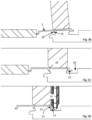
- the locking profile (3) is pressed against the bottom surface (4) of the panel (1), thereby pressing the first rim (17) of the locking profile (3) in the first groove (10) of the first panel (1).
- This pressing operation is preferably performed by guiding a first press-roll (22) over the locking profile (3).
- the first rim (17) of the locking profile (3) is at least partially bent by pressing the first rim (17) firmly against the abutment or sidewall surface (12) of the first groove (10) thereby ensuring that the wedge-shaped section (13) of the first panel (1) is adequately clamped between the first and second rim (17, 18) of the concerning locking profile (3).
- This pressing is preferably performed by a second press-roll assembly (23) which preferably presses a second part (17.2) of the first rim (17) firmly against or even partially into second wall part (12.2).
- the first rim (17) of the locking profile (3) when extruded, is configured to allow bending the first rim (17) towards the second rim (18), for clamping said locking profile (3) on a panel (1), while still providing sufficient resistance against bending the first rim (17) backwards such that the tensile strength of the locking profile (3), measured in the plane of the base (16) of the locking profile (3) is at least 3 kN/m measured in accordance with ISO24334(2006), preferably at least 4 kN/m.
- the first rim (17) is permanently deformed by the bending operation.
- heat may be applied to the first rim (17) just before, during or after bending the first rim (17) to make the deformation of the first rim permanent thereby ensuring clamping of the locking profile (3) on a panel (1).
- Figures 4-6 represent alternative embodiments of a locking profile (3) of the set of panels according to the present invention.
- the locking profile (3) shown in Figure 4 comprises a base (16) and three protruding rims (17, 18, 19) extending parallel to one another in the longitudinal direction of the locking profile (3).
- This protrusion (24) positioned at a distance from the base (16) of the locking profile (3), facilitating clamping the locking profile (3) on the first panel (1) as the inclined second part (17.2) of the first rim (17) of the locking profile described with reference to figure 2A .
- the locking profile shown in Figure 5 comprises a base (16) and three protruding rims (17, 18, 19) extending parallel to one another in the longitudinal direction of the locking profile (3).
- the second rim (18) comprises a first wing (25) and a second wing (26).
- the first wing (25) is inclined towards the first rim (17) of the locking profile (3) and has the same function of clamping the locking profile (3) on the first panel (1) as the inclined second part (18.2) of the second rim (18) of the locking profile described with reference to Figure 2A .
- the second wing (26) is inclined towards the third rim (19) and as such defines a groove (27) between the base (16) of the locking profile (3), the second rim (18) and the second wing (26).
- the second edge (7) of each panel comprises a recess (28) configured to accommodate the second wing (26).
- the locking profile (3) shown in Figure 6 comprises a base (16) and three protruding rims (17, 18, 19) extending parallel to one another in the longitudinal direction of the locking profile (3).
- the second rim (18) is designed as a composite rim having two or more parallel and spaced apart rims (181, 182) or else can be described as a rim (18) having a central void.
- both spaced apart rims (181 and 182) comprise a wing.
- the first spaced apart rim (181), situated most proximate to the first rim (17), comprises a wing (25) that is inclined towards the first rim (17) of the locking profile (3).
- This rim (181) has the same function as the second rim (18) of the locking profile described with reference to figure 2B .
- the second spaced apart rim (182) located most distant from the first rim (17) comprises a second wing (26), inclined towards the third rim (19) and as such defines a groove (27) between the base (16) of the locking profile (3), the second rim (18) and the second wing (26).
- a slot (30) comprising in this case a female snap-fit locking means (31), wherein a spacer (32) having a corresponding male snap-fit locking means (33) is disposed.
- the spacer is positioned between the facing edges (6, 7) of the first and second panels (1,2) locked by the locking profile.
- the locking between spacer (32) and locking profile (3) can be executed in accordance with a multitude of alternatives without departing from the present invention as defined in the appended claims.
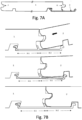
- FIG 7A and 7B an assembly of panels is shown that differs from the embodiment of Figure 2A in that the first and second edges (6, 7) of the panels (1, 2) are configured as a tongue and groove system allowing vertically locking both panels once assembled.
- the tongue is provided on the first edge (6) of the first panel (1), while the groove is provided in the second edge (7) of the second panel (2), yet clearly it is also possible to provide the tongue on the second edge (7) of the second panel (2) and to provide the groove in the first edge (6) of the first panel (1).
- the thickness of the base (16) of the locking profile may vary between a first section (16.1) extending between the first rim (17) and second rim (18) and a second section (16.2) extending between the second rim (18) and the third rim (19).
- the thickness is preferably chosen to allow elastic bending of the locking profile (3) as shown in figure 7B while yet providing sufficient stretch resistance, this to allow easy assembly of the set of panels (1, 2) by inserting the second edge (7) of the second panel (2) between the second and third rims (18, 19) of the locking profile (3), whereas the thickness of the first section (16.1) is preferably chosen to provide a desired clamping of the locking profile (3) on the first panel (1).
- first and second edges (6 and 7), without limitation to the shape of the panels and without specifying, in case the panels are rectangular, whether the concerned first and second edges are longitudinal edges (long edges) or transversal edges (short edges). It is therefore clear that for the above description, no limitation to position or length of the pair of parallel edges was intended.
- each panel comprises in addition to the above first and second edges (6, 7) and the corresponding locking profile (3):
- the locking profile disposed at a long side of the panel is allowed to extend into the corner region defined by the first and third edges of the panel, whereas the locking profile disposed at the short edge of the panel does not extend into that corner portion or vice versa.
- the minimum and maximum length of the locking profile disposed along a single side of a panel there is no real limit on the minimum and maximum length of the locking profile disposed along a single side of a panel and lengths varying from 5 cm up to several meters can be envisaged.
- the locking profile has a length that is a multitude smaller than the length of the side on which it is disposed, a plurality of locking profiles is disposed on that same edge of the panel, with the sum of the lengths of the locking profiles disposed on that edge being equal to or larger than at least 80% of the total length of the concerned side edge.
- the panels can be be made from many different materials or combinations of materials as long as it is feasible to make the retaining profiles as described hereinbefore, on their edges.
- the panels may be wood-based (e.g. solid wood, a fiberboard (MDF, HDF), or a particle board).
- the panels may also be made of, or at least comprising a layer of, synthetic material.
- synthetic material as used in the context of the current invention can be a single polymer or a blend of two or more polymers.
- the synthetic material can be, for example, a thermoplastic polymer, a thermosetting polymer, a rubber (elastomer), or any combinations thereof.
- the polymeric material is a thermoplastic polymer that includes vinyl containing thermoplastics such as polyvinyl chloride, polyvinyl acetate, polyvinyl alcohol, and other vinyl and vinylidene resins and copolymers thereof; polyethylenes such as low density polyethylenes and high density polyethylenes and copolymers thereof; styrenes such as ABS, SAN, and polystyrenes and copolymers thereof, polypropylene and copolymers thereof; saturated and unsaturated polyesters; acrylics; polyamides such as nylon containing types; engineering plastics such as polycarbonate, polyimide, polysulfone, and polyphenylene oxide and sulfide resins and the like.
- the synthetic material compound used to form the panel or a layer thereof can be a PVC powder compound that has good impact strength, ease of processing, high extrusion rate, good surface properties, excellent dimensional stability, and indentation resistance.
- the panels may also comprise composite materials, or one or more layers thereof, such as wood-plastic composites (WPC), referring to a composite structure comprising a wood- based material and a synthetic material.
- WPC wood-plastic composites
- the panel may comprise multiple layers which can be identical or different with respect to composition and/or physical properties.
Landscapes
- Engineering & Computer Science (AREA)
- Architecture (AREA)
- Civil Engineering (AREA)
- Structural Engineering (AREA)
- Life Sciences & Earth Sciences (AREA)
- Wood Science & Technology (AREA)
- Finishing Walls (AREA)
- Roof Covering Using Slabs Or Stiff Sheets (AREA)
- Floor Finish (AREA)
Claims (12)
- Ensemble de panneaux (1, 2), chaque panneau comprenant :• une surface supérieure (5) et une surface inférieure (4) ;• un premier bord (6) et un deuxième bord (7) parallèle au premier bord (6), lesdits bords (6, 7) s'étendant entre lesdites surfaces supérieure et inférieure (5, 4) ;• une première rainure (10) prévue dans la surface inférieure (4) de chaque panneau, ladite première rainure (10) s'étendant parallèlement à et le long du premier bord (6) du panneau ;• une deuxième rainure (11) prévue dans la surface inférieure (4) de chaque panneau, ladite deuxième rainure (11) s'étendant parallèlement à la première rainure (10) le long du deuxième bord (7) du panneau ;• un profilé de verrouillage (3) permettant de verrouiller un premier panneau (1) avec son premier bord (6) au deuxième bord (7) d'un deuxième panneau (2), ledit profilé de verrouillage (3) comprenant une base (16) et au au moins trois rebords saillants (17, 18, 19) s'étendant parallèlement les uns aux autres dans la direction longitudinale du profilé de verrouillage (3), un premier rebord (17) inséré par pression dans la première rainure (10) d'un premier panneau (1) et un deuxième rebord (18) situé entre les premier et troisième rebords (17, 19) de chaque profilé de verrouillage (3) et coopérant avec une partie du premier panneau (1) de sorte qu'une section (13) de la surface inférieure (4) du premier panneau (1) est serrée de manière parmanente entre le premier rebord et le deuxième rebord (17, 18) du profilé de verrouillage (3), le troisième rebord (19) étant configuré pour s'adapter dans la deuxième rainure (11) d'un deuxième panneau (2) en verrouillant ainsi le deuxième panneau (2) au premier panneau (1), caractérisé en ce qu'au moins le premier rebord (17) et le deuxième rebord (18) sont continus sur toute la longueur du profilé de verrouillage (3), et en ce que la première rainure (10) définit une surface de butée (12) pour le premier rebord (17), laquelle surface de butée (12) est inclinée en vue de la surface inférieure (4) de sorte que la section (13) du premier panneau (1) serrée entre le premier rebord (17) et le deuxième rebord (18) du profilé de verrouillage (3) augmente en largeur vers la surface inférieure (4) du panneau (1).
- Ensemble de panneaux (1, 2) selon la revendication 1, dans lequel ledit profilé de verrouillage (3) est fabriqué par extrusion.
- Ensemble de panneaux (1, 2) selon la revendication 1 ou 2, dans lequel ledit profilé de verrouillage (3) est fabriqué à partir d'un matériau métallique, de préférence de l'aluminium.
- Ensemble de panneaux (1, 2) selon l'une quelconque des revendications précédentes, chaque panneau comprenant un évidement (14) dans son premier bord (6), ledit évidement (14) s'étendant dans la direction longitudinale du premier bord (6), ledit évidement (14) logeant au moins partiellement le deuxième rebord (18) du profilé de verrouillage (3) concerné.
- Ensemble de panneaux (1, 2) selon l'une quelconque des revendications précédentes, dans lequel ledit deuxième rebord (18) est incliné vers le premier rebord (17) du profilé de verrouillage (3).
- Ensemble de panneaux (1, 2) selon l'une quelconque des revendications précédentes, le deuxième rebord (18) comprenant deux ailes (25, 26) à son extrémité libre, une première aile (25) inclinée vers le premier rebord (17) du profilé de verrouillage (3) et s'étendant jusque dans l'évidement (14) dans le premier bord (6), et une seconde aile (26) inclinée vers le troisième rebord (19) du profilé de verrouillage (3) et s'étendant jusque dans un évidement (28) prévu le long du deuxième bord (7) d'un deuxième panneau (2).
- Ensemble de panneaux (1, 2) selon les revendications 1-5, dans lequel le deuxième rebord (18) du profilé de verrouillage (3) est un rebord composé présentant deux rebords parallèles et espacés (181, 182) ou plus, de préférence configuré pour recevoir une entretoise (32) après verrouillage du deuxième panneau (2) au premier panneau (1) avec une distance prédéfinie entre les deux panneaux (1, 2).
- Ensemble de panneaux (1, 2) selon l'une quelconque des revendications précédentes, dans lequel un ou plusieurs profilés de verrouillage sont prévus le long du premier bord (6) d'un premier panneau (1), lesdits un ou plusieurs profils de verrouillage présentant une longueur totale égale ou supérieure à 80 % de la longueur du premier bord (6).
- Ensemble de panneaux (1, 2) selon l'une quelconque des revendications précédentes, lesdits panneaux comprenant :• un troisième bord (8) et un quatrième bord (9) parallèles au troisième bord (8), lesdits bords (8, 9) s'étendant entre la surface supérieure (5) et la surface inférieure (4) du panneau (1) ;• une troisième rainure (34) prévue dans la surface inférieure (4) de chaque panneau, ladite troisième rainure (34) s'étendant parallèlement à et le long du troisième bord (8) du panneau (1) ;• une quatrième rainure (35) prévue dans la surface inférieure (4) de chaque panneau, ladite quatrième rainure (35) s'étendant parallèlement à la troisième rainure (34) le long du quatrième bord (9) du panneau (1) ;• un second profilé de verrouillage (36) permettant de verrouiller un premier panneau (1) avec son troisième bord (8) au quatrième bord (9) d'un troisième panneau, ledit second profilé de verrouillage (36) comprenant une base (16) et au moins trois rebords saillants (17, 18, 19) s'étendant parallèlement les uns aux autres dans la direction longitudinale du profilé de verrouillage (36), un premier rebord (17) adapté par pression dans la troisième rainure (34) d'un premier panneau (1) et un deuxième rebord (18) situé entre les premier et troisième rebords (17, 19) de chaque second profilé de verrouillage (36) et coopérant avec une partie du premier panneau (1) de sorte qu'une section de la surface inférieure (4) du premier panneau (1) est serrée entre le premier rebord (17) et le deuxième rebord (18) du second profilé de verrouillage (36), le troisième rebord (19) étant configuré pour s'adapter dans la quatrième rainure (35) d'un troisième panneau en verrouillant ainsi le troisième panneau au premier panneau (1), dans lequel au moins le deuxième rebord (18) du second profilé de verrouillage (36) est continu sur toute la longueur dudit second profilé de verrouillage (36).
- Ensemble de panneaux selon l'une quelconque des revendications précédentes, dans lequel les premier et deuxième bords (6, 7) sont configurés pour définir un système à rainure et languette.
- Procédé de fabrication d'un ensemble de panneaux (1, 2), le procédé comprenant les étapes consistant à :a. fournir un premier panneau (1) présentant :• une surface supérieure (5) et une surface inférieure (4) ;• un premier bord (6) et un deuxième bord (7) parallèle au premier bord (6), lesdits bords (6, 7) s'étendant entre lesdites surfaces supérieure et inférieure (5, 4) ;• une première rainure (10) prévue dans la surface inférieure (4) de chaque panneau (1, 2), ladite première rainure (10) s'étendant parallèlement à et le long du premier bord (6) du panneau ;• une deuxième rainure (11) prévue dans la surface inférieure (4) de chaque panneau (1, 2), ladite deuxième rainure (11) s'étendant parallèlement à la première rainure (10) le long du deuxième bord (7) du panneau ;b. fournir un profilé de verrouillage (3) comprenant une base (16) et au moins trois rebords saillants (17, 18, 19) s'étendant parallèlement les uns aux autres dans la direction longitudinale du profilé de verrouillage (3), dans lequel au moins un premier rebord (17) et un deuxième rebord (18) - situé entre le premier rebord (17) et un troisième rebord (19) - sont continus sur toute la longueur du profilé de verrouillage (3) ;c. positionner le deuxième rebord (18) du profilé de verrouillage (3) contre une surface de butée (15) du premier panneau (1) ;d. insérer par pression le premier rebord (17) dudit profilé de verrouillage (3) dans la première rainure (10) du premier panneau (1), de sorte qu'une section (13) du panneau est serrée entre le premier rebord (17) et le deuxième rebord (18) du profilé de verrouillage (3) ; ete. déformer de manière permanente le premier rebord (17) du profilé de verrouillage (3) en le pliant dans la direction du deuxième rebord (18) après avoir inséré par pression le premier rebord (17) dans la première rainure (10) du premier panneau (1), la première rainure (10) définissant une surface de butée (12) pour le premier rebord (17), laquelle surface de butée (12) est inclinée en vue de la surface inférieure (4) de sorte que la section (13) du premier panneau (1) serrée entre le premier rebord (17) et le deuxième rebord (18) du profilé de verrouillage augmente en largeur vers la surface inférieure du panneau (1).
- Assemblage de panneaux comprenant un ensemble de panneaux (1, 2) tel que défini dans l'une quelconque des revendications 1-10.
Applications Claiming Priority (2)
| Application Number | Priority Date | Filing Date | Title |
|---|---|---|---|
| EP16151625 | 2016-01-15 | ||
| PCT/EP2017/050669 WO2017121851A1 (fr) | 2016-01-15 | 2017-01-13 | Ensemble de panneaux, procédé de fabrication d'un tel ensemble de panneaux, assemblage des panneaux et profilé de verrouillage utilisé dans lesdits panneaux |
Publications (2)
| Publication Number | Publication Date |
|---|---|
| EP3402939A1 EP3402939A1 (fr) | 2018-11-21 |
| EP3402939B1 true EP3402939B1 (fr) | 2023-02-01 |
Family
ID=55177779
Family Applications (1)
| Application Number | Title | Priority Date | Filing Date |
|---|---|---|---|
| EP17700366.2A Active EP3402939B1 (fr) | 2016-01-15 | 2017-01-13 | Ensemble de panneaux comportant une bande de verrouillage, procede de fabrication d'un tel ensemble de panneaux, et assemblage des panneaux |
Country Status (13)
| Country | Link |
|---|---|
| US (1) | US11486147B2 (fr) |
| EP (1) | EP3402939B1 (fr) |
| JP (1) | JP2019502045A (fr) |
| CN (1) | CN108884679A (fr) |
| CA (1) | CA3010903C (fr) |
| DK (1) | DK3402939T3 (fr) |
| ES (1) | ES2943065T3 (fr) |
| FI (1) | FI3402939T3 (fr) |
| HU (1) | HUE062077T2 (fr) |
| LT (1) | LT3402939T (fr) |
| PL (1) | PL3402939T3 (fr) |
| RU (1) | RU2018127782A (fr) |
| WO (1) | WO2017121851A1 (fr) |
Families Citing this family (5)
| Publication number | Priority date | Publication date | Assignee | Title |
|---|---|---|---|---|
| CA3022306C (fr) * | 2016-04-26 | 2020-02-11 | Les Plafonds Embassy Inc. | Pince modulaire servant a joindre des elements de plafond suspendu |
| DE102017105146A1 (de) * | 2017-03-10 | 2018-09-13 | GKT Gummi- und Kunststofftechnik Fürstenwalde GmbH | Bodendielensystem |
| CN114182912A (zh) | 2017-06-27 | 2022-03-15 | 地板工业有限公司 | 墙壁或天花板面板、墙壁或天花板组件和相关安装方法 |
| IT201900003627A1 (it) * | 2019-03-13 | 2020-09-13 | Parchettificio Garbelotto S R L | Giunto per pavimenti di listelli |
| US11939776B2 (en) | 2020-10-15 | 2024-03-26 | Solutions Murales Proslat, Inc. | Reinforced slatwall assembly |
Citations (2)
| Publication number | Priority date | Publication date | Assignee | Title |
|---|---|---|---|---|
| WO1994026999A1 (fr) * | 1993-05-10 | 1994-11-24 | Välinge Aluminium AB | Systeme d'assemblage de panneaux de construction |
| WO2012159162A1 (fr) * | 2011-05-24 | 2012-11-29 | Inotec International Pty Ltd | Coulisseau pour assembler deux substrats |
Family Cites Families (24)
| Publication number | Priority date | Publication date | Assignee | Title |
|---|---|---|---|---|
| SE509060C2 (sv) * | 1996-12-05 | 1998-11-30 | Valinge Aluminium Ab | Metod för tillverkning av byggnadsskiva såsom en golvskiva |
| SE509059C2 (sv) | 1996-12-05 | 1998-11-30 | Valinge Aluminium Ab | Metod och utrustning för framställning av en byggnadsskiva, såsom en golvskiva |
| US7386963B2 (en) * | 1998-06-03 | 2008-06-17 | Valinge Innovation Ab | Locking system and flooring board |
| SE512313E (sv) * | 1998-06-03 | 2004-03-16 | Valinge Aluminium Ab | Låssystem samt golvskiva |
| SE513189C2 (sv) * | 1998-10-06 | 2000-07-24 | Perstorp Flooring Ab | Vertikalmonterbart golvbeläggningsmaterial innefattande skivformiga golvelement vilka sammanfogas med hjälp av separata sammanfogningsprofiler |
| SE515789C2 (sv) * | 1999-02-10 | 2001-10-08 | Perstorp Flooring Ab | Golvbeläggningsmaterial innefattande golvelement vilka är avsedda att sammanfogas vertikalt |
| JP3064349U (ja) * | 1999-05-27 | 2000-01-14 | 富 敏 荘 | 綴り合わせ方式の木質床構造 |
| US6449918B1 (en) * | 1999-11-08 | 2002-09-17 | Premark Rwp Holdings, Inc. | Multipanel floor system panel connector with seal |
| US6339908B1 (en) * | 2000-07-21 | 2002-01-22 | Fu-Ming Chuang | Wood floor board assembly |
| JP4472355B2 (ja) * | 2002-04-03 | 2010-06-02 | ベーリンゲ、イノベイション、アクチボラグ | フロアボード用機械式係止システム |
| US7051486B2 (en) * | 2002-04-15 | 2006-05-30 | Valinge Aluminium Ab | Mechanical locking system for floating floor |
| US7171790B2 (en) * | 2004-03-22 | 2007-02-06 | Tzu-Chiang Mei | Clamp unit for Do-It-Yourself (DIY) solid wood flooring |
| KR100762943B1 (ko) * | 2006-05-19 | 2007-10-02 | 주식회사 한솔홈데코 | 결합구를 이용한 조립식 바닥재 및 이의 조립 방법 |
| US7805903B2 (en) * | 2007-12-13 | 2010-10-05 | Liu David C | Locking mechanism for flooring boards |
| TWM373948U (en) * | 2009-07-22 | 2010-02-11 | Feng-Ling Yang | Assembly floor |
| EP4092213B1 (fr) * | 2010-01-11 | 2023-12-13 | Välinge Innovation AB | Revêtement de sol avec conception d'interverrouillage |
| GB2483525B (en) * | 2011-02-03 | 2013-05-01 | Oliver James Furniture Ltd | A panel connection system |
| EP2492416A1 (fr) | 2011-02-28 | 2012-08-29 | Silicalia S.L. | Système pour le revêtement de sol |
| US8763340B2 (en) * | 2011-08-15 | 2014-07-01 | Valinge Flooring Technology Ab | Mechanical locking system for floor panels |
| CN102493625B (zh) * | 2011-12-21 | 2014-12-10 | 张家铭 | 锁扣式板材连接件及其板材 |
| US10060139B2 (en) * | 2013-07-09 | 2018-08-28 | Ceraloc Innovation Ab | Mechanical locking system for floor panels |
| RU2662745C2 (ru) * | 2013-10-25 | 2018-07-30 | Сералок Инновейшн Аб | Механическая замковая система для панелей пола |
| US9441379B2 (en) * | 2014-08-27 | 2016-09-13 | Evan J. Stover | Flooring system having assembly clip and related method |
| CN106032696B (zh) * | 2015-03-18 | 2019-03-08 | 杨凤玲 | 拼接地板 |
-
2017
- 2017-01-13 CA CA3010903A patent/CA3010903C/fr active Active
- 2017-01-13 US US16/066,570 patent/US11486147B2/en active Active
- 2017-01-13 WO PCT/EP2017/050669 patent/WO2017121851A1/fr not_active Ceased
- 2017-01-13 PL PL17700366.2T patent/PL3402939T3/pl unknown
- 2017-01-13 DK DK17700366.2T patent/DK3402939T3/da active
- 2017-01-13 EP EP17700366.2A patent/EP3402939B1/fr active Active
- 2017-01-13 RU RU2018127782A patent/RU2018127782A/ru unknown
- 2017-01-13 FI FIEP17700366.2T patent/FI3402939T3/fi active
- 2017-01-13 JP JP2018537532A patent/JP2019502045A/ja active Pending
- 2017-01-13 HU HUE17700366A patent/HUE062077T2/hu unknown
- 2017-01-13 LT LTEPPCT/EP2017/050669T patent/LT3402939T/lt unknown
- 2017-01-13 CN CN201780006390.5A patent/CN108884679A/zh active Pending
- 2017-01-13 ES ES17700366T patent/ES2943065T3/es active Active
Patent Citations (2)
| Publication number | Priority date | Publication date | Assignee | Title |
|---|---|---|---|---|
| WO1994026999A1 (fr) * | 1993-05-10 | 1994-11-24 | Välinge Aluminium AB | Systeme d'assemblage de panneaux de construction |
| WO2012159162A1 (fr) * | 2011-05-24 | 2012-11-29 | Inotec International Pty Ltd | Coulisseau pour assembler deux substrats |
Also Published As
| Publication number | Publication date |
|---|---|
| JP2019502045A (ja) | 2019-01-24 |
| WO2017121851A1 (fr) | 2017-07-20 |
| CN108884679A (zh) | 2018-11-23 |
| DK3402939T3 (da) | 2023-05-01 |
| HUE062077T2 (hu) | 2023-09-28 |
| RU2018127782A3 (fr) | 2020-05-18 |
| PL3402939T3 (pl) | 2023-05-15 |
| CA3010903C (fr) | 2023-12-05 |
| CA3010903A1 (fr) | 2017-07-20 |
| FI3402939T3 (fi) | 2023-05-03 |
| EP3402939A1 (fr) | 2018-11-21 |
| US20180355618A1 (en) | 2018-12-13 |
| US11486147B2 (en) | 2022-11-01 |
| RU2018127782A (ru) | 2020-02-17 |
| ES2943065T3 (es) | 2023-06-08 |
| LT3402939T (lt) | 2023-05-10 |
Similar Documents
| Publication | Publication Date | Title |
|---|---|---|
| EP3402939B1 (fr) | Ensemble de panneaux comportant une bande de verrouillage, procede de fabrication d'un tel ensemble de panneaux, et assemblage des panneaux | |
| US11898356B2 (en) | Floorboards provided with a mechanical locking system | |
| AU2019333191B2 (en) | Set of panels with a mechanical locking device | |
| EP3594429B1 (fr) | Jeu de panneaux de plancher idéntiques avec système de verrouillage mécanique | |
| EP3486401B1 (fr) | Panneau de plancher | |
| CN105658883B (zh) | 用于地板镶板的机械锁定系统 | |
| US10876302B2 (en) | Set of panels for floor, wall or ceiling covering | |
| EP2964851B1 (fr) | Panneaux de construction pourvus d'un système de verrouillage mécanique |
Legal Events
| Date | Code | Title | Description |
|---|---|---|---|
| STAA | Information on the status of an ep patent application or granted ep patent |
Free format text: STATUS: UNKNOWN |
|
| STAA | Information on the status of an ep patent application or granted ep patent |
Free format text: STATUS: THE INTERNATIONAL PUBLICATION HAS BEEN MADE |
|
| PUAI | Public reference made under article 153(3) epc to a published international application that has entered the european phase |
Free format text: ORIGINAL CODE: 0009012 |
|
| STAA | Information on the status of an ep patent application or granted ep patent |
Free format text: STATUS: REQUEST FOR EXAMINATION WAS MADE |
|
| 17P | Request for examination filed |
Effective date: 20180816 |
|
| AK | Designated contracting states |
Kind code of ref document: A1 Designated state(s): AL AT BE BG CH CY CZ DE DK EE ES FI FR GB GR HR HU IE IS IT LI LT LU LV MC MK MT NL NO PL PT RO RS SE SI SK SM TR |
|
| AX | Request for extension of the european patent |
Extension state: BA ME |
|
| DAV | Request for validation of the european patent (deleted) | ||
| DAX | Request for extension of the european patent (deleted) | ||
| RAP1 | Party data changed (applicant data changed or rights of an application transferred) |
Owner name: BEAULIEU INTERNATIONAL GROUP NV |
|
| STAA | Information on the status of an ep patent application or granted ep patent |
Free format text: STATUS: EXAMINATION IS IN PROGRESS |
|
| 17Q | First examination report despatched |
Effective date: 20200224 |
|
| GRAP | Despatch of communication of intention to grant a patent |
Free format text: ORIGINAL CODE: EPIDOSNIGR1 |
|
| STAA | Information on the status of an ep patent application or granted ep patent |
Free format text: STATUS: GRANT OF PATENT IS INTENDED |
|
| RIC1 | Information provided on ipc code assigned before grant |
Ipc: E04F 13/08 20060101ALI20220718BHEP Ipc: E04F 15/04 20060101ALI20220718BHEP Ipc: E04F 15/02 20060101AFI20220718BHEP |
|
| INTG | Intention to grant announced |
Effective date: 20220818 |
|
| GRAS | Grant fee paid |
Free format text: ORIGINAL CODE: EPIDOSNIGR3 |
|
| GRAA | (expected) grant |
Free format text: ORIGINAL CODE: 0009210 |
|
| STAA | Information on the status of an ep patent application or granted ep patent |
Free format text: STATUS: THE PATENT HAS BEEN GRANTED |
|
| AK | Designated contracting states |
Kind code of ref document: B1 Designated state(s): AL AT BE BG CH CY CZ DE DK EE ES FI FR GB GR HR HU IE IS IT LI LT LU LV MC MK MT NL NO PL PT RO RS SE SI SK SM TR |
|
| REG | Reference to a national code |
Ref country code: GB Ref legal event code: FG4D |
|
| REG | Reference to a national code |
Ref country code: CH Ref legal event code: EP Ref country code: AT Ref legal event code: REF Ref document number: 1546978 Country of ref document: AT Kind code of ref document: T Effective date: 20230215 |
|
| REG | Reference to a national code |
Ref country code: DE Ref legal event code: R096 Ref document number: 602017065881 Country of ref document: DE |
|
| REG | Reference to a national code |
Ref country code: IE Ref legal event code: FG4D |
|
| REG | Reference to a national code |
Ref country code: RO Ref legal event code: EPE |
|
| REG | Reference to a national code |
Ref country code: NL Ref legal event code: FP |
|
| REG | Reference to a national code |
Ref country code: DK Ref legal event code: T3 Effective date: 20230426 |
|
| REG | Reference to a national code |
Ref country code: SE Ref legal event code: TRGR |
|
| REG | Reference to a national code |
Ref country code: ES Ref legal event code: FG2A Ref document number: 2943065 Country of ref document: ES Kind code of ref document: T3 Effective date: 20230608 |
|
| REG | Reference to a national code |
Ref country code: NO Ref legal event code: T2 Effective date: 20230201 |
|
| P01 | Opt-out of the competence of the unified patent court (upc) registered |
Effective date: 20230517 |
|
| PG25 | Lapsed in a contracting state [announced via postgrant information from national office to epo] |
Ref country code: RS Free format text: LAPSE BECAUSE OF FAILURE TO SUBMIT A TRANSLATION OF THE DESCRIPTION OR TO PAY THE FEE WITHIN THE PRESCRIBED TIME-LIMIT Effective date: 20230201 Ref country code: PT Free format text: LAPSE BECAUSE OF FAILURE TO SUBMIT A TRANSLATION OF THE DESCRIPTION OR TO PAY THE FEE WITHIN THE PRESCRIBED TIME-LIMIT Effective date: 20230601 Ref country code: LV Free format text: LAPSE BECAUSE OF FAILURE TO SUBMIT A TRANSLATION OF THE DESCRIPTION OR TO PAY THE FEE WITHIN THE PRESCRIBED TIME-LIMIT Effective date: 20230201 Ref country code: HR Free format text: LAPSE BECAUSE OF FAILURE TO SUBMIT A TRANSLATION OF THE DESCRIPTION OR TO PAY THE FEE WITHIN THE PRESCRIBED TIME-LIMIT Effective date: 20230201 |
|
| PG25 | Lapsed in a contracting state [announced via postgrant information from national office to epo] |
Ref country code: IS Free format text: LAPSE BECAUSE OF FAILURE TO SUBMIT A TRANSLATION OF THE DESCRIPTION OR TO PAY THE FEE WITHIN THE PRESCRIBED TIME-LIMIT Effective date: 20230601 Ref country code: GR Free format text: LAPSE BECAUSE OF FAILURE TO SUBMIT A TRANSLATION OF THE DESCRIPTION OR TO PAY THE FEE WITHIN THE PRESCRIBED TIME-LIMIT Effective date: 20230502 |
|
| REG | Reference to a national code |
Ref country code: HU Ref legal event code: AG4A Ref document number: E062077 Country of ref document: HU |
|
| PG25 | Lapsed in a contracting state [announced via postgrant information from national office to epo] |
Ref country code: SM Free format text: LAPSE BECAUSE OF FAILURE TO SUBMIT A TRANSLATION OF THE DESCRIPTION OR TO PAY THE FEE WITHIN THE PRESCRIBED TIME-LIMIT Effective date: 20230201 Ref country code: EE Free format text: LAPSE BECAUSE OF FAILURE TO SUBMIT A TRANSLATION OF THE DESCRIPTION OR TO PAY THE FEE WITHIN THE PRESCRIBED TIME-LIMIT Effective date: 20230201 |
|
| REG | Reference to a national code |
Ref country code: DE Ref legal event code: R097 Ref document number: 602017065881 Country of ref document: DE |
|
| PG25 | Lapsed in a contracting state [announced via postgrant information from national office to epo] |
Ref country code: SK Free format text: LAPSE BECAUSE OF FAILURE TO SUBMIT A TRANSLATION OF THE DESCRIPTION OR TO PAY THE FEE WITHIN THE PRESCRIBED TIME-LIMIT Effective date: 20230201 |
|
| PLBE | No opposition filed within time limit |
Free format text: ORIGINAL CODE: 0009261 |
|
| STAA | Information on the status of an ep patent application or granted ep patent |
Free format text: STATUS: NO OPPOSITION FILED WITHIN TIME LIMIT |
|
| 26N | No opposition filed |
Effective date: 20231103 |
|
| REG | Reference to a national code |
Ref country code: AT Ref legal event code: UEP Ref document number: 1546978 Country of ref document: AT Kind code of ref document: T Effective date: 20230201 |
|
| PG25 | Lapsed in a contracting state [announced via postgrant information from national office to epo] |
Ref country code: SI Free format text: LAPSE BECAUSE OF FAILURE TO SUBMIT A TRANSLATION OF THE DESCRIPTION OR TO PAY THE FEE WITHIN THE PRESCRIBED TIME-LIMIT Effective date: 20230201 |
|
| PG25 | Lapsed in a contracting state [announced via postgrant information from national office to epo] |
Ref country code: MC Free format text: LAPSE BECAUSE OF FAILURE TO SUBMIT A TRANSLATION OF THE DESCRIPTION OR TO PAY THE FEE WITHIN THE PRESCRIBED TIME-LIMIT Effective date: 20230201 |
|
| PG25 | Lapsed in a contracting state [announced via postgrant information from national office to epo] |
Ref country code: MC Free format text: LAPSE BECAUSE OF FAILURE TO SUBMIT A TRANSLATION OF THE DESCRIPTION OR TO PAY THE FEE WITHIN THE PRESCRIBED TIME-LIMIT Effective date: 20230201 |
|
| PG25 | Lapsed in a contracting state [announced via postgrant information from national office to epo] |
Ref country code: LU Free format text: LAPSE BECAUSE OF NON-PAYMENT OF DUE FEES Effective date: 20240113 |
|
| PG25 | Lapsed in a contracting state [announced via postgrant information from national office to epo] |
Ref country code: LU Free format text: LAPSE BECAUSE OF NON-PAYMENT OF DUE FEES Effective date: 20240113 |
|
| PGFP | Annual fee paid to national office [announced via postgrant information from national office to epo] |
Ref country code: PL Payment date: 20241218 Year of fee payment: 9 |
|
| PGFP | Annual fee paid to national office [announced via postgrant information from national office to epo] |
Ref country code: BG Payment date: 20241219 Year of fee payment: 9 |
|
| PGFP | Annual fee paid to national office [announced via postgrant information from national office to epo] |
Ref country code: CZ Payment date: 20241220 Year of fee payment: 9 |
|
| PGFP | Annual fee paid to national office [announced via postgrant information from national office to epo] |
Ref country code: HU Payment date: 20241220 Year of fee payment: 9 |
|
| PGFP | Annual fee paid to national office [announced via postgrant information from national office to epo] |
Ref country code: AT Payment date: 20241219 Year of fee payment: 9 Ref country code: CH Payment date: 20250201 Year of fee payment: 9 |
|
| PG25 | Lapsed in a contracting state [announced via postgrant information from national office to epo] |
Ref country code: CY Free format text: LAPSE BECAUSE OF FAILURE TO SUBMIT A TRANSLATION OF THE DESCRIPTION OR TO PAY THE FEE WITHIN THE PRESCRIBED TIME-LIMIT; INVALID AB INITIO Effective date: 20170113 |
|
| REG | Reference to a national code |
Ref country code: CH Ref legal event code: U11 Free format text: ST27 STATUS EVENT CODE: U-0-0-U10-U11 (AS PROVIDED BY THE NATIONAL OFFICE) Effective date: 20260201 |
|
| PGFP | Annual fee paid to national office [announced via postgrant information from national office to epo] |
Ref country code: NL Payment date: 20260126 Year of fee payment: 10 |
|
| PGFP | Annual fee paid to national office [announced via postgrant information from national office to epo] |
Ref country code: SE Payment date: 20260127 Year of fee payment: 10 |
|
| PGFP | Annual fee paid to national office [announced via postgrant information from national office to epo] |
Ref country code: GB Payment date: 20260127 Year of fee payment: 10 Ref country code: LT Payment date: 20260120 Year of fee payment: 10 |
|
| PGFP | Annual fee paid to national office [announced via postgrant information from national office to epo] |
Ref country code: ES Payment date: 20260202 Year of fee payment: 10 |
|
| PGFP | Annual fee paid to national office [announced via postgrant information from national office to epo] |
Ref country code: DE Payment date: 20260128 Year of fee payment: 10 Ref country code: NO Payment date: 20260128 Year of fee payment: 10 Ref country code: DK Payment date: 20260126 Year of fee payment: 10 Ref country code: IE Payment date: 20260127 Year of fee payment: 10 |
|
| PGFP | Annual fee paid to national office [announced via postgrant information from national office to epo] |
Ref country code: RO Payment date: 20260126 Year of fee payment: 10 Ref country code: FI Payment date: 20260126 Year of fee payment: 10 Ref country code: BE Payment date: 20260127 Year of fee payment: 10 Ref country code: IT Payment date: 20260121 Year of fee payment: 10 |
|
| PGFP | Annual fee paid to national office [announced via postgrant information from national office to epo] |
Ref country code: FR Payment date: 20260126 Year of fee payment: 10 |
|
| PGFP | Annual fee paid to national office [announced via postgrant information from national office to epo] |
Ref country code: TR Payment date: 20260127 Year of fee payment: 10 |