EP3403002B1 - Doppelkupplungsgetriebe mit reservegegenwelle - Google Patents
Doppelkupplungsgetriebe mit reservegegenwelle Download PDFInfo
- Publication number
- EP3403002B1 EP3403002B1 EP17700294.6A EP17700294A EP3403002B1 EP 3403002 B1 EP3403002 B1 EP 3403002B1 EP 17700294 A EP17700294 A EP 17700294A EP 3403002 B1 EP3403002 B1 EP 3403002B1
- Authority
- EP
- European Patent Office
- Prior art keywords
- gears
- countershaft
- selectively
- rigidly fixed
- reverse
- Prior art date
- Legal status (The legal status is an assumption and is not a legal conclusion. Google has not performed a legal analysis and makes no representation as to the accuracy of the status listed.)
- Not-in-force
Links
Images

Classifications
-
- F—MECHANICAL ENGINEERING; LIGHTING; HEATING; WEAPONS; BLASTING
- F16—ENGINEERING ELEMENTS AND UNITS; GENERAL MEASURES FOR PRODUCING AND MAINTAINING EFFECTIVE FUNCTIONING OF MACHINES OR INSTALLATIONS; THERMAL INSULATION IN GENERAL
- F16H—GEARING
- F16H3/00—Toothed gearings for conveying rotary motion with variable gear ratio or for reversing rotary motion
- F16H3/02—Toothed gearings for conveying rotary motion with variable gear ratio or for reversing rotary motion without gears having orbital motion
- F16H3/08—Toothed gearings for conveying rotary motion with variable gear ratio or for reversing rotary motion without gears having orbital motion exclusively or essentially with continuously meshing gears, that can be disengaged from their shafts
- F16H3/087—Toothed gearings for conveying rotary motion with variable gear ratio or for reversing rotary motion without gears having orbital motion exclusively or essentially with continuously meshing gears, that can be disengaged from their shafts characterised by the disposition of the gears
- F16H3/093—Toothed gearings for conveying rotary motion with variable gear ratio or for reversing rotary motion without gears having orbital motion exclusively or essentially with continuously meshing gears, that can be disengaged from their shafts characterised by the disposition of the gears with two or more countershafts
-
- F—MECHANICAL ENGINEERING; LIGHTING; HEATING; WEAPONS; BLASTING
- F16—ENGINEERING ELEMENTS AND UNITS; GENERAL MEASURES FOR PRODUCING AND MAINTAINING EFFECTIVE FUNCTIONING OF MACHINES OR INSTALLATIONS; THERMAL INSULATION IN GENERAL
- F16H—GEARING
- F16H3/00—Toothed gearings for conveying rotary motion with variable gear ratio or for reversing rotary motion
- F16H3/006—Toothed gearings for conveying rotary motion with variable gear ratio or for reversing rotary motion power being selectively transmitted by parallel flow paths, e.g. dual clutch transmissions
-
- F—MECHANICAL ENGINEERING; LIGHTING; HEATING; WEAPONS; BLASTING
- F16—ENGINEERING ELEMENTS AND UNITS; GENERAL MEASURES FOR PRODUCING AND MAINTAINING EFFECTIVE FUNCTIONING OF MACHINES OR INSTALLATIONS; THERMAL INSULATION IN GENERAL
- F16H—GEARING
- F16H3/00—Toothed gearings for conveying rotary motion with variable gear ratio or for reversing rotary motion
- F16H3/02—Toothed gearings for conveying rotary motion with variable gear ratio or for reversing rotary motion without gears having orbital motion
- F16H3/08—Toothed gearings for conveying rotary motion with variable gear ratio or for reversing rotary motion without gears having orbital motion exclusively or essentially with continuously meshing gears, that can be disengaged from their shafts
- F16H2003/0822—Toothed gearings for conveying rotary motion with variable gear ratio or for reversing rotary motion without gears having orbital motion exclusively or essentially with continuously meshing gears, that can be disengaged from their shafts characterised by the arrangement of at least one reverse gear
-
- F—MECHANICAL ENGINEERING; LIGHTING; HEATING; WEAPONS; BLASTING
- F16—ENGINEERING ELEMENTS AND UNITS; GENERAL MEASURES FOR PRODUCING AND MAINTAINING EFFECTIVE FUNCTIONING OF MACHINES OR INSTALLATIONS; THERMAL INSULATION IN GENERAL
- F16H—GEARING
- F16H2200/00—Transmissions for multiple ratios
- F16H2200/003—Transmissions for multiple ratios characterised by the number of forward speeds
- F16H2200/006—Transmissions for multiple ratios characterised by the number of forward speeds the gear ratios comprising eight forward speeds
-
- F—MECHANICAL ENGINEERING; LIGHTING; HEATING; WEAPONS; BLASTING
- F16—ENGINEERING ELEMENTS AND UNITS; GENERAL MEASURES FOR PRODUCING AND MAINTAINING EFFECTIVE FUNCTIONING OF MACHINES OR INSTALLATIONS; THERMAL INSULATION IN GENERAL
- F16H—GEARING
- F16H2200/00—Transmissions for multiple ratios
- F16H2200/0082—Transmissions for multiple ratios characterised by the number of reverse speeds
- F16H2200/0091—Transmissions for multiple ratios characterised by the number of reverse speeds the gear ratios comprising three reverse speeds
-
- F—MECHANICAL ENGINEERING; LIGHTING; HEATING; WEAPONS; BLASTING
- F16—ENGINEERING ELEMENTS AND UNITS; GENERAL MEASURES FOR PRODUCING AND MAINTAINING EFFECTIVE FUNCTIONING OF MACHINES OR INSTALLATIONS; THERMAL INSULATION IN GENERAL
- F16H—GEARING
- F16H2200/00—Transmissions for multiple ratios
- F16H2200/0082—Transmissions for multiple ratios characterised by the number of reverse speeds
- F16H2200/0095—Transmissions for multiple ratios characterised by the number of reverse speeds the gear ratios comprising four reverse speeds
Definitions
- the present invention relates to a transmission for use in motor vehicles and, more particularly, to a dual clutch transmission having a reverse countershaft.
- Dual clutch transmissions are used extensively in driveline systems for motor vehicles.
- DCTs include parallel shafts between two independent gearboxes coupled on a common output axis. Each of the parallel shafts is disconnected from the engine of a motor vehicle using wet-plate clutch systems.
- DCTs are able to shift more quickly than conventional single clutch systems.
- the parallel shafts split the gears into two subsets, the axial length is reduced compared to traditional gearboxes.
- the total length of the gearbox containing the shafts remains long if a large speed ratio range is required by the motor vehicle. In particular, an increased number of reverse speed ratios increases the axial length of the gearbox.
- Reverse gears are traditionally mounted on the parallel shafts using an extra idle gear between the reversing gears.
- Each reverse gear added to one of the parallel shafts results in longer axial lengths of the parallel shafts when the number of reverse speed ratios desired is large. This set up allows for multiple powershifts. However, the axial length of the DCT is increased as the number of reversing shifts increase.
- a direct interconnection of the two parallel shafts is a possible solution for decreasing the length of the reverse gearing; however, it does not provide power shifts in the reverse mode as only the gears of one shaft are used while the other shaft is used as a reversing idler shaft.
- This set up does not increase the axial length due to the reverse gearing; however, the shifts in reverse mode have to be enabled using a preselector system and powershifts in the reverse mode are not allowed.
- US 2011/290072 A1 discloses, in the opinion of the examining division of the European Patent Office, in its Fig.3 a dual clutch transmission having an input shaft, an output shaft, coaxial first and second clutches, a first and second primary shaft, a first and second countershaft as well as a reverse countershaft.
- the reverse countershaft comprises one idle gear and three fixed gears.
- WO 2013/167095 A1 discloses, in the opinion of the examining division of the European Patent Office, in its Fig.1 a dual clutch transmission having an input shaft, a primary shaft being the output shaft, parallel first and second clutches, a first and second primary shaft as well as a first and second countershaft. It does not contain a reverse countershaft.
- the invention is defined by a dual clutch transmission according to independent claim 1 and by a dual clutch transmission according to independent claim 10.
- the dependent claims concern particular embodiments of said invention.
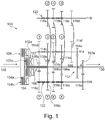
- FIG. 1 depicts one embodiment of a dual clutch transmission (DCT) 100.
- the DCT 100 is driven by an input shaft 128 driven by an engine (not shown) of a motor vehicle.
- the DCT 100 is configured to provide speed ratio changes without torque interruption.
- the DCT 100 includes two clutches 102, 104.
- a first clutch 102 is an inner clutch and a second clutch 104 is an outer clutch.
- the first and second clutches 102, 104 are concentric with respect to each other.
- the concentric clutches 102, 104 provide a compact arrangement.
- the first and second clutches 102, 104 are disposed within a clutch housing 126 that is drivingly fixed to the input shaft 128.
- the clutches 102, 104 are wet-plate style clutches having a set of friction plates 102a, 104a attached to the clutch housing 126.
- a second set of friction plates 102b, 104b are splined for rotation to a primary shaft 106, 108.
- the first and second set of friction plates 102a, 102b are interleaved with each other and form a clutch pack.
- the first and second set of friction plates 104a, 104b are interleaved with each other and form another clutch pack.
- the clutches 102, 104 are actuated by an electric, hydraulic or pneumatic operator (not illustrated) which selectively connects the input shaft 128 with the primary shafts 106, 108.
- the second clutch 104 is drivingly connected to a first primary shaft 106.
- the first clutch 102 is drivingly connected to a second primary shaft 108.
- the second primary shaft 108 is radially outward from the first primary shaft 106.
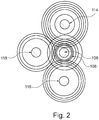
- the second primary shaft 108 and the first primary shaft 106 are concentric with one another as shown in FIG. 2 .
- the clutches 102, 104 establish a connection between the input shaft 128 and the primary shafts 106, 108 respectively.
- the second primary shaft 108 has a set of primary gears 108a, 108b mounted thereon.
- the first primary shaft 106 has a set of primary gears 106a, 106b mounted thereon.
- the gears 108a, 108b, 106a, 106b are selectively connectable with countershafts 114, 116, 118 to provide forward and reverse speed ratios.
- the number of primary gears rotatably mounted on the primary shafts 106, 108 vary depending on the number of forward and reverse speed ratios needed for the application.
- a first countershaft 114 is radially outward from the primary shafts 106, 108.
- the first countershaft 114 has a set of even gears 114a, 114b selectively fixed thereto.
- the even gears 114a, 114b selectively mesh with the primary gears 106a, 106b mounted on the first primary shaft 106.
- the first countershaft 114 has two even gears 114a, 114b selectively fixed thereto; however, the number of even gears mounted on the countershaft 114 can vary depending on the application.
- the first countershaft 114 has a set of odd gears 114c, 114d selectively fixed thereto.
- the odd gears 114c, 114d selectively mesh with the primary gears 108a, 108b connected to the second primary shaft 108.
- the first countershaft 114 has two odd gears 114c, 114d selectively fixed thereto; however, the number of odd gears mounted on the countershaft 114 can vary depending on the application.
- first countershaft 114 includes a first rigidly gear 114e fixed thereto.
- the first rigidly fixed gear 114e is drivingly connected to an output shaft 130.
- gear 114e is drivingly connected to the output shaft 130 by a gearset 112 having a carrier 112a rotationally connected to the output shaft 130.
- the second countershaft 116 is radially outward from the primary shafts 106, 108.
- the second countershaft 116 has a set of even gears 116a, 116b selectively fixed thereto.
- the even gears 116a, 116b selectively mesh with the primary gears 106a, 106b connected to the first primary shaft 106.
- second countershaft 116 has two even gears 106a, 106b selectively fixed thereto; however, the number of even gears mounted on the countershaft 116 can vary depending on the application.
- the second countershaft 116 has a set of odd gears 116c, 116d selectively fixed thereto.
- the odd gears 116c, 116d selectively mesh with the primary gears 108a, 108b connected to the second primary shaft 108.
- the second countershaft 116 has two even gears 116c, 116d mounted thereon; however, the number of odd gears mounted on the countershaft 116 can vary depending on the application.
- the second countershaft 116 includes a first rigidly fixed gear 116e.
- the first rigidly fixed gear 116e is drivingly connected to the output shaft 130.
- gear 116e is drivingly connected to the output shaft 130 by gearset 112.
- the second countershaft shaft 116 and the first countershaft 114 are parallel with the primary shafts 106, 108 to provide a compact arrangement.
- the reverse countershaft 118 is also parallel with primary shafts 106, 108 to provide a compact arrangement.
- the forward even speed ratios are established using the primary gears 108a, 108b on the first primary shaft 106 and the even gears 114a, 114b, 116a, 116b and the forward odd speed ratios are established between the primary gears 106a, 106b on the primary shaft 108 and the odd gears 114c, 114d, 116c, 116d.
- Gears 114d and 108b provide a first forward speed ratio and gears 114c and 108b provide a third forward speed ratio.
- Gears 114b and 106b provide a second forward speed ratio and gears 114a and 106a provide a fourth forward speed ratio.
- Gears 116d and 108b provide a fifth forward speed ratio and gears 116c and 108a provide a seventh forward speed ratio.
- Gears 116b and 106b provide a sixth forward speed ratio and gears 116a and 106a provide an eightf forward speed ratio.
- a third countershaft, or reverse countershaft 118 is radially outward from the primary shafts 106, 108.
- the third countershaft 118 has a set of gears 118a, 118b, 118c, selectively fixed thereto.
- An even set of gears 118a selectively mesh with the gear 108a on the primary shaft 108.
- the reverse countershaft 118 has one even gear 118a and two odd gears 118b, 118c mounted thereon; however, the number of even and odd gears mounted on the countershaft 118 can vary depending on the application.
- gears 118b and 106b provide a first reverse speed ratio
- gears 118a and 108a provide a second reverse speed ratio
- gears 118c and 106a provide a third reverse speed ratio.
- a rigidly fixed gear 118d is rotationally mounted on the reverse countershaft 118 and meshes with a second rigidly fixed gear 114f rotatably mounted on the first countershaft 114.
- the countershafts 114, 116, 118 have a preselector system 122 used to selectively fix the gears 114a, 114b, 114c, 114d, 116a, 116b, 116c, 116d, 118a, 118b, 118c to the countershafts 114, 116, 118 respectively.
- the preselector system 122 selectively fixes gears 114a, 114b, 114c, 114d to countershaft 114, gears 116a, 116b, 116c, 116d to countershaft 116 and gears 118a, 118b, 118c to reverse countershaft 118 to preselect the gear desired for engagement or disengagement.
- the preselector system 122 can be actuated by an electrically, hydraulically or pneumatically.
- the DCT 100 provides multiple forward and reverse speed ratio connections.
- the DCT 100 depicted in FIG.1 has eight forward speed ratios and three reverse speed ratios although more or less speed ratios in the forward and reverse directions are possible depending on the need of the application.
- the number of reverse speed ratios are less than or equal to half the number of forward speed ratios.
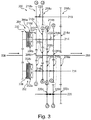
- FIG. 3 depicts another embodiment of a dual clutch transmission (DCT) 200.
- the DCT 200 includes an input shaft 228 driven by an engine (not shown) of a motor vehicle.
- the DCT 200 includes two clutches 202, 204.
- a first clutch 202 is an inner clutch and a second clutch 204 is an outer clutch.
- the first and second clutches 202, 204 are parallel to each other to provide a compact arrangement.
- the first and second clutches 202, 204 are disposed within clutch housings 226, 232 respectively.
- the clutch housings 226, 232 are drivingly connected to the input shaft 228.
- the clutches 202, 204 are wet-plate style clutches having a set of friction plates 202a, 204a attached to clutch housings 226, 232.
- a second set of friction plates 202b, 204b are splined for rotation countershafts 214, 216 respectively.
- the first and second set of friction plates 202a, 202b are interleaved with each other and form a clutch pack.
- the first and second set of friction plates 204a, 204b are interleaved with each other and form another clutch pack.
- the clutches 202, 204 are actuated by an electric, hydraulic or pneumatic operator (not illustrated) and selectively connect the input shaft 228 with the countershafts 214, 216.
- the second clutch 204 is drivingly connected to a first countershaft 214.
- the first clutch 202 is drivingly connected to the countershaft 216.
- the clutches 202, 204 establish a connection between the engine output shaft 228 and the countershafts 214, 216 respectively.
- a primary shaft 208 has a set of gears 208a, 208b, 208c, 208d rotatable mounted thereon.
- the primary shaft 208 is an output shaft for the DTC 200.
- the first countershaft 214 has a set of gears 214a, 214b, 214c, 214d selectively fixed thereto.
- the second countershaft 216 has a set of gears 216a, 216b, 216c, 216d selectively fixed thereto.
- the gears 208a, 208b, 208c, 208d are selectively connectable with countershafts 214, 216, 218 to provide forward and reverse speed ratios.
- the number of primary gears rotatably mounted on the primary shaft 208 vary depending on the number of forward and reverse speed ratios need for the application.
- the first countershaft 214 is radially outward from the primary shaft 208.
- the first countershaft 214 has a set of odd gears 214a, 214b, 214c, 214d selectively fixed thereto.
- the gears 214a, 214b, 214c, 214d selectively mesh with the primary gears 208a, 208b, 208c, 208d mounted on the primary shaft 208.
- the first countershaft 214 has four odd gears 214a, 214b, 214c, 214d selectively fixed thereto; however, the number of gears mounted on the countershaft 214 can vary depending on the application.
- the first countershaft 214 includes a rigidly fixed gear 214e mounted thereon. Gear 214e selectively meshes with a gear 218c rotatably mounted on a third countershaft 218.
- the second countershaft 216 is radially outward from the primary shaft 208.
- the second countershaft 216 has a set of even gears 216a, 216b, 216c, 216d selectively fixed thereto.
- the gears 216a, 216b, 216c, 216d selectively mesh with the primary gears 208a, 208b, 208c, 208d connected to the primary shaft 208.
- second countershaft 216 has four even gears 216a, 216b, 218c, 218d selectively fixed thereto; however, the number of even gears mounted on the countershaft 216 can vary depending on the application.
- the second countershaft 216 includes a rigidly fixed gear 216e mounted thereon. Gear 216e selectively meshes with a gear 220c rotatably mounted on a fourth countershaft 220.
- the forward even speed ratios are established using the primary gears 208a, 208b, 208c, 208d on the primary shaft 208 and the even gears 216a, 216b, 216c, 216d and the forward odd speed ratios are established between the primary gears 208a, 208b, 208c, 208d on the primary shaft 208 and the odd gears 214a, 214b, 214c, 214d.
- Gears 214d and 208d provide a first forward speed ratio
- gears 214a and 208a provide a third forward speed ratio
- gears 214b and 208b provide a fifth forward speed ratio
- gears 214c and 208c provide a seventh forward speed ratio.
- Gears 216d and 208d provide a second forward speed ratio
- gears 216a and 208a provide a fourth forward speed ratio
- gears 216b and 208b provide a fourth forward speed ratio
- gears 216c and 208c provide an eighth forward speed ratio.
- a third countershaft, or first reverse countershaft 218, is radially outward from the primary shaft 208.
- the third countershaft 218 has a set of gears 218a, 218b selectively fixed thereto.
- An even set of gears 218a, 218b selectively mesh with the gears 208c, 208d on the primary shaft 208.
- the reverse countershaft 218 has two even gears 218a, 218b selectively fixed thereto; however, the number of even gears mounted on the countershaft 218 can vary depending on the application.
- the reverse even speed ratios are established between the gears 208c, 208d on the primary shaft 208 and gears 218a, 218b the reverse countershaft 218.
- Gears 218a and 208c provide a second reverse speed ratio gears 218b and 208d provide a fourthe reverse speed ratio. Additionally, a rigidly fixed gear 218c is rigidly mounted on the reverse countershaft 218 and meshes with a rigid gear 214e drivingly connected to the first countershaft 214.
- a fourth countershaft or second reverse countershaft 220 is radially outward from the primary shaft 208.
- the fourth countershaft 220 has a set of gears 220a, 220b selectively fixed thereto.
- An odd set of gears 220a, 220b selectively mesh with the gears 208a, 208b on the primary shaft 208.
- the reverse countershaft 220 has two odd gears 220a, 220b selectively fixed thereto; however, the number of odd gears mounted on the countershaft 228 can vary depending on the application.
- the reverse odd speed ratios are established between the gears 208a, 208b on the primary shaft 208 and gears 220a, 220b the reverse countershaft 220.
- Gears 220a and 208b provide a first reverse speed ratio gears 220b and 208a provide a third reverse speed ratio.
- a rigidly fixed gear 220c is rigidly mounted on the reverse countershaft 220 and meshes with a rigid gear 216e drivingly connected to the second countershaft 216.
- the second countershaft shaft 216 and the first countershaft 214 are parallel with the primary shaft 208 to provide a compact arrangement.
- the reverse countershafts 218, 220 is also parallel with primary shaft 208 to provide a compact arrangement.
- the shafts 214, 216, 218, 220 have a preselector system 222 connected thereto that rigidly fix the gears 214a, 214b, 214c, 214d, 216a, 216b, 216c, 216d, 218a, 218b, 220a, 220b to the shafts 214, 216, 218, 220 respectively.
- the preselector system 22 selectively fixes gears 214a, 214b, 214c, 214d to countershaft 214, gears 216a, 216b, 216c, 216d to countershaft 116, gears 218a, 218b, to reverse countershaft 218 and gears 220a, 220b, to reverse countershaft 218 to preselect the gear desired for engagement or disengagement.
- the preselector system 222 can be actuated by an electrically, hydraulically or pneumatically.
- the DCT 200 provides multiple forward and reverse speed ratio connections.
- the DCT 200 depicted in FIG. 3 has eight forward speed ratios and four reverse speed ratios although more or less speed ratios in the forward and reverse directions are possible depending on the need of the application.
- the number of reverse speed ratios are less than or equal to half the number of forward speed ratios.
- FIG. 4 depicts one embodiment of a dual clutch transmission (DCT) 300.
- the DCT 300 is driven by an input shaft 328 driven by an engine (not shown) of a motor vehicle.
- the DCT 300 is configured to provide speed ratio changes without torque interruption.
- the DCT 300 includes two clutches 302, 304.
- a first clutch 302 is an inner clutch and a second clutch 304 is an outer clutch.
- the first and second clutches 302, 304 are parallel with respect to each other to provide a compact arrangement.
- the clutches 302, 304 are disposed within clutch housings 326, 332 that are in driving engagement with the input shaft 328.
- the clutches 302, 304 are wet-plate style clutches having a set of friction plates 302a, 304a attached to clutch housings 326, 332, respectively.
- a second set of friction plates 302b, 304b are splined for rotation to a primary shaft 306, 308.
- the first and second set of friction plates 302a, 302b are interleaved with each other and form a clutch pack.
- the first and second set of friction plates 304a, 304b are interleaved with each other and form another clutch pack.
- the clutches 302, 304 are actuated by an electric, hydraulic or pneumatic operator (not illustrated) which selectively connects the input shaft 328 with the primary shafts 306, 308.
- the second clutch 304 is drivingly connected to a first primary shaft 306.
- the first clutch 302 is drivingly connected to a second primary shaft 308.
- the second primary shaft 308 is radially outward from the first primary shaft 306.
- the second primary shaft 308 and the first primary shaft 306 are concentric with one another as shown in FIG. 4 to provide a compact arrangement.
- the clutches 302, 304 establish a connection between the input shaft 328 and the primary shafts 306, 308 respectively.
- the second primary shaft 308 has a set of primary gears 308a, 308b mounted thereon.
- the first primary shaft 306 has a set of primary gears 306a, 306b mounted thereon.
- the gears 308a, 308b, 306a, 306b are selectively connectable with countershafts 314, 316, 318 to provide forward and reverse speed ratios.
- the number of primary gears rotatably mounted on the primary shafts 306, 308 vary depending on the number of forward and reverse speed ratios need for the application.
- a first countershaft 314 is radially outward from the primary shafts 306, 308.
- the first countershaft 314 has a set of even gears 314a, 314b selectively fixed thereto.
- the even gears 314a, 314b selectively mesh with the primary gears 306a, 306b mounted on the first primary shaft 306.
- the first countershaft 314 has two even gears 314a, 314b selectively fixed thereto; however, the number of even gears mounted on the countershaft 314 can vary depending on the application.
- the first countershaft 314 has a set of odd gears 314c, 314d selectively fixed thereto.
- the odd gears 314c, 314d selectively mesh with the primary gears 308a, 308b connected to the second primary shaft 308.
- the first countershaft 314 has two odd gears 314c, 314d selectively fixed thereto; however, the number of odd gears mounted on the countershaft 314 can vary depending on the application.
- the first countershaft 314 includes a first rigidly fixed gear 314e is rotatably mounted thereon.
- the first rigidly fixed gear 314e is drivingly connected to an output shaft 330.
- gear 314e is drivingly connected to the output shaft 330 by a gearset 312 having a carrier 312a rotationally connected to the output shaft 330.
- the second countershaft 316 is radially outward from the primary shafts 306, 308.
- the second countershaft 316 has a set of even gears 316a, 316b selectively fixed thereto.
- the even gears 316a, 316b selectively mesh with the primary gears 306a, 306b connected to the first primary shaft 306.
- second countershaft 316 has two even gears 306a, 306b selectively fixed thereto; however, the number of even gears mounted on the countershaft 316 can vary depending on the application.
- the second countershaft 316 has a set of odd gears 316c, 316d selectively fixed thereto.
- the odd gears 316c, 316d selectively mesh with the primary gears 308a, 308b connected to the second primary shaft 308.
- the second countershaft 316 has two even gears 316c, 316d mounted thereon; however, the number of odd gears mounted on the countershaft 316 can vary depending on the application.
- the second countershaft 316 includes a first rigidly fixed gear 316e is rotatably mounted thereon.
- the first rigidly fixed gear 316e is drivingly connected to the output shaft 330.
- gear 316e is drivingly connected to the output shaft 330.
- the forward even speed ratios are established using the primary gears 308a, 308b on the first primary shaft 306 and the even gears 314a, 314b, 316a, 316b and the forward odd speed ratios are established between the on the primary gears 306a, 306b on the primary shaft 308 and the odd gears 314c, 314d, 316c, 316d.
- Gears 314d and 308b provide a first forward speed ratio
- gears 314b and 306b provide a second forward speed ratio
- gears 314c and 308a provide a third forward speed ratio
- gears 314d and 308b provide a fourth forward speed ratio.
- Gears 316d and 308b provide a fifth forward speed ratio
- gears 316b and 306b provide a sixth forward speed ratio
- gears 316c and 308a provide a seventh forward speed ratio
- gears 316a and 306a provide an eighth forward speed ratio.
- a third countershaft or reverse countershaft 318 is radially outward from the primary shafts 306, 308.
- the third countershaft 318 has a set of gears 318a, 318b, 318c, 318d selectively fixed thereto.
- An even set of gears 318a, 318b selectively mesh with the gear 308a, 308b on the primary shaft 308 such that gears 318a and 308b provide a second reverse speed ratio and gears 318b and 308a provide fourth reverse speed ratio.
- gears 318c, 318d that mesh with the gears 306a, 306b on the primary shaft 306 such that gears 318c and 306b provide a first reverse speed ratio and gears 318d and 306a provide fourth reverse speed ratio.
- the reverse countershaft 318 has two even gears 318a, 318b and two odd gears 318c, 318d mounted thereon; however, the number of even and odd gears mounted on the countershaft 318 can vary depending on the application.
- the reverse even speed ratios are established between the gears 308a on the primary shaft 308 and gears 318a, 318b the reverse countershaft 318 and the reverse odd speed ratios are established between the gears 306a, 306b on the primary shaft 306 and the reverse countershaft 318.
- a first rigidly fixed gear 318e is rotatably mounted on the reverse countershaft 318 and meshes with a second rigidly fixed gear 314f rotatably mounted on the first countershaft 314.
- the second countershaft shaft 316 and the first countershaft 314 are parallel, but offset from the primary shafts 306, 308 to provide a compact arrangement.
- the reverse countershaft 318 is also parallel, but offset with primary shafts 306, 308 to provide a compact arrangement.
- the countershafts 314, 316, 318 have a preselector system 322 used to selectively fix the gears 314a, 314b, 314c, 314d, 316a, 316b, 316c, 316d, 318a, 318b, 318c, 318d to the countershafts 314, 316, 318 respectively.
- the preselector system 322 selectively fixes gears 314a, 314b, 314c, 314d to countershaft 314, gears 316a, 316b, 316c, 316d to countershaft 316, and gears 318a, 318b, 318c, 318d to reverse countershaft 318 to preselect the gear desired for engagement or disengagement.
- the preselector system 322 can be actuated by an electrically, hydraulically or pneumatically.
- the DCT 300 provides multiple forward and reverse speed ratio connections.
- the DCT 300 depicted in FIG. 4 has eight forward speed ratios and four reverse speed ratios although more or less speed ratios in the forward and reverse directions are possible depending on the need of the application.
- the number of reverse speed ratios are less than or equal to half the number of forward speed ratios.
- the DCT 100, 200, 300 has a forward operational mode wherein a reverse countershaft 118, 218, 220, 318 operates in forward mode. Both clutches 102, 202, 302, 104, 204, 304 are (dis)engaged gradually such that the torque transfer is never interrupted resulting in smooth shifts.
- an odd gear When operated in an even gear, an odd gear can be preselected using the preselector system 122, 222, 322.
- the speed ratio/gears are shifted by disengaging the second clutch 104, 204, 304 and engaging the first clutch 102, 202, 302. Both clutches 102, 202, 302, 104, 204, 304 are (dis)engaged gradually such that the torque transfer is never interrupted resulting in smooth shifts.
- the gear set to be engaged is preselected using the preselector system 122, 222, 322 and simultaneously the first 102, 202, 302 and second clutches 104, 204, 304 are engaged/disengaged.
- the previous gear set is selected using the preselector system 122, 222, 322 and the first 102, 202, 302 and second 104, 204, 302 clutches 102,104 are simultaneously engaged/disengaged.
- the clutches 102, 104, 202, 204, 302, 304 and the preselector systems 122, 222, 322 may be controlled using a control unit (not pictured).
- the control unit can be, but is not limited to a hydro-electronic control unit.
- the hydro-electronic control unit pressurizes the clutches 102, 202, 302, 104, 204, 304 and the preselector systems 122, 222, 322 in order to engage/disengage the corresponding elements.
- the forward and reverse speed ratios of the DCT 100/200/300 are operated such that shifts between the speed ratios are realized by selectively engaging and disengaging the clutches 102, 104, 202, 204, 302, 304. All forward - reverse shifts are smooth shift and the gear number stays the same: +1/-1, +2/-2, +3/-1 as shown in FIGs. 1 and 3-4 .
- a shift control unit (not shown) is used to limit forward - reverse to these shifts such that it cannot do +2/-1 for instance.
Landscapes
- Engineering & Computer Science (AREA)
- General Engineering & Computer Science (AREA)
- Mechanical Engineering (AREA)
- Structure Of Transmissions (AREA)
Claims (14)
- Doppelkupplungsgetriebe (100), umfassend:eine Eingangswelle (128), treibend verbunden mit einer Kraftmaschine;eine Ausgangswelle (130);eine erste primäre Welle (106) mit einer Vielzahl von Zahnrädern (106a, 106b), die starr daran befestigt sind;eine zweite primäre Welle (108) mit einer Vielzahl von Zahnrädern (108a, 108b), die starr daran befestigt sind;eine erste Kupplung (102), die mit der zweiten primären Welle (108) direkt verbunden ist und mit der Eingangswelle (128) treibend verbunden ist;eine zweite Kupplung (104), die mit der ersten primären Welle (208) direkt verbunden ist und mit der Eingangswelle (128) treibend verbunden ist;eine erste Gegenwelle (114) mit einer Vielzahl von selektiv daran befestigten geraden Zahnrädern (114a, 114b), einer Vielzahl von selektiv daran befestigten ungeraden Zahnrädern (114c, 114d), einem daran angebrachten ersten starr befestigten Zahnrad (114e) und einem daran angebrachten zweiten starr befestigten Zahnrad (114f), wobei jedes von der Vielzahl von geraden Zahnrädern (114a, 114d) selektiv in treibendem Eingriff mit einem anderen von der Vielzahl von Zahnrädern (106a, 106b), die starr auf der ersten primären Welle (106) befestigt sind, ist, wobei jedes von der Vielzahl von ungeraden Zahnrädern (114c, 114d) selektiv in treibendem Eingriff mit einem anderen von der Vielzahl von Zahnrädern (108a, 108b), die starr auf der zweiten primären Welle (108) befestigt sind, ist, und das an der ersten Gegenwelle (114) angebrachte erste starr befestigte Zahnrad (114e) ist in treibendem Eingriff mit der Ausgangswelle (130);eine zweite Gegenwelle (116) mit einer Vielzahl von selektiv daran befestigten geraden Zahnrädern (116a, 116b), einer Vielzahl von selektiv daran befestigten ungeraden Zahnrädern (116c, 116d) und einem daran angebrachten ersten starr befestigten Zahnrad (116e), wobei jedes von der Vielzahl von geraden Zahnrädern (116a, 116b) selektiv in treibendem Eingriff mit einem anderen von der Vielzahl von Zahnrädern (106a, 106b), die starr auf der ersten primären Welle (106) befestigt sind, ist, wobei jedes von der Vielzahl von ungeraden Zahnrädern (116c, 116d) selektiv in treibendem Eingriff mit einem anderen von der Vielzahl von Zahnrädern (108a, 108b), die starr auf der zweiten primären Welle (108) befestigt sind, ist, und das an der zweiten Gegenwelle (116) angebrachte erste starr befestigte Zahnrad (116e) ist in treibendem Eingriff mit der Ausgangswelle (130);gekennzeichnet durcheine Rückwärtsgegenwelle (118) mit einer Vielzahl selektiv daran befestigter ungerader Zahnräder (118b, 118c) und einem (118a) oder mehreren selektiv daran befestigten geraden Zahnrädern und einem starr befestigten Zahnrad (118d), das daran angebracht und in treibendem Eingriff mit dem an der ersten Gegenwelle (114) angebrachten zweiten starr befestigten Zahnrad (114f) ist,wobei jedes der ungeraden Zahnräder (118b, 118c), die selektiv an der Rückwärtsgegenwelle (118) befestigt sind, selektiv in treibendem Eingriff mit einem anderen von der Vielzahl von Zahnrädern (106a, 106b) ist, die starr auf der ersten primären Welle (106) befestigt sind, und das eine oder mehrere der geraden Zahnräder (118a), die selektiv an der Rückwärtsgegenwelle (118) befestigt sind, befinden sich selektiv in treibendem Eingriff mit einem anderen von der Vielzahl von Zahnrädern (108a), die starr auf der zweiten primären Welle (108) befestigt sind.
- Doppelkupplungsgetriebe (100) nach Anspruch 1, wobei die erste und zweite primäre Welle (106, 108) konzentrisch sind.
- Doppelkupplungsgetriebe (100) nach einem der vorangehenden Ansprüche, wobei die erste und zweite Kupplung (102, 104) konzentrische Kupplungen sind.
- Doppelkupplungsgetriebe (100) nach einem der Ansprüche 1 und 2, wobei die erste und zweite Kupplung (102, 104) parallel zueinander sind.
- Doppelkupplungsgetriebe (100) nach einem der vorangehenden Ansprüche, wobei die zweite Gegenwelle ein zweites starr befestigtes Zahnrad umfasst, wobei die Rückwärtsgegenwelle ein zweites starr befestigtes Zahnrad umfasst, das selektiv in treibendem Eingriff mit dem auf der zweiten Gegenwelle montierten zweiten starr befestigten Zahnrad ist.
- Doppelkupplungsgetriebe (100) nach einem der vorangehenden Ansprüche, wobei die Anzahl der Zahnräder auf der Rückwärtsgegenwelle kleiner als oder gleich groß wie die halbe Anzahl der Zahnräder auf der ersten und zweiten Gegenwelle ist.
- Doppelkupplungsgetriebe (100) nach einem der vorangehenden Ansprüche, wobei die erste und zweite Kupplung (102, 104) in einem Kupplungsgehäuse (126) untergebracht sind, das mit der Eingangswelle (128) treibend verbunden ist.
- Doppelkupplungsgetriebe (100) nach Anspruch 7, wobei die erste Kupplung eine Nassscheibenkupplung ist, die einen ersten Satz von Kupplungsscheiben, die direkt mit dem Kupplungsgehäuse (126) verbunden sind, und einen zweiten Satz von Kupplungsscheiben, die direkt mit der zweiten primären Welle (108) verbunden sind, umfasst, und wobei die zweite Kupplung (104) eine Nassscheibenkupplung ist, die einen ersten Satz von Kupplungsscheiben, die direkt mit dem Kupplungsgehäuse (126) verbunden sind, und einen zweiten Satz von Kupplungsscheiben, die direkt mit der ersten primären Welle (106) verbunden sind, umfasst.
- Doppelkupplungsgetriebe (100) nach einem der vorangehenden Ansprüche, ferner umfassend ein Vorwählsystem (122) zum selektiven Befestigen der Vielzahl von geraden und ungeraden Zahnrädern an der ersten Gegenwelle (114), zweiten Gegenwelle (116) und der Rückwärtsgegenwelle (118).
- Doppelkupplungsgetriebe (200), umfassend:eine Eingangswelle (228), treibend verbunden mit einer Kraftmaschine;eine Ausgangswelle;eine primäre Welle (208) mit einer Vielzahl von starr daran befestigten Zahnrädern (208a, 208b, 208c, 208d), wobei die primäre Welle (208) die Ausgangswelle des Doppelkupplungsgetriebes (200) ist;eine erste Kupplung (202) in treibendem Eingriff mit der Eingangswelle (228) und einer ersten Gegenwelle (214);eine zweite Kupplung (204) in treibendem Eingriff mit der Eingangswelle (128) und einer zweiten Gegenwelle (216);gekennzeichnet durcheine erste Rückwärtsgegenwelle (218); undeine zweite Rückwärtsgegenwelle (220);wobei die erste Gegenwelle (214) eine Vielzahl selektiv daran befestigter ungerader Zahnräder (214a, 214b, 214c, 214d) und ein starr daran befestigtes Zahnrad (214e) aufweist, wobei jedes von der Vielzahl ungerader Zahnräder (214a, 214b, 214c, 214d) selektiv in treibendem Eingriff mit einem anderen von der Vielzahl von starr an der primären Welle (208) befestigten Zahnrädern (208a, 208b, 208c, 208d) ist, und wobei das an der ersten Gegenwelle (214) angebrachte, starr befestigte Zahnrad (214e) in treibendem Eingriff mit der ersten Rückwärtsgegenwelle (218) ist,wobei die zweite Gegenwelle (216) eine Vielzahl selektiv daran befestigter gerader Zahnräder (216a, 216b, 216c, 216d) und ein starr daran angebrachtes Zahnrad (216e) aufweist, wobei jedes von der Vielzahl von selektiv an der zweiten Gegenwelle (216) befestigten geraden Zahnrädern (216a, 216b, 216c, 216d) selektiv in treibendem Eingriff mit einem anderen von der Vielzahl von starr an der primären Welle (208) befestigten Zahnrädern (208a, 208b, 208c, 208d) ist, und wobei das an der zweiten Gegenwelle (216) angebrachte, starr befestigte Zahnrad (216e) in treibendem Eingriff mit der zweiten Rückwärtsgegenwelle (220) ist,wobei die erste Rückwärtsgegenwelle (218) eine Vielzahl selektiv daran befestigter gerader Zahnräder (218a, 218b) aufweist, von denen ein jedes in einem selektiven treibenden Eingriff mit einem anderen von der Vielzahl von starr an der primären Welle (208) befestigten Zahnrädern (208c, 208d) ist, und die erste Rückwärtsgegenwelle (218) ein daran angebrachtes, starr befestigtes Zahnrad (218c) aufweist, das in treibendem Eingriff mit dem an der ersten Gegenwelle (214) angebrachten, starr befestigten Zahnrad (214e) ist,wobei die zweite Rückwärtsgegenwelle (220) eine Vielzahl selektiv daran befestigter ungerader Zahnräder (220a, 220b) aufweist, von denen ein jedes in einem selektiven treibenden Eingriff mit einem anderen von der Vielzahl von starr an der primären Welle (208) befestigten Zahnrädern (208a, 208b) ist, und die zweite Rückwärtsgegenwelle (220) ein daran angebrachtes, starr befestigtes Zahnrad (220c) aufweist, das in treibendem Eingriff mit dem an der zweiten Gegenwelle (216) angebrachten, starr befestigten Zahnrad (216e) ist.
- Doppelkupplungsgetriebe (200) nach Anspruch 10, wobei die Anzahl der Zahnräder auf der ersten und zweiten Rückwärtsgegenwelle kleiner als oder gleich groß wie die Anzahl der Zahnräder auf der ersten und zweiten Gegenwelle ist.
- Doppelkupplungsgetriebe (200) nach einem der Ansprüche 10 und 11, wobei die erste und zweite Kupplung (202, 204) parallel zueinander sind.
- Doppelkupplungsgetriebe (200) nach einem Ansprüche 10 bis 12, ferner umfassend ein erstes Kupplungsgehäuse und ein zweites Kupplungsgehäuse, wobei das erste und zweite Kupplungsgehäuse treibend mit der Eingangswelle (228) verbunden sind.
- Doppelkupplungsgetriebe (200) nach einem der Ansprüche 10 bis 13, ferner umfassend ein Vorwählsystem (222) zum selektiven Befestigen der Vielzahl von geraden und ungeraden Zahnrädern an der ersten Gegenwelle, zweiten Gegenwelle, der ersten Rückwärtsgegenwelle und der zweiten Rückwärtsgegenwelle.
Applications Claiming Priority (2)
| Application Number | Priority Date | Filing Date | Title |
|---|---|---|---|
| US201662277627P | 2016-01-12 | 2016-01-12 | |
| PCT/EP2017/050588 WO2017121813A1 (en) | 2016-01-12 | 2017-01-12 | Dual clutch transmission with a reverse countershaft |
Publications (2)
| Publication Number | Publication Date |
|---|---|
| EP3403002A1 EP3403002A1 (de) | 2018-11-21 |
| EP3403002B1 true EP3403002B1 (de) | 2021-10-13 |
Family
ID=57794298
Family Applications (1)
| Application Number | Title | Priority Date | Filing Date |
|---|---|---|---|
| EP17700294.6A Not-in-force EP3403002B1 (de) | 2016-01-12 | 2017-01-12 | Doppelkupplungsgetriebe mit reservegegenwelle |
Country Status (4)
| Country | Link |
|---|---|
| US (1) | US10883573B2 (de) |
| EP (1) | EP3403002B1 (de) |
| CN (1) | CN108700163B (de) |
| WO (1) | WO2017121813A1 (de) |
Families Citing this family (6)
| Publication number | Priority date | Publication date | Assignee | Title |
|---|---|---|---|---|
| GB2513608B (en) * | 2013-05-01 | 2015-05-06 | Jaguar Land Rover Ltd | Transmission |
| DE102017204125A1 (de) * | 2017-03-13 | 2018-09-13 | Zf Friedrichshafen Ag | Doppelkupplungsgetriebeanordnung sowie Kraftfahrzeug |
| CN110131364A (zh) * | 2019-05-20 | 2019-08-16 | 深圳臻宇新能源动力科技有限公司 | 变速器、驻车锁止的方法和车辆 |
| CN112709789A (zh) * | 2020-12-25 | 2021-04-27 | 中国第一汽车股份有限公司 | 一种八挡双离合变速器 |
| US11427079B1 (en) | 2022-05-02 | 2022-08-30 | Cvet Patent Technologies Inc. | Bi-directional rotary speed conversion via mirrored rotational power transfer tunnel |
| CN114962636B (zh) * | 2022-05-07 | 2023-05-30 | 陈正华 | 一种拖拉机智能控制离合器总成 |
Family Cites Families (17)
| Publication number | Priority date | Publication date | Assignee | Title |
|---|---|---|---|---|
| US6397994B1 (en) | 2001-01-10 | 2002-06-04 | New Venture Gear, Inc. | Powershift transmission with engine clutch assembly |
| US6958028B2 (en) | 2004-03-18 | 2005-10-25 | Ford Global Technologies, Llc | Ranged dual clutch transmission for motor vehicles |
| DE102005025273B4 (de) | 2005-06-02 | 2013-11-28 | Daimler Ag | Doppelkupplungsgetriebe |
| FR2887002B1 (fr) * | 2005-06-09 | 2008-07-18 | Renault Sas | Commande de marche arriere pour boite de vitesses |
| US8011274B2 (en) | 2006-08-28 | 2011-09-06 | Vladimir Abramov | Gear box apparatus |
| DE102006054281A1 (de) | 2006-11-17 | 2008-06-12 | Zf Friedrichshafen Ag | Doppelkupplungs-Windungsgetriebe |
| CN101713448B (zh) * | 2009-03-13 | 2012-07-04 | 浙江吉利汽车研究院有限公司 | 双离合器式自动变速器 |
| CN102259583B (zh) * | 2010-05-31 | 2014-03-19 | 比亚迪股份有限公司 | 混合动力驱动系统及具有该系统的车辆 |
| EP2578901B1 (de) | 2010-06-01 | 2015-05-06 | Hitachi Nico Transmission Co., Ltd. | Doppelkupplungsgetriebe |
| CN102678842B (zh) * | 2011-12-08 | 2014-08-13 | 河南科技大学 | 一种多挡拖拉机中使用的双离合器变速器 |
| US8720290B2 (en) | 2012-05-04 | 2014-05-13 | Ford Global Technologies, Llc | Vehicle with dual clutch transmission |
| CZ2012313A3 (cs) | 2012-05-11 | 2013-05-29 | Zetor Tractors A.S. | Usporádání reverzacní dvoutoké prevodovky, zejména pro motorová vozidla a stavební stroje, s dvema vetvemi toku výkonu |
| DE102012220063A1 (de) | 2012-11-05 | 2014-05-08 | Zf Friedrichshafen Ag | Doppelkupplungsgetriebe in Vorgelegebauweise |
| DE102013020564B3 (de) | 2013-12-09 | 2015-02-19 | Audi Ag | Vorrichtung zum Schalten von Gängen in einem Doppelkupplungsgetriebe |
| US9568065B2 (en) * | 2014-09-10 | 2017-02-14 | Byd Company Limited | Transmission unit, power transmission system and vehicle comprising the same |
| US20160131223A1 (en) * | 2014-11-06 | 2016-05-12 | Schaeffler Technologies Gmbh & Co. Kg | Transmission with dual input and reduced number of lay shafts |
| JP6421682B2 (ja) * | 2015-04-08 | 2018-11-14 | スズキ株式会社 | 自動変速機 |
-
2017
- 2017-01-12 EP EP17700294.6A patent/EP3403002B1/de not_active Not-in-force
- 2017-01-12 CN CN201780006098.3A patent/CN108700163B/zh not_active Expired - Fee Related
- 2017-01-12 WO PCT/EP2017/050588 patent/WO2017121813A1/en not_active Ceased
- 2017-01-12 US US16/069,543 patent/US10883573B2/en not_active Expired - Fee Related
Non-Patent Citations (1)
| Title |
|---|
| None * |
Also Published As
| Publication number | Publication date |
|---|---|
| WO2017121813A1 (en) | 2017-07-20 |
| US10883573B2 (en) | 2021-01-05 |
| EP3403002A1 (de) | 2018-11-21 |
| CN108700163A (zh) | 2018-10-23 |
| CN108700163B (zh) | 2021-08-31 |
| US20190024757A1 (en) | 2019-01-24 |
Similar Documents
| Publication | Publication Date | Title |
|---|---|---|
| EP3403002B1 (de) | Doppelkupplungsgetriebe mit reservegegenwelle | |
| EP2141385B1 (de) | Transaxle-Einheit mit Doppelkupplung und mehreren Geschwindigkeiten | |
| EP2167843B1 (de) | Doppelkupplungsgetriebe mit planetengetriebesatz | |
| US7070534B2 (en) | Power transmission with preselected ratios and a preselected output splitter | |
| EP3312462B1 (de) | Planetengetriebe mit mehreren drehzahlen | |
| EP3312459B1 (de) | Planetengetriebe mit mehreren drehzahlen | |
| US6802795B2 (en) | Automatic transmission of motor vehicle | |
| EP3312460B9 (de) | Planetengetriebe mit mehreren drehzahlen | |
| EP3312463B1 (de) | Planetengetriebe mit mehreren drehzahlen | |
| EP3312469B1 (de) | Planetengetriebe mit mehreren drehzahlen | |
| EP3312468B1 (de) | Planetengetriebe mit mehreren drehzahlen | |
| EP4198345A1 (de) | Mehrgang-planetengetriebe | |
| EP3312467B1 (de) | Planetengetriebe mit mehreren drehzahlen | |
| EP3312464B1 (de) | Planetengetriebe mit mehreren drehzahlen | |
| US20060270507A1 (en) | Split power transmission to include a variable drive | |
| EP3312470B1 (de) | Planetengetriebe mit mehreren drehzahlen | |
| EP3312455B1 (de) | Planetengetriebe mit mehreren drehzahlen | |
| EP3312458A1 (de) | Planetengetriebe mit mehreren drehzahlen | |
| EP3312453A1 (de) | Planetengetriebe mit mehreren drehzahlen | |
| WO2021173414A1 (en) | Multi-speed planetary transmission | |
| US20230265913A1 (en) | Multi-speed planetary transmission | |
| EP4513058A1 (de) | Mehrgang-planetengetriebe |
Legal Events
| Date | Code | Title | Description |
|---|---|---|---|
| STAA | Information on the status of an ep patent application or granted ep patent |
Free format text: STATUS: UNKNOWN |
|
| STAA | Information on the status of an ep patent application or granted ep patent |
Free format text: STATUS: THE INTERNATIONAL PUBLICATION HAS BEEN MADE |
|
| PUAI | Public reference made under article 153(3) epc to a published international application that has entered the european phase |
Free format text: ORIGINAL CODE: 0009012 |
|
| STAA | Information on the status of an ep patent application or granted ep patent |
Free format text: STATUS: REQUEST FOR EXAMINATION WAS MADE |
|
| 17P | Request for examination filed |
Effective date: 20180709 |
|
| AK | Designated contracting states |
Kind code of ref document: A1 Designated state(s): AL AT BE BG CH CY CZ DE DK EE ES FI FR GB GR HR HU IE IS IT LI LT LU LV MC MK MT NL NO PL PT RO RS SE SI SK SM TR |
|
| AX | Request for extension of the european patent |
Extension state: BA ME |
|
| DAV | Request for validation of the european patent (deleted) | ||
| DAX | Request for extension of the european patent (deleted) | ||
| STAA | Information on the status of an ep patent application or granted ep patent |
Free format text: STATUS: EXAMINATION IS IN PROGRESS |
|
| 17Q | First examination report despatched |
Effective date: 20200511 |
|
| GRAP | Despatch of communication of intention to grant a patent |
Free format text: ORIGINAL CODE: EPIDOSNIGR1 |
|
| STAA | Information on the status of an ep patent application or granted ep patent |
Free format text: STATUS: GRANT OF PATENT IS INTENDED |
|
| INTG | Intention to grant announced |
Effective date: 20210517 |
|
| GRAS | Grant fee paid |
Free format text: ORIGINAL CODE: EPIDOSNIGR3 |
|
| GRAA | (expected) grant |
Free format text: ORIGINAL CODE: 0009210 |
|
| STAA | Information on the status of an ep patent application or granted ep patent |
Free format text: STATUS: THE PATENT HAS BEEN GRANTED |
|
| AK | Designated contracting states |
Kind code of ref document: B1 Designated state(s): AL AT BE BG CH CY CZ DE DK EE ES FI FR GB GR HR HU IE IS IT LI LT LU LV MC MK MT NL NO PL PT RO RS SE SI SK SM TR |
|
| REG | Reference to a national code |
Ref country code: GB Ref legal event code: FG4D |
|
| REG | Reference to a national code |
Ref country code: CH Ref legal event code: EP |
|
| REG | Reference to a national code |
Ref country code: DE Ref legal event code: R096 Ref document number: 602017047497 Country of ref document: DE |
|
| REG | Reference to a national code |
Ref country code: IE Ref legal event code: FG4D |
|
| REG | Reference to a national code |
Ref country code: AT Ref legal event code: REF Ref document number: 1438415 Country of ref document: AT Kind code of ref document: T Effective date: 20211115 |
|
| REG | Reference to a national code |
Ref country code: LT Ref legal event code: MG9D |
|
| REG | Reference to a national code |
Ref country code: NL Ref legal event code: MP Effective date: 20211013 |
|
| REG | Reference to a national code |
Ref country code: AT Ref legal event code: MK05 Ref document number: 1438415 Country of ref document: AT Kind code of ref document: T Effective date: 20211013 |
|
| PG25 | Lapsed in a contracting state [announced via postgrant information from national office to epo] |
Ref country code: RS Free format text: LAPSE BECAUSE OF FAILURE TO SUBMIT A TRANSLATION OF THE DESCRIPTION OR TO PAY THE FEE WITHIN THE PRESCRIBED TIME-LIMIT Effective date: 20211013 Ref country code: LT Free format text: LAPSE BECAUSE OF FAILURE TO SUBMIT A TRANSLATION OF THE DESCRIPTION OR TO PAY THE FEE WITHIN THE PRESCRIBED TIME-LIMIT Effective date: 20211013 Ref country code: FI Free format text: LAPSE BECAUSE OF FAILURE TO SUBMIT A TRANSLATION OF THE DESCRIPTION OR TO PAY THE FEE WITHIN THE PRESCRIBED TIME-LIMIT Effective date: 20211013 Ref country code: BG Free format text: LAPSE BECAUSE OF FAILURE TO SUBMIT A TRANSLATION OF THE DESCRIPTION OR TO PAY THE FEE WITHIN THE PRESCRIBED TIME-LIMIT Effective date: 20220113 Ref country code: AT Free format text: LAPSE BECAUSE OF FAILURE TO SUBMIT A TRANSLATION OF THE DESCRIPTION OR TO PAY THE FEE WITHIN THE PRESCRIBED TIME-LIMIT Effective date: 20211013 |
|
| PG25 | Lapsed in a contracting state [announced via postgrant information from national office to epo] |
Ref country code: IS Free format text: LAPSE BECAUSE OF FAILURE TO SUBMIT A TRANSLATION OF THE DESCRIPTION OR TO PAY THE FEE WITHIN THE PRESCRIBED TIME-LIMIT Effective date: 20220213 Ref country code: SE Free format text: LAPSE BECAUSE OF FAILURE TO SUBMIT A TRANSLATION OF THE DESCRIPTION OR TO PAY THE FEE WITHIN THE PRESCRIBED TIME-LIMIT Effective date: 20211013 Ref country code: PT Free format text: LAPSE BECAUSE OF FAILURE TO SUBMIT A TRANSLATION OF THE DESCRIPTION OR TO PAY THE FEE WITHIN THE PRESCRIBED TIME-LIMIT Effective date: 20220214 Ref country code: PL Free format text: LAPSE BECAUSE OF FAILURE TO SUBMIT A TRANSLATION OF THE DESCRIPTION OR TO PAY THE FEE WITHIN THE PRESCRIBED TIME-LIMIT Effective date: 20211013 Ref country code: NO Free format text: LAPSE BECAUSE OF FAILURE TO SUBMIT A TRANSLATION OF THE DESCRIPTION OR TO PAY THE FEE WITHIN THE PRESCRIBED TIME-LIMIT Effective date: 20220113 Ref country code: NL Free format text: LAPSE BECAUSE OF FAILURE TO SUBMIT A TRANSLATION OF THE DESCRIPTION OR TO PAY THE FEE WITHIN THE PRESCRIBED TIME-LIMIT Effective date: 20211013 Ref country code: LV Free format text: LAPSE BECAUSE OF FAILURE TO SUBMIT A TRANSLATION OF THE DESCRIPTION OR TO PAY THE FEE WITHIN THE PRESCRIBED TIME-LIMIT Effective date: 20211013 Ref country code: HR Free format text: LAPSE BECAUSE OF FAILURE TO SUBMIT A TRANSLATION OF THE DESCRIPTION OR TO PAY THE FEE WITHIN THE PRESCRIBED TIME-LIMIT Effective date: 20211013 Ref country code: GR Free format text: LAPSE BECAUSE OF FAILURE TO SUBMIT A TRANSLATION OF THE DESCRIPTION OR TO PAY THE FEE WITHIN THE PRESCRIBED TIME-LIMIT Effective date: 20220114 Ref country code: ES Free format text: LAPSE BECAUSE OF FAILURE TO SUBMIT A TRANSLATION OF THE DESCRIPTION OR TO PAY THE FEE WITHIN THE PRESCRIBED TIME-LIMIT Effective date: 20211013 |
|
| REG | Reference to a national code |
Ref country code: DE Ref legal event code: R097 Ref document number: 602017047497 Country of ref document: DE |
|
| PG25 | Lapsed in a contracting state [announced via postgrant information from national office to epo] |
Ref country code: SM Free format text: LAPSE BECAUSE OF FAILURE TO SUBMIT A TRANSLATION OF THE DESCRIPTION OR TO PAY THE FEE WITHIN THE PRESCRIBED TIME-LIMIT Effective date: 20211013 Ref country code: SK Free format text: LAPSE BECAUSE OF FAILURE TO SUBMIT A TRANSLATION OF THE DESCRIPTION OR TO PAY THE FEE WITHIN THE PRESCRIBED TIME-LIMIT Effective date: 20211013 Ref country code: RO Free format text: LAPSE BECAUSE OF FAILURE TO SUBMIT A TRANSLATION OF THE DESCRIPTION OR TO PAY THE FEE WITHIN THE PRESCRIBED TIME-LIMIT Effective date: 20211013 Ref country code: EE Free format text: LAPSE BECAUSE OF FAILURE TO SUBMIT A TRANSLATION OF THE DESCRIPTION OR TO PAY THE FEE WITHIN THE PRESCRIBED TIME-LIMIT Effective date: 20211013 Ref country code: DK Free format text: LAPSE BECAUSE OF FAILURE TO SUBMIT A TRANSLATION OF THE DESCRIPTION OR TO PAY THE FEE WITHIN THE PRESCRIBED TIME-LIMIT Effective date: 20211013 Ref country code: CZ Free format text: LAPSE BECAUSE OF FAILURE TO SUBMIT A TRANSLATION OF THE DESCRIPTION OR TO PAY THE FEE WITHIN THE PRESCRIBED TIME-LIMIT Effective date: 20211013 |
|
| PLBE | No opposition filed within time limit |
Free format text: ORIGINAL CODE: 0009261 |
|
| STAA | Information on the status of an ep patent application or granted ep patent |
Free format text: STATUS: NO OPPOSITION FILED WITHIN TIME LIMIT |
|
| PG25 | Lapsed in a contracting state [announced via postgrant information from national office to epo] |
Ref country code: MC Free format text: LAPSE BECAUSE OF FAILURE TO SUBMIT A TRANSLATION OF THE DESCRIPTION OR TO PAY THE FEE WITHIN THE PRESCRIBED TIME-LIMIT Effective date: 20211013 |
|
| REG | Reference to a national code |
Ref country code: CH Ref legal event code: PL |
|
| 26N | No opposition filed |
Effective date: 20220714 |
|
| GBPC | Gb: european patent ceased through non-payment of renewal fee |
Effective date: 20220113 |
|
| REG | Reference to a national code |
Ref country code: BE Ref legal event code: MM Effective date: 20220131 |
|
| PG25 | Lapsed in a contracting state [announced via postgrant information from national office to epo] |
Ref country code: LU Free format text: LAPSE BECAUSE OF NON-PAYMENT OF DUE FEES Effective date: 20220112 Ref country code: GB Free format text: LAPSE BECAUSE OF NON-PAYMENT OF DUE FEES Effective date: 20220113 Ref country code: AL Free format text: LAPSE BECAUSE OF FAILURE TO SUBMIT A TRANSLATION OF THE DESCRIPTION OR TO PAY THE FEE WITHIN THE PRESCRIBED TIME-LIMIT Effective date: 20211013 |
|
| PG25 | Lapsed in a contracting state [announced via postgrant information from national office to epo] |
Ref country code: SI Free format text: LAPSE BECAUSE OF FAILURE TO SUBMIT A TRANSLATION OF THE DESCRIPTION OR TO PAY THE FEE WITHIN THE PRESCRIBED TIME-LIMIT Effective date: 20211013 Ref country code: FR Free format text: LAPSE BECAUSE OF NON-PAYMENT OF DUE FEES Effective date: 20220131 Ref country code: BE Free format text: LAPSE BECAUSE OF NON-PAYMENT OF DUE FEES Effective date: 20220131 |
|
| PG25 | Lapsed in a contracting state [announced via postgrant information from national office to epo] |
Ref country code: LI Free format text: LAPSE BECAUSE OF NON-PAYMENT OF DUE FEES Effective date: 20220131 Ref country code: CH Free format text: LAPSE BECAUSE OF NON-PAYMENT OF DUE FEES Effective date: 20220131 |
|
| PG25 | Lapsed in a contracting state [announced via postgrant information from national office to epo] |
Ref country code: IE Free format text: LAPSE BECAUSE OF NON-PAYMENT OF DUE FEES Effective date: 20220112 |
|
| PG25 | Lapsed in a contracting state [announced via postgrant information from national office to epo] |
Ref country code: IT Free format text: LAPSE BECAUSE OF FAILURE TO SUBMIT A TRANSLATION OF THE DESCRIPTION OR TO PAY THE FEE WITHIN THE PRESCRIBED TIME-LIMIT Effective date: 20211013 |
|
| PGFP | Annual fee paid to national office [announced via postgrant information from national office to epo] |
Ref country code: DE Payment date: 20221220 Year of fee payment: 7 |
|
| P01 | Opt-out of the competence of the unified patent court (upc) registered |
Effective date: 20230513 |
|
| P02 | Opt-out of the competence of the unified patent court (upc) changed |
Effective date: 20230522 |
|
| PG25 | Lapsed in a contracting state [announced via postgrant information from national office to epo] |
Ref country code: HU Free format text: LAPSE BECAUSE OF FAILURE TO SUBMIT A TRANSLATION OF THE DESCRIPTION OR TO PAY THE FEE WITHIN THE PRESCRIBED TIME-LIMIT; INVALID AB INITIO Effective date: 20170112 |
|
| PG25 | Lapsed in a contracting state [announced via postgrant information from national office to epo] |
Ref country code: MK Free format text: LAPSE BECAUSE OF FAILURE TO SUBMIT A TRANSLATION OF THE DESCRIPTION OR TO PAY THE FEE WITHIN THE PRESCRIBED TIME-LIMIT Effective date: 20211013 Ref country code: CY Free format text: LAPSE BECAUSE OF FAILURE TO SUBMIT A TRANSLATION OF THE DESCRIPTION OR TO PAY THE FEE WITHIN THE PRESCRIBED TIME-LIMIT Effective date: 20211013 |
|
| REG | Reference to a national code |
Ref country code: DE Ref legal event code: R119 Ref document number: 602017047497 Country of ref document: DE |
|
| PG25 | Lapsed in a contracting state [announced via postgrant information from national office to epo] |
Ref country code: MT Free format text: LAPSE BECAUSE OF FAILURE TO SUBMIT A TRANSLATION OF THE DESCRIPTION OR TO PAY THE FEE WITHIN THE PRESCRIBED TIME-LIMIT Effective date: 20211013 |
|
| PG25 | Lapsed in a contracting state [announced via postgrant information from national office to epo] |
Ref country code: DE Free format text: LAPSE BECAUSE OF NON-PAYMENT OF DUE FEES Effective date: 20240801 |
|
| PG25 | Lapsed in a contracting state [announced via postgrant information from national office to epo] |
Ref country code: DE Free format text: LAPSE BECAUSE OF NON-PAYMENT OF DUE FEES Effective date: 20240801 |
|
| PG25 | Lapsed in a contracting state [announced via postgrant information from national office to epo] |
Ref country code: TR Free format text: LAPSE BECAUSE OF FAILURE TO SUBMIT A TRANSLATION OF THE DESCRIPTION OR TO PAY THE FEE WITHIN THE PRESCRIBED TIME-LIMIT Effective date: 20211013 |