EP3403607A1 - Vernetzte thermistoren - Google Patents
Vernetzte thermistoren Download PDFInfo
- Publication number
- EP3403607A1 EP3403607A1 EP18172047.5A EP18172047A EP3403607A1 EP 3403607 A1 EP3403607 A1 EP 3403607A1 EP 18172047 A EP18172047 A EP 18172047A EP 3403607 A1 EP3403607 A1 EP 3403607A1
- Authority
- EP
- European Patent Office
- Prior art keywords
- thermistors
- splines
- balloon assembly
- electrodes
- ablation electrodes
- Prior art date
- Legal status (The legal status is an assumption and is not a legal conclusion. Google has not performed a legal analysis and makes no representation as to the accuracy of the status listed.)
- Withdrawn
Links
- 238000002679 ablation Methods 0.000 claims abstract description 49
- 239000004020 conductor Substances 0.000 claims abstract description 19
- 238000005259 measurement Methods 0.000 claims abstract description 11
- 238000000034 method Methods 0.000 description 22
- 210000001519 tissue Anatomy 0.000 description 8
- 230000000747 cardiac effect Effects 0.000 description 6
- 239000011248 coating agent Substances 0.000 description 4
- 238000000576 coating method Methods 0.000 description 4
- 238000010586 diagram Methods 0.000 description 4
- 238000010438 heat treatment Methods 0.000 description 4
- 238000013507 mapping Methods 0.000 description 4
- 230000002159 abnormal effect Effects 0.000 description 3
- 230000000694 effects Effects 0.000 description 3
- 230000003902 lesion Effects 0.000 description 3
- 238000012545 processing Methods 0.000 description 3
- 230000004913 activation Effects 0.000 description 2
- 206010003119 arrhythmia Diseases 0.000 description 2
- 229910003460 diamond Inorganic materials 0.000 description 2
- 239000010432 diamond Substances 0.000 description 2
- 210000005003 heart tissue Anatomy 0.000 description 2
- 230000002792 vascular Effects 0.000 description 2
- 206010001497 Agitation Diseases 0.000 description 1
- 206010061218 Inflammation Diseases 0.000 description 1
- 230000001594 aberrant effect Effects 0.000 description 1
- 238000013459 approach Methods 0.000 description 1
- 230000006793 arrhythmia Effects 0.000 description 1
- 210000001367 artery Anatomy 0.000 description 1
- 230000004888 barrier function Effects 0.000 description 1
- 210000004204 blood vessel Anatomy 0.000 description 1
- 210000005242 cardiac chamber Anatomy 0.000 description 1
- 239000013065 commercial product Substances 0.000 description 1
- 238000004590 computer program Methods 0.000 description 1
- 238000010276 construction Methods 0.000 description 1
- 238000001816 cooling Methods 0.000 description 1
- 238000011156 evaluation Methods 0.000 description 1
- 238000010191 image analysis Methods 0.000 description 1
- 238000003384 imaging method Methods 0.000 description 1
- 230000004054 inflammatory process Effects 0.000 description 1
- 239000007788 liquid Substances 0.000 description 1
- 239000000463 material Substances 0.000 description 1
- 230000002503 metabolic effect Effects 0.000 description 1
- 238000012986 modification Methods 0.000 description 1
- 230000004048 modification Effects 0.000 description 1
- 210000004165 myocardium Anatomy 0.000 description 1
- 238000003012 network analysis Methods 0.000 description 1
- 230000003287 optical effect Effects 0.000 description 1
- 238000013021 overheating Methods 0.000 description 1
- 230000037361 pathway Effects 0.000 description 1
- 230000008569 process Effects 0.000 description 1
- 230000006903 response to temperature Effects 0.000 description 1
- 238000002604 ultrasonography Methods 0.000 description 1
Images


Classifications
-
- A—HUMAN NECESSITIES
- A61—MEDICAL OR VETERINARY SCIENCE; HYGIENE
- A61B—DIAGNOSIS; SURGERY; IDENTIFICATION
- A61B18/00—Surgical instruments, devices or methods for transferring non-mechanical forms of energy to or from the body
- A61B18/04—Surgical instruments, devices or methods for transferring non-mechanical forms of energy to or from the body by heating
- A61B18/12—Surgical instruments, devices or methods for transferring non-mechanical forms of energy to or from the body by heating by passing a current through the tissue to be heated, e.g. high-frequency current
- A61B18/14—Probes or electrodes therefor
- A61B18/1492—Probes or electrodes therefor having a flexible, catheter-like structure, e.g. for heart ablation
-
- A—HUMAN NECESSITIES
- A61—MEDICAL OR VETERINARY SCIENCE; HYGIENE
- A61B—DIAGNOSIS; SURGERY; IDENTIFICATION
- A61B18/00—Surgical instruments, devices or methods for transferring non-mechanical forms of energy to or from the body
- A61B18/04—Surgical instruments, devices or methods for transferring non-mechanical forms of energy to or from the body by heating
- A61B18/12—Surgical instruments, devices or methods for transferring non-mechanical forms of energy to or from the body by heating by passing a current through the tissue to be heated, e.g. high-frequency current
-
- A—HUMAN NECESSITIES
- A61—MEDICAL OR VETERINARY SCIENCE; HYGIENE
- A61B—DIAGNOSIS; SURGERY; IDENTIFICATION
- A61B18/00—Surgical instruments, devices or methods for transferring non-mechanical forms of energy to or from the body
- A61B18/04—Surgical instruments, devices or methods for transferring non-mechanical forms of energy to or from the body by heating
- A61B18/12—Surgical instruments, devices or methods for transferring non-mechanical forms of energy to or from the body by heating by passing a current through the tissue to be heated, e.g. high-frequency current
- A61B18/1206—Generators therefor
-
- A—HUMAN NECESSITIES
- A61—MEDICAL OR VETERINARY SCIENCE; HYGIENE
- A61B—DIAGNOSIS; SURGERY; IDENTIFICATION
- A61B5/00—Measuring for diagnostic purposes; Identification of persons
- A61B5/68—Arrangements of detecting, measuring or recording means, e.g. sensors, in relation to patient
- A61B5/6846—Arrangements of detecting, measuring or recording means, e.g. sensors, in relation to patient specially adapted to be brought in contact with an internal body part, i.e. invasive
- A61B5/6885—Monitoring or controlling sensor contact pressure
-
- A—HUMAN NECESSITIES
- A61—MEDICAL OR VETERINARY SCIENCE; HYGIENE
- A61M—DEVICES FOR INTRODUCING MEDIA INTO, OR ONTO, THE BODY; DEVICES FOR TRANSDUCING BODY MEDIA OR FOR TAKING MEDIA FROM THE BODY; DEVICES FOR PRODUCING OR ENDING SLEEP OR STUPOR
- A61M25/00—Catheters; Hollow probes
- A61M25/01—Introducing, guiding, advancing, emplacing or holding catheters
- A61M25/0105—Steering means as part of the catheter or advancing means; Markers for positioning
-
- A—HUMAN NECESSITIES
- A61—MEDICAL OR VETERINARY SCIENCE; HYGIENE
- A61M—DEVICES FOR INTRODUCING MEDIA INTO, OR ONTO, THE BODY; DEVICES FOR TRANSDUCING BODY MEDIA OR FOR TAKING MEDIA FROM THE BODY; DEVICES FOR PRODUCING OR ENDING SLEEP OR STUPOR
- A61M25/00—Catheters; Hollow probes
- A61M25/01—Introducing, guiding, advancing, emplacing or holding catheters
- A61M25/0105—Steering means as part of the catheter or advancing means; Markers for positioning
- A61M25/0133—Tip steering devices
- A61M25/0136—Handles therefor
-
- A—HUMAN NECESSITIES
- A61—MEDICAL OR VETERINARY SCIENCE; HYGIENE
- A61B—DIAGNOSIS; SURGERY; IDENTIFICATION
- A61B18/00—Surgical instruments, devices or methods for transferring non-mechanical forms of energy to or from the body
- A61B2018/00053—Mechanical features of the instrument of device
- A61B2018/00214—Expandable means emitting energy, e.g. by elements carried thereon
- A61B2018/0022—Balloons
-
- A—HUMAN NECESSITIES
- A61—MEDICAL OR VETERINARY SCIENCE; HYGIENE
- A61B—DIAGNOSIS; SURGERY; IDENTIFICATION
- A61B18/00—Surgical instruments, devices or methods for transferring non-mechanical forms of energy to or from the body
- A61B2018/00315—Surgical instruments, devices or methods for transferring non-mechanical forms of energy to or from the body for treatment of particular body parts
- A61B2018/00345—Vascular system
- A61B2018/00351—Heart
-
- A—HUMAN NECESSITIES
- A61—MEDICAL OR VETERINARY SCIENCE; HYGIENE
- A61B—DIAGNOSIS; SURGERY; IDENTIFICATION
- A61B18/00—Surgical instruments, devices or methods for transferring non-mechanical forms of energy to or from the body
- A61B2018/00315—Surgical instruments, devices or methods for transferring non-mechanical forms of energy to or from the body for treatment of particular body parts
- A61B2018/00345—Vascular system
- A61B2018/00351—Heart
- A61B2018/00357—Endocardium
-
- A—HUMAN NECESSITIES
- A61—MEDICAL OR VETERINARY SCIENCE; HYGIENE
- A61B—DIAGNOSIS; SURGERY; IDENTIFICATION
- A61B18/00—Surgical instruments, devices or methods for transferring non-mechanical forms of energy to or from the body
- A61B2018/00571—Surgical instruments, devices or methods for transferring non-mechanical forms of energy to or from the body for achieving a particular surgical effect
- A61B2018/00577—Ablation
-
- A—HUMAN NECESSITIES
- A61—MEDICAL OR VETERINARY SCIENCE; HYGIENE
- A61B—DIAGNOSIS; SURGERY; IDENTIFICATION
- A61B18/00—Surgical instruments, devices or methods for transferring non-mechanical forms of energy to or from the body
- A61B2018/00571—Surgical instruments, devices or methods for transferring non-mechanical forms of energy to or from the body for achieving a particular surgical effect
- A61B2018/00595—Cauterization
-
- A—HUMAN NECESSITIES
- A61—MEDICAL OR VETERINARY SCIENCE; HYGIENE
- A61B—DIAGNOSIS; SURGERY; IDENTIFICATION
- A61B18/00—Surgical instruments, devices or methods for transferring non-mechanical forms of energy to or from the body
- A61B2018/00636—Sensing and controlling the application of energy
- A61B2018/00773—Sensed parameters
- A61B2018/00791—Temperature
-
- A—HUMAN NECESSITIES
- A61—MEDICAL OR VETERINARY SCIENCE; HYGIENE
- A61B—DIAGNOSIS; SURGERY; IDENTIFICATION
- A61B18/00—Surgical instruments, devices or methods for transferring non-mechanical forms of energy to or from the body
- A61B2018/00636—Sensing and controlling the application of energy
- A61B2018/00773—Sensed parameters
- A61B2018/00791—Temperature
- A61B2018/00797—Temperature measured by multiple temperature sensors
-
- A—HUMAN NECESSITIES
- A61—MEDICAL OR VETERINARY SCIENCE; HYGIENE
- A61B—DIAGNOSIS; SURGERY; IDENTIFICATION
- A61B18/00—Surgical instruments, devices or methods for transferring non-mechanical forms of energy to or from the body
- A61B2018/00636—Sensing and controlling the application of energy
- A61B2018/00773—Sensed parameters
- A61B2018/00791—Temperature
- A61B2018/00815—Temperature measured by a thermistor
-
- A—HUMAN NECESSITIES
- A61—MEDICAL OR VETERINARY SCIENCE; HYGIENE
- A61B—DIAGNOSIS; SURGERY; IDENTIFICATION
- A61B18/00—Surgical instruments, devices or methods for transferring non-mechanical forms of energy to or from the body
- A61B2018/00636—Sensing and controlling the application of energy
- A61B2018/00773—Sensed parameters
- A61B2018/00875—Resistance or impedance
-
- A—HUMAN NECESSITIES
- A61—MEDICAL OR VETERINARY SCIENCE; HYGIENE
- A61B—DIAGNOSIS; SURGERY; IDENTIFICATION
- A61B18/00—Surgical instruments, devices or methods for transferring non-mechanical forms of energy to or from the body
- A61B18/04—Surgical instruments, devices or methods for transferring non-mechanical forms of energy to or from the body by heating
- A61B18/12—Surgical instruments, devices or methods for transferring non-mechanical forms of energy to or from the body by heating by passing a current through the tissue to be heated, e.g. high-frequency current
- A61B18/14—Probes or electrodes therefor
- A61B2018/1465—Deformable electrodes
-
- A—HUMAN NECESSITIES
- A61—MEDICAL OR VETERINARY SCIENCE; HYGIENE
- A61B—DIAGNOSIS; SURGERY; IDENTIFICATION
- A61B18/00—Surgical instruments, devices or methods for transferring non-mechanical forms of energy to or from the body
- A61B18/04—Surgical instruments, devices or methods for transferring non-mechanical forms of energy to or from the body by heating
- A61B18/12—Surgical instruments, devices or methods for transferring non-mechanical forms of energy to or from the body by heating by passing a current through the tissue to be heated, e.g. high-frequency current
- A61B18/14—Probes or electrodes therefor
- A61B2018/1467—Probes or electrodes therefor using more than two electrodes on a single probe
Definitions
- This invention relates to invasive medical devices. More particularly, this invention relates to detecting the temperature of the interior portion of the body.
- Ablation of body tissue using electrical energy is known in the art.
- the ablation is typically performed by applying alternating currents, for example radiofrequency energy, to the electrodes, at a sufficient power to destroy target tissue.
- the electrodes are mounted on the distal tip of a catheter, which is inserted into a subject.
- the distal tip may be tracked in a number of different ways known in the art, for example by measuring magnetic fields generated at the distal tip by coils external to the subject.
- U.S. Patent No. 7,081,096 proposes a device for locating inflammation and increased metabolic activity associated with conditions such as vulnerable plaque by mapping temperature of a body lumen, such as an artery or blood vessel.
- the temperature mapping balloon comprises a balloon with a thermal mapping coating disposed on the inside or outside of the balloon.
- the thermal mapping coating can be a thermochromic coating that changes color in response to temperature or a sensor coating comprising a plurality of temperature sensors. The temperatures are read by deflating and withdrawing the balloon, then reading temperature maps using optical scanning machines.
- thermocouples In a balloon catheter adding temperature sensors such as thermistors or thermocouples normally requires adding extra leads to each sensor. This is problematic because of the limited amount of "real estate" available for the extra leads.
- thermistors are used as the temperature sensors in a balloon ablation catheter, but rather than connecting separate leads to the thermistors, the leads to the ablating electrodes are also used for the thermistors.
- a medical catheter having an inflatable balloon assembly on its distal portion and a plurality of ablation electrodes disposed on the surface of the balloon assembly.
- Conductors extending through the shaft supply the ablation electrodes with electrical power when connected to a power source.
- a plurality of thermistors on the balloon assembly are connected to the conductors to form a resistive network, and a plurality of access points on the conductors are provided for obtaining electrical measurements therefrom.
- the network has nodes connected to respective voltage or current sources.
- the respective voltage or current sources have respective frequencies.
- the balloon assembly has a plurality of splines, and the ablation electrodes and the thermistors are electrically connected with the splines.
- the splines comprise flexible circuitry, and the thermistors are mounted on the splines.
- the splines each have four thermistors mounted thereon.
- the splines are connected by bridging connectors to define electromagnetic loops.
- the ablation electrodes are placed on the surface of the balloon assembly by printing.
- the ablation electrodes are placed on the surface of the balloon assembly by stamping.
- a method which is carried out by inserting a catheter into the body of a subject.
- the distal portion of the catheter has an inflatable balloon assembly and a plurality of ablation electrodes on the surface of the balloon assembly.
- the method is further carried out by connecting the ablation electrodes to a power source via conductors extending through the shaft to supply the ablation electrodes with electrical power.
- a plurality of thermistors are disposed on the balloon assembly in electrical connection with the conductors to form a resistive network.
- the method is further carried out by obtaining electrical measurements at a plurality of access points on the conductors, and analyzing the electrical measurements to derive respective resistances of the thermistors.
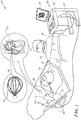
- Fig. 1 is a pictorial illustration of a system 10 for evaluating electrical activity and performing ablative procedures on a heart 12 of a living subject, which is constructed and operative in accordance with a disclosed embodiment of the invention.
- the system comprises a catheter 14, which is percutaneously inserted by an operator 16 through the patient's vascular system into a chamber or vascular structure of the heart 12.
- the operator 16 who is typically a physician, brings the catheter's distal tip 18 into contact with the heart wall, for example, at an ablation target site.
- Electrical activation maps may be prepared, according to the methods disclosed in U.S. Patent Nos. 6,226,542 , and 6,301,496 , and in commonly assigned U.S.
- Patent No. 6,892,091 whose disclosures are herein incorporated by reference.
- One commercial product embodying elements of the system 10 is available as the CARTO® 3 System, available from Biosense Webster, Inc., 3333 Diamond Canyon Road, Diamond Bar, CA 91765. This system may be modified by those skilled in the art to embody the principles of the invention described herein.
- Areas determined to be abnormal can be ablated by application of thermal energy, e.g., by passage of radiofrequency electrical current through wires in the catheter to one or more electrodes at the distal tip 18, which apply the radiofrequency energy to the myocardium.
- the energy is absorbed in the tissue, heating it to a point (typically about 60°C) at which it permanently loses its electrical excitability.
- this procedure creates non-conducting lesions in the cardiac tissue, which disrupt the abnormal electrical pathway causing the arrhythmia.
- the principles of the invention can be applied to different heart chambers to diagnose and treat many different cardiac arrhythmias.
- the catheter 14 typically comprises a handle 20, having suitable controls on the handle to enable the operator 16 to steer, position and orient the distal end of the catheter as desired for the ablation.
- the distal portion of the catheter 14 contains position sensors (not shown) that provide signals to a processor 22, located in a console 24.
- the processor 22 may fulfill several processing functions as described below.
- Ablation energy and electrical signals can be conveyed to and from the heart 12 through one or more ablation electrodes 32 located at or near the distal tip 18 via cable 34 to the console 24. Pacing signals and other control signals may be conveyed from the console 24 through the cable 34 and the electrodes 32 to the heart 12. Sensing electrodes 33, also connected to the console 24 are disposed between the ablation electrodes 32 and have connections to the cable 34.
- Wire connections 35 link the console 24 with body surface electrodes 30 and other components of a positioning sub-system for measuring location and orientation coordinates of the catheter 14.
- the processor 22 or another processor may be an element of the positioning subsystem.
- the electrodes 32 and the body surface electrodes 30 may be used to measure tissue impedance at the ablation site as taught in U.S. Patent No. 7,536,218, issued to Govari et al. , which is herein incorporated by reference.
- a temperature sensor (not shown), typically a thermocouple or thermistor, may be mounted on or near each of the electrodes 32.
- the console 24 typically contains one or more ablation power generators 25.
- the catheter 14 may be adapted to conduct ablative energy to the heart using any known ablation technique, e.g., radiofrequency energy, ultrasound energy, and laser-produced light energy. Such methods are disclosed in commonly assigned U.S. Patent Nos. 6,814,733 , 6,997,924 , and 7,156,816 , which are herein incorporated by reference.
- the positioning subsystem comprises a magnetic position tracking arrangement that determines the position and orientation of the catheter 14 by generating magnetic fields in a predefined working volume and sensing these fields at the catheter, using field generating coils 28.
- the positioning subsystem is described in U.S. Patent No. 7,756,576 , which is hereby incorporated by reference, and in the above-noted U.S. Patent No. 7,536,218 .
- the catheter 14 is coupled to the console 24, which enables the operator 16 to observe and regulate the functions of the catheter 14.
- Console 24 includes a processor, preferably a computer with appropriate signal processing circuits.
- the processor is coupled to drive a monitor 29.
- the signal processing circuits typically receive, amplify, filter and digitize signals from the catheter 14, including signals generated by sensors such as electrical, temperature and contact force sensors, and a plurality of location sensing electrodes (not shown) located distally in the catheter 14.
- the digitized signals are received and used by the console 24 and the positioning system to compute the position and orientation of the catheter 14, and to analyze the electrical signals from the electrodes.
- the processor 22 typically comprises an electroanatomic map generator, an image registration program, an image or data analysis program and a graphical user interface configured to present graphical information on the monitor 29.
- the system 10 includes other elements, which are not shown in the figures for the sake of simplicity.
- the system 10 may include an electrocardiogram (ECG) monitor, coupled to receive signals from one or more body surface electrodes, in order to provide an ECG synchronization signal to the console 24.
- ECG electrocardiogram
- the system 10 typically also includes a reference position sensor, either on an externally-applied reference patch attached to the exterior of the subject's body, or on an internally-placed catheter, which is inserted into the heart 12 maintained in a fixed position relative to the heart 12. Conventional pumps and lines for circulating liquids through the catheter 14 for cooling the ablation site are provided.
- the system 10 may receive image data from an external imaging modality, such as an MRI unit or the like and includes image processors that can be incorporated in or invoked by the processor 22 for generating and displaying images.
- Fig. 2 is a partially schematic view of the distal portion of an expanded balloon catheter 40 in accordance with an embodiment of the invention.
- a network of leads 42 extending from the proximal end (not shown) of the catheter 40 supply multiple ablation electrodes, which are disposed on the surface of a balloon 44.
- the leads 42 supplies proximal and distal groups of electrodes 46, 48, respectively.
- This number and configuration of ablation electrodes is exemplary, and the principles of the invention are applicable to many configurations and any number of ablation electrodes.
- the network of leads may vary and assume many configurations. For example, there may be one subnetwork that supplies the proximal group of electrodes 46 and another that supplies the distal group of electrodes 48. The subnetworks may be independent or interconnected.
- thermistors 50 which are positioned generally near the electrodes 46, 48 in order that they contact the endocardial surface at or near the ablation site and that the readings accurately reflect the temperatures at the ablation site.
- Fig. 2 there are a total of 24 thermistors.
- Fig. 3 is a schematic diagram of the arrangement of a resistive network defined by leads 42 ( Fig. 2 ) in accordance with an embodiment of the invention.
- the leads 42 are represented by lines 52.
- Rows 54, 56 represent the proximal and distal electrodes 46, 48, respectively.
- Thermistors 50 are not shown explicitly, but are realized as connections between pairs of dots 58.
- the proximity of the pairs of dots 58 to the electrodes 46, 48 is represented.
- Connections between the electrodes and the lines 52 corresponding to the leads 42 ( Fig. 2 ) are not shown explicitly but will be understood.
- Voltage and current readings are taken at external measuring points of the network formed by the lines 52, e.g., points 60, 62, 64.
- the number of measuring points is at least sufficient to derive the resistances of the individual thermistors 50 by applying well-known principles of linear network analysis to the topology of the particular network formed by the lines 52 and solving the resulting linear system of equations.
- the network topology may vary according to the number and positions of the ablation electrodes on the balloon; nevertheless the principles are applicable by choosing suitable external measuring points to derive the resistance of each thermistor, using logical circuitry or a processor in the console 24 ( Fig. 1 ).
- each node of the network To implement the voltage and current measurement a source of voltage (or current) is implemented at each node of the network.
- the frequency of the sources are selected in a way that they can be detected independently of any other signal that may be present during the measurement (e.g., ablation signal, magnetic tracker signal or ECG signal), thus allowing a continuous resistance measurement.
- each node may be connected to a source having a respective frequency.
- the thermistors may be incorporated into the leads supplying the ablation electrodes in different ways, for example, by stamping or printing, or combinations thereof, as known in the art. Flexible circuitry may be employed.
- Fig. 4 is an elevation of the distal portion of an expanded cardiac balloon catheter 66 in accordance with an alternate embodiment of the invention.
- Balloon 68 has eight splines 70, of which five are visible.
- Distal bridging connections 72 join pairs of the splines 70 to define electromagnetic loops.
- Ablation electrodes 74 have connections 76 with the splines 70.
- the electrodes 74 are located on the surface of the balloon 68 and are positioned near thermistors 78. Typically there are four thermistors per spline, which are mounted on flexible circuitry that forms the splines.
- the thermistors 78 share the conductors leading to the electrodes 74.
- the resistances of the thermistors 78 are measured by taking voltage and current readings at eight access points along the proximal continuations (not shown) of the splines 70. In general the interconnections among the lines become more complex as the number of thermistors increases and the number of access points required to analyze the resistive network increases as well.
- FIG. 5 is an elevation of the distal portion of an expanded cardiac balloon catheter 80 in accordance with an alternate embodiment of the invention.
- splines 82 having a common distal connection 84 and individual connections 86 to ablation electrodes 88, which are applied to the surface of balloon 90, e.g., by printing or stamping.
- Two rows of thermistors 92 appear on each of the splines 82 (typically four thermistors per spline), and are connected in a network by flexible circuit conductors, e.g., leads 94.
- FIG. 6 is a partially schematic diagram of the distal portion of an expanded cardiac balloon catheter 96 in accordance with an alternate embodiment of the invention.
- a representative electromagnetic loop comprising conductors shared by ablation electrodes and thermistors is represented by a line 98 extending along and bridging splines 100, 102 across bridge connector 104.
- ablation electrodes 106 are printed on the surface of the balloon.
- Additional ablation electrodes 108, indicated by rectangles are printed atop thermistors 110.
- Flexible circuitry is used in the construction of the balloon catheter 96.
Landscapes
- Health & Medical Sciences (AREA)
- Life Sciences & Earth Sciences (AREA)
- Engineering & Computer Science (AREA)
- Surgery (AREA)
- Animal Behavior & Ethology (AREA)
- General Health & Medical Sciences (AREA)
- Veterinary Medicine (AREA)
- Public Health (AREA)
- Biomedical Technology (AREA)
- Heart & Thoracic Surgery (AREA)
- Molecular Biology (AREA)
- Physics & Mathematics (AREA)
- Medical Informatics (AREA)
- Otolaryngology (AREA)
- Plasma & Fusion (AREA)
- Nuclear Medicine, Radiotherapy & Molecular Imaging (AREA)
- Biophysics (AREA)
- Cardiology (AREA)
- Pulmonology (AREA)
- Anesthesiology (AREA)
- Hematology (AREA)
- Pathology (AREA)
- Surgical Instruments (AREA)
- Media Introduction/Drainage Providing Device (AREA)
Applications Claiming Priority (1)
| Application Number | Priority Date | Filing Date | Title |
|---|---|---|---|
| US15/594,866 US20180325585A1 (en) | 2017-05-15 | 2017-05-15 | Networked thermistors |
Publications (1)
| Publication Number | Publication Date |
|---|---|
| EP3403607A1 true EP3403607A1 (de) | 2018-11-21 |
Family
ID=62165414
Family Applications (1)
| Application Number | Title | Priority Date | Filing Date |
|---|---|---|---|
| EP18172047.5A Withdrawn EP3403607A1 (de) | 2017-05-15 | 2018-05-14 | Vernetzte thermistoren |
Country Status (7)
| Country | Link |
|---|---|
| US (1) | US20180325585A1 (de) |
| EP (1) | EP3403607A1 (de) |
| JP (1) | JP2018192254A (de) |
| CN (1) | CN108852501A (de) |
| AU (1) | AU2018203383A1 (de) |
| CA (1) | CA3004866A1 (de) |
| IL (1) | IL259331A (de) |
Families Citing this family (4)
| Publication number | Priority date | Publication date | Assignee | Title |
|---|---|---|---|---|
| US11801082B2 (en) * | 2017-06-05 | 2023-10-31 | St. Jude Medical, Cardiology Division, Inc. | Balloon-in-basket ablation catheter |
| US12114918B2 (en) * | 2019-08-15 | 2024-10-15 | Biosense Webster (Israel) Ltd. | Dynamic ablation and sensing according to contact of segmented electrodes |
| EP4203827A1 (de) * | 2020-08-31 | 2023-07-05 | Boston Scientific Scimed, Inc. | Expandierbare elektroporationsvorrichtungen und verfahren zur verwendung |
| CN115252112A (zh) * | 2022-08-25 | 2022-11-01 | 复旦大学附属中山医院 | 一种多层环形消融装置 |
Citations (15)
| Publication number | Priority date | Publication date | Assignee | Title |
|---|---|---|---|---|
| US6226542B1 (en) | 1998-07-24 | 2001-05-01 | Biosense, Inc. | Three-dimensional reconstruction of intrabody organs |
| US6301496B1 (en) | 1998-07-24 | 2001-10-09 | Biosense, Inc. | Vector mapping of three-dimensionally reconstructed intrabody organs and method of display |
| US6814733B2 (en) | 2002-01-31 | 2004-11-09 | Biosense, Inc. | Radio frequency pulmonary vein isolation |
| US6892091B1 (en) | 2000-02-18 | 2005-05-10 | Biosense, Inc. | Catheter, method and apparatus for generating an electrical map of a chamber of the heart |
| US6997924B2 (en) | 2002-09-17 | 2006-02-14 | Biosense Inc. | Laser pulmonary vein isolation |
| US7081096B2 (en) | 2003-01-24 | 2006-07-25 | Medtronic Vascular, Inc. | Temperature mapping balloon |
| US7156816B2 (en) | 2002-11-26 | 2007-01-02 | Biosense, Inc. | Ultrasound pulmonary vein isolation |
| US7536218B2 (en) | 2005-07-15 | 2009-05-19 | Biosense Webster, Inc. | Hybrid magnetic-based and impedance-based position sensing |
| US7756576B2 (en) | 2005-08-26 | 2010-07-13 | Biosense Webster, Inc. | Position sensing and detection of skin impedance |
| US20120143179A1 (en) * | 2010-12-07 | 2012-06-07 | Boaz Avitall | Catheter Systems for Cardiac Arrhythmia Ablation |
| JP2014184134A (ja) * | 2013-02-25 | 2014-10-02 | Inter Noba Kk | 生体環境を監視するためのカテーテル |
| US20150025532A1 (en) * | 2013-07-22 | 2015-01-22 | Boston Scientific Scimed, Inc. | Medical devices for renal nerve ablation |
| US20150057656A1 (en) * | 2013-08-22 | 2015-02-26 | Boston Scientific Scimed, Inc. | Flexible circuit having improved adhesion to a renal nerve modulation balloon |
| US20160175041A1 (en) * | 2014-12-22 | 2016-06-23 | Biosense Webster (Israel) Ltd. | Balloon for ablation around pulmonary veins |
| US20170042614A1 (en) * | 2008-11-11 | 2017-02-16 | Amr Salahieh | Ablation catheters |
Family Cites Families (16)
| Publication number | Priority date | Publication date | Assignee | Title |
|---|---|---|---|---|
| US5575810A (en) * | 1993-10-15 | 1996-11-19 | Ep Technologies, Inc. | Composite structures and methods for ablating tissue to form complex lesion patterns in the treatment of cardiac conditions and the like |
| US5830213A (en) * | 1996-04-12 | 1998-11-03 | Ep Technologies, Inc. | Systems for heating and ablating tissue using multifunctional electrode structures |
| US6511478B1 (en) * | 2000-06-30 | 2003-01-28 | Scimed Life Systems, Inc. | Medical probe with reduced number of temperature sensor wires |
| DE202004021947U1 (de) * | 2003-09-12 | 2013-05-13 | Vessix Vascular, Inc. | Auswählbare exzentrische Remodellierung und/oder Ablation von atherosklerotischem Material |
| JP5575654B2 (ja) * | 2007-10-29 | 2014-08-20 | シュヴェイガー・メディカ・アーゲー | カテーテル |
| CA2716657A1 (en) * | 2008-03-05 | 2009-09-11 | Robert Hoch | Pressure sensing catheter |
| DE102008021060A1 (de) * | 2008-04-26 | 2009-10-29 | Biotronik Vi Patent Ag | Einführvorrichtung mit einer Freisetzeinrichtung zur Freisetzung eines von einem Katheter getragenen Gegenstandes sowie Freisetzeinrichtung einer Einführvorrichtung |
| US8128617B2 (en) * | 2008-05-27 | 2012-03-06 | Boston Scientific Scimed, Inc. | Electrical mapping and cryo ablating with a balloon catheter |
| US9289132B2 (en) * | 2008-10-07 | 2016-03-22 | Mc10, Inc. | Catheter balloon having stretchable integrated circuitry and sensor array |
| US8097926B2 (en) * | 2008-10-07 | 2012-01-17 | Mc10, Inc. | Systems, methods, and devices having stretchable integrated circuitry for sensing and delivering therapy |
| US9883906B2 (en) * | 2012-04-22 | 2018-02-06 | Newuro, B.V. | Bladder tissue modification for overactive bladder disorders |
| JP2015521894A (ja) * | 2012-07-05 | 2015-08-03 | エムシー10 インコーポレイテッドMc10,Inc. | 流量センシングを含むカテーテルデバイス |
| US10499984B2 (en) * | 2012-07-18 | 2019-12-10 | Bernard Boon Chye Lim | Apparatus and method for assessing tissue treatment |
| JP6259099B2 (ja) * | 2013-10-18 | 2018-01-10 | ボストン サイエンティフィック サイムド,インコーポレイテッドBoston Scientific Scimed,Inc. | 可撓性を備える導電性ワイヤを備えるバルーン・カテーテル、並びに関連する使用および製造方法 |
| US9907609B2 (en) * | 2014-02-04 | 2018-03-06 | Boston Scientific Scimed, Inc. | Alternative placement of thermal sensors on bipolar electrode |
| EP3131488A1 (de) * | 2014-04-17 | 2017-02-22 | Boston Scientific Scimed, Inc. | Medizinische vorrichtungen für therapeutische wärmebehandlungen |
-
2017
- 2017-05-15 US US15/594,866 patent/US20180325585A1/en not_active Abandoned
-
2018
- 2018-05-14 IL IL259331A patent/IL259331A/en unknown
- 2018-05-14 JP JP2018092768A patent/JP2018192254A/ja active Pending
- 2018-05-14 CA CA3004866A patent/CA3004866A1/en not_active Abandoned
- 2018-05-14 EP EP18172047.5A patent/EP3403607A1/de not_active Withdrawn
- 2018-05-15 AU AU2018203383A patent/AU2018203383A1/en not_active Abandoned
- 2018-05-15 CN CN201810461252.2A patent/CN108852501A/zh active Pending
Patent Citations (15)
| Publication number | Priority date | Publication date | Assignee | Title |
|---|---|---|---|---|
| US6226542B1 (en) | 1998-07-24 | 2001-05-01 | Biosense, Inc. | Three-dimensional reconstruction of intrabody organs |
| US6301496B1 (en) | 1998-07-24 | 2001-10-09 | Biosense, Inc. | Vector mapping of three-dimensionally reconstructed intrabody organs and method of display |
| US6892091B1 (en) | 2000-02-18 | 2005-05-10 | Biosense, Inc. | Catheter, method and apparatus for generating an electrical map of a chamber of the heart |
| US6814733B2 (en) | 2002-01-31 | 2004-11-09 | Biosense, Inc. | Radio frequency pulmonary vein isolation |
| US6997924B2 (en) | 2002-09-17 | 2006-02-14 | Biosense Inc. | Laser pulmonary vein isolation |
| US7156816B2 (en) | 2002-11-26 | 2007-01-02 | Biosense, Inc. | Ultrasound pulmonary vein isolation |
| US7081096B2 (en) | 2003-01-24 | 2006-07-25 | Medtronic Vascular, Inc. | Temperature mapping balloon |
| US7536218B2 (en) | 2005-07-15 | 2009-05-19 | Biosense Webster, Inc. | Hybrid magnetic-based and impedance-based position sensing |
| US7756576B2 (en) | 2005-08-26 | 2010-07-13 | Biosense Webster, Inc. | Position sensing and detection of skin impedance |
| US20170042614A1 (en) * | 2008-11-11 | 2017-02-16 | Amr Salahieh | Ablation catheters |
| US20120143179A1 (en) * | 2010-12-07 | 2012-06-07 | Boaz Avitall | Catheter Systems for Cardiac Arrhythmia Ablation |
| JP2014184134A (ja) * | 2013-02-25 | 2014-10-02 | Inter Noba Kk | 生体環境を監視するためのカテーテル |
| US20150025532A1 (en) * | 2013-07-22 | 2015-01-22 | Boston Scientific Scimed, Inc. | Medical devices for renal nerve ablation |
| US20150057656A1 (en) * | 2013-08-22 | 2015-02-26 | Boston Scientific Scimed, Inc. | Flexible circuit having improved adhesion to a renal nerve modulation balloon |
| US20160175041A1 (en) * | 2014-12-22 | 2016-06-23 | Biosense Webster (Israel) Ltd. | Balloon for ablation around pulmonary veins |
Also Published As
| Publication number | Publication date |
|---|---|
| CN108852501A (zh) | 2018-11-23 |
| IL259331A (en) | 2018-06-28 |
| US20180325585A1 (en) | 2018-11-15 |
| AU2018203383A1 (en) | 2018-11-29 |
| JP2018192254A (ja) | 2018-12-06 |
| CA3004866A1 (en) | 2018-11-15 |
Similar Documents
| Publication | Publication Date | Title |
|---|---|---|
| US11213347B2 (en) | Monitoring and tracking bipolar ablation | |
| CN103565432B (zh) | 用于多刺状物探针的图形界面 | |
| US10045707B2 (en) | Basket catheter with far-field electrode | |
| US11207125B2 (en) | Effective parasitic capacitance minimization for micro ablation electrode | |
| AU2012268833B2 (en) | Electrode irrigation using micro-jets | |
| EP3034024B1 (de) | System zur steuerung der gewebeablation mithilfe von temperatursensoren | |
| EP3453323A1 (de) | Automatische anzeige des frühesten lat-punktes | |
| EP3494916B1 (de) | Katheter mit mitteln zur erfassung eines kontaktverlusts einer ablationselektrode | |
| US20180310987A1 (en) | Systems and processes for map-guided automatic cardiac ablation | |
| EP3033995B1 (de) | Weitfeld-unempfindliche intrakardiale katheterelektroden | |
| US20160175041A1 (en) | Balloon for ablation around pulmonary veins | |
| CA2960038A1 (en) | Magnetic resonance thermometry during ablation | |
| AU2018203383A1 (en) | Networked thermistors | |
| US11794004B2 (en) | Electroporation with cooling | |
| CN118973482A (zh) | 电解剖信号中的噪声 |
Legal Events
| Date | Code | Title | Description |
|---|---|---|---|
| PUAI | Public reference made under article 153(3) epc to a published international application that has entered the european phase |
Free format text: ORIGINAL CODE: 0009012 |
|
| STAA | Information on the status of an ep patent application or granted ep patent |
Free format text: STATUS: THE APPLICATION HAS BEEN PUBLISHED |
|
| AK | Designated contracting states |
Kind code of ref document: A1 Designated state(s): AL AT BE BG CH CY CZ DE DK EE ES FI FR GB GR HR HU IE IS IT LI LT LU LV MC MK MT NL NO PL PT RO RS SE SI SK SM TR |
|
| AX | Request for extension of the european patent |
Extension state: BA ME |
|
| STAA | Information on the status of an ep patent application or granted ep patent |
Free format text: STATUS: REQUEST FOR EXAMINATION WAS MADE |
|
| 17P | Request for examination filed |
Effective date: 20190520 |
|
| RBV | Designated contracting states (corrected) |
Designated state(s): AL AT BE BG CH CY CZ DE DK EE ES FI FR GB GR HR HU IE IS IT LI LT LU LV MC MK MT NL NO PL PT RO RS SE SI SK SM TR |
|
| STAA | Information on the status of an ep patent application or granted ep patent |
Free format text: STATUS: EXAMINATION IS IN PROGRESS |
|
| 17Q | First examination report despatched |
Effective date: 20220511 |
|
| STAA | Information on the status of an ep patent application or granted ep patent |
Free format text: STATUS: THE APPLICATION HAS BEEN WITHDRAWN |
|
| 18W | Application withdrawn |
Effective date: 20220622 |