EP3404009B1 - Procédé de fabrication de 1,4-bis(4-phénoxybenzoyle)benzène dans des conditions de sursaturation - Google Patents
Procédé de fabrication de 1,4-bis(4-phénoxybenzoyle)benzène dans des conditions de sursaturation Download PDFInfo
- Publication number
- EP3404009B1 EP3404009B1 EP17305561.7A EP17305561A EP3404009B1 EP 3404009 B1 EP3404009 B1 EP 3404009B1 EP 17305561 A EP17305561 A EP 17305561A EP 3404009 B1 EP3404009 B1 EP 3404009B1
- Authority
- EP
- European Patent Office
- Prior art keywords
- phenoxybenzoyl
- bis
- benzene
- lewis acid
- solvent
- Prior art date
- Legal status (The legal status is an assumption and is not a legal conclusion. Google has not performed a legal analysis and makes no representation as to the accuracy of the status listed.)
- Active
Links
Images

Classifications
-
- C—CHEMISTRY; METALLURGY
- C07—ORGANIC CHEMISTRY
- C07C—ACYCLIC OR CARBOCYCLIC COMPOUNDS
- C07C45/00—Preparation of compounds having >C = O groups bound only to carbon or hydrogen atoms; Preparation of chelates of such compounds
- C07C45/45—Preparation of compounds having >C = O groups bound only to carbon or hydrogen atoms; Preparation of chelates of such compounds by condensation
- C07C45/46—Friedel-Crafts reactions
-
- C—CHEMISTRY; METALLURGY
- C08—ORGANIC MACROMOLECULAR COMPOUNDS; THEIR PREPARATION OR CHEMICAL WORKING-UP; COMPOSITIONS BASED THEREON
- C08G—MACROMOLECULAR COMPOUNDS OBTAINED OTHERWISE THAN BY REACTIONS ONLY INVOLVING UNSATURATED CARBON-TO-CARBON BONDS
- C08G61/00—Macromolecular compounds obtained by reactions forming a carbon-to-carbon link in the main chain of the macromolecule
- C08G61/12—Macromolecular compounds containing atoms other than carbon in the main chain of the macromolecule
- C08G61/127—Macromolecular compounds containing atoms other than carbon in the main chain of the macromolecule derived from carbon dioxide, carbonyl halide, carboxylic acids or their derivatives
-
- C—CHEMISTRY; METALLURGY
- C08—ORGANIC MACROMOLECULAR COMPOUNDS; THEIR PREPARATION OR CHEMICAL WORKING-UP; COMPOSITIONS BASED THEREON
- C08G—MACROMOLECULAR COMPOUNDS OBTAINED OTHERWISE THAN BY REACTIONS ONLY INVOLVING UNSATURATED CARBON-TO-CARBON BONDS
- C08G65/00—Macromolecular compounds obtained by reactions forming an ether link in the main chain of the macromolecule
- C08G65/34—Macromolecular compounds obtained by reactions forming an ether link in the main chain of the macromolecule from hydroxy compounds or their metallic derivatives
- C08G65/38—Macromolecular compounds obtained by reactions forming an ether link in the main chain of the macromolecule from hydroxy compounds or their metallic derivatives derived from phenols
- C08G65/40—Macromolecular compounds obtained by reactions forming an ether link in the main chain of the macromolecule from hydroxy compounds or their metallic derivatives derived from phenols from phenols (I) and other compounds (II), e.g. OH-Ar-OH + X-Ar-X, where X is halogen atom, i.e. leaving group
- C08G65/4012—Other compound (II) containing a ketone group, e.g. X-Ar-C(=O)-Ar-X for polyetherketones
-
- C—CHEMISTRY; METALLURGY
- C07—ORGANIC CHEMISTRY
- C07C—ACYCLIC OR CARBOCYCLIC COMPOUNDS
- C07C49/00—Ketones; Ketenes; Dimeric ketenes; Ketonic chelates
- C07C49/76—Ketones containing a keto group bound to a six-membered aromatic ring
- C07C49/84—Ketones containing a keto group bound to a six-membered aromatic ring containing ether groups, groups, groups, or groups
-
- C—CHEMISTRY; METALLURGY
- C08—ORGANIC MACROMOLECULAR COMPOUNDS; THEIR PREPARATION OR CHEMICAL WORKING-UP; COMPOSITIONS BASED THEREON
- C08G—MACROMOLECULAR COMPOUNDS OBTAINED OTHERWISE THAN BY REACTIONS ONLY INVOLVING UNSATURATED CARBON-TO-CARBON BONDS
- C08G2261/00—Macromolecular compounds obtained by reactions forming a carbon-to-carbon link in the main chain of the macromolecule
- C08G2261/30—Monomer units or repeat units incorporating structural elements in the main chain
- C08G2261/34—Monomer units or repeat units incorporating structural elements in the main chain incorporating partially-aromatic structural elements in the main chain
- C08G2261/344—Monomer units or repeat units incorporating structural elements in the main chain incorporating partially-aromatic structural elements in the main chain containing heteroatoms
- C08G2261/3442—Polyetherketones
-
- C—CHEMISTRY; METALLURGY
- C08—ORGANIC MACROMOLECULAR COMPOUNDS; THEIR PREPARATION OR CHEMICAL WORKING-UP; COMPOSITIONS BASED THEREON
- C08G—MACROMOLECULAR COMPOUNDS OBTAINED OTHERWISE THAN BY REACTIONS ONLY INVOLVING UNSATURATED CARBON-TO-CARBON BONDS
- C08G2261/00—Macromolecular compounds obtained by reactions forming a carbon-to-carbon link in the main chain of the macromolecule
- C08G2261/40—Polymerisation processes
- C08G2261/45—Friedel-Crafts-type
-
- C—CHEMISTRY; METALLURGY
- C08—ORGANIC MACROMOLECULAR COMPOUNDS; THEIR PREPARATION OR CHEMICAL WORKING-UP; COMPOSITIONS BASED THEREON
- C08G—MACROMOLECULAR COMPOUNDS OBTAINED OTHERWISE THAN BY REACTIONS ONLY INVOLVING UNSATURATED CARBON-TO-CARBON BONDS
- C08G2650/00—Macromolecular compounds obtained by reactions forming an ether link in the main chain of the macromolecule
- C08G2650/62—Macromolecular compounds obtained by reactions forming an ether link in the main chain of the macromolecule characterised by the nature of monomer used
Definitions
- the present invention relates to a method for manufacturing 1,4-bis(4-phenoxybenzoyl)benzene, as well as polyether ketone ketone polymers starting from said 1,4-bis(4-phenoxybenzoyl)benzene.
- Polyether ketone ketone (PEKK) polymers have a number of properties which make them useful in applications involving exposure to high temperature or to high mechanical or chemical stress. They are for instance useful in the aerospace industry, in off-shore drilling and in medical devices.
- 1,4-bis(4-phenoxybenzoyl)benzene can be prepared by reacting terephthaloyl chloride and diphenyl ether in the presence of a Lewis acid such as aluminum trichloride.
- 1,4-bis(4-phenoxybenzoyl)benzene is prepared by dissolving terephthaloyl chloride and diphenyl ether in ortho-dichlorobenzene, cooling to 0-5°C and adding aluminum chloride with temperature kept below 5°C. The mixture is then warmed to 20°C. Thereafter, cold methanol is added so as to produce a slurry which is filtered, reslurried in methanol and filtered again.
- 1,4-bis(4-phenoxybenzoyl)benzene is prepared by providing a mixture of methylene chloride, methylsulfone and aluminum trichloride, cooling to a temperature of between -30 and -35°C, and then adding diphenyl ether and thereafter terephthaloyl chloride. The reaction mixture is then poured into cold methanol so as to make a slurry which is then filtered.
- EP 0 268 112 A2 shows (see step 1 of Referential Example 1 on p. 14, I. 18-26) a method for preparing 1,4-bis(4-phenoxybenzoyl)benzene wherein terephthaloyl chloride is reacted with diphenyl ether and aluminium chloride in o-dichlorobenzene.
- the 1,4-bis(4-phenoxybenzoyl)benzene-Lewis acid complex is dissolved in the solvent at a 1,4-bis(4-phenoxybenzoyl)benzene weight concentration which is higher by at least 5 %, preferably by at least 10 %, more preferably by at least 20 %, than the saturation limit of the 1,4-bis(4-phenoxybenzoyl)benzene-Lewis acid complex, during part of the step of reacting terephthaloyl chloride with diphenyl ether.
- the 1,4-bis(4-phenoxybenzoyl)benzene-Lewis acid complex is dissolved in the solvent at a 1,4-bis(4-phenoxybenzoyl)benzene weight concentration of more than 5 wt.%, preferably more than 10 wt.%, more preferably more than 15 wt.%, and most preferably more than 30 wt.%, during part of the step of reacting terephthaloyl chloride with diphenyl ether.
- the 1,4-bis(4-phenoxybenzoyl)benzene-Lewis acid complex is dissolved in the solvent during at least 75 %, preferably at least 90 %, more preferably at least 95 % of the duration of the step of reacting terephthaloyl chloride with diphenyl ether, and most preferably during the totality of the step of reacting terephthaloyl chloride with diphenyl ether.
- the 1,4-bis(4-phenoxybenzoyl)benzene-Lewis acid complex is dissolved in the solvent when an amount of 1,4-bis(4-phenoxybenzoyl)benzene of 75 mol.%, relative to the initial amount of terephthaloyl chloride, is present in the reactant mixture; preferably the 1,4-bis(4-phenoxybenzoyl)benzene-Lewis acid complex is dissolved in the solvent when an amount of 1,4-bis(4-phenoxybenzoyl)benzene of 80 mol.%, relative to the initial amount of terephthaloyl chloride, is present in the reactant mixture; more preferably the 1,4-bis(4-phenoxybenzoyl)benzene-Lewis acid complex is dissolved in the solvent when an amount of 1,4-bis(4-phenoxybenzoyl)benzene of 85 mol.%, relative to the initial amount of terephthaloyl chloride, is present in the reactant mixture
- the step of reacting terephthaloyl chloride with diphenyl ether is performed in a reactor, and:
- the Lewis acid is aluminum trichloride.
- the temperature of the reactant mixture is at least 5°C, preferably at least 15°C or at least 25°C or at least 35°C or at least 45°C during at least part of the step of reacting terephthaloyl chloride with diphenyl ether.
- the Lewis acid is progressively added to a mixture of terephthaloyl chloride and diphenyl ether in the solvent, and the temperature of the reactant mixture is at least 30°C, preferably at least 40°C and more preferably at least 45°C, after 30 % by weight of Lewis acid has been added, relative to the total weight of Lewis acid.
- the temperature of the reactant mixture increases during the step of reacting terephthaloyl chloride with diphenyl ether, from an initial temperature to a final temperature, and preferably:
- the solvent is ortho-dichlorobenzene.
- the method comprises the additional steps of:
- the invention also relates to a method of making a polyether ketone ketone polymer, comprising:
- the present invention provides a method for manufacturing 1,4-bis(4-phenoxybenzoyl)benzene with a high purity and a high yield. This method can be implemented at the industrial scale.
- 1,4-bis(4-phenoxybenzoyl)benzene is the compound of formula I:
- reaction step It is made by reacting terephthaloyl chloride of formula II: with diphenyl ether of formula III: in a solvent, and in the presence of a Lewis acid, acting as a Friedel-Crafts catalyst. This is hereafter called “the reaction step " .
- reaction results in the production of the compound of formula I which is predominantly in the form of a complex with the Lewis acid.
- reaction comprises two stages.
- one molecule of formula II reacts with one molecule of formula III to form the following intermediate of formula IV (4-(4-phenoxybenzoyl)benzoyl chloride) which is called an " active intermediate ":
- the corresponding 4-(4-phenoxybenzoyl)benzoic acid ester can be formed either directly from the acyl chloride of formula IV or from the carboxylic acid of formula IVa.
- the acid form and/or the ester form of the intermediate can be formed during the reaction but they can also primarily be formed from the remaining active intermediate during subsequent workup (such as when the product mixture is mixed with a protic solvent, as described below).
- the 4-(4-phenoxybenzoyl)benzoic acid and 4-(4-phenoxybenzoyl)benzoic acid ester are inactive and therefore remain as impurities in the product mixture.
- the other main impurities produced by the reaction are xanthydrol moiety-containing molecules.
- the solvent is preferably a non-protic solvent, which can in particular be selected from methylene chloride, carbon disulfide, ortho-dichlorobenzene, meta-dichlorobenzene, para-dichlorobenzene, 1,2,4-trichlorobenzene, 1,2,3-trichlorobenzene, ortho-difluorobenzene, 1,2-dichloroethane, 1,1,2,2-tetrachloroethane, tetrachloroethylene, dichloromethane, nitrobenzene and mixtures thereof.
- a non-protic solvent which can in particular be selected from methylene chloride, carbon disulfide, ortho-dichlorobenzene, meta-dichlorobenzene, para-dichlorobenzene, 1,2,4-trichlorobenzene, 1,2,3-trichlorobenzene, ortho-difluorobenzene, 1,2-dichloroethane, 1,1,2,2-t
- Ortho-dichlorobenzene is the most preferred solvent.
- Lewis acids which may be used include, for example, aluminum trichloride, aluminum tribromide, antimony pentachloride, antimony pentafluoride, indium trichloride, gallium trichloride, boron trichloride, boron trifluoride, zinc chloride, ferric chloride, stannic chloride, titanium tetrachloride, and molybdenum pentachloride.
- Aluminum trichloride, boron trichloride, aluminum tribromide, titanium tetrachloride, antimony pentachloride, ferric chloride, gallium trichloride, and molybdenum pentachloride are preferred.
- Aluminum trichloride is particularly preferred.
- the reaction between the compounds of formulas II and III to make the compound of formula I is performed in a reactor.
- the reactor can be for instance a glass reactor, a glass-lined reactor or a stainless-steel reactor.
- the materials introduced into the reactor in the method of the invention consist essentially, or consist, of the compounds of formulas II and III, the solvent and the Lewis acid.
- the materials introduced into the reactor in the method of the invention additionally comprise one or more additives for increasing the solubility of Lewis acid complexes.
- additives may notably be selected from Lewis bases such as diphenylsulfone, carboxylic acids, ethers and inorganic salts such as LiCl, NaCl, KCl, CaCl 2 and MgCl 2 , as well as mixtures thereof.
- an initial reactant mixture comprising (and preferably consisting of) terephthaloyl chloride and diphenyl ether in a solvent
- the reactant mixture can be made by mixing the three components together, in any order.
- the solvent can be introduced first into the reactor, and then the two reactants can be added to the reactor.
- the Lewis acid is added to the reactant mixture.
- the Lewis acid is added as a solid.
- it can also be added as a suspension or a solution, preferably in the abovementioned solvent.
- the Lewis acid is added in a particulate form, such as in the form of granules (having e.g. a Dv80 of more than 1 mm) or in the form of a powder (having e.g. a Dv80 of less than 1 mm, and preferably a Dv50 of less than 0.5 mm).
- Dv80 and Dv50 are respectively the particle sizes at the 80 th and 50 th percentiles (in volume) of the cumulative size distribution of the Lewis acid particles. These parameters may be determined by sieving.
- the weight concentrations and weight ratios of the reactants and of the catalyst are as follows:
- the addition of the Lewis acid is preferably performed progressively, over a period of time which can advantageously range from 5 to 600 minutes, preferably from 30 to 300 minutes.
- the addition can be performed continuously or with one or more interruptions. If it is performed continuously, it can be conducted at a constant rate of addition. Alternatively, the rate of addition can vary over time.
- the reactant mixture is preferably agitated during at least part of the reaction step.
- the reactor is preferably provided with an agitation device such as a mechanical stirrer (which may e.g. comprise one or more impellers) or a recirculation loop with a pump.
- an agitation device such as a mechanical stirrer (which may e.g. comprise one or more impellers) or a recirculation loop with a pump.
- the reactant mixture is agitated using the agitation device during the addition of the Lewis acid.
- the reaction step may optionally comprise a step of maintaining the reactant mixture, preferably under agitation, for a certain time, in order to complete the reaction to the desired degree.
- the mixture is maintained from 0 to 600 min, more preferably from 5 to 180 min.
- the reactant mixture becomes designated as a product mixture.
- the end of the reaction step corresponds to the beginning of the next step in the method, which is usually a purification step, as described in more detail below.
- 1,4-bis(4-phenoxybenzoyl)benzene-Lewis acid complex is initially produced as a dissolved species, the concentration of which progressively increases.
- concentration of the 1,4-bis(4-phenoxybenzoyl)benzene-Lewis acid complex exceeds the saturation limit of the 1,4-bis(4-phenoxybenzoyl)benzene-Lewis acid complex.
- the 1,4-bis(4-phenoxybenzoyl)benzene-Lewis acid complex is maintained in a supersaturated state during at least part of the step of reacting terephthaloyl chloride with diphenyl ether.
- This saturation limit depends on the conditions of the reactant mixture in real time and may vary during the reaction step. In particular, it depends on the temperature of the reactant mixture, the nature of the solvent and the amount of Lewis-acid.
- the 1,4-bis(4-phenoxybenzoyl)benzene-Lewis acid complex is said to be in a supersaturated state when it is dissolved in the reactant mixture at a concentration exceeding the saturation limit.
- the supersaturated state is a metastable state. Therefore, the 1,4-bis(4-phenoxybenzoyl)benzene-Lewis acid complex in a supersaturated state is able to suddenly precipitate if a nucleating agent (e.g. solid particles) is present in the reactant mixture.
- a nucleating agent e.g. solid particles
- the concentration of the 1,4-bis(4-phenoxybenzoyl)benzene-Lewis acid complex is indicated by the weight concentration of 1,4-bis(4-phenoxybenzoyl)benzene in the solvent. The same applies to the saturation limit.
- the saturation limit can be determined using the following model experiment: predetermined quantities of 1,4-bis(4-phenoxybenzoyl)benzene and Lewis acid are added to a given solvent contained in a glass tube. The contents of the glass tube are agitated by magnetic stirring. The temperature of the mixture within the tube is controlled by placing the tube in a thermofluid. The initial temperature is such that the 1,4-bis(4-phenoxybenzoyl)benzene-Lewis acid complex is initially present as a suspension in the solvent. Then the temperature is gradually increased until the 1,4-bis(4-phenoxybenzoyl)benzene-Lewis acid complex gets fully solubilized in the solvent.
- the saturation limit is equal to the weight concentration of 1,4-bis(4-phenoxybenzoyl)benzene in the mixture.
- the experiment can be repeated a number of times using another weight concentration of 1,4-bis(4-phenoxybenzoyl)benzene and the same weight ratio of Lewis acid with respect to 1,4-bis(4-phenoxybenzoyl)benzene, so that a temperature / saturation curve can be finally obtained for a given solvent and a given weight ratio of Lewis acid to 1,4-bis(4-phenoxybenzoyl)benzene.
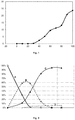
- Fig.1 shows by way of illustration the temperature / saturation curve obtained as described above in ortho-dichlorobenzene as a solvent, with a Lewis acid-to-1,4-bis(4-phenoxybenzoyl)benzene molar ratio of 4.05. If the 1,4-bis(4-phenoxybenzoyl)benzene-Lewis acid complex is dissolved in the solvent at a certain temperature and at a certain weight concentration of 1,4-bis(4-phenoxybenzoyl)benzene and if the corresponding temperature / concentration point is situated above the curve, then the 1,4-bis(4-phenoxybenzoyl)benzene-Lewis acid complex is in the supersaturated state.
- Fig.2 shows the typical evolution of the concentration of the relevant species in the reactant mixture during the reaction step. It can be seen that, as terephthaloyl chloride (A) is consumed, the 4-(4-phenoxybenzoyl)benzoyl chloride (B) is initially produced in a large amount. Then the concentration of 4-(4-phenoxybenzoyl)benzoyl chloride in the reactant mixture reaches a peak and decreases, while the concentration of the desired product (C) increases. The amount of xanthydrol moiety-containing impurities (D) increases over time but remains at a relatively low level.
- 1,4-bis(4-phenoxybenzoyl)benzene-Lewis acid complex precipitates during the reaction step, it is believed (without wishing to be bound by any theory) that part of the unreacted 4-(4-phenoxybenzoyl)benzoyl chloride is caught in the precipitate and thus substantially prevented from further reacting. In other terms, after the 1,4-bis(4-phenoxybenzoyl)benzene-Lewis acid complex has precipitated, it is believed that the conversion of the remaining 4-(4-phenoxybenzoyl)benzoyl chloride (B) to the desired product (C) is significantly impeded.
- this precipitation is either prevented or at least postponed during the reaction step, without however keeping the concentration of 1,4-bis(4-phenoxybenzoyl)benzene-Lewis acid complex in the mixture at a low level, which would in turn reduce the overall efficiency and kinetics of the reaction.
- This is made possible because the 1,4-bis(4-phenoxybenzoyl)benzene-Lewis acid complex remains dissolved in the solvent during at least part of the reaction step even after its concentration has reached the saturation limit.
- the 1,4-bis(4-phenoxybenzoyl)benzene-Lewis acid complex precipitates at some point of time during the reaction step (after the concentration of this species has exceeded the saturation limit).
- the 1,4-bis(4-phenoxybenzoyl)benzene-Lewis acid complex does not precipitate during the reaction step and remains dissolved in the solvent during the entirety of the reaction step.
- the 1,4-bis(4-phenoxybenzoyl)benzene-Lewis acid complex is dissolved in the solvent during at least 75%, or at least 80%, or at least 85%, or at least 90%, or at least 95%, or at least 98%, or at least 99% of the overall duration of the reaction step.
- the 1,4-bis(4-phenoxybenzoyl)benzene-Lewis acid complex is still dissolved in the solvent ( i.e. has not precipitated), when it is present in an amount of 75 mol.%, (or in other variations 80 mol.%, or 85 mol.%, or 90 mol.%, or 91 mol.%, or 92 mol.%, or 93 mol.%, or 94 mol.%, or 95 mol.%) in the reactant mixture, said amount being expressed as the amount of 1,4-bis(4-phenoxybenzoyl)benzene relative to the initial amount of terephthaloyl chloride reactant which was introduced.
- the 1,4-bis(4-phenoxybenzoyl)benzene-Lewis acid complex is dissolved in the solvent at a 1,4-bis(4-phenoxybenzoyl)benzene weight concentration which is higher by at least 5 %, (or in other variations by at least 10 %, or 15 %, or 20 %, or 25 %, or 30 %, or 35 %, or 40 %) than the saturation limit of the 1,4-bis(4-phenoxybenzoyl)benzene-Lewis acid complex, during part of the reaction step, and for instance during at least 5 minutes, or at least 10 minutes, or at least 15 minutes, or at least 20 minutes, or at least 30 minutes, or at least 40 minutes, or at least 1 hour.
- the 1,4-bis(4-phenoxybenzoyl)benzene-Lewis acid complex is dissolved in the solvent (without precipitation) at a 1,4-bis(4-phenoxybenzoyl)benzene concentration of more than 5 wt.%, or more than 10 wt.%, or more than 15 wt.%, or more than 20 wt.%, or more than 25 wt.%, or more than 30 wt.%, or more than 35 wt.%, or more than 40 wt.%, or more than 50 wt.%, during part of the reaction step.
- nucleation of the precipitate should be prevented or at least delayed.
- the internal walls of the reactor should have a low surface roughness.
- the surface roughness Ra as defined in ISO 4287
- the surface roughness of the walls should be less than 2 ⁇ m, or less than 1 ⁇ m, or less than 0.8 ⁇ m, or less than 0.5 ⁇ m, or less than 0.2 ⁇ m.
- all equipment surfaces in contact with the reactant mixture during the reaction step such as the surfaces of an impeller (if any) or the internal surfaces of a recirculation loop, should also have a rugosity of less than 2 ⁇ m, or less than 1 ⁇ m, or less than 0.8 ⁇ m, or less than 0.5 ⁇ m, or less than 0.2 ⁇ m.
- the method may comprise a preliminary step of washing the reactor, in order to eliminate all solid residues, such as dust particles or residual product particles from a previous reaction, before providing the reactant mixture in the reactor.
- this can be achieved by spraying or blasting a liquid or a solid or a suspension on reactor wall, preferably the reaction solvent, or by filling the reactor with a liquid or a suspension under agitation, or by any mechanical action.
- the method may comprise a step of eliminating solid particles from the reactant mixture, either before the start of the reaction step or during the reaction step, such as by filtration (including e.g . ultrafiltration).
- the conditions (in particular intensity) of agitation during the reaction step may be selected in such a manner that the average shear stress (calculated as the product K mo x N where K mo is the Metzner-Otto constant for the impellers used and N is the rotation frequency) for the reactant mixture remains below 100 s -1 , preferably below 50 s -1 , more preferably below 25 s -1 , even more preferably below 20 s -1 during at least part of the reaction step, and more particularly during the part of the reaction step when the concentration of the dissolved 1,4-bis(4-phenoxybenzoyl)benzene-Lewis acid complex in the solvent is above the saturation limit (such as during the last 5%, or the last 10%, or the last 15%, or the last 20%, or the last 25%, or the last 30%, or the last 35%, or the last 40%, or the last 45%, or the last 50% of the reaction step, relative to the overall duration of the reaction step).
- the saturation limit such as during the last 5%, or the
- the reaction at stake is exothermic.
- a temperature control system is provided, in order to control the temperature of the reactant mixture in the reactor, in particular during and after addition of the Lewis acid.
- the temperature control system may in particular comprise a temperature sensor within the reactor and may be configured to cool and/or to heat the reactant mixture. Preferably, it is at least configured to cool the reactant mixture.
- Devices for heating and/or cooling the reactant mixture may include a heat exchanger inside the reactor or in a recirculation loop, or a heat exchange fluid circuit in the jacket of the reactor.
- the reactant mixture is cooled during and possibly also after the step of adding the Lewis acid, in order to prevent an excessively large or rapid increase in temperature of the reactant mixture as the reactants start reacting with each other.
- the temperature of the reactant mixture is greater than 5°C during at least part of the step of adding the Lewis acid to the reactant mixture.
- the temperature of the reactant mixture is at least 10°C, or at least 15°C, or at least 20 °C, or at least 25°C, or at least 30°C, or at least 35°C, or at least 40°C, or at least 45°C, or at least 50°C, or at least 55°C, or at least 60°C, during at least part of the step of adding the Lewis acid to the reactant mixture.
- the saturation limit of the 1,4-bis(4-phenoxybenzoyl)benzene-Lewis acid complex is also higher, so that a relatively high temperature during at least part of the reaction step is useful for preventing or delaying the undesired precipitation of the 1,4-bis(4-phenoxybenzoyl)benzene-Lewis acid complex.
- the temperature during the step of adding the Lewis acid to the reactant mixture should preferably remain below a certain threshold in order to avoid any significant polymerization of the reactants into a PEKK polymer.
- the temperature during the step of adding the Lewis acid to the reactant mixture should remain below the boiling temperature of the solvent.
- the pressure in the reactor can range from 1 bar (atmospheric pressure) to 6 bar, preferably from 1.5 bar to 3 bar.
- reaction is performed at atmospheric pressure.
- the temperature of the reactant mixture does not exceed 100°C, preferably 90°C, more preferably 80°C, even more preferably 70°C, during the step of adding the Lewis acid.
- the temperature of the reactant mixture is and remains of at least 5°C, preferably at least 10°C, or at least 15°C, or at least 20°C, or at least 25°C, or at least 30°C, or at least 35°C, or at least 40°C, or at least 45°C, or at least 50°C, or at least 55°C, or at least 60°C, during the remainder of the step of adding the Lewis acid to the reactant mixture.
- the temperature of the reactant mixture is and remains of at least 5°C, preferably at least 10°C, or at least 15°C, or at least 20°C, or at least 25°C, or at least 30°C, or at least 35°C, or at least 40°C, or at least 45°C, or at least 50°C, or at least 55°C, or at least 60°C, during the remainder of the step of adding the Lewis acid to the reactant mixture.
- the temperature of the reactant mixture is and remains of at least 5°C, preferably at least 10°C, or at least 15°C, or at least 20°C, or at least 25°C, or at least 30°C, or at least 35°C, or at least 40°C, or at least 45°C, or at least 50°C, or at least 55°C, or at least 60°C, during the remainder of the step of adding the Lewis acid to the reactant mixture.
- the temperature of the reactant mixture is and remains of at least 5°C, preferably at least 10°C, or at least 15°C, or at least 20°C, or at least 25°C, or at least 30°C, or at least 35°C, or at least 40°C, or at least 45°C, or at least 50°C, or at least 55°C, or at least 60°C, during the remainder of the step of adding the Lewis acid to the reactant mixture.
- the temperature of the reactant mixture can remain constant during the step of adding the Lewis acid. Alternatively, it can vary during this step.
- initial temperature is meant the temperature of the reactant mixture at the beginning of the step of adding the Lewis acid, i.e. as the first molecules of Lewis acid are added to the reactant mixture.
- final temperature is meant the temperature of the reactant mixture at the end of the step of adding the Lewis acid, i.e. as the last molecules of Lewis acid are added to the reactant mixture.
- the initial temperature of the reactant mixture may range from e.g . -30°C to 80°C.
- the initial temperature of the reactant mixture is from -30 to -25°C; or from -25 to -20°C; or from -20 to -15°C; or from -15 to -10°C; or from -10 to -5°C; or from -5 to -0°C; or from 0 to 5°C; or from 5 to 10°C; or from 10 to 15°C; or from 15 to 20°C; or from 20 to 25°C; or from 25 to 30°C; or from 30 to 35°C; or from 35 to 40°C; or from 40 to 45°C; or from 45 to 50°C; or from 50 to 55°C; or from 55 to 60°C; or from 60 to 65°C; or from 65 to 70°C; or from 70 to 75°C; or from 75 to 80°C. Ranges of from 0 to 80°C, more particularly from 20 to 50°C are preferred.
- the final temperature of the reactant mixture may range from e.g . 10°C to 80°C.
- the final temperature of the reactant mixture is from 10 to 15°C; or from 15 to 20°C; or from 20 to 25°C; or from 25 to 30°C; or from 30 to 35°C; or from 35 to 40°C; or from 40 to 45°C; or from 45 to 50°C; or from 50 to 55°C; or from 55 to 60°C; or from 60 to 65°C; or from 65 to 70°C; or from 70 to 75°C; or from 75 to 80°C. Ranges of from 30 to 80°C, and more particularly from 40 to 70°C, even more particularly from 45 to 60°C are preferred.
- the final temperature is at least 30°C, preferably at least 40°C, more preferably at least 45°C and most preferably at least 50°C.
- the temperature of the reactant mixture decreases during the step of adding the Lewis acid, i.e. the final temperature is lower than the initial temperature.
- the temperature of the reactant mixture increases during the step of adding the Lewis acid, i.e. the final temperature is greater than the initial temperature.
- the temperature difference ⁇ T between the final temperature and the initial temperature is from 5 to 60°C, preferably from 10 to 50°C, more preferably from 20 to 40°C.
- the increase in temperature is monotonous, i.e. there is no transient decrease in temperature during the entire step of adding the Lewis acid.
- transient variations or fluctuations in temperature are possible in some embodiments, especially due to the non-instantaneous nature of the temperature control.
- the temperature of the reactant mixture continuously increases from the initial temperature to the final temperature.
- the temperature of the reactant mixture may comprise one or more increase stages and one more plateau stages during the step of adding the Lewis acid.
- the temperature of the reactant mixture may initially increase during a first part of the step of adding the Lewis acid, from the initial temperature to the final temperature, and then plateau at the final temperature during a second part of the step of adding the Lewis acid.
- the plateau temperature may be set with a precision of e.g . +/- 5°C, or +/- 2°C, or +/- 1°C.
- the temperature of the reactant mixture during the optional step of maintaining the reactant mixture, after the addition of the Lewis acid.
- the temperature of the mixture is maintained at the final temperature described above. In other variations, it increases or decreases relative to the final temperature.
- the method of the invention advantageously comprises one or more steps (after the reaction step) for purifying 1,4-bis(4-phenoxybenzoyl)benzene from the product mixture, and in particular from the solvent, catalyst and unreacted reactants as well as by-products.
- the purification may comprise the steps of:
- the protic solvent used to make the product slurry is advantageously selected so that 1,4-bis(4-phenoxybenzoyl)benzene tends to easily precipitate.
- methanol may be used as a protic solvent.
- the desired product can then be recovered from the product slurry by filtration. If necessary, the product can be washed, preferably by a protic solvent such as methanol, and filtrated again, once or several times. Washing can be performed for example by re-slurrying the product in the solvent.
- a protic solvent such as methanol
- the 1,4-bis(4-phenoxybenzoyl)benzene obtained according to the invention can subsequently be used to perform a polymerization reaction so as to make a PEKK polymer.
- 1,4-bis(4-phenoxybenzoyl)benzene is reacted with at least one difunctional aromatic acyl chloride.
- the difunctional aromatic acyl chloride may in particular include terephthaloyl chloride, isophthaloyl chloride and more preferably a mixture of terephthaloyl chloride and isophthaloyl chloride.
- the reaction is preferably implemented in a solvent.
- the solvent is preferably a non-protic solvent, which can in particular be selected from methylene chloride, carbon disulfide, ortho-dichlorobenzene, meta-dichlorobenzene, para-dichlorobenzene, 1,2,4-trichlorobenzene, 1,2,3-trichlorobenzene, ortho-difluorobenzene, 1,2-dichloroethane, 1,1,2,2-tetrachloroethane, tetrachloroethylene, dichloromethane, nitrobenzene and mixtures thereof.
- the reaction is preferably implemented in the presence of a Lewis acid as a catalyst.
- Lewis acids which may be used include, for example, aluminum trichloride, aluminum tribromide, antimony pentachloride, antimony pentafluoride, indium trichloride, gallium trichloride, boron trichloride, boron trifluoride, zinc chloride, ferric chloride, stannic chloride, titanium tetrachloride, and molybdenum pentachloride.
- Aluminum trichloride, boron trichloride, aluminum tribromide, titanium tetrachloride, antimony pentachloride, ferric chloride, gallium trichloride, and molybdenum pentachloride are preferred.
- Aluminum trichloride is particularly preferred.
- the polymerization can be implemented in the same reactor as the one used for the production of 1,4-bis(4-phenoxybenzoyl)benzene. But more preferably it is implemented in one or more other reactors.
- the polymerization can be carried out at a temperature ranging from e.g . 50 to 120°C.
- the method of making the PEKK polymer advantageously also comprises one or more steps for purifying the PEKK polymer, such as steps of:
- the protic solvent used to make the PEKK slurry may be e.g . methanol.
- the PEKK polymer can then be recovered from the PEKK slurry by filtration. If necessary, the polymer can be washed, preferably by a protic solvent such as methanol, and filtrated again, once or several times. Washing can be performed for example by re-slurrying the polymer in the solvent.
- a protic solvent such as methanol
- the temperature of the mixture was set at 25°C. While keeping the temperature at 25°C, 198 g of AlCl 3 were slowly added to the reactant mixture. After completion of AlCl 3 addition, the mixture was kept agitated at 25°C during 3 hours to finish the reaction. Then a sample was taken, quenched in methanol and analyzed with 1H NMR. The relative molar composition was calculated based on the characteristic peaks of each impurity formed from terephthaloyl chloride.
Landscapes
- Chemical & Material Sciences (AREA)
- Organic Chemistry (AREA)
- Chemical Kinetics & Catalysis (AREA)
- Health & Medical Sciences (AREA)
- Medicinal Chemistry (AREA)
- Polymers & Plastics (AREA)
- Organic Low-Molecular-Weight Compounds And Preparation Thereof (AREA)
- Catalysts (AREA)
- Low-Molecular Organic Synthesis Reactions Using Catalysts (AREA)
- Polyethers (AREA)
Claims (13)
- Procédé pour la fabrication du 1,4-bis(4-phénoxybenzoyl)benzène, comprenant :- la mise à disposition d'un mélange de réactants comprenant du chlorure de téréphtaloyle, du diphényléther et un acide de Lewis dans un solvant ;- la mise en réaction du chlorure de téréphtaloyle avec le diphényléther, afin d'obtenir un mélange de produits comprenant un complexe 1,4-bis(4-phénoxybenzoyl)benzène-acide de Lewis ;le complexe 1,4-bis(4-phénoxybenzoyl)benzène-acide de Lewis étant dissous dans le solvant en une concentration en poids de 1,4-bis(4-phénoxybenzoyl)benzène dans le solvant qui est supérieure à la limite de saturation du complexe 1,4-bis(4-phénoxybenzoyl)benzène-acide de Lewis pendant au moins une partie de l'étape de mise en réaction du chlorure de téréphtaloyle avec le diphényléther.
- Procédé selon la revendication 1, le complexe 1,4-bis(4-phénoxybenzoyl)benzène-acide de Lewis étant dissous dans le solvant en une concentration en poids de 1,4-bis(4-phénoxybenzoyl)benzène qui est supérieure d'au moins 5 %, préférablement d'au moins 10 %, plus préférablement d'au moins 20 %, par rapport à la limite de saturation du complexe 1,4-bis(4-phénoxybenzoyl)benzène-acide de Lewis, pendant une partie de l'étape de mise en réaction du chlorure de téréphtaloyle avec le diphényléther.
- Procédé selon la revendication 1 ou 2, le complexe 1,4-bis(4-phénoxybenzoyl)benzène-acide de Lewis étant dissous dans le solvant en une concentration en poids de 1,4-bis(4-phénoxybenzoyl)benzène de plus de 5 % en poids, préférablement de plus de 10 % en poids, plus préférablement de plus de 15 % en poids, et le plus préférablement de plus de 30 % en poids, pendant une partie de l'étape de mise en réaction du chlorure de téréphtaloyle avec le diphényléther.
- Procédé selon l'une quelconque des revendications 1 à 3, le complexe 1,4-bis(4-phénoxybenzoyl)benzène-acide de Lewis étant dissous dans le solvant pendant au moins 75 %, préférablement au moins 90 %, plus préférablement au moins 95 % de la durée de l'étape de mise en réaction du chlorure de téréphtaloyle avec le diphényléther, et le plus préférablement pendant la totalité de l'étape de mise en réaction du chlorure de téréphtaloyle avec le diphényléther.
- Procédé selon l'une quelconque des revendications 1 à 4, le complexe 1,4-bis(4-phénoxybenzoyl)benzène-acide de Lewis étant dissous dans le solvant lorsqu'une quantité de 1,4-bis(4-phénoxybenzoyl)benzène de 75 % en moles, par rapport à la quantité initiale de chlorure de téréphtaloyle, est présente dans le mélange de réactants ; préférablement le complexe 1,4-bis(4-phénoxybenzoyl)benzène-acide de Lewis étant dissous dans le solvant lorsqu'une quantité de 1,4-bis(4-phénoxybenzoyl)benzène de 80 % en moles, par rapport à la quantité initiale de chlorure de téréphtaloyle, est présente dans le mélange de réactants ; plus préférablement le complexe 1,4-bis (4-phénoxybenzoyl)benzène-acide de Lewis étant dissous dans le solvant lorsqu'une quantité de 1,4-bis(4-phénoxybenzoyl)benzène de 85 % en moles, par rapport à la quantité initiale de chlorure de téréphtaloyle, est présente dans le mélange de réactants ; et le plus préférablement le complexe 1,4-bis(4-phénoxybenzoyl)benzène-acide de Lewis étant dissous dans le solvant lorsqu'une quantité de 1,4-bis(4-phénoxybenzoyl)benzène de 90 % en moles, par rapport à la quantité initiale de chlorure de téréphtaloyle, est présente dans le mélange de réactants.
- Procédé selon l'une quelconque des revendications 1 à 5, l'étape de mise en réaction du chlorure de téréphtaloyle avec le diphényléther étant réalisée dans un réacteur, et :- le réacteur comprenant des parois internes possédant une rugosité de moins de 1 µm, préférablement de moins de 0,2 µm ; et/ou- le procédé comprenant une étape préliminaire de lavage du réacteur ; et/ou- le procédé comprenant une étape d'élimination de particules solides du mélange de réactants, avant ou après l'étape de mise en réaction du chlorure de téréphtaloyle avec le diphényléther ; et/ou- la contrainte de cisaillement du mélange de réactants restant inférieure à 100 s-1, préférablement inférieure à 25 s-1 pendant au moins une partie de l'étape de mise en réaction du chlorure de téréphtaloyle avec le diphényléther.
- Procédé selon l'une quelconque des revendications 1 à 6, l'acide de Lewis étant le trichlorure d'aluminium.
- Procédé selon l'une quelconque des revendications 1 à 7, la température du mélange de réactants étant d'au moins 5 °C, préférablement d'au moins 15 °C ou d'au moins 25 °C ou d'au moins 35 °C ou d'au moins 45 °C pendant au moins une partie de l'étape de mise en réaction du chlorure de téréphtaloyle avec le diphényléther.
- Procédé selon l'une quelconque des revendications 1 à 8, l'acide de Lewis étant ajouté de manière progressive à un mélange de chlorure de téréphtaloyle et de diphényléther dans le solvant, et la température du mélange de réactants étant d'au moins 30 °C, préférablement d'au moins 40 °C et plus préférablement d'au moins 45 °C, après que 30 % en poids d'acide de Lewis a été ajouté, par rapport au poids total d'acide de Lewis.
- Procédé selon l'une quelconque des revendications 1 à 9, la température du mélange de réactants augmentant pendant l'étape de mise en réaction du chlorure de téréphtaloyle avec le diphényléther, d'une température initiale à une température finale, et préférablement :- la température initiale étant de 0 °C à 80 °C, plus préférablement de 30 °C à 50 °C, et/ou- la température finale étant d'au moins 30 °C, plus préférablement d'au moins 40 °C, encore plus préférablement d'au moins 45 °C et le plus préférablement d'au moins 50 °C.
- Procédé selon l'une quelconque des revendications 1 à 10, le solvant étant l'ortho-dichlorobenzène.
- Procédé selon l'une quelconque des revendications 1 à 11, comprenant les étapes supplémentaires de :- mélange du mélange de produits avec un solvant protique afin d'obtenir une suspension de produits ;- séparation du 1,4-bis(4-phénoxybenzoyl)benzène de la suspension de produits, préférablement par filtration et éventuellement lavage.
- Procédé de préparation d'un polymère de type polyéthercétonecétone, comprenant :- la fabrication du 1,4-bis(4-phénoxybenzoyl)benzène conformément au procédé selon l'une quelconque des revendications 1 à 12 ;- la mise en réaction dudit 1,4-bis(4-phénoxybenzoyl)benzène avec au moins un chlorure d'acyle aromatique difonctionnel.
Priority Applications (14)
| Application Number | Priority Date | Filing Date | Title |
|---|---|---|---|
| ES17305561T ES2774725T3 (es) | 2017-05-16 | 2017-05-16 | Método de fabricación de 1,4-bis(4-fenoxibenzoil)benceno en condiciones de sobresaturación |
| EP17305561.7A EP3404009B1 (fr) | 2017-05-16 | 2017-05-16 | Procédé de fabrication de 1,4-bis(4-phénoxybenzoyle)benzène dans des conditions de sursaturation |
| CN201880031934.8A CN110621647B (zh) | 2017-05-16 | 2018-05-16 | 在超饱和条件下制造1,4-双(4-苯氧基苯甲酰基苯)的方法 |
| EP18724891.9A EP3625206A1 (fr) | 2017-05-16 | 2018-05-16 | Procédé de fabrication de 1,4-bis (4-phénoxybenzoylbenzène) dans des conditions de sursaturation |
| US16/609,790 US20200087456A1 (en) | 2017-05-16 | 2018-05-16 | Method for manufacturing 1,4-bis(4-phenoxybenzoyl)benzene in supersaturation conditions |
| CA3061431A CA3061431C (fr) | 2017-05-16 | 2018-05-16 | Procede de fabrication de 1,4-bis (4-phenoxybenzoyl)benzene dans des conditions de sursaturation |
| MX2019012999A MX2019012999A (es) | 2017-05-16 | 2018-05-16 | Metodo para fabricar 1,4-bis(4-fenoxibenzoil)benceno en condiciones de supersaturacion. |
| JP2019563523A JP6795712B2 (ja) | 2017-05-16 | 2018-05-16 | 過飽和条件下で1,4−ビス(4−フェノキシベンゾイル)ベンゼンを製造する方法 |
| PCT/EP2018/062796 WO2018210959A1 (fr) | 2017-05-16 | 2018-05-16 | Procédé de fabrication de 1,4-bis (4-phénoxybenzoylbenzène) dans des conditions de sursaturation |
| BR112019023201A BR112019023201A2 (pt) | 2017-05-16 | 2018-05-16 | método para a produção de 1,4-bis(4-fenoxibenzoil)benzeno em condições de supersaturação |
| RU2019141274A RU2019141274A (ru) | 2017-05-16 | 2018-05-16 | Способ получения 1,4-бис(4-феноксибензоил)бензола в условиях перенасыщения |
| US15/981,439 US10428002B2 (en) | 2017-05-16 | 2018-05-16 | Method for manufacturing 1,4-bis (4-phenoxybenzoyl)benzene in supersaturation conditions |
| KR1020197036486A KR102097304B1 (ko) | 2017-05-16 | 2018-05-16 | 과포화 상태에서 1,4-비스(4-페녹시벤조일)벤젠을 제조하는 방법 |
| US16/186,039 US10793500B2 (en) | 2017-05-16 | 2018-11-09 | Dissociation of 1,4-bis (4-phenoxybenzoyl)benzene—Lewis acid complex in a protic solvent |
Applications Claiming Priority (1)
| Application Number | Priority Date | Filing Date | Title |
|---|---|---|---|
| EP17305561.7A EP3404009B1 (fr) | 2017-05-16 | 2017-05-16 | Procédé de fabrication de 1,4-bis(4-phénoxybenzoyle)benzène dans des conditions de sursaturation |
Publications (2)
| Publication Number | Publication Date |
|---|---|
| EP3404009A1 EP3404009A1 (fr) | 2018-11-21 |
| EP3404009B1 true EP3404009B1 (fr) | 2019-12-25 |
Family
ID=58779040
Family Applications (2)
| Application Number | Title | Priority Date | Filing Date |
|---|---|---|---|
| EP17305561.7A Active EP3404009B1 (fr) | 2017-05-16 | 2017-05-16 | Procédé de fabrication de 1,4-bis(4-phénoxybenzoyle)benzène dans des conditions de sursaturation |
| EP18724891.9A Withdrawn EP3625206A1 (fr) | 2017-05-16 | 2018-05-16 | Procédé de fabrication de 1,4-bis (4-phénoxybenzoylbenzène) dans des conditions de sursaturation |
Family Applications After (1)
| Application Number | Title | Priority Date | Filing Date |
|---|---|---|---|
| EP18724891.9A Withdrawn EP3625206A1 (fr) | 2017-05-16 | 2018-05-16 | Procédé de fabrication de 1,4-bis (4-phénoxybenzoylbenzène) dans des conditions de sursaturation |
Country Status (11)
| Country | Link |
|---|---|
| US (2) | US10428002B2 (fr) |
| EP (2) | EP3404009B1 (fr) |
| JP (1) | JP6795712B2 (fr) |
| KR (1) | KR102097304B1 (fr) |
| CN (1) | CN110621647B (fr) |
| BR (1) | BR112019023201A2 (fr) |
| CA (1) | CA3061431C (fr) |
| ES (1) | ES2774725T3 (fr) |
| MX (1) | MX2019012999A (fr) |
| RU (1) | RU2019141274A (fr) |
| WO (1) | WO2018210959A1 (fr) |
Families Citing this family (13)
| Publication number | Priority date | Publication date | Assignee | Title |
|---|---|---|---|---|
| WO2005003375A2 (fr) | 2003-01-29 | 2005-01-13 | 454 Corporation | Procede d'amplification et de sequençage d'acides nucleiques |
| JP2009536313A (ja) | 2006-01-11 | 2009-10-08 | レインダンス テクノロジーズ, インコーポレイテッド | ナノリアクターの形成および制御において使用するマイクロ流体デバイスおよび方法 |
| EP3404011B1 (fr) * | 2017-05-18 | 2020-08-26 | Arkema France | Dissociation d'un complexe benzène 1,4-bis(4-phénoxybenzoyle) - acide de lewis dans une solution aqueuse |
| EP3404008B1 (fr) | 2017-05-16 | 2020-08-12 | Arkema France | Procédé de fabrication de 1,4-bis (4-phénoxybenzoyle) benzène à une température élevée |
| US10793500B2 (en) | 2017-05-16 | 2020-10-06 | Arkema France | Dissociation of 1,4-bis (4-phenoxybenzoyl)benzene—Lewis acid complex in a protic solvent |
| EP3404010B1 (fr) | 2017-05-16 | 2020-08-12 | Arkema France | Procédé de fabrication de 1,4-bis (4-phénoxybenzoyle) benzène au moyen de chlorure de téréphtaloyle sensiblement non hydrolysé |
| EP3404012B1 (fr) | 2017-05-18 | 2020-09-09 | Arkema France | Mûrissement de 1,4-bis (4-phénoxybenzoyle) benzène |
| EP3438085A1 (fr) * | 2017-08-04 | 2019-02-06 | Arkema France | Procédé de production de cétone de polyéther cétone |
| EP3650433B1 (fr) | 2018-11-09 | 2024-04-24 | Arkema France | Procédé de fabrication de 1,4-bis (4-phénoxybenzoyle benzène) à une température élevée |
| FR3110572B1 (fr) * | 2020-05-19 | 2022-10-07 | Arkema France | Dérivé de xanthène, mélanges le comprenant, procédé de fabrication et utilisations correspondants |
| KR20220028244A (ko) * | 2020-08-28 | 2022-03-08 | 한화솔루션 주식회사 | 1,4-비스(4-페녹시벤조일)벤젠을 제조하는 방법 및 이에 의해 제조된 1,4-비스(4-페녹시벤조일)벤젠 |
| EP4008742A1 (fr) | 2020-12-04 | 2022-06-08 | Arkema France | Composition pulvérulente à base de paek(s), procédé de construction de frittage et objet dérivé de ceux-ci |
| CN119371297B (zh) * | 2024-12-30 | 2025-04-11 | 山东凯盛新材料股份有限公司 | 1,4-双(4-苯氧基苯甲酰基)苯的合成工艺 |
Family Cites Families (13)
| Publication number | Priority date | Publication date | Assignee | Title |
|---|---|---|---|---|
| SU445643A1 (ru) | 1973-01-08 | 1974-10-05 | Институт Высокомолекулярных Соединений Ан Ссср | Способ получени 1,4-бис(4-феноксибензоил)бензола |
| US4816556A (en) | 1985-02-22 | 1989-03-28 | E. I. Du Pont De Nemours And Company | Ordered polyetherketones |
| US4716211A (en) | 1985-03-11 | 1987-12-29 | Amoco Corporation | Slurry process for producing high molecular weight crystalline polyaryletherketones |
| DE3789354T2 (de) * | 1986-11-20 | 1994-08-04 | Asahi Chemical Ind | Aromatischer Polyether und Verfahren zur Herstellung eines Polyethers. |
| JPS63258923A (ja) * | 1987-04-16 | 1988-10-26 | Asahi Chem Ind Co Ltd | 芳香族ポリエ−テルケトンの製造方法 |
| US4826947A (en) | 1987-07-09 | 1989-05-02 | Raychem Corporation | Preparation of poly(arylene ether ketones) |
| US4794155A (en) * | 1987-08-26 | 1988-12-27 | The Dow Chemical Company | Process for forming arylether polymers |
| US4835319A (en) | 1987-11-09 | 1989-05-30 | E. I. Du Pont De Nemours And Company | Process for the manufacture of 1,4-bis(4-phenoxybenzoyl)benzene with a zeolite catalyst |
| US4827041A (en) * | 1988-03-10 | 1989-05-02 | E. I. Du Pont De Nemours And Company | Process for the manufacture of 1,4-bis(4-phenoxybenzoyl)benzene with a perfluorosulfonyl resin catalyst |
| US4918237A (en) | 1989-03-13 | 1990-04-17 | E. I. Du Pont De Nemours And Company | Process for the manufacture of 1,4-bis(4-phenoxybenzoyl)benzene with certain metal-containing catalysts |
| GB9403944D0 (en) | 1994-03-02 | 1994-04-20 | Victrex Manufacturing Ltd | Aromatic polymers |
| EP3404010B1 (fr) * | 2017-05-16 | 2020-08-12 | Arkema France | Procédé de fabrication de 1,4-bis (4-phénoxybenzoyle) benzène au moyen de chlorure de téréphtaloyle sensiblement non hydrolysé |
| US10793500B2 (en) * | 2017-05-16 | 2020-10-06 | Arkema France | Dissociation of 1,4-bis (4-phenoxybenzoyl)benzene—Lewis acid complex in a protic solvent |
-
2017
- 2017-05-16 EP EP17305561.7A patent/EP3404009B1/fr active Active
- 2017-05-16 ES ES17305561T patent/ES2774725T3/es active Active
-
2018
- 2018-05-16 EP EP18724891.9A patent/EP3625206A1/fr not_active Withdrawn
- 2018-05-16 WO PCT/EP2018/062796 patent/WO2018210959A1/fr not_active Ceased
- 2018-05-16 CN CN201880031934.8A patent/CN110621647B/zh active Active
- 2018-05-16 BR BR112019023201A patent/BR112019023201A2/pt not_active Application Discontinuation
- 2018-05-16 JP JP2019563523A patent/JP6795712B2/ja not_active Expired - Fee Related
- 2018-05-16 CA CA3061431A patent/CA3061431C/fr not_active Expired - Fee Related
- 2018-05-16 KR KR1020197036486A patent/KR102097304B1/ko active Active
- 2018-05-16 US US15/981,439 patent/US10428002B2/en active Active
- 2018-05-16 RU RU2019141274A patent/RU2019141274A/ru not_active Application Discontinuation
- 2018-05-16 US US16/609,790 patent/US20200087456A1/en not_active Abandoned
- 2018-05-16 MX MX2019012999A patent/MX2019012999A/es unknown
Non-Patent Citations (1)
| Title |
|---|
| None * |
Also Published As
| Publication number | Publication date |
|---|---|
| JP6795712B2 (ja) | 2020-12-02 |
| CA3061431A1 (fr) | 2018-11-22 |
| CN110621647A (zh) | 2019-12-27 |
| JP2020520363A (ja) | 2020-07-09 |
| EP3625206A1 (fr) | 2020-03-25 |
| EP3404009A1 (fr) | 2018-11-21 |
| MX2019012999A (es) | 2020-01-20 |
| ES2774725T3 (es) | 2020-07-22 |
| BR112019023201A2 (pt) | 2020-05-19 |
| KR102097304B1 (ko) | 2020-04-06 |
| US20200087456A1 (en) | 2020-03-19 |
| KR20190140489A (ko) | 2019-12-19 |
| RU2019141274A3 (fr) | 2021-06-16 |
| CA3061431C (fr) | 2020-07-21 |
| US10428002B2 (en) | 2019-10-01 |
| US20190135721A1 (en) | 2019-05-09 |
| WO2018210959A1 (fr) | 2018-11-22 |
| CN110621647B (zh) | 2021-05-25 |
| RU2019141274A (ru) | 2021-06-16 |
Similar Documents
| Publication | Publication Date | Title |
|---|---|---|
| EP3404009B1 (fr) | Procédé de fabrication de 1,4-bis(4-phénoxybenzoyle)benzène dans des conditions de sursaturation | |
| EP3404010B1 (fr) | Procédé de fabrication de 1,4-bis (4-phénoxybenzoyle) benzène au moyen de chlorure de téréphtaloyle sensiblement non hydrolysé | |
| EP3625202A1 (fr) | Procédé de fabrication de 1,4-bis(4 phénoxybenzoylbenzène) à température élevée | |
| US10793500B2 (en) | Dissociation of 1,4-bis (4-phenoxybenzoyl)benzene—Lewis acid complex in a protic solvent | |
| US20210155571A1 (en) | Purification of 1,4-bis (4-phenoxybenzoyl)benzene by centrifugal filtration | |
| US20200109100A1 (en) | Dissociation of a 1,4-bis (4-phenoxybenzoyl)benzene- lewis acid complex in an aqueous solution | |
| WO2020094819A1 (fr) | Procédé de fabrication de 1,4-bis(4-phénoxybenzoyl)benzène à l'aide de chlorure de téréphtaloyle sensiblement non hydrolysé | |
| EP3650433B1 (fr) | Procédé de fabrication de 1,4-bis (4-phénoxybenzoyle benzène) à une température élevée | |
| WO2020094820A1 (fr) | Dissociation d'un complexe 1,4-bis (4-phénoxybenzoyl)benzène - acide de lewis dans un solvant protique | |
| EP3650435B1 (fr) | Dissociation d'un complexe d'acide 1,4-bis (4-phénoxybenzoyle) benzène-lewis dans un solvant protique |
Legal Events
| Date | Code | Title | Description |
|---|---|---|---|
| PUAI | Public reference made under article 153(3) epc to a published international application that has entered the european phase |
Free format text: ORIGINAL CODE: 0009012 |
|
| STAA | Information on the status of an ep patent application or granted ep patent |
Free format text: STATUS: THE APPLICATION HAS BEEN PUBLISHED |
|
| AK | Designated contracting states |
Kind code of ref document: A1 Designated state(s): AL AT BE BG CH CY CZ DE DK EE ES FI FR GB GR HR HU IE IS IT LI LT LU LV MC MK MT NL NO PL PT RO RS SE SI SK SM TR |
|
| AX | Request for extension of the european patent |
Extension state: BA ME |
|
| STAA | Information on the status of an ep patent application or granted ep patent |
Free format text: STATUS: REQUEST FOR EXAMINATION WAS MADE |
|
| 17P | Request for examination filed |
Effective date: 20190517 |
|
| RBV | Designated contracting states (corrected) |
Designated state(s): AL AT BE BG CH CY CZ DE DK EE ES FI FR GB GR HR HU IE IS IT LI LT LU LV MC MK MT NL NO PL PT RO RS SE SI SK SM TR |
|
| GRAP | Despatch of communication of intention to grant a patent |
Free format text: ORIGINAL CODE: EPIDOSNIGR1 |
|
| STAA | Information on the status of an ep patent application or granted ep patent |
Free format text: STATUS: GRANT OF PATENT IS INTENDED |
|
| INTG | Intention to grant announced |
Effective date: 20191018 |
|
| GRAS | Grant fee paid |
Free format text: ORIGINAL CODE: EPIDOSNIGR3 |
|
| GRAA | (expected) grant |
Free format text: ORIGINAL CODE: 0009210 |
|
| STAA | Information on the status of an ep patent application or granted ep patent |
Free format text: STATUS: THE PATENT HAS BEEN GRANTED |
|
| AK | Designated contracting states |
Kind code of ref document: B1 Designated state(s): AL AT BE BG CH CY CZ DE DK EE ES FI FR GB GR HR HU IE IS IT LI LT LU LV MC MK MT NL NO PL PT RO RS SE SI SK SM TR |
|
| REG | Reference to a national code |
Ref country code: GB Ref legal event code: FG4D |
|
| REG | Reference to a national code |
Ref country code: CH Ref legal event code: EP |
|
| REG | Reference to a national code |
Ref country code: AT Ref legal event code: REF Ref document number: 1216958 Country of ref document: AT Kind code of ref document: T Effective date: 20200115 |
|
| REG | Reference to a national code |
Ref country code: DE Ref legal event code: R096 Ref document number: 602017010085 Country of ref document: DE |
|
| REG | Reference to a national code |
Ref country code: IE Ref legal event code: FG4D |
|
| REG | Reference to a national code |
Ref country code: CH Ref legal event code: NV Representative=s name: VALIPAT S.A. C/O BOVARD SA NEUCHATEL, CH |
|
| REG | Reference to a national code |
Ref country code: SE Ref legal event code: TRGR |
|
| REG | Reference to a national code |
Ref country code: NL Ref legal event code: FP |
|
| PG25 | Lapsed in a contracting state [announced via postgrant information from national office to epo] |
Ref country code: FI Free format text: LAPSE BECAUSE OF FAILURE TO SUBMIT A TRANSLATION OF THE DESCRIPTION OR TO PAY THE FEE WITHIN THE PRESCRIBED TIME-LIMIT Effective date: 20191225 Ref country code: BG Free format text: LAPSE BECAUSE OF FAILURE TO SUBMIT A TRANSLATION OF THE DESCRIPTION OR TO PAY THE FEE WITHIN THE PRESCRIBED TIME-LIMIT Effective date: 20200325 Ref country code: LV Free format text: LAPSE BECAUSE OF FAILURE TO SUBMIT A TRANSLATION OF THE DESCRIPTION OR TO PAY THE FEE WITHIN THE PRESCRIBED TIME-LIMIT Effective date: 20191225 Ref country code: LT Free format text: LAPSE BECAUSE OF FAILURE TO SUBMIT A TRANSLATION OF THE DESCRIPTION OR TO PAY THE FEE WITHIN THE PRESCRIBED TIME-LIMIT Effective date: 20191225 Ref country code: GR Free format text: LAPSE BECAUSE OF FAILURE TO SUBMIT A TRANSLATION OF THE DESCRIPTION OR TO PAY THE FEE WITHIN THE PRESCRIBED TIME-LIMIT Effective date: 20200326 Ref country code: NO Free format text: LAPSE BECAUSE OF FAILURE TO SUBMIT A TRANSLATION OF THE DESCRIPTION OR TO PAY THE FEE WITHIN THE PRESCRIBED TIME-LIMIT Effective date: 20200325 |
|
| REG | Reference to a national code |
Ref country code: LT Ref legal event code: MG4D |
|
| PG25 | Lapsed in a contracting state [announced via postgrant information from national office to epo] |
Ref country code: HR Free format text: LAPSE BECAUSE OF FAILURE TO SUBMIT A TRANSLATION OF THE DESCRIPTION OR TO PAY THE FEE WITHIN THE PRESCRIBED TIME-LIMIT Effective date: 20191225 Ref country code: RS Free format text: LAPSE BECAUSE OF FAILURE TO SUBMIT A TRANSLATION OF THE DESCRIPTION OR TO PAY THE FEE WITHIN THE PRESCRIBED TIME-LIMIT Effective date: 20191225 |
|
| PG25 | Lapsed in a contracting state [announced via postgrant information from national office to epo] |
Ref country code: AL Free format text: LAPSE BECAUSE OF FAILURE TO SUBMIT A TRANSLATION OF THE DESCRIPTION OR TO PAY THE FEE WITHIN THE PRESCRIBED TIME-LIMIT Effective date: 20191225 |
|
| REG | Reference to a national code |
Ref country code: ES Ref legal event code: FG2A Ref document number: 2774725 Country of ref document: ES Kind code of ref document: T3 Effective date: 20200722 |
|
| PG25 | Lapsed in a contracting state [announced via postgrant information from national office to epo] |
Ref country code: EE Free format text: LAPSE BECAUSE OF FAILURE TO SUBMIT A TRANSLATION OF THE DESCRIPTION OR TO PAY THE FEE WITHIN THE PRESCRIBED TIME-LIMIT Effective date: 20191225 Ref country code: PT Free format text: LAPSE BECAUSE OF FAILURE TO SUBMIT A TRANSLATION OF THE DESCRIPTION OR TO PAY THE FEE WITHIN THE PRESCRIBED TIME-LIMIT Effective date: 20200520 Ref country code: CZ Free format text: LAPSE BECAUSE OF FAILURE TO SUBMIT A TRANSLATION OF THE DESCRIPTION OR TO PAY THE FEE WITHIN THE PRESCRIBED TIME-LIMIT Effective date: 20191225 Ref country code: RO Free format text: LAPSE BECAUSE OF FAILURE TO SUBMIT A TRANSLATION OF THE DESCRIPTION OR TO PAY THE FEE WITHIN THE PRESCRIBED TIME-LIMIT Effective date: 20191225 |
|
| PGFP | Annual fee paid to national office [announced via postgrant information from national office to epo] |
Ref country code: CH Payment date: 20200515 Year of fee payment: 4 Ref country code: ES Payment date: 20200601 Year of fee payment: 4 Ref country code: IE Payment date: 20200513 Year of fee payment: 4 |
|
| PG25 | Lapsed in a contracting state [announced via postgrant information from national office to epo] |
Ref country code: IS Free format text: LAPSE BECAUSE OF FAILURE TO SUBMIT A TRANSLATION OF THE DESCRIPTION OR TO PAY THE FEE WITHIN THE PRESCRIBED TIME-LIMIT Effective date: 20200425 Ref country code: SK Free format text: LAPSE BECAUSE OF FAILURE TO SUBMIT A TRANSLATION OF THE DESCRIPTION OR TO PAY THE FEE WITHIN THE PRESCRIBED TIME-LIMIT Effective date: 20191225 Ref country code: SM Free format text: LAPSE BECAUSE OF FAILURE TO SUBMIT A TRANSLATION OF THE DESCRIPTION OR TO PAY THE FEE WITHIN THE PRESCRIBED TIME-LIMIT Effective date: 20191225 |
|
| PGFP | Annual fee paid to national office [announced via postgrant information from national office to epo] |
Ref country code: SE Payment date: 20200512 Year of fee payment: 4 |
|
| REG | Reference to a national code |
Ref country code: DE Ref legal event code: R097 Ref document number: 602017010085 Country of ref document: DE |
|
| PG25 | Lapsed in a contracting state [announced via postgrant information from national office to epo] |
Ref country code: DK Free format text: LAPSE BECAUSE OF FAILURE TO SUBMIT A TRANSLATION OF THE DESCRIPTION OR TO PAY THE FEE WITHIN THE PRESCRIBED TIME-LIMIT Effective date: 20191225 |
|
| PLBE | No opposition filed within time limit |
Free format text: ORIGINAL CODE: 0009261 |
|
| STAA | Information on the status of an ep patent application or granted ep patent |
Free format text: STATUS: NO OPPOSITION FILED WITHIN TIME LIMIT |
|
| PG25 | Lapsed in a contracting state [announced via postgrant information from national office to epo] |
Ref country code: SI Free format text: LAPSE BECAUSE OF FAILURE TO SUBMIT A TRANSLATION OF THE DESCRIPTION OR TO PAY THE FEE WITHIN THE PRESCRIBED TIME-LIMIT Effective date: 20191225 |
|
| 26N | No opposition filed |
Effective date: 20200928 |
|
| PG25 | Lapsed in a contracting state [announced via postgrant information from national office to epo] |
Ref country code: MC Free format text: LAPSE BECAUSE OF FAILURE TO SUBMIT A TRANSLATION OF THE DESCRIPTION OR TO PAY THE FEE WITHIN THE PRESCRIBED TIME-LIMIT Effective date: 20191225 |
|
| PG25 | Lapsed in a contracting state [announced via postgrant information from national office to epo] |
Ref country code: PL Free format text: LAPSE BECAUSE OF FAILURE TO SUBMIT A TRANSLATION OF THE DESCRIPTION OR TO PAY THE FEE WITHIN THE PRESCRIBED TIME-LIMIT Effective date: 20191225 |
|
| PG25 | Lapsed in a contracting state [announced via postgrant information from national office to epo] |
Ref country code: LU Free format text: LAPSE BECAUSE OF NON-PAYMENT OF DUE FEES Effective date: 20200516 |
|
| REG | Reference to a national code |
Ref country code: SE Ref legal event code: EUG |
|
| REG | Reference to a national code |
Ref country code: CH Ref legal event code: PL |
|
| PG25 | Lapsed in a contracting state [announced via postgrant information from national office to epo] |
Ref country code: SE Free format text: LAPSE BECAUSE OF NON-PAYMENT OF DUE FEES Effective date: 20210517 Ref country code: CH Free format text: LAPSE BECAUSE OF NON-PAYMENT OF DUE FEES Effective date: 20210531 Ref country code: LI Free format text: LAPSE BECAUSE OF NON-PAYMENT OF DUE FEES Effective date: 20210531 |
|
| REG | Reference to a national code |
Ref country code: AT Ref legal event code: UEP Ref document number: 1216958 Country of ref document: AT Kind code of ref document: T Effective date: 20191225 |
|
| PG25 | Lapsed in a contracting state [announced via postgrant information from national office to epo] |
Ref country code: IE Free format text: LAPSE BECAUSE OF NON-PAYMENT OF DUE FEES Effective date: 20210516 |
|
| PG25 | Lapsed in a contracting state [announced via postgrant information from national office to epo] |
Ref country code: TR Free format text: LAPSE BECAUSE OF FAILURE TO SUBMIT A TRANSLATION OF THE DESCRIPTION OR TO PAY THE FEE WITHIN THE PRESCRIBED TIME-LIMIT Effective date: 20191225 Ref country code: MT Free format text: LAPSE BECAUSE OF FAILURE TO SUBMIT A TRANSLATION OF THE DESCRIPTION OR TO PAY THE FEE WITHIN THE PRESCRIBED TIME-LIMIT Effective date: 20191225 Ref country code: CY Free format text: LAPSE BECAUSE OF FAILURE TO SUBMIT A TRANSLATION OF THE DESCRIPTION OR TO PAY THE FEE WITHIN THE PRESCRIBED TIME-LIMIT Effective date: 20191225 |
|
| PG25 | Lapsed in a contracting state [announced via postgrant information from national office to epo] |
Ref country code: MK Free format text: LAPSE BECAUSE OF FAILURE TO SUBMIT A TRANSLATION OF THE DESCRIPTION OR TO PAY THE FEE WITHIN THE PRESCRIBED TIME-LIMIT Effective date: 20191225 |
|
| REG | Reference to a national code |
Ref country code: ES Ref legal event code: FD2A Effective date: 20220701 |
|
| PG25 | Lapsed in a contracting state [announced via postgrant information from national office to epo] |
Ref country code: ES Free format text: LAPSE BECAUSE OF NON-PAYMENT OF DUE FEES Effective date: 20210517 |
|
| P01 | Opt-out of the competence of the unified patent court (upc) registered |
Effective date: 20230524 |
|
| REG | Reference to a national code |
Ref country code: AT Ref legal event code: MM01 Ref document number: 1216958 Country of ref document: AT Kind code of ref document: T Effective date: 20220516 |
|
| PG25 | Lapsed in a contracting state [announced via postgrant information from national office to epo] |
Ref country code: AT Free format text: LAPSE BECAUSE OF NON-PAYMENT OF DUE FEES Effective date: 20220516 |
|
| PGFP | Annual fee paid to national office [announced via postgrant information from national office to epo] |
Ref country code: IT Payment date: 20240411 Year of fee payment: 8 |
|
| PGFP | Annual fee paid to national office [announced via postgrant information from national office to epo] |
Ref country code: NL Payment date: 20250409 Year of fee payment: 9 |
|
| PGFP | Annual fee paid to national office [announced via postgrant information from national office to epo] |
Ref country code: DE Payment date: 20250402 Year of fee payment: 9 |
|
| PGFP | Annual fee paid to national office [announced via postgrant information from national office to epo] |
Ref country code: GB Payment date: 20250401 Year of fee payment: 9 |
|
| PGFP | Annual fee paid to national office [announced via postgrant information from national office to epo] |
Ref country code: BE Payment date: 20250410 Year of fee payment: 9 |
|
| PGFP | Annual fee paid to national office [announced via postgrant information from national office to epo] |
Ref country code: FR Payment date: 20250401 Year of fee payment: 9 |
|
| REG | Reference to a national code |
Ref country code: DE Ref legal event code: R081 Ref document number: 602017010085 Country of ref document: DE Owner name: ARKEMA FRANCE, FR Free format text: FORMER OWNER: ARKEMA FRANCE, COLOMBES, FR |
|
| REG | Reference to a national code |
Ref country code: BE Ref legal event code: PD Owner name: ARKEMA FRANCE; FR Free format text: DETAILS ASSIGNMENT: CHANGE OF OWNER(S), OTHER; FORMER OWNER NAME: ARKEMA FRANCE Effective date: 20250919 |
|
| PG25 | Lapsed in a contracting state [announced via postgrant information from national office to epo] |
Ref country code: IT Free format text: LAPSE BECAUSE OF NON-PAYMENT OF DUE FEES Effective date: 20250516 |