EP3404048B1 - Procédé de préparation d'un polymère à base de chlorure de vinyle - Google Patents
Procédé de préparation d'un polymère à base de chlorure de vinyle Download PDFInfo
- Publication number
- EP3404048B1 EP3404048B1 EP17853382.4A EP17853382A EP3404048B1 EP 3404048 B1 EP3404048 B1 EP 3404048B1 EP 17853382 A EP17853382 A EP 17853382A EP 3404048 B1 EP3404048 B1 EP 3404048B1
- Authority
- EP
- European Patent Office
- Prior art keywords
- polymerization
- vinyl chloride
- chain transfer
- transfer agent
- mercaptan
- Prior art date
- Legal status (The legal status is an assumption and is not a legal conclusion. Google has not performed a legal analysis and makes no representation as to the accuracy of the status listed.)
- Active
Links
Classifications
-
- C—CHEMISTRY; METALLURGY
- C08—ORGANIC MACROMOLECULAR COMPOUNDS; THEIR PREPARATION OR CHEMICAL WORKING-UP; COMPOSITIONS BASED THEREON
- C08F—MACROMOLECULAR COMPOUNDS OBTAINED BY REACTIONS ONLY INVOLVING CARBON-TO-CARBON UNSATURATED BONDS
- C08F14/00—Homopolymers and copolymers of compounds having one or more unsaturated aliphatic radicals, each having only one carbon-to-carbon double bond, and at least one being terminated by a halogen
- C08F14/02—Monomers containing chlorine
- C08F14/04—Monomers containing two carbon atoms
- C08F14/06—Vinyl chloride
-
- C—CHEMISTRY; METALLURGY
- C08—ORGANIC MACROMOLECULAR COMPOUNDS; THEIR PREPARATION OR CHEMICAL WORKING-UP; COMPOSITIONS BASED THEREON
- C08F—MACROMOLECULAR COMPOUNDS OBTAINED BY REACTIONS ONLY INVOLVING CARBON-TO-CARBON UNSATURATED BONDS
- C08F114/00—Homopolymers of compounds having one or more unsaturated aliphatic radicals, each having only one carbon-to-carbon double bond, and at least one being terminated by a halogen
- C08F114/02—Monomers containing chlorine
- C08F114/04—Monomers containing two carbon atoms
- C08F114/06—Vinyl chloride
-
- C—CHEMISTRY; METALLURGY
- C08—ORGANIC MACROMOLECULAR COMPOUNDS; THEIR PREPARATION OR CHEMICAL WORKING-UP; COMPOSITIONS BASED THEREON
- C08F—MACROMOLECULAR COMPOUNDS OBTAINED BY REACTIONS ONLY INVOLVING CARBON-TO-CARBON UNSATURATED BONDS
- C08F2/00—Processes of polymerisation
- C08F2/02—Polymerisation in bulk
-
- C—CHEMISTRY; METALLURGY
- C08—ORGANIC MACROMOLECULAR COMPOUNDS; THEIR PREPARATION OR CHEMICAL WORKING-UP; COMPOSITIONS BASED THEREON
- C08F—MACROMOLECULAR COMPOUNDS OBTAINED BY REACTIONS ONLY INVOLVING CARBON-TO-CARBON UNSATURATED BONDS
- C08F2/00—Processes of polymerisation
- C08F2/38—Polymerisation using regulators, e.g. chain terminating agents, e.g. telomerisation
-
- C—CHEMISTRY; METALLURGY
- C08—ORGANIC MACROMOLECULAR COMPOUNDS; THEIR PREPARATION OR CHEMICAL WORKING-UP; COMPOSITIONS BASED THEREON
- C08F—MACROMOLECULAR COMPOUNDS OBTAINED BY REACTIONS ONLY INVOLVING CARBON-TO-CARBON UNSATURATED BONDS
- C08F259/00—Macromolecular compounds obtained by polymerising monomers on to polymers of halogen containing monomers as defined in group C08F14/00
- C08F259/02—Macromolecular compounds obtained by polymerising monomers on to polymers of halogen containing monomers as defined in group C08F14/00 on to polymers containing chlorine
- C08F259/04—Macromolecular compounds obtained by polymerising monomers on to polymers of halogen containing monomers as defined in group C08F14/00 on to polymers containing chlorine on to polymers of vinyl chloride
-
- C—CHEMISTRY; METALLURGY
- C08—ORGANIC MACROMOLECULAR COMPOUNDS; THEIR PREPARATION OR CHEMICAL WORKING-UP; COMPOSITIONS BASED THEREON
- C08K—Use of inorganic or non-macromolecular organic substances as compounding ingredients
- C08K5/00—Use of organic ingredients
-
- C—CHEMISTRY; METALLURGY
- C08—ORGANIC MACROMOLECULAR COMPOUNDS; THEIR PREPARATION OR CHEMICAL WORKING-UP; COMPOSITIONS BASED THEREON
- C08K—Use of inorganic or non-macromolecular organic substances as compounding ingredients
- C08K5/00—Use of organic ingredients
- C08K5/0008—Organic ingredients according to more than one of the "one dot" groups of C08K5/01 - C08K5/59
- C08K5/0083—Nucleating agents promoting the crystallisation of the polymer matrix
-
- C—CHEMISTRY; METALLURGY
- C08—ORGANIC MACROMOLECULAR COMPOUNDS; THEIR PREPARATION OR CHEMICAL WORKING-UP; COMPOSITIONS BASED THEREON
- C08K—Use of inorganic or non-macromolecular organic substances as compounding ingredients
- C08K5/00—Use of organic ingredients
- C08K5/36—Sulfur-, selenium-, or tellurium-containing compounds
- C08K5/37—Thiols
- C08K5/372—Sulfides, e.g. R-(S)x-R'
-
- C—CHEMISTRY; METALLURGY
- C08—ORGANIC MACROMOLECULAR COMPOUNDS; THEIR PREPARATION OR CHEMICAL WORKING-UP; COMPOSITIONS BASED THEREON
- C08F—MACROMOLECULAR COMPOUNDS OBTAINED BY REACTIONS ONLY INVOLVING CARBON-TO-CARBON UNSATURATED BONDS
- C08F2500/00—Characteristics or properties of obtained polyolefins; Use thereof
- C08F2500/02—Low molecular weight, e.g. <100,000 Da.
-
- C—CHEMISTRY; METALLURGY
- C08—ORGANIC MACROMOLECULAR COMPOUNDS; THEIR PREPARATION OR CHEMICAL WORKING-UP; COMPOSITIONS BASED THEREON
- C08F—MACROMOLECULAR COMPOUNDS OBTAINED BY REACTIONS ONLY INVOLVING CARBON-TO-CARBON UNSATURATED BONDS
- C08F2500/00—Characteristics or properties of obtained polyolefins; Use thereof
- C08F2500/03—Narrow molecular weight distribution, i.e. Mw/Mn < 3
Definitions
- the present invention relates to a method of preparing a vinyl chloride-based polymer and a vinyl chloride-based polymer prepared thereby.
- a vinyl chloride-based polymer which is a polymer containing 50 wt% or more of a repeat unit derived from a vinyl chloride monomer (VCM), is widely applied because a cost is low, hardness is easily adjusted, and it is applicable to most processing devices. Moreover, a vinyl chloride-based polymer may be used to prepare a molded product excellent in physical and chemical properties, for example, mechanical strength, weather resistance, chemical resistance, and the like, and thus has been widely used in various fields.
- VCM vinyl chloride monomer
- the present invention is designed to solve the problems of the prior art, and it is an aspect of the present invention to provide a method of preparing a vinyl chloride-based polymer according to the present invention comprising:
- a method of preparing a vinyl chloride-based polymer according to the present invention includes inducing the nucleation of particles by adding a mercaptan-based chain transfer agent to a monomer composition including a vinyl chloride-based monomer and a preliminary polymerization initiator (preliminary polymerization); and preparing a polymer by mixing a vinyl chloride-based monomer and the particle nuclei and adding a main polymerization initiator (main polymerization).
- polymerization may be performed in two steps in the preparation of a vinyl chloride-based polymer.
- a vinyl chloride-based polymer may be prepared by performing preliminary polymerization in which particle nuclei are formed and then performing main polymerization in which a polymer is prepared.
- the preliminary polymerization is preferably performed under reaction conditions of a pressure of 11 to 13 K/G and a temperature of 65 to 75 °C.
- continuous stirring may be required, wherein the stirring is preferably performed at high speed as much as possible.
- control of the point of time to add or addition amounts may be an important factor, and which substance is added may also be important.
- the mercaptan-based chain transfer agent is a compound represented by Chemical Formula 1.
- R 1 and R 2 are the same or different from each other, are each independently hydrogen or a C1 to C20 alkyl group, and any one of R 1 and R 2 includes -OH, -COOH, or -COOR (here, R is a C1 to C5 alkyl group) when R 1 and R 2 are not hydrogen,
- A is a C1 to C30 alkylene group, a C1 to C30 alkylene group including one or more hydroxy groups, or a C2 to C30 heteroalkylene group, wherein the heteroalkylene group includes one or more heteroatoms selected from N, O, and S, and
- X is -OH, -COOH, or -COOR (here, R is a C1 to C5 alkyl group).
- the mercaptan-based chain transfer agent essentially includes a mercapto group, and may further include one or more other functional groups. Also, a hydroxyl group represented by -OH, a carboxyl group represented by -COOH, or an ester group represented by -COOR is preferably applied thereto.
- the mercaptan-based chain transfer agent is a compound represented by Chemical Formula 1, and may be 2-mercaptoethanol, 3-mercapto-1,2-propanediol, methyl mercaptodecanoate, dimethyl 9-mercapto octadecyl-1,18-dioate, or a mixture thereof.
- the addition point and amount thereof may also be important.
- the mercaptan-based chain transfer agent is added from a point in time when a conversion rate of preliminary polymerization reaches 3% to a point in time when it reaches 8%.
- the mercaptan-based chain transfer agent is added at the above range of points in time, the dispersibility of the chain transfer agent is excellent, and thus an optimum effect of the mercaptan-based chain transfer agent may be obtained.
- the mercaptan-based chain transfer agent may be added in an amount of 0.01 to 0.1 parts by weight with respect to 100 parts by weight of the vinyl chloride-based monomer in the preliminary polymerization.
- the mercaptan-based chain transfer agent is added in an amount of less than 0.01 parts by weight, the growth of a polymer may not be effectively suppressed, and when the mercaptan-based chain transfer agent is added in an amount of greater than 0.1 parts by weight, it may be difficult to progress the growth of a polymer due to the predominance of a radical transfer reaction caused by a chain transfer agent.
- Such an action of the mercaptan-based chain transfer agent may not only occur in the preliminary polymerization but also continuously occur in the main polymerization because all products in the preliminary polymerization are transferred to a main polymerization reactor for further polymerization.
- a high-temperature and high-pressure process essentially required in the preparation of a vinyl chloride-based polymer having a low degree of polymerization may be unnecessary due to such an action of the chain transfer agent, and thus a process may be more stably managed.
- the particle nuclei formed through the preliminary polymerization may be transferred to a prearranged main polymerization reactor, which may generally contain a vinyl chloride-based monomer.
- the particle nuclei and the vinyl chloride-based monomer are mixed, and a main polymerization initiator is added to the mixture to initiate main polymerization.
- the main polymerization may progress for a predetermined time and then be terminated to prepare a vinyl chloride-based polymer having a low degree of polymerization.
- the reaction is generally terminated after sufficient progression, unlike the preliminary polymerization, because the main polymerization is a reaction for forming a polymer. Therefore, the reaction is generally terminated when a conversion rate is about 70% or more.
- the main polymerization is preferably performed under reaction conditions of a pressure of 7.0 to 8.0 K/G and a temperature of 50 to 60 °C. During the main polymerization, continuous stirring may be required.
- the preliminary polymerization and the main polymerization may employ different reactors, and the employed reactors may be used in the preparation of a vinyl chloride-based polymer having a low degree of polymerization.
- a volume ratio of a preliminary polymerization reactor and a main polymerization reactor may be about 25:75 to 40:60, and the main polymerization reactor may have a volume larger than that of the preliminary polymerization reactor.
- the vinyl chloride-based monomer may be a pure vinyl chloride-based monomer or a mixture of a vinyl chloride-based monomer and a vinyl-based monomer copolymerizable with the vinyl chloride-based monomer.
- the vinyl-based monomer copolymerizable with the vinyl chloride-based monomer is not particularly limited, but may be an olefin compound such as ethylene, propylene, butene, or the like: a vinyl ester such as vinyl acetate, vinyl propionate, vinyl stearate, or the like; an unsaturated nitrile such as acrylonitrile or the like; a vinyl alkyl ether such as vinyl methyl ether, vinyl ethyl ether, vinyl octyl ether, vinyl lauryl ether, or the like; a halogenated vinylidene such as vinylidene chloride or the like; an unsaturated fatty acid such as acrylic acid, methacrylic acid, itaconic acid, maleic acid, fumaric acid, or the like, and an anhydride of these fatty acids such as maleic anhydride, itaconic anhydride; an unsaturated fatty acid ester such as methyl acrylate, ethyl acryl
- the vinyl chloride-based monomer may be added in both the preliminary polymerization and the main polymerization, and a larger amount thereof may be added in the preliminary polymerization than in the main polymerization because a vinyl chloride-based monomer added in a preliminary polymerization is generally transferred to a main polymerization reactor for continued progression of the polymerization reaction.
- a weight ratio of amounts of a vinyl chloride-based monomer added in the preliminary polymerization and a vinyl chloride-based monomer added in the main polymerization may be about 55:45 to 75:25.
- a preliminary polymerization initiator and a main polymerization initiator may be used as a polymerization initiator, and may be the same or different from each other.
- the preliminary polymerization initiator and the main polymerization initiator each independently may be, for example, t-butyl peroxyester, cumyl peroxyester, cumyl peroxy neodecanoate, 1,1,3,3-tetramethylbutyl peroxy neodecanoate, t-hexyl peroxy neodecanoate, t-butyl peroxy neodecanoate, t-hexyl peroxypivalate, t-butyl peroxypivalate, di-sec-butyl peroxydicarbonate, di-2-ethoxyethyl peroxy dicarbonate, di-2-ethylhexyl peroxydicarbonate, isobutyryl peroxide, 3,5,5-trimethylhexano
- the preliminary polymerization initiator may be added, but is not limited to, in an amount of 0.01 to 1 part by weight with respect to 100 parts by weight of the vinyl chloride-based monomer added in the preliminary polymerization, and may constitute a monomer composition together with the vinyl chloride-based monomer.
- the preliminary polymerization initiator may be added to a reactor when a vinyl chloride-based monomer is added or after a vinyl chloride-based monomer is added.
- the main polymerization initiator may be added, but is not limited to, in an amount of 0.1 to 2 parts by weight with respect to 100 parts by weight of the vinyl chloride-based monomer further added in the main polymerization.
- the point of time to add the main polymerization initiator may slightly affect the reaction, and the main polymerization initiator may be added any time before the reaction is initiated, for example, when particle nuclei are transferred from a preliminary polymerization reactor, after the transfer is completed, when a vinyl chloride-based monomer is further added, or when the transfer of particle nuclei and the addition of a vinyl chloride-based monomer are completed.
- the preliminary polymerization and the main polymerization may be performed through a bulk polymerization method.
- the bulk polymerization is performed without water, and thus a chain transfer agent is not smoothly dispersed due to the absence of water when a chain transfer agent is added. Accordingly, it is difficult to apply a chain transfer agent that may be added to progress a stable reaction without a high-temperature and high-pressure reaction when a vinyl chloride-based polymer having a low degree of polymerization is prepared.
- the above problems may be solved by appropriately adjusting the point of time to add a mercaptan-based chain transfer agent, and an effect of addition of a chain transfer agent may be maximized.
- a polymerization inhibitor may be added at the end of the main polymerization to eliminate the reactivity of a residual main polymerization initiator.
- the polymerization inhibitor is not particularly limited as long as it is commonly known in the art, but may be hydroquinone, butylated hydroxytoluene, hydroquinone monomethyl ether, quaternary butyl catechol, diphenyl amine, triisopropanolamine, triethanolamine, or the like.
- the polymerization inhibitor may be used by appropriately adjusting an amount thereof in accordance with an amount of a residual main polymerization initiator, and may be commonly used in an amount of 0.001 parts by weight to 0.1 parts by weight with respect to 100 parts by weight of the vinyl chloride-based monomer.
- a vinyl chloride-based monomer may be used in combination with a reaction medium, and an additive such as a molecular weight controlling agent may be further included in addition to the above-described effective component.
- the reaction medium may be a common organic solvent without particular limitation.
- the reaction medium may be an aromatic compound such as benzene, toluene, xylene, or the like, methyl ethyl ketone, acetone, n-hexane, chloroform, cyclohexane, or the like.
- the molecular weight controlling agent is not particularly limited, but may be, for example, n-butyl mercaptan, n-octyl mercaptan, n-dodecyl mercaptan, t-dodecyl mercaptan, or the like.
- a vinyl chloride-based polymer prepared according to the above preparation method may have a low number average molecular weight due to a low degree of polymerization and a low polydispersity index due to a uniform molecular weight distribution.
- the vinyl chloride-based polymer may be generally used for applications such as a hard sheet, a fitting, and the like, and when the vinyl chloride-based polymer has a number average molecular weight of greater than 55,000 when being used for such an application, processability may be degraded.
- a vinyl chloride-based polymer having a number average molecular weight of 55,000 or less may be prepared through bulk polymerization having a low unit cost of production.
- reaction conditions with a high risk such as high temperature and high pressure are generally required, and thus there is risk involved in the process.
- a method in which a vinyl chloride-based polymer having a low number average molecular weight is prepared by adding a chain transfer agent may be employed.
- a chain transfer agent is not easily dispersed due to the absence of a medium such as water in the case of bulk polymerization, or a vinyl chloride-based polymer having a wide molecular weight distribution is prepared due to a high polydispersity index.
- a chain transfer agent may be effectively used to ensure safety in the process and economic feasibility of a product and to prepare a vinyl chloride-based polymer suitable for application to a hard sheet, a fitting, or the like.
- the vinyl chloride-based polymer is prepared through the above-described preparation method so as to have a) a number average molecular weight of 55,000 or less, b) a degree of polymerization of 890 or less, and c) a polydispersity index of 2.3 or less.
- the vinyl chloride-based polymer preferably has a number average molecular weight of 37,000 to 55,000.
- the vinyl chloride-based polymer preferably has a number average degree of polymerization of 600 to 890.
- the vinyl chloride-based polymer includes the mercaptan-based chain transfer agent in an amount of 500 ppm or less. Some of the mercaptan-based chain transfer agent may remain even after the reaction, and the residual mercaptan-based chain transfer agent may not affect a vinyl chloride-based polymer even when being not removed.
- a vinyl chloride-based monomer 75 kg was added to a 0.5 m 3 main polymerization reactor, the particle nuclei formed in the preliminary polymerization reactor were transferred thereinto, and then 170 g of 1,1,3,3-tetramethylbutyl peroxy neodecanoate as a reaction initiator was added. While stirring was maintained, polymerization was performed at a pressure of 7.5 K/G for 180 minutes. After the polymerization was completed, a residual unreacted vinyl chloride-based monomer was recovered using vacuum for 30 minutes while stirring was maintained to finally obtain a vinyl chloride-based polymer.
- a vinyl chloride-based polymer was prepared in the same manner as in Example 1 except that 45 g of 2-mercaptoethanol was added to a preliminary polymerization reactor and main polymerization was performed at a pressure of 8.0 K/G.
- a vinyl chloride-based polymer was prepared in the same manner as in Example 1 except that 75 g of 2-mercaptoethanol was added to a preliminary polymerization reactor and main polymerization was performed at a pressure of 8.0 K/G.
- a vinyl chloride-based polymer was prepared in the same manner as in Example 1 except that 2-mercaptoethanol was added to a preliminary polymerization reactor when a conversion rate of preliminary polymerization reached 3%.
- a vinyl chloride-based polymer was prepared in the same manner as in Example 1 except that 3-mercapto-1,2-propanediol instead of 2-mercaptoethanol was added to a preliminary polymerization reactor.
- a vinyl chloride-based polymer was prepared in the same manner as in Example 1 except that 2-mercaptoethanol was not added to a preliminary polymerization reactor.
- a vinyl chloride-based polymer was prepared in the same manner as in Example 1 except that 2-mercaptoethanol was not added to a preliminary polymerization reactor and main polymerization was performed at a pressure of 8.0 K/G.
- a vinyl chloride-based polymer was prepared in the same manner as in Example 1 except that 2-mercaptoethanol was added to a preliminary polymerization reactor when a conversion rate of preliminary polymerization reached 2%.
- a vinyl chloride-based polymer was prepared in the same manner as in Example 1 except that 2-mercaptoethanol was added to a preliminary polymerization reactor when a conversion rate of preliminary polymerization reached 10%.
- a vinyl chloride-based polymer was prepared in the same manner as in Example 1 except that 2-mercaptoethanol was added immediately when main polymerization was initiated, not in preliminary polymerization.
- a vinyl chloride-based polymer was prepared in the same manner as in Example 1 except that 10 g of 2-mercaptoethanol was added to a preliminary polymerization reactor and main polymerization was performed at a pressure of 8.0 K/G.
- a vinyl chloride-based polymer was prepared in the same manner as in Example 1 except that 150 g of 2-mercaptoethanol was added to a preliminary polymerization reactor and main polymerization was performed at a pressure of 8.0 K/G.
- Examples 1 to 5 in which a mercaptan-based chain transfer agent was added when a conversion rate of preliminary polymerization reached 3 to 8%, had a polydispersity index of about 2.3 or less, indicating a uniform molecular weight distribution, and a vinyl chloride-based polymer having a uniform molecular weight distribution, a number average molecular weight of 55,000 or less, and a low degree of polymerization may be prepared through the preparation method according to the present invention.
- Comparative Examples 1 and 2 in which the same conditions were applied but a mercaptan-based chain transfer agent was not added, had a relatively uniform molecular weight distribution, but exhibited a significantly large number average molecular weight compared to Examples 1 to 5. Also, it can be confirmed that, in the case of Comparative Example 3 in which a mercaptan-based chain transfer agent was added before a conversion rate of preliminary polymerization reached 3%, the reaction did not sufficiently progress so that measurement was not possible because polymerization among the preliminary polymerization and a radical reaction caused by a chain transfer agent, which are competitive reactions, is degraded.
- Comparative Examples 4 and 5 in which a mercaptan-based chain transfer agent was added when a conversion rate of preliminary polymerization exceeded 8% or a chain transfer agent was added in the main polymerization after the preliminary polymerization was completed, had a high polydispersity index of greater than 2.3, indicating that the desired uniformity of a molecular weight distribution could not be achieved by adding a chain transfer agent.
- Comparative Example 6 in which a significantly small amount of a mercaptan-based chain transfer agent was added, had a significantly large number average molecular weight like Comparative Example 2, indicating that a desired effect of a chain transfer agent could not be obtained, and in the case of Comparative Example 7 in which a significantly large amount of a mercaptan-based chain transfer agent was added, polymerization did not normally progress due to dominance of the radical reaction like Comparative Example 3.
- a vinyl chloride-based polymer having a low molecular weight due to a low degree of polymerization and a significantly uniform molecular weight distribution can be prepared by adding a mercaptan-based chain transfer agent when a specific conversion rate of preliminary polymerization is reached.
Landscapes
- Chemical & Material Sciences (AREA)
- Health & Medical Sciences (AREA)
- Chemical Kinetics & Catalysis (AREA)
- Medicinal Chemistry (AREA)
- Polymers & Plastics (AREA)
- Organic Chemistry (AREA)
- Crystallography & Structural Chemistry (AREA)
- Polymerisation Methods In General (AREA)
- Addition Polymer Or Copolymer, Post-Treatments, Or Chemical Modifications (AREA)
Claims (7)
- Procédé de préparation d'un polymère à base de chlorure de vinyle, le procédé consistant à :former des noyaux de particules en ajoutant un agent de transfert de chaîne à base de mercaptan à une composition de monomère incluant un monomère à base de chlorure de vinyle et un initiateur de polymérisation préliminaire (polymérisation préliminaire),dans lequel l'agent de transfert de chaîne à base de mercaptan est ajouté quand un taux de conversion de la polymérisation préliminaire est comprise entre 3 et 8 % ; etpréparer un polymère en mélangeant un monomère à base de chlorure de vinyle et les noyaux de particules et ajouter un initiateur de polymérisation principale (polymérisation principale),dans lequel la polymérisation principale est effectuée par un procédé de polymérisation en masse,dans lequel l'agent de transfert de chaîne à base de mercaptan est représenté par la Formule chimique 1 ci-dessous :
 dans lequel R1 et R2 sont les mêmes ou différents l'un de l'autre, sont chacun indépendamment un hydrogène ou un groupe alkyle en C1 à C20, et chacun de R1 et R2 est combiné avec -OH, -COOH ou -COOR (ici, R est un groupe alkyle en C1 à C5) quand R1 et R2 ne sont pas un hydrogène,A est un groupe alkylène en C1 à C30, un groupe alkylène en C1 à C30 combiné avec un ou plusieurs groupes hydroxy ou un groupe hétéroalkylène en C2 à C30, dans lequel le groupe hétéroalkylène inclut un ou plusieurs hétéroatomes sélectionnés dans le groupe constitué de N, O et S, etX est -OH, -COOH ou -COOR (ici, R est un groupe alkyle en C1 à C5).
- Procédé selon la revendication 1, dans lequel l'agent de transfert de chaîne à base de mercaptan inclut un ou plusieurs éléments sélectionnés dans le groupe constitué de 2-mercaptoéthanol, 3-mercapto-1,2-propanediol, mercaptodécanoate de méthyle et 9-mercapto-octadécyl-1,18-dioate de diméthyle.
- Procédé selon la revendication 1, dans lequel l'agent de transfert de chaîne à base de mercaptan est ajouté dans une quantité comprise entre 0,01 et 0,1 partie en poids pour 100 parties en poids du monomère à base de chlorure de vinyle dans la polymérisation préliminaire.
- Procédé selon la revendication 1, dans lequel un rapport de volume d'un réacteur pour la polymérisation préliminaire et d'un réacteur pour la polymérisation principale est compris entre 25:75 et 40:60.
- Polymère à base de chlorure de vinyle ayanta) un masse moléculaire moyenne en nombre égal ou inférieur à 55 000,b) un degré de polymérisation moyen en nombre de polymérisation égal ou inférieur à 890, etc) un indice de polydispersité égal ou inférieur à 2,3,le polymère à base de chlorure de vinyle comprenant un agent de transfert de chaîne à base de mercaptan dans une quantité égale ou inférieure à 500 ppm,
dans lequel l'agent de transfert de chaîne à base de mercaptan est représenté par la Formule chimique 1 ci-dessous :
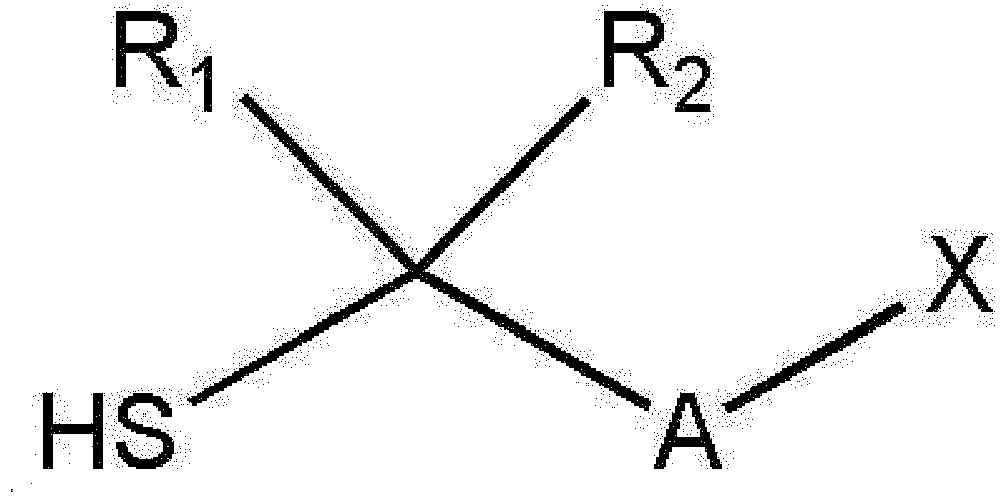 dans lequel R1 et R2 sont les mêmes ou différents l'un de l'autre, sont chacun indépendamment un hydrogène ou un groupe alkyle en C1 à C20, et soit R1, soit R2 est combiné avec -OH, -COOH ou -COOR (ici, R est un groupe alkyle en C1 à C5) quand R1 et R2 ne sont pas un hydrogène,A est un groupe alkylène en C1 à C30, un groupe alkylène en C1 à C30 combiné avec un ou plusieurs groupes hydroxy ou un groupe hétéroalkylène en C2 à C30, dans lequel le groupe hétéroalkylène inclut un ou plusieurs hétéroatomes sélectionnés dans le groupe constitué de N, O et S, etX est -OH, -COOH ou -COOR (ici, R est un groupe alkyle en C1 à C5).
- Polymère à base de chlorure de vinyle selon la revendication 5 ayant un masse moléculaire moyenne en nombre compris entre 37 000 et 55 000.
- Polymère à base de chlorure de vinyle selon la revendication 5 ayant un degré de polymérisation moyen en nombre compris entre 600 et 890.
Applications Claiming Priority (2)
| Application Number | Priority Date | Filing Date | Title |
|---|---|---|---|
| KR1020160122459A KR102075567B1 (ko) | 2016-09-23 | 2016-09-23 | 염화비닐계 중합체의 제조방법 |
| PCT/KR2017/010247 WO2018056668A1 (fr) | 2016-09-23 | 2017-09-19 | Procédé de préparation d'un polymère à base de chlorure de vinyle |
Publications (3)
| Publication Number | Publication Date |
|---|---|
| EP3404048A1 EP3404048A1 (fr) | 2018-11-21 |
| EP3404048A4 EP3404048A4 (fr) | 2019-08-21 |
| EP3404048B1 true EP3404048B1 (fr) | 2020-08-26 |
Family
ID=61689646
Family Applications (1)
| Application Number | Title | Priority Date | Filing Date |
|---|---|---|---|
| EP17853382.4A Active EP3404048B1 (fr) | 2016-09-23 | 2017-09-19 | Procédé de préparation d'un polymère à base de chlorure de vinyle |
Country Status (5)
| Country | Link |
|---|---|
| US (1) | US10766976B2 (fr) |
| EP (1) | EP3404048B1 (fr) |
| KR (1) | KR102075567B1 (fr) |
| CN (1) | CN109071714B (fr) |
| WO (1) | WO2018056668A1 (fr) |
Families Citing this family (2)
| Publication number | Priority date | Publication date | Assignee | Title |
|---|---|---|---|---|
| CN114891147B (zh) * | 2022-06-20 | 2023-08-11 | 万华化学集团股份有限公司 | 一种甲基丙烯酸甲酯共聚物及其制备方法与应用 |
| WO2026089502A1 (fr) * | 2024-10-23 | 2026-04-30 | 주식회사 엘지화학 | Polymère à base de chlorure de vinyle, composition de résine le comprenant, et son procédé de préparation |
Family Cites Families (16)
| Publication number | Priority date | Publication date | Assignee | Title |
|---|---|---|---|---|
| NL134231C (fr) * | 1966-09-24 | 1900-01-01 | ||
| DE6929255U (de) | 1969-07-23 | 1969-12-11 | Heimbach Gmbh Thomas Josef | Kupplungselement fuer nahtverbinder |
| US4189552A (en) * | 1975-09-11 | 1980-02-19 | Shin-Etsu Chemical Co., Ltd. | Method for preparing vinyl chloride polymers |
| US5112522A (en) | 1984-10-12 | 1992-05-12 | The B. F. Goodrich Company | Mercaptan chain transfer agent compositions useful in aqueous polymerizations |
| IN164548B (fr) * | 1984-10-12 | 1989-04-01 | Goodrich Co B F | |
| US4918151A (en) * | 1984-10-12 | 1990-04-17 | The B. F. Goodrich Company | Aqueous suspension process for producing low molecular weight vinyl copolymers |
| US4797458A (en) * | 1986-09-02 | 1989-01-10 | The B.F. Goodrich Company | Colloidal stable vinyl halide polymerizations with mercaptan chain transfer agents |
| US5194498A (en) | 1991-09-09 | 1993-03-16 | Rohm And Haas Company | Poly(vinyl chloride) blends and additives therefor |
| JP3284722B2 (ja) | 1993-12-21 | 2002-05-20 | 信越化学工業株式会社 | 塩化ビニル系重合体の製造方法 |
| JPH11166004A (ja) * | 1997-12-04 | 1999-06-22 | Sekisui Chem Co Ltd | 塩素化塩化ビニル系樹脂及び塩化ビニル系樹脂の製造方法 |
| JP4843228B2 (ja) | 2005-02-17 | 2011-12-21 | 三菱樹脂株式会社 | 塩化ビニル系樹脂組成物およびその成形体 |
| KR100983702B1 (ko) | 2006-08-22 | 2010-09-24 | 주식회사 엘지화학 | 가공성이 우수한 염화비닐계 중합체의 제조방법 |
| JP2009227698A (ja) * | 2008-03-19 | 2009-10-08 | Kaneka Corp | 塩化ビニル系樹脂の製造方法 |
| JP6267499B2 (ja) * | 2013-12-03 | 2018-01-24 | 積水化学工業株式会社 | 塩化ビニル系樹脂、塩化ビニル系樹脂材料及び成形体 |
| KR101725587B1 (ko) * | 2014-06-02 | 2017-04-26 | 주식회사 엘지화학 | 염화비닐계 수지의 제조방법 |
| KR101755078B1 (ko) * | 2014-11-21 | 2017-07-06 | 주식회사 엘지화학 | 염화비닐계 중합체 및 이의 제조방법 |
-
2016
- 2016-09-23 KR KR1020160122459A patent/KR102075567B1/ko active Active
-
2017
- 2017-09-19 WO PCT/KR2017/010247 patent/WO2018056668A1/fr not_active Ceased
- 2017-09-19 US US16/079,437 patent/US10766976B2/en active Active
- 2017-09-19 CN CN201780017257.XA patent/CN109071714B/zh active Active
- 2017-09-19 EP EP17853382.4A patent/EP3404048B1/fr active Active
Non-Patent Citations (1)
| Title |
|---|
| None * |
Also Published As
| Publication number | Publication date |
|---|---|
| KR20180033012A (ko) | 2018-04-02 |
| KR102075567B1 (ko) | 2020-02-10 |
| EP3404048A1 (fr) | 2018-11-21 |
| CN109071714B (zh) | 2021-03-09 |
| US10766976B2 (en) | 2020-09-08 |
| EP3404048A4 (fr) | 2019-08-21 |
| US20190048110A1 (en) | 2019-02-14 |
| WO2018056668A1 (fr) | 2018-03-29 |
| CN109071714A (zh) | 2018-12-21 |
Similar Documents
| Publication | Publication Date | Title |
|---|---|---|
| KR101784548B1 (ko) | 염화비닐계 중합체 및 이의 제조방법 | |
| KR101755078B1 (ko) | 염화비닐계 중합체 및 이의 제조방법 | |
| EP3404048A1 (fr) | Procédé de préparation d'un polymère à base de chlorure de vinyle | |
| EP3279222B1 (fr) | Polymère à base de chlorure de vinyle, procédé de préparation correspondant et plastisol le contenant | |
| EP3288986B1 (fr) | Copolymère de l'éthylène à basse température et mélanges vulcanisables et vulcanisats à base de ceux-ci | |
| KR101941098B1 (ko) | 염화비닐계 중합체의 제조방법 및 이에 따라 제조된 염화비닐계 중합체 | |
| KR101617592B1 (ko) | 염화비닐계 중합체 및 이의 제조방법 | |
| CN113396166A (zh) | 制备乙烯-羧酸共聚物的方法 | |
| RU2295540C2 (ru) | Совместное введение органических инициаторов и защитных коллоидов в ходе проведения реакций полимеризации | |
| TWI518100B (zh) | 甲基丙烯酸酯聚合物的製造方法 | |
| KR101362665B1 (ko) | 페이스트 염화비닐 수지 조성물 및 이를 이용하여 중합 제열능이 개선된 페이스트 염화비닐 수지의 제조방법 | |
| JPS6228803B2 (fr) | ||
| EP4036127B1 (fr) | Procédé pour la préparation d'un polymère à base de chlorure de vinyle utilisant une composition pour la polymérisation d'un polymère à base de chlorure de vinyle | |
| US12534561B2 (en) | Controlled radical polymerization | |
| KR102930723B1 (ko) | 염화비닐계 중합체의 제조방법 | |
| US11441012B2 (en) | Use of at least one phenolic compound to stabilise ethylene copolymerisation reactions | |
| US9617364B2 (en) | Vinyl chloride polymer and preparation method thereof | |
| KR101755079B1 (ko) | 염화비닐계 중합체 및 이의 제조방법 | |
| JP5904345B2 (ja) | 高機能性重合用添加剤、及びそれを用いた塩化ビニル系シードの製造方法 | |
| EP4053178B1 (fr) | Procédé de préparation de polymère | |
| KR102498716B1 (ko) | 염화비닐계 중합체 제조용 개시제 조성물 및 이를 이용한 염화비닐계 중합체의 제조방법 | |
| JPH02208307A (ja) | 塩化ビニル系共重合体の製造方法 | |
| US2843571A (en) | Inhibition of polymerisation reaction | |
| KR20200046979A (ko) | 내충격성 염화비닐계 중합체의 제조방법 | |
| JP3158178B2 (ja) | 塩化ビニル系単量体の重合方法 |
Legal Events
| Date | Code | Title | Description |
|---|---|---|---|
| STAA | Information on the status of an ep patent application or granted ep patent |
Free format text: STATUS: THE INTERNATIONAL PUBLICATION HAS BEEN MADE |
|
| PUAI | Public reference made under article 153(3) epc to a published international application that has entered the european phase |
Free format text: ORIGINAL CODE: 0009012 |
|
| STAA | Information on the status of an ep patent application or granted ep patent |
Free format text: STATUS: REQUEST FOR EXAMINATION WAS MADE |
|
| 17P | Request for examination filed |
Effective date: 20180816 |
|
| AK | Designated contracting states |
Kind code of ref document: A1 Designated state(s): AL AT BE BG CH CY CZ DE DK EE ES FI FR GB GR HR HU IE IS IT LI LT LU LV MC MK MT NL NO PL PT RO RS SE SI SK SM TR |
|
| AX | Request for extension of the european patent |
Extension state: BA ME |
|
| RIC1 | Information provided on ipc code assigned before grant |
Ipc: C08K 5/00 20060101ALI20190430BHEP Ipc: C08F 2/02 20060101ALI20190430BHEP Ipc: C08K 5/372 20060101ALI20190430BHEP Ipc: C08F 2/38 20060101ALI20190430BHEP Ipc: C08F 14/06 20060101AFI20190430BHEP |
|
| A4 | Supplementary search report drawn up and despatched |
Effective date: 20190722 |
|
| RIC1 | Information provided on ipc code assigned before grant |
Ipc: C08F 14/06 20060101AFI20190716BHEP Ipc: C08F 2/38 20060101ALI20190716BHEP Ipc: C08F 2/02 20060101ALI20190716BHEP Ipc: C08K 5/372 20060101ALI20190716BHEP Ipc: C08K 5/00 20060101ALI20190716BHEP |
|
| DAV | Request for validation of the european patent (deleted) | ||
| DAX | Request for extension of the european patent (deleted) | ||
| STAA | Information on the status of an ep patent application or granted ep patent |
Free format text: STATUS: EXAMINATION IS IN PROGRESS |
|
| 17Q | First examination report despatched |
Effective date: 20200129 |
|
| GRAP | Despatch of communication of intention to grant a patent |
Free format text: ORIGINAL CODE: EPIDOSNIGR1 |
|
| STAA | Information on the status of an ep patent application or granted ep patent |
Free format text: STATUS: GRANT OF PATENT IS INTENDED |
|
| INTG | Intention to grant announced |
Effective date: 20200612 |
|
| GRAS | Grant fee paid |
Free format text: ORIGINAL CODE: EPIDOSNIGR3 |
|
| GRAA | (expected) grant |
Free format text: ORIGINAL CODE: 0009210 |
|
| STAA | Information on the status of an ep patent application or granted ep patent |
Free format text: STATUS: THE PATENT HAS BEEN GRANTED |
|
| AK | Designated contracting states |
Kind code of ref document: B1 Designated state(s): AL AT BE BG CH CY CZ DE DK EE ES FI FR GB GR HR HU IE IS IT LI LT LU LV MC MK MT NL NO PL PT RO RS SE SI SK SM TR |
|
| REG | Reference to a national code |
Ref country code: GB Ref legal event code: FG4D |
|
| REG | Reference to a national code |
Ref country code: CH Ref legal event code: EP |
|
| REG | Reference to a national code |
Ref country code: AT Ref legal event code: REF Ref document number: 1306310 Country of ref document: AT Kind code of ref document: T Effective date: 20200915 |
|
| REG | Reference to a national code |
Ref country code: IE Ref legal event code: FG4D |
|
| REG | Reference to a national code |
Ref country code: DE Ref legal event code: R096 Ref document number: 602017022550 Country of ref document: DE |
|
| REG | Reference to a national code |
Ref country code: LT Ref legal event code: MG4D |
|
| PG25 | Lapsed in a contracting state [announced via postgrant information from national office to epo] |
Ref country code: LT Free format text: LAPSE BECAUSE OF FAILURE TO SUBMIT A TRANSLATION OF THE DESCRIPTION OR TO PAY THE FEE WITHIN THE PRESCRIBED TIME-LIMIT Effective date: 20200826 Ref country code: HR Free format text: LAPSE BECAUSE OF FAILURE TO SUBMIT A TRANSLATION OF THE DESCRIPTION OR TO PAY THE FEE WITHIN THE PRESCRIBED TIME-LIMIT Effective date: 20200826 Ref country code: NO Free format text: LAPSE BECAUSE OF FAILURE TO SUBMIT A TRANSLATION OF THE DESCRIPTION OR TO PAY THE FEE WITHIN THE PRESCRIBED TIME-LIMIT Effective date: 20201126 Ref country code: GR Free format text: LAPSE BECAUSE OF FAILURE TO SUBMIT A TRANSLATION OF THE DESCRIPTION OR TO PAY THE FEE WITHIN THE PRESCRIBED TIME-LIMIT Effective date: 20201127 Ref country code: SE Free format text: LAPSE BECAUSE OF FAILURE TO SUBMIT A TRANSLATION OF THE DESCRIPTION OR TO PAY THE FEE WITHIN THE PRESCRIBED TIME-LIMIT Effective date: 20200826 Ref country code: FI Free format text: LAPSE BECAUSE OF FAILURE TO SUBMIT A TRANSLATION OF THE DESCRIPTION OR TO PAY THE FEE WITHIN THE PRESCRIBED TIME-LIMIT Effective date: 20200826 Ref country code: PT Free format text: LAPSE BECAUSE OF FAILURE TO SUBMIT A TRANSLATION OF THE DESCRIPTION OR TO PAY THE FEE WITHIN THE PRESCRIBED TIME-LIMIT Effective date: 20201228 Ref country code: BG Free format text: LAPSE BECAUSE OF FAILURE TO SUBMIT A TRANSLATION OF THE DESCRIPTION OR TO PAY THE FEE WITHIN THE PRESCRIBED TIME-LIMIT Effective date: 20201126 |
|
| REG | Reference to a national code |
Ref country code: NL Ref legal event code: MP Effective date: 20200826 |
|
| REG | Reference to a national code |
Ref country code: AT Ref legal event code: MK05 Ref document number: 1306310 Country of ref document: AT Kind code of ref document: T Effective date: 20200826 |
|
| PG25 | Lapsed in a contracting state [announced via postgrant information from national office to epo] |
Ref country code: RS Free format text: LAPSE BECAUSE OF FAILURE TO SUBMIT A TRANSLATION OF THE DESCRIPTION OR TO PAY THE FEE WITHIN THE PRESCRIBED TIME-LIMIT Effective date: 20200826 Ref country code: LV Free format text: LAPSE BECAUSE OF FAILURE TO SUBMIT A TRANSLATION OF THE DESCRIPTION OR TO PAY THE FEE WITHIN THE PRESCRIBED TIME-LIMIT Effective date: 20200826 Ref country code: NL Free format text: LAPSE BECAUSE OF FAILURE TO SUBMIT A TRANSLATION OF THE DESCRIPTION OR TO PAY THE FEE WITHIN THE PRESCRIBED TIME-LIMIT Effective date: 20200826 Ref country code: PL Free format text: LAPSE BECAUSE OF FAILURE TO SUBMIT A TRANSLATION OF THE DESCRIPTION OR TO PAY THE FEE WITHIN THE PRESCRIBED TIME-LIMIT Effective date: 20200826 Ref country code: IS Free format text: LAPSE BECAUSE OF FAILURE TO SUBMIT A TRANSLATION OF THE DESCRIPTION OR TO PAY THE FEE WITHIN THE PRESCRIBED TIME-LIMIT Effective date: 20201226 |
|
| PG25 | Lapsed in a contracting state [announced via postgrant information from national office to epo] |
Ref country code: DK Free format text: LAPSE BECAUSE OF FAILURE TO SUBMIT A TRANSLATION OF THE DESCRIPTION OR TO PAY THE FEE WITHIN THE PRESCRIBED TIME-LIMIT Effective date: 20200826 Ref country code: CZ Free format text: LAPSE BECAUSE OF FAILURE TO SUBMIT A TRANSLATION OF THE DESCRIPTION OR TO PAY THE FEE WITHIN THE PRESCRIBED TIME-LIMIT Effective date: 20200826 Ref country code: RO Free format text: LAPSE BECAUSE OF FAILURE TO SUBMIT A TRANSLATION OF THE DESCRIPTION OR TO PAY THE FEE WITHIN THE PRESCRIBED TIME-LIMIT Effective date: 20200826 Ref country code: EE Free format text: LAPSE BECAUSE OF FAILURE TO SUBMIT A TRANSLATION OF THE DESCRIPTION OR TO PAY THE FEE WITHIN THE PRESCRIBED TIME-LIMIT Effective date: 20200826 Ref country code: SM Free format text: LAPSE BECAUSE OF FAILURE TO SUBMIT A TRANSLATION OF THE DESCRIPTION OR TO PAY THE FEE WITHIN THE PRESCRIBED TIME-LIMIT Effective date: 20200826 |
|
| REG | Reference to a national code |
Ref country code: CH Ref legal event code: PL |
|
| REG | Reference to a national code |
Ref country code: DE Ref legal event code: R097 Ref document number: 602017022550 Country of ref document: DE |
|
| PG25 | Lapsed in a contracting state [announced via postgrant information from national office to epo] |
Ref country code: MC Free format text: LAPSE BECAUSE OF FAILURE TO SUBMIT A TRANSLATION OF THE DESCRIPTION OR TO PAY THE FEE WITHIN THE PRESCRIBED TIME-LIMIT Effective date: 20200826 Ref country code: AT Free format text: LAPSE BECAUSE OF FAILURE TO SUBMIT A TRANSLATION OF THE DESCRIPTION OR TO PAY THE FEE WITHIN THE PRESCRIBED TIME-LIMIT Effective date: 20200826 Ref country code: AL Free format text: LAPSE BECAUSE OF FAILURE TO SUBMIT A TRANSLATION OF THE DESCRIPTION OR TO PAY THE FEE WITHIN THE PRESCRIBED TIME-LIMIT Effective date: 20200826 Ref country code: ES Free format text: LAPSE BECAUSE OF FAILURE TO SUBMIT A TRANSLATION OF THE DESCRIPTION OR TO PAY THE FEE WITHIN THE PRESCRIBED TIME-LIMIT Effective date: 20200826 |
|
| REG | Reference to a national code |
Ref country code: BE Ref legal event code: MM Effective date: 20200930 |
|
| PG25 | Lapsed in a contracting state [announced via postgrant information from national office to epo] |
Ref country code: LU Free format text: LAPSE BECAUSE OF NON-PAYMENT OF DUE FEES Effective date: 20200919 Ref country code: SK Free format text: LAPSE BECAUSE OF FAILURE TO SUBMIT A TRANSLATION OF THE DESCRIPTION OR TO PAY THE FEE WITHIN THE PRESCRIBED TIME-LIMIT Effective date: 20200826 |
|
| PLBE | No opposition filed within time limit |
Free format text: ORIGINAL CODE: 0009261 |
|
| STAA | Information on the status of an ep patent application or granted ep patent |
Free format text: STATUS: NO OPPOSITION FILED WITHIN TIME LIMIT |
|
| PG25 | Lapsed in a contracting state [announced via postgrant information from national office to epo] |
Ref country code: IT Free format text: LAPSE BECAUSE OF FAILURE TO SUBMIT A TRANSLATION OF THE DESCRIPTION OR TO PAY THE FEE WITHIN THE PRESCRIBED TIME-LIMIT Effective date: 20200826 |
|
| 26N | No opposition filed |
Effective date: 20210527 |
|
| PG25 | Lapsed in a contracting state [announced via postgrant information from national office to epo] |
Ref country code: BE Free format text: LAPSE BECAUSE OF NON-PAYMENT OF DUE FEES Effective date: 20200930 Ref country code: CH Free format text: LAPSE BECAUSE OF NON-PAYMENT OF DUE FEES Effective date: 20200930 Ref country code: SI Free format text: LAPSE BECAUSE OF FAILURE TO SUBMIT A TRANSLATION OF THE DESCRIPTION OR TO PAY THE FEE WITHIN THE PRESCRIBED TIME-LIMIT Effective date: 20200826 Ref country code: IE Free format text: LAPSE BECAUSE OF NON-PAYMENT OF DUE FEES Effective date: 20200919 Ref country code: LI Free format text: LAPSE BECAUSE OF NON-PAYMENT OF DUE FEES Effective date: 20200930 |
|
| PG25 | Lapsed in a contracting state [announced via postgrant information from national office to epo] |
Ref country code: TR Free format text: LAPSE BECAUSE OF FAILURE TO SUBMIT A TRANSLATION OF THE DESCRIPTION OR TO PAY THE FEE WITHIN THE PRESCRIBED TIME-LIMIT Effective date: 20200826 Ref country code: MT Free format text: LAPSE BECAUSE OF FAILURE TO SUBMIT A TRANSLATION OF THE DESCRIPTION OR TO PAY THE FEE WITHIN THE PRESCRIBED TIME-LIMIT Effective date: 20200826 Ref country code: CY Free format text: LAPSE BECAUSE OF FAILURE TO SUBMIT A TRANSLATION OF THE DESCRIPTION OR TO PAY THE FEE WITHIN THE PRESCRIBED TIME-LIMIT Effective date: 20200826 |
|
| PG25 | Lapsed in a contracting state [announced via postgrant information from national office to epo] |
Ref country code: MK Free format text: LAPSE BECAUSE OF FAILURE TO SUBMIT A TRANSLATION OF THE DESCRIPTION OR TO PAY THE FEE WITHIN THE PRESCRIBED TIME-LIMIT Effective date: 20200826 |
|
| PGFP | Annual fee paid to national office [announced via postgrant information from national office to epo] |
Ref country code: DE Payment date: 20250820 Year of fee payment: 9 |
|
| PGFP | Annual fee paid to national office [announced via postgrant information from national office to epo] |
Ref country code: GB Payment date: 20250820 Year of fee payment: 9 |
|
| PGFP | Annual fee paid to national office [announced via postgrant information from national office to epo] |
Ref country code: FR Payment date: 20250821 Year of fee payment: 9 |