EP3404436B1 - Imagerie par résonance magnétique fonctionnelle - Google Patents
Imagerie par résonance magnétique fonctionnelle Download PDFInfo
- Publication number
- EP3404436B1 EP3404436B1 EP17172018.8A EP17172018A EP3404436B1 EP 3404436 B1 EP3404436 B1 EP 3404436B1 EP 17172018 A EP17172018 A EP 17172018A EP 3404436 B1 EP3404436 B1 EP 3404436B1
- Authority
- EP
- European Patent Office
- Prior art keywords
- patterns
- events
- neurophysical
- correlation patterns
- candidate
- Prior art date
- Legal status (The legal status is an assumption and is not a legal conclusion. Google has not performed a legal analysis and makes no representation as to the accuracy of the status listed.)
- Active
Links
Images
Classifications
-
- A—HUMAN NECESSITIES
- A61—MEDICAL OR VETERINARY SCIENCE; HYGIENE
- A61B—DIAGNOSIS; SURGERY; IDENTIFICATION
- A61B5/00—Measuring for diagnostic purposes; Identification of persons
- A61B5/05—Detecting, measuring or recording for diagnosis by means of electric currents or magnetic fields; Measuring using microwaves or radio waves
- A61B5/055—Detecting, measuring or recording for diagnosis by means of electric currents or magnetic fields; Measuring using microwaves or radio waves involving electronic [EMR] or nuclear [NMR] magnetic resonance, e.g. magnetic resonance imaging
-
- A—HUMAN NECESSITIES
- A61—MEDICAL OR VETERINARY SCIENCE; HYGIENE
- A61B—DIAGNOSIS; SURGERY; IDENTIFICATION
- A61B5/00—Measuring for diagnostic purposes; Identification of persons
- A61B5/0033—Features or image-related aspects of imaging apparatus, e.g. for MRI, optical tomography or impedance tomography apparatus; Arrangements of imaging apparatus in a room
- A61B5/004—Features or image-related aspects of imaging apparatus, e.g. for MRI, optical tomography or impedance tomography apparatus; Arrangements of imaging apparatus in a room adapted for image acquisition of a particular organ or body part
- A61B5/0042—Features or image-related aspects of imaging apparatus, e.g. for MRI, optical tomography or impedance tomography apparatus; Arrangements of imaging apparatus in a room adapted for image acquisition of a particular organ or body part for the brain
-
- A—HUMAN NECESSITIES
- A61—MEDICAL OR VETERINARY SCIENCE; HYGIENE
- A61B—DIAGNOSIS; SURGERY; IDENTIFICATION
- A61B5/00—Measuring for diagnostic purposes; Identification of persons
- A61B5/40—Detecting, measuring or recording for evaluating the nervous system
-
- G—PHYSICS
- G01—MEASURING; TESTING
- G01R—MEASURING ELECTRIC VARIABLES; MEASURING MAGNETIC VARIABLES
- G01R33/00—Arrangements or instruments for measuring magnetic variables
- G01R33/20—Arrangements or instruments for measuring magnetic variables involving magnetic resonance
- G01R33/44—Arrangements or instruments for measuring magnetic variables involving magnetic resonance using nuclear magnetic resonance [NMR]
- G01R33/48—NMR imaging systems
- G01R33/4806—Functional imaging of brain activation
-
- G—PHYSICS
- G01—MEASURING; TESTING
- G01R—MEASURING ELECTRIC VARIABLES; MEASURING MAGNETIC VARIABLES
- G01R33/00—Arrangements or instruments for measuring magnetic variables
- G01R33/20—Arrangements or instruments for measuring magnetic variables involving magnetic resonance
- G01R33/44—Arrangements or instruments for measuring magnetic variables involving magnetic resonance using nuclear magnetic resonance [NMR]
- G01R33/48—NMR imaging systems
- G01R33/54—Signal processing systems, e.g. using pulse sequences ; Generation or control of pulse sequences; Operator console
- G01R33/56—Image enhancement or correction, e.g. subtraction or averaging techniques, e.g. improvement of signal-to-noise ratio and resolution
- G01R33/5601—Image enhancement or correction, e.g. subtraction or averaging techniques, e.g. improvement of signal-to-noise ratio and resolution involving use of a contrast agent for contrast manipulation, e.g. a paramagnetic, super-paramagnetic, ferromagnetic or hyperpolarised contrast agent
-
- G—PHYSICS
- G06—COMPUTING OR CALCULATING; COUNTING
- G06F—ELECTRIC DIGITAL DATA PROCESSING
- G06F18/00—Pattern recognition
- G06F18/20—Analysing
- G06F18/24—Classification techniques
- G06F18/241—Classification techniques relating to the classification model, e.g. parametric or non-parametric approaches
- G06F18/2413—Classification techniques relating to the classification model, e.g. parametric or non-parametric approaches based on distances to training or reference patterns
- G06F18/24133—Distances to prototypes
-
- G—PHYSICS
- G06—COMPUTING OR CALCULATING; COUNTING
- G06T—IMAGE DATA PROCESSING OR GENERATION, IN GENERAL
- G06T7/00—Image analysis
- G06T7/0002—Inspection of images, e.g. flaw detection
- G06T7/0012—Biomedical image inspection
-
- G—PHYSICS
- G06—COMPUTING OR CALCULATING; COUNTING
- G06V—IMAGE OR VIDEO RECOGNITION OR UNDERSTANDING
- G06V10/00—Arrangements for image or video recognition or understanding
- G06V10/10—Image acquisition
- G06V10/12—Details of acquisition arrangements; Constructional details thereof
- G06V10/14—Optical characteristics of the device performing the acquisition or on the illumination arrangements
- G06V10/143—Sensing or illuminating at different wavelengths
-
- G—PHYSICS
- G06—COMPUTING OR CALCULATING; COUNTING
- G06V—IMAGE OR VIDEO RECOGNITION OR UNDERSTANDING
- G06V10/00—Arrangements for image or video recognition or understanding
- G06V10/70—Arrangements for image or video recognition or understanding using pattern recognition or machine learning
- G06V10/764—Arrangements for image or video recognition or understanding using pattern recognition or machine learning using classification, e.g. of video objects
-
- G—PHYSICS
- G06—COMPUTING OR CALCULATING; COUNTING
- G06V—IMAGE OR VIDEO RECOGNITION OR UNDERSTANDING
- G06V10/00—Arrangements for image or video recognition or understanding
- G06V10/70—Arrangements for image or video recognition or understanding using pattern recognition or machine learning
- G06V10/82—Arrangements for image or video recognition or understanding using pattern recognition or machine learning using neural networks
-
- A—HUMAN NECESSITIES
- A61—MEDICAL OR VETERINARY SCIENCE; HYGIENE
- A61B—DIAGNOSIS; SURGERY; IDENTIFICATION
- A61B2576/00—Medical imaging apparatus involving image processing or analysis
- A61B2576/02—Medical imaging apparatus involving image processing or analysis specially adapted for a particular organ or body part
- A61B2576/026—Medical imaging apparatus involving image processing or analysis specially adapted for a particular organ or body part for the brain
-
- G—PHYSICS
- G06—COMPUTING OR CALCULATING; COUNTING
- G06T—IMAGE DATA PROCESSING OR GENERATION, IN GENERAL
- G06T2207/00—Indexing scheme for image analysis or image enhancement
- G06T2207/10—Image acquisition modality
- G06T2207/10072—Tomographic images
- G06T2207/10088—Magnetic resonance imaging [MRI]
-
- G—PHYSICS
- G06—COMPUTING OR CALCULATING; COUNTING
- G06T—IMAGE DATA PROCESSING OR GENERATION, IN GENERAL
- G06T2207/00—Indexing scheme for image analysis or image enhancement
- G06T2207/30—Subject of image; Context of image processing
- G06T2207/30004—Biomedical image processing
- G06T2207/30016—Brain
-
- G—PHYSICS
- G06—COMPUTING OR CALCULATING; COUNTING
- G06V—IMAGE OR VIDEO RECOGNITION OR UNDERSTANDING
- G06V2201/00—Indexing scheme relating to image or video recognition or understanding
- G06V2201/03—Recognition of patterns in medical or anatomical images
- G06V2201/031—Recognition of patterns in medical or anatomical images of internal organs
-
- G—PHYSICS
- G16—INFORMATION AND COMMUNICATION TECHNOLOGY [ICT] SPECIALLY ADAPTED FOR SPECIFIC APPLICATION FIELDS
- G16H—HEALTHCARE INFORMATICS, i.e. INFORMATION AND COMMUNICATION TECHNOLOGY [ICT] SPECIALLY ADAPTED FOR THE HANDLING OR PROCESSING OF MEDICAL OR HEALTHCARE DATA
- G16H30/00—ICT specially adapted for the handling or processing of medical images
- G16H30/40—ICT specially adapted for the handling or processing of medical images for processing medical images, e.g. editing
Definitions
- Various examples of the invention relate to techniques for evaluating image data from functional magnetic resonance imaging.
- various examples relate to techniques for separating correlation patterns from neurophysical events and false patterns in the context of an independence analysis.
- Magnetic resonance imaging can be used to analyze neurophysical events.
- MRI can be used to analyze functionally correlated regions of the brain (neural networks) with regard to neurophysical events.
- the neural networks can be made visible by identifying correlation patterns of the neurophysical events.
- the correlation patterns can denote a temporal and / or spatial correlation of neurophysical events.
- fMRI functional MRI
- changes in an image contrast over time are shown by means of suitable imaging measurement sequences of the MRI.
- a contrast dependent on the blood oxygen content can be considered in the context of fMRI, also referred to as BOLD contrast (English blood oxygenation level dependent). This allows neurophysical events to be measured.
- fMRI fMRI
- rsfMRI fMRI
- the time dependency between neurophysical events spaced apart in the spatial area (functional connectivity) is taken into account, with no or no significant external stimuli being given to the neural network become.
- the rsfMRI does not allow the person to be examined to carry out certain activities or thoughts (state of rest).
- Typical time series cover a period of approx. 6-8 minutes and can, for example, depict 700-1000 volume areas, each with 70-80 layers.
- the rsfMRI uses different techniques to evaluate the time series of image data.
- An evaluation is based on an independence analysis (English independent component analysis, ICA).
- the ICA is conventionally based on model assumptions as a function of the current data set, such as seed points that control the evaluation a priori or descriptions of an external stimulus. This means that the correlation pattern can be recognized without an a priori restriction.
- correlation patterns are sought in the underlying image data, which can explain the changes in the intensity of the time series of image data as a result of neurofunctional events.
- independent candidate correlation patterns are found by the ICA. These are also referred to as components of the ICA.
- the multitude of candidate correlation patterns includes correlation patterns of the multitude of neurophysical events, as well as false patterns that are obtained, for example, due to noise in the image data or inevitably from the ICA algorithm used. The wrong patterns are often of subordinate interest and should be sorted out.
- a method according to claim 1 for MRI comprises, in particular, obtaining a time series of image data.
- the time series of image data depicts a multitude of neurophysical events in the brain of a person being examined in a spatially resolved manner.
- the method further comprises performing an ICA to identify a plurality of candidate correlation patterns based on the time series of image data.
- the multitude of candidate correlation patterns includes correlation patterns of the multitude of neurophysical events as well as false patterns, e.g. changes in intensity caused by noise or other effects such as physiological effects - e.g. heartbeat or breathing - or heating of the scanner.
- the method further includes determining a portion of the brain.
- the method further comprises for each candidate correlation pattern from the plurality of candidate correlation patterns: determining a corresponding value of a predetermined metric.
- the metric indicates an intensity of the respective candidate correlation pattern in the sub-area.
- the method further comprises selecting at least one candidate correlation pattern from the plurality of candidate correlation patterns based on the determined values of the predetermined metric.
- the method also includes marking the selected at least one Candidate correlation pattern for analysis by a user.
- a computer program product comprises program code that can be executed by at least one processor.
- the execution of the program code causes the at least one processor to carry out a method.
- the method includes obtaining a time series of image data.
- the time series of image data depicts a multitude of neurophysical events in the brain of a person being examined with superimposed noise in a spatially resolved manner.
- the method further comprises performing an ICA to identify a plurality of candidate correlation patterns based on the time series of image data.
- the multitude of candidate correlation patterns includes correlation patterns of the multitude of neurophysical events as well as false patterns, e.g. changes in intensity caused by noise or other effects such as physiological effects or heating of the scanner.
- the method further includes determining a portion of the brain.
- the method further comprises for each candidate correlation pattern from the plurality of candidate correlation patterns: determining a corresponding value of a predetermined metric.
- the metric indicates an intensity of the respective candidate correlation pattern in the sub-area.
- the method further comprises selecting at least one candidate correlation pattern from the plurality of candidate correlation patterns based on the determined values of the predetermined metric.
- the method also includes marking the selected at least one candidate correlation pattern for analysis by a user.
- a computer program comprises program code that can be executed by at least one processor.
- the execution of the program code causes the at least one processor to carry out a method.
- the method includes obtaining a time series of image data.
- the time series of image data forms a multitude of neurophysical events in the The brain of an examiner with superimposed noise is spatially resolved.
- the method further comprises performing an ICA to identify a plurality of candidate correlation patterns based on the time series of image data.
- the multitude of candidate correlation patterns includes correlation patterns of the multitude of neurophysical events as well as false patterns, for example changes in intensity caused by noise or other effects, such as physiological effects or heating of the scanner.
- the method further includes determining a portion of the brain.
- the method further comprises for each candidate correlation pattern from the plurality of candidate correlation patterns: determining a corresponding value of a predetermined metric.
- the metric indicates an intensity of the respective candidate correlation pattern in the sub-area.
- the method further comprises selecting at least one candidate correlation pattern from the plurality of candidate correlation patterns based on the determined values of the predetermined metric.
- the method also includes marking the selected at least one candidate correlation pattern for analysis by a user.
- a device comprises in particular at least one processor.
- the at least one processor is set up to carry out a method.
- the method includes obtaining a time series of image data.
- the time series of image data depicts a multitude of neurophysical events in the brain of an examined person with superimposed noise in a spatially resolved manner.
- the method further comprises performing an ICA to identify a plurality of candidate correlation patterns based on the time series of image data.
- the multitude of candidate correlation patterns includes correlation patterns of the multitude of neurophysical events as well as false patterns, for example changes in intensity caused by noise or other effects, such as physiological effects or heating of the Scanners.
- the method further includes determining a portion of the brain.
- the method further comprises for each candidate correlation pattern from the plurality of candidate correlation patterns: determining a corresponding value of a predetermined metric.
- the metric indicates an intensity of the respective candidate correlation pattern in the sub-area.
- the method further comprises selecting at least one candidate correlation pattern from the plurality of candidate correlation patterns based on the determined values of the predetermined metric.
- the method also includes marking the selected at least one candidate correlation pattern for analysis by a user.
- One method of MRI involves obtaining a time series of image data.
- the time series depicts a multitude of neurophysical events in the brain of a person being examined in a spatially resolved manner.
- the method further comprises, based on the time series of image data, performing an ICA to identify a plurality of candidate correlation patterns.
- the multitude of candidate correlation patterns includes correlation patterns of the multitude of neurophysical events as well as false patterns.
- the method further includes applying a computer implemented classifier to the plurality of candidate correlation patterns. The classifier is set up to separate the false patterns and the correlation patterns of the multitude of neurophysical events.
- a computer program product comprises program code that can be executed by at least one processor.
- the execution of the program code causes the at least one processor to carry out a method.
- the method includes obtaining a time series of image data.
- the time series depicts a multitude of neurophysical events in the brain of a person being examined in a spatially resolved manner.
- the method further comprises, based on the time series of image data, performing an ICA to identify a plurality of candidate correlation patterns.
- the multitude of candidate correlation patterns includes correlation patterns of the multitude of neurophysical events as well as false patterns.
- the method further includes applying a computer implemented classifier to the plurality of candidate correlation patterns. The classifier is set up to separate the false patterns and the correlation patterns of the multitude of neurophysical events.
- a computer program comprises program code that can be executed by at least one processor.
- the execution of the program code causes the at least one processor to carry out a method.
- the method includes obtaining a time series of image data.
- the time series depicts a multitude of neurophysical events in the brain of a person being examined in a spatially resolved manner.
- the method further comprises, based on the time series of image data, performing an ICA to identify a plurality of candidate correlation patterns.
- the multitude of candidate correlation patterns includes correlation patterns of the multitude of neurophysical events as well as false patterns.
- the method further includes applying a computer implemented classifier to the plurality of candidate correlation patterns. The classifier is set up to separate the false patterns and the correlation patterns of the multitude of neurophysical events.
- a device comprises at least one processor which is set up to carry out a method.
- the method includes obtaining a time series of image data.
- the time series depicts a multitude of neurophysical events in the brain of a person being examined in a spatially resolved manner.
- the method further comprises, based on the time series of image data, performing an ICA to identify a plurality of candidate correlation patterns.
- the multitude of candidate correlation patterns includes correlation patterns of the multitude of neurophysical events as well as false patterns.
- the method further includes applying a computer-implemented classifier on the plurality of candidate correlation patterns. The classifier is set up to separate the false patterns and the correlation patterns of the multitude of neurophysical events.
- a use of an ANN for the identification of correlation patterns of neurophysical events of a neural network in a plurality of candidate correlation patterns is disclosed.
- Techniques are described below to make the functional connectivity of a neural network such as the brain of a person under examination visible.
- this means that techniques are described below in order to recognize neurophysical events in the brain of an examination person as well as associated correlation patterns.
- the techniques described herein make it possible to automatically and particularly reliably recognize the neurophysical events and the associated correlation patterns in the brain of the person being examined.
- it can be dispensable for an operator, such as medical personnel, to manually annotate a large number of candidate correlation patterns, which include both the correlation patterns of the large number of neurophysical events, but also false patterns, for example due to noise, around the To separate false patterns from the correlation patterns of the neurophysical events.
- a time series of image data that three-dimensionally depicts the neural network with a suitable contrast is obtained.
- the image data can be MR image data with BOLD contrast.
- a corresponding MR measurement sequence could be carried out which records the time series of image data.
- the MR measurement sequence it would be possible for the MR measurement sequence to be image-accelerated, for example using SMS techniques or an undersampling of the spatial frequency space.
- a particularly high time resolution can be obtained, so that the time series of image data has a particularly large number of time steps.
- an increased spatial spatial resolution or a mixture of increased spatial and temporal resolution can also be achieved by accelerating the measurement sequence.
- an ICA can then be performed based on the time series of image data. For example, in the various techniques described herein, it can be dispensable to define a seed point in relation to a sub-area of the examination area or of the neural network before the ICA is carried out.
- the ICA can be used to obtain a large number of candidate correlation patterns which contain both the actual correlation pattern of the neurophysical events - which depict the functional connectivity of the neural network - as well as false patterns, for example due to noise, signal changes, for example due to heating of the scanner, certain properties of the algorithm on which the ICA is based and / or changes in intensity caused by physiological effects such as breathing or heartbeat.
- a sub-area of the brain or, in general, the neural network is determined manually, partially automatically or fully automatically.
- a one-dimensional or multi-dimensional value of a predetermined metric is then determined for each candidate correlation pattern obtained from the ICA.
- the metric can indicate an intensity of the respective candidate correlation pattern in the sub-area. It is then possible to select one or more candidate correlation patterns from the plurality of candidate correlation patterns based on the determined values of the predetermined metric. For example, threshold comparisons could be made with a predetermined threshold can be carried out. Those candidate correlation patterns which have a particularly high intensity in the selected partial area, for example in comparison to other candidate correlation patterns or in comparison to an absolute reference, can then be selected and marked for analysis by a user.
- the sub-area By means of the sub-area it is possible to restrict the ICA result space - which corresponds to the multiplicity of candidate correlation patterns - to those candidate correlation patterns which have a significant intensity in the sub-area.
- the sub-area can correspond to a region of interest (ROI) that is to be analyzed more precisely for diagnosis.
- ROI region of interest
- the candidate correlation patterns to be checked by the user can be greatly reduced.
- the number of candidate correlation patterns selected on the basis of the metric it would be possible for the number of candidate correlation patterns selected on the basis of the metric to be no greater than 10% compared to the total number of candidate correlation patterns, optionally no greater than 5%, further optionally no greater than 1%.
- a suitable choice of the metric it can also be possible, in particular, that when the candidate correlation patterns are selected based on the specific values of the predetermined metric, a separation between false patterns and correlation patterns of the neurophysical events can take place at the same time. In other words, this means that through a suitable choice of the metric it may also be possible to select only correlation patterns of the neurophysical events with a particularly high probability and thus to achieve a separation between correlation patterns of the neurophysical events and false patterns.
- the sub-area is not taken into account when performing the ICA.
- the sub-area can only be taken into account after the ICA has been carried out. This means that the evaluation of the time series of image data is carried out without an a priori model assumption relating to a seed region.
- ANN artificial neural network
- CNN convolutional neural network
- the KNN can have multiple layers.
- the KNN can comprise an input layer, several hidden intermediate layers and an output layer.
- the input layer can include a set of neurons, the number of neurons corresponding to the number of pixels of a candidate correlation pattern - or a component identified by the ICA.
- the different candidate correlation patterns can then be transferred to the input layer as input values (input feature map).
- the input layer can be connected to the output layer via several hidden intermediate layers.
- In the output layer there can be a corresponding neuron for each category to be classified, which neuron supplies as an output value the association of the respectively transferred candidate correlation pattern with the respective category (output feature map).
- the output layer contains two neurons, one for the correlation pattern of the neurophysical events and one for the false patterns.
- the classifier could furthermore be set up to separate correlation patterns of neurophysical events caused by physiological events and correlation patterns of spontaneous neurophysical events. This means that a distinction can be made between neurophysical events and associated correlation patterns and other neurophysical events and associated correlation patterns caused, for example, by a heartbeat or breathing, by means of the classifier.
- the classifier could continue to be set up for the separation between correlation patterns of different types of spontaneous neurophysical events.
- the correlation patterns of the different spontaneous neurophysical events could be classified by which regions of the brain have a particularly high corresponding intensity.
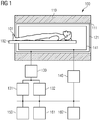
- FIG. 1 schematically illustrates an MR system 100 that can be used to carry out the techniques described above and the techniques which are described below.
- the MR system 100 has a magnet 110 which defines a tube 111.
- the magnet 110 can generate a basic magnetic field parallel to its longitudinal axis.
- An examination subject here an examination person 101
- An examination area of the person under examination can be taken into account in the MR imaging.
- the examination area is FIG. 1 arranged in the area of the head of the person being examined 101, in particular in the area of the brain.
- the brain forms a neural network and neurophysical events in the brain are to be made visible.
- the MR system 100 also has a gradient system 140 for generating gradient fields that are used for MR imaging and for spatial coding of acquired MR data.
- the gradient system 140 typically comprises at least three separately controllable gradient coils 141 that are well-defined with respect to one another.
- the gradient coils 141 make it possible to apply gradient pulses along certain spatial directions (gradient axes) which generate the gradient fields. These gradient axes define a machine coordinate system.
- the gradient fields can be used, for example, for slice selection, for frequency coding (in the readout direction) and for phase coding. A spatial coding of the MR data can thereby be achieved.
- an RF coil arrangement 121 which can radiate an amplitude-modulated and / or frequency-modulated RF excitation pulse into the person under examination 101.
- a transverse magnetization can thereby be generated.
- an RF transmission system 131 is connected to the RF coil arrangement 121 via an RF switch 130.
- the RF transmission system 131 can comprise an RF generator and an RF amplitude modulation unit.
- the RF excitation pulses can tilt the transverse magnetization 1D slice-selective or 2D / 3D locally or globally out of the rest position.
- RF refocusing pulses can also be emitted. Then, for example, in SMS measurement sequences, the transverse magnetization can be modified in several layers at the same time.
- an RF receiving system 132 is coupled to the RF coil arrangement 121 via the RF switch 130.
- MR signals of the relaxing transverse magnetization for example by inductive coupling into the RF coil arrangement 121, can be acquired or measured as MR data.
- SMS measurement sequence MR data can be obtained from more than one slice at the same time.
- the MR data are typically initially available as raw data in the spatial frequency space.
- a computing unit 161 of the MR system 100 can be set up accordingly.
- the MR system 100 also has an operating unit 150, which can include a screen, a keyboard, a mouse, etc., for example.
- an operating unit 150 By means of the operating unit 150, user input can be recorded and output to the user can be implemented. For example, it may be possible, by means of the operating unit 150, to set individual operating modes or operating parameters of the MR system 100 by the user and / or automatically and / or remotely.
- the MR system 100 also has the computing unit 161.
- the computing unit 161 could be a processor, a microprocessor or a microcontroller. It would also be possible for the computing unit 161 to be a field-programmed array (FPGA) or an application-specific integrated circuit (ASIC).
- the MR system 100 also has a memory 162. For example, it would be possible for control instructions to be stored in the memory 162, it being possible for the control instructions to be executed by the computing unit 161. Execution of the control instructions by the arithmetic unit 161 can cause the arithmetic unit 161 to use various techniques with regard to determining a measurement sequence on the basis of a representation of the impulse response of the gradient system 140 in k-space according to various examples described herein.
- Execution of the control instructions by the computing unit 161 can cause the computing unit 161 to execute various techniques.
- the computing unit 161 could carry out techniques relating to SMS imaging, as well as relating to the post-processing of a time series of image data in connection with the rsfMRI.
- the computing unit 161 could perform techniques relating to an ICA for identifying a plurality of candidate correlation patterns, which include correlation patterns of neurophysical events as well as false patterns.
- the computing unit 161 could then carry out techniques in order to separate the false patterns from the correlation patterns of the neurophysical events from the components or candidate correlation patterns identified by the ICA.
- the computing unit 161 could, for example, use a computer-implemented classifier and / or a metric which indicates an intensity of the various candidate correlation patterns in a sub-area of the brain.
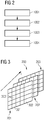
- Figure 2 is a flow diagram of an exemplary method.
- the method according to Figure 2 be carried out by the arithmetic unit 161.
- a time series of image data is obtained.
- an MR measurement sequence could be carried out in 1001 in order to obtain raw data with BOLD contrast.
- the MR measurement sequence could include SMS imaging with undersampling of the spatial frequency space, as well as simultaneous excitation and reading of several slices.
- subsampled raw data could be reconstructed in 1001, for example using techniques of partial parallel acquisition such as Grappa Griswold, Mark A., et al. "Generalized autocalibrating partially parallel acquisitions (GRAPPA). "Magnetic resonance in medicine 47.6 (2002): 1202-1210 .
- a movement of the person being examined could be compensated for during preprocessing.
- a compensation could take place in the sub-voxel range.
- a rigid movement correction could be performed. See for example Theses, Stefan, et al. "Prospective acquisition correction for head motion with image-based tracking for real-time fMRI.” Magnetic Resonance in Medicine 44.3 (2000): 457-465 .
- Another aspect of a corresponding preprocessing can relate, for example, to a normalization of the contrast in the image data. In this way, temporal drifts in the amplitude of the contrast can be compensated.
- No other technique that can be taken into account in connection with the preprocessing of the image data relates to a filtering of the time course of the contrast, for example for individual voxels of the image data.
- a temporal bandpass filtering could be carried out.
- a frequency of the observed signal changes is typically in a special frequency band, for example in the range from 8 mHz to 150 mHz. See for example Greicius, Michael D., et al. "Regional analysis of hippocampal activation during memory encoding and retrieval: fMRI study.” Hippocampus 13.1 (2003): 164-174 .
- Another technique that may be considered in conjunction with the pre-processing at 1001 relates to spatial filtering.
- a Gaussian kernel with a half width of 3-4 mm could be used. In this way, signal artifacts can be reduced.
- a temporal correction of the image data can also be carried out.
- the type of time offset between the acquisition of MR data in different slices can be compensated for.
- preprocessing 1002 The above examples of techniques described in preprocessing 1002 are exemplary techniques. In other examples, it would be possible to use only some of the techniques described above or to use other techniques for preprocessing the image data in 1002.
- the ICA is then carried out in 1003.
- a large number of candidate correlation patterns are identified based on the ICA.
- the candidate correlation patterns correspond to independent components recognized by the ICA.
- the time series of image data can be described by superimposing the independent components.
- Each candidate correlation pattern can, for example, indicate a specific intensity in different voxels of the image data.
- Each candidate correlation pattern can, for example, be associated with a specific time dependency of an underlying signal curve.
- different voxels that contribute to a candidate correlation pattern can have the same, complementary or otherwise phase-shifted signal profiles with respect to one another.
- the signal profile of the various voxels of the time series of image data can be described as a linear combination of different components.
- Each point in time can correspond to an observation, for example.
- the number of points in time can thus designate the number of observations that are generated from a certain other number of components.
- the ICA can be set up to handle a mix identify underlying components that describe the measured image data.
- the ICA provides components that are as independent from each other as possible.
- the ICA can be applied resolved to the entire measurement range for different voxels. Details on ICA in connection with the resting state fMRI are described, for example, in: Beckmann, Christian F., et al. "Investigations into resting-state connectivity using independent component analysis.” Philosophical Transactions of the Royal Society of London B: Biological Sciences 360.1457 (2005): 1001-1013 .
- the number of actual sources, ie the correlation patterns of actual neurophysical events, is not necessarily the same as the number of candidate correlation patterns that are identified as components within the framework of the ICA.
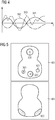
- Figure 3 illustrates aspects relating to a time series 200 of image data 201-203.
- different image data 201-203 are obtained at different times.
- an example is shown in which two-dimensional image data 201-203 of a specific slice of an examination region are obtained at different times.
- three-dimensional image data 201-203 it would also be possible for three-dimensional image data 201-203 to be obtained for each point in time, which image data represent a three-dimensional examination area, for example the brain of an examination person.
- Each pixel of the image data can have a contrast that corresponds to that in a voxel of the examination area corresponds to the integrated signal.
- the contrast can be a BOLD contrast, for example.
- the image data 201-203 can be obtained, for example, with an MR measurement sequence.
- the image data 201-203 can, for example, be suitably preprocessed, for example in step 1002 according to the method from Figure 2 .
- Figure 4 illustrates aspects relating to a time signal curve of the contrast in the pixels 301-303.
- the contrast in the pixels 301-303 varies as a function of time.
- the number of times for which the contrast is available in the various pixels is sometimes also referred to as the number of observations. Any point in time can therefore represent an observation. With accelerated imaging, the time resolution and thus the number of observations can be particularly large.
- the contrast in the pixel 301 has a high correlation to the signal profile of the contrast in the pixel 302. This is the case because the signal curve in pixel 301 is out of phase with the signal curve in pixel 302.
- the signal profile in the image point 303 does not have a particularly high correlation with the signal profile in the image points 301, 302. In the context of the ICA, it could therefore be identified that the signal profiles in the image points 301, 302 contribute to a common candidate correlation pattern.
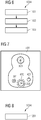
- Figure 5 illustrates aspects related to the outcome of the ICA.
- an image 401 is shown which depicts a slice of the brain.
- a transverse section through the brain is shown.
- the candidate correlation patterns 421, 422 correspond to different components of the ICA.
- the correlation pattern 421 is what is known as the default mode network, see FIG Van Den Heuvel, Martijn P., and Hilleke E. Hulshoff Pol. "Exploring the brain network: a review on resting-state fMRI functional connectivity.” European neuropsychopharmacology 8/20 (2010): 519-534 , There Figure 2 .
- the correlation pattern 422 is the extra-striate visual, see ibid ..
- the candidate correlation patterns 421, 422 show a large intensity (hatched areas in Figure 5 ) in disjoint areas of the brain. It is possible to identify candidate correlation patterns that have significant intensity in overlapping areas of the brain (in Figure 5 not shown). Furthermore, in Figure 5 a scenario is shown in which only two candidate correlation patterns 421, 422 are identified. In general, however, it is possible for a much larger number of candidate correlation patterns to be identified. In particular, it is possible for candidate correlation patterns to be identified which do not correspond to correlation patterns of the neurophysical events, but rather false patterns, for example due to noise (in Figure 5 not shown). Techniques are described below that make it possible to separate correlation patterns of neurophysical events from false patterns. For example, such techniques can be used in the context of 1004 in Figure 2 be performed.
- Such techniques can be performed particularly in view of the fact that the ICA does not provide the candidate correlation patterns in a predetermined or deterministic order.
- the sign of the correlation pattern cannot vary deterministically.
- the number of candidate correlation patterns can depend on the number of observations. Therefore, with a particularly large number of observations, a large number of false events can be obtained.
- Such boundary conditions of the algorithm on which the ICA is based can be taken into account in the various examples described herein.
- Figure 6 Figure 3 is a flow diagram of an exemplary method.
- the method according to Figure 6 used to separate correlation patterns of the neurophysical events and false patterns based on a plurality of candidate correlation patterns identified by an ICA.
- the procedure according to Figure 6 can for example in 1004 from Figure 2 be performed.
- a sub-area of the brain is determined (cf. Figure 7 where a portion 470 of the brain is highlighted in the image 401 with the dashed line).
- the subarea 470 of the brain it would be possible for the subarea 470 of the brain to be determined manually by a user.
- anatomical regions of the brain can be segmented based on the image data 201-203 or reference image data that are obtained, for example, by a reference MR measurement sequence.
- the sub-area can be determined based on the segmented area.
- the segmented could also include a registration between the image data and reference image data in which the anatomical regions are annotated.
- an automated determination of the partial area can take place in 1101. This can be done, for example, on a Registration of an anatomical atlas.
- the user can select the region relevant to him as sub-area 470 from a list of known brain regions.
- a one-dimensional or multidimensional value of a predetermined metric is determined for each candidate correlation pattern that was previously identified by the ICA.
- the metric describes an intensity of the respective candidate correlation pattern in the sub-area.
- At least one candidate correlation pattern is selected on the basis of the determined values of the predefined metric for the various candidate correlation patterns.
- those candidate correlation patterns could be selected from 1103 which have a particularly high or a particularly low intensity in the partial area.
- a threshold value comparison can be carried out for this purpose, for example.
- Selected candidate correlation patterns can then be marked for analysis by a user. For example, it would be possible to output selected candidate correlation patterns via the user interface. For example, the user could receive a sorted list of candidate correlation patterns, the list being sorted according to the respectively determined values of the given metric.
- Such techniques can achieve a reduction in the result space that has to be analyzed by the user.
- a filtering can be achieved with regard to those candidate correlation patterns which are relevant with regard to the sub-area 470 - e.g. an ROI.
- the ICA is performed in an area of the brain that includes the sub-area and is larger than the sub-area 470, or in the entire brain becomes.
- the selection of the sub-area does not affect the implementation of the ICA.
- the selected sub-area 470 is therefore not used as a basis for identifying the candidate correlation pattern. Instead, the sub-area 470 is only used after the ICA, namely to support a separation of false patterns from correlation patterns of the neurophysical events.
- a suitable choice of the metric can support an exact separation between correlation patterns of the neurophysical events and false patterns. This can be promoted by considering the properties of the components extracted by the ICA when choosing the metric. For example, some techniques for choosing the metric are based on the knowledge that the ICA determines the candidate correlation patterns in a non-deterministic order and also with variable variance and variable sign. Therefore, in some examples it may be possible for the metric to take into account a normalized variance of a component of the time series of image data that corresponds to the respective candidate correlation pattern.
- the metric can take into account an intensity, integrated over the sub-area 470, of a component of the time series 200 of image data 201-203, which corresponds to the respective candidate correlation pattern.
- the metric could therefore take into account an integrated intensity of the normalized variance of a component as an integral over the subrange 470.
- the sub-area 470 can be defined in two dimensions or three dimensions, for example; and the integral can be defined two-dimensionally or three-dimensionally, respectively.
- the metric it is also possible for the metric to take into account an amount of the intensity of a component of the time series 200 of image data 201-203 which corresponds to the respective candidate correlation pattern. This means that the sign the intensity of a respective candidate correlation pattern can remain unconsidered. In this way, any signs that are obtained by the ICA for the different components can be compensated for in the partial area 170 when the intensity of the corresponding candidate correlation pattern is determined. This is based on the knowledge that the sign of the intensity of the various candidate correlation patterns is often without physically relevant content.
- the metric could take into account a difference between intensities of a component of the time series 200 of image data 201 - 203, which corresponds to the respective candidate correlation pattern, inside and outside the sub-area 470.
- those candidate correlation patterns that have a particularly uniform intensity inside and outside the sub-area 470 could be recognized.
- Such candidate correlation patterns can be identified as false patterns, for example, because they are caused, for example, due to noise and are activated uniformly in the area of the brain or over extensive areas of the brain and not restricted to an anatomically relevant sub-area 470. In this way, a particularly efficient separation between false patterns and correlation patterns of the neurophysical events can take place.
- Such techniques as referred to in relation to the procedure Figure 6 thus enable an automated detection of correlation patterns of the neurophysical events on the basis of a large number of candidate correlation patterns, which also include false patterns.
- a recognition can take place without error-prone and time-consuming manual definition of seed regions as an a priori restriction.
- a sub-area can be considered after the ICA has been carried out.
- the consistency of the recognized correlation patterns of the neurophysical Events can be higher than a priori restriction in comparison to manually defined seed regions, since the ICA, for example, does not generate inconsistent "mixed regions".
- Figure 8 Figure 3 is a flow diagram of an exemplary method.
- Techniques related to separating correlation patterns of neurophysical events from false patterns For example, the method according to Figure 8 within 1004 in Figure 2 be performed.
- a computer-implemented classifier is applied to the plurality of candidate correlation patterns identified in the ICA.
- the classifier is set up in order to achieve a separation of the false patterns and the correlation patterns of the large number of neurophysical events.
- Such effects are based on the knowledge that false patterns can often have a characteristic spatial profile of the intensity.
- false patterns due to movement - for example caused by physiological effects such as breathing - or due to blood flow - for example caused by physiological effects such as heartbeat - can have a characteristic spatial profile.
- the spatial profile of false patterns due to movement can have a particularly high intensity at the circumference of the brain, because opposite sides of the brain move in a correlated manner.
- it can be particularly well possible to identify false patterns by means of the computer-implemented classifier.
- an ANN could be used as a classifier.
- An exemplary KNN is a CNN.
- Corresponding techniques are basically known to the person skilled in the art from: Krizhevsky, Alex, Ilya Sutskever, and Geoffrey E. Hinton. "Imagenet classification with deep convolutional neural networks.” Advances in neural information processing systems. 2012 and Lawrence, Steve, et al. "Face recognition: A convolutional neural-network approach.” IEEE transactions on neural networks 8.1 (1997): 98-113 .
- spatially limited three-dimensional areas are folded with three-dimensional kernels. This means that there is no full connection between a neuron in one layer and all neurons in a previous layer.
- Translation invariance is achieved by convolving each kernel with all possible sensitive areas.
- the CNN can also support multiple hidden levels. Depending on the number of levels used, a different number of features can be recognized in the input data, ie in the image data provided by the ICA which depict the candidate correlation patterns. At the same time, the number of parameters is reduced. Pooling layers can also be used, which consolidate the results from previous layers. It can also be fully connected Layers are used, typically close to the output layer.
- An ANN can be trained on the basis of generally known techniques.
- the backward propagation algorithm can be used, see FIG Rumelhart, David E., Geoffrey E. Hinton, and Ronald J. Williams. "Learning representations by back-propagating errors.”
- Cognitive modeling 5.3 (1988): 1 This typically requires a number of known training pairs from components of an ICA versus categories. The categories are assigned manually, for example, by an experienced user. The result of the training is then available in a set of edge weights for the corresponding ANN, which characterize the respective weighting of the data when passing through the ANN from the input layer to the output layer. After the ANN has been trained, typically no further interaction is required to classify the components of the ICA or the candidate correlation pattern. The set of components of the ICA can then be classified iteratively by the ANN.
- the classifier could for example be set up to separate correlation patterns of different types of spontaneous neurophysical events.
- Examples of correlation patterns of spontaneous neurophysical events include, for example, "Default Mode Network", "Attention Network”, etc.
- the correlation patterns of different types of spontaneous neurophysical events are described, for example, in: Greicius, Michael D., et al. "Functional connectivity in the resting brain: a network analysis of the default mode hypothesis.” Proceedings of the National Academy of Sciences 100.1 (2003): 253-258 .
- the various techniques described herein can be carried out, for example, by computing unit 161 of MR system 100. But it would also be possible to use cloud computing. for example, the candidate correlation patterns could be transmitted to a server and the server could then be arranged to separate the correlation patterns of the neurophysical events and false patterns.
- the features of the embodiments and aspects of the invention described above can be combined with one another. In particular, the features can be used not only in the combinations described, but also in other combinations or on their own, provided that this does not depart from the scope of protection of the invention.
Landscapes
- Health & Medical Sciences (AREA)
- Engineering & Computer Science (AREA)
- Physics & Mathematics (AREA)
- Life Sciences & Earth Sciences (AREA)
- General Health & Medical Sciences (AREA)
- Nuclear Medicine, Radiotherapy & Molecular Imaging (AREA)
- Theoretical Computer Science (AREA)
- Radiology & Medical Imaging (AREA)
- Medical Informatics (AREA)
- General Physics & Mathematics (AREA)
- Surgery (AREA)
- Animal Behavior & Ethology (AREA)
- Biomedical Technology (AREA)
- Pathology (AREA)
- Veterinary Medicine (AREA)
- Computer Vision & Pattern Recognition (AREA)
- Public Health (AREA)
- Biophysics (AREA)
- Heart & Thoracic Surgery (AREA)
- Molecular Biology (AREA)
- Evolutionary Computation (AREA)
- High Energy & Nuclear Physics (AREA)
- Multimedia (AREA)
- Artificial Intelligence (AREA)
- Neurology (AREA)
- Neurosurgery (AREA)
- Software Systems (AREA)
- Databases & Information Systems (AREA)
- Computing Systems (AREA)
- Condensed Matter Physics & Semiconductors (AREA)
- Physiology (AREA)
- Quality & Reliability (AREA)
- Data Mining & Analysis (AREA)
- Signal Processing (AREA)
- General Engineering & Computer Science (AREA)
- Evolutionary Biology (AREA)
- Bioinformatics & Computational Biology (AREA)
- Bioinformatics & Cheminformatics (AREA)
- Magnetic Resonance Imaging Apparatus (AREA)
Claims (3)
- Procédé d'imagerie par résonnance magnétique, comprenant les stades suivants- on obtient une série temporelle de données d'image, qui représente en résolution spatiale une pluralité d'événements neurophysiques dans le cerveau d'une personne à examiner,- on effectue une analyse d'indépendance pour l'identification d'une pluralité de motifs de corrélation candidats, la pluralité de motifs de corrélation candidats comprenant des motifs de corrélation de la pluralité d'événements neurophysiques, ainsi que des motifs faux, et- on applique un classificateur assisté par ordinateur à la pluralité de motifs de corrélation candidats, qui est conçu pour la séparation des motifs faux et des motifs de corrélation de la pluralité d'événements neurophysiques, le classificateur comprenant un réseau neuronal artificiel comprenant une couche d'entrée, plusieurs couches intermédiaires cachées et une couche de sortie, en étant par exemple un réseau neuronal convolutif artificiel, et dans lequel la couche de sortie comprend au moins deux neurones, un pour les motifs de corrélation des événements neurophysiques et un pour les motifs faux.
- Procédé suivant la revendication 1,
dans lequel le classificateur est conçu en outre pour la séparation entre des motifs de corrélation de types différents d'événements neurophysiques spontanés. - Appareil comprenant au moins un processeur, qui est conçu pour effectuer un procédé ayant les stades suivants :- on obtient une série temporelle de données d'image, qui représente en résolution spatiale une pluralité d'événements neurophysiques dans le cerveau d'une personne à examiner,- on effectue une analyse d'indépendance pour l'identification d'une pluralité de motifs de corrélation candidats, la pluralité de motifs de corrélation candidats comprenant des motifs de corrélation de la pluralité d'événements neurophysiques, ainsi que des motifs faux, et- on applique un classificateur assisté par ordinateur à la pluralité de motifs de corrélation candidats, qui est conçu pour la séparation des motifs faux et des motifs de corrélation de la pluralité d'événements neurophysiques, le classificateur comprenant un réseau neuronal artificiel comprenant une couche d'entrée, plusieurs couches intermédiaires cachées et une couche de sortie, en étant par exemple un réseau neuronal convolutif artificiel, et dans lequel la couche de sortie comprend au moins deux neurones, un pour les motifs de corrélation des événements neurophysiques et un pour les motifs faux.
Priority Applications (2)
| Application Number | Priority Date | Filing Date | Title |
|---|---|---|---|
| EP17172018.8A EP3404436B1 (fr) | 2017-05-19 | 2017-05-19 | Imagerie par résonance magnétique fonctionnelle |
| US15/983,442 US10736538B2 (en) | 2017-05-19 | 2018-05-18 | Method and computer differentiating correlation patterns in functional magnetic resonance imaging |
Applications Claiming Priority (1)
| Application Number | Priority Date | Filing Date | Title |
|---|---|---|---|
| EP17172018.8A EP3404436B1 (fr) | 2017-05-19 | 2017-05-19 | Imagerie par résonance magnétique fonctionnelle |
Publications (2)
| Publication Number | Publication Date |
|---|---|
| EP3404436A1 EP3404436A1 (fr) | 2018-11-21 |
| EP3404436B1 true EP3404436B1 (fr) | 2021-04-21 |
Family
ID=59053879
Family Applications (1)
| Application Number | Title | Priority Date | Filing Date |
|---|---|---|---|
| EP17172018.8A Active EP3404436B1 (fr) | 2017-05-19 | 2017-05-19 | Imagerie par résonance magnétique fonctionnelle |
Country Status (2)
| Country | Link |
|---|---|
| US (1) | US10736538B2 (fr) |
| EP (1) | EP3404436B1 (fr) |
Families Citing this family (6)
| Publication number | Priority date | Publication date | Assignee | Title |
|---|---|---|---|---|
| DE102017208560A1 (de) | 2017-05-19 | 2018-11-22 | Siemens Healthcare Gmbh | Funktionelle Magnetresonanz-Bildgebung |
| WO2020170101A1 (fr) * | 2019-02-19 | 2020-08-27 | King Abdullah University Of Science And Technology | Génération de caractéristiques réduites en vue d'une classification de signal basée sur une matrice de pondération de position |
| KR20210157052A (ko) * | 2020-06-19 | 2021-12-28 | 삼성전자주식회사 | 객체 인식 방법 및 객체 인식 장치 |
| TWI785390B (zh) * | 2020-09-28 | 2022-12-01 | 臺北醫學大學 | 用於識別大腦組織及判定大腦年齡之方法及裝置 |
| EP4101498A1 (fr) * | 2021-06-10 | 2022-12-14 | Koninklijke Philips N.V. | Système de fourniture de stimulation |
| CN119205731B (zh) * | 2024-11-22 | 2025-03-04 | 江西财经大学 | 一种自然图像的人脑认知文本描述生成方法及系统 |
Family Cites Families (3)
| Publication number | Priority date | Publication date | Assignee | Title |
|---|---|---|---|---|
| US11074495B2 (en) * | 2013-02-28 | 2021-07-27 | Z Advanced Computing, Inc. (Zac) | System and method for extremely efficient image and pattern recognition and artificial intelligence platform |
| US20170188868A1 (en) * | 2016-01-04 | 2017-07-06 | AventuSoft, LLC | System and method of identification of the heart valve signals |
| US10346981B2 (en) * | 2016-11-04 | 2019-07-09 | Eric Kenneth Anderson | System and method for non-invasive tissue characterization and classification |
-
2017
- 2017-05-19 EP EP17172018.8A patent/EP3404436B1/fr active Active
-
2018
- 2018-05-18 US US15/983,442 patent/US10736538B2/en active Active
Also Published As
| Publication number | Publication date |
|---|---|
| US20180333068A1 (en) | 2018-11-22 |
| EP3404436A1 (fr) | 2018-11-21 |
| US10736538B2 (en) | 2020-08-11 |
Similar Documents
| Publication | Publication Date | Title |
|---|---|---|
| EP3404436B1 (fr) | Imagerie par résonance magnétique fonctionnelle | |
| EP2449528B1 (fr) | Segmentation basée sur la connaissance de zones d'affaiblissement au niveau de la tête | |
| DE102015212953A1 (de) | Künstliche neuronale Netze zur Klassifizierung von medizinischen Bilddatensätzen | |
| DE102010017432A1 (de) | Vorrichtung und Verfahren zum Isolieren eines Gebietes in einem Bild | |
| DE102013103832A1 (de) | Dämpfungskorrektur in der Positronen-Emissions-Tomographie unter Verwendung von Magnetresonanztomographie | |
| DE102018214325A1 (de) | Verfahren und Bereitstellungseinheit zum Bereitstellen eines virtuellen tomographischen Schlaganfall-Nachfolgeuntersuchungsbildes | |
| DE19959719A1 (de) | Verfahren zum Betrieb eines Magnetresonanztomographiegeräts | |
| DE102008044844A1 (de) | Verfahren zur Ermittlung einer Schwächungskarte zur Verwendung in der Positronenemissionstomographie und von Homogenitätsinformationen des Magnetresonanzmagnetfeldes | |
| EP3485457B1 (fr) | Système, en particulier système de résonance magnétique, pour générer des images | |
| DE102015207591B4 (de) | Verfahren zu einer Bewegungskorrektur von Magnetresonanz-Messdaten | |
| EP3351956B1 (fr) | Procédé de classification de données de mesure de résonance magnétique détectées d'un objet d'analyse au moyen d'un procédé de prise d'empreinte par résonance magnétique | |
| DE102015220078B4 (de) | Erstellung von reduzierten Signalverläufen für eine Magnetresonanz-Fingerprinting-Untersuchung eines Untersuchungsobjekts | |
| DE112021000860T5 (de) | Vorrichtung zur analyse von diffusions-magnetresonanz-bildgebungsdaten | |
| DE102016207314A1 (de) | Verfahren zur Anzeige von quantitativen Magnetresonanz-Bilddaten | |
| DE102015221876A1 (de) | Verfahren zum Auswerten von medizinischen Bilddaten eines Untersuchungsobjekts | |
| DE102017208560A1 (de) | Funktionelle Magnetresonanz-Bildgebung | |
| DE112014007064T5 (de) | System und Verfahren für die Konnektivitätszuordnung | |
| DE102020207210A1 (de) | Rekonstruktionsmodul und Verfahren zur Rekonstruktion von medizinischen Bildern | |
| DE102024201496A1 (de) | Verfahren und Systeme zum Bereitstellen einer Bilderfassungsinformation eines medizinischen Bildes | |
| DE102014210218B4 (de) | Verfahren zum Generieren von medizinischen Bilddatensätzen, sowie medizinisches Bildgebungsgerät | |
| DE102014225299A1 (de) | Verfahren zur Rekonstruktion von Magnetresonanz-Bilddaten | |
| EP4154797A1 (fr) | Procédé de détermination d'un plan de coupe pertinent pour le diagnostic | |
| EP3599586B1 (fr) | Procédé et dispositif d'analyse d'images de résonance magnétique | |
| EP3579010B1 (fr) | Détermination améliorée de paramètres tissulaires quantitatifs | |
| DE102015215778B4 (de) | Verfahren zu einer Darstellung von Magnetresonanz-Daten |
Legal Events
| Date | Code | Title | Description |
|---|---|---|---|
| PUAI | Public reference made under article 153(3) epc to a published international application that has entered the european phase |
Free format text: ORIGINAL CODE: 0009012 |
|
| STAA | Information on the status of an ep patent application or granted ep patent |
Free format text: STATUS: REQUEST FOR EXAMINATION WAS MADE |
|
| 17P | Request for examination filed |
Effective date: 20180405 |
|
| AK | Designated contracting states |
Kind code of ref document: A1 Designated state(s): AL AT BE BG CH CY CZ DE DK EE ES FI FR GB GR HR HU IE IS IT LI LT LU LV MC MK MT NL NO PL PT RO RS SE SI SK SM TR |
|
| AX | Request for extension of the european patent |
Extension state: BA ME |
|
| GRAP | Despatch of communication of intention to grant a patent |
Free format text: ORIGINAL CODE: EPIDOSNIGR1 |
|
| STAA | Information on the status of an ep patent application or granted ep patent |
Free format text: STATUS: GRANT OF PATENT IS INTENDED |
|
| RIC1 | Information provided on ipc code assigned before grant |
Ipc: A61B 5/00 20060101ALI20201204BHEP Ipc: A61B 5/055 20060101ALI20201204BHEP Ipc: G06K 9/20 20060101ALI20201204BHEP Ipc: G06T 7/00 20170101ALI20201204BHEP Ipc: G01R 33/48 20060101AFI20201204BHEP Ipc: G06K 9/62 20060101ALN20201204BHEP |
|
| INTG | Intention to grant announced |
Effective date: 20201222 |
|
| RIN1 | Information on inventor provided before grant (corrected) |
Inventor name: BECK, THOMAS |
|
| GRAS | Grant fee paid |
Free format text: ORIGINAL CODE: EPIDOSNIGR3 |
|
| GRAA | (expected) grant |
Free format text: ORIGINAL CODE: 0009210 |
|
| STAA | Information on the status of an ep patent application or granted ep patent |
Free format text: STATUS: THE PATENT HAS BEEN GRANTED |
|
| AK | Designated contracting states |
Kind code of ref document: B1 Designated state(s): AL AT BE BG CH CY CZ DE DK EE ES FI FR GB GR HR HU IE IS IT LI LT LU LV MC MK MT NL NO PL PT RO RS SE SI SK SM TR |
|
| REG | Reference to a national code |
Ref country code: GB Ref legal event code: FG4D Free format text: NOT ENGLISH |
|
| REG | Reference to a national code |
Ref country code: CH Ref legal event code: EP |
|
| REG | Reference to a national code |
Ref country code: DE Ref legal event code: R096 Ref document number: 502017010118 Country of ref document: DE Ref country code: IE Ref legal event code: FG4D Free format text: LANGUAGE OF EP DOCUMENT: GERMAN |
|
| REG | Reference to a national code |
Ref country code: AT Ref legal event code: REF Ref document number: 1385191 Country of ref document: AT Kind code of ref document: T Effective date: 20210515 |
|
| REG | Reference to a national code |
Ref country code: LT Ref legal event code: MG9D |
|
| REG | Reference to a national code |
Ref country code: NL Ref legal event code: MP Effective date: 20210421 |
|
| PG25 | Lapsed in a contracting state [announced via postgrant information from national office to epo] |
Ref country code: LT Free format text: LAPSE BECAUSE OF FAILURE TO SUBMIT A TRANSLATION OF THE DESCRIPTION OR TO PAY THE FEE WITHIN THE PRESCRIBED TIME-LIMIT Effective date: 20210421 Ref country code: FI Free format text: LAPSE BECAUSE OF FAILURE TO SUBMIT A TRANSLATION OF THE DESCRIPTION OR TO PAY THE FEE WITHIN THE PRESCRIBED TIME-LIMIT Effective date: 20210421 Ref country code: NL Free format text: LAPSE BECAUSE OF FAILURE TO SUBMIT A TRANSLATION OF THE DESCRIPTION OR TO PAY THE FEE WITHIN THE PRESCRIBED TIME-LIMIT Effective date: 20210421 Ref country code: HR Free format text: LAPSE BECAUSE OF FAILURE TO SUBMIT A TRANSLATION OF THE DESCRIPTION OR TO PAY THE FEE WITHIN THE PRESCRIBED TIME-LIMIT Effective date: 20210421 Ref country code: BG Free format text: LAPSE BECAUSE OF FAILURE TO SUBMIT A TRANSLATION OF THE DESCRIPTION OR TO PAY THE FEE WITHIN THE PRESCRIBED TIME-LIMIT Effective date: 20210721 |
|
| PG25 | Lapsed in a contracting state [announced via postgrant information from national office to epo] |
Ref country code: LV Free format text: LAPSE BECAUSE OF FAILURE TO SUBMIT A TRANSLATION OF THE DESCRIPTION OR TO PAY THE FEE WITHIN THE PRESCRIBED TIME-LIMIT Effective date: 20210421 Ref country code: IS Free format text: LAPSE BECAUSE OF FAILURE TO SUBMIT A TRANSLATION OF THE DESCRIPTION OR TO PAY THE FEE WITHIN THE PRESCRIBED TIME-LIMIT Effective date: 20210821 Ref country code: GR Free format text: LAPSE BECAUSE OF FAILURE TO SUBMIT A TRANSLATION OF THE DESCRIPTION OR TO PAY THE FEE WITHIN THE PRESCRIBED TIME-LIMIT Effective date: 20210722 Ref country code: RS Free format text: LAPSE BECAUSE OF FAILURE TO SUBMIT A TRANSLATION OF THE DESCRIPTION OR TO PAY THE FEE WITHIN THE PRESCRIBED TIME-LIMIT Effective date: 20210421 Ref country code: SE Free format text: LAPSE BECAUSE OF FAILURE TO SUBMIT A TRANSLATION OF THE DESCRIPTION OR TO PAY THE FEE WITHIN THE PRESCRIBED TIME-LIMIT Effective date: 20210421 Ref country code: PT Free format text: LAPSE BECAUSE OF FAILURE TO SUBMIT A TRANSLATION OF THE DESCRIPTION OR TO PAY THE FEE WITHIN THE PRESCRIBED TIME-LIMIT Effective date: 20210823 Ref country code: PL Free format text: LAPSE BECAUSE OF FAILURE TO SUBMIT A TRANSLATION OF THE DESCRIPTION OR TO PAY THE FEE WITHIN THE PRESCRIBED TIME-LIMIT Effective date: 20210421 Ref country code: NO Free format text: LAPSE BECAUSE OF FAILURE TO SUBMIT A TRANSLATION OF THE DESCRIPTION OR TO PAY THE FEE WITHIN THE PRESCRIBED TIME-LIMIT Effective date: 20210721 |
|
| REG | Reference to a national code |
Ref country code: CH Ref legal event code: PL |
|
| REG | Reference to a national code |
Ref country code: DE Ref legal event code: R097 Ref document number: 502017010118 Country of ref document: DE |
|
| PG25 | Lapsed in a contracting state [announced via postgrant information from national office to epo] |
Ref country code: SM Free format text: LAPSE BECAUSE OF FAILURE TO SUBMIT A TRANSLATION OF THE DESCRIPTION OR TO PAY THE FEE WITHIN THE PRESCRIBED TIME-LIMIT Effective date: 20210421 Ref country code: SK Free format text: LAPSE BECAUSE OF FAILURE TO SUBMIT A TRANSLATION OF THE DESCRIPTION OR TO PAY THE FEE WITHIN THE PRESCRIBED TIME-LIMIT Effective date: 20210421 Ref country code: RO Free format text: LAPSE BECAUSE OF FAILURE TO SUBMIT A TRANSLATION OF THE DESCRIPTION OR TO PAY THE FEE WITHIN THE PRESCRIBED TIME-LIMIT Effective date: 20210421 Ref country code: ES Free format text: LAPSE BECAUSE OF FAILURE TO SUBMIT A TRANSLATION OF THE DESCRIPTION OR TO PAY THE FEE WITHIN THE PRESCRIBED TIME-LIMIT Effective date: 20210421 Ref country code: CH Free format text: LAPSE BECAUSE OF NON-PAYMENT OF DUE FEES Effective date: 20210531 Ref country code: EE Free format text: LAPSE BECAUSE OF FAILURE TO SUBMIT A TRANSLATION OF THE DESCRIPTION OR TO PAY THE FEE WITHIN THE PRESCRIBED TIME-LIMIT Effective date: 20210421 Ref country code: CZ Free format text: LAPSE BECAUSE OF FAILURE TO SUBMIT A TRANSLATION OF THE DESCRIPTION OR TO PAY THE FEE WITHIN THE PRESCRIBED TIME-LIMIT Effective date: 20210421 Ref country code: DK Free format text: LAPSE BECAUSE OF FAILURE TO SUBMIT A TRANSLATION OF THE DESCRIPTION OR TO PAY THE FEE WITHIN THE PRESCRIBED TIME-LIMIT Effective date: 20210421 Ref country code: MC Free format text: LAPSE BECAUSE OF FAILURE TO SUBMIT A TRANSLATION OF THE DESCRIPTION OR TO PAY THE FEE WITHIN THE PRESCRIBED TIME-LIMIT Effective date: 20210421 Ref country code: LI Free format text: LAPSE BECAUSE OF NON-PAYMENT OF DUE FEES Effective date: 20210531 Ref country code: LU Free format text: LAPSE BECAUSE OF NON-PAYMENT OF DUE FEES Effective date: 20210519 |
|
| REG | Reference to a national code |
Ref country code: BE Ref legal event code: MM Effective date: 20210531 |
|
| PLBE | No opposition filed within time limit |
Free format text: ORIGINAL CODE: 0009261 |
|
| STAA | Information on the status of an ep patent application or granted ep patent |
Free format text: STATUS: NO OPPOSITION FILED WITHIN TIME LIMIT |
|
| 26N | No opposition filed |
Effective date: 20220124 |
|
| PG25 | Lapsed in a contracting state [announced via postgrant information from national office to epo] |
Ref country code: IE Free format text: LAPSE BECAUSE OF NON-PAYMENT OF DUE FEES Effective date: 20210519 |
|
| PG25 | Lapsed in a contracting state [announced via postgrant information from national office to epo] |
Ref country code: IS Free format text: LAPSE BECAUSE OF FAILURE TO SUBMIT A TRANSLATION OF THE DESCRIPTION OR TO PAY THE FEE WITHIN THE PRESCRIBED TIME-LIMIT Effective date: 20210821 Ref country code: AL Free format text: LAPSE BECAUSE OF FAILURE TO SUBMIT A TRANSLATION OF THE DESCRIPTION OR TO PAY THE FEE WITHIN THE PRESCRIBED TIME-LIMIT Effective date: 20210421 |
|
| PG25 | Lapsed in a contracting state [announced via postgrant information from national office to epo] |
Ref country code: IT Free format text: LAPSE BECAUSE OF FAILURE TO SUBMIT A TRANSLATION OF THE DESCRIPTION OR TO PAY THE FEE WITHIN THE PRESCRIBED TIME-LIMIT Effective date: 20210421 Ref country code: BE Free format text: LAPSE BECAUSE OF NON-PAYMENT OF DUE FEES Effective date: 20210531 |
|
| PG25 | Lapsed in a contracting state [announced via postgrant information from national office to epo] |
Ref country code: CY Free format text: LAPSE BECAUSE OF FAILURE TO SUBMIT A TRANSLATION OF THE DESCRIPTION OR TO PAY THE FEE WITHIN THE PRESCRIBED TIME-LIMIT Effective date: 20210421 |
|
| REG | Reference to a national code |
Ref country code: AT Ref legal event code: MM01 Ref document number: 1385191 Country of ref document: AT Kind code of ref document: T Effective date: 20220519 |
|
| PG25 | Lapsed in a contracting state [announced via postgrant information from national office to epo] |
Ref country code: HU Free format text: LAPSE BECAUSE OF FAILURE TO SUBMIT A TRANSLATION OF THE DESCRIPTION OR TO PAY THE FEE WITHIN THE PRESCRIBED TIME-LIMIT; INVALID AB INITIO Effective date: 20170519 Ref country code: AT Free format text: LAPSE BECAUSE OF NON-PAYMENT OF DUE FEES Effective date: 20220519 |
|
| REG | Reference to a national code |
Ref country code: DE Ref legal event code: R081 Ref document number: 502017010118 Country of ref document: DE Owner name: SIEMENS HEALTHINEERS AG, DE Free format text: FORMER OWNER: SIEMENS HEALTHCARE GMBH, MUENCHEN, DE |
|
| PG25 | Lapsed in a contracting state [announced via postgrant information from national office to epo] |
Ref country code: MK Free format text: LAPSE BECAUSE OF FAILURE TO SUBMIT A TRANSLATION OF THE DESCRIPTION OR TO PAY THE FEE WITHIN THE PRESCRIBED TIME-LIMIT Effective date: 20210421 |
|
| PG25 | Lapsed in a contracting state [announced via postgrant information from national office to epo] |
Ref country code: TR Free format text: LAPSE BECAUSE OF FAILURE TO SUBMIT A TRANSLATION OF THE DESCRIPTION OR TO PAY THE FEE WITHIN THE PRESCRIBED TIME-LIMIT Effective date: 20210421 |
|
| PG25 | Lapsed in a contracting state [announced via postgrant information from national office to epo] |
Ref country code: MT Free format text: LAPSE BECAUSE OF FAILURE TO SUBMIT A TRANSLATION OF THE DESCRIPTION OR TO PAY THE FEE WITHIN THE PRESCRIBED TIME-LIMIT Effective date: 20210421 |
|
| PGFP | Annual fee paid to national office [announced via postgrant information from national office to epo] |
Ref country code: GB Payment date: 20250610 Year of fee payment: 9 |
|
| PGFP | Annual fee paid to national office [announced via postgrant information from national office to epo] |
Ref country code: FR Payment date: 20250516 Year of fee payment: 9 |
|
| PGFP | Annual fee paid to national office [announced via postgrant information from national office to epo] |
Ref country code: DE Payment date: 20250718 Year of fee payment: 9 |