EP3404758A1 - Conception améliorée de lumière localisatrice de survivants - Google Patents
Conception améliorée de lumière localisatrice de survivants Download PDFInfo
- Publication number
- EP3404758A1 EP3404758A1 EP18172378.4A EP18172378A EP3404758A1 EP 3404758 A1 EP3404758 A1 EP 3404758A1 EP 18172378 A EP18172378 A EP 18172378A EP 3404758 A1 EP3404758 A1 EP 3404758A1
- Authority
- EP
- European Patent Office
- Prior art keywords
- cathode
- anode
- basic copper
- water
- housing
- Prior art date
- Legal status (The legal status is an assumption and is not a legal conclusion. Google has not performed a legal analysis and makes no representation as to the accuracy of the status listed.)
- Withdrawn
Links
Images


Classifications
-
- H—ELECTRICITY
- H01—ELECTRIC ELEMENTS
- H01M—PROCESSES OR MEANS, e.g. BATTERIES, FOR THE DIRECT CONVERSION OF CHEMICAL ENERGY INTO ELECTRICAL ENERGY
- H01M6/00—Primary cells; Manufacture thereof
- H01M6/30—Deferred-action cells
- H01M6/32—Deferred-action cells activated through external addition of electrolyte or of electrolyte components
- H01M6/34—Immersion cells, e.g. sea-water cells
-
- H—ELECTRICITY
- H01—ELECTRIC ELEMENTS
- H01M—PROCESSES OR MEANS, e.g. BATTERIES, FOR THE DIRECT CONVERSION OF CHEMICAL ENERGY INTO ELECTRICAL ENERGY
- H01M4/00—Electrodes
- H01M4/02—Electrodes composed of, or comprising, active material
- H01M4/06—Electrodes for primary cells
- H01M4/08—Processes of manufacture
-
- H—ELECTRICITY
- H01—ELECTRIC ELEMENTS
- H01M—PROCESSES OR MEANS, e.g. BATTERIES, FOR THE DIRECT CONVERSION OF CHEMICAL ENERGY INTO ELECTRICAL ENERGY
- H01M4/00—Electrodes
- H01M4/02—Electrodes composed of, or comprising, active material
- H01M4/04—Processes of manufacture in general
- H01M4/043—Processes of manufacture in general involving compressing or compaction
-
- H—ELECTRICITY
- H01—ELECTRIC ELEMENTS
- H01M—PROCESSES OR MEANS, e.g. BATTERIES, FOR THE DIRECT CONVERSION OF CHEMICAL ENERGY INTO ELECTRICAL ENERGY
- H01M4/00—Electrodes
- H01M4/02—Electrodes composed of, or comprising, active material
- H01M4/04—Processes of manufacture in general
- H01M4/0471—Processes of manufacture in general involving thermal treatment, e.g. firing, sintering, backing particulate active material, thermal decomposition, pyrolysis
-
- H—ELECTRICITY
- H01—ELECTRIC ELEMENTS
- H01M—PROCESSES OR MEANS, e.g. BATTERIES, FOR THE DIRECT CONVERSION OF CHEMICAL ENERGY INTO ELECTRICAL ENERGY
- H01M4/00—Electrodes
- H01M4/02—Electrodes composed of, or comprising, active material
- H01M4/06—Electrodes for primary cells
-
- H—ELECTRICITY
- H01—ELECTRIC ELEMENTS
- H01M—PROCESSES OR MEANS, e.g. BATTERIES, FOR THE DIRECT CONVERSION OF CHEMICAL ENERGY INTO ELECTRICAL ENERGY
- H01M4/00—Electrodes
- H01M4/02—Electrodes composed of, or comprising, active material
- H01M4/36—Selection of substances as active materials, active masses, active liquids
- H01M4/362—Composites
- H01M4/364—Composites as mixtures
-
- H—ELECTRICITY
- H01—ELECTRIC ELEMENTS
- H01M—PROCESSES OR MEANS, e.g. BATTERIES, FOR THE DIRECT CONVERSION OF CHEMICAL ENERGY INTO ELECTRICAL ENERGY
- H01M4/00—Electrodes
- H01M4/02—Electrodes composed of, or comprising, active material
- H01M4/36—Selection of substances as active materials, active masses, active liquids
- H01M4/48—Selection of substances as active materials, active masses, active liquids of inorganic oxides or hydroxides
-
- H—ELECTRICITY
- H01—ELECTRIC ELEMENTS
- H01M—PROCESSES OR MEANS, e.g. BATTERIES, FOR THE DIRECT CONVERSION OF CHEMICAL ENERGY INTO ELECTRICAL ENERGY
- H01M4/00—Electrodes
- H01M4/02—Electrodes composed of, or comprising, active material
- H01M4/36—Selection of substances as active materials, active masses, active liquids
- H01M4/58—Selection of substances as active materials, active masses, active liquids of inorganic compounds other than oxides or hydroxides, e.g. sulfides, selenides, tellurides, halogenides or LiCoFy; of polyanionic structures, e.g. phosphates, silicates or borates
-
- H—ELECTRICITY
- H01—ELECTRIC ELEMENTS
- H01M—PROCESSES OR MEANS, e.g. BATTERIES, FOR THE DIRECT CONVERSION OF CHEMICAL ENERGY INTO ELECTRICAL ENERGY
- H01M4/00—Electrodes
- H01M4/02—Electrodes composed of, or comprising, active material
- H01M4/36—Selection of substances as active materials, active masses, active liquids
- H01M4/58—Selection of substances as active materials, active masses, active liquids of inorganic compounds other than oxides or hydroxides, e.g. sulfides, selenides, tellurides, halogenides or LiCoFy; of polyanionic structures, e.g. phosphates, silicates or borates
- H01M4/5825—Oxygenated metallic salts or polyanionic structures, e.g. borates, phosphates, silicates, olivines
-
- H—ELECTRICITY
- H01—ELECTRIC ELEMENTS
- H01M—PROCESSES OR MEANS, e.g. BATTERIES, FOR THE DIRECT CONVERSION OF CHEMICAL ENERGY INTO ELECTRICAL ENERGY
- H01M4/00—Electrodes
- H01M4/02—Electrodes composed of, or comprising, active material
- H01M4/62—Selection of inactive substances as ingredients for active masses, e.g. binders, fillers
-
- H—ELECTRICITY
- H01—ELECTRIC ELEMENTS
- H01M—PROCESSES OR MEANS, e.g. BATTERIES, FOR THE DIRECT CONVERSION OF CHEMICAL ENERGY INTO ELECTRICAL ENERGY
- H01M4/00—Electrodes
- H01M4/02—Electrodes composed of, or comprising, active material
- H01M4/62—Selection of inactive substances as ingredients for active masses, e.g. binders, fillers
- H01M4/621—Binders
-
- H—ELECTRICITY
- H01—ELECTRIC ELEMENTS
- H01M—PROCESSES OR MEANS, e.g. BATTERIES, FOR THE DIRECT CONVERSION OF CHEMICAL ENERGY INTO ELECTRICAL ENERGY
- H01M4/00—Electrodes
- H01M4/02—Electrodes composed of, or comprising, active material
- H01M4/62—Selection of inactive substances as ingredients for active masses, e.g. binders, fillers
- H01M4/624—Electric conductive fillers
- H01M4/625—Carbon or graphite
-
- H—ELECTRICITY
- H01—ELECTRIC ELEMENTS
- H01M—PROCESSES OR MEANS, e.g. BATTERIES, FOR THE DIRECT CONVERSION OF CHEMICAL ENERGY INTO ELECTRICAL ENERGY
- H01M4/00—Electrodes
- H01M4/02—Electrodes composed of, or comprising, active material
- H01M4/64—Carriers or collectors
- H01M4/66—Selection of materials
- H01M4/661—Metal or alloys, e.g. alloy coatings
-
- H—ELECTRICITY
- H01—ELECTRIC ELEMENTS
- H01M—PROCESSES OR MEANS, e.g. BATTERIES, FOR THE DIRECT CONVERSION OF CHEMICAL ENERGY INTO ELECTRICAL ENERGY
- H01M4/00—Electrodes
- H01M4/02—Electrodes composed of, or comprising, active material
- H01M4/64—Carriers or collectors
- H01M4/70—Carriers or collectors characterised by shape or form
- H01M4/72—Grids
- H01M4/74—Meshes or woven material; Expanded metal
- H01M4/745—Expanded metal
-
- H—ELECTRICITY
- H01—ELECTRIC ELEMENTS
- H01M—PROCESSES OR MEANS, e.g. BATTERIES, FOR THE DIRECT CONVERSION OF CHEMICAL ENERGY INTO ELECTRICAL ENERGY
- H01M50/00—Constructional details or processes of manufacture of the non-active parts of electrochemical cells other than fuel cells, e.g. hybrid cells
- H01M50/30—Arrangements for facilitating escape of gases
-
- H—ELECTRICITY
- H01—ELECTRIC ELEMENTS
- H01M—PROCESSES OR MEANS, e.g. BATTERIES, FOR THE DIRECT CONVERSION OF CHEMICAL ENERGY INTO ELECTRICAL ENERGY
- H01M50/00—Constructional details or processes of manufacture of the non-active parts of electrochemical cells other than fuel cells, e.g. hybrid cells
- H01M50/30—Arrangements for facilitating escape of gases
- H01M50/342—Non-re-sealable arrangements
-
- H—ELECTRICITY
- H01—ELECTRIC ELEMENTS
- H01M—PROCESSES OR MEANS, e.g. BATTERIES, FOR THE DIRECT CONVERSION OF CHEMICAL ENERGY INTO ELECTRICAL ENERGY
- H01M6/00—Primary cells; Manufacture thereof
- H01M6/04—Cells with aqueous electrolyte
-
- H—ELECTRICITY
- H01—ELECTRIC ELEMENTS
- H01M—PROCESSES OR MEANS, e.g. BATTERIES, FOR THE DIRECT CONVERSION OF CHEMICAL ENERGY INTO ELECTRICAL ENERGY
- H01M6/00—Primary cells; Manufacture thereof
- H01M6/30—Deferred-action cells
- H01M6/32—Deferred-action cells activated through external addition of electrolyte or of electrolyte components
-
- H—ELECTRICITY
- H01—ELECTRIC ELEMENTS
- H01M—PROCESSES OR MEANS, e.g. BATTERIES, FOR THE DIRECT CONVERSION OF CHEMICAL ENERGY INTO ELECTRICAL ENERGY
- H01M2220/00—Batteries for particular applications
- H01M2220/20—Batteries in motive systems, e.g. vehicle, ship, plane
-
- H—ELECTRICITY
- H01—ELECTRIC ELEMENTS
- H01M—PROCESSES OR MEANS, e.g. BATTERIES, FOR THE DIRECT CONVERSION OF CHEMICAL ENERGY INTO ELECTRICAL ENERGY
- H01M4/00—Electrodes
- H01M4/02—Electrodes composed of, or comprising, active material
- H01M4/64—Carriers or collectors
- H01M4/70—Carriers or collectors characterised by shape or form
- H01M4/76—Containers for holding the active material, e.g. tubes, capsules
- H01M4/765—Tubular type or pencil type electrodes; tubular or multitubular sheaths or covers of insulating material for said tubular-type electrodes
Definitions
- WABs Water Activated Batteries
- WABs for use on ships typically include lithium based power cells which are safe, reliable and economical.
- lithium based power cells are forbidden to be used in WABs for aircraft.
- WABs have been developed which contain dry electrodes connected to a lamp, such that immersion in water causes the water to enter apertures in the outer casing of the WAB, fill the gap between the electrodes and dissolve a salt contained in the WAB to provide ions so that an ionic current is created between the electrodes powering the lamp.
- Water Activated Batteries are required to light the lamp with a specified light intensity within ten minutes of immersion in fresh water and within 5 minutes of immersion in seawater, and to maintain this light intensity for at least eight hours. Such Water Activated Batteries are also required to have a long shelf life. Unfortunately humidity tends to cause the same reactions as those that immersion activates, and some parts of the world, such as Jamaica, Florida and Hong Kong, have hot humid environments. The chemicals used in water activated batteries thus need to meet the conflicting requirements of being stable in hot, humid environments, yet easily activated by immersion in water.
- Deferred-action batteries of this type have been known for decades, and various embodiments of such batteries and methods for the production and use thereof, as well as for the manufacture of their component parts, have been described, inter alia, in U.S. Pat. Nos. 2,491,640 ; 2,636,060 ; 2,655,551 ; 2,658,935 ; 2,716,671 ; 2,817,697 ; 3,343,988 ; 3,859,136 ; 3,953,238 ; 4,016,339 ; 4,192,913 ; 4,261,853 ; 4,332,864 ; 4,368,167 ; 4,487,821 ; 4,803,135 ; and 4,822,698 .
- US 2,491,640 describes a voltaic cell of this type that is intended especially for use in operating an emergency signal at sea.
- the signal may be a light to indicate the presence of a person who has become stranded by shipwreck or other causes. It may also be an electronic apparatus floating on the water that emits a signal which can be detected at a distant point.
- the battery is adapted to power the signal and to be activated by immersion in water, which may be the fresh water of an inland lake or river, or the salt water of the ocean.
- Such batteries essentially comprise an anode which is usually a magnesium alloy, and a cathode that has traditionally been a silver or copper halide, wherein discharge of the stored energy is initiated by immersing the battery in seawater, which serves as a conducting electrolyte between the anode and the cathode.
- US 5,424,147 to Khasin et al describes a water-activated, deferred-action battery having a housing containing at least one cell, comprising at least one anode selected from the group consisting of magnesium, aluminum, zinc and alloys thereof; a cathode comprising a skeletal frame including conductive metal and having a portion of its surface area formed as open spaces, and further comprising a heat-pressed, rigid static bed of active cathode material encompassing the skeletal frame, the cathode material being formed of cuprous chloride, sulfur, carbon and a water-ionizable salt and being compacted and fused under pressure and heat to itself and to the skeletal frame, to form a heat-fused, conductive, electrochemically active phase; at least one cavity separating the cathode and the at least one anode, and at least one aperture leading to the at least one cavity for the ingress of an electrolyte-forming, aqueous liquid.
- cathodes described in the literature include copper sulfate, lead chloride, copper iodide, lead oxide or potassium persulfate as the active material.
- copper sulfate copper sulfate, lead chloride, copper iodide, lead oxide or potassium persulfate as the active material.
- a first aspect of the invention is directed to providing a Water Activated Battery comprising:
- the basic copper salt is selected from the list comprising basic copper sulfate, basic copper carbonate, basic copper acetate (verdigris) and basic copper chloride.
- the basic copper salt is compacted and fused to itself and to the skeletal frame, to form a heat-fused, conductive, electrochemically active material.
- a portion of a surface of the cathode is formed as open spaces.
- the cathode further comprises an electronically conductive material.
- said electronically conductive material is selected from the group comprising graphite, carbon black and carbon fibers.
- the ionically conductive material comprises a salt of an alkali, alkali earth element or a transition metal.
- the ionically conductive material comprises a halide or a sulfate.
- the ionically conductive material further comprises a non-hygroscopic soluble salt.
- the binder material comprises a Fluoropolymer, a kaolin, a wax or sulfur.
- the cathode material is fused to itself by heating during or after compression.
- the cathode material further comprises copper sulfate.
- the anode and cathode are parallel flat plates.
- the anode is a hollow cylinder and the cathode is a smaller cylinder nested within the anode without contact between the anode and cathode.
- the cathode is a hollow cylinder and the anode is a smaller cylinder nested within the cathode without contact between the anode and cathode.
- the present invention relates to water-activated, deferred-action batteries and to a method for producing a cathode for such batteries.
- the present invention relates to a deferred-action battery which is adapted to be activated by immersing it in water.
- Such batteries may be used for automatically powering emergency lamps and sirens on life-jackets and in case of flooding, for example.
- Embodiments of the invention are directed to such survivor locator lights and their batteries.
- Embodiments of the invention are directed to such survivor locator lights and their batteries.
- the battery 10 consists of two spaced-apart anodes 12, each having the form of a thin plate.
- Anodes 12 are made of a metal selected from the group comprising magnesium, aluminum, zinc, and alloys thereof. Particularly preferred is a magnesium alloy.
- Each anode 12 is held in parallel, adjacent relationship to a major inner face 14 of a plastic battery housing 16. Both anodes 12 are connected in parallel to a negative terminal 18, accessible from outside housing 16.
- a cathode plate 20 that is typically thicker than the anodes 12, but has about the same area as each anode 12, is positioned between the anodes 12.
- a cavity 22 containing air and, optionally, separator layers is included between the cathode plate 20 and each anode 12 to electrically insulate the cathode 20 from the anode 12 while the battery 10 is in its inactivated state.
- the battery has a housing 16 that is typically plastic.
- Two apertures 23, 28 are provided in the case 14, one near its base and the second one near the top of the case. Both cavities connect the cavity 22 to the environment outside the case 14.
- the aperture 23 has an inlet 23 at the base of the housing 16, and serves for the ingress of an electrolyte-forming aqueous liquid, typically water and also allows reaction products such as solid hydroxides and oxides to be emitted from the cavity 22.
- the second aperture 28 is an outlet near the top of the housing 16 that, on immersion of the battery 10 into water, serves to allow air to escape from the housing 16 so that water can enter the battery 10 to start power-producing operation.
- the aperture 28 also allows the escape of hydrogen subsequently evolved during operation of the battery 10.
- the higher aperture 25 is located on an opposite surface of the housing 16. In some embodiments, more than one venting aperture 28 is provided.
- the battery 10 is usually directly and switchlessly connected to a lamp 50 and is generally attached to a lifejacket (not shown). On immersion into water, the battery 10 is activated and the lamp is illuminated.
- the cathode plate 20 including a basic copper salt such as basic copper sulfate or basic copper carbonate.
- the basic copper salt has a low aqueous solubility, so usefully, unlike the battery described in US 5,424,147 to Khasin et al , the apertures 23, 28 of batteries in accordance with the present battery 10 do not require sealing by a water soluble film to protect the battery 10 before use to extend its shelf-life. The absence of this film decreases the activation time, decreases the product complexity and so also lowers fabrication costs.
- the cathode plate 20 is fabricated from a number of materials, but especially a basic copper salt such as basic copper sulfate, basic copper carbonate, basic copper acetate (verdigris) Cu(CH 3 COO) 2 .CuO.xH 2 O and basic copper chloride CuCl 2.3 Ca(OH) 2 .
- a basic copper salt such as basic copper sulfate, basic copper carbonate, basic copper acetate (verdigris) Cu(CH 3 COO) 2 .CuO.xH 2 O and basic copper chloride CuCl 2.3 Ca(OH) 2 .
- the active cathode material may further include carbon to provide electrons, sulfur, a polymeric binder such as a Fluoropolymer, wax and / or a water-ionizable salt.
- the carbon may suitably be provided as graphite, carbon fibers or carbon black, where carbon black is preferred.
- the water ionizable salt is provided to provide ions on immersion into fresh water, such as a lake, for example.
- the discharge reaction of basic copper sulfate against a Mg based anode in water could be: CuSO 4 + Mg ⁇ Cu + MgSO 4 together with Cu(OH) 2 + Mg ⁇ Cu + Mg(OH) 2
- sulfur present in the cathode converts any copper produced by these discharge reactions to CuS, which increases the energy content of the battery.
- the cathode plate 20 comprises a skeletal frame 24 including a conductive metal and having a portion of its surface area formed as open spaces 30.
- the main bulk of the cathode plate 20 comprises a heat-pressed, rigid, static bed 32 of active cathode material including basic a copper salt such as basic copper sulfate or basic copper carbonate encompassing the skeletal frame 24.
- the cathode plate 20 is compacted and fused under pressure and heat to itself and to the skeletal frame 24, to form a heat-fused, conductive, electrochemically-active phase.
- a suitable binder material advantageously, fluorinated ethylene propylene and/or kaolin may be added to act as a supplementary binder.
- the skeletal frame 24 is electrically connected to a positive terminal 33 which is accessible from outside the housing 16.
- a basic copper sulfate cathode 20 was prepared as follows: CuSO 4. 3Cu(OH) 2 .H 2 O 4 gm (Northern Michigan Aquatics), sulfur 1.2gm (Aldrich), carbon black 1 gm (Cabot), sodium chloride 0.25 gm (Aldrich), and FEP powder 0.8 gm (DuPont) were weighed into a Pascal blender and blended for two hours. The 8 g mix was transferred to the cylinder of a piston and cylinder type die, wherein the cylinder had a die recess with an open area of 72.5 mm.
- the cathode current collector (a pre-tabbed copper expanded metal sheet, approximately 20 mesh, obtained from the Dexmet Corp. or a Titanium strip) was laid over this, and a further 4 g portion of mix added to the die cylinder and leveled.
- the standard die was then closed with its mating piston section.
- the closed die was then heated to 110° C. in a 5 ton press with heated platens (PHI), and the mix pressed for four minutes. After cooling and removing the compact from the die, the cathode was observed to be robust and uniform, with a thickness of 5 mm.
- PHI heated platens
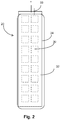
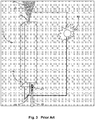
- the battery of Fig. 1 including the cathode 20 described above was connected to a lamp. Shortly after immersion of the battery of Fig. 3 into fresh water, a steady stream of micro-bubbles 27 with occasional large bubbles 39 were emitted from the upper outlet 28 and the lamp 50 lit up. Detritus 25 was expelled from the lower aperture 23. However, the battery took almost an hour to activate correctly, which is well after the time required by the AS4492 specification. It seems that sodium and chlorine ions were washed out of the battery by the stream of micro-bubbles 27 and so an insufficient concentration of ions built up in the cavity 22 of the battery 10 within the specified time as shown in FIG 5 . With reference to Fig.
- these larger bubbles of hydrogen 29 mean that there is a much smaller surface of hydrogen - fluid interface around the hydrogen emitted and less ions are dragged out of the housing 16 either in the surface layer or in the wake of these bubbles, resulting in the solution coupling the cathode 20 to the anodes 11 becoming ion rich substantially faster.
- the quantity of hygroscopic salt required in the battery may be greatly reduced by reducing the rate at which it escapes from the battery cavity.
- the present invention can enable the use of less soluble salts that are not hygroscopic. These salts would not reach a high enough concentration in the battery cavity to activate the bulb correctly without the present invention.
- the shelf-life of the batteries in humid environments is increased.
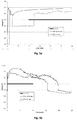
- Fig. 5a a graph comparing the activation times of the prior art battery of Fig. 3 (without the addition of an air-gap in the top of the case) with the battery of the present invention with the addition of an air-gap as illustrated Fig. 4 is shown. Without the addition of the airgap the battery takes too long to light up and does not accord with the demands of the AS4492 standard.
- Fig. 5b a graph showing the difference in active discharge life due to immersion into cold, fresh water between the prior art battery of Fig. 3 and the battery of the present invention as illustrated in Fig. 4 is shown.
- the minimum voltage for the specified light output is 0.8 volts. It is clearly demonstrated that the current lasts much longer where an air gap is provided despite the fact that the size of the cathodes 20 is actually reduced.
Landscapes
- Chemical & Material Sciences (AREA)
- Chemical Kinetics & Catalysis (AREA)
- Electrochemistry (AREA)
- General Chemical & Material Sciences (AREA)
- Engineering & Computer Science (AREA)
- Manufacturing & Machinery (AREA)
- Inorganic Chemistry (AREA)
- Composite Materials (AREA)
- Crystallography & Structural Chemistry (AREA)
- Materials Engineering (AREA)
- Hybrid Cells (AREA)
- Battery Electrode And Active Subsutance (AREA)
- Primary Cells (AREA)
Applications Claiming Priority (1)
| Application Number | Priority Date | Filing Date | Title |
|---|---|---|---|
| US15/598,857 US10693149B2 (en) | 2017-05-18 | 2017-05-18 | Survivor locator light |
Publications (1)
| Publication Number | Publication Date |
|---|---|
| EP3404758A1 true EP3404758A1 (fr) | 2018-11-21 |
Family
ID=62167246
Family Applications (1)
| Application Number | Title | Priority Date | Filing Date |
|---|---|---|---|
| EP18172378.4A Withdrawn EP3404758A1 (fr) | 2017-05-18 | 2018-05-15 | Conception améliorée de lumière localisatrice de survivants |
Country Status (3)
| Country | Link |
|---|---|
| US (1) | US10693149B2 (fr) |
| EP (1) | EP3404758A1 (fr) |
| CN (1) | CN108963289B (fr) |
Cited By (1)
| Publication number | Priority date | Publication date | Assignee | Title |
|---|---|---|---|---|
| EP3404759B1 (fr) * | 2017-05-18 | 2024-08-14 | Epsilor-Electric Fuel Ltd | Formulation de cathode améliorée pour lumière localisatrice de survivants |
Families Citing this family (2)
| Publication number | Priority date | Publication date | Assignee | Title |
|---|---|---|---|---|
| CN112002945B (zh) * | 2020-10-28 | 2021-03-12 | 深圳市寒暑科技新能源有限公司 | 一种固态柔性电池、制备及使用方法 |
| US12140454B2 (en) | 2022-04-01 | 2024-11-12 | Goodrich Corporation | Wireless water activated lights |
Citations (23)
| Publication number | Priority date | Publication date | Assignee | Title |
|---|---|---|---|---|
| US1011485A (en) * | 1911-06-21 | 1911-12-12 | Georg Pfleiderer | Electric battery. |
| US1400513A (en) * | 1920-05-05 | 1921-12-20 | Nat Carbon Co Inc | Electric battery |
| US2491640A (en) | 1945-06-20 | 1949-12-20 | Burgess Battery Co | Deferred action battery |
| US2636060A (en) | 1950-05-03 | 1953-04-21 | Fischbach Adolph | Primary battery and method of making the same |
| US2655551A (en) | 1950-07-31 | 1953-10-13 | Grenville B Ellis | Magnesium-cuprous chloride reserve battery |
| US2658935A (en) | 1951-01-03 | 1953-11-10 | Melvin F Chubb | Cuprous chloride electrode |
| US2716671A (en) | 1952-05-03 | 1955-08-30 | Eagle Picher Co | Cuprous chloride magnesium primary batteries |
| US2817697A (en) | 1954-04-06 | 1957-12-24 | Eagle Picher Co | Cuprous chloride magnesium battery |
| US3343988A (en) | 1964-07-08 | 1967-09-26 | Espey Mfg & Electronics Corp | Saltwater battery |
| US3859136A (en) | 1973-05-18 | 1975-01-07 | Esb Inc | Seawater battery with valve |
| US3953238A (en) | 1974-09-16 | 1976-04-27 | Esb Incorporated | Multicell seawater battery |
| US4016339A (en) | 1974-11-06 | 1977-04-05 | Her Majesty The Queen In Right Of Canada As Represented By The Minister Of National Defence | Salt water battery |
| US4192913A (en) | 1978-11-27 | 1980-03-11 | Magnavox Government And Industrial Electronics Company | Deferred action battery having an improved depolarizer |
| US4261853A (en) | 1979-09-24 | 1981-04-14 | Magnavox Government And Industrial Electronics Co. | Deferred action battery having an improved depolarizer |
| US4332864A (en) | 1979-09-19 | 1982-06-01 | Magnesium Elektron Limited | Primary electric cell having magnesium alloy anode |
| US4368167A (en) | 1981-03-05 | 1983-01-11 | Yardney Electric Corporation | Method of making an electrode |
| US4487821A (en) | 1980-07-01 | 1984-12-11 | Innovex Oy | Battery cell for a primary battery |
| US4803135A (en) | 1988-02-29 | 1989-02-07 | Honeywell Inc. | Pressure Activated reserve battery |
| US4822698A (en) | 1987-05-15 | 1989-04-18 | Westinghouse Electric Corp. | Seawater power cell |
| US5424147A (en) | 1994-07-15 | 1995-06-13 | Electric Fuel (E.F.L.) Ltd. | Water-activated battery |
| WO1995030248A2 (fr) * | 1994-04-20 | 1995-11-09 | I.N.Frantsevich Institute For Problems Of Materialscience | Source chimique de courant a activation par l'eau |
| US6010799A (en) * | 1997-04-03 | 2000-01-04 | Prosar Technologies | Cathode member for water-activated storage battery |
| US20170237082A1 (en) * | 2016-02-11 | 2017-08-17 | Epsilor-Electric Fuel Ltd | Water activated battery |
-
2017
- 2017-05-18 US US15/598,857 patent/US10693149B2/en active Active
-
2018
- 2018-05-15 EP EP18172378.4A patent/EP3404758A1/fr not_active Withdrawn
- 2018-05-16 CN CN201810469629.9A patent/CN108963289B/zh active Active
Patent Citations (24)
| Publication number | Priority date | Publication date | Assignee | Title |
|---|---|---|---|---|
| US1011485A (en) * | 1911-06-21 | 1911-12-12 | Georg Pfleiderer | Electric battery. |
| US1400513A (en) * | 1920-05-05 | 1921-12-20 | Nat Carbon Co Inc | Electric battery |
| US2491640A (en) | 1945-06-20 | 1949-12-20 | Burgess Battery Co | Deferred action battery |
| US2636060A (en) | 1950-05-03 | 1953-04-21 | Fischbach Adolph | Primary battery and method of making the same |
| US2655551A (en) | 1950-07-31 | 1953-10-13 | Grenville B Ellis | Magnesium-cuprous chloride reserve battery |
| US2658935A (en) | 1951-01-03 | 1953-11-10 | Melvin F Chubb | Cuprous chloride electrode |
| US2716671A (en) | 1952-05-03 | 1955-08-30 | Eagle Picher Co | Cuprous chloride magnesium primary batteries |
| US2817697A (en) | 1954-04-06 | 1957-12-24 | Eagle Picher Co | Cuprous chloride magnesium battery |
| US3343988A (en) | 1964-07-08 | 1967-09-26 | Espey Mfg & Electronics Corp | Saltwater battery |
| US3859136A (en) | 1973-05-18 | 1975-01-07 | Esb Inc | Seawater battery with valve |
| US3953238A (en) | 1974-09-16 | 1976-04-27 | Esb Incorporated | Multicell seawater battery |
| US4016339A (en) | 1974-11-06 | 1977-04-05 | Her Majesty The Queen In Right Of Canada As Represented By The Minister Of National Defence | Salt water battery |
| US4192913A (en) | 1978-11-27 | 1980-03-11 | Magnavox Government And Industrial Electronics Company | Deferred action battery having an improved depolarizer |
| US4332864A (en) | 1979-09-19 | 1982-06-01 | Magnesium Elektron Limited | Primary electric cell having magnesium alloy anode |
| US4261853A (en) | 1979-09-24 | 1981-04-14 | Magnavox Government And Industrial Electronics Co. | Deferred action battery having an improved depolarizer |
| US4487821A (en) | 1980-07-01 | 1984-12-11 | Innovex Oy | Battery cell for a primary battery |
| US4368167A (en) | 1981-03-05 | 1983-01-11 | Yardney Electric Corporation | Method of making an electrode |
| US4822698A (en) | 1987-05-15 | 1989-04-18 | Westinghouse Electric Corp. | Seawater power cell |
| US4803135A (en) | 1988-02-29 | 1989-02-07 | Honeywell Inc. | Pressure Activated reserve battery |
| WO1995030248A2 (fr) * | 1994-04-20 | 1995-11-09 | I.N.Frantsevich Institute For Problems Of Materialscience | Source chimique de courant a activation par l'eau |
| US5424147A (en) | 1994-07-15 | 1995-06-13 | Electric Fuel (E.F.L.) Ltd. | Water-activated battery |
| EP0692834A1 (fr) * | 1994-07-15 | 1996-01-17 | Electric Fuel (E.F.L.) Limited | Batterie activée par l'eau |
| US6010799A (en) * | 1997-04-03 | 2000-01-04 | Prosar Technologies | Cathode member for water-activated storage battery |
| US20170237082A1 (en) * | 2016-02-11 | 2017-08-17 | Epsilor-Electric Fuel Ltd | Water activated battery |
Cited By (1)
| Publication number | Priority date | Publication date | Assignee | Title |
|---|---|---|---|---|
| EP3404759B1 (fr) * | 2017-05-18 | 2024-08-14 | Epsilor-Electric Fuel Ltd | Formulation de cathode améliorée pour lumière localisatrice de survivants |
Also Published As
| Publication number | Publication date |
|---|---|
| CN108963289A (zh) | 2018-12-07 |
| US20180337412A1 (en) | 2018-11-22 |
| CN108963289B (zh) | 2021-10-15 |
| US10693149B2 (en) | 2020-06-23 |
Similar Documents
| Publication | Publication Date | Title |
|---|---|---|
| EP3404759B1 (fr) | Formulation de cathode améliorée pour lumière localisatrice de survivants | |
| US5424147A (en) | Water-activated battery | |
| US5166011A (en) | Process for forming an argentic oxide containing bipolar electrode and product produced thereby and deferred actuated battery assembly employing same | |
| US8323817B2 (en) | Alkali metal seawater battery | |
| US9905860B2 (en) | Water activated battery system having enhanced start-up behavior | |
| US9825311B2 (en) | Water activated battery | |
| CN104813507B (zh) | 具有分隔体和电解质组合的碱性电化学电池 | |
| EP3404758A1 (fr) | Conception améliorée de lumière localisatrice de survivants | |
| US8304121B2 (en) | Primary aluminum hydride battery | |
| CN102057525A (zh) | 碱性电池 | |
| Sarakonsri et al. | Primary batteries | |
| Vuorilehto | An environmentally friendly water-activated manganese dioxide battery | |
| CN108352589A (zh) | 锌-空气电池 | |
| US4007316A (en) | Deferred action battery having an improved depolarizer | |
| FI113417B (fi) | Vesiaktivoitava paristo | |
| Kim et al. | Primary seawater batteries | |
| JP6263371B2 (ja) | 金属空気電池 | |
| Balasubramanian et al. | Gasometric corrosion-rate studies of magnesium alloy in magnesium batteries | |
| CN101939866A (zh) | 具有包含按重量计小于4%碳颗粒的阴极的碱性电池 | |
| US20250309410A1 (en) | Ultra-Low-Cost Luffa Aluminum-Air Fuel Cell | |
| CN108470966B (zh) | 一种应急充电宝 | |
| Downing | 4 Magnesium–Air Battery | |
| US20260098664A1 (en) | Hypogeal Electricity Generator Using Sandy Al-Air Fuel Cells | |
| US3525645A (en) | Silver chloride battery and method of operating same | |
| NO763885L (no) | Alkalisk prim{relement. |
Legal Events
| Date | Code | Title | Description |
|---|---|---|---|
| PUAI | Public reference made under article 153(3) epc to a published international application that has entered the european phase |
Free format text: ORIGINAL CODE: 0009012 |
|
| STAA | Information on the status of an ep patent application or granted ep patent |
Free format text: STATUS: REQUEST FOR EXAMINATION WAS MADE |
|
| 17P | Request for examination filed |
Effective date: 20180518 |
|
| AK | Designated contracting states |
Kind code of ref document: A1 Designated state(s): AL AT BE BG CH CY CZ DE DK EE ES FI FR GB GR HR HU IE IS IT LI LT LU LV MC MK MT NL NO PL PT RO RS SE SI SK SM TR |
|
| AX | Request for extension of the european patent |
Extension state: BA ME |
|
| RBV | Designated contracting states (corrected) |
Designated state(s): AL AT BE BG CH CY CZ DE DK EE ES FI FR GB GR HR HU IE IS IT LI LT LU LV MC MK MT NL NO PL PT RO RS SE SI SK SM TR |
|
| STAA | Information on the status of an ep patent application or granted ep patent |
Free format text: STATUS: EXAMINATION IS IN PROGRESS |
|
| 17Q | First examination report despatched |
Effective date: 20220105 |
|
| STAA | Information on the status of an ep patent application or granted ep patent |
Free format text: STATUS: THE APPLICATION IS DEEMED TO BE WITHDRAWN |
|
| 18D | Application deemed to be withdrawn |
Effective date: 20250611 |