EP3405002B1 - Kohlenstoffverbundstoffzusammensetzung und unter verwendung davon hergestellter kohlenstoffheizer - Google Patents
Kohlenstoffverbundstoffzusammensetzung und unter verwendung davon hergestellter kohlenstoffheizer Download PDFInfo
- Publication number
- EP3405002B1 EP3405002B1 EP18171796.8A EP18171796A EP3405002B1 EP 3405002 B1 EP3405002 B1 EP 3405002B1 EP 18171796 A EP18171796 A EP 18171796A EP 3405002 B1 EP3405002 B1 EP 3405002B1
- Authority
- EP
- European Patent Office
- Prior art keywords
- carbon
- carbon composite
- present
- composition
- heater
- Prior art date
- Legal status (The legal status is an assumption and is not a legal conclusion. Google has not performed a legal analysis and makes no representation as to the accuracy of the status listed.)
- Active
Links
Images



Classifications
-
- C—CHEMISTRY; METALLURGY
- C04—CEMENTS; CONCRETE; ARTIFICIAL STONE; CERAMICS; REFRACTORIES
- C04B—LIME, MAGNESIA; SLAG; CEMENTS; COMPOSITIONS THEREOF, e.g. MORTARS, CONCRETE OR LIKE BUILDING MATERIALS; ARTIFICIAL STONE; CERAMICS; REFRACTORIES; TREATMENT OF NATURAL STONE
- C04B35/00—Shaped ceramic products characterised by their composition; Ceramics compositions; Processing powders of inorganic compounds preparatory to the manufacturing of ceramic products
- C04B35/515—Shaped ceramic products characterised by their composition; Ceramics compositions; Processing powders of inorganic compounds preparatory to the manufacturing of ceramic products based on non-oxide ceramics
- C04B35/56—Shaped ceramic products characterised by their composition; Ceramics compositions; Processing powders of inorganic compounds preparatory to the manufacturing of ceramic products based on non-oxide ceramics based on carbides or oxycarbides
- C04B35/565—Shaped ceramic products characterised by their composition; Ceramics compositions; Processing powders of inorganic compounds preparatory to the manufacturing of ceramic products based on non-oxide ceramics based on carbides or oxycarbides based on silicon carbide
-
- C—CHEMISTRY; METALLURGY
- C04—CEMENTS; CONCRETE; ARTIFICIAL STONE; CERAMICS; REFRACTORIES
- C04B—LIME, MAGNESIA; SLAG; CEMENTS; COMPOSITIONS THEREOF, e.g. MORTARS, CONCRETE OR LIKE BUILDING MATERIALS; ARTIFICIAL STONE; CERAMICS; REFRACTORIES; TREATMENT OF NATURAL STONE
- C04B35/00—Shaped ceramic products characterised by their composition; Ceramics compositions; Processing powders of inorganic compounds preparatory to the manufacturing of ceramic products
- C04B35/622—Forming processes; Processing powders of inorganic compounds preparatory to the manufacturing of ceramic products
- C04B35/626—Preparing or treating the powders individually or as batches ; preparing or treating macroscopic reinforcing agents for ceramic products, e.g. fibres; mechanical aspects section B
- C04B35/63—Preparing or treating the powders individually or as batches ; preparing or treating macroscopic reinforcing agents for ceramic products, e.g. fibres; mechanical aspects section B using additives specially adapted for forming the products, e.g.. binder binders
- C04B35/6303—Inorganic additives
-
- C—CHEMISTRY; METALLURGY
- C04—CEMENTS; CONCRETE; ARTIFICIAL STONE; CERAMICS; REFRACTORIES
- C04B—LIME, MAGNESIA; SLAG; CEMENTS; COMPOSITIONS THEREOF, e.g. MORTARS, CONCRETE OR LIKE BUILDING MATERIALS; ARTIFICIAL STONE; CERAMICS; REFRACTORIES; TREATMENT OF NATURAL STONE
- C04B35/00—Shaped ceramic products characterised by their composition; Ceramics compositions; Processing powders of inorganic compounds preparatory to the manufacturing of ceramic products
- C04B35/622—Forming processes; Processing powders of inorganic compounds preparatory to the manufacturing of ceramic products
- C04B35/626—Preparing or treating the powders individually or as batches ; preparing or treating macroscopic reinforcing agents for ceramic products, e.g. fibres; mechanical aspects section B
- C04B35/63—Preparing or treating the powders individually or as batches ; preparing or treating macroscopic reinforcing agents for ceramic products, e.g. fibres; mechanical aspects section B using additives specially adapted for forming the products, e.g.. binder binders
- C04B35/632—Organic additives
- C04B35/634—Polymers
-
- C—CHEMISTRY; METALLURGY
- C04—CEMENTS; CONCRETE; ARTIFICIAL STONE; CERAMICS; REFRACTORIES
- C04B—LIME, MAGNESIA; SLAG; CEMENTS; COMPOSITIONS THEREOF, e.g. MORTARS, CONCRETE OR LIKE BUILDING MATERIALS; ARTIFICIAL STONE; CERAMICS; REFRACTORIES; TREATMENT OF NATURAL STONE
- C04B35/00—Shaped ceramic products characterised by their composition; Ceramics compositions; Processing powders of inorganic compounds preparatory to the manufacturing of ceramic products
- C04B35/622—Forming processes; Processing powders of inorganic compounds preparatory to the manufacturing of ceramic products
- C04B35/626—Preparing or treating the powders individually or as batches ; preparing or treating macroscopic reinforcing agents for ceramic products, e.g. fibres; mechanical aspects section B
- C04B35/63—Preparing or treating the powders individually or as batches ; preparing or treating macroscopic reinforcing agents for ceramic products, e.g. fibres; mechanical aspects section B using additives specially adapted for forming the products, e.g.. binder binders
- C04B35/632—Organic additives
- C04B35/634—Polymers
- C04B35/63448—Polymers obtained otherwise than by reactions only involving carbon-to-carbon unsaturated bonds
- C04B35/63472—Condensation polymers of aldehydes or ketones
- C04B35/63476—Phenol-formaldehyde condensation polymers
-
- H—ELECTRICITY
- H05—ELECTRIC TECHNIQUES NOT OTHERWISE PROVIDED FOR
- H05B—ELECTRIC HEATING; ELECTRIC LIGHT SOURCES NOT OTHERWISE PROVIDED FOR; CIRCUIT ARRANGEMENTS FOR ELECTRIC LIGHT SOURCES, IN GENERAL
- H05B3/00—Ohmic-resistance heating
- H05B3/10—Heating elements characterised by the composition or nature of the materials or by the arrangement of the conductor
- H05B3/12—Heating elements characterised by the composition or nature of the materials or by the arrangement of the conductor characterised by the composition or nature of the conductive material
- H05B3/14—Heating elements characterised by the composition or nature of the materials or by the arrangement of the conductor characterised by the composition or nature of the conductive material the material being non-metallic
-
- H—ELECTRICITY
- H05—ELECTRIC TECHNIQUES NOT OTHERWISE PROVIDED FOR
- H05B—ELECTRIC HEATING; ELECTRIC LIGHT SOURCES NOT OTHERWISE PROVIDED FOR; CIRCUIT ARRANGEMENTS FOR ELECTRIC LIGHT SOURCES, IN GENERAL
- H05B3/00—Ohmic-resistance heating
- H05B3/10—Heating elements characterised by the composition or nature of the materials or by the arrangement of the conductor
- H05B3/12—Heating elements characterised by the composition or nature of the materials or by the arrangement of the conductor characterised by the composition or nature of the conductive material
- H05B3/14—Heating elements characterised by the composition or nature of the materials or by the arrangement of the conductor characterised by the composition or nature of the conductive material the material being non-metallic
- H05B3/145—Carbon only, e.g. carbon black, graphite
-
- H—ELECTRICITY
- H05—ELECTRIC TECHNIQUES NOT OTHERWISE PROVIDED FOR
- H05B—ELECTRIC HEATING; ELECTRIC LIGHT SOURCES NOT OTHERWISE PROVIDED FOR; CIRCUIT ARRANGEMENTS FOR ELECTRIC LIGHT SOURCES, IN GENERAL
- H05B3/00—Ohmic-resistance heating
- H05B3/10—Heating elements characterised by the composition or nature of the materials or by the arrangement of the conductor
- H05B3/12—Heating elements characterised by the composition or nature of the materials or by the arrangement of the conductor characterised by the composition or nature of the conductive material
- H05B3/14—Heating elements characterised by the composition or nature of the materials or by the arrangement of the conductor characterised by the composition or nature of the conductive material the material being non-metallic
- H05B3/148—Silicon, e.g. silicon carbide, magnesium silicide, heating transistors or diodes
-
- H—ELECTRICITY
- H05—ELECTRIC TECHNIQUES NOT OTHERWISE PROVIDED FOR
- H05B—ELECTRIC HEATING; ELECTRIC LIGHT SOURCES NOT OTHERWISE PROVIDED FOR; CIRCUIT ARRANGEMENTS FOR ELECTRIC LIGHT SOURCES, IN GENERAL
- H05B3/00—Ohmic-resistance heating
- H05B3/62—Heating elements specially adapted for furnaces
- H05B3/64—Heating elements specially adapted for furnaces using ribbon, rod, or wire heater
-
- C—CHEMISTRY; METALLURGY
- C04—CEMENTS; CONCRETE; ARTIFICIAL STONE; CERAMICS; REFRACTORIES
- C04B—LIME, MAGNESIA; SLAG; CEMENTS; COMPOSITIONS THEREOF, e.g. MORTARS, CONCRETE OR LIKE BUILDING MATERIALS; ARTIFICIAL STONE; CERAMICS; REFRACTORIES; TREATMENT OF NATURAL STONE
- C04B2235/00—Aspects relating to ceramic starting mixtures or sintered ceramic products
- C04B2235/02—Composition of constituents of the starting material or of secondary phases of the final product
- C04B2235/30—Constituents and secondary phases not being of a fibrous nature
- C04B2235/32—Metal oxides, mixed metal oxides, or oxide-forming salts thereof, e.g. carbonates, nitrates, (oxy)hydroxides, chlorides
- C04B2235/3217—Aluminum oxide or oxide forming salts thereof, e.g. bauxite, alpha-alumina
-
- C—CHEMISTRY; METALLURGY
- C04—CEMENTS; CONCRETE; ARTIFICIAL STONE; CERAMICS; REFRACTORIES
- C04B—LIME, MAGNESIA; SLAG; CEMENTS; COMPOSITIONS THEREOF, e.g. MORTARS, CONCRETE OR LIKE BUILDING MATERIALS; ARTIFICIAL STONE; CERAMICS; REFRACTORIES; TREATMENT OF NATURAL STONE
- C04B2235/00—Aspects relating to ceramic starting mixtures or sintered ceramic products
- C04B2235/02—Composition of constituents of the starting material or of secondary phases of the final product
- C04B2235/30—Constituents and secondary phases not being of a fibrous nature
- C04B2235/34—Non-metal oxides, non-metal mixed oxides, or salts thereof that form the non-metal oxides upon heating, e.g. carbonates, nitrates, (oxy)hydroxides, chlorides
- C04B2235/3418—Silicon oxide, silicic acids or oxide forming salts thereof, e.g. silica sol, fused silica, silica fume, cristobalite, quartz or flint
-
- C—CHEMISTRY; METALLURGY
- C04—CEMENTS; CONCRETE; ARTIFICIAL STONE; CERAMICS; REFRACTORIES
- C04B—LIME, MAGNESIA; SLAG; CEMENTS; COMPOSITIONS THEREOF, e.g. MORTARS, CONCRETE OR LIKE BUILDING MATERIALS; ARTIFICIAL STONE; CERAMICS; REFRACTORIES; TREATMENT OF NATURAL STONE
- C04B2235/00—Aspects relating to ceramic starting mixtures or sintered ceramic products
- C04B2235/02—Composition of constituents of the starting material or of secondary phases of the final product
- C04B2235/30—Constituents and secondary phases not being of a fibrous nature
- C04B2235/38—Non-oxide ceramic constituents or additives
- C04B2235/3817—Carbides
- C04B2235/3826—Silicon carbides
-
- C—CHEMISTRY; METALLURGY
- C04—CEMENTS; CONCRETE; ARTIFICIAL STONE; CERAMICS; REFRACTORIES
- C04B—LIME, MAGNESIA; SLAG; CEMENTS; COMPOSITIONS THEREOF, e.g. MORTARS, CONCRETE OR LIKE BUILDING MATERIALS; ARTIFICIAL STONE; CERAMICS; REFRACTORIES; TREATMENT OF NATURAL STONE
- C04B2235/00—Aspects relating to ceramic starting mixtures or sintered ceramic products
- C04B2235/02—Composition of constituents of the starting material or of secondary phases of the final product
- C04B2235/30—Constituents and secondary phases not being of a fibrous nature
- C04B2235/42—Non metallic elements added as constituents or additives, e.g. sulfur, phosphor, selenium or tellurium
- C04B2235/422—Carbon
- C04B2235/425—Graphite
-
- C—CHEMISTRY; METALLURGY
- C04—CEMENTS; CONCRETE; ARTIFICIAL STONE; CERAMICS; REFRACTORIES
- C04B—LIME, MAGNESIA; SLAG; CEMENTS; COMPOSITIONS THEREOF, e.g. MORTARS, CONCRETE OR LIKE BUILDING MATERIALS; ARTIFICIAL STONE; CERAMICS; REFRACTORIES; TREATMENT OF NATURAL STONE
- C04B2235/00—Aspects relating to ceramic starting mixtures or sintered ceramic products
- C04B2235/02—Composition of constituents of the starting material or of secondary phases of the final product
- C04B2235/30—Constituents and secondary phases not being of a fibrous nature
- C04B2235/48—Organic compounds becoming part of a ceramic after heat treatment, e.g. carbonising phenol resins
-
- C—CHEMISTRY; METALLURGY
- C04—CEMENTS; CONCRETE; ARTIFICIAL STONE; CERAMICS; REFRACTORIES
- C04B—LIME, MAGNESIA; SLAG; CEMENTS; COMPOSITIONS THEREOF, e.g. MORTARS, CONCRETE OR LIKE BUILDING MATERIALS; ARTIFICIAL STONE; CERAMICS; REFRACTORIES; TREATMENT OF NATURAL STONE
- C04B2235/00—Aspects relating to ceramic starting mixtures or sintered ceramic products
- C04B2235/60—Aspects relating to the preparation, properties or mechanical treatment of green bodies or pre-forms
- C04B2235/602—Making the green bodies or pre-forms by moulding
- C04B2235/6025—Tape casting, e.g. with a doctor blade
-
- C—CHEMISTRY; METALLURGY
- C08—ORGANIC MACROMOLECULAR COMPOUNDS; THEIR PREPARATION OR CHEMICAL WORKING-UP; COMPOSITIONS BASED THEREON
- C08K—Use of inorganic or non-macromolecular organic substances as compounding ingredients
- C08K3/00—Use of inorganic substances as compounding ingredients
- C08K3/02—Elements
- C08K3/04—Carbon
-
- C—CHEMISTRY; METALLURGY
- C08—ORGANIC MACROMOLECULAR COMPOUNDS; THEIR PREPARATION OR CHEMICAL WORKING-UP; COMPOSITIONS BASED THEREON
- C08L—COMPOSITIONS OF MACROMOLECULAR COMPOUNDS
- C08L61/00—Compositions of condensation polymers of aldehydes or ketones; Compositions of derivatives of such polymers
- C08L61/04—Condensation polymers of aldehydes or ketones with phenols only
- C08L61/06—Condensation polymers of aldehydes or ketones with phenols only of aldehydes with phenols
Definitions
- the present invention relates to a carbon composite composition for manufacturing a heating element and a carbon heater manufactured using the same, in a carbon heater used as a heater for applying heat in the field of a cooking appliance such as an oven.
- FIG. 1 is a perspective view showing a general structure of an oven.
- an oven 1 is provided with a cavity 2 in which food to be cooked is placed, a door 3 for selectively opening the cavity 2, and a plurality of heaters 6 for applying heat to the cavity 2.
- the heater 6 is provided with one or more heaters, and is protected by a cover 8 from the exterior of the cavity 2.
- a magnetron 4 is provided on the exterior of an upper surface of the cavity 2. The magnetron 4 generates electromagnetic waves, and the generated electromagnetic waves are radiated to an inner space of the cavity 2 through a predetermined waveguide and a stirrer.
- a sheath heater 5 is provided on an upper side of the inner space of the cavity, as necessary.
- the heaters are different from each other in terms of an operation depending on a material, a heating method and the like thereof.
- a carbon heater which is generally used as the sheath heater 5 and the heater 6, is a grill heater that heats food inside the cavity 2 using a radiant heating method.
- a carbon fiber For a conventional carbon heater, a carbon fiber (CF) is mainly used.
- the CF refers to a fibrous carbon material having a carbon content of 90% or more.
- Such CF is widely used in various fields because it has flexibility, high strength, high elasticity, and adsorbability as well as basic properties of a carbon material such as heat resistance, chemical stability, electrical conductivity, thermal conductivity, mechanical strength, biocompatibility and the like.
- the CF has a high thermal conductivity, a low coefficient of thermal expansion, and high thermal shock resistance. For this reason, recently, the CF has been widely used as a structural material or a functional material for high temperature such as heat rays, heaters and the like.
- the CF Since the CF is made of a material called "carbon", it has a microwave absorption property of carbon itself. Further, the CF has an inherent property that a ratio of a fiber length to a fiber diameter is very large in view of properties of a shape of "fiber".
- the CF is made of single carbon filaments.
- the filaments not only have a diameter but also an interval between filaments of several micrometers ( ⁇ m).
- a high voltage is applied to a very narrow distance (interval) between the filaments.
- a voltage of 10 V is applied to an interval of 1 ⁇ m
- a high voltage of about 10 7 V/m is applied between filaments.
- the filaments are likely to cause a dielectric breakdown, and sometimes a spark occurs.
- the carbon heater consists of a carbon fiber, a connector for applying electricity to the carbon fiber, a quartz tube including the carbon fiber and the connector, and an assembly (or a unit) composed of encapsulation gas such as Ar and the like sealed in the tube.
- the encapsulation gas maintains a vacuum atmosphere of about 10 -1 to 10 -2 torr.
- a shield member is provided between a carbon heater and a cabin to suppress a reaction of the plasma and the like, and a progress of light to the cabin due to the plasma.
- the shield member since the shield member not only shields plasma light, but also partially blocks radiation light emitted from the carbon heater, radiation efficiency of the oven is greatly lowered.
- FR1300359 A discloses an electric heating rod of the type comprising a hot zone for use in hightemperature furnaces, having the following features, considered separately or collectively: a. it is made of recrystallized silicon carbide, and the hot zone is impregnated with a molybdenum silicidebased compound; b. The hot zone has the shape of a helix; c. This helix has sufficient mechanical strength to remain self-supporting at a working temperature of between 1400 and 1800 °C, the pitch of the helix determining the electrical resistance of this hot zone; d. The hot zone is arranged between cold ends impregnated with molybdenum silicide; e.
- the hot zone is arranged between cold ends impregnated with silicon; f .
- the cold ends contain boron in a quantity ranging from 0.078% to 5 % relative to the free-state silicon content, g. Boron is present in the form of carbon boride, titanium, zirconium or mixtures thereof; h.
- a refractory baffle is provided at each end of the hot zone, this baffle acting as a reflector for radiant energy, to minimize the transfer of thermic energy from the hot zone.
- the present invention aims to provide a carbon composite composition for a new carbon heater which does not cause a dielectric breakdown or a spark even under a high voltage in a carbon heater.
- the present invention aims to provide a carbon composite composition for a new carbon heater which does not cause plasma even under encapsulation gas and a high voltage in a carbon heater.
- the SiC is included in an amount of 50 to 75 wt.% (hereafter referred to as "%"), based on the total weight of the composition.
- the SiO 2 is included in an amount of 24% or less, based on the total weight of the composition.
- the novolac resin is included in an amount of 15 to 30%, based on the total weight of the composition.
- the lubricant acts as a curing agent.
- the graphite is included in an amount of 0.1 to 10%, based on the total weight of the composition.
- a resistance heating element obtained from the aforementioned compositions according to an aspect of the present invention.
- the resistance heating element is preferably obtainable by curing and carbonizing the carbon composite composition of the present invention.
- the carbon composite composition of the present invention does not generate a local concentration of voltage between filaments, which is a disadvantage inherent in a fiber shape, thereby preventing a dielectric breakdown or a spark from occurring.
- the carbon composite composition of the present invention may fundamentally prevent plasma from occurring between filaments due to a local high voltage, and improve a decline in radiation efficiency because a shield member is not necessary.
- the carbon composite composition of the present invention has no restriction on a shape, which is an inherent property of a composition, and thereby it is possible to easily manufacture a carbon heater of a desired shape necessary for an oven having various sizes and shapes.
- the carbon composite composition of the present invention may control a specific resistance and an output of the carbon heater by changing constituent components and composition ranges of the composition, and thereby it is possible to improve a degree of freedom of an electrical design of the carbon heater.
- the carbon composite composition of the present invention is relatively excellent in resistance to surface oxidation or surface erosion which may occur frequently at a high temperature since a surface area ratio is relatively small in comparison to that of the conventional carbon fiber. Also, such property of the composition makes it possible to omit a post-treatment process such as a surface coating and the like which is necessary for the conventional carbon fiber, thereby improving the lead time and productivity.
- the carbon composite composition of the present invention includes an inorganic powder (herein also referred to as the base material) capable of serving as a main component of a heating element to be used as a high temperature heater and a binder for coupling the powder particles with one another, as essential components.
- the base material comprises at least silicon carbide, and may further comprise silicon oxide (SiO 2 ) and aluminum oxide (Al 2 O 3 ) as shown in Table 1 below.
- ZrO 2 Zirconium oxide
- BN boron nitride
- MoSi 2 molybdenum silicide
- the composition of the present invention typically contains SiC since SiC, which has the lowest specific resistance among the inorganic powders, may stably maintain a specific resistance and an electric conductivity which are necessary properties for a heater, and the specific resistance may be too high to be used as a heater in case that the carbon composite composition is formed without SiC.
- SiO 2 and/or Al 2 O 3 in addition to SiC are added as a specific resistance controlling agent for controlling a specific resistance of a finally manufactured carbon heater since they each have high specific resistance.
- SiC is preferably added in an amount of 50 to 75% based on the total weight of the composition, for the following reasons.
- a content of SiC is less than 50%, a specific resistance of a finally manufactured carbon heater is excessively high and a thermal conductivity thereof is lowered, and thus disconnection is likely to occur.
- the content of SiC exceeds 75%, the specific resistance of the carbon heater is lowered, so that it is difficult to use such carbon heater as a heater.
- SiO 2 is more preferable than Al 2 O 3 since the melting point of SiO 2 is lower than that of Al 2 O 3 so that the increase of a specific resistance of a carbon heater can be more easily controlled when a final heat treatment is performed thereon.
- SiO 2 is preferably added at a maximum of 24% based on the total weight of the composition, for the following reasons.
- a content of SiO 2 exceeds 24%, a thermal conductivity of the carbon heater is drastically lowered and thus a terminal disconnection may occur.
- additional design changes such as reducing a length of the heater or widening a cross-sectional area may be required.
- the phenolic resin of the present invention performs functions of both the binder resin and the carbon raw material.
- the phenolic resin is one of the oldest synthetic resins and has excellent heat resistance and flame retardancy.
- the phenolic resin is generally synthesized by a reaction of phenol and formaldehyde, and the properties of the phenolic resin greatly vary depending on acidity of a catalyst used therefor.
- a novolac resin is produced when a catalyst is an acid. More specifically, the novolac resin is obtained by reacting phenol and formaldehyde in a formaldehyde to phenol molar ratio of 0.5:1 to 1:1 in the presence of an acidic catalyst such as sulfuric acid, hydrochloric acid, oxalic acid or the like. Under acidic catalysis, a condensation reaction occurs rapidly, and the novolac resin has a structure in which a large number of phenol nuclei are linked by a methylene group, and the novolac resin itself is a thermoplastic resin, so that the novolac resin has a property of not being cured without a curing agent.
- the novolac resin is cured by condensation curing or thermal curing, normally mixed with hexamine and cured by heating.
- a resol resin may be obtained by reacting phenol and formaldehyde in a formaldehyde to phenol molar ratio of 1:1 to 3:1 in the presence of a basic catalyst such as caustic soda or ammonia. Since the condensation reaction generally occurs more slowly than an addition reaction, the resol resin is produced as a compound of phenol alcohol having a relatively low molecular weight. That is, the resol resin has a structure in which many methylol groups are substituted in phenol nucleus. Such resol resin has a property of being cured at a room temperature or at a moderate temperature without a curing agent.
- the novolac resin is more preferable as a phenolic resin. Description thereon is set forth as follows.
- the carbon composite composition of the present invention essentially includes an inorganic powder to manufacture a carbon heater.
- an inorganic powder to manufacture a carbon heater.
- the extrusion process is a very common process in the technical field of using a resin.
- the present inventors found out that, in the resol resin, a curing reaction rapidly proceeds at a temperature and pressure at which the extrusion process is generally performed, and the carbon composite composition is cured before a carbon electrode is formed into a desired shape, so that extrusion molding is preferably not used when a resol resin is included.
- the novolac resin of the present invention is preferably added in an amount of 15 to 30% based on the total weight of the composition.
- a content of the novolac resin is less than 15%, not only the carbon composite obtained by performing the extrusion process is easily broken but also a content of carbon in the finally produced carbon heater is too low, so that the specific resistance of the carbon heater becomes higher in comparison to a specification thereof.
- the content of the novolac resin exceeds 30%, the carbon composite has poor stability in terms of a shape after an injection process is performed thereon, and the finally manufactured carbon heater is more likely to have a dimensional defect, and the carbon content in the carbon heater becomes higher, whereby the specific resistance of the carbon heater is lower in comparison to the specification thereof.
- the carbon composite composition of the present invention includes a lubricant as an essential component for reducing the friction between the composition and a die during the extrusion process.
- a final product is a carbon heater, and thus it is preferable to include carbon as a lubricant component.
- the lubricant comprises graphite.
- Graphite has excellent lubrication properties during the extrusion process.
- the present inventors identified a function of the novolac resin as a curing agent in addition to a function of graphite as a lubricant, for the first time.
- a novolac resin is not cured by itself.
- a curing agent such as "hexamine” is required for thermal curing.
- the carbon composite composition of the present invention is cured on its own without the curing agent after the extrusion process is performed thereon when the graphite is included in the carbon composite composition. But, a mechanism thereof has not been identified, yet.
- the graphite is preferably added in an amount of 0.1 to 10% based on the total weight of the composition of the present invention.
- a content of the graphite is less than 0.1%, the friction between the composition and the die increases during the extrusion process, and after the extrusion process, the curing is insufficient and the carbon composite has poor stability in terms of a shape, and thereby the finally manufactured carbon heater is more likely to have a dimensional defect.
- the content of the graphite exceeds 10%, the curing reaction proceeds too fast during the extrusion process, which makes processing such as extruding difficult, and the carbon content in the finally manufactured carbon heater becomes higher, whereby the specific resistance of the carbon heater is lower in comparison to the specification thereof.
- a general method used to manufacture another functional material using the carbon composite composition may be applied to the carbon heater manufacturing method of the present invention.
- the manufacturing method of the present invention starts with a process of mixing an inorganic power and a phenolic resin binder (S 100).
- raw materials each having desired components and composition ranges are sufficiently mixed for a desired time using an apparatus such as an attrition mill.
- the mixed raw materials are thermally extruded using a general extruder widely used in the field of polymer injection (S 200).
- An extrusion condition used for the present invention is a speed of 60 rpm at 100 to 200°C, but is not limited thereto.
- the extrusion condition may be changed depending on the components and the composition ranges of the inorganic powder and the binder.
- the extruded carbon composite composition is subjected to a stabilization heat treatment process at a high temperature (S 300).
- the stabilization heat treatment process aims to cure the binder so that the extruded carbon composite composition may maintain its extruded shape.
- the stabilization heat treatment process is preferably performed at 200 to 300°C for 0.1 to 2 hours.
- the carbonization heat treatment process aims to produce an active component of the carbon heater that is a final product, and includes a first step of out-gassing components which volatilize a volatile component among the components constituting the carbon composite composition, and a second step of carbonizing the remaining components subsequent to the out-gassing step.
- the carbonization heat treatment process is preferably divided into two steps.
- a first carbonization heat treatment process is performed at a relatively low temperature of 600-1,000°C for 0.1 to 2 hours, and the first carbonization heat treatment process mainly aims to volatilize components other than carbon among binder components, and other components other than carbon which may exist in impurities and the like included in components other than the binder components among components of the composition.
- a second carbonization heat treatment process is performed, immediately after the first carbonization heat treatment process.
- the second carbonization heat treatment process is performed at 1,200 to 1,400°C for 0.5 to 3 hours, and aims to carbonize components of the carbon composite composition remaining after the first carbonization heat treatment process.
- the first and second carbonization heat treatment processes may be integrated and operated in a single carbonization heat treatment process.
- the present invention may include a separate post-treatment process to adjust or improve mechanical and/or electrical properties of the carbon heater subsequent to the carbonization heat treatment process.
- the carbon composite produced after the second heat treatment process is combined with a connector and a sealing tube to manufacture the carbon heater that is a final product.
- a binary composition was prepared by mixing 1 type of inorganic powder selected from a group of SiC, SiO 2 , Al 2 O 3 and ZrO 2 shown in Table 1 above with a novolac resin as a binder.
- the prepared binary composition was mixed uniformly through a step of mixing raw materials, and then extruded.
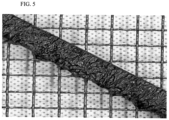
- FIG. 4 and FIG. 5 show the carbon composite extruded and the carbon composite subjected to the stabilization heat treatment using the binary carbon composite composition, respectively.
- FIGS. 4 and 5 it was impossible to extrude the binary carbon composite composition into a desired shape due to extremely low mechanical stability after extrusion molding and molding are performed thereon ( FIG. 4 ), and the binary carbon composite composition had dimensional and surficial defects which make impossible to be used as a carbon heater even though the stabilization heat treatment was performed thereon after the curing agent is added ( FIG. 5 ).
- a ternary carbon composite composition was prepared by adding 23% of the novolac resin as a binder and 3% of the graphite as a lubricant to 74% of SiC among the inorganic power components shown in Table 1 above.
- the prepared ternary composition was mixed uniformly through the step of mixing raw materials and extruded, and subsequently was subjected to the stabilization heat treatment and the carbonization heat treatment processes, followed by being processed into a final carbon heater. Thereafter, electrical properties of the final carbon heater were evaluated.
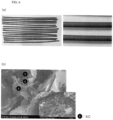
- FIG. 6 shows a surface and a cross-section of the ternary carbon composite after the stabilization heat treatment process is performed thereon.
- the carbon composite composed of the ternary composition has excellent macroscopic mechanical stability and almost no defects on the surface thereof. Also, it is shown that SiC is very uniformly distributed by the binder even in the cross-sectional microstructure of the carbon composite without segregation, agglomeration, or macro voids.
- a carbon heater was manufactured using the ternary composition of Example 1, and the electrical properties thereof were evaluated. Electrical resistance of the carbon heater was measured to be about 4 to 5 ⁇ at an applied voltage of 115 V.
- Example 2 As Comparative Example 2 with respect to Example 1, another ternary carbon composite composition was prepared to include the inorganic powder substituted only with SiO 2 or Al 2 O 3 instead of SiC and the other components and composition ranges same as those of Example 1.
- the carbon composite composition of Comparative Example 2 was identified to have the same level of mechanical stability as that of Example 1.
- the electrical resistance of the carbon heater manufactured using the carbon composite composition of Comparative Example 2 is measured to be close to infinity at an applied voltage of 115 V.
- a quaternary carbon composite composition was prepared by adding a novolac resin as a binder and graphite as a lubricant to an inorganic powder which is based on SiC and further includes SiO 2 as a specific resistance controlling agent among the inorganic power components shown in Table 1 above.
- the prepared quaternary composition was mixed uniformly through the step of mixing raw materials and extruded, and subsequently was subjected to the stabilization heat treatment and the carbonization heat treatment processes, followed by being processed into a final carbon heater. Thereafter, electrical properties of the final carbon heater were evaluated.
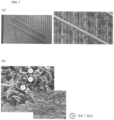
- FIG. 7 shows a surface and a cross-section of the quaternary carbon composite after the stabilization heat treatment process is performed thereon.
- the carbon composite composed of the ternary composition has excellent macroscopic mechanical stability and almost no defects on the surface thereof.
- SiC is uniformly distributed by the binder even in the cross-sectional microstructure of the carbon composite without segregation, agglomeration, or macro voids.
- SiC and SiO 2 were uniformly distributed without macroscopic/micro segregation.
- Table 2 shows electrical properties of a carbon heater made of ternary and quaternary carbon composites (In Table 2, PN, GP, SC and SO represent the novolac resin, graphite, SiC and SiO 2 , respectively).
- PN, GP, SC and SO represent the novolac resin, graphite, SiC and SiO 2 , respectively.
- the more the content of SiO 2 increases the more the electrical resistance of the carbon heater increases, while the electrical conductivity of the carbon heater decreases.
- Such experimental results indicate that the electrical resistivity of the carbon heater made of the quaternary carbon composite may be controlled as necessary, which means that the degree of freedom of electrical design can be greatly improved in comparison to the carbon heater made of the ternary carbon composite.
- the content of silicon oxide exceeded 24%, the thermal conductivity thereof was drastically lowered, and thus a terminal disconnection occurred.
- FIG. 8 shows a carbon heater product made of a heating element 11 using the composition of the present invention.
- the actual carbon heater includes the heating element 11 and a connector 14 for supporting the heating element 11 and supplying power from the outside. Also, the carbon heater further includes a tube 12 enclosing the heating element 14 and containing inert gas, a metal wire 15 for supplying electricity to the heating element 11 from the outside, a metal piece 16, an exterior electrode 17 and the like.
Landscapes
- Chemical & Material Sciences (AREA)
- Engineering & Computer Science (AREA)
- Ceramic Engineering (AREA)
- Manufacturing & Machinery (AREA)
- Materials Engineering (AREA)
- Structural Engineering (AREA)
- Organic Chemistry (AREA)
- Inorganic Chemistry (AREA)
- Chemical Kinetics & Catalysis (AREA)
- Resistance Heating (AREA)
- Ceramic Products (AREA)
Claims (9)
- Eine Kohlenstoff-Verbundwerkstoff-Zusammensetzung zur Herstellung eines Widerstandsheizelements (11), umfassendein Bindemittel;ein Schmiermittel;ein Mittel zur Steuerung des spezifischen Widerstands; undein Basismaterial, das Siliciumkarbid umfasst, wobei das Basismaterial einen spezifischen Widerstand des Widerstandsheizelements bei einer hohen Temperatur bestimmt;dadurch gekennzeichnet, dass das Bindemittel ein Novolakharz umfasst, das Mittel zur Steuerung des spezifischen Widerstands Aluminiumoxid und/oder Siliciumoxid umfasst und das Schmiermittel Graphit umfasst.
- Die Kohlenstoff-Verbundwerkstoff-Zusammensetzung nach Anspruch 1, wobei das Siliciumcarbid in einer Menge von 50 bis 75 Gew.-%, bezogen auf das Gesamtgewicht der Zusammensetzung, vorhanden ist.
- Die Kohlenstoff-Verbundwerkstoff-Zusammensetzung nach Anspruch 1 oder 2, wobei das Siliciumoxid in einer Menge von 24 Gew.-% oder weniger, bezogen auf das Gesamtgewicht der Zusammensetzung, vorhanden ist.
- Die Kohlenstoff-Verbundwerkstoff-Zusammensetzung nach einem der Ansprüche 1 bis 3, wobei das Novolakharz in einer Menge von 15 bis 30 Gew.-%, bezogen auf das Gesamtgewicht der Zusammensetzung, vorhanden ist.
- Die Kohlenstoff-Verbundwerkstoff-Zusammensetzung nach Anspruch 1, wobei der Graphit in einer Menge von 0,1 bis 10 Gew.-%, bezogen auf das Gesamtgewicht der Zusammensetzung, vorhanden ist.
- Die Kohlenstoff-Verbundwerkstoff-Zusammensetzung nach Anspruch 1, wobei das Novolakharz in einer Menge von 15 bis 30 Gew.-% vorhanden ist, der Graphit in einer Menge von 0,1 bis 10 Gew.-% vorhanden ist und das Siliciumcarbid in einer Menge von 50 bis 70 Gew.-%, bezogen auf das Gesamtgewicht der Zusammensetzung, vorhanden ist.
- Die Kohlenstoff-Verbundwerkstoff-Zusammensetzung nach einem der Ansprüche 1 bis 6, wobei die Zusammensetzung ein Mittel zur Steuerung des spezifischen Widerstands umfasst; das Mittel zur Steuerung des spezifischen Widerstands Siliciumoxid ist; und das Siliciumoxid in einer Menge von 24 Gew.-% oder weniger, bezogen auf das Gesamtgewicht der Zusammensetzung, vorhanden ist.
- Ein Widerstandsheizelement (11), erhalten aus der Kohlenstoff-Verbundwerkstoff-Zusammensetzung nach einem der Ansprüche 1 bis 7.
- Eine Kohlenstoff-Heizvorrichtung, umfassend das Widerstandsheizelement (11) nach Anspruch 8.
Applications Claiming Priority (1)
| Application Number | Priority Date | Filing Date | Title |
|---|---|---|---|
| KR1020170058076A KR102137032B1 (ko) | 2017-05-10 | 2017-05-10 | 탄소 복합체 조성물 및 이를 이용하여 제조되는 탄소 히터 |
Publications (3)
| Publication Number | Publication Date |
|---|---|
| EP3405002A2 EP3405002A2 (de) | 2018-11-21 |
| EP3405002A3 EP3405002A3 (de) | 2019-01-02 |
| EP3405002B1 true EP3405002B1 (de) | 2024-07-17 |
Family
ID=62152434
Family Applications (1)
| Application Number | Title | Priority Date | Filing Date |
|---|---|---|---|
| EP18171796.8A Active EP3405002B1 (de) | 2017-05-10 | 2018-05-11 | Kohlenstoffverbundstoffzusammensetzung und unter verwendung davon hergestellter kohlenstoffheizer |
Country Status (4)
| Country | Link |
|---|---|
| US (1) | US11097985B2 (de) |
| EP (1) | EP3405002B1 (de) |
| KR (1) | KR102137032B1 (de) |
| CN (1) | CN108863390B (de) |
Families Citing this family (3)
| Publication number | Priority date | Publication date | Assignee | Title |
|---|---|---|---|---|
| KR102137032B1 (ko) | 2017-05-10 | 2020-07-23 | 엘지전자 주식회사 | 탄소 복합체 조성물 및 이를 이용하여 제조되는 탄소 히터 |
| US20180338350A1 (en) * | 2017-05-19 | 2018-11-22 | Lg Electronics Inc. | Carbon heater |
| KR102004035B1 (ko) * | 2017-05-26 | 2019-07-25 | 엘지전자 주식회사 | 탄소 발열체 |
Citations (3)
| Publication number | Priority date | Publication date | Assignee | Title |
|---|---|---|---|---|
| US4525461A (en) * | 1983-12-14 | 1985-06-25 | Kennecott Corporation | Sintered silicon carbide/graphite/carbon composite ceramic body having ultrafine grain microstructure |
| KR20150141382A (ko) * | 2014-06-10 | 2015-12-18 | 주식회사 유리테크 | 탄화규소 히터 |
| JP2016067993A (ja) * | 2014-09-29 | 2016-05-09 | イビデン株式会社 | ハニカムフィルタの製造方法 |
Family Cites Families (39)
| Publication number | Priority date | Publication date | Assignee | Title |
|---|---|---|---|---|
| GB976468A (de) | 1960-03-02 | 1964-11-25 | Aktiebolaget Kanthal | |
| FR1300359A (fr) | 1961-06-27 | 1962-08-03 | Norton Co | Barre de chauffage électrique |
| US3189778A (en) | 1962-01-29 | 1965-06-15 | Westinghouse Electric Corp | Lamp filament connection |
| CA2128213A1 (en) | 1992-01-16 | 1993-07-22 | Jainagesh A. Sekhar | Electrical heating element, related composites, and composition and method for producing such products using dieless micropyretic synthesis |
| DE4413127C1 (de) | 1994-04-19 | 1995-10-05 | Forschungszentrum Juelich Gmbh | Verfahren zur Herstellung poröser, durchströmbarer Formkörper aus Siliciumcarbid und Formkörper |
| JPH10172738A (ja) | 1996-12-04 | 1998-06-26 | Tokai Carbon Co Ltd | ガラス状カーボン発熱体 |
| US6793873B2 (en) | 1997-03-21 | 2004-09-21 | Daimlerchrysler Ag | Melted-infiltrated fiber-reinforced composite ceramic |
| US6501056B1 (en) | 1998-04-28 | 2002-12-31 | E. Tec Corporation | Carbon heating element and method of manufacturing the same |
| JP3262071B2 (ja) * | 1998-06-09 | 2002-03-04 | 松下電器産業株式会社 | 炭素発熱体の製造方法 |
| FR2780845B1 (fr) | 1998-07-06 | 2000-08-11 | Electricite De France | Resistance electrique chauffante pour four electrique et procede de fabrication d'une telle resistance |
| DE10029437B4 (de) | 2000-06-21 | 2005-11-17 | Heraeus Noblelight Gmbh | Infrarotstrahler und Verfahren zum Betreiben eines solchen Infrarotstrahlers |
| DE10111225A1 (de) | 2001-03-08 | 2002-09-19 | Wacker Chemie Gmbh | Verbundwerkstoff auf der Basis von Siliciumcarbid und Kohlenstoff, Verfahren zu seiner Herstellung sowie seine Verwendung |
| US8382004B2 (en) | 2001-04-04 | 2013-02-26 | Graftech International Holdings Inc. | Flexible graphite flooring heat spreader |
| DE10164231B4 (de) | 2001-12-31 | 2005-11-10 | Sgl Carbon Ag | Verfahren zur Herstellung von Formkörpern aus faserverstärkten keramischen Materialien und deren Verwendung |
| US6749937B2 (en) | 2002-03-19 | 2004-06-15 | Honeywell International Inc. | Melt-infiltrated pitch-pan preforms |
| JP4175558B2 (ja) | 2002-07-23 | 2008-11-05 | 株式会社ファーベスト | 遠赤外線放射材料 |
| DE10319468A1 (de) | 2003-04-29 | 2004-11-25 | Heraeus Noblelight Gmbh | Infrarotstrahler |
| JP4213717B2 (ja) | 2003-11-20 | 2009-01-21 | パナソニック株式会社 | 赤外線電球及び加熱装置 |
| JP2005206449A (ja) | 2003-12-26 | 2005-08-04 | Bridgestone Corp | ヒータ用炭化ケイ素焼結体の製造方法 |
| JP5113982B2 (ja) | 2004-04-23 | 2013-01-09 | トヨタ自動車株式会社 | 金属炭化物粒子が分散した炭素複合材料の製造方法 |
| KR100761286B1 (ko) | 2004-07-27 | 2007-09-27 | 엘지전자 주식회사 | 탄소 히터의 탄소 필라멘트 구조 |
| CN1796334A (zh) | 2004-12-27 | 2006-07-05 | 陈瑾惠 | 碳/碳复合材料及其制造方法 |
| EP1741685B1 (de) | 2005-07-05 | 2014-04-30 | MANN+HUMMEL Innenraumfilter GmbH & Co. KG | Poröser beta-SiC-haltiger keramischer Formkörper und Verfahren zu dessen Herstellung. |
| KR100751111B1 (ko) | 2005-07-14 | 2007-08-22 | 엘지전자 주식회사 | 발열체의 구조 |
| US8901462B2 (en) | 2005-07-14 | 2014-12-02 | Lg Electronics Inc. | Heating unit and method of manufacturing the same |
| KR101306725B1 (ko) | 2007-03-08 | 2013-09-10 | 엘지전자 주식회사 | 히팅장치 |
| KR101600108B1 (ko) * | 2008-02-28 | 2016-03-04 | 바스프 에스이 | 흑연 나노판 및 조성물 |
| CN101562914B (zh) | 2008-04-17 | 2011-05-18 | 泰州市环能硅碳棒制造有限公司 | 硅碳棒冷端部生产工艺 |
| CN101765253B (zh) | 2010-02-02 | 2012-01-04 | 西安交通大学 | 一种长寿命SiC发热元件的制备方法 |
| KR101810238B1 (ko) | 2010-03-31 | 2017-12-18 | 엘지전자 주식회사 | 탄소/탄소 복합재료의 내산화 코팅방법, 카본 히터 및 조리기기 |
| CN101880174A (zh) | 2010-05-28 | 2010-11-10 | 上海麦戈士科贸有限公司 | 一种碳/碳复合密度梯度隔热材料 |
| WO2012027394A1 (en) * | 2010-08-24 | 2012-03-01 | Allied Mineral Products, Inc. | Monolithic graphitic castable refractory |
| JP5415382B2 (ja) * | 2010-08-31 | 2014-02-12 | 東京窯業株式会社 | 導電性炭化珪素質多孔体の製造方法 |
| CN102558609B (zh) * | 2011-12-13 | 2013-07-31 | 金发科技股份有限公司 | 一种提高导热聚合物导热性能的方法 |
| KR101321517B1 (ko) | 2012-02-08 | 2013-10-28 | (주)글로벌코센테크 | 탄화규소(SiC)를 이용한 허니콤 구조의 히터 |
| CN104755554A (zh) | 2012-11-02 | 2015-07-01 | 旭有机材工业株式会社 | 树脂组合物及使用该树脂组合物得到的碳纤维强化复合材料的前体、碳纤维强化复合材料以及碳纤维强化碳材料 |
| US10542587B2 (en) | 2015-12-08 | 2020-01-21 | Temp4 Inc. | Heating elements of large sizes and of metallic tubular designs |
| KR102137032B1 (ko) | 2017-05-10 | 2020-07-23 | 엘지전자 주식회사 | 탄소 복합체 조성물 및 이를 이용하여 제조되는 탄소 히터 |
| KR102004035B1 (ko) | 2017-05-26 | 2019-07-25 | 엘지전자 주식회사 | 탄소 발열체 |
-
2017
- 2017-05-10 KR KR1020170058076A patent/KR102137032B1/ko active Active
-
2018
- 2018-05-09 US US15/975,348 patent/US11097985B2/en active Active
- 2018-05-10 CN CN201810443605.6A patent/CN108863390B/zh active Active
- 2018-05-11 EP EP18171796.8A patent/EP3405002B1/de active Active
Patent Citations (3)
| Publication number | Priority date | Publication date | Assignee | Title |
|---|---|---|---|---|
| US4525461A (en) * | 1983-12-14 | 1985-06-25 | Kennecott Corporation | Sintered silicon carbide/graphite/carbon composite ceramic body having ultrafine grain microstructure |
| KR20150141382A (ko) * | 2014-06-10 | 2015-12-18 | 주식회사 유리테크 | 탄화규소 히터 |
| JP2016067993A (ja) * | 2014-09-29 | 2016-05-09 | イビデン株式会社 | ハニカムフィルタの製造方法 |
Also Published As
| Publication number | Publication date |
|---|---|
| EP3405002A3 (de) | 2019-01-02 |
| CN108863390B (zh) | 2022-02-22 |
| US11097985B2 (en) | 2021-08-24 |
| US20180327323A1 (en) | 2018-11-15 |
| CN108863390A (zh) | 2018-11-23 |
| KR20180123841A (ko) | 2018-11-20 |
| KR102137032B1 (ko) | 2020-07-23 |
| EP3405002A2 (de) | 2018-11-21 |
Similar Documents
| Publication | Publication Date | Title |
|---|---|---|
| US11096249B2 (en) | Carbon heating element and method for manufacturing a carbon heating element | |
| KR101757069B1 (ko) | 알루미나 복합체 세라믹스 조성물 및 그의 제조방법 | |
| EP3405002A2 (de) | Kohlenstoffverbundstoffzusammensetzung und unter verwendung davon hergestellter kohlenstoffheizer | |
| US20080019485A1 (en) | Method for manufacturing a heat sink as well as heat sinks | |
| WO1998059526A1 (fr) | Element chauffant carbone et son procede de production | |
| KR20260042503A (ko) | 텅스텐 합금 와이어, 그 제조 방법, 용도, 탄화텅스텐 합금 필라멘트 | |
| JPH08288103A (ja) | 電気抵抗素子 | |
| KR102535856B1 (ko) | 반도체 제조 장치용 세라믹 히터 | |
| JP2004108767A (ja) | セラミック調理システムおよびその製造方法 | |
| KR101732573B1 (ko) | 섬유상 세라믹 발열체 및 그 제조방법 | |
| KR101972350B1 (ko) | 탄화 지르코늄 복합체 및 이의 제조방법 | |
| JPH10172738A (ja) | ガラス状カーボン発熱体 | |
| CN108966379B (zh) | 碳加热器的制造方法 | |
| JP2022035196A (ja) | 球状AlN粒子およびその製造方法、並びにこれを含有する複合材料 | |
| KR102947295B1 (ko) | 유전발열체 제조방법 및 이에 의해 제조된 유전발열체 | |
| KR100460810B1 (ko) | 고효율 고온용 세라믹 발열체 및 그의 제조방법 | |
| JPH07257977A (ja) | 鋳造セラミックの製造方法 | |
| KR20160063537A (ko) | 팽창 흑연, 이의 제조방법 및 이를 포함하는 열전도성 수지 조성물 | |
| KR20200052841A (ko) | 탄소 분말을 갖는 MoCu 방열 소재 및 이의 제조 방법 | |
| KR102326570B1 (ko) | 고비표면적 산화아연 제조방법 | |
| JP4766742B2 (ja) | 炭素系発熱体の製造方法 | |
| JP4071691B2 (ja) | 耐熱衝撃性に優れたMoSi2を主成分とする発熱体の製造方法及び発熱体 | |
| KR20250121819A (ko) | SiC 섬유 복합 발열체의 제조 방법 및 이에 의해 제조된 SiC 섬유 복합 발열체 | |
| JPH11242984A (ja) | 炭素系発熱体 | |
| JP3198120B2 (ja) | ガラス状カーボン板の製造方法 |
Legal Events
| Date | Code | Title | Description |
|---|---|---|---|
| PUAI | Public reference made under article 153(3) epc to a published international application that has entered the european phase |
Free format text: ORIGINAL CODE: 0009012 |
|
| STAA | Information on the status of an ep patent application or granted ep patent |
Free format text: STATUS: THE APPLICATION HAS BEEN PUBLISHED |
|
| AK | Designated contracting states |
Kind code of ref document: A2 Designated state(s): AL AT BE BG CH CY CZ DE DK EE ES FI FR GB GR HR HU IE IS IT LI LT LU LV MC MK MT NL NO PL PT RO RS SE SI SK SM TR |
|
| AX | Request for extension of the european patent |
Extension state: BA ME |
|
| PUAL | Search report despatched |
Free format text: ORIGINAL CODE: 0009013 |
|
| AK | Designated contracting states |
Kind code of ref document: A3 Designated state(s): AL AT BE BG CH CY CZ DE DK EE ES FI FR GB GR HR HU IE IS IT LI LT LU LV MC MK MT NL NO PL PT RO RS SE SI SK SM TR |
|
| AX | Request for extension of the european patent |
Extension state: BA ME |
|
| RIC1 | Information provided on ipc code assigned before grant |
Ipc: H05B 3/14 20060101AFI20181126BHEP |
|
| STAA | Information on the status of an ep patent application or granted ep patent |
Free format text: STATUS: REQUEST FOR EXAMINATION WAS MADE |
|
| 17P | Request for examination filed |
Effective date: 20190701 |
|
| RBV | Designated contracting states (corrected) |
Designated state(s): AL AT BE BG CH CY CZ DE DK EE ES FI FR GB GR HR HU IE IS IT LI LT LU LV MC MK MT NL NO PL PT RO RS SE SI SK SM TR |
|
| STAA | Information on the status of an ep patent application or granted ep patent |
Free format text: STATUS: EXAMINATION IS IN PROGRESS |
|
| 17Q | First examination report despatched |
Effective date: 20190905 |
|
| GRAP | Despatch of communication of intention to grant a patent |
Free format text: ORIGINAL CODE: EPIDOSNIGR1 |
|
| STAA | Information on the status of an ep patent application or granted ep patent |
Free format text: STATUS: GRANT OF PATENT IS INTENDED |
|
| INTG | Intention to grant announced |
Effective date: 20231006 |
|
| GRAJ | Information related to disapproval of communication of intention to grant by the applicant or resumption of examination proceedings by the epo deleted |
Free format text: ORIGINAL CODE: EPIDOSDIGR1 |
|
| STAA | Information on the status of an ep patent application or granted ep patent |
Free format text: STATUS: EXAMINATION IS IN PROGRESS |
|
| GRAS | Grant fee paid |
Free format text: ORIGINAL CODE: EPIDOSNIGR3 |
|
| STAA | Information on the status of an ep patent application or granted ep patent |
Free format text: STATUS: GRANT OF PATENT IS INTENDED |
|
| GRAP | Despatch of communication of intention to grant a patent |
Free format text: ORIGINAL CODE: EPIDOSNIGR1 |
|
| INTC | Intention to grant announced (deleted) | ||
| INTG | Intention to grant announced |
Effective date: 20240320 |
|
| GRAA | (expected) grant |
Free format text: ORIGINAL CODE: 0009210 |
|
| STAA | Information on the status of an ep patent application or granted ep patent |
Free format text: STATUS: THE PATENT HAS BEEN GRANTED |
|
| AK | Designated contracting states |
Kind code of ref document: B1 Designated state(s): AL AT BE BG CH CY CZ DE DK EE ES FI FR GB GR HR HU IE IS IT LI LT LU LV MC MK MT NL NO PL PT RO RS SE SI SK SM TR |
|
| REG | Reference to a national code |
Ref country code: CH Ref legal event code: EP |
|
| REG | Reference to a national code |
Ref country code: DE Ref legal event code: R096 Ref document number: 602018071788 Country of ref document: DE |
|
| REG | Reference to a national code |
Ref country code: IE Ref legal event code: FG4D |
|
| REG | Reference to a national code |
Ref country code: LT Ref legal event code: MG9D |
|
| REG | Reference to a national code |
Ref country code: NL Ref legal event code: MP Effective date: 20240717 |
|
| PG25 | Lapsed in a contracting state [announced via postgrant information from national office to epo] |
Ref country code: PT Free format text: LAPSE BECAUSE OF FAILURE TO SUBMIT A TRANSLATION OF THE DESCRIPTION OR TO PAY THE FEE WITHIN THE PRESCRIBED TIME-LIMIT Effective date: 20241118 |
|
| REG | Reference to a national code |
Ref country code: AT Ref legal event code: MK05 Ref document number: 1705318 Country of ref document: AT Kind code of ref document: T Effective date: 20240717 |
|
| PG25 | Lapsed in a contracting state [announced via postgrant information from national office to epo] |
Ref country code: NL Free format text: LAPSE BECAUSE OF FAILURE TO SUBMIT A TRANSLATION OF THE DESCRIPTION OR TO PAY THE FEE WITHIN THE PRESCRIBED TIME-LIMIT Effective date: 20240717 |
|
| PG25 | Lapsed in a contracting state [announced via postgrant information from national office to epo] |
Ref country code: PT Free format text: LAPSE BECAUSE OF FAILURE TO SUBMIT A TRANSLATION OF THE DESCRIPTION OR TO PAY THE FEE WITHIN THE PRESCRIBED TIME-LIMIT Effective date: 20241118 Ref country code: NL Free format text: LAPSE BECAUSE OF FAILURE TO SUBMIT A TRANSLATION OF THE DESCRIPTION OR TO PAY THE FEE WITHIN THE PRESCRIBED TIME-LIMIT Effective date: 20240717 |
|
| PG25 | Lapsed in a contracting state [announced via postgrant information from national office to epo] |
Ref country code: NO Free format text: LAPSE BECAUSE OF FAILURE TO SUBMIT A TRANSLATION OF THE DESCRIPTION OR TO PAY THE FEE WITHIN THE PRESCRIBED TIME-LIMIT Effective date: 20241017 |
|
| PG25 | Lapsed in a contracting state [announced via postgrant information from national office to epo] |
Ref country code: FI Free format text: LAPSE BECAUSE OF FAILURE TO SUBMIT A TRANSLATION OF THE DESCRIPTION OR TO PAY THE FEE WITHIN THE PRESCRIBED TIME-LIMIT Effective date: 20240717 Ref country code: PL Free format text: LAPSE BECAUSE OF FAILURE TO SUBMIT A TRANSLATION OF THE DESCRIPTION OR TO PAY THE FEE WITHIN THE PRESCRIBED TIME-LIMIT Effective date: 20240717 Ref country code: GR Free format text: LAPSE BECAUSE OF FAILURE TO SUBMIT A TRANSLATION OF THE DESCRIPTION OR TO PAY THE FEE WITHIN THE PRESCRIBED TIME-LIMIT Effective date: 20241018 |
|
| PG25 | Lapsed in a contracting state [announced via postgrant information from national office to epo] |
Ref country code: BG Free format text: LAPSE BECAUSE OF FAILURE TO SUBMIT A TRANSLATION OF THE DESCRIPTION OR TO PAY THE FEE WITHIN THE PRESCRIBED TIME-LIMIT Effective date: 20240717 |
|
| PG25 | Lapsed in a contracting state [announced via postgrant information from national office to epo] |
Ref country code: LV Free format text: LAPSE BECAUSE OF FAILURE TO SUBMIT A TRANSLATION OF THE DESCRIPTION OR TO PAY THE FEE WITHIN THE PRESCRIBED TIME-LIMIT Effective date: 20240717 |
|
| PG25 | Lapsed in a contracting state [announced via postgrant information from national office to epo] |
Ref country code: IS Free format text: LAPSE BECAUSE OF FAILURE TO SUBMIT A TRANSLATION OF THE DESCRIPTION OR TO PAY THE FEE WITHIN THE PRESCRIBED TIME-LIMIT Effective date: 20241117 Ref country code: AT Free format text: LAPSE BECAUSE OF FAILURE TO SUBMIT A TRANSLATION OF THE DESCRIPTION OR TO PAY THE FEE WITHIN THE PRESCRIBED TIME-LIMIT Effective date: 20240717 |
|
| PG25 | Lapsed in a contracting state [announced via postgrant information from national office to epo] |
Ref country code: HR Free format text: LAPSE BECAUSE OF FAILURE TO SUBMIT A TRANSLATION OF THE DESCRIPTION OR TO PAY THE FEE WITHIN THE PRESCRIBED TIME-LIMIT Effective date: 20240717 |
|
| PG25 | Lapsed in a contracting state [announced via postgrant information from national office to epo] |
Ref country code: ES Free format text: LAPSE BECAUSE OF FAILURE TO SUBMIT A TRANSLATION OF THE DESCRIPTION OR TO PAY THE FEE WITHIN THE PRESCRIBED TIME-LIMIT Effective date: 20240717 Ref country code: RS Free format text: LAPSE BECAUSE OF FAILURE TO SUBMIT A TRANSLATION OF THE DESCRIPTION OR TO PAY THE FEE WITHIN THE PRESCRIBED TIME-LIMIT Effective date: 20241017 |
|
| PG25 | Lapsed in a contracting state [announced via postgrant information from national office to epo] |
Ref country code: RS Free format text: LAPSE BECAUSE OF FAILURE TO SUBMIT A TRANSLATION OF THE DESCRIPTION OR TO PAY THE FEE WITHIN THE PRESCRIBED TIME-LIMIT Effective date: 20241017 Ref country code: PL Free format text: LAPSE BECAUSE OF FAILURE TO SUBMIT A TRANSLATION OF THE DESCRIPTION OR TO PAY THE FEE WITHIN THE PRESCRIBED TIME-LIMIT Effective date: 20240717 Ref country code: NO Free format text: LAPSE BECAUSE OF FAILURE TO SUBMIT A TRANSLATION OF THE DESCRIPTION OR TO PAY THE FEE WITHIN THE PRESCRIBED TIME-LIMIT Effective date: 20241017 Ref country code: LV Free format text: LAPSE BECAUSE OF FAILURE TO SUBMIT A TRANSLATION OF THE DESCRIPTION OR TO PAY THE FEE WITHIN THE PRESCRIBED TIME-LIMIT Effective date: 20240717 Ref country code: IS Free format text: LAPSE BECAUSE OF FAILURE TO SUBMIT A TRANSLATION OF THE DESCRIPTION OR TO PAY THE FEE WITHIN THE PRESCRIBED TIME-LIMIT Effective date: 20241117 Ref country code: HR Free format text: LAPSE BECAUSE OF FAILURE TO SUBMIT A TRANSLATION OF THE DESCRIPTION OR TO PAY THE FEE WITHIN THE PRESCRIBED TIME-LIMIT Effective date: 20240717 Ref country code: GR Free format text: LAPSE BECAUSE OF FAILURE TO SUBMIT A TRANSLATION OF THE DESCRIPTION OR TO PAY THE FEE WITHIN THE PRESCRIBED TIME-LIMIT Effective date: 20241018 Ref country code: FI Free format text: LAPSE BECAUSE OF FAILURE TO SUBMIT A TRANSLATION OF THE DESCRIPTION OR TO PAY THE FEE WITHIN THE PRESCRIBED TIME-LIMIT Effective date: 20240717 Ref country code: ES Free format text: LAPSE BECAUSE OF FAILURE TO SUBMIT A TRANSLATION OF THE DESCRIPTION OR TO PAY THE FEE WITHIN THE PRESCRIBED TIME-LIMIT Effective date: 20240717 Ref country code: BG Free format text: LAPSE BECAUSE OF FAILURE TO SUBMIT A TRANSLATION OF THE DESCRIPTION OR TO PAY THE FEE WITHIN THE PRESCRIBED TIME-LIMIT Effective date: 20240717 Ref country code: AT Free format text: LAPSE BECAUSE OF FAILURE TO SUBMIT A TRANSLATION OF THE DESCRIPTION OR TO PAY THE FEE WITHIN THE PRESCRIBED TIME-LIMIT Effective date: 20240717 |
|
| PG25 | Lapsed in a contracting state [announced via postgrant information from national office to epo] |
Ref country code: DK Free format text: LAPSE BECAUSE OF FAILURE TO SUBMIT A TRANSLATION OF THE DESCRIPTION OR TO PAY THE FEE WITHIN THE PRESCRIBED TIME-LIMIT Effective date: 20240717 Ref country code: SM Free format text: LAPSE BECAUSE OF FAILURE TO SUBMIT A TRANSLATION OF THE DESCRIPTION OR TO PAY THE FEE WITHIN THE PRESCRIBED TIME-LIMIT Effective date: 20240717 Ref country code: RO Free format text: LAPSE BECAUSE OF FAILURE TO SUBMIT A TRANSLATION OF THE DESCRIPTION OR TO PAY THE FEE WITHIN THE PRESCRIBED TIME-LIMIT Effective date: 20240717 |
|
| REG | Reference to a national code |
Ref country code: DE Ref legal event code: R097 Ref document number: 602018071788 Country of ref document: DE |
|
| PG25 | Lapsed in a contracting state [announced via postgrant information from national office to epo] |
Ref country code: EE Free format text: LAPSE BECAUSE OF FAILURE TO SUBMIT A TRANSLATION OF THE DESCRIPTION OR TO PAY THE FEE WITHIN THE PRESCRIBED TIME-LIMIT Effective date: 20240717 |
|
| PG25 | Lapsed in a contracting state [announced via postgrant information from national office to epo] |
Ref country code: CZ Free format text: LAPSE BECAUSE OF FAILURE TO SUBMIT A TRANSLATION OF THE DESCRIPTION OR TO PAY THE FEE WITHIN THE PRESCRIBED TIME-LIMIT Effective date: 20240717 |
|
| PG25 | Lapsed in a contracting state [announced via postgrant information from national office to epo] |
Ref country code: SK Free format text: LAPSE BECAUSE OF FAILURE TO SUBMIT A TRANSLATION OF THE DESCRIPTION OR TO PAY THE FEE WITHIN THE PRESCRIBED TIME-LIMIT Effective date: 20240717 |
|
| PLBE | No opposition filed within time limit |
Free format text: ORIGINAL CODE: 0009261 |
|
| STAA | Information on the status of an ep patent application or granted ep patent |
Free format text: STATUS: NO OPPOSITION FILED WITHIN TIME LIMIT |
|
| 26N | No opposition filed |
Effective date: 20250422 |
|
| PGFP | Annual fee paid to national office [announced via postgrant information from national office to epo] |
Ref country code: DE Payment date: 20250407 Year of fee payment: 8 |
|
| PG25 | Lapsed in a contracting state [announced via postgrant information from national office to epo] |
Ref country code: SE Free format text: LAPSE BECAUSE OF FAILURE TO SUBMIT A TRANSLATION OF THE DESCRIPTION OR TO PAY THE FEE WITHIN THE PRESCRIBED TIME-LIMIT Effective date: 20240717 |
|
| REG | Reference to a national code |
Ref country code: CH Ref legal event code: H13 Free format text: ST27 STATUS EVENT CODE: U-0-0-H10-H13 (AS PROVIDED BY THE NATIONAL OFFICE) Effective date: 20251223 |
|
| PG25 | Lapsed in a contracting state [announced via postgrant information from national office to epo] |
Ref country code: LU Free format text: LAPSE BECAUSE OF NON-PAYMENT OF DUE FEES Effective date: 20250511 |
|
| PG25 | Lapsed in a contracting state [announced via postgrant information from national office to epo] |
Ref country code: CH Free format text: LAPSE BECAUSE OF NON-PAYMENT OF DUE FEES Effective date: 20250531 |
|
| GBPC | Gb: european patent ceased through non-payment of renewal fee |
Effective date: 20250511 |
|
| REG | Reference to a national code |
Ref country code: BE Ref legal event code: MM Effective date: 20250531 |
|
| PG25 | Lapsed in a contracting state [announced via postgrant information from national office to epo] |
Ref country code: MC Free format text: LAPSE BECAUSE OF FAILURE TO SUBMIT A TRANSLATION OF THE DESCRIPTION OR TO PAY THE FEE WITHIN THE PRESCRIBED TIME-LIMIT Effective date: 20240717 |
|
| PG25 | Lapsed in a contracting state [announced via postgrant information from national office to epo] |
Ref country code: GB Free format text: LAPSE BECAUSE OF NON-PAYMENT OF DUE FEES Effective date: 20250511 |
|
| PG25 | Lapsed in a contracting state [announced via postgrant information from national office to epo] |
Ref country code: IE Free format text: LAPSE BECAUSE OF NON-PAYMENT OF DUE FEES Effective date: 20250511 |
|
| PG25 | Lapsed in a contracting state [announced via postgrant information from national office to epo] |
Ref country code: BE Free format text: LAPSE BECAUSE OF NON-PAYMENT OF DUE FEES Effective date: 20250531 Ref country code: IT Free format text: LAPSE BECAUSE OF NON-PAYMENT OF DUE FEES Effective date: 20250511 |
|
| PG25 | Lapsed in a contracting state [announced via postgrant information from national office to epo] |
Ref country code: FR Free format text: LAPSE BECAUSE OF NON-PAYMENT OF DUE FEES Effective date: 20250531 |