EP3405899B1 - Procédé de classification d'un échantillon biologique - Google Patents
Procédé de classification d'un échantillon biologique Download PDFInfo
- Publication number
- EP3405899B1 EP3405899B1 EP17705020.0A EP17705020A EP3405899B1 EP 3405899 B1 EP3405899 B1 EP 3405899B1 EP 17705020 A EP17705020 A EP 17705020A EP 3405899 B1 EP3405899 B1 EP 3405899B1
- Authority
- EP
- European Patent Office
- Prior art keywords
- group
- descriptors
- programmed
- measurement
- reference curves
- Prior art date
- Legal status (The legal status is an assumption and is not a legal conclusion. Google has not performed a legal analysis and makes no representation as to the accuracy of the status listed.)
- Active
Links
Images


Classifications
-
- G—PHYSICS
- G16—INFORMATION AND COMMUNICATION TECHNOLOGY [ICT] SPECIALLY ADAPTED FOR SPECIFIC APPLICATION FIELDS
- G16B—BIOINFORMATICS, i.e. INFORMATION AND COMMUNICATION TECHNOLOGY [ICT] SPECIALLY ADAPTED FOR GENETIC OR PROTEIN-RELATED DATA PROCESSING IN COMPUTATIONAL MOLECULAR BIOLOGY
- G16B40/00—ICT specially adapted for biostatistics; ICT specially adapted for bioinformatics-related machine learning or data mining, e.g. knowledge discovery or pattern finding
- G16B40/20—Supervised data analysis
-
- C—CHEMISTRY; METALLURGY
- C12—BIOCHEMISTRY; BEER; SPIRITS; WINE; VINEGAR; MICROBIOLOGY; ENZYMOLOGY; MUTATION OR GENETIC ENGINEERING
- C12Q—MEASURING OR TESTING PROCESSES INVOLVING ENZYMES, NUCLEIC ACIDS OR MICROORGANISMS; COMPOSITIONS OR TEST PAPERS THEREFOR; PROCESSES OF PREPARING SUCH COMPOSITIONS; CONDITION-RESPONSIVE CONTROL IN MICROBIOLOGICAL OR ENZYMOLOGICAL PROCESSES
- C12Q1/00—Measuring or testing processes involving enzymes, nucleic acids or microorganisms; Compositions therefor; Processes of preparing such compositions
- C12Q1/68—Measuring or testing processes involving enzymes, nucleic acids or microorganisms; Compositions therefor; Processes of preparing such compositions involving nucleic acids
- C12Q1/6813—Hybridisation assays
- C12Q1/6816—Hybridisation assays characterised by the detection means
-
- G—PHYSICS
- G16—INFORMATION AND COMMUNICATION TECHNOLOGY [ICT] SPECIALLY ADAPTED FOR SPECIFIC APPLICATION FIELDS
- G16B—BIOINFORMATICS, i.e. INFORMATION AND COMMUNICATION TECHNOLOGY [ICT] SPECIALLY ADAPTED FOR GENETIC OR PROTEIN-RELATED DATA PROCESSING IN COMPUTATIONAL MOLECULAR BIOLOGY
- G16B20/00—ICT specially adapted for functional genomics or proteomics, e.g. genotype-phenotype associations
-
- G—PHYSICS
- G16—INFORMATION AND COMMUNICATION TECHNOLOGY [ICT] SPECIALLY ADAPTED FOR SPECIFIC APPLICATION FIELDS
- G16B—BIOINFORMATICS, i.e. INFORMATION AND COMMUNICATION TECHNOLOGY [ICT] SPECIALLY ADAPTED FOR GENETIC OR PROTEIN-RELATED DATA PROCESSING IN COMPUTATIONAL MOLECULAR BIOLOGY
- G16B25/00—ICT specially adapted for hybridisation; ICT specially adapted for gene or protein expression
-
- G—PHYSICS
- G16—INFORMATION AND COMMUNICATION TECHNOLOGY [ICT] SPECIALLY ADAPTED FOR SPECIFIC APPLICATION FIELDS
- G16B—BIOINFORMATICS, i.e. INFORMATION AND COMMUNICATION TECHNOLOGY [ICT] SPECIALLY ADAPTED FOR GENETIC OR PROTEIN-RELATED DATA PROCESSING IN COMPUTATIONAL MOLECULAR BIOLOGY
- G16B30/00—ICT specially adapted for sequence analysis involving nucleotides or amino acids
-
- G—PHYSICS
- G16—INFORMATION AND COMMUNICATION TECHNOLOGY [ICT] SPECIALLY ADAPTED FOR SPECIFIC APPLICATION FIELDS
- G16B—BIOINFORMATICS, i.e. INFORMATION AND COMMUNICATION TECHNOLOGY [ICT] SPECIALLY ADAPTED FOR GENETIC OR PROTEIN-RELATED DATA PROCESSING IN COMPUTATIONAL MOLECULAR BIOLOGY
- G16B40/00—ICT specially adapted for biostatistics; ICT specially adapted for bioinformatics-related machine learning or data mining, e.g. knowledge discovery or pattern finding
-
- C—CHEMISTRY; METALLURGY
- C12—BIOCHEMISTRY; BEER; SPIRITS; WINE; VINEGAR; MICROBIOLOGY; ENZYMOLOGY; MUTATION OR GENETIC ENGINEERING
- C12Q—MEASURING OR TESTING PROCESSES INVOLVING ENZYMES, NUCLEIC ACIDS OR MICROORGANISMS; COMPOSITIONS OR TEST PAPERS THEREFOR; PROCESSES OF PREPARING SUCH COMPOSITIONS; CONDITION-RESPONSIVE CONTROL IN MICROBIOLOGICAL OR ENZYMOLOGICAL PROCESSES
- C12Q1/00—Measuring or testing processes involving enzymes, nucleic acids or microorganisms; Compositions therefor; Processes of preparing such compositions
- C12Q1/68—Measuring or testing processes involving enzymes, nucleic acids or microorganisms; Compositions therefor; Processes of preparing such compositions involving nucleic acids
- C12Q1/6813—Hybridisation assays
- C12Q1/6827—Hybridisation assays for detection of mutation or polymorphism
Definitions
- the present invention relates to a method of classifying a biological sample, and an associated device.
- Such a device allows a user to classify a biological sample among several possible groups.
- the field of the invention is that of biological classification.
- WO2013 / 166373 describes a method of determining the regulatory status of the IL-6 / STAT3 signaling pathway in a cell sample or in a subject.
- the regulatory status of the IL-6 / STAT3 signaling pathway in a cell sample or in a subject can be analyzed based on the level of expression of one or more of 16 genes of an expression signature.
- Expression of biomarkers is preferably determined by RT-PCR using SYBR Green methods, and expression data is analyzed and compared to a control sample using the random forest method.
- the determination of the selected variables here the 16 genes is specific to the problem and must be done manually for each new problem.
- the aim of the present invention is to solve at least one of these problems.
- the acquisition of at least one DNA melting curve of the biological measurement sample can comprise the acquisition of at least one melting curve of a result of a PCR obtained in the simultaneous presence of several pairs of 'primers targeting several DNA target molecules, corresponding for example to several pathogens.
- This embodiment is useful for speeding up searches, for example for several very pathogens. rarely present in common in the same biological sample. Rare cases, for example of several pathogens present in common in a sample, are identified: typically, the melting curve has as many inflection points as there are pathogens present; different "determined groups" can then bring together the different combinations of the presence of these different pathogens.
- descriptors can comprise, for each set of descriptors exhibiting in pairs a Pearson correlation coefficient greater than 0.95, the retention of a single descriptor.
- the method according to the invention may further comprise, after the step of determining that the biological measurement sample belongs to a determined group, a refusal to assign the biological measurement sample to any group whatsoever. depending on the value of the confidence index.
- the means arranged and / or programmed for the elimination of certain descriptors can comprise means arranged and / or programmed for, for each set of descriptors exhibiting two by two a Pearson correlation coefficient greater than 0.95, a conservation of only one descriptor.
- the device according to the invention may further comprise means arranged and / or programmed for, after the step of determining that the measurement biological sample belongs to a determined group, a refusal to assign the biological sample. measurement to any group depending on the value of the confidence index.
- the objective of this embodiment is to be able to discriminate between different species.
- a non-limiting example is chosen to discriminate between different species of the genus Mycobacterium.
- a “biological sample” corresponds to any type of sample containing, or likely to contain, biological material.
- it is a sample capable of containing mycobacteria and / or a sample capable of containing deoxyribonucleic acid (or “DNA”), or traces of DNA of mycobacteria.
- DNA deoxyribonucleic acid
- the so-called “high resolution DNA fusion” molecular biology technique is also called “HRM” (for “high resolution melting”).
- HRM high resolution melting
- This HRM technique is performed using double stranded DNA.
- a fragment of DNA, in which mutations of interest may be located is amplified by a PCR reaction (for “polymerase chain reaction”).
- the sample then contains a large number of copies of the DNA fragment targeted and amplified by the PCR reaction.
- the HRM analysis then consists of heating in a precise and controlled manner the DNA fragment amplified by PCR to cause its denaturation. Monitoring the denaturation of the DNA, during the HRM analysis, thus makes it possible to determine a specific fusion profile of the target DNA fragment.
- the “melting profile” (also called “melting curve”) corresponds to the change in the denaturation of one (or on average of each) DNA molecule as a function of temperature.
- a melting curve is not necessarily a graphical curve, but can be a list or a table of values of several points of this curve during this denaturation of one (or on average of each ) DNA molecule as a function of temperature.
- the cycle is typically repeated 40 to 50 times, preferably 45 times.
- Said PCR reaction is preferably preceded by a step of initial denaturation of the DNA contained in said biological sample, preferably at 95 ° C. for 10 minutes.
- This initial denaturation step is a heating step performed before the PCR cycle. It makes it possible to prepare the DNA of the sample, which will serve as a template during the amplification reaction, in particular by completely dehybridizing double-stranded DNA, breaking DNA secondary structures or activating DNA polymerase.
- Said PCR reaction is for example followed by a step of gradual heating between 60 ° C and 100 ° C, preferably from 65 ° C to 95 ° C, to achieve denaturation of said amplification product, and to obtain a fusion profile. of said amplification product.
- This progressive heating step corresponds to heating the sample in a controlled manner, during which the temperature gradually increases in stages over time, such as for example an increase of 0.2 ° C./second.
- the denaturation of said amplification product is typically monitored using a fluorescent label, preferably chosen from LC Green, LC Green Plus, ResoLight, EvaGreen, Chromofy, and SYTO 9.
- a fluorescent label preferably chosen from LC Green, LC Green Plus, ResoLight, EvaGreen, Chromofy, and SYTO 9.
- the amplification and fusion steps were performed using the high resolution LightCycler® 480 master kit (Roche) fusion kit.
- the reaction mixture is composed of 2X Master Mix, MgCl 2 , sense and reverse primers, genomic DNA and water, in a final volume of 10 ⁇ l.
- the amplification procedure consists of an initial denaturation followed by 45 cycles of denaturation, hybridization and elongation.
- the fusion program is carried out by heating to 95 ° C for 1 minute, cooling to 40 ° C for 1 min, followed by the application of a temperature increase from 65 to 95 ° C with a step rate 0.2 ° C / s and continuous fluorescence measurement.
- Each reaction was performed in triplicate in 96-well plates, with the LightCycler® 480 system (Roche).
- Each HRM analysis includes a negative control where the DNA template has been replaced with water.
- the “possible groups”, among which we will then seek to classify an unknown biological sample consist of the various “initial groups” of the various reference biological samples used during the learning step, possibly modified (for example by au minus one group separation step and / or at least one group unification step as described below for group rationalization).
- the “possible groups” include at least part of the different “initial groups”.
- Table 1 Species Number of biological replicates "M. abscessus” 3 "M. avium” 20 "M. bohemicum” 4 "M. bovis” 4 "M. chelonae” 4 "M. flavescens” 3 "M. fortuitum” 5 "Mr. Gastri” 4 "M. gordonae” 5 "M. haemophilum” 3 "M. immunogenicum” 3 "M. kansasii” 9 “M. marinum” 4 “Mr. phlei” 4 "M. phocaicum” 4 "M. pseudoschottsi” 3 "M. smegmatis” 6 "Mr. szulgai” 4 "Mr. wolinski” 3 TOTAL 95
- the initial groups “M. szulgai” 12c and “M. avium” 12d are for example very close, but are not ultimately unified despite their proximity, thanks to the large fineness of analysis of the method according to the invention.
- the “group rationalization” step can, moreover, be iterative, after construction of the random forest described below.
- the Random Forest method adapted in cross-validation in two blocks.
- a new group is created bringing together this poorly affected replicate and the biological replicate closest to the wrongly affected group.
- the procedure is repeated until all biological replicates of the training sample are correctly assigned.
- a certain number of groups having one or more “labels” are obtained.
- this step can include the creation of hybrid groups comprising several initial groups. But, it is very precious in a prediction context with a large number of groups to have the possibility of significantly reducing the number of possibilities. All the more so with this method, we do not force the whole group to merge with another but we reason on the scale of the biological replicate. Thus, if an initial group is heterogeneous with a subset of biological replicates which is similar to another group, we will ultimately obtain two possible final groups: a final group comprising only replicates of the initial group and a final hybrid group. .
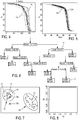
- Learning 6 finally includes construction 8 of the forest using the random forest method.
- this random forest method is here adapted to the structure of the data in technical replicates / biological replicates according to the invention.
- the technical replicates make it possible to account for the technical variability in obtaining the fusion profiles (fairly limited variability).
- Biological variability is at the heart of learning because it reflects the variability with which the embodiment of the method according to the invention will be confronted under real conditions of use. It is linked to the differences in sequences that can be observed between individuals of the same possible group.
- Each node 17 corresponds to a question asked in relation to a descriptor, typically: does this descriptor have a value lower (or lower or equal) to a threshold?
- Each sheet 18 corresponds to one of the k final possible groups.
- the Random Forests method makes it possible to calculate proximities between observations by studying the number of trees in which two observations “fall” in the same sheet. This proximity is used to calculate a confidence indicator of the prediction and therefore to possibly refuse to assign an observation to one of the possible groups.
- the distribution of the two by two proximities of all the pairs of biological replicates of the learning library belonging to the same possible group is calculated.
- the proximities between biological replicates are defined by the minimum value of the proximities calculated between its technical replicates (so-called full link method).
- This distribution can be smoothed by a kernel method. This operation is repeated for each possible group, thus obtaining a distribution of the intra-group distances specific to each group.
- the objective of the embodiment of the method according to the invention is then, from the description of “measurement” samples by their melting curve, to decide whether or not to assign this individual to one. k final possible groups defined during learning (supervised method) and assigning a confidence indicator to the proposed decision.
- the embodiment of the method according to the invention comprises an acquisition (9) of at least one normalized curve (as seen previously) of DNA fusion of the biological measurement sample, called at least one measurement curve.
- each measurement curve comprising different points, each point corresponding to a quantity proportional (for example a fluorescence signal) or representative of a rate (typically in%) or of a quantity of denaturation of the DNA of the sample measurement as a function of temperature;
- this acquisition may include performing the PCR and the melting curve itself (in the laboratory), and / or a simple downloading of data (computer data for example) of this melting curve.
- carrying out the PCR for this melting curve can be obtained in the simultaneous presence of several pairs of primers targeting several DNA target molecules. We then speak of “multiplexing” conditions.
- the technical replicates of the measurement biological sample are independently submitted to the random forest and a possible group is assigned to each of them.
- the measurement biological sample is assigned to the majority group among the predicted groups for each technical replicate.
- the confidence index can be used to decide.
- the quality of the embodiment of the method according to the invention is conditioned by the quality of the initial learning library.
- the embodiment of the method according to the invention comprises a calculation of a confidence index of the step of determining that the biological measurement sample belongs to a determined group.
- Random forests have the advantage of providing measurements of proximity between observations. For more details on this well-known notion of “proximity” in the random forest method, one can for example refer to references [3] and [4].
- the distribution of the mean proximities of the reference melting curves of the same possible group was calculated. Then, when a measurement biological sample is assigned to a possible group, its average proximity to the biological replicates of that group is calculated and compared to the proximities of the reference melting curves of that possible group. It is then possible to calculate the percentage of reference melting curves whose proximity is less than that of the measurement melting curve to be predicted. This percentage is an estimate of the probability of belonging to the predicted group and is used as an index of confidence.
- the figure 7 illustrates the principle of this index with two possible groups 22, 23 to which belong the reference melting curves (crosses) 32 and 33 respectively.
- the probability of belonging to this possible group is provided to the user along with the predicted group.
- the confidence index can be used to separate two possible groups that would have been assigned the same number of times to a measurement melting curve.
- the figure 9 schematically illustrates an embodiment of device 100 according to the invention arranged and programmed to implement this embodiment of the method according to the invention.
- the means 102 comprise a computer, and / or a central or computing unit, and / or an analog electronic circuit (preferably dedicated), and / or a digital electronic circuit (preferably dedicated), and / or a microprocessor (of preferably dedicated), and / or software resources. These means 102 further preferably comprise a screen or printing means or data export means for step 11 of providing or displaying the result.
- the means 101 comprise a PCR machine, and / or depending on the variant may comprise computer means (software combined with a USB port, an SD card reader, a connection to a computer network, etc.) arranged and programmed to charge. and read DNA fusion curves. Thus these means 101 are connected or form part of the means 102.
- the invention is applicable to any biological sample, in particular human, animal, plant, viral, bacterial, archaic, fungal, yeast, viroid, a eukaryote, or a protozoan. .
Landscapes
- Life Sciences & Earth Sciences (AREA)
- Engineering & Computer Science (AREA)
- Health & Medical Sciences (AREA)
- Physics & Mathematics (AREA)
- Medical Informatics (AREA)
- Bioinformatics & Cheminformatics (AREA)
- Biophysics (AREA)
- General Health & Medical Sciences (AREA)
- Biotechnology (AREA)
- Theoretical Computer Science (AREA)
- Spectroscopy & Molecular Physics (AREA)
- Bioinformatics & Computational Biology (AREA)
- Evolutionary Biology (AREA)
- Chemical & Material Sciences (AREA)
- Data Mining & Analysis (AREA)
- Proteomics, Peptides & Aminoacids (AREA)
- Databases & Information Systems (AREA)
- Artificial Intelligence (AREA)
- Public Health (AREA)
- Evolutionary Computation (AREA)
- Epidemiology (AREA)
- Computer Vision & Pattern Recognition (AREA)
- Bioethics (AREA)
- Software Systems (AREA)
- Organic Chemistry (AREA)
- Genetics & Genomics (AREA)
- Molecular Biology (AREA)
- Analytical Chemistry (AREA)
- Wood Science & Technology (AREA)
- Zoology (AREA)
- Immunology (AREA)
- Microbiology (AREA)
- Biochemistry (AREA)
- General Engineering & Computer Science (AREA)
- Measuring Or Testing Involving Enzymes Or Micro-Organisms (AREA)
- Apparatus Associated With Microorganisms And Enzymes (AREA)
Priority Applications (1)
| Application Number | Priority Date | Filing Date | Title |
|---|---|---|---|
| PL17705020T PL3405899T3 (pl) | 2016-01-22 | 2017-01-23 | Sposób klasyfikacji próbki biologicznej |
Applications Claiming Priority (2)
| Application Number | Priority Date | Filing Date | Title |
|---|---|---|---|
| FR1650527A FR3047013A1 (fr) | 2016-01-22 | 2016-01-22 | Procede de classification d'un echantillon biologique. |
| PCT/EP2017/051327 WO2017125606A1 (fr) | 2016-01-22 | 2017-01-23 | Procédé de classification d'un échantillon biologique |
Publications (2)
| Publication Number | Publication Date |
|---|---|
| EP3405899A1 EP3405899A1 (fr) | 2018-11-28 |
| EP3405899B1 true EP3405899B1 (fr) | 2021-08-11 |
Family
ID=55808631
Family Applications (1)
| Application Number | Title | Priority Date | Filing Date |
|---|---|---|---|
| EP17705020.0A Active EP3405899B1 (fr) | 2016-01-22 | 2017-01-23 | Procédé de classification d'un échantillon biologique |
Country Status (10)
| Country | Link |
|---|---|
| US (1) | US20190050535A1 (pl) |
| EP (1) | EP3405899B1 (pl) |
| JP (1) | JP6845256B2 (pl) |
| CN (1) | CN109074431B (pl) |
| AU (1) | AU2017208665B2 (pl) |
| CA (1) | CA3012874A1 (pl) |
| ES (1) | ES2897941T3 (pl) |
| FR (1) | FR3047013A1 (pl) |
| PL (1) | PL3405899T3 (pl) |
| WO (1) | WO2017125606A1 (pl) |
Families Citing this family (1)
| Publication number | Priority date | Publication date | Assignee | Title |
|---|---|---|---|---|
| EP4728095A1 (en) | 2023-06-13 | 2026-04-22 | Innovative Diagnostics | New method of detection of several target nucleic acids in a biological sample |
Family Cites Families (7)
| Publication number | Priority date | Publication date | Assignee | Title |
|---|---|---|---|---|
| GB2512153B (en) * | 2008-11-17 | 2014-11-12 | Veracyte Inc | Methods and compositions of molecular profiling for disease diagnostics |
| US8606527B2 (en) * | 2009-02-27 | 2013-12-10 | Bio-Rad Laboratories, Inc. | SNP detection by melt curve clustering |
| US20130218476A1 (en) * | 2010-08-02 | 2013-08-22 | Life Technologies Corporation | Methods for the analysis of high resolution melt curve data |
| AU2010328019A1 (en) * | 2009-12-09 | 2012-06-28 | Aviir, Inc. | Biomarker assay for diagnosis and classification of cardiovascular disease |
| CN102399862B (zh) * | 2010-09-16 | 2016-03-30 | 苏州承美生物科技有限公司 | 一种基于解链曲线的甲基化dna检测方法 |
| WO2013166373A1 (en) | 2012-05-03 | 2013-11-07 | Zhong Wu | Gene expression signature for il-6/stat3 signaling pathway and use thereof |
| US9665694B2 (en) * | 2013-01-31 | 2017-05-30 | Codexis, Inc. | Methods, systems, and software for identifying bio-molecules with interacting components |
-
2016
- 2016-01-22 FR FR1650527A patent/FR3047013A1/fr not_active Withdrawn
-
2017
- 2017-01-23 PL PL17705020T patent/PL3405899T3/pl unknown
- 2017-01-23 AU AU2017208665A patent/AU2017208665B2/en active Active
- 2017-01-23 JP JP2018557201A patent/JP6845256B2/ja active Active
- 2017-01-23 EP EP17705020.0A patent/EP3405899B1/fr active Active
- 2017-01-23 US US16/071,857 patent/US20190050535A1/en not_active Abandoned
- 2017-01-23 WO PCT/EP2017/051327 patent/WO2017125606A1/fr not_active Ceased
- 2017-01-23 CA CA3012874A patent/CA3012874A1/fr active Pending
- 2017-01-23 ES ES17705020T patent/ES2897941T3/es active Active
- 2017-01-23 CN CN201780007759.4A patent/CN109074431B/zh active Active
Non-Patent Citations (1)
| Title |
|---|
| None * |
Also Published As
| Publication number | Publication date |
|---|---|
| US20190050535A1 (en) | 2019-02-14 |
| CN109074431A (zh) | 2018-12-21 |
| JP6845256B2 (ja) | 2021-03-17 |
| JP2019511242A (ja) | 2019-04-25 |
| EP3405899A1 (fr) | 2018-11-28 |
| CN109074431B (zh) | 2022-03-11 |
| AU2017208665A1 (en) | 2018-08-23 |
| CA3012874A1 (fr) | 2017-07-27 |
| HK1259490A1 (zh) | 2019-11-29 |
| BR112018014878A2 (pt) | 2018-12-18 |
| PL3405899T3 (pl) | 2022-02-28 |
| AU2017208665B2 (en) | 2022-03-10 |
| ES2897941T3 (es) | 2022-03-03 |
| FR3047013A1 (fr) | 2017-07-28 |
| WO2017125606A1 (fr) | 2017-07-27 |
Similar Documents
| Publication | Publication Date | Title |
|---|---|---|
| Caron et al. | Are we overestimating protistan diversity in nature? | |
| EP2834777B1 (fr) | Identification de microorganismes par spectrometrie et classification structurée | |
| De Gruyter et al. | Patterns of local, intercontinental and interseasonal variation of soil bacterial and eukaryotic microbial communities | |
| EP3028202B1 (fr) | Procédé et dispositif d'analyse d'un échantillon biologique | |
| EP3879537A1 (fr) | Technologie moléculaire de prédiction d'un caractère phénotypique d'une bactérie à partir de son génome | |
| EP3405899B1 (fr) | Procédé de classification d'un échantillon biologique | |
| EP3879536A1 (fr) | Technologie moléculaire de détection d'une séquence génomique dans le génome d'une bactérie | |
| Yeh et al. | Comprehensive single-PCR 16S and 18S rRNA community analysis validated with mock communities and denoising algorithms | |
| JP2010512777A (ja) | 差分解析により取得されるトランスクリプトーム実験の結果を処理するための補正方法 | |
| WO2015180972A1 (fr) | Procede d'identification d'une relation entre des elements biologiques | |
| CN113362120B (zh) | 群体确定方法及装置、电子设备、计算机可读存储介质 | |
| EP2952888B1 (fr) | Marqueur de taille et procede pour le contrôle de la resolution d'un electrophoregramme | |
| EP1934873A1 (fr) | Procede pour determiner l'etat d'un ensemble de cellules et systeme pour la mise en oeuvre dudit procede | |
| US20240392346A1 (en) | Dilution tagging for quantification of biological targets | |
| FR3064387A1 (fr) | Procede de fabrication de pieces base sur une analyse de stabilite d'une dimension caracteristique | |
| EP4471785A1 (fr) | Procede et systeme de typage probabiliste de souches microbiennes | |
| EP4471784A1 (fr) | Procede et systeme de typage probabiliste de souches microbiennes | |
| FR3151603A1 (fr) | Procédé de détection d’une pathologie | |
| EP4621730A1 (fr) | Procede et systeme de caracterisation de microorganismes contenus dans un echantillon complexe | |
| EP4736167A1 (fr) | Fabrication de kits d'amplification en chaine par polymerase optimisant une phase de denaturation de l'amplification | |
| WO2025003074A1 (fr) | Fabrication de kits d'amplification en chaine par polymerase optimisant une phase d'hybridation de l'amplification | |
| FR3152885A1 (fr) | Procédé de génération de rapports d'analyse protéomique comparatifs à partir de multiples échantillons biologiques mis en œuvre par ordinateur | |
| HK1259490B (en) | Process for classifying a biological sample | |
| HK40048125A (en) | Dilution tagging for quantification of biological targets | |
| WO2003102849A9 (fr) | Methode d'analyse des variations de transcription d'un ensemble de genes |
Legal Events
| Date | Code | Title | Description |
|---|---|---|---|
| STAA | Information on the status of an ep patent application or granted ep patent |
Free format text: STATUS: UNKNOWN |
|
| STAA | Information on the status of an ep patent application or granted ep patent |
Free format text: STATUS: THE INTERNATIONAL PUBLICATION HAS BEEN MADE |
|
| PUAI | Public reference made under article 153(3) epc to a published international application that has entered the european phase |
Free format text: ORIGINAL CODE: 0009012 |
|
| STAA | Information on the status of an ep patent application or granted ep patent |
Free format text: STATUS: REQUEST FOR EXAMINATION WAS MADE |
|
| 17P | Request for examination filed |
Effective date: 20180808 |
|
| AK | Designated contracting states |
Kind code of ref document: A1 Designated state(s): AL AT BE BG CH CY CZ DE DK EE ES FI FR GB GR HR HU IE IS IT LI LT LU LV MC MK MT NL NO PL PT RO RS SE SI SK SM TR |
|
| AX | Request for extension of the european patent |
Extension state: BA ME |
|
| DAV | Request for validation of the european patent (deleted) | ||
| DAX | Request for extension of the european patent (deleted) | ||
| STAA | Information on the status of an ep patent application or granted ep patent |
Free format text: STATUS: EXAMINATION IS IN PROGRESS |
|
| 17Q | First examination report despatched |
Effective date: 20190923 |
|
| REG | Reference to a national code |
Ref country code: HK Ref legal event code: DE Ref document number: 1259490 Country of ref document: HK |
|
| RAP1 | Party data changed (applicant data changed or rights of an application transferred) |
Owner name: INSTITUT DE RECHERCHE POUR LE DEVELOPPEMENT (IRD) Owner name: UNIVERSITE DE MONTPELLIER Owner name: CENTRE NATIONAL DE LA RECHERCHE SCIENTIFIQUE |
|
| REG | Reference to a national code |
Ref country code: DE Ref legal event code: R079 Ref document number: 602017043777 Country of ref document: DE Free format text: PREVIOUS MAIN CLASS: G06F0019240000 Ipc: G16B0040000000 |
|
| GRAP | Despatch of communication of intention to grant a patent |
Free format text: ORIGINAL CODE: EPIDOSNIGR1 |
|
| STAA | Information on the status of an ep patent application or granted ep patent |
Free format text: STATUS: GRANT OF PATENT IS INTENDED |
|
| RIC1 | Information provided on ipc code assigned before grant |
Ipc: C12Q 1/6827 20180101ALI20210225BHEP Ipc: G16B 40/00 20190101AFI20210225BHEP |
|
| INTG | Intention to grant announced |
Effective date: 20210318 |
|
| RAP3 | Party data changed (applicant data changed or rights of an application transferred) |
Owner name: CENTRE NATIONAL DE LA RECHERCHE SCIENTIFIQUE Owner name: INSTITUT RECHERCHE POUR LE DEVELOPPEMENT Owner name: UNIVERSITE DE MONTPELLIER |
|
| GRAS | Grant fee paid |
Free format text: ORIGINAL CODE: EPIDOSNIGR3 |
|
| GRAA | (expected) grant |
Free format text: ORIGINAL CODE: 0009210 |
|
| STAA | Information on the status of an ep patent application or granted ep patent |
Free format text: STATUS: THE PATENT HAS BEEN GRANTED |
|
| AK | Designated contracting states |
Kind code of ref document: B1 Designated state(s): AL AT BE BG CH CY CZ DE DK EE ES FI FR GB GR HR HU IE IS IT LI LT LU LV MC MK MT NL NO PL PT RO RS SE SI SK SM TR |
|
| REG | Reference to a national code |
Ref country code: CH Ref legal event code: EP |
|
| REG | Reference to a national code |
Ref country code: DE Ref legal event code: R096 Ref document number: 602017043777 Country of ref document: DE |
|
| REG | Reference to a national code |
Ref country code: IE Ref legal event code: FG4D Free format text: LANGUAGE OF EP DOCUMENT: FRENCH Ref country code: AT Ref legal event code: REF Ref document number: 1420217 Country of ref document: AT Kind code of ref document: T Effective date: 20210915 |
|
| REG | Reference to a national code |
Ref country code: LT Ref legal event code: MG9D |
|
| REG | Reference to a national code |
Ref country code: NL Ref legal event code: MP Effective date: 20210811 |
|
| REG | Reference to a national code |
Ref country code: AT Ref legal event code: MK05 Ref document number: 1420217 Country of ref document: AT Kind code of ref document: T Effective date: 20210811 |
|
| PG25 | Lapsed in a contracting state [announced via postgrant information from national office to epo] |
Ref country code: SE Free format text: LAPSE BECAUSE OF FAILURE TO SUBMIT A TRANSLATION OF THE DESCRIPTION OR TO PAY THE FEE WITHIN THE PRESCRIBED TIME-LIMIT Effective date: 20210811 Ref country code: RS Free format text: LAPSE BECAUSE OF FAILURE TO SUBMIT A TRANSLATION OF THE DESCRIPTION OR TO PAY THE FEE WITHIN THE PRESCRIBED TIME-LIMIT Effective date: 20210811 Ref country code: HR Free format text: LAPSE BECAUSE OF FAILURE TO SUBMIT A TRANSLATION OF THE DESCRIPTION OR TO PAY THE FEE WITHIN THE PRESCRIBED TIME-LIMIT Effective date: 20210811 Ref country code: NO Free format text: LAPSE BECAUSE OF FAILURE TO SUBMIT A TRANSLATION OF THE DESCRIPTION OR TO PAY THE FEE WITHIN THE PRESCRIBED TIME-LIMIT Effective date: 20211111 Ref country code: PT Free format text: LAPSE BECAUSE OF FAILURE TO SUBMIT A TRANSLATION OF THE DESCRIPTION OR TO PAY THE FEE WITHIN THE PRESCRIBED TIME-LIMIT Effective date: 20211213 Ref country code: FI Free format text: LAPSE BECAUSE OF FAILURE TO SUBMIT A TRANSLATION OF THE DESCRIPTION OR TO PAY THE FEE WITHIN THE PRESCRIBED TIME-LIMIT Effective date: 20210811 Ref country code: AT Free format text: LAPSE BECAUSE OF FAILURE TO SUBMIT A TRANSLATION OF THE DESCRIPTION OR TO PAY THE FEE WITHIN THE PRESCRIBED TIME-LIMIT Effective date: 20210811 Ref country code: BG Free format text: LAPSE BECAUSE OF FAILURE TO SUBMIT A TRANSLATION OF THE DESCRIPTION OR TO PAY THE FEE WITHIN THE PRESCRIBED TIME-LIMIT Effective date: 20211111 Ref country code: LT Free format text: LAPSE BECAUSE OF FAILURE TO SUBMIT A TRANSLATION OF THE DESCRIPTION OR TO PAY THE FEE WITHIN THE PRESCRIBED TIME-LIMIT Effective date: 20210811 |
|
| PG25 | Lapsed in a contracting state [announced via postgrant information from national office to epo] |
Ref country code: LV Free format text: LAPSE BECAUSE OF FAILURE TO SUBMIT A TRANSLATION OF THE DESCRIPTION OR TO PAY THE FEE WITHIN THE PRESCRIBED TIME-LIMIT Effective date: 20210811 Ref country code: GR Free format text: LAPSE BECAUSE OF FAILURE TO SUBMIT A TRANSLATION OF THE DESCRIPTION OR TO PAY THE FEE WITHIN THE PRESCRIBED TIME-LIMIT Effective date: 20211112 |
|
| REG | Reference to a national code |
Ref country code: ES Ref legal event code: FG2A Ref document number: 2897941 Country of ref document: ES Kind code of ref document: T3 Effective date: 20220303 |
|
| PG25 | Lapsed in a contracting state [announced via postgrant information from national office to epo] |
Ref country code: NL Free format text: LAPSE BECAUSE OF FAILURE TO SUBMIT A TRANSLATION OF THE DESCRIPTION OR TO PAY THE FEE WITHIN THE PRESCRIBED TIME-LIMIT Effective date: 20210811 |
|
| PG25 | Lapsed in a contracting state [announced via postgrant information from national office to epo] |
Ref country code: DK Free format text: LAPSE BECAUSE OF FAILURE TO SUBMIT A TRANSLATION OF THE DESCRIPTION OR TO PAY THE FEE WITHIN THE PRESCRIBED TIME-LIMIT Effective date: 20210811 |
|
| REG | Reference to a national code |
Ref country code: DE Ref legal event code: R097 Ref document number: 602017043777 Country of ref document: DE |
|
| PG25 | Lapsed in a contracting state [announced via postgrant information from national office to epo] |
Ref country code: SM Free format text: LAPSE BECAUSE OF FAILURE TO SUBMIT A TRANSLATION OF THE DESCRIPTION OR TO PAY THE FEE WITHIN THE PRESCRIBED TIME-LIMIT Effective date: 20210811 Ref country code: SK Free format text: LAPSE BECAUSE OF FAILURE TO SUBMIT A TRANSLATION OF THE DESCRIPTION OR TO PAY THE FEE WITHIN THE PRESCRIBED TIME-LIMIT Effective date: 20210811 Ref country code: RO Free format text: LAPSE BECAUSE OF FAILURE TO SUBMIT A TRANSLATION OF THE DESCRIPTION OR TO PAY THE FEE WITHIN THE PRESCRIBED TIME-LIMIT Effective date: 20210811 Ref country code: EE Free format text: LAPSE BECAUSE OF FAILURE TO SUBMIT A TRANSLATION OF THE DESCRIPTION OR TO PAY THE FEE WITHIN THE PRESCRIBED TIME-LIMIT Effective date: 20210811 Ref country code: CZ Free format text: LAPSE BECAUSE OF FAILURE TO SUBMIT A TRANSLATION OF THE DESCRIPTION OR TO PAY THE FEE WITHIN THE PRESCRIBED TIME-LIMIT Effective date: 20210811 Ref country code: AL Free format text: LAPSE BECAUSE OF FAILURE TO SUBMIT A TRANSLATION OF THE DESCRIPTION OR TO PAY THE FEE WITHIN THE PRESCRIBED TIME-LIMIT Effective date: 20210811 |
|
| PLBE | No opposition filed within time limit |
Free format text: ORIGINAL CODE: 0009261 |
|
| STAA | Information on the status of an ep patent application or granted ep patent |
Free format text: STATUS: NO OPPOSITION FILED WITHIN TIME LIMIT |
|
| 26N | No opposition filed |
Effective date: 20220512 |
|
| PG25 | Lapsed in a contracting state [announced via postgrant information from national office to epo] |
Ref country code: SI Free format text: LAPSE BECAUSE OF FAILURE TO SUBMIT A TRANSLATION OF THE DESCRIPTION OR TO PAY THE FEE WITHIN THE PRESCRIBED TIME-LIMIT Effective date: 20210811 Ref country code: MC Free format text: LAPSE BECAUSE OF FAILURE TO SUBMIT A TRANSLATION OF THE DESCRIPTION OR TO PAY THE FEE WITHIN THE PRESCRIBED TIME-LIMIT Effective date: 20210811 |
|
| REG | Reference to a national code |
Ref country code: CH Ref legal event code: PL |
|
| REG | Reference to a national code |
Ref country code: BE Ref legal event code: MM Effective date: 20220131 |
|
| PG25 | Lapsed in a contracting state [announced via postgrant information from national office to epo] |
Ref country code: LU Free format text: LAPSE BECAUSE OF NON-PAYMENT OF DUE FEES Effective date: 20220123 |
|
| PG25 | Lapsed in a contracting state [announced via postgrant information from national office to epo] |
Ref country code: BE Free format text: LAPSE BECAUSE OF NON-PAYMENT OF DUE FEES Effective date: 20220131 |
|
| PG25 | Lapsed in a contracting state [announced via postgrant information from national office to epo] |
Ref country code: LI Free format text: LAPSE BECAUSE OF NON-PAYMENT OF DUE FEES Effective date: 20220131 Ref country code: CH Free format text: LAPSE BECAUSE OF NON-PAYMENT OF DUE FEES Effective date: 20220131 |
|
| PG25 | Lapsed in a contracting state [announced via postgrant information from national office to epo] |
Ref country code: IE Free format text: LAPSE BECAUSE OF NON-PAYMENT OF DUE FEES Effective date: 20220123 |
|
| P01 | Opt-out of the competence of the unified patent court (upc) registered |
Effective date: 20230630 |
|
| PG25 | Lapsed in a contracting state [announced via postgrant information from national office to epo] |
Ref country code: HU Free format text: LAPSE BECAUSE OF FAILURE TO SUBMIT A TRANSLATION OF THE DESCRIPTION OR TO PAY THE FEE WITHIN THE PRESCRIBED TIME-LIMIT; INVALID AB INITIO Effective date: 20170123 |
|
| PG25 | Lapsed in a contracting state [announced via postgrant information from national office to epo] |
Ref country code: MK Free format text: LAPSE BECAUSE OF FAILURE TO SUBMIT A TRANSLATION OF THE DESCRIPTION OR TO PAY THE FEE WITHIN THE PRESCRIBED TIME-LIMIT Effective date: 20210811 Ref country code: CY Free format text: LAPSE BECAUSE OF FAILURE TO SUBMIT A TRANSLATION OF THE DESCRIPTION OR TO PAY THE FEE WITHIN THE PRESCRIBED TIME-LIMIT Effective date: 20210811 |
|
| PG25 | Lapsed in a contracting state [announced via postgrant information from national office to epo] |
Ref country code: TR Free format text: LAPSE BECAUSE OF FAILURE TO SUBMIT A TRANSLATION OF THE DESCRIPTION OR TO PAY THE FEE WITHIN THE PRESCRIBED TIME-LIMIT Effective date: 20210811 |
|
| PG25 | Lapsed in a contracting state [announced via postgrant information from national office to epo] |
Ref country code: MT Free format text: LAPSE BECAUSE OF FAILURE TO SUBMIT A TRANSLATION OF THE DESCRIPTION OR TO PAY THE FEE WITHIN THE PRESCRIBED TIME-LIMIT Effective date: 20210811 |
|
| PGFP | Annual fee paid to national office [announced via postgrant information from national office to epo] |
Ref country code: ES Payment date: 20250328 Year of fee payment: 9 |
|
| PGFP | Annual fee paid to national office [announced via postgrant information from national office to epo] |
Ref country code: GB Payment date: 20260128 Year of fee payment: 10 |
|
| PGFP | Annual fee paid to national office [announced via postgrant information from national office to epo] |
Ref country code: DE Payment date: 20260223 Year of fee payment: 10 |
|
| PGFP | Annual fee paid to national office [announced via postgrant information from national office to epo] |
Ref country code: IT Payment date: 20260127 Year of fee payment: 10 |
|
| PGFP | Annual fee paid to national office [announced via postgrant information from national office to epo] |
Ref country code: FR Payment date: 20260128 Year of fee payment: 10 |
|
| PGFP | Annual fee paid to national office [announced via postgrant information from national office to epo] |
Ref country code: PL Payment date: 20260121 Year of fee payment: 10 |