EP3406199A2 - Thermomètre radio indépendant du réseau pour une utilisation à long terme - Google Patents
Thermomètre radio indépendant du réseau pour une utilisation à long terme Download PDFInfo
- Publication number
- EP3406199A2 EP3406199A2 EP18174071.3A EP18174071A EP3406199A2 EP 3406199 A2 EP3406199 A2 EP 3406199A2 EP 18174071 A EP18174071 A EP 18174071A EP 3406199 A2 EP3406199 A2 EP 3406199A2
- Authority
- EP
- European Patent Office
- Prior art keywords
- temperature
- measurement
- thermometer
- series
- minutes
- Prior art date
- Legal status (The legal status is an assumption and is not a legal conclusion. Google has not performed a legal analysis and makes no representation as to the accuracy of the status listed.)
- Granted
Links
Images


Classifications
-
- A—HUMAN NECESSITIES
- A61—MEDICAL OR VETERINARY SCIENCE; HYGIENE
- A61B—DIAGNOSIS; SURGERY; IDENTIFICATION
- A61B10/00—Instruments for taking body samples for diagnostic purposes; Other methods or instruments for diagnosis, e.g. for vaccination diagnosis, sex determination or ovulation-period determination; Throat striking implements
- A61B10/0012—Ovulation-period determination
-
- G—PHYSICS
- G01—MEASURING; TESTING
- G01K—MEASURING TEMPERATURE; MEASURING QUANTITY OF HEAT; THERMALLY-SENSITIVE ELEMENTS NOT OTHERWISE PROVIDED FOR
- G01K1/00—Details of thermometers not specially adapted for particular types of thermometer
- G01K1/02—Means for indicating or recording specially adapted for thermometers
- G01K1/024—Means for indicating or recording specially adapted for thermometers for remote indication
-
- G—PHYSICS
- G01—MEASURING; TESTING
- G01K—MEASURING TEMPERATURE; MEASURING QUANTITY OF HEAT; THERMALLY-SENSITIVE ELEMENTS NOT OTHERWISE PROVIDED FOR
- G01K13/00—Thermometers specially adapted for specific purposes
- G01K13/20—Clinical contact thermometers for use with humans or animals
-
- A—HUMAN NECESSITIES
- A61—MEDICAL OR VETERINARY SCIENCE; HYGIENE
- A61B—DIAGNOSIS; SURGERY; IDENTIFICATION
- A61B10/00—Instruments for taking body samples for diagnostic purposes; Other methods or instruments for diagnosis, e.g. for vaccination diagnosis, sex determination or ovulation-period determination; Throat striking implements
- A61B10/0012—Ovulation-period determination
- A61B2010/0019—Ovulation-period determination based on measurement of temperature
Definitions
- the invention relates to a network-independent radio thermometer for temperature measurement in a body opening for long-term use and a method for measuring the basal body temperature over a long period of time with the aid of the network-independent wireless thermometer according to the invention.
- the woman's body temperature should be measured regularly with a thermometer. By regular measurement and recording of the body temperature then a statement about the ovulation time can be made.
- the body core temperature For the most reliable detection of the change from low to high, therefore, the body core temperature must be measured, and preferably at a time when it may be expected that, unaffected by physical activity, it is at a stable and reproducible level.
- This temperature is called the "basal body temperature” and corresponds to the temperature minimum (base) that occurs in the body during sleep.
- the core temperature is measured by thermometer at the end of each night's sleep, which must be stopped by alarm at the same time, and documented by means of graph paper as a temperature graph.
- thermometers with, depending on the equipment, built-in alarm, which is pronounced of the measurement, a memory for several temperature values, an evaluation software for determining the ovulation time, an indicator for current and older Temperature values or the calculated ovulation time.
- intravaginal thermometers such as in the EP 2 567 680 B1 disclosed, which are worn intravaginally throughout the night's sleep and during this time at certain intervals (eg every 5 minutes) to measure and store the body core temperature.
- the recorded series of measurements of these sensors are read by means of a special reader.
- this reader then simultaneously takes over the evaluation of the series of measurements for determining the real basal body temperature and the ovulation time.
- the reader must be connected to another computer which will take care of the evaluation and display the results.
- the temperature sensors are powered by rechargeable batteries, which then need to be recharged regularly, for example, by the reader or a power supply, to ensure that the sensor can record the next nightly series of measurements.
- thermometers still have disadvantages in terms of comfort, usability and everyday usability.
- Ovulationsthermometer is the EP 2 567 680 B1 designed as a pessary and must be placed in a complex manner on the outer cervix.
- thermometer By design as a network-independent radio thermometer is a self-sufficient measuring unit that requires no charging with a corresponding charger. This makes the wireless thermometer particularly user-friendly, and less prone to error.
- thermometer housing Since no battery or battery change under opening of the thermometer housing is required for the wireless thermometer, it can be factory provided as a hermetically sealed system and thus meet the high hygienic requirements for a measurement in body orifices.
- thermometer for long-term use.
- a long-term use according to the invention is to be understood as use for at least one year, preferably at least two years and particularly preferably over three, four or even five years with daily measurement.
- the use of a semiconductor temperature sensor allows accurate measurement with low power consumption.
- This sensor type also has a high long-term stability with regard to the temperature measurement.
- the semiconductor temperature sensor has a high resolution over a wide temperature range as well as over a wide voltage range.
- Energy saving is also the signal transmission via Bluetooth Smart according to the BLE standard.
- the acquisition, storage and transmission of incremental or decremental temperature data decisively reduces the volume of data so that not only longer series of measurements can be stored, but also the transmission time of the energy-intensive radio transmission can be reduced.
- the wireless thermometer can communicate with numerous receivers.
- the use with a smartphone or tablet is possible, in which an application software, can be used as a so-called “App”. This type of evaluation is particularly well received by the young people in question.
- the radio thermometer has the capability of storing the temperature measured values as increments or decrements relative to a base temperature and then also transmitting them by means of Bluetooth. This is possible because only measured values between 35.5 ° C and 40 ° C are relevant and therefore the increment values are significantly smaller than the absolute values of the measurement.
- the temperature of 35.5 ° C. is taken as the base value or offset value, and all other values are expressed as the difference to this value.
- the underlying must be so high that it is physiologically relevant, but also so low that only higher values than increments and no lower values than decrements are to be expected. Due to the increment or decrement storage and transmission, the length of the measurement series is shortened by approx. 50%.
- the increments or decrements are not related to the base value (offset value) but to the respectively preceding value. Since the temperature difference of successive measurement times is very low or even zero, the measured values recorded here are significantly smaller, so that the length of the measurement series can be shortened by a further 50 to 62.5%.
- the wireless thermometer has a coin-cell battery. This is preferably a lithium battery.
- the battery has a power of between 0.1 and 2 watts, preferably between 0.2 and 1 watts, and more preferably about 0.5 watts.
- the network-independent wireless thermometer according to the invention can be used in many different ways Body openings are introduced and used there for temperature measurement. Examples include the mouth, the armpit, the rectum or the vagina called.
- the wireless thermometer is used to measure the basal body temperature and can accordingly preferably be used in the rectum and especially in the vagina.
- the wireless thermometer is designed for long-term use.
- the "long-term use” is defined according to the invention as an application in which the wireless thermometer with daily recording a series of measurements for at least 6 hours and daily transmission of the data use over a period of at least one year, preferably at least two years and more preferably of at least three, four or even five years.
- the plastic rasp of the wireless thermometer essentially consists of a plastic which has a body compatibility (biocompatibility) according to DIN ISO 10993-5: 2009.
- body compatibility biocompatibility
- DIN ISO 10993-5 2009.
- An "essentially" existing configuration with this plastic is to be understood in the context of the invention, an embodiment in which at least the outer, the body accessible surface consists of this plastic.
- the biocompatible plastic is selected from the group consisting of polycarbonate, polyacrylate, polyester, polyethylene, polypropylene, polyacrylonitrile, acrylonitrile-butadiene-styrene copolymers (ABS), and mixtures thereof.
- ABS polymer the proportions of the monomers used vary from 15-35% acrylonitrile, 5-30% butadiene and 40-60% styrene.
- the capsule consists of a mixture of 80% ABS polymer, 10% polycarbonate and 10% rubber.
- the plastic capsule can be easily cleaned with water and / or liquid disinfectants.
- the plastic capsule of the radio thermometer is a flattened over half its length circular cylinder, which is preferably hemispherical rounded at its cylindrical end and has at its flattened end an eyelet for receiving a pulling device.
- the wireless thermometer can be easily removed from the body opening through the eyelet in conjunction with a pulling device. By approaching standard menstrual pads, the user is instantly familiar with the application and feel of the wireless thermometer, resulting in increased compliance.
- a pulling device a band or a cord can be used here expediently.
- an annular silicone cord is used, which can be pulled to form a loop through the eyelet.
- the capsule has a length of less than 60 mm, preferably less than 50 mm, more preferably between 35 and 50 mm and in particular 47 mm.
- the capsule has at its thickest point a diameter of less than 25 mm, preferably less than 20 mm, more preferably between 12 and 16 mm and in particular 14 mm.
- the radio thermometer expediently has a total weight of less than 15 g, preferably less than 10 g, particularly preferably a total weight of between 6 and 8 g and in particular of 7 g.
- the plastic capsule in the wireless thermometer, consists of a capsule housing and a capsule lid. It thus consists of a simple, only two-part capsule construction, which reduces the risk of impermeability and represents a cost-effective solution.
- the capsule housing with the capsule lid before use as a thermometer by bonding firmly and waterproof connected to each other.
- the connection of these two parts is done appropriately in the factory, so that only controlled closed, i. radio-controlled thermometers subjected to quality control are used.
- a UV-curing cyanoacrylate adhesive is preferably used for the bonding. These are biocompatible adhesives with high adhesive strength.
- a resolution of 0.05 ° C in the range of body temperature is necessary in order to be able to measure the basal temperature sufficiently accurately for ovulation measurement.
- the semiconductor temperature sensor according to the invention has a resolution of 0.01 ° C.
- Semiconductor sensors have a high long-term stability.
- the semiconductor sensor has a long-term stability of less than 0.05 ° C / year, preferably less than 0.01 ° C / year. Only then is a very long, that is over several years extending operability of the wireless thermometer for measuring the vaginal basal body temperature.
- the semiconductor temperature sensor according to the invention has the advantage of maintaining its measuring capability and, in particular, its resolution, even when the voltage is decreasing during long-term operation. The semiconductor temperature sensor thus has no voltage-dependent drifting.
- a factory calibration of the temperature sensor with storage of the calibration data on the temperature sensor chip in a non-volatile memory contributes to the measurement accuracy.
- the measurement can be carried out with an average power consumption of less than 200 nA per measurement (at one measurement per second).
- the semiconductor temperature sensor also called “bandgap” temperature sensor
- the semiconductor temperature sensor has all of the features listed above (a) to (f).
- the electronic components of the wireless thermometer such as data storage, Bluetooth LE transmission unit and control unit as a single-chip computer ("system-on-a-chip", SOC) are available. This allows a cost-effective, space-saving and energy-saving design.
- the electronic components are mounted on a preferably mounted on both sides, the first circuit board, one of the edges of the first circuit board via a perpendicular thereto mounted second circular circuit board with the negative pole of the button cell battery in contact is, and wherein the connection to the positive pole of the battery is made via a U-shaped battery contact spring, the middle base is preferably arranged between the first and second printed circuit board.
- the electronic components are mounted on a preferably printed on both sides, first circuit board, wherein one of the edges of the first circuit board as a slightly curved metallized edge is in direct contact with the negative pole of the coin-cell battery, and wherein the connection to the positive pole the battery is produced via a U-shaped battery contact spring whose middle base preferably engages in a recess metallized on the edge side of the printed circuit board.
- the radio thermometer is temperature-dependent controlled, wherein the activation of the radio thermometer is induced starting from a resting state by the introduction into the body opening and the temperature increase caused thereby to a physiological value.
- the detection of the resting phase by a method in which the wireless thermometer in the idle mode increments a timed counter and after a predetermined counting time, preferably between 10 minutes and 60 minutes, more preferably between 15 and 45 minutes and particularly preferably 30 minutes low-precision energy-saving temperature measurement is performed, and the measurement result is compared to the threshold of 35.5 ° C, maintaining the sleep mode as long as a configurable number of consecutive measurements preferably equal to at least two consecutive measurements , do not exceed 35.5 ° C.
- the resting state is maintained in a simple and energy-saving manner until it is introduced into the body opening.
- the wireless thermometer is placed in a "deep sleep mode" with extremely low power consumption.
- the energy-saving measurement for detecting a position in the body cavity can also be initiated by a power-saving external timer circuit, which reactivates the radio thermometer for this "test measurement" when the set time is reached.
- this external timer circuit is a system timer with an integrated MOSFET driver and consumption in the nanoampere range.
- the TPL5110 "Nano-power system timer for power gating" from Texas Instruments (Dallas, TX, USA) is used here.
- the storage of the measurement data is implemented in a ring buffer, in which the oldest contents are overwritten, when the buffer is full and further elements are stored in the ring buffer.
- the memory is dimensioned so that it can accommodate about 30 or more series of measurements. Since that Radiometer is not worn during menstruation and not between ovulation and menstruation, this means that the wireless thermometer can collect data over a period of more than a month, without the need to transmit data to the receiving device.
- the temperature control of the radio thermometer according to the invention also includes the automatic detection of removal from the body opening with the two central sequences that 1.) the measurement series is completed and 2.) a data transmission is initiated.
- this is done by a method in which the wireless thermometer after its removal from the body opening and a concomitant detection of a configurable, at least 2 amount of consecutive measured values below 35.5 ° C, the series of measurements is completed and the Bluetooth transmission unit the Availability of a completed measurement series is signaled (so-called "Advertising").
- the data transmission takes place in a two-stage process, in which the device search for connection establishment takes place only in a short period of time with high transmission power and then iteratively starts a new attempt after a rest period with reduced or no activity.
- the senor After completing a series of measurements, the sensor activates its Bluetooth transmitter for 10 seconds in order to signal the smartphone app the availability of a new series of measurements via "Bluetooth advertising". 10-second Bluetooth advertising is also referred to as an "advertising burst”.
- the smartphone app If the smartphone app does not initiate a connection with the sensor within these 10 seconds, it will generate additional advertising bursts at intervals of 1 minute each, but for a maximum of 60 intervals (for one hour).
- Z [AB] The number of advertising bursts is hereafter called "Z [AB]". In the scenario described above, Z [AB] is "60".
- the smartphone app Normally (ie: if the switched-on smartphone with activated app is in Bluetooth range) the smartphone app initiates the connection with the sensor already within the first advertising burst.
- 600 advertising bursts In these cases, 60 failed advertising bursts occur after each recorded series of measurements. For a 10-day holiday, that would be 600 advertising bursts. The power consumption per advertising burst is significant. Under normal conditions, 600 advertising bursts will last for 600 days (ie, around 15 measurement series / month> 3 years).
- the following two embodiments are proposed, which are either used separately or combined with each other:
- the Z [AB] is reduced.
- the advertising bursts can be reduced to 10.
- the intervals from one advertising burst to the next advertising burst can be successively extended, e.g. from 1 to 2 to 3 to 5 to 10 to 20 to 45 to 90 to 180 to 360 minutes.
- both Z [AB] and the intervals can be optimized according to requirements.
- the timeout is changed, that is, the number of futile advertising bursts, which then leads to a "timerout" of the Advertising Burst series.
- the sensor maintains a counter for consecutive timeouts (hereinafter referred to as "Z [TO]”).
- Z [AB] The above-described number of advertising bursts
- Z [AB] depends on Z [TO]: If Z [TO] exceeds a certain threshold (e.g., 3 time-outs in succession), Z [AB] will be reduced to e.g. 3 (“Holiday mode") otherwise set to 10 (see above).
- the sensor Z sets [TO] to "0" (zero).
- the transmission time is also provided with a time stamp.
- the receiving device will determine the actual beginning of the measurement series by subtraction.
- the receiving unit can also, preferably with recourse to the cloud, carry out an updating of the software or specific configuration parameters.
- the receiving unit is authorized by reading a, the individual wireless thermometer associated barcodes or a two-dimensional code for recording series of measurements from this wireless thermometer.
- a 2D code is used here, which is particularly preferably a QR code.
- a 2D code can provide a high density of information for safe device detection at small measures.
- One such 2D code can be mounted on the radio thermometer itself or the thermometer package.
- the 2D code which is preferably a QR code, expediently contains a key with the aid of which the software of the receiving unit (preferably an "app") can retrieve the data from the cloud, which itself must automatically authenticate itself to the cloud server.
- the measurement data is stored by the receiving unit in encrypted form in a database accessible via the Internet (so-called “cloud”) and can be read out of this cloud again.
- cloud a database accessible via the Internet
- the temperature method is about detecting in the female cycle the time of the hormonally induced temperature jump from low to high altitude - this is about 0.5 ° C.
- thermometer in the morning after the night's sleep always at the same time.
- One of the relevant relevant advantages of the present invention instead of a single measurement after sleep, at certain intervals (eg: 5 minutes) during the entire night to make temperature measurements to create a temperature measurement series.
- the quality of the evaluation with regard to the accuracy of the determination of the ovulation time is then still dependent on the respective calculation method or the respective evaluation algorithm.
- the method or algorithm has the task of identifying a representative temperature value from the respective nocturnal measurement series, which then flows into the monthly / cycle curve for determining the ovulation time.
- basal body temperature is often referred to in this context - this is the lowest temperature that occurs (for example) during this sleep phase. - In our practice, however, shows that the definition of basal body temperature as nightly temperature minium is not optimal, since it is often an "outlier", so a singular minimum.
- Temperature curve is searched for a time range of about 20 minutes in length with the lowest temperature amplitude in the time about 20 - 90 minutes before waking and from this time range, the average temperature is defined as the basal body temperature.
- the nocturnal temperature curves are divided into segments of the same length (eg 5 - 60 minutes) and their average temperature (eg in the form of the arithmetic mean or the median) is determined.
- a series of measurements recorded between about 1:00 and 7:00 o'clock is "broken down" into 6 - 724 segments, whose respective mean temperature averages 6 to 72 monthly cycle curves.
- suitable methods such as by regression or KI pattern recognition, dy statistically, syntactically or can be done by neuronal network, the cycle curve is determined, which optimally represents the hormone-related monthly temperature profile in the cycle.
- this method "attenuates” or eliminates singular extrema in the monthly temperature profile and at the same time exposes the significance of the hormonally induced temperature jump at the time of ovulation.
- Various statistical methods are suitable for further processing with regard to the recognition of the time of ovulation (see regime change models, etc.).
- the nocturnal temperature curves (before segmentation) e.g. taking into account similar temperature patterns or circadian rhythms aligned in time (so-called alignment).
- thermometer can be used advantageously for a variety of measurement purposes. So it can be used in devices where an accurate and simple temperature measurement over a long period of time is necessary.
- thermometer can be used in the shipment of temperature-sensitive goods (food, pharmaceuticals) as a data logger to prove an uninterrupted cold chain.
- the wireless thermometer can also be used in buildings to create a networked, "smart" home (“smart home”) and can, for example, further reduce energy costs.
- a configurable value is to be understood as meaning a value which can be freely configured, that is, in the context of the method, it is then possible to assume the arbitrarily preselected value given in each case in the configuration.
- This also explicitly includes dynamic configurability. This means that the configuration e.g. in response to the present test conditions can be adapted dynamically to these test conditions. For example, an intravaginal measurement series can only begin at a later point in time with a close-to-time temperature measurement, if the earlier measurements show that the basal temperature of the person concerned is only reached correspondingly late.
- a "substantially rigid" plastic capsule is a plastic capsule in which the plastic has a hardness according to DIN ISO 2039-1: 2003-6 of at least 75 MPa, preferably of at least 90 MPa and particularly preferably of at least 95 MPa has.
- a "body opening” in the sense of the invention is an opening on a body of an animal or human. This includes body cavities such as the vagina, the rectum, the ear canal or the oral cavity as well as body cavities such as the armpit or the popliteal fossa as actual body openings.
- the term "hermetically sealed” means a capsule which is sealed watertight. This prevents that body exudates and in particular body fluids such as sweat, urine or cervical fluid can penetrate into the interior of the capsule.
- Bluetooth Low Energy also called Bluetooth LE, BLE or Bluetooth Smart
- BLE Bluetooth Low Energy
- Bluetooth Smart is a wireless technology that allows devices in an environment of about 10 meters up to 500 m to be networked with newer versions.
- Bluetooth Smart / BLE has significantly lower power consumption and lower costs for a similar range of communication.
- the corresponding Bluetooth versions are currently in use under the 4.x or 5.x specification.
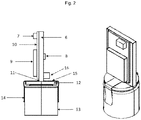
- Fig. 1 shows a schematic diagram of a network-independent wireless thermometer (1) according to the invention as a cylindrical body (2) with a hemispherical distal end (3) for easy insertion into the body opening and a flattened end (4) having an eyelet (5) for receiving a pulling device (not shown).
- This second circuit board is connected to the negative pole of the coin cell battery (13), wherein the connection to the positive pole of the battery via a U-shaped battery contact spring (14) is prepared, the middle base (15) is arranged between the first and second circuit board.
- Fig. 3 are the individual steps of the measurement and transmission method, as described in the claims 11 and 13 described.
- the sub-step of data transmission there are two alternative sequential steps. If the connection is successful with the receiving device (plus in the circle), the next step is to transfer data to the receiver Receiver. If no connection can be established even after repeating 60 times (minus in a circle), the device is put back into idle mode.
Landscapes
- Health & Medical Sciences (AREA)
- Life Sciences & Earth Sciences (AREA)
- General Physics & Mathematics (AREA)
- Physics & Mathematics (AREA)
- Medical Informatics (AREA)
- Engineering & Computer Science (AREA)
- Biomedical Technology (AREA)
- Heart & Thoracic Surgery (AREA)
- Pathology (AREA)
- Molecular Biology (AREA)
- Surgery (AREA)
- Animal Behavior & Ethology (AREA)
- General Health & Medical Sciences (AREA)
- Public Health (AREA)
- Veterinary Medicine (AREA)
- Measuring And Recording Apparatus For Diagnosis (AREA)
- Arrangements For Transmission Of Measured Signals (AREA)
Applications Claiming Priority (2)
| Application Number | Priority Date | Filing Date | Title |
|---|---|---|---|
| DE102017208883.4A DE102017208883A1 (de) | 2017-05-24 | 2017-05-24 | Netzunabhängiges Funkthermometer für den Langzeiteinsatz |
| DE102017217477 | 2017-09-29 |
Publications (4)
| Publication Number | Publication Date |
|---|---|
| EP3406199A2 true EP3406199A2 (fr) | 2018-11-28 |
| EP3406199A3 EP3406199A3 (fr) | 2019-02-27 |
| EP3406199B1 EP3406199B1 (fr) | 2025-06-25 |
| EP3406199C0 EP3406199C0 (fr) | 2025-06-25 |
Family
ID=62562942
Family Applications (1)
| Application Number | Title | Priority Date | Filing Date |
|---|---|---|---|
| EP18174071.3A Active EP3406199B1 (fr) | 2017-05-24 | 2018-05-24 | Thermomètre radio indépendant du réseau pour une utilisation à long terme |
Country Status (1)
| Country | Link |
|---|---|
| EP (1) | EP3406199B1 (fr) |
Cited By (1)
| Publication number | Priority date | Publication date | Assignee | Title |
|---|---|---|---|---|
| CN113143205A (zh) * | 2021-02-02 | 2021-07-23 | 中国人民解放军海军军医大学第一附属医院 | 一种体内测温胶囊的监测系统 |
Citations (2)
| Publication number | Priority date | Publication date | Assignee | Title |
|---|---|---|---|---|
| DE102009002906A1 (de) * | 2009-05-07 | 2010-11-11 | Robert Bosch Gmbh | Am menschlichen oder tierischen Körper zu tragende Vorrichtung zur Erfassung körperbezogener Daten sowie Verfahren zum Aktivieren oder Deaktivieren einer derartigen Vorrichtung |
| US20160213354A1 (en) * | 2014-09-12 | 2016-07-28 | Yono Health Inc. | Temperature Measuring Device |
Family Cites Families (6)
| Publication number | Priority date | Publication date | Assignee | Title |
|---|---|---|---|---|
| US8715204B2 (en) * | 2010-07-14 | 2014-05-06 | Prima Temp, Inc. | Wireless vaginal sensor probe |
| US9782082B2 (en) * | 2012-11-01 | 2017-10-10 | Blue Spark Technologies, Inc. | Body temperature logging patch |
| GB2518648A (en) * | 2013-09-26 | 2015-04-01 | Vivosensmedical Gmbh | Ovulation Determination |
| CA2886522A1 (fr) * | 2015-03-30 | 2016-09-30 | Precise.Ai Inc. | Capteur intravaginal et methode de selection du moment d'insemination |
| US20160331244A1 (en) * | 2015-05-12 | 2016-11-17 | Razzberry Inc. | Core body temperature system |
| US20180214028A1 (en) * | 2015-07-23 | 2018-08-02 | Yono Health Inc. | System for body temperature measurement |
-
2018
- 2018-05-24 EP EP18174071.3A patent/EP3406199B1/fr active Active
Patent Citations (2)
| Publication number | Priority date | Publication date | Assignee | Title |
|---|---|---|---|---|
| DE102009002906A1 (de) * | 2009-05-07 | 2010-11-11 | Robert Bosch Gmbh | Am menschlichen oder tierischen Körper zu tragende Vorrichtung zur Erfassung körperbezogener Daten sowie Verfahren zum Aktivieren oder Deaktivieren einer derartigen Vorrichtung |
| US20160213354A1 (en) * | 2014-09-12 | 2016-07-28 | Yono Health Inc. | Temperature Measuring Device |
Cited By (1)
| Publication number | Priority date | Publication date | Assignee | Title |
|---|---|---|---|---|
| CN113143205A (zh) * | 2021-02-02 | 2021-07-23 | 中国人民解放军海军军医大学第一附属医院 | 一种体内测温胶囊的监测系统 |
Also Published As
| Publication number | Publication date |
|---|---|
| EP3406199B1 (fr) | 2025-06-25 |
| EP3406199A3 (fr) | 2019-02-27 |
| EP3406199C0 (fr) | 2025-06-25 |
Similar Documents
| Publication | Publication Date | Title |
|---|---|---|
| DE3788811T2 (de) | Elektronisches klinisches thermometer. | |
| DE69625967T2 (de) | Am Handgelenk tragbare Vorrichtung zur Messung von Pulswellen | |
| AT409216B (de) | Verfahren zur tragekontrolle von regulierungen | |
| DE202009019053U1 (de) | Nahbereichs-Kommunikationseinrichtung | |
| EP1335190A2 (fr) | Système comprenant un module enfichable de transmission des données | |
| CN104504844A (zh) | 一种可实现手机实时通信的多功能的尿不湿报警系统 | |
| WO2003030581A2 (fr) | Telemetrie de donnees analogiques et numeriques | |
| AT512101A2 (de) | Messeinrichtung zur glukosemessung | |
| WO1999055221A1 (fr) | Systeme de telemesure medical | |
| DE2941363A1 (de) | Geraet zur bestimmung der elektrischen leitfaehigkeit von koerperfluessigkeit | |
| DE102017110817A1 (de) | Elastische Venenkompressionsorthese | |
| EP3406199B1 (fr) | Thermomètre radio indépendant du réseau pour une utilisation à long terme | |
| CN204797809U (zh) | 一种可准确监测体温的蓝牙温度计 | |
| DE112023005263T5 (de) | Verfahren für biofeedback unter verwendung von herzfrequenzdaten | |
| CN104770347B (zh) | 一种便携式智能型虫情测报系统 | |
| CN208097258U (zh) | 一种握力器 | |
| DE3244695C2 (de) | Zeitmesser für medizinische Apparate, insbesondere für zahnärztliche Apparate | |
| CN103654744B (zh) | 一种睡眠质量监测方法 | |
| DE102017208883A1 (de) | Netzunabhängiges Funkthermometer für den Langzeiteinsatz | |
| EP2664273B1 (fr) | Dispositif destiné à l'enregistrement et au stockage de signaux d'électrocardiogramme | |
| EP1978863B1 (fr) | Procede et dispositif pour la saisie de donnees de mesure physiologiques | |
| DE112018002482T5 (de) | Messvorrichtung, Übertragungsverfahren und Programm | |
| DE102019116757A1 (de) | System zur Bestätigung eines Ovulationsvorgangs und Verfahren dafür | |
| AT515151A1 (de) | Anordnung für eine Ermittlung des Glukosegehalts einer Lösung, insbesondere von Blut | |
| CN203280832U (zh) | 一种带警报提示的医用输液瓶网套装置 |
Legal Events
| Date | Code | Title | Description |
|---|---|---|---|
| PUAI | Public reference made under article 153(3) epc to a published international application that has entered the european phase |
Free format text: ORIGINAL CODE: 0009012 |
|
| STAA | Information on the status of an ep patent application or granted ep patent |
Free format text: STATUS: THE APPLICATION HAS BEEN PUBLISHED |
|
| AK | Designated contracting states |
Kind code of ref document: A2 Designated state(s): AL AT BE BG CH CY CZ DE DK EE ES FI FR GB GR HR HU IE IS IT LI LT LU LV MC MK MT NL NO PL PT RO RS SE SI SK SM TR |
|
| AX | Request for extension of the european patent |
Extension state: BA ME |
|
| PUAL | Search report despatched |
Free format text: ORIGINAL CODE: 0009013 |
|
| RIC1 | Information provided on ipc code assigned before grant |
Ipc: G01K 13/00 20060101ALI20190102BHEP Ipc: A61B 10/00 20060101AFI20190102BHEP |
|
| AK | Designated contracting states |
Kind code of ref document: A3 Designated state(s): AL AT BE BG CH CY CZ DE DK EE ES FI FR GB GR HR HU IE IS IT LI LT LU LV MC MK MT NL NO PL PT RO RS SE SI SK SM TR |
|
| AX | Request for extension of the european patent |
Extension state: BA ME |
|
| STAA | Information on the status of an ep patent application or granted ep patent |
Free format text: STATUS: REQUEST FOR EXAMINATION WAS MADE |
|
| 17P | Request for examination filed |
Effective date: 20190827 |
|
| RBV | Designated contracting states (corrected) |
Designated state(s): AL AT BE BG CH CY CZ DE DK EE ES FI FR GB GR HR HU IE IS IT LI LT LU LV MC MK MT NL NO PL PT RO RS SE SI SK SM TR |
|
| 19U | Interruption of proceedings before grant |
Effective date: 20220225 |
|
| 19X | Information on stay/interruption of proceedings deleted |
Effective date: 20220520 |
|
| STAA | Information on the status of an ep patent application or granted ep patent |
Free format text: STATUS: EXAMINATION IS IN PROGRESS |
|
| 17Q | First examination report despatched |
Effective date: 20221005 |
|
| GRAP | Despatch of communication of intention to grant a patent |
Free format text: ORIGINAL CODE: EPIDOSNIGR1 |
|
| STAA | Information on the status of an ep patent application or granted ep patent |
Free format text: STATUS: GRANT OF PATENT IS INTENDED |
|
| INTG | Intention to grant announced |
Effective date: 20250204 |
|
| GRAS | Grant fee paid |
Free format text: ORIGINAL CODE: EPIDOSNIGR3 |
|
| GRAA | (expected) grant |
Free format text: ORIGINAL CODE: 0009210 |
|
| STAA | Information on the status of an ep patent application or granted ep patent |
Free format text: STATUS: THE PATENT HAS BEEN GRANTED |
|
| AK | Designated contracting states |
Kind code of ref document: B1 Designated state(s): AL AT BE BG CH CY CZ DE DK EE ES FI FR GB GR HR HU IE IS IT LI LT LU LV MC MK MT NL NO PL PT RO RS SE SI SK SM TR |
|
| REG | Reference to a national code |
Ref country code: GB Ref legal event code: FG4D Free format text: NOT ENGLISH |
|
| REG | Reference to a national code |
Ref country code: CH Ref legal event code: EP |
|
| REG | Reference to a national code |
Ref country code: CH Ref legal event code: EP |
|
| REG | Reference to a national code |
Ref country code: IE Ref legal event code: FG4D Free format text: LANGUAGE OF EP DOCUMENT: GERMAN |
|
| REG | Reference to a national code |
Ref country code: DE Ref legal event code: R096 Ref document number: 502018015894 Country of ref document: DE |
|
| U01 | Request for unitary effect filed |
Effective date: 20250724 |
|
| U07 | Unitary effect registered |
Designated state(s): AT BE BG DE DK EE FI FR IT LT LU LV MT NL PT RO SE SI Effective date: 20250731 |
|
| PG25 | Lapsed in a contracting state [announced via postgrant information from national office to epo] |
Ref country code: GR Free format text: LAPSE BECAUSE OF FAILURE TO SUBMIT A TRANSLATION OF THE DESCRIPTION OR TO PAY THE FEE WITHIN THE PRESCRIBED TIME-LIMIT Effective date: 20250926 Ref country code: NO Free format text: LAPSE BECAUSE OF FAILURE TO SUBMIT A TRANSLATION OF THE DESCRIPTION OR TO PAY THE FEE WITHIN THE PRESCRIBED TIME-LIMIT Effective date: 20250925 |
|
| PG25 | Lapsed in a contracting state [announced via postgrant information from national office to epo] |
Ref country code: HR Free format text: LAPSE BECAUSE OF FAILURE TO SUBMIT A TRANSLATION OF THE DESCRIPTION OR TO PAY THE FEE WITHIN THE PRESCRIBED TIME-LIMIT Effective date: 20250625 |
|
| PG25 | Lapsed in a contracting state [announced via postgrant information from national office to epo] |
Ref country code: RS Free format text: LAPSE BECAUSE OF FAILURE TO SUBMIT A TRANSLATION OF THE DESCRIPTION OR TO PAY THE FEE WITHIN THE PRESCRIBED TIME-LIMIT Effective date: 20250925 |
|
| PG25 | Lapsed in a contracting state [announced via postgrant information from national office to epo] |
Ref country code: IS Free format text: LAPSE BECAUSE OF FAILURE TO SUBMIT A TRANSLATION OF THE DESCRIPTION OR TO PAY THE FEE WITHIN THE PRESCRIBED TIME-LIMIT Effective date: 20251025 |
|
| PG25 | Lapsed in a contracting state [announced via postgrant information from national office to epo] |
Ref country code: SM Free format text: LAPSE BECAUSE OF FAILURE TO SUBMIT A TRANSLATION OF THE DESCRIPTION OR TO PAY THE FEE WITHIN THE PRESCRIBED TIME-LIMIT Effective date: 20250625 |
|
| PG25 | Lapsed in a contracting state [announced via postgrant information from national office to epo] |
Ref country code: CZ Free format text: LAPSE BECAUSE OF FAILURE TO SUBMIT A TRANSLATION OF THE DESCRIPTION OR TO PAY THE FEE WITHIN THE PRESCRIBED TIME-LIMIT Effective date: 20250625 |
|
| PG25 | Lapsed in a contracting state [announced via postgrant information from national office to epo] |
Ref country code: PL Free format text: LAPSE BECAUSE OF FAILURE TO SUBMIT A TRANSLATION OF THE DESCRIPTION OR TO PAY THE FEE WITHIN THE PRESCRIBED TIME-LIMIT Effective date: 20250625 |
|
| PG25 | Lapsed in a contracting state [announced via postgrant information from national office to epo] |
Ref country code: SK Free format text: LAPSE BECAUSE OF FAILURE TO SUBMIT A TRANSLATION OF THE DESCRIPTION OR TO PAY THE FEE WITHIN THE PRESCRIBED TIME-LIMIT Effective date: 20250625 |
|
| PG25 | Lapsed in a contracting state [announced via postgrant information from national office to epo] |
Ref country code: ES Free format text: LAPSE BECAUSE OF FAILURE TO SUBMIT A TRANSLATION OF THE DESCRIPTION OR TO PAY THE FEE WITHIN THE PRESCRIBED TIME-LIMIT Effective date: 20250625 |
|
| PLBE | No opposition filed within time limit |
Free format text: ORIGINAL CODE: 0009261 |
|
| STAA | Information on the status of an ep patent application or granted ep patent |
Free format text: STATUS: NO OPPOSITION FILED WITHIN TIME LIMIT |
|
| REG | Reference to a national code |
Ref country code: CH Ref legal event code: L10 Free format text: ST27 STATUS EVENT CODE: U-0-0-L10-L00 (AS PROVIDED BY THE NATIONAL OFFICE) Effective date: 20260507 |
|
| 26N | No opposition filed |
Effective date: 20260326 |
|
| U20 | Renewal fee for the european patent with unitary effect paid |
Year of fee payment: 9 Effective date: 20260526 |