EP3406532B1 - Verfahren zur ausrichtung eines erdumlaufenden raumfahrzeuges - Google Patents
Verfahren zur ausrichtung eines erdumlaufenden raumfahrzeuges Download PDFInfo
- Publication number
- EP3406532B1 EP3406532B1 EP18170229.1A EP18170229A EP3406532B1 EP 3406532 B1 EP3406532 B1 EP 3406532B1 EP 18170229 A EP18170229 A EP 18170229A EP 3406532 B1 EP3406532 B1 EP 3406532B1
- Authority
- EP
- European Patent Office
- Prior art keywords
- spacecraft
- sun
- axis
- vector
- registered
- Prior art date
- Legal status (The legal status is an assumption and is not a legal conclusion. Google has not performed a legal analysis and makes no representation as to the accuracy of the status listed.)
- Active
Links
Images

Classifications
-
- B—PERFORMING OPERATIONS; TRANSPORTING
- B64—AIRCRAFT; AVIATION; COSMONAUTICS
- B64G—COSMONAUTICS; VEHICLES OR EQUIPMENT THEREFOR
- B64G1/00—Cosmonautic vehicles
- B64G1/22—Parts of, or equipment specially adapted for fitting in or to, cosmonautic vehicles
- B64G1/24—Guiding or controlling apparatus, e.g. for attitude control
- B64G1/36—Guiding or controlling apparatus, e.g. for attitude control using sensors, e.g. sun-sensors, horizon sensors
- B64G1/363—Guiding or controlling apparatus, e.g. for attitude control using sensors, e.g. sun-sensors, horizon sensors using sun sensors
-
- B—PERFORMING OPERATIONS; TRANSPORTING
- B64—AIRCRAFT; AVIATION; COSMONAUTICS
- B64G—COSMONAUTICS; VEHICLES OR EQUIPMENT THEREFOR
- B64G1/00—Cosmonautic vehicles
- B64G1/22—Parts of, or equipment specially adapted for fitting in or to, cosmonautic vehicles
- B64G1/24—Guiding or controlling apparatus, e.g. for attitude control
- B64G1/242—Orbits and trajectories
-
- B—PERFORMING OPERATIONS; TRANSPORTING
- B64—AIRCRAFT; AVIATION; COSMONAUTICS
- B64G—COSMONAUTICS; VEHICLES OR EQUIPMENT THEREFOR
- B64G1/00—Cosmonautic vehicles
- B64G1/22—Parts of, or equipment specially adapted for fitting in or to, cosmonautic vehicles
- B64G1/24—Guiding or controlling apparatus, e.g. for attitude control
- B64G1/36—Guiding or controlling apparatus, e.g. for attitude control using sensors, e.g. sun-sensors, horizon sensors
- B64G1/361—Guiding or controlling apparatus, e.g. for attitude control using sensors, e.g. sun-sensors, horizon sensors using star sensors
-
- B—PERFORMING OPERATIONS; TRANSPORTING
- B64—AIRCRAFT; AVIATION; COSMONAUTICS
- B64G—COSMONAUTICS; VEHICLES OR EQUIPMENT THEREFOR
- B64G1/00—Cosmonautic vehicles
- B64G1/22—Parts of, or equipment specially adapted for fitting in or to, cosmonautic vehicles
- B64G1/42—Arrangements or adaptations of power supply systems
- B64G1/44—Arrangements or adaptations of power supply systems using radiation, e.g. deployable solar arrays
Definitions
- the present invention relates to a method for orienting an earth-orbiting spacecraft and to a spacecraft.
- the present invention relates generally to spacecraft attitude control, and more particularly to improved techniques for sun acquisition.
- the invention relates to an ecliptic sun acquisition control mode for satellites.
- the assignee of the present invention manufactures and deploys spacecraft for observation of the earth and other celestial bodies, and to provide broadcast and communications services, for example.
- the payloads and solar panels of such spacecraft must be oriented and maintained in a particular orientation with respect to the earth (or other celestial body) or with respect to the earth and sun.
- the general requirement for three-axis, body-stabilized spacecraft operating in geostationary orbit is to orient the spacecraft such that the payload is directed toward the earth and the axis of rotation of the solar array is orthogonal to the earth's equatorial plane. In such orientation, the solar arrays are enabled to rotate in such a manner to compensate for the spacecraft's motion with respect to the sun.
- attitude and rate sensors coupled to torque generators through an attitude determination and control subsystem, which includes an onboard computer referred to as the spacecraft controller.
- Attitude sensors may comprise celestial body observers, such as earth sensors, sun sensors and star trackers.
- Rate sensors may comprise such devices as digital integrating rate assemblies or gyros.
- Torque generators may comprise such devices as thrusters, magnetic torquers or momentum or reaction wheels.
- U.S. Patent 7,874,519 assigned to the assignee of the present invention and U.S. Patent 6,695,263 disclose techniques for achieving or reacquiring three-axis attitude control.
- To achieve or reacquire three-axis attitude control generally requires determining a direction of the sun with respect to a spacecraft coordinate frame. Satellites are configured with digital or analog sun sensors for that purpose, and six to eight such sensors may typically be required for a geosynchronous satellite. Alternatively or in addition, when orbital parameters and time are known, the sun's vector with respect to the spacecraft orbital position can be calculated, and so a spacecraft with a star tracker can be re-oriented to be sun-pointing.
- US-A-2011/297794 describes a method of controlling inertial attitude of a satellite.
- the satellite is deployed in orbit about the poles of the earth and gyroscopic precession is applied to maintain the satellite near to the ecliptic pole.
- the spin axis of the satellite is initially perpendicular to the sun lines and then is precessed away from this orientation to maintain the spin axis perpendicular to the sun lines as the satellite orbits.
- the presently disclosed techniques enable reducing the number of required sun sensors and also enhance satellite autonomy.
- a method for orienting an earth-orbiting spacecraft comprising: determining, using a star tracker on board the spacecraft, a first vector aligned between an ecliptic pole of the earth and the spacecraft; adjusting attitude of the spacecraft so as to align a first axis of the spacecraft with the first vector; and rotating the spacecraft about the first axis until presence of the sun is registered.
- the presence of the sun is registered by a sun sensor of the spacecraft.
- the method further comprises reducing rotation rates of the spacecraft such that the sun remains within a field of view of the sun sensor or of a solar array of the spacecraft.
- the method further comprises controlling the spacecraft using sun sensor data for angle determination in one or more axes.
- the determining step is executed in the absence of knowledge of at least one of spacecraft orbital position, orbit epoch and angular rates.
- the determining step is executed in the absence of knowledge of each of spacecraft orbital position, orbit epoch and angular rates.
- the presence of the sun is registered by a solar array of the spacecraft.
- the first axis is parallel or substantially co-aligned with an axis of rotation of a solar array of the spacecraft.
- a spacecraft comprising a spacecraft controller and a star tracker, the spacecraft controller configured to: determine, using the star tracker, a first vector aligned between an ecliptic pole of the earth and the spacecraft; adjust attitude of the spacecraft so as to align a first axis of the spacecraft with the first vector; and rotate the spacecraft about the first axis until presence of the sun is registered.
- the spacecraft comprises a sun sensor, wherein the presence of the sun is registered by the sun sensor.
- the spacecraft controller is configured to reduce rotation rates of the spacecraft such that the sun remains within a field of view of the sun sensor or of a solar array of the spacecraft.
- the spacecraft controller is configured to determine the first vector in the absence of knowledge of at least one of spacecraft orbital position, orbit epoch and angular rates.
- the spacecraft controller is configured to determine the first vector in the absence of knowledge of each of spacecraft orbital position, orbit epoch and angular rates.
- the presence of the sun is registered by a solar array of the spacecraft.
- the first axis is parallel or substantially co-aligned with an axis of rotation of a solar array of the spacecraft.
- a non-transitory computer readable medium having software stored thereon, the software including instructions for causing a spacecraft controller to: determine, using a star tracker, a first vector aligned between an ecliptic pole of the earth and a spacecraft including the spacecraft controller and the star tracker; adjust attitude of the spacecraft so as to align a first axis of the spacecraft with the first vector; and rotate the spacecraft about the first axis until presence of the sun is registered.
- the software further includes instructions for causing the controller to reduce rotation rates of the spacecraft such that the sun remains within a field of view of a sun sensor or of a solar array of the spacecraft.
- the software further includes instructions for causing the controller to determine the first vector in the absence of knowledge of one or all of spacecraft orbital position, orbit epoch and angular rates.
- a method for orienting an earth-orbiting spacecraft includes determining, using a star tracker on board the spacecraft, a first vector aligned between an ecliptic pole of the earth and the spacecraft adjusting attitude of the spacecraft so as to align a first axis of the spacecraft with the first vector, and rotating the spacecraft about the first axis until presence of the sun is registered.
- the presence of the sun may be registered by a sun sensor of the spacecraft.
- the method may further include reducing rotation rates of the spacecraft such that the sun remains within a field of view of the sun sensor or of a solar array of the spacecraft.
- the method may further include controlling the spacecraft using sun sensor data for angle determination in one or more axes.
- the determining step may be executed in the absence of knowledge of at least one of spacecraft orbital position, orbit epoch and angular rates.
- the determining step may be executed in the absence of knowledge of each of spacecraft orbital position, orbit epoch and angular rates.
- the presence of the sun is registered by a solar array of the spacecraft. In some examples, use of a sun sensor may be avoided.
- the first axis may be parallel or substantially co-aligned with an axis of rotation of a solar array of the spacecraft.
- a spacecraft includes a spacecraft controller and a star tracker, the spacecraft controller configured to: (i) determine, using the star tracker, a first vector aligned between an ecliptic pole of the earth and the spacecraft; (ii) adjust attitude of the spacecraft so as to align a first axis of the spacecraft with the first vector; and (iii) rotate the spacecraft about the first axis until presence of the sun is registered.
- the spacecraft may further include a sun sensor, wherein the presence of the sun is registered by the sun sensor.
- the spacecraft controller may be configured to reduce rotation rates of the spacecraft such that the sun remains within a field of view of the sun sensor or of a solar array of the spacecraft.
- the spacecraft controller may be configured to determine the first vector in the absence of knowledge of at least one of spacecraft orbital position, orbit epoch and angular rates.
- the spacecraft controller may be configured to determine the first vector in the absence of knowledge of each of spacecraft orbital position, orbit epoch and angular rates.
- the presence of the sun may be registered by a solar array of the spacecraft. In some examples, use of a sun sensor may be avoided.
- the first axis may be parallel or substantially co-aligned with an axis of rotation of a solar array of the spacecraft.
- the software includes instructions for causing a spacecraft controller to: (i) determine, using a star tracker, a first vector aligned between an ecliptic pole of the earth and a spacecraft including the spacecraft controller and the star tracker; (ii) adjust attitude of the spacecraft so as to align a first axis of the spacecraft with the first vector; and (iii) rotate the spacecraft about the first axis until presence of the sun is registered.
- the software may further include instructions for causing the controller to reduce rotation rates of the spacecraft such that the sun remains within a field of view of a sun sensor or of a solar array of the spacecraft.
- the software may further include instructions for causing the controller to determine the first vector in the absence of knowledge of one or all of spacecraft orbital position, orbit epoch and angular rates.
- spacecraft spacecraft
- spacecraft spacecraft
- satellite spacecraft
- vehicle vehicle
- the present disclosure relates to an "ecliptic sun acquisition control mode" that enables prompt and reliable reacquisition of a sun pointing orientation using inertial attitude data provided by a star tracker.
- the disclosed techniques may be effective even in the absence of knowledge of initial spacecraft attitude, angular rates and/or orbital position.
- the techniques first orients an arbitrary spacecraft axis, referred to as the - Y axis, so as to be directed toward one of the earth's ecliptic poles.
- the -Y axis when so directed will, by definition be located 90° ecliptic plane at all times of the year.
- the North ecliptic pole for example, is located in the constellation Draco.
- a star tracker may be used to obtain knowledge of the spacecraft's inertial attitude and/or angular rates of motion with respect to inertial space.
- the star tracker may be configured to compare actually observed stars with a database, such as a star catalogue associated with the star tracker, and to make an identification of the observed stars based on the comparison.
- the star tracker and/or spacecraft controller may use known location data for the identified stars to make a determination of the spacecraft's attitude and angular rates of motion with respect to inertial space.
- the spacecraft controller may be configured to reorient the -Y axis toward the North or South ecliptic pole.
- the -Y axis may be reoriented autonomously by the spacecraft controller irrespective of whether information regarding date, time and orbit parameters is available to the spacecraft controller.
- a vector toward the sun in the body frame is still not determined, but the sun is known to be in the X-Z spacecraft body plane.
- a slew about the Y axis may then be performed to search for the sun until presence of the sun is registered on a sun sensor, for example, or a solar array.
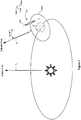
- Figure 1 provides a conceptual diagram of a spacecraft in earth orbit.
- the spacecraft 100 is shown disposed in an orbit 1000.
- the orbit 1000 may be equatorial or near equatorial orbit.
- the orbit 1000 may be a geosynchronous or geostationary orbit.
- the earth's equatorial plane is at an approximately 23.44° angle with respect to the ecliptic plane of the earth's orbit around the sun.
- a first vector, V 1 that is normal to the ecliptic plane is oriented toward the ecliptic pole and is at an approximately 23.44° angle with respect to a second vector V 2 that is normal to the earth's equatorial axis (and the plane of orbit 1000, in the illustrated example).
- the spacecraft 100 may be configured to operate with respect to an orbital plane of orbit 1000, such that the spacecraft has a yaw axis within the orbital plane directed from a spacecraft coordinate system origin toward nadir, a pitch axis orthogonal to the orbital plane and passing through the spacecraft coordinate system origin, and a roll axis orthogonal to the pitch axis and the yaw axis passing through the spacecraft coordinate system origin.
- a spacecraft Y axis that is parallel or substantially co-aligned with a rotational axis of a solar array 101, may be approximately aligned with the pitch axis.
- the spacecraft pitch axis will ordinarily be directed toward the earth's south celestial pole.
- a spacecraft X axis and Z axis, mutually orthogonal and each orthogonal to the Y axis may also be defined to complete a body frame coordinate system.
- the X axis may be aligned with the roll axis, whereas the Z axis may be aligned with the yaw axis.
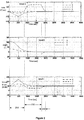
- Figure 2 illustrates results of a simulation of the presently disclosed techniques.
- a first phase 210 a first vector toward the ecliptic pole is found, using the star tracker, and the Y axis is aligned with the first vector.
- spacecraft angular rates assumed for simplicity of illustration to be initially zero, increase to a maximum at about 500 second, then are reduced to near zero by about 800 seconds.
- the Y axis of the spacecraft is approximately oriented toward the ecliptic pole.
- a vector to the sun at the end first phase 210 remains unknown at the end of first phase 210.
- Angular rates about the Y axis are then increased at the start of a second phase 220. Because the Y axis is orthogonal to the ecliptic plane, rotation about the Y axis is certain to result, within less than 360° of rotation, in acquiring the sun. Sun acquisition may be registered by a dedicated sun sensor. Alternatively, or in addition, sun acquisition may be registered by measuring solar power received by the spacecraft solar arrays. In the illustrated simulation, it may be observed (Detail B) that the sun is first acquired the end of the second phase 220, at about 1800 seconds after start of the ecliptic sun acquisition control mode.
- the spacecraft may then be stabilized in a sun-oriented attitude. In the illustrated simulation, this requires about 200 additional seconds. More particularly, approximately 1800 seconds after start, the sun has been found. A sun sensor may be aligned therewith, and the angular rates returned to near zero, a process that is shown to take place over a third phase 230 that requires, in the illustrated simulation, about 200 seconds. Thus, sun reacquisition is shown to be accomplished in a total time of less than 40 minutes, even in the absence of information regarding date, time and orbit parameters.
- reaction wheels provide the control authority for adjusting spacecraft rates by momentum exchange between the spacecraft body and the reaction wheels.
- Detail C shows the wheel momentum storage, in newton-meter-seconds (NMS) as a function of time for the illustrated simulation.
- NMS newton-meter-seconds
- An advantage of the presently disclosed techniques is that, even in implementations relying on a sun sensor for sun acquisition, only a single sun sensor may be required (although reliability considerations may dictate a second redundant sun sensor).
- a further advantage is that the techniques are operable whether or not spacecraft orbital position, orbit epoch and angular rates are known.
- the techniques may be used as a nominal transfer orbit procedure or in a recovery mode in case of an anomaly (e.g. a "loss of lock” anomaly).
- an anomaly e.g. a "loss of lock” anomaly.
- Figure 3 illustrates results of another simulation of the presently disclosed techniques.
- a first phase 310 a first vector toward the ecliptic pole is found, using the star tracker, and the Y axis is aligned with the first vector.
- spacecraft angular rates assumed to be initially about -0.18° about each axis, are reduced to near zero by about 700 seconds.
- the Y axis of the spacecraft is approximately oriented toward the ecliptic pole.
- a vector to the sun at the end first phase 310 remains unknown at the end of first phase 210.
- Angular rates about the Y axis are then increased at the start of a second phase 320. Because the Y axis is orthogonal to the ecliptic plane, rotation about the Y axis is certain to result, within less than 360° of rotation, in acquiring the sun.
- Sun acquisition may be registered by a dedicated sun sensor. Alternatively, or in addition, sun acquisition may be registered by measuring solar power received by the spacecraft solar arrays. In the illustrated simulation, it may be observed (Detail E) that the sun is first acquired the end of the second phase 320, at about 1150 seconds after start of the ecliptic sun acquisition control mode.
- the spacecraft may then be stabilized in a sun-oriented attitude. In the illustrated simulation, this requires about 200 additional seconds. More particularly, approximately 1800 seconds after start, the sun has been found. A sun sensor may be aligned therewith, and the angular rates returned to near zero, a process that is shown to take place over a third phase 230 that requires, in the illustrated simulation, about 100 seconds. Thus, in the simulation illustrated in Figure 3 , sun reacquisition is accomplished in a total time of less than about 25 minutes, even in the absence of information regarding date, time and orbit parameters.
- reaction wheels provide the control authority for adjusting spacecraft rates by momentum exchange between the spacecraft body and the reaction wheels.
- Detail F shows the wheel momentum storage NMS as a function of time for illustrated simulation.
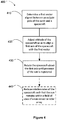
- a method 400 for orienting an earth-orbiting spacecraft will be described.
- a first vector aligned between an ecliptic pole of the earth and the spacecraft may be determined, using a star tracker.
- an attitude of the spacecraft may be adjusted so as to align a first axis of the spacecraft with the first vector.
- the first axis may parallel or substantially co-aligned with an axis of rotation of a solar array of the spacecraft.
- the spacecraft may be rotated about the first until presence of the sun is registered.
- Sun presence may be registered by a sun sensor, for example or by a solar array of the spacecraft.
- rotation rate so the spacecraft may be reduced such that the sun remains within a field of view of the sun sensor or of a solar array of the spacecraft.
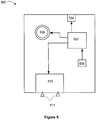
- Spacecraft 500 may include propulsion subsystem 510 and spacecraft controller 520.
- propulsion subsystem 510 may include propulsion equipment, such as tankage and control and service devices (not illustrated) and thrusters 511.
- spacecraft controller 520 may include or be included in a spacecraft attitude and orbit control subsystem.
- spacecraft controller 520 is communicatively coupled with propulsion subsystem 510 and may be configured to control the operation of propulsion subsystem 510, including thrusters 511.
- Spacecraft controller 520 may be configured to execute, autonomously, or in response to ground command, the presently disclosed techniques of acquiring or reacquiring the sun.
- the spacecraft 500 includes one or more star trackers 534 and/or inertial rate sensors 536.
- Inertial rate sensor 536 may include a digital integrating rate assembly (DIRA) or the like.
- determination of spacecraft inertial attitude may be performed by spacecraft controller 520 using the output of star tracker 534 and/or inertial sensor 536. Determination of spacecraft inertial attitude may be performed using only the output of the star tracker 534 and/or the inertial rate sensor 536.
- the spacecraft 500 also includes one or more reaction wheels 538 which may be configured as torque actuators to control spacecraft rotation rates about one or more axes.
- Implementations of the subject matter described in this specification may be implemented as one or more computer programs, i.e., one or more modules of computer program instructions, encoded on non-transitory computer readable medium for execution by, or to control the operation of, a data processing apparatus, such as, for example, spacecraft controller 520.
Landscapes
- Engineering & Computer Science (AREA)
- Remote Sensing (AREA)
- Aviation & Aerospace Engineering (AREA)
- Chemical & Material Sciences (AREA)
- Combustion & Propulsion (AREA)
- Radar, Positioning & Navigation (AREA)
- Life Sciences & Earth Sciences (AREA)
- Sustainable Development (AREA)
- Control Of Position, Course, Altitude, Or Attitude Of Moving Bodies (AREA)
Claims (13)
- Verfahren (400) zum Orientieren eines erdumkreisenden Raumfahrzeugs (100; 500), wobei das Verfahren umfasst:Bestimmen (410) eines ersten Vektors, der zwischen einem elliptischen Pol der Erde und dem Raumfahrzeug ausgerichtet ist, unter Verwendung eines Sterntrackers (534) an Bord des Raumfahrzeugs;Einstellen (420) einer Stellung des Raumfahrzeugs, um eine erste Achse des Raumfahrzeugs mit dem ersten Vektor auszurichten; undDrehen (430) des Raumfahrzeugs um die erste Achse, bis die Gegenwart der Sonne registriert wird.
- Verfahren nach Anspruch 1, wobei die Gegenwart der Sonne durch einen Sonnensensor des Raumfahrzeugs (100; 500) registriert wird.
- Verfahren nach Anspruch 2, das ferner das Verringern von Drehraten des Raumfahrzeugs (100; 500) umfasst, so dass die Sonne innerhalb eines Sichtfelds des Sonnensensors oder einer Solarzellengruppe des Raumfahrzeugs bleibt.
- Verfahren nach einem der Ansprüche 2 und 3, das ferner das Steuern des Raumfahrzeugs (100; 500) unter Verwendung von Sonnensensordaten für eine Winkelbestimmung in einer oder mehreren Achsen umfasst.
- Verfahren nach einem der Ansprüche 1 bis 4, wobei der Bestimmungsschritt (410) ohne Kenntnis zumindest eines von Umlaufbahnposition des Raumfahrzeugs, Umlaufbahnepoche und Winkelraten durchgeführt wird.
- Verfahren nach Anspruch 5, wobei der Bestimmungsschritt (410) ohne Kenntnis eines jeden von Umlaufbahnposition des Raumfahrzeugs, Umlaufbahnepoche und Winkelraten durchgeführt wird.
- Verfahren nach einem der Ansprüche 1 bis 6, wobei die Gegenwart der Sonne durch eine Solarzellengruppe (101) des Raumfahrzeugs (100; 500) registriert wird.
- Verfahren nach einem der Ansprüche 1 bis 7, wobei die erste Achse in Bezug auf eine Drehachse einer Solarzellengruppe (101) des Raumfahrzeugs (100; 500) parallel verläuft oder im Wesentlichen coausgerichtet ist.
- Raumfahrzeug (100; 500), das eine Raumfahrzeugsteuerung (520) und einen Sternentracker (534) umfasst, wobei die Raumfahrzeugsteuerung konfiguriert ist zum:Bestimmen (410) eines ersten Vektors, der zwischen einem elliptischen Pol der Erde und dem Raumfahrzeugs ausgerichtet ist, unter Verwendung des Sterntrackers;Einstellen (420) einer Stellung des Raumfahrzeugs, um eine erste Achse des Raumfahrzeugs mit dem ersten Vektor auszurichten; undDrehen (430) des Raumfahrzeugs um die erste Achse, bis die Gegenwart der Sonne registriert wird.
- Raumfahrzeug (100; 500) nach Anspruch 9, das ferner einen Sonnensensor umfasst, wobei die Gegenwart der Sonne durch den Sonnensensor registriert wird.
- Raumfahrzeug (100; 500) nach Anspruch 10, wobei die Raumfahrzeugsteuerung (520) so konfiguriert ist, dass sie Drehraten des Raumfahrzeugs so verringert, dass die Sonne innerhalb eines Sichtfelds des Sonnensensors oder einer Solarzellengruppe (101) des Raumfahrzeugs bleibt.
- Raumfahrzeug (100; 500) nach einem der Ansprüche 9 bis 11, wobei die Raumfahrzeugsteuerung (520) so konfiguriert ist, dass sie den ersten Vektor ohne Kenntnis eines jeden von Umlaufbahnposition des Raumfahrzeugs, Umlaufbahnepoche und Winkelraten bestimmt.
- Raumfahrzeug (100; 500) nach einem der Ansprüche 9 bis 12, wobei die Gegenwart der Sonne durch eine Solarzellengruppe (101) des Raumfahrzeugs registriert wird.
Applications Claiming Priority (1)
| Application Number | Priority Date | Filing Date | Title |
|---|---|---|---|
| US15/603,288 US10538342B2 (en) | 2017-05-23 | 2017-05-23 | Ecliptic sun acquisition control mode for satellites |
Publications (2)
| Publication Number | Publication Date |
|---|---|
| EP3406532A1 EP3406532A1 (de) | 2018-11-28 |
| EP3406532B1 true EP3406532B1 (de) | 2020-07-08 |
Family
ID=62104135
Family Applications (1)
| Application Number | Title | Priority Date | Filing Date |
|---|---|---|---|
| EP18170229.1A Active EP3406532B1 (de) | 2017-05-23 | 2018-05-01 | Verfahren zur ausrichtung eines erdumlaufenden raumfahrzeuges |
Country Status (2)
| Country | Link |
|---|---|
| US (1) | US10538342B2 (de) |
| EP (1) | EP3406532B1 (de) |
Families Citing this family (5)
| Publication number | Priority date | Publication date | Assignee | Title |
|---|---|---|---|---|
| US11338944B2 (en) * | 2019-05-29 | 2022-05-24 | GM Global Technology Operations LLC | Control system for executing a safing mode sequence in a spacecraft |
| US11273933B2 (en) | 2019-05-29 | 2022-03-15 | The Boeing Company | Spacecraft attitude control strategy for reducing disturbance torques |
| US11174047B2 (en) | 2019-05-29 | 2021-11-16 | The Boeing Company | Spacecraft control system for determining reaction torque |
| CN110963087B (zh) * | 2019-11-11 | 2021-10-29 | 上海航天控制技术研究所 | 一种多模式复杂流程的空间站太阳翼的控制方法 |
| CN112977889B (zh) * | 2021-03-19 | 2022-08-30 | 航天科工空间工程发展有限公司 | 一种基于太阳敏感器和地球敏感器的卫星姿态捕获方法 |
Family Cites Families (17)
| Publication number | Priority date | Publication date | Assignee | Title |
|---|---|---|---|---|
| US5107434A (en) | 1990-04-19 | 1992-04-21 | General Electric Company | Three-axis spacecraft attitude control using polar star sensor |
| US5826828A (en) * | 1996-02-05 | 1998-10-27 | Hughes Electronics Corporation | Sun/earth acquisition without thrusters |
| US6266616B1 (en) * | 1999-12-03 | 2001-07-24 | Hughes Electronics Corporation | Confused-in-space stellar attitude acquisition using multiple star trackers |
| US6289268B1 (en) | 2000-03-02 | 2001-09-11 | Hughes Electronics Corp. | Attitude determination system and method |
| US6577929B2 (en) | 2001-01-26 | 2003-06-10 | The Charles Stark Draper Laboratory, Inc. | Miniature attitude sensing suite |
| US6588708B2 (en) | 2001-01-29 | 2003-07-08 | The Boeing Company | Spacecraft methods and structures for acquiring and determining power-safe attitudes |
| US6695263B1 (en) | 2002-02-12 | 2004-02-24 | Lockheed Martin Corporation | System for geosynchronous spacecraft rapid earth reacquisition |
| US7410130B2 (en) | 2003-12-03 | 2008-08-12 | The Boeing Company | Star-tracker-based attitude determination for spinning spacecraft |
| US7546983B2 (en) * | 2003-12-03 | 2009-06-16 | The Boeing Company | Spacecraft power acquisition method for wing-stowed configuration |
| US7874519B2 (en) | 2006-02-25 | 2011-01-25 | Space Systems/Loral, Inc. | Spacecraft three-axis attitude acquisition from sun direction measurement |
| US8706322B2 (en) | 2006-06-20 | 2014-04-22 | Kara Whitney Johnson | Method and computer program product for controlling inertial attitude of an artificial satellite by applying gyroscopic precession to maintain the spin axis perpendicular to sun lines |
| US8676503B2 (en) | 2006-06-20 | 2014-03-18 | Kara Whitney Johnson | System for determing and controlling inertial attitude, for navigation, and for pointing and/or tracking for an artificial satellite employing and optical sensor and a counter-rotational optical mirror, and terrestrial-based testing system for assessing inertial attitude functions of an artificial satellite |
| US8016240B2 (en) * | 2007-03-29 | 2011-09-13 | The Boeing Company | Satellites and satellite fleet implementation methods and apparatus |
| JP5449905B2 (ja) * | 2009-07-29 | 2014-03-19 | フェリカネットワークス株式会社 | 情報処理装置、プログラム、および情報処理システム |
| FR2993863B1 (fr) | 2012-07-27 | 2014-08-29 | Thales Sa | Procede de reduction du moment cinetique et de controle d'attitude d'un engin spatial |
| US10301043B2 (en) * | 2015-11-24 | 2019-05-28 | The Charles Stark Draper Laboratory, Inc. | Conical scanning process for spacecraft sun pointing |
| US9921099B1 (en) * | 2016-09-01 | 2018-03-20 | The United States Of America As Represented By The Administrator Of The National Aeronautics And Space Administration | Spherical occulter coronagraph cubesat |
-
2017
- 2017-05-23 US US15/603,288 patent/US10538342B2/en active Active
-
2018
- 2018-05-01 EP EP18170229.1A patent/EP3406532B1/de active Active
Non-Patent Citations (1)
| Title |
|---|
| None * |
Also Published As
| Publication number | Publication date |
|---|---|
| EP3406532A1 (de) | 2018-11-28 |
| US20180339792A1 (en) | 2018-11-29 |
| US10538342B2 (en) | 2020-01-21 |
Similar Documents
| Publication | Publication Date | Title |
|---|---|---|
| EP3406532B1 (de) | Verfahren zur ausrichtung eines erdumlaufenden raumfahrzeuges | |
| US7113851B1 (en) | Practical orbit raising system and method for geosynchronous satellites | |
| US9108749B2 (en) | Spacecraft momentum management | |
| US8056863B2 (en) | Unified attitude control for spacecraft transfer orbit operations | |
| US9527607B2 (en) | Propulsion system for satellite orbit control and attitude control | |
| US9957067B2 (en) | Propulsion system in two modules for satellite orbit control and attitude control | |
| US7546983B2 (en) | Spacecraft power acquisition method for wing-stowed configuration | |
| US7410130B2 (en) | Star-tracker-based attitude determination for spinning spacecraft | |
| US9045239B2 (en) | Spacecraft payload orientation steering | |
| US7877173B2 (en) | Method and apparatus for determining a satellite attitude using crosslink reference signals | |
| US6637701B1 (en) | Gimbaled ion thruster arrangement for high efficiency stationkeeping | |
| US7874519B2 (en) | Spacecraft three-axis attitude acquisition from sun direction measurement | |
| US5277385A (en) | Method of attitude reacquisition for three-axis stabilized satellites using star recognition | |
| US20140361124A1 (en) | Propulsion system with four modules for satellite orbit control and attitude control | |
| US9988162B2 (en) | Method and device for control of a sunlight acquisition phase of a spacecraft | |
| US6695263B1 (en) | System for geosynchronous spacecraft rapid earth reacquisition | |
| US20050133670A1 (en) | Unified sensor-based attitude determination and control for spacecraft operations | |
| US10144531B2 (en) | Reorientation of a spinning spacecraft using gimbaled electric thrusters | |
| Hacker et al. | Globalstar second generation hybrid attitude control on-orbit experience | |
| Nicolai et al. | The tet satellite bus-future mission capabilities | |
| Jeon et al. | Spacecraft operation design for an energy-balanced mission of a lunar orbiter | |
| D'Amico et al. | GPS-based spaceborne autonomous formation flying experiment (SAFE) on PRISMA: initial commissioning | |
| Strikwerda et al. | The near guidance and control system | |
| Hoffmanna | Attitude control on TET-1 and BIROS-experiences from the firebird mission and end of life operations Lukas Hoffmanna*, Thomas Terzibaschianb, Dr | |
| Posani et al. | Agile Satellite Attitude Maneuvers for Intersat and Downlink Data Routing |
Legal Events
| Date | Code | Title | Description |
|---|---|---|---|
| PUAI | Public reference made under article 153(3) epc to a published international application that has entered the european phase |
Free format text: ORIGINAL CODE: 0009012 |
|
| STAA | Information on the status of an ep patent application or granted ep patent |
Free format text: STATUS: THE APPLICATION HAS BEEN PUBLISHED |
|
| AK | Designated contracting states |
Kind code of ref document: A1 Designated state(s): AL AT BE BG CH CY CZ DE DK EE ES FI FR GB GR HR HU IE IS IT LI LT LU LV MC MK MT NL NO PL PT RO RS SE SI SK SM TR |
|
| AX | Request for extension of the european patent |
Extension state: BA ME |
|
| STAA | Information on the status of an ep patent application or granted ep patent |
Free format text: STATUS: REQUEST FOR EXAMINATION WAS MADE |
|
| 17P | Request for examination filed |
Effective date: 20190520 |
|
| RBV | Designated contracting states (corrected) |
Designated state(s): AL AT BE BG CH CY CZ DE DK EE ES FI FR GB GR HR HU IE IS IT LI LT LU LV MC MK MT NL NO PL PT RO RS SE SI SK SM TR |
|
| RIC1 | Information provided on ipc code assigned before grant |
Ipc: B64G 1/36 20060101AFI20191216BHEP Ipc: B64G 1/44 20060101ALI20191216BHEP |
|
| GRAP | Despatch of communication of intention to grant a patent |
Free format text: ORIGINAL CODE: EPIDOSNIGR1 |
|
| STAA | Information on the status of an ep patent application or granted ep patent |
Free format text: STATUS: GRANT OF PATENT IS INTENDED |
|
| INTG | Intention to grant announced |
Effective date: 20200124 |
|
| GRAS | Grant fee paid |
Free format text: ORIGINAL CODE: EPIDOSNIGR3 |
|
| GRAA | (expected) grant |
Free format text: ORIGINAL CODE: 0009210 |
|
| STAA | Information on the status of an ep patent application or granted ep patent |
Free format text: STATUS: THE PATENT HAS BEEN GRANTED |
|
| AK | Designated contracting states |
Kind code of ref document: B1 Designated state(s): AL AT BE BG CH CY CZ DE DK EE ES FI FR GB GR HR HU IE IS IT LI LT LU LV MC MK MT NL NO PL PT RO RS SE SI SK SM TR |
|
| REG | Reference to a national code |
Ref country code: CH Ref legal event code: EP Ref country code: AT Ref legal event code: REF Ref document number: 1288207 Country of ref document: AT Kind code of ref document: T Effective date: 20200715 |
|
| REG | Reference to a national code |
Ref country code: DE Ref legal event code: R096 Ref document number: 602018005798 Country of ref document: DE |
|
| REG | Reference to a national code |
Ref country code: IE Ref legal event code: FG4D |
|
| REG | Reference to a national code |
Ref country code: LT Ref legal event code: MG4D |
|
| REG | Reference to a national code |
Ref country code: AT Ref legal event code: MK05 Ref document number: 1288207 Country of ref document: AT Kind code of ref document: T Effective date: 20200708 |
|
| REG | Reference to a national code |
Ref country code: NL Ref legal event code: MP Effective date: 20200708 |
|
| PG25 | Lapsed in a contracting state [announced via postgrant information from national office to epo] |
Ref country code: LT Free format text: LAPSE BECAUSE OF FAILURE TO SUBMIT A TRANSLATION OF THE DESCRIPTION OR TO PAY THE FEE WITHIN THE PRESCRIBED TIME-LIMIT Effective date: 20200708 Ref country code: PT Free format text: LAPSE BECAUSE OF FAILURE TO SUBMIT A TRANSLATION OF THE DESCRIPTION OR TO PAY THE FEE WITHIN THE PRESCRIBED TIME-LIMIT Effective date: 20201109 Ref country code: HR Free format text: LAPSE BECAUSE OF FAILURE TO SUBMIT A TRANSLATION OF THE DESCRIPTION OR TO PAY THE FEE WITHIN THE PRESCRIBED TIME-LIMIT Effective date: 20200708 Ref country code: GR Free format text: LAPSE BECAUSE OF FAILURE TO SUBMIT A TRANSLATION OF THE DESCRIPTION OR TO PAY THE FEE WITHIN THE PRESCRIBED TIME-LIMIT Effective date: 20201009 Ref country code: FI Free format text: LAPSE BECAUSE OF FAILURE TO SUBMIT A TRANSLATION OF THE DESCRIPTION OR TO PAY THE FEE WITHIN THE PRESCRIBED TIME-LIMIT Effective date: 20200708 Ref country code: SE Free format text: LAPSE BECAUSE OF FAILURE TO SUBMIT A TRANSLATION OF THE DESCRIPTION OR TO PAY THE FEE WITHIN THE PRESCRIBED TIME-LIMIT Effective date: 20200708 Ref country code: ES Free format text: LAPSE BECAUSE OF FAILURE TO SUBMIT A TRANSLATION OF THE DESCRIPTION OR TO PAY THE FEE WITHIN THE PRESCRIBED TIME-LIMIT Effective date: 20200708 Ref country code: NO Free format text: LAPSE BECAUSE OF FAILURE TO SUBMIT A TRANSLATION OF THE DESCRIPTION OR TO PAY THE FEE WITHIN THE PRESCRIBED TIME-LIMIT Effective date: 20201008 Ref country code: BG Free format text: LAPSE BECAUSE OF FAILURE TO SUBMIT A TRANSLATION OF THE DESCRIPTION OR TO PAY THE FEE WITHIN THE PRESCRIBED TIME-LIMIT Effective date: 20201008 Ref country code: AT Free format text: LAPSE BECAUSE OF FAILURE TO SUBMIT A TRANSLATION OF THE DESCRIPTION OR TO PAY THE FEE WITHIN THE PRESCRIBED TIME-LIMIT Effective date: 20200708 |
|
| PG25 | Lapsed in a contracting state [announced via postgrant information from national office to epo] |
Ref country code: RS Free format text: LAPSE BECAUSE OF FAILURE TO SUBMIT A TRANSLATION OF THE DESCRIPTION OR TO PAY THE FEE WITHIN THE PRESCRIBED TIME-LIMIT Effective date: 20200708 Ref country code: PL Free format text: LAPSE BECAUSE OF FAILURE TO SUBMIT A TRANSLATION OF THE DESCRIPTION OR TO PAY THE FEE WITHIN THE PRESCRIBED TIME-LIMIT Effective date: 20200708 Ref country code: LV Free format text: LAPSE BECAUSE OF FAILURE TO SUBMIT A TRANSLATION OF THE DESCRIPTION OR TO PAY THE FEE WITHIN THE PRESCRIBED TIME-LIMIT Effective date: 20200708 Ref country code: IS Free format text: LAPSE BECAUSE OF FAILURE TO SUBMIT A TRANSLATION OF THE DESCRIPTION OR TO PAY THE FEE WITHIN THE PRESCRIBED TIME-LIMIT Effective date: 20201108 |
|
| PG25 | Lapsed in a contracting state [announced via postgrant information from national office to epo] |
Ref country code: NL Free format text: LAPSE BECAUSE OF FAILURE TO SUBMIT A TRANSLATION OF THE DESCRIPTION OR TO PAY THE FEE WITHIN THE PRESCRIBED TIME-LIMIT Effective date: 20200708 |
|
| REG | Reference to a national code |
Ref country code: DE Ref legal event code: R097 Ref document number: 602018005798 Country of ref document: DE |
|
| PG25 | Lapsed in a contracting state [announced via postgrant information from national office to epo] |
Ref country code: IT Free format text: LAPSE BECAUSE OF FAILURE TO SUBMIT A TRANSLATION OF THE DESCRIPTION OR TO PAY THE FEE WITHIN THE PRESCRIBED TIME-LIMIT Effective date: 20200708 Ref country code: SM Free format text: LAPSE BECAUSE OF FAILURE TO SUBMIT A TRANSLATION OF THE DESCRIPTION OR TO PAY THE FEE WITHIN THE PRESCRIBED TIME-LIMIT Effective date: 20200708 Ref country code: RO Free format text: LAPSE BECAUSE OF FAILURE TO SUBMIT A TRANSLATION OF THE DESCRIPTION OR TO PAY THE FEE WITHIN THE PRESCRIBED TIME-LIMIT Effective date: 20200708 Ref country code: DK Free format text: LAPSE BECAUSE OF FAILURE TO SUBMIT A TRANSLATION OF THE DESCRIPTION OR TO PAY THE FEE WITHIN THE PRESCRIBED TIME-LIMIT Effective date: 20200708 Ref country code: CZ Free format text: LAPSE BECAUSE OF FAILURE TO SUBMIT A TRANSLATION OF THE DESCRIPTION OR TO PAY THE FEE WITHIN THE PRESCRIBED TIME-LIMIT Effective date: 20200708 Ref country code: EE Free format text: LAPSE BECAUSE OF FAILURE TO SUBMIT A TRANSLATION OF THE DESCRIPTION OR TO PAY THE FEE WITHIN THE PRESCRIBED TIME-LIMIT Effective date: 20200708 |
|
| PLBE | No opposition filed within time limit |
Free format text: ORIGINAL CODE: 0009261 |
|
| STAA | Information on the status of an ep patent application or granted ep patent |
Free format text: STATUS: NO OPPOSITION FILED WITHIN TIME LIMIT |
|
| PG25 | Lapsed in a contracting state [announced via postgrant information from national office to epo] |
Ref country code: AL Free format text: LAPSE BECAUSE OF FAILURE TO SUBMIT A TRANSLATION OF THE DESCRIPTION OR TO PAY THE FEE WITHIN THE PRESCRIBED TIME-LIMIT Effective date: 20200708 |
|
| 26N | No opposition filed |
Effective date: 20210409 |
|
| PG25 | Lapsed in a contracting state [announced via postgrant information from national office to epo] |
Ref country code: SK Free format text: LAPSE BECAUSE OF FAILURE TO SUBMIT A TRANSLATION OF THE DESCRIPTION OR TO PAY THE FEE WITHIN THE PRESCRIBED TIME-LIMIT Effective date: 20200708 |
|
| PG25 | Lapsed in a contracting state [announced via postgrant information from national office to epo] |
Ref country code: SI Free format text: LAPSE BECAUSE OF FAILURE TO SUBMIT A TRANSLATION OF THE DESCRIPTION OR TO PAY THE FEE WITHIN THE PRESCRIBED TIME-LIMIT Effective date: 20200708 |
|
| REG | Reference to a national code |
Ref country code: DE Ref legal event code: R119 Ref document number: 602018005798 Country of ref document: DE |
|
| REG | Reference to a national code |
Ref country code: CH Ref legal event code: PL |
|
| PG25 | Lapsed in a contracting state [announced via postgrant information from national office to epo] |
Ref country code: LI Free format text: LAPSE BECAUSE OF NON-PAYMENT OF DUE FEES Effective date: 20210531 Ref country code: LU Free format text: LAPSE BECAUSE OF NON-PAYMENT OF DUE FEES Effective date: 20210501 Ref country code: MC Free format text: LAPSE BECAUSE OF FAILURE TO SUBMIT A TRANSLATION OF THE DESCRIPTION OR TO PAY THE FEE WITHIN THE PRESCRIBED TIME-LIMIT Effective date: 20200708 Ref country code: CH Free format text: LAPSE BECAUSE OF NON-PAYMENT OF DUE FEES Effective date: 20210531 |
|
| REG | Reference to a national code |
Ref country code: BE Ref legal event code: MM Effective date: 20210531 |
|
| PG25 | Lapsed in a contracting state [announced via postgrant information from national office to epo] |
Ref country code: IE Free format text: LAPSE BECAUSE OF NON-PAYMENT OF DUE FEES Effective date: 20210501 Ref country code: DE Free format text: LAPSE BECAUSE OF NON-PAYMENT OF DUE FEES Effective date: 20211201 |
|
| PG25 | Lapsed in a contracting state [announced via postgrant information from national office to epo] |
Ref country code: BE Free format text: LAPSE BECAUSE OF NON-PAYMENT OF DUE FEES Effective date: 20210531 |
|
| PG25 | Lapsed in a contracting state [announced via postgrant information from national office to epo] |
Ref country code: CY Free format text: LAPSE BECAUSE OF FAILURE TO SUBMIT A TRANSLATION OF THE DESCRIPTION OR TO PAY THE FEE WITHIN THE PRESCRIBED TIME-LIMIT Effective date: 20200708 |
|
| P01 | Opt-out of the competence of the unified patent court (upc) registered |
Effective date: 20230528 |
|
| PG25 | Lapsed in a contracting state [announced via postgrant information from national office to epo] |
Ref country code: HU Free format text: LAPSE BECAUSE OF FAILURE TO SUBMIT A TRANSLATION OF THE DESCRIPTION OR TO PAY THE FEE WITHIN THE PRESCRIBED TIME-LIMIT; INVALID AB INITIO Effective date: 20180501 |
|
| PG25 | Lapsed in a contracting state [announced via postgrant information from national office to epo] |
Ref country code: MK Free format text: LAPSE BECAUSE OF FAILURE TO SUBMIT A TRANSLATION OF THE DESCRIPTION OR TO PAY THE FEE WITHIN THE PRESCRIBED TIME-LIMIT Effective date: 20200708 |
|
| PG25 | Lapsed in a contracting state [announced via postgrant information from national office to epo] |
Ref country code: MT Free format text: LAPSE BECAUSE OF FAILURE TO SUBMIT A TRANSLATION OF THE DESCRIPTION OR TO PAY THE FEE WITHIN THE PRESCRIBED TIME-LIMIT Effective date: 20200708 |
|
| PG25 | Lapsed in a contracting state [announced via postgrant information from national office to epo] |
Ref country code: TR Free format text: LAPSE BECAUSE OF FAILURE TO SUBMIT A TRANSLATION OF THE DESCRIPTION OR TO PAY THE FEE WITHIN THE PRESCRIBED TIME-LIMIT Effective date: 20200708 |
|
| PGFP | Annual fee paid to national office [announced via postgrant information from national office to epo] |
Ref country code: GB Payment date: 20260312 Year of fee payment: 9 |
|
| PGFP | Annual fee paid to national office [announced via postgrant information from national office to epo] |
Ref country code: FR Payment date: 20260309 Year of fee payment: 9 |