EP3407307A1 - Système de stationnement et son procédé de fonctionnement - Google Patents
Système de stationnement et son procédé de fonctionnement Download PDFInfo
- Publication number
- EP3407307A1 EP3407307A1 EP17172461.0A EP17172461A EP3407307A1 EP 3407307 A1 EP3407307 A1 EP 3407307A1 EP 17172461 A EP17172461 A EP 17172461A EP 3407307 A1 EP3407307 A1 EP 3407307A1
- Authority
- EP
- European Patent Office
- Prior art keywords
- access
- record
- parking system
- mobile terminal
- transmission
- Prior art date
- Legal status (The legal status is an assumption and is not a legal conclusion. Google has not performed a legal analysis and makes no representation as to the accuracy of the status listed.)
- Granted
Links
Images


Classifications
-
- G—PHYSICS
- G07—CHECKING-DEVICES
- G07C—TIME OR ATTENDANCE REGISTERS; REGISTERING OR INDICATING THE WORKING OF MACHINES; GENERATING RANDOM NUMBERS; VOTING OR LOTTERY APPARATUS; ARRANGEMENTS, SYSTEMS OR APPARATUS FOR CHECKING NOT PROVIDED FOR ELSEWHERE
- G07C9/00—Individual registration on entry or exit
- G07C9/00174—Electronically operated locks; Circuits therefor; Nonmechanical keys therefor, e.g. passive or active electrical keys or other data carriers without mechanical keys
- G07C9/00896—Electronically operated locks; Circuits therefor; Nonmechanical keys therefor, e.g. passive or active electrical keys or other data carriers without mechanical keys specially adapted for particular uses
-
- G—PHYSICS
- G07—CHECKING-DEVICES
- G07B—TICKET-ISSUING APPARATUS; FARE-REGISTERING APPARATUS; FRANKING APPARATUS
- G07B15/00—Arrangements or apparatus for collecting fares, tolls or entrance fees at one or more control points
- G07B15/02—Arrangements or apparatus for collecting fares, tolls or entrance fees at one or more control points taking into account a variable factor such as distance or time, e.g. for passenger transport, parking systems or car rental systems
- G07B15/04—Arrangements or apparatus for collecting fares, tolls or entrance fees at one or more control points taking into account a variable factor such as distance or time, e.g. for passenger transport, parking systems or car rental systems comprising devices to free a barrier, turnstile, or the like
-
- H—ELECTRICITY
- H04—ELECTRIC COMMUNICATION TECHNIQUE
- H04W—WIRELESS COMMUNICATION NETWORKS
- H04W4/00—Services specially adapted for wireless communication networks; Facilities therefor
- H04W4/30—Services specially adapted for particular environments, situations or purposes
- H04W4/40—Services specially adapted for particular environments, situations or purposes for vehicles, e.g. vehicle-to-pedestrians [V2P]
- H04W4/44—Services specially adapted for particular environments, situations or purposes for vehicles, e.g. vehicle-to-pedestrians [V2P] for communication between vehicles and infrastructures, e.g. vehicle-to-cloud [V2C] or vehicle-to-home [V2H]
-
- G—PHYSICS
- G06—COMPUTING OR CALCULATING; COUNTING
- G06Q—INFORMATION AND COMMUNICATION TECHNOLOGY [ICT] SPECIALLY ADAPTED FOR ADMINISTRATIVE, COMMERCIAL, FINANCIAL, MANAGERIAL OR SUPERVISORY PURPOSES; SYSTEMS OR METHODS SPECIALLY ADAPTED FOR ADMINISTRATIVE, COMMERCIAL, FINANCIAL, MANAGERIAL OR SUPERVISORY PURPOSES, NOT OTHERWISE PROVIDED FOR
- G06Q2240/00—Transportation facility access, e.g. fares, tolls or parking
-
- G—PHYSICS
- G07—CHECKING-DEVICES
- G07C—TIME OR ATTENDANCE REGISTERS; REGISTERING OR INDICATING THE WORKING OF MACHINES; GENERATING RANDOM NUMBERS; VOTING OR LOTTERY APPARATUS; ARRANGEMENTS, SYSTEMS OR APPARATUS FOR CHECKING NOT PROVIDED FOR ELSEWHERE
- G07C9/00—Individual registration on entry or exit
- G07C9/00174—Electronically operated locks; Circuits therefor; Nonmechanical keys therefor, e.g. passive or active electrical keys or other data carriers without mechanical keys
- G07C9/00309—Electronically operated locks; Circuits therefor; Nonmechanical keys therefor, e.g. passive or active electrical keys or other data carriers without mechanical keys operated with bidirectional data transmission between data carrier and locks
- G07C2009/00317—Electronically operated locks; Circuits therefor; Nonmechanical keys therefor, e.g. passive or active electrical keys or other data carriers without mechanical keys operated with bidirectional data transmission between data carrier and locks keyless data carrier having only one limited data transmission range
-
- G—PHYSICS
- G07—CHECKING-DEVICES
- G07C—TIME OR ATTENDANCE REGISTERS; REGISTERING OR INDICATING THE WORKING OF MACHINES; GENERATING RANDOM NUMBERS; VOTING OR LOTTERY APPARATUS; ARRANGEMENTS, SYSTEMS OR APPARATUS FOR CHECKING NOT PROVIDED FOR ELSEWHERE
- G07C2209/00—Indexing scheme relating to groups G07C9/00 - G07C9/38
- G07C2209/60—Indexing scheme relating to groups G07C9/00174 - G07C9/00944
- G07C2209/63—Comprising locating means for detecting the position of the data carrier, i.e. within the vehicle or within a certain distance from the vehicle
-
- H—ELECTRICITY
- H04—ELECTRIC COMMUNICATION TECHNIQUE
- H04W—WIRELESS COMMUNICATION NETWORKS
- H04W4/00—Services specially adapted for wireless communication networks; Facilities therefor
- H04W4/20—Services signaling; Auxiliary data signalling, i.e. transmitting data via a non-traffic channel
-
- H—ELECTRICITY
- H04—ELECTRIC COMMUNICATION TECHNIQUE
- H04W—WIRELESS COMMUNICATION NETWORKS
- H04W4/00—Services specially adapted for wireless communication networks; Facilities therefor
- H04W4/80—Services using short range communication, e.g. near-field communication [NFC], radio-frequency identification [RFID] or low energy communication
Definitions
- the application relates to a parking system, in particular for a parking device, comprising at least one access arrangement with at least one access device, set up to control a passage from a first area with an access section into a further area, at least a first, the access device associated transmitting device, configured to emit a first transmission field, wherein the first transmission field transmits at least a first access record receivable by a mobile terminal located in the access section.
- the application relates to a method for operating a parking system, an access application and a mobile terminal.
- a parking system for parking devices usually has one or more access arrangements.
- An access arrangement generally comprises one or more access devices.
- a barrier with a pivotable boom can be provided as the access arrangement.
- an access device in particular the passage of a vehicle is controlled or controlled from a first area to a further area.
- an access arrangement with at least one access device can be provided in order to control the passage from an uncontrolled area, for example a street, into a controlled area, for example the parking area.
- the entry into the parking device can be controlled by an access device.
- an access arrangement with at least one access device may be provided to control the passage of a vehicle from the controlled area to the uncontrolled area.
- the exit from the parking device can be controlled by an access device.
- the entry into a parking device is granted after the creation of a short-term parking ticket due to a user action.
- the short-term parking ticket in particular a paper ticket, is then paid by a user at a machine after the end of a parking time and checked at the exit by a validator device of the access device. In a positive test, the passage is released. However, if the validator device detects that the ticket has not yet been paid or the payment is too long ago, then the access device remains closed.
- a constant concern in parking systems is to improve user comfort.
- the manual user actions are considered user-unfriendly.
- parking systems are known from the prior art, in which the required user actions can be minimized.
- FIG. 7 An exemplary parking system 700 according to the prior art is in FIG. 7 shown.
- the parking system 700 includes an access arrangement 702 having two access devices 704.1, 704.2.
- Each access device 704.1, 704.2 is assigned a transmission device 710.1, 710.2, each of which emits a transmission field with an access data record.
- the access arrangement 702 or the access devices 704.1, 704.2 in general, the passage from a first area 706 into a further area 708 can be controlled.
- a higher level of user comfort is made possible by the fact that the user no longer has to use a short-term parking ticket for transit in a conventional manner.
- a user-assigned mobile terminal 732 can be used on which an access application can be installed.
- the mobile terminal 732 receives a transmission field 712.1, 712.2 with an access record contained therein, it processes the received access record using the access application and sends an access message to a control device 724 via a wireless Communication network 736.
- the controller 724 may then, based on the received access record, determine the transmitting device transmitting this access record and derive therefrom the access device associated with the sending device. This can then be controlled to release the passage. In other words, it should be ensured that the correct entrance to the parking garage is released, namely the one in front of which the vehicle 718 is located
- a transmission field 712.2 can also be received by a second access device 704.2 from a mobile terminal 732, which is actually positioned in front of the first access device 704.1.
- the mobile terminal 732 receives both overhead records or only the "wrong" overhead record. While in the latter case, the wrong access device is controlled and released, it is not possible in the former case to determine the access device to be controlled in a unique manner.
- the present application has the object to provide a parking system, which allows a more reliable operation with high user comfort.
- the parking system comprises at least one access arrangement with at least one access device, set up to control a passage from a first area with an access section into a further area.
- the parking system comprises at least one first local transmission device associated with the access device, configured to broadcast a first transmission field.
- the first transmission field transmits at least one first access data record receivable by a mobile terminal located in the access section.
- the parking system comprises at least one second local transmission device assigned to the access device, configured to emit a second transmission field.
- the second transmission field transmits at least one second access data record receivable by the mobile terminal located in the access section.
- this access device can be determined in a reliable and in particular unambiguous manner by evaluating the first and second access data sets of the transmitting transmission devices. Thus, it may happen that a further transmission field is additionally received by a mobile device from a transmission device assigned to an adjacent access device. From the three additional data records received, however, the access device actually to be controlled can be reliably determined. A more reliable operation of the parking system with high user comfort is achieved.
- the parking system for a parking device has one or more access arrangements.
- An access arrangement comprises one or more access devices.
- a barrier with at least one barrier boom arranged pivotably on a column can be provided as the access arrangement.
- a blocking means in an access arrangement but also a roller door, swing door, Sectional door, retractable bollard and the like. Can be used.
- the access arrangement can manage without blocking means and control the passage by means of a light signal.
- a supply section is provided in the first area, which a vehicle, which will drive through the access device, has to pass in advance.
- the passage of a vehicle is controlled or controlled from a first area to a further area.
- each with an access device is provided to control the passage from an uncontrolled area to a controlled area, for example the parking area of the parking facility.
- the entry into the parking device can be controlled by the exactly one access device (entrance).
- at least one access arrangement with at least one access device can be provided in the parking device in order to control the passage from the controlled area to the uncontrolled area.
- the exit from the parking device can be controlled by exactly one access device (exit). It goes without saying that a parking device can certainly identify multiple entrances and exits.
- each access device of a parking arrangement is uniquely associated with at least two local transmission devices.
- An association is to be understood in particular that at least one first local transmission device and at least one second local transmission device are provided for each access device.
- both the first transmission field of the first local transmission device and the second transmission field of the second local transmission device essentially cover a specific part of the access section of the first area, in particular (almost) the entire access section. In other words, a vehicle must pass through the first and the second transmission field for the passage of the access device.
- the first transmission field comprises, in particular transmits, at least one first access data set and the second transmission field at least one second access data set.
- the first access data record and the second access data record are formed in such a way that the transmitting transmitting devices can be determined, so that the access device (unambiguously) assigned to these transmitting transmitters can be (unambiguously) determined.
- the first and second access records may differ from each other here.
- an access record may include a unique code.
- a first (or second) local transmission device is set up, preferably (quasi) continuously transmitting the first (or second) transmission field.
- a transmitting device is in particular a transmitting device with a minimum range of at least 2 m, preferably at least 2.5 m, and a maximum range of at most 5 m, preferably at most 4 m.
- RFID technology infrared technology, WLAN technology and / or sound technology can be used.
- the first (or second) transmission field may be a Bluetooth transmission field emitted by a Bluetooth beacon.
- a BLE (Bluetooth Low Energy) beacon can be used as transmitting device.
- a transmission field emitted by such a transmission device can be received by a mobile terminal located within the range of the transmission device.
- exemplary mobile terminals are smartphones, tablet computers, mobile game consoles, laptops, netbooks, data glasses, smart watches and similar wearables.
- a mobile terminal is also understood to mean a device integrated in the vehicle (for example navigation system, etc.).
- the first access data record and the second access data record can each comprise any information (code) which enables a unique determination of the assigned access device.
- the first access record can be a function of the second access record.
- the term function is not limited to the mathematical definition of a function.
- any method is meant which makes it possible to deduce from a first data record to a second data record. This can be realized in one embodiment by a mathematical function, in particular by a reversible-unique function, in another embodiment, for example by a look-up table.
- s is a random number
- t is the transmission time
- g can be a link (eg a function) of the parameters s and t.
- the first local transmission device can be arranged on a first side edge of the access section of the access device.
- the second local transmission device may be arranged on a second side edge, opposite the first side edge, of the access section of the access device.
- the selectivity at the terminal can be increased by means of intelligently arranged reflectors and / or absorbers and / or shielding and damping elements in the region of an access section.
- the parking system may comprise at least one evaluation device.
- the evaluation device may be configured to determine the assigned access device, at least based on the received first access record and the received second access record.
- the associated access device may be determined, for example, by evaluating the above functional relationship of the access records. The evaluation result can then be taken into account in the activation and, in particular, clearance of a passage through an access arrangement.
- the parking system may preferably include at least one controller configured to enable passage through a particular access device.
- the control device may include a control module configured to drive the particular access device depending on the evaluation result.
- the evaluation result can be made available to the control module.
- the control device may comprise the evaluation device.
- a drive signal can be generated and for example, to an actuator (eg, a motor) and / or a signal of the particular access device to permit or deny transit.
- an actuator eg, a motor
- the control device may be at least partially intergrated in a local computing device of the parking device, in a remote central computing device and / or in the access device.
- the control device may comprise at least one reception module configured to receive an access message from the mobile terminal or a vehicle-integrated transmitter.
- the access message may include at least a third access record corresponding to the first received access record and the second received access record.
- the mobile terminal or the vehicle-integrated transmitter may include the evaluation device.
- the third access record may be an evaluation record.
- the evaluation data set may comprise at least information about the access device determined in the evaluation step.
- the first and the second access data set can form, for example, two third access data records.
- These third access data sets can then be made available to an evaluation device of the control device, for example. It is understood that in this case, one or more other access record (s) will be transmitted as third access records. These may originate from adjacent local transmitters of adjacent access devices. However, as described above, the correct access device can be uniquely determined in the evaluation step.
- the access message may comprise further data records, such as a time stamp and in particular at least one identifier assigned to the mobile terminal and / or the user of the mobile terminal. For example, it can be provided that a passage through the access device only allows authorized users becomes. This can be ensured by checking the identifier, for example by comparing the identifier with a positive list or negative list.
- the receivable access message may (additionally) comprise at least one status data record of the mobile terminal.
- the status data set may represent at least one coupling state of the mobile terminal with a coupling device of the vehicle.
- the access record may include a status indicator (flag) to indicate whether there is a pairing (e.g., status indicator is set) or not (e.g., status indicator is not set).
- the coupling device may be a hands-free system of the vehicle and / or a device (e.g., a specially-designed park dongle) plugged into an interface (e.g., OBD (on-board diagnostic) interface).
- a pairing may be a Bluetooth connection or another connection (e.g., WiFi, infrared, etc.). If the mobile terminal has a corresponding coupling, in particular a corresponding indicator can be inserted into the access message.
- the situation may arise that, according to the prior art, no unambiguous assignment of a parking operation to a single user / mobile terminal is possible.
- the driver's mobile terminal is coupled to a coupling device of the vehicle.
- the coupling state is a preferred indication for the selection of a mobile terminal from a plurality of terminals that may be present in a vehicle.
- the data stored at the entrance may be resorted to.
- the identifiers of the users / mobile terminals can be compared with the identifiers of the users / mobile terminals stored at the entrance. If a correspondence is detected, this can determine the identifier to be used.
- a communication with the users is started and a user from a plurality of vehicle occupants confirms that the parking procedure is to be assigned to him, for example by sending a response to a corresponding message (in particular a push message).
- the parking system may comprise at least one vehicle detection device associated with the access device.
- the vehicle detection device such as an induction loop, may be configured to detect a vehicle in front of the access arrangement.
- the control device may include at least one evaluation module configured to determine whether a vehicle is being detected in the particular access device. In particular, it is possible to check (immediately) after or during the evaluation step described above whether a vehicle is actually present at the particular access device.
- the evaluation module may for example be partially integrated in the evaluation device. It is understood that in addition to an induction loop and other devices can be used with which the presence of a vehicle can be determined in front of the access arrangement. This includes, for example, cameras, image processing systems, ultrasonic sensors, pressure sensors, vehicle scales, light barriers, etc.
- the parking system may have at least one fourth local sending device within the controlled area.
- the at least one fourth local sending device may send another code (consisting of, for example, a sender identification and a time stamp) that is receivable to terminals that have successfully passed the access device. Terminals that have been on the access device but subsequently are not within the controlled area (e.g., unwanted "users" who have been walking near the access device) may thus be safely excluded from unwanted billing.
- a time interval could also be set and monitored: terminals which received the code of at least one fourth transmitter device, but where the time interval from the receipt of the access records (from the first and second transmitters) to the receipt of the further code (from the fourth transmitting device) is greater than defined by the parking system, can be excluded from the billing. For example, (slow) pedestrians and users in a vehicle can be distinguished.
- the mobile terminal may preferably comprise an access application (eg a so-called app).
- the access application can be set up to process received access records and / or to detect a coupling state.
- the access arrangement may comprise a processing means for generating an access message described above.
- the processing means can effect a transmission of this access message by the mobile terminal.
- the communication address of a particular recipient may be stored in the mobile terminal (eg, communication address of the central computing device) and / or transmitted, for example, via the first and second transmission fields.
- the parking system may comprise at least a third transmission device associated with the access device.
- the third transmission device can be set up to broadcast a third transmission field, transmitting an activation data record for activation of an access application installed on the mobile device. By starting the access application before reaching the access section, the access application can immediately process the received access records when it reaches the access section. Waiting times can at least be reduced.
- the at least one third transmission device for example a local transmission device, can be positioned such that a vehicle which will drive into the parking device (or will drive out of the parking device) must pass the third transmission field. Furthermore, the at least one third transmission device may be positioned such that the travel time to the access section is at least greater than the time period that is (probably) required to start the access application.
- the mobile terminal has a position sensor (for example GPS sensor, etc.). Upon reaching at least one predeterminable geographical area, an automatic activation (awakening) of the access application can take place.
- a position sensor for example GPS sensor, etc.
- the first local transmitting device and / or the second local transmitting device may preferably comprise a directional antenna. As a result, an access section with higher precision can be covered by a transmission field.
- the allocation of at least two local transmission devices to a single access device is expedient, in particular in the case of an access arrangement with a plurality (> 1) of access devices.
- the access arrangement comprise at least two adjacent to each other access devices.
- Each of the adjacent access devices may be associated with at least one first local transmit device (previously described) and one second local transmit device (previously described).
- An evaluation device (described above) may be configured (as described above) for determining the associated access device from the at least two access devices based at least on the first received access record and the second received access record.
- a screen which is impermeable to the transmission fields or hard to be penetrated or (strongly) attenuated can be arranged (for example in the form of a correspondingly formed partition of electrically conductive material or the like).
- an association of a first and a second local transmission device to an access device may be controlled by a local computing device or by a remote central computing device.
- each of these local transmitters may have a communication connection to a computing device.
- a computing device may be configured to provide (eg, generate) the first access record and the second access record such that there is a unique association with the access device.
- These access records can then be transmitted to the appropriate local senders over the communication link. Any necessary adaptation and modification of the access records can be controlled in a simple manner.
- the evaluation device may preferably be integrated in the corresponding computing device that provided the access data sets. An evaluation can then be performed based on the provided access records.
- the access application comprises at least one receiving means for obtaining a first received access record and at least one second received access record.
- the access application further comprises at least one processing means for processing the received first access record and the obtained second access record such that a transmission of an access message is effected, comprising at least one third access record corresponding to the first access record and the second access record.
- the access application in particular a computer program, can in particular be installable on the mobile terminal.
- the access application may comprise at least one evaluation device (described above) configured to determine the assigned access device, based at least on the obtained first access record and the obtained second access record, in an evaluation step.
- the processing means may be configured to generate a third access data record based on the evaluation result.
- Yet another aspect of the application is a mobile terminal comprising at least one access application described above.
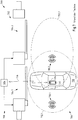
- FIG. 1 shows a schematic plan view of an embodiment of a parking system 100 according to the present application.
- the illustrated parking system includes an access arrangement 102 having an access device 104. It is understood that according to other variants of the application, multiple access arrangements and / or multiple access devices may be provided.
- the parking system 100 can be used in particular in parking devices, such as parking lots or parking garages.
- the access device 104 is formed as a barrier 104 with a barrier boom 122 attached to a column 120. It is understood that other forms of access devices can be used.
- the access device 104 is configured to control the passage from a first one Area 106, in particular an access section 107 (which is arranged in the direction of travel of a vehicle in front of the access device) of the first area 106, in a further area 108. If the access device 104 is a parking garage entrance, the first area 106 in particular the uncontrolled area and the further area 108 the controlled area, in particular the parking area. If the access device 104 is a parking garage exit, it is the other way around.
- a controllable actuator 130 e.g., an electric motor
- the actuator 130 is in particular configured for moving the barrier boom 122 as a function of a drive signal.
- the parking system 100 here comprises a first local transmitting device 110 and a second local transmitting device 114.
- the first local transmitting device 110 is uniquely associated with the access device 104.
- the second local transmitting device 114 is uniquely associated with the access device 104.
- the first local transmission device 110 transmits a first transmission field 112, and the second local transmission device 114 transmits a second transmission field 116.
- each near-field transmitting device 110, 114 may be formed by a Bluetooth beacon, in particular a BLE beacon.
- the first transmission field 112 transmits at least one first access data set and the second transmission field 116 transmits at least one second access data set. It is understood that further data sets can be transmitted by the transmission fields 112, 116.
- the (unambiguous) assignment of the first transmitting device 110 and the second transmitting device 114 to the access device 104 is mapped in particular by the first access data record and the second access data record.
- the first access record may include a unique identifier that results in association with the access device 104. The same can apply to the second access record.
- the local transmission devices 110, 114 may in particular be positioned such that the access section 107 is at least partially covered by the respective transmission fields 112, 116.
- the access section 107 may be arranged in front of an access device in an inlet direction and may have predeterminable dimensions.
- access section 107 may be dimensioned such that a vehicle 118 may pass it.
- the transmission devices 110, 114 may be set such that the vehicle 118 passing the access section 107 is completely covered by the corresponding transmission fields 112, 116 at least in one section.
- an access application 134 for example a so-called app
- the first transmitting device 110 is arranged on a first side edge 109 of the access section 107 of the access device 104 and the second transmitting device 114 on a second side edge 111 of the access section 107 of the access device 104 opposite the first side edge 109.
- a control device 124 integrated in the column 120 of the access device 104 is arranged with at least one receiving module 126 and at least one control module 128.
- Each of the first local transmitting device 110 and the second local transmitting device 114 broadly transmits the first and second transmitting fields 112, 116, respectively. Due to the selected positioning of the local transmitters 110, 114, a vehicle 118 approaching the access device 104 via the approach section 107 must pass the two transmission fields 112, 116 such that these transmission fields 112, 116 are received by the mobile terminal 132 located in the vehicle 118.
- the access application 134 installed on the mobile terminal 132 comprises processing means for generating an access message and causing the access message to be sent over a wireless communication channel 136 (e.g., another local or far field such as a mobile network).
- the access message may include at least a third access record corresponding to the first received access record and the second received access record (e.g., an evaluation record comprising information about the particular access device and / or the first and second access records themselves).
- the access message may include an identifier, in particular unambiguously assigned to the mobile terminal 132 and / or the user of the mobile terminal 132. A more detailed exemplary description is provided below.
- the access message may be received by the receiving module 126 and, for example, evaluated by the controller 124.
- the control module 128 is set up in particular for driving the specific access device 104 depending on the evaluation result.
- a suitable drive signal is transmitted to the actuator 130.
- the control can preferably depend on an evaluation of the above identifier.
- the drive can cause an opening (or closing) of the access device 104. In a reliable and user-friendly way, the parking system 100 can be operated.
- FIG. 2 shows a further embodiment of a parking system 200 according to the present application.
- FIG. 1 shows a further embodiment of a parking system 200 according to the present application.
- FIG. 1 shows essentially only the differences from the exemplary embodiment.
- the parking system 200 reference is made to the above statements.
- the presentation of vehicles and mobile devices was omitted for the sake of clarity.
- the illustrated parking system 200 comprises an access arrangement 202 having at least two adjacent access devices 204.1, 204.2. It is understood that two or more access arrangements may be provided.
- Each access device 204.1, 204.2 is assigned a first transmission device 210.1, 210.2 and a second transmission device 214.1, 214.2 (unambiguously) in the manner described above.
- each access device 204.1, 204.2 additionally has a vehicle detection device 242.1, 242.2 assigned to it.
- vehicle detection device 242.1, 242.2 assigned to it.
- induction loops 242.1, 242.2 are provided in the present case.
- parking system 200 additionally includes a local computing device 244 (eg, a cell computer).
- the local computing device 244 may be located in particular in the parking device, but separate from the access device 204.
- the illustrated local computing device 244 includes a controller 224 having a receiving module 226, a control module 228, and an evaluating device 246.
- the illustrated evaluating device 246 is configured to determine the associated access device based at least on the received first access record and the received second access record as more closely described below will be explained.
- the evaluation device 246 (also) form the evaluation module 246, which is used to determine the presence of a vehicle in the area Vehicle detection device 242.1, 242.2 is set up. In particular, it may be determined whether in the particular access device (in particular at the same time) a vehicle is detected by the corresponding vehicle detection device 242.1, 242.2.
- the local computing device 246 may be connected to a remote central computing device 248 (e.g., one or more servers of a so-called back office).
- the central computing device 248 may bill for parking operations and / or check the authorization of users before or after entry (and / or exit).
- user accounts with data of users identifiers, billing data (eg credit card data or other account data) may be stored in a database of the central computing device 248 and used for the authenticity check and / or billing, for example, a received identifier of a user / mobile terminal
- the central computing device 248 may be set up to manage a plurality of parking devices (eg, each with local computing devices).
- the illustrated local computing device 246 is further connected via a network 240 to the vehicle detection devices 242.1, 242.2 and the actuators 230 of the access devices 204.1, 204.2.
- the control module 228, in the manner described above, can actuate an access device 204, which is determined in an evaluation step, to clear the passage.
- the function of a local computing device may be at least partially integrated in the central and remote computing device 248.
- each transmitting device 210, 214 may comprise a directional antenna.
- optional (electromagnetic) shielding between the adjoining side edges 211.1, 209.2 of two adjacently arranged access devices 204.1, 204.2 be arranged.
- FIG. 3 shows a schematic view of an embodiment of a mobile terminal 332 according to the present application.
- the mobile terminal 332 is distinguished in particular by an access application 334 according to the application, in particular a computer program installed on the mobile terminal 332.
- the access application 334 comprises a receiving means 350 arranged to receive received access records (described above). These are processed by a processing means 352.
- the access application 334 in particular the processing means 352, may include an evaluation device 354 described above.
- the processing means 352 is in particular configured to generate an access message based on the access records, in particular based on an evaluation result.
- an access message can be generated with a third access data record, eg an evaluation data record containing information about the particular access device and / or the first and second access data set itself.
- the access message may comprise a further first (or second) access record. This is for example in FIG. 2 indicated (see in particular transmission fields 212.2, 216.1, each of which extend into the adjacent access section 207.1 and 207.2).
- the access message may include a (unique) identifier of the mobile terminal 332 and / or the user of the mobile terminal 332.
- exemplary and non-terminating identifiers are user names, mobile terminal number 332, an International Mobile Station Equipment Identity (IMEI) number of the mobile terminal 332, a MAC (Media Access Control) address of the mobile terminal 332, a credit card number, and / or a SIM (Subscriber Identity Module).
- IMEI International Mobile Station Equipment Identity
- MAC Media Access Control
- SIM Subscriber Identity Module
- the access application 334 comprises a detection means 354, arranged for detecting the (current) coupling state of the mobile terminal 332 with a coupling device of the vehicle.
- the coupling device may be, for example, a hands-free device of the vehicle or a similar device.
- the coupling device may be a parking element (e.g., OBD2 dongle).
- Such coupling devices may require a one-time pairing. Subsequently, the coupling between the devices takes place automatically (with activated interfaces, for example Bluetooth). A corresponding coupling can be detected by the detection means 354. Based on the detected coupling condition, the processing means 352 may generate a status message with a corresponding status record.
- the processing means 352 can effect a transmission of the status message by the mobile terminal 332.
- FIG. 4 shows a schematic view of another embodiment of a parking system 400. To avoid repetition below essentially only the differences from the embodiments after FIG. 1 and 2 described. For the other components of the parking system 400, reference is made to the above statements. In addition, for the sake of clarity, the presentation of vehicles, mobile terminals, access devices, first and second near-field local transmission devices, etc. has been dispensed with.
- the parking system 400 comprises a parking device 460 in the form of a parking garage 460.
- the arrangement of an access arrangement 402 (for example in the form of the FIG Access arrangement 202) at an access of the parking device 460.
- the access can be reached via a road 462.
- the illustrated parking system 400 comprises a plurality of third transmission devices 464.1, 464.3, which are arranged at a predeterminable distance from the access arrangement 402.
- each of the third transmission devices 464.1, 464.3 is assigned to the access arrangement 402 (uniquely).
- a third transmitting device 464.1, 464.3 in particular a local transmitting device 464.1, 464.3, is set up to transmit a third transmitting field 466.1, 466.2.
- the third transmission devices 464.1, 464.3 can in particular be positioned in such a way that a vehicle which will park in the parking device 460 must (in any case) pass a third transmission field 466.1, 466.2 beforehand.
- the third transmission field 466.1, 466.2 comprises an activation data record for activating an access application (eg access application 334) installed on a mobile terminal.
- the activation data set can in particular comprise a UUID (eg according to the iBeacon standard) and so-called major and minor data (eg according to the iBeacon standard).
- the UUID data may be selected so that a mobile terminal recognizes the third transmission field 466.1, 466.2 as originating from an iBeacon.
- the major and minor data may be used to represent receive information in the form of a ServiceUUID of the first local sending device and the second local sending device.
- the access application After receiving the activation data record, in particular the access application can be started on the mobile terminal and in particular configured.
- the access application Upon receipt of the activation record, the access application in particular knows after which service UUIDs it must scan to receive and process first and second send fields. Due to an assignment to the access arrangement 402, the third transmission field 466.1, 466.2 can be correspondingly matched to the first transmission fields and second transmission fields.
- corresponding third transmission devices can be provided in front of the exits of the parking device 460 within the parking device 460.
- a first step 501 at least one first transmission field is transmitted by a first local transmission device (at least almost continuously).
- step 502 at least one second transmission field is transmitted by a second local transmission device (at least almost continuously).
- Steps 501 and 502 may preferably be performed in parallel. Both local transmitters are associated with the same access device.
- the associated access device can be determined based at least on the first (from a mobile terminal) received access record and the second (from the mobile terminal) received access record. In particular, this can be used to determine in front of which access device the vehicle, comprising the mobile terminal, is located.
- the evaluation step will be described in more detail below.
- a passage through the particular access device may be enabled by driving the corresponding access device, at least based on the evaluation result of the evaluation step.
- FIG. 6 shows another diagram of an embodiment of a method according to the present application.
- the illustrated method describes the determination of the access device in more detail.
- the mobile terminal receives at least two in step 601 (different) access records.
- the mobile terminal may preferably according to the embodiment in FIG. 3 be formed.
- all received first and second access records can be obtained from the receiving means of the access application.
- the access application may have previously been activated or woken up by a third transmission field (cf. Fig. 4 ).
- the method may be continued according to steps 602 and 603 or with steps 604 and 605.
- the processing module may in particular cause the generation of an access message and its transmission by the mobile terminal.
- the access message may include as third access record all previously received first and second access records.
- the received first and second access records can be transmitted from the mobile terminal in the form of an access message, for example to a control device.
- the access message may additionally comprise at least one (unique) identifier of the mobile terminal and / or the user of the mobile terminal, and in particular a status data record about a coupling state of the mobile terminal.
- an access message can also consist of several partial access messages depending on the size of the amount of data to be transmitted. It is further understood that an access message may include other data, such as e.g. a timestamp, a checksum, and the like.
- a control device can receive the access message and evaluate it by means of an evaluation device (step 603).
- the evaluation device can evaluate the first and second access data records. In particular, it can be checked from which first and second local transmission devices the received access data records were sent out and in particular to which access device these local transmission devices are assigned.
- a first access record has a functional relationship with a second access record (see, for example, formula a) when the corresponding local senders are associated with the same access device.
- the evaluation result can then in particular unambiguously specify the correct access device.
- the procedure in steps 604 and 605 can be as follows: First of all, the evaluation step (see step 603) can be carried out in step 604 by an evaluation device of the terminal.
- the evaluation may be performed by the mobile terminal receiving the access records.
- an access message with a third access record can be generated by the processing means of the terminal.
- the third access data set may include the evaluation result (see formula b).
- the access message may include other records.
- the processing means may effect the transmission of the access message by the mobile terminal.
- At least one status record of the access messages can be checked by the control device. For example, two access messages may be received with identifiers from different mobile terminals. The evaluations (see step 603 or 604) may result in the same access device.
- a mobile terminal can be determined depending on the respective coupling conditions. If, for example, one of the two access messages indicates that a mobile terminal is currently coupled to a coupling device of the vehicle, this terminal is determined and the associated access message with the identifier is further processed by this terminal (as described below). The other access message can be ignored and / or deleted, for example.
- steps 603 and 606 can be performed at least partially in parallel and / or by the same evaluation device.
- a mobile terminal can be located within the transmission range of a first and a second transmission field without the mobile terminal being in a vehicle.
- a user can run with a corresponding mobile terminal through the corresponding send fields.
- step 607 may determine the actual presence of a vehicle in the access section before the particular access device.
- a detection signal of the vehicle detection device can be evaluated in step 607. If this evaluation shows that no vehicle is present at the particular access device, the procedure can be aborted.
- the method may proceed to optional step 608.
- the evaluation in a simple case may only include the presence or absence of a detection signal.
- a received identifier of the mobile terminal and / or of the user of the mobile terminal provision may be made, in particular, to check (locally) a received identifier of the mobile terminal and / or of the user of the mobile terminal (step 608). For example, a negative list of unauthorized identifiers may be stored in a local computing device.
- the received identifier can be compared with the stored identifiers. If the identifier corresponds to a stored identifier, then the method can be aborted. The access device remains locked (or locked). If the identifier does not correspond to a stored identifier, the method may proceed to step 609.
- this step can also be carried out beforehand, for example before step 606. It goes without saying that this step can also be carried out with a positive list: If the identifier corresponds to an identifier stored in the positive list, the method is continued, otherwise it is aborted.
- a check by the remotely located central computing device can take place.
- the computing device may compare at least the identifier of the mobile terminal and / or the user of the mobile terminal with stored user data.
- a comparison can be made with the valid for the parking system identifiers that can be stored in the central computing device, for example, due to previous registration steps.
- registration of the user / mobile terminal with the central computing device may be required.
- a unique identifier may be set and stored both in a memory device of the mobile terminal (if not already present) and in a memory device of the central computing device.
- billing data may be stored in the registration step.
- an optional billing step may follow.
- This billing step can also be done before the exit.
- the exit in particular before a release, to be checked whether a payment has actually been made.
- the devices / devices may have appropriate means (processors, memory, interfaces, etc.).
Landscapes
- Physics & Mathematics (AREA)
- General Physics & Mathematics (AREA)
- Business, Economics & Management (AREA)
- Finance (AREA)
- Engineering & Computer Science (AREA)
- Computer Networks & Wireless Communication (AREA)
- Signal Processing (AREA)
- Traffic Control Systems (AREA)
- Management, Administration, Business Operations System, And Electronic Commerce (AREA)
Priority Applications (2)
| Application Number | Priority Date | Filing Date | Title |
|---|---|---|---|
| EP17172461.0A EP3407307B1 (fr) | 2017-05-23 | 2017-05-23 | Système de stationnement et son procédé de fonctionnement |
| US15/984,511 US10417853B2 (en) | 2017-05-23 | 2018-05-21 | Parking system and method for operating a parking system |
Applications Claiming Priority (1)
| Application Number | Priority Date | Filing Date | Title |
|---|---|---|---|
| EP17172461.0A EP3407307B1 (fr) | 2017-05-23 | 2017-05-23 | Système de stationnement et son procédé de fonctionnement |
Publications (2)
| Publication Number | Publication Date |
|---|---|
| EP3407307A1 true EP3407307A1 (fr) | 2018-11-28 |
| EP3407307B1 EP3407307B1 (fr) | 2022-05-18 |
Family
ID=58778898
Family Applications (1)
| Application Number | Title | Priority Date | Filing Date |
|---|---|---|---|
| EP17172461.0A Not-in-force EP3407307B1 (fr) | 2017-05-23 | 2017-05-23 | Système de stationnement et son procédé de fonctionnement |
Country Status (2)
| Country | Link |
|---|---|
| US (1) | US10417853B2 (fr) |
| EP (1) | EP3407307B1 (fr) |
Cited By (1)
| Publication number | Priority date | Publication date | Assignee | Title |
|---|---|---|---|---|
| EP3910603A1 (fr) | 2020-05-15 | 2021-11-17 | Scheidt & Bachmann GmbH | Système de stationnement |
Families Citing this family (3)
| Publication number | Priority date | Publication date | Assignee | Title |
|---|---|---|---|---|
| US20190304220A1 (en) * | 2018-03-30 | 2019-10-03 | Total Automation Group, Inc. | Systems and methods for monitoring and controlling access to a secured area |
| DE102020004860A1 (de) * | 2020-08-10 | 2022-02-10 | Scheidt & Bachmann Gmbh | Verfahren zum Betreiben einer Parkvorrichtung |
| DE102022112554A1 (de) | 2022-05-19 | 2023-11-23 | Scheidt & Bachmann Gmbh | Parksystem |
Citations (5)
| Publication number | Priority date | Publication date | Assignee | Title |
|---|---|---|---|---|
| EP2312537A1 (fr) * | 2009-10-15 | 2011-04-20 | Alcatel Lucent | Dispositif et procédé d'initiation à distance d'un service de stationnement |
| DE102014018190A1 (de) * | 2014-12-09 | 2015-07-16 | Daimler Ag | Zugangskontrollsystem für einen Verkehrsraum, Parkraummanagementsystem und Zugangskontrollverfahren für einen Verkehrsraum |
| WO2016123662A1 (fr) * | 2015-02-02 | 2016-08-11 | Tma Capital Australia Pty Ltd | Système, procédé et programme informatique pour système de commande d'accès |
| US20170055157A1 (en) * | 2015-08-17 | 2017-02-23 | Bytemark, Inc. | Short range wireless translation methods and systems for hands-free fare validation |
| WO2017063089A1 (fr) * | 2015-10-16 | 2017-04-20 | Imperial Parking Canada Corporation | Procédé et système de gestion de stationnement par double vérification de position |
Family Cites Families (3)
| Publication number | Priority date | Publication date | Assignee | Title |
|---|---|---|---|---|
| US6990444B2 (en) * | 2001-01-17 | 2006-01-24 | International Business Machines Corporation | Methods, systems, and computer program products for securely transforming an audio stream to encoded text |
| JP4613969B2 (ja) * | 2008-03-03 | 2011-01-19 | ソニー株式会社 | 通信装置、及び通信方法 |
| US10019860B1 (en) * | 2017-07-25 | 2018-07-10 | Amazon Technologies, Inc. | Remote access authentication and authorization |
-
2017
- 2017-05-23 EP EP17172461.0A patent/EP3407307B1/fr not_active Not-in-force
-
2018
- 2018-05-21 US US15/984,511 patent/US10417853B2/en active Active
Patent Citations (5)
| Publication number | Priority date | Publication date | Assignee | Title |
|---|---|---|---|---|
| EP2312537A1 (fr) * | 2009-10-15 | 2011-04-20 | Alcatel Lucent | Dispositif et procédé d'initiation à distance d'un service de stationnement |
| DE102014018190A1 (de) * | 2014-12-09 | 2015-07-16 | Daimler Ag | Zugangskontrollsystem für einen Verkehrsraum, Parkraummanagementsystem und Zugangskontrollverfahren für einen Verkehrsraum |
| WO2016123662A1 (fr) * | 2015-02-02 | 2016-08-11 | Tma Capital Australia Pty Ltd | Système, procédé et programme informatique pour système de commande d'accès |
| US20170055157A1 (en) * | 2015-08-17 | 2017-02-23 | Bytemark, Inc. | Short range wireless translation methods and systems for hands-free fare validation |
| WO2017063089A1 (fr) * | 2015-10-16 | 2017-04-20 | Imperial Parking Canada Corporation | Procédé et système de gestion de stationnement par double vérification de position |
Cited By (2)
| Publication number | Priority date | Publication date | Assignee | Title |
|---|---|---|---|---|
| EP3910603A1 (fr) | 2020-05-15 | 2021-11-17 | Scheidt & Bachmann GmbH | Système de stationnement |
| DE102020113243A1 (de) | 2020-05-15 | 2021-11-18 | Scheidt & Bachmann Gmbh | Parksystem |
Also Published As
| Publication number | Publication date |
|---|---|
| EP3407307B1 (fr) | 2022-05-18 |
| US10417853B2 (en) | 2019-09-17 |
| US20180342123A1 (en) | 2018-11-29 |
Similar Documents
| Publication | Publication Date | Title |
|---|---|---|
| EP3695389B1 (fr) | Système de communication d'un véhicule | |
| DE102015201420A1 (de) | Parkraum-Zufahrtskontrollsystem sowie Verfahren zur Kontrolle der Zufahrt in einen Parkraum | |
| EP3580731A1 (fr) | Procédé de fonctionnement d'un système d'authentification et système d'authentification | |
| EP3407307B1 (fr) | Système de stationnement et son procédé de fonctionnement | |
| EP2833329B1 (fr) | Procédé et système destinés à améliorer un processus de stationnement payant de véhicule dans une installation de parking, programme informatique et produit-programme informatique | |
| DE102023100511B3 (de) | Verfahren zum Authentifizieren eines mobilen ID-Gebers, ID-Geber sowie System | |
| WO2014206611A1 (fr) | Système pour détecter des composants d'un véhicule | |
| EP3261060B1 (fr) | Procédés de contrôle d'accès dans un système de contrôle d'accès pour personnes ou véhicules automobiles et système de contrôle d'accès | |
| DE102017207830A1 (de) | Vorrichtung und Verfahren zur Bestimmung einer Distanz | |
| DE102007051961B4 (de) | Einrichtung zum Überwachen von sich in einem ausgezeichneten Bereich, insbesondere einem Werksgelände oder einem Parkhaus befindlichen Fahrzeugen | |
| EP3955219A2 (fr) | Procédé de fonctionnement d'un dispositif de stationnement | |
| DE102018207658B4 (de) | Verfahren zum Verarbeiten von Sensordaten, Anordnung zur Verarbeitung von Sensordaten, Anordnung zum Verarbeiten einer Anfrage eines Ego-Fahrzeugs für ein weiteres Fahrzeug, Rechner zum Verarbeiten von Sensordaten sowie Rechner zum Verarbeiten einer Anfrage eines Ego-Fahrzeugs für ein weiteres Fahrzeug | |
| WO2017129188A1 (fr) | Procédé et système de contrôle d'accès | |
| EP3910603A1 (fr) | Système de stationnement | |
| EP3809394B1 (fr) | Dispositif capteur destiné à la surveillance d'espace de stationnement | |
| EP3482384B1 (fr) | Détermination de places de stationnement libres éloignées latéralement | |
| DE102007035737A1 (de) | Verfahren zum Überprüfen einer von einem Fahrzeug ausgesendeten Positionsnachricht des Fahrzeugs und Sende- und Empfangseinrichtung zur Verwendung in einem Fahrzeug | |
| WO2018072930A1 (fr) | Système d'authentification sans clé pour véhicule automobile, procédé d'authentification pour pouvoir faire marcher un véhicule automobile et kit de rééquipement | |
| EP3886057A1 (fr) | Méthode pour la transmission de données précises sur la position | |
| EP3355249A1 (fr) | Procédé d'attribution d'un véhicule à un lieu de stationnement, installation de traitement de données et véhicule | |
| EP4595027A1 (fr) | Procédé d'interaction avec un système de péage, et véhicule | |
| EP3425610B1 (fr) | Procédé et système pour détection de véhicules dans un parking | |
| EP3174015B1 (fr) | Reconnaissance d'erreurs dans une unité embarquée à bord d'une véhicule d'un système de péage | |
| DE102015209839A1 (de) | Vorrichtung, System und Verfahren zum Bestimmen einer Position eines mobilen Geräts während eines Bezahlvorgangs | |
| DE102024130923A1 (de) | Verwaltungssystem für parkplätze und verfahren |
Legal Events
| Date | Code | Title | Description |
|---|---|---|---|
| PUAI | Public reference made under article 153(3) epc to a published international application that has entered the european phase |
Free format text: ORIGINAL CODE: 0009012 |
|
| STAA | Information on the status of an ep patent application or granted ep patent |
Free format text: STATUS: REQUEST FOR EXAMINATION WAS MADE |
|
| 17P | Request for examination filed |
Effective date: 20180327 |
|
| AK | Designated contracting states |
Kind code of ref document: A1 Designated state(s): AL AT BE BG CH CY CZ DE DK EE ES FI FR GB GR HR HU IE IS IT LI LT LU LV MC MK MT NL NO PL PT RO RS SE SI SK SM TR |
|
| AX | Request for extension of the european patent |
Extension state: BA ME |
|
| RBV | Designated contracting states (corrected) |
Designated state(s): AL AT BE BG CH CY CZ DE DK EE ES FI FR GB GR HR HU IE IS IT LI LT LU LV MC MK MT NL NO PL PT RO RS SE SI SK SM TR |
|
| STAA | Information on the status of an ep patent application or granted ep patent |
Free format text: STATUS: EXAMINATION IS IN PROGRESS |
|
| 17Q | First examination report despatched |
Effective date: 20190611 |
|
| GRAP | Despatch of communication of intention to grant a patent |
Free format text: ORIGINAL CODE: EPIDOSNIGR1 |
|
| STAA | Information on the status of an ep patent application or granted ep patent |
Free format text: STATUS: GRANT OF PATENT IS INTENDED |
|
| INTG | Intention to grant announced |
Effective date: 20211203 |
|
| GRAS | Grant fee paid |
Free format text: ORIGINAL CODE: EPIDOSNIGR3 |
|
| GRAA | (expected) grant |
Free format text: ORIGINAL CODE: 0009210 |
|
| STAA | Information on the status of an ep patent application or granted ep patent |
Free format text: STATUS: THE PATENT HAS BEEN GRANTED |
|
| AK | Designated contracting states |
Kind code of ref document: B1 Designated state(s): AL AT BE BG CH CY CZ DE DK EE ES FI FR GB GR HR HU IE IS IT LI LT LU LV MC MK MT NL NO PL PT RO RS SE SI SK SM TR |
|
| REG | Reference to a national code |
Ref country code: GB Ref legal event code: FG4D Free format text: NOT ENGLISH |
|
| REG | Reference to a national code |
Ref country code: CH Ref legal event code: EP |
|
| REG | Reference to a national code |
Ref country code: IE Ref legal event code: FG4D Free format text: LANGUAGE OF EP DOCUMENT: GERMAN |
|
| REG | Reference to a national code |
Ref country code: DE Ref legal event code: R096 Ref document number: 502017013195 Country of ref document: DE |
|
| REG | Reference to a national code |
Ref country code: AT Ref legal event code: REF Ref document number: 1493598 Country of ref document: AT Kind code of ref document: T Effective date: 20220615 |
|
| REG | Reference to a national code |
Ref country code: LT Ref legal event code: MG9D |
|
| REG | Reference to a national code |
Ref country code: NL Ref legal event code: MP Effective date: 20220518 |
|
| PG25 | Lapsed in a contracting state [announced via postgrant information from national office to epo] |
Ref country code: SE Free format text: LAPSE BECAUSE OF FAILURE TO SUBMIT A TRANSLATION OF THE DESCRIPTION OR TO PAY THE FEE WITHIN THE PRESCRIBED TIME-LIMIT Effective date: 20220518 Ref country code: PT Free format text: LAPSE BECAUSE OF FAILURE TO SUBMIT A TRANSLATION OF THE DESCRIPTION OR TO PAY THE FEE WITHIN THE PRESCRIBED TIME-LIMIT Effective date: 20220919 Ref country code: NO Free format text: LAPSE BECAUSE OF FAILURE TO SUBMIT A TRANSLATION OF THE DESCRIPTION OR TO PAY THE FEE WITHIN THE PRESCRIBED TIME-LIMIT Effective date: 20220818 Ref country code: NL Free format text: LAPSE BECAUSE OF FAILURE TO SUBMIT A TRANSLATION OF THE DESCRIPTION OR TO PAY THE FEE WITHIN THE PRESCRIBED TIME-LIMIT Effective date: 20220518 Ref country code: LT Free format text: LAPSE BECAUSE OF FAILURE TO SUBMIT A TRANSLATION OF THE DESCRIPTION OR TO PAY THE FEE WITHIN THE PRESCRIBED TIME-LIMIT Effective date: 20220518 Ref country code: HR Free format text: LAPSE BECAUSE OF FAILURE TO SUBMIT A TRANSLATION OF THE DESCRIPTION OR TO PAY THE FEE WITHIN THE PRESCRIBED TIME-LIMIT Effective date: 20220518 Ref country code: GR Free format text: LAPSE BECAUSE OF FAILURE TO SUBMIT A TRANSLATION OF THE DESCRIPTION OR TO PAY THE FEE WITHIN THE PRESCRIBED TIME-LIMIT Effective date: 20220819 Ref country code: FI Free format text: LAPSE BECAUSE OF FAILURE TO SUBMIT A TRANSLATION OF THE DESCRIPTION OR TO PAY THE FEE WITHIN THE PRESCRIBED TIME-LIMIT Effective date: 20220518 Ref country code: ES Free format text: LAPSE BECAUSE OF FAILURE TO SUBMIT A TRANSLATION OF THE DESCRIPTION OR TO PAY THE FEE WITHIN THE PRESCRIBED TIME-LIMIT Effective date: 20220518 Ref country code: BG Free format text: LAPSE BECAUSE OF FAILURE TO SUBMIT A TRANSLATION OF THE DESCRIPTION OR TO PAY THE FEE WITHIN THE PRESCRIBED TIME-LIMIT Effective date: 20220818 |
|
| PG25 | Lapsed in a contracting state [announced via postgrant information from national office to epo] |
Ref country code: RS Free format text: LAPSE BECAUSE OF FAILURE TO SUBMIT A TRANSLATION OF THE DESCRIPTION OR TO PAY THE FEE WITHIN THE PRESCRIBED TIME-LIMIT Effective date: 20220518 Ref country code: PL Free format text: LAPSE BECAUSE OF FAILURE TO SUBMIT A TRANSLATION OF THE DESCRIPTION OR TO PAY THE FEE WITHIN THE PRESCRIBED TIME-LIMIT Effective date: 20220518 Ref country code: LV Free format text: LAPSE BECAUSE OF FAILURE TO SUBMIT A TRANSLATION OF THE DESCRIPTION OR TO PAY THE FEE WITHIN THE PRESCRIBED TIME-LIMIT Effective date: 20220518 Ref country code: IS Free format text: LAPSE BECAUSE OF FAILURE TO SUBMIT A TRANSLATION OF THE DESCRIPTION OR TO PAY THE FEE WITHIN THE PRESCRIBED TIME-LIMIT Effective date: 20220918 |
|
| REG | Reference to a national code |
Ref country code: CH Ref legal event code: PL |
|
| REG | Reference to a national code |
Ref country code: BE Ref legal event code: MM Effective date: 20220531 |
|
| PG25 | Lapsed in a contracting state [announced via postgrant information from national office to epo] |
Ref country code: SM Free format text: LAPSE BECAUSE OF FAILURE TO SUBMIT A TRANSLATION OF THE DESCRIPTION OR TO PAY THE FEE WITHIN THE PRESCRIBED TIME-LIMIT Effective date: 20220518 Ref country code: SK Free format text: LAPSE BECAUSE OF FAILURE TO SUBMIT A TRANSLATION OF THE DESCRIPTION OR TO PAY THE FEE WITHIN THE PRESCRIBED TIME-LIMIT Effective date: 20220518 Ref country code: RO Free format text: LAPSE BECAUSE OF FAILURE TO SUBMIT A TRANSLATION OF THE DESCRIPTION OR TO PAY THE FEE WITHIN THE PRESCRIBED TIME-LIMIT Effective date: 20220518 Ref country code: LU Free format text: LAPSE BECAUSE OF NON-PAYMENT OF DUE FEES Effective date: 20220523 Ref country code: LI Free format text: LAPSE BECAUSE OF NON-PAYMENT OF DUE FEES Effective date: 20220531 Ref country code: EE Free format text: LAPSE BECAUSE OF FAILURE TO SUBMIT A TRANSLATION OF THE DESCRIPTION OR TO PAY THE FEE WITHIN THE PRESCRIBED TIME-LIMIT Effective date: 20220518 Ref country code: DK Free format text: LAPSE BECAUSE OF FAILURE TO SUBMIT A TRANSLATION OF THE DESCRIPTION OR TO PAY THE FEE WITHIN THE PRESCRIBED TIME-LIMIT Effective date: 20220518 Ref country code: CZ Free format text: LAPSE BECAUSE OF FAILURE TO SUBMIT A TRANSLATION OF THE DESCRIPTION OR TO PAY THE FEE WITHIN THE PRESCRIBED TIME-LIMIT Effective date: 20220518 Ref country code: CH Free format text: LAPSE BECAUSE OF NON-PAYMENT OF DUE FEES Effective date: 20220531 |
|
| REG | Reference to a national code |
Ref country code: DE Ref legal event code: R097 Ref document number: 502017013195 Country of ref document: DE |
|
| PG25 | Lapsed in a contracting state [announced via postgrant information from national office to epo] |
Ref country code: MC Free format text: LAPSE BECAUSE OF FAILURE TO SUBMIT A TRANSLATION OF THE DESCRIPTION OR TO PAY THE FEE WITHIN THE PRESCRIBED TIME-LIMIT Effective date: 20220518 |
|
| PLBE | No opposition filed within time limit |
Free format text: ORIGINAL CODE: 0009261 |
|
| STAA | Information on the status of an ep patent application or granted ep patent |
Free format text: STATUS: NO OPPOSITION FILED WITHIN TIME LIMIT |
|
| PG25 | Lapsed in a contracting state [announced via postgrant information from national office to epo] |
Ref country code: AL Free format text: LAPSE BECAUSE OF FAILURE TO SUBMIT A TRANSLATION OF THE DESCRIPTION OR TO PAY THE FEE WITHIN THE PRESCRIBED TIME-LIMIT Effective date: 20220518 |
|
| 26N | No opposition filed |
Effective date: 20230221 |
|
| GBPC | Gb: european patent ceased through non-payment of renewal fee |
Effective date: 20220818 |
|
| PG25 | Lapsed in a contracting state [announced via postgrant information from national office to epo] |
Ref country code: IE Free format text: LAPSE BECAUSE OF NON-PAYMENT OF DUE FEES Effective date: 20220523 Ref country code: FR Free format text: LAPSE BECAUSE OF NON-PAYMENT OF DUE FEES Effective date: 20220718 |
|
| PG25 | Lapsed in a contracting state [announced via postgrant information from national office to epo] |
Ref country code: SI Free format text: LAPSE BECAUSE OF FAILURE TO SUBMIT A TRANSLATION OF THE DESCRIPTION OR TO PAY THE FEE WITHIN THE PRESCRIBED TIME-LIMIT Effective date: 20220518 Ref country code: BE Free format text: LAPSE BECAUSE OF NON-PAYMENT OF DUE FEES Effective date: 20220531 |
|
| P01 | Opt-out of the competence of the unified patent court (upc) registered |
Effective date: 20230427 |
|
| REG | Reference to a national code |
Ref country code: AT Ref legal event code: MM01 Ref document number: 1493598 Country of ref document: AT Kind code of ref document: T Effective date: 20220523 |
|
| PG25 | Lapsed in a contracting state [announced via postgrant information from national office to epo] |
Ref country code: AT Free format text: LAPSE BECAUSE OF NON-PAYMENT OF DUE FEES Effective date: 20220523 |
|
| PGFP | Annual fee paid to national office [announced via postgrant information from national office to epo] |
Ref country code: DE Payment date: 20230523 Year of fee payment: 7 |
|
| PG25 | Lapsed in a contracting state [announced via postgrant information from national office to epo] |
Ref country code: GB Free format text: LAPSE BECAUSE OF NON-PAYMENT OF DUE FEES Effective date: 20220818 |
|
| PG25 | Lapsed in a contracting state [announced via postgrant information from national office to epo] |
Ref country code: IT Free format text: LAPSE BECAUSE OF FAILURE TO SUBMIT A TRANSLATION OF THE DESCRIPTION OR TO PAY THE FEE WITHIN THE PRESCRIBED TIME-LIMIT Effective date: 20220518 |
|
| PG25 | Lapsed in a contracting state [announced via postgrant information from national office to epo] |
Ref country code: HU Free format text: LAPSE BECAUSE OF FAILURE TO SUBMIT A TRANSLATION OF THE DESCRIPTION OR TO PAY THE FEE WITHIN THE PRESCRIBED TIME-LIMIT; INVALID AB INITIO Effective date: 20170523 |
|
| PG25 | Lapsed in a contracting state [announced via postgrant information from national office to epo] |
Ref country code: MK Free format text: LAPSE BECAUSE OF FAILURE TO SUBMIT A TRANSLATION OF THE DESCRIPTION OR TO PAY THE FEE WITHIN THE PRESCRIBED TIME-LIMIT Effective date: 20220511 Ref country code: CY Free format text: LAPSE BECAUSE OF FAILURE TO SUBMIT A TRANSLATION OF THE DESCRIPTION OR TO PAY THE FEE WITHIN THE PRESCRIBED TIME-LIMIT Effective date: 20220511 |
|
| PG25 | Lapsed in a contracting state [announced via postgrant information from national office to epo] |
Ref country code: MT Free format text: LAPSE BECAUSE OF FAILURE TO SUBMIT A TRANSLATION OF THE DESCRIPTION OR TO PAY THE FEE WITHIN THE PRESCRIBED TIME-LIMIT Effective date: 20220511 |
|
| PG25 | Lapsed in a contracting state [announced via postgrant information from national office to epo] |
Ref country code: BG Free format text: LAPSE BECAUSE OF FAILURE TO SUBMIT A TRANSLATION OF THE DESCRIPTION OR TO PAY THE FEE WITHIN THE PRESCRIBED TIME-LIMIT Effective date: 20220518 |
|
| PG25 | Lapsed in a contracting state [announced via postgrant information from national office to epo] |
Ref country code: BG Free format text: LAPSE BECAUSE OF FAILURE TO SUBMIT A TRANSLATION OF THE DESCRIPTION OR TO PAY THE FEE WITHIN THE PRESCRIBED TIME-LIMIT Effective date: 20220518 |
|
| REG | Reference to a national code |
Ref country code: DE Ref legal event code: R119 Ref document number: 502017013195 Country of ref document: DE |
|
| PG25 | Lapsed in a contracting state [announced via postgrant information from national office to epo] |
Ref country code: DE Free format text: LAPSE BECAUSE OF NON-PAYMENT OF DUE FEES Effective date: 20241203 |
|
| PG25 | Lapsed in a contracting state [announced via postgrant information from national office to epo] |
Ref country code: TR Free format text: LAPSE BECAUSE OF FAILURE TO SUBMIT A TRANSLATION OF THE DESCRIPTION OR TO PAY THE FEE WITHIN THE PRESCRIBED TIME-LIMIT Effective date: 20220518 |