EP3407363A1 - Verfahren zur herstellung eines ionenleiters - Google Patents
Verfahren zur herstellung eines ionenleiters Download PDFInfo
- Publication number
- EP3407363A1 EP3407363A1 EP17741296.2A EP17741296A EP3407363A1 EP 3407363 A1 EP3407363 A1 EP 3407363A1 EP 17741296 A EP17741296 A EP 17741296A EP 3407363 A1 EP3407363 A1 EP 3407363A1
- Authority
- EP
- European Patent Office
- Prior art keywords
- ionic conductor
- solvent
- libh
- manufacturing
- temperature
- Prior art date
- Legal status (The legal status is an assumption and is not a legal conclusion. Google has not performed a legal analysis and makes no representation as to the accuracy of the status listed.)
- Granted
Links
Images



Classifications
-
- H—ELECTRICITY
- H01—ELECTRIC ELEMENTS
- H01M—PROCESSES OR MEANS, e.g. BATTERIES, FOR THE DIRECT CONVERSION OF CHEMICAL ENERGY INTO ELECTRICAL ENERGY
- H01M6/00—Primary cells; Manufacture thereof
- H01M6/14—Cells with non-aqueous electrolyte
- H01M6/18—Cells with non-aqueous electrolyte with solid electrolyte
-
- H—ELECTRICITY
- H01—ELECTRIC ELEMENTS
- H01B—CABLES; CONDUCTORS; INSULATORS; SELECTION OF MATERIALS FOR THEIR CONDUCTIVE, INSULATING OR DIELECTRIC PROPERTIES
- H01B1/00—Conductors or conductive bodies characterised by the conductive materials; Selection of materials as conductors
- H01B1/06—Conductors or conductive bodies characterised by the conductive materials; Selection of materials as conductors mainly consisting of other non-metallic substances
- H01B1/12—Conductors or conductive bodies characterised by the conductive materials; Selection of materials as conductors mainly consisting of other non-metallic substances organic substances
- H01B1/122—Ionic conductors
-
- C—CHEMISTRY; METALLURGY
- C01—INORGANIC CHEMISTRY
- C01D—COMPOUNDS OF ALKALI METALS, i.e. LITHIUM, SODIUM, POTASSIUM, RUBIDIUM, CAESIUM, OR FRANCIUM
- C01D15/00—Lithium compounds
-
- C—CHEMISTRY; METALLURGY
- C01—INORGANIC CHEMISTRY
- C01D—COMPOUNDS OF ALKALI METALS, i.e. LITHIUM, SODIUM, POTASSIUM, RUBIDIUM, CAESIUM, OR FRANCIUM
- C01D15/00—Lithium compounds
- C01D15/04—Halides
-
- H—ELECTRICITY
- H01—ELECTRIC ELEMENTS
- H01B—CABLES; CONDUCTORS; INSULATORS; SELECTION OF MATERIALS FOR THEIR CONDUCTIVE, INSULATING OR DIELECTRIC PROPERTIES
- H01B1/00—Conductors or conductive bodies characterised by the conductive materials; Selection of materials as conductors
- H01B1/06—Conductors or conductive bodies characterised by the conductive materials; Selection of materials as conductors mainly consisting of other non-metallic substances
-
- H—ELECTRICITY
- H01—ELECTRIC ELEMENTS
- H01B—CABLES; CONDUCTORS; INSULATORS; SELECTION OF MATERIALS FOR THEIR CONDUCTIVE, INSULATING OR DIELECTRIC PROPERTIES
- H01B1/00—Conductors or conductive bodies characterised by the conductive materials; Selection of materials as conductors
- H01B1/20—Conductive material dispersed in non-conductive organic material
-
- H—ELECTRICITY
- H01—ELECTRIC ELEMENTS
- H01B—CABLES; CONDUCTORS; INSULATORS; SELECTION OF MATERIALS FOR THEIR CONDUCTIVE, INSULATING OR DIELECTRIC PROPERTIES
- H01B13/00—Apparatus or processes specially adapted for manufacturing conductors or cables
-
- H—ELECTRICITY
- H01—ELECTRIC ELEMENTS
- H01M—PROCESSES OR MEANS, e.g. BATTERIES, FOR THE DIRECT CONVERSION OF CHEMICAL ENERGY INTO ELECTRICAL ENERGY
- H01M10/00—Secondary cells; Manufacture thereof
- H01M10/05—Accumulators with non-aqueous electrolyte
- H01M10/052—Li-accumulators
- H01M10/0525—Rocking-chair batteries, i.e. batteries with lithium insertion or intercalation in both electrodes; Lithium-ion batteries
-
- H—ELECTRICITY
- H01—ELECTRIC ELEMENTS
- H01M—PROCESSES OR MEANS, e.g. BATTERIES, FOR THE DIRECT CONVERSION OF CHEMICAL ENERGY INTO ELECTRICAL ENERGY
- H01M10/00—Secondary cells; Manufacture thereof
- H01M10/05—Accumulators with non-aqueous electrolyte
- H01M10/056—Accumulators with non-aqueous electrolyte characterised by the materials used as electrolytes, e.g. mixed inorganic/organic electrolytes
-
- H—ELECTRICITY
- H01—ELECTRIC ELEMENTS
- H01M—PROCESSES OR MEANS, e.g. BATTERIES, FOR THE DIRECT CONVERSION OF CHEMICAL ENERGY INTO ELECTRICAL ENERGY
- H01M10/00—Secondary cells; Manufacture thereof
- H01M10/05—Accumulators with non-aqueous electrolyte
- H01M10/056—Accumulators with non-aqueous electrolyte characterised by the materials used as electrolytes, e.g. mixed inorganic/organic electrolytes
- H01M10/0561—Accumulators with non-aqueous electrolyte characterised by the materials used as electrolytes, e.g. mixed inorganic/organic electrolytes the electrolyte being constituted of inorganic materials only
- H01M10/0562—Solid materials
-
- H—ELECTRICITY
- H01—ELECTRIC ELEMENTS
- H01M—PROCESSES OR MEANS, e.g. BATTERIES, FOR THE DIRECT CONVERSION OF CHEMICAL ENERGY INTO ELECTRICAL ENERGY
- H01M4/00—Electrodes
- H01M4/02—Electrodes composed of, or comprising, active material
- H01M4/13—Electrodes for accumulators with non-aqueous electrolyte, e.g. for lithium-accumulators; Processes of manufacture thereof
- H01M4/134—Electrodes based on metals, Si or alloys
-
- C—CHEMISTRY; METALLURGY
- C01—INORGANIC CHEMISTRY
- C01P—INDEXING SCHEME RELATING TO STRUCTURAL AND PHYSICAL ASPECTS OF SOLID INORGANIC COMPOUNDS
- C01P2002/00—Crystal-structural characteristics
- C01P2002/70—Crystal-structural characteristics defined by measured X-ray, neutron or electron diffraction data
-
- H—ELECTRICITY
- H01—ELECTRIC ELEMENTS
- H01M—PROCESSES OR MEANS, e.g. BATTERIES, FOR THE DIRECT CONVERSION OF CHEMICAL ENERGY INTO ELECTRICAL ENERGY
- H01M4/00—Electrodes
- H01M4/02—Electrodes composed of, or comprising, active material
- H01M2004/026—Electrodes composed of, or comprising, active material characterised by the polarity
- H01M2004/027—Negative electrodes
-
- H—ELECTRICITY
- H01—ELECTRIC ELEMENTS
- H01M—PROCESSES OR MEANS, e.g. BATTERIES, FOR THE DIRECT CONVERSION OF CHEMICAL ENERGY INTO ELECTRICAL ENERGY
- H01M4/00—Electrodes
- H01M4/02—Electrodes composed of, or comprising, active material
- H01M2004/026—Electrodes composed of, or comprising, active material characterised by the polarity
- H01M2004/028—Positive electrodes
-
- H—ELECTRICITY
- H01—ELECTRIC ELEMENTS
- H01M—PROCESSES OR MEANS, e.g. BATTERIES, FOR THE DIRECT CONVERSION OF CHEMICAL ENERGY INTO ELECTRICAL ENERGY
- H01M2300/00—Electrolytes
- H01M2300/0017—Non-aqueous electrolytes
- H01M2300/0065—Solid electrolytes
- H01M2300/0068—Solid electrolytes inorganic
-
- Y—GENERAL TAGGING OF NEW TECHNOLOGICAL DEVELOPMENTS; GENERAL TAGGING OF CROSS-SECTIONAL TECHNOLOGIES SPANNING OVER SEVERAL SECTIONS OF THE IPC; TECHNICAL SUBJECTS COVERED BY FORMER USPC CROSS-REFERENCE ART COLLECTIONS [XRACs] AND DIGESTS
- Y02—TECHNOLOGIES OR APPLICATIONS FOR MITIGATION OR ADAPTATION AGAINST CLIMATE CHANGE
- Y02E—REDUCTION OF GREENHOUSE GAS [GHG] EMISSIONS, RELATED TO ENERGY GENERATION, TRANSMISSION OR DISTRIBUTION
- Y02E60/00—Enabling technologies; Technologies with a potential or indirect contribution to GHG emissions mitigation
- Y02E60/10—Energy storage using batteries
Definitions
- the present invention relates to a method for manufacturing an ionic conductor.
- oxides and phosphate compounds have a characteristic that particles thereof are hard. Accordingly, in order to form a solid electrolyte layer by using these materials, it is generally required to perform sintering at a high temperature (600°C or higher), and it is laborious. Moreover, when using an oxide or phosphate compound as a material for a solid electrolyte layer, there is a drawback that the interface resistance between that and an active material increases. In the case of organic polymers, there is a drawback that lithium-ion conductivity at room temperature is low and the conductivity is rapidly reduced when the temperature is decreased.
- Non-Patent Document 1 the high temperature phase of LiBH 4 that is a complex hydride solid electrolyte has high lithium-ion conductivity.
- the density of LiBH 4 is low, and when using this as a solid electrolyte, a light battery can be prepared. Further, since LiBH 4 is stable even at high temperatures (for example, about 200°C), a heat-resistant battery can also be prepared.
- LiBH 4 has a problem that the lithium-ion conductivity thereof is significantly reduced at a temperature lower than 115°C that is the phase transition temperature.
- a solid electrolyte obtained by using LiBH 4 in combination with an alkali metal compound has been proposed.
- a high temperature phase of a solid solution obtained by adding LiI to LiBH 4 can be kept even at room temperature (Non-Patent Document 2 and Patent Document 1).
- a complex hydride solid electrolyte made of this solid solution is stable against metallic lithium and this metallic lithium can be used for a negative electrode, it is possible to prepare an all-solid-state battery having high capacity (Patent Document 2 and Patent Document 3).
- the objective of the present invention is to provide a manufacturing method suitable for mass production of an ionic conductor that is excellent in various characteristics including ion conductivity.
- the present inventors diligently made researches in order to solve the above-described problem, and obtained an unexpected finding that an ionic conductor that is excellent in various characteristics including ion conductivity, like ionic conductors obtained by a conventional melt-mixing method or mechanical milling method, can be obtained by mixing LiBH 4 and a lithium halide using a solvent and removing the solvent at a temperature within a specific range. Moreover, the present inventors found that this method can be applied to mass production. The present invention was achieved based on the above-described findings.
- the present invention has characteristics described below.
- an ionic conductor which includes: mixing, using a solvent, LiBH 4 and a lithium halide represented by formula (1): LiX (1) wherein X represents one selected from the group consisting of halogen atoms; and removing the solvent at 60 to 280°C.
- a high temperature like that for melt mixing is not required and a solvent can be removed at 60 to 280°C, and as a result, decomposition of LiBH 4 can be suppressed and generation of hydrogen can also be suppressed.
- LiBH 4 to be used in the manufacturing method of the present invention usually commercially available products can be used.
- the purity thereof is preferably 90% or more, and more preferably 95% or more. This is because a compound having a purity within the above-described range has high performance as an ionic conductor.
- a commercially available LiBH 4 in the solid state may be used, and a commercially available LiBH 4 in the solution state dissolved in a solvent such as THF may also be used. Note that in the case of a solution, the purity thereof, wherein a solvent is removed, is preferably 90% or more, and more preferably 95% or more.
- X of the lithium halide is a halogen atom, which is selected from an iodine atom, a bromine atom, a fluorine atom, a chlorine atom, etc.
- X is preferably an iodine atom.
- the lithium halide one type of a lithium halide may be used solely, or two or more types of lithium halides may be used in combination.
- the solvent is not particularly limited, and various organic solvents can be used as the solvent.
- organic solvents include an ether-based solvent such as tetrahydrofuran and diethyl ether, and an amide-based solvent such as N,N-dimethylformamide and N,N-dimethylacetamide.
- an ether-based solvent is preferred.
- the ether-based solvent substances, which are stable against raw materials, and in which the solubility of raw materials is high, can be used.
- Examples thereof include dimethyl ether, diethyl ether, dibutyl ether, diethylene glycol dimethyl ether, tetrahydrofuran, 2-methyltetrahydrofuran, 1,2-dimethoxyethane, triethylene glycol dimethyl ether, cyclopentyl methyl ether, methyl t-butyl ether and dioxane.
- tetrahydrofuran, 2-methyltetrahydrofuran and cyclopentyl methyl ether are more preferred.
- the mixing method is not particularly limited, and general mixing methods can be used. Note that at the time of mixing, when one of substrates is dissolved, the other substrate may be incompletely dissolved (slurry state). Preferably, all the substrates are dissolved in the solvent to provide a homogeneous state. When such a state is undergone, an ionic conductor having better ion conductivity can be produced.
- the concentration of the substrates is preferably 1 to 60 wt%, more preferably 10 to 55 wt%, and even more preferably 20 to 50 wt%.
- the temperature for solution mixing is not particularly limited. Further, heating is not required but can be performed for increasing the solubility or dissolution speed of the substrates. When heating is performed, it is sufficient when it is performed at a temperature that is the boiling point of the solvent or lower. However, heating can be performed at a temperature up to 200°C under the pressurized state using an autoclave or the like. When the temperature is 200°C or lower, decomposition of LiBH 4 can be sufficiently suppressed.
- the mixing time it is sufficient when the time necessary for obtaining a homogenous mixture can be ensured.
- the time is often influenced by a manufacturing scale, but for example, a sufficiently homogenous mixture can be obtained by mixing for 0.1 to 5 hours.
- the solvent After the mixture becomes homogeneous, the solvent must be removed for obtaining the ionic conductor.
- the solvent is removed by means of heated-air drying or vacuum drying, and the optimum temperature for it varies depending on the type of the solvent.
- the time for removing the solvent can be shortened by applying a temperature sufficiently higher than the boiling point.
- the temperature for removing the solvent is 60 to 280°C.
- the temperature is 60°C or higher, the solvent in the ionic conductor can be sufficiently removed and adverse effects on ion conductivity can be diminished. Further, when the temperature is 280°C or lower, decomposition of the ionic conductor and change in quality of crystal can be sufficiently suppressed.
- the temperature for removing the solvent is preferably 100 to 250°C, and more preferably 150 to 220°C.
- the temperature at the time of removing the solvent can be lowered and the required time can be shortened.
- the time required for removing the solvent can also be shortened by flowing an inert gas such as nitrogen and argon in which the moisture content is sufficiently low.
- the heating temperature is usually 50 to 300°C, more preferably 60 to 250°C, and particularly preferably 65°C or higher and lower than 200°C.
- the temperature is 50°C or higher, crystallization tends to easily occur, and when the temperature is 300°C or lower, decomposition of the ionic conductor and change in quality of crystal can be sufficiently suppressed. Note that when heating is performed for removing the solvent in the manufacturing method of the present invention, crystallization proceeds simultaneously and therefore it is efficient.
- the heating time slightly varies depending on the heating temperature, but usually, crystallization is sufficiently performed when the heating time is 0.1 to 12 hours.
- the heating time is preferably 0.3 to 6 hours, and more preferably 0.5 to 4 hours. From the viewpoint of suppressing change in quality of the ionic conductor, it is preferred to set a shorter heating time.
- LiBH 4 may be decomposed, for example, at the time when water in a lithium halide directly acts on LiBH 4 when heating, and for this reason, it was impossible to use a lithium halide having a high water content.
- the direct action of water in the lithium halide on LiBH 4 can be prevented by mixing LiBH 4 and the lithium halide using the solvent.
- water in the lithium halide can be removed when removing the solvent at 60 to 280°C.
- a lithium halide having a high water content can be used without any problem.
- the upper limit of the water content in the lithium halide is not particularly limited, but from the viewpoint of ion conductivity, it is preferably less than 70000 ppm, and more preferably 26000 ppm or less. Thus, according to a preferred embodiment of the present invention, the cost required for the lithium halide can be significantly reduced.
- an ionic conductor which can be manufactured by the above-described manufacturing method.
- the ionic conductor manufactured by the above-described manufacturing method has excellent ion conductivity.
- LiBH 4 has the problem that lithium-ion conductivity is significantly reduced at less than 115°C that is the phase transition temperature.
- such reduction in lithium-ion conductivity is less likely to occur, and excellent ion conductivity can be obtained in a wide temperature range.
- the ionic conductor has a property that ion conductivity is less likely to vary depending on the temperature (specifically, the difference between ion conductivity at low temperatures and ion conductivity at high temperatures is small). Moreover, since the ionic conductor of the present invention is a crystal, it is superior to glass on the point that it is mechanically and thermally stronger.
- These diffraction peaks at five regions correspond to diffraction peaks of the high temperature phase of LiBH 4 .
- Such a material having diffraction peaks at five regions even at a temperature lower than the transition temperature of the high temperature phase of LiBH 4 (115°C) tends to exhibit high ion conductivity even at a temperature lower than the transition temperature.
- the ionic conductor obtained by the manufacturing method of the present invention contains lithium (Li), borohydride (BH 4 - ) and a halogen atom as major components, and may also contain components other than these components.
- the other components include oxygen (O), nitrogen (N), silicon (Si) and germanium (Ge).
- a solid electrolyte for all-solid-state batteries which comprises an ionic conductor obtained by a method including: mixing, using a solvent, LiBH 4 and a lithium halide represented by formula (1): LiX (1) wherein X represents one selected from the group consisting of halogen atoms; and removing the solvent at 60 to 280°C.
- LiX (1) represents one selected from the group consisting of halogen atoms
- the all-solid-state battery is an all-solid-state battery in which lithium ions perform electrical conduction, and particularly an all-solid-state lithium-ion rechargeable battery.
- the all-solid-state battery has a structure in which a solid electrolyte layer is disposed between a positive electrode layer and a negative electrode layer.
- the ionic conductor of the present invention may be contained as the solid electrolyte in at least one of the positive electrode layer, negative electrode layer and solid electrolyte layer.
- use in the positive electrode layer is more preferred compared to use in the negative electrode layer. This is because a side reaction is less likely to be caused in the positive electrode layer compared to the negative electrode layer.
- the ionic conductor of the embodiment is contained in the positive electrode layer or negative electrode layer, the ionic conductor is used in combination with a publicly-known positive active material or negative active material for lithium-ion rechargeable batteries.
- a positive electrode layer a bulk type in which an active material and a solid electrolyte are mixed together is preferably used because the capacity per single cell is larger.
- the all-solid-state battery is prepared by forming and laminating the above-described layers, and the forming method and laminating method for the respective layers are not particularly limited. Examples thereof include: a method in which a solid electrolyte and/or an active material are dispersed in a solvent to provide a slurry-like mixture, which is applied by a doctor blade, spin coating or the like and subjected to rolling to form a film; a gas phase method in which film forming and lamination are performed by using a vacuum deposition method, ion plating method, sputtering method, laser ablation method or the like; and a pressing method in which powder is formed by hot pressing or cold pressing (not heating) and laminated. Since the ionic conductor of the embodiment is relatively soft, it is particularly preferred to prepare a battery by forming by pressing and lamination. Further, the positive electrode layer can also be formed by using a sol-gel method.
- LiI manufactured by Aldrich, purity: 99.9%
- LiBH 4 manufactured by Lockwood Lithium, Product No. 401653
- Solution mixing was carried out at 50°C for 1 hour, thereby obtaining a sufficiently homogenous solution.
- the obtained solution was dried under vacuum at 150°C for 3 hours while flowing argon at a flow rate of 5 cc/min, thereby obtaining a white ionic conductor (0.75 LiBH 4 -0.25 LiI).
- a white ionic conductor (0.75 LiBH 4 -0.25 LiI) was obtained in a manner similar to that in Example 1, except that the temperature at the time of drying was 200°C.
- a white ionic conductor (0.75 LiBH 4 -0.25 LiI) was obtained in a manner similar to that in Example 1, except that the temperature at the time of drying was 250°C.
- a white ionic conductor (0.75 LiBH 4 -0.25 LiI) was obtained in a manner similar to that in Example 1, except that the temperature at the time of drying was 280°C.
- LiBH 4 manufactured by Aldrich, purity: 90%
- LiI manufactured by Aldrich, purity: 99.9%
- Each of the ionic conductors obtained in Examples 1-4 and Comparative Example 1 was subjected to uniaxial molding (240 MPa) to obtain a disk having a thickness of about 1 mm and a diameter of 8 mm.
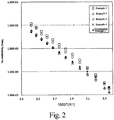
- the AC impedance was measured by the four-terminal method utilizing a lithium electrode at 10°C intervals in a temperature range of room temperature to 150°C (SI1260 IMPEDANCE/GAIN-PHASE ANALYZER), and the ion conductivity was calculated.
- the disk obtained in the above-described manner as a sample was put into a thermostatic bath with its temperature being set at 25°C and it was kept for 30 minutes, and after that, the ion conductivity was measured.
- the temperature of the thermostatic bath was increased at 10°C intervals from 30°C to 150°C, and the same operation was carried out at each temperature.
- the temperature of the thermostatic bath was decreased at 10°C intervals from 140°C to 30°C, and at each temperature, the state was kept for 40 minutes and then the ion conductivity was measured.
- the temperature of the thermostatic bath was decreased to 25°C, and after it was kept for 40 minutes, the ion conductivity was measured.
- the measurement frequency range was 0.1 Hz to 1 MHz, and the amplitude was 50 mV.
- an ionic conductor was produced as described below.
- the water content in the lithium halide was measured using a Karl Fischer moisture meter (model 851/1), a stirrer (model 801) and an auto-sampler (model 874) manufactured by Metrohm, and a dedicated sealed vial.
- a titration reagent a new Karl Fischer reagent for water content measurement, HYDRANAL-Coulomat AG-Oven (manufactured by Hayashi Pure Chemical Ind., Ltd.) was selected.
- the measurement sample was analyzed with a sample heating temperature of 200°C, an extraction time of 300 seconds, an extraction temperature of 25°C, titration end of 5 ⁇ g/min (relative drift) and an end point setting of 50 mV.
- the measurement data was analyzed using an analysis software: tiamo (Ver 2.3) manufactured by Metrohm.
- the end point (EP) of titration analysis was determined using the function of "Set EP with parallel tangents". In this regard, as the tangent lines, those corresponding to baselines before titration (0 to 20 sec) and after titration (250 to 300 sec) were used.
- the weight of water ( ⁇ g) was calculated based on the obtained end point (EP), and the water content in the lithium halide was calculated using the below-described formula A.
- Weight of water in measurement sample ⁇ g ⁇ weight of water in blank ⁇ g / weight of lithium halide g water content in lithium halide ppm
- a mixed gas consisting of argon and water (water content: 300 ppm) was flowed through a container in which a lithium halide was put for a predetermined amount of time, thereby further preparing a lithium halide having a different water content.
- the obtained lithium halide having a water content of 290 ppm was used in Example 5 described below to produce an ionic conductor.
- LiI having a water content of 2000 ppm (manufactured by Wako Pure Chemical Industries, Ltd., purity: 97% or more, Lot. No. LKM6992) was dissolved in ultra-pure water. Excess water was removed by an evaporator (6 hours, rotation speed: 120 rpm, hot water temperature: 60°C, vacuum degree: 5 hPa), thereby obtaining a trihydrate of LiI. The trihydrate of LiI was subjected to vacuum drying (vacuum degree: 6.7 ⁇ 10 -1 Pa) at room temperature for 24 hours to prepare LiI having a water content of 70000 ppm. The obtained lithium halide having the water content of 70000 ppm was used in Examples 7-8 and Comparative Example 2 described below to produce ionic conductors.
- LiI manufactured by Sigma-Aldrich, purity: 99.9% or more, Lot. No. MKBT8164V
- a THF solution of LiBH 4 manufactured by Lockwood Lithium
- Solution mixing was carried out at 50°C for 1 hour, thereby obtaining a sufficiently homogenous solution.
- the obtained solution was dried under vacuum at 200°C for 3 hours while flowing argon at a flow rate of 5 cc/min, thereby obtaining a white ionic conductor (0.75 LiBH 4 -0.25 LiI).
- a white ionic conductor (0.75 LiBH 4 -0.25 LiI) was obtained in a manner similar to that in Example 5, except that LiI having a water content of 2000 ppm (manufactured by Wako Pure Chemical Industries, Ltd., purity: 97% or more, Lot. No. LKM6992) was used and that mixing of the THF solution of LiBH 4 with LiI was performed at room temperature for 30 minutes, thereby obtaining a sufficiently homogenous solution.
- LiI having a water content of 2000 ppm and LiI having a water content of 70000 ppm were mixed together at a predetermined ratio, thereby obtaining LiI having a water content of 10000 ppm.
- a white ionic conductor (0.75 LiBH 4 -0.25 LiI) was obtained in a manner similar to that in Example 6, except that the obtained LiI having a water content of 10000 ppm was used.
- LiI having a water content of 2000 ppm and LiI having a water content of 70000 ppm were mixed together at a predetermined ratio, thereby obtaining LiI having a water content of 25700 ppm.
- a white ionic conductor (0.75 LiBH 4 -0.25 LiI) was obtained in a manner similar to that in Example 6, except that the obtained LiI having a water content of 25700 ppm was used.
- a white ionic conductor (0.75 LiBH 4 -0.25 LiI) was obtained in a manner similar to that in Example 6, except that LiI having a water content of 70000 ppm was used.
- the ionic conductors of Examples 5-8 and Comparative Example 2 were subjected to the X-ray diffraction measurement and the ion conductivity measurement in manners similar to those for the ionic conductors obtained in Examples 1-4 and Comparative Example 1.
- X-ray diffraction patterns of the ionic conductors obtained in Examples 5-8 and Comparative Example 2 are shown in Figure 3 .
- lithium-ion conductivities of the ionic conductors obtained in Examples 5-8 and Comparative Example 2 are shown in Figure 4 .
- Example 5 Water content in LiI (ppm) Lithium-ion conductivity (S/cm) 25°C 150°C Example 5 290 2.0 ⁇ 10 -5 1.7 ⁇ 10 -2
- Example 6 2000 1.3 ⁇ 10 -5 7.8 ⁇ 10 -3
- Example 7 10000 1.4 ⁇ 10 -5 8.3 ⁇ 10 -3
- Example 8 25700 1.6 ⁇ 10 -5 7.8 ⁇ 10 -3
- Comparative Example 2 70000 0.8 ⁇ 10 -5 3.7 ⁇ 10 -3
Landscapes
- Chemical & Material Sciences (AREA)
- Engineering & Computer Science (AREA)
- Manufacturing & Machinery (AREA)
- Chemical Kinetics & Catalysis (AREA)
- Electrochemistry (AREA)
- General Chemical & Material Sciences (AREA)
- Physics & Mathematics (AREA)
- Materials Engineering (AREA)
- Inorganic Chemistry (AREA)
- Organic Chemistry (AREA)
- Spectroscopy & Molecular Physics (AREA)
- General Physics & Mathematics (AREA)
- Condensed Matter Physics & Semiconductors (AREA)
- Dispersion Chemistry (AREA)
- Conductive Materials (AREA)
- Secondary Cells (AREA)
Applications Claiming Priority (3)
| Application Number | Priority Date | Filing Date | Title |
|---|---|---|---|
| JP2016007433 | 2016-01-18 | ||
| JP2016007434 | 2016-01-18 | ||
| PCT/JP2017/000905 WO2017126416A1 (ja) | 2016-01-18 | 2017-01-13 | イオン伝導体の製造方法 |
Publications (5)
| Publication Number | Publication Date |
|---|---|
| EP3407363A1 true EP3407363A1 (de) | 2018-11-28 |
| EP3407363A4 EP3407363A4 (de) | 2019-10-02 |
| EP3407363B1 EP3407363B1 (de) | 2023-10-25 |
| EP3407363C0 EP3407363C0 (de) | 2023-10-25 |
| EP3407363B8 EP3407363B8 (de) | 2023-12-06 |
Family
ID=59362357
Family Applications (1)
| Application Number | Title | Priority Date | Filing Date |
|---|---|---|---|
| EP17741296.2A Active EP3407363B8 (de) | 2016-01-18 | 2017-01-13 | Verfahren zur herstellung eines ionenleiters |
Country Status (13)
| Country | Link |
|---|---|
| US (1) | US10825574B2 (de) |
| EP (1) | EP3407363B8 (de) |
| JP (1) | JP6724044B2 (de) |
| KR (1) | KR102723760B1 (de) |
| CN (1) | CN108475565B (de) |
| AU (1) | AU2017209394B2 (de) |
| BR (1) | BR112018014421B1 (de) |
| CA (1) | CA3010253C (de) |
| HU (1) | HUE064792T2 (de) |
| PL (1) | PL3407363T3 (de) |
| RU (1) | RU2714498C1 (de) |
| TW (1) | TWI712197B (de) |
| WO (1) | WO2017126416A1 (de) |
Families Citing this family (9)
| Publication number | Priority date | Publication date | Assignee | Title |
|---|---|---|---|---|
| EP3699996B1 (de) * | 2017-10-19 | 2024-02-14 | Mitsubishi Gas Chemical Company, Inc. | Herstellungsverfahren für festkörperbatterie |
| WO2019167813A1 (ja) | 2018-02-28 | 2019-09-06 | 三菱瓦斯化学株式会社 | Li2B12H12およびLiBH4を含むイオン伝導体およびその製造方法、並びに該イオン伝導体を含む全固体電池用固体電解質 |
| ES3037041T3 (en) | 2018-08-23 | 2025-09-26 | Mitsubishi Gas Chemical Co | Ionic conductor containing high-temperature phase of licb9h10, method for manufacturing same, and solid electrolyte for all-solid-state battery containing said ion conductor |
| CN109244535B (zh) * | 2018-11-01 | 2021-01-19 | 上海理工大学 | 硼氢化锂基固态电解质材料的制备方法 |
| JP7576743B2 (ja) * | 2018-12-26 | 2024-11-01 | パナソニックIpマネジメント株式会社 | 固体電解質組成物、および、固体電解質部材の製造方法 |
| JP7527590B2 (ja) * | 2019-03-12 | 2024-08-05 | 三菱瓦斯化学株式会社 | 全固体電池の製造方法 |
| WO2021131426A1 (ja) * | 2019-12-27 | 2021-07-01 | パナソニックIpマネジメント株式会社 | 固体電解質組成物、および、固体電解質粒子 |
| EP4109600A4 (de) | 2020-02-17 | 2024-01-03 | Mitsubishi Gas Chemical Company, Inc. | Ionenleiter mit einer hochtemperaturphase von licb9h10 und verfahren zu seiner herstellung |
| JP7722216B2 (ja) * | 2022-02-18 | 2025-08-13 | トヨタ自動車株式会社 | リチウムイオン伝導体 |
Family Cites Families (15)
| Publication number | Priority date | Publication date | Assignee | Title |
|---|---|---|---|---|
| JPS5187703U (de) | 1975-01-09 | 1976-07-14 | ||
| JPS5971263A (ja) * | 1982-10-18 | 1984-04-21 | Toshiba Corp | 固体電池 |
| CN1051569A (zh) * | 1989-11-07 | 1991-05-22 | 广州市华远电热电器厂 | 高分子复合固态电解质及制法 |
| RU2066901C1 (ru) * | 1993-07-01 | 1996-09-20 | Жуковский Владимир Михайлович | Твердый литийпроводящий электролит и способ его получения |
| CN1142610C (zh) | 2001-01-16 | 2004-03-17 | 华中科技大学 | 磺酰亚胺类锂盐的复合固体电解质材料及其制备方法 |
| US7776201B1 (en) * | 2005-06-15 | 2010-08-17 | Hrl Laboratories | Electrochemical regeneration of chemical hydrides |
| CN101013766A (zh) * | 2007-02-26 | 2007-08-08 | 清华大学 | 一种准固态电解质及其制备方法与应用 |
| WO2009139382A1 (ja) | 2008-05-13 | 2009-11-19 | 国立大学法人東北大学 | 固体電解質、その製造方法、および固体電解質を備える二次電池 |
| EP2919313A4 (de) | 2012-11-06 | 2016-03-30 | Idemitsu Kosan Co | Festelektrolyt |
| KR102272556B1 (ko) | 2013-09-02 | 2021-07-02 | 미츠비시 가스 가가쿠 가부시키가이샤 | 전고체 전지 |
| RU2672556C2 (ru) | 2013-09-02 | 2018-11-16 | Мицубиси Газ Кемикал Компани, Инк. | Батарея с твёрдым электролитом и способ получения активного материала электрода |
| RU2561919C1 (ru) * | 2014-07-08 | 2015-09-10 | Федеральное государственное бюджетное учреждение науки Институт химии твердого тела Уральского отделения Российский академии наук | Способ получения литий-ионного проводящего материала |
| JP2016134316A (ja) | 2015-01-20 | 2016-07-25 | 出光興産株式会社 | 固体電解質 |
| US10326164B2 (en) * | 2015-03-03 | 2019-06-18 | Ut-Battelle, Llc | High-conduction GE substituted LiAsS4 solid electrolyte |
| CN105481887A (zh) * | 2015-12-31 | 2016-04-13 | 苏州润禾化学材料有限公司 | 一种草酸二氟硼酸锂的制备方法 |
-
2017
- 2017-01-13 CA CA3010253A patent/CA3010253C/en active Active
- 2017-01-13 US US16/069,439 patent/US10825574B2/en active Active
- 2017-01-13 WO PCT/JP2017/000905 patent/WO2017126416A1/ja not_active Ceased
- 2017-01-13 RU RU2018124793A patent/RU2714498C1/ru active
- 2017-01-13 KR KR1020187022808A patent/KR102723760B1/ko active Active
- 2017-01-13 JP JP2017562538A patent/JP6724044B2/ja active Active
- 2017-01-13 BR BR112018014421-5A patent/BR112018014421B1/pt active IP Right Grant
- 2017-01-13 HU HUE17741296A patent/HUE064792T2/hu unknown
- 2017-01-13 PL PL17741296.2T patent/PL3407363T3/pl unknown
- 2017-01-13 AU AU2017209394A patent/AU2017209394B2/en active Active
- 2017-01-13 EP EP17741296.2A patent/EP3407363B8/de active Active
- 2017-01-13 CN CN201780006992.0A patent/CN108475565B/zh active Active
- 2017-01-17 TW TW106101465A patent/TWI712197B/zh active
Also Published As
| Publication number | Publication date |
|---|---|
| WO2017126416A1 (ja) | 2017-07-27 |
| AU2017209394A1 (en) | 2018-09-06 |
| CN108475565A (zh) | 2018-08-31 |
| KR102723760B1 (ko) | 2024-10-29 |
| EP3407363B1 (de) | 2023-10-25 |
| RU2714498C1 (ru) | 2020-02-18 |
| JP6724044B2 (ja) | 2020-07-15 |
| AU2017209394B2 (en) | 2021-08-19 |
| US20190080814A1 (en) | 2019-03-14 |
| EP3407363B8 (de) | 2023-12-06 |
| TWI712197B (zh) | 2020-12-01 |
| EP3407363C0 (de) | 2023-10-25 |
| TW201729455A (zh) | 2017-08-16 |
| PL3407363T3 (pl) | 2024-03-04 |
| US10825574B2 (en) | 2020-11-03 |
| JPWO2017126416A1 (ja) | 2018-11-15 |
| BR112018014421B1 (pt) | 2023-10-31 |
| EP3407363A4 (de) | 2019-10-02 |
| HUE064792T2 (hu) | 2024-04-28 |
| KR20180105163A (ko) | 2018-09-27 |
| CA3010253A1 (en) | 2017-07-27 |
| CA3010253C (en) | 2025-07-08 |
| CN108475565B (zh) | 2020-11-06 |
| BR112018014421A2 (pt) | 2019-02-19 |
Similar Documents
| Publication | Publication Date | Title |
|---|---|---|
| EP3407363B1 (de) | Verfahren zur herstellung eines ionenleiters | |
| TWI799601B (zh) | Lgps系固體電解質及其製造方法 | |
| EP3239986B1 (de) | Ionenleiter und verfahren zur herstellung davon | |
| JP7172433B2 (ja) | 固体電解質材料およびその成形体 | |
| JP7107087B2 (ja) | Lgps系固体電解質の製造方法 | |
| US20200358130A1 (en) | PRODUCTION METHOD FOR SOLID ELECTROLYTE HAVING Li3PS4 | |
| US20260121112A1 (en) | METHOD FOR PRODUCING SULFIDE SOLID ELECTROLYTE INCLUDING Sn | |
| US11769873B2 (en) | Ion conductor containing Li2B12H12 and LiBH4, method for producing same, and solid electrolyte for all-solid-state batteries, which contains said ion conductor | |
| EP3843192B1 (de) | Ionenleiter mit einer hochtemperaturphase von licb9h10, verfahren zur herstellung davon und festelektrolyt für eine festkörperbatterie mit besagtem ionenleiter | |
| JP2020027780A (ja) | Lgps系固体電解質の製造方法 | |
| US20240194937A1 (en) | Method for producing lgps-type solid electrolyte | |
| JP6776743B2 (ja) | イオン伝導体の製造方法 | |
| JP7022498B2 (ja) | イオン伝導体の経時劣化を抑制する方法 | |
| JPWO2018139629A1 (ja) | イオン伝導体及びその製造方法 | |
| JP6759880B2 (ja) | イオン伝導体の製造方法 |
Legal Events
| Date | Code | Title | Description |
|---|---|---|---|
| STAA | Information on the status of an ep patent application or granted ep patent |
Free format text: STATUS: THE INTERNATIONAL PUBLICATION HAS BEEN MADE |
|
| PUAI | Public reference made under article 153(3) epc to a published international application that has entered the european phase |
Free format text: ORIGINAL CODE: 0009012 |
|
| STAA | Information on the status of an ep patent application or granted ep patent |
Free format text: STATUS: REQUEST FOR EXAMINATION WAS MADE |
|
| 17P | Request for examination filed |
Effective date: 20180818 |
|
| AK | Designated contracting states |
Kind code of ref document: A1 Designated state(s): AL AT BE BG CH CY CZ DE DK EE ES FI FR GB GR HR HU IE IS IT LI LT LU LV MC MK MT NL NO PL PT RO RS SE SI SK SM TR |
|
| AX | Request for extension of the european patent |
Extension state: BA ME |
|
| RIN1 | Information on inventor provided before grant (corrected) |
Inventor name: SHIMADA, MASAHIRO Inventor name: UNEMOTO, ATSUSHI Inventor name: KATORI, AKI Inventor name: ORIMO, SHINICHI Inventor name: ITO, TOMOHIRO |
|
| DAV | Request for validation of the european patent (deleted) | ||
| DAX | Request for extension of the european patent (deleted) | ||
| A4 | Supplementary search report drawn up and despatched |
Effective date: 20190829 |
|
| RIC1 | Information provided on ipc code assigned before grant |
Ipc: C09D 11/52 20140101ALI20190823BHEP Ipc: H01B 1/20 20060101ALI20190823BHEP Ipc: H01M 10/0562 20100101ALI20190823BHEP Ipc: H01B 13/00 20060101ALI20190823BHEP Ipc: H01B 1/06 20060101AFI20190823BHEP |
|
| STAA | Information on the status of an ep patent application or granted ep patent |
Free format text: STATUS: EXAMINATION IS IN PROGRESS |
|
| 17Q | First examination report despatched |
Effective date: 20221209 |
|
| REG | Reference to a national code |
Ref country code: DE Ref legal event code: R079 Free format text: PREVIOUS MAIN CLASS: H01B0013000000 Ipc: H01B0001120000 Ref country code: DE Ref legal event code: R079 Ref document number: 602017075668 Country of ref document: DE Free format text: PREVIOUS MAIN CLASS: H01B0013000000 Ipc: H01B0001120000 |
|
| GRAP | Despatch of communication of intention to grant a patent |
Free format text: ORIGINAL CODE: EPIDOSNIGR1 |
|
| STAA | Information on the status of an ep patent application or granted ep patent |
Free format text: STATUS: GRANT OF PATENT IS INTENDED |
|
| RIC1 | Information provided on ipc code assigned before grant |
Ipc: H01B 1/20 20060101ALI20230628BHEP Ipc: H01M 10/0562 20100101ALI20230628BHEP Ipc: H01B 13/00 20060101ALI20230628BHEP Ipc: H01B 1/06 20060101ALI20230628BHEP Ipc: H01B 1/12 20060101AFI20230628BHEP |
|
| INTG | Intention to grant announced |
Effective date: 20230727 |
|
| GRAS | Grant fee paid |
Free format text: ORIGINAL CODE: EPIDOSNIGR3 |
|
| GRAA | (expected) grant |
Free format text: ORIGINAL CODE: 0009210 |
|
| STAA | Information on the status of an ep patent application or granted ep patent |
Free format text: STATUS: THE PATENT HAS BEEN GRANTED |
|
| AK | Designated contracting states |
Kind code of ref document: B1 Designated state(s): AL AT BE BG CH CY CZ DE DK EE ES FI FR GB GR HR HU IE IS IT LI LT LU LV MC MK MT NL NO PL PT RO RS SE SI SK SM TR |
|
| REG | Reference to a national code |
Ref country code: GB Ref legal event code: FG4D |
|
| GRAT | Correction requested after decision to grant or after decision to maintain patent in amended form |
Free format text: ORIGINAL CODE: EPIDOSNCDEC |
|
| REG | Reference to a national code |
Ref country code: CH Ref legal event code: EP |
|
| REG | Reference to a national code |
Ref country code: DE Ref legal event code: R096 Ref document number: 602017075668 Country of ref document: DE |
|
| REG | Reference to a national code |
Ref country code: CH Ref legal event code: PK Free format text: BERICHTIGUNG B8 |
|
| REG | Reference to a national code |
Ref country code: IE Ref legal event code: FG4D |
|
| RAP4 | Party data changed (patent owner data changed or rights of a patent transferred) |
Owner name: TOHOKU TECHNO ARCH CO., LTD. Owner name: MITSUBISHI GAS CHEMICAL COMPANY, INC. |
|
| U01 | Request for unitary effect filed |
Effective date: 20231108 |
|
| U07 | Unitary effect registered |
Designated state(s): AT BE BG DE DK EE FI FR IT LT LU LV MT NL PT SE SI Effective date: 20231114 |
|
| U20 | Renewal fee for the european patent with unitary effect paid |
Year of fee payment: 8 Effective date: 20231219 |
|
| PG25 | Lapsed in a contracting state [announced via postgrant information from national office to epo] |
Ref country code: GR Free format text: LAPSE BECAUSE OF FAILURE TO SUBMIT A TRANSLATION OF THE DESCRIPTION OR TO PAY THE FEE WITHIN THE PRESCRIBED TIME-LIMIT Effective date: 20240126 |
|
| PG25 | Lapsed in a contracting state [announced via postgrant information from national office to epo] |
Ref country code: IS Free format text: LAPSE BECAUSE OF FAILURE TO SUBMIT A TRANSLATION OF THE DESCRIPTION OR TO PAY THE FEE WITHIN THE PRESCRIBED TIME-LIMIT Effective date: 20240225 |
|
| PG25 | Lapsed in a contracting state [announced via postgrant information from national office to epo] |
Ref country code: ES Free format text: LAPSE BECAUSE OF FAILURE TO SUBMIT A TRANSLATION OF THE DESCRIPTION OR TO PAY THE FEE WITHIN THE PRESCRIBED TIME-LIMIT Effective date: 20231025 |
|
| REG | Reference to a national code |
Ref country code: HU Ref legal event code: AG4A Ref document number: E064792 Country of ref document: HU |
|
| PG25 | Lapsed in a contracting state [announced via postgrant information from national office to epo] |
Ref country code: IS Free format text: LAPSE BECAUSE OF FAILURE TO SUBMIT A TRANSLATION OF THE DESCRIPTION OR TO PAY THE FEE WITHIN THE PRESCRIBED TIME-LIMIT Effective date: 20240225 Ref country code: GR Free format text: LAPSE BECAUSE OF FAILURE TO SUBMIT A TRANSLATION OF THE DESCRIPTION OR TO PAY THE FEE WITHIN THE PRESCRIBED TIME-LIMIT Effective date: 20240126 Ref country code: ES Free format text: LAPSE BECAUSE OF FAILURE TO SUBMIT A TRANSLATION OF THE DESCRIPTION OR TO PAY THE FEE WITHIN THE PRESCRIBED TIME-LIMIT Effective date: 20231025 |
|
| PG25 | Lapsed in a contracting state [announced via postgrant information from national office to epo] |
Ref country code: RS Free format text: LAPSE BECAUSE OF FAILURE TO SUBMIT A TRANSLATION OF THE DESCRIPTION OR TO PAY THE FEE WITHIN THE PRESCRIBED TIME-LIMIT Effective date: 20231025 Ref country code: NO Free format text: LAPSE BECAUSE OF FAILURE TO SUBMIT A TRANSLATION OF THE DESCRIPTION OR TO PAY THE FEE WITHIN THE PRESCRIBED TIME-LIMIT Effective date: 20240125 Ref country code: HR Free format text: LAPSE BECAUSE OF FAILURE TO SUBMIT A TRANSLATION OF THE DESCRIPTION OR TO PAY THE FEE WITHIN THE PRESCRIBED TIME-LIMIT Effective date: 20231025 |
|
| PG25 | Lapsed in a contracting state [announced via postgrant information from national office to epo] |
Ref country code: CZ Free format text: LAPSE BECAUSE OF FAILURE TO SUBMIT A TRANSLATION OF THE DESCRIPTION OR TO PAY THE FEE WITHIN THE PRESCRIBED TIME-LIMIT Effective date: 20231025 |
|
| REG | Reference to a national code |
Ref country code: DE Ref legal event code: R097 Ref document number: 602017075668 Country of ref document: DE |
|
| PG25 | Lapsed in a contracting state [announced via postgrant information from national office to epo] |
Ref country code: SK Free format text: LAPSE BECAUSE OF FAILURE TO SUBMIT A TRANSLATION OF THE DESCRIPTION OR TO PAY THE FEE WITHIN THE PRESCRIBED TIME-LIMIT Effective date: 20231025 |
|
| PG25 | Lapsed in a contracting state [announced via postgrant information from national office to epo] |
Ref country code: SM Free format text: LAPSE BECAUSE OF FAILURE TO SUBMIT A TRANSLATION OF THE DESCRIPTION OR TO PAY THE FEE WITHIN THE PRESCRIBED TIME-LIMIT Effective date: 20231025 Ref country code: SK Free format text: LAPSE BECAUSE OF FAILURE TO SUBMIT A TRANSLATION OF THE DESCRIPTION OR TO PAY THE FEE WITHIN THE PRESCRIBED TIME-LIMIT Effective date: 20231025 Ref country code: RO Free format text: LAPSE BECAUSE OF FAILURE TO SUBMIT A TRANSLATION OF THE DESCRIPTION OR TO PAY THE FEE WITHIN THE PRESCRIBED TIME-LIMIT Effective date: 20231025 Ref country code: CZ Free format text: LAPSE BECAUSE OF FAILURE TO SUBMIT A TRANSLATION OF THE DESCRIPTION OR TO PAY THE FEE WITHIN THE PRESCRIBED TIME-LIMIT Effective date: 20231025 |
|
| PG25 | Lapsed in a contracting state [announced via postgrant information from national office to epo] |
Ref country code: MC Free format text: LAPSE BECAUSE OF FAILURE TO SUBMIT A TRANSLATION OF THE DESCRIPTION OR TO PAY THE FEE WITHIN THE PRESCRIBED TIME-LIMIT Effective date: 20231025 |
|
| PG25 | Lapsed in a contracting state [announced via postgrant information from national office to epo] |
Ref country code: MC Free format text: LAPSE BECAUSE OF FAILURE TO SUBMIT A TRANSLATION OF THE DESCRIPTION OR TO PAY THE FEE WITHIN THE PRESCRIBED TIME-LIMIT Effective date: 20231025 |
|
| PLBE | No opposition filed within time limit |
Free format text: ORIGINAL CODE: 0009261 |
|
| REG | Reference to a national code |
Ref country code: CH Ref legal event code: PL |
|
| STAA | Information on the status of an ep patent application or granted ep patent |
Free format text: STATUS: NO OPPOSITION FILED WITHIN TIME LIMIT |
|
| 26N | No opposition filed |
Effective date: 20240726 |
|
| PG25 | Lapsed in a contracting state [announced via postgrant information from national office to epo] |
Ref country code: CH Free format text: LAPSE BECAUSE OF NON-PAYMENT OF DUE FEES Effective date: 20240131 |
|
| PG25 | Lapsed in a contracting state [announced via postgrant information from national office to epo] |
Ref country code: CH Free format text: LAPSE BECAUSE OF NON-PAYMENT OF DUE FEES Effective date: 20240131 |
|
| U20 | Renewal fee for the european patent with unitary effect paid |
Year of fee payment: 9 Effective date: 20241205 |
|
| PG25 | Lapsed in a contracting state [announced via postgrant information from national office to epo] |
Ref country code: IE Free format text: LAPSE BECAUSE OF NON-PAYMENT OF DUE FEES Effective date: 20240113 |
|
| PG25 | Lapsed in a contracting state [announced via postgrant information from national office to epo] |
Ref country code: IE Free format text: LAPSE BECAUSE OF NON-PAYMENT OF DUE FEES Effective date: 20240113 |
|
| PG25 | Lapsed in a contracting state [announced via postgrant information from national office to epo] |
Ref country code: CY Free format text: LAPSE BECAUSE OF FAILURE TO SUBMIT A TRANSLATION OF THE DESCRIPTION OR TO PAY THE FEE WITHIN THE PRESCRIBED TIME-LIMIT; INVALID AB INITIO Effective date: 20170113 |
|
| PG25 | Lapsed in a contracting state [announced via postgrant information from national office to epo] |
Ref country code: TR Free format text: LAPSE BECAUSE OF FAILURE TO SUBMIT A TRANSLATION OF THE DESCRIPTION OR TO PAY THE FEE WITHIN THE PRESCRIBED TIME-LIMIT Effective date: 20231025 |
|
| PGFP | Annual fee paid to national office [announced via postgrant information from national office to epo] |
Ref country code: GB Payment date: 20251127 Year of fee payment: 10 |
|
| U20 | Renewal fee for the european patent with unitary effect paid |
Year of fee payment: 10 Effective date: 20251205 |
|
| PGFP | Annual fee paid to national office [announced via postgrant information from national office to epo] |
Ref country code: PL Payment date: 20251211 Year of fee payment: 10 |
|
| PGFP | Annual fee paid to national office [announced via postgrant information from national office to epo] |
Ref country code: HU Payment date: 20260112 Year of fee payment: 10 |