EP3408841B1 - Procédés et systèmes de détection de noyade - Google Patents
Procédés et systèmes de détection de noyade Download PDFInfo
- Publication number
- EP3408841B1 EP3408841B1 EP17743840.5A EP17743840A EP3408841B1 EP 3408841 B1 EP3408841 B1 EP 3408841B1 EP 17743840 A EP17743840 A EP 17743840A EP 3408841 B1 EP3408841 B1 EP 3408841B1
- Authority
- EP
- European Patent Office
- Prior art keywords
- humans
- images
- candidates
- underwater
- water
- Prior art date
- Legal status (The legal status is an assumption and is not a legal conclusion. Google has not performed a legal analysis and makes no representation as to the accuracy of the status listed.)
- Active
Links
Images

Classifications
-
- G—PHYSICS
- G06—COMPUTING OR CALCULATING; COUNTING
- G06V—IMAGE OR VIDEO RECOGNITION OR UNDERSTANDING
- G06V10/00—Arrangements for image or video recognition or understanding
- G06V10/70—Arrangements for image or video recognition or understanding using pattern recognition or machine learning
- G06V10/82—Arrangements for image or video recognition or understanding using pattern recognition or machine learning using neural networks
-
- G—PHYSICS
- G06—COMPUTING OR CALCULATING; COUNTING
- G06F—ELECTRIC DIGITAL DATA PROCESSING
- G06F18/00—Pattern recognition
- G06F18/20—Analysing
- G06F18/24—Classification techniques
- G06F18/241—Classification techniques relating to the classification model, e.g. parametric or non-parametric approaches
- G06F18/2413—Classification techniques relating to the classification model, e.g. parametric or non-parametric approaches based on distances to training or reference patterns
- G06F18/24133—Distances to prototypes
-
- G—PHYSICS
- G06—COMPUTING OR CALCULATING; COUNTING
- G06N—COMPUTING ARRANGEMENTS BASED ON SPECIFIC COMPUTATIONAL MODELS
- G06N3/00—Computing arrangements based on biological models
- G06N3/02—Neural networks
- G06N3/04—Architecture, e.g. interconnection topology
- G06N3/0464—Convolutional networks [CNN, ConvNet]
-
- G—PHYSICS
- G06—COMPUTING OR CALCULATING; COUNTING
- G06N—COMPUTING ARRANGEMENTS BASED ON SPECIFIC COMPUTATIONAL MODELS
- G06N3/00—Computing arrangements based on biological models
- G06N3/02—Neural networks
- G06N3/08—Learning methods
- G06N3/09—Supervised learning
-
- G—PHYSICS
- G06—COMPUTING OR CALCULATING; COUNTING
- G06T—IMAGE DATA PROCESSING OR GENERATION, IN GENERAL
- G06T7/00—Image analysis
- G06T7/0002—Inspection of images, e.g. flaw detection
-
- G—PHYSICS
- G06—COMPUTING OR CALCULATING; COUNTING
- G06T—IMAGE DATA PROCESSING OR GENERATION, IN GENERAL
- G06T7/00—Image analysis
- G06T7/20—Analysis of motion
-
- G—PHYSICS
- G06—COMPUTING OR CALCULATING; COUNTING
- G06T—IMAGE DATA PROCESSING OR GENERATION, IN GENERAL
- G06T7/00—Image analysis
- G06T7/70—Determining position or orientation of objects or cameras
- G06T7/73—Determining position or orientation of objects or cameras using feature-based methods
-
- G—PHYSICS
- G06—COMPUTING OR CALCULATING; COUNTING
- G06V—IMAGE OR VIDEO RECOGNITION OR UNDERSTANDING
- G06V10/00—Arrangements for image or video recognition or understanding
- G06V10/40—Extraction of image or video features
- G06V10/44—Local feature extraction by analysis of parts of the pattern, e.g. by detecting edges, contours, loops, corners, strokes or intersections; Connectivity analysis, e.g. of connected components
- G06V10/443—Local feature extraction by analysis of parts of the pattern, e.g. by detecting edges, contours, loops, corners, strokes or intersections; Connectivity analysis, e.g. of connected components by matching or filtering
- G06V10/449—Biologically inspired filters, e.g. difference of Gaussians [DoG] or Gabor filters
- G06V10/451—Biologically inspired filters, e.g. difference of Gaussians [DoG] or Gabor filters with interaction between the filter responses, e.g. cortical complex cells
- G06V10/454—Integrating the filters into a hierarchical structure, e.g. convolutional neural networks [CNN]
-
- G—PHYSICS
- G06—COMPUTING OR CALCULATING; COUNTING
- G06V—IMAGE OR VIDEO RECOGNITION OR UNDERSTANDING
- G06V10/00—Arrangements for image or video recognition or understanding
- G06V10/70—Arrangements for image or video recognition or understanding using pattern recognition or machine learning
- G06V10/764—Arrangements for image or video recognition or understanding using pattern recognition or machine learning using classification, e.g. of video objects
-
- G—PHYSICS
- G06—COMPUTING OR CALCULATING; COUNTING
- G06V—IMAGE OR VIDEO RECOGNITION OR UNDERSTANDING
- G06V20/00—Scenes; Scene-specific elements
- G06V20/05—Underwater scenes
-
- G—PHYSICS
- G06—COMPUTING OR CALCULATING; COUNTING
- G06V—IMAGE OR VIDEO RECOGNITION OR UNDERSTANDING
- G06V20/00—Scenes; Scene-specific elements
- G06V20/50—Context or environment of the image
- G06V20/52—Surveillance or monitoring of activities, e.g. for recognising suspicious objects
-
- G—PHYSICS
- G06—COMPUTING OR CALCULATING; COUNTING
- G06V—IMAGE OR VIDEO RECOGNITION OR UNDERSTANDING
- G06V40/00—Recognition of biometric, human-related or animal-related patterns in image or video data
- G06V40/20—Movements or behaviour, e.g. gesture recognition
-
- G—PHYSICS
- G08—SIGNALLING
- G08B—SIGNALLING SYSTEMS, e.g. PERSONAL CALLING SYSTEMS; ORDER TELEGRAPHS; ALARM SYSTEMS
- G08B21/00—Alarms responsive to a single specified undesired or abnormal condition and not otherwise provided for
- G08B21/02—Alarms for ensuring the safety of persons
- G08B21/08—Alarms for ensuring the safety of persons responsive to the presence of persons in a body of water, e.g. a swimming pool; responsive to an abnormal condition of a body of water
-
- H—ELECTRICITY
- H04—ELECTRIC COMMUNICATION TECHNIQUE
- H04N—PICTORIAL COMMUNICATION, e.g. TELEVISION
- H04N7/00—Television systems
- H04N7/18—Closed-circuit television [CCTV] systems, i.e. systems in which the video signal is not broadcast
- H04N7/183—Closed-circuit television [CCTV] systems, i.e. systems in which the video signal is not broadcast for receiving images from a single remote source
- H04N7/185—Closed-circuit television [CCTV] systems, i.e. systems in which the video signal is not broadcast for receiving images from a single remote source from a mobile camera, e.g. for remote control
-
- G—PHYSICS
- G08—SIGNALLING
- G08B—SIGNALLING SYSTEMS, e.g. PERSONAL CALLING SYSTEMS; ORDER TELEGRAPHS; ALARM SYSTEMS
- G08B21/00—Alarms responsive to a single specified undesired or abnormal condition and not otherwise provided for
- G08B21/02—Alarms for ensuring the safety of persons
- G08B21/08—Alarms for ensuring the safety of persons responsive to the presence of persons in a body of water, e.g. a swimming pool; responsive to an abnormal condition of a body of water
- G08B21/084—Alarms for ensuring the safety of persons responsive to the presence of persons in a body of water, e.g. a swimming pool; responsive to an abnormal condition of a body of water by monitoring physical movement characteristics of the water
-
- G—PHYSICS
- G08—SIGNALLING
- G08B—SIGNALLING SYSTEMS, e.g. PERSONAL CALLING SYSTEMS; ORDER TELEGRAPHS; ALARM SYSTEMS
- G08B29/00—Checking or monitoring of signalling or alarm systems; Prevention or correction of operating errors, e.g. preventing unauthorised operation
- G08B29/18—Prevention or correction of operating errors
- G08B29/185—Signal analysis techniques for reducing or preventing false alarms or for enhancing the reliability of the system
- G08B29/188—Data fusion; cooperative systems, e.g. voting among different detectors
Definitions
- no complicated calibration is needed to install the device.
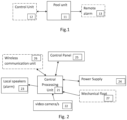
- Fig. 1 illustrates an embodiment of a system for detecting human drowning, for instance in a pool.
- the system may comprise at least a pool unit 11, a remote alarm unit 12, and a control unit 13.
- the system may comprise multiple remote alarm units.
- Such remote alarm units may be a part of the system (such as a remote alarm unit which is specific to the system), or may be units that are used for other applications or with other products and that the pool unit is paired with during the installation process or later.
- the control unit 13 is operable on a processing unit and may comprise a control application.
- the control unit 13 may be installed e.g. on a smart phone, tablet, or any other computer, or on a dedicated control unit. This list is not limitative.
- the control unit 13 may also be part of the pool unit 11. It may allow a user to control or to interact with the pool unit 11.
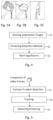
- the pool unit 11 may comprise a central processing unit 21.
- the central processing unit may comprise for instance a CPU or multiple CPUs, a memory, CPUs (Graphical Processing Units), DSPs, FPGAs, other processing units, and a storage disk.
- the pool unit 11 includes at least one video camera 22.
- the system's cameras may enable a full visual coverage of the pool.
- each camera covers a different part of the pool.
- a single camera with for example at least a 90 degrees of horizontal angle and at least 90 degrees of vertical angle may be used (these numbers being not limitative), while placing the pool unit in one of the pool's corners.
- two cameras may be used in a back-to-back manner, while locating the pool unit in the middle of one of the long edges of the pool.
- the system may also comprise a local alarm 23 (such as a speaker) for alerting on drowning risks.
- a local alarm 23 such as a speaker
- the system is fed with power by a power supply 24. According to some embodiments, it is supplied with power from an external source. According to some embodiments, the system may include solar panels and/or batteries.
- the system may include a local control panel 25 that may include a small screen for user notifications, and may allow user input.
- the system may comprise a communication unit 26, which may be a wireless communication unit that may use any wireless communication technology, such as Wi-Fi, or Bluetooth.
- the pool unit may also comprise a mechanical float 27 that may be used to indicate whether there was an entrance to the pool.
- a mechanical float 27 may be used to indicate whether there was an entrance to the pool.
- Such information may be used as complementary information to the insights of the video analytics method, or as the only source of information, e.g. in situations of low visibility (dirty water or darkness) or occlusions.
- Fig. 3A illustrates an embodiment of a pool unit for underground pools that uses solar panels.
- Fig. 3B illustrates an embodiment of a pool unit for underground pools that uses auxiliary electricity.
- Fig. 3C illustrates an embodiment for a pool unit for aboveground pools. These examples are not limitative.
- Fig. 4 illustrates an embodiment of a method for drowning detection that may be performed by the system for drowning detection.
- the system senses underwater images (step 41 ) from the video camera/s. Video frames from each camera may be used as input for the drowning detection method (step 42 ), embodiments of which are described below.
- the drowning detection method may output warnings or alarms (step 43 ). These warnings or alarms may be at different levels of severity. As a consequence, the system may output different types of alarms/messages in the local speakers, and if applicable, in the local control panel, and/or in the remote control units and/or in the remote alarm units.
- the method may comprise analyzing a sequence of video frames, which may represent underwater images taken by the cameras of the system. Processing steps, such as detection, comparison, tracking of elements may for instance be performed by the central processing unit of the pool unit 11.
- the method comprises a step 51 of detecting which image parts comprise humans underwater, and which do not.
- This detection may be applied on part of the video frames and may be applied in different resolutions of the images at different times and at different image parts.
- the detection applied on a video frame may output a confidence level for the presence of humans at each image part.
- This detection may output humans-in-water candidates in the images, which comprise parts of the image that are detected as comprising a human.
- this detection uses at least a machine learning algorithm, which may be trained with a training set of underwater images.
- Embodiments of humans-in-water detection algorithms that detect humans from underwater images, in particular from images obtained by a single camera, will now be described. Detecting humans submerged, or partly submerged, in water (as opposed to pedestrian detections, for instance), may comprise recognizing humans at a variety of postures.
- the humans-in-water detection/recognition methods may be based on machine learning algorithms that are pre-trained.
- Fig. 6 is a general illustration of a possible training stage of a humans-in-water object detection/recognition algorithm 61.
- This algorithm may be pre-operable on a processing unit that is not part of the pool unit (an embodiment is a personal computer or a cluster of computers), or can partly run on different computers and then further run on the pool units' processing unit.
- the algorithm 61 may be fed with a training set of underwater images.
- This training set may comprise "positive" examples 62, which means that the underwater images comprise humans-in-water, and a set of "negative" examples 63 that may comprise any other images, such as underwater images without humans and underwater images with non-human objects.
- the algorithm 61 outputs after the training stage a model or a plurality of models for humans-in-water.
- models may be used to detect humans-in-water candidates in the underwater images.
- These models may comprise one or more visual representations (such as a particular distribution of pixels) that indicate the fact that a human is present in the underwater image.
- the algorithm 61 may in particular comprise a machine learning algorithm.
- This machine learning algorithm may use any SVMs (Support Vector Machines), any neural network based technology, including the deep learning technology, CNN (Convolutional neural networks), Decision Trees/Forests based technologies, Bag-of-words based technology, HOG (Histogram Of Gradients) based technology, DPM (Deformable Parts Model) based technology, or any other classification/modelling technology that aims to distinguish between different types of objects. It may use one or more of the abovementioned technologies.
- SVMs Serial Vector Machines
- CNN Convolutional neural networks
- Decision Trees/Forests based technologies Bag-of-words based technology
- HOG Heistogram Of Gradients
- DPM Deformable Parts Model
- the output humans-in-water models may model explicitly, or implicitly, multiple sub-categories, each associated, for instance, with a different human posture (as detailed later) or any other type of subcategories.
- Other embodiments may be subcategorization by age or gender.
- the machine learning algorithm is trained based on HOG (Histogram Of Gradients) and SVM. According to some embodiments, the machine learning algorithm is trained using DPM to be used as a detector.
- a first machine learning algorithm is used to identify human-in-water candidates in the image.
- This first machine learning algorithm scans all the parts of the image with a sliding window detector in order to identify the humans-in-water candidates.
- another machine learning algorithm such as an object classification convolutional neural network, is applied only on the candidates/proposals that the first machine learning algorithm outputs (using a pre-defined threshold score).
- the object classification convolutional neural network may also be first trained using a training set of underwater images.
- the object classification convolutional neural network performs both the identification of humans-in-water candidates, and the classification said candidates. Further explanations will be provided with reference to Fig. 14 .
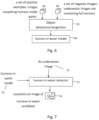
- Fig. 7 generally sketches a possible machine learning based humans-in-water detector 71, which comprises at least a machine learning algorithm for detecting humans-in-water candidates in the underwater images.
- This machine learning algorithm may have been trained as explained e.g. in reference to Fig. 6 .
- the detector 71 may receive as input at least an input underwater image 72, which was taken by the underwater camera 22.
- the detector 71 may use at least a humans-in-water model which is the output of the training phase detailed above (step 73, which is the same as step 64 of Fig. 6 ).
- the detector 71 may compare each part of the underwater image with the humans-in-water model in order to detect humans-in-water candidates.
- the output of the detection method may be a set of humans-in-water candidates 74, each associated with a location, and possibly other information, such as a grade associated with the detector's certainty, and possibly the association to a sub-category, associated, for instance, with posture (as detailed later).
- the same candidate may be associated with more than one sub-category.
- the candidate's location may be described by a rectangle (associated with the bounding-box of the human candidate), by a silhouette, by a binary bitmap, or any other spatial description.
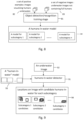
- Fig. 8, and Fig. 9 illustrate the training and detection stages of an embodiment of a detector for which the humans-in-water model comprises different subcategories.
- References 81, 82 and 83 are similar to references 61, 62, and 63, respectively.
- the output of the training stage is a humans-in-water model which comprises a plurality of models, each model being associated to a different subcategory, with particular characteristics for each subcategory as illustrated by reference 84.
- An example of subcategory is a posture of the human in water.
- the model of a given subcategory can represent how the human would appear in the underwater image for this given subcategory (e.g. different models can be created for different postures, or for different genders of the humans, etc.).
- the machine learning algorithm that is used for building the plurality of models may also be based on the SVM (Support Vector Machines) technology or any neural network based technology, including the deep learning technology, CNN (Convolutional neural networks), Decision Trees/Forests based technologies, Bag-of-words based technology, HOG (Histogram Of Gradients) based technology, DPM (Deformable Parts Model) based technology, or any other classification/modelling technology.
- SVM Small Vector Machines
- CNN Convolutional neural networks
- Decision Trees/Forests based technologies including Bag-of-words based technology, HOG (Histogram Of Gradients) based technology, DPM (Deformable Parts Model) based technology, or any other classification/modelling technology.
- HOG Heistogram Of Gradients
- DPM Deformable Parts Model
- Fig. 9 the underwater image is compared to each of the models, wherein each model is associated to a subcategory.
- References 91 and 92 are similar to references 71 and 72, respectively.
- Reference 93 is similar to reference 84, but as illustrated, a plurality of human-in-water models is used.
- the output of the detector 91 when applied on an input underwater image may comprise a set of candidates for humans-in-water locations, while associating each candidate to a model of a particular subcategory.
- the machine learning algorithm which attempts to detect humans-in-water candidates in the underwater is trained based on the input of a training set of underwater images clustered to subcategories.
- the underwater images of the training set which comprise a human may be pre-clustered by subcategory.
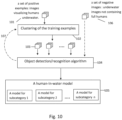
- the positive training images 101 may be divided using a clustering method 102 into sets, each set associated with a subcategory 103.
- Embodiments for pre-clustering methods are described in the context of Fig. 12 below.
- the pre-clustered images may then be fed to the detection algorithm, in order to construct the different subcategories' models ( 105 , which is the same as 84 ).
- the training algorithm when it attempts to create a model representing each subcategory, it may use also the negative examples ( 106 , which is the same as 83 ).
- the clustering and modelling may be performed in an iterative manner (the dotted arrow 107 represents the option for the method to be iterative). For instance, using initial pre-clustering results, subcategory models are created. Then, all positive examples may be assigned to a subcategory by the model it best fits, then the models are re-trained. This may be repeated for a few finite number of iterations.
- the subcategories may be implicitly or explicitly associated with posture of the human in water.
- An explicit association includes the fact that the candidates were explicitly associated to a posture, e.g. by a human annotator.
- An implicit association includes the fact that an algorithm that is based on certain descriptors extracted from the underwater image automatically clustered the data, wherein the resulted clustering turns out to be associated with posture.
- posture refers to the way the human appears in the 2D projection in the image plane (and not to the 3D posture of the human in the 3D space). Examples of posture include e.g. appears horizontally in the image plane with head to the right and feat to the left, appears vertical in the image plane with head down and legs up, head facing camera and legs occluded, etc.
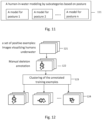
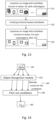
- Fig. 12 illustrates an embodiment for a method for pre-clustering the images (an embodiment for how step 102 may be implemented).
- the underwater images of the training set may be manually annotated as positive (including human) or negative ones (not including a full human).
- the positive examples may be further annotated by a manual mark of the location of the human in the image. This additional information can be used in the clustering procedure.
- the annotation may be, for instance, in the form of a rectangle that is a bounding-box of the human. In such a case the pre-clustering method may use the aspect ratio of the bounding box and/or the visual data in order to divide the examples into clusters.
- each positive example is manually pre-annotated by a subcategory, associated, for instance, to a posture (The user defines for each image to which subcategory the image belongs).
- the clustering is a manual one with no algorithm involved.
- manual annotations are provided by some details on the location of the body parts (without explicit posture annotation).
- the annotations may define a set of points that are each associated with a certain joint of the body. For example, a point for each elbow, knee, shoulder, etc (this list being not limitative”. Then, a vector representing this point may be built to represent each image.
- Such annotations provide information that allows to then automatically pre-cluster the underwater images of the training set by the human posture.
Landscapes
- Engineering & Computer Science (AREA)
- Theoretical Computer Science (AREA)
- Physics & Mathematics (AREA)
- General Physics & Mathematics (AREA)
- Multimedia (AREA)
- Computer Vision & Pattern Recognition (AREA)
- Evolutionary Computation (AREA)
- Artificial Intelligence (AREA)
- General Health & Medical Sciences (AREA)
- Health & Medical Sciences (AREA)
- Software Systems (AREA)
- Computing Systems (AREA)
- Life Sciences & Earth Sciences (AREA)
- Biomedical Technology (AREA)
- Molecular Biology (AREA)
- Data Mining & Analysis (AREA)
- Medical Informatics (AREA)
- Databases & Information Systems (AREA)
- General Engineering & Computer Science (AREA)
- Mathematical Physics (AREA)
- Computational Linguistics (AREA)
- Biophysics (AREA)
- Business, Economics & Management (AREA)
- Emergency Management (AREA)
- Biodiversity & Conservation Biology (AREA)
- Quality & Reliability (AREA)
- Signal Processing (AREA)
- Evolutionary Biology (AREA)
- Bioinformatics & Computational Biology (AREA)
- Bioinformatics & Cheminformatics (AREA)
- Human Computer Interaction (AREA)
- Social Psychology (AREA)
- Psychiatry (AREA)
- Image Analysis (AREA)
- Emergency Alarm Devices (AREA)
- Closed-Circuit Television Systems (AREA)
Claims (10)
- Procédé de détection de noyade humaine, le procédé comprenant les étapes suivantes exécutées par une unité de traitement (21) :∘ la détection (51) d'humains dans une séquence d'images sous-marines prises par une seule caméra (22), pour identifier des candidats humains dans l'eau dans les images, ladite détection comprenant la détection des parties des images comprenant des humains sous l'eau, et de celles qui n'en comprennent pas, la partie des images détectées comme comprenant des humains sous l'eau correspondant auxdits candidats humains dans l'eau dans les images, ladite détection comprenant l'utilisation d'un premier réseau neuronal d'apprentissage profond parcourant la séquence d'images sous-marines à l'aide d'une fenêtre glissante et fournissant des propositions pour les candidats humains dans l'eau dans la séquence d'images sous-marines, et d'un second réseau neuronal d'apprentissage profond appliqué uniquement sur les propositions, un nombre de couches du second réseau neuronal d'apprentissage profond étant supérieur à un nombre de couches du premier réseau neuronal d'apprentissage profond,∘ le suivi (52) des candidats humains dans l'eau tout au long de cette séquence, et∘ la détection (154) d'une absence de mouvement des candidats humains dans l'eau, afin de détecter un risque de noyade humaine.
- Procédé selon la revendication 1, comprenant l'association desdits candidats dans chaque image à un modèle parmi une pluralité de modèles différents, chacun des modèles de ladite pluralité de modèles différents (84, 93) étant associé à une sous-catégorie différente.
- Procédé selon la revendication 2, dans lequel chaque modèle est obtenu en entraînant un algorithme d'apprentissage automatique sur la base de l'entrée d'un ensemble d'entraînement d'images sous-marines (101) regroupées en sous-catégories.
- Procédé selon la revendication 3, dans lequel chaque sous-catégorie (103) est associée à une posture humaine.
- Procédé selon la revendication 3, comprenant une étape de pré-regroupement (123) des images sous-marines de l'ensemble d'entraînement qui comprennent un humain, le pré-regroupement comprenant :- l'annotation manuelle des articulations des humains, et- le pré-regroupement automatique des images sous-marines sur la base de caractéristiques posturales extraites desdites annotations.
- Procédé selon la revendication 2, comprenant le remplacement (133) de candidats superposés associés à un modèle de la même sous-catégorie par un nouveau candidat ayant une localisation moyenne pondérée, dans lequel :- chaque candidat comprend un score reflétant la pertinence de l'association du modèle d'une sous-catégorie par rapport à la partie de l'image sous-marine couverte par le candidat, et- la localisation du nouveau candidat qui remplace les candidats superposés est définie en pondérant les localisations des candidats superposés en fonction de leurs dits scores.
- Procédé selon la revendication 2, comprenant :- le suivi (153) desdits candidats tout au long de la séquence d'images, en prenant en compte la sous-catégorie à laquelle chaque candidat est associé,- la détection (154) d'une absence de mouvement des candidats, afin de détecter un risque de noyade humaine.
- Système de détection de noyade humaine, le système comprenant une seule caméra sous-marine (22) configurée pour prendre au moins une séquence d'images sous-marines, le système étant configuré pour :∘ détecter des humains dans la séquence d'images sous-marines, pour identifier des candidats humains dans l'eau dans les images, ladite détection comprenant la détection des parties des images comprenant des humains sous l'eau, et de celles qui n'en comprennent pas, la partie des images détectées comme comprenant des humains sous l'eau correspondant auxdits candidats humains dans l'eau dans les images, ladite détection comprenant l'utilisation d'un premier réseau neuronal d'apprentissage profond parcourant la séquence d'images sous-marines à l'aide d'une fenêtre glissante et fournissant des propositions pour les candidats humains dans l'eau dans la séquence d'images sous-marines, et d'un second réseau neuronal d'apprentissage profond appliqué uniquement sur les propositions, un nombre de couches du second réseau neuronal d'apprentissage profond étant supérieur à un nombre de couches du premier réseau neuronal d'apprentissage profond,∘ suivre les candidats humains dans l'eau tout au long de cette séquence, et∘ détecter (154) une absence de mouvement des candidats humains dans l'eau, afin de détecter un risque de noyade humaine.
- Système selon la revendication 8, dans lequel le système est actionné pour détecter un risque de noyade humaine sans étalonnage par rapport à sa zone de fonctionnement.
- Système selon la revendication 8 ou la revendication 9, dans lequel le système utilise une source d'énergie (24) comprenant des panneaux solaires.
Applications Claiming Priority (2)
| Application Number | Priority Date | Filing Date | Title |
|---|---|---|---|
| US201662287165P | 2016-01-26 | 2016-01-26 | |
| PCT/IL2017/050081 WO2017130187A1 (fr) | 2016-01-26 | 2017-01-19 | Procédés et systèmes de détection de noyade |
Publications (4)
| Publication Number | Publication Date |
|---|---|
| EP3408841A1 EP3408841A1 (fr) | 2018-12-05 |
| EP3408841A4 EP3408841A4 (fr) | 2019-08-14 |
| EP3408841B1 true EP3408841B1 (fr) | 2024-12-25 |
| EP3408841C0 EP3408841C0 (fr) | 2024-12-25 |
Family
ID=59397587
Family Applications (1)
| Application Number | Title | Priority Date | Filing Date |
|---|---|---|---|
| EP17743840.5A Active EP3408841B1 (fr) | 2016-01-26 | 2017-01-19 | Procédés et systèmes de détection de noyade |
Country Status (4)
| Country | Link |
|---|---|
| US (1) | US11216654B2 (fr) |
| EP (1) | EP3408841B1 (fr) |
| AU (1) | AU2017211712C1 (fr) |
| WO (1) | WO2017130187A1 (fr) |
Families Citing this family (44)
| Publication number | Priority date | Publication date | Assignee | Title |
|---|---|---|---|---|
| US12639982B2 (en) | 2017-04-12 | 2026-05-26 | Disney Enterprises, Inc. | Predicting a need for assistance by determining behavior based on machine learning model analysis of video data |
| US12688732B2 (en) * | 2017-04-12 | 2026-07-21 | Disney Enterprises, Inc. | Providing assistance based on machine learning model analysis of video data |
| US10825319B1 (en) * | 2017-09-05 | 2020-11-03 | Objectvideo Labs, Llc | Underwater video monitoring for swimming pool |
| CN109816086B (zh) * | 2017-11-20 | 2023-05-23 | 富士通株式会社 | 移动物体的计数装置、方法和电子设备 |
| CN108111808B (zh) * | 2017-11-30 | 2020-04-28 | 江西洪都航空工业集团有限责任公司 | 一种基于实时视频图像分析的落水检测方法 |
| EP3776345B1 (fr) * | 2018-04-16 | 2024-09-18 | Lynxight Ltd. | Procédé et appareil de suivi de nageur |
| TWI657379B (zh) * | 2018-05-31 | 2019-04-21 | 國立勤益科技大學 | 智慧深度學習溺水救生系統 |
| US11159769B2 (en) * | 2018-08-07 | 2021-10-26 | Lynxight Ltd | Drowning detection enhanced by swimmer analytics |
| US11182603B1 (en) * | 2018-08-31 | 2021-11-23 | Snap Inc. | Weakly supervised semantic parsing |
| US10964187B2 (en) | 2019-01-29 | 2021-03-30 | Pool Knight, Llc | Smart surveillance system for swimming pools |
| US12406563B2 (en) | 2019-01-29 | 2025-09-02 | Pool Knight, Llc | Smart surveillance system for swimming pools |
| US20220319178A1 (en) * | 2019-05-03 | 2022-10-06 | Hayward Industries, Inc. | Systems And Methods For Providing Monitoring, Optimization, And Control Of Pool/Spa Equipment Using Video Analytics |
| US12039851B2 (en) * | 2019-05-23 | 2024-07-16 | Lifeguard Ai, Inc. | System and a method for surveilling swimmers |
| US20220122431A1 (en) | 2019-06-17 | 2022-04-21 | Guard, Inc. | Analysis and deep learning modeling of sensor-based object detection data for organic motion determination in bounded aquatic environments using underwater powered systems |
| US20200394804A1 (en) | 2019-06-17 | 2020-12-17 | Guard, Inc. | Analysis and deep learning modeling of sensor-based object detection data in bounded aquatic environments |
| CN110363153B (zh) * | 2019-07-16 | 2022-08-02 | 广州图普网络科技有限公司 | 涉水检测方法、装置、服务器及计算机可读存储介质 |
| FR3100076B1 (fr) | 2019-08-23 | 2023-01-20 | Atos Integration | Dispositif de détection de personnes en situation de noyade ou de situation à risque de noyade |
| CN110569772B (zh) * | 2019-08-30 | 2022-03-08 | 北京科技大学 | 一种泳池内人员状态检测方法 |
| CN110696003A (zh) * | 2019-09-17 | 2020-01-17 | 五邑大学 | 基于slam技术和深度学习的水边救援机器人 |
| US10943456B1 (en) | 2019-09-30 | 2021-03-09 | International Business Machines Corporation | Virtual safety guardian |
| WO2021130740A1 (fr) | 2019-12-25 | 2021-07-01 | Coral Detection Systems Ltd. | Procédé d'élimination de bulles sous-marines et dispositif associé |
| US12073703B2 (en) | 2020-01-16 | 2024-08-27 | Angarak, Inc. | Image based aquatic alert system |
| CN112257309B (zh) * | 2020-09-29 | 2023-08-25 | 北京科技大学 | 一种水下履带装备流场及力学响应预测方法及系统 |
| CN112309078A (zh) * | 2020-10-15 | 2021-02-02 | 泰州市出彩网络科技有限公司 | 基于局域网通信的状态检测平台 |
| CN112396807A (zh) * | 2020-10-27 | 2021-02-23 | 西北工业大学 | 一种落水人员检测识别方法 |
| US20220139180A1 (en) * | 2020-10-29 | 2022-05-05 | Visual One Technologies Inc. | Custom event detection for surveillance cameras |
| US20220139187A1 (en) * | 2020-10-30 | 2022-05-05 | Swimguard, Inc. | Swimguard protection system |
| US12288457B2 (en) | 2020-12-04 | 2025-04-29 | Wearable Technologies Inc. | Smart wearable personal safety devices and related systems and methods |
| CN112527793A (zh) * | 2020-12-05 | 2021-03-19 | 泰州市朗嘉馨网络科技有限公司 | 水下沉浸时长检测系统 |
| WO2022204153A1 (fr) * | 2021-03-22 | 2022-09-29 | Angarak, Inc. | Système de suivi basé sur les images |
| US12008881B1 (en) | 2021-05-28 | 2024-06-11 | Swamcam LLC | Water safety device, system, and method |
| EP4374354B1 (fr) | 2021-07-19 | 2026-08-19 | Maiguard AI Detection Systems Ltd | Système et procédé de détection de pré-noyade et de noyade |
| TWI790715B (zh) * | 2021-08-18 | 2023-01-21 | 國立勤益科技大學 | 智慧影像辨識溺水警示系統 |
| CN113516828B (zh) * | 2021-09-15 | 2022-01-07 | 深圳市信润富联数字科技有限公司 | 溺水监测方法、装置、设备与计算机可读存储介质 |
| CN114219833B (zh) * | 2021-12-06 | 2023-04-07 | 汉朗科技(北京)有限责任公司 | 一种水上水下计算机视觉综合溺水判断系统 |
| CN114155470A (zh) * | 2021-12-08 | 2022-03-08 | 中科计算技术西部研究院 | 一种河道区域入侵检测方法、系统及存储介质 |
| CN114022910B (zh) * | 2022-01-10 | 2022-04-12 | 杭州巨岩欣成科技有限公司 | 泳池防溺水监管方法、装置、计算机设备及存储介质 |
| CN114359373B (zh) * | 2022-01-10 | 2022-09-09 | 杭州巨岩欣成科技有限公司 | 泳池防溺水目标行为识别方法、装置、计算机设备及存储介质 |
| EP4605918A4 (fr) | 2022-10-24 | 2026-01-14 | Coral Smart Pool Ltd | Surveillance de l'état de l'eau et de l'activité d'une piscine par vision par ordinateur, et utilisation de cette surveillance pour faciliter l'entretien de la piscine |
| CN116110194A (zh) * | 2023-02-15 | 2023-05-12 | 上海旺链信息科技有限公司 | 一种基于半监督支持向量机的防溺水监测方法和系统 |
| CN116402847B (zh) * | 2023-02-16 | 2025-12-02 | 杭州巨岩欣成科技有限公司 | 泳池防溺水水面人头跟踪方法、装置、计算机设备及存储介质 |
| DE102023111688A1 (de) | 2023-05-04 | 2024-11-07 | Forsit Invest GmbH | Überwachungsverfahren und Überwachungssystem für Schwimmbecken zur Erkennung ertrinkender Personen |
| CN117218579A (zh) * | 2023-09-12 | 2023-12-12 | 常州先进制造技术研究所 | 一种游泳池溺水检测方法 |
| KR102995704B1 (ko) * | 2025-12-11 | 2026-07-24 | 주식회사 라이프블루 | 인공지능 기반 수영장 내 익수자 감지를 위한 모니터링 시스템 |
Citations (2)
| Publication number | Priority date | Publication date | Assignee | Title |
|---|---|---|---|---|
| US6133838A (en) * | 1995-11-16 | 2000-10-17 | Poseidon | System for monitoring a swimming pool to prevent drowning accidents |
| CN109242775A (zh) * | 2018-09-03 | 2019-01-18 | 科大讯飞股份有限公司 | 一种属性信息迁移方法、装置、设备以及可读存储介质 |
Family Cites Families (14)
| Publication number | Priority date | Publication date | Assignee | Title |
|---|---|---|---|---|
| US7330123B1 (en) | 2003-06-09 | 2008-02-12 | Stanford University-Office Of Technology Licensing | Sonar based drowning monitor |
| WO2009094591A2 (fr) * | 2008-01-24 | 2009-07-30 | Micropower Appliance | Systèmes de distribution de vidéo utilisant des caméras sans fil |
| US8237574B2 (en) | 2008-06-05 | 2012-08-07 | Hawkeye Systems, Inc. | Above-water monitoring of swimming pools |
| US20100176956A1 (en) * | 2009-01-10 | 2010-07-15 | Richard Moerschell | Device for detecting a body fall into a pool |
| US20140267736A1 (en) * | 2013-03-15 | 2014-09-18 | Bruno Delean | Vision based system for detecting a breach of security in a monitored location |
| WO2014183004A1 (fr) * | 2013-05-10 | 2014-11-13 | Robert Bosch Gmbh | Système et procédé d'identification d'objets et d'événements au moyen de plusieurs caméras |
| CN103413114A (zh) * | 2013-05-17 | 2013-11-27 | 浙江大学 | 一种基于支持向量机的溺水行为检测方法 |
| US20150107015A1 (en) * | 2013-10-21 | 2015-04-23 | James Ng | Drowning Detection and Response System |
| US9400925B2 (en) * | 2013-11-15 | 2016-07-26 | Facebook, Inc. | Pose-aligned networks for deep attribute modeling |
| US9477908B2 (en) | 2014-04-10 | 2016-10-25 | Disney Enterprises, Inc. | Multi-level framework for object detection |
| US20160037138A1 (en) * | 2014-08-04 | 2016-02-04 | Danny UDLER | Dynamic System and Method for Detecting Drowning |
| US9972188B2 (en) * | 2014-10-09 | 2018-05-15 | Khalifa University of Science and Technology | Sonar based drowning detection system, method and kit |
| US9640058B1 (en) * | 2016-05-10 | 2017-05-02 | Jimmy Bollman | Swimming pool monitor |
| US11615623B2 (en) * | 2018-02-19 | 2023-03-28 | Nortek Security & Control Llc | Object detection in edge devices for barrier operation and parcel delivery |
-
2017
- 2017-01-19 EP EP17743840.5A patent/EP3408841B1/fr active Active
- 2017-01-19 WO PCT/IL2017/050081 patent/WO2017130187A1/fr not_active Ceased
- 2017-01-19 AU AU2017211712A patent/AU2017211712C1/en active Active
- 2017-01-19 US US16/072,581 patent/US11216654B2/en active Active
Patent Citations (2)
| Publication number | Priority date | Publication date | Assignee | Title |
|---|---|---|---|---|
| US6133838A (en) * | 1995-11-16 | 2000-10-17 | Poseidon | System for monitoring a swimming pool to prevent drowning accidents |
| CN109242775A (zh) * | 2018-09-03 | 2019-01-18 | 科大讯飞股份有限公司 | 一种属性信息迁移方法、装置、设备以及可读存储介质 |
Also Published As
| Publication number | Publication date |
|---|---|
| AU2017211712C1 (en) | 2024-05-02 |
| EP3408841A4 (fr) | 2019-08-14 |
| WO2017130187A1 (fr) | 2017-08-03 |
| EP3408841C0 (fr) | 2024-12-25 |
| AU2017211712B2 (en) | 2021-10-07 |
| EP3408841A1 (fr) | 2018-12-05 |
| AU2017211712A1 (en) | 2018-08-02 |
| US11216654B2 (en) | 2022-01-04 |
| US20190034712A1 (en) | 2019-01-31 |
Similar Documents
| Publication | Publication Date | Title |
|---|---|---|
| US11216654B2 (en) | Methods and systems for drowning detection | |
| US10242266B2 (en) | Method and system for detecting actions in videos | |
| Pathirannahalage et al. | A comprehensive analysis of real-time video anomaly detection methods for human and vehicular movement | |
| US10007850B2 (en) | System and method for event monitoring and detection | |
| Yang et al. | Context-aware visual tracking | |
| Gharani et al. | Context-aware obstacle detection for navigation by visually impaired | |
| Sokolova et al. | A fuzzy model for human fall detection in infrared video | |
| US20090296989A1 (en) | Method for Automatic Detection and Tracking of Multiple Objects | |
| US11694120B2 (en) | Generation and usage of semantic features for detection and correction of perception errors | |
| Mohan et al. | Anomaly and activity recognition using machine learning approach for video based surveillance | |
| Li et al. | Robust multiperson detection and tracking for mobile service and social robots | |
| Aboah et al. | Deepsegmenter: Temporal action localization for detecting anomalies in untrimmed naturalistic driving videos | |
| Vicente et al. | Embedded vision modules for tracking and counting people | |
| Lai | Real-time aerial detection and reasoning on embedded-UAVs in rural environments | |
| Nakkach et al. | Smart border surveillance system based on deep learning methods | |
| Adewopo et al. | Baby physical safety monitoring in smart home using action recognition system | |
| Vezzani et al. | Probabilistic people tracking with appearance models and occlusion classification: The ad-hoc system | |
| Zouaoui et al. | Embedded security system for multi-modal surveillance in a railway carriage | |
| Priya et al. | An adaptive fall detection system based on ensemble learning using variants of YOLO V8 retinanet and DETR | |
| Kim et al. | Vision-based recognition algorithm for up-To-date indoor digital map generations at damaged buildings | |
| Shaban et al. | Multi-camera based intelligent video surveillance system using ssd_mobilenet_v3 | |
| US20250191364A1 (en) | Anomaly detection system for video surveillance | |
| Lygouras et al. | A new method to combine detection and tracking algorithms for fast and accurate human localization in UAV-based SAR operations | |
| Sakthivel et al. | AI‐Based Smart Surveillance for Drowning and Theft Detection on Beaches Using Drones | |
| Kalyanshetti et al. | Integrating multimodal learning for scalable indoor scene understanding |
Legal Events
| Date | Code | Title | Description |
|---|---|---|---|
| STAA | Information on the status of an ep patent application or granted ep patent |
Free format text: STATUS: THE INTERNATIONAL PUBLICATION HAS BEEN MADE |
|
| PUAI | Public reference made under article 153(3) epc to a published international application that has entered the european phase |
Free format text: ORIGINAL CODE: 0009012 |
|
| STAA | Information on the status of an ep patent application or granted ep patent |
Free format text: STATUS: REQUEST FOR EXAMINATION WAS MADE |
|
| 17P | Request for examination filed |
Effective date: 20180806 |
|
| AK | Designated contracting states |
Kind code of ref document: A1 Designated state(s): AL AT BE BG CH CY CZ DE DK EE ES FI FR GB GR HR HU IE IS IT LI LT LU LV MC MK MT NL NO PL PT RO RS SE SI SK SM TR |
|
| AX | Request for extension of the european patent |
Extension state: BA ME |
|
| DAV | Request for validation of the european patent (deleted) | ||
| DAX | Request for extension of the european patent (deleted) | ||
| A4 | Supplementary search report drawn up and despatched |
Effective date: 20190716 |
|
| RIC1 | Information provided on ipc code assigned before grant |
Ipc: G08B 23/00 20060101AFI20190710BHEP |
|
| STAA | Information on the status of an ep patent application or granted ep patent |
Free format text: STATUS: EXAMINATION IS IN PROGRESS |
|
| 17Q | First examination report despatched |
Effective date: 20210318 |
|
| RAP1 | Party data changed (applicant data changed or rights of an application transferred) |
Owner name: CORAL SMART POOL LTD. |
|
| REG | Reference to a national code |
Ref legal event code: R079 Free format text: PREVIOUS MAIN CLASS: G08B0023000000 Ref country code: DE Ref legal event code: R079 Ref document number: 602017086960 Country of ref document: DE Free format text: PREVIOUS MAIN CLASS: G08B0023000000 Ipc: G06V0020520000 |
|
| REG | Reference to a national code |
Ref legal event code: R079 Ipc: G06V0020050000 Ref country code: DE Ref legal event code: R079 Ref document number: 602017086960 Country of ref document: DE Free format text: PREVIOUS MAIN CLASS: G06V0020520000 Ipc: G06V0020050000 |
|
| RIC1 | Information provided on ipc code assigned before grant |
Ipc: G08B 21/08 20060101ALI20240610BHEP Ipc: G06V 10/764 20220101ALI20240610BHEP Ipc: G06V 10/82 20220101ALI20240610BHEP Ipc: G06V 20/52 20220101AFI20240610BHEP |
|
| GRAP | Despatch of communication of intention to grant a patent |
Free format text: ORIGINAL CODE: EPIDOSNIGR1 |
|
| STAA | Information on the status of an ep patent application or granted ep patent |
Free format text: STATUS: GRANT OF PATENT IS INTENDED |
|
| RIC1 | Information provided on ipc code assigned before grant |
Ipc: G08B 21/08 20060101ALI20240617BHEP Ipc: G06V 10/764 20220101ALI20240617BHEP Ipc: G06V 10/82 20220101ALI20240617BHEP Ipc: G06V 20/52 20220101ALI20240617BHEP Ipc: G06V 20/05 20220101AFI20240617BHEP |
|
| INTG | Intention to grant announced |
Effective date: 20240719 |
|
| GRAS | Grant fee paid |
Free format text: ORIGINAL CODE: EPIDOSNIGR3 |
|
| GRAA | (expected) grant |
Free format text: ORIGINAL CODE: 0009210 |
|
| STAA | Information on the status of an ep patent application or granted ep patent |
Free format text: STATUS: THE PATENT HAS BEEN GRANTED |
|
| AK | Designated contracting states |
Kind code of ref document: B1 Designated state(s): AL AT BE BG CH CY CZ DE DK EE ES FI FR GB GR HR HU IE IS IT LI LT LU LV MC MK MT NL NO PL PT RO RS SE SI SK SM TR |
|
| REG | Reference to a national code |
Ref country code: GB Ref legal event code: FG4D |
|
| REG | Reference to a national code |
Ref country code: CH Ref legal event code: EP |
|
| REG | Reference to a national code |
Ref country code: DE Ref legal event code: R096 Ref document number: 602017086960 Country of ref document: DE |
|
| REG | Reference to a national code |
Ref country code: IE Ref legal event code: FG4D |
|
| U01 | Request for unitary effect filed |
Effective date: 20250123 |
|
| U07 | Unitary effect registered |
Designated state(s): AT BE BG DE DK EE FI FR IT LT LU LV MT NL PT RO SE SI Effective date: 20250211 |
|
| PG25 | Lapsed in a contracting state [announced via postgrant information from national office to epo] |
Ref country code: HR Free format text: LAPSE BECAUSE OF FAILURE TO SUBMIT A TRANSLATION OF THE DESCRIPTION OR TO PAY THE FEE WITHIN THE PRESCRIBED TIME-LIMIT Effective date: 20241225 |
|
| U20 | Renewal fee for the european patent with unitary effect paid |
Year of fee payment: 9 Effective date: 20250310 |
|
| PG25 | Lapsed in a contracting state [announced via postgrant information from national office to epo] |
Ref country code: NO Free format text: LAPSE BECAUSE OF FAILURE TO SUBMIT A TRANSLATION OF THE DESCRIPTION OR TO PAY THE FEE WITHIN THE PRESCRIBED TIME-LIMIT Effective date: 20250325 |
|
| PG25 | Lapsed in a contracting state [announced via postgrant information from national office to epo] |
Ref country code: GR Free format text: LAPSE BECAUSE OF FAILURE TO SUBMIT A TRANSLATION OF THE DESCRIPTION OR TO PAY THE FEE WITHIN THE PRESCRIBED TIME-LIMIT Effective date: 20250326 |
|
| PG25 | Lapsed in a contracting state [announced via postgrant information from national office to epo] |
Ref country code: RS Free format text: LAPSE BECAUSE OF FAILURE TO SUBMIT A TRANSLATION OF THE DESCRIPTION OR TO PAY THE FEE WITHIN THE PRESCRIBED TIME-LIMIT Effective date: 20250325 |
|
| PG25 | Lapsed in a contracting state [announced via postgrant information from national office to epo] |
Ref country code: SM Free format text: LAPSE BECAUSE OF FAILURE TO SUBMIT A TRANSLATION OF THE DESCRIPTION OR TO PAY THE FEE WITHIN THE PRESCRIBED TIME-LIMIT Effective date: 20241225 |
|
| PG25 | Lapsed in a contracting state [announced via postgrant information from national office to epo] |
Ref country code: PL Free format text: LAPSE BECAUSE OF FAILURE TO SUBMIT A TRANSLATION OF THE DESCRIPTION OR TO PAY THE FEE WITHIN THE PRESCRIBED TIME-LIMIT Effective date: 20241225 |
|
| PG25 | Lapsed in a contracting state [announced via postgrant information from national office to epo] |
Ref country code: ES Free format text: LAPSE BECAUSE OF FAILURE TO SUBMIT A TRANSLATION OF THE DESCRIPTION OR TO PAY THE FEE WITHIN THE PRESCRIBED TIME-LIMIT Effective date: 20241225 |
|
| PG25 | Lapsed in a contracting state [announced via postgrant information from national office to epo] |
Ref country code: IS Free format text: LAPSE BECAUSE OF FAILURE TO SUBMIT A TRANSLATION OF THE DESCRIPTION OR TO PAY THE FEE WITHIN THE PRESCRIBED TIME-LIMIT Effective date: 20250425 |
|
| PG25 | Lapsed in a contracting state [announced via postgrant information from national office to epo] |
Ref country code: SK Free format text: LAPSE BECAUSE OF FAILURE TO SUBMIT A TRANSLATION OF THE DESCRIPTION OR TO PAY THE FEE WITHIN THE PRESCRIBED TIME-LIMIT Effective date: 20241225 |
|
| PG25 | Lapsed in a contracting state [announced via postgrant information from national office to epo] |
Ref country code: CZ Free format text: LAPSE BECAUSE OF FAILURE TO SUBMIT A TRANSLATION OF THE DESCRIPTION OR TO PAY THE FEE WITHIN THE PRESCRIBED TIME-LIMIT Effective date: 20241225 |
|
| REG | Reference to a national code |
Ref country code: CH Ref legal event code: PL |
|
| PG25 | Lapsed in a contracting state [announced via postgrant information from national office to epo] |
Ref country code: MC Free format text: LAPSE BECAUSE OF FAILURE TO SUBMIT A TRANSLATION OF THE DESCRIPTION OR TO PAY THE FEE WITHIN THE PRESCRIBED TIME-LIMIT Effective date: 20241225 |
|
| PG25 | Lapsed in a contracting state [announced via postgrant information from national office to epo] |
Ref country code: CH Free format text: LAPSE BECAUSE OF NON-PAYMENT OF DUE FEES Effective date: 20250131 |
|
| PLBE | No opposition filed within time limit |
Free format text: ORIGINAL CODE: 0009261 |
|
| STAA | Information on the status of an ep patent application or granted ep patent |
Free format text: STATUS: NO OPPOSITION FILED WITHIN TIME LIMIT |
|
| GBPC | Gb: european patent ceased through non-payment of renewal fee |
Effective date: 20250325 |
|
| 26N | No opposition filed |
Effective date: 20250926 |
|
| PG25 | Lapsed in a contracting state [announced via postgrant information from national office to epo] |
Ref country code: GB Free format text: LAPSE BECAUSE OF NON-PAYMENT OF DUE FEES Effective date: 20250325 |
|
| PG25 | Lapsed in a contracting state [announced via postgrant information from national office to epo] |
Ref country code: IE Free format text: LAPSE BECAUSE OF NON-PAYMENT OF DUE FEES Effective date: 20250119 |
|
| U20 | Renewal fee for the european patent with unitary effect paid |
Year of fee payment: 10 Effective date: 20260119 |
|
| PG25 | Lapsed in a contracting state [announced via postgrant information from national office to epo] |
Ref country code: CY Free format text: LAPSE BECAUSE OF FAILURE TO SUBMIT A TRANSLATION OF THE DESCRIPTION OR TO PAY THE FEE WITHIN THE PRESCRIBED TIME-LIMIT Effective date: 20241225 |
|
| PG25 | Lapsed in a contracting state [announced via postgrant information from national office to epo] |
Ref country code: TR Free format text: LAPSE BECAUSE OF FAILURE TO SUBMIT A TRANSLATION OF THE DESCRIPTION OR TO PAY THE FEE WITHIN THE PRESCRIBED TIME-LIMIT Effective date: 20241225 |