EP3409453A1 - Procédé de production de structures tridimensionnelles - Google Patents
Procédé de production de structures tridimensionnelles Download PDFInfo
- Publication number
- EP3409453A1 EP3409453A1 EP17741355.6A EP17741355A EP3409453A1 EP 3409453 A1 EP3409453 A1 EP 3409453A1 EP 17741355 A EP17741355 A EP 17741355A EP 3409453 A1 EP3409453 A1 EP 3409453A1
- Authority
- EP
- European Patent Office
- Prior art keywords
- filament
- thermoplastic resin
- base
- fiber
- dimensional structure
- Prior art date
- Legal status (The legal status is an assumption and is not a legal conclusion. Google has not performed a legal analysis and makes no representation as to the accuracy of the status listed.)
- Pending
Links
Images


Classifications
-
- B—PERFORMING OPERATIONS; TRANSPORTING
- B29—WORKING OF PLASTICS; WORKING OF SUBSTANCES IN A PLASTIC STATE IN GENERAL
- B29C—SHAPING OR JOINING OF PLASTICS; SHAPING OF MATERIAL IN A PLASTIC STATE, NOT OTHERWISE PROVIDED FOR; AFTER-TREATMENT OF THE SHAPED PRODUCTS, e.g. REPAIRING
- B29C64/00—Additive manufacturing, i.e. manufacturing of three-dimensional [3D] objects by additive deposition, additive agglomeration or additive layering, e.g. by 3D printing, stereolithography or selective laser sintering
- B29C64/10—Processes of additive manufacturing
- B29C64/106—Processes of additive manufacturing using only liquids or viscous materials, e.g. depositing a continuous bead of viscous material
- B29C64/118—Processes of additive manufacturing using only liquids or viscous materials, e.g. depositing a continuous bead of viscous material using filamentary material being melted, e.g. fused deposition modelling [FDM]
-
- B—PERFORMING OPERATIONS; TRANSPORTING
- B29—WORKING OF PLASTICS; WORKING OF SUBSTANCES IN A PLASTIC STATE IN GENERAL
- B29C—SHAPING OR JOINING OF PLASTICS; SHAPING OF MATERIAL IN A PLASTIC STATE, NOT OTHERWISE PROVIDED FOR; AFTER-TREATMENT OF THE SHAPED PRODUCTS, e.g. REPAIRING
- B29C70/00—Shaping composites, i.e. plastics material comprising reinforcements, fillers or preformed parts, e.g. inserts
- B29C70/04—Shaping composites, i.e. plastics material comprising reinforcements, fillers or preformed parts, e.g. inserts comprising reinforcements only, e.g. self-reinforcing plastics
- B29C70/28—Shaping operations therefor
- B29C70/30—Shaping by lay-up, i.e. applying fibres, tape or broadsheet on a mould, former or core; Shaping by spray-up, i.e. spraying of fibres on a mould, former or core
- B29C70/38—Automated lay-up, e.g. using robots, laying filaments according to predetermined patterns
-
- B—PERFORMING OPERATIONS; TRANSPORTING
- B33—ADDITIVE MANUFACTURING TECHNOLOGY
- B33Y—ADDITIVE MANUFACTURING, i.e. MANUFACTURING OF THREE-DIMENSIONAL [3D] OBJECTS BY ADDITIVE DEPOSITION, ADDITIVE AGGLOMERATION OR ADDITIVE LAYERING, e.g. BY 3D PRINTING, STEREOLITHOGRAPHY OR SELECTIVE LASER SINTERING
- B33Y10/00—Processes of additive manufacturing
-
- B—PERFORMING OPERATIONS; TRANSPORTING
- B33—ADDITIVE MANUFACTURING TECHNOLOGY
- B33Y—ADDITIVE MANUFACTURING, i.e. MANUFACTURING OF THREE-DIMENSIONAL [3D] OBJECTS BY ADDITIVE DEPOSITION, ADDITIVE AGGLOMERATION OR ADDITIVE LAYERING, e.g. BY 3D PRINTING, STEREOLITHOGRAPHY OR SELECTIVE LASER SINTERING
- B33Y70/00—Materials specially adapted for additive manufacturing
- B33Y70/10—Composites of different types of material, e.g. mixtures of ceramics and polymers or mixtures of metals and biomaterials
-
- D—TEXTILES; PAPER
- D02—YARNS; MECHANICAL FINISHING OF YARNS OR ROPES; WARPING OR BEAMING
- D02G—CRIMPING OR CURLING FIBRES, FILAMENTS, THREADS, OR YARNS; YARNS OR THREADS
- D02G3/00—Yarns or threads, e.g. fancy yarns; Processes or apparatus for the production thereof, not otherwise provided for
- D02G3/22—Yarns or threads characterised by constructional features, e.g. blending, filament/fibre
- D02G3/40—Yarns in which fibres are united by adhesives; Impregnated yarns or threads
- D02G3/402—Yarns in which fibres are united by adhesives; Impregnated yarns or threads the adhesive being one component of the yarn, i.e. thermoplastic yarn
-
- B—PERFORMING OPERATIONS; TRANSPORTING
- B29—WORKING OF PLASTICS; WORKING OF SUBSTANCES IN A PLASTIC STATE IN GENERAL
- B29K—INDEXING SCHEME ASSOCIATED WITH SUBCLASSES B29B, B29C OR B29D, RELATING TO MOULDING MATERIALS OR TO MATERIALS FOR MOULDS, REINFORCEMENTS, FILLERS OR PREFORMED PARTS, e.g. INSERTS
- B29K2077/00—Use of PA, i.e. polyamides, e.g. polyesteramides or derivatives thereof, as moulding material
-
- B—PERFORMING OPERATIONS; TRANSPORTING
- B29—WORKING OF PLASTICS; WORKING OF SUBSTANCES IN A PLASTIC STATE IN GENERAL
- B29K—INDEXING SCHEME ASSOCIATED WITH SUBCLASSES B29B, B29C OR B29D, RELATING TO MOULDING MATERIALS OR TO MATERIALS FOR MOULDS, REINFORCEMENTS, FILLERS OR PREFORMED PARTS, e.g. INSERTS
- B29K2307/00—Use of elements other than metals as reinforcement
- B29K2307/04—Carbon
-
- B—PERFORMING OPERATIONS; TRANSPORTING
- B29—WORKING OF PLASTICS; WORKING OF SUBSTANCES IN A PLASTIC STATE IN GENERAL
- B29K—INDEXING SCHEME ASSOCIATED WITH SUBCLASSES B29B, B29C OR B29D, RELATING TO MOULDING MATERIALS OR TO MATERIALS FOR MOULDS, REINFORCEMENTS, FILLERS OR PREFORMED PARTS, e.g. INSERTS
- B29K2309/00—Use of inorganic materials not provided for in groups B29K2303/00 - B29K2307/00, as reinforcement
- B29K2309/08—Glass
Definitions
- Non-Patent Literature 1 Reinforced Plastics, Vol.61, No.7 (July, 2015 )
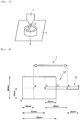
- FIG. 1 illustrates the mode where the endmost part of the filament is bonded, it is not always necessary to bond the endmost part of the filament.
- This invention also encompasses the mode of bonding the filament at a near-end part, while leaving some margin beyond that part.
- thermoplastic resin contained in the filament is allowed to melt at least in one step before discharge, during discharge, or after discharge.
- melting means that at least a part of the thermoplastic resin contained in the filament melts, preferably means that 80% by weight or more of the thermoplastic resin melts, more preferably means that 95% by weight or more thereof melts, and even more preferably means that 99% by eight or more thereof melts.
- the melting temperature is not specifically limited so far as the thermoplastic resin can melt at that temperature.
- the melting temperature is preferably 10°C or more higher than the melting point of the thermoplastic resin, more preferably 15 to 60°C higher than the melting point of the thermoplastic resin, and even more preferably 20 to 40°C higher than the melting point of the thermoplastic resin.
- the filament is preferably melted by heating the inside of the nozzle, when the filament is discharged.
- the dimensional structure 6 in the process of building would warp, since the thermoplastic resin is not yet completely solidified. Hence when the three-dimensional structure is manufactured, it is also preferable to heat the stage 2.
- the heating temperature of the stage is typically 50 to 100°C, also may be 55 to 90°C.
- the three-dimensional structure 6 may be manufactured by using a supporting member that supports a space part of the three-dimensional structure6. When the supporting member is used, the filament is discharged onto the surface of the supporting member. Acryl resin is typically used as the supporting member.
- the filament used in this invention contains the thermoplastic resin. With the thermoplastic resin contained therein, it now becomes possible to melt and deposit the thermoplastic resin, as described above.
- a filament composed of a continuous thermoplastic resin fiber.
- the continuous thermoplastic resin fiber refers to a thermoplastic resin having a length exceeding 6 mm, and preferably refers to a thermoplastic resin fiber having a length exceeding 30 mm.
- the continuous thermoplastic resin fiber used in this invention preferably, but not restrictively, has a number-average fiber length of 1 to 20,000 m from the viewpoint of improving buildability, which is more preferably 100 to 10,000 m, and even more preferably 1,000 to 7,000 m.
- the filament composed of such continuous thermoplastic resin fiber is preferably a fiber made from a thermoplastic resin composition that contains a single type, or two or more types of thermoplastic resins as major ingredients.
- the major ingredient means that the thermoplastic resin typically accounts for 80% by weight or more of the thermoplastic resin composition, and further accounts for 90 to 100% by weight.
- the thermoplastic resin will be detailed later.
- the continuous thermoplastic resin fiber may be a monofilament or a multifilament.
- the monofilament is preferable.
- the multifilament it preferably has the number of fibers of 16 to 540 f, and more preferably 24 to 108 f.
- a treatment agent may be used to gather the continuous thermoplastic resin fibers into a bundle.
- the continuous thermoplastic resin fiber used in this invention may also have the surface thereof treated with a treatment agent.
- the filament As a second embodiment of the filament, exemplified is a filament that contains a reinforcing fiber.
- the filament With the reinforcing fiber contained therein, the filament will have improved strength, and will be made less breakable during discharge. Making the filament less breakable successfully increases the discharge speed, and improves the productivity.
- the filament With the reinforcing fiber contained therein, the filament will also be advantageous in that it is allowed for a wider variety of geometries that can be built up without using supporting member.
- the reinforcing fiber may be a short fiber, or may be a continuous reinforcing fiber.
- the staple When the staple is employed, it is preferable to knead, in a molten state, a composition that contains the thermoplastic resin, the staple, and optionally-added various additives, and to form the composition into filaments.
- Ratio of content of the staple in the composition is preferably 10 to 70% by weight, and more preferably 30 to 70% by weight.
- the filament that contains the continuous reinforcing fiber is exemplified by filament that contains a powdery resin and the continuous reinforcing fiber; core-sheath type filament composed of the continuous thermoplastic resin fiber and the continuous reinforcing fiber; braid or twisted cord composed of the continuous thermoplastic resin fiber and the continuous reinforcing fiber; fiber processed product such as knitted fabric and edge rolled fabric; covered type prepreg; prepreg containing the thermoplastic resin and the continuous reinforcing fiber; blended yarn that contains the continuous thermoplastic resin fiber and the continuous reinforcing fiber; interlaced yarn that contains the continuous thermoplastic resin fiber and the continuous reinforcing fiber; and commingled yarn of the continuous thermoplastic resin fiber and the continuous reinforcing fiber.
- Modes of embodiment of using the commingled yarn include a mode in which the commingled yarn is used without modification; a mode in which the commingled yarn is made into braid or twisted cord; and a mode in which other continuous thermoplastic resin fiber is used besides the continuous thermoplastic resin fiber that composes the commingled yarn, and the commingled yarn is applied (by heat-sealing, adhesive bonding, etc.) to at least a part of such other continuous thermoplastic resin fiber.
- This invention is particularly beneficial in that the three-dimensional structure may be built up using the filament which is substantially composed of the commingled yarn only.
- substantially means that any material, other than the materials that compose the commingled yarn, such as the continuous thermoplastic resin fiber, the continuous reinforcing fiber and the treatment agent, is not intentionally used; and typically means that the materials composing the commingled yarn account for 95% by weight or more of the filament, and further 99% by weight or more of the filament.
- the filament used in this invention may have an elastic modulus of smaller than 10 MPa.
- the elastic modulus in this context means the value measured by embedding an end of a 15 mm-long filament up to 10 mm depth in a resin to form a 25 mm-diameter cylinder; by inserting the cylindrical resin part directed downward into a 25 mm-diameter, 20 mm-high cylindrical hole of a jig; by fitting a 25 mm-diameter disk-like weight from above the cylindrical resin part into the jig; and thereby applying load at a testing speed of 0.2 mm/min.
- the loading range may appropriately be determined by those skilled in the art, depending on expected levels of the elastic modulus. In this invention, the loading range is exemplified by 50 N, 100 N and 1kN.
- the filament in this invention may have a circular cross section, or non-circular cross section.
- UD tape and non-woven fabric are suitably used as the filament.
- the filament in this invention preferably contains substantially no resin-based adhesive.
- the filament may more effectively be suppressed from unintentionally adhering onto inappropriate part.
- the adhesive preferably accounts for 5% by weight or less of the resin component contained in the filament in this invention, which is more preferably 1% by weight or less, and even more preferably 0.5% by weight or less.
- the diameter of the 3D printer filament may suitably be determined, depending on applications or nozzles to be used, and may preferably be 0.5 mm or above at lowest, more preferably 0.7 mm or above, and may even be 1.1 mm or above.
- the filament diameter is preferably 3.0 mm or below at highest, more preferably 2.5 mm or below, and may even be 2.0 mm or below.
- thermoplastic resin is the crystalline thermoplastic resin, although depending on types of resin to be used, its melting point is preferably 165 to 390°C, which is more preferably 165 to 375°C, even more preferably 165 to 305°C, yet more preferably 175 to 295°C, and furthermore preferably 185 to 285°C.
- the polyamide resin preferably contains a structural unit derived from diamine and a structural unit derived from dicarboxylic acid, wherein xylylenediamine-derived polyamide resin (occasionally referred to as "XD-based polyamide", hereinafter) preferably accounts for 50 mol% or more of the structural unit derived from diamine.
- XD-based polyamide xylylenediamine-derived polyamide resin
- the straight-chain aliphatic ⁇ , ⁇ -dicarboxylic acid having 4 to 20 carbon atoms is exemplified by aliphatic dicarboxylic acids such as succinic acid, glutaric acid, pimelic acid, suberic acid, azelaic acid, adipic acid, sebacic acid, undecanedioic acid, and dodecanedioic acid, which may be used independently, or may be used as a mixture of two or more compounds.
- aliphatic dicarboxylic acids such as succinic acid, glutaric acid, pimelic acid, suberic acid, azelaic acid, adipic acid, sebacic acid, undecanedioic acid, and dodecanedioic acid, which may be used independently, or may be used as a mixture of two or more compounds.
- adipic acid or sebacic acid is preferable since the polyamide resin will have the melting point suitable for building-up. Sebacic acid is more prefer
- the polyamide resin used in this invention preferably has a number-average molecular weight (Mn) of 6,000 to 30,000, which is more preferably 8,000 to 28,000, even more preferably 9,000 to 26,000, yet more preferably 10,000 to 24,000, and particularly preferably 11,000 to 22,000. Within these ranges, the heat resistance, elastic modulus, dimensional stability, and buildability may further be improved.
- Mn number-average molecular weight
- the polyamide resin used in this invention preferably has a polydispersity (weight-average molecular weight/number-average molecular weight (Mw/Mn)) of 1.8 to 3.1.
- the polydispersity is more preferably 1.9 to 3.0, and even more preferably 2.0 to 2.9. With the polydispersity controlled within these ranges, it will become more easy to obtain the three-dimensional structure that excels in mechanical properties.
- the polydispersity of polyamide resin is controllable, typically by suitably selecting types and amounts of initiator or catalyst used for polymerization, and polymerization conditions including reaction temperature, pressure and temporal duration. Alternatively, it is also controllable by mixing two or more types of polyamide resins obtained under different conditions and have different average molecular weights, or by subjecting the polyamide resin after being polymerized to fractional precipitation.
- the polyamide resin preferably has a melting point of 150 to 310°C, which is more preferably 180 to 300°C, and even more preferably 180 to 250°C.
- the melting point in this invention is defined by peak-top temperature at which an endothermic peak observed in DSC (differential scanning calorimetry).
- the measurement employs a DSC apparatus, approximately 1 mg of sample, nitrogen gas as an atmospheric gas at a flow rate of 30 ml/min, and a heating rate of 10°C/min.
- the sample is heated from room temperature up to a predicted melting point or above, and the melting point may be determined from peak-top temperature of the endothermic peak in the process of melting.
- the molten polyamide resin is rapidly cooled on dry ice, and again heated at a heating rate of 10°C/min up to the melting point or above, to determine the glass transition point and the melting point.
- the DSC apparatus employable here is DSC-60 from Shimadzu Corporation, for example.
- thermoplastic resin composition used in this invention may contain an elastomer component in addition to the thermoplastic resin component.
- the dispersity of the continuous reinforcing fiber in the commingled yarn is preferably 60 to 100%, more preferably 60 to 99%, even more preferably 63 to 99%, and yet more preferably 68 to 99%. Within these ranges, the continuous thermoplastic resin fiber and continuous thermoplastic resin fiber will be more likely to impregnate into the commingled yarn, and thereby the obtainable three-dimensional structure will have a lesser amount of voids. The dispersity is measured in a method described below.
- a wide range of other combinations of the materials for composing the base and the filament are also employable, wherein the materials may be bonded by heat sealing, attached using adhesive or tacky agent, or fixed using tape or fitting such as metal fitting.
- the thus obtained polyamide resin was found to have a melting point of 213°C, and a number-average molecular weight of 15,400.
Landscapes
- Engineering & Computer Science (AREA)
- Chemical & Material Sciences (AREA)
- Materials Engineering (AREA)
- Manufacturing & Machinery (AREA)
- Mechanical Engineering (AREA)
- Composite Materials (AREA)
- Optics & Photonics (AREA)
- Physics & Mathematics (AREA)
- Ceramic Engineering (AREA)
- Civil Engineering (AREA)
- Structural Engineering (AREA)
- Textile Engineering (AREA)
- Robotics (AREA)
Applications Claiming Priority (2)
| Application Number | Priority Date | Filing Date | Title |
|---|---|---|---|
| JP2016010239A JP6602678B2 (ja) | 2016-01-22 | 2016-01-22 | 立体構造物の製造方法 |
| PCT/JP2017/001272 WO2017126477A1 (fr) | 2016-01-22 | 2017-01-16 | Procédé de production de structures tridimensionnelles |
Publications (2)
| Publication Number | Publication Date |
|---|---|
| EP3409453A1 true EP3409453A1 (fr) | 2018-12-05 |
| EP3409453A4 EP3409453A4 (fr) | 2019-08-21 |
Family
ID=59362410
Family Applications (1)
| Application Number | Title | Priority Date | Filing Date |
|---|---|---|---|
| EP17741355.6A Pending EP3409453A4 (fr) | 2016-01-22 | 2017-01-16 | Procédé de production de structures tridimensionnelles |
Country Status (6)
| Country | Link |
|---|---|
| US (1) | US11235513B2 (fr) |
| EP (1) | EP3409453A4 (fr) |
| JP (1) | JP6602678B2 (fr) |
| CN (1) | CN108602246B (fr) |
| TW (1) | TWI728039B (fr) |
| WO (1) | WO2017126477A1 (fr) |
Cited By (3)
| Publication number | Priority date | Publication date | Assignee | Title |
|---|---|---|---|---|
| US20180065322A1 (en) * | 2016-09-06 | 2018-03-08 | Cc3D Llc | Control methods for additive manufacturing system |
| DE102019003450A1 (de) * | 2019-05-16 | 2020-05-14 | Diehl Aviation Laupheim Gmbh | Commingied Yarn auf durchplastischem Bauteil |
| US11161297B2 (en) | 2012-08-29 | 2021-11-02 | Continuous Composites Inc. | Control methods for additive manufacturing system |
Families Citing this family (64)
| Publication number | Priority date | Publication date | Assignee | Title |
|---|---|---|---|---|
| US9908978B2 (en) | 2015-04-08 | 2018-03-06 | Arevo Inc. | Method to manufacture polymer composite materials with nano-fillers for use in additive manufacturing to improve material properties |
| US11117311B2 (en) | 2015-10-05 | 2021-09-14 | Arevo, Inc. | Amorphous polyaryletherketone and blends thereof for use in additive manufacturing |
| US10543640B2 (en) | 2016-09-06 | 2020-01-28 | Continuous Composites Inc. | Additive manufacturing system having in-head fiber teasing |
| US10625467B2 (en) | 2016-09-06 | 2020-04-21 | Continuous Composites Inc. | Additive manufacturing system having adjustable curing |
| US10759113B2 (en) | 2016-09-06 | 2020-09-01 | Continuous Composites Inc. | Additive manufacturing system having trailing cure mechanism |
| US10901386B2 (en) | 2016-09-06 | 2021-01-26 | Continuous Composites Inc. | Systems and methods for controlling additive manufacturing |
| US10766594B2 (en) | 2016-11-03 | 2020-09-08 | Continuous Composites Inc. | Composite vehicle body |
| US20210094230A9 (en) | 2016-11-04 | 2021-04-01 | Continuous Composites Inc. | System for additive manufacturing |
| US10953598B2 (en) | 2016-11-04 | 2021-03-23 | Continuous Composites Inc. | Additive manufacturing system having vibrating nozzle |
| US10040240B1 (en) | 2017-01-24 | 2018-08-07 | Cc3D Llc | Additive manufacturing system having fiber-cutting mechanism |
| US10857726B2 (en) | 2017-01-24 | 2020-12-08 | Continuous Composites Inc. | Additive manufacturing system implementing anchor curing |
| US20180229092A1 (en) | 2017-02-13 | 2018-08-16 | Cc3D Llc | Composite sporting equipment |
| US10798783B2 (en) | 2017-02-15 | 2020-10-06 | Continuous Composites Inc. | Additively manufactured composite heater |
| US10589463B2 (en) | 2017-06-29 | 2020-03-17 | Continuous Composites Inc. | Print head for additive manufacturing system |
| US10814569B2 (en) | 2017-06-29 | 2020-10-27 | Continuous Composites Inc. | Method and material for additive manufacturing |
| CN110997292B (zh) * | 2017-07-20 | 2022-04-15 | 昕诺飞控股有限公司 | 在具有金属外观的fdm打印照明器的部件上隐藏光学缺陷线 |
| US10543645B2 (en) * | 2017-09-15 | 2020-01-28 | The Boeing Company | Feedstock lines for additive manufacturing of an object |
| US10525635B2 (en) * | 2017-09-15 | 2020-01-07 | The Boeing Company | Systems and methods for creating feedstock lines for additive manufacturing of an object |
| US10618222B2 (en) * | 2017-09-15 | 2020-04-14 | The Boeing Company | Systems and methods for additively manufacturing an object |
| US10603890B2 (en) * | 2017-09-15 | 2020-03-31 | The Boeing Company | Systems and methods for creating feedstock lines for additive manufacturing of an object |
| US10189237B1 (en) * | 2017-09-15 | 2019-01-29 | The Boeing Company | Feedstock lines for additive manufacturing of an object |
| WO2019067857A1 (fr) * | 2017-09-29 | 2019-04-04 | Arkema Inc. | Impression 3d par extrusion de matériau sur un film thermoplastique compatible |
| CN111566161A (zh) | 2017-11-16 | 2020-08-21 | 缅因大学系统董事会 | 用于3d打印的改进的长丝 |
| US10319499B1 (en) | 2017-11-30 | 2019-06-11 | Cc3D Llc | System and method for additively manufacturing composite wiring harness |
| JP7043807B2 (ja) | 2017-11-30 | 2022-03-30 | セイコーエプソン株式会社 | 溶融材料供給装置、三次元造形装置、複合材料の製造方法 |
| US10131088B1 (en) | 2017-12-19 | 2018-11-20 | Cc3D Llc | Additive manufacturing method for discharging interlocking continuous reinforcement |
| TWI664075B (zh) * | 2017-12-22 | 2019-07-01 | 遠東科技大學 | 添加木質、植物纖維之積層列印材料 |
| US10081129B1 (en) | 2017-12-29 | 2018-09-25 | Cc3D Llc | Additive manufacturing system implementing hardener pre-impregnation |
| US10919222B2 (en) | 2017-12-29 | 2021-02-16 | Continuous Composites Inc. | System and method for additively manufacturing functional elements into existing components |
| US11167495B2 (en) | 2017-12-29 | 2021-11-09 | Continuous Composites Inc. | System and method for additively manufacturing functional elements into existing components |
| US10857729B2 (en) | 2017-12-29 | 2020-12-08 | Continuous Composites Inc. | System and method for additively manufacturing functional elements into existing components |
| US10759114B2 (en) | 2017-12-29 | 2020-09-01 | Continuous Composites Inc. | System and print head for continuously manufacturing composite structure |
| US12060657B2 (en) * | 2018-03-06 | 2024-08-13 | Basf Se | Filaments based on a core material comprising a fibrous filler |
| US11161300B2 (en) | 2018-04-11 | 2021-11-02 | Continuous Composites Inc. | System and print head for additive manufacturing system |
| US11110656B2 (en) | 2018-04-12 | 2021-09-07 | Continuous Composites Inc. | System for continuously manufacturing composite structure |
| US11110654B2 (en) | 2018-04-12 | 2021-09-07 | Continuous Composites Inc. | System and print head for continuously manufacturing composite structure |
| US11052603B2 (en) | 2018-06-07 | 2021-07-06 | Continuous Composites Inc. | Additive manufacturing system having stowable cutting mechanism |
| WO2020002745A1 (fr) * | 2018-06-26 | 2020-01-02 | Arctic Biomaterials Oy | Filament renforcé pour impression 3d |
| JP7435996B2 (ja) * | 2018-08-17 | 2024-02-21 | ユニチカ株式会社 | 熱溶解積層方式3次元造形用樹脂組成物およびそれからなるフィラメント状成形体、造形体 |
| JP6511577B1 (ja) * | 2018-08-21 | 2019-05-15 | 独立行政法人国立高等専門学校機構 | 成形装置および成形方法 |
| US20200086563A1 (en) | 2018-09-13 | 2020-03-19 | Cc3D Llc | System and head for continuously manufacturing composite structure |
| US11235522B2 (en) | 2018-10-04 | 2022-02-01 | Continuous Composites Inc. | System for additively manufacturing composite structures |
| US11325304B2 (en) | 2018-10-26 | 2022-05-10 | Continuous Composites Inc. | System and method for additive manufacturing |
| US11420390B2 (en) | 2018-11-19 | 2022-08-23 | Continuous Composites Inc. | System for additively manufacturing composite structure |
| US11358331B2 (en) | 2018-11-19 | 2022-06-14 | Continuous Composites Inc. | System and head for continuously manufacturing composite structure |
| JP2020104374A (ja) * | 2018-12-27 | 2020-07-09 | ネオマテリア株式会社 | 熱溶解積層方式の三次元積層造形方法 |
| JP2020104373A (ja) * | 2018-12-27 | 2020-07-09 | ネオマテリア株式会社 | 熱溶解積層方式の三次元積層造形装置、三次元積層造形方法及びプラットフォームシート |
| US20200238603A1 (en) | 2019-01-25 | 2020-07-30 | Continuous Composites Inc. | System for additively manufacturing composite structure |
| JP2020163671A (ja) * | 2019-03-29 | 2020-10-08 | ホッティーポリマー株式会社 | 3次元印刷装置の造形物のプラットフォームへの定着方法 |
| JP7207131B2 (ja) * | 2019-04-22 | 2023-01-18 | 株式会社Ihi | 三次元造形装置及び三次元造形方法 |
| US20200376758A1 (en) | 2019-05-28 | 2020-12-03 | Continuous Composites Inc. | System for additively manufacturing composite structure |
| US11840022B2 (en) | 2019-12-30 | 2023-12-12 | Continuous Composites Inc. | System and method for additive manufacturing |
| JP7547736B2 (ja) * | 2020-02-10 | 2024-09-10 | 富士フイルムビジネスイノベーション株式会社 | 三次元造形用フィラメント、三次元造形物、三次元造形方法、及び三次元造形装置 |
| US11904534B2 (en) | 2020-02-25 | 2024-02-20 | Continuous Composites Inc. | Additive manufacturing system |
| US11760030B2 (en) | 2020-06-23 | 2023-09-19 | Continuous Composites Inc. | Systems and methods for controlling additive manufacturing |
| US11613080B2 (en) | 2020-09-11 | 2023-03-28 | Continuous Composites Inc. | Print head for additive manufacturing system |
| JP6949192B1 (ja) * | 2020-12-18 | 2021-10-13 | ホッティーポリマー株式会社 | 三次元印刷装置 |
| US11926099B2 (en) | 2021-04-27 | 2024-03-12 | Continuous Composites Inc. | Additive manufacturing system |
| KR20240025605A (ko) * | 2021-06-24 | 2024-02-27 | 디아이씨 가부시끼가이샤 | 섬유 강화 열가소성 수지 필라멘트 및 조형물 |
| JP7706296B2 (ja) * | 2021-07-30 | 2025-07-11 | 帝人株式会社 | 再生炭素繊維及び熱可塑性樹脂繊維の混紡糸を含む炭素繊維強化熱可塑性樹脂ストランド |
| CN113845718B (zh) * | 2021-09-30 | 2023-05-05 | 山西省化工研究所(有限公司) | 一种竹纤维/玄武岩纤维/聚丙烯环保型复合线材的制备方法 |
| US20230118530A1 (en) | 2021-10-20 | 2023-04-20 | Continuous Composites Inc. | Systems and methods for additive manufacturing |
| US12600084B2 (en) | 2022-05-12 | 2026-04-14 | Continuous Composites Inc. | Additive manufacturing system |
| CN121712639A (zh) | 2023-08-07 | 2026-03-20 | 旭化成株式会社 | 3d打印机造型物及其制造方法 |
Family Cites Families (12)
| Publication number | Priority date | Publication date | Assignee | Title |
|---|---|---|---|---|
| US6228923B1 (en) | 1997-04-02 | 2001-05-08 | Stratasys, Inc. | Water soluble rapid prototyping support and mold material |
| US6022207A (en) | 1998-01-26 | 2000-02-08 | Stratasys, Inc. | Rapid prototyping system with filament supply spool monitoring |
| DE102010052078B4 (de) | 2010-11-18 | 2014-07-17 | Faserinstitut Bremen E.V. | Hybridgarn, Verfahren zur Herstellung von Faser-Preforms für Faserverbundbauteile, insbesondere Hochleistungsfaserverbundbauteile, unter Verwendung desselben sowie Verfahren zur Herstellung von Faserverbundbauteilen, insbesondere Hochleistungsfaserverbundbauteilen |
| US20130252497A1 (en) * | 2011-11-14 | 2013-09-26 | Faserinstitut Bremen E.V. | Thermoplastic fibre, hybrid yarn, fibre perform and method for producing fibre performs for fibre composite components, in particular high performance fibre composite component, using the same, fibre composite component and method for producing fibre composite components, in particular high performance fibre composite components |
| US9511543B2 (en) | 2012-08-29 | 2016-12-06 | Cc3D Llc | Method and apparatus for continuous composite three-dimensional printing |
| KR102002328B1 (ko) * | 2012-09-25 | 2019-07-22 | 미쯔비시 가스 케미칼 컴파니, 인코포레이티드 | 섬유강화 폴리아미드 수지재료 |
| CA3121870A1 (fr) * | 2013-03-22 | 2014-09-25 | Markforged, Inc. | Impression tridimensionnelle |
| US20150021832A1 (en) * | 2013-07-18 | 2015-01-22 | Mitsubishi Electric Research Laboratories, Inc. | Method and Apparatus for Additively Manufacturing of Objects Based on Tensile Strength |
| JP5802877B2 (ja) | 2013-10-18 | 2015-11-04 | 国立大学法人岐阜大学 | 混繊糸およびその製造方法、組紐、織物、編み物ならびに不織布 |
| WO2015149054A1 (fr) | 2014-03-28 | 2015-10-01 | Ez Print, Llc | Lit d'impression 3d ayant un revêtement permanent |
| EP3150361B1 (fr) | 2014-05-27 | 2020-12-16 | Nihon University | Système d'impression en trois dimensions et procédé d'impression en trois dimensions |
| US10894353B2 (en) * | 2015-11-09 | 2021-01-19 | United States Of America As Represented By The Administrator Of Nasa | Devices and methods for additive manufacturing using flexible filaments |
-
2016
- 2016-01-22 JP JP2016010239A patent/JP6602678B2/ja active Active
-
2017
- 2017-01-16 WO PCT/JP2017/001272 patent/WO2017126477A1/fr not_active Ceased
- 2017-01-16 EP EP17741355.6A patent/EP3409453A4/fr active Pending
- 2017-01-16 US US16/071,346 patent/US11235513B2/en active Active
- 2017-01-16 CN CN201780007409.8A patent/CN108602246B/zh active Active
- 2017-01-20 TW TW106101991A patent/TWI728039B/zh active
Cited By (6)
| Publication number | Priority date | Publication date | Assignee | Title |
|---|---|---|---|---|
| US11161297B2 (en) | 2012-08-29 | 2021-11-02 | Continuous Composites Inc. | Control methods for additive manufacturing system |
| US20180065322A1 (en) * | 2016-09-06 | 2018-03-08 | Cc3D Llc | Control methods for additive manufacturing system |
| US20180065320A1 (en) * | 2016-09-06 | 2018-03-08 | Cc3D Llc | Additive manufacturing system having shutter machanism |
| US10632673B2 (en) * | 2016-09-06 | 2020-04-28 | Continuous Composites Inc. | Additive manufacturing system having shutter mechanism |
| US10647058B2 (en) * | 2016-09-06 | 2020-05-12 | Continuous Composites Inc. | Control methods for additive manufacturing system |
| DE102019003450A1 (de) * | 2019-05-16 | 2020-05-14 | Diehl Aviation Laupheim Gmbh | Commingied Yarn auf durchplastischem Bauteil |
Also Published As
| Publication number | Publication date |
|---|---|
| TWI728039B (zh) | 2021-05-21 |
| US20200061906A1 (en) | 2020-02-27 |
| CN108602246A (zh) | 2018-09-28 |
| US11235513B2 (en) | 2022-02-01 |
| EP3409453A4 (fr) | 2019-08-21 |
| TW201729983A (zh) | 2017-09-01 |
| JP2017128073A (ja) | 2017-07-27 |
| JP6602678B2 (ja) | 2019-11-06 |
| WO2017126477A1 (fr) | 2017-07-27 |
| CN108602246B (zh) | 2021-03-30 |
Similar Documents
| Publication | Publication Date | Title |
|---|---|---|
| US11235513B2 (en) | Method for manufacturing three-dimensional structure | |
| US12162209B2 (en) | Method for manufacturing three-dimensional structure, and 3D printer filament | |
| EP3653362B1 (fr) | Méthode de fabrication d'article moulé et dispositif de fabrication | |
| EP3192904B1 (fr) | Procédé de production de fil mélangé | |
| EP3278945A1 (fr) | Matériau composite, procédé de production de ce matériau composite et procédé de production d'un article moulé | |
| KR102385582B1 (ko) | 복합재료, 복합재료의 제조방법 및 성형품의 제조방법 | |
| EP3543282A1 (fr) | Procédé pour la fabrication d'un article moulé | |
| JP7228178B2 (ja) | 材料および成形品の製造方法 | |
| JP7546236B2 (ja) | カバリング糸、カバリング糸の製造方法および成形品の製造方法 | |
| JP7275962B2 (ja) | 長尺平板状材料 | |
| EP4005788A1 (fr) | Procédé de production de produit formé et matériau composite | |
| CA3011927C (fr) | Methode de fabrication d'une structure tridimensionnelle, et filament d'imprimante 3d | |
| WO2021019928A1 (fr) | Procédé de production de produit formé et matériau composite |
Legal Events
| Date | Code | Title | Description |
|---|---|---|---|
| STAA | Information on the status of an ep patent application or granted ep patent |
Free format text: STATUS: THE INTERNATIONAL PUBLICATION HAS BEEN MADE |
|
| PUAI | Public reference made under article 153(3) epc to a published international application that has entered the european phase |
Free format text: ORIGINAL CODE: 0009012 |
|
| STAA | Information on the status of an ep patent application or granted ep patent |
Free format text: STATUS: REQUEST FOR EXAMINATION WAS MADE |
|
| 17P | Request for examination filed |
Effective date: 20180822 |
|
| AK | Designated contracting states |
Kind code of ref document: A1 Designated state(s): AL AT BE BG CH CY CZ DE DK EE ES FI FR GB GR HR HU IE IS IT LI LT LU LV MC MK MT NL NO PL PT RO RS SE SI SK SM TR |
|
| AX | Request for extension of the european patent |
Extension state: BA ME |
|
| DAV | Request for validation of the european patent (deleted) | ||
| DAX | Request for extension of the european patent (deleted) | ||
| A4 | Supplementary search report drawn up and despatched |
Effective date: 20190724 |
|
| RIC1 | Information provided on ipc code assigned before grant |
Ipc: D02G 3/40 20060101ALI20190718BHEP Ipc: B29K 105/06 20060101ALI20190718BHEP Ipc: B33Y 70/00 20150101ALI20190718BHEP Ipc: B33Y 10/00 20150101ALI20190718BHEP Ipc: B29C 70/38 20060101ALI20190718BHEP Ipc: B29C 64/118 20170101AFI20190718BHEP |
|
| STAA | Information on the status of an ep patent application or granted ep patent |
Free format text: STATUS: EXAMINATION IS IN PROGRESS |
|
| 17Q | First examination report despatched |
Effective date: 20211014 |